Science
revision
By Vardhan basuraj
Define the following.
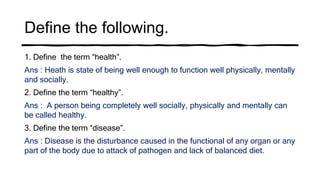
1. Define the term “health”.
Ans : Heath is state of being well enough to function well physically, mentally
and socially.
2. Define the term “healthy”.
Ans : A person being completely well socially, physically and mentally can
be called healthy.
3. Define the term “disease”.
Ans : Disease is the disturbance caused in the functional of any organ or any
part of the body due to attack of pathogen and lack of balanced diet.
Answer the following briefly.
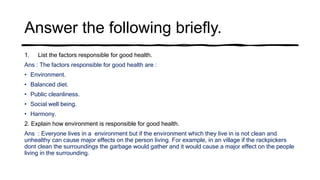
1. List the factors responsible for good health.
Ans : The factors responsible for good health are :
• Environment.
• Balanced diet.
• Public cleanliness.
• Social well being.
• Harmony.
2. Explain how environment is responsible for good health.
Ans : Everyone lives in a environment but if the environment which they live in is not clean and
unhealthy can cause major effects on the person living. For example, in an village if the rackpickers
dont clean the surroundings the garbage would gather and it would cause a major effect on the people
living in the surrounding.
Differentiate.
1. Write the difference
between acute and
chronic disease.
Ans
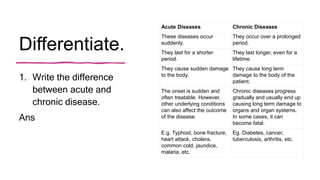
Acute Diseases Chronic Diseases
These diseases occur
suddenly.
They occur over a prolonged
period.
They last for a shorter
period.
They last longer, even for a
lifetime.
They cause sudden damage
to the body.
They cause long term
damage to the body of the
patient.
The onset is sudden and
often treatable. However,
other underlying conditions
can also affect the outcome
of the disease.
Chronic diseases progress
gradually and usually end up
causing long term damage to
organs and organ systems.
In some cases, it can
become fatal.
E.g. Typhoid, bone fracture,
heart attack, cholera,
common cold, jaundice,
malaria, etc.
Eg. Diabetes, cancer,
tuberculosis, arthritis, etc.
2. Differentiate between
infectious(communicable)
and noninfectious ( non –
communicable ) diseases.
Ans :
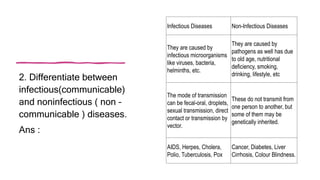
Infectious Diseases Non-Infectious Diseases
They are caused by
infectious microorganisms
like viruses, bacteria,
helminths, etc.
They are caused by
pathogens as well has due
to old age, nutritional
deficiency, smoking,
drinking, lifestyle, etc
The mode of transmission
can be fecal-oral, droplets,
sexual transmission, direct
contact or transmission by
vector.
These do not transmit from
one person to another, but
some of them may be
genetically inherited.
AIDS, Herpes, Cholera,
Polio, Tuberculosis, Pox
Cancer, Diabetes, Liver
Cirrhosis, Colour Blindness.
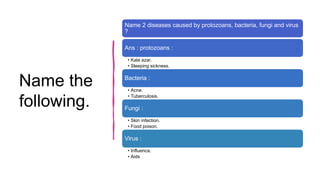
Name the
following.
Name 2 diseases caused by protozoans, bacteria, fungi and virus
?
Ans : protozoans :
• Kala azar.
• Sleeping sickness.
Bacteria :
• Acne.
• Tuberculosis.
Fungi :
• Skin infection.
• Food poison.
Virus :
• Influenca.
• Aids
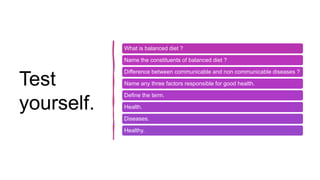
Test
yourself.
What is balanced diet ?
Name the constituents of balanced diet ?
Difference between communicable and non communicable diseases ?
Name any three factors responsible for good health.
Define the term.
Health.
Diseases.
Healthy.

Science revision for class 9 why do well fall ill. ch 13

  • 1.
  • 2.
    Define the following. 1.Define the term “health”. Ans : Heath is state of being well enough to function well physically, mentally and socially. 2. Define the term “healthy”. Ans : A person being completely well socially, physically and mentally can be called healthy. 3. Define the term “disease”. Ans : Disease is the disturbance caused in the functional of any organ or any part of the body due to attack of pathogen and lack of balanced diet.
  • 3.
    Answer the followingbriefly. 1. List the factors responsible for good health. Ans : The factors responsible for good health are : • Environment. • Balanced diet. • Public cleanliness. • Social well being. • Harmony. 2. Explain how environment is responsible for good health. Ans : Everyone lives in a environment but if the environment which they live in is not clean and unhealthy can cause major effects on the person living. For example, in an village if the rackpickers dont clean the surroundings the garbage would gather and it would cause a major effect on the people living in the surrounding.
  • 4.
    Differentiate. 1. Write thedifference between acute and chronic disease. Ans Acute Diseases Chronic Diseases These diseases occur suddenly. They occur over a prolonged period. They last for a shorter period. They last longer, even for a lifetime. They cause sudden damage to the body. They cause long term damage to the body of the patient. The onset is sudden and often treatable. However, other underlying conditions can also affect the outcome of the disease. Chronic diseases progress gradually and usually end up causing long term damage to organs and organ systems. In some cases, it can become fatal. E.g. Typhoid, bone fracture, heart attack, cholera, common cold, jaundice, malaria, etc. Eg. Diabetes, cancer, tuberculosis, arthritis, etc.
  • 5.
    2. Differentiate between infectious(communicable) andnoninfectious ( non – communicable ) diseases. Ans : Infectious Diseases Non-Infectious Diseases They are caused by infectious microorganisms like viruses, bacteria, helminths, etc. They are caused by pathogens as well has due to old age, nutritional deficiency, smoking, drinking, lifestyle, etc The mode of transmission can be fecal-oral, droplets, sexual transmission, direct contact or transmission by vector. These do not transmit from one person to another, but some of them may be genetically inherited. AIDS, Herpes, Cholera, Polio, Tuberculosis, Pox Cancer, Diabetes, Liver Cirrhosis, Colour Blindness.
  • 6.
    Name the following. Name 2diseases caused by protozoans, bacteria, fungi and virus ? Ans : protozoans : • Kala azar. • Sleeping sickness. Bacteria : • Acne. • Tuberculosis. Fungi : • Skin infection. • Food poison. Virus : • Influenca. • Aids
  • 7.
    Test yourself. What is balanceddiet ? Name the constituents of balanced diet ? Difference between communicable and non communicable diseases ? Name any three factors responsible for good health. Define the term. Health. Diseases. Healthy.