SCIENCE EDUCATION IN
THE PHILIPPINES
Ma. Nicole Cassandra Bolanio
Instructor I
mncbolanio@mmsu.edu.ph
LESSON OBJECTIVES
At the end of this lesson, the students should be able to:
• Discuss the concept of science education; and
• Identify science schools established to promote science
education in the Philippines.
The Concept of Science Education
Science education focuses on teaching, learning, and
understanding science.
• Teaching science involves exploring pedagogical theories and
models in helping teachers teach scientific concepts and processes effectively.
• Learning science includes both pedagogy and the most interesting
aspect, which is helping students understand and love science.
• Understanding science implies developing and applying science-
process skills and using science literacy in understanding the natural world
and activities in everyday life.
Science Education in Basic and Tertiary Education
• In basic education, science education helps students learn
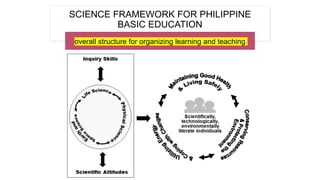
important concepts and facts that are related to everyday life including
important skills such as process skills, critical thinking skills, and life skills.
• In tertiary education, science education deals with developing
students’ understanding and appreciation of science ideas and
scientific works. It also focuses on the preparation of science teachers,
scientists, engineers, and other professionals in various science-related fields.
Science Schools in the Philippines
Philippine Science High School System (PSHSS)
• A government program for gifted students in the Philippines
• A service institute of the Department of Science and Technology (DOST)
• Offers free scholarship basis for secondary course with special
emphasis on subjects pertaining to the sciences
Science Schools in the Philippines
Special Science Elementary Schools (SSES) Project
• started in June 2007 with 57 (or 60 since its inception) identified
elementary schools that participated or were identified as science
elementary schools in the country.
• aims to develop Filipino children equipped with scientific and
technological knowledge, skills, and values. Its mission is to:
• provide a learning environment to science-inclined children through a special
curriculum that recognizes the multiple intelligences of the learners;
• promote the development of lifelong learning skills; and
• foster the holistic development of the learners.
Science Schools in the Philippines
Quezon City Regional Science High School
• The school envisions to serve as a venue in providing maximum
opportunities for science-gifted students to develop spirit of inquiry and
creativity.
• The focus of its curriculum is on science and technology.
• It is well-supported by the local government unit and by the Parents
and Teachers Association (PTA).
Science Schools in the Philippines
Manila Science High School
• It is the first science high school in the Philippines.
• It aims to produce scientists with souls.
• The organization and curriculum of the school puts more emphasis on science
and mathematics.
• The school administers an entrance exam, the Manila Science High School
Admission Test (MSAT), for students who wish to enroll.
• MSAT has five parts: aptitude in science, aptitude test in mathematics,
problem-solving test in science, problem solving test in mathematics, and
proficiency in English.
Science Schools in the Philippines
Central Visayan Institute Foundation
• It is the home and pioneer of the prominent school-based innovation
known as the Dynamic Learning Program (DLP).
• DLP is a synthesis of classical and modern pedagogical theories
adapted to foster the highest level of learning, creativity, and
productivity.
• The school takes pride in its Research Center for Theoretical Physics
(RCTP).
SCIENCE CURRICULUM FRAMEWORK
FOR BASIC EDUCATION
Science is important to everyone. School science education
should support the development of scientific literacy in all
students as well as motivate them to pursue careers in
science, technology, and engineering
• These statements were drawn from a series of consultation meetings and focus group
discussions with different sectors of society held in 2006: industry, university, scientists,
parents, teachers, school administrators, community leaders, media, students, and many
others.
Importance of the School Science Education
• Its links to technology and industry, which, from a national perspective, are
areas of high priority for development.
• Science provides ways of making sense of the world systematically.
• It develops students’ scientific inquiry skills, values and attitudes, such as
objectivity, curiosity, and honesty and habits of mind including critical thinking.
• All these are useful to the individual student for his own personal development, future
career, and life in general. These skills, values, attitudes, and dispositions are likewise
useful to the community that an individual student belongs to, and are further useful to
the country that he lives in.
• For the nation’s cultural development and preservation of its cultural identity.
• Science is most useful to a nation when it is utilized to solve its own problems and
challenges, keeping a nation's cultural uniqueness and peculiarities intact. Thus, in
many countries, science teaching and learning is linked with culture.
Challenges in Science Education:
Philippines Context
• Poor performance of Filipino students in international
assessment studies and national assessment studies
• Low retention of concepts, have limited reasoning and analytical
skills, and poor communication skills (UP NISMED, 2004).
• Cannot apply concepts to real-life problem solving situations nor
design an investigation to solve a problem (UP NISMED, 2005).
Challenges in Science Education:
Philippines Context
• Factors behind the low performance in science of Filipino
students
• quality of teachers, the teaching-learning process, the school
curriculum, instructional materials, and administrative support
(DOST-SEI, 2006)
The Guiding Principles of Science Curriculum
Framework
1. Science is for everyone.
• It recognizes the proactive relationship between science and society. This
means putting science into the service of individuals and society.
• Science education should aim for scientific literacy that is operational in
understanding oneself, common human welfare, social, and civic affairs.
• Science should permeate all levels of society. Whether or not students
pursue a university education, they should leave school with a level of
understanding and scientific literacy that will prepare them to be informed
and participative citizens who are able to make judgments and decisions
regarding science applications that may have social, health, or
environmental impacts.
The Guiding Principles of Science Curriculum
Framework
2. Science is both content and process.
• Science content and science process are intertwined. The value of
science processes is to advance content or the body of knowledge.
Without content, students will have difficulty utilizing the science
process skills. Science processes cannot exist in a vacuum. They
are learned in context.
The Guiding Principles of Science Curriculum
Framework
3. School science should emphasize depth rather breadth,
coherence rather than fragmentation, and use of evidence
in constructing explanation.
The Guiding Principles of Science Curriculum
Framework
4. School science should be relevant and useful.
• To be relevant and useful, the teaching of science should be
organized around situations, problems or projects that engage the
students both as an individual and a member of a team.
The Guiding Principles of Science Curriculum
Framework
5. School science should nurture interest in learning.
• Students are generally interested in problems that puzzle them.
They have a natural urge to find solutions. Organizing the curriculum
around problems or phenomena that puzzle students helps motivate
them to learn.
• Rather than relying solely on textbooks, teachers are encouraged to
use hands-on learning activities to develop students’ interest and let
them become active learners.
The Guiding Principles of Science Curriculum
Framework
6. School science should demonstrate a commitment to the
development of a culture of science.
• A culture of science is characterized by excellence, integrity, hard
work, and discipline.
The Guiding Principles of Science Curriculum
Framework
7. School science should promote the strong link between
science and technology, including indigenous technology.
The Guiding Principles of Science Curriculum
Framework
8. School science should recognize that science and
technology reflect, influence, and shape our culture.
• The science curriculum should recognize the place of science and
technology in everyday human affairs. It should integrate science
and technology in the civic, personal, social, economic, and the
values and ethical aspects of life
SCIENCE FRAMEWORK FOR PHILIPPINE
BASIC EDUCATION
overall structure for organizing learning and teaching
SCIENCE FRAMEWORK FOR PHILIPPINE
BASIC EDUCATION
This Framework
is organized
around three
interlocking
components
namely: (1)
inquiry skills, (2)
scientific
attitudes, and (3)
content and
connections.
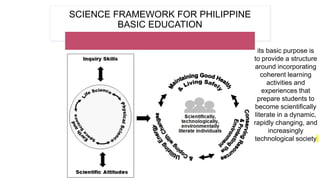
SCIENCE FRAMEWORK FOR PHILIPPINE
BASIC EDUCATION
its basic purpose is
to provide a structure
around incorporating
coherent learning
activities and
experiences that
prepare students to
become scientifically
literate in a dynamic,
rapidly changing, and
increasingly
technological society
SCIENCE FRAMEWORK FOR PHILIPPINE
BASIC EDUCATION
The Core Content:
• describes the major science
concepts that all students are
expected to learn to become
scientifically literate as well as
the competencies that indicate
what students should be able to
do and demonstrate at the end
of Grade 2, Grade 4, Grade 6,
Grade 8 and Grade 10
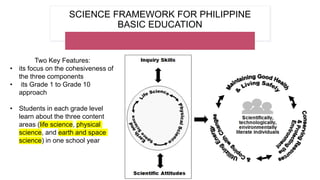
SCIENCE FRAMEWORK FOR PHILIPPINE
BASIC EDUCATION
Two Key Features:
• its focus on the cohesiveness of
the three components
• its Grade 1 to Grade 10
approach
• Students in each grade level
learn about the three content
areas (life science, physical
science, and earth and space
science) in one school year
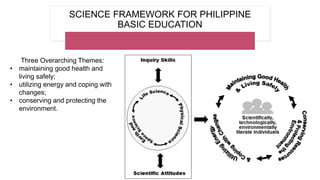
SCIENCE FRAMEWORK FOR PHILIPPINE
BASIC EDUCATION
Three Overarching Themes:
• maintaining good health and
living safely;
• utilizing energy and coping with
changes;
• conserving and protecting the
environment.

SCIENCE-EDUCATION-IN-THE-PHILIPPINES.pdf

  • 1.
    SCIENCE EDUCATION IN THEPHILIPPINES Ma. Nicole Cassandra Bolanio Instructor I mncbolanio@mmsu.edu.ph
  • 2.
    LESSON OBJECTIVES At theend of this lesson, the students should be able to: • Discuss the concept of science education; and • Identify science schools established to promote science education in the Philippines.
  • 3.
    The Concept ofScience Education Science education focuses on teaching, learning, and understanding science. • Teaching science involves exploring pedagogical theories and models in helping teachers teach scientific concepts and processes effectively. • Learning science includes both pedagogy and the most interesting aspect, which is helping students understand and love science. • Understanding science implies developing and applying science- process skills and using science literacy in understanding the natural world and activities in everyday life.
  • 4.
    Science Education inBasic and Tertiary Education • In basic education, science education helps students learn important concepts and facts that are related to everyday life including important skills such as process skills, critical thinking skills, and life skills. • In tertiary education, science education deals with developing students’ understanding and appreciation of science ideas and scientific works. It also focuses on the preparation of science teachers, scientists, engineers, and other professionals in various science-related fields.
  • 5.
    Science Schools inthe Philippines Philippine Science High School System (PSHSS) • A government program for gifted students in the Philippines • A service institute of the Department of Science and Technology (DOST) • Offers free scholarship basis for secondary course with special emphasis on subjects pertaining to the sciences
  • 6.
    Science Schools inthe Philippines Special Science Elementary Schools (SSES) Project • started in June 2007 with 57 (or 60 since its inception) identified elementary schools that participated or were identified as science elementary schools in the country. • aims to develop Filipino children equipped with scientific and technological knowledge, skills, and values. Its mission is to: • provide a learning environment to science-inclined children through a special curriculum that recognizes the multiple intelligences of the learners; • promote the development of lifelong learning skills; and • foster the holistic development of the learners.
  • 7.
    Science Schools inthe Philippines Quezon City Regional Science High School • The school envisions to serve as a venue in providing maximum opportunities for science-gifted students to develop spirit of inquiry and creativity. • The focus of its curriculum is on science and technology. • It is well-supported by the local government unit and by the Parents and Teachers Association (PTA).
  • 8.
    Science Schools inthe Philippines Manila Science High School • It is the first science high school in the Philippines. • It aims to produce scientists with souls. • The organization and curriculum of the school puts more emphasis on science and mathematics. • The school administers an entrance exam, the Manila Science High School Admission Test (MSAT), for students who wish to enroll. • MSAT has five parts: aptitude in science, aptitude test in mathematics, problem-solving test in science, problem solving test in mathematics, and proficiency in English.
  • 9.
    Science Schools inthe Philippines Central Visayan Institute Foundation • It is the home and pioneer of the prominent school-based innovation known as the Dynamic Learning Program (DLP). • DLP is a synthesis of classical and modern pedagogical theories adapted to foster the highest level of learning, creativity, and productivity. • The school takes pride in its Research Center for Theoretical Physics (RCTP).
  • 10.
    SCIENCE CURRICULUM FRAMEWORK FORBASIC EDUCATION Science is important to everyone. School science education should support the development of scientific literacy in all students as well as motivate them to pursue careers in science, technology, and engineering • These statements were drawn from a series of consultation meetings and focus group discussions with different sectors of society held in 2006: industry, university, scientists, parents, teachers, school administrators, community leaders, media, students, and many others.
  • 11.
    Importance of theSchool Science Education • Its links to technology and industry, which, from a national perspective, are areas of high priority for development. • Science provides ways of making sense of the world systematically. • It develops students’ scientific inquiry skills, values and attitudes, such as objectivity, curiosity, and honesty and habits of mind including critical thinking. • All these are useful to the individual student for his own personal development, future career, and life in general. These skills, values, attitudes, and dispositions are likewise useful to the community that an individual student belongs to, and are further useful to the country that he lives in. • For the nation’s cultural development and preservation of its cultural identity. • Science is most useful to a nation when it is utilized to solve its own problems and challenges, keeping a nation's cultural uniqueness and peculiarities intact. Thus, in many countries, science teaching and learning is linked with culture.
  • 12.
    Challenges in ScienceEducation: Philippines Context • Poor performance of Filipino students in international assessment studies and national assessment studies • Low retention of concepts, have limited reasoning and analytical skills, and poor communication skills (UP NISMED, 2004). • Cannot apply concepts to real-life problem solving situations nor design an investigation to solve a problem (UP NISMED, 2005).
  • 13.
    Challenges in ScienceEducation: Philippines Context • Factors behind the low performance in science of Filipino students • quality of teachers, the teaching-learning process, the school curriculum, instructional materials, and administrative support (DOST-SEI, 2006)
  • 14.
    The Guiding Principlesof Science Curriculum Framework 1. Science is for everyone. • It recognizes the proactive relationship between science and society. This means putting science into the service of individuals and society. • Science education should aim for scientific literacy that is operational in understanding oneself, common human welfare, social, and civic affairs. • Science should permeate all levels of society. Whether or not students pursue a university education, they should leave school with a level of understanding and scientific literacy that will prepare them to be informed and participative citizens who are able to make judgments and decisions regarding science applications that may have social, health, or environmental impacts.
  • 15.
    The Guiding Principlesof Science Curriculum Framework 2. Science is both content and process. • Science content and science process are intertwined. The value of science processes is to advance content or the body of knowledge. Without content, students will have difficulty utilizing the science process skills. Science processes cannot exist in a vacuum. They are learned in context.
  • 16.
    The Guiding Principlesof Science Curriculum Framework 3. School science should emphasize depth rather breadth, coherence rather than fragmentation, and use of evidence in constructing explanation.
  • 17.
    The Guiding Principlesof Science Curriculum Framework 4. School science should be relevant and useful. • To be relevant and useful, the teaching of science should be organized around situations, problems or projects that engage the students both as an individual and a member of a team.
  • 18.
    The Guiding Principlesof Science Curriculum Framework 5. School science should nurture interest in learning. • Students are generally interested in problems that puzzle them. They have a natural urge to find solutions. Organizing the curriculum around problems or phenomena that puzzle students helps motivate them to learn. • Rather than relying solely on textbooks, teachers are encouraged to use hands-on learning activities to develop students’ interest and let them become active learners.
  • 19.
    The Guiding Principlesof Science Curriculum Framework 6. School science should demonstrate a commitment to the development of a culture of science. • A culture of science is characterized by excellence, integrity, hard work, and discipline.
  • 20.
    The Guiding Principlesof Science Curriculum Framework 7. School science should promote the strong link between science and technology, including indigenous technology.
  • 21.
    The Guiding Principlesof Science Curriculum Framework 8. School science should recognize that science and technology reflect, influence, and shape our culture. • The science curriculum should recognize the place of science and technology in everyday human affairs. It should integrate science and technology in the civic, personal, social, economic, and the values and ethical aspects of life
  • 22.
    SCIENCE FRAMEWORK FORPHILIPPINE BASIC EDUCATION overall structure for organizing learning and teaching
  • 23.
    SCIENCE FRAMEWORK FORPHILIPPINE BASIC EDUCATION This Framework is organized around three interlocking components namely: (1) inquiry skills, (2) scientific attitudes, and (3) content and connections.
  • 24.
    SCIENCE FRAMEWORK FORPHILIPPINE BASIC EDUCATION its basic purpose is to provide a structure around incorporating coherent learning activities and experiences that prepare students to become scientifically literate in a dynamic, rapidly changing, and increasingly technological society
  • 25.
    SCIENCE FRAMEWORK FORPHILIPPINE BASIC EDUCATION The Core Content: • describes the major science concepts that all students are expected to learn to become scientifically literate as well as the competencies that indicate what students should be able to do and demonstrate at the end of Grade 2, Grade 4, Grade 6, Grade 8 and Grade 10
  • 26.
    SCIENCE FRAMEWORK FORPHILIPPINE BASIC EDUCATION Two Key Features: • its focus on the cohesiveness of the three components • its Grade 1 to Grade 10 approach • Students in each grade level learn about the three content areas (life science, physical science, and earth and space science) in one school year
  • 27.
    SCIENCE FRAMEWORK FORPHILIPPINE BASIC EDUCATION Three Overarching Themes: • maintaining good health and living safely; • utilizing energy and coping with changes; • conserving and protecting the environment.