Science,
Technology,
and
Nation
Building
What is Science and
Technology in Nation
Building?
Science and Technology hold the key
to the progress and development of
any nation.
Technology plays a fundamental role
in wealth creation, improvement of
the quality of life, real economic
growth and transformation in society.
How does “Science
and Technology”
contributes in Nation
Building?
Science and technology have played a crucial role in
the development of the Philippines as a nation.
Throughout its history, the Philippines has been
influenced by different cultures and colonial powers,
each leaving its mark on the country's scientific and
technological development.
HISTORY
Before the colonization by the Spaniards in the Philippine
islands, the natives of the archipelago already had
practices linked to science and technology. Filipinos
were already aware of the medicinal and therapeutic
properties of plants and the methods of extracting
medicine from herbs. The Banaue Rice Terraces are
among the sophisticated products of engineering by pre-
Spanish era Filipinos.
• Pre-Spanish Period
The colonization of the Philippines contributed to growth of
science and technology in the archipelago. The Spanish
introduced formal education and founded scientific institution.
During the early years of Spanish rule in the Philippines.
2. Spanish Colonial Period
3. American Colonial Period
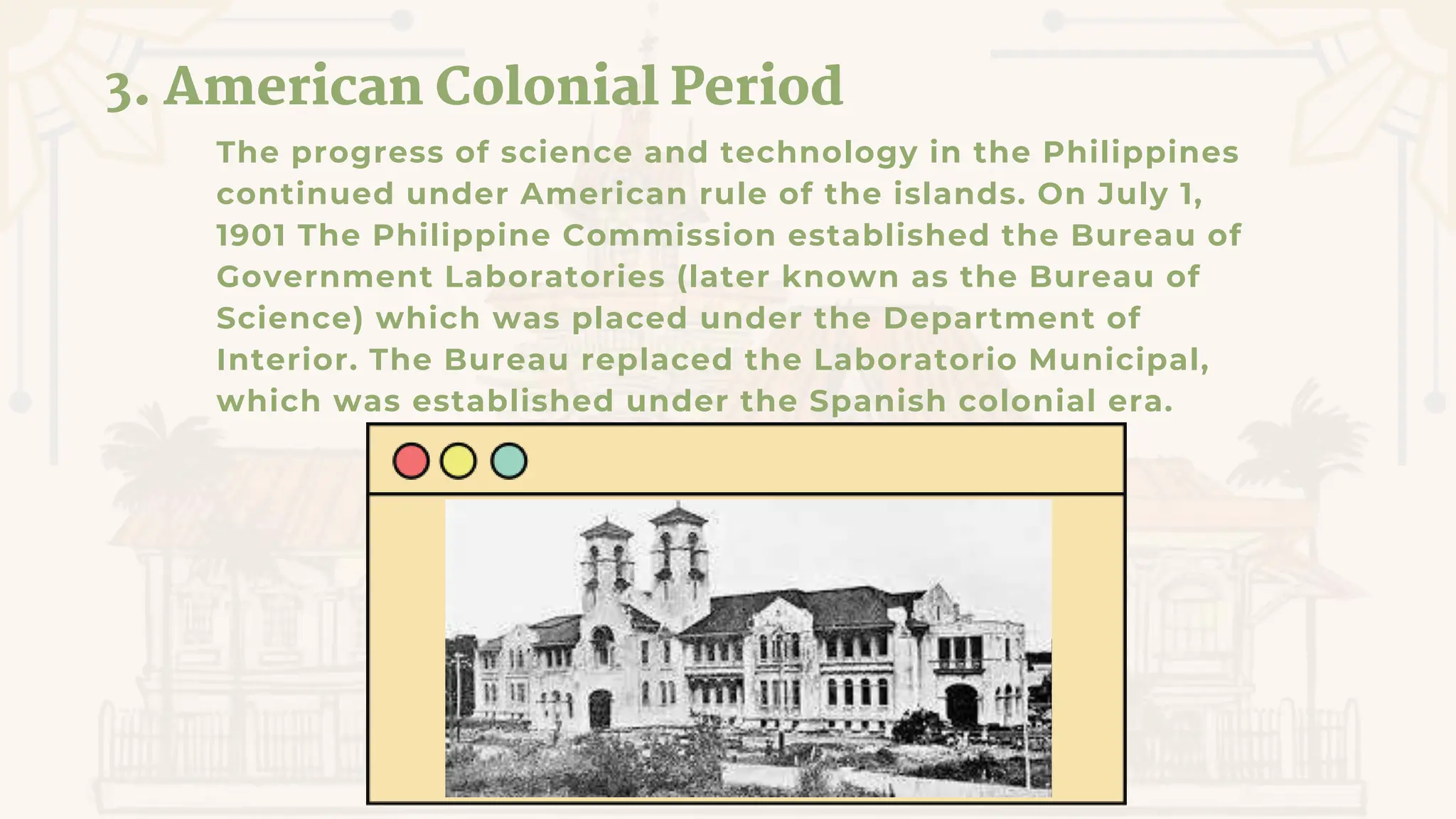
The progress of science and technology in the Philippines
continued under American rule of the islands. On July 1,
1901 The Philippine Commission established the Bureau of
Government Laboratories (later known as the Bureau of
Science) which was placed under the Department of
Interior. The Bureau replaced the Laboratorio Municipal,
which was established under the Spanish colonial era.
The Philippine
Government Science and
Technology Agenda
(a.)
The Harmonized National Research and
Development Agenda (HNRDA) 2017-2022 was
prepared by the Department of Science and
Technology (DOST), in collaboration with the
government and other concerned private
agencies.
The HNRDA (2017-2020)
AmBisyon Natin 2040: matatag, maginhawa
at panatag na buhay para sa lahat, which has
three pillars: Malasakit (enhancing the social
fabric), Pagbabago (reducing inequality), and
Kaunlaran (increasing potential growth)
AmBisyon Natin 2040
To express support In the Philippine
Development Plan, National Security Plan, and
the Science for Change Program led by DOST,
the National Integrated Basic Research Agenda
(NIBRA) focus on basic principles of research. It
has six programs, namely:
• National Integrated Basic
Research Agenda
A. Water Security– TUBIG Program(Tubig ay Buhayin at
Ingatan)
B. Food and Nutrition Security– SAPAT Program (Saganang
Pagkain Para sa Lahat)
C. Health Sufficiency– LIKAS Program(Likas Yaman sa
Kalusugan)
D. Clean Energy– ALERT Program(Alternative Energy Research
Trends)
E. Sustainable Community– SAKLAW Program (Saklolo sa
Lawa)
F. Inclusive Nation-Building– ATIN Program(Ang Tinig Natin)
• National Integrated Basic
Research Agenda
The collaborating agencies for health research
and development agenda in the Philippine
Council for Health Research and Development
(PCHRD) under the DOST and the National
Unified Health Research Agenda (NUHRA).
2. Health Research and
Development Agenda
The research priorities for agriculture, aquatic
and natural resources include crops, livestock,
aquaculture, forestry, natural resources and
environment, technology transfer, socio
economics, and policy research.
3. Agriculture Aquatic and
Natural Resources
The Philippine Council for Industry, Energy, and
Emerging Technology Research and
Development (PCIEERTD) is responsible for the
implementation of research priorities of this
agenda.
4. Industry, Energy, and
Emerging Technology
The research priorities for this agenda were
evaluated and finalized by a group of people
from the Philippine Institute of Volcanology and
Seismotology (PHIVOLCS) and Philippine
Atmospheric, Geophysical and Astronomical
Services Administration (PAGASA).
5. Disaster Risk Reduction and
Climate Change Adaptation
• RA 10055 - known as the Philippine
Technology Transfer Act of 2009.
• RA 2067 - known as Science Act of 1958.
Government Policies
Science, Technology and Nation Building.pptx

Science, Technology and Nation Building.pptx

  • 1.
  • 2.
    What is Scienceand Technology in Nation Building? Science and Technology hold the key to the progress and development of any nation. Technology plays a fundamental role in wealth creation, improvement of the quality of life, real economic growth and transformation in society.
  • 3.
    How does “Science andTechnology” contributes in Nation Building? Science and technology have played a crucial role in the development of the Philippines as a nation. Throughout its history, the Philippines has been influenced by different cultures and colonial powers, each leaving its mark on the country's scientific and technological development.
  • 4.
  • 5.
    Before the colonizationby the Spaniards in the Philippine islands, the natives of the archipelago already had practices linked to science and technology. Filipinos were already aware of the medicinal and therapeutic properties of plants and the methods of extracting medicine from herbs. The Banaue Rice Terraces are among the sophisticated products of engineering by pre- Spanish era Filipinos. • Pre-Spanish Period
  • 6.
    The colonization ofthe Philippines contributed to growth of science and technology in the archipelago. The Spanish introduced formal education and founded scientific institution. During the early years of Spanish rule in the Philippines. 2. Spanish Colonial Period
  • 7.
    3. American ColonialPeriod The progress of science and technology in the Philippines continued under American rule of the islands. On July 1, 1901 The Philippine Commission established the Bureau of Government Laboratories (later known as the Bureau of Science) which was placed under the Department of Interior. The Bureau replaced the Laboratorio Municipal, which was established under the Spanish colonial era.
  • 8.
    The Philippine Government Scienceand Technology Agenda (a.)
  • 9.
    The Harmonized NationalResearch and Development Agenda (HNRDA) 2017-2022 was prepared by the Department of Science and Technology (DOST), in collaboration with the government and other concerned private agencies. The HNRDA (2017-2020)
  • 10.
    AmBisyon Natin 2040:matatag, maginhawa at panatag na buhay para sa lahat, which has three pillars: Malasakit (enhancing the social fabric), Pagbabago (reducing inequality), and Kaunlaran (increasing potential growth) AmBisyon Natin 2040
  • 12.
    To express supportIn the Philippine Development Plan, National Security Plan, and the Science for Change Program led by DOST, the National Integrated Basic Research Agenda (NIBRA) focus on basic principles of research. It has six programs, namely: • National Integrated Basic Research Agenda
  • 13.
    A. Water Security–TUBIG Program(Tubig ay Buhayin at Ingatan) B. Food and Nutrition Security– SAPAT Program (Saganang Pagkain Para sa Lahat) C. Health Sufficiency– LIKAS Program(Likas Yaman sa Kalusugan) D. Clean Energy– ALERT Program(Alternative Energy Research Trends) E. Sustainable Community– SAKLAW Program (Saklolo sa Lawa) F. Inclusive Nation-Building– ATIN Program(Ang Tinig Natin) • National Integrated Basic Research Agenda
  • 14.
    The collaborating agenciesfor health research and development agenda in the Philippine Council for Health Research and Development (PCHRD) under the DOST and the National Unified Health Research Agenda (NUHRA). 2. Health Research and Development Agenda
  • 15.
    The research prioritiesfor agriculture, aquatic and natural resources include crops, livestock, aquaculture, forestry, natural resources and environment, technology transfer, socio economics, and policy research. 3. Agriculture Aquatic and Natural Resources
  • 16.
    The Philippine Councilfor Industry, Energy, and Emerging Technology Research and Development (PCIEERTD) is responsible for the implementation of research priorities of this agenda. 4. Industry, Energy, and Emerging Technology
  • 17.
    The research prioritiesfor this agenda were evaluated and finalized by a group of people from the Philippine Institute of Volcanology and Seismotology (PHIVOLCS) and Philippine Atmospheric, Geophysical and Astronomical Services Administration (PAGASA). 5. Disaster Risk Reduction and Climate Change Adaptation
  • 18.
    • RA 10055- known as the Philippine Technology Transfer Act of 2009. • RA 2067 - known as Science Act of 1958. Government Policies