PHILIPPINE SCIENCE
EDUCATION SYSTEM
Science education
•aims to develop scientific literacy among
learners that will prepare them to be informed
and participative citizens who are able to make
judgments and decisions regarding applications
of scientific knowledge that may have social,
health, or environmental impacts.
Science curriculum
• The science curriculum recognizes the place of science
and technology in everyday human affairs. It
integrates science and technology in the social,
economic, personal and ethical aspects of life. The
science curriculum promotes a strong link between
science and technology, including indigenous
technology, thus preserving our country’s cultural
heritage.
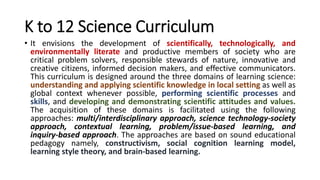
K to 12 Science Curriculum
• It envisions the development of scientifically, technologically, and
environmentally literate and productive members of society who are
critical problem solvers, responsible stewards of nature, innovative and
creative citizens, informed decision makers, and effective communicators.
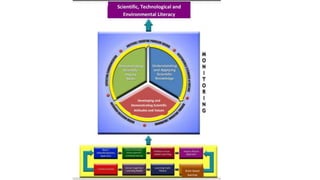
This curriculum is designed around the three domains of learning science:
understanding and applying scientific knowledge in local setting as well as
global context whenever possible, performing scientific processes and
skills, and developing and demonstrating scientific attitudes and values.
The acquisition of these domains is facilitated using the following
approaches: multi/interdisciplinary approach, science technology-society
approach, contextual learning, problem/issue-based learning, and
inquiry-based approach. The approaches are based on sound educational
pedagogy namely, constructivism, social cognition learning model,
learning style theory, and brain-based learning.
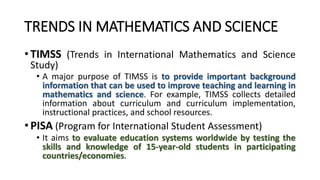
TRENDS IN MATHEMATICS AND SCIENCE
• TIMSS (Trends in International Mathematics and Science
Study)
• A major purpose of TIMSS is to provide important background
information that can be used to improve teaching and learning in
mathematics and science. For example, TIMSS collects detailed
information about curriculum and curriculum implementation,
instructional practices, and school resources.
• PISA (Program for International Student Assessment)
• It aims to evaluate education systems worldwide by testing the
skills and knowledge of 15-year-old students in participating
countries/economies.
1-Science-100.pptx
1-Science-100.pptx
1-Science-100.pptx
1-Science-100.pptx
1-Science-100.pptx
1-Science-100.pptx
1-Science-100.pptx
1-Science-100.pptx
1-Science-100.pptx
1-Science-100.pptx

1-Science-100.pptx

  • 1.
  • 2.
    Science education •aims todevelop scientific literacy among learners that will prepare them to be informed and participative citizens who are able to make judgments and decisions regarding applications of scientific knowledge that may have social, health, or environmental impacts.
  • 3.
    Science curriculum • Thescience curriculum recognizes the place of science and technology in everyday human affairs. It integrates science and technology in the social, economic, personal and ethical aspects of life. The science curriculum promotes a strong link between science and technology, including indigenous technology, thus preserving our country’s cultural heritage.
  • 4.
    K to 12Science Curriculum • It envisions the development of scientifically, technologically, and environmentally literate and productive members of society who are critical problem solvers, responsible stewards of nature, innovative and creative citizens, informed decision makers, and effective communicators. This curriculum is designed around the three domains of learning science: understanding and applying scientific knowledge in local setting as well as global context whenever possible, performing scientific processes and skills, and developing and demonstrating scientific attitudes and values. The acquisition of these domains is facilitated using the following approaches: multi/interdisciplinary approach, science technology-society approach, contextual learning, problem/issue-based learning, and inquiry-based approach. The approaches are based on sound educational pedagogy namely, constructivism, social cognition learning model, learning style theory, and brain-based learning.
  • 6.
    TRENDS IN MATHEMATICSAND SCIENCE • TIMSS (Trends in International Mathematics and Science Study) • A major purpose of TIMSS is to provide important background information that can be used to improve teaching and learning in mathematics and science. For example, TIMSS collects detailed information about curriculum and curriculum implementation, instructional practices, and school resources. • PISA (Program for International Student Assessment) • It aims to evaluate education systems worldwide by testing the skills and knowledge of 15-year-old students in participating countries/economies.