Science, Technology
and Society (STS)
Introduction
Science
is a system of knowledge of the natural world gained through the scientific method.
originally called “philosophy of the natural world” since it stemmed from the ancient Greeks’ desire to know about
nature.
Introduction
Philosophers as a Scientist
The first scientists were called “philosophers of nature.”
They sought to discover the truth behind material things and natural things.
They observed the world and beyond, and discovered what makes materials the same and what them different.
Introduction
Philosophers as a Scientist
They were able to name and classify the objects found in nature and was seen as the first step towards
knowledge.
They were able to recognized the usefulness of language and the ability it gave to describe, classify, and explain
the different objects of study.
Introduction
Technology
The term comes from Greek words “tekhne” meaning art or craft and “logia” meaning a subject or interest.
The term has come to mean “practical applications of what we know about nature” using scientific
principles for the betterment of the human situation .
Historical Antecedents in the Course
of Science & Technology
ANCIENT TIMES
 With all these in mind, we can conclude that the developments in science and technology, aside from affecting the
lives of the people, were the results of many prior antecedents.
 Out of necessity, people in ancient times were able to discover and invent things that would impact the lives of the
modern people.
Historical Antecedents in the Course
of Science & Technology
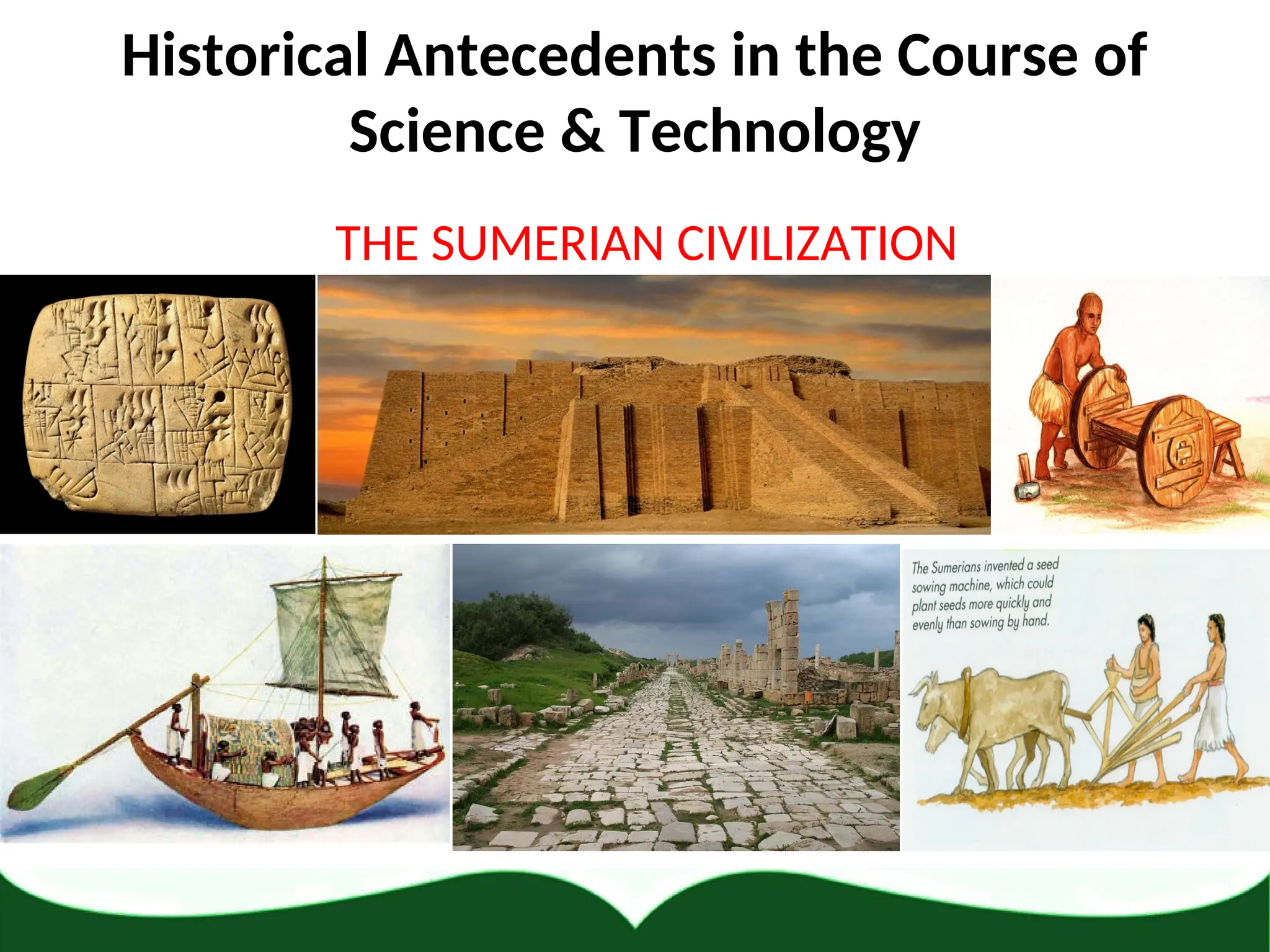
THE SUMERIAN CIVILIZATION
 Sumeria is located on the southernmost tip of ancient Mesopotamia.
 They are known for their high degree of cooperation with one another and their desire for great things.
 They are not contented with the basic things that life can offer.
 This desire pushed them to develop many things connected with science and technology.
Historical Antecedents in the Course of
Science & Technology
THE SUMERIAN CIVILIZATION
Historical Antecedents in the Course
of Science & Technology
THE SUMERIAN CIVILIZATION
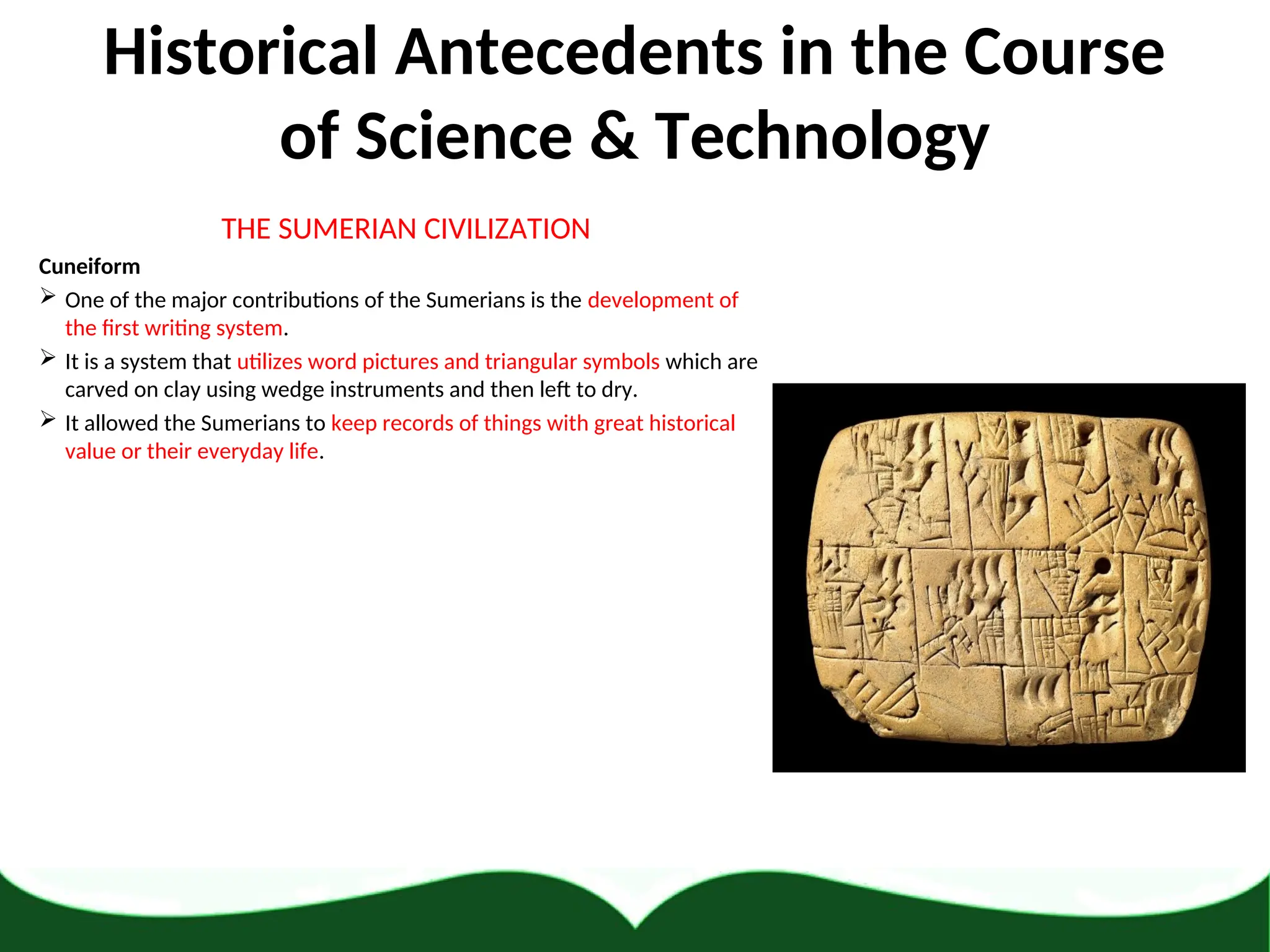
Cuneiform
 One of the major contributions of the Sumerians is the development of
the first writing system.
 It is a system that utilizes word pictures and triangular symbols which are
carved on clay using wedge instruments and then left to dry.
 It allowed the Sumerians to keep records of things with great historical
value or their everyday life.
Historical Antecedents in the Course of
Science & Technology
THE SUMERIAN CIVILIZATION
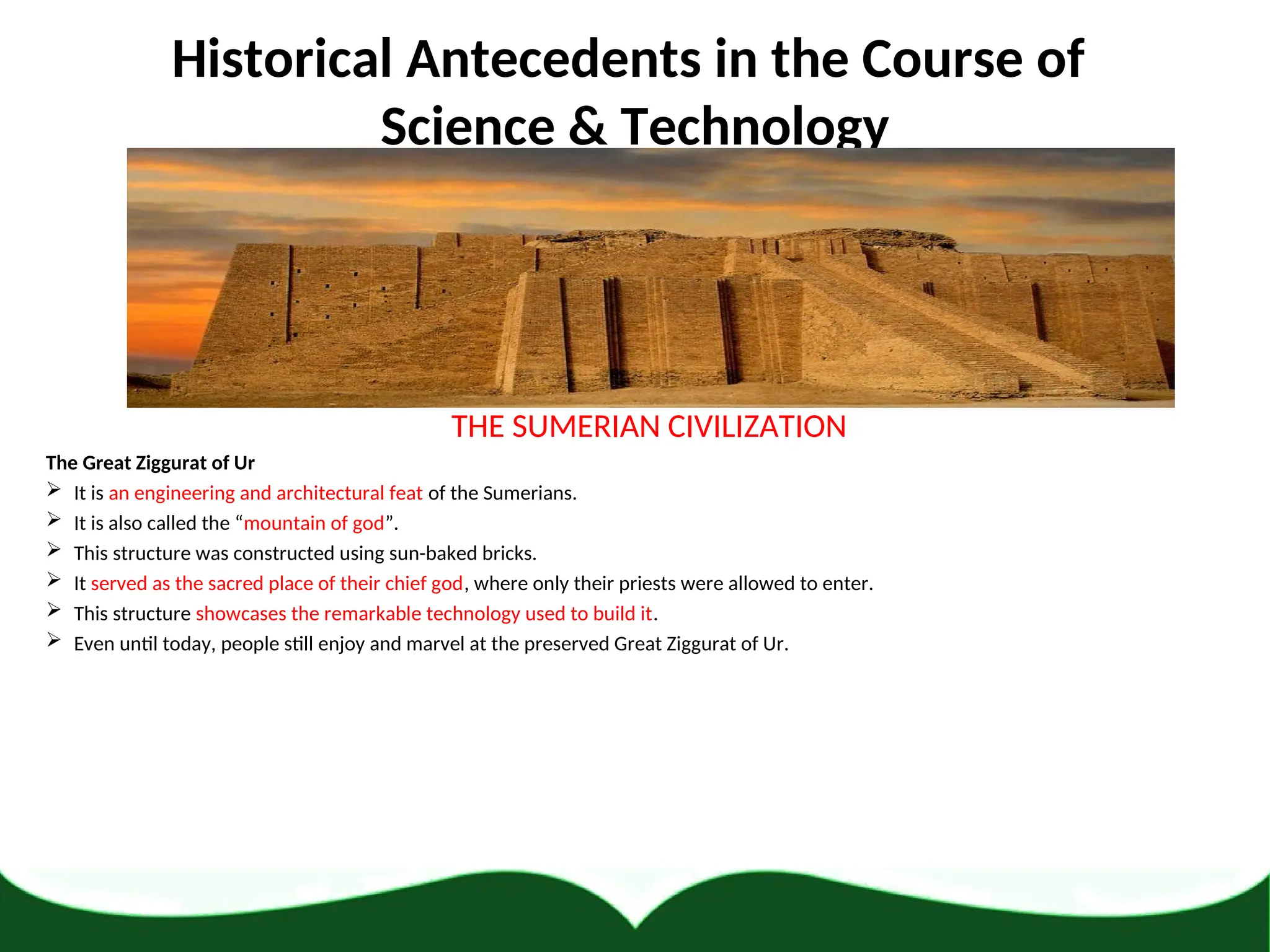
The Great Ziggurat of Ur
 It is an engineering and architectural feat of the Sumerians.
 It is also called the “mountain of god”.
 This structure was constructed using sun-baked bricks.
 It served as the sacred place of their chief god, where only their priests were allowed to enter.
 This structure showcases the remarkable technology used to build it.
 Even until today, people still enjoy and marvel at the preserved Great Ziggurat of Ur.
Historical Antecedents in the Course
of Science & Technology
THE SUMERIAN CIVILIZATION
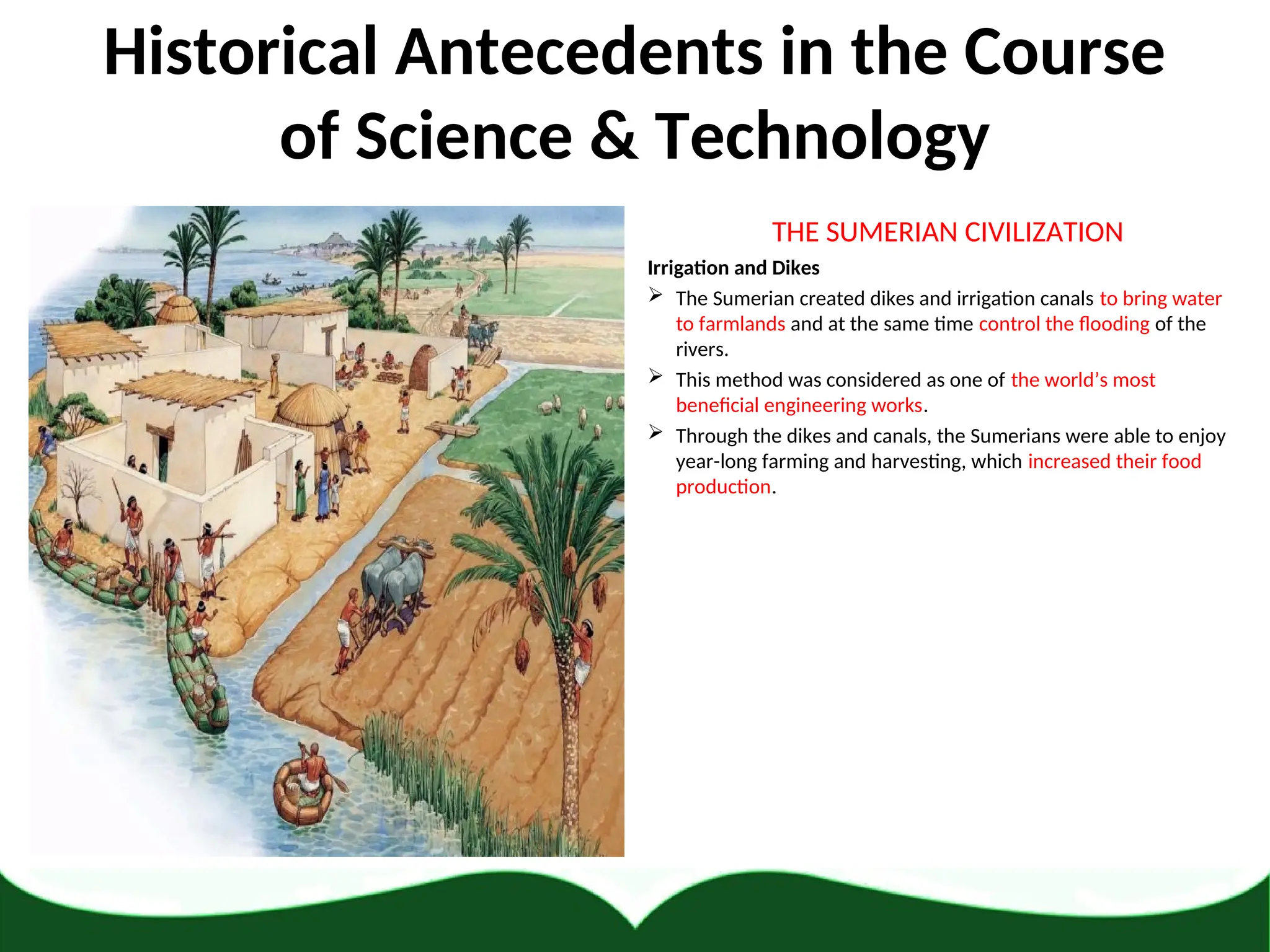
Irrigation and Dikes
 The Sumerian created dikes and irrigation canals to bring water
to farmlands and at the same time control the flooding of the
rivers.
 This method was considered as one of the world’s most
beneficial engineering works.
 Through the dikes and canals, the Sumerians were able to enjoy
year-long farming and harvesting, which increased their food
production.
Historical Antecedents in the Course
of Science & Technology
THE SUMERIAN CIVILIZATION
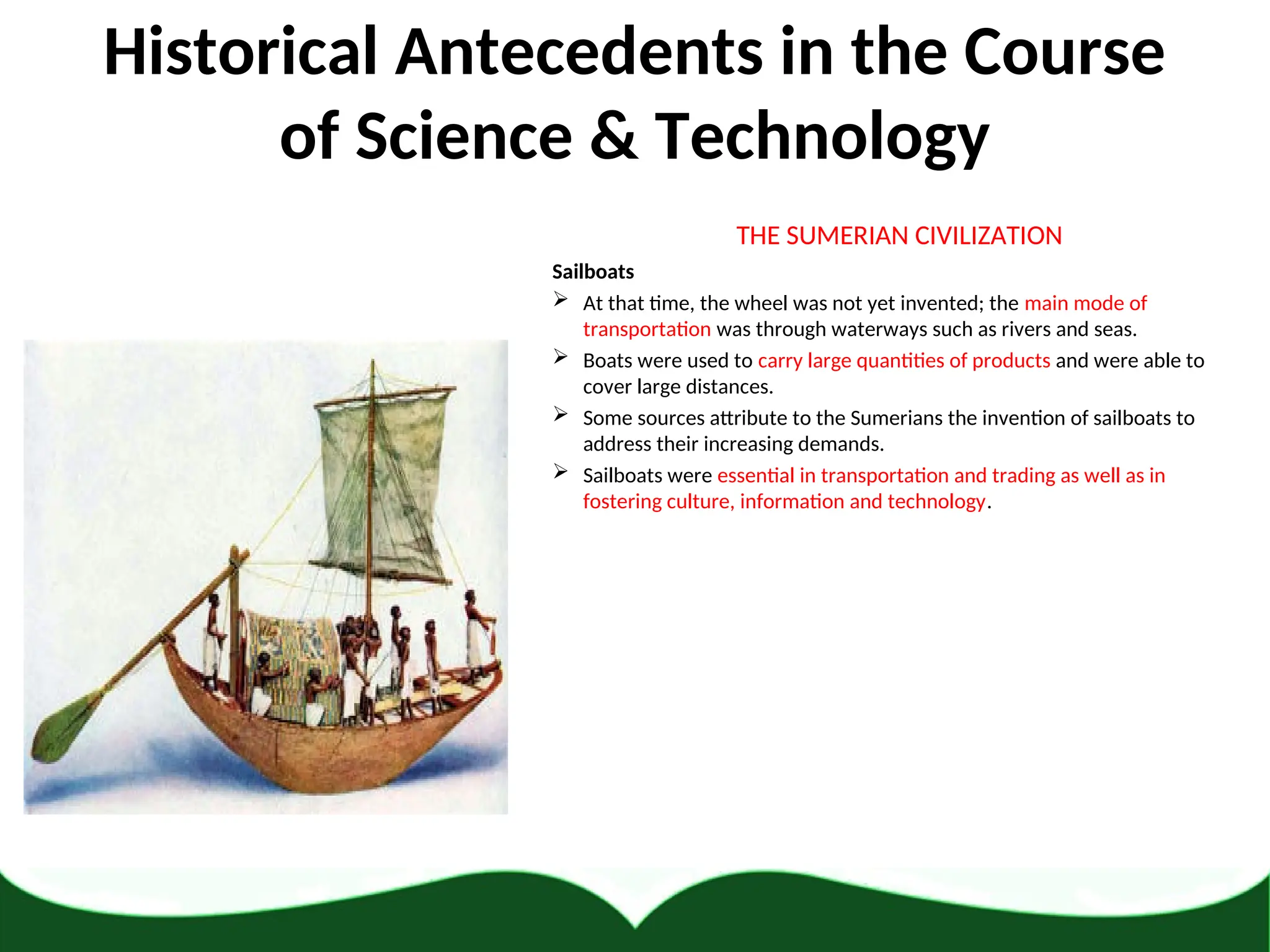
Sailboats
 At that time, the wheel was not yet invented; the main mode of
transportation was through waterways such as rivers and seas.
 Boats were used to carry large quantities of products and were able to
cover large distances.
 Some sources attribute to the Sumerians the invention of sailboats to
address their increasing demands.
 Sailboats were essential in transportation and trading as well as in
fostering culture, information and technology.
Historical Antecedents in the Course
of Science & Technology
THE SUMERIAN CIVILIZATION
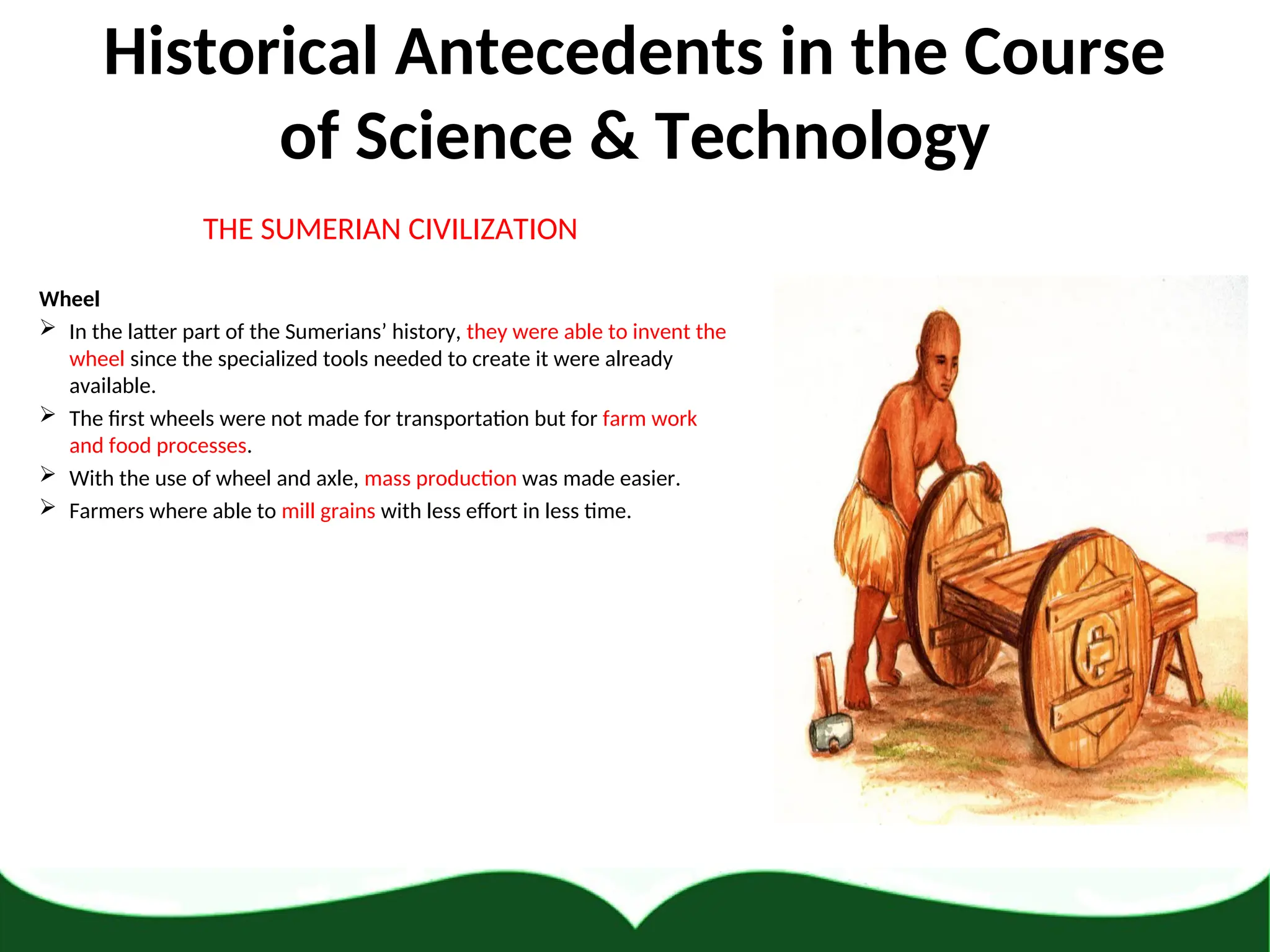
Wheel
 In the latter part of the Sumerians’ history, they were able to invent the
wheel since the specialized tools needed to create it were already
available.
 The first wheels were not made for transportation but for farm work
and food processes.
 With the use of wheel and axle, mass production was made easier.
 Farmers where able to mill grains with less effort in less time.
Historical Antecedents in the Course
of Science & Technology
THE SUMERIAN CIVILIZATION
The Plow
 Another farm technology invented by the
Mesopotamians is the plow. Humans evolved from
being food gatherers to farm cultivators.
 The plow was invented to dig the earth in a faster pace.
 With this tool, farmers could cultivate larger parcels of
land faster, enabling them to mass produce food
without taking so much effort and time.
Historical Antecedents in the Course
of Science & Technology
THE SUMERIAN CIVILIZATION
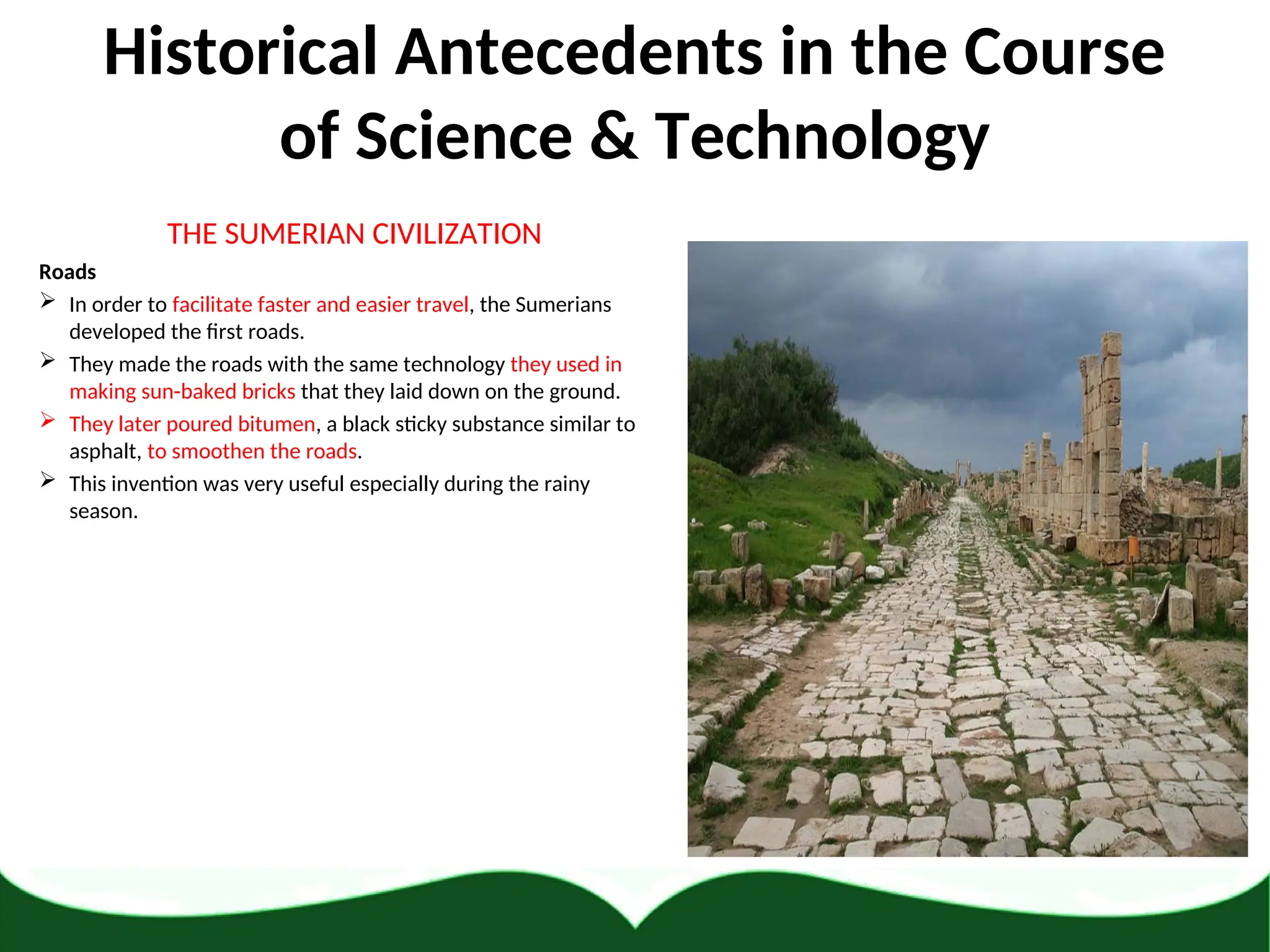
Roads
 In order to facilitate faster and easier travel, the Sumerians
developed the first roads.
 They made the roads with the same technology they used in
making sun-baked bricks that they laid down on the ground.
 They later poured bitumen, a black sticky substance similar to
asphalt, to smoothen the roads.
 This invention was very useful especially during the rainy
season.
Historical Antecedents in the Course of
Science & Technology
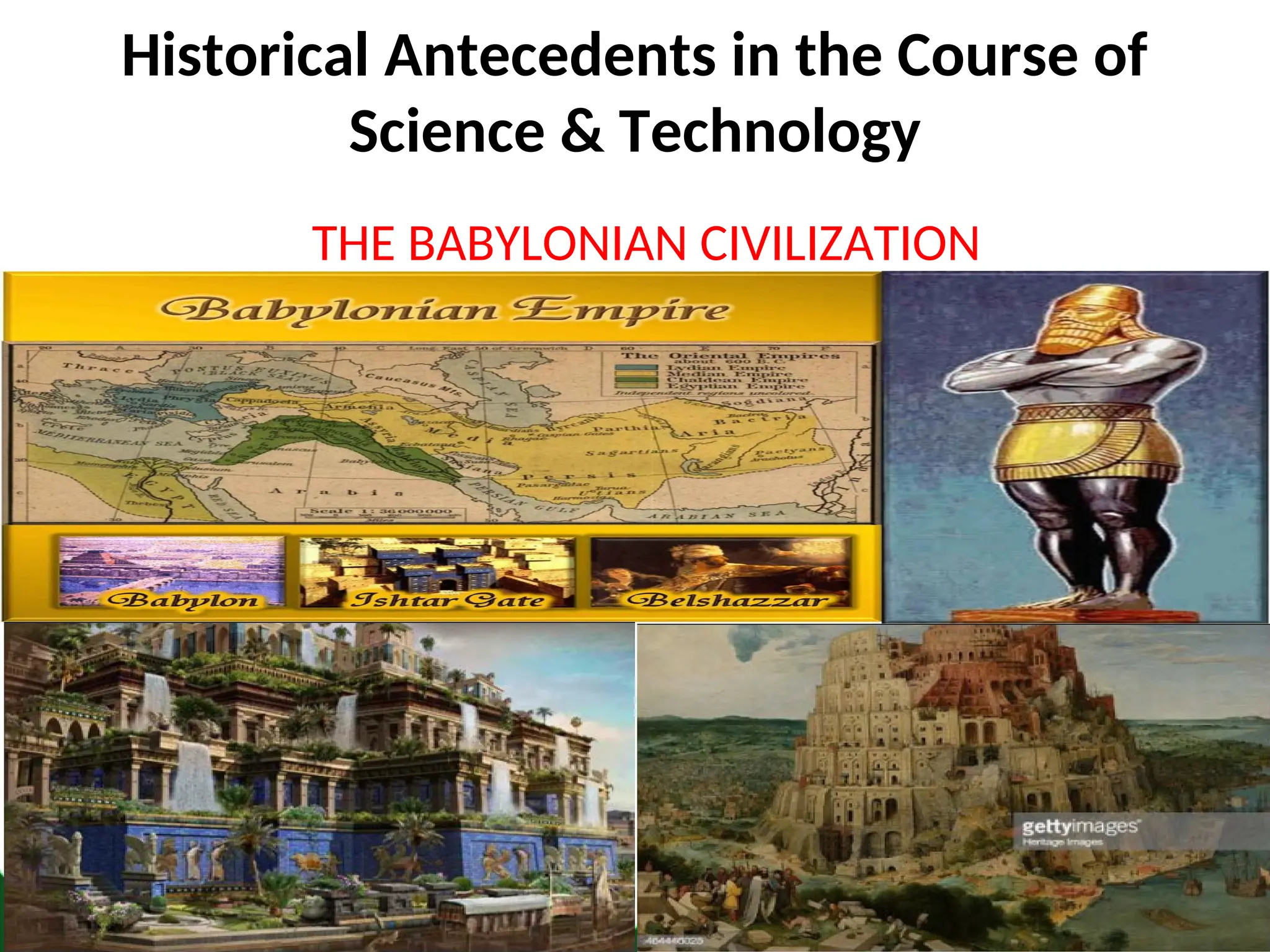
THE BABYLONIAN CIVILIZATION
Historical Antecedents in the Course
of Science & Technology
THE BABYLONIAN CIVILIZATION
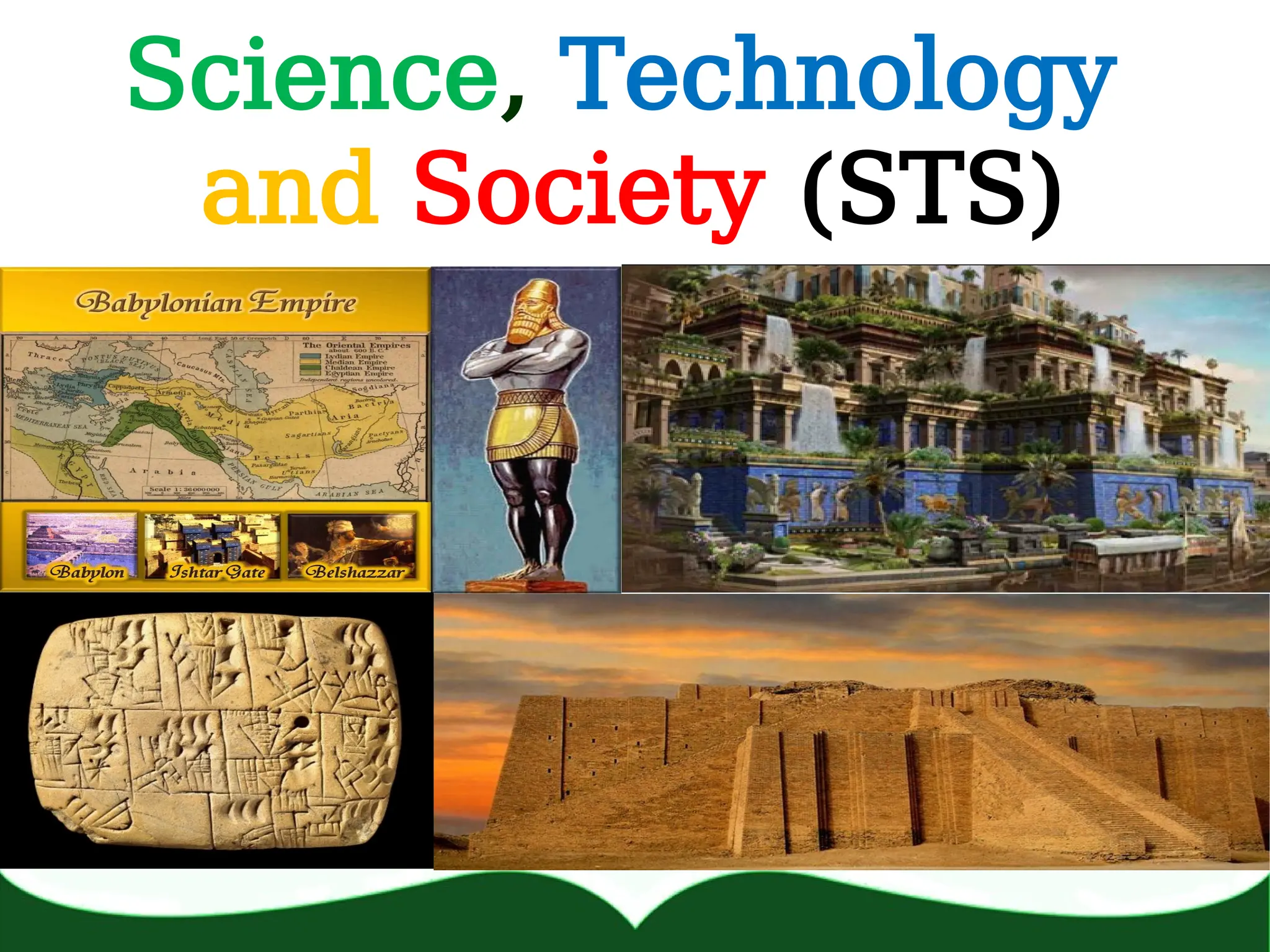
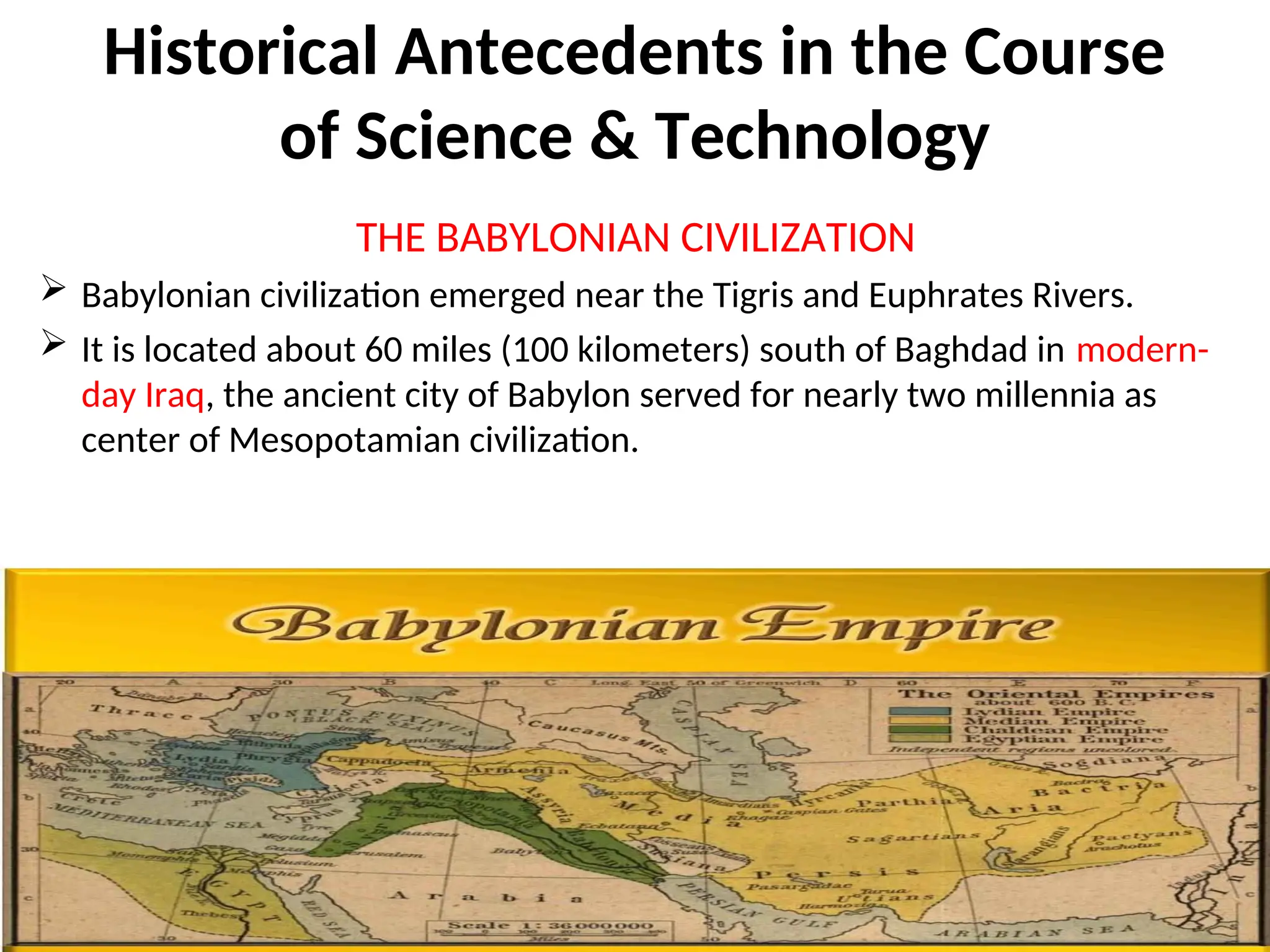
 Babylonian civilization emerged near the Tigris and Euphrates Rivers.
 It is located about 60 miles (100 kilometers) south of Baghdad in modern-
day Iraq, the ancient city of Babylon served for nearly two millennia as
center of Mesopotamian civilization.
Historical Antecedents in the Course
of Science & Technology
THE BABYLONIAN CIVILIZATION
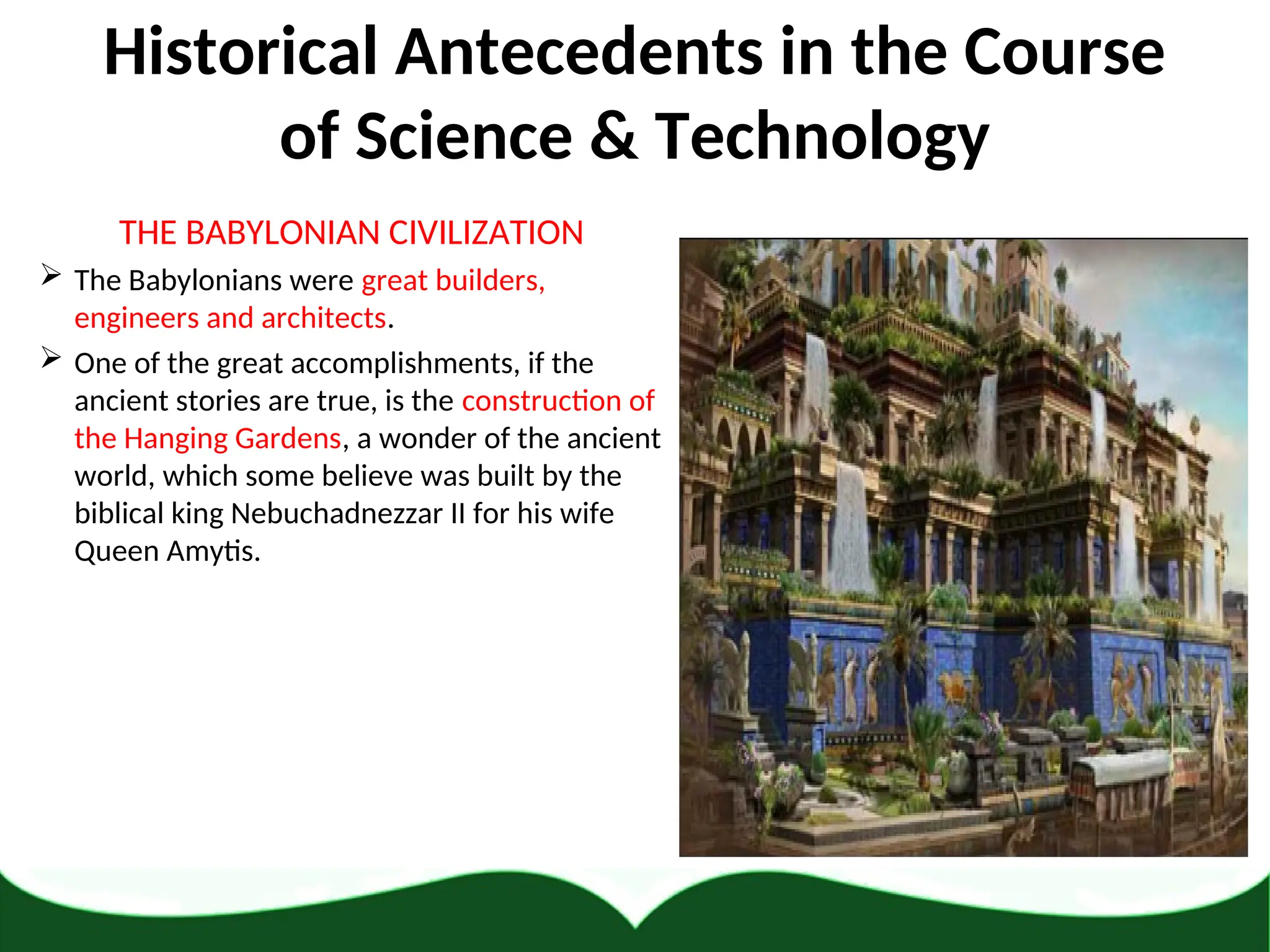
 The Babylonians were great builders,
engineers and architects.
 One of the great accomplishments, if the
ancient stories are true, is the construction of
the Hanging Gardens, a wonder of the ancient
world, which some believe was built by the
biblical king Nebuchadnezzar II for his wife
Queen Amytis.
Historical Antecedents in the Course
of Science & Technology
THE BABYLONIAN CIVILIZATION
 The ancient scientists who lived in the city made important discoveries in mathematics, physics
and astronomy.
 Among their many accomplishments, they developed trigonometry, used mathematical models
to track the planet Jupiter and developed methods of tracking time that are still used today.
 Ancient Babylonian records are still used by modern-day astronomers to study how the rotation
of the Earth has changed
Historical Antecedents in the Course
of Science & Technology
THE BABYLONIAN CIVILIZATION
 Michael Seymour, a research associate at the Metropolitan Museum of Art, writes in
his book “Legend, History and the Ancient City of Babylon” (I.B. Tauris, 2014) that an
irrigation system that distributed from the Euphrates and Tigris rivers had to be used
to grow crops.
 Once established, however, such a system could reap the benefit of rich alluvial soils
and support extremely productive agriculture on the levees of canals.
Historical Antecedents in the Course
of Science & Technology
THE EGYPTIAN CIVILIZATION
 Another early civilization famous for its legacy is the Egyptian civilization
located in North Africa.
 Many stories tell about the engineering feats of the Egyptians especially
regarding the infrastructures established by the pharaohs.
 Aside from engineering technology, the Egyptians have contributed other
practical things that the world now considers as essential.
 It is thus safe to say that the pyramids are not the only contributions of the
Egyptian civilization to the modern world.
Historical Antecedents in the Course of Science & Technology
THE EGYPTIAN CIVILIZATION
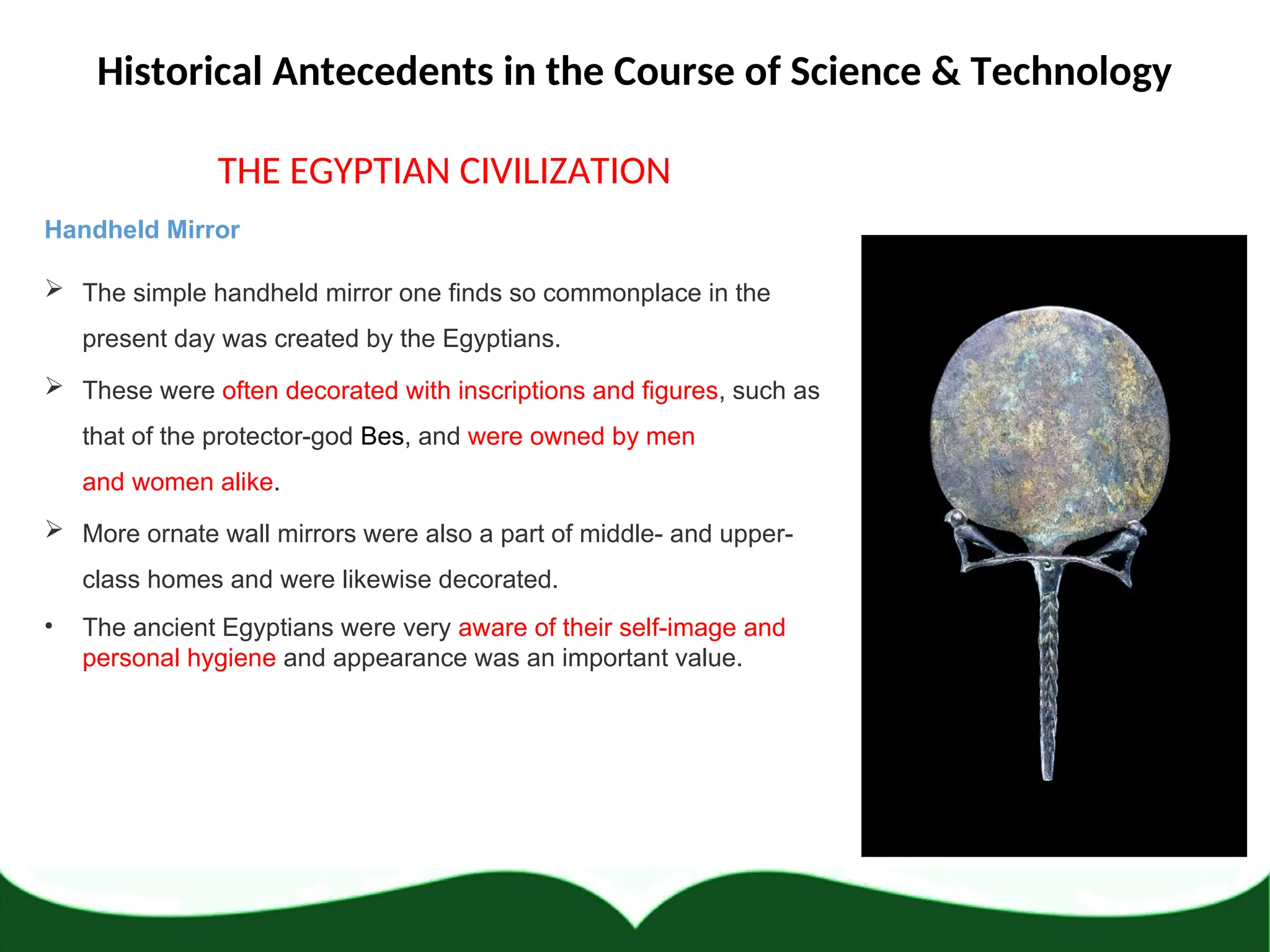
Handheld Mirror
 The simple handheld mirror one finds so commonplace in the
present day was created by the Egyptians.
 These were often decorated with inscriptions and figures, such as
that of the protector-god Bes, and were owned by men
and women alike.
 More ornate wall mirrors were also a part of middle- and upper-
class homes and were likewise decorated.
• The ancient Egyptians were very aware of their self-image and
personal hygiene and appearance was an important value.
Historical Antecedents in the Course of Science & Technology
THE EGYPTIAN CIVILIZATION
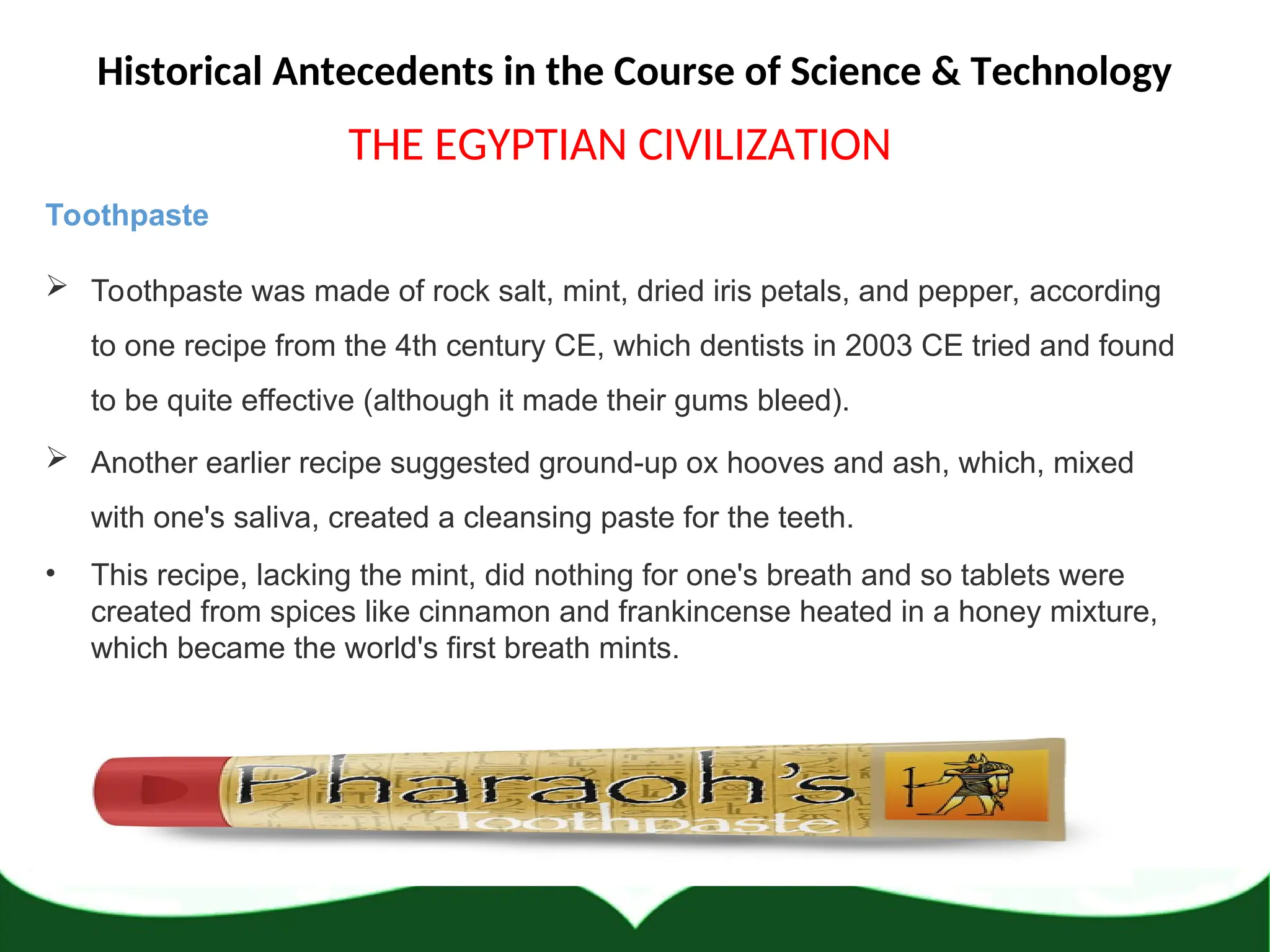
Toothpaste
 Toothpaste was made of rock salt, mint, dried iris petals, and pepper, according
to one recipe from the 4th century CE, which dentists in 2003 CE tried and found
to be quite effective (although it made their gums bleed).
 Another earlier recipe suggested ground-up ox hooves and ash, which, mixed
with one's saliva, created a cleansing paste for the teeth.
• This recipe, lacking the mint, did nothing for one's breath and so tablets were
created from spices like cinnamon and frankincense heated in a honey mixture,
which became the world's first breath mints.
Historical Antecedents in the Course of Science & Technology
THE EGYPTIAN CIVILIZATION
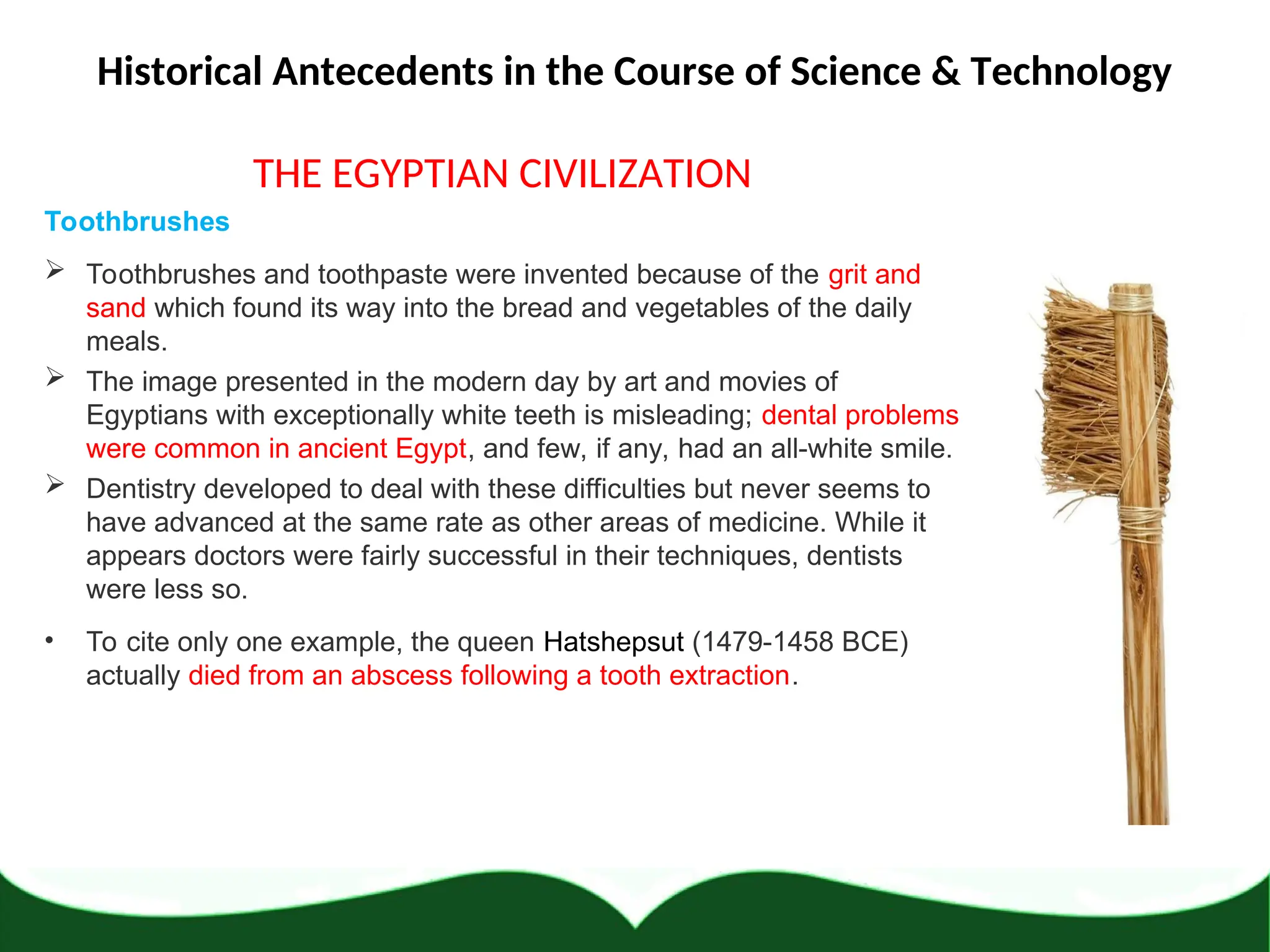
Toothbrushes
 Toothbrushes and toothpaste were invented because of the grit and
sand which found its way into the bread and vegetables of the daily
meals.
 The image presented in the modern day by art and movies of
Egyptians with exceptionally white teeth is misleading; dental problems
were common in ancient Egypt, and few, if any, had an all-white smile.
 Dentistry developed to deal with these difficulties but never seems to
have advanced at the same rate as other areas of medicine. While it
appears doctors were fairly successful in their techniques, dentists
were less so.
• To cite only one example, the queen Hatshepsut (1479-1458 BCE)
actually died from an abscess following a tooth extraction.
Historical Antecedents in the Course of Science & Technology
THE EGYPTIAN CIVILIZATION
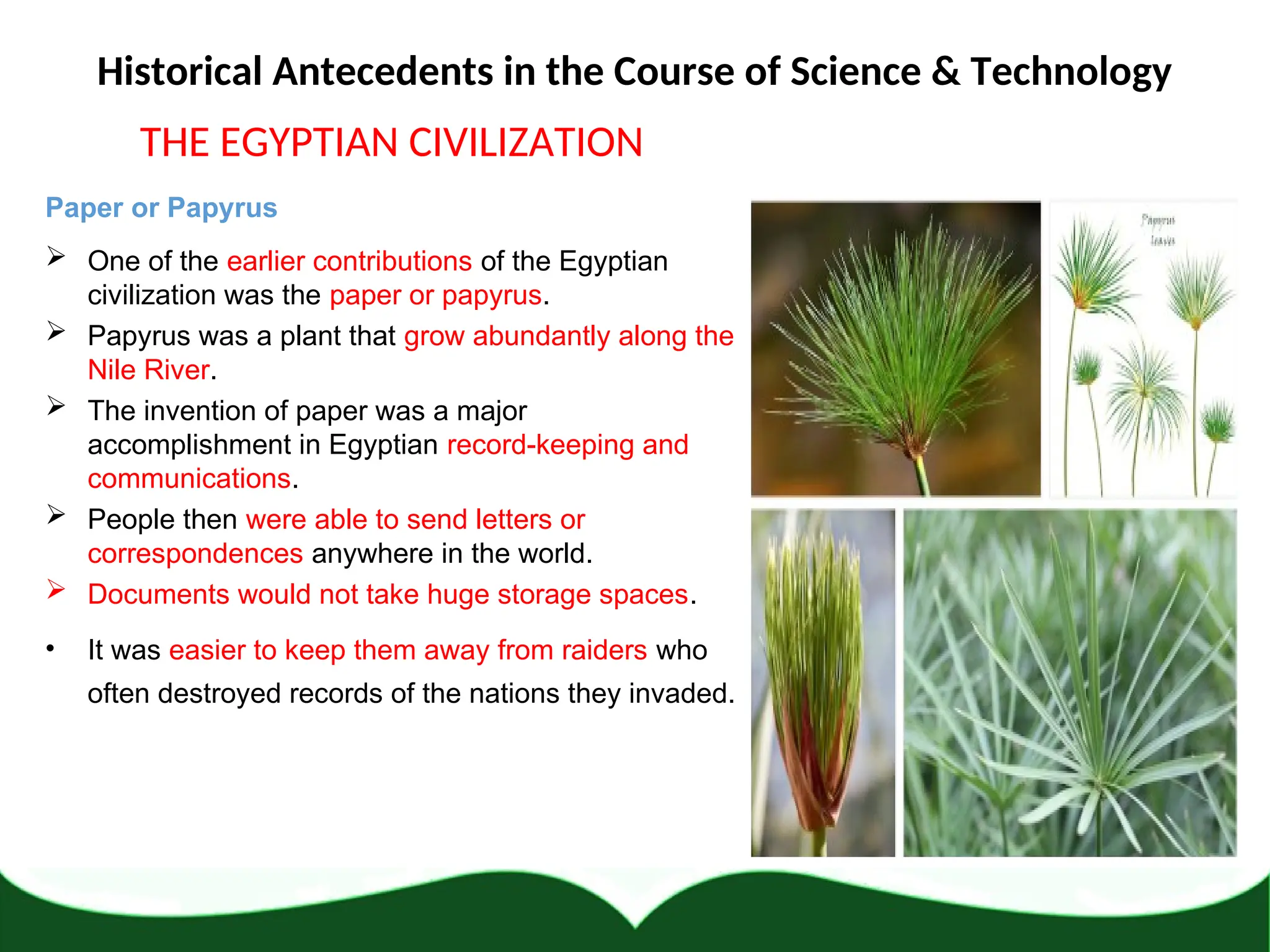
Paper or Papyrus
 One of the earlier contributions of the Egyptian
civilization was the paper or papyrus.
 Papyrus was a plant that grow abundantly along the
Nile River.
 The invention of paper was a major
accomplishment in Egyptian record-keeping and
communications.
 People then were able to send letters or
correspondences anywhere in the world.
 Documents would not take huge storage spaces.
• It was easier to keep them away from raiders who
often destroyed records of the nations they invaded.
Historical Antecedents in the Course of Science & Technology
THE EGYPTIAN CIVILIZATION
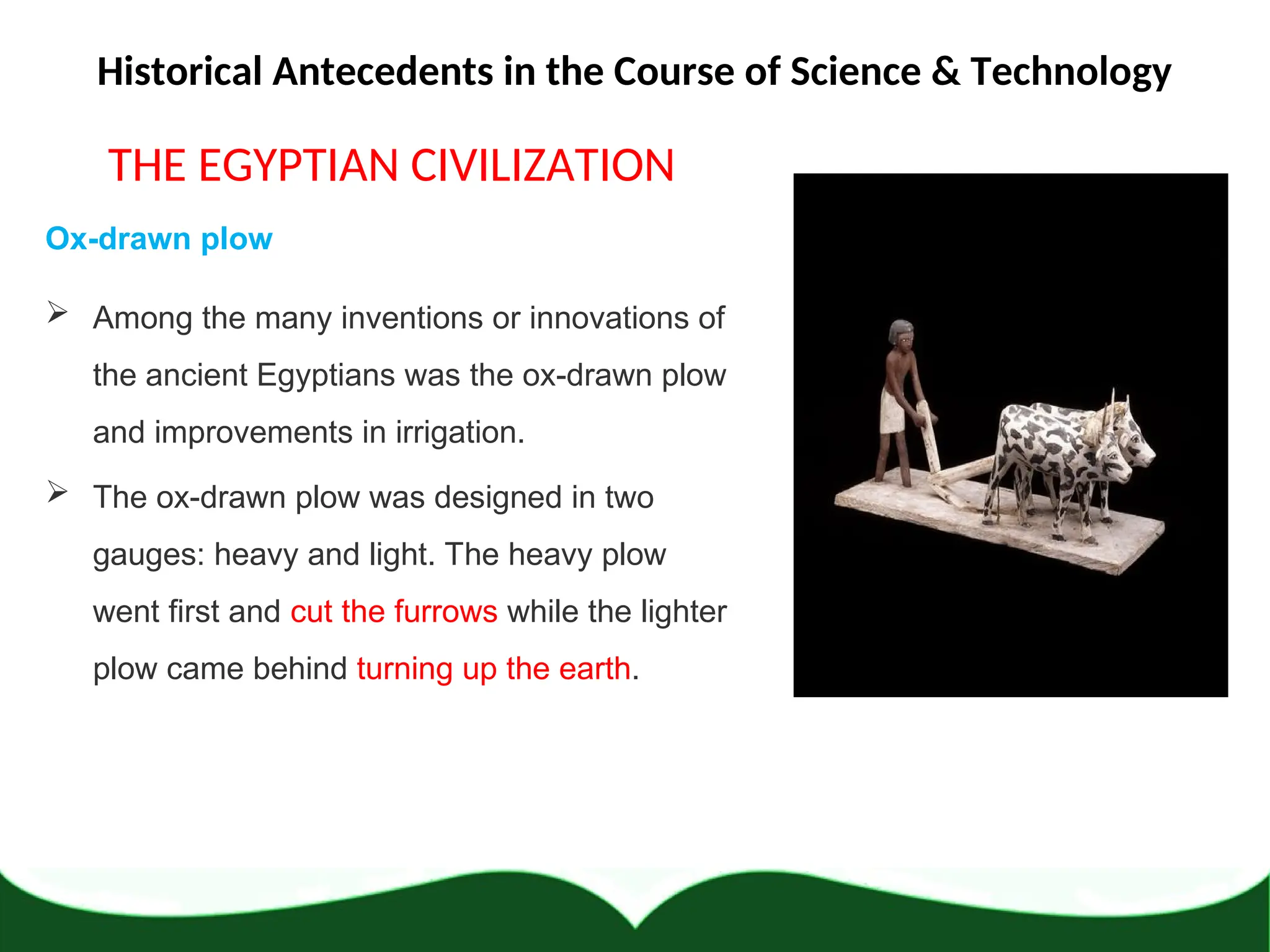
Ox-drawn plow
 Among the many inventions or innovations of
the ancient Egyptians was the ox-drawn plow
and improvements in irrigation.
 The ox-drawn plow was designed in two
gauges: heavy and light. The heavy plow
went first and cut the furrows while the lighter
plow came behind turning up the earth.
Historical Antecedents in the Course of Science & Technology
THE EGYPTIAN CIVILIZATION
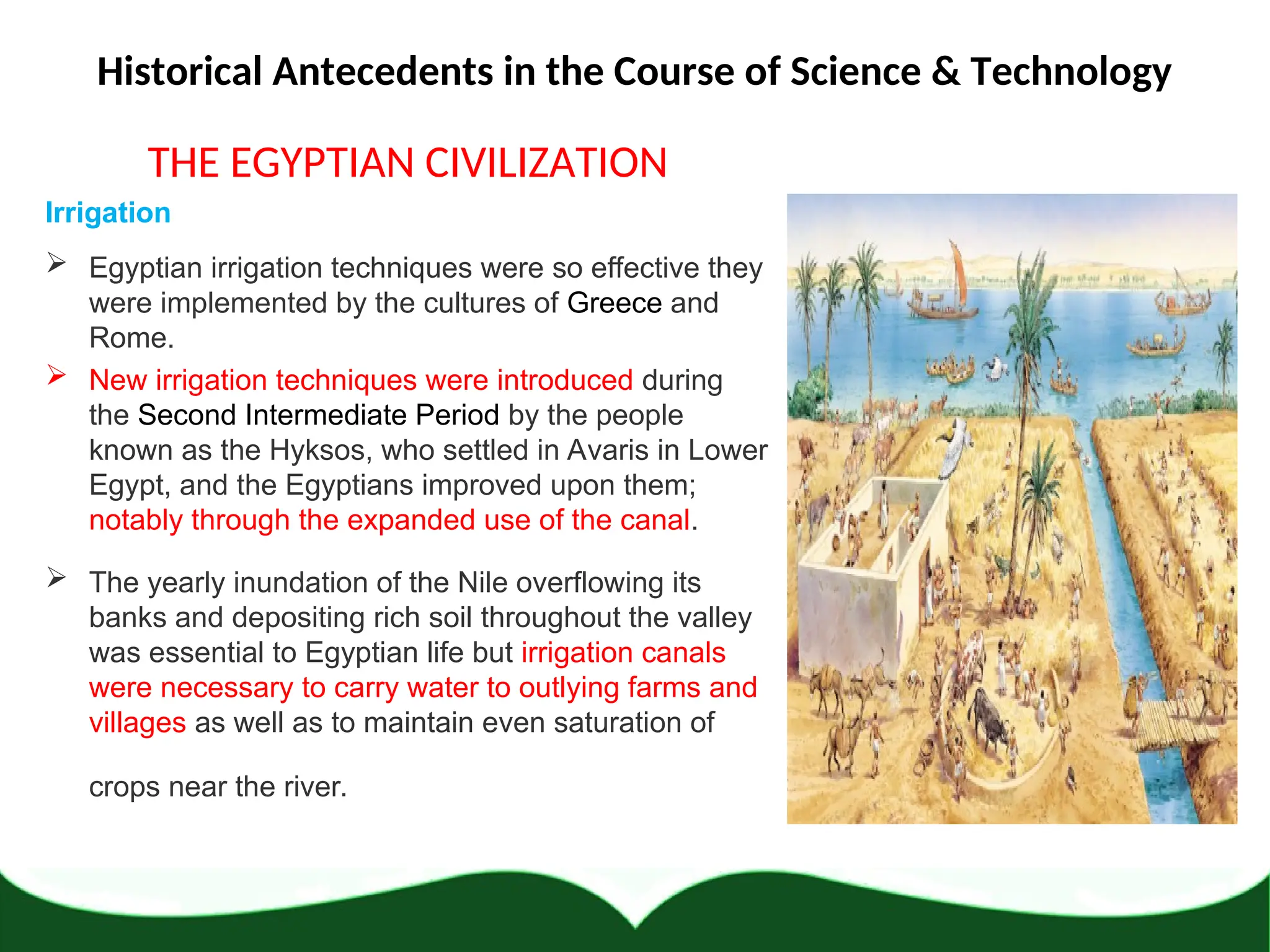
Irrigation
 Egyptian irrigation techniques were so effective they
were implemented by the cultures of Greece and
Rome.
 New irrigation techniques were introduced during
the Second Intermediate Period by the people
known as the Hyksos, who settled in Avaris in Lower
Egypt, and the Egyptians improved upon them;
notably through the expanded use of the canal.
 The yearly inundation of the Nile overflowing its
banks and depositing rich soil throughout the valley
was essential to Egyptian life but irrigation canals
were necessary to carry water to outlying farms and
villages as well as to maintain even saturation of
crops near the river.
Historical Antecedents in the Course of Science & Technology
THE EGYPTIAN CIVILIZATION
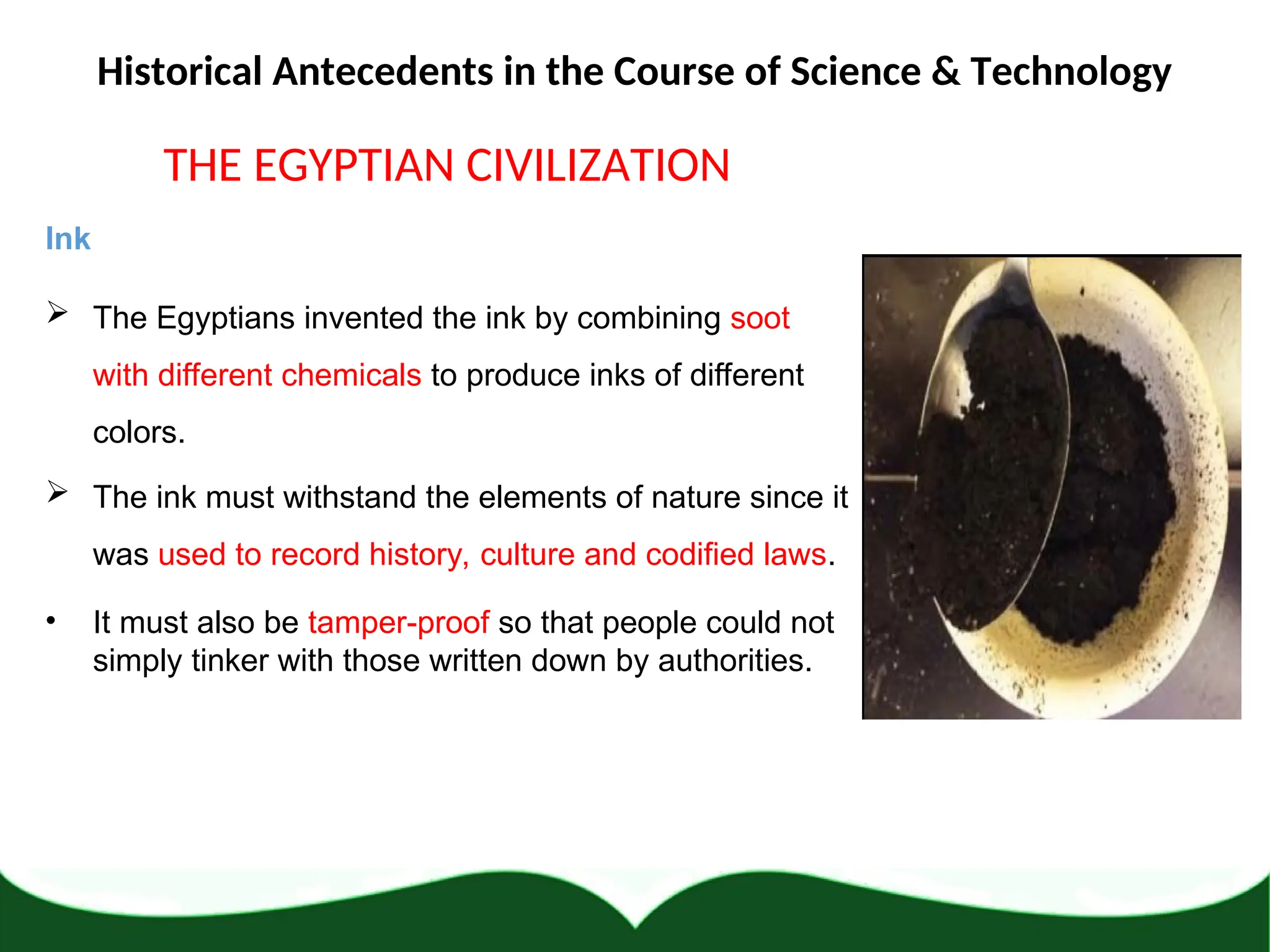
Ink
 The Egyptians invented the ink by combining soot
with different chemicals to produce inks of different
colors.
 The ink must withstand the elements of nature since it
was used to record history, culture and codified laws.
• It must also be tamper-proof so that people could not
simply tinker with those written down by authorities.
Historical Antecedents in the Course of Science & Technology
THE EGYPTIAN CIVILIZATION
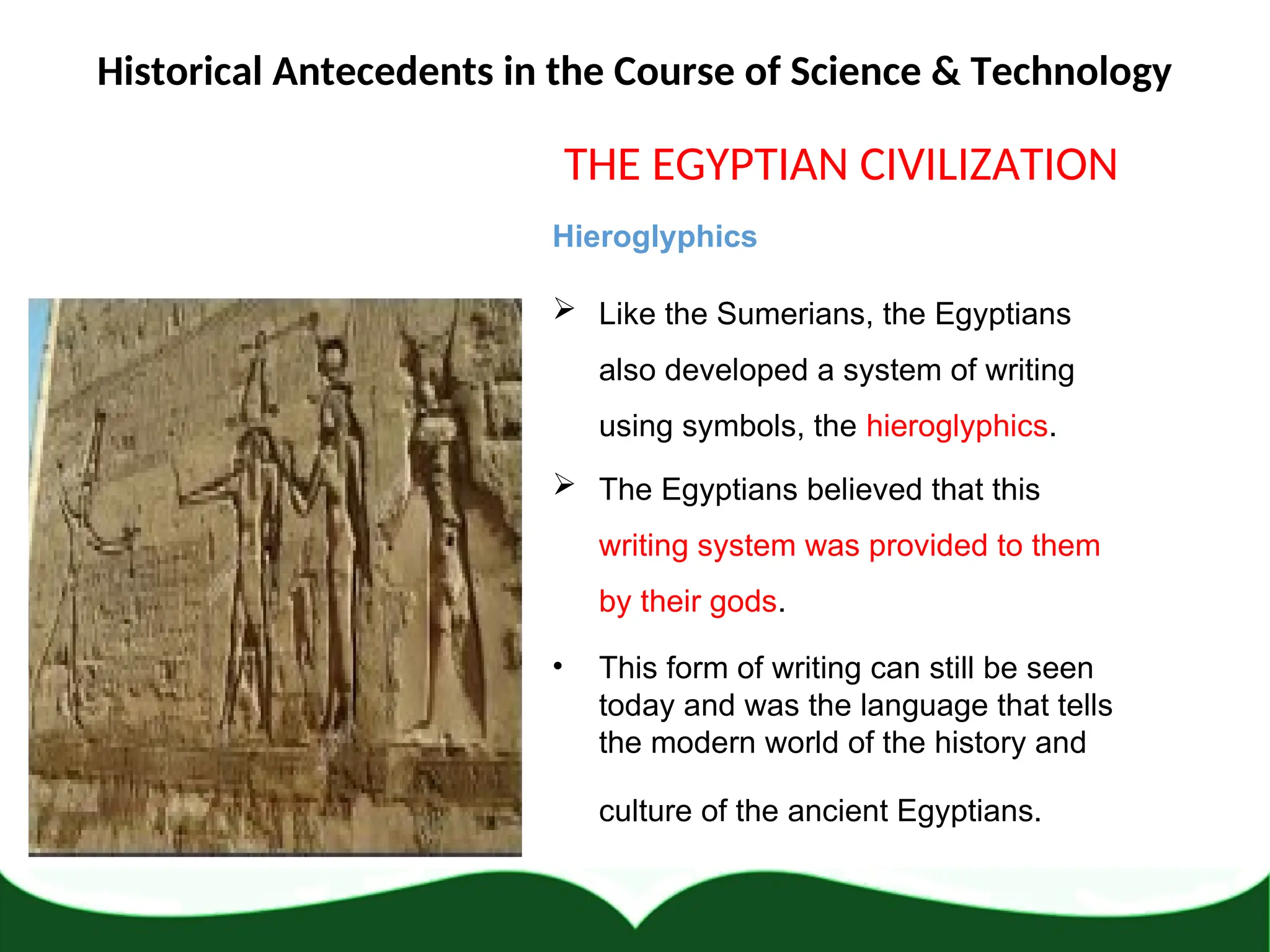
Hieroglyphics
 Like the Sumerians, the Egyptians
also developed a system of writing
using symbols, the hieroglyphics.
 The Egyptians believed that this
writing system was provided to them
by their gods.
• This form of writing can still be seen
today and was the language that tells
the modern world of the history and
culture of the ancient Egyptians.
Historical Antecedents in the Course of Science & Technology
THE EGYPTIAN CIVILIZATION
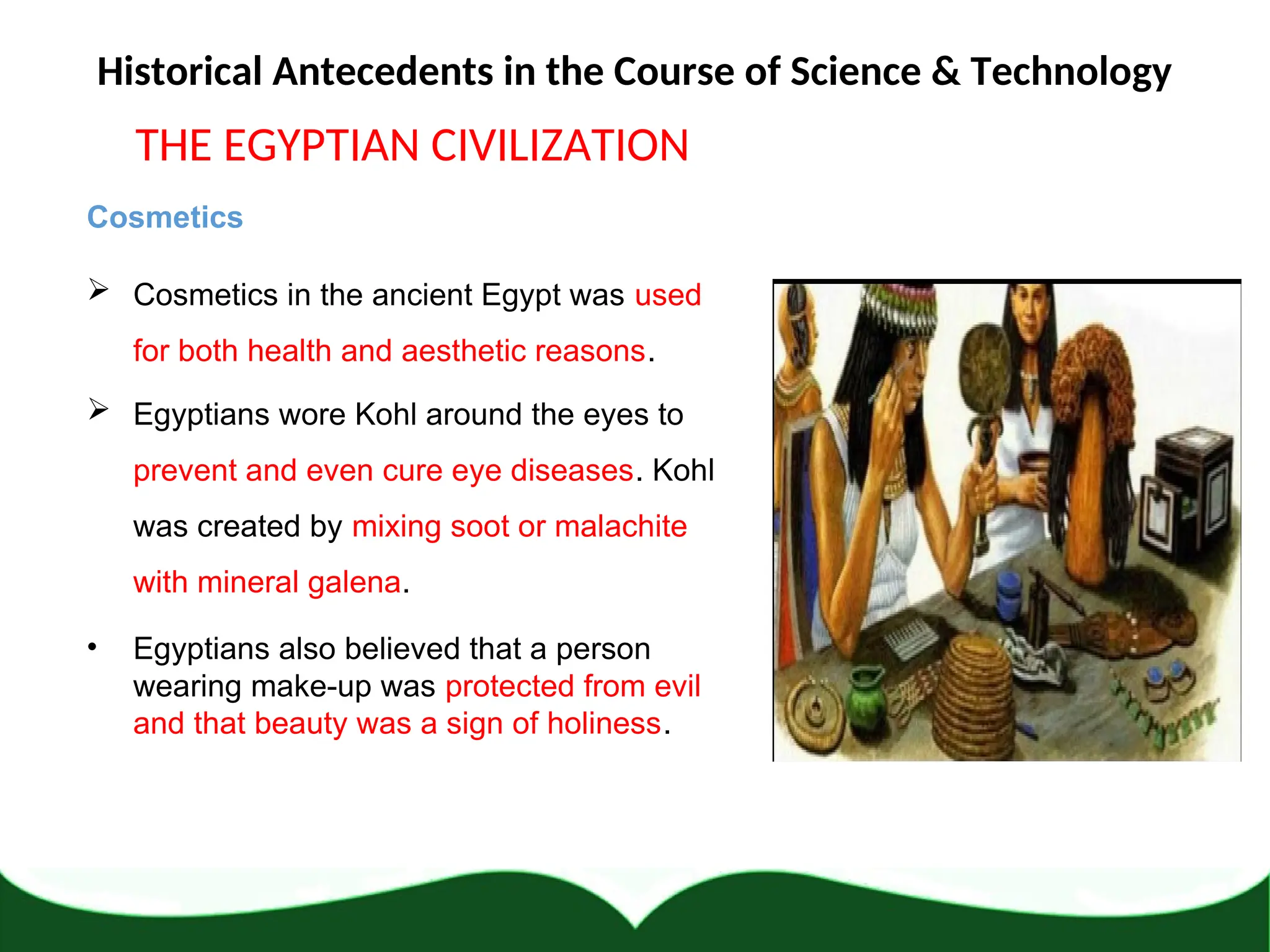
Cosmetics
 Cosmetics in the ancient Egypt was used
for both health and aesthetic reasons.
 Egyptians wore Kohl around the eyes to
prevent and even cure eye diseases. Kohl
was created by mixing soot or malachite
with mineral galena.
• Egyptians also believed that a person
wearing make-up was protected from evil
and that beauty was a sign of holiness.
Historical Antecedents in the Course of Science & Technology
THE EGYPTIAN CIVILIZATION
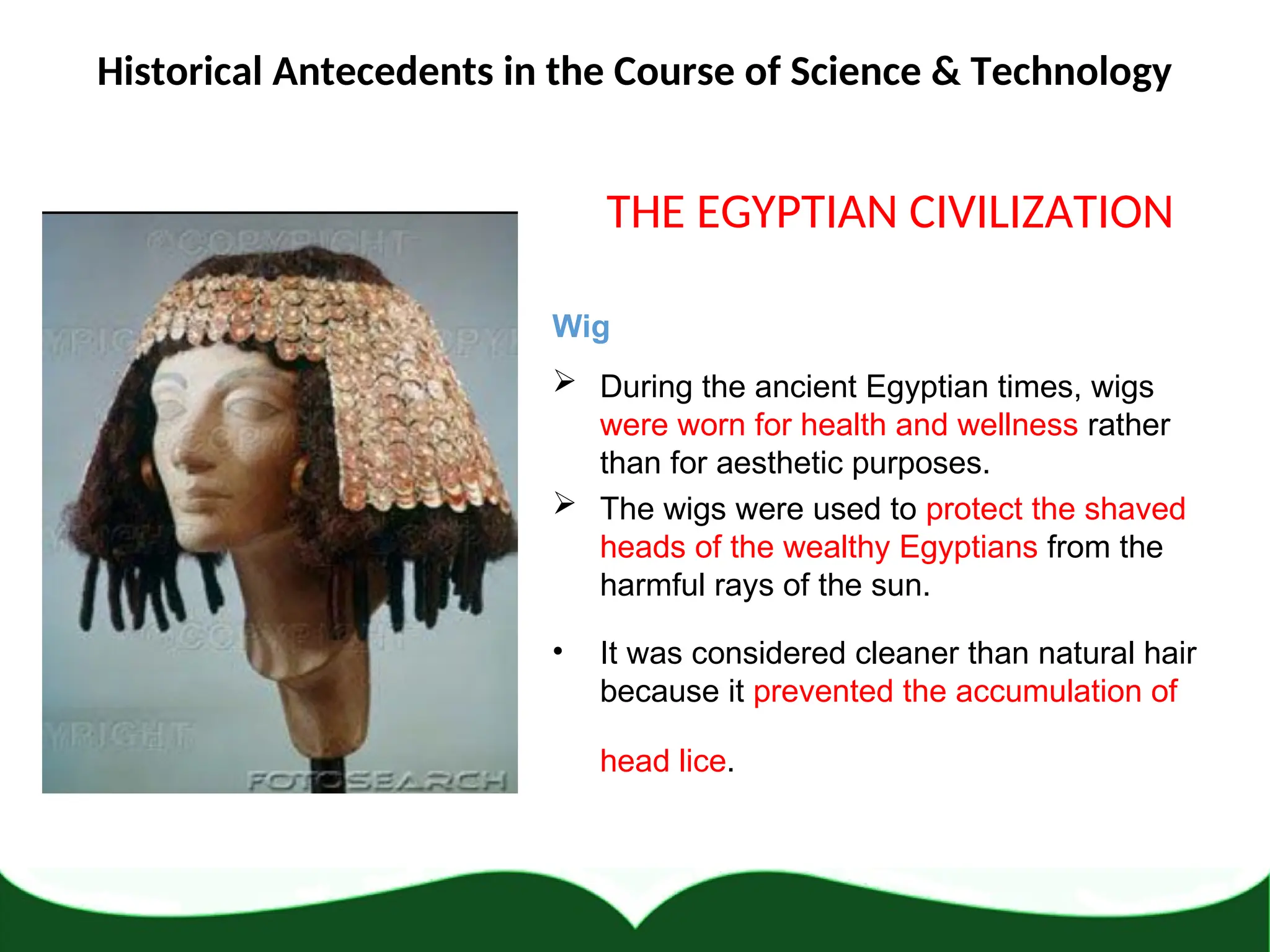
Wig
 During the ancient Egyptian times, wigs
were worn for health and wellness rather
than for aesthetic purposes.
 The wigs were used to protect the shaved
heads of the wealthy Egyptians from the
harmful rays of the sun.
• It was considered cleaner than natural hair
because it prevented the accumulation of
head lice.
Historical Antecedents in the Course of Science & Technology
THE EGYPTIAN CIVILIZATION
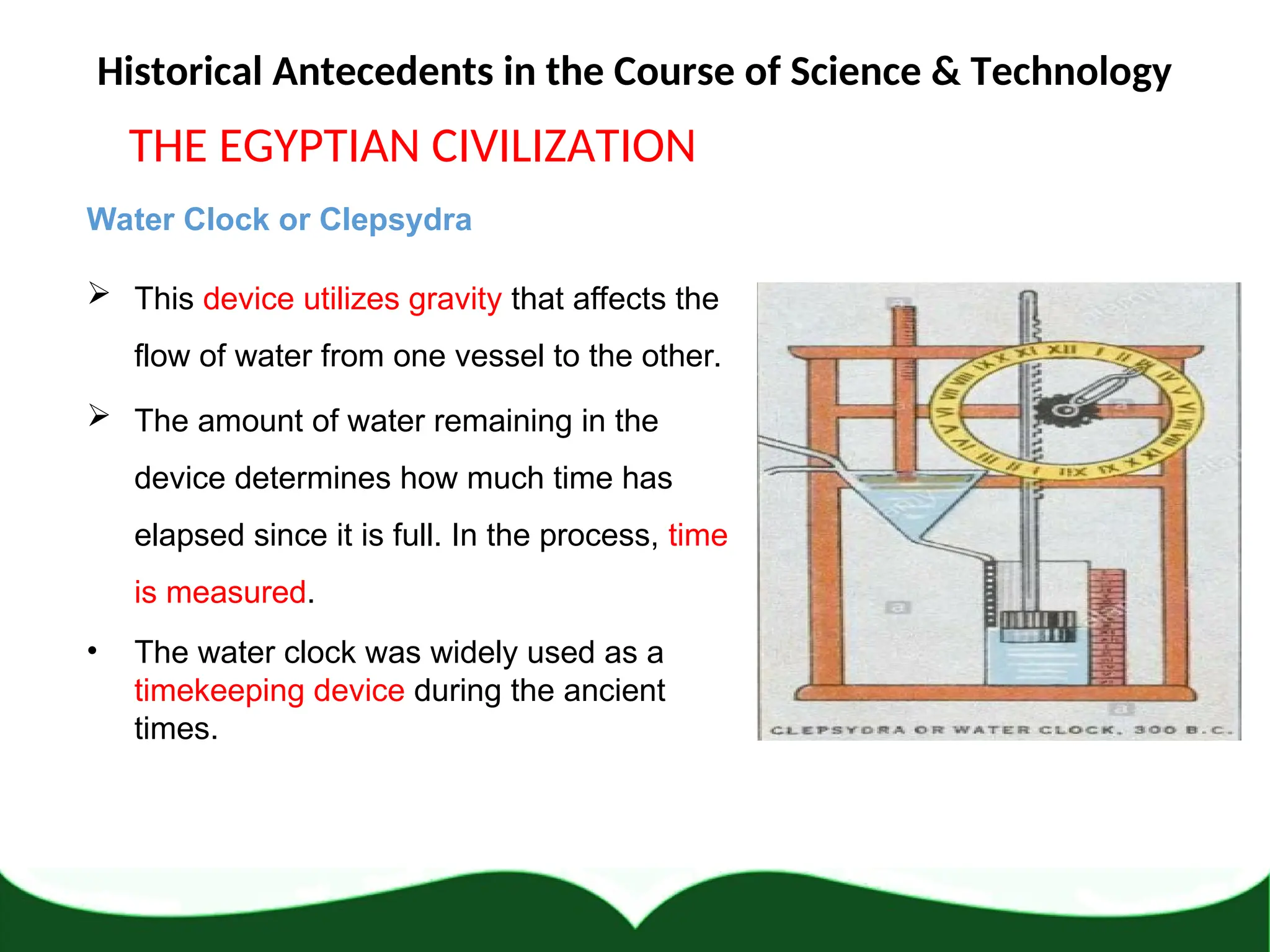
Water Clock or Clepsydra
 This device utilizes gravity that affects the
flow of water from one vessel to the other.
 The amount of water remaining in the
device determines how much time has
elapsed since it is full. In the process, time
is measured.
• The water clock was widely used as a
timekeeping device during the ancient
times.
Historical Antecedents in the Course of Science & Technology
THE EGYPTIAN CIVILIZATION
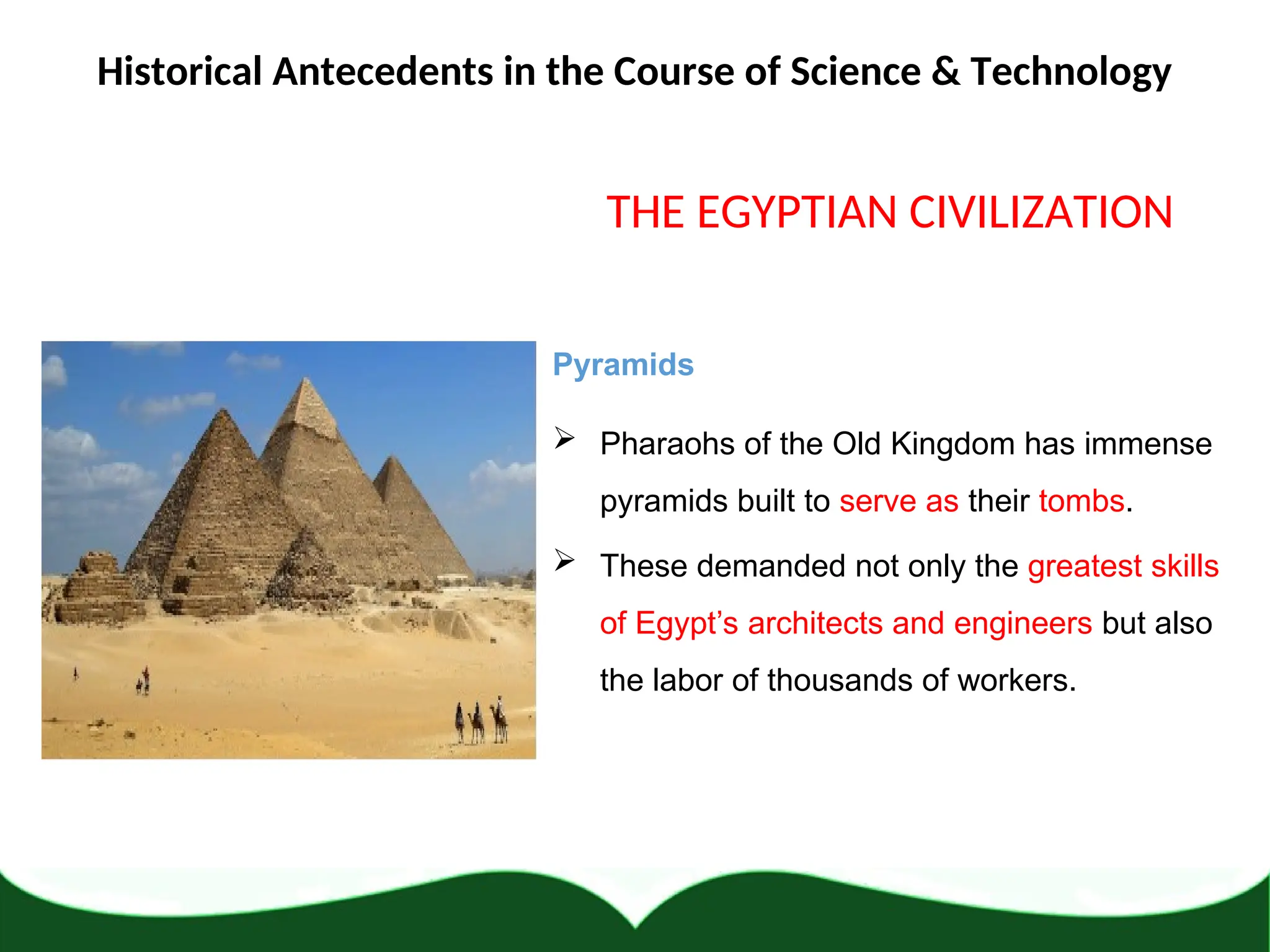
Pyramids
 Pharaohs of the Old Kingdom has immense
pyramids built to serve as their tombs.
 These demanded not only the greatest skills
of Egypt’s architects and engineers but also
the labor of thousands of workers.
Historical Antecedents in the Course of Science & Technology
THE EGYPTIAN CIVILIZATION
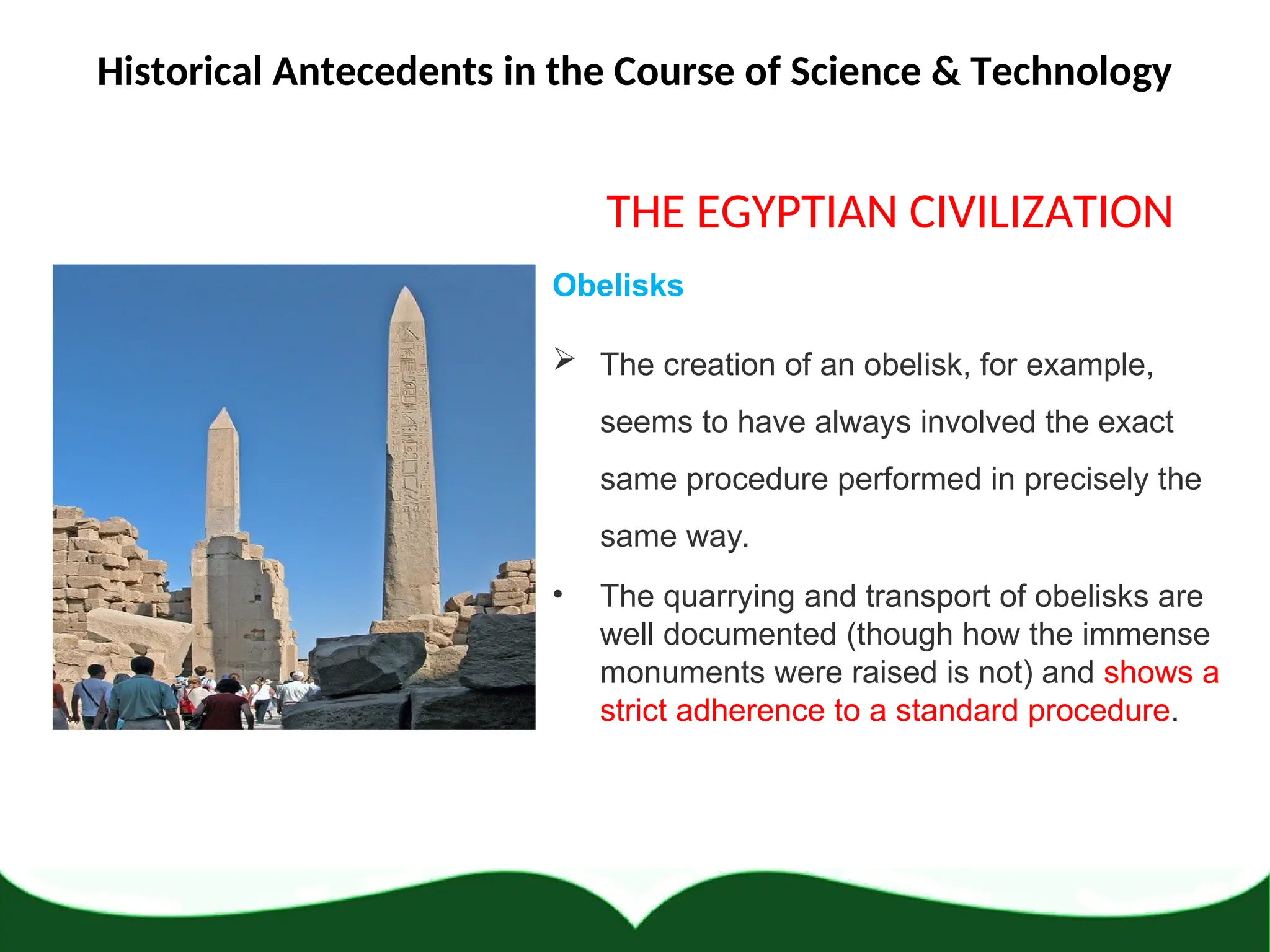
Obelisks
 The creation of an obelisk, for example,
seems to have always involved the exact
same procedure performed in precisely the
same way.
• The quarrying and transport of obelisks are
well documented (though how the immense
monuments were raised is not) and shows a
strict adherence to a standard procedure.
Historical Antecedents in the Course of Science & Technology
THE EGYPTIAN CIVILIZATION
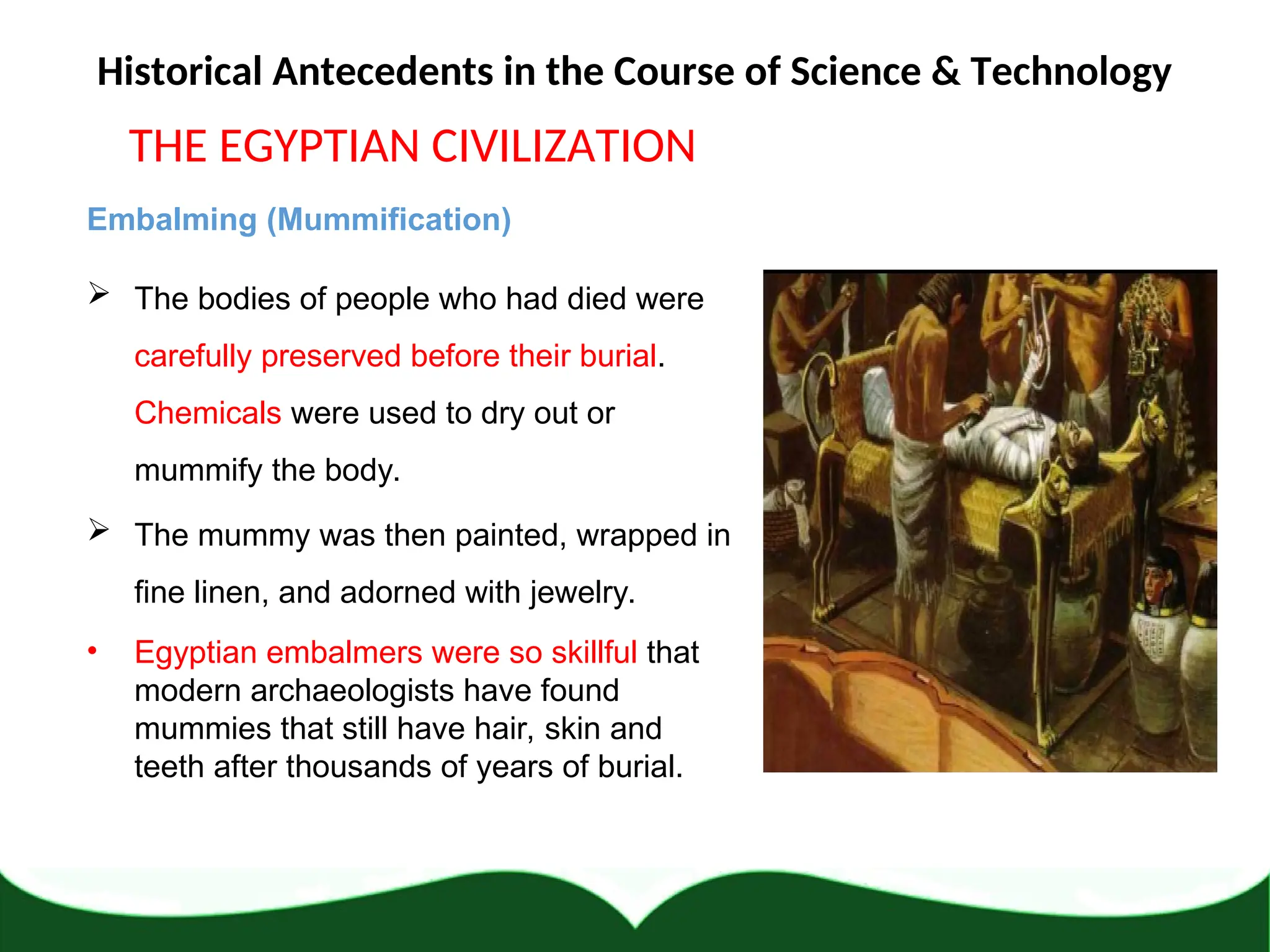
Embalming (Mummification)
 The bodies of people who had died were
carefully preserved before their burial.
Chemicals were used to dry out or
mummify the body.
 The mummy was then painted, wrapped in
fine linen, and adorned with jewelry.
• Egyptian embalmers were so skillful that
modern archaeologists have found
mummies that still have hair, skin and
teeth after thousands of years of burial.
Historical Antecedents in the Course of Science & Technology
THE EGYPTIAN CIVILIZATION
Medicine
 Medicine in ancient Egypt was intimately tied to magic.
There are three best-known works dealing with medical
issues of medical knowledge.
 The Ebers Papyrus is a text of 110 pages treating
ailments such as trauma, cancer, heart disease,
depression, dermatology, gastrointestinal distress, and
many others.
 The Edwin Smith Papyrus is the oldest known work on
surgical techniques and is thought to have been written
for triage surgeons in field hospitals. This work shows
detailed knowledge of anatomy and physiology.
• The London Medical Papyrus combines practical
medical skill with magical spells for the treatment of
conditions ranging from eye problems to miscarriages.
Historical Antecedents in the Course of Science & Technology
THE EGYPTIAN CIVILIZATION
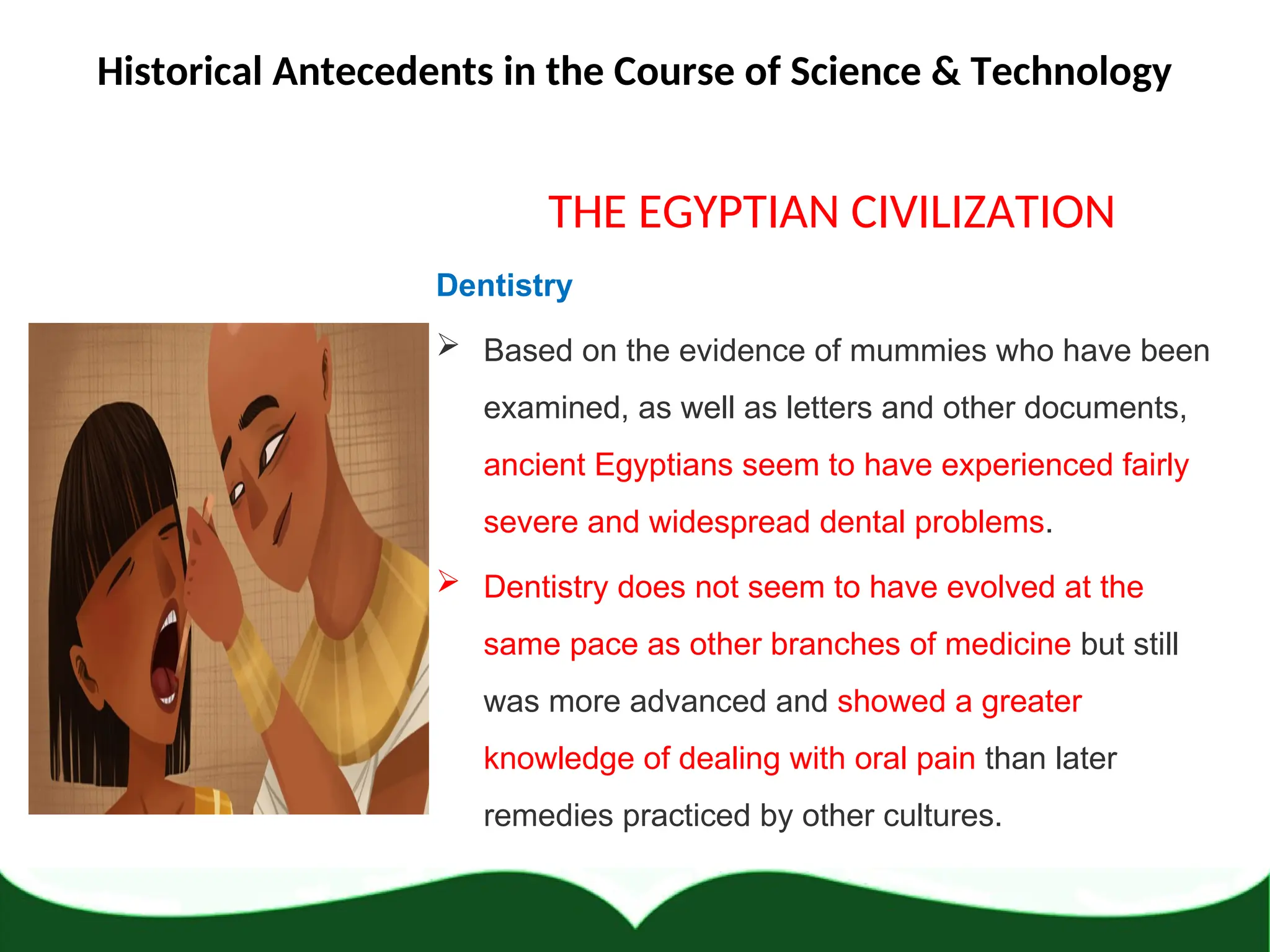
Dentistry
 Based on the evidence of mummies who have been
examined, as well as letters and other documents,
ancient Egyptians seem to have experienced fairly
severe and widespread dental problems.
 Dentistry does not seem to have evolved at the
same pace as other branches of medicine but still
was more advanced and showed a greater
knowledge of dealing with oral pain than later
remedies practiced by other cultures.
Historical Antecedents in the Course of Science & Technology
THE EGYPTIAN CIVILIZATION
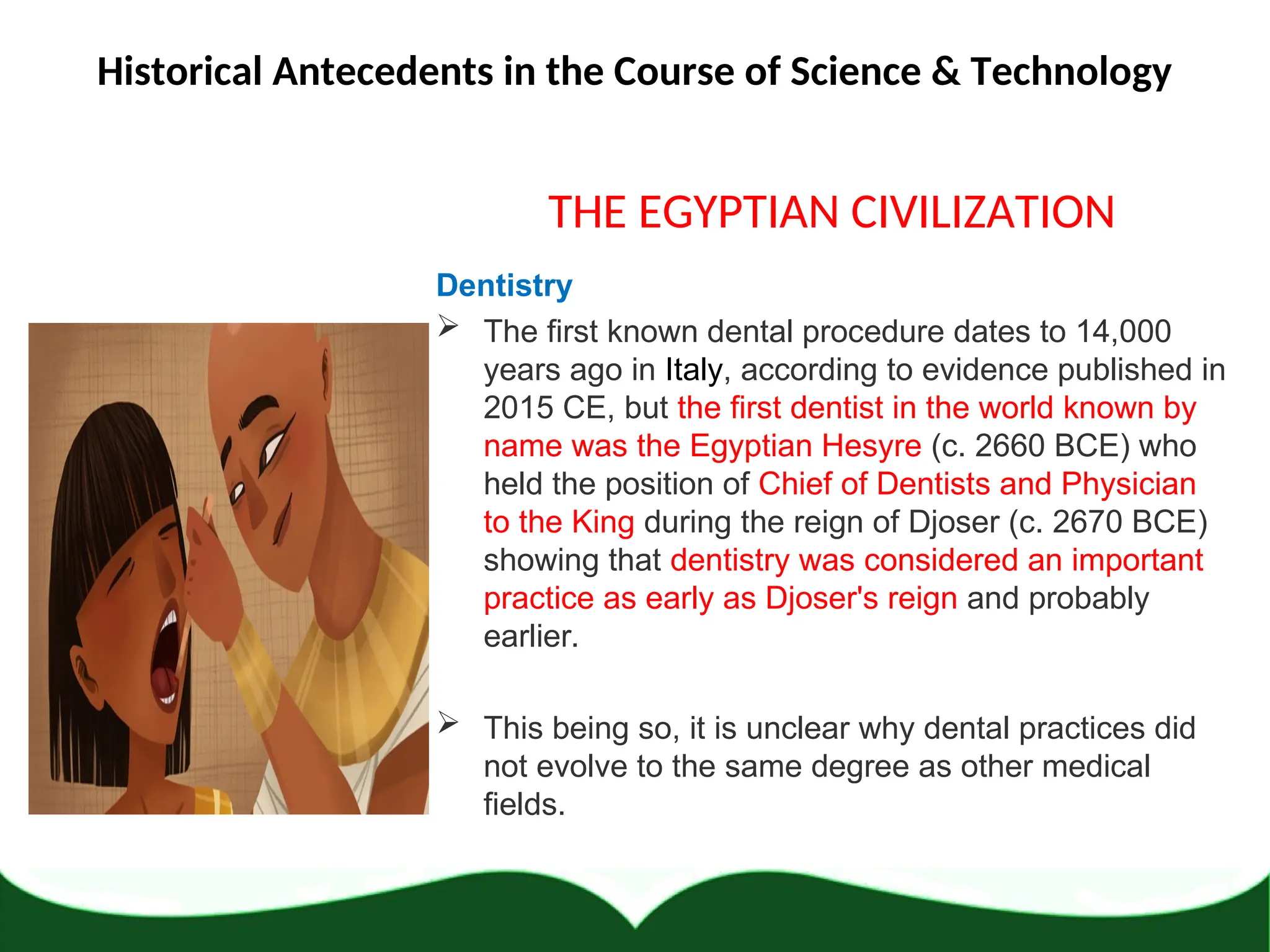
Dentistry
 The first known dental procedure dates to 14,000
years ago in Italy, according to evidence published in
2015 CE, but the first dentist in the world known by
name was the Egyptian Hesyre (c. 2660 BCE) who
held the position of Chief of Dentists and Physician
to the King during the reign of Djoser (c. 2670 BCE)
showing that dentistry was considered an important
practice as early as Djoser's reign and probably
earlier.
 This being so, it is unclear why dental practices did
not evolve to the same degree as other medical
fields.

Science and Technology during Sumerian, Babylonian and Egyptians

  • 1.
  • 2.
    Introduction Science is a systemof knowledge of the natural world gained through the scientific method. originally called “philosophy of the natural world” since it stemmed from the ancient Greeks’ desire to know about nature.
  • 3.
    Introduction Philosophers as aScientist The first scientists were called “philosophers of nature.” They sought to discover the truth behind material things and natural things. They observed the world and beyond, and discovered what makes materials the same and what them different.
  • 4.
    Introduction Philosophers as aScientist They were able to name and classify the objects found in nature and was seen as the first step towards knowledge. They were able to recognized the usefulness of language and the ability it gave to describe, classify, and explain the different objects of study.
  • 5.
    Introduction Technology The term comesfrom Greek words “tekhne” meaning art or craft and “logia” meaning a subject or interest. The term has come to mean “practical applications of what we know about nature” using scientific principles for the betterment of the human situation .
  • 6.
    Historical Antecedents inthe Course of Science & Technology ANCIENT TIMES  With all these in mind, we can conclude that the developments in science and technology, aside from affecting the lives of the people, were the results of many prior antecedents.  Out of necessity, people in ancient times were able to discover and invent things that would impact the lives of the modern people.
  • 7.
    Historical Antecedents inthe Course of Science & Technology THE SUMERIAN CIVILIZATION  Sumeria is located on the southernmost tip of ancient Mesopotamia.  They are known for their high degree of cooperation with one another and their desire for great things.  They are not contented with the basic things that life can offer.  This desire pushed them to develop many things connected with science and technology.
  • 8.
    Historical Antecedents inthe Course of Science & Technology THE SUMERIAN CIVILIZATION
  • 9.
    Historical Antecedents inthe Course of Science & Technology THE SUMERIAN CIVILIZATION Cuneiform  One of the major contributions of the Sumerians is the development of the first writing system.  It is a system that utilizes word pictures and triangular symbols which are carved on clay using wedge instruments and then left to dry.  It allowed the Sumerians to keep records of things with great historical value or their everyday life.
  • 10.
    Historical Antecedents inthe Course of Science & Technology THE SUMERIAN CIVILIZATION The Great Ziggurat of Ur  It is an engineering and architectural feat of the Sumerians.  It is also called the “mountain of god”.  This structure was constructed using sun-baked bricks.  It served as the sacred place of their chief god, where only their priests were allowed to enter.  This structure showcases the remarkable technology used to build it.  Even until today, people still enjoy and marvel at the preserved Great Ziggurat of Ur.
  • 11.
    Historical Antecedents inthe Course of Science & Technology THE SUMERIAN CIVILIZATION Irrigation and Dikes  The Sumerian created dikes and irrigation canals to bring water to farmlands and at the same time control the flooding of the rivers.  This method was considered as one of the world’s most beneficial engineering works.  Through the dikes and canals, the Sumerians were able to enjoy year-long farming and harvesting, which increased their food production.
  • 12.
    Historical Antecedents inthe Course of Science & Technology THE SUMERIAN CIVILIZATION Sailboats  At that time, the wheel was not yet invented; the main mode of transportation was through waterways such as rivers and seas.  Boats were used to carry large quantities of products and were able to cover large distances.  Some sources attribute to the Sumerians the invention of sailboats to address their increasing demands.  Sailboats were essential in transportation and trading as well as in fostering culture, information and technology.
  • 13.
    Historical Antecedents inthe Course of Science & Technology THE SUMERIAN CIVILIZATION Wheel  In the latter part of the Sumerians’ history, they were able to invent the wheel since the specialized tools needed to create it were already available.  The first wheels were not made for transportation but for farm work and food processes.  With the use of wheel and axle, mass production was made easier.  Farmers where able to mill grains with less effort in less time.
  • 14.
    Historical Antecedents inthe Course of Science & Technology THE SUMERIAN CIVILIZATION The Plow  Another farm technology invented by the Mesopotamians is the plow. Humans evolved from being food gatherers to farm cultivators.  The plow was invented to dig the earth in a faster pace.  With this tool, farmers could cultivate larger parcels of land faster, enabling them to mass produce food without taking so much effort and time.
  • 15.
    Historical Antecedents inthe Course of Science & Technology THE SUMERIAN CIVILIZATION Roads  In order to facilitate faster and easier travel, the Sumerians developed the first roads.  They made the roads with the same technology they used in making sun-baked bricks that they laid down on the ground.  They later poured bitumen, a black sticky substance similar to asphalt, to smoothen the roads.  This invention was very useful especially during the rainy season.
  • 16.
    Historical Antecedents inthe Course of Science & Technology THE BABYLONIAN CIVILIZATION
  • 17.
    Historical Antecedents inthe Course of Science & Technology THE BABYLONIAN CIVILIZATION  Babylonian civilization emerged near the Tigris and Euphrates Rivers.  It is located about 60 miles (100 kilometers) south of Baghdad in modern- day Iraq, the ancient city of Babylon served for nearly two millennia as center of Mesopotamian civilization.
  • 18.
    Historical Antecedents inthe Course of Science & Technology THE BABYLONIAN CIVILIZATION  The Babylonians were great builders, engineers and architects.  One of the great accomplishments, if the ancient stories are true, is the construction of the Hanging Gardens, a wonder of the ancient world, which some believe was built by the biblical king Nebuchadnezzar II for his wife Queen Amytis.
  • 19.
    Historical Antecedents inthe Course of Science & Technology THE BABYLONIAN CIVILIZATION  The ancient scientists who lived in the city made important discoveries in mathematics, physics and astronomy.  Among their many accomplishments, they developed trigonometry, used mathematical models to track the planet Jupiter and developed methods of tracking time that are still used today.  Ancient Babylonian records are still used by modern-day astronomers to study how the rotation of the Earth has changed
  • 20.
    Historical Antecedents inthe Course of Science & Technology THE BABYLONIAN CIVILIZATION  Michael Seymour, a research associate at the Metropolitan Museum of Art, writes in his book “Legend, History and the Ancient City of Babylon” (I.B. Tauris, 2014) that an irrigation system that distributed from the Euphrates and Tigris rivers had to be used to grow crops.  Once established, however, such a system could reap the benefit of rich alluvial soils and support extremely productive agriculture on the levees of canals.
  • 21.
    Historical Antecedents inthe Course of Science & Technology THE EGYPTIAN CIVILIZATION  Another early civilization famous for its legacy is the Egyptian civilization located in North Africa.  Many stories tell about the engineering feats of the Egyptians especially regarding the infrastructures established by the pharaohs.  Aside from engineering technology, the Egyptians have contributed other practical things that the world now considers as essential.  It is thus safe to say that the pyramids are not the only contributions of the Egyptian civilization to the modern world.
  • 22.
    Historical Antecedents inthe Course of Science & Technology THE EGYPTIAN CIVILIZATION Handheld Mirror  The simple handheld mirror one finds so commonplace in the present day was created by the Egyptians.  These were often decorated with inscriptions and figures, such as that of the protector-god Bes, and were owned by men and women alike.  More ornate wall mirrors were also a part of middle- and upper- class homes and were likewise decorated. • The ancient Egyptians were very aware of their self-image and personal hygiene and appearance was an important value.
  • 23.
    Historical Antecedents inthe Course of Science & Technology THE EGYPTIAN CIVILIZATION Toothpaste  Toothpaste was made of rock salt, mint, dried iris petals, and pepper, according to one recipe from the 4th century CE, which dentists in 2003 CE tried and found to be quite effective (although it made their gums bleed).  Another earlier recipe suggested ground-up ox hooves and ash, which, mixed with one's saliva, created a cleansing paste for the teeth. • This recipe, lacking the mint, did nothing for one's breath and so tablets were created from spices like cinnamon and frankincense heated in a honey mixture, which became the world's first breath mints.
  • 24.
    Historical Antecedents inthe Course of Science & Technology THE EGYPTIAN CIVILIZATION Toothbrushes  Toothbrushes and toothpaste were invented because of the grit and sand which found its way into the bread and vegetables of the daily meals.  The image presented in the modern day by art and movies of Egyptians with exceptionally white teeth is misleading; dental problems were common in ancient Egypt, and few, if any, had an all-white smile.  Dentistry developed to deal with these difficulties but never seems to have advanced at the same rate as other areas of medicine. While it appears doctors were fairly successful in their techniques, dentists were less so. • To cite only one example, the queen Hatshepsut (1479-1458 BCE) actually died from an abscess following a tooth extraction.
  • 25.
    Historical Antecedents inthe Course of Science & Technology THE EGYPTIAN CIVILIZATION Paper or Papyrus  One of the earlier contributions of the Egyptian civilization was the paper or papyrus.  Papyrus was a plant that grow abundantly along the Nile River.  The invention of paper was a major accomplishment in Egyptian record-keeping and communications.  People then were able to send letters or correspondences anywhere in the world.  Documents would not take huge storage spaces. • It was easier to keep them away from raiders who often destroyed records of the nations they invaded.
  • 26.
    Historical Antecedents inthe Course of Science & Technology THE EGYPTIAN CIVILIZATION Ox-drawn plow  Among the many inventions or innovations of the ancient Egyptians was the ox-drawn plow and improvements in irrigation.  The ox-drawn plow was designed in two gauges: heavy and light. The heavy plow went first and cut the furrows while the lighter plow came behind turning up the earth.
  • 27.
    Historical Antecedents inthe Course of Science & Technology THE EGYPTIAN CIVILIZATION Irrigation  Egyptian irrigation techniques were so effective they were implemented by the cultures of Greece and Rome.  New irrigation techniques were introduced during the Second Intermediate Period by the people known as the Hyksos, who settled in Avaris in Lower Egypt, and the Egyptians improved upon them; notably through the expanded use of the canal.  The yearly inundation of the Nile overflowing its banks and depositing rich soil throughout the valley was essential to Egyptian life but irrigation canals were necessary to carry water to outlying farms and villages as well as to maintain even saturation of crops near the river.
  • 28.
    Historical Antecedents inthe Course of Science & Technology THE EGYPTIAN CIVILIZATION Ink  The Egyptians invented the ink by combining soot with different chemicals to produce inks of different colors.  The ink must withstand the elements of nature since it was used to record history, culture and codified laws. • It must also be tamper-proof so that people could not simply tinker with those written down by authorities.
  • 29.
    Historical Antecedents inthe Course of Science & Technology THE EGYPTIAN CIVILIZATION Hieroglyphics  Like the Sumerians, the Egyptians also developed a system of writing using symbols, the hieroglyphics.  The Egyptians believed that this writing system was provided to them by their gods. • This form of writing can still be seen today and was the language that tells the modern world of the history and culture of the ancient Egyptians.
  • 30.
    Historical Antecedents inthe Course of Science & Technology THE EGYPTIAN CIVILIZATION Cosmetics  Cosmetics in the ancient Egypt was used for both health and aesthetic reasons.  Egyptians wore Kohl around the eyes to prevent and even cure eye diseases. Kohl was created by mixing soot or malachite with mineral galena. • Egyptians also believed that a person wearing make-up was protected from evil and that beauty was a sign of holiness.
  • 31.
    Historical Antecedents inthe Course of Science & Technology THE EGYPTIAN CIVILIZATION Wig  During the ancient Egyptian times, wigs were worn for health and wellness rather than for aesthetic purposes.  The wigs were used to protect the shaved heads of the wealthy Egyptians from the harmful rays of the sun. • It was considered cleaner than natural hair because it prevented the accumulation of head lice.
  • 32.
    Historical Antecedents inthe Course of Science & Technology THE EGYPTIAN CIVILIZATION Water Clock or Clepsydra  This device utilizes gravity that affects the flow of water from one vessel to the other.  The amount of water remaining in the device determines how much time has elapsed since it is full. In the process, time is measured. • The water clock was widely used as a timekeeping device during the ancient times.
  • 33.
    Historical Antecedents inthe Course of Science & Technology THE EGYPTIAN CIVILIZATION Pyramids  Pharaohs of the Old Kingdom has immense pyramids built to serve as their tombs.  These demanded not only the greatest skills of Egypt’s architects and engineers but also the labor of thousands of workers.
  • 34.
    Historical Antecedents inthe Course of Science & Technology THE EGYPTIAN CIVILIZATION Obelisks  The creation of an obelisk, for example, seems to have always involved the exact same procedure performed in precisely the same way. • The quarrying and transport of obelisks are well documented (though how the immense monuments were raised is not) and shows a strict adherence to a standard procedure.
  • 35.
    Historical Antecedents inthe Course of Science & Technology THE EGYPTIAN CIVILIZATION Embalming (Mummification)  The bodies of people who had died were carefully preserved before their burial. Chemicals were used to dry out or mummify the body.  The mummy was then painted, wrapped in fine linen, and adorned with jewelry. • Egyptian embalmers were so skillful that modern archaeologists have found mummies that still have hair, skin and teeth after thousands of years of burial.
  • 36.
    Historical Antecedents inthe Course of Science & Technology THE EGYPTIAN CIVILIZATION Medicine  Medicine in ancient Egypt was intimately tied to magic. There are three best-known works dealing with medical issues of medical knowledge.  The Ebers Papyrus is a text of 110 pages treating ailments such as trauma, cancer, heart disease, depression, dermatology, gastrointestinal distress, and many others.  The Edwin Smith Papyrus is the oldest known work on surgical techniques and is thought to have been written for triage surgeons in field hospitals. This work shows detailed knowledge of anatomy and physiology. • The London Medical Papyrus combines practical medical skill with magical spells for the treatment of conditions ranging from eye problems to miscarriages.
  • 37.
    Historical Antecedents inthe Course of Science & Technology THE EGYPTIAN CIVILIZATION Dentistry  Based on the evidence of mummies who have been examined, as well as letters and other documents, ancient Egyptians seem to have experienced fairly severe and widespread dental problems.  Dentistry does not seem to have evolved at the same pace as other branches of medicine but still was more advanced and showed a greater knowledge of dealing with oral pain than later remedies practiced by other cultures.
  • 38.
    Historical Antecedents inthe Course of Science & Technology THE EGYPTIAN CIVILIZATION Dentistry  The first known dental procedure dates to 14,000 years ago in Italy, according to evidence published in 2015 CE, but the first dentist in the world known by name was the Egyptian Hesyre (c. 2660 BCE) who held the position of Chief of Dentists and Physician to the King during the reign of Djoser (c. 2670 BCE) showing that dentistry was considered an important practice as early as Djoser's reign and probably earlier.  This being so, it is unclear why dental practices did not evolve to the same degree as other medical fields.