Science, Technology
and Society (STS)
Science and Technology
during American Regime in
the Philippines
Learning Outcomes:
At the end of the lesson, the students should be able to:
1.
explain how early Filipinos applied scientific
principles in their daily living;
2. trace the development of science and technology
during the American period; and
3. record important contributions of the Filipinos and
Americans in science and technology during
American occupation.
Introduction
 The progress of science and technology in the Philippines continued under
American rule of the islands.
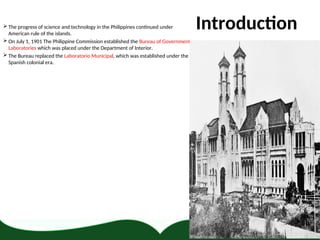
 On July 1, 1901 The Philippine Commission established the Bureau of Government
Laboratories which was placed under the Department of Interior.
 The Bureau replaced the Laboratorio Municipal, which was established under the
Spanish colonial era.
 The Bureau dealt with the study of tropical diseases and laboratory
projects.
 On October 26, 1905, the Bureau of Government Laboratories was
replaced by the Bureau of Science and on December 8, 1933, the National
Research Council of the Philippines was established.
 The Bureau of Science became the primary research center of the
Philippines until World War II.
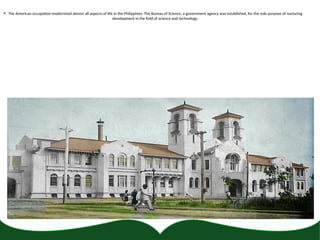
 The American occupation modernized almost all aspects of life in the Philippines. The Bureau of Science, a government agency was established, for the sole purpose of nurturing
development in the field of science and technology.
 There was remarkable scientific progress in the Philippines during
the American period. Modern techniques and research in
medicine, pharmacy, biology and technology and other Western
Sciences sprang in the Philippines.
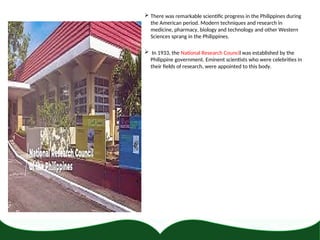
 In 1933, the National Research Council was established by the
Philippine government. Eminent scientists who were celebrities in
their fields of research, were appointed to this body.
1. Science and Technology during the American Regime
Sciences
Among the Filipinos who contributed to the progress of science during the American times were the following:

Dr. Angel S. Arguelles, the first Filipino director of the Bureau of Science

Dr. Eliodoro Mercado, noted leprologist

Dr. Miguel Canizares, the first surgeon in the Far East to perform the Jacobian operation on tubercular patients

Dr. Joaquin Maranon, an eminent botanist

Dr. Pedro Lantin, an authority on typhoid fever

Dr. Eduardo Quisumbing, a distinguished orchidist

Dr. Leopoldo B. Uichangco, a learned entomologist
 Public health which had been neglected by Spain was promoted by America in the
country.
 At the beginning of the American regime, two government agencies were established
to safeguard the health and sanitation of the people namely, the Bureau of Health and
the Quarantine Service.
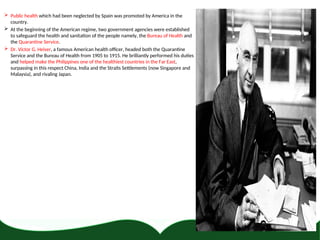
 Dr. Victor G. Heiser, a famous American health officer, headed both the Quarantine
Service and the Bureau of Health from 1905 to 1915. He brilliantly performed his duties
and helped make the Philippines one of the healthiest countries in the Far East,
surpassing in this respect China, India and the Straits Settlements (now Singapore and
Malaysia), and rivaling Japan.
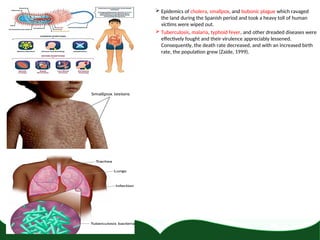
 Epidemics of cholera, smallpox, and bubonic plague which ravaged
the land during the Spanish period and took a heavy toll of human
victims were wiped out.
 Tuberculosis, malaria, typhoid fever, and other dreaded diseases were
effectively fought and their virulence appreciably lessened.
Consequently, the death rate decreased, and with an increased birth
rate, the population grew (Zaide, 1999).
 Science during the American period was inclined towards agriculture, food processing, forestry, medicine and pharmacy.
 Not much focus was given on the development of industrial technology due to free trade policy with the United States which
nurtured an economy geared towards agriculture and trade. In 1946 the Bureau of Science was replaced by the Institute of
Science.
 In a report by the US Economic Survey to the Philippines in 1950, there is a lack of basic information which were
necessities to the country’s industries, lack of support of experimental work and minimal budget for scientific research
and low salaries of scientists employed by the government. In 1958, during the regime of President Carlos P. Garcia,
the Philippine Congress passed the Science Act of 1958 which established the National Science Development Board.

Science and Technology during American Regime

  • 1.
    Science, Technology and Society(STS) Science and Technology during American Regime in the Philippines
  • 2.
    Learning Outcomes: At theend of the lesson, the students should be able to: 1. explain how early Filipinos applied scientific principles in their daily living; 2. trace the development of science and technology during the American period; and 3. record important contributions of the Filipinos and Americans in science and technology during American occupation.
  • 3.
    Introduction  The progressof science and technology in the Philippines continued under American rule of the islands.  On July 1, 1901 The Philippine Commission established the Bureau of Government Laboratories which was placed under the Department of Interior.  The Bureau replaced the Laboratorio Municipal, which was established under the Spanish colonial era.
  • 4.
     The Bureaudealt with the study of tropical diseases and laboratory projects.  On October 26, 1905, the Bureau of Government Laboratories was replaced by the Bureau of Science and on December 8, 1933, the National Research Council of the Philippines was established.  The Bureau of Science became the primary research center of the Philippines until World War II.
  • 5.
     The Americanoccupation modernized almost all aspects of life in the Philippines. The Bureau of Science, a government agency was established, for the sole purpose of nurturing development in the field of science and technology.
  • 6.
     There wasremarkable scientific progress in the Philippines during the American period. Modern techniques and research in medicine, pharmacy, biology and technology and other Western Sciences sprang in the Philippines.  In 1933, the National Research Council was established by the Philippine government. Eminent scientists who were celebrities in their fields of research, were appointed to this body.
  • 7.
    1. Science andTechnology during the American Regime Sciences Among the Filipinos who contributed to the progress of science during the American times were the following:  Dr. Angel S. Arguelles, the first Filipino director of the Bureau of Science  Dr. Eliodoro Mercado, noted leprologist  Dr. Miguel Canizares, the first surgeon in the Far East to perform the Jacobian operation on tubercular patients  Dr. Joaquin Maranon, an eminent botanist  Dr. Pedro Lantin, an authority on typhoid fever  Dr. Eduardo Quisumbing, a distinguished orchidist  Dr. Leopoldo B. Uichangco, a learned entomologist
  • 8.
     Public healthwhich had been neglected by Spain was promoted by America in the country.  At the beginning of the American regime, two government agencies were established to safeguard the health and sanitation of the people namely, the Bureau of Health and the Quarantine Service.  Dr. Victor G. Heiser, a famous American health officer, headed both the Quarantine Service and the Bureau of Health from 1905 to 1915. He brilliantly performed his duties and helped make the Philippines one of the healthiest countries in the Far East, surpassing in this respect China, India and the Straits Settlements (now Singapore and Malaysia), and rivaling Japan.
  • 9.
     Epidemics ofcholera, smallpox, and bubonic plague which ravaged the land during the Spanish period and took a heavy toll of human victims were wiped out.  Tuberculosis, malaria, typhoid fever, and other dreaded diseases were effectively fought and their virulence appreciably lessened. Consequently, the death rate decreased, and with an increased birth rate, the population grew (Zaide, 1999).
  • 10.
     Science duringthe American period was inclined towards agriculture, food processing, forestry, medicine and pharmacy.  Not much focus was given on the development of industrial technology due to free trade policy with the United States which nurtured an economy geared towards agriculture and trade. In 1946 the Bureau of Science was replaced by the Institute of Science.  In a report by the US Economic Survey to the Philippines in 1950, there is a lack of basic information which were necessities to the country’s industries, lack of support of experimental work and minimal budget for scientific research and low salaries of scientists employed by the government. In 1958, during the regime of President Carlos P. Garcia, the Philippine Congress passed the Science Act of 1958 which established the National Science Development Board.

Editor's Notes

  • #6 In 1521, the Spaniards, led by Ferdinand Magellan, discovered the islands. The Spanish conquistadores established a colonial government in Cebu in 1565. They transferred the seat of government to Manila in 1571 and proceeded to colonize the country. The principalía or noble class was the ruling and usually educated upper class in the pueblos of Spanish Philippines,