CHAPTER 6.1
Solutions and Other Mixtures
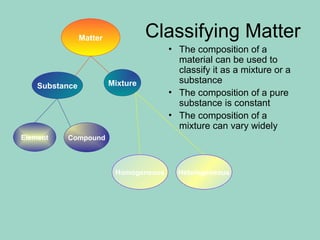
Classifying Matter
• The composition of a
material can be used to
classify it as a mixture or a
substance
• The composition of a pure
substance is constant
• The composition of a
mixture can vary widely
Matter
Substance Mixture
Element
Heterogeneous
Homogeneous
Compound
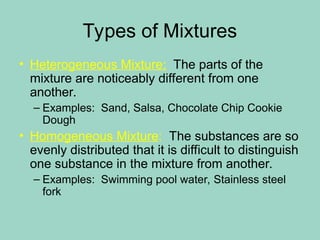
Types of Mixtures
• Heterogeneous Mixture: The parts of the
mixture are noticeably different from one
another.
– Examples: Sand, Salsa, Chocolate Chip Cookie
Dough
• Homogeneous Mixture: The substances are so
evenly distributed that it is difficult to distinguish
one substance in the mixture from another.
– Examples: Swimming pool water, Stainless steel
fork
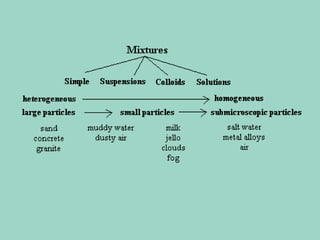
Solutions, Suspensions, & Colloids
• Mixtures can be
classified based
on the size of
their largest
particles.
Suspension
• Suspension –
• Settles out or separates into different
layers when it is no longer agitated
• (no longer moving).
• Heterogeneous mixture
• Separates into layers over time
• Particles can be trapped by filter
paper (like a coffee filter)
• Are cloudy in appearance
• Examples: Sand and Water
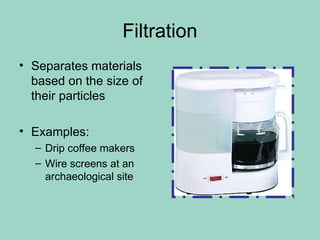
Filtration
• Separates materials
based on the size of
their particles
• Examples:
– Drip coffee makers
– Wire screens at an
archaeological site
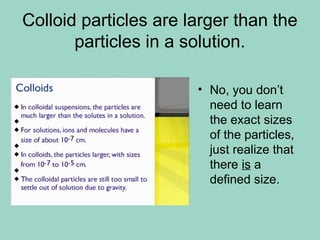
Colloid particles are larger than the
particles in a solution.
• No, you don’t
need to learn
the exact sizes
of the particles,
just realize that
there is a
defined size.
Colloids
• Contain some particles that are intermediate in
size and are in between the small parts in a
solution, and the larger particles in a
suspension.
• They do not separate in layers
• You can’t use a filter to separate the parts of a colloid
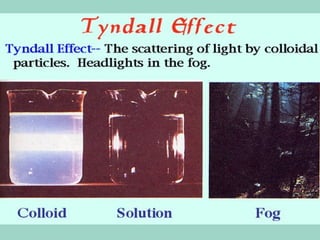
• The scattering of light property can be used to
separate them from other mixtures
Colloids
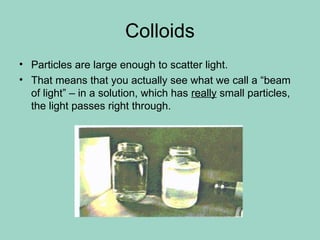
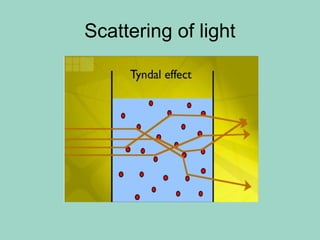
• Particles are large enough to scatter light.
• That means that you actually see what we call a “beam
of light” – in a solution, which has really small particles,
the light passes right through.
Scattering of light
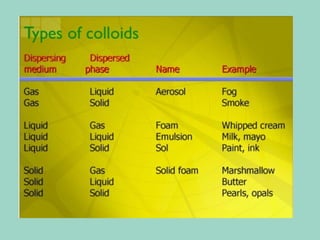
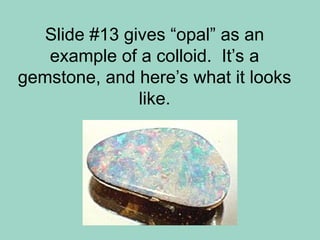
Slide #13 gives “opal” as an
example of a colloid. It’s a
gemstone, and here’s what it looks
like.
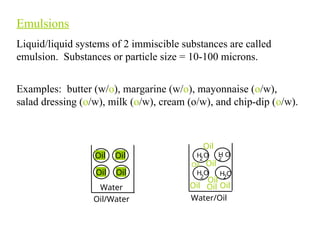
Emulsions
Liquid/liquid systems of 2 immiscible substances are called
emulsion. Substances or particle size = 10-100 microns.
Examples: butter (w/o), margarine (w/o), mayonnaise (o/w),
salad dressing (o/w), milk (o/w), cream (o/w), and chip-dip (o/w).
Water
Oil
Oil
Oil
Oil
Oil
H O
H O
H O
H O
Oil/Water Water/Oil
2 2
2 2
Oil
Oil Oil
Oil
Oil
Oil
Solutions
• Formed when substances dissolve and
form a homogeneous mixture
• Characteristics
– Do not separate into distinct layers over time
– Will not leave trapped substances when
poured through a filter
– Most are translucent (clear or see-through)
Solutions
• Solvent
• Substance that dissolves
the solute,
• stuff “doing the
dissolving.”
• Water in salt and water
• water in “sweet tea”
• What you have the most
of!
• Solute
• Substance that
dissolves in the
solution.
• Salt in the water
• Sugar in the tea
• Chemicals put in your
fish tank.
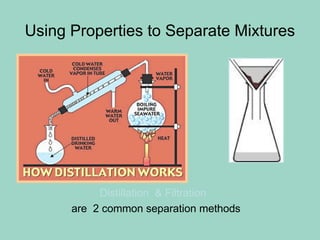
Using Properties to Separate Mixtures
Distillation & Filtration
are 2 common separation methods

science about mixture grade six deped ppt

  • 1.
  • 2.
    Classifying Matter • Thecomposition of a material can be used to classify it as a mixture or a substance • The composition of a pure substance is constant • The composition of a mixture can vary widely Matter Substance Mixture Element Heterogeneous Homogeneous Compound
  • 3.
    Types of Mixtures •Heterogeneous Mixture: The parts of the mixture are noticeably different from one another. – Examples: Sand, Salsa, Chocolate Chip Cookie Dough • Homogeneous Mixture: The substances are so evenly distributed that it is difficult to distinguish one substance in the mixture from another. – Examples: Swimming pool water, Stainless steel fork
  • 4.
    Solutions, Suspensions, &Colloids • Mixtures can be classified based on the size of their largest particles.
  • 6.
    Suspension • Suspension – •Settles out or separates into different layers when it is no longer agitated • (no longer moving). • Heterogeneous mixture • Separates into layers over time • Particles can be trapped by filter paper (like a coffee filter) • Are cloudy in appearance • Examples: Sand and Water
  • 7.
    Filtration • Separates materials basedon the size of their particles • Examples: – Drip coffee makers – Wire screens at an archaeological site
  • 8.
    Colloid particles arelarger than the particles in a solution. • No, you don’t need to learn the exact sizes of the particles, just realize that there is a defined size.
  • 9.
    Colloids • Contain someparticles that are intermediate in size and are in between the small parts in a solution, and the larger particles in a suspension. • They do not separate in layers • You can’t use a filter to separate the parts of a colloid • The scattering of light property can be used to separate them from other mixtures
  • 10.
    Colloids • Particles arelarge enough to scatter light. • That means that you actually see what we call a “beam of light” – in a solution, which has really small particles, the light passes right through.
  • 12.
  • 14.
    Slide #13 gives“opal” as an example of a colloid. It’s a gemstone, and here’s what it looks like.
  • 15.
    Emulsions Liquid/liquid systems of2 immiscible substances are called emulsion. Substances or particle size = 10-100 microns. Examples: butter (w/o), margarine (w/o), mayonnaise (o/w), salad dressing (o/w), milk (o/w), cream (o/w), and chip-dip (o/w). Water Oil Oil Oil Oil Oil H O H O H O H O Oil/Water Water/Oil 2 2 2 2 Oil Oil Oil Oil Oil Oil
  • 16.
    Solutions • Formed whensubstances dissolve and form a homogeneous mixture • Characteristics – Do not separate into distinct layers over time – Will not leave trapped substances when poured through a filter – Most are translucent (clear or see-through)
  • 17.
    Solutions • Solvent • Substancethat dissolves the solute, • stuff “doing the dissolving.” • Water in salt and water • water in “sweet tea” • What you have the most of! • Solute • Substance that dissolves in the solution. • Salt in the water • Sugar in the tea • Chemicals put in your fish tank.
  • 18.
    Using Properties toSeparate Mixtures Distillation & Filtration are 2 common separation methods