National Training of
Trainers for Campus
Journalism
SCIENCE WRITING (NEWS, FEATURE & EDITORIAL)
Julia Jasmine Sta Romana
Science and Technology/Lifestyle Contributor for GMA News Online
Freelance writer and virtual assistant
ICT Davao, member
www.gmanetwork.com/news/archives/authors/juliajasminemadrazostaromana
twitter.com/JuliaMStaRomana
Assessment
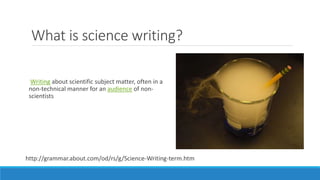
What is science writing?
Writing about scientific subject matter, often in a
non-technical manner for an audience of non-
scientists
http://grammar.about.com/od/rs/g/Science-Writing-term.htm
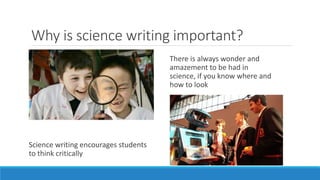
Why is science writing important?
There is always wonder and
amazement to be had in
science, if you know where and
how to look
Science writing encourages students
to think critically
Science = Boring?
Science News
Basically news about science
Pig farmers on New Ireland are battling an insect plague which has
already killed more than 500 pigs on the island.
The insect, which is related to the horse fly, has already devastated
herds in Africa and South East Asia.
The new species called penetrens lugoles lays its eggs in pigs' ears.
When the eggs hatch, the maggots burrow into the animal's brain in
search of food.
Where can students get science news?
1. Science fair
2. School events
3. Local science community
4. Make the process of learning science newsworthy
Writing exercise
Write a piece of science news based on what happened in your school
Science feature
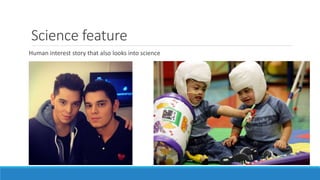
Human interest story that also looks into science
Write for your audience
Research, research, research
Simplify, but don’t dumb it down
Responsibilities of the editor
Stop/prevent
plagiarism
Ensure that the story is
comprehensible
What can student science journalists
feature?
What they see in media
Products they use
What affects them and their
communities directly
Their bodies
Exercise
Write a science feature on something you or your students are naturally interested in.
Science Editorial
a newspaper article written by or on behalf of an editor that gives an opinion on a science issue
Science Editorials
Focus on the facts
Analysis of the issue must
be based on scientific facts
and following the scientific
method
Assumptions raised must
be based on solid logic and
following the scientific
method
What issues in your community are
affected by science?
SAMPLE ARTICLES
Exercise
Write a science editorial
Bonus: Science Cartoon!
Cartoons are a great way to make learning science fun!
Fun Exercise: 1 panel science comic
based on geeky pick-up lines
Thank you for participating!
Resources
http://www.wfsj.org/course/index-e.html
http://boredomtherapy.com/nerd-science-jokes/
http://xkcd.com/
http://www.scidev.net/global/biotechnology/news/citizen-scientists-pitch-new-uses-for-paper-microscope.html
http://www.gmanetwork.com/news/story/401385/scitech/science/us-backed-uplb-graduate-program-focused-on-marine-biodiversity
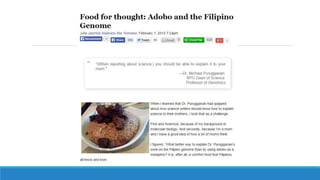
http://www.gmanetwork.com/news/story/293017/scitech/science/food-for-thought-adobo-and-the-filipino-genome
http://mypocketshurt90.tumblr.com/post/27495622491/i-sent-this-paper-to-jk-rowling-explaining-how-the
http://www.theguardian.com/commentisfree/2014/oct/09/guardian-view-on-ebola-fighting-fear-as-well-as-infection
http://www.beatricebiologist.com/
http://www.nextnature.net/wp-content/uploads/2008/04/news_writing_inverted_pyramid.jpg
Julia Jasmine Sta Romana
Science and Technology/Lifestyle Contributor for GMA News Online
Freelance writer and virtual assistant
ICT Davao, member
www.gmanetwork.com/news/archives/authors/juliajasminemadrazostaromana
twitter.com/JuliaMStaRomana

science journalism.pptx

Editor's Notes

  • #2 Do short welcome
  • #3 Introduce myself and flatter the attendees
  • #4 Assess the current situation of their school papers in terms of science journalism (do they have regular science news and features? What challenges are they facing?) We will try to address these issues throughout the course
  • #5 Simplest explanation
  • #6 Stress how science writing can benefit students and community
  • #7 Science is not boring! Show examples!
  • #8 Still follows the same principles of journalism (4 ws), you still need good research practices (primary sources if possible)
  • #12 School events (like Oltrap launch), local science community (DOST, DA, DENR, DOH)
  • #14 If there’s no human factor, it’s not a science feature, it’s a science paper.
  • #15 One common mistake of science journalists is when they drown their audience in technical jargon
  • #16 Find primary, latest sources as much as possible. Look to both sides of the story
  • #17 Bad analogy, comparing vaccines with small caliber bullets
  • #18 Plagiarism (students will copy/paste from sources when they don’t understand the concepts, so encourage your students to ask until they understand)
  • #25 Opinion must be substantiated by facts, science editorials allows your students to discuss issues in an educated manner
  • #43 Introduce myself and flatter the attendees