INTRODUCTION TO
PHYSICAL FACILITIES
PLANNING
OBJECTIVES
1. Discuss the essential foundation of physical facilities
in educational planning.
2. Identify the procedures in planning physical facilities
and content of educational facilities specifications.
3. Determine requisite conditions for modernization
using Castaldi Generalized Formula.
 Physical Facilities (also known as physical
plant) for education comprises land,
buildings, and furniture. It includes physical
facilities for teaching and learning, spaces
and for ancillary rooms. (John Beynon)
 Physical facilities for education include all
material resources that are needed to impart
formal education. It may include land,
building, furniture, laboratory and library.
(Amjad Ali Arain)
 Physical Facilities are often regarded as
educational tools designed to facilitate,
promote, and stimulate the educational
program. Sometimes possess physical
characteristics that impose severe restrictions
on the educational program.
 Physical facilities and resources form an
essential foundation in educational planning
for the school programs, the importance of
which is reflected in the goal: ā€œ To provide an
educational environment that fosters
effective teaching and learning.ā€ The School
must recognize its essentials to provide
sufficient physical resources and facilities in
order to accomplish its vision, mission,
goals, and instructional objectives.
 The improvements along with the physical
resources and facilities of the School and the
University provide an excellent learning
environment, reinforcing the quality of the
teaching and learning process and enhanced
opportunities to meet the instructional
challenges of the information age.
 Physical facilities in education such as building
and equipment represent the school largest
element of the educational budget after
teacher’s salaries. They typically account for
20% to 25% of the overall education budget.
 Fire Safety – points to be considered in evaluating
the fire safety of a school include heating plants,
escape of combustible gases, the rapidity with which
fire may spread through the structure, electrical
wiring, and overloaded circuits, storage of
combustible materials, fire alarm systems, condition
and serviceability of fire extinguishers, and safety of
emergency egress from the building.
 Structural Soundness – building should be
structurally sound that they provide a secure
learning environment. Structural engineer is needed
to examined observable structural deterioration to
the point of endangering lives of its occupants.
 Environmental Conditions – Essential visual
environment of the school includes the quality of
illumination, brightness balances in the instructional
areas, freedom from glare in the visual sphere of
the students, performance of heating and
ventilating systems and an appraisal of acoustical
environment particularly in every quiet or extremely
noisy areas.
 Other Safety Considerations – The school should
be carefully note the improper location of doors,
worn stairs treads, loose plaster, slippery floors,
and unprotected plate glass, layout of driveways,
the location of student bus-loading zones, the type
and condition of play equipment, the various play
surfaces, and the presence of unprotected high-
voltage electrical transformers.
 Task One: Developing Long-Range
Plan
1. Make an Enrolment Projection – once the
average grade-by-grade ratios are computed, it
is necessary to refine these ratios by applying
reasoned professional judgement.
2. Conduct a School Building Survey – the
school building report contains an evaluation of
existing buildings in relation to the educational
functions.
3. Adopt a Long-Range Building Plan – the process
whereby the actions of the past and present are
logically and sensibly related to those planned for
the future educational programs, existing buildings,
student population, and finance must be examined
and carefully considered
4. Take Official Action – school officials and the
board of education would normally begin to
implement the plan in accordance with the order of
priorities specified in along-range plan.
5. Enlist Citizen Partnership – citizen participation
should be encourage by school officials and the
board of education.
 Task Two: Generating Public Support
6. Assess Public Attitude – it can take the form
of an open discussion called by the board of
education with parents, teachers, school
administrators, students and classified staff.
7. Develop a Strategy for Gaining Public
Support – know the level of public support for
potential bond referendum and to select a
technique that is motivating rather than
coercive, and one that is in harmony with public
sentiment.
 Task Three: Planning a School
Building
8. Obtain Planning Funds – setting aside
sufficient funds for the complete planning
process including cost of on going bid.
9. Secure Professional Services – the
architect has the primary responsibility for
translating educational concepts and
functions into educational facilities that are
conducive and effective learning. Every
board member should clearly understand
that the architect strongly affects both the
function and the cost of a school building.
10. Select the School Site – ideally, new
schools should be located where they
provide maximum convenience and safety for
the students. The selection of school site, the
school board should seek the advice of
superintendent, chief administrators and other
member of professional staff including architect
and the educational consultant for
recommendation and for making final
determination.
11. Prepare a Comprehensive Set of Educational
Specifications – the consultant submits the
complete set of educational specifications to the
superintendent of schools and to be submitted to the
board of education for its final review and approval
and they are transmitted to the architect who will
follow them in designing the building.
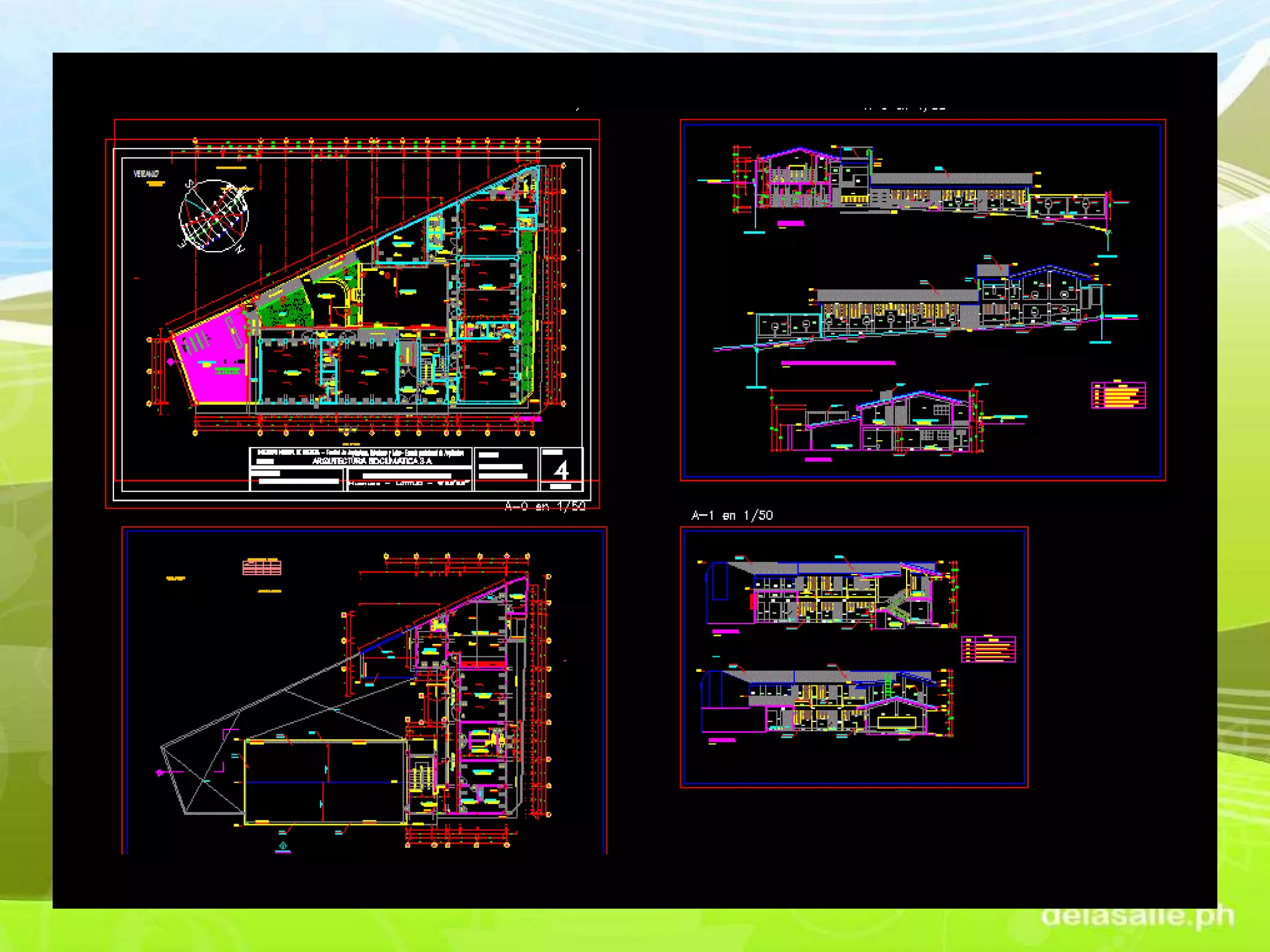
12. Stage 1 – Preliminary Drawings (Schematic
Design Phase) - It is at this time that the
educational consultant can make the greatest
impact on the function of the building and can get
positive responses to changes from the architect.
13. Stage 2 – Progress Prints (Design Development
Plan) – The functional design features of the school
are beginning to display their ultimate form, and
the major economy measures influenced by the design
of the school have been taken. The various engineers
and consultant begin working on the project in tangible
way. They begin to make studies, calculation and
drawings that supplemented the architectural design
14. Stage 3 – Final Working Drawing and Specifications
– At this point 95% of educational planning is completed.
The architect is deeply involved in a multitude of client-
oriented details such as the choice of surface materials ,
the selection of doors, the development of an integrated
lock system, the selection of appropriate fixed
educational equipment in the laboratories and learning
resource centers, and the choice of communication
systems.
15. Procedures After the Aproval Drawings and
Specifications – After the board of education has
approved the final working drawings and
specifications, these documents are made
available in sufficient quantities to all contractors
wishing to submit bids for the construction of the
school. For the most part, the architect is
responsible for all of the technical work associated
with bidding and the awarding of bids to the
lowest responsible bidder, as required by law for the
construction of buildings financed by public funds.
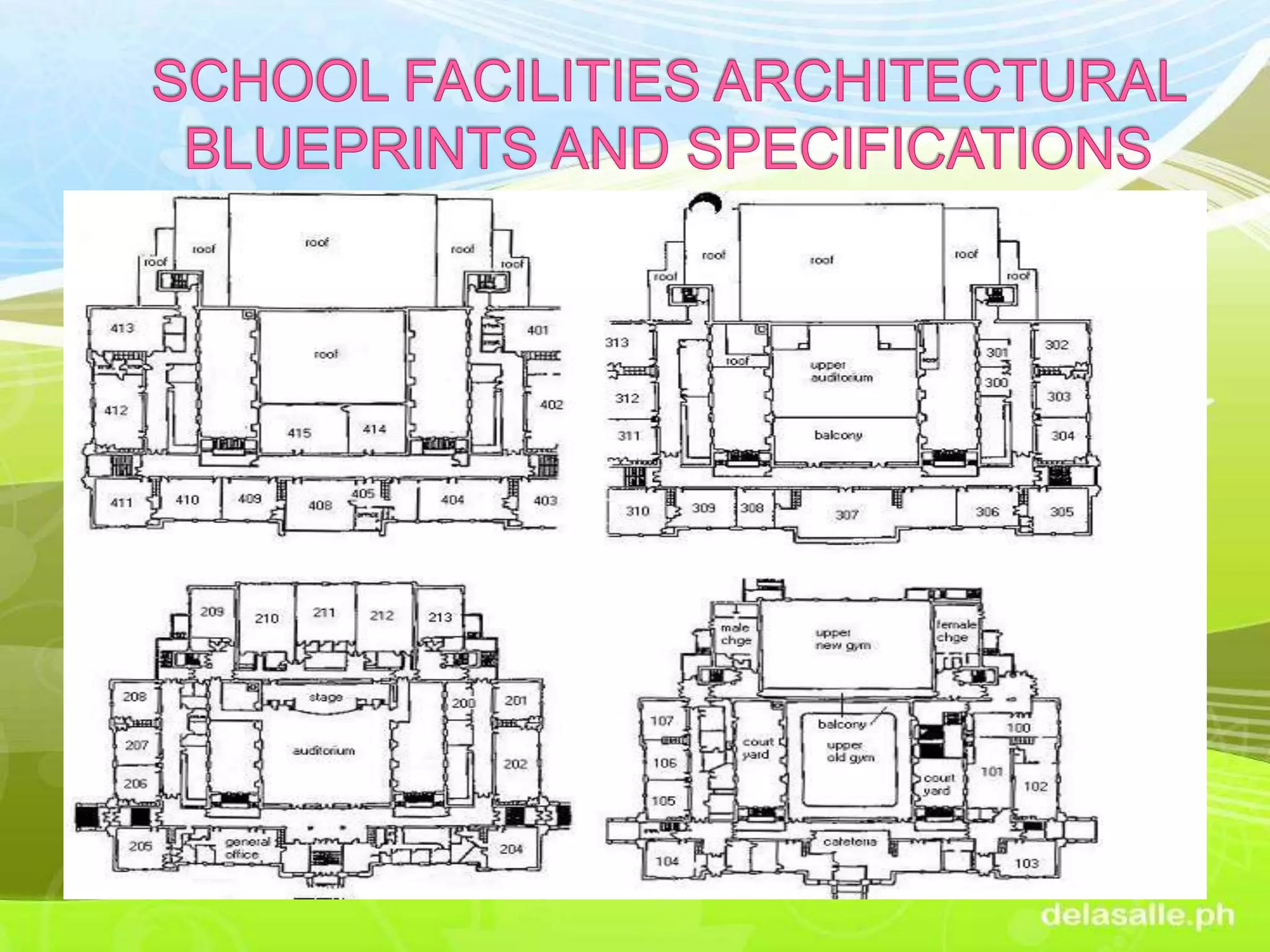
 Part I: Description of the Educational
Function – the description of operational and
educational function of each space and activity or
educational program to be housed in every part of the
building should be so detailed that the architect will be
able to visualize the entire school in operation before
making a single sketch or design.
 Part II: Physical Specifics of the Desired
School Facility – From the standpoint of the
architect in school plant planning, the data specifics
must include: Number and types of spaces, Suggested
size of each space and Space relationships.
Part III: Description of Special Physical
Features – It is essential that all exceptional or
special features of a school building be clearly set forth
space by space. Special features are most often
concerned with shape, ceiling height, intensity of
lightning, acoustical condition or insulation from other
spaces, humidity and temperature control, orientation,
color, ability of floor to support more than average
weight, type of flooring, arrangement of built-in
equipments and utilities including elevation and
foundation.
1. Rehabilitation – The school building is simply
restored to the same conditioned it was in when
it was it built.
2. Remodelling – The school building changes in
the view, size and shape of any space within
the building.
3. Modernization – Existing school facilities is
brought up-to-date structurally, and
environmentally.
 The formula consider the initial cost, the expected
life of the facility, and the ability of an existing
facility to physical and efficiently adapt to new
functions. The formulas are based on the rate of
depreciation. The fundamental determinate is the
annual rate of depreciation as represented by the
amount of capital outlay required to provide a
school that is adequately in every respect. The
formula postulates that the financial feasibility is not
based on the initial construction cost but on the
rate at which the initial cost is likely to depreciate
over a period of years.
 As a requisite, before modernization can be justified as
the best expenditure of public funds in any school
district, Castaldi Generalized Formula has developed a
list of seven question that must be answered in the
affirmative to qualify for modernization?
1. Is the school building under consideration needed in its
present location for at least 75% percent of its
remaining useful life after modernization?
2. It is impractical to distribute the pupil load of the school
considered for modernization among nearby adequate
schools?
3. Does the structure lend itself to improvement, alteration,
remodelling and expansion?
4. Does the modernization building fit into a well conceived
long-range plan?
5. Can the site of the school considered for modernization
be expected minimum standards for the ultimate
enrollment envisioned on the site?
6. In accordance with Castaldi Generalized Formula, is the
annual cost of capital outlay for modernization less than
it would be replacement building?
7. Has a blue-ribbon committee concluded that eductional
obsolescence of a given building can be substantially
eliminated through the process of modernization?
 There are two approaches discussed in the Formula.
One approach focuses on actual economic
considerations and is noted as Rules of Thumb. The
second approach is the Castaldi Generalized Formula,
which is a mathematical method to evaluate the
economic feasibility of modernization versus
replacement.
RULES OF THUMB
Rule 1: If the cost of modernization is 40% or more of
replacement, then the decision to modernize is
questionable.
Rule 2: If any two of the following items are required,
modernization should be questioned.
A. Major replacement of plumbing and air conditioning.
B. Total replacement of electrical wiring.
C. Basic structural changes involving space arrangement.
D. Complete replacement of roofing.
E. Complete revamping of fenestration pattern.
Example: Let assume that a school building is 35 years old and
is estimated to have a remaining life of 30 years after
modernization and would contain unavoidable compromises
so that its educational adequacy is judged to be about 90%
of that expected for its replacement. It is also assumed that
the replacement would have an expected life of 65 years.
40% (cost of replacement) (cost of replacement)
(30) (.90) 65
0.4 __1__
(30)(0.90) 65
0.0148 < 0.0154
Since the left side of the expression is less than the right,
modernization is justifiable according to the generalized formula.
Both rules of thumbs are more related to the expenditures
required for modernization.
Ce + Ch + Cs R
(Lm) (Ia) Lr
Ce – Total Cost of Educational Improvements, may include
the expansion of new site, new wiring and
accommodating new teaching practices.
Ch – Total Cost of Improvement in Healthfulness (physical,
psychological and aesthetics)
Cs – Total Cost for Improvements in Safety
Ia – Estimated Index of Educational Adequacy (0 – 1)
Lm – Estimated Useful Life of the Modernized School
R – Cost of Replacement of School Considered for
Modernization
Lr – Estimated Life of New Building
AVERAGE CAPITAL COST
PER YEAR OVER REMAINING
LIFE OF MODERNIZED
SCHOOL BUILDINGS
AVERAGE CAPITAL COST
PER YEAR OVER THE
EXPECTED LIFE OF NEW
BUILDING REPLACING
EXISTING SCHOOL
BUIILDING
ITEMS FACTOR
IA = Estimate Index of Educational
Adequacy
0.75
Expected Life of Existing Facility 65
Age of Existing Facility 26
LM = Estimated useful life of Modernizing 39
R = Replacement Cost of New Building 524,643.00
LR = Useful Life of New Building 65
CE+CH+CS 260,288.00
_260,288.00 524,643.00_
65 – 26 (0.75) 65
260,288.00_ 524,643.00
29.5 65
8,898.74 > 8,071.43
REPLACEMENT IS JUSTIFIED
ITEMS FACTOR
IA = Estimate Index of Educational
Adequacy
0.75
Expected Life of Existing Facility 65
Age of Existing Facility 14
LM = Estimated useful life of Modernizing 51
R = Replacement Cost of New Building 963,968.00
LR = Useful Life of New Building 65
CE+CH+CS 1,942,998.00
_963,968.00 1,942,998.00_
65 – 14 (0.75) 65
963,968.00_ 1,942,998.00
38.25 65
25,201.78 < 29,892.28
RENOVATION/MODERNIZATION IS JUSTIFIED
Planning physical facilities final report

Planning physical facilities final report

  • 1.
  • 2.
    OBJECTIVES 1. Discuss theessential foundation of physical facilities in educational planning. 2. Identify the procedures in planning physical facilities and content of educational facilities specifications. 3. Determine requisite conditions for modernization using Castaldi Generalized Formula.
  • 3.
     Physical Facilities(also known as physical plant) for education comprises land, buildings, and furniture. It includes physical facilities for teaching and learning, spaces and for ancillary rooms. (John Beynon)
  • 4.
     Physical facilitiesfor education include all material resources that are needed to impart formal education. It may include land, building, furniture, laboratory and library. (Amjad Ali Arain)  Physical Facilities are often regarded as educational tools designed to facilitate, promote, and stimulate the educational program. Sometimes possess physical characteristics that impose severe restrictions on the educational program.
  • 5.
     Physical facilitiesand resources form an essential foundation in educational planning for the school programs, the importance of which is reflected in the goal: ā€œ To provide an educational environment that fosters effective teaching and learning.ā€ The School must recognize its essentials to provide sufficient physical resources and facilities in order to accomplish its vision, mission, goals, and instructional objectives.
  • 6.
     The improvementsalong with the physical resources and facilities of the School and the University provide an excellent learning environment, reinforcing the quality of the teaching and learning process and enhanced opportunities to meet the instructional challenges of the information age.  Physical facilities in education such as building and equipment represent the school largest element of the educational budget after teacher’s salaries. They typically account for 20% to 25% of the overall education budget.
  • 7.
     Fire Safety– points to be considered in evaluating the fire safety of a school include heating plants, escape of combustible gases, the rapidity with which fire may spread through the structure, electrical wiring, and overloaded circuits, storage of combustible materials, fire alarm systems, condition and serviceability of fire extinguishers, and safety of emergency egress from the building.  Structural Soundness – building should be structurally sound that they provide a secure learning environment. Structural engineer is needed to examined observable structural deterioration to the point of endangering lives of its occupants.
  • 8.
     Environmental Conditions– Essential visual environment of the school includes the quality of illumination, brightness balances in the instructional areas, freedom from glare in the visual sphere of the students, performance of heating and ventilating systems and an appraisal of acoustical environment particularly in every quiet or extremely noisy areas.  Other Safety Considerations – The school should be carefully note the improper location of doors, worn stairs treads, loose plaster, slippery floors, and unprotected plate glass, layout of driveways, the location of student bus-loading zones, the type and condition of play equipment, the various play surfaces, and the presence of unprotected high- voltage electrical transformers.
  • 9.
     Task One:Developing Long-Range Plan 1. Make an Enrolment Projection – once the average grade-by-grade ratios are computed, it is necessary to refine these ratios by applying reasoned professional judgement. 2. Conduct a School Building Survey – the school building report contains an evaluation of existing buildings in relation to the educational functions.
  • 10.
    3. Adopt aLong-Range Building Plan – the process whereby the actions of the past and present are logically and sensibly related to those planned for the future educational programs, existing buildings, student population, and finance must be examined and carefully considered 4. Take Official Action – school officials and the board of education would normally begin to implement the plan in accordance with the order of priorities specified in along-range plan. 5. Enlist Citizen Partnership – citizen participation should be encourage by school officials and the board of education.
  • 11.
     Task Two:Generating Public Support 6. Assess Public Attitude – it can take the form of an open discussion called by the board of education with parents, teachers, school administrators, students and classified staff. 7. Develop a Strategy for Gaining Public Support – know the level of public support for potential bond referendum and to select a technique that is motivating rather than coercive, and one that is in harmony with public sentiment.
  • 12.
     Task Three:Planning a School Building 8. Obtain Planning Funds – setting aside sufficient funds for the complete planning process including cost of on going bid. 9. Secure Professional Services – the architect has the primary responsibility for translating educational concepts and functions into educational facilities that are conducive and effective learning. Every board member should clearly understand that the architect strongly affects both the function and the cost of a school building.
  • 13.
    10. Select theSchool Site – ideally, new schools should be located where they provide maximum convenience and safety for the students. The selection of school site, the school board should seek the advice of superintendent, chief administrators and other member of professional staff including architect and the educational consultant for recommendation and for making final determination.
  • 14.
    11. Prepare aComprehensive Set of Educational Specifications – the consultant submits the complete set of educational specifications to the superintendent of schools and to be submitted to the board of education for its final review and approval and they are transmitted to the architect who will follow them in designing the building. 12. Stage 1 – Preliminary Drawings (Schematic Design Phase) - It is at this time that the educational consultant can make the greatest impact on the function of the building and can get positive responses to changes from the architect.
  • 15.
    13. Stage 2– Progress Prints (Design Development Plan) – The functional design features of the school are beginning to display their ultimate form, and the major economy measures influenced by the design of the school have been taken. The various engineers and consultant begin working on the project in tangible way. They begin to make studies, calculation and drawings that supplemented the architectural design 14. Stage 3 – Final Working Drawing and Specifications – At this point 95% of educational planning is completed. The architect is deeply involved in a multitude of client- oriented details such as the choice of surface materials , the selection of doors, the development of an integrated lock system, the selection of appropriate fixed educational equipment in the laboratories and learning resource centers, and the choice of communication systems.
  • 16.
    15. Procedures Afterthe Aproval Drawings and Specifications – After the board of education has approved the final working drawings and specifications, these documents are made available in sufficient quantities to all contractors wishing to submit bids for the construction of the school. For the most part, the architect is responsible for all of the technical work associated with bidding and the awarding of bids to the lowest responsible bidder, as required by law for the construction of buildings financed by public funds.
  • 17.
     Part I:Description of the Educational Function – the description of operational and educational function of each space and activity or educational program to be housed in every part of the building should be so detailed that the architect will be able to visualize the entire school in operation before making a single sketch or design.  Part II: Physical Specifics of the Desired School Facility – From the standpoint of the architect in school plant planning, the data specifics must include: Number and types of spaces, Suggested size of each space and Space relationships.
  • 18.
    Part III: Descriptionof Special Physical Features – It is essential that all exceptional or special features of a school building be clearly set forth space by space. Special features are most often concerned with shape, ceiling height, intensity of lightning, acoustical condition or insulation from other spaces, humidity and temperature control, orientation, color, ability of floor to support more than average weight, type of flooring, arrangement of built-in equipments and utilities including elevation and foundation.
  • 19.
    1. Rehabilitation –The school building is simply restored to the same conditioned it was in when it was it built. 2. Remodelling – The school building changes in the view, size and shape of any space within the building. 3. Modernization – Existing school facilities is brought up-to-date structurally, and environmentally.
  • 20.
     The formulaconsider the initial cost, the expected life of the facility, and the ability of an existing facility to physical and efficiently adapt to new functions. The formulas are based on the rate of depreciation. The fundamental determinate is the annual rate of depreciation as represented by the amount of capital outlay required to provide a school that is adequately in every respect. The formula postulates that the financial feasibility is not based on the initial construction cost but on the rate at which the initial cost is likely to depreciate over a period of years.
  • 21.
     As arequisite, before modernization can be justified as the best expenditure of public funds in any school district, Castaldi Generalized Formula has developed a list of seven question that must be answered in the affirmative to qualify for modernization? 1. Is the school building under consideration needed in its present location for at least 75% percent of its remaining useful life after modernization? 2. It is impractical to distribute the pupil load of the school considered for modernization among nearby adequate schools?
  • 22.
    3. Does thestructure lend itself to improvement, alteration, remodelling and expansion? 4. Does the modernization building fit into a well conceived long-range plan? 5. Can the site of the school considered for modernization be expected minimum standards for the ultimate enrollment envisioned on the site? 6. In accordance with Castaldi Generalized Formula, is the annual cost of capital outlay for modernization less than it would be replacement building? 7. Has a blue-ribbon committee concluded that eductional obsolescence of a given building can be substantially eliminated through the process of modernization?
  • 23.
     There aretwo approaches discussed in the Formula. One approach focuses on actual economic considerations and is noted as Rules of Thumb. The second approach is the Castaldi Generalized Formula, which is a mathematical method to evaluate the economic feasibility of modernization versus replacement. RULES OF THUMB Rule 1: If the cost of modernization is 40% or more of replacement, then the decision to modernize is questionable.
  • 24.
    Rule 2: Ifany two of the following items are required, modernization should be questioned. A. Major replacement of plumbing and air conditioning. B. Total replacement of electrical wiring. C. Basic structural changes involving space arrangement. D. Complete replacement of roofing. E. Complete revamping of fenestration pattern.
  • 25.
    Example: Let assumethat a school building is 35 years old and is estimated to have a remaining life of 30 years after modernization and would contain unavoidable compromises so that its educational adequacy is judged to be about 90% of that expected for its replacement. It is also assumed that the replacement would have an expected life of 65 years. 40% (cost of replacement) (cost of replacement) (30) (.90) 65 0.4 __1__ (30)(0.90) 65 0.0148 < 0.0154 Since the left side of the expression is less than the right, modernization is justifiable according to the generalized formula. Both rules of thumbs are more related to the expenditures required for modernization.
  • 26.
    Ce + Ch+ Cs R (Lm) (Ia) Lr Ce – Total Cost of Educational Improvements, may include the expansion of new site, new wiring and accommodating new teaching practices. Ch – Total Cost of Improvement in Healthfulness (physical, psychological and aesthetics) Cs – Total Cost for Improvements in Safety Ia – Estimated Index of Educational Adequacy (0 – 1) Lm – Estimated Useful Life of the Modernized School R – Cost of Replacement of School Considered for Modernization Lr – Estimated Life of New Building AVERAGE CAPITAL COST PER YEAR OVER REMAINING LIFE OF MODERNIZED SCHOOL BUILDINGS AVERAGE CAPITAL COST PER YEAR OVER THE EXPECTED LIFE OF NEW BUILDING REPLACING EXISTING SCHOOL BUIILDING
  • 27.
    ITEMS FACTOR IA =Estimate Index of Educational Adequacy 0.75 Expected Life of Existing Facility 65 Age of Existing Facility 26 LM = Estimated useful life of Modernizing 39 R = Replacement Cost of New Building 524,643.00 LR = Useful Life of New Building 65 CE+CH+CS 260,288.00 _260,288.00 524,643.00_ 65 – 26 (0.75) 65 260,288.00_ 524,643.00 29.5 65 8,898.74 > 8,071.43 REPLACEMENT IS JUSTIFIED
  • 28.
    ITEMS FACTOR IA =Estimate Index of Educational Adequacy 0.75 Expected Life of Existing Facility 65 Age of Existing Facility 14 LM = Estimated useful life of Modernizing 51 R = Replacement Cost of New Building 963,968.00 LR = Useful Life of New Building 65 CE+CH+CS 1,942,998.00 _963,968.00 1,942,998.00_ 65 – 14 (0.75) 65 963,968.00_ 1,942,998.00 38.25 65 25,201.78 < 29,892.28 RENOVATION/MODERNIZATION IS JUSTIFIED