by
JHANET ELFA C. SEASTRES
SCHOOL LEARNING
MANAGEMENT PROGRAM
Republic Act No.9155
Governance of Basic Education Act
of 2001
“ The School Head shall have the authority,
accountability and responsibility in developing
the School Education Program
and School Improvement Plan.
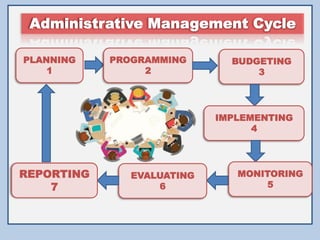
PLANNING
1
PROGRAMMING
2
BUDGETING
3
IMPLEMENTING
4
MONITORING
5
EVALUATING
6
REPORTING
7
Planning or plan formulation involves
the following phases: situation analysis,
goal setting, strategy formulation and
program identification
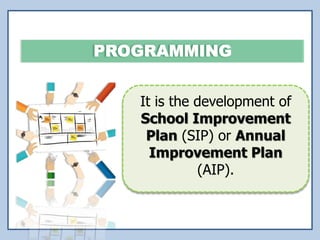
It is the development of
School Improvement
Plan (SIP) or Annual
Improvement Plan
(AIP).
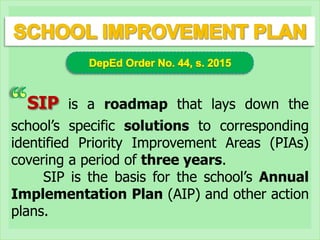
SIP is a roadmap that lays down the
school’s specific solutions to corresponding
identified Priority Improvement Areas (PIAs)
covering a period of three years.
SIP is the basis for the school’s Annual
Implementation Plan (AIP) and other action
plans.
SCHOOL IMPROVEMENT PLAN
Name of School
SY 2016-2019
I. DedEd Vision, Mission and Core Values
II.School’s Current Situation
III.Planning Worksheet
IV.Monitoring and Evaluation
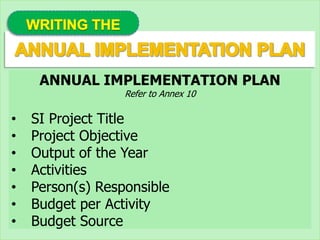
ANNUAL IMPLEMENTATION PLAN
Refer to Annex 10
• SI Project Title
• Project Objective
• Output of the Year
• Activities
• Person(s) Responsible
• Budget per Activity
• Budget Source
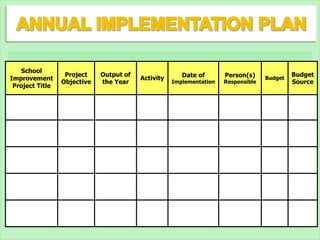
School
Improvement
Project Title
Project
Objective
Output of
the Year
Activity Date of
Implementation
Person(s)
Responsible
Budget
Budget
Source
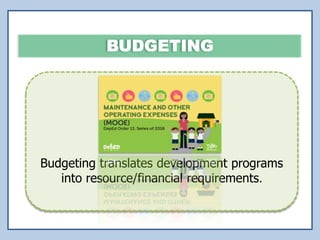
Budgeting translates development programs
into resource/financial requirements.
It is the execution of
projects or delivery of
services in support of the
development plan or
SIP/AIP, utilizing resources
allocated for these
purposes to achieve the
agreed improvements.
Monitoring is a collection of data on the
school’s actual performance in programs,
identification of problems encountered by the
program and formulation of solutions.
It involves the identification
and measurement of the
over-all outcomes of the
school’s programs.
Year-end reporting of the accomplished
targets is done during a public assembly to
be attended by the school constituencies.
• Set mission, goals, and targets of
school
• Development and implement the school
educational program
• Administer and manage personnel,
physical and fiscal resources
School Management Program (Human Resource)

School Management Program (Human Resource)

  • 1.
    by JHANET ELFA C.SEASTRES SCHOOL LEARNING MANAGEMENT PROGRAM
  • 2.
    Republic Act No.9155 Governanceof Basic Education Act of 2001 “ The School Head shall have the authority, accountability and responsibility in developing the School Education Program and School Improvement Plan.
  • 3.
  • 4.
    Planning or planformulation involves the following phases: situation analysis, goal setting, strategy formulation and program identification
  • 5.
    It is thedevelopment of School Improvement Plan (SIP) or Annual Improvement Plan (AIP).
  • 6.
    SIP is aroadmap that lays down the school’s specific solutions to corresponding identified Priority Improvement Areas (PIAs) covering a period of three years. SIP is the basis for the school’s Annual Implementation Plan (AIP) and other action plans.
  • 7.
    SCHOOL IMPROVEMENT PLAN Nameof School SY 2016-2019 I. DedEd Vision, Mission and Core Values II.School’s Current Situation III.Planning Worksheet IV.Monitoring and Evaluation
  • 8.
    ANNUAL IMPLEMENTATION PLAN Referto Annex 10 • SI Project Title • Project Objective • Output of the Year • Activities • Person(s) Responsible • Budget per Activity • Budget Source
  • 9.
    School Improvement Project Title Project Objective Output of theYear Activity Date of Implementation Person(s) Responsible Budget Budget Source
  • 10.
    Budgeting translates developmentprograms into resource/financial requirements.
  • 11.
    It is theexecution of projects or delivery of services in support of the development plan or SIP/AIP, utilizing resources allocated for these purposes to achieve the agreed improvements.
  • 12.
    Monitoring is acollection of data on the school’s actual performance in programs, identification of problems encountered by the program and formulation of solutions.
  • 13.
    It involves theidentification and measurement of the over-all outcomes of the school’s programs.
  • 14.
    Year-end reporting ofthe accomplished targets is done during a public assembly to be attended by the school constituencies.
  • 15.
    • Set mission,goals, and targets of school • Development and implement the school educational program • Administer and manage personnel, physical and fiscal resources