School failure and dropout
Asit kumar maurya
P. g. diploma in counseling guidance &
psychological intervention
Objective :
• Definition
• Theories of dropout
• Rates of school failure and dropout
• Areas of influence in School Failure
• Possible Prevention of School dropout
• Management of school dropout
definition
• A pupil who has not completed basic education
and no longer attends school .
• Pupils who have not attend school for six months
and thus are unable to meet the demands set for
basic education.
• Dropout may refer either to leaving school before
passing any recognize exams, or to leaving
unqualified to pursue employment opportunities
of personal fulfilment. (Dowrick, 2003)
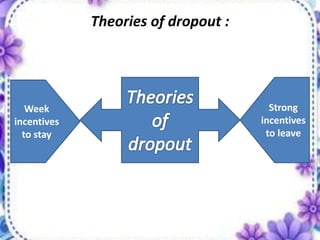
Theories of dropout :
Week
incentives
to stay
Strong
incentives
to leave
Rates of school failure and dropout
• In India
o 2009-10 dropout rate was 9.1, in 2010-11 it was 6.9 and
now present time it is approximately 5.5.
o in Bihar (7.06),
o Jharkhand (5.3),
o Nagaland (6.23) and
o Uttar Pradesh (5.65)
• In USA 8.1%
• In China 40%
• In Canada 7.8%
• In US 7.4 %
Areas of influence in School Failure:
• Individuals factor
o individual learning problems
o low motivation to learn and study
o difficulties in study strategies
o relationship and social competence and / or
emotional difficulties
o drugs abuse
o personal events of life that are possible
psycho-social risk factors (e.g., early pregnancy,
serious family problems, etc.)
Areas of influence in School Failure:
• Family factors
oPoor family environment
oSocio economic status
oAbsence of the family (death, removal or carelessness)
oFamily conflicts
oHigh family mobility
oLow educated family
oParents contribution in children study
Areas of influence in School Failure:
• SCHOOL factor: Quality of school-learning
experiences
o use of ineffective methods of teaching (in relation
to learning or motivation)
o Using teaching methods that do not meet the
needs of individual students
o hostile relationship with the teachers-trainers and
tutors
o lack support in the process of adaptation and
integration
o poor guidance support
Areas of influence in School Failure:
• Psychological factor :
oADHD
oConduct disorder
oLearning Disability
oMental Retardation
Possible Prevention of School
dropout:
• The Basic Core Strategies
oMentoring/Tutoring
oAlternative Schooling
oAfter School Opportunities
• Early Interventions
oEarly Childhood Education
oFamily Engagement
oEarly Literacy Development
Continued…
• Making the Most of Instruction
oProfessional Development
oActive Learning
oEducational Technology
oIndividualized Instruction
• Making the Most of the Wider Community
oSystemic Renewal
oSchool-Community Collaboration
oCareer and Technical Education
oSafe Schools
Management of school dropout:
• Management of school dropout may be possible with
psychopharmacological drugs…
o Amphetamines (methylphhenidate/ritalin) used for ADHD.
o Fluoxetine (prozac) use for teenage dipression.
o Risperidone (risperdol) use for Conduct Disorder.
• Several Government policy
o Just like in india (mid day meals programs, free education policy
etc.)
School failure and dropout

School failure and dropout

  • 1.
    School failure anddropout Asit kumar maurya P. g. diploma in counseling guidance & psychological intervention
  • 2.
    Objective : • Definition •Theories of dropout • Rates of school failure and dropout • Areas of influence in School Failure • Possible Prevention of School dropout • Management of school dropout
  • 3.
    definition • A pupilwho has not completed basic education and no longer attends school . • Pupils who have not attend school for six months and thus are unable to meet the demands set for basic education. • Dropout may refer either to leaving school before passing any recognize exams, or to leaving unqualified to pursue employment opportunities of personal fulfilment. (Dowrick, 2003)
  • 4.
    Theories of dropout: Week incentives to stay Strong incentives to leave
  • 5.
    Rates of schoolfailure and dropout • In India o 2009-10 dropout rate was 9.1, in 2010-11 it was 6.9 and now present time it is approximately 5.5. o in Bihar (7.06), o Jharkhand (5.3), o Nagaland (6.23) and o Uttar Pradesh (5.65) • In USA 8.1% • In China 40% • In Canada 7.8% • In US 7.4 %
  • 6.
    Areas of influencein School Failure: • Individuals factor o individual learning problems o low motivation to learn and study o difficulties in study strategies o relationship and social competence and / or emotional difficulties o drugs abuse o personal events of life that are possible psycho-social risk factors (e.g., early pregnancy, serious family problems, etc.)
  • 7.
    Areas of influencein School Failure: • Family factors oPoor family environment oSocio economic status oAbsence of the family (death, removal or carelessness) oFamily conflicts oHigh family mobility oLow educated family oParents contribution in children study
  • 8.
    Areas of influencein School Failure: • SCHOOL factor: Quality of school-learning experiences o use of ineffective methods of teaching (in relation to learning or motivation) o Using teaching methods that do not meet the needs of individual students o hostile relationship with the teachers-trainers and tutors o lack support in the process of adaptation and integration o poor guidance support
  • 9.
    Areas of influencein School Failure: • Psychological factor : oADHD oConduct disorder oLearning Disability oMental Retardation
  • 10.
    Possible Prevention ofSchool dropout: • The Basic Core Strategies oMentoring/Tutoring oAlternative Schooling oAfter School Opportunities • Early Interventions oEarly Childhood Education oFamily Engagement oEarly Literacy Development
  • 11.
    Continued… • Making theMost of Instruction oProfessional Development oActive Learning oEducational Technology oIndividualized Instruction • Making the Most of the Wider Community oSystemic Renewal oSchool-Community Collaboration oCareer and Technical Education oSafe Schools
  • 12.
    Management of schooldropout: • Management of school dropout may be possible with psychopharmacological drugs… o Amphetamines (methylphhenidate/ritalin) used for ADHD. o Fluoxetine (prozac) use for teenage dipression. o Risperidone (risperdol) use for Conduct Disorder. • Several Government policy o Just like in india (mid day meals programs, free education policy etc.)