


































































































1
CHAPTER 1
INTRODUCTION
Background of the Study
The importance of stakeholders’ participation in school programs and
projects in developing the total growth and development of the students
greatly contributes to the enhancement of learning. The school needs the
genuine support of the community in attaining quality education of the
students.
Quality education cannot be attained if the school needs the
cooperative action of the community leaders and members who can make
education work to the maximum development of the students’ potentials. As
Lapus (2009) puts it, a school-community partnership provides opportunities
to community members to support the improvement of student learning.
Their role is crucial in transforming our schools into a safe and conducive
learning environment.
Concedingly, when schools work with community organizations,
businesses, and agencies, they become powerful agents of change for
students, families, and the neighborhoods around them.
2
Schools are the natural hub of a neighborhood or community, and can
serve as the foundation for community partnerships that are beneficial to
students, families, businesses, agencies, and other civic organizations. By
building communication, sharing resources, and developing unique solutions
to community problems, these partnerships can become vital and organic
entities that are agents of lasting change in the community.
In order for a school community partnership to work, Cameron (2006)
stressed that it is essential to build strong communication among all the
participants and those who will be affected by the partnership. The levels of
communication may vary, depending on the circumstances and the purpose
of the message, and include the following components: (1) Awareness,
where the school or community organization is merely sharing what they are
doing with the other partners; (2) Information-gathering, where the school or
community organization is seeking information from or about the other
partners; (3) Evaluation, where the school or community organization is
asking for feedback about its programs or services; and (4) Collaboration,
where the schools and organizations are actively involved with each other
and communicate regularly in order to plan for their collaborative efforts
Accordingly, active school community partnerships achieve the
highest levels of communication as they collaborate toward solving
3
community issues and providing services that build on their shared resources
and expertise. Regular meetings with designated agendas help ensure that all
partners are kept actively involved in the process; however, channels for less
formal communication should also be encouraged so that relationships are
built among the members and other less-structured or creative opportunities
are explored.
A main purpose for building school community partnerships is to
share resources and avoid the duplication of services. Schools can provide
easy access to children and families in need of community services, and by
partnering with agencies in the community, they can ensure that parents and
other family members are aware of all the types of assistance that are
available to them and how to access thoseservices.
Strong communication among school and community partners can
result in a network of services available to community members at a school.
Schools and their partners may provide parent education, legal assistance,
job training, tutoring, diet and nutrition information, health visits, and many
other types of services. By avoiding duplication of services, each agency is
able to channel its resources more directly toward its specific purposes.
4
While donations of time, materials, space, and expertise by local
businesses or organizations are always appreciated by schools, they are just
the beginning of what a school community partnership can be. By becoming
actively involved with each other, schools and community organizations can
build unique networks of services that specifically serve the communities
they share and provide real solutions to the problems faced by the school and
students (Lapus, 2009).
At its best, the education of young people is a partnership between the
school, the home and the community. Effective partnership, however,
requires leadership, a compelling purpose for their work, and a set of
mutually agreed upon goals. As Ames, C. (1995) marks, educators who wish
to strengthen the bonds among those individuals and organizations who
contribute to the education and welfare of the community’s youth must be
knowledgeable about various ways which families and community members
can be involved meaningfully in the affairs of the school for the benefit of
students.
Thus, the school is empowered to continuously improve its
performance in attaining desired outcomes for students; to engage
stakeholders in shared decision-making; lead the school staff, together with
5
other stakeholders accountable for school performance and student
outcomes.
Basically, the Schools First Initiatives (SFI) of 2004 empowers
educational leaders and stakeholders to focus on school improvement and
total well-being of school children. When schools regard their relationship
with families as a partnership in which school and home share responsibility
for children’s learning, the result is an increase in the levels and types of
parent involvement as well as the support that family demonstrate for the
school. When this partnership is extended to include the larger community,
the benefits are greater yet. Perhaps, most important is that when
responsibility for children’s learning is shared by the school, home, and
community, children have more opportunity for meaningful engaged
learning. Students are able to see the connection between the curriculum in
the schooland the skills that are required in the real world (Epstein, 1995).
It is then significant to create an environment where all the people
involved in the decentralization process not only agree but also commit to
make that change happen. The school with the current decentralization
policies must strengthen the stakeholders’ capacity to perform their task
under a decentralized set-up.
6
Along this line, all stakeholders in general, acknowledge that each
has a role and a corresponding responsibility in fulfilling that role. Each
level of implementation has accountability in accordance with its role. Thus,
the following stakeholders are accountable for the following respective
responsibilities: (1) For the school head- he ensures the improvement of
school performance and well-being of learners and lead in preparing the
school improvement plan (SIP) and the school report card; (2) The teachers
ensure the optimum and holistic development of learners, work to achieve
the targeted level of mastery and work with parents and learners to address
learner’s needs and promote their well-being; (3) The students/pupils work
with teachers to achieve targets and continuously improve performance; (4)
The community supports and provides assistance to the school in its
continuous efforts to improve school and learner’s performance, assists in
implementing the School Improvement Plan and assists in monitoring and
evaluation of school performance; and (5) The school carries out department
policies and standards, requires the best performance of its officials, teachers
and support staff, facilitates the achievement of high performance and other
desirable learning outcomes among learners, develops strategic relationships
with the local community and other key partner, directs funds to intended
7
program initiatives and create a safe and favorable environment where
teachers and students can give their best.
It proves, therefore, that the school, teacher, instructional leader and
stakeholders understand that improved pupils’ learning outcomes is the
result of the activities of all internal and external stakeholders working
together; and that effective schools does not happen by chance, it is the
result from the strong collaboration of the schooland community as one.
Apparently, the current school-community synergy situation in all
secondary schools in Borongan City Division, Eastern Samar is quite poor, it
needs improvement. There is the external stakeholders composed of
community members, people from non-governmental organizations or
NGOs and the local government officials (LGU) who have a stake in the
education of the children. Their participation in the strategic planning for
school improvement and attainment of learning outcomes is an opportunity
for the schoolto grapple with.
The internal stakeholders composed of the school head, teachers,
students and parents of students and their associations have the strength to
directly work for the improvement of the school performance. Their inputs
about the school’s strengths, weaknesses, threats and opportunities are
necessary in the agenda for schoolimprovement.
8
An analysis of the school’s performance of secondary schools in
Borongan City Division, Eastern Samar shows that majority of the
stakeholders and parents are unaware of the importance of synergy and
collaboration of efforts in improving pupils’ performance. As a result, 45%
of the secondary schools are average performing schools. There is a need to
develop a school-community synergy operational plan for all secondary
schools in Borongan City Division, Eastern Samar to improve the
performance of the said schools, hence, this study.
Statement of the Problem
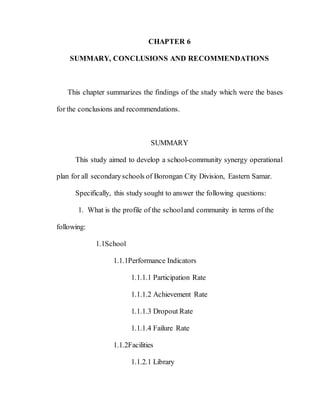
This study aimed to develop a school-community synergy operational
plan in all secondary schools in Borongan City Division, Eastern Samar.
Specifically, this study sought to answer the following questions:
1. What is the profile of the school and community in terms of the
following?
1.1 School
1.1.1 Performance Indicators
1.1.1.1 Participation Rate
1.1.1.2 Achievement Rate
1.1.1.3 Dropout Rate
9
1.1.1.4 Failure Rate
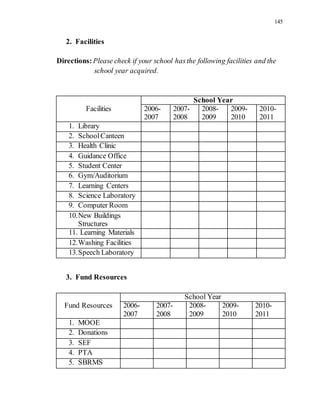
1.1.2 Facilities
1.1.2.1 Library
1.1.2.2 Health Clinic
1.1.2.3 Guidance Office
1.1.2.4 SchoolCanteen
1.1.2.5 Students’ Center/School Government
Office
1.1.2.6 Computer Laboratory
1.1.2.7 Gymnasium/Auditorium
1.1.2.8 Learning Centers
1.1.2.9 Science Laboratory Room
1.1.2.10 New Buildings/Structures
1.1.2.11 Washing Facilities
1.1.2.12 Speech Laboratory
1.1.3 Fund Resources
1.1.3.1 Maintenance and Other Operating
Expenses
1.1.3.2 Donations
1.1.3.3 Special Education Fund
10
1.1.3.4 Parents Teachers Association
1.1.3.5 School-Based Repair and Maintenance
Scheme
2. To what extent are the activities undertaken by the school and
community along the following?
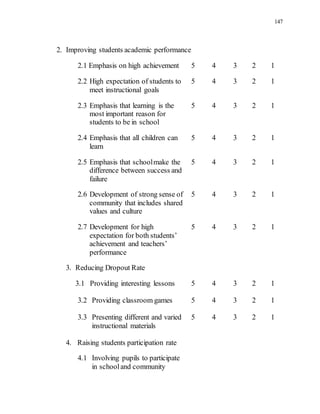
2.1 Continuing Maintaining Activities
2.2 Improving Students’ Academic Performance
2.3 Reducing Drop-out Rate
2.4 Raising Students’ Participation rate
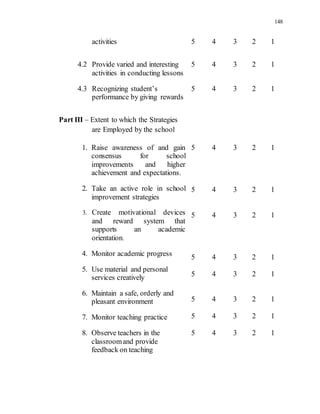
3. To what extent are the following existing strategies employed
by the schooland community in creating a learning environment?
3.1. Raise awareness of and gain consensus for school
improvements and higher achievement and expectations.
3.2 Take an active role in schoolimprovement strategies.
3.3 Create motivational devices and reward systems that
supportan academic orientation.
3.4 Monitor academic progress
3.5 Use material and personal services creatively
3.6 Maintain a safe and orderly, and pleasant environment.
3.7 Monitor teaching practices
11
3.8 Observe teachers in the classroom and provide feedback on
teaching.
4. What school-community synergy operational plan for
secondary schools of Borongan City Division, Eastern Samar may be
developed based on the findings of the study along the following?
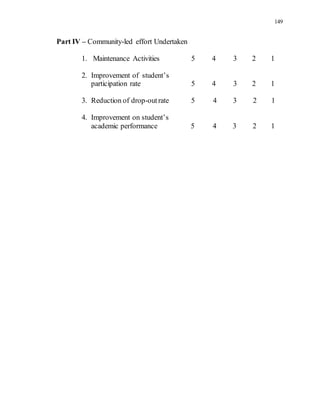
4.1 Community-led effort for:
4.1.1 Maintenance activities
4.1.2 Improvement of students’ participation rate
4.1.3 Reduction of drop-outrate
4.1.4 Improvement on students’ academic performance
Theoretical Framework of the Study
The theoretical framework of the study is anchored on the theories,
concepts, ideas and principles on teacher, school, leadership and
stakeholders’ participation on students’ achievement and the theories on
devising alternative choices on achieving the school community synergy and
social process forwhatever need and want.
According to Former Secretary Lapus, (2011) an empowered school
can undertake dramatic improvements by generating supports from
community. School principals can take the lead in establishing a viable
working relationship between the schooland the community.
12
In fact, the Department of Education (DepEd) yearly launches the
implementation phase of Brigada Eskwela, a program incepted in 2003 that
aims to enlist the help of the community in cleaning school grounds and
repairing classrooms, school furniture and other school facilities year-round.
Adopt A School Program Director Mari Paul Soriano said, “Brigada
Eskwela Plus is the department’s frontline initiative that believes in the role
of the community in improving public education”
Reasearch also shows that collaborative efforts have enhanced
connections to school and are making an impact on reducing drop outs rates
and increasing attendance rates (School-Based Management Primer, 2009).
Accordingly, in school-based management, community stakeholders
participation is a necessary complement to quality education for the simple
reason that child education, including his instruction is the primary
responsibility of the parents who are one of the stakeholders that share their
responsibilities with the tachers. Hence, the school should strive to form
school-community synergy operational plan to enable them to carry out their
respective responsibilities and to synergize or collaborate with the
community in other aspects.
Thus, an operational plan draws directly from agency and program
strategic plans to describe agency and program mission and goals, program
13
objectives and program activities. Like a strategic plan, an operational plan
addresses four questions like (1) Where are we now? (2) Where do we want
to be? (3) How do we get there? and (4) How do we measure our progress
(Miclat)?
The purpose of the school-community synergy operational plan for
secondary schools of Borongan City Division, Eastern Samar in this study is
to provide organization personnel with a clear picture of the tasks and
responsibilities in line with the goals and objectives contained within the
operational plan. It is also the management tool that facilitates the
coordination of the organization resources (human, financial and physical)
so that goals and objectives in the synergy operational plan can be achieved.
The theory as devising alternative choices on achieving the school-
community synergy operational plan features the need to identify specific
opportunities for the students to find meaningful development locally and to
sustain school and community synergy to find just what the known benefits
of school-community networking might be for social change and progress.
Thus, community awareness and involvement in networking is necessary to
students integrating their academic and technical knowledge toard
community issues and eventually personality development (http:// love-
eagles.com/arcticle/synergies.html).
14
Similarly, the theory on social process from what the school-
community wants and needs features a partnership or synergy approach to
give families and community members greater opportunities to determine
options for school development to participate in the wide range of
involvement ativities, and to assume key roles and responsibilities in school-
improvement efforts, including participation in the school’s decision-making
process. If a school-community synergy partnership is to succeed, it must be
based on “mutual trust and respect an on-going exchange of information-
agreement on goals and strategies, and a sharing of rights and
responsibilities”. (Ballen and Moles, 1994). Schools must be willing to
involve parents, families, and community or society at deeper levels and to
supporttheir participation.
In broad sense, it is widely recognized that if students are to maximize
their potential from schooling, they will need the full support of their
parents. It is anticipated that parents should play a role not only in the
promotion of their own children‘s achievements but more broadly in school
improvement and the democratization of school governance(Glickman,
1990).
15
Likewise, McDel (2003) Identified leadership responsibilities with
statistically significant relationship to achievement that when consistently
implemented can have a substantial impact on student achievements.
Supporting the statement of Mc Del are Walters Manzano and Mc
Nulty, (2003) who postulated that leadership responsibilities include such
tasks as establishing a set of standard operating procedure and routines,
involving teachers in the design, and implementation of important decisions
and policies and monitoring the effectiveness of school practices and
strategies and their impact on student learning.
Conversely, Weber (1971), Edmonds (1982), and Ubber and Hughes
(1989 as cited by Davis, et al. 1989) identified school characteristics as
strong instructional leadership, staff high expectations, school climate,
curriculum (emphasis on basic skills), monitoring of pupils progress, time-
on-task, and commitment to an academic focus closely relate to improved
achievement and consequently cause effectiveness.
Fullan (2005) holds the claim that one of its major responsibilities of
leadership to cause effect and sustain effective schools is to develop others
as leaders. He disclosed that principals alone cannot do all the things
necessary to run the school. It needs the support of teachers, stakeholders
and the community.
16
In the same way, the theory on synergy operational plan holds to the
idea that the students learning outcomes would improve through the strong
and combined action of the school and community working together to
develop a plan, scheme, method and strategies for the improved performance
of the students vis-a-vis the school. (Webster, 1990, 1976).
Thus the present study takes off from the concepts, ideas, principles
and theories on school leadership, school-community participation, the
concept of collaboration and synergy of modern leadership and stakeholders’
participation towards improved academic performance of students, theories
on devising alternative choices on achieving the school-community synergy
and the social process from what they need and want in school-community
synergy who hold in common that effective schools are the result of the
collaborative efforts of the principals, teachers and the community.
Conceptual Framework of the Study
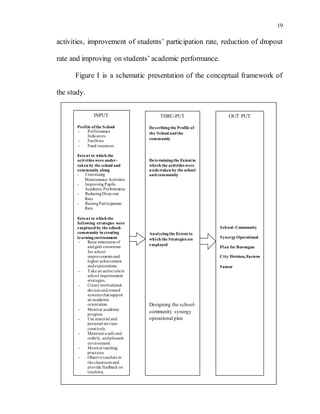
The conceptual framework of the study is shown in Figure 1. It is
shown in the schematic diagram that the study is focused on the following
variables: (1.) describing the profile of the school in terms of (a.)
Performance Indicators, namely: participation rate, achievement rate, drop-
out rate and failure rate (b.) Facilities which included the library, health
17
clinic, guidance office, school canteen, students’ center or student
government organization office, computer laboratory,
gymnasium/auditorium, learning centers, science laboratory room, new
building/structures, washing facilities and speech laboratory and (c.) Fund
Resources which included the donations and funds, (2.) It also focused on
determining the extent to which the activities were undertaken by the school
and community along (a) continuing maintenance activites, (b) improving
students’ academic performance, (c) reducing dropout rate and raising pupils
participation rate, (3) Analyzing the extent to which the existing strategies
were employed by the school and community in creating a learning
environment, namely: (a) raising awareness of the gain consensus for school
improvement and higher schievement and expectations, (b) taking an active
role in shool improvement and strategies, (c) Creating motivational devices
and reward systems that support an academic orientation, (d) Monitoring of
academic progress, (e) Using material and personal services creatively, (f)
Maintaining a safe, orderly and pleasant environment, (g) Monitoring
teaching practices; and (h) observing teachers in the classroom and provide
feedback on teaching; and (4) developing and designing what school-
community synergy operational plan for secondary schools of Borongan
City Division, Eastern Samar may be developed based on the findings of the
18
study along community-led effort for maintenance activities, improvement
of students’ participation rate, reduction of dropout rate and improvement on
students’ academic performance.
The framework of the school-community synergy operational plan for
the secondary schools of Borongan City Division, Eastern Samar is focused
on educational planning and development on school-community synergy
focused on the operation of programs phasing out the identified as obsolete
and prepared programs for modification and for diversification or
integration; develop school-community market planning which includes the
geographical area to be served, area of concern and area of activities
required to achieve planned level, advertising and promotion, plan
improvement, required budget, man power planning which determines the
man power requirements, development program, training program and
estimates changes in wage rate and fringe benefits.
Further, the school-community synergy operational plan would look
into the organization planning goals, organizational structure, financial
planning, projected budget, cost, capital expenditures, cash flow analysis and
financing required.
Moreover, the school-community synergy operational plan would
determine the community-led efforts provided in the continuing maintenance
19
activities, improvement of students’ participation rate, reduction of dropout
rate and improving on students’ academic performance.
Figure I is a schematic presentation of the conceptual framework of
the study.
INPUT
Profile ofthe School
- Performance
Indicators
- Facilities
- Fund resources
Extent to which the
activities were under-
taken by the school and
community along
- Continuing
Maintenance Activities
- ImprovingPupils
Academic Performance
- ReducingDrop-out
Rate
- RaisingParticipation
Rate
Extent to which the
following strategies were
employed by the school-
community in creating
learningenvironment
- Raise awareness of
andgain consensus
for school
improvements and
higher achievement
andexpectations.
- Take an active rolein
school improvement
strategies.
- Create motivational
devices andreward
systems that support
an academic
orientation.
- Monitor academic
progress
- Use material and
personal services
creatively
- Maintain a safe and
orderly, andpleasant
environment.
- Monitor teaching
practices
- Observe teachers in
the classroomand
provide feedback on
teaching.
THRU-PUT
Describingthe Profile of
the School and the
community
Determiningthe Extentto
which the activities were
undertaken by the school
and community
Analyzingthe Extent to
which the Strategies are
employed
Designing the school-
community synergy
operational plan
OUT PUT
School- Community
SynergyOperational
Plan for Borongan
City Division,Eastern
Samar
20
Figure I: A Schematic Presentation of the Conceptualization of the Study
Significance of the Study
The concept of the school-community synergy operational plan is to
draw collaboration and cooperative action of the school and community in
local decision-making process to improve schoolperformance.
Thus, the output of the study which the school-community synergy
operational plan would be significant to the following groups of people:
Students. The school-community synergy operational plan would
motivate the students’ interest in participating all school and community
activities geared towards creating a learning environment and ultimately
improve their learning outcomes, participation rate, reduce drop-out rate
and failure rate.
Teachers. The school-community synergy operational plan would
help the teachers modify their teaching style and methodologies to fit the
students’ development and increase academic performance. Also the
operational plan would build strong ties between the school and community
in making the schoolproductive.
Instructional Leaders. The school-community synergy operational
plan would give the instructional leaders a greater commitment and
awareness of their administrative and supervisory duties and community
21
partnership needed to improve school performance and community
relationship.
Division Program Supervisors. The result of this study would be used
as inputs for restructuring a study intended for the improvement of academic
achievement.
Researcher. The School-Community Synergy Operational Plan is
very necessary and essential to the researcher as it would serve as the
reference guide in building school and community harmonious relationship
and collaboration in improving the academic performance of the students
vis-à-vis schoolperformance.
Scopeand Delimitation of the Study
This study was conducted in all secondary schools in Borongan City
Division, Eastern Samar during the school year 2011-2012. The schools
involved in the study were the seven secondary schools in Borongan City
Division, namely: (1) Benowangan National High School, (2) Calingatnagn
National High School, (3) Eastern Samar National Comprehensive High
School, (4) Superintendent Fidel Anacta, Sr. Memorial High School, (5)
Lalawigan National High School, (6) Maypangdan National High School;
and (7) Sta. Fe National High School.
22
To answer the posted problems, the study focused on describing the
profile of the school in terms of (a) Performance Indicators, namely;
participation rate, dropout rate and failure rate (b) Facilities which included
the library , health clinic, guidance office, school canteen, students’ center
or student government office, computer laboratory, gymnasium/auditorium,
learning centers, science laboratory room, new building/structures, washing
facilities and speech laboratory (c) Fund Resources which included
donations and funds. (2.) It also analyzed the extent to which the activities
were undertaken by the school and community along, continuing
maintenance activities, improving students academic performance, reducing
drop-out rate and raising students participation rate and reducing failure rate,
and (3) determined the strategies employed by the school and community in
creating a learning environment which include on (a) raising awareness of
and gain consensus for school improvements and higher achievement and
expectations, (b) take an active role in school improvement strategies, (c)
create motivational devices and reward systems that support an academic
orientation, (d) monitor academic progress, (e) use material and personal
services creatively, (f) maintain a safe and orderly, and pleasant
environment, (g) monitor teaching practices; and (h) observe teachers in the
classroom and provide feedback on teaching which served as the bases for
23
designing and developing of the school-community synergy operational plan
which is anchored on the community-led efforts for maintenance activities,
improvement of pupils participation rate, reduction of drop-out and failure
rate; and improvement on students' academic performance.
The respondents of the study were the 187 or 100 percent of the
teachers’ population, as well as the 7 instructional leaders of the 7 secondary
schools. Only 30 % of the stakeholders were taken as representative samples
of the study which constituted the 70 General Parents and Teachers
Association members, 57 School Governing Council, 207 homeroom
president/officer and 112 other community stakeholders of the school. A
total of 194 instructional leaders and teachers and 446 stakeholders were
involved in the study during the schoolyear 2011-2012.
The school-community synergy operational plan for secondary
schools in Borongan City Division, Eastern Samar was developed in order to
highlight areas needing synergy between the schooland community where
support is much-needed and required to improve the seven secondary
schools’ academic performance, reduce dropout rate and failure rate and
increase the community participation in school and community activities in
creating a learning environment.
24
Definition of Terms
To gain understanding of the study, the following terms are defined
according to how they are used in the study.
Accountability. In this study, the term refers to the acknowledgment
and assumption of the responsibility for all actions, decisions, policies,
outputs and outcomes of all stakeholders.
Community Ownership or Shared Governance. In this study, the
term means the ongoing partnership among stakeholders to address the
needs and concerns of the school, most especially those that directly affect
learners’ welfare.
Completion Rate. The term refers to the proportion of the number of
graduates in a certain level to the total annual enrolment of the initial year of
that level.
Drop-out Rate. It is the proportion of the number of students who
left school during a school year to the total number of students enrolled in
the same schoolyear.
Extent of Participation. As used in this study, the term refers to the
degree or frequency of involvement of stakeholders in school-related
activities.
25
Instructional Leader. This term refers to the school head which
maybe a school head teacher, principal, or district supervisor and teacher in-
charge running the school and assumes the responsibilities in making the
schooleffective.
Maintenance and Other Operating Expenses (MOOE). This term
refers to the monthly budget allocation of the school intended for the
expenditures in relation to the usual operations of the school which include
repairs and maintenance, payment for bills and are subject to the usual
accounting and auditing rules and procedures.
Operational Synergy. Operational Synergy is a concept used to
describe the state of an organization when the people and process work
together to continuously expand the ability of the organization to deliver
products and services to its customers, while maintaining competitiveness.
Parents and Teachers Association (PTA). This term refers to the
association of parents or guardians of students currently enrolled and the
teachers who are actually teaching in the particular school. A set of officers
to lead the organization is organized to head in running the activities of the
school.
Participation Rate. It is the proportion of school-age population (6-12
years) accommodated in schoolto the total population (6-12 years)
26
Partnership. As used in this study, the term refers to the relationship
established between and among educators, students, families, and
community at large to work together in bringing about better and improved
performance.
Performance Indicators. In this study, it refers to the numerical
percentage performance of particular school on a given period on the
following areas: participation rate, achievement rate, drop-out rate and
failure rate.
School-Community Partnership. In this study, this term refers to any
relationship established between the school and community working
together in bringing about better and improved school performance of the
respondent schools
Students’ Achievement. This refers to the academic performance of
the students as measured in the school achievement test as indicated by their
mean percentage score (MPS) in the five learning areas, namely: English,
Science, Mathematics, Filipino and Makabayan.
School Heads. This refers to the leader and manager of the school.
Republic Act 9155 envisions the School Head as both an instructional leader
and an administrative manager.
27
Stakeholders. This term refers to the person instructed in helping
the implementation of school-related activities or programs and projects of
the school.
28
CHAPTER 2
REVIEW OF RELATED LETERATURE AND STUDIES
The intention of this chapter is to present the review of related
literature, ideas and concepts, information and studies taken from books,
magazines, journals, unpublished theses and dissertations, internet
researches, and other sources which are significant to the present work.
Related Literature
The concept of school-community synergy is persuasively simple. It
is giving the school heads, teachers, and students to work together with
community leaders and local government officials and other stakeholders to
improve students and schoolperformance.
Conceptually, developing school partnership, collaboration, and
synergy with families and community groups is now the biggest concern of
of effective schools. Educators are sometimes content to let parents and
families take the initiative in becoming involved in their childrens’
education. But for a real partnership and synergy to occur, educators must
look at ways in which the school can initiate the involvement. In such a
partnership, the school and the home share responsibility for children’s
29
learning, and the relationship is based on mutual respect and
acknowledgment of the assets and expertise of each member. As an
extension of this partnership, schools can emphasize a broad base of
community involvement. When schools develop and implement alternative
choices and strategies for promoting effective school-family-community
partnership, the result is improved learning for all students and strengthened
collaboration and synergy among schools, families, and communities
(http://www.ncrel.org/sdrs/areas/issues/environment/fancom/pa400.html).
The theory on devising alternative choices on achieving the school-
community synergy features the need to identify specific opportunities for
the students to find meaningful development locally and sustain scool and
community synergy to find just what the known benefits of school-
community networking might be for social change and progress. Thus,
community awareness and involvement in networking is necessary for the
success of school networking initiatives that apply to students integrating
their academic and technical knowledge toward community issues and
eventually personality development
(http://love_eagles.comarticles/synergies.html)
Likewise, the theory on social process from what the school-
community wants and needs features an partnership or synegy approach to
30
give families and community memebers greater opportunities to determine
options or initiatives for school involvement to participate in the wide range
of involvement activities and to assume key roles and responsibilities in
school-improvement efforts, including participation in the schools decision-
making process. As Ballen and Mole stressed, if a school-community
synergy partnership is to succeed, it must be based on “mutual trust and
respect, an on-going exchange of information, agreement on goals and
strategies, and a sharing of rights and responsibilities”.
Ballen and Moles (1994) disclosed that schools must be willing to
involve parents, families and community or society at deeper levels and to
supporttheir participation.
Thus, the initial step in involving parents, families and community
participation that would strengthen collaboration and synergy among school
and community members is the formulation of tactical and operational plans
through the operation of a method means analysis. The analysis identifies
the possible ways and means for doing and undertaking the products, tasks
or outputs. Once the products and the different means for doing them are
completed, funds and resources are allocated. Tasks and products are then
implemented.
31
To ensure successful plan implementation, requires developing of
structures within the organization, installing a management information
system (MIS), and a monitoring system. After a short period of time,
formative evaluation is undertaken to determine whether or not outputs
approximated the stated objectives and mission. The conduct of summative
evaluation determines the level of efficiency and effectiveness of the outputs
to revise if not improve the strategic and tactical planning process. From the
planning process, operational plan or model in school-based operational plan
is developed. (Miclat, 2005)
Thus, the idea of the school-community synergy operational plan is to
empower people in the community to be part of the local decision-making
process, giving all school heads, teachers and students to work together with
community leaders and local government officials and other stakeholders to
improve schoolperformance (http://www.deped.gov.ph)
Concedingly, the primary responsibilities of school heads are to
create and maintain the organizational characteristics that reward and
encourage collective efforts (Shein, 2005). Many of the problems
confronting educational leaders can be traced to their inability to analyze and
evaluate organizational culture. School heads who institute sweeping
changes often experience resistance to changes. Difficulties with
32
organizational transformation arise from failure to communicate and
understand social system from network to shared ideologies from among the
subordinates.
Rubis (2005) argued that school heads must practice deliberate role
modeling, teaching, and coaching. He believes that nothing can take the
place of school heads “walking their tall”. The personal example of a school
head can send a powerful message to the members of the organization
particularly if it is ethical and consistent. Reinforcing that example with
teaching and coaching will help others to internalize the desired values.
On the other hand, Jamrog (2006) emphasized that school heads have
an additional set of challenges. They have to create the means and
opportunities to improve their teachers with new ways of looking at
themselves and their capabilities. School heads’ new ideologies and values
need to be communicated effectively, internalized by the teachers and then
translated into productive methods of thinking and working. The useful
techniques for overcoming these challenges fall within the domain of
evaluating and transforming organizational culture.
School-based management of change relies on school heads’
communication techniques that cross sub-cultural boundaries and carry
message about ideologies, values and norms that can be internalized by all
33
teachers and staff. Memoranda and vision statement cannot achieve all these
objectives (Cameron, 2006). School heads, however, have a variety of
sophisticated cultural communication techniques at their disposal to link
teacher’ values to achieving objectives of the organization. In other words,
school heads have a better chance of creating or transforming an
organizational culture if they accept and foster productive endeavor and
consistently communicate how teachers must perform in their job in order
for the organization to achieve its objectives.
Wellins (2000) argued that for the school head to be effective in
management the educational organization, he must recognize the need to
create team among his subordinates. With proper support, eventually
teachers would realize their interdependence and start working effectively
with internal and external partners. The school heads, therefore, should
nurture the value of creating ownership or originators of ideas. Hence, the
more responsibility the team has for something from beginning to end, the
more excited they will be about the task. As a consequence, teachers can
solve interpersonal problems, work together, and maintain predictable levels
of high performance.
In another development, James (2003) countered that when
subordinates are empowered, they develop a climate of trust and shared
34
vision that resonate with everybody in the organization and that, within the
context of that vision; everybody knows that they are supposed to do and
where they are going. Thus, the process of working is filled with energy,
enthusiasm and humor. As a consequence, teachers work hard, not out of
obligation or fear, but because they believed in the organization’s goals, and
truly enjoy what they are doing for an effective change.
Supporting the ideas of James is Kaminski (2011) who stressed that
effective change would happen when the teachers are empowered. She
articulated that empowering teachers to be leaders within a school is critical
to the success of the school as a whole. She explains that allowing teachers
to be integral part of the school’s decision-making process can lead to a
greater sense of teacher satisfaction and an increase of overall commitment
to the work taking place every day. Further, certain behaviors on the part of
the principal can be the deciding factor indicating the level of impact teacher
leadership will have on the schoolitself.
Furthermore, Kaminski explains that in an era or ever increasing
accountability for schools, never has it been more important to understand
the role of leaders within a school. In order to delve into the subject of
school leadership today, it is important to think beyond the traditional roles
of principals as leaders and the remaining faculty as subordinates. Lambert
35
(2002) comments that, “the days of principal as the lone instructional leader
are over. We no longer believe that one administrator can serve as the
instructional leaders for an entire school without the substantial participation
of other educators” (p.37). Leadership in school today must be expanded to
include teachers. After all, they are the people closest to students and have
the most potential impact on them. The theory that instructional leadership is
shared endeavor amongst teachers and principals is now quite widely
accepted and is critical to a school’s overall success.
Indeed, empowering teachers to lead is at the heart of school
improvement and the continuity of success. When teachers see themselves as
leaders and have an opportunity to participate in the decision-making
processes of a school, they become an integral part of the school
organization. Historically, teachers have been bound by the confines of their
individual classrooms and the extent to which they impact their students on
their school as a whole was limited. Isolation is a word frequently used to
describe this point where teachers served as islands of information seeking
primarily to meet only the needs of their students.
Stearns (2008) pointed out that people wish to feel good about them.
The desire is reflected in their drive for self-efficiency, or the belief that one
has the necessary capabilities to perform a task, fulfill role expectations,
36
male meaningful contributions or meet challenging situation successfully.
Many employees today are actively seeking opportunities at work to become
involved in relevant decisions. There by contributing their talents and ideas
to the organizations’ success. The hunger for a chance to share what they
know and learn from experience. Organization need to provide opportunities
for meaningful involvement, a practice which will result in mutual benefits
for both parties.
Thus, the instructional leader must be sensitive enough to share with
teachers the vision and mission of the school in order to reap success. It
makes a difference when the teachers, pupils and stakeholders know the
beliefs of the school and the ultimate goal of the school which is improved
learning outcomes of pupils.
According to Edmonds (1987) so that pupils will rise to the popular
competence the country wants, the school academic climate, leadership,
teaching and management practices and stakeholders/ parents support must
be engineered to improve student achievement with the intention of
developing a productive and satisfying working environment for teachers
and desirable learning conditions and outcomes for children.
Viewed thus, strong instructional leadership by a principal and strong
support of the community with vision become the most critical components
37
of a successful, effective school. Principals of this type have high
achievement expectations, observe teachers’ teaching, and monitor
individual and collective student achievement (Davis, 1989, p. 39). Achilles
(1987) described how the vision and leadership of effective principals can be
reduced to the three basic questions of Why, What, and How. According to
Achilles, effective principals must know why better education is needed,
what is needed to improve the schools, and how to administer their schools
to achieve the best results. Why questions relate to vision and the tendency
of effective principals to envision and work toward what their schools can
become.
In the study of Garro (1986, p. 1546-A), four variables were
identified as associated with a principal’s effectiveness. His role concerning
discipline and establishing a positive school atmosphere, his support for
teachers and his involvement is evaluating student progress.
In a practical sense, the principal, the teacher attitudes and behavior is
coupled with the parents support in a particular school do indeed cause the
improved student attitudes and achievement.
Rowan, Bossert, and Duyer (1987) suggested that high achievement
might actually cause school effectiveness. Ubben and Hughes (1987)
identified characteristics of effective schools which include strong
38
leadership, staff high expectations, school climate, curriculum (emphasis on
basic skills), and commitments to an academic focus. These seven school
factors were believed to closely relate to improved student achievement and
consequently cause schooleffectiveness.
Milwaukee’s Project Rise (Mc Cormack, Larkin and Kritek, 1983 p.
49) and the New York School Improvement Project (Clark and McCarthy,
1983, p. 49) complemented and supplemented Ubben and Hughes’ list of
characteristics of effective schools. Date generated in the two studies
became their guide in launching educational reforms and teaching
improvement plan in every state.
Strong Instructional Leadership
According to DeBevoice (Davis, 1989, p. 21) instructional leadership
means “those actions that a principal takes, or delegates to others, to
promote growth in student learning.” Schools with improved organizational
structure utilized student’s feedback on teacher effectiveness. Noerrlinger’s
(1988,p. 22-A) investigations on student feedback on teacher effectiveness
for the purpose of improving instruction reported that the students agreed
with the principals and rated the more effective teachers significantly higher
than the less effective teachers. The student also rated the more effective
teachers significantly higher than the less effective teachers on personal
39
interest, classroom management, presentation, guided practice and
independent practice. To gain proper perspective on personal interest,
classroom management and practices, one needs to study school climate and
expectations of both student and the staff.
Academic SchoolClimate and High Expectations for Student Achievement
Generally, an organizational climate or culture consists of shared
values, rules, ideology, and conceptions regarding the organization. Walter
and Stanford (1988, p. 24) said of the importance of school culture: “Culture
is the glue, the consistency in values that holds the organization together.”
In an academic climate, staff and students are aware of and value
goals of high achievement. Researchers agree that principals play a vital role
in creating such an atmosphere through their beliefs, attitudes, expectations,
and activities. Cohen (1983, p. 25) reported that effective principals
emphasizes high achievement and express optimism about the ability of all
students to meet instructional goals. Blum similarly noted that effective
principals believe and emphasize to staff that learning is the most important
reason for students to be in school; that all children can learn; and that
schoolmakes the difference between success and failure.
Good and Brophy (1985, p. 25) also stressed that effective principals
are able to create a strong sense of community that includes shared values
40
and culture, common goals, and high expectations for both student
achievement and the staff performance that creates it. Cohen added that
there is also an effective side to a favorable school climate or culture. He
pointed out that a good sense of community requires not only shared goals
but the creation of a moral order that includes respect for authority, mutual
trust, and a genuine caring about individuals and their feelings and attitudes.
Oden (1988, p. 25) similarly mentioned “caring attitudes about kids” as an
important part of the schoolclimate.
Creating an Academic Climate. It is impossible to separate
characteristics of effective principals from their attitudes, expectations and
actual behaviour. Hence, description of creating an academic climate will
overlap and continue the previous description of behaviors contributing to an
academic climate.
Davis (1989, pp. 25-40) explained that principals can take many
concrete steps to aid the development of academic climate or culture.
Among many suggestions for creating an academic climate, the principal
can; Raise awareness of and gain consensus for school improvements and
higher achievement and expectations; Take an active role in school
improvement strategies; Create motivational devices and reward systems
that support an academic orientation; Monitor academic progress; Use
41
material and personal services creatively; Maintain a safe and orderly, and
pleasant environment; Monitor teaching practices and Observe teachers in
the classroom and provide feedback on teaching.
In addition, Davis underscored some specific actions that promote
the development of an academic climate. These include insuring that
academic rates are high; classes starts on time and proceed without
interruption; meaningful homework is assigned; lessons are planned in
advance; course planning is conducted by teacher groups; and staff are
available to help students.
The aforementioned activities of effective principals implicitly
convey an academic school orientation and the principals’ dedication to
improve teaching and higher pupil achievement.
In a study on the relationship between school effectiveness and the
perception of teachers on leadership effectiveness and school climate, it was
found out that the interaction between leadership effectiveness and school
climate; contribute significantly to the prediction of 6th grade total battery
and 6th grade reading (Brooks, 1986, p. 3250-A).
On the other hand, Dencio’s study (1987, p. 669-A) on effective
school leadership demonstrated that principal’s instructional leadership
behavior directly influences teacher energy with exerts positive effects on
42
three measures of school adaptability, fifth grade math achievement scores,
and teachers’ satisfactions with school and job. Bangston (1985, p. 3542-A)
related that the type and size of school buildings in which principal and
teachers may live (rural or urban) were unrelated to characteristics of
effective teaching.
Fitch (1987, p. 671-A) disagreed with the findings of Ingraffia’s and
Zeanah (1986). He emphasized the importance of principals to have good
interpersonal and communication skills to foster the type of school climate
that maximizes the potential for effectiveness.
Needless to say, the studies cited above render valid the
consideration of school climate as one of the bases for identifying school
effectiveness, hence, the inclusion of school climate as one of the variables
in the present study.
Time-on-Task
Another factor to be looked into as one of the underlying
characteristics of school effectiveness is time-on-task. Empirical data
indicates a relationship between time-on-task and academic achievement of
pupils. Laurence (1987, p. 1730-A) noted that when two groups of average
and effective schools were investigated – one state-wide (predominantly
rural) and another of low- income minority, urban schools – multi-variant
43
analysis showed that the Edmonds type variables – instructional leadership,
high expectations, and monitoring of progress – had a weak ability to
account for rural school, school effectiveness but that several discipline and
time-on-task items contributed to urban schoolsuccess.
In the work of Rivera (1987, p. 1687-A), it was likewise revealed that
teachers with achieving classroom were found to spend more time o
academic activities challenged students more frequently, and had higher
rates of active students’ participation. Teachers in lower-achieving spent
less time on academic activities, had more passive students, and had serious
difficulty controlling their classrooms.
The study of Engwan (1986, p. 813-A) remained sensitive to the
contribution of a safe and orderly environment, a clear school mission, high
expectations, opportunity to learn, and time-on-task as factors that promote
god schoolattitude and higher achievement, particularly in mathematics.
Basic Commitment
In order to clarify school goals and help establish a proper climate and
direction, the principal and his staff in a particular school should have a clear
understanding of what the school believes in and stands for. For instance, a
belief of an academic focus that all students have the ability to learn, an
44
expectation that each student will learn, and high expectations for each
student to learn (Ubben and Hughes, 1987, pp. 77-79).
Necessarily, these beliefs become the basic commitment to those
directly and indirectly concerned in improving student’s achievement and
school performance. Ubben and Hughes added that the staff may assemble a
school beliefs statement in order to help raise the awareness of the staff and
students for the goals and purposes of the school in a concrete way. This
school belief statement could be made part of the school code and displayed
prominently in the schoolcampus.
Curriculum (Emphasis on Basic Skills)
In support of the idea of raising achievement levels in basic skills
areas in English, Mathematics, Filipino, Araling Panlipunan, Science,
Physical Education, Health and Music (PEHM), and Technology and
Livelihood Educationn (TLE), Rosenshine (1986, pp. 134-136) formulated
six principles for teaching knowledge and skills in any of the well-structured
subject areas. These six principles are: (1) providing daily review; (2)
presenting new lesson; (3) conducting guided practice; (4) providing
feedback and correctives; (5) assigning independent practice; and (6)
providing weekly and monthly review. Rosenshine observed that all teachers
use all of them most of the time and implement them consistently and
45
systematically. He suggested that in order to apply these ideas effectively
with different subject areas, teachers must use a lot of art, thoughtfulness
and creativity.
Continuous Monitoring of Student Progress
Aware of the criteria of school effectiveness, an instructionally
effective principal must stress that a well-documented behavior of an
effective school is monitoring student’s progress, especially as reflected in
test scores for each grade, each class, and each student. Such behavior
intrinsically reflects on academic focus and academic values. (Davis and
Thomas, 1989, p. 26).
Davis and Thomas explained further that if school is serious about
increasing student achievement, that achievement must be closely monitored
via test results, grade reports, attendance records, and other methods and
changes must be made in school procedure and instructional programs to
meet identified needs and weaknesses. Such monitoring may include the
following activities or practices: (1) holding students accountable for their
work; (2) monitoring student learning via informal observation and contact;
(3) developing and using simple and efficient routines for collecting
summarizing and reporting achievement data related to learning objectives;
(4) establishing and periodically updating individual students’ records and
46
group summaries, making sure that both individual data and scores for
classes and grades are reviewed over time to detect changing trends; using
assessment results to evaluate the effectiveness of teaching methods; and (5)
encouraging parents to monitor student’s progress (Ibid., p. 74).
In effective schools, Davis (1989) added, monitoring student’s
progress takes place at all levels. Effective teachers monitor minute –to-
minute comprehension, success and engagement rates along with the longer
term achievement records of every student. Effective principals monitor
achievement scores for individual student classes and grade levels.
Improvement-minded superintendents also monitor average achievement
scores, comparing them with schools in other districts and with national
averages. Whatever level or form monitoring student progress takes,
effective administrators and teachers use the achievement information as the
basis for modification of teaching (Ibid., p. 142).
A survey of characteristics of effective school system in Georgia was
conducted by Baylor (1985, p. 2491-A), using a survey of characteristics of
effective schools drawn from effective school literature. Effective systems
identified in this study exhibited in varying degrees all 12 characteristics of
effective schools measured by the survey. The systems surveyed rated three
47
characteristics: assessment, curricular congruence and monitoring student’s
progress within the top five of the twelve characteristics.
Conversely, interesting initiatives of the government is the Adopt-a-
School Program (RA 8225) over which the Brigada Eskwela Plus project
taps the local business sectors and external funding bodies for assistance
such as building and facilities construction. Through this project,
corporations, business establishments, non-government organizations and
private individuals have become partners of the government in addressing
the perennial problems of the educational system such as lack of classrooms,
desks and textbooks.
Cognizant of the cogent role that linkages and collaboration play in
ensuring the survival and stability of any school or school system, the
department of education, through the years, has given much and equal
attention to close tie-up with community constituents for purpose of resource
sharing. As early as 1989, Presidential Proclamation No. 480 was issued
declaring 1990-2000 as the decade of Education for All (EFA). As a result,
subsequent policies, programs and projects were consciously formulated
against the backdrop ofEducation ForAll objectives.
48
Related Studies
In the study of Joyce L. Epstein, entitled School/family/Community
Partnership: Caring for the Children we Share, he described in his paper that
a partnership approach gives families and community members greater
opportunities to determine options for school involvement, to participate in
the wide range of involvement activities, and to assume key roles and
responsibilities in school-improvement efforts, including participation in the
school’s decision-making process. If a partnership is to succeed, it must be
based on “mutual trust and respect, an ongoing exchange of information,
agreement on goals and strategies, and a sharing of rights and
responsibilities”. Schools must be willing to involve parents, families and
community at deeper levels and to supporttheir participation.
The study of Epstein is very much related to this study since his
study and the present study both focused on family and parents involvement
in school. Educators look ways in which they get involved in their children’s
education. In such a partnership, the school and the home share
responsibility for children’s learning; the relationship is based on mutual
respect and acknowledgement of the assets and expertise of each member.
As an extension of this partnership, schools can emphasize a broad sense of
community involvement. When schools develop and implement strategies
49
for promoting effective school-family-community partnerships, the result is
improved learning for all students and strengthened schools, families, and
communities.
In another study, “Essential tasks, skills, and decisions for developing
sustainable community-based programs for children, youth, and families at
risk” Banach M., and Gregory, P.J. (2001) concluded that stakeholders offer
important insight into each phase of program planning, implementation and
evaluation. Stakeholders are most commonly involved at the beginning
stages of program planning. They are able to provide insight for the various
needs that a program or curriculum should meet. Experience shows that once
the goals have been set in the first part of program development,
stakeholders are sometimes not consulted in latter stages of program
implementation and evaluation.
The study of Banach and Gregory is related to this study, like the
latter, the investigation is on participation of the person or organization for
the betterment of the educational program.
The impact of teacher leadership on school effectiveness in selected
exemplary secondary schools has been studied by David Paul (2006).
This qualitative study used naturalistic inquiry methodology study the
impact that teacher leadership has on school effectiveness. Two suburban
50
high schools were chosen for his study. Both of these schools had been rated
as exemplary in 2002 by the Texas education agency. Interviews,
observations, and survey were used to obtain data. Through these, seven
categories emerged that were used to create a written description of teacher
leadership on the campuses. Teacher leadership in the past, teacher
leadership roles, teacher leadership enablers, teacher leadership restraints,
products of teacher leadership, teacher leadership in the present, and the role
of the principal emerged when the data were analyzed.
Local Studies
One related study in terms of parents’ value towards child’s education
is the study of Jacer (1993) which revealed that among home and
background environment factors namely: the parents’ education, parents’
occupation, dependency burden, and parents’ value for child’s education
variable came out to have moderate correlation of .53 which is significant at
.05 level of significance. When the four index variables were taken in
combinations, only parents’ value for child’s education and parents’
education combined significantly came out as predictor variables on RO-DO
(Regional Office and Division Office) scores with parents’ value of childs
education having the highest impact on schoolperformance.
51
Another related study in terms of parents’ involvement in school
related activities is the study of Firmo (2002) which concluded that parent-
respondents are seldom involved in school-related activities along school
plant and facilities development; sometimes involved along school-
community affairs; seldom involved along school-cultural affairs; seldom
involved in academic/classroom-related concerns; and sometimes involved
in home assistance and follow-up.
Firmo (2002) disclosed that generally, parents do not participate
regularly in school-related activities. It implies that these findings should be
addressed to via a proposal strategy for sustainable involvement of parents in
school-related activities that would help improve the academic achievement
level of the elementary schoolpupils in Tolosa District.
From the foregoing related studies, the researcher got insights on
instrumentation, research design, and the synergy operational plan. This
study happens to be limited. But somehow, they provided insights to the
researcher in the conceptualization of the study.
52
CHAPTER 3
METHODOLOGY
This chapter states the research design, locale of the study, research
respondents, research instruments, and data gathering procedure, validation
of the research instruments, and statistical treatment of data gathered.
Research Design
This study utilized the descriptive survey method which identified
and described the profile of the school in terms of (a.) Performance
Indicators such as participation rate, achievement rate, drop-out rate, failure
rate, (b.) Facilities which included the library, health clinic, guidance office,
school canteen, pupil’s center or pupils government organization office,
computer laboratory, gymnasium/auditorium, learning centers, science
laboratory room, new building/structures, washing facilities and speech
laboratory (c.) Fund Resources which included Maintenance and Other
Operating Expenseses, donations, Special Education Fund, Parents and
Teachers Association and School-Based Repair and Maintenance Scheme
funds. It also determined the extent to which the activities were undertaken
by the school and community along continuing maintenance activities,
53
improving pupils academic performance, reducing drop-out and failure rate
and raising pupils participation rate; and determined the extent to which the
following strategies were employed by the school and community in
creating a learning environment which are raising awareness of and gain
consensus for school improvements and higher achievement and
expectations, take an active role in school improvement strategies, create
motivational devices and reward systems that support an academic
orientation, monitor academic progress, use material and personal services
creatively, maintain a safe and orderly, and pleasant environment, monitor
teaching practices, observe teachers in the classroom and provide feedback
on teaching; and developed the school-community synergy operational plan
which is anchored on the following community-led efforts (a.) maintenance
activities, (b.) improvement of pupils participation rate, (c.) reduction of
drop-outrate and (d.) improvement on pupils academic performance.
Locale of the Study
This study was conducted in all secondary schools in Borongan City
Divsion, Eastern Samar during the schoolyear 2011-2012.
The schools involved in the study were the seven secondary schools
of Borongan City Division, Eastern Samar this school year 2011-2012.
54
These schools were Benowangan National High School, Calingatngan
National High School, Eastern Samar National Comprehensive High
School, Superintendent Fidel Anacta, Sr. Memorial High School, Lalawigan
National High School, Maypangdan National High School and Sta. Fe
National High School in Borongan City Division, Eastern Samar this
schoolyear 2011-2012.
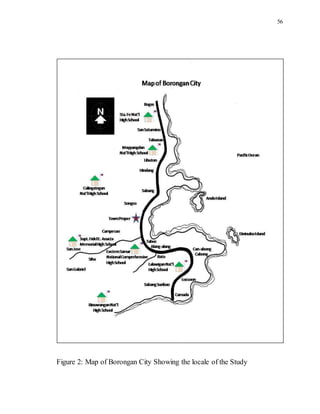
Figure 2 is the map of Borongan City showing the locale of the study.
Borongan is a component city and the provincial capital of the province of
Eastern Samar, Philippines. It is bounded on the north by the municipality
of San Julian, in the south by the municipality of Maydolong, in the west by
the Samar municipalities of Hinabangan, Calbiga, Pinabacdao and Basey,
and in the east by the Pacific Ocean. Its cityhood was settled by the Supreme
Court of the Philippines when it decided with finality on April 12, 2011 the
constitutionality of its city charter, Republic Act 9394, which conferred
upon and elevated the status of the municipality of Borongan into a
component city of the province of Eastern Samar.
The City of Borongan is located along the middle coastal part of the
province of Eastern Samar. The city proper itself is situated along the
northern banks of the Lo-om River and is set back a little distance away
55
from the shoreline of Borongan Bay. The province itself comprises a part of
the Eastern Visayas Region (Region VIII) of the Republic of the Philippines.
According to the 2007 census conducted by the Community-Based
Monitoring System , Borongan has a total population of 59,354 people in
10,699 households. Their common language is Waray-Waray, and a huge
majority are also literate in both English and Filipino. Boronganons are
predominantly Roman Catholic, but it also has other small Christian, as well
as minority religious sects.
Borongan's main product is copra. It has lively commercial activity
throughout the year not only catering to the needs of the local city populace
but serving as well as the central business hub of the entire province of
Eastern Samar. Many families rely on coastal and deep-sea fishing as well as
lowland and upland farming as means of livelihood. Others have spouses,
children, parents or other relatives working in Manila or in other places
within the Philippines or abroad either as professionals, contract workers or
domestic helpers who regularly remit part of their earnings to their families
back home. The single biggest employer of its local populace is the
government.
56
Figure 2: Map of Borongan City Showing the locale of the Study
57
Respondents ofthe Study
The respondents of the study were the 194 school teachers and 7
instructional leaders taken from all secondary schools of Borongan City
Division, Eastern Samar.
From among the stakeholders, a total of 640 were involved in the
study, broken down as 70 general Parents-Teachers Association (PTA), 57
School Governing Council (SGC), 207 Homeroom Parents-Teachers
Association, and 112 other community stakeholders during the school year
2011-2012.
Table 1 gives the distribution of respondents of the study.
Table 1
DISTRIBUTION OF RESPONDENTS
Schools
Tea-
cher-
Respon
-dents
Instruc-
tional
Leaders
Stakeholders
Total
Gen.
PTA
Officer
s
SGC
Home
-room
PTA
Other
Com-
munity
Stake-
holders
Benowangan NHS 5 1 10 9 18 5 48
Calingatngan NHS 11 1 10 8 27 9 66
ESNCHS 100 1 10 8 48 35 202
ESNCHS - Supt.
Fidel Anacta, Sr.
MHS
8 1 10 9 20 10 58
Lalawigan NHS 28 1 10 8 39 20 106
Maypangadan
NHS
14 1 10 8 25 15 73
Sta. Fe NHS 21 1 10 7 30 18 87
TOTAL 187 7 70 57 207 112 640
58
Research Instruments
The instruments used in this study were the survey questionnaires for
teachers, instructional leaders, and stakeholders.
The Survey Questionnaire for Teachers and Instructional Leaders.
The survey questionnaire is composed of four parts. Part I elicited the
profile of the school which included the performance indicators, facilities
and fund resources; Part II asked the extent to which the activities were
undertaken by the school and community. Part III solicited the extent to
which the strategies were employed by the school and the community in
creating a learning environment, and Part IV elicited the extent to which the
community-led effort were undertaken by the schooland community.
The Survey Questionnaire for Stakeholders.
The survey questionnaire for stakeholders is the same with that of the
teachers and instructional leaders. Only that the stakeholders did not answer
the Part I- of the survey questionnaire because it solicited the profile of the
school. Part II, III and IV were answered by the stakeholders.
59
Validation of the Instruments
To ensure the validity of the instruments, the instruments were pilot-
tested in San Julian National High School, Eastern Samar Division because
said secondary school is near to the respondent-schools and accessible to
transportation. Also, the school has the same topographical and
demographical characteristics with the respondent schools. Hence, there
was an equivalence in characteristics of schools involved in the study. A set
of school teachers, instructional leaders and stakeholders of San Julian
National High School were involved in the validation of the instrument to
ascertain that the items included would gather the desired data needed for
this study.
After the field testing, the final draft of the questionnaire with no
revision was reproduced.
Data Gathering Procedure
Before the questionnaire was administered to the respondents, the
researcher requested permission from the Schools Division Superintendent
of Eastern Samar and School Heads of the respondent schools. Upon
approval of the request, the following have been done by the researcher.
60
Foremost, the researcher met the Secondary School Principals where
the schools were covered and sought help in the administration of the
questionnaire and the selection of parents and stakeholders through the
school forms and records of the names of parents whose children were
enrolled within the current school year and the list of stakeholders indicated
in the attendance sheets during the PTA (Parents-Teachers Association)
meetings.
From the list of parents and stakeholders, the representative samples
were drawn through simple random sampling.
Before the administration of the survey questionnaire, an orientation
relative to the propose of the study was done. The copies of the
questionnaire were administered during scheduled homeroom Parents-
Teachers Association meetings. Other parents and stakeholders who were
not presnt during the meeting were visited by the researcher in their
respective homes. Their suggestions have been sought relative to the
preparation of the School-Community Synergy Operational Plan,
particularly on community-led effort activities critical to improved school
performance.
61
Statistical Treatment of Data
All data gathered were tallied, analyzed and interpreted. To establish
the profile of the school as to the performance indicators, facilities, fund
resources, the frequency counts, percentage and weighted means were used.
The formula is as follows:
𝑃 = 𝑓 𝑥 100
N
Where:
P = percentage
f = frequency
N = number of cases
To get the weighted score, the response for each part were multiplied
by weights assigned and added to get the sum of the product of the
weighted scoredivided by the number of cases.
The formula is as follows:
∑WS
X= N
Where:
X = mean
∑WS = sum of weighted score
N = number of cases
62
To describe the extent to which the activities were undertaken by the
school and community, the following mean values and qualitative
descriptions were used.
Mean Value Qualitative Description
4.20 – 5.00 Outstandingly undertaken
3.40 - 4.19 Very satisfactorily undertaken
2.60 – 3.39 Satisfactorily undertaken
1.80 – 2.59 Poorly undertaken
1.00 - 1.79 Never undertaken
To determine the extent to which the existing strategies were
employed by the school and community in creating a learning environment,
the following mean values and qualitative descriptions were used.
Mean Value Qualitative Description
4.20 – 5.00 Outstandingly Employed
3.40 - 4.19 Very Satisfactorily Employed
2.60 – 3.39 Satisfactorily Employed
1.80 – 2.59 Fairly Employed
1.00 - 1.79 Poorly Employed
63
To describe the extent to which the community-led effort undertaken
by the school and community, the following mean values and qualitative
descriptions were used.
Mean Value Qualitative Description
4.20 – 5.00 Outstandingly undertaken
3.40 - 4.19 Very satisfactorily undertaken
2.60 – 3.39 Satisfactorily undertaken
1.80 – 2.59 Poorly undertaken
1.00 - 1.79 Never undertaken
64
CHAPTER 4
PRESENTATION, ANALYSIS AND INTERPRETATION OF DATA
This chapter discusses the data obtained from the survey
questionnaire. The focus of this study was to create a school-community
synergy operational plan for Borongan City Division, Eastern Samar. Hence,
this chapter discusses the profile of the school and the community in terms
of performance indicators, school facilities, fund resources; the extent to
which the activities were undertaken by the school and community, namely:
continuing and maintaining activities, improving academic performance,
reducing drop-out and failure rate, raising pupil’s participation rate; the
extent to which the existing strategies were employed by the school and
community in creating a learning environment; and the community-led effort
undertaken by the school and community. These are presented in the
succeeding tables.
65
PROFILE OF THE SCHOOL
The profile of the school is composed of performance indicators,
facilities and fund resources.
Participation Rate
Table 2 presents the participation rate of the seven respondent schools
of Borongan City Division, Eastern Samar.
Table 2
PARTICIPATION RATE
School
Participation Rate for the last five years
School Year
2006-
2007
2007-
2007
2008-
2009
2009-
2010
2010-
2011
Average
Participa
tion Rate
Benowangan NHS 93.56 95.20 97.20 94.33 96.26 95.31
Calingatngan NHS 94.30 96.50 96.60 97.00 100.00 96.88
ESNCHS 95.50 94.00 90.00 95.00 96.00 94.10
ESNCHS - Supt. Fidel
Anacta, Sr. MHS
97.60 97.00 97.50 99.10 99.80 98.20
Lalawigan NHS 96.17 96.70 98.95 84.00 85.00 92.16
Maypangadan NHS 98.70 97.30 99.30
100.0
0
99.80 99.02
Sta. Fe NHS 91.00 90.00 90.20 94.40 94.00 91.92
Average 95.26 95.24 95.68 94.83 95.84 95.37
It could be gleaned from the foregoing table that the highest
participation rate was 99.02% obtained by Maypangdan National High
School. The second highest participation rate was obtained by
Superintendent Fidel Anacta, Sr. Memorial High School with 98.20%; and
66
the lowest participation rate was 91.92% obtained by Sta Fe National High
School.
Other schools like Calingatngan National High School, Benowangan
National High School, Eastern Samar National Comprehensive High School,
and Lalawigan National High School, the obtained participation rates were
96.88%, 95.31%, 94.10%, and 92.16%, respectively.
Further analysis showed that the general participation rate obtained by
the respondent schools was 95.37%. This means that the respondent schools
need the school-community synergy operational plan for all secondary
schools in Borongan City Division, Eastern Samar.
It could be noted that the goal of the School-Based Management is to
achieve 100% participation rate. None from the respondent schools obtained
100% participation rate which signals for the development of the school-
community synergy operational plan for all secondary schools of Borongan
City Division, Eastern Samar.
67
Achievement Rate
Table 3 presents the achievement rate of the seven respondent schools of
Borongan City Division, Easter Samar.
Table 3
ACHIEVEMENT RATE
School
Achievement Rate for the last five years
School Year
2006-
2007
2007-
2007
2008-
2009
2009-
2010
2010-
2011
Average
Participati
on Rate
Benowangan NHS 76.97 75.36 61.10 65.23 71.30 69.99
Calingatngan NHS 81.09 74.27 47.27 63.70 72.70 67.81
ESNCHS 86.15 71.77 53.31 49.94 56.60 63.55
ESNCHS - Supt. Fidel
Anacta, Sr. MHS
73.91 83.37 67.38 62.00 73.60 72.05
Lalawigan NHS 86.92 78.78 49.55 58.57 59.00 66.56
Maypangadan NHS 79.73 79.40 64.54 56.43 68.80 69.78
Sta. Fe NHS 76.00 72.93 59.47 66.02 69.50 68.78
Average MPS 80.11 76.55 57.52 60.27 67.36 68.36
Table 3 reveals that the achievement rate per school varies from one
school to another. It could be gleaned that the respondent schools do not
have a consistent achievement rating. Each year, the achievement rating per
school is declining except for the school year 2010-2011 where the schools
have improved their ratings from 60.27 in 2009-2010 to 67.36 in school year
2010 to 2011.
68
When taken singly, the highest achievement rate achieved was 72.05
obtained by Superintendent Fidel Anacta, Sr. Memorial High School,
followed by the schools of Benowangan National High School and
Maypangdan National High School with an obtained achievement rate of
69.99% and 69.78%, respectively. It is very alarming that all respondent
schools were below target.
Further analysis revealed that in school year 2011-2012 the obtained
average achievement rate of the 7 schools was 68.36 percent which was far
below the target of 75 percent.
This implies that the schools need for the development of the school-
community synergy operational plan, so that collaborative efforts with the
community and other stakeholders would be developed and ultimately,
increase the achievement rate of the schools under study. It makes a
difference when there is a collaborative effort done between the school and
community in operationalizing the goals of the schools.
Dropout Rate
Table 4 presents the dropout rate of the seven respondent schools of
Borongan City Division, Eastern Samar.
69
Table 4
DROPOUT RATE
School
Dropout Rate for the last five years
School Year
2006-
2007
2007-
2007
2008-
2009
2009-
2010
2010-
2011
Ave.
Partici
pation
Rate
Benowangan NHS 4.55% 6.12% 2.55% 1.30% 2.50% 3.40%
Calingatngan NHS 5.02% 5.37% 2.58% 2.10% 3.90% 3.79%
ESNCHS 1.90% 0.46% 2.04% 2.01% 3.00% 1.88%
ESNCHS - Supt. Fidel
Anacta Sr. MHS
1.89% 2.70% 2.20% 1.03% 1.20% 1.80%
Lalawigan NHS 2.53% 0.85% 1.96% 1.39% 7.80% 2.91%
Maypangadan NHS 3.91% 5.81% 2.15% 1.89% 1.20% 2.99%
Sta. Fe NHS 6.82% 1.65% 2.66% 2.09% 1.70% 2.98%
Average Mean 3.80% 3.28% 2.31% 1.69% 3.04% 2.82%
The table reveals the dropout rate of the seven respondent schools of
Borongan City Division, Eastern Samar. It could be gleaned that the lowest
dropout rate achieved was 1.80 percent obtained by Superintendent Fidel
Anacta, Sr. Memorial High School followed by the school of Eastern Samar
National Comprehensive High School with an obtained dropout rate of 1.88
percent. The school with highest dropout rate was Benowangan National
High Schoolwith an obtained dropoutrate of 3.40 percent.
Other respondent schools like Maypangdan National High School,
Sta. Fe National High School and Lalawigan National High School, the
obtained dropoutrates were 2.99%, 2.98% and 2.915, respectively.
70
It is considered that the goal of Education For All is to zero out
dropout and failure rates. None from the respondent schools has obtained a
zero dropout rate. This indicates that there is a need to develop a school-
community synergy operational plan that would help decrease if not zero out
dropout rate of the school. It is strongly believed that through the
collaborative efforts of the school and the community, the participation rate
would increase and an assurance of a zero dropoutrate and failure rate.
Failure Rate
Table 5 presents the failure rate of the seven respondent schools of
Borongan City Division, Eastern Samar.
Table 5
FAILURE RATE
School
Failure Rate for the last five years
School Year
2006-
2007
2007-
2007
2008-
2009
2009-
2010
2010-
2011
Ave.
Particip
ation
Rate
Benowangan NHS 0.00% 3.40% 3.02% 2.79% 3.00% 2.44%
Calingatngan NHS 2.00% 6.31% 4.56% 3.40% 2.80% 3.81%
ESNCHS 2.80% 2.34% 2.09% 3.02% 2.79% 2.61%
ESNCHS - Supt.
Fidel Anacta Sr.
MHS
1.23% 9.80% 2.40% 3.27% 3.90% 4.12%
Lalawigan NHS 0.35% 5.93% 4.60% 3.90% 4.05% 3.77%
Maypangadan NHS 0.98% 0.83% 2.60% 1.03% 2.90% 1.67%
71
Sta. Fe NHS 9.98% 6.58% 5.70% 4.67% 4.08% 6.20%
Average Mean 2.48% 5.03% 3.57% 3.15% 3.36% 3.52%
The table reveals the failure rate of the seven respondent schools. The
lowest failure rate achieved was 1.67 percent obtained by Maypangdan
National High School followed by the school of Benowangan National High
School with an obtained failure rate of 2.44 percent. The school with highest
failure rate was Sta. Fe National High School with an obtained dropout rate
of 6.20 percent. This is very alarming as in school-based management, it is
targeted and expected to have a zero dropoutrate and zero failure rate.
Other respondent schools like Eastern Samar National Comprehensive
High School, Lalawigan National High School, Calingatngan National High
School and Superintendent Fidel Anacta, Sr. MHS, the obtained failure rates
were 2.61%, 3.77%, 3.81% , and 4.12%, respectively.
Education For All has its goal of reducing or zeroing out failure rate
which is one of the targets of each school. None from the respondent schools
has zero failure rate. This requires for the development of a school-
community synergy operational plan that would help reduce if not zero-out
failure rate of the school by way of the collaborative efforts done by the
schooland the community.
72
Facilities
Table 6 presents the school facilities of the seven respondent schools of
Borongan City Division, Eastern Samar.
Table 6
PROFILE OF SCHOOL IN TERMS OF FACILITIES
School
No. of Facilities Acquired
Remar
ksLib.
Hea
lth
Clin
ic
Guid
ance
Cente
r
Scho
ol
Cant
een
Stu
d.
Cen
t.
Gym/
Audit
orium
Learn
ing
Cente
r
Sc
i.
La
b
Co
mp
.
La
b
N
e
w
Bl
dg
.
Benowang
an NHS
/ / X / X X X X / X
Incom
plete
Calingatng
an NHS
/ / X X X X X / X
Incom
plete
ESNCHS / / / / / / / / / /
Compl
ete
ESNCHS -
Supt. Fidel
Anacta Sr.
MHS
/ / X X X X X / / X
Incom
plete
Lalawigan
NHS
/ / X X X X X / / /
Incom
plete
Maypanga
dan NHS
/ / X X X X X X / X
Incom
plete
Sta. Fe
NHS
/ / X X X X X / / X
Incom
plete
Legend:
/ - Acquired
X - Not acquired
73
It is apparently shown in this table that only Eastern Samar National
Comprehensive High School has a complete facility, while other schools
have incomplete school facilities like Calingatngan National High School
and Maypangdan National High School which had only 3 facilities acquired
to date. However, all installed/acquired facilities are still available for use at
this time since the school has been established, the said facilities have
already been acquired.
The findings demand for the development of a school-community
synergy operational plan that would help out in acquiring other needed
facilities, services or amenities that would aid in increasing the students’
academic performance through the collaborative efforts done by the school
and the community.
Fund Resources
Table 7 presents the fund resources of the seven respondent schools of
Borongan City Division, Eastern Samar.
74
Table 7
PROFILE OF THE SCHOOL IN TERMS OF FUND RESOURCES
School
NUMBER OF FUND RESOURCES AVAILABLE
MOO
E
Donati
on
SEF PTA
SBRM
S
Average
Benowangan NHS 5 3 5 2 0 3
Calingatngan NHS 5 3 5 1 0 2.8
ESNCHS 5 4 5 3 1 3.6
ESNCHS - Supt.
Fidel Anacta Sr.
MHS
5 4 5 1 1 3.2
Lalawigan NHS 5 4 5 2 1 3.4
Maypangadan NHS 5 3 5 3 0 3.2
Sta. Fe NHS 5 3 5 2 1 3.2
Average 5 3.4 5 2 0.6 3.2
Table 7 shows that the schools have diverse sources of fund for the
last five years. The only fund sources that regularly supports the needs of the
school was the Maintenance and Other Operating Expenses which is
downloaded every month to all secondary schools and the Special Education
Fund taken from the revenue taxes of the city which equally obtained 5.0
average. Other fund resources are said to be erratic or irregular like Parents-
Teachers Association funds and donations from private entities which had an
average of 3.4 and 2.0, respectively. School-Based Repair and Maintenance
Scheme fund with an average of 0.6 only become available if the school is a
recipient of it.
75
With these findings, it is necessary to develop a school-community
synergy operational plan that would facilitate the school head identify and
link up with the external stakeholders in sourcing out funds for the school
that would certainly support to the realization of the school’s target of
raising the students’ academic performance.
Continuing Maintenance Activities
Table 8 presents the maintenance activities undertaken by the school
and the community.
Table 8
ACTIVITIES UNDERTAKEN BY THE SCHOOL AND
CUMMUNITY
Items
Tea-
chers
and
Instruc
tional
Lea-
ders
Stake-
holder
s
Com-
bined
Ave.
Mean
Interpretation
1. Continuing
Maintenance
Activities
a. Repaint
b. Repair
c. Rehabilitate
d. Restore
e. Remodel
f. Recycle
g. Refurbish
h. Renew
i. Redistribute
j. Reuse
3.27
3.7
2.4
3.0
3.3
2.2
1.9
2.9
2.7
4.0
4.1
5.0
3.0
2.0
1.0
3.0
2.0
2.0
3.0
2.0
3.67
4.35
2.7
2.5
2.15
2.6
1.95
2.45
2.85
3.0
Very Satisfactorily Undertaken
Outstandingly Undertaken
Satisfactorily Undertaken
Poorly Undertaken
Poorly Undertaken
Satisfactorily Undertaken
Poorly Undertaken
Poorly Undertaken
Satisfactorily Undertaken
76
Sub-averageMean 2.93 2.7 2.82 Satisfactorily Undertaken
2. Improving
Students’
Academic
Performance
a. Emphasis on
high
achievement
b. High
expectation of
students to
meet
instructional
goals
c. Emphasis that
learning is the
most
important
reason for
students to be
in school
d. Emphasis that
all children
can learn
e. Emphasis that
schoolmake
the difference
between
success and
failure
f. Development
of strong
sense of
community
that includes
shared values
and culture
g. Development
of high
expectation
4.5
4.3
4.0
3.5
4.0
3.5
3.6
3.2
2.6
2.6
3.0
3.2
2.1
2.0
3.85
3.45
3.3
3.25
3.6
2.8
2.8
Very Satisfactorily Undertaken
Satisfactorily Undertaken
Very Satisfactorily Undertaken
Satisfactorily Undertaken
77
for both
students’
achievement
and teachers’
performance
Sub-averageMean 3.91 2.67 3.29 Satisfactorily Undertaken
3. Reducing
Dropout Rate
a. Providing
interesting
lessons
b. Providing
classroom
games
c. Preparing
different and
varied
instructional
materials
3.5
3.6
4.0
2.0
3.0
2.7
2.75
3.3
3.35
Satisfactorily Undertaken
Sub-average Mean 3.7 2.56 3.13 Satisfactorily Undertaken
4. Raising Pupils
Participation Rate
a. Involving
students to
participate in
school
activities
b. Preparing
different and
varied
activities in
conducting
lessons
c. Recognizing
student’s
performance
by giving
rewards
3.6
3.3
4.0
2.0
3.2
2.4
2.8
3.25
3.2
Satisfactorily Undertaken
Sub-averageMean 3.63 2.53 3.08 Satisfactorily Undertaken
Overall Mean 3.54 2.62 3.08 Satisfactorily Undertaken
78
Table 8 reveals that the items on repainting, recycling, rehabilitation,
repairing, restoring, remodeling, renewing, redistributing and reusing, the
obtained average means were 3.30, 3.17, 2.80, 3.34, 2.79, 2.97, 2.98 and
3.09, respectively, all interpreted as “satisfactorily undertaken”. Only the
item on refurbishing obtained a combined mean of 2.59 interpreted as
“poorly undertaken”.
Further analysis showed that the maintenance activities was
“satisfactorily undertaken” as indicated by the combined average mean of
3.0.
The data imply that the activities undertaken in school maintenance
need further planning to strongly encourage the school and community to
participate and excel in the maintenance activities of the school.
This further implies that to make a difference, a school- community
synergy operational plan is important and essential.
EXTENT TO WHICH THE STRATEGIES WERE EMPLOYED BY THE
SCHOOOL AND COMMUNNITY
Table 9 presents the extent to which strategies were employed by the
school and community of the seven respondent schools of Borongan City
Division, Eastern Samar.
79
Table 9
EXTENT TO WHICH THE STRATEGIES WERE IMPLOYED BY
THE SCHOOOL AND COMMUNNITY
ITEMS Teachers
Mean
Instruct
ional
Leaders
Mean
Stake-
holders
Mean
Combined
Average
Mean
Interpretation
I. Strategies
Employed by the
Schoolin Creating
Learning
Environment
1.1 Raise
awareness of and
gain consensus
for school
improvement and
higher
achievement and
expectation
2.87 3.05 2.86 2.92 Satisfactorily
Employed
1.2 Take an
active role in
school
improvement
strategies
2.92 2.9 2.92 2.91 Satisfactorily
Employed
1.3 Create
motivational
devices and
reward system
that supports an
academic
orientation
3.05 3.2 2.97 3.07 Satisfactorily
Employed
1.4 Monitor
academic progress
2.98 2.7 3.03 2.90 Satisfactorily
Employed
80
1.5 Use material
and personal
services creatively
2.98 2.9 3.05 2.97 Satisfactorily
Employed
1.6 Maintain a
safe, orderly and
pleasant
environment
3.30 3.45 3.23 3.32 Satisfactorily
Employed
1.7 Monitor
teaching practice
3.32 3.45 2.90 3.22 Satisfactorily
Employed
1.8 Observe
teachers in the
classroomand
provide feedback
on teaching
3.11 3.75 2.82 3.22 Satisfactorily
Employed
Average Mean 3.06 3.17 2.97 3.06 Satisfactorily
Employed
It could be glreaned in Table 9 that the highest obtained combined
average mean was 3.32 interpreted as “satisfactorily employed” for item on
maintain a safe, orderly, and pleasant environment. The second highest mean
obtained were 3.22 and 3.22 interpreted as “satisfactorily employed”,
respectively, on the items such as times monitoring teaching practice and
observe teachers in the classroom and provide feedback on teaching. The
lowest combined average mean obtained was 2.90 interpreted as
“satisfactorily employed” on item monitor academic progress.
Other items obtained a combined average means of 2.92, 2.91, 3.07,
and 2.97, all interpreted as “satisfactorily employed” on items like raise
81
awareness of gain consensus for school improvement and higher
achievement and expectation, take an active role in school improvement
strategies, create motivational devices and reward system that supports an
academic orientation and use material and personal services creatively,
respectively.
Further analysis showed that the extent to which the strategies were
employed by the school was “satisfactorily employed” as indicated by the
obtained combined average mean of 3.06.
This implies that there is a need to design a school-community
synergy operational plan with focus on strategies that would develop
partnership collaborative efforts in creating a learning environment critical
to improved learning outcomes of students and improved participation rate,
and reduced failure rate and dropoutrate.
Community-Led Efforts
Table 10 presents the community-led efforts conducted by the school
and community of the respondent schools.
82
Table 10
COMMUNITY – LED EFFORTS
ITEMS
Teachers
&
Instructi
onal
Leaders
Mean
Instruc-
tional
Leaders
Mean
Stake-
holders
Mean
Combined
Average
Mean
Interpretation
Community-led
effort
1.1Maintenance
activities
3.11 3.35 2.94 3.13 Satisfactorily
Undertaken
1.2 Improvement
of students
participation
3.38 3.2 3.01 3.19 Satisfactorily
Undertaken
1.3 Reduction of
dropoutrate
3.23 2.25 2.87 2.78 Satisfactorily
Undertaken
1.4 Improvement
of students’
academic
performance
3.15 3.0 2.96 3.03 Satisfactorily
Undertaken
Average Mean 3.21 2.95 2.94 3.03 Satisfactorily
Undertaken
It could be gleaned from the foregoing table that the items on
maintenance activities, improvement of pupils’ participation, reduction of
dropout rate and improvement of pupils’ academic performance, the
obtained combined average means were 3.13, 3.19, 2.78 and 3.03,
respectively, all interpreted as “satisfactorily undertaken”.
83
Further analysis showed that the extent to which the school -
community-led effort was ‘satisfactorily undertaken’ as indicated by the
obtained combined average mean of 3.03.
This points for development of the school-community synergy
operational plan for all secondary schools of Borongan City Division,
Eastern Samar. It makes a difference when there is a community – led effort
in helping the schools improve their academic performance.
It should also be remembered that the Schools First Initiative (SFI)
empowers educational leaders and stakeholders to focus on school
improvement and total well-being of students. When schools regard their
relationship with families as a partnership in which school and home share
responsibility for students’ learning, the result is an increase in the levels and
types of parent involvement, as well as the support that family demonstrates
for the school. When this partnership is extended to include the larger
community, the benefits are greater yet. Most importantly, when
responsibility for students’ learning is shared by the school, home and
community, student have more opportunity for meaningful engaged
learning. Students are able to see the connection between the curriculum in
the schooland the skills that are required in the real world.
84
CHAPTER 5
SCHOOL-COMMUNITY SYNERGY OPERATIONAL PLAN FOR
SECONDARY SCHOOLS OF BORONGAN CITY DIVISION,
EASTERN SAMAR
This chapter discusses the school-community synergy operational
plan for secondary schools in Borongan City Division, Eastern Samar as an
output of this study.
The school-community synergy operational plan for secondary
schools in Borongan City Division, contains the rationale of the need of the
said output, statement of the objectives, discussion of the school-community
synergy operational plan, the activities undertaken for community-led efforts
in relation to maintenance activities, improvement of students’ participation
rate, reduction of dropout rate and failure rate and improvement of students’
performance, as well as the concept behind educational planning and
development or school-community synergy operational plan.
85
I Rationale
Conceptually, school-community operational synergy is achieved
through leader development with the support of a strong resilient
organizational structure. Beyond technical execution, school and community
leaders must be prepared to exercise sound leadership and judgment in the
performance of community led effort activities in raising participation rate,
reduce dropout and failure rate and improving students’ performance.
Hence, the need to accelerate the process of cohesion and collaboration
within the schooland community, as well as with the other stakeholders.
Findings of this study showed a high incidence of dropout rate and
failure rate and an average achievement rate. Likewise, the study pointed out
that the activities undertaken by the school and community along continuing
maintenance activities, improving students’ academic performance and
participation rate were satisfactorily undertaken.
Hence, there is a need to develop the school-community synergy
operational plan in order to improve the performance indicators, the
strategies employed and the community-led effort in the maintenance of
schoolactivities.
86
II Objectives of the School-Community Synergy Operational Plan
Generally, the school-community synergy operational plans aims to
prepare programs for modification, diversification or integration to achieve
planned level of participation. Hence, there is a need for school-community
market planning, estimate of coverage, manpower planning, organizational
planning and financial planning.
Specifically, the school-community synergy operational plan aims to:
1. Strengthen the school support system through mobilization of
stakeholders.
2. Strengthen the stakeholders’ participation and understanding of
their role, functions and responsibilities to carry out educational
programs, projects, and services for better student outcomes.
3. Put in place a continuing systematic method of upgrading the
delivery of educational services at the schoollevel.
III Description of School-Community Synergy Operational Plan
The demand for a strong sense of school-community synergy
operational plan for secondary schools in Borongan City Division, Eastern
Samar calls for educational planning and development. The absence of
community participation in planning and in decision making to implement
87
educational development would lead to failure in school-community
development.
Thus, the school-community synergy operational plan for secondary
schools in Borongan City Division focuses on educational planning and
development on school-community synergy focused on the operation of
programs for modification and for diversification or integration, develop
school-community market planning which includes the geographical area to
be served, area of concern and area of priority, estimate of coverage, prepare
program of activities required to achieve planned level of participation,
advertising and promotion, plan improvement, required budget; man power
planning which determines the man power requirements, develop
recruitment program, training program and estimates changes in wage rates
and fringe benefits.
The school-community synergy operational plan also looks into the
organizational planning, goals, organizational structure, financial planning,
projected budget, cost, capital expenditures, cash flow analysis and
financing required.
Further, the operational plan would determine the community-led
efforts in the continuing maintenance activities, improvement of students’
88
participation rate, reduction of dropout rates, and improvement of students’
academic performance.
Generally, the school-community synergy operational plan is
specifically designed and integrated to improve concentric action and
thought within the school and the community. Operational synergy defines
the framework of the school and community leadership efforts in achieving
the goals of the educational endeavors.
IV Educational Planning and Development on School-Community
Synergy
The concept of school-community synergy in developed schools have
important role in the process of educational planning and development. But
in some schools like the secondary schools in Borongan City Division have
some weaknesses in school community synergy. Hence, there is a need to
develop an operational plan in educational activities, as well as in the role of
community participation in educational planning.
Hence, the school-community synergy operational plan sets out to
explore the roles of communities in the development of education.
89
Community participation is one of the mechanisms to empower
people to take part in the educational development. Incresed participation
and synergy in school and community activities are means to achieve
development to resolve the educational problems on high dropout rate, low
participation rate, low achievement rate and high failure rate.
The operational plan, therefore looks at the community-led efforts in
the continuing maintenance activities in raising students’ academic
performance, reduction of dropout rate and failure rate, and improve
students’ participation rate.
The levels of community participation, according to Shaeffer (1991),
includes the following concerns:
(1)Involvement through contribution of money, materials and labor;
(2)Involvement through attendance specially at parents’ meetings at
school, implying passive acceptanceof decisions made by others;
(3)Involvement through consultation on a particular issue;
(4)Participation in the delivery of service, often as a partner with
other actors;
(5)Participation as implementers of delegated powers; and
participation in real decisions at every stage, including
90
identification of problems, the stage of planning, implementation,
and evaluation (Vemura, 1999).
In this study, the school-community synergy operational plan
utilizes and stresses largely on strong collaboration of school and
community activities among internal and external stakeholders in
planning, implementing and evaluating the operational plan. By and
large, participation and synergy is a good thing because it breaks
people’s isolation and lays the groundwork for them to have not only
a more substantial influence on development, but also a greater
independence and control over their lives.
Without school-community synergy, there is obviously no
partnership, no development and no program. Hence, the lack of
school-community synergy in decision-making to implement
educational programs can lead to failure in the school and community
development.
A. Prepared Programs Identified not Obsolete but Recommended for
Modification /Strengthening
The community where the schoolexists and where the students
91
grow is an important stakeholder in the students’ education. Hence,
the successful collaboration and synergy of the stakeholders is
therefore important in ensuring that all students go to school, remain
in schooland learn in school.
Hence, the following programs need to be strengthened through
community participation, instead of phasing-out, in order to develop
strong school-community partnership or synergy in achieving the
goals in educational endeavor which are raising students’ academic
performance, increasing participation rate, and reducing failure rate
and dropoutrate.
1. The Drop-Out Reduction Program (DORP) is a project of
the Bureau of Secondary Education (BSE) under the Department of
Education (DepEd) Central Office. It aims to curb the high dropout
rates in public schools by offering alternative modes of education for
students at the risk of dropping out (SARDO). Family-related
problems, Individual-related problems, Community-related problems,
School-related problems or (FICS) are considered the four major
recognized risk factors for dropping-out.
92
The three major components of the Drop-Out Reduction
Program are the Open High School Program (OHSP) which is a
formal, structured distance learning program for high school,
Project Effective Alternative Secondary Education (EASE) - a
program for regular high school students who intermittently miss
classes due to various reasons and the School Initiated Interventions
(SII),these are other programs implemented by schools, often informal
and unrecorded.
In a school implementing the Drop-Out Reduction Program, a
support team must be formed. They shall be tasked with organizing,
designing and implementing the school's Drop-Out Reduction
Program through setting the targets for the program and choosing the
appropriate intervention methods in the context of the available school
and community resources.
The team will be composed of the principal, a guidance
counselor (or an equivalent teacher), the teacher-coordinator for
Project Effective Alternative Secondary Education (EASE), the
teacher-coordinator for the Open High School Program (OHSP), four
teacher-year level coordinators (one for each year level), and one
representative each from the parents, the students, and the community.
93
At the division level, the Drop-Out Reduction Program team
will be tasked with designing the division-level supporting Drop-Out
Reduction Program plan that will run for two years. It will primarily
concern itself with assisting schools in Drop-Out Reduction Program
implementation through the monitoring and evaluation of Drop-Out
Reduction Program programs in their respective schools, as well as
giving technical assistance and designing a capacity-building
program.
The school-level team will be composed of a Drop-Out
Reduction Program teacher coordinator, a school head, a guidance
counselor, the classroom teacher, a parent and a representative from
the private sector in order to harmonize schoolcommunity activities.
2. Project WATCH. We Advocate Time Consciousness and
Honesty (W.A.T.C.H.) is a joint values advocacy movement of the
Junior Chamber International Senate Philippines, Department of
Education (DepEd), Commission on Higher Education (CHED),
Technical Education and Skills Development Authority (TESDA),
Office of the President for Education and Education Related
Organizations of the Philippine Association of Colleges and
Universities (PACU), Private Schools Athletic Association (PRISAA)
94
which maintain objective to inculcate to the Filipino youth the value
of Punctuality and Honesty in the development and productivity of
our Nation.
Advocacy for time-consciousness and honesty is a significant
campaign for core development of individuals. If everyone is punctual
and honest, there will be a concomitant valuing for self-respect and
for respecting others’ time. These values cannot be taught but they can
be caught by simply modeling the practice and making it a habit.
Awareness of the benefits we can derive from being a We Advocate
Time Consciousness and Honesty (WATCH) implementer is basically
the end goal in establishing a We Advocate Time Consciousness and
Honesty (WATCH) School. Its objectives are the following: To know
and understand the value of punctuality in the context of the
development of a better Filipino character; to cherish and value
punctuality as an integral part of a true Filipino; and to identify
concrete strategies that will assist an individual in the actualization of
the value of punctuality and honesty in one’s life.
However, this program advocacy seems to be intangible. It is so
hard to realize considering power of control are not that clear more
observable. Probably, one has to set standards or guidelines in order to
95
evaluate the effectiveness of the program in such a way that the goal
can be figure out or easy to achieve. A tool is one important features
of the program that can help spell out output and in some way could
be a basis for modification.
SchoolLevel Modification to Improve Instruction
1. Organize teachers into working committees to handle specific
Programs (e.g reading, numeracy, science, health, feeding).
2. Make use of expertise of master teachers in school.
3. Demonstrate high degree of trust and confidence in teachers’
strengths, as well as concern for their development through maximum
support, in-service training and professional/personal development,
opportunities.
4. Provide teachers with adequate information and risk-taking
opportunities that will encourage them to create, produce, innovate or
modify teaching-learning materials, methods and techniques to
improve instruction and enrich the curriculum.
5. Localize/Indigenize the curriculum to make it relevant to children’s
needs, community life and development.
6. Monitor the implementation of agreed programs, projects and
interventions.
96
7. Ensure that formative assessment of continuous diagnosis of pupil
learning is done by the teachers.
8. Assist teachers in modifying or improving instruction using the
strategies developed under the school improvement and innovation
process.
V School-Community Market Planning, Geographical Area to be
Served, and Area of Concern and Priority
A successful communication strategy is based on presenting the facts
and vision of the schools to the community in order to understand the direct
and indirect benefits of their public schools. A comprehensive marketing
and public relations strategy brings together parents, community groups,
town officials, and private sectors, etc. They need to understand how the
school district’s strategic plan, goals, and objectives affect school budgeting,
test scores, program improvements, etc. More than ever, public schools are
competing for students, funding and other resources. By implementing a
marketing and communication strategy, secondary schools can be more
proactive in positioning their schools in a prime position to garner support
from the community.
97
It is essential that the school leadership be accepted as the only
credible source of information and facts about the schools—as opposed to
other interest groups (taxpayers, senior citizens, religious, etc.).These groups
use the schools and budget planning process as a platform for promoting
their usually confrontational messages and agenda. Providing bonafide
information that results in positive support from the community/targeted
audience is key to meet a schooldistricts’ goals and objectives.
As a mandate, the Department of Education shall establish, maintain and
support a complete adequate and integrated system of basic education
relevant to the needs of the people and society. It shall establish and
maintain a system of free and compulsory public education in the elementary
level and free public education in the high schoollevel.
Towards this end, there is a need to produce quality graduates and
enhance the internal efficiency of the system in terms of expanding the
provision of equity, access to quality and relevant basic education and the
improvement of the management of educational services.
The Borongan City Division, being tasked to deliver quality education
in the province has utilized the relevant data which serves as the springboard
of governance to the different sectors in the society it serves. Borongan City
98
has 61 barangays and is in the "LONE" Voting Congressional District of
Eastern Samar with a total population of 59,354.
The City Division of Borongan is made-up of 3 elementary school-
districts and 8 public secondaryschools.
The Division is headed by a Schools Division Superintendent in her
capacity as the Officer In-charge with 9 Education Program Supervisors and
administrative staff designated by the Assistant Schools Division
Superintendent –Officer In-Charge of the mother Division.
By and large, in this study, the area of concern and priority secondary
schools are Benowangan National High School, Calingatngan National High
School, Eastern Samar National Comprehensive High School, Eastern
Samar National Comprehensive High School - Superintendent Fidel Anacta,
Sr. Memorial High School, Lalawigan National High School, Maypangdan
National High School, and Sta. Fe National High School.
Further, the priority area of concern in this school-community synergy
operational plan for secondary schools in Borongan City Division is to
determine the community-led efforts in raising students participation rate
and academic performance and reduction of failure rate and dropoutraqte.
VI Program of Activities Required to Achieve Planned Level
99
To achieve the planned level of participation, the school-synergy
operational plan is focused on the following community-led efforts which
are (a) maintenance activities, (b) improvement of students participation, (c)
reduction of dropout rate and failure rate; (d) improvement of students’
academic performance.
The said community-led effort/activities is presented in a matrix form
to get a clear vision of mechanisms employed in raising the performance of
the students vis-à-vis the school.
Seemingly, to develop optimum school-community synergy, the
operational plan would involve everyone who has a stake in the school. This
is based on the premise that if various stakeholders in the community are
organized to plan, initiate, manage and support all school related activities,
the goals of education would be better achieved. To this effect the
Operational Plan of Secondary Schools in Borongan City Division is a
product of self-conscious and deliberate effort of all the members of the
School-Community Planning Committee (SWPC) with the full of all the
internal and external stakeholders in the school.
VII School-Community Synergy Operational Plan in MATRIX
100
The school-community synergy operational plan is presented in
matrix with the following parts: Column I Area of Concerns, Column II
Mechanism to Ensure Synergy in Creating a Learning Environment and
Improving Perfomance, broken down as Activities of the School and
Community and Strategies, Column III Resource Management; and Column
IV Performance Accountability.
OPERATIONAL PLAN IN MATRIX
Area of
Concern
Mechanism to Ensure
Synergy in Creating a
Learning Environment and
Improving Performance
Resource
Management
Performance
Accountability
Activities of
School and
Community
Strategies
School -
Community
Led Efforts
I. Maintenance
Activities
 Raise
awareness
of and gain
consensus
for school
improve-
ment and
expecta-
tions
Continu-
ing
Mainte-
nance
Activities
1. Repaint
 Take an
active
role in
school
improve
ment
strategies
Implemen
tation of
Brigada
Eskwela
Plus
- Regular
 Allocating,
sourcing
and
managing
resources
Human
Resources
1. Teachers
2. Instruction
al Leaders
3. PTA
 Understan-
ding of their
roles,
functions
and
responsibili-
ties to carry
out
educational
programs
for better
student
outcomes
Acquired
adequate
facilities
101
2. Repair
3. Refurbish
4. Rehabili-
tate
5. Restore
6. Remodel
7. Recycle
8. Renew
9. Redistri-
bute
10.Reuse
* Request for
repairs of
school
buildings
and
rehabilitation
of school
materials
*
Identification
of school
materials/
building/reso
urces as to
rehabilitation
remodeling,
refurbishing,
renewal and
redistribution
PTA
Meeting
Maintain/im
prove the
physical
aspect of
the school
4. NGOs
5. LGUs
6. Students
7. Local
Business-
men
8. Private
Entities
9. Other
Agencies
10. Civic
Spirited
Individuals
Material
and
Financial
Resources
1. MOOE
2. SEF
3. Donati
on
4. PTA
Funds
5. SBRM
S
Maintained/
improved
the physical
aspectof the
school
II. Improve
ment of
Student
Participation
Rate
Provide
varied and
interesting
activities
in
conductin
g lessons
Create
motivati
onal
devices
and
reward
systems
Human
Resources
1. Teache
rs
2. Instruct
ional
Leader
 Improved
participati
on rate
thru
collaborati
ve efforts
of internal
102
Involving
pupils to
participate
in school
and
communit
y activities
Recognizi
ng pupils’
performan
ce by
giving
rewards
Create
motivation
al devices
and
reward
systems
that
support an
academic
orientation
Maintain a
safe,
orderly
and
pleasant
school
environme
nt through
implement
ing the
child
friendly
system.
Conduct
survey of
school age
children
that
support
an
academi
c
orientati
on
Maintain
a safe,
orderly
and
pleasant
environ
ment
Home
visitation
Regular
meeting
with
parents
*House to
house visit
*Encourage
and
maximize
pupils
participatio
n in all
school
s
3. PTA
Material
and
Financial
Resources
1. MOOE
2. SEF
3. Donati
on
4. PTA
Funds
and
external
stakeholde
rs
*Assessment
tools
103
from 5 to
12 year
old
Encourage
participati
onof
pupils in
school and
communit
y activities
activities
III. Reductio
n of dropout
and failure
rate
Provide
interesting
lessons
Provide
classroom
games
Presenting
varied
instruction
al
materials
Develop
study
habits of
pupils to
increase
completio
n by
dropout
and failure
such as
-Inability
to provide
classroom
games
suited to
the lessons
-Lacks
motivation
Observe
teachers
in the
classroom
and
provide
feedback
on
teaching
Recogni-
tion and
reward
system
Provide
the pupils
with
more
interes-
ting
activities
with
adequate
and
necessary
IMS and
supple-
mentary
materials
Human
Resources
4. Teachers
5. Instructio
-nal
Leaders
6. PTA
Material
and
Financial
Resources
1. MOOE
2. SEF
3. Donation
4. PTA
Funds
Zero-out
dropout&
failure rates
104
and
motivatio-
nal
devices/
varied
instruction
-nal
materials
-
Nutritional
status of
pupils
-Make
60% of the
pupils are
normal in
their
nutritional
status
Conducting
regular
assessment
on the
nutritional
status of the
pupils.
IV. Improve
ment of
students’
academic
performance
.
Implement
DepEd
Programs
& Projects
a. Project
CRÈME
b. Project
DEAR
c. ECARP
d. RRE
e. TOT
Monitor
academic
progress
Monitor
teaching
practices
Providing
daily
review
Conduc-
Conduct
diagnos-
tic test in
all
subject
areas
Provide
adequate
textbooks
Participat
e
academic
competiti
on
Exposure
of pupils
to varied
school
activities
Human
Resources
1. Teachers
2. Instruction
al Leader
3. PTA
4. NGOs
5. LGUs
6. Students
7. Local
Business-
men
8. Private
Entities
9. Other
Agencies
10. Civic
Spirited
Individual
s
Material
Raised
students’
academic
performance
through
profound
implementat
ion of
DepEd
Programs
and Projects
Monitoring
105
ting
guided
practice
Providing
feedbacks
and
correctives
Providing
regular
review
Assigning
indepen-
dent
practice
Implement
DepEd
Programs
and
Projects
(Project
DORP,CR
ÈME,
Project
DEAR,
ECARP,
RRE,
TOT)by:
Giving
more
activities
in the
classroom
that will
be
Conduc-
ting
diagnos-
tic tests in
all
subjects
areas
Exposure
of pupils
to varied
school
activities
Ability of
pupils to
meet
instructio
nal goals
If
possible
all
children
can read
talk &
learn
and
Financial
Resources
1. MOOE
2. SEF
3. Donati
on
4. PTA
Funds
5. SBRMS
Test
materials/m
aterial
Financial
Resources
1. MOOE
2. SEF
3. PTA
Funds
4. Dona-
tions
-Instructional
leader
- teachers
- District
Supervisor
 Reading
materials,
supplemen
tary
reading,
textbooks
Academic
Progress of
pupils
Assess and
evaluate
daily
performance
of the pupils
using
effective
106
participate
d by all
the pupils
Monitor
teaching
practices
by
providing
feedback
&correctiv
es
Conduct
regular
silent and
oral
reading
list to
identify
reading
level of
the pupils
conduct
regular
silent and
oral
reading
test to
identify
reading
level of
the pupils.
Demonstra
te a high
degree of
school
participati
on in
establi-
numbers.
Participa-
ting in
academic
compete-
tions/
school
activities
Providing
daily/regu
lar review
Provide
the pupils
with
more
reading
activities
in the
classroom
Provide
the pupils
with
more
reading
activities
in the
classroom
.
and
appropriate
assessment
tool
Create a
school
environment
conducive to
learning and
be accountable
for learning
outcome.
107
shing and
maintain-
ning
rights-
based
child
friendly
school
environ-
ment.
Demonstra
te an
understand
-ding of
the
instruction
-nal
system
and
process.
Accept
responsibi
-lity as
effective
instruction
al leader
and
accountabi
lity for
school
and pupils
perfor-
mance.
108
SCHOOL EDUCATION PARTNERSHIP DEVELOPMENT AND
OPERATIONAL PLAN
Current/
Potential
Partners
Existing
Level of
Partnership
Plan for
Initiating/Streng-
thening/ extension
of partnership
Timeline
Success
Indicators
Outcome/
Results
SHs,
HTs,
teachers,
PTA,
SGC and
Academic
representa
tives
SSP,
Provincial
Governm
ent and
other
agencies
Coordinated
the different
committees
to undergone
SBM
Practices
-Advocacy
on SBM
Practices
-Establish rapport
by giving
information on
the SBM
implementation
-Involved
stakeholders in
planning and
implementation
of programs and
projects through
the SH’s
initiatives.
-Give recognition
and awards
through giving
certificates, MOA
signing, tripartite
agreement DepEd
Day, Teachers
4th week
of
October
2011
As
schedul
ed
Christm
as Day
or
during
recogni-
tion day
Oct.
80% of
the
stakehol-
ders
involved
in school
programs
and
projects
85% of
the
stakehol-
ders
participa-
ted in the
planning
and
implement
-tation of
programs
and
projects
-100% of
the
stakeholde
rs were
given the
recogni-
tion
Commit-
ment to
support
the
school
program
s and
projects
-The
purpose
of
getting
the
ultimate
goal of
quality
educa-
tion
-Conti-
nued and
strong
support
of the
schools
109
Current/
Potential
Partners
Existing
Level of
Partnership
Plan for
Initiating/Streng-
thening/ extension
of partnership
Timeline
Success
Indicators
Outcome/
Results
Day and
Pasidungog of
stakeholders
-Conduct
information
campaign on
SBM
-Coach SH’s how
to mobilize
resources
-Mentor the SH’s
on the process in
the
implementation
of fund resources.
-Conducthands
on reporting on
the
accomplishment
of projects
2012
Feb.
2012
Month-
ly
-do-
6 Plan
covered
schools
oriented
on the
resource
mobiliza-
tion
Practice
transparen
cy on how
money
spent
-SH’s of
13
schools
are
motiva-
ted to
mobilize
resour-
ces in
order to
have
better
accom-
plish-
ment
Trans-
parency
led to the
success
of the
plan.
110
Advertising and Promotion of the the Operational Plan
To run and manage the school-community synergy operational plan,
creation of different committees, and orientation of specific roles and
functions are necessary and important. Creation of steering committee,
advertising and promotion committee, and working committee are equally
important to effectively and efficiently run the operational plan.
Hence, promotion of public awareness and involvement of everyone
in all maintenance activities and conducting extensive awareness campaign
are very essential and important in school-community synergy operational
planning.
Advertisement with local radio, newspapers, posting of campaing
banners , distribution of campaign materials, road shows, caravans and
interviews are some of the marketing activities which would help advertise
and promote the school-community synergy operational plan on community-
led maintenance activities other school-community related activities.
111
Budget Requirement
To carry out the objectives of the school-community synergy
operational plan effectively and efficiently, the following budget
requirement is presented:
A. AdvocacyMaterials
1. Campaign Materials - - P 20,000.00
2. Advertisement with Local Radio- P 10,000.00
3. Advertisement with Local Television- P 20,000.00
P 50,000.00
B. Maintenance Activities
1. Repaint of SchoolBuildings - P 150,000.00
2. Repaint of Classrooms - - P 150,000.00
3. Repair of Classrooms and other
Buildings - - - - P 600,000.00
4. SchoolFacilities - - - P 200,000.00
P1, 100,000.00
C. Improvement of Students’ Participation
1. Reward System
Medals and Trophies - P 50,000.00
112
D. Reduction of Dropout Rate and Failure Rate
1. Instructional Materials to make
Lessons interesting - - P 150,000.00
2. Supplementary Materials - P 150,000.00
3. Ancillary Services - - - P 100,000.00
P 600,000.00
E. Improvement of Students’ Academic Performance
1. Materials for Daily Review - P 100,000.00
2. Supplementary Workbooks - P 150,000.00
3. Academic Competition/
Reward System - - - P100,000.00
4. Evaluation/Assessment/
Testing Materials - - - P 150,000.00
5. Monitoring Activities - - P 100,000.00
P 600,000.00
F. Contingency Fund for the Synergy Operational Plan
Contengency Fund for the
Synergy Operational Plan - - P 200,000.00
113
Summary of Expenses
A. AdvocacyMaterials - - - P 50,000.00
B. Maintenance Activities - - P 1,100,000.00
C. Improvement of Students’ Participation- P 50,000.00
D. Reduction of Dropout and Failure Rate- P 400,000.00
E. Improvement of Students’ Academic
Performance - - - - P 600,000.00
F. Contingency Fund for the Synergy
Operational Plan - - - P 200,000.00
P 2,400,000.00
II. Targeted Generated Resources from
Pledges/Commitment and Donations - P 3,000,000.00
Manpower Planning
Manpower management starts with manpower planning. Planning is
using the available assets for the effective implementation of the production
plans. After preparing the plans, people are grouped together to achieve
organizational objectives.
Planning is concerned with coordinating, motivating and controlling
of the various activities within the organization. Time required for acquiring
114
the material, capital and machinery should be taken into account. The
manager has to reasonably predict future events and plan out the production.
The basic purpose of the management is to increase the production, so that
the profit margin can be increased. Manager has to guess the future business
and to take timely and correct decisions in respect of company objectives,
policies and cost performances. The plans need to be supported by all the
members of the organization. Planning is making a decision in advance what
is to be done. It is the willpower of course of action to achieve the desired
results. It is a kind of future picture where events are sketched. It can be
defined as a mental process requiring the use of intellectual faculty,
imagination, foresight and sound judgment.
It involves problem-solving and decision-making. Management has to
prepare for short term strategy and measure the achievements, while the long
term plans are prepared to develop the better and new products, services,
expansion to keep the interest of the owners.
In this study, after preparing the plan would organize people to run
and manage the school-community synergy operational plan in order to
achieve or realize the goals/objectives of the said plan.
Coordinating, motivating, and controlling of the various community-
led activities would be the primary concern in manpower planning.
115
Organizational Plannin Strategic Goals
Borongan City Division as a Division of Educational Excellence,
through the seven secondary schools shall direct all programs, projects and
activities towards the attainment of the following strategic goals:
1. Zero dropout rate and failure rate and help the school students
overcome their reading difficulties and become independent
readers. This strategic goal is very important to hold the students
stay in schooluntil the schoolyear ends.
2. To get the interst of the students in attending classes and ultimately
improve their participation rate and academic performance, the
secondary school shall be manned by strong instructional leaders,
as well as dedicated teachers who have the charisma and influence
among stakeholders in improving students and school
performance.
3. All the respondents secondary schools shall be interconnected and
linked with the division office, with the community and within all
secondary schools for proper coodination, collaboration, and
synergy of activities.
116
4. The school-community synergy operational plan must be properly
implemented through the collaboration of internal and external
atakeholders in order to achieve the strategic goals.
Organizational Structure of the Operational Plan
A. Operational Plan Steering Committee
Overall Chairman: Principal/Department Head
Co-Chair: Parents-Teachers Association
President or Representative
Members: SchoolPhysical Facilities Coordinator
Barangay Chairman
SchoolGoverning Council
Private SectorRepresentative
Selected Teachers and Students
B. Operational Plan Working Committees
1. Advocacyand Marketing Committee
2. ResourceMobilization Committee
3. Program Implementation Committee
4. Administrative and Finance Committee
5. Documentation Committee
117
Roles and Tasks of the Different Committees
1. Steering Committee
The steering committe spearheads the implementation of
the school-community synergy operational plan; and oversee
the various efforts done by all committees so that the goals of
the synergy operational plan would be realized
2. Advocacyand Marketing Committee
The advocacyand marketing committee promote public
awareness and encourages involvement in the different school
community activities utilizing the developed advocacyand
marketing materials.
The commitee should see to it that all the internal and
external stakeholders know the activities of both the school and
community.
Hence, the committee conducts extensive awareness
campaign and other marketing activities which may include
interviews/advertisement with local radio, television and
posting of campaign banners or streamers.
3. ResourceMobilization Committee
118
The resource mobilization committee’s task is to generate
resources with both materials and manpower or volunteer
services for the conduct of community-led effort strategies
through the utilization of the following sctivities:
3.1 determining target resources and volunteers
3.2 meeting potential partners, volunteers, community
leaders/officials and members to engage support
from the community and local business enterprises.
3.3 Ensuring that the pledges/ commitment of partners
are delivered.
3.4 Accepting donations from partners.
4. Program Implementation Committee
The program implementation (operational plan)
committee task is to direct and monitor the different
activities specified in the operational plan by:
4.1 providing guidance and directions to work teams in
the performance of assigned tasks.
4.2 Ensuring that the program of works are accomplished
as planned.
119
4.3 Monitoring of actual accomplishments vis-avis
identified needs and planned activities.
5. Administrative and Finance Committee
The task of adminstrative committee is to provide
adminstrative supports and manage funds that will be genrated
in supportof school-community led activities by:
5.1 ensuring that all financial assistance from both
government and private sources are used in
accordancewith applicable rules and regulations.
5.2 Accounting the usage of all materials thru the
conductof daily inventory.
6. Documentation Committee
The role of the documentation committe is to prepare the
necessary documentation and reports using the prescribed
forms by:
6.1 Taking photos and/or video footages of activities,
especially the improvement done on the schools
before, during and after photos.
6.2 Keeping and maintaining records and pertinent
papers and documents.
120
6.3 Keeping records on donations received and daily
attendance of volunteers.
FinancialPlanning
Conceptually, a financial plan is a series of steps which are carried
out, or goals that are accomplished, which relate to an individual's or a
business's financial affairs. This often includes a budget which organizes an
individual's finances and sometimes includes a series of steps or specific
goals for spending and saving future income. This plan allocates future
income to various types of expenses, such as rent or utilities, and also
reserves some income for short-term and long-term savings. A financial plan
sometimes refers to an investment plan, which allocates savings to various
assets or projects expected to produce future income, such as a new business
or productline, shares in an existing business, or real estate.
In this study, the school-community synergy operational plan
considers financial plan as an investment plan which allocated funding and
savings to various activities geared towards raising the students participation
rate, reduction of dropout rate and failure rate and improving students’
academic performance.
121
Further, the financial plan refers to the three primary financial
statements (balance sheet, income statement, and cash flow statement)
created within the operational plan. Financial forecast or financial plan also
refer to the annual projection of the schools’ income and expenses for the
school-community led effort or activities to improve school’s performance.
The financial plan is also an estimate of cash needs and a decision on how to
raise the cash, such as through borrowing or donations from the internal or
external stakeholders.
Cash Flow
In financial accounting, a cash flow statement, also known as
statement of cash flows or funds flow statement. Cash flow is a financial
statement that shows how changes in balance sheet accounts and income
affect cash and cash equivalents, and breaks the analysis down to operating,
investing, and financing activities. Essentially, the cash flow statement is
concerned with the flow of cash in and cash out of the business. The
statement captures both the current operating results and the accompanying
changes in the balance sheet. As an analytical tool, the statement of cash
flows is useful in determining the short-term viability of a company,
organization or intitutions/schoolsparticularly its ability to pay bills.
122
International Accounting Standard 7 (IAS 7), is the International Accounting
Standard that deals with cashflow statements.
People and groups interested in cash flow statements include:
 Accounting personnel, who need to know whether the organization
will be able to cover payroll and other immediate expenses
 Potential lenders or creditors, who want a clear picture of a company's
ability to repay
 Potential investors, who need to judge whether the company is
financially sound
 Potential employees or contractors, who need to know whether the
company will be able to afford compensation
 Shareholders of the Business.
Sample cash flow statement using the direct method
Cash flows from (used in) operating activities
Cash receipts from customers
Cash paid to suppliers and employees
Cash generated from operations (sum)
Interest paid
Income taxes paid
123
Net cashflows from operating activities
Cash flows from (used in) investing activities
Capital Expenditures
Capital Expenditures (CAPEX or capex) are expenditures creating
future benefits. A capital expenditure is incurred when a business spends
money either to buy fixed assets or to add to the value of an existing fixed
asset with a useful life extending beyond the taxable year. Capital
Expenditures (CAPEX) is used by a company to enquire or upgrade physical
assets such as equipment, property or industrial buildings. In the case when a
capital expenditure constitutes a major financial decision for a company, the
expenditure shall be formalized at an annual shareholders’ meeting or a
special meeting of the Board of Directors. In accounting, a capital
expenditure is added to an asset account (‘capitalized”), thus increasing the
asset’s basis (the cost or value of an assets adjusted for tax purposes).
Capital Expenditures (CAPEX) is commonly found on the cash flow
statement under “Investment in Plant Property and Equipment” or something
similar in the investing subsection.
For tax purposes, Capital Expenditures (CAPEX) is a cost which
cannot be deducted in the year in which it is paid or incurred and must be
124
capitalized. The general rule is that, if the acquired property’s useful life is
longer than the taxable year, then the cost must be capitalized. The capital
expenditure costs are then amortized or depreciated over the life of the asset
or property, which once adjusted, will determine tax liability in the event of
sale or transfer. In the United States, Internal Revenue Code 263 and 263A
deal extensively with capitalization requirements and exceptions.
Included in capital expenditures are amounts spent on:
1. acquiring fixed, and in some cases, intangible assets
2. repairing an existing asset so as to improve its useful life
3. upgrading an existing asset if its results in a superior fixture
4. preparing an assetto be used in business
5. restoring property or adapting it to a new or different use
6. starting or acquiring a new business
An ongoing question for the accounting of any company is whether
certain expenses should be capitalized or expensed. Costs which are
expensed in a particular month simply appear on the financial statement as a
cost incurred that month. Costs that are capitalized, however, are amortized
or depreciated over multiple years. Capitalized expenditures show up on the
125
balance sheet. Most ordinary business expenses are clearly either expendable
or capitalizable, but some expenses could be treated either way, according to
the preference of the company. Capitalized interest if applicable is also
spread out over the life of the asset.
The counterpart of capital expenditure is operational
expenditure (“OpEx”).
FINANCIAL ANALYSIS
 Faculty/Teachers’ Salaries
 Financial Supportof Schools
 Elementary enrolment by grade
 Demographic of school
 Teachers/student ration
 Textbooks student ratio
 Computer student ratio
Budget Accountability
The budget is geared toward outcomes or desired results from
expenditure. Schools are given flexibility and relative autonomy in
managing expenditures to achieve their desired outcomes.
126
Effective budget monitoring requires information on the following:
1. What are the schoolgoals and objectives? Plans and Programs?
2. What resources (funds and in-kind) were made available to
accomplish the objectives?
3. How are programs and projects implemented?
4. Who implemented the programs and activities?
5. Who benefited?
6. What controls were in place to safeguard integrity of transactions?
7. What are the results?
8. What do the results mean to the stakeholders?
Accountability Tools
The School Report Card (SRC) measures the performance of the
school in terms of learner achievement and well-being. The School Report
Card (SRC) will be one of the criteria for assessing whether proper and
effective measures were taken.
At the end of every school year, during a public assembly, the School
Head presents the School Report Card (SRC) that includes learning
outcomes of the students. The report will also discuss fund management and
127
indicate amounts generated by the school from various sources. This report
becomes the basis of the annual review and adjustments in the School
Improvement Plan (SIP) and the development of Annual Implementation
Plan (AIP) for the next schoolyear.
SchoolPerformance and Financial Report
The use of government funds requires strict compliance and rules,
Thus, there is a need to prepare required financial reports to show funds are
disturbed.
The disbursement of funds should be in accordance with existing
accounting rules and regulations. Funds under cash advance must always be
accounted for any time. That is, cash on hand plus all receipts or other forms
of evidence equals the amount of the outstanding cash advance audit by the
Division finance staff or Commission On Audit (COA) auditor can be
undertaken anytime.
There must be a summary of disbursements to support liquidation. A
summary of physical outputs corresponding to the financial resources used
shall be reported. Explanations on variances between approved and actual
reports should be made on the summary of financial and physical operations.
128
The summary with explanations should be submitted to the Division Office
and should be open to the SchoolGoverning Council.
These reports document the school’s progress, outstanding
achievements and major events during and after the school year.
Performance reports also include Parent and Student Opinions (Client
Satisfaction Survey), Staff Opinion, and Student Learning Achievement.
Based on these reports, the school should create and provide
opportunities for continuous dialogue among stakeholders to unify
directions, define roles and accountabilities, and build closer relationships.
The dialogue can be done through formal and informal assemblies like
meetings, school presentations, stakeholders’ get-together, regular school
reports and papers, and various media like radio and television broadcasts.
129
CHAPTER 6
SUMMARY, CONCLUSIONS AND RECOMMENDATIONS
This chapter summarizes the findings of the study which were the bases
for the conclusions and recommendations.
SUMMARY
This study aimed to develop a school-community synergy operational
plan for all secondaryschools of Borongan City Division, Eastern Samar.
Specifically, this study sought to answer the following questions:
1. What is the profile of the schooland community in terms of the
following:
1.1School
1.1.1Performance Indicators
1.1.1.1 Participation Rate
1.1.1.2 Achievement Rate
1.1.1.3 Dropout Rate
1.1.1.4 Failure Rate
1.1.2Facilities
1.1.2.1 Library
130
1.1.2.2 Health Clinic
1.1.2.3 Guidance Office
1.1.2.4 SchoolCanteen
1.1.2.5Students’ Center/SchoolGovernment Office
1.1.2.6 Computer Laboratory
1.1.2.7 Gymnasium/Auditorium
1.1.2.8 Learning Centers
1.1.2.9 Science Laboratory Room
1.1.2.9 New Buildings/Structures
1.1.2.10 Washing Facilities
1.1.2.11 SpeechLaboratory
1.1.3Fund Resources
1.1.3.1 Maintenance and Other Operating
Expenses
1.1.3.2 Donations
1.1.3.3 Special Education Fund
1.1.3.4 Parents-Teachers Association
1.1.3.5 School-Based Repair and Maintenance
Scheme
131
2. To what extent are the activities undertaken by the school and
community along the following?
2.1 Continuing Maintaining Activities
2.2 Improving Students’ Academic Performance
2.3 Reducing Drop-out Rate
2.4 Raising Students’ Participation rate
3. To what extent are the following existing strategies employed
by the schooland community in creating a learning environment?
3.1 Raise awareness of and gain consensus for school
improvement and higher achievement and
expectations.
3.2 Take an active role in schoolimprovement strategies.
3.3 Create motivational devices and reward systems that
supportan academic orientation.
3.4 Monitor academic progress
3.5 Use material and personal services creatively
3.6 Maintain a safe and orderly, and pleasant
environment.
3.7 Monitor teaching practices
132
3.8 Observe teachers in the classroom and provide
feedback on teaching.
4. What school-community synergy operational plan for
secondary schools of Borongan City Division, Eastern Samar may be
developed based on the findings of the study along the following?
4.1 Community-led effort for:
4.1.1 Maintenance activities
4.1.2 Improvement of students’ participation rate
4.1.3 Reduction of drop-outrate
4.1.4 Improvement on students’ academic performance
The descriptive survey method was used in this study to describethe
profile of the school in terms of performance indicators, facilities, and fund
resources; the extent to which the activities were undertaken by the school
and the community along continuing maintenance activities, improving
students’ academic performance, reducing dropout and failure rates; raising
student’ participation rate; and the extent to which the strategies were
employed in creating a learning environment.
A total of 640 respondents broken down as 187 teachers, 7
instructional leaders and 446 stakeholders from the 7 secondary schools in
Borongan City Division, Eastern Samar were involved in this study during
133
the school year 2011-2012, A structured survey questionnaire was
constructed by the researcher to gather data needed to answer questions
posted. The data was tabulated and computed through the simple percentage
and mean system.
Findings
After several statistical computations were made on the data gathered,
the following findings were revealed.
1. On the profile of the school, it was revealed that schools’
performance indicators of each school differ from each other and that their
ratings for the last five years were not consistent. The average participation
rate was 95.37, average achievement rate was 68.36, average dropout rate
was 2.82 and the average failure rate was 3.52. With regards to the facilities
of the school, it was revealed that not all schools have the complete
facilities. Very few of which were present in each school. However,
whatever was available, the school maximizes its usability since it has been
installed or erected in their respective schools. On fund resources, it was
shown that for the last five years, each school managed to source out funds
for school needs and improvement like Maintenance and Other Operating
Expenses, donations, Parents Teachers Association fund, Special Education
Fund and School-Based Repair and Maintenance Scheme. MOOE
134
downloaded to each secondary school remained to be the only regular source
of fund.
2. Relative to the activities undertaken by the school and
community, it was revealed the items on continuing maintenance activities
the obtained combined average means were 3.55 and 2.62, interpreted as
‘very satisfactorily undertaken’ and ‘satisfactorily undertaken’, respectively.
Only the item on ‘repair’ obtained a combined mean of 4.35 interpreted as
‘outstandingly undertaken’.
Further analysis showed that the activities in continuing school
maintenance was ‘satisfactorily undertaken’ as indicated by the combined
average mean of 2.82.
Items on improving pupils’ academic performance, the combined
average means were 3.3, 3.25, and 2.8 all are interpreted as “satisfactorily
undertaken”. Combined average mean of 3.85, 3.34 and 3.6 on items such as
‘emphasis on high achievement’, high expectation of students to meet the
instructional goals’, and ‘emphasis that school make the difference between
success and failure’, all interpreted as “very satisfactorily undertaken”.
Items on Reducing Drop-out Rate, the combined average means were
3.75, 3.3, and 3.35 all interpreted as “satisfactorily undertaken” including the
general average mean of 3.13.
135
Items on Raising Students Participation, the combined average means
were 2.8, 3.25 and 3.2 all interpreted as “satisfactorily undertaken”. Analysis
also showed that all the activities in raising pupils participation was
‘satisfactorily undertaken’ as indicated by the combined average mean of
3.08.
3. On the extent of strategies employed by the school, the
combined average mean were 2.92, 2.91, 3.07, 3.90, 2.97, 3.32, and 3.33
interpreted as “satisfactorily employed”.
Further analysis showed that the extent to which the strategies were
employed was interpreted as ‘satisfactorily employed’ as indicated by the
obtained combined average mean of 3.06.
4. With reference to the community-led effort for maintenance
activities, improvement on students participation, reduction of drop-out rate,
improvement of academic performance, the obtained combined average
means were 3.13, 3.19, 2.78, 3.03 and 3.03 repectively, all interpreted as
‘satisfactorily undertaken’.
Further analysis showed that the community-led effort undertaken was
‘satisfactorily undertaken’ as indicated by the obtained combined mean of
3.03.
136
CONCLUSIONS
Based on the findings of the study, the following conclusions were
reached.
1. The profile of the school in terms of performance indicators for
the last five years, particularly on participation rate and academic
performance were spread to very satisfactory and satisfactory, respectively.
Not all schools have complete facilities. However, whatever was available,
the school maximizes its usability from the time it has been installed in their
respective schools. The respondent schools managed to source out funds for
school needs and improvement. The Maintenance and Other Operating
Expenses was only the source of funds downloaded to secondary schools
regularly, hence, the need for synergy among stakeholders.
2. The extent to which the activities were undertaken by the
school and community in continuing maintenance activities was
“satisfactorily undertaken” which implies that the activities undertaken need
further development to drumbeat understanding or excellent academic
performance and encouragement of stakeholders to take part in school
activities which would led to the improvement of academic performance of
students.
137
3. The extent to which the strategies were employed was
‘satisfactorily undertaken’ which indicates that there is a need to improve the
strategies and techniques in involving the community in school-related
activities to raise the academic performance of students, as well as the
schools’ participation rate.
4. The extent to which community-led efforts were undertaken
was perceived as “satisfactorily undertaken’ which indicates that there is a
need to design a school-community synergy operational plan.
RECOMMENDATIONS
Based on the findings of the study and the conclusions drawn, some
courses of action are recommended for implementation.
1. The fact that the academic performance of the secondary
schools was generally satisfactory, it is suggested that the school and
community should collaborate in raising the students’ performance.
2. Since dropout and failure rates are high in secondary schools, it
is suggested that the school and community should join forces in order to
reduce or zero out dropoutand failure rates.
138
3. Full and proper implementation of the developed school-
community synergy operational plan for all secondary schools is highly
recommended.
4. A similar study may be conducted to see results
139
BIBLIOGRAPHY
140
BIBLIOGRAPHY
A. BOOKS
Archilles, C.M., “A Vision of Better Schools”, Instructional Leadership:
Concepts, Issues and Controversies. Boston: Allyn and bacon.1987
Bennett, Susan.”Environmental Correlates of Educational Achievement
Among Metropolitan Manila Private School Boys Modernization: Its
Impact in the Philippines. IPC Papers No. 10 Quezon: Ateneo
Manila Printing Press, 1976
Cameron, Kim S. (2006), Diagnosing and Changing Organizational
Culture”. New York Revised Edition, San Francisco, California:
Jossy-Bass, Inc.
Davis, Gary A. and Margaet A. Thomas, Effective Schools and Effective
Teachers: Boston: Allyn and Bacon.1989
Edmonds, R.R., Effective School for the Urban Poor: Educational
Leadership, Journals of Education, 1989
Edmonds, R.R., Programs of School Improvement: an Overview, Journals
of Education, 1982
B. JOURNAL, MAGAZINES AND NEWS LETTER
DECS Service Manual 2000, Department of Education Culture and Sports.
Department of Education, Culture and Sports (2001). “Fact Sheet”. Pasig
City: Department of Education Culture and sports
James, Lawrence R. (2003) “Theory of Leader Effectiveness” Academy of
Management Journal, Volume 13
Jamrog, Jay (2006) Building and Sustaining A Culture That Supports
Innovation: Human Resource Planning, Volume 29
141
Homeschooling in the United States: Statistical Analysis Report. NCES
Newsletter, Febuary 2006 issue.
Kaminski, Julie, “Leadership and Its Impact on Schools, Journal of
Education, 2010
Lapus, Jesli, “Primer on School-Based Management”, 2009
Rowan, B. Bossert, S.T. and Dueyer, “Research on Effective Schools:
Cautionary Note”, Educational Research, 1983
Rubis, Leon (2005), Cultural Consistency Amid Changes at Analytical
Graphics, HR Magazine, Volume 50
Shein, Edgar II., (2005) the Missing Concept in Organizational Studies,
Administrative Science Quarterly, Volume 41
Stearn, Thomas M. (2008) The Trenchy ethics of Corporate Anthropology,
Business Week
The EFA 2000 Assessment: Country Report( n.d.) retrieved July 10,2003
from The Basic Education Curriculum. 7th Draft. Department of
Education. April 5, 2002.
Ubben, G.C. and Hughes, L.W., The Principal: Creative Leadership for
Effective Schools, Newton: Allyn and Bacon, 1987
C. PUBLISHED AND UNPUBLISHED MATERIALS
Banach, M., and Gregory, P.J. (2001). Essential Tasks, Skills, and
Decisions for Developing Sustainable Community-Based
Programs for Children, Youth, and Families at Risk. Journal of
Extension (Published)
Baylor, June Oliver, A Summary of Characteristics of Effective School
System in Georgia, Dissertation Abstracts International. Volume
46, No. 03, September, 1986
Ames,C. (1995). Teacher’s school-to-home communications and parent
involvement: The role of parent perceptions and beliefs(report No.
142
28). Michigan State University, East Lansing, MI: Center on
Families, Communities, Schools, and Children’s Learning. (Eric
Document reproduction Service No. ED 383 451
Garro, Garita Gilberto, “The Relationship Between School Effectiveness
and Selected Variables Associated with Principals’ Effectiveness
in Public Academic Secondary Schools in San Jose, Costa Rica,
Dissertation Abstract International, Volume 47, No. 05, November,
1986
D. INTERNET-SOURCE MATERIALS
http://web.worldbank.org/website/external?topics?exteduc
http://www.deped.gov.ph
http://www.deped.gov.ph/jal/arch002.html
http://www.springerlink.com/content
http://www.adbi.org/event
http://www2.ed.gov/pubs/OR/ConsumerGuides/baseman.html
http://www.ettow.com.list6515210.home-education.program
http://www.Suite101.com/content/internet-home-schooling-program-
a75661
www.old.org/databased/17/8/29472036.pdf
www.ocd,ettow.2011
www.pchs.K12.ca.us
http://www.csos.jhu.edu/p2000/ivory.htm
143
APPENDICES
144
APPENDIX A
A. Survey Questionnaire
(For Teachers, Instructional Leaders and Stakeholders)
Name of Respondent(Optional): _____________________
School: ____________________________ (Please Check)
District: ____________________________ Teacher
Division: ___________________________ SchoolHead
Stakeholder
Part I. Profile of the Schooland Community
A. SchoolProfile
Directions:Kindlyprovide the information/data called for in each item as
honestly as possible.
1. Performance Indicators
Performance Indicator
School Year
2006-
2007
2007-
2008
2008-
2009
2009-
2010
2010-
2011
1. Participation Rate
2. Achievement Rate
3. Drop Out Rate
4. Failure Rate
145
2. Facilities
Directions: Please check if your school hasthe following facilities and the
school year acquired.
Facilities
School Year
2006-
2007
2007-
2008
2008-
2009
2009-
2010
2010-
2011
1. Library
2. SchoolCanteen
3. Health Clinic
4. Guidance Office
5. Student Center
6. Gym/Auditorium
7. Learning Centers
8. Science Laboratory
9. Computer Room
10.New Buildings
Structures
11. Learning Materials
12.Washing Facilities
13.Speech Laboratory
3. Fund Resources
Fund Resources
School Year
2006-
2007
2007-
2008
2008-
2009
2009-
2010
2010-
2011
1. MOOE
2. Donations
3. SEF
4. PTA
5. SBRMS
146
Part II. Extent to which the Activities Are Undertaken by the School
Directions: Using the scale below where 1 is the lowest and 5 is the highest;
please rate by encircling the number the extent to which the
following actions are undertaken during schools maintenance
activities.
5 - Outstandingly Undertaken
4 - Very satisfactorily Undertaken
3 - Satisfactorily Undertaken
2 - Unsatisfactorily Undertaken
1 - Poorly Undertaken
1. Continuing maintenance activities
1.1 Repainting 5 4 3 2 1
1.2 Recycling 5 4 3 2 1
1.3 Rehabilitation
1.4 Repairing
1.5 Refurbishing
1.6 Restoring
1.7 Remodeling
1.8 Renewing
1.9 Redistributing
1.10 Reusing
5
5
5
5
5
5
5
5
4
4
4
4
4
4
4
4
3
3
3
3
3
3
3
3
2
2
2
2
2
2
2
2
1
1
1
1
1
1
1
1
147
2. Improving students academic performance
2.1 Emphasis on high achievement 5 4 3 2 1
2.2 High expectation of students to
meet instructional goals
5 4 3 2 1
2.3 Emphasis that learning is the
most important reason for
students to be in school
5 4 3 2 1
2.4 Emphasis that all children can
learn
5 4 3 2 1
2.5 Emphasis that schoolmake the
difference between success and
failure
5 4 3 2 1
2.6 Development of strong sense of
community that includes shared
values and culture
5 4 3 2 1
2.7 Development for high
expectation for both students’
achievement and teachers’
performance
5 4 3 2 1
3. Reducing Dropout Rate
3.1 Providing interesting lessons 5 4 3 2 1
3.2 Providing classroom games 5 4 3 2 1
3.3 Presenting different and varied
instructional materials
5 4 3 2 1
4. Raising students participation rate
4.1 Involving pupils to participate
in schooland community
148
activities 5 4 3 2 1
4.2 Provide varied and interesting
activities in conducting lessons
5 4 3 2 1
4.3 Recognizing student’s
performance by giving rewards
Part III – Extent to which the Strategies
are Employed by the school
1. Raise awareness of and gain
consensus for school
improvements and higher
achievement and expectations.
2. Take an active role in school
improvement strategies
3. Create motivational devices
and reward system that
supports an academic
orientation.
4. Monitor academic progress
5. Use material and personal
services creatively
6. Maintain a safe, orderly and
pleasant environment
7. Monitor teaching practice
8. Observe teachers in the
classroomand provide
feedback on teaching
5
5
5
5
5
5
5
5
5
4
4
4
4
4
4
4
4
4
3
3
3
3
3
3
3
3
3
2
2
2
2
2
2
2
2
2
1
1
1
1
1
1
1
1
1
149
Part IV – Community-led effort Undertaken
1. Maintenance Activities
2. Improvement of student’s
participation rate
5
5
4
4
3
3
2
2
1
1
3. Reduction of drop-outrate 5 4 3 2 1
4. Improvement on student’s
academic performance 5 4 3 2 1

Dissertation protocol neil new_edited

  • 1.
    1 CHAPTER 1 INTRODUCTION Background ofthe Study The importance of stakeholders’ participation in school programs and projects in developing the total growth and development of the students greatly contributes to the enhancement of learning. The school needs the genuine support of the community in attaining quality education of the students. Quality education cannot be attained if the school needs the cooperative action of the community leaders and members who can make education work to the maximum development of the students’ potentials. As Lapus (2009) puts it, a school-community partnership provides opportunities to community members to support the improvement of student learning. Their role is crucial in transforming our schools into a safe and conducive learning environment. Concedingly, when schools work with community organizations, businesses, and agencies, they become powerful agents of change for students, families, and the neighborhoods around them.
  • 2.
    2 Schools are thenatural hub of a neighborhood or community, and can serve as the foundation for community partnerships that are beneficial to students, families, businesses, agencies, and other civic organizations. By building communication, sharing resources, and developing unique solutions to community problems, these partnerships can become vital and organic entities that are agents of lasting change in the community. In order for a school community partnership to work, Cameron (2006) stressed that it is essential to build strong communication among all the participants and those who will be affected by the partnership. The levels of communication may vary, depending on the circumstances and the purpose of the message, and include the following components: (1) Awareness, where the school or community organization is merely sharing what they are doing with the other partners; (2) Information-gathering, where the school or community organization is seeking information from or about the other partners; (3) Evaluation, where the school or community organization is asking for feedback about its programs or services; and (4) Collaboration, where the schools and organizations are actively involved with each other and communicate regularly in order to plan for their collaborative efforts Accordingly, active school community partnerships achieve the highest levels of communication as they collaborate toward solving
  • 3.
    3 community issues andproviding services that build on their shared resources and expertise. Regular meetings with designated agendas help ensure that all partners are kept actively involved in the process; however, channels for less formal communication should also be encouraged so that relationships are built among the members and other less-structured or creative opportunities are explored. A main purpose for building school community partnerships is to share resources and avoid the duplication of services. Schools can provide easy access to children and families in need of community services, and by partnering with agencies in the community, they can ensure that parents and other family members are aware of all the types of assistance that are available to them and how to access thoseservices. Strong communication among school and community partners can result in a network of services available to community members at a school. Schools and their partners may provide parent education, legal assistance, job training, tutoring, diet and nutrition information, health visits, and many other types of services. By avoiding duplication of services, each agency is able to channel its resources more directly toward its specific purposes.
  • 4.
    4 While donations oftime, materials, space, and expertise by local businesses or organizations are always appreciated by schools, they are just the beginning of what a school community partnership can be. By becoming actively involved with each other, schools and community organizations can build unique networks of services that specifically serve the communities they share and provide real solutions to the problems faced by the school and students (Lapus, 2009). At its best, the education of young people is a partnership between the school, the home and the community. Effective partnership, however, requires leadership, a compelling purpose for their work, and a set of mutually agreed upon goals. As Ames, C. (1995) marks, educators who wish to strengthen the bonds among those individuals and organizations who contribute to the education and welfare of the community’s youth must be knowledgeable about various ways which families and community members can be involved meaningfully in the affairs of the school for the benefit of students. Thus, the school is empowered to continuously improve its performance in attaining desired outcomes for students; to engage stakeholders in shared decision-making; lead the school staff, together with
  • 5.
    5 other stakeholders accountablefor school performance and student outcomes. Basically, the Schools First Initiatives (SFI) of 2004 empowers educational leaders and stakeholders to focus on school improvement and total well-being of school children. When schools regard their relationship with families as a partnership in which school and home share responsibility for children’s learning, the result is an increase in the levels and types of parent involvement as well as the support that family demonstrate for the school. When this partnership is extended to include the larger community, the benefits are greater yet. Perhaps, most important is that when responsibility for children’s learning is shared by the school, home, and community, children have more opportunity for meaningful engaged learning. Students are able to see the connection between the curriculum in the schooland the skills that are required in the real world (Epstein, 1995). It is then significant to create an environment where all the people involved in the decentralization process not only agree but also commit to make that change happen. The school with the current decentralization policies must strengthen the stakeholders’ capacity to perform their task under a decentralized set-up.
  • 6.
    6 Along this line,all stakeholders in general, acknowledge that each has a role and a corresponding responsibility in fulfilling that role. Each level of implementation has accountability in accordance with its role. Thus, the following stakeholders are accountable for the following respective responsibilities: (1) For the school head- he ensures the improvement of school performance and well-being of learners and lead in preparing the school improvement plan (SIP) and the school report card; (2) The teachers ensure the optimum and holistic development of learners, work to achieve the targeted level of mastery and work with parents and learners to address learner’s needs and promote their well-being; (3) The students/pupils work with teachers to achieve targets and continuously improve performance; (4) The community supports and provides assistance to the school in its continuous efforts to improve school and learner’s performance, assists in implementing the School Improvement Plan and assists in monitoring and evaluation of school performance; and (5) The school carries out department policies and standards, requires the best performance of its officials, teachers and support staff, facilitates the achievement of high performance and other desirable learning outcomes among learners, develops strategic relationships with the local community and other key partner, directs funds to intended
  • 7.
    7 program initiatives andcreate a safe and favorable environment where teachers and students can give their best. It proves, therefore, that the school, teacher, instructional leader and stakeholders understand that improved pupils’ learning outcomes is the result of the activities of all internal and external stakeholders working together; and that effective schools does not happen by chance, it is the result from the strong collaboration of the schooland community as one. Apparently, the current school-community synergy situation in all secondary schools in Borongan City Division, Eastern Samar is quite poor, it needs improvement. There is the external stakeholders composed of community members, people from non-governmental organizations or NGOs and the local government officials (LGU) who have a stake in the education of the children. Their participation in the strategic planning for school improvement and attainment of learning outcomes is an opportunity for the schoolto grapple with. The internal stakeholders composed of the school head, teachers, students and parents of students and their associations have the strength to directly work for the improvement of the school performance. Their inputs about the school’s strengths, weaknesses, threats and opportunities are necessary in the agenda for schoolimprovement.
  • 8.
    8 An analysis ofthe school’s performance of secondary schools in Borongan City Division, Eastern Samar shows that majority of the stakeholders and parents are unaware of the importance of synergy and collaboration of efforts in improving pupils’ performance. As a result, 45% of the secondary schools are average performing schools. There is a need to develop a school-community synergy operational plan for all secondary schools in Borongan City Division, Eastern Samar to improve the performance of the said schools, hence, this study. Statement of the Problem This study aimed to develop a school-community synergy operational plan in all secondary schools in Borongan City Division, Eastern Samar. Specifically, this study sought to answer the following questions: 1. What is the profile of the school and community in terms of the following? 1.1 School 1.1.1 Performance Indicators 1.1.1.1 Participation Rate 1.1.1.2 Achievement Rate 1.1.1.3 Dropout Rate
  • 9.
    9 1.1.1.4 Failure Rate 1.1.2Facilities 1.1.2.1 Library 1.1.2.2 Health Clinic 1.1.2.3 Guidance Office 1.1.2.4 SchoolCanteen 1.1.2.5 Students’ Center/School Government Office 1.1.2.6 Computer Laboratory 1.1.2.7 Gymnasium/Auditorium 1.1.2.8 Learning Centers 1.1.2.9 Science Laboratory Room 1.1.2.10 New Buildings/Structures 1.1.2.11 Washing Facilities 1.1.2.12 Speech Laboratory 1.1.3 Fund Resources 1.1.3.1 Maintenance and Other Operating Expenses 1.1.3.2 Donations 1.1.3.3 Special Education Fund
  • 10.
    10 1.1.3.4 Parents TeachersAssociation 1.1.3.5 School-Based Repair and Maintenance Scheme 2. To what extent are the activities undertaken by the school and community along the following? 2.1 Continuing Maintaining Activities 2.2 Improving Students’ Academic Performance 2.3 Reducing Drop-out Rate 2.4 Raising Students’ Participation rate 3. To what extent are the following existing strategies employed by the schooland community in creating a learning environment? 3.1. Raise awareness of and gain consensus for school improvements and higher achievement and expectations. 3.2 Take an active role in schoolimprovement strategies. 3.3 Create motivational devices and reward systems that supportan academic orientation. 3.4 Monitor academic progress 3.5 Use material and personal services creatively 3.6 Maintain a safe and orderly, and pleasant environment. 3.7 Monitor teaching practices
  • 11.
    11 3.8 Observe teachersin the classroom and provide feedback on teaching. 4. What school-community synergy operational plan for secondary schools of Borongan City Division, Eastern Samar may be developed based on the findings of the study along the following? 4.1 Community-led effort for: 4.1.1 Maintenance activities 4.1.2 Improvement of students’ participation rate 4.1.3 Reduction of drop-outrate 4.1.4 Improvement on students’ academic performance Theoretical Framework of the Study The theoretical framework of the study is anchored on the theories, concepts, ideas and principles on teacher, school, leadership and stakeholders’ participation on students’ achievement and the theories on devising alternative choices on achieving the school community synergy and social process forwhatever need and want. According to Former Secretary Lapus, (2011) an empowered school can undertake dramatic improvements by generating supports from community. School principals can take the lead in establishing a viable working relationship between the schooland the community.
  • 12.
    12 In fact, theDepartment of Education (DepEd) yearly launches the implementation phase of Brigada Eskwela, a program incepted in 2003 that aims to enlist the help of the community in cleaning school grounds and repairing classrooms, school furniture and other school facilities year-round. Adopt A School Program Director Mari Paul Soriano said, “Brigada Eskwela Plus is the department’s frontline initiative that believes in the role of the community in improving public education” Reasearch also shows that collaborative efforts have enhanced connections to school and are making an impact on reducing drop outs rates and increasing attendance rates (School-Based Management Primer, 2009). Accordingly, in school-based management, community stakeholders participation is a necessary complement to quality education for the simple reason that child education, including his instruction is the primary responsibility of the parents who are one of the stakeholders that share their responsibilities with the tachers. Hence, the school should strive to form school-community synergy operational plan to enable them to carry out their respective responsibilities and to synergize or collaborate with the community in other aspects. Thus, an operational plan draws directly from agency and program strategic plans to describe agency and program mission and goals, program
  • 13.
    13 objectives and programactivities. Like a strategic plan, an operational plan addresses four questions like (1) Where are we now? (2) Where do we want to be? (3) How do we get there? and (4) How do we measure our progress (Miclat)? The purpose of the school-community synergy operational plan for secondary schools of Borongan City Division, Eastern Samar in this study is to provide organization personnel with a clear picture of the tasks and responsibilities in line with the goals and objectives contained within the operational plan. It is also the management tool that facilitates the coordination of the organization resources (human, financial and physical) so that goals and objectives in the synergy operational plan can be achieved. The theory as devising alternative choices on achieving the school- community synergy operational plan features the need to identify specific opportunities for the students to find meaningful development locally and to sustain school and community synergy to find just what the known benefits of school-community networking might be for social change and progress. Thus, community awareness and involvement in networking is necessary to students integrating their academic and technical knowledge toard community issues and eventually personality development (http:// love- eagles.com/arcticle/synergies.html).
  • 14.
    14 Similarly, the theoryon social process from what the school- community wants and needs features a partnership or synergy approach to give families and community members greater opportunities to determine options for school development to participate in the wide range of involvement ativities, and to assume key roles and responsibilities in school- improvement efforts, including participation in the school’s decision-making process. If a school-community synergy partnership is to succeed, it must be based on “mutual trust and respect an on-going exchange of information- agreement on goals and strategies, and a sharing of rights and responsibilities”. (Ballen and Moles, 1994). Schools must be willing to involve parents, families, and community or society at deeper levels and to supporttheir participation. In broad sense, it is widely recognized that if students are to maximize their potential from schooling, they will need the full support of their parents. It is anticipated that parents should play a role not only in the promotion of their own children‘s achievements but more broadly in school improvement and the democratization of school governance(Glickman, 1990).
  • 15.
    15 Likewise, McDel (2003)Identified leadership responsibilities with statistically significant relationship to achievement that when consistently implemented can have a substantial impact on student achievements. Supporting the statement of Mc Del are Walters Manzano and Mc Nulty, (2003) who postulated that leadership responsibilities include such tasks as establishing a set of standard operating procedure and routines, involving teachers in the design, and implementation of important decisions and policies and monitoring the effectiveness of school practices and strategies and their impact on student learning. Conversely, Weber (1971), Edmonds (1982), and Ubber and Hughes (1989 as cited by Davis, et al. 1989) identified school characteristics as strong instructional leadership, staff high expectations, school climate, curriculum (emphasis on basic skills), monitoring of pupils progress, time- on-task, and commitment to an academic focus closely relate to improved achievement and consequently cause effectiveness. Fullan (2005) holds the claim that one of its major responsibilities of leadership to cause effect and sustain effective schools is to develop others as leaders. He disclosed that principals alone cannot do all the things necessary to run the school. It needs the support of teachers, stakeholders and the community.
  • 16.
    16 In the sameway, the theory on synergy operational plan holds to the idea that the students learning outcomes would improve through the strong and combined action of the school and community working together to develop a plan, scheme, method and strategies for the improved performance of the students vis-a-vis the school. (Webster, 1990, 1976). Thus the present study takes off from the concepts, ideas, principles and theories on school leadership, school-community participation, the concept of collaboration and synergy of modern leadership and stakeholders’ participation towards improved academic performance of students, theories on devising alternative choices on achieving the school-community synergy and the social process from what they need and want in school-community synergy who hold in common that effective schools are the result of the collaborative efforts of the principals, teachers and the community. Conceptual Framework of the Study The conceptual framework of the study is shown in Figure 1. It is shown in the schematic diagram that the study is focused on the following variables: (1.) describing the profile of the school in terms of (a.) Performance Indicators, namely: participation rate, achievement rate, drop- out rate and failure rate (b.) Facilities which included the library, health
  • 17.
    17 clinic, guidance office,school canteen, students’ center or student government organization office, computer laboratory, gymnasium/auditorium, learning centers, science laboratory room, new building/structures, washing facilities and speech laboratory and (c.) Fund Resources which included the donations and funds, (2.) It also focused on determining the extent to which the activities were undertaken by the school and community along (a) continuing maintenance activites, (b) improving students’ academic performance, (c) reducing dropout rate and raising pupils participation rate, (3) Analyzing the extent to which the existing strategies were employed by the school and community in creating a learning environment, namely: (a) raising awareness of the gain consensus for school improvement and higher schievement and expectations, (b) taking an active role in shool improvement and strategies, (c) Creating motivational devices and reward systems that support an academic orientation, (d) Monitoring of academic progress, (e) Using material and personal services creatively, (f) Maintaining a safe, orderly and pleasant environment, (g) Monitoring teaching practices; and (h) observing teachers in the classroom and provide feedback on teaching; and (4) developing and designing what school- community synergy operational plan for secondary schools of Borongan City Division, Eastern Samar may be developed based on the findings of the
  • 18.
    18 study along community-ledeffort for maintenance activities, improvement of students’ participation rate, reduction of dropout rate and improvement on students’ academic performance. The framework of the school-community synergy operational plan for the secondary schools of Borongan City Division, Eastern Samar is focused on educational planning and development on school-community synergy focused on the operation of programs phasing out the identified as obsolete and prepared programs for modification and for diversification or integration; develop school-community market planning which includes the geographical area to be served, area of concern and area of activities required to achieve planned level, advertising and promotion, plan improvement, required budget, man power planning which determines the man power requirements, development program, training program and estimates changes in wage rate and fringe benefits. Further, the school-community synergy operational plan would look into the organization planning goals, organizational structure, financial planning, projected budget, cost, capital expenditures, cash flow analysis and financing required. Moreover, the school-community synergy operational plan would determine the community-led efforts provided in the continuing maintenance
  • 19.
    19 activities, improvement ofstudents’ participation rate, reduction of dropout rate and improving on students’ academic performance. Figure I is a schematic presentation of the conceptual framework of the study. INPUT Profile ofthe School - Performance Indicators - Facilities - Fund resources Extent to which the activities were under- taken by the school and community along - Continuing Maintenance Activities - ImprovingPupils Academic Performance - ReducingDrop-out Rate - RaisingParticipation Rate Extent to which the following strategies were employed by the school- community in creating learningenvironment - Raise awareness of andgain consensus for school improvements and higher achievement andexpectations. - Take an active rolein school improvement strategies. - Create motivational devices andreward systems that support an academic orientation. - Monitor academic progress - Use material and personal services creatively - Maintain a safe and orderly, andpleasant environment. - Monitor teaching practices - Observe teachers in the classroomand provide feedback on teaching. THRU-PUT Describingthe Profile of the School and the community Determiningthe Extentto which the activities were undertaken by the school and community Analyzingthe Extent to which the Strategies are employed Designing the school- community synergy operational plan OUT PUT School- Community SynergyOperational Plan for Borongan City Division,Eastern Samar
  • 20.
    20 Figure I: ASchematic Presentation of the Conceptualization of the Study Significance of the Study The concept of the school-community synergy operational plan is to draw collaboration and cooperative action of the school and community in local decision-making process to improve schoolperformance. Thus, the output of the study which the school-community synergy operational plan would be significant to the following groups of people: Students. The school-community synergy operational plan would motivate the students’ interest in participating all school and community activities geared towards creating a learning environment and ultimately improve their learning outcomes, participation rate, reduce drop-out rate and failure rate. Teachers. The school-community synergy operational plan would help the teachers modify their teaching style and methodologies to fit the students’ development and increase academic performance. Also the operational plan would build strong ties between the school and community in making the schoolproductive. Instructional Leaders. The school-community synergy operational plan would give the instructional leaders a greater commitment and awareness of their administrative and supervisory duties and community
  • 21.
    21 partnership needed toimprove school performance and community relationship. Division Program Supervisors. The result of this study would be used as inputs for restructuring a study intended for the improvement of academic achievement. Researcher. The School-Community Synergy Operational Plan is very necessary and essential to the researcher as it would serve as the reference guide in building school and community harmonious relationship and collaboration in improving the academic performance of the students vis-à-vis schoolperformance. Scopeand Delimitation of the Study This study was conducted in all secondary schools in Borongan City Division, Eastern Samar during the school year 2011-2012. The schools involved in the study were the seven secondary schools in Borongan City Division, namely: (1) Benowangan National High School, (2) Calingatnagn National High School, (3) Eastern Samar National Comprehensive High School, (4) Superintendent Fidel Anacta, Sr. Memorial High School, (5) Lalawigan National High School, (6) Maypangdan National High School; and (7) Sta. Fe National High School.
  • 22.
    22 To answer theposted problems, the study focused on describing the profile of the school in terms of (a) Performance Indicators, namely; participation rate, dropout rate and failure rate (b) Facilities which included the library , health clinic, guidance office, school canteen, students’ center or student government office, computer laboratory, gymnasium/auditorium, learning centers, science laboratory room, new building/structures, washing facilities and speech laboratory (c) Fund Resources which included donations and funds. (2.) It also analyzed the extent to which the activities were undertaken by the school and community along, continuing maintenance activities, improving students academic performance, reducing drop-out rate and raising students participation rate and reducing failure rate, and (3) determined the strategies employed by the school and community in creating a learning environment which include on (a) raising awareness of and gain consensus for school improvements and higher achievement and expectations, (b) take an active role in school improvement strategies, (c) create motivational devices and reward systems that support an academic orientation, (d) monitor academic progress, (e) use material and personal services creatively, (f) maintain a safe and orderly, and pleasant environment, (g) monitor teaching practices; and (h) observe teachers in the classroom and provide feedback on teaching which served as the bases for
  • 23.
    23 designing and developingof the school-community synergy operational plan which is anchored on the community-led efforts for maintenance activities, improvement of pupils participation rate, reduction of drop-out and failure rate; and improvement on students' academic performance. The respondents of the study were the 187 or 100 percent of the teachers’ population, as well as the 7 instructional leaders of the 7 secondary schools. Only 30 % of the stakeholders were taken as representative samples of the study which constituted the 70 General Parents and Teachers Association members, 57 School Governing Council, 207 homeroom president/officer and 112 other community stakeholders of the school. A total of 194 instructional leaders and teachers and 446 stakeholders were involved in the study during the schoolyear 2011-2012. The school-community synergy operational plan for secondary schools in Borongan City Division, Eastern Samar was developed in order to highlight areas needing synergy between the schooland community where support is much-needed and required to improve the seven secondary schools’ academic performance, reduce dropout rate and failure rate and increase the community participation in school and community activities in creating a learning environment.
  • 24.
    24 Definition of Terms Togain understanding of the study, the following terms are defined according to how they are used in the study. Accountability. In this study, the term refers to the acknowledgment and assumption of the responsibility for all actions, decisions, policies, outputs and outcomes of all stakeholders. Community Ownership or Shared Governance. In this study, the term means the ongoing partnership among stakeholders to address the needs and concerns of the school, most especially those that directly affect learners’ welfare. Completion Rate. The term refers to the proportion of the number of graduates in a certain level to the total annual enrolment of the initial year of that level. Drop-out Rate. It is the proportion of the number of students who left school during a school year to the total number of students enrolled in the same schoolyear. Extent of Participation. As used in this study, the term refers to the degree or frequency of involvement of stakeholders in school-related activities.
  • 25.
    25 Instructional Leader. Thisterm refers to the school head which maybe a school head teacher, principal, or district supervisor and teacher in- charge running the school and assumes the responsibilities in making the schooleffective. Maintenance and Other Operating Expenses (MOOE). This term refers to the monthly budget allocation of the school intended for the expenditures in relation to the usual operations of the school which include repairs and maintenance, payment for bills and are subject to the usual accounting and auditing rules and procedures. Operational Synergy. Operational Synergy is a concept used to describe the state of an organization when the people and process work together to continuously expand the ability of the organization to deliver products and services to its customers, while maintaining competitiveness. Parents and Teachers Association (PTA). This term refers to the association of parents or guardians of students currently enrolled and the teachers who are actually teaching in the particular school. A set of officers to lead the organization is organized to head in running the activities of the school. Participation Rate. It is the proportion of school-age population (6-12 years) accommodated in schoolto the total population (6-12 years)
  • 26.
    26 Partnership. As usedin this study, the term refers to the relationship established between and among educators, students, families, and community at large to work together in bringing about better and improved performance. Performance Indicators. In this study, it refers to the numerical percentage performance of particular school on a given period on the following areas: participation rate, achievement rate, drop-out rate and failure rate. School-Community Partnership. In this study, this term refers to any relationship established between the school and community working together in bringing about better and improved school performance of the respondent schools Students’ Achievement. This refers to the academic performance of the students as measured in the school achievement test as indicated by their mean percentage score (MPS) in the five learning areas, namely: English, Science, Mathematics, Filipino and Makabayan. School Heads. This refers to the leader and manager of the school. Republic Act 9155 envisions the School Head as both an instructional leader and an administrative manager.
  • 27.
    27 Stakeholders. This termrefers to the person instructed in helping the implementation of school-related activities or programs and projects of the school.
  • 28.
    28 CHAPTER 2 REVIEW OFRELATED LETERATURE AND STUDIES The intention of this chapter is to present the review of related literature, ideas and concepts, information and studies taken from books, magazines, journals, unpublished theses and dissertations, internet researches, and other sources which are significant to the present work. Related Literature The concept of school-community synergy is persuasively simple. It is giving the school heads, teachers, and students to work together with community leaders and local government officials and other stakeholders to improve students and schoolperformance. Conceptually, developing school partnership, collaboration, and synergy with families and community groups is now the biggest concern of of effective schools. Educators are sometimes content to let parents and families take the initiative in becoming involved in their childrens’ education. But for a real partnership and synergy to occur, educators must look at ways in which the school can initiate the involvement. In such a partnership, the school and the home share responsibility for children’s
  • 29.
    29 learning, and therelationship is based on mutual respect and acknowledgment of the assets and expertise of each member. As an extension of this partnership, schools can emphasize a broad base of community involvement. When schools develop and implement alternative choices and strategies for promoting effective school-family-community partnership, the result is improved learning for all students and strengthened collaboration and synergy among schools, families, and communities (http://www.ncrel.org/sdrs/areas/issues/environment/fancom/pa400.html). The theory on devising alternative choices on achieving the school- community synergy features the need to identify specific opportunities for the students to find meaningful development locally and sustain scool and community synergy to find just what the known benefits of school- community networking might be for social change and progress. Thus, community awareness and involvement in networking is necessary for the success of school networking initiatives that apply to students integrating their academic and technical knowledge toward community issues and eventually personality development (http://love_eagles.comarticles/synergies.html) Likewise, the theory on social process from what the school- community wants and needs features an partnership or synegy approach to
  • 30.
    30 give families andcommunity memebers greater opportunities to determine options or initiatives for school involvement to participate in the wide range of involvement activities and to assume key roles and responsibilities in school-improvement efforts, including participation in the schools decision- making process. As Ballen and Mole stressed, if a school-community synergy partnership is to succeed, it must be based on “mutual trust and respect, an on-going exchange of information, agreement on goals and strategies, and a sharing of rights and responsibilities”. Ballen and Moles (1994) disclosed that schools must be willing to involve parents, families and community or society at deeper levels and to supporttheir participation. Thus, the initial step in involving parents, families and community participation that would strengthen collaboration and synergy among school and community members is the formulation of tactical and operational plans through the operation of a method means analysis. The analysis identifies the possible ways and means for doing and undertaking the products, tasks or outputs. Once the products and the different means for doing them are completed, funds and resources are allocated. Tasks and products are then implemented.
  • 31.
    31 To ensure successfulplan implementation, requires developing of structures within the organization, installing a management information system (MIS), and a monitoring system. After a short period of time, formative evaluation is undertaken to determine whether or not outputs approximated the stated objectives and mission. The conduct of summative evaluation determines the level of efficiency and effectiveness of the outputs to revise if not improve the strategic and tactical planning process. From the planning process, operational plan or model in school-based operational plan is developed. (Miclat, 2005) Thus, the idea of the school-community synergy operational plan is to empower people in the community to be part of the local decision-making process, giving all school heads, teachers and students to work together with community leaders and local government officials and other stakeholders to improve schoolperformance (http://www.deped.gov.ph) Concedingly, the primary responsibilities of school heads are to create and maintain the organizational characteristics that reward and encourage collective efforts (Shein, 2005). Many of the problems confronting educational leaders can be traced to their inability to analyze and evaluate organizational culture. School heads who institute sweeping changes often experience resistance to changes. Difficulties with
  • 32.
    32 organizational transformation arisefrom failure to communicate and understand social system from network to shared ideologies from among the subordinates. Rubis (2005) argued that school heads must practice deliberate role modeling, teaching, and coaching. He believes that nothing can take the place of school heads “walking their tall”. The personal example of a school head can send a powerful message to the members of the organization particularly if it is ethical and consistent. Reinforcing that example with teaching and coaching will help others to internalize the desired values. On the other hand, Jamrog (2006) emphasized that school heads have an additional set of challenges. They have to create the means and opportunities to improve their teachers with new ways of looking at themselves and their capabilities. School heads’ new ideologies and values need to be communicated effectively, internalized by the teachers and then translated into productive methods of thinking and working. The useful techniques for overcoming these challenges fall within the domain of evaluating and transforming organizational culture. School-based management of change relies on school heads’ communication techniques that cross sub-cultural boundaries and carry message about ideologies, values and norms that can be internalized by all
  • 33.
    33 teachers and staff.Memoranda and vision statement cannot achieve all these objectives (Cameron, 2006). School heads, however, have a variety of sophisticated cultural communication techniques at their disposal to link teacher’ values to achieving objectives of the organization. In other words, school heads have a better chance of creating or transforming an organizational culture if they accept and foster productive endeavor and consistently communicate how teachers must perform in their job in order for the organization to achieve its objectives. Wellins (2000) argued that for the school head to be effective in management the educational organization, he must recognize the need to create team among his subordinates. With proper support, eventually teachers would realize their interdependence and start working effectively with internal and external partners. The school heads, therefore, should nurture the value of creating ownership or originators of ideas. Hence, the more responsibility the team has for something from beginning to end, the more excited they will be about the task. As a consequence, teachers can solve interpersonal problems, work together, and maintain predictable levels of high performance. In another development, James (2003) countered that when subordinates are empowered, they develop a climate of trust and shared
  • 34.
    34 vision that resonatewith everybody in the organization and that, within the context of that vision; everybody knows that they are supposed to do and where they are going. Thus, the process of working is filled with energy, enthusiasm and humor. As a consequence, teachers work hard, not out of obligation or fear, but because they believed in the organization’s goals, and truly enjoy what they are doing for an effective change. Supporting the ideas of James is Kaminski (2011) who stressed that effective change would happen when the teachers are empowered. She articulated that empowering teachers to be leaders within a school is critical to the success of the school as a whole. She explains that allowing teachers to be integral part of the school’s decision-making process can lead to a greater sense of teacher satisfaction and an increase of overall commitment to the work taking place every day. Further, certain behaviors on the part of the principal can be the deciding factor indicating the level of impact teacher leadership will have on the schoolitself. Furthermore, Kaminski explains that in an era or ever increasing accountability for schools, never has it been more important to understand the role of leaders within a school. In order to delve into the subject of school leadership today, it is important to think beyond the traditional roles of principals as leaders and the remaining faculty as subordinates. Lambert
  • 35.
    35 (2002) comments that,“the days of principal as the lone instructional leader are over. We no longer believe that one administrator can serve as the instructional leaders for an entire school without the substantial participation of other educators” (p.37). Leadership in school today must be expanded to include teachers. After all, they are the people closest to students and have the most potential impact on them. The theory that instructional leadership is shared endeavor amongst teachers and principals is now quite widely accepted and is critical to a school’s overall success. Indeed, empowering teachers to lead is at the heart of school improvement and the continuity of success. When teachers see themselves as leaders and have an opportunity to participate in the decision-making processes of a school, they become an integral part of the school organization. Historically, teachers have been bound by the confines of their individual classrooms and the extent to which they impact their students on their school as a whole was limited. Isolation is a word frequently used to describe this point where teachers served as islands of information seeking primarily to meet only the needs of their students. Stearns (2008) pointed out that people wish to feel good about them. The desire is reflected in their drive for self-efficiency, or the belief that one has the necessary capabilities to perform a task, fulfill role expectations,
  • 36.
    36 male meaningful contributionsor meet challenging situation successfully. Many employees today are actively seeking opportunities at work to become involved in relevant decisions. There by contributing their talents and ideas to the organizations’ success. The hunger for a chance to share what they know and learn from experience. Organization need to provide opportunities for meaningful involvement, a practice which will result in mutual benefits for both parties. Thus, the instructional leader must be sensitive enough to share with teachers the vision and mission of the school in order to reap success. It makes a difference when the teachers, pupils and stakeholders know the beliefs of the school and the ultimate goal of the school which is improved learning outcomes of pupils. According to Edmonds (1987) so that pupils will rise to the popular competence the country wants, the school academic climate, leadership, teaching and management practices and stakeholders/ parents support must be engineered to improve student achievement with the intention of developing a productive and satisfying working environment for teachers and desirable learning conditions and outcomes for children. Viewed thus, strong instructional leadership by a principal and strong support of the community with vision become the most critical components
  • 37.
    37 of a successful,effective school. Principals of this type have high achievement expectations, observe teachers’ teaching, and monitor individual and collective student achievement (Davis, 1989, p. 39). Achilles (1987) described how the vision and leadership of effective principals can be reduced to the three basic questions of Why, What, and How. According to Achilles, effective principals must know why better education is needed, what is needed to improve the schools, and how to administer their schools to achieve the best results. Why questions relate to vision and the tendency of effective principals to envision and work toward what their schools can become. In the study of Garro (1986, p. 1546-A), four variables were identified as associated with a principal’s effectiveness. His role concerning discipline and establishing a positive school atmosphere, his support for teachers and his involvement is evaluating student progress. In a practical sense, the principal, the teacher attitudes and behavior is coupled with the parents support in a particular school do indeed cause the improved student attitudes and achievement. Rowan, Bossert, and Duyer (1987) suggested that high achievement might actually cause school effectiveness. Ubben and Hughes (1987) identified characteristics of effective schools which include strong
  • 38.
    38 leadership, staff highexpectations, school climate, curriculum (emphasis on basic skills), and commitments to an academic focus. These seven school factors were believed to closely relate to improved student achievement and consequently cause schooleffectiveness. Milwaukee’s Project Rise (Mc Cormack, Larkin and Kritek, 1983 p. 49) and the New York School Improvement Project (Clark and McCarthy, 1983, p. 49) complemented and supplemented Ubben and Hughes’ list of characteristics of effective schools. Date generated in the two studies became their guide in launching educational reforms and teaching improvement plan in every state. Strong Instructional Leadership According to DeBevoice (Davis, 1989, p. 21) instructional leadership means “those actions that a principal takes, or delegates to others, to promote growth in student learning.” Schools with improved organizational structure utilized student’s feedback on teacher effectiveness. Noerrlinger’s (1988,p. 22-A) investigations on student feedback on teacher effectiveness for the purpose of improving instruction reported that the students agreed with the principals and rated the more effective teachers significantly higher than the less effective teachers. The student also rated the more effective teachers significantly higher than the less effective teachers on personal
  • 39.
    39 interest, classroom management,presentation, guided practice and independent practice. To gain proper perspective on personal interest, classroom management and practices, one needs to study school climate and expectations of both student and the staff. Academic SchoolClimate and High Expectations for Student Achievement Generally, an organizational climate or culture consists of shared values, rules, ideology, and conceptions regarding the organization. Walter and Stanford (1988, p. 24) said of the importance of school culture: “Culture is the glue, the consistency in values that holds the organization together.” In an academic climate, staff and students are aware of and value goals of high achievement. Researchers agree that principals play a vital role in creating such an atmosphere through their beliefs, attitudes, expectations, and activities. Cohen (1983, p. 25) reported that effective principals emphasizes high achievement and express optimism about the ability of all students to meet instructional goals. Blum similarly noted that effective principals believe and emphasize to staff that learning is the most important reason for students to be in school; that all children can learn; and that schoolmakes the difference between success and failure. Good and Brophy (1985, p. 25) also stressed that effective principals are able to create a strong sense of community that includes shared values
  • 40.
    40 and culture, commongoals, and high expectations for both student achievement and the staff performance that creates it. Cohen added that there is also an effective side to a favorable school climate or culture. He pointed out that a good sense of community requires not only shared goals but the creation of a moral order that includes respect for authority, mutual trust, and a genuine caring about individuals and their feelings and attitudes. Oden (1988, p. 25) similarly mentioned “caring attitudes about kids” as an important part of the schoolclimate. Creating an Academic Climate. It is impossible to separate characteristics of effective principals from their attitudes, expectations and actual behaviour. Hence, description of creating an academic climate will overlap and continue the previous description of behaviors contributing to an academic climate. Davis (1989, pp. 25-40) explained that principals can take many concrete steps to aid the development of academic climate or culture. Among many suggestions for creating an academic climate, the principal can; Raise awareness of and gain consensus for school improvements and higher achievement and expectations; Take an active role in school improvement strategies; Create motivational devices and reward systems that support an academic orientation; Monitor academic progress; Use
  • 41.
    41 material and personalservices creatively; Maintain a safe and orderly, and pleasant environment; Monitor teaching practices and Observe teachers in the classroom and provide feedback on teaching. In addition, Davis underscored some specific actions that promote the development of an academic climate. These include insuring that academic rates are high; classes starts on time and proceed without interruption; meaningful homework is assigned; lessons are planned in advance; course planning is conducted by teacher groups; and staff are available to help students. The aforementioned activities of effective principals implicitly convey an academic school orientation and the principals’ dedication to improve teaching and higher pupil achievement. In a study on the relationship between school effectiveness and the perception of teachers on leadership effectiveness and school climate, it was found out that the interaction between leadership effectiveness and school climate; contribute significantly to the prediction of 6th grade total battery and 6th grade reading (Brooks, 1986, p. 3250-A). On the other hand, Dencio’s study (1987, p. 669-A) on effective school leadership demonstrated that principal’s instructional leadership behavior directly influences teacher energy with exerts positive effects on
  • 42.
    42 three measures ofschool adaptability, fifth grade math achievement scores, and teachers’ satisfactions with school and job. Bangston (1985, p. 3542-A) related that the type and size of school buildings in which principal and teachers may live (rural or urban) were unrelated to characteristics of effective teaching. Fitch (1987, p. 671-A) disagreed with the findings of Ingraffia’s and Zeanah (1986). He emphasized the importance of principals to have good interpersonal and communication skills to foster the type of school climate that maximizes the potential for effectiveness. Needless to say, the studies cited above render valid the consideration of school climate as one of the bases for identifying school effectiveness, hence, the inclusion of school climate as one of the variables in the present study. Time-on-Task Another factor to be looked into as one of the underlying characteristics of school effectiveness is time-on-task. Empirical data indicates a relationship between time-on-task and academic achievement of pupils. Laurence (1987, p. 1730-A) noted that when two groups of average and effective schools were investigated – one state-wide (predominantly rural) and another of low- income minority, urban schools – multi-variant
  • 43.
    43 analysis showed thatthe Edmonds type variables – instructional leadership, high expectations, and monitoring of progress – had a weak ability to account for rural school, school effectiveness but that several discipline and time-on-task items contributed to urban schoolsuccess. In the work of Rivera (1987, p. 1687-A), it was likewise revealed that teachers with achieving classroom were found to spend more time o academic activities challenged students more frequently, and had higher rates of active students’ participation. Teachers in lower-achieving spent less time on academic activities, had more passive students, and had serious difficulty controlling their classrooms. The study of Engwan (1986, p. 813-A) remained sensitive to the contribution of a safe and orderly environment, a clear school mission, high expectations, opportunity to learn, and time-on-task as factors that promote god schoolattitude and higher achievement, particularly in mathematics. Basic Commitment In order to clarify school goals and help establish a proper climate and direction, the principal and his staff in a particular school should have a clear understanding of what the school believes in and stands for. For instance, a belief of an academic focus that all students have the ability to learn, an
  • 44.
    44 expectation that eachstudent will learn, and high expectations for each student to learn (Ubben and Hughes, 1987, pp. 77-79). Necessarily, these beliefs become the basic commitment to those directly and indirectly concerned in improving student’s achievement and school performance. Ubben and Hughes added that the staff may assemble a school beliefs statement in order to help raise the awareness of the staff and students for the goals and purposes of the school in a concrete way. This school belief statement could be made part of the school code and displayed prominently in the schoolcampus. Curriculum (Emphasis on Basic Skills) In support of the idea of raising achievement levels in basic skills areas in English, Mathematics, Filipino, Araling Panlipunan, Science, Physical Education, Health and Music (PEHM), and Technology and Livelihood Educationn (TLE), Rosenshine (1986, pp. 134-136) formulated six principles for teaching knowledge and skills in any of the well-structured subject areas. These six principles are: (1) providing daily review; (2) presenting new lesson; (3) conducting guided practice; (4) providing feedback and correctives; (5) assigning independent practice; and (6) providing weekly and monthly review. Rosenshine observed that all teachers use all of them most of the time and implement them consistently and
  • 45.
    45 systematically. He suggestedthat in order to apply these ideas effectively with different subject areas, teachers must use a lot of art, thoughtfulness and creativity. Continuous Monitoring of Student Progress Aware of the criteria of school effectiveness, an instructionally effective principal must stress that a well-documented behavior of an effective school is monitoring student’s progress, especially as reflected in test scores for each grade, each class, and each student. Such behavior intrinsically reflects on academic focus and academic values. (Davis and Thomas, 1989, p. 26). Davis and Thomas explained further that if school is serious about increasing student achievement, that achievement must be closely monitored via test results, grade reports, attendance records, and other methods and changes must be made in school procedure and instructional programs to meet identified needs and weaknesses. Such monitoring may include the following activities or practices: (1) holding students accountable for their work; (2) monitoring student learning via informal observation and contact; (3) developing and using simple and efficient routines for collecting summarizing and reporting achievement data related to learning objectives; (4) establishing and periodically updating individual students’ records and
  • 46.
    46 group summaries, makingsure that both individual data and scores for classes and grades are reviewed over time to detect changing trends; using assessment results to evaluate the effectiveness of teaching methods; and (5) encouraging parents to monitor student’s progress (Ibid., p. 74). In effective schools, Davis (1989) added, monitoring student’s progress takes place at all levels. Effective teachers monitor minute –to- minute comprehension, success and engagement rates along with the longer term achievement records of every student. Effective principals monitor achievement scores for individual student classes and grade levels. Improvement-minded superintendents also monitor average achievement scores, comparing them with schools in other districts and with national averages. Whatever level or form monitoring student progress takes, effective administrators and teachers use the achievement information as the basis for modification of teaching (Ibid., p. 142). A survey of characteristics of effective school system in Georgia was conducted by Baylor (1985, p. 2491-A), using a survey of characteristics of effective schools drawn from effective school literature. Effective systems identified in this study exhibited in varying degrees all 12 characteristics of effective schools measured by the survey. The systems surveyed rated three
  • 47.
    47 characteristics: assessment, curricularcongruence and monitoring student’s progress within the top five of the twelve characteristics. Conversely, interesting initiatives of the government is the Adopt-a- School Program (RA 8225) over which the Brigada Eskwela Plus project taps the local business sectors and external funding bodies for assistance such as building and facilities construction. Through this project, corporations, business establishments, non-government organizations and private individuals have become partners of the government in addressing the perennial problems of the educational system such as lack of classrooms, desks and textbooks. Cognizant of the cogent role that linkages and collaboration play in ensuring the survival and stability of any school or school system, the department of education, through the years, has given much and equal attention to close tie-up with community constituents for purpose of resource sharing. As early as 1989, Presidential Proclamation No. 480 was issued declaring 1990-2000 as the decade of Education for All (EFA). As a result, subsequent policies, programs and projects were consciously formulated against the backdrop ofEducation ForAll objectives.
  • 48.
    48 Related Studies In thestudy of Joyce L. Epstein, entitled School/family/Community Partnership: Caring for the Children we Share, he described in his paper that a partnership approach gives families and community members greater opportunities to determine options for school involvement, to participate in the wide range of involvement activities, and to assume key roles and responsibilities in school-improvement efforts, including participation in the school’s decision-making process. If a partnership is to succeed, it must be based on “mutual trust and respect, an ongoing exchange of information, agreement on goals and strategies, and a sharing of rights and responsibilities”. Schools must be willing to involve parents, families and community at deeper levels and to supporttheir participation. The study of Epstein is very much related to this study since his study and the present study both focused on family and parents involvement in school. Educators look ways in which they get involved in their children’s education. In such a partnership, the school and the home share responsibility for children’s learning; the relationship is based on mutual respect and acknowledgement of the assets and expertise of each member. As an extension of this partnership, schools can emphasize a broad sense of community involvement. When schools develop and implement strategies
  • 49.
    49 for promoting effectiveschool-family-community partnerships, the result is improved learning for all students and strengthened schools, families, and communities. In another study, “Essential tasks, skills, and decisions for developing sustainable community-based programs for children, youth, and families at risk” Banach M., and Gregory, P.J. (2001) concluded that stakeholders offer important insight into each phase of program planning, implementation and evaluation. Stakeholders are most commonly involved at the beginning stages of program planning. They are able to provide insight for the various needs that a program or curriculum should meet. Experience shows that once the goals have been set in the first part of program development, stakeholders are sometimes not consulted in latter stages of program implementation and evaluation. The study of Banach and Gregory is related to this study, like the latter, the investigation is on participation of the person or organization for the betterment of the educational program. The impact of teacher leadership on school effectiveness in selected exemplary secondary schools has been studied by David Paul (2006). This qualitative study used naturalistic inquiry methodology study the impact that teacher leadership has on school effectiveness. Two suburban
  • 50.
    50 high schools werechosen for his study. Both of these schools had been rated as exemplary in 2002 by the Texas education agency. Interviews, observations, and survey were used to obtain data. Through these, seven categories emerged that were used to create a written description of teacher leadership on the campuses. Teacher leadership in the past, teacher leadership roles, teacher leadership enablers, teacher leadership restraints, products of teacher leadership, teacher leadership in the present, and the role of the principal emerged when the data were analyzed. Local Studies One related study in terms of parents’ value towards child’s education is the study of Jacer (1993) which revealed that among home and background environment factors namely: the parents’ education, parents’ occupation, dependency burden, and parents’ value for child’s education variable came out to have moderate correlation of .53 which is significant at .05 level of significance. When the four index variables were taken in combinations, only parents’ value for child’s education and parents’ education combined significantly came out as predictor variables on RO-DO (Regional Office and Division Office) scores with parents’ value of childs education having the highest impact on schoolperformance.
  • 51.
    51 Another related studyin terms of parents’ involvement in school related activities is the study of Firmo (2002) which concluded that parent- respondents are seldom involved in school-related activities along school plant and facilities development; sometimes involved along school- community affairs; seldom involved along school-cultural affairs; seldom involved in academic/classroom-related concerns; and sometimes involved in home assistance and follow-up. Firmo (2002) disclosed that generally, parents do not participate regularly in school-related activities. It implies that these findings should be addressed to via a proposal strategy for sustainable involvement of parents in school-related activities that would help improve the academic achievement level of the elementary schoolpupils in Tolosa District. From the foregoing related studies, the researcher got insights on instrumentation, research design, and the synergy operational plan. This study happens to be limited. But somehow, they provided insights to the researcher in the conceptualization of the study.
  • 52.
    52 CHAPTER 3 METHODOLOGY This chapterstates the research design, locale of the study, research respondents, research instruments, and data gathering procedure, validation of the research instruments, and statistical treatment of data gathered. Research Design This study utilized the descriptive survey method which identified and described the profile of the school in terms of (a.) Performance Indicators such as participation rate, achievement rate, drop-out rate, failure rate, (b.) Facilities which included the library, health clinic, guidance office, school canteen, pupil’s center or pupils government organization office, computer laboratory, gymnasium/auditorium, learning centers, science laboratory room, new building/structures, washing facilities and speech laboratory (c.) Fund Resources which included Maintenance and Other Operating Expenseses, donations, Special Education Fund, Parents and Teachers Association and School-Based Repair and Maintenance Scheme funds. It also determined the extent to which the activities were undertaken by the school and community along continuing maintenance activities,
  • 53.
    53 improving pupils academicperformance, reducing drop-out and failure rate and raising pupils participation rate; and determined the extent to which the following strategies were employed by the school and community in creating a learning environment which are raising awareness of and gain consensus for school improvements and higher achievement and expectations, take an active role in school improvement strategies, create motivational devices and reward systems that support an academic orientation, monitor academic progress, use material and personal services creatively, maintain a safe and orderly, and pleasant environment, monitor teaching practices, observe teachers in the classroom and provide feedback on teaching; and developed the school-community synergy operational plan which is anchored on the following community-led efforts (a.) maintenance activities, (b.) improvement of pupils participation rate, (c.) reduction of drop-outrate and (d.) improvement on pupils academic performance. Locale of the Study This study was conducted in all secondary schools in Borongan City Divsion, Eastern Samar during the schoolyear 2011-2012. The schools involved in the study were the seven secondary schools of Borongan City Division, Eastern Samar this school year 2011-2012.
  • 54.
    54 These schools wereBenowangan National High School, Calingatngan National High School, Eastern Samar National Comprehensive High School, Superintendent Fidel Anacta, Sr. Memorial High School, Lalawigan National High School, Maypangdan National High School and Sta. Fe National High School in Borongan City Division, Eastern Samar this schoolyear 2011-2012. Figure 2 is the map of Borongan City showing the locale of the study. Borongan is a component city and the provincial capital of the province of Eastern Samar, Philippines. It is bounded on the north by the municipality of San Julian, in the south by the municipality of Maydolong, in the west by the Samar municipalities of Hinabangan, Calbiga, Pinabacdao and Basey, and in the east by the Pacific Ocean. Its cityhood was settled by the Supreme Court of the Philippines when it decided with finality on April 12, 2011 the constitutionality of its city charter, Republic Act 9394, which conferred upon and elevated the status of the municipality of Borongan into a component city of the province of Eastern Samar. The City of Borongan is located along the middle coastal part of the province of Eastern Samar. The city proper itself is situated along the northern banks of the Lo-om River and is set back a little distance away
  • 55.
    55 from the shorelineof Borongan Bay. The province itself comprises a part of the Eastern Visayas Region (Region VIII) of the Republic of the Philippines. According to the 2007 census conducted by the Community-Based Monitoring System , Borongan has a total population of 59,354 people in 10,699 households. Their common language is Waray-Waray, and a huge majority are also literate in both English and Filipino. Boronganons are predominantly Roman Catholic, but it also has other small Christian, as well as minority religious sects. Borongan's main product is copra. It has lively commercial activity throughout the year not only catering to the needs of the local city populace but serving as well as the central business hub of the entire province of Eastern Samar. Many families rely on coastal and deep-sea fishing as well as lowland and upland farming as means of livelihood. Others have spouses, children, parents or other relatives working in Manila or in other places within the Philippines or abroad either as professionals, contract workers or domestic helpers who regularly remit part of their earnings to their families back home. The single biggest employer of its local populace is the government.
  • 56.
    56 Figure 2: Mapof Borongan City Showing the locale of the Study
  • 57.
    57 Respondents ofthe Study Therespondents of the study were the 194 school teachers and 7 instructional leaders taken from all secondary schools of Borongan City Division, Eastern Samar. From among the stakeholders, a total of 640 were involved in the study, broken down as 70 general Parents-Teachers Association (PTA), 57 School Governing Council (SGC), 207 Homeroom Parents-Teachers Association, and 112 other community stakeholders during the school year 2011-2012. Table 1 gives the distribution of respondents of the study. Table 1 DISTRIBUTION OF RESPONDENTS Schools Tea- cher- Respon -dents Instruc- tional Leaders Stakeholders Total Gen. PTA Officer s SGC Home -room PTA Other Com- munity Stake- holders Benowangan NHS 5 1 10 9 18 5 48 Calingatngan NHS 11 1 10 8 27 9 66 ESNCHS 100 1 10 8 48 35 202 ESNCHS - Supt. Fidel Anacta, Sr. MHS 8 1 10 9 20 10 58 Lalawigan NHS 28 1 10 8 39 20 106 Maypangadan NHS 14 1 10 8 25 15 73 Sta. Fe NHS 21 1 10 7 30 18 87 TOTAL 187 7 70 57 207 112 640
  • 58.
    58 Research Instruments The instrumentsused in this study were the survey questionnaires for teachers, instructional leaders, and stakeholders. The Survey Questionnaire for Teachers and Instructional Leaders. The survey questionnaire is composed of four parts. Part I elicited the profile of the school which included the performance indicators, facilities and fund resources; Part II asked the extent to which the activities were undertaken by the school and community. Part III solicited the extent to which the strategies were employed by the school and the community in creating a learning environment, and Part IV elicited the extent to which the community-led effort were undertaken by the schooland community. The Survey Questionnaire for Stakeholders. The survey questionnaire for stakeholders is the same with that of the teachers and instructional leaders. Only that the stakeholders did not answer the Part I- of the survey questionnaire because it solicited the profile of the school. Part II, III and IV were answered by the stakeholders.
  • 59.
    59 Validation of theInstruments To ensure the validity of the instruments, the instruments were pilot- tested in San Julian National High School, Eastern Samar Division because said secondary school is near to the respondent-schools and accessible to transportation. Also, the school has the same topographical and demographical characteristics with the respondent schools. Hence, there was an equivalence in characteristics of schools involved in the study. A set of school teachers, instructional leaders and stakeholders of San Julian National High School were involved in the validation of the instrument to ascertain that the items included would gather the desired data needed for this study. After the field testing, the final draft of the questionnaire with no revision was reproduced. Data Gathering Procedure Before the questionnaire was administered to the respondents, the researcher requested permission from the Schools Division Superintendent of Eastern Samar and School Heads of the respondent schools. Upon approval of the request, the following have been done by the researcher.
  • 60.
    60 Foremost, the researchermet the Secondary School Principals where the schools were covered and sought help in the administration of the questionnaire and the selection of parents and stakeholders through the school forms and records of the names of parents whose children were enrolled within the current school year and the list of stakeholders indicated in the attendance sheets during the PTA (Parents-Teachers Association) meetings. From the list of parents and stakeholders, the representative samples were drawn through simple random sampling. Before the administration of the survey questionnaire, an orientation relative to the propose of the study was done. The copies of the questionnaire were administered during scheduled homeroom Parents- Teachers Association meetings. Other parents and stakeholders who were not presnt during the meeting were visited by the researcher in their respective homes. Their suggestions have been sought relative to the preparation of the School-Community Synergy Operational Plan, particularly on community-led effort activities critical to improved school performance.
  • 61.
    61 Statistical Treatment ofData All data gathered were tallied, analyzed and interpreted. To establish the profile of the school as to the performance indicators, facilities, fund resources, the frequency counts, percentage and weighted means were used. The formula is as follows: 𝑃 = 𝑓 𝑥 100 N Where: P = percentage f = frequency N = number of cases To get the weighted score, the response for each part were multiplied by weights assigned and added to get the sum of the product of the weighted scoredivided by the number of cases. The formula is as follows: ∑WS X= N Where: X = mean ∑WS = sum of weighted score N = number of cases
  • 62.
    62 To describe theextent to which the activities were undertaken by the school and community, the following mean values and qualitative descriptions were used. Mean Value Qualitative Description 4.20 – 5.00 Outstandingly undertaken 3.40 - 4.19 Very satisfactorily undertaken 2.60 – 3.39 Satisfactorily undertaken 1.80 – 2.59 Poorly undertaken 1.00 - 1.79 Never undertaken To determine the extent to which the existing strategies were employed by the school and community in creating a learning environment, the following mean values and qualitative descriptions were used. Mean Value Qualitative Description 4.20 – 5.00 Outstandingly Employed 3.40 - 4.19 Very Satisfactorily Employed 2.60 – 3.39 Satisfactorily Employed 1.80 – 2.59 Fairly Employed 1.00 - 1.79 Poorly Employed
  • 63.
    63 To describe theextent to which the community-led effort undertaken by the school and community, the following mean values and qualitative descriptions were used. Mean Value Qualitative Description 4.20 – 5.00 Outstandingly undertaken 3.40 - 4.19 Very satisfactorily undertaken 2.60 – 3.39 Satisfactorily undertaken 1.80 – 2.59 Poorly undertaken 1.00 - 1.79 Never undertaken
  • 64.
    64 CHAPTER 4 PRESENTATION, ANALYSISAND INTERPRETATION OF DATA This chapter discusses the data obtained from the survey questionnaire. The focus of this study was to create a school-community synergy operational plan for Borongan City Division, Eastern Samar. Hence, this chapter discusses the profile of the school and the community in terms of performance indicators, school facilities, fund resources; the extent to which the activities were undertaken by the school and community, namely: continuing and maintaining activities, improving academic performance, reducing drop-out and failure rate, raising pupil’s participation rate; the extent to which the existing strategies were employed by the school and community in creating a learning environment; and the community-led effort undertaken by the school and community. These are presented in the succeeding tables.
  • 65.
    65 PROFILE OF THESCHOOL The profile of the school is composed of performance indicators, facilities and fund resources. Participation Rate Table 2 presents the participation rate of the seven respondent schools of Borongan City Division, Eastern Samar. Table 2 PARTICIPATION RATE School Participation Rate for the last five years School Year 2006- 2007 2007- 2007 2008- 2009 2009- 2010 2010- 2011 Average Participa tion Rate Benowangan NHS 93.56 95.20 97.20 94.33 96.26 95.31 Calingatngan NHS 94.30 96.50 96.60 97.00 100.00 96.88 ESNCHS 95.50 94.00 90.00 95.00 96.00 94.10 ESNCHS - Supt. Fidel Anacta, Sr. MHS 97.60 97.00 97.50 99.10 99.80 98.20 Lalawigan NHS 96.17 96.70 98.95 84.00 85.00 92.16 Maypangadan NHS 98.70 97.30 99.30 100.0 0 99.80 99.02 Sta. Fe NHS 91.00 90.00 90.20 94.40 94.00 91.92 Average 95.26 95.24 95.68 94.83 95.84 95.37 It could be gleaned from the foregoing table that the highest participation rate was 99.02% obtained by Maypangdan National High School. The second highest participation rate was obtained by Superintendent Fidel Anacta, Sr. Memorial High School with 98.20%; and
  • 66.
    66 the lowest participationrate was 91.92% obtained by Sta Fe National High School. Other schools like Calingatngan National High School, Benowangan National High School, Eastern Samar National Comprehensive High School, and Lalawigan National High School, the obtained participation rates were 96.88%, 95.31%, 94.10%, and 92.16%, respectively. Further analysis showed that the general participation rate obtained by the respondent schools was 95.37%. This means that the respondent schools need the school-community synergy operational plan for all secondary schools in Borongan City Division, Eastern Samar. It could be noted that the goal of the School-Based Management is to achieve 100% participation rate. None from the respondent schools obtained 100% participation rate which signals for the development of the school- community synergy operational plan for all secondary schools of Borongan City Division, Eastern Samar.
  • 67.
    67 Achievement Rate Table 3presents the achievement rate of the seven respondent schools of Borongan City Division, Easter Samar. Table 3 ACHIEVEMENT RATE School Achievement Rate for the last five years School Year 2006- 2007 2007- 2007 2008- 2009 2009- 2010 2010- 2011 Average Participati on Rate Benowangan NHS 76.97 75.36 61.10 65.23 71.30 69.99 Calingatngan NHS 81.09 74.27 47.27 63.70 72.70 67.81 ESNCHS 86.15 71.77 53.31 49.94 56.60 63.55 ESNCHS - Supt. Fidel Anacta, Sr. MHS 73.91 83.37 67.38 62.00 73.60 72.05 Lalawigan NHS 86.92 78.78 49.55 58.57 59.00 66.56 Maypangadan NHS 79.73 79.40 64.54 56.43 68.80 69.78 Sta. Fe NHS 76.00 72.93 59.47 66.02 69.50 68.78 Average MPS 80.11 76.55 57.52 60.27 67.36 68.36 Table 3 reveals that the achievement rate per school varies from one school to another. It could be gleaned that the respondent schools do not have a consistent achievement rating. Each year, the achievement rating per school is declining except for the school year 2010-2011 where the schools have improved their ratings from 60.27 in 2009-2010 to 67.36 in school year 2010 to 2011.
  • 68.
    68 When taken singly,the highest achievement rate achieved was 72.05 obtained by Superintendent Fidel Anacta, Sr. Memorial High School, followed by the schools of Benowangan National High School and Maypangdan National High School with an obtained achievement rate of 69.99% and 69.78%, respectively. It is very alarming that all respondent schools were below target. Further analysis revealed that in school year 2011-2012 the obtained average achievement rate of the 7 schools was 68.36 percent which was far below the target of 75 percent. This implies that the schools need for the development of the school- community synergy operational plan, so that collaborative efforts with the community and other stakeholders would be developed and ultimately, increase the achievement rate of the schools under study. It makes a difference when there is a collaborative effort done between the school and community in operationalizing the goals of the schools. Dropout Rate Table 4 presents the dropout rate of the seven respondent schools of Borongan City Division, Eastern Samar.
  • 69.
    69 Table 4 DROPOUT RATE School DropoutRate for the last five years School Year 2006- 2007 2007- 2007 2008- 2009 2009- 2010 2010- 2011 Ave. Partici pation Rate Benowangan NHS 4.55% 6.12% 2.55% 1.30% 2.50% 3.40% Calingatngan NHS 5.02% 5.37% 2.58% 2.10% 3.90% 3.79% ESNCHS 1.90% 0.46% 2.04% 2.01% 3.00% 1.88% ESNCHS - Supt. Fidel Anacta Sr. MHS 1.89% 2.70% 2.20% 1.03% 1.20% 1.80% Lalawigan NHS 2.53% 0.85% 1.96% 1.39% 7.80% 2.91% Maypangadan NHS 3.91% 5.81% 2.15% 1.89% 1.20% 2.99% Sta. Fe NHS 6.82% 1.65% 2.66% 2.09% 1.70% 2.98% Average Mean 3.80% 3.28% 2.31% 1.69% 3.04% 2.82% The table reveals the dropout rate of the seven respondent schools of Borongan City Division, Eastern Samar. It could be gleaned that the lowest dropout rate achieved was 1.80 percent obtained by Superintendent Fidel Anacta, Sr. Memorial High School followed by the school of Eastern Samar National Comprehensive High School with an obtained dropout rate of 1.88 percent. The school with highest dropout rate was Benowangan National High Schoolwith an obtained dropoutrate of 3.40 percent. Other respondent schools like Maypangdan National High School, Sta. Fe National High School and Lalawigan National High School, the obtained dropoutrates were 2.99%, 2.98% and 2.915, respectively.
  • 70.
    70 It is consideredthat the goal of Education For All is to zero out dropout and failure rates. None from the respondent schools has obtained a zero dropout rate. This indicates that there is a need to develop a school- community synergy operational plan that would help decrease if not zero out dropout rate of the school. It is strongly believed that through the collaborative efforts of the school and the community, the participation rate would increase and an assurance of a zero dropoutrate and failure rate. Failure Rate Table 5 presents the failure rate of the seven respondent schools of Borongan City Division, Eastern Samar. Table 5 FAILURE RATE School Failure Rate for the last five years School Year 2006- 2007 2007- 2007 2008- 2009 2009- 2010 2010- 2011 Ave. Particip ation Rate Benowangan NHS 0.00% 3.40% 3.02% 2.79% 3.00% 2.44% Calingatngan NHS 2.00% 6.31% 4.56% 3.40% 2.80% 3.81% ESNCHS 2.80% 2.34% 2.09% 3.02% 2.79% 2.61% ESNCHS - Supt. Fidel Anacta Sr. MHS 1.23% 9.80% 2.40% 3.27% 3.90% 4.12% Lalawigan NHS 0.35% 5.93% 4.60% 3.90% 4.05% 3.77% Maypangadan NHS 0.98% 0.83% 2.60% 1.03% 2.90% 1.67%
  • 71.
    71 Sta. Fe NHS9.98% 6.58% 5.70% 4.67% 4.08% 6.20% Average Mean 2.48% 5.03% 3.57% 3.15% 3.36% 3.52% The table reveals the failure rate of the seven respondent schools. The lowest failure rate achieved was 1.67 percent obtained by Maypangdan National High School followed by the school of Benowangan National High School with an obtained failure rate of 2.44 percent. The school with highest failure rate was Sta. Fe National High School with an obtained dropout rate of 6.20 percent. This is very alarming as in school-based management, it is targeted and expected to have a zero dropoutrate and zero failure rate. Other respondent schools like Eastern Samar National Comprehensive High School, Lalawigan National High School, Calingatngan National High School and Superintendent Fidel Anacta, Sr. MHS, the obtained failure rates were 2.61%, 3.77%, 3.81% , and 4.12%, respectively. Education For All has its goal of reducing or zeroing out failure rate which is one of the targets of each school. None from the respondent schools has zero failure rate. This requires for the development of a school- community synergy operational plan that would help reduce if not zero-out failure rate of the school by way of the collaborative efforts done by the schooland the community.
  • 72.
    72 Facilities Table 6 presentsthe school facilities of the seven respondent schools of Borongan City Division, Eastern Samar. Table 6 PROFILE OF SCHOOL IN TERMS OF FACILITIES School No. of Facilities Acquired Remar ksLib. Hea lth Clin ic Guid ance Cente r Scho ol Cant een Stu d. Cen t. Gym/ Audit orium Learn ing Cente r Sc i. La b Co mp . La b N e w Bl dg . Benowang an NHS / / X / X X X X / X Incom plete Calingatng an NHS / / X X X X X / X Incom plete ESNCHS / / / / / / / / / / Compl ete ESNCHS - Supt. Fidel Anacta Sr. MHS / / X X X X X / / X Incom plete Lalawigan NHS / / X X X X X / / / Incom plete Maypanga dan NHS / / X X X X X X / X Incom plete Sta. Fe NHS / / X X X X X / / X Incom plete Legend: / - Acquired X - Not acquired
  • 73.
    73 It is apparentlyshown in this table that only Eastern Samar National Comprehensive High School has a complete facility, while other schools have incomplete school facilities like Calingatngan National High School and Maypangdan National High School which had only 3 facilities acquired to date. However, all installed/acquired facilities are still available for use at this time since the school has been established, the said facilities have already been acquired. The findings demand for the development of a school-community synergy operational plan that would help out in acquiring other needed facilities, services or amenities that would aid in increasing the students’ academic performance through the collaborative efforts done by the school and the community. Fund Resources Table 7 presents the fund resources of the seven respondent schools of Borongan City Division, Eastern Samar.
  • 74.
    74 Table 7 PROFILE OFTHE SCHOOL IN TERMS OF FUND RESOURCES School NUMBER OF FUND RESOURCES AVAILABLE MOO E Donati on SEF PTA SBRM S Average Benowangan NHS 5 3 5 2 0 3 Calingatngan NHS 5 3 5 1 0 2.8 ESNCHS 5 4 5 3 1 3.6 ESNCHS - Supt. Fidel Anacta Sr. MHS 5 4 5 1 1 3.2 Lalawigan NHS 5 4 5 2 1 3.4 Maypangadan NHS 5 3 5 3 0 3.2 Sta. Fe NHS 5 3 5 2 1 3.2 Average 5 3.4 5 2 0.6 3.2 Table 7 shows that the schools have diverse sources of fund for the last five years. The only fund sources that regularly supports the needs of the school was the Maintenance and Other Operating Expenses which is downloaded every month to all secondary schools and the Special Education Fund taken from the revenue taxes of the city which equally obtained 5.0 average. Other fund resources are said to be erratic or irregular like Parents- Teachers Association funds and donations from private entities which had an average of 3.4 and 2.0, respectively. School-Based Repair and Maintenance Scheme fund with an average of 0.6 only become available if the school is a recipient of it.
  • 75.
    75 With these findings,it is necessary to develop a school-community synergy operational plan that would facilitate the school head identify and link up with the external stakeholders in sourcing out funds for the school that would certainly support to the realization of the school’s target of raising the students’ academic performance. Continuing Maintenance Activities Table 8 presents the maintenance activities undertaken by the school and the community. Table 8 ACTIVITIES UNDERTAKEN BY THE SCHOOL AND CUMMUNITY Items Tea- chers and Instruc tional Lea- ders Stake- holder s Com- bined Ave. Mean Interpretation 1. Continuing Maintenance Activities a. Repaint b. Repair c. Rehabilitate d. Restore e. Remodel f. Recycle g. Refurbish h. Renew i. Redistribute j. Reuse 3.27 3.7 2.4 3.0 3.3 2.2 1.9 2.9 2.7 4.0 4.1 5.0 3.0 2.0 1.0 3.0 2.0 2.0 3.0 2.0 3.67 4.35 2.7 2.5 2.15 2.6 1.95 2.45 2.85 3.0 Very Satisfactorily Undertaken Outstandingly Undertaken Satisfactorily Undertaken Poorly Undertaken Poorly Undertaken Satisfactorily Undertaken Poorly Undertaken Poorly Undertaken Satisfactorily Undertaken Satisfactorily Undertaken
  • 76.
    76 Sub-averageMean 2.93 2.72.82 Satisfactorily Undertaken 2. Improving Students’ Academic Performance a. Emphasis on high achievement b. High expectation of students to meet instructional goals c. Emphasis that learning is the most important reason for students to be in school d. Emphasis that all children can learn e. Emphasis that schoolmake the difference between success and failure f. Development of strong sense of community that includes shared values and culture g. Development of high expectation 4.5 4.3 4.0 3.5 4.0 3.5 3.6 3.2 2.6 2.6 3.0 3.2 2.1 2.0 3.85 3.45 3.3 3.25 3.6 2.8 2.8 Very Satisfactorily Undertaken Very Satisfactorily Undertaken Satisfactorily Undertaken Satisfactorily Undertaken Very Satisfactorily Undertaken Satisfactorily Undertaken Satisfactorily Undertaken
  • 77.
    77 for both students’ achievement and teachers’ performance Sub-averageMean3.91 2.67 3.29 Satisfactorily Undertaken 3. Reducing Dropout Rate a. Providing interesting lessons b. Providing classroom games c. Preparing different and varied instructional materials 3.5 3.6 4.0 2.0 3.0 2.7 2.75 3.3 3.35 Satisfactorily Undertaken Satisfactorily Undertaken Satisfactorily Undertaken Sub-average Mean 3.7 2.56 3.13 Satisfactorily Undertaken 4. Raising Pupils Participation Rate a. Involving students to participate in school activities b. Preparing different and varied activities in conducting lessons c. Recognizing student’s performance by giving rewards 3.6 3.3 4.0 2.0 3.2 2.4 2.8 3.25 3.2 Satisfactorily Undertaken Satisfactorily Undertaken Satisfactorily Undertaken Sub-averageMean 3.63 2.53 3.08 Satisfactorily Undertaken Overall Mean 3.54 2.62 3.08 Satisfactorily Undertaken
  • 78.
    78 Table 8 revealsthat the items on repainting, recycling, rehabilitation, repairing, restoring, remodeling, renewing, redistributing and reusing, the obtained average means were 3.30, 3.17, 2.80, 3.34, 2.79, 2.97, 2.98 and 3.09, respectively, all interpreted as “satisfactorily undertaken”. Only the item on refurbishing obtained a combined mean of 2.59 interpreted as “poorly undertaken”. Further analysis showed that the maintenance activities was “satisfactorily undertaken” as indicated by the combined average mean of 3.0. The data imply that the activities undertaken in school maintenance need further planning to strongly encourage the school and community to participate and excel in the maintenance activities of the school. This further implies that to make a difference, a school- community synergy operational plan is important and essential. EXTENT TO WHICH THE STRATEGIES WERE EMPLOYED BY THE SCHOOOL AND COMMUNNITY Table 9 presents the extent to which strategies were employed by the school and community of the seven respondent schools of Borongan City Division, Eastern Samar.
  • 79.
    79 Table 9 EXTENT TOWHICH THE STRATEGIES WERE IMPLOYED BY THE SCHOOOL AND COMMUNNITY ITEMS Teachers Mean Instruct ional Leaders Mean Stake- holders Mean Combined Average Mean Interpretation I. Strategies Employed by the Schoolin Creating Learning Environment 1.1 Raise awareness of and gain consensus for school improvement and higher achievement and expectation 2.87 3.05 2.86 2.92 Satisfactorily Employed 1.2 Take an active role in school improvement strategies 2.92 2.9 2.92 2.91 Satisfactorily Employed 1.3 Create motivational devices and reward system that supports an academic orientation 3.05 3.2 2.97 3.07 Satisfactorily Employed 1.4 Monitor academic progress 2.98 2.7 3.03 2.90 Satisfactorily Employed
  • 80.
    80 1.5 Use material andpersonal services creatively 2.98 2.9 3.05 2.97 Satisfactorily Employed 1.6 Maintain a safe, orderly and pleasant environment 3.30 3.45 3.23 3.32 Satisfactorily Employed 1.7 Monitor teaching practice 3.32 3.45 2.90 3.22 Satisfactorily Employed 1.8 Observe teachers in the classroomand provide feedback on teaching 3.11 3.75 2.82 3.22 Satisfactorily Employed Average Mean 3.06 3.17 2.97 3.06 Satisfactorily Employed It could be glreaned in Table 9 that the highest obtained combined average mean was 3.32 interpreted as “satisfactorily employed” for item on maintain a safe, orderly, and pleasant environment. The second highest mean obtained were 3.22 and 3.22 interpreted as “satisfactorily employed”, respectively, on the items such as times monitoring teaching practice and observe teachers in the classroom and provide feedback on teaching. The lowest combined average mean obtained was 2.90 interpreted as “satisfactorily employed” on item monitor academic progress. Other items obtained a combined average means of 2.92, 2.91, 3.07, and 2.97, all interpreted as “satisfactorily employed” on items like raise
  • 81.
    81 awareness of gainconsensus for school improvement and higher achievement and expectation, take an active role in school improvement strategies, create motivational devices and reward system that supports an academic orientation and use material and personal services creatively, respectively. Further analysis showed that the extent to which the strategies were employed by the school was “satisfactorily employed” as indicated by the obtained combined average mean of 3.06. This implies that there is a need to design a school-community synergy operational plan with focus on strategies that would develop partnership collaborative efforts in creating a learning environment critical to improved learning outcomes of students and improved participation rate, and reduced failure rate and dropoutrate. Community-Led Efforts Table 10 presents the community-led efforts conducted by the school and community of the respondent schools.
  • 82.
    82 Table 10 COMMUNITY –LED EFFORTS ITEMS Teachers & Instructi onal Leaders Mean Instruc- tional Leaders Mean Stake- holders Mean Combined Average Mean Interpretation Community-led effort 1.1Maintenance activities 3.11 3.35 2.94 3.13 Satisfactorily Undertaken 1.2 Improvement of students participation 3.38 3.2 3.01 3.19 Satisfactorily Undertaken 1.3 Reduction of dropoutrate 3.23 2.25 2.87 2.78 Satisfactorily Undertaken 1.4 Improvement of students’ academic performance 3.15 3.0 2.96 3.03 Satisfactorily Undertaken Average Mean 3.21 2.95 2.94 3.03 Satisfactorily Undertaken It could be gleaned from the foregoing table that the items on maintenance activities, improvement of pupils’ participation, reduction of dropout rate and improvement of pupils’ academic performance, the obtained combined average means were 3.13, 3.19, 2.78 and 3.03, respectively, all interpreted as “satisfactorily undertaken”.
  • 83.
    83 Further analysis showedthat the extent to which the school - community-led effort was ‘satisfactorily undertaken’ as indicated by the obtained combined average mean of 3.03. This points for development of the school-community synergy operational plan for all secondary schools of Borongan City Division, Eastern Samar. It makes a difference when there is a community – led effort in helping the schools improve their academic performance. It should also be remembered that the Schools First Initiative (SFI) empowers educational leaders and stakeholders to focus on school improvement and total well-being of students. When schools regard their relationship with families as a partnership in which school and home share responsibility for students’ learning, the result is an increase in the levels and types of parent involvement, as well as the support that family demonstrates for the school. When this partnership is extended to include the larger community, the benefits are greater yet. Most importantly, when responsibility for students’ learning is shared by the school, home and community, student have more opportunity for meaningful engaged learning. Students are able to see the connection between the curriculum in the schooland the skills that are required in the real world.
  • 84.
    84 CHAPTER 5 SCHOOL-COMMUNITY SYNERGYOPERATIONAL PLAN FOR SECONDARY SCHOOLS OF BORONGAN CITY DIVISION, EASTERN SAMAR This chapter discusses the school-community synergy operational plan for secondary schools in Borongan City Division, Eastern Samar as an output of this study. The school-community synergy operational plan for secondary schools in Borongan City Division, contains the rationale of the need of the said output, statement of the objectives, discussion of the school-community synergy operational plan, the activities undertaken for community-led efforts in relation to maintenance activities, improvement of students’ participation rate, reduction of dropout rate and failure rate and improvement of students’ performance, as well as the concept behind educational planning and development or school-community synergy operational plan.
  • 85.
    85 I Rationale Conceptually, school-communityoperational synergy is achieved through leader development with the support of a strong resilient organizational structure. Beyond technical execution, school and community leaders must be prepared to exercise sound leadership and judgment in the performance of community led effort activities in raising participation rate, reduce dropout and failure rate and improving students’ performance. Hence, the need to accelerate the process of cohesion and collaboration within the schooland community, as well as with the other stakeholders. Findings of this study showed a high incidence of dropout rate and failure rate and an average achievement rate. Likewise, the study pointed out that the activities undertaken by the school and community along continuing maintenance activities, improving students’ academic performance and participation rate were satisfactorily undertaken. Hence, there is a need to develop the school-community synergy operational plan in order to improve the performance indicators, the strategies employed and the community-led effort in the maintenance of schoolactivities.
  • 86.
    86 II Objectives ofthe School-Community Synergy Operational Plan Generally, the school-community synergy operational plans aims to prepare programs for modification, diversification or integration to achieve planned level of participation. Hence, there is a need for school-community market planning, estimate of coverage, manpower planning, organizational planning and financial planning. Specifically, the school-community synergy operational plan aims to: 1. Strengthen the school support system through mobilization of stakeholders. 2. Strengthen the stakeholders’ participation and understanding of their role, functions and responsibilities to carry out educational programs, projects, and services for better student outcomes. 3. Put in place a continuing systematic method of upgrading the delivery of educational services at the schoollevel. III Description of School-Community Synergy Operational Plan The demand for a strong sense of school-community synergy operational plan for secondary schools in Borongan City Division, Eastern Samar calls for educational planning and development. The absence of community participation in planning and in decision making to implement
  • 87.
    87 educational development wouldlead to failure in school-community development. Thus, the school-community synergy operational plan for secondary schools in Borongan City Division focuses on educational planning and development on school-community synergy focused on the operation of programs for modification and for diversification or integration, develop school-community market planning which includes the geographical area to be served, area of concern and area of priority, estimate of coverage, prepare program of activities required to achieve planned level of participation, advertising and promotion, plan improvement, required budget; man power planning which determines the man power requirements, develop recruitment program, training program and estimates changes in wage rates and fringe benefits. The school-community synergy operational plan also looks into the organizational planning, goals, organizational structure, financial planning, projected budget, cost, capital expenditures, cash flow analysis and financing required. Further, the operational plan would determine the community-led efforts in the continuing maintenance activities, improvement of students’
  • 88.
    88 participation rate, reductionof dropout rates, and improvement of students’ academic performance. Generally, the school-community synergy operational plan is specifically designed and integrated to improve concentric action and thought within the school and the community. Operational synergy defines the framework of the school and community leadership efforts in achieving the goals of the educational endeavors. IV Educational Planning and Development on School-Community Synergy The concept of school-community synergy in developed schools have important role in the process of educational planning and development. But in some schools like the secondary schools in Borongan City Division have some weaknesses in school community synergy. Hence, there is a need to develop an operational plan in educational activities, as well as in the role of community participation in educational planning. Hence, the school-community synergy operational plan sets out to explore the roles of communities in the development of education.
  • 89.
    89 Community participation isone of the mechanisms to empower people to take part in the educational development. Incresed participation and synergy in school and community activities are means to achieve development to resolve the educational problems on high dropout rate, low participation rate, low achievement rate and high failure rate. The operational plan, therefore looks at the community-led efforts in the continuing maintenance activities in raising students’ academic performance, reduction of dropout rate and failure rate, and improve students’ participation rate. The levels of community participation, according to Shaeffer (1991), includes the following concerns: (1)Involvement through contribution of money, materials and labor; (2)Involvement through attendance specially at parents’ meetings at school, implying passive acceptanceof decisions made by others; (3)Involvement through consultation on a particular issue; (4)Participation in the delivery of service, often as a partner with other actors; (5)Participation as implementers of delegated powers; and participation in real decisions at every stage, including
  • 90.
    90 identification of problems,the stage of planning, implementation, and evaluation (Vemura, 1999). In this study, the school-community synergy operational plan utilizes and stresses largely on strong collaboration of school and community activities among internal and external stakeholders in planning, implementing and evaluating the operational plan. By and large, participation and synergy is a good thing because it breaks people’s isolation and lays the groundwork for them to have not only a more substantial influence on development, but also a greater independence and control over their lives. Without school-community synergy, there is obviously no partnership, no development and no program. Hence, the lack of school-community synergy in decision-making to implement educational programs can lead to failure in the school and community development. A. Prepared Programs Identified not Obsolete but Recommended for Modification /Strengthening The community where the schoolexists and where the students
  • 91.
    91 grow is animportant stakeholder in the students’ education. Hence, the successful collaboration and synergy of the stakeholders is therefore important in ensuring that all students go to school, remain in schooland learn in school. Hence, the following programs need to be strengthened through community participation, instead of phasing-out, in order to develop strong school-community partnership or synergy in achieving the goals in educational endeavor which are raising students’ academic performance, increasing participation rate, and reducing failure rate and dropoutrate. 1. The Drop-Out Reduction Program (DORP) is a project of the Bureau of Secondary Education (BSE) under the Department of Education (DepEd) Central Office. It aims to curb the high dropout rates in public schools by offering alternative modes of education for students at the risk of dropping out (SARDO). Family-related problems, Individual-related problems, Community-related problems, School-related problems or (FICS) are considered the four major recognized risk factors for dropping-out.
  • 92.
    92 The three majorcomponents of the Drop-Out Reduction Program are the Open High School Program (OHSP) which is a formal, structured distance learning program for high school, Project Effective Alternative Secondary Education (EASE) - a program for regular high school students who intermittently miss classes due to various reasons and the School Initiated Interventions (SII),these are other programs implemented by schools, often informal and unrecorded. In a school implementing the Drop-Out Reduction Program, a support team must be formed. They shall be tasked with organizing, designing and implementing the school's Drop-Out Reduction Program through setting the targets for the program and choosing the appropriate intervention methods in the context of the available school and community resources. The team will be composed of the principal, a guidance counselor (or an equivalent teacher), the teacher-coordinator for Project Effective Alternative Secondary Education (EASE), the teacher-coordinator for the Open High School Program (OHSP), four teacher-year level coordinators (one for each year level), and one representative each from the parents, the students, and the community.
  • 93.
    93 At the divisionlevel, the Drop-Out Reduction Program team will be tasked with designing the division-level supporting Drop-Out Reduction Program plan that will run for two years. It will primarily concern itself with assisting schools in Drop-Out Reduction Program implementation through the monitoring and evaluation of Drop-Out Reduction Program programs in their respective schools, as well as giving technical assistance and designing a capacity-building program. The school-level team will be composed of a Drop-Out Reduction Program teacher coordinator, a school head, a guidance counselor, the classroom teacher, a parent and a representative from the private sector in order to harmonize schoolcommunity activities. 2. Project WATCH. We Advocate Time Consciousness and Honesty (W.A.T.C.H.) is a joint values advocacy movement of the Junior Chamber International Senate Philippines, Department of Education (DepEd), Commission on Higher Education (CHED), Technical Education and Skills Development Authority (TESDA), Office of the President for Education and Education Related Organizations of the Philippine Association of Colleges and Universities (PACU), Private Schools Athletic Association (PRISAA)
  • 94.
    94 which maintain objectiveto inculcate to the Filipino youth the value of Punctuality and Honesty in the development and productivity of our Nation. Advocacy for time-consciousness and honesty is a significant campaign for core development of individuals. If everyone is punctual and honest, there will be a concomitant valuing for self-respect and for respecting others’ time. These values cannot be taught but they can be caught by simply modeling the practice and making it a habit. Awareness of the benefits we can derive from being a We Advocate Time Consciousness and Honesty (WATCH) implementer is basically the end goal in establishing a We Advocate Time Consciousness and Honesty (WATCH) School. Its objectives are the following: To know and understand the value of punctuality in the context of the development of a better Filipino character; to cherish and value punctuality as an integral part of a true Filipino; and to identify concrete strategies that will assist an individual in the actualization of the value of punctuality and honesty in one’s life. However, this program advocacy seems to be intangible. It is so hard to realize considering power of control are not that clear more observable. Probably, one has to set standards or guidelines in order to
  • 95.
    95 evaluate the effectivenessof the program in such a way that the goal can be figure out or easy to achieve. A tool is one important features of the program that can help spell out output and in some way could be a basis for modification. SchoolLevel Modification to Improve Instruction 1. Organize teachers into working committees to handle specific Programs (e.g reading, numeracy, science, health, feeding). 2. Make use of expertise of master teachers in school. 3. Demonstrate high degree of trust and confidence in teachers’ strengths, as well as concern for their development through maximum support, in-service training and professional/personal development, opportunities. 4. Provide teachers with adequate information and risk-taking opportunities that will encourage them to create, produce, innovate or modify teaching-learning materials, methods and techniques to improve instruction and enrich the curriculum. 5. Localize/Indigenize the curriculum to make it relevant to children’s needs, community life and development. 6. Monitor the implementation of agreed programs, projects and interventions.
  • 96.
    96 7. Ensure thatformative assessment of continuous diagnosis of pupil learning is done by the teachers. 8. Assist teachers in modifying or improving instruction using the strategies developed under the school improvement and innovation process. V School-Community Market Planning, Geographical Area to be Served, and Area of Concern and Priority A successful communication strategy is based on presenting the facts and vision of the schools to the community in order to understand the direct and indirect benefits of their public schools. A comprehensive marketing and public relations strategy brings together parents, community groups, town officials, and private sectors, etc. They need to understand how the school district’s strategic plan, goals, and objectives affect school budgeting, test scores, program improvements, etc. More than ever, public schools are competing for students, funding and other resources. By implementing a marketing and communication strategy, secondary schools can be more proactive in positioning their schools in a prime position to garner support from the community.
  • 97.
    97 It is essentialthat the school leadership be accepted as the only credible source of information and facts about the schools—as opposed to other interest groups (taxpayers, senior citizens, religious, etc.).These groups use the schools and budget planning process as a platform for promoting their usually confrontational messages and agenda. Providing bonafide information that results in positive support from the community/targeted audience is key to meet a schooldistricts’ goals and objectives. As a mandate, the Department of Education shall establish, maintain and support a complete adequate and integrated system of basic education relevant to the needs of the people and society. It shall establish and maintain a system of free and compulsory public education in the elementary level and free public education in the high schoollevel. Towards this end, there is a need to produce quality graduates and enhance the internal efficiency of the system in terms of expanding the provision of equity, access to quality and relevant basic education and the improvement of the management of educational services. The Borongan City Division, being tasked to deliver quality education in the province has utilized the relevant data which serves as the springboard of governance to the different sectors in the society it serves. Borongan City
  • 98.
    98 has 61 barangaysand is in the "LONE" Voting Congressional District of Eastern Samar with a total population of 59,354. The City Division of Borongan is made-up of 3 elementary school- districts and 8 public secondaryschools. The Division is headed by a Schools Division Superintendent in her capacity as the Officer In-charge with 9 Education Program Supervisors and administrative staff designated by the Assistant Schools Division Superintendent –Officer In-Charge of the mother Division. By and large, in this study, the area of concern and priority secondary schools are Benowangan National High School, Calingatngan National High School, Eastern Samar National Comprehensive High School, Eastern Samar National Comprehensive High School - Superintendent Fidel Anacta, Sr. Memorial High School, Lalawigan National High School, Maypangdan National High School, and Sta. Fe National High School. Further, the priority area of concern in this school-community synergy operational plan for secondary schools in Borongan City Division is to determine the community-led efforts in raising students participation rate and academic performance and reduction of failure rate and dropoutraqte. VI Program of Activities Required to Achieve Planned Level
  • 99.
    99 To achieve theplanned level of participation, the school-synergy operational plan is focused on the following community-led efforts which are (a) maintenance activities, (b) improvement of students participation, (c) reduction of dropout rate and failure rate; (d) improvement of students’ academic performance. The said community-led effort/activities is presented in a matrix form to get a clear vision of mechanisms employed in raising the performance of the students vis-à-vis the school. Seemingly, to develop optimum school-community synergy, the operational plan would involve everyone who has a stake in the school. This is based on the premise that if various stakeholders in the community are organized to plan, initiate, manage and support all school related activities, the goals of education would be better achieved. To this effect the Operational Plan of Secondary Schools in Borongan City Division is a product of self-conscious and deliberate effort of all the members of the School-Community Planning Committee (SWPC) with the full of all the internal and external stakeholders in the school. VII School-Community Synergy Operational Plan in MATRIX
  • 100.
    100 The school-community synergyoperational plan is presented in matrix with the following parts: Column I Area of Concerns, Column II Mechanism to Ensure Synergy in Creating a Learning Environment and Improving Perfomance, broken down as Activities of the School and Community and Strategies, Column III Resource Management; and Column IV Performance Accountability. OPERATIONAL PLAN IN MATRIX Area of Concern Mechanism to Ensure Synergy in Creating a Learning Environment and Improving Performance Resource Management Performance Accountability Activities of School and Community Strategies School - Community Led Efforts I. Maintenance Activities  Raise awareness of and gain consensus for school improve- ment and expecta- tions Continu- ing Mainte- nance Activities 1. Repaint  Take an active role in school improve ment strategies Implemen tation of Brigada Eskwela Plus - Regular  Allocating, sourcing and managing resources Human Resources 1. Teachers 2. Instruction al Leaders 3. PTA  Understan- ding of their roles, functions and responsibili- ties to carry out educational programs for better student outcomes Acquired adequate facilities
  • 101.
    101 2. Repair 3. Refurbish 4.Rehabili- tate 5. Restore 6. Remodel 7. Recycle 8. Renew 9. Redistri- bute 10.Reuse * Request for repairs of school buildings and rehabilitation of school materials * Identification of school materials/ building/reso urces as to rehabilitation remodeling, refurbishing, renewal and redistribution PTA Meeting Maintain/im prove the physical aspect of the school 4. NGOs 5. LGUs 6. Students 7. Local Business- men 8. Private Entities 9. Other Agencies 10. Civic Spirited Individuals Material and Financial Resources 1. MOOE 2. SEF 3. Donati on 4. PTA Funds 5. SBRM S Maintained/ improved the physical aspectof the school II. Improve ment of Student Participation Rate Provide varied and interesting activities in conductin g lessons Create motivati onal devices and reward systems Human Resources 1. Teache rs 2. Instruct ional Leader  Improved participati on rate thru collaborati ve efforts of internal
  • 102.
    102 Involving pupils to participate in school and communit yactivities Recognizi ng pupils’ performan ce by giving rewards Create motivation al devices and reward systems that support an academic orientation Maintain a safe, orderly and pleasant school environme nt through implement ing the child friendly system. Conduct survey of school age children that support an academi c orientati on Maintain a safe, orderly and pleasant environ ment Home visitation Regular meeting with parents *House to house visit *Encourage and maximize pupils participatio n in all school s 3. PTA Material and Financial Resources 1. MOOE 2. SEF 3. Donati on 4. PTA Funds and external stakeholde rs *Assessment tools
  • 103.
    103 from 5 to 12year old Encourage participati onof pupils in school and communit y activities activities III. Reductio n of dropout and failure rate Provide interesting lessons Provide classroom games Presenting varied instruction al materials Develop study habits of pupils to increase completio n by dropout and failure such as -Inability to provide classroom games suited to the lessons -Lacks motivation Observe teachers in the classroom and provide feedback on teaching Recogni- tion and reward system Provide the pupils with more interes- ting activities with adequate and necessary IMS and supple- mentary materials Human Resources 4. Teachers 5. Instructio -nal Leaders 6. PTA Material and Financial Resources 1. MOOE 2. SEF 3. Donation 4. PTA Funds Zero-out dropout& failure rates
  • 104.
    104 and motivatio- nal devices/ varied instruction -nal materials - Nutritional status of pupils -Make 60% ofthe pupils are normal in their nutritional status Conducting regular assessment on the nutritional status of the pupils. IV. Improve ment of students’ academic performance . Implement DepEd Programs & Projects a. Project CRÈME b. Project DEAR c. ECARP d. RRE e. TOT Monitor academic progress Monitor teaching practices Providing daily review Conduc- Conduct diagnos- tic test in all subject areas Provide adequate textbooks Participat e academic competiti on Exposure of pupils to varied school activities Human Resources 1. Teachers 2. Instruction al Leader 3. PTA 4. NGOs 5. LGUs 6. Students 7. Local Business- men 8. Private Entities 9. Other Agencies 10. Civic Spirited Individual s Material Raised students’ academic performance through profound implementat ion of DepEd Programs and Projects Monitoring
  • 105.
    105 ting guided practice Providing feedbacks and correctives Providing regular review Assigning indepen- dent practice Implement DepEd Programs and Projects (Project DORP,CR ÈME, Project DEAR, ECARP, RRE, TOT)by: Giving more activities in the classroom that will be Conduc- ting diagnos- tictests in all subjects areas Exposure of pupils to varied school activities Ability of pupils to meet instructio nal goals If possible all children can read talk & learn and Financial Resources 1. MOOE 2. SEF 3. Donati on 4. PTA Funds 5. SBRMS Test materials/m aterial Financial Resources 1. MOOE 2. SEF 3. PTA Funds 4. Dona- tions -Instructional leader - teachers - District Supervisor  Reading materials, supplemen tary reading, textbooks Academic Progress of pupils Assess and evaluate daily performance of the pupils using effective
  • 106.
    106 participate d by all thepupils Monitor teaching practices by providing feedback &correctiv es Conduct regular silent and oral reading list to identify reading level of the pupils conduct regular silent and oral reading test to identify reading level of the pupils. Demonstra te a high degree of school participati on in establi- numbers. Participa- ting in academic compete- tions/ school activities Providing daily/regu lar review Provide the pupils with more reading activities in the classroom Provide the pupils with more reading activities in the classroom . and appropriate assessment tool Create a school environment conducive to learning and be accountable for learning outcome.
  • 107.
    107 shing and maintain- ning rights- based child friendly school environ- ment. Demonstra te an understand -dingof the instruction -nal system and process. Accept responsibi -lity as effective instruction al leader and accountabi lity for school and pupils perfor- mance.
  • 108.
    108 SCHOOL EDUCATION PARTNERSHIPDEVELOPMENT AND OPERATIONAL PLAN Current/ Potential Partners Existing Level of Partnership Plan for Initiating/Streng- thening/ extension of partnership Timeline Success Indicators Outcome/ Results SHs, HTs, teachers, PTA, SGC and Academic representa tives SSP, Provincial Governm ent and other agencies Coordinated the different committees to undergone SBM Practices -Advocacy on SBM Practices -Establish rapport by giving information on the SBM implementation -Involved stakeholders in planning and implementation of programs and projects through the SH’s initiatives. -Give recognition and awards through giving certificates, MOA signing, tripartite agreement DepEd Day, Teachers 4th week of October 2011 As schedul ed Christm as Day or during recogni- tion day Oct. 80% of the stakehol- ders involved in school programs and projects 85% of the stakehol- ders participa- ted in the planning and implement -tation of programs and projects -100% of the stakeholde rs were given the recogni- tion Commit- ment to support the school program s and projects -The purpose of getting the ultimate goal of quality educa- tion -Conti- nued and strong support of the schools
  • 109.
    109 Current/ Potential Partners Existing Level of Partnership Plan for Initiating/Streng- thening/extension of partnership Timeline Success Indicators Outcome/ Results Day and Pasidungog of stakeholders -Conduct information campaign on SBM -Coach SH’s how to mobilize resources -Mentor the SH’s on the process in the implementation of fund resources. -Conducthands on reporting on the accomplishment of projects 2012 Feb. 2012 Month- ly -do- 6 Plan covered schools oriented on the resource mobiliza- tion Practice transparen cy on how money spent -SH’s of 13 schools are motiva- ted to mobilize resour- ces in order to have better accom- plish- ment Trans- parency led to the success of the plan.
  • 110.
    110 Advertising and Promotionof the the Operational Plan To run and manage the school-community synergy operational plan, creation of different committees, and orientation of specific roles and functions are necessary and important. Creation of steering committee, advertising and promotion committee, and working committee are equally important to effectively and efficiently run the operational plan. Hence, promotion of public awareness and involvement of everyone in all maintenance activities and conducting extensive awareness campaign are very essential and important in school-community synergy operational planning. Advertisement with local radio, newspapers, posting of campaing banners , distribution of campaign materials, road shows, caravans and interviews are some of the marketing activities which would help advertise and promote the school-community synergy operational plan on community- led maintenance activities other school-community related activities.
  • 111.
    111 Budget Requirement To carryout the objectives of the school-community synergy operational plan effectively and efficiently, the following budget requirement is presented: A. AdvocacyMaterials 1. Campaign Materials - - P 20,000.00 2. Advertisement with Local Radio- P 10,000.00 3. Advertisement with Local Television- P 20,000.00 P 50,000.00 B. Maintenance Activities 1. Repaint of SchoolBuildings - P 150,000.00 2. Repaint of Classrooms - - P 150,000.00 3. Repair of Classrooms and other Buildings - - - - P 600,000.00 4. SchoolFacilities - - - P 200,000.00 P1, 100,000.00 C. Improvement of Students’ Participation 1. Reward System Medals and Trophies - P 50,000.00
  • 112.
    112 D. Reduction ofDropout Rate and Failure Rate 1. Instructional Materials to make Lessons interesting - - P 150,000.00 2. Supplementary Materials - P 150,000.00 3. Ancillary Services - - - P 100,000.00 P 600,000.00 E. Improvement of Students’ Academic Performance 1. Materials for Daily Review - P 100,000.00 2. Supplementary Workbooks - P 150,000.00 3. Academic Competition/ Reward System - - - P100,000.00 4. Evaluation/Assessment/ Testing Materials - - - P 150,000.00 5. Monitoring Activities - - P 100,000.00 P 600,000.00 F. Contingency Fund for the Synergy Operational Plan Contengency Fund for the Synergy Operational Plan - - P 200,000.00
  • 113.
    113 Summary of Expenses A.AdvocacyMaterials - - - P 50,000.00 B. Maintenance Activities - - P 1,100,000.00 C. Improvement of Students’ Participation- P 50,000.00 D. Reduction of Dropout and Failure Rate- P 400,000.00 E. Improvement of Students’ Academic Performance - - - - P 600,000.00 F. Contingency Fund for the Synergy Operational Plan - - - P 200,000.00 P 2,400,000.00 II. Targeted Generated Resources from Pledges/Commitment and Donations - P 3,000,000.00 Manpower Planning Manpower management starts with manpower planning. Planning is using the available assets for the effective implementation of the production plans. After preparing the plans, people are grouped together to achieve organizational objectives. Planning is concerned with coordinating, motivating and controlling of the various activities within the organization. Time required for acquiring
  • 114.
    114 the material, capitaland machinery should be taken into account. The manager has to reasonably predict future events and plan out the production. The basic purpose of the management is to increase the production, so that the profit margin can be increased. Manager has to guess the future business and to take timely and correct decisions in respect of company objectives, policies and cost performances. The plans need to be supported by all the members of the organization. Planning is making a decision in advance what is to be done. It is the willpower of course of action to achieve the desired results. It is a kind of future picture where events are sketched. It can be defined as a mental process requiring the use of intellectual faculty, imagination, foresight and sound judgment. It involves problem-solving and decision-making. Management has to prepare for short term strategy and measure the achievements, while the long term plans are prepared to develop the better and new products, services, expansion to keep the interest of the owners. In this study, after preparing the plan would organize people to run and manage the school-community synergy operational plan in order to achieve or realize the goals/objectives of the said plan. Coordinating, motivating, and controlling of the various community- led activities would be the primary concern in manpower planning.
  • 115.
    115 Organizational Plannin StrategicGoals Borongan City Division as a Division of Educational Excellence, through the seven secondary schools shall direct all programs, projects and activities towards the attainment of the following strategic goals: 1. Zero dropout rate and failure rate and help the school students overcome their reading difficulties and become independent readers. This strategic goal is very important to hold the students stay in schooluntil the schoolyear ends. 2. To get the interst of the students in attending classes and ultimately improve their participation rate and academic performance, the secondary school shall be manned by strong instructional leaders, as well as dedicated teachers who have the charisma and influence among stakeholders in improving students and school performance. 3. All the respondents secondary schools shall be interconnected and linked with the division office, with the community and within all secondary schools for proper coodination, collaboration, and synergy of activities.
  • 116.
    116 4. The school-communitysynergy operational plan must be properly implemented through the collaboration of internal and external atakeholders in order to achieve the strategic goals. Organizational Structure of the Operational Plan A. Operational Plan Steering Committee Overall Chairman: Principal/Department Head Co-Chair: Parents-Teachers Association President or Representative Members: SchoolPhysical Facilities Coordinator Barangay Chairman SchoolGoverning Council Private SectorRepresentative Selected Teachers and Students B. Operational Plan Working Committees 1. Advocacyand Marketing Committee 2. ResourceMobilization Committee 3. Program Implementation Committee 4. Administrative and Finance Committee 5. Documentation Committee
  • 117.
    117 Roles and Tasksof the Different Committees 1. Steering Committee The steering committe spearheads the implementation of the school-community synergy operational plan; and oversee the various efforts done by all committees so that the goals of the synergy operational plan would be realized 2. Advocacyand Marketing Committee The advocacyand marketing committee promote public awareness and encourages involvement in the different school community activities utilizing the developed advocacyand marketing materials. The commitee should see to it that all the internal and external stakeholders know the activities of both the school and community. Hence, the committee conducts extensive awareness campaign and other marketing activities which may include interviews/advertisement with local radio, television and posting of campaign banners or streamers. 3. ResourceMobilization Committee
  • 118.
    118 The resource mobilizationcommittee’s task is to generate resources with both materials and manpower or volunteer services for the conduct of community-led effort strategies through the utilization of the following sctivities: 3.1 determining target resources and volunteers 3.2 meeting potential partners, volunteers, community leaders/officials and members to engage support from the community and local business enterprises. 3.3 Ensuring that the pledges/ commitment of partners are delivered. 3.4 Accepting donations from partners. 4. Program Implementation Committee The program implementation (operational plan) committee task is to direct and monitor the different activities specified in the operational plan by: 4.1 providing guidance and directions to work teams in the performance of assigned tasks. 4.2 Ensuring that the program of works are accomplished as planned.
  • 119.
    119 4.3 Monitoring ofactual accomplishments vis-avis identified needs and planned activities. 5. Administrative and Finance Committee The task of adminstrative committee is to provide adminstrative supports and manage funds that will be genrated in supportof school-community led activities by: 5.1 ensuring that all financial assistance from both government and private sources are used in accordancewith applicable rules and regulations. 5.2 Accounting the usage of all materials thru the conductof daily inventory. 6. Documentation Committee The role of the documentation committe is to prepare the necessary documentation and reports using the prescribed forms by: 6.1 Taking photos and/or video footages of activities, especially the improvement done on the schools before, during and after photos. 6.2 Keeping and maintaining records and pertinent papers and documents.
  • 120.
    120 6.3 Keeping recordson donations received and daily attendance of volunteers. FinancialPlanning Conceptually, a financial plan is a series of steps which are carried out, or goals that are accomplished, which relate to an individual's or a business's financial affairs. This often includes a budget which organizes an individual's finances and sometimes includes a series of steps or specific goals for spending and saving future income. This plan allocates future income to various types of expenses, such as rent or utilities, and also reserves some income for short-term and long-term savings. A financial plan sometimes refers to an investment plan, which allocates savings to various assets or projects expected to produce future income, such as a new business or productline, shares in an existing business, or real estate. In this study, the school-community synergy operational plan considers financial plan as an investment plan which allocated funding and savings to various activities geared towards raising the students participation rate, reduction of dropout rate and failure rate and improving students’ academic performance.
  • 121.
    121 Further, the financialplan refers to the three primary financial statements (balance sheet, income statement, and cash flow statement) created within the operational plan. Financial forecast or financial plan also refer to the annual projection of the schools’ income and expenses for the school-community led effort or activities to improve school’s performance. The financial plan is also an estimate of cash needs and a decision on how to raise the cash, such as through borrowing or donations from the internal or external stakeholders. Cash Flow In financial accounting, a cash flow statement, also known as statement of cash flows or funds flow statement. Cash flow is a financial statement that shows how changes in balance sheet accounts and income affect cash and cash equivalents, and breaks the analysis down to operating, investing, and financing activities. Essentially, the cash flow statement is concerned with the flow of cash in and cash out of the business. The statement captures both the current operating results and the accompanying changes in the balance sheet. As an analytical tool, the statement of cash flows is useful in determining the short-term viability of a company, organization or intitutions/schoolsparticularly its ability to pay bills.
  • 122.
    122 International Accounting Standard7 (IAS 7), is the International Accounting Standard that deals with cashflow statements. People and groups interested in cash flow statements include:  Accounting personnel, who need to know whether the organization will be able to cover payroll and other immediate expenses  Potential lenders or creditors, who want a clear picture of a company's ability to repay  Potential investors, who need to judge whether the company is financially sound  Potential employees or contractors, who need to know whether the company will be able to afford compensation  Shareholders of the Business. Sample cash flow statement using the direct method Cash flows from (used in) operating activities Cash receipts from customers Cash paid to suppliers and employees Cash generated from operations (sum) Interest paid Income taxes paid
  • 123.
    123 Net cashflows fromoperating activities Cash flows from (used in) investing activities Capital Expenditures Capital Expenditures (CAPEX or capex) are expenditures creating future benefits. A capital expenditure is incurred when a business spends money either to buy fixed assets or to add to the value of an existing fixed asset with a useful life extending beyond the taxable year. Capital Expenditures (CAPEX) is used by a company to enquire or upgrade physical assets such as equipment, property or industrial buildings. In the case when a capital expenditure constitutes a major financial decision for a company, the expenditure shall be formalized at an annual shareholders’ meeting or a special meeting of the Board of Directors. In accounting, a capital expenditure is added to an asset account (‘capitalized”), thus increasing the asset’s basis (the cost or value of an assets adjusted for tax purposes). Capital Expenditures (CAPEX) is commonly found on the cash flow statement under “Investment in Plant Property and Equipment” or something similar in the investing subsection. For tax purposes, Capital Expenditures (CAPEX) is a cost which cannot be deducted in the year in which it is paid or incurred and must be
  • 124.
    124 capitalized. The generalrule is that, if the acquired property’s useful life is longer than the taxable year, then the cost must be capitalized. The capital expenditure costs are then amortized or depreciated over the life of the asset or property, which once adjusted, will determine tax liability in the event of sale or transfer. In the United States, Internal Revenue Code 263 and 263A deal extensively with capitalization requirements and exceptions. Included in capital expenditures are amounts spent on: 1. acquiring fixed, and in some cases, intangible assets 2. repairing an existing asset so as to improve its useful life 3. upgrading an existing asset if its results in a superior fixture 4. preparing an assetto be used in business 5. restoring property or adapting it to a new or different use 6. starting or acquiring a new business An ongoing question for the accounting of any company is whether certain expenses should be capitalized or expensed. Costs which are expensed in a particular month simply appear on the financial statement as a cost incurred that month. Costs that are capitalized, however, are amortized or depreciated over multiple years. Capitalized expenditures show up on the
  • 125.
    125 balance sheet. Mostordinary business expenses are clearly either expendable or capitalizable, but some expenses could be treated either way, according to the preference of the company. Capitalized interest if applicable is also spread out over the life of the asset. The counterpart of capital expenditure is operational expenditure (“OpEx”). FINANCIAL ANALYSIS  Faculty/Teachers’ Salaries  Financial Supportof Schools  Elementary enrolment by grade  Demographic of school  Teachers/student ration  Textbooks student ratio  Computer student ratio Budget Accountability The budget is geared toward outcomes or desired results from expenditure. Schools are given flexibility and relative autonomy in managing expenditures to achieve their desired outcomes.
  • 126.
    126 Effective budget monitoringrequires information on the following: 1. What are the schoolgoals and objectives? Plans and Programs? 2. What resources (funds and in-kind) were made available to accomplish the objectives? 3. How are programs and projects implemented? 4. Who implemented the programs and activities? 5. Who benefited? 6. What controls were in place to safeguard integrity of transactions? 7. What are the results? 8. What do the results mean to the stakeholders? Accountability Tools The School Report Card (SRC) measures the performance of the school in terms of learner achievement and well-being. The School Report Card (SRC) will be one of the criteria for assessing whether proper and effective measures were taken. At the end of every school year, during a public assembly, the School Head presents the School Report Card (SRC) that includes learning outcomes of the students. The report will also discuss fund management and
  • 127.
    127 indicate amounts generatedby the school from various sources. This report becomes the basis of the annual review and adjustments in the School Improvement Plan (SIP) and the development of Annual Implementation Plan (AIP) for the next schoolyear. SchoolPerformance and Financial Report The use of government funds requires strict compliance and rules, Thus, there is a need to prepare required financial reports to show funds are disturbed. The disbursement of funds should be in accordance with existing accounting rules and regulations. Funds under cash advance must always be accounted for any time. That is, cash on hand plus all receipts or other forms of evidence equals the amount of the outstanding cash advance audit by the Division finance staff or Commission On Audit (COA) auditor can be undertaken anytime. There must be a summary of disbursements to support liquidation. A summary of physical outputs corresponding to the financial resources used shall be reported. Explanations on variances between approved and actual reports should be made on the summary of financial and physical operations.
  • 128.
    128 The summary withexplanations should be submitted to the Division Office and should be open to the SchoolGoverning Council. These reports document the school’s progress, outstanding achievements and major events during and after the school year. Performance reports also include Parent and Student Opinions (Client Satisfaction Survey), Staff Opinion, and Student Learning Achievement. Based on these reports, the school should create and provide opportunities for continuous dialogue among stakeholders to unify directions, define roles and accountabilities, and build closer relationships. The dialogue can be done through formal and informal assemblies like meetings, school presentations, stakeholders’ get-together, regular school reports and papers, and various media like radio and television broadcasts.
  • 129.
    129 CHAPTER 6 SUMMARY, CONCLUSIONSAND RECOMMENDATIONS This chapter summarizes the findings of the study which were the bases for the conclusions and recommendations. SUMMARY This study aimed to develop a school-community synergy operational plan for all secondaryschools of Borongan City Division, Eastern Samar. Specifically, this study sought to answer the following questions: 1. What is the profile of the schooland community in terms of the following: 1.1School 1.1.1Performance Indicators 1.1.1.1 Participation Rate 1.1.1.2 Achievement Rate 1.1.1.3 Dropout Rate 1.1.1.4 Failure Rate 1.1.2Facilities 1.1.2.1 Library
  • 130.
    130 1.1.2.2 Health Clinic 1.1.2.3Guidance Office 1.1.2.4 SchoolCanteen 1.1.2.5Students’ Center/SchoolGovernment Office 1.1.2.6 Computer Laboratory 1.1.2.7 Gymnasium/Auditorium 1.1.2.8 Learning Centers 1.1.2.9 Science Laboratory Room 1.1.2.9 New Buildings/Structures 1.1.2.10 Washing Facilities 1.1.2.11 SpeechLaboratory 1.1.3Fund Resources 1.1.3.1 Maintenance and Other Operating Expenses 1.1.3.2 Donations 1.1.3.3 Special Education Fund 1.1.3.4 Parents-Teachers Association 1.1.3.5 School-Based Repair and Maintenance Scheme
  • 131.
    131 2. To whatextent are the activities undertaken by the school and community along the following? 2.1 Continuing Maintaining Activities 2.2 Improving Students’ Academic Performance 2.3 Reducing Drop-out Rate 2.4 Raising Students’ Participation rate 3. To what extent are the following existing strategies employed by the schooland community in creating a learning environment? 3.1 Raise awareness of and gain consensus for school improvement and higher achievement and expectations. 3.2 Take an active role in schoolimprovement strategies. 3.3 Create motivational devices and reward systems that supportan academic orientation. 3.4 Monitor academic progress 3.5 Use material and personal services creatively 3.6 Maintain a safe and orderly, and pleasant environment. 3.7 Monitor teaching practices
  • 132.
    132 3.8 Observe teachersin the classroom and provide feedback on teaching. 4. What school-community synergy operational plan for secondary schools of Borongan City Division, Eastern Samar may be developed based on the findings of the study along the following? 4.1 Community-led effort for: 4.1.1 Maintenance activities 4.1.2 Improvement of students’ participation rate 4.1.3 Reduction of drop-outrate 4.1.4 Improvement on students’ academic performance The descriptive survey method was used in this study to describethe profile of the school in terms of performance indicators, facilities, and fund resources; the extent to which the activities were undertaken by the school and the community along continuing maintenance activities, improving students’ academic performance, reducing dropout and failure rates; raising student’ participation rate; and the extent to which the strategies were employed in creating a learning environment. A total of 640 respondents broken down as 187 teachers, 7 instructional leaders and 446 stakeholders from the 7 secondary schools in Borongan City Division, Eastern Samar were involved in this study during
  • 133.
    133 the school year2011-2012, A structured survey questionnaire was constructed by the researcher to gather data needed to answer questions posted. The data was tabulated and computed through the simple percentage and mean system. Findings After several statistical computations were made on the data gathered, the following findings were revealed. 1. On the profile of the school, it was revealed that schools’ performance indicators of each school differ from each other and that their ratings for the last five years were not consistent. The average participation rate was 95.37, average achievement rate was 68.36, average dropout rate was 2.82 and the average failure rate was 3.52. With regards to the facilities of the school, it was revealed that not all schools have the complete facilities. Very few of which were present in each school. However, whatever was available, the school maximizes its usability since it has been installed or erected in their respective schools. On fund resources, it was shown that for the last five years, each school managed to source out funds for school needs and improvement like Maintenance and Other Operating Expenses, donations, Parents Teachers Association fund, Special Education Fund and School-Based Repair and Maintenance Scheme. MOOE
  • 134.
    134 downloaded to eachsecondary school remained to be the only regular source of fund. 2. Relative to the activities undertaken by the school and community, it was revealed the items on continuing maintenance activities the obtained combined average means were 3.55 and 2.62, interpreted as ‘very satisfactorily undertaken’ and ‘satisfactorily undertaken’, respectively. Only the item on ‘repair’ obtained a combined mean of 4.35 interpreted as ‘outstandingly undertaken’. Further analysis showed that the activities in continuing school maintenance was ‘satisfactorily undertaken’ as indicated by the combined average mean of 2.82. Items on improving pupils’ academic performance, the combined average means were 3.3, 3.25, and 2.8 all are interpreted as “satisfactorily undertaken”. Combined average mean of 3.85, 3.34 and 3.6 on items such as ‘emphasis on high achievement’, high expectation of students to meet the instructional goals’, and ‘emphasis that school make the difference between success and failure’, all interpreted as “very satisfactorily undertaken”. Items on Reducing Drop-out Rate, the combined average means were 3.75, 3.3, and 3.35 all interpreted as “satisfactorily undertaken” including the general average mean of 3.13.
  • 135.
    135 Items on RaisingStudents Participation, the combined average means were 2.8, 3.25 and 3.2 all interpreted as “satisfactorily undertaken”. Analysis also showed that all the activities in raising pupils participation was ‘satisfactorily undertaken’ as indicated by the combined average mean of 3.08. 3. On the extent of strategies employed by the school, the combined average mean were 2.92, 2.91, 3.07, 3.90, 2.97, 3.32, and 3.33 interpreted as “satisfactorily employed”. Further analysis showed that the extent to which the strategies were employed was interpreted as ‘satisfactorily employed’ as indicated by the obtained combined average mean of 3.06. 4. With reference to the community-led effort for maintenance activities, improvement on students participation, reduction of drop-out rate, improvement of academic performance, the obtained combined average means were 3.13, 3.19, 2.78, 3.03 and 3.03 repectively, all interpreted as ‘satisfactorily undertaken’. Further analysis showed that the community-led effort undertaken was ‘satisfactorily undertaken’ as indicated by the obtained combined mean of 3.03.
  • 136.
    136 CONCLUSIONS Based on thefindings of the study, the following conclusions were reached. 1. The profile of the school in terms of performance indicators for the last five years, particularly on participation rate and academic performance were spread to very satisfactory and satisfactory, respectively. Not all schools have complete facilities. However, whatever was available, the school maximizes its usability from the time it has been installed in their respective schools. The respondent schools managed to source out funds for school needs and improvement. The Maintenance and Other Operating Expenses was only the source of funds downloaded to secondary schools regularly, hence, the need for synergy among stakeholders. 2. The extent to which the activities were undertaken by the school and community in continuing maintenance activities was “satisfactorily undertaken” which implies that the activities undertaken need further development to drumbeat understanding or excellent academic performance and encouragement of stakeholders to take part in school activities which would led to the improvement of academic performance of students.
  • 137.
    137 3. The extentto which the strategies were employed was ‘satisfactorily undertaken’ which indicates that there is a need to improve the strategies and techniques in involving the community in school-related activities to raise the academic performance of students, as well as the schools’ participation rate. 4. The extent to which community-led efforts were undertaken was perceived as “satisfactorily undertaken’ which indicates that there is a need to design a school-community synergy operational plan. RECOMMENDATIONS Based on the findings of the study and the conclusions drawn, some courses of action are recommended for implementation. 1. The fact that the academic performance of the secondary schools was generally satisfactory, it is suggested that the school and community should collaborate in raising the students’ performance. 2. Since dropout and failure rates are high in secondary schools, it is suggested that the school and community should join forces in order to reduce or zero out dropoutand failure rates.
  • 138.
    138 3. Full andproper implementation of the developed school- community synergy operational plan for all secondary schools is highly recommended. 4. A similar study may be conducted to see results
  • 139.
  • 140.
    140 BIBLIOGRAPHY A. BOOKS Archilles, C.M.,“A Vision of Better Schools”, Instructional Leadership: Concepts, Issues and Controversies. Boston: Allyn and bacon.1987 Bennett, Susan.”Environmental Correlates of Educational Achievement Among Metropolitan Manila Private School Boys Modernization: Its Impact in the Philippines. IPC Papers No. 10 Quezon: Ateneo Manila Printing Press, 1976 Cameron, Kim S. (2006), Diagnosing and Changing Organizational Culture”. New York Revised Edition, San Francisco, California: Jossy-Bass, Inc. Davis, Gary A. and Margaet A. Thomas, Effective Schools and Effective Teachers: Boston: Allyn and Bacon.1989 Edmonds, R.R., Effective School for the Urban Poor: Educational Leadership, Journals of Education, 1989 Edmonds, R.R., Programs of School Improvement: an Overview, Journals of Education, 1982 B. JOURNAL, MAGAZINES AND NEWS LETTER DECS Service Manual 2000, Department of Education Culture and Sports. Department of Education, Culture and Sports (2001). “Fact Sheet”. Pasig City: Department of Education Culture and sports James, Lawrence R. (2003) “Theory of Leader Effectiveness” Academy of Management Journal, Volume 13 Jamrog, Jay (2006) Building and Sustaining A Culture That Supports Innovation: Human Resource Planning, Volume 29
  • 141.
    141 Homeschooling in theUnited States: Statistical Analysis Report. NCES Newsletter, Febuary 2006 issue. Kaminski, Julie, “Leadership and Its Impact on Schools, Journal of Education, 2010 Lapus, Jesli, “Primer on School-Based Management”, 2009 Rowan, B. Bossert, S.T. and Dueyer, “Research on Effective Schools: Cautionary Note”, Educational Research, 1983 Rubis, Leon (2005), Cultural Consistency Amid Changes at Analytical Graphics, HR Magazine, Volume 50 Shein, Edgar II., (2005) the Missing Concept in Organizational Studies, Administrative Science Quarterly, Volume 41 Stearn, Thomas M. (2008) The Trenchy ethics of Corporate Anthropology, Business Week The EFA 2000 Assessment: Country Report( n.d.) retrieved July 10,2003 from The Basic Education Curriculum. 7th Draft. Department of Education. April 5, 2002. Ubben, G.C. and Hughes, L.W., The Principal: Creative Leadership for Effective Schools, Newton: Allyn and Bacon, 1987 C. PUBLISHED AND UNPUBLISHED MATERIALS Banach, M., and Gregory, P.J. (2001). Essential Tasks, Skills, and Decisions for Developing Sustainable Community-Based Programs for Children, Youth, and Families at Risk. Journal of Extension (Published) Baylor, June Oliver, A Summary of Characteristics of Effective School System in Georgia, Dissertation Abstracts International. Volume 46, No. 03, September, 1986 Ames,C. (1995). Teacher’s school-to-home communications and parent involvement: The role of parent perceptions and beliefs(report No.
  • 142.
    142 28). Michigan StateUniversity, East Lansing, MI: Center on Families, Communities, Schools, and Children’s Learning. (Eric Document reproduction Service No. ED 383 451 Garro, Garita Gilberto, “The Relationship Between School Effectiveness and Selected Variables Associated with Principals’ Effectiveness in Public Academic Secondary Schools in San Jose, Costa Rica, Dissertation Abstract International, Volume 47, No. 05, November, 1986 D. INTERNET-SOURCE MATERIALS http://web.worldbank.org/website/external?topics?exteduc http://www.deped.gov.ph http://www.deped.gov.ph/jal/arch002.html http://www.springerlink.com/content http://www.adbi.org/event http://www2.ed.gov/pubs/OR/ConsumerGuides/baseman.html http://www.ettow.com.list6515210.home-education.program http://www.Suite101.com/content/internet-home-schooling-program- a75661 www.old.org/databased/17/8/29472036.pdf www.ocd,ettow.2011 www.pchs.K12.ca.us http://www.csos.jhu.edu/p2000/ivory.htm
  • 143.
  • 144.
    144 APPENDIX A A. SurveyQuestionnaire (For Teachers, Instructional Leaders and Stakeholders) Name of Respondent(Optional): _____________________ School: ____________________________ (Please Check) District: ____________________________ Teacher Division: ___________________________ SchoolHead Stakeholder Part I. Profile of the Schooland Community A. SchoolProfile Directions:Kindlyprovide the information/data called for in each item as honestly as possible. 1. Performance Indicators Performance Indicator School Year 2006- 2007 2007- 2008 2008- 2009 2009- 2010 2010- 2011 1. Participation Rate 2. Achievement Rate 3. Drop Out Rate 4. Failure Rate
  • 145.
    145 2. Facilities Directions: Pleasecheck if your school hasthe following facilities and the school year acquired. Facilities School Year 2006- 2007 2007- 2008 2008- 2009 2009- 2010 2010- 2011 1. Library 2. SchoolCanteen 3. Health Clinic 4. Guidance Office 5. Student Center 6. Gym/Auditorium 7. Learning Centers 8. Science Laboratory 9. Computer Room 10.New Buildings Structures 11. Learning Materials 12.Washing Facilities 13.Speech Laboratory 3. Fund Resources Fund Resources School Year 2006- 2007 2007- 2008 2008- 2009 2009- 2010 2010- 2011 1. MOOE 2. Donations 3. SEF 4. PTA 5. SBRMS
  • 146.
    146 Part II. Extentto which the Activities Are Undertaken by the School Directions: Using the scale below where 1 is the lowest and 5 is the highest; please rate by encircling the number the extent to which the following actions are undertaken during schools maintenance activities. 5 - Outstandingly Undertaken 4 - Very satisfactorily Undertaken 3 - Satisfactorily Undertaken 2 - Unsatisfactorily Undertaken 1 - Poorly Undertaken 1. Continuing maintenance activities 1.1 Repainting 5 4 3 2 1 1.2 Recycling 5 4 3 2 1 1.3 Rehabilitation 1.4 Repairing 1.5 Refurbishing 1.6 Restoring 1.7 Remodeling 1.8 Renewing 1.9 Redistributing 1.10 Reusing 5 5 5 5 5 5 5 5 4 4 4 4 4 4 4 4 3 3 3 3 3 3 3 3 2 2 2 2 2 2 2 2 1 1 1 1 1 1 1 1
  • 147.
    147 2. Improving studentsacademic performance 2.1 Emphasis on high achievement 5 4 3 2 1 2.2 High expectation of students to meet instructional goals 5 4 3 2 1 2.3 Emphasis that learning is the most important reason for students to be in school 5 4 3 2 1 2.4 Emphasis that all children can learn 5 4 3 2 1 2.5 Emphasis that schoolmake the difference between success and failure 5 4 3 2 1 2.6 Development of strong sense of community that includes shared values and culture 5 4 3 2 1 2.7 Development for high expectation for both students’ achievement and teachers’ performance 5 4 3 2 1 3. Reducing Dropout Rate 3.1 Providing interesting lessons 5 4 3 2 1 3.2 Providing classroom games 5 4 3 2 1 3.3 Presenting different and varied instructional materials 5 4 3 2 1 4. Raising students participation rate 4.1 Involving pupils to participate in schooland community
  • 148.
    148 activities 5 43 2 1 4.2 Provide varied and interesting activities in conducting lessons 5 4 3 2 1 4.3 Recognizing student’s performance by giving rewards Part III – Extent to which the Strategies are Employed by the school 1. Raise awareness of and gain consensus for school improvements and higher achievement and expectations. 2. Take an active role in school improvement strategies 3. Create motivational devices and reward system that supports an academic orientation. 4. Monitor academic progress 5. Use material and personal services creatively 6. Maintain a safe, orderly and pleasant environment 7. Monitor teaching practice 8. Observe teachers in the classroomand provide feedback on teaching 5 5 5 5 5 5 5 5 5 4 4 4 4 4 4 4 4 4 3 3 3 3 3 3 3 3 3 2 2 2 2 2 2 2 2 2 1 1 1 1 1 1 1 1 1
  • 149.
    149 Part IV –Community-led effort Undertaken 1. Maintenance Activities 2. Improvement of student’s participation rate 5 5 4 4 3 3 2 2 1 1 3. Reduction of drop-outrate 5 4 3 2 1 4. Improvement on student’s academic performance 5 4 3 2 1