I NSTITUTO DE FORMACIÓN DOCENTE CONTINUA
LENGUAS VIVAS BARILOCHE (A-052)
TALLER DE PRÁCTICA DOCENTE
Student: Gieser Leticia
Período de Práctica: Nivel Primario
Number of Students: 36
Institution: Colegio Cavagnaro
Adress: Calle 70 – N° 2753
Age: 11 years old
Level: Beginners
Lesson plan: a class
Date: August, 3rd
Time: 40’ (11.10 a 11.50hs)
 Teaching Points: The Pets (cat – frog – fish – rabbit – parrot – dog )
 Aims: During this lesson, learners will be able to…
 Identify and name different pets that they have.
 Develop their listening skills by listening and song and watch a video.
 Todeepen their understanding of commands/instructions while
developing their macro skills as well.
 Language Focuses:
LEXIS FUNCTION STRUCTURE PRONUNCIATION
REVISION Colours, big,
small, long, short,
blond
Describing
people`s
Appearance
Who is it? Who’s
this?
It’s…
S/he’s got…
S/he hasn’t got
Sound /∫/
NEW Pets: (cat – dog –
frog – fish –
rabbit – parrot –
hamster - snake)
Recognizing
pets
Talking
about them
What’s this?
What colour is it?
It’s….
Is it big? Small?
Smile /æ/
 Teaching Approach: The lesson is based on the Natural Approach, and
organized trough the PPP procedure (Harmer, 2010).
 Materials and Resources: pictures about the different pets made on cardboard
with different colours. A Domino game about pets in a big piece of cardboard.
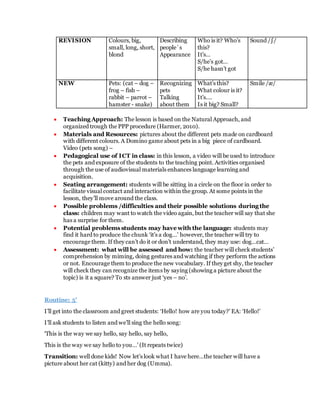
Video (pets song) –
 Pedagogical use of ICT in class: in this lesson, a video will be used to introduce
the pets and exposure of the students to the teaching point. Activities organised
through the use of audiovisual materials enhances language learning and
acquisition.
 Seating arrangement: students will be sitting in a circle on the floor in order to
facilitate visual contact and interaction within the group. At some points in the
lesson, they’ll move around the class.
 Possible problems /difficulties and their possible solutions during the
class: children may want to watch the video again, but the teacher will say that she
has a surprise for them.
 Potential problems students may have with the language: students may
find it hard to produce the chunk ‘it’s a dog…’ however, the teacher will try to
encourage them. If they can’t do it or don’t understand, they may use: dog…cat…
 Assessment: what will be assessed and how: the teacher will check students’
comprehension by miming, doing gestures and watching if they perform the actions
or not. Encourage them to produce the new vocabulary. If they get shy, the teacher
will check they can recognize the items by saying (showing a picture about the
topic) is it a square? To sts answer just ‘yes – no’.
Routine: 5’
I’ll get into the classroom and greet students: ‘Hello! how are you today?’ EA: ‘Hello!’
I’ll ask students to listen and we’ll sing the hello song:
‘This is the way we say hello, say hello, say hello,
This is the way we say hello to you…’ (It repeats twice)
Transition: well done kids! Now let’s look what I have here…the teacher will have a
picture about her cat (kitty) and her dog (Umma).
Warm – up 5’
‘Look! Can you see that? This is mi little cat Kitty. She’s got long dark hair. She’s got green
eyes and she is very funny!
This is my dog Umma. She is very big. She has got short brown hair. She’s got a long nose
and brown eyes. I love it! Have you got any animal?
Presentation 10’
I’ll stick the pets’ pictures on the board and the teacher will ask students if they have some
animals in their houses.
‘Marti, have you got any pet?’ She will show the pictures in case she won’t understand, and
she will say that pet is what you can have in a house. ‘Lucas, and you?’ EA: yes/noand
probably they will say their pets.
When they finish speaking about their pets, the teacher will play the next video to
understand better the meaning of pets:
https://youtu.be/pWepfJ-8XU0
In it they will watch different pets and the structure ‘I’ve a…’
Transition: ‘ok, do you like the video?’ sshhh 1…2…3… silence please! (She will use this
chant to keep calm the children).
Development 15’
Activity 1 - 10’
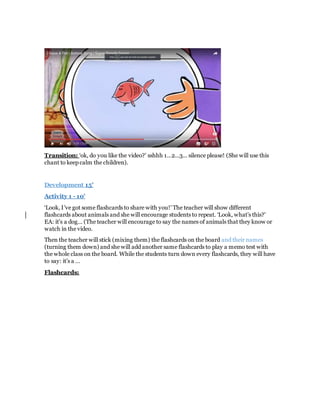
‘Look, I’ve got some flashcards to share with you!’ The teacher will show different
flashcards about animals and she will encourage students to repeat. ‘Look, what’s this?’
EA: it’s a dog… (The teacher will encourage to say the names of animals that they know or
watch in the video.
Then the teacher will stick (mixing them) the flashcards on the board and their names
(turning them down) and she will add another same flashcards to play a memo test with
the whole class on the board. While the students turn down every flashcards, they will have
to say: it’s a …
Flashcards:
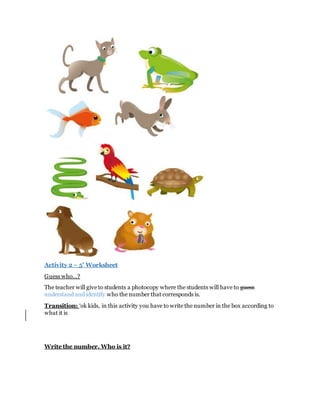
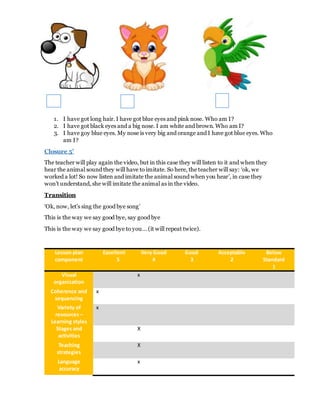
Activity 2 – 5’ Worksheet
Guess who…?
The teacher will give to students a photocopy where the students will have to guess
understand and identify who the number that corresponds is.
Transition: ‘ok kids, in this activity you have to write the number in the box according to
what it is
Write the number. Who is it?
1. I have got long hair. I have got blue eyes and pink nose. Who am I?
2. I have got black eyes and a big nose. I am white and brown. Who am I?
3. I have goy blue eyes. My nose is very big and orange and I have got blue eyes. Who
am I?
Closure 5’
The teacher will play again the video, but in this case they will listen to it and when they
hear the animal sound they will have to imitate. So here, the teacher will say: ‘ok, we
worked a lot! So now listen and imitate the animal sound when you hear’, in case they
won’t understand, she will imitate the animal as in the video.
Transition
‘Ok, now, let’s sing the good bye song’
This is the way we say good bye, say good bye
This is the way we say good bye to you… (it will repeat twice).
Lesson plan
component
Excellent
5
Very Good
4
Good
3
Acceptable
2
Below
Standard
1
Visual
organization
x
Coherence and
sequencing
x
Variety of
resources –
Learning styles
x
Stages and
activities
X
Teaching
strategies
X
Language
accuracy
x
Observations Lovelylesson!Hope mycommentsandsuggestionsare useful.
Best,
Aure

Gieser leticia lessonplan_class 1 primary school - corrected

  • 1.
    I NSTITUTO DEFORMACIÓN DOCENTE CONTINUA LENGUAS VIVAS BARILOCHE (A-052) TALLER DE PRÁCTICA DOCENTE Student: Gieser Leticia Período de Práctica: Nivel Primario Number of Students: 36 Institution: Colegio Cavagnaro Adress: Calle 70 – N° 2753 Age: 11 years old Level: Beginners Lesson plan: a class Date: August, 3rd Time: 40’ (11.10 a 11.50hs)  Teaching Points: The Pets (cat – frog – fish – rabbit – parrot – dog )  Aims: During this lesson, learners will be able to…  Identify and name different pets that they have.  Develop their listening skills by listening and song and watch a video.  Todeepen their understanding of commands/instructions while developing their macro skills as well.  Language Focuses: LEXIS FUNCTION STRUCTURE PRONUNCIATION
  • 2.
    REVISION Colours, big, small,long, short, blond Describing people`s Appearance Who is it? Who’s this? It’s… S/he’s got… S/he hasn’t got Sound /∫/ NEW Pets: (cat – dog – frog – fish – rabbit – parrot – hamster - snake) Recognizing pets Talking about them What’s this? What colour is it? It’s…. Is it big? Small? Smile /æ/  Teaching Approach: The lesson is based on the Natural Approach, and organized trough the PPP procedure (Harmer, 2010).  Materials and Resources: pictures about the different pets made on cardboard with different colours. A Domino game about pets in a big piece of cardboard. Video (pets song) –  Pedagogical use of ICT in class: in this lesson, a video will be used to introduce the pets and exposure of the students to the teaching point. Activities organised through the use of audiovisual materials enhances language learning and acquisition.  Seating arrangement: students will be sitting in a circle on the floor in order to facilitate visual contact and interaction within the group. At some points in the lesson, they’ll move around the class.  Possible problems /difficulties and their possible solutions during the class: children may want to watch the video again, but the teacher will say that she has a surprise for them.  Potential problems students may have with the language: students may find it hard to produce the chunk ‘it’s a dog…’ however, the teacher will try to encourage them. If they can’t do it or don’t understand, they may use: dog…cat…  Assessment: what will be assessed and how: the teacher will check students’ comprehension by miming, doing gestures and watching if they perform the actions or not. Encourage them to produce the new vocabulary. If they get shy, the teacher will check they can recognize the items by saying (showing a picture about the topic) is it a square? To sts answer just ‘yes – no’. Routine: 5’ I’ll get into the classroom and greet students: ‘Hello! how are you today?’ EA: ‘Hello!’ I’ll ask students to listen and we’ll sing the hello song: ‘This is the way we say hello, say hello, say hello, This is the way we say hello to you…’ (It repeats twice) Transition: well done kids! Now let’s look what I have here…the teacher will have a picture about her cat (kitty) and her dog (Umma).
  • 4.
    Warm – up5’ ‘Look! Can you see that? This is mi little cat Kitty. She’s got long dark hair. She’s got green eyes and she is very funny! This is my dog Umma. She is very big. She has got short brown hair. She’s got a long nose and brown eyes. I love it! Have you got any animal? Presentation 10’ I’ll stick the pets’ pictures on the board and the teacher will ask students if they have some animals in their houses. ‘Marti, have you got any pet?’ She will show the pictures in case she won’t understand, and she will say that pet is what you can have in a house. ‘Lucas, and you?’ EA: yes/noand probably they will say their pets. When they finish speaking about their pets, the teacher will play the next video to understand better the meaning of pets: https://youtu.be/pWepfJ-8XU0 In it they will watch different pets and the structure ‘I’ve a…’
  • 5.
    Transition: ‘ok, doyou like the video?’ sshhh 1…2…3… silence please! (She will use this chant to keep calm the children). Development 15’ Activity 1 - 10’ ‘Look, I’ve got some flashcards to share with you!’ The teacher will show different flashcards about animals and she will encourage students to repeat. ‘Look, what’s this?’ EA: it’s a dog… (The teacher will encourage to say the names of animals that they know or watch in the video. Then the teacher will stick (mixing them) the flashcards on the board and their names (turning them down) and she will add another same flashcards to play a memo test with the whole class on the board. While the students turn down every flashcards, they will have to say: it’s a … Flashcards:
  • 6.
    Activity 2 –5’ Worksheet Guess who…? The teacher will give to students a photocopy where the students will have to guess understand and identify who the number that corresponds is. Transition: ‘ok kids, in this activity you have to write the number in the box according to what it is Write the number. Who is it?
  • 7.
    1. I havegot long hair. I have got blue eyes and pink nose. Who am I? 2. I have got black eyes and a big nose. I am white and brown. Who am I? 3. I have goy blue eyes. My nose is very big and orange and I have got blue eyes. Who am I? Closure 5’ The teacher will play again the video, but in this case they will listen to it and when they hear the animal sound they will have to imitate. So here, the teacher will say: ‘ok, we worked a lot! So now listen and imitate the animal sound when you hear’, in case they won’t understand, she will imitate the animal as in the video. Transition ‘Ok, now, let’s sing the good bye song’ This is the way we say good bye, say good bye This is the way we say good bye to you… (it will repeat twice). Lesson plan component Excellent 5 Very Good 4 Good 3 Acceptable 2 Below Standard 1 Visual organization x Coherence and sequencing x Variety of resources – Learning styles x Stages and activities X Teaching strategies X Language accuracy x
  • 8.