Cultural Compass
Cultural Compass
Gözde Berberoğlu Özen
Navigating Diversity
Navigating Diversity in the Workplace
in the Workplace
Yourearringsareso
pretty!
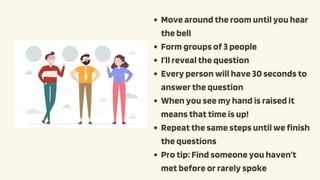
Move around the room until you hear
the bell
Form groups of 3 people
I’ll reveal the question
Every person will have 30 seconds to
answer the question
When you see my hand is raised it
means that time is up!
Repeat the same steps until we finish
the questions
Pro tip: Find someone you haven’t
met before or rarely spoke
Howdoyougreeteachotherin
yourculture?Handshake-hug-
kiss?Whatisacceptable?
?
? ?
? ?
?
Howdoyoucelebratea
birthdayinyour
culture?(Who
organizeswhat,how
giftisexchanged?...)
?
? ?
? ?
?
?
?
Howdoyougaintrustin
yourculture?
?
? ?
?
?
?
Isspeakingfranklyagiftor
aslapinthefaceinyourculture?
?
? ?
?
Whataretheattitudestowardshierarchy,
communicationstyles,work-lifebalance,and
expectationsregardingpunctualityanddeadlines
whenitcomestotheworkplaceinyourculture?
?
? ?
? ?
?
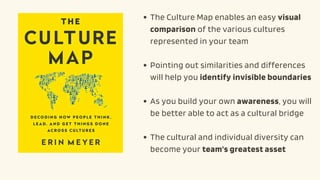
The Culture Map enables an easy visual
comparison of the various cultures
represented in your team
Pointing out similarities and differences
will help you identify invisible boundaries
As you build your own awareness, you will
be better able to act as a cultural bridge
The cultural and individual diversity can
become your team's greatest asset
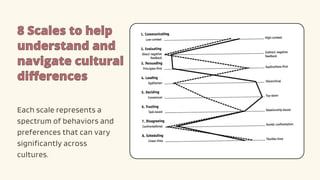
8 Scales to help
8 Scales to help
understand and
understand and
navigate cultural
navigate cultural
differences
differences
Each scale represents a
spectrum of behaviors and
preferences that can vary
significantly across
cultures.
Good to know about the scales
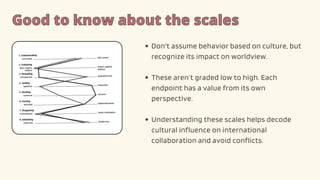
Don't assume behavior based on culture, but
recognize its impact on worldview.
These aren’t graded low to high. Each
endpoint has a value from its own
perspective.
Understanding these scales helps decode
cultural influence on international
collaboration and avoid conflicts.
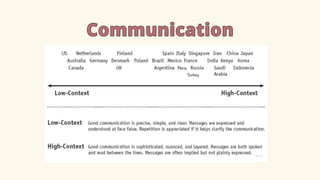
Exercise: Culture Mapping
As I explain each scale, add your initials on the scale
We’ll debrief everything at the end
There is no right or wrong, it’s your perspective ;)
TIMEBOX
15 MINS
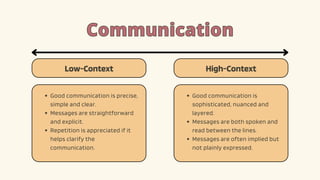
Communication
Communication
Low-Context High-Context
Good communication is precise,
simple and clear.
Messages are straightforward
and explicit.
Repetition is appreciated if it
helps clarify the
communication.
Good communication is
sophisticated, nuanced and
layered.
Messages are both spoken and
read between the lines.
Messages are often implied but
not plainly expressed.
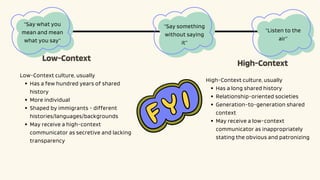
High-Context
Low-Context
“Say what you
mean and mean
what you say”
“Listen to the
air”
Low-Context culture, usually
Has a few hundred years of shared
history
More individual
Shaped by immigrants - different
histories/languages/backgrounds
May receive a high-context
communicator as secretive and lacking
transparency
High-Context culture, usually
Has a long shared history
Relationship-oriented societies
Generation-to-generation shared
context
May receive a low-context
communicator as inappropriately
stating the obvious and patronizing
“Say something
without saying
it”
Communication
Communication
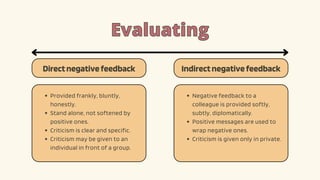
Evaluating
Evaluating
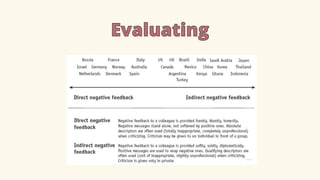
Directnegativefeedback Indirectnegativefeedback
Provided frankly, bluntly,
honestly.
Stand alone, not softened by
positive ones.
Criticism is clear and specific.
Criticism may be given to an
individual in front of a group.
Negative feedback to a
colleague is provided softly,
subtly, diplomatically.
Positive messages are used to
wrap negative ones.
Criticism is given only in private.
Evaluating
Evaluating
Leading
Leading
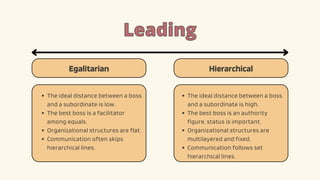
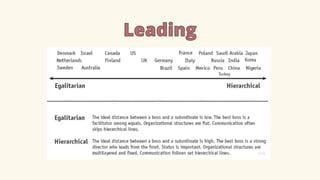
Egalitarian Hierarchical
The ideal distance between a boss
and a subordinate is low.
The best boss is a facilitator
among equals.
Organizational structures are flat.
Communication often skips
hierarchical lines.
The ideal distance between a boss
and a subordinate is high.
The best boss is an authority
figure, status is important.
Organizational structures are
multilayered and fixed.
Communication follows set
hierarchical lines.
Leading
Leading
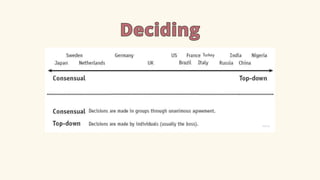
Deciding
Deciding
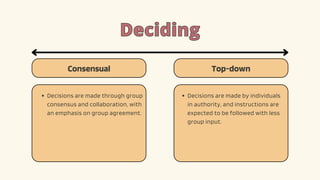
Consensual Top-down
Decisions are made through group
consensus and collaboration, with
an emphasis on group agreement.
Decisions are made by individuals
in authority, and instructions are
expected to be followed with less
group input.
Deciding
Deciding
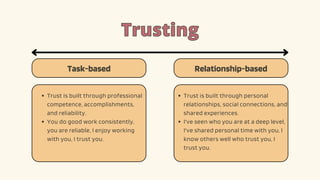
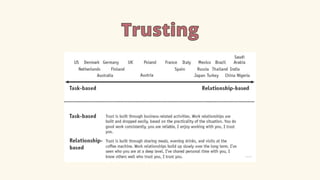
Trusting
Trusting
Task-based Relationship-based
Trust is built through professional
competence, accomplishments,
and reliability.
You do good work consistently,
you are reliable, I enjoy working
with you, I trust you.
Trust is built through personal
relationships, social connections, and
shared experiences.
I've seen who you are at a deep level,
I've shared personal time with you, I
know others well who trust you, I
trust you.
Trusting
Trusting
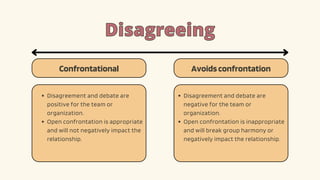
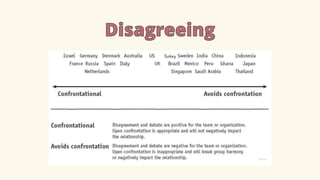
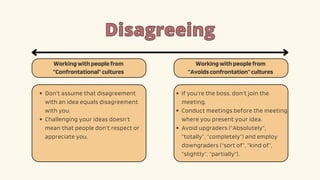
Disagreeing
Disagreeing
Confrontational Avoidsconfrontation
Disagreement and debate are
positive for the team or
organization.
Open confrontation is appropriate
and will not negatively impact the
relationship.
Disagreement and debate are
negative for the team or
organization.
Open confrontation is inappropriate
and will break group harmony or
negatively impact the relationship.
Disagreeing
Disagreeing
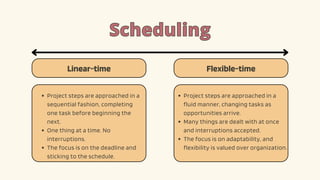
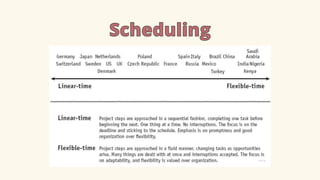
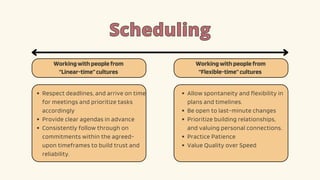
Scheduling
Scheduling
Linear-time Flexible-time
Project steps are approached in a
sequential fashion, completing
one task before beginning the
next.
One thing at a time. No
interruptions.
The focus is on the deadline and
sticking to the schedule.
Project steps are approached in a
fluid manner, changing tasks as
opportunities arrive.
Many things are dealt with at once
and interruptions accepted.
The focus is on adaptability, and
flexibility is valued over organization.
Scheduling
Scheduling
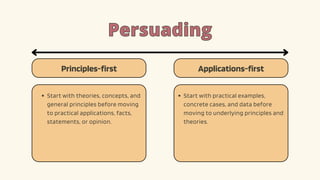
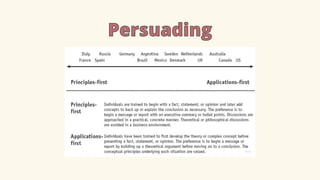
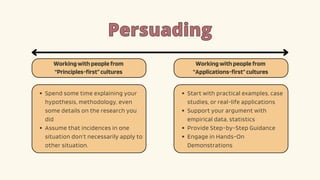
Persuading
Persuading
Principles-first Applications-first
Start with theories, concepts, and
general principles before moving
to practical applications, facts,
statements, or opinion.
Start with practical examples,
concrete cases, and data before
moving to underlying principles and
theories.
Persuading
Persuading
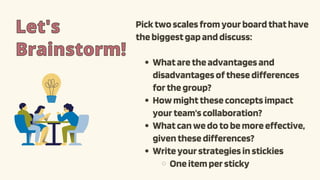
Picktwoscalesfromyourboardthathave
thebiggestgapanddiscuss:
Whataretheadvantagesand
disadvantagesofthesedifferences
forthegroup?
Howmighttheseconceptsimpact
yourteam'scollaboration?
Whatcanwedotobemoreeffective,
giventhesedifferences?
Writeyourstrategiesinstickies
Oneitempersticky
Let's
Let's
Brainstorm!
Brainstorm!
Strategies
Strategies
Beflexibleandrespectfulwhilestillstaying
truetoyourcorevaluesandprinciples
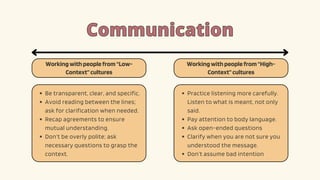
Communication
Communication
Workingwithpeoplefrom“Low-
Context”cultures
Workingwithpeoplefrom“High-
Context”cultures
Be transparent, clear, and specific.
Avoid reading between the lines;
ask for clarification when needed.
Recap agreements to ensure
mutual understanding.
Don’t be overly polite; ask
necessary questions to grasp the
context.
Practice listening more carefully.
Listen to what is meant, not only
said.
Pay attention to body language.
Ask open-ended questions
Clarify when you are not sure you
understood the message.
Don’t assume bad intention
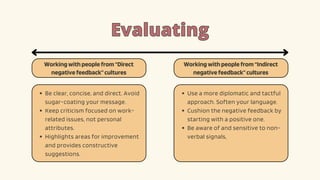
Evaluating
Evaluating
Workingwithpeoplefrom“Direct
negativefeedback”cultures
Workingwithpeoplefrom“Indirect
negativefeedback”cultures
Be clear, concise, and direct. Avoid
sugar-coating your message.
Keep criticism focused on work-
related issues, not personal
attributes.
Highlights areas for improvement
and provides constructive
suggestions.
Use a more diplomatic and tactful
approach. Soften your language.
Cushion the negative feedback by
starting with a positive one.
Be aware of and sensitive to non-
verbal signals,
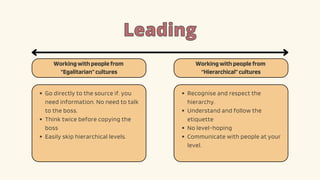
Leading
Leading
Workingwithpeoplefrom
“Egalitarian”cultures
Workingwithpeoplefrom
“Hierarchical”cultures
Go directly to the source if. you
need information. No need to talk
to the boss.
Think twice before copying the
boss
Easily skip hierarchical levels.
Recognise and respect the
hierarchy.
Understand and follow the
etiquette
No level-hoping
Communicate with people at your
level.
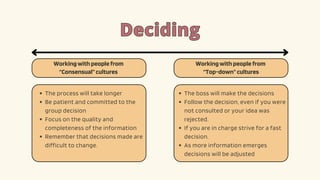
Deciding
Deciding
Workingwithpeoplefrom
“Consensual”cultures
Workingwithpeoplefrom
“Top-down”cultures
The process will take longer
Be patient and committed to the
group decision
Focus on the quality and
completeness of the information
Remember that decisions made are
difficult to change.
The boss will make the decisions
Follow the decision, even if you were
not consulted or your idea was
rejected.
If you are in charge strive for a fast
decision.
As more information emerges
decisions will be adjusted
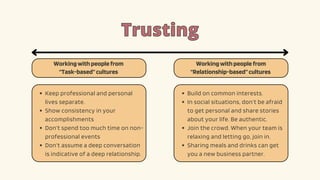
Trusting
Trusting
Workingwithpeoplefrom
“Task-based”cultures
Workingwithpeoplefrom
“Relationship-based”cultures
Keep professional and personal
lives separate.
Show consistency in your
accomplishments
Don’t spend too much time on non-
professional events
Don’t assume a deep conversation
is indicative of a deep relationship.
Build on common interests.
In social situations, don’t be afraid
to get personal and share stories
about your life. Be authentic.
Join the crowd. When your team is
relaxing and letting go, join in.
Sharing meals and drinks can get
you a new business partner.
Disagreeing
Disagreeing
Workingwithpeoplefrom
“Confrontational”cultures
Workingwithpeoplefrom
“Avoidsconfrontation”cultures
Don’t assume that disagreement
with an idea equals disagreement
with you.
Challenging your ideas doesn’t
mean that people don’t respect or
appreciate you.
If you’re the boss, don’t join the
meeting.
Conduct meetings before the meeting
where you present your idea.
Avoid upgraders (“Absolutely”,
“totally”, “completely“) and employ
downgraders (“sort of”, “kind of”,
“slightly”, “partially“).
Scheduling
Scheduling
Workingwithpeoplefrom
“Linear-time”cultures
Workingwithpeoplefrom
“Flexible-time”cultures
Respect deadlines, and arrive on time
for meetings and prioritize tasks
accordingly
Provide clear agendas in advance
Consistently follow through on
commitments within the agreed-
upon timeframes to build trust and
reliability.
Allow spontaneity and flexibility in
plans and timelines.
Be open to last-minute changes
Prioritize building relationships,
and valuing personal connections.
Practice Patience
Value Quality over Speed
Persuading
Persuading
Workingwithpeoplefrom
“Principles-first”cultures
Workingwithpeoplefrom
“Applications-first”cultures
Spend some time explaining your
hypothesis, methodology, even
some details on the research you
did
Assume that incidences in one
situation don’t necessarily apply to
other situation.
Start with practical examples, case
studies, or real-life applications
Support your argument with
empirical data, statistics
Provide Step-by-Step Guidance
Engage in Hands-On
Demonstrations
Persuading
Persuading
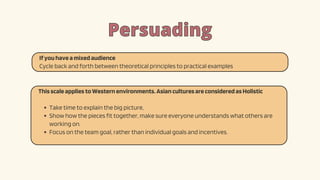
Ifyouhaveamixedaudience
Cycle back and forth between theoretical principles to practical examples
ThisscaleappliestoWesternenvironments.AsianculturesareconsideredasHolistic
Take time to explain the big picture,
Show how the pieces fit together, make sure everyone understands what others are
working on.
Focus on the team goal, rather than individual goals and incentives.
Strategies in
Strategies in
Action
Action
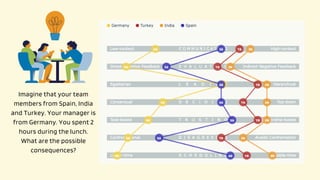
Imagine that your team
members from Spain, India
and Turkey. Your manager is
from Germany. You spent 2
hours during the lunch.
What are the possible
consequences?
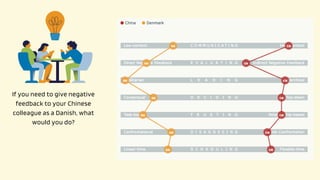
If you need to give negative
feedback to your Chinese
colleague as a Danish, what
would you do?
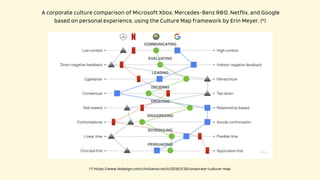
A corporate culture comparison of Microsoft Xbox, Mercedes-Benz R&D, Netflix, and Google
based on personal experience, using the Culture Map framework by Erin Meyer. (*)
(*) https://www.i4design.com/chickenscratch/2018/3/18/corporate-culture-map
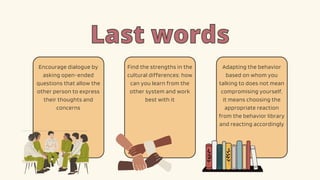
Last words
Last words
Find the strengths in the
cultural differences: how
can you learn from the
other system and work
best with it
Adapting the behavior
based on whom you
talking to does not mean
compromising yourself,
it means choosing the
appropriate reaction
from the behavior library
and reacting accordingly
Encourage dialogue by
asking open-ended
questions that allow the
other person to express
their thoughts and
concerns
Thank you for
Thank you for
listening!
listening!
Gözde Berberoğlu Özen
Credits
Credits
References
Erin Meyer’s Culture Map
i4design.com
Increase Your Team’s Performance
with The Culture Map
Images:
Freepik
Canva

[Workshop] Cultural Compass Navigating Diversity in the Workplace