Religion 15
3rd edition
Copyright © 2016 McGraw-Hill Education. All rights reserved.
No reproduction or distribution without the prior written consent of McGraw-Hill Education.
Sociology in Modules
Richard T. Schaefer
Slide 2 Copyright © 2016 McGraw-Hill Education. All rights reserved.
No reproduction or distribution without the prior written consent of McGraw-Hill Education.
The Sociological Approach to
Religion
• Durkheim and the Importance of
Religion
• Religion: unified system of beliefs and
practices relative to sacred things
(Durkheim)
– Collective act
– Includes many forms of behavior in which
people interact with others
Slide 3 Copyright © 2016 McGraw-Hill Education. All rights reserved.
No reproduction or distribution without the prior written consent of McGraw-Hill Education.
Durkheim and the Importance
of Religion
• Sacred: elements beyond everyday life that
inspire awe, respect, and even fear
• Profane: includes the ordinary and
the commonplace
• Secularization: religion’s influence on social
institutions diminishes
• Sociologists study religion through:
– Norms and values of religious faiths
through their substantive beliefs
– The social functions religion fulfills
Slide 4 Copyright © 2016 McGraw-Hill Education. All rights reserved.
No reproduction or distribution without the prior written consent of McGraw-Hill Education.
Sociological Perspectives
on Religion
• Manifest functions: open and stated
functions; religion defines the spiritual
world and gives meaning to the divine
• Latent functions: unintended, covert, or
hidden functions; might include providing
a meeting ground for unmarried members
Slide 5 Copyright © 2016 McGraw-Hill Education. All rights reserved.
No reproduction or distribution without the prior written consent of McGraw-Hill Education.
The Integrative Function
of Religion
• Durkheim viewed religion as an integrative
force in human society
– Gives meaning and purpose to lives
– Offers ultimate values and ends
– Strengthens social integration
– Integrative power seen in work with
immigrant groups
– Can be dysfunctional
Slide 6 Copyright © 2016 McGraw-Hill Education. All rights reserved.
No reproduction or distribution without the prior written consent of McGraw-Hill Education.
Religion and Social Support
• Religion’s emphasis on divine and
supernatural allows us to “do something”
about calamities we face
– Encourages people to view personal
misfortunes as relatively unimportant
– Religious function of social support also
apparent in people’s use of social media
Slide 7 Copyright © 2016 McGraw-Hill Education. All rights reserved.
No reproduction or distribution without the prior written consent of McGraw-Hill Education.
Religion and Social Change
• The Weberian Thesis
– Protestant ethic: followers of Protestant
Reformation emphasized a disciplined work
ethic, this-worldly concerns, and a rational
orientation for life
– “Spirit of capitalism” has emerged as
generalized cultural trait
Slide 8 Copyright © 2016 McGraw-Hill Education. All rights reserved.
No reproduction or distribution without the prior written consent of McGraw-Hill Education.
Religion and Social Change
• Liberation Theology
– Liberation theology: use of a church in
a political effort to eliminate poverty,
discrimination, and other forms of injustice
from a secular society
– May be dysfunctional
Slide 9 Copyright © 2016 McGraw-Hill Education. All rights reserved.
No reproduction or distribution without the prior written consent of McGraw-Hill Education.
Religion and Social Control:
A Conflict Perspective
• Marx: religion impeded social change
– People focus on other-worldly concerns
– Religion’s promotion of social stability only
helps to perpetuate patterns of social
inequality
– By inducing a “false consciousness” among
disadvantaged, religion lessens the possibility
of collective political action
Slide 10 Copyright © 2016 McGraw-Hill Education. All rights reserved.
No reproduction or distribution without the prior written consent of McGraw-Hill Education.
Feminist Perspective
• Theorists have stressed fundamental role
women play in religious socialization
– Women generally take subordinate role
in religious governance
– Women play vital role as volunteers, staff,
and educators
– In U.S., women more likely than men to be
affiliated with religion
Slide 11 Copyright © 2016 McGraw-Hill Education. All rights reserved.
No reproduction or distribution without the prior written consent of McGraw-Hill Education.
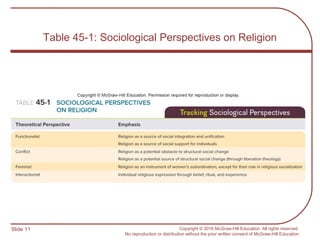
Table 45-1: Sociological Perspectives on Religion
Slide 12 Copyright © 2016 McGraw-Hill Education. All rights reserved.
No reproduction or distribution without the prior written consent of McGraw-Hill Education.
World Religions
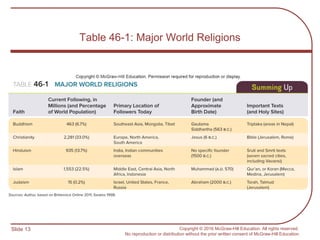
• About 89% of world’s population adheres
to some religion
– Christianity largest, Islam second largest
– Judaism forms historical foundation for
Christianity and Islam
– Hinduism embraces number of gods
and reincarnation
– Buddhism developed as reaction against
Hinduism; uses meditation to overcome
selfish cravings
Slide 13 Copyright © 2016 McGraw-Hill Education. All rights reserved.
No reproduction or distribution without the prior written consent of McGraw-Hill Education.
Table 46-1: Major World Religions
Slide 14 Copyright © 2016 McGraw-Hill Education. All rights reserved.
No reproduction or distribution without the prior written consent of McGraw-Hill Education.
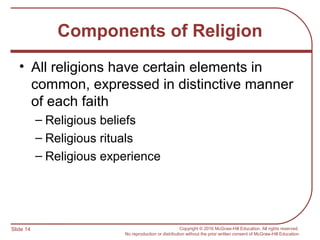
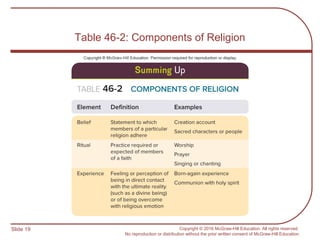
Components of Religion
• All religions have certain elements in
common, expressed in distinctive manner
of each faith
– Religious beliefs
– Religious rituals
– Religious experience
Slide 15 Copyright © 2016 McGraw-Hill Education. All rights reserved.
No reproduction or distribution without the prior written consent of McGraw-Hill Education.
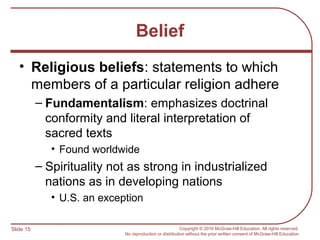
Belief
• Religious beliefs: statements to which
members of a particular religion adhere
– Fundamentalism: emphasizes doctrinal
conformity and literal interpretation of
sacred texts
• Found worldwide
– Spirituality not as strong in industrialized
nations as in developing nations
• U.S. an exception
Slide 16 Copyright © 2016 McGraw-Hill Education. All rights reserved.
No reproduction or distribution without the prior written consent of McGraw-Hill Education.
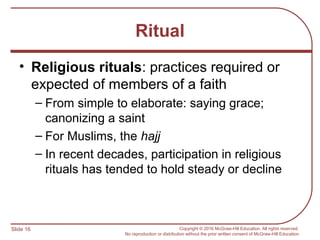
Ritual
• Religious rituals: practices required or
expected of members of a faith
– From simple to elaborate: saying grace;
canonizing a saint
– For Muslims, the hajj
– In recent decades, participation in religious
rituals has tended to hold steady or decline
Slide 17 Copyright © 2016 McGraw-Hill Education. All rights reserved.
No reproduction or distribution without the prior written consent of McGraw-Hill Education.
Experience
• Religious experience: feeling or
perception of being in direct contact with
ultimate reality or of being overcome with
religious emotion
– Being born again
Slide 18 Copyright © 2016 McGraw-Hill Education. All rights reserved.
No reproduction or distribution without the prior written consent of McGraw-Hill Education.
None of the Above:
The Nonreligious
• Between 1990 and 2008 the number of
Americans who identified as having no
religious affiliation doubled
– Mostly attributed to decision not to affiliate
with organized religion
Slide 19 Copyright © 2016 McGraw-Hill Education. All rights reserved.
No reproduction or distribution without the prior written consent of McGraw-Hill Education.
Table 46-2: Components of Religion
Slide 20 Copyright © 2016 McGraw-Hill Education. All rights reserved.
No reproduction or distribution without the prior written consent of McGraw-Hill Education.
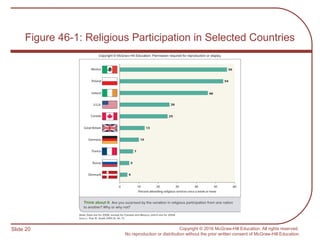
Figure 46-1: Religious Participation in Selected Countries
Slide 21 Copyright © 2016 McGraw-Hill Education. All rights reserved.
No reproduction or distribution without the prior written consent of McGraw-Hill Education.
Religious Organization
• Four Basic Forms of Organization
– Ecclesiae
– Denomination
– Sect
– New religious movement, cult
Slide 22 Copyright © 2016 McGraw-Hill Education. All rights reserved.
No reproduction or distribution without the prior written consent of McGraw-Hill Education.
Religious Organization
• Ecclesiae
– Ecclesia: religious organization claiming to
include most or all members of a society;
recognized as national or official religion
• Denominations
– Denomination: large, organized religion not
officially linked with state or government
Slide 23 Copyright © 2016 McGraw-Hill Education. All rights reserved.
No reproduction or distribution without the prior written consent of McGraw-Hill Education.
Religious Organization
• Sects
– Sect: relatively small religious group that
broke away from some other religious
organization to renew original vision of faith
– Fundamentally at odds with society; do not
seek to become established national religions
– Established sect: out-growth of a sect that
remains isolated (Yinger)
Slide 24 Copyright © 2016 McGraw-Hill Education. All rights reserved.
No reproduction or distribution without the prior written consent of McGraw-Hill Education.
Religious Organization
• New Religious Movements or Cults
– New religious movement (NRM) or cult:
small, secretive religious group that
represents either a new religion or a major
innovation of an existing faith
– Similar to sects
– Tend to be small
– Viewed as less respectable than more
established faiths
Slide 25 Copyright © 2016 McGraw-Hill Education. All rights reserved.
No reproduction or distribution without the prior written consent of McGraw-Hill Education.
Comparing Forms
of Religious Organization
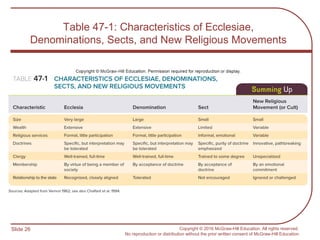
• Ecclesiae, denominations, and sects
best viewed as types along a continuum
• From individual perspective, religion
and spirituality remarkably fluid
– Rapid rise of electronic church
– Many people shop online for church or faith
Slide 26 Copyright © 2016 McGraw-Hill Education. All rights reserved.
No reproduction or distribution without the prior written consent of McGraw-Hill Education.
Table 47-1: Characteristics of Ecclesiae,
Denominations, Sects, and New Religious Movements
Slide 27 Copyright © 2016 McGraw-Hill Education. All rights reserved.
No reproduction or distribution without the prior written consent of McGraw-Hill Education.
Social Policy and Religion:
Religion in the Schools
• Controversy over teaching of theories
about the origin of humans and the
universe
• Mainstream scientific thinking: humans
evolved over billions of years; universe
came into existence 15 billion years ago
• Creationism: holding to biblical account of
the creation of humans and the universe
some 10,000 years ago
Slide 28 Copyright © 2016 McGraw-Hill Education. All rights reserved.
No reproduction or distribution without the prior written consent of McGraw-Hill Education.
Social Policy and Religion:
Religion in the Schools
• Looking at the Issue
– Issue goes to heart of First Amendment
provisions regarding religious freedom
– Engle v. Vitale, 1962: prayer in New York
schools unconstitutional
– Intelligent design (ID): idea that life is so
complex it could only have been created by
intelligent design
• Federal judge: ID is “a religious belief”
Slide 29 Copyright © 2016 McGraw-Hill Education. All rights reserved.
No reproduction or distribution without the prior written consent of McGraw-Hill Education.
Social Policy and Religion:
Religion in the Schools
• Applying Sociology
– Supporters of school prayer:
• Supreme Court has driven too big a wedge
between church and state
• Prayer can provide socialization and spiritual
guidance
– Opponents of school prayer:
• Through school prayer, religious majority may
impose specific viewpoints onto religious minorities
Slide 30 Copyright © 2016 McGraw-Hill Education. All rights reserved.
No reproduction or distribution without the prior written consent of McGraw-Hill Education.
Social Policy and Religion:
Religion in the Schools
• Initiating Policy
– Most initiatives and lobbying occur at state
and local level
– Supreme Court has taken a hard line
– Debate still strong and ongoing
– Critics worry fundamentalist activism may
lead to sectarian religious control of public
education
Slide 31 Copyright © 2016 McGraw-Hill Education. All rights reserved.
No reproduction or distribution without the prior written consent of McGraw-Hill Education.
47-1: Mormons: A Controversial
Denomination
– Mormons are not supposed to drink
alcohol, soft drinks, coffee, or tea.
What aspects of your own religious
faith are sometimes observable to
others?
– Do you have any reservations about
a Mormon becoming president of the
United States? If so, on what grounds?
Research Today
Slide 32 Copyright © 2016 McGraw-Hill Education. All rights reserved.
No reproduction or distribution without the prior written consent of McGraw-Hill Education.
47-2: Wicca: Religion or
Quasi-Religion
– Do you know anyone who practices
Wicca? If so, describe the person’s
practices?
– Do you think that Wicca should be
considered a religion? Why or why
not?
Research Today

Schaefermods3 ppt ch15 (2)

  • 1.
    Religion 15 3rd edition Copyright© 2016 McGraw-Hill Education. All rights reserved. No reproduction or distribution without the prior written consent of McGraw-Hill Education. Sociology in Modules Richard T. Schaefer
  • 2.
    Slide 2 Copyright© 2016 McGraw-Hill Education. All rights reserved. No reproduction or distribution without the prior written consent of McGraw-Hill Education. The Sociological Approach to Religion • Durkheim and the Importance of Religion • Religion: unified system of beliefs and practices relative to sacred things (Durkheim) – Collective act – Includes many forms of behavior in which people interact with others
  • 3.
    Slide 3 Copyright© 2016 McGraw-Hill Education. All rights reserved. No reproduction or distribution without the prior written consent of McGraw-Hill Education. Durkheim and the Importance of Religion • Sacred: elements beyond everyday life that inspire awe, respect, and even fear • Profane: includes the ordinary and the commonplace • Secularization: religion’s influence on social institutions diminishes • Sociologists study religion through: – Norms and values of religious faiths through their substantive beliefs – The social functions religion fulfills
  • 4.
    Slide 4 Copyright© 2016 McGraw-Hill Education. All rights reserved. No reproduction or distribution without the prior written consent of McGraw-Hill Education. Sociological Perspectives on Religion • Manifest functions: open and stated functions; religion defines the spiritual world and gives meaning to the divine • Latent functions: unintended, covert, or hidden functions; might include providing a meeting ground for unmarried members
  • 5.
    Slide 5 Copyright© 2016 McGraw-Hill Education. All rights reserved. No reproduction or distribution without the prior written consent of McGraw-Hill Education. The Integrative Function of Religion • Durkheim viewed religion as an integrative force in human society – Gives meaning and purpose to lives – Offers ultimate values and ends – Strengthens social integration – Integrative power seen in work with immigrant groups – Can be dysfunctional
  • 6.
    Slide 6 Copyright© 2016 McGraw-Hill Education. All rights reserved. No reproduction or distribution without the prior written consent of McGraw-Hill Education. Religion and Social Support • Religion’s emphasis on divine and supernatural allows us to “do something” about calamities we face – Encourages people to view personal misfortunes as relatively unimportant – Religious function of social support also apparent in people’s use of social media
  • 7.
    Slide 7 Copyright© 2016 McGraw-Hill Education. All rights reserved. No reproduction or distribution without the prior written consent of McGraw-Hill Education. Religion and Social Change • The Weberian Thesis – Protestant ethic: followers of Protestant Reformation emphasized a disciplined work ethic, this-worldly concerns, and a rational orientation for life – “Spirit of capitalism” has emerged as generalized cultural trait
  • 8.
    Slide 8 Copyright© 2016 McGraw-Hill Education. All rights reserved. No reproduction or distribution without the prior written consent of McGraw-Hill Education. Religion and Social Change • Liberation Theology – Liberation theology: use of a church in a political effort to eliminate poverty, discrimination, and other forms of injustice from a secular society – May be dysfunctional
  • 9.
    Slide 9 Copyright© 2016 McGraw-Hill Education. All rights reserved. No reproduction or distribution without the prior written consent of McGraw-Hill Education. Religion and Social Control: A Conflict Perspective • Marx: religion impeded social change – People focus on other-worldly concerns – Religion’s promotion of social stability only helps to perpetuate patterns of social inequality – By inducing a “false consciousness” among disadvantaged, religion lessens the possibility of collective political action
  • 10.
    Slide 10 Copyright© 2016 McGraw-Hill Education. All rights reserved. No reproduction or distribution without the prior written consent of McGraw-Hill Education. Feminist Perspective • Theorists have stressed fundamental role women play in religious socialization – Women generally take subordinate role in religious governance – Women play vital role as volunteers, staff, and educators – In U.S., women more likely than men to be affiliated with religion
  • 11.
    Slide 11 Copyright© 2016 McGraw-Hill Education. All rights reserved. No reproduction or distribution without the prior written consent of McGraw-Hill Education. Table 45-1: Sociological Perspectives on Religion
  • 12.
    Slide 12 Copyright© 2016 McGraw-Hill Education. All rights reserved. No reproduction or distribution without the prior written consent of McGraw-Hill Education. World Religions • About 89% of world’s population adheres to some religion – Christianity largest, Islam second largest – Judaism forms historical foundation for Christianity and Islam – Hinduism embraces number of gods and reincarnation – Buddhism developed as reaction against Hinduism; uses meditation to overcome selfish cravings
  • 13.
    Slide 13 Copyright© 2016 McGraw-Hill Education. All rights reserved. No reproduction or distribution without the prior written consent of McGraw-Hill Education. Table 46-1: Major World Religions
  • 14.
    Slide 14 Copyright© 2016 McGraw-Hill Education. All rights reserved. No reproduction or distribution without the prior written consent of McGraw-Hill Education. Components of Religion • All religions have certain elements in common, expressed in distinctive manner of each faith – Religious beliefs – Religious rituals – Religious experience
  • 15.
    Slide 15 Copyright© 2016 McGraw-Hill Education. All rights reserved. No reproduction or distribution without the prior written consent of McGraw-Hill Education. Belief • Religious beliefs: statements to which members of a particular religion adhere – Fundamentalism: emphasizes doctrinal conformity and literal interpretation of sacred texts • Found worldwide – Spirituality not as strong in industrialized nations as in developing nations • U.S. an exception
  • 16.
    Slide 16 Copyright© 2016 McGraw-Hill Education. All rights reserved. No reproduction or distribution without the prior written consent of McGraw-Hill Education. Ritual • Religious rituals: practices required or expected of members of a faith – From simple to elaborate: saying grace; canonizing a saint – For Muslims, the hajj – In recent decades, participation in religious rituals has tended to hold steady or decline
  • 17.
    Slide 17 Copyright© 2016 McGraw-Hill Education. All rights reserved. No reproduction or distribution without the prior written consent of McGraw-Hill Education. Experience • Religious experience: feeling or perception of being in direct contact with ultimate reality or of being overcome with religious emotion – Being born again
  • 18.
    Slide 18 Copyright© 2016 McGraw-Hill Education. All rights reserved. No reproduction or distribution without the prior written consent of McGraw-Hill Education. None of the Above: The Nonreligious • Between 1990 and 2008 the number of Americans who identified as having no religious affiliation doubled – Mostly attributed to decision not to affiliate with organized religion
  • 19.
    Slide 19 Copyright© 2016 McGraw-Hill Education. All rights reserved. No reproduction or distribution without the prior written consent of McGraw-Hill Education. Table 46-2: Components of Religion
  • 20.
    Slide 20 Copyright© 2016 McGraw-Hill Education. All rights reserved. No reproduction or distribution without the prior written consent of McGraw-Hill Education. Figure 46-1: Religious Participation in Selected Countries
  • 21.
    Slide 21 Copyright© 2016 McGraw-Hill Education. All rights reserved. No reproduction or distribution without the prior written consent of McGraw-Hill Education. Religious Organization • Four Basic Forms of Organization – Ecclesiae – Denomination – Sect – New religious movement, cult
  • 22.
    Slide 22 Copyright© 2016 McGraw-Hill Education. All rights reserved. No reproduction or distribution without the prior written consent of McGraw-Hill Education. Religious Organization • Ecclesiae – Ecclesia: religious organization claiming to include most or all members of a society; recognized as national or official religion • Denominations – Denomination: large, organized religion not officially linked with state or government
  • 23.
    Slide 23 Copyright© 2016 McGraw-Hill Education. All rights reserved. No reproduction or distribution without the prior written consent of McGraw-Hill Education. Religious Organization • Sects – Sect: relatively small religious group that broke away from some other religious organization to renew original vision of faith – Fundamentally at odds with society; do not seek to become established national religions – Established sect: out-growth of a sect that remains isolated (Yinger)
  • 24.
    Slide 24 Copyright© 2016 McGraw-Hill Education. All rights reserved. No reproduction or distribution without the prior written consent of McGraw-Hill Education. Religious Organization • New Religious Movements or Cults – New religious movement (NRM) or cult: small, secretive religious group that represents either a new religion or a major innovation of an existing faith – Similar to sects – Tend to be small – Viewed as less respectable than more established faiths
  • 25.
    Slide 25 Copyright© 2016 McGraw-Hill Education. All rights reserved. No reproduction or distribution without the prior written consent of McGraw-Hill Education. Comparing Forms of Religious Organization • Ecclesiae, denominations, and sects best viewed as types along a continuum • From individual perspective, religion and spirituality remarkably fluid – Rapid rise of electronic church – Many people shop online for church or faith
  • 26.
    Slide 26 Copyright© 2016 McGraw-Hill Education. All rights reserved. No reproduction or distribution without the prior written consent of McGraw-Hill Education. Table 47-1: Characteristics of Ecclesiae, Denominations, Sects, and New Religious Movements
  • 27.
    Slide 27 Copyright© 2016 McGraw-Hill Education. All rights reserved. No reproduction or distribution without the prior written consent of McGraw-Hill Education. Social Policy and Religion: Religion in the Schools • Controversy over teaching of theories about the origin of humans and the universe • Mainstream scientific thinking: humans evolved over billions of years; universe came into existence 15 billion years ago • Creationism: holding to biblical account of the creation of humans and the universe some 10,000 years ago
  • 28.
    Slide 28 Copyright© 2016 McGraw-Hill Education. All rights reserved. No reproduction or distribution without the prior written consent of McGraw-Hill Education. Social Policy and Religion: Religion in the Schools • Looking at the Issue – Issue goes to heart of First Amendment provisions regarding religious freedom – Engle v. Vitale, 1962: prayer in New York schools unconstitutional – Intelligent design (ID): idea that life is so complex it could only have been created by intelligent design • Federal judge: ID is “a religious belief”
  • 29.
    Slide 29 Copyright© 2016 McGraw-Hill Education. All rights reserved. No reproduction or distribution without the prior written consent of McGraw-Hill Education. Social Policy and Religion: Religion in the Schools • Applying Sociology – Supporters of school prayer: • Supreme Court has driven too big a wedge between church and state • Prayer can provide socialization and spiritual guidance – Opponents of school prayer: • Through school prayer, religious majority may impose specific viewpoints onto religious minorities
  • 30.
    Slide 30 Copyright© 2016 McGraw-Hill Education. All rights reserved. No reproduction or distribution without the prior written consent of McGraw-Hill Education. Social Policy and Religion: Religion in the Schools • Initiating Policy – Most initiatives and lobbying occur at state and local level – Supreme Court has taken a hard line – Debate still strong and ongoing – Critics worry fundamentalist activism may lead to sectarian religious control of public education
  • 31.
    Slide 31 Copyright© 2016 McGraw-Hill Education. All rights reserved. No reproduction or distribution without the prior written consent of McGraw-Hill Education. 47-1: Mormons: A Controversial Denomination – Mormons are not supposed to drink alcohol, soft drinks, coffee, or tea. What aspects of your own religious faith are sometimes observable to others? – Do you have any reservations about a Mormon becoming president of the United States? If so, on what grounds? Research Today
  • 32.
    Slide 32 Copyright© 2016 McGraw-Hill Education. All rights reserved. No reproduction or distribution without the prior written consent of McGraw-Hill Education. 47-2: Wicca: Religion or Quasi-Religion – Do you know anyone who practices Wicca? If so, describe the person’s practices? – Do you think that Wicca should be considered a religion? Why or why not? Research Today