Cross Cultural Perceptions
              between Arab Muslims
              and the West
Kuwait Grand Mosque
Presentation, June 13, 2006
Chris Yalonis, Communique Partners
2


                    Agenda


• Study/Campaign Objectives, Background,
  Methodology
• Western Perception of Islam and Muslims
• Arab Perception of the West
• Drivers of Perception
• Awqaf Campaigns and Other Initiatives
• What can be done to Improve Perception?
• Q&A
3

                       Background

• Early 2005 impetus was recognition of worsening
  perceptions between Middle East Muslims and
  the West
• 2 Perception studies lay the foundation for long
  term initiatives to improve Islamic-Arab World-
  West understanding and perception
  – 2005 study on Western Perception of Islam and
    Muslims
  – 2006 study on Arab Perception of the West
• Studies sponsored by Kuwait’s Ministry of Awqaf
  and Islamic Affairs
4


                             Objectives:

• 2005 Western Perception of Islam study:
   – Better understand the image and perception of Islam and
     Muslims in Western Europe and the US
• 2006 Arab Perception of the West Study
   – Better understand Arab Perception of the West, drivers, foreign
     policy vs other “products” and values of the West.
• Identify the key drivers and influences
• Uncover the role of the media and other sources of
  information
• Identify means of improving perception and intercultural
  understanding between Arab Muslims and the Western
  public
5

                Study components

• Public opinion poll of 2750 US and European
  citizens (Western Perception study) and 2000
  Arabs (2006 study on Arab Perceptions)
• Interviews of Islamic, media, public diplomacy
  experts
• An analysis of online and offline media and
  articles and topical association with Islam
• A review and summary of important research
  sources, reports, reports
• A review and summary of other third party public
  polls
6


Western Perception of Islam Study
           Highlights
7


       Public Opinion Survey Results
• Muslims rated the lowest in overall favorability among
  various religious groups.
• 26% overall had a very or somewhat unfavorable opinion
  of “Muslims who live inside my country”
   – 37% of US respondents-unfavorable opinion
   – 19% and 24% of UK and French respondents
      respectively
• For “Muslims who live outside my country”, and “Arab
  Muslims”, 5-10% more respondents (depending on
  country) had a unfavorable opinion
8

       Ignorance of and lack of empathy
           with Islam is widespread
• Half of the respondents say they have very little
  or no knowledge
• 80% said that “my religion and Islam are very
  different” or that they “do not know enough to
  determine if their religion and Islam have a lot in
  common”
• 46% believe that Islam is more likely than other
  religions to encourage violence
• 34% believe that the US is fighting a war on
  Islam or both Islam and terrorism
• 60% do not know the difference between Arab
  Muslims and non-Arab Muslims
9


                  Framers of Perception

• Stereotyping in movies, TV
  shows, cartoons, and other
  media.
• Television: “If it bleeds, it
  leads”. Simplistic depiction of
  “Islamic terrorists”
• Anti-Western Islamist
  extremists who condemn the
  West in the name of Islam
• “Experts” in academia and
  thinktanks
10


           Framers of Perception

• Christian Fundamentalists, Jewish Lobby
• The absence of a countering view.
• Western Muslim communities do not have
  strong PR or lobbying efforts.
• Lack of personal interaction between
  American Muslims and non-Muslims
11


               Media has a Critical Role

• TV documentaries and news are
  the most influential followed by
  newspapers
• 40% have very limited exposure
  to news and information about
  Islam and Muslims (once every
  2 months or more or never in the
  past year)
• 3/4 of respondents believe that
  the media depicts Arab Muslims
  and Islam accurately only half of
  the time, not often or never
12

              Personal Interactions Shape
                     Perceptions
• 60-70% are comfortable with
  having Arab Muslims as
  neighbors, friends, co-workers
• Only a quarter of the US and UK
  respondents have Arab Muslims
  friends, colleagues or family
  members (versus 59% of the
  French)
• Very small percentage (<5% have
  ever participated in an Islamic
  activity (such as Ramadan)
13

         Issues in Resetting the Perception
                      Frame
• Islam is not a Monolith.
• Who speaks for Islam?
• Is Islam inherently extremist and
  militant?
• Is Islam anti-West?
• Women’s empowerment
• Religious tolerance/pluralism
• Modernism
• Democracy
• Reducing the root causes of
  violent extremism.
14

         Recommendations on Improving
       Perception: Practitioners and Scholars

• Build a message consensus among Muslims and friends
   – A moderate and balanced view of Islam
   – Objective debate on contentious issues
• Create balanced content on Islam
   – Supply proper information nationwide
   – Counter the lack of good, objective books about Islam
• Show Muslims as normal, professional, modern, diverse,
  anti-militant: have spokespeople reflect these images
• Call for more media balance and more positive
  coverage, not just negatives
15


           Improving Perception
• Invest in media-tours and campaigns, PSA’s,
  press relations
• Encourage Muslims groups to share more
  educational and celebration interactions with
  local communities
• Build and resource more Islamic cultural centers
  and museums
• Encourage business and cultural exchanges
  between Islamic states (especially ME) and
  US/EU
16


     “Drying up the Swamp” of Extremism

• Address the root causes of extremist
  violence to reduce it long term
• Marginalize religious zealotry by
  extremists-return to peaceful teachings
• Continue to encourage Arab region
  development (UN Arab Human
  Development Report (2002,03,04,05)
  recommendations
17


            Guidelines for Journalists

• Use language that is informatory and not
  inflammatory
• Portray Muslims and Islam in its richness and
  diversity
• Seek truth through a full, balanced Outlook
  database and help convey Islam complexities
  and ME-West relations
• Do not represent Arabs and Muslims as
  monolithic groups
• Use photos and features to demystify veils,
  turbans, and cultural articles/customs
18


            Guidelines for Journalists

• Avoid using word combinations such as “Islamic
  terrorist” or “Muslim extremist” that are
  misleading
• Do not use religious characterizations as
  shorthand
• Include olive complexioned and darker men and
  women, Sikhs, Muslims, and devote religious
  groups in the arts, business, society columns,
  and other news and features, not just in terrorist
  coverage
• Ask Muslims to review your coverage and make
  suggestions
19


                   Resources

• www.islamperceptions.org
  – Journalist’s Guide to Islam and Muslims
  – Western Perceptions of Islam and Muslims
  – Arab Perceptions of The West
• Professor John Esposito’s
  – What Everyone should Know about Islam
  – Unholy War
• Q&A
20


                       Follow-Up Actions

• NewsXchange (Media conference) in Amsterdam in
  November, 2005 and to US Muslim Leaders, coverage of
  Western Perception study
• Presented Arab Perception study at the first annual Arab
  Broadcaster’s Forum in Abu Dhabi last week
• Moderation Conferences in EU, US,Russia (tentative),
    – Build internal Muslim community consensus (London in May)
    – Key external stakeholders (London in May, more planned for late
      2006/2007
•   Moderation Center in Grand Mosque
•   Distribution of books and DVD’s
•   Translation Center
•   Cultural Centers
•   Debate Centers in London
•   www.islamperceptions.org
21


Insights into Islam Campaign
          (Proposed):
22


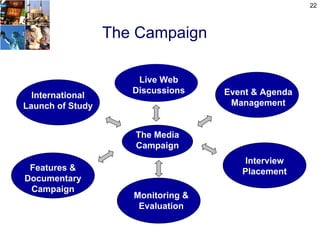
                  The Campaign

                      Live Web
                     Discussions    Event & Agenda
  International
Launch of Study                      Management


                     The Media
                     Campaign
                                        Interview
 Features &                            Placement
Documentary
 Campaign
                     Monitoring &
                      Evaluation
23


               Other 2006 Initiatives

• The Speakup.com
  – ME’s first Online Opinion Panel of 50,000 consumers,
    opinion leaders in government, business, education,
    religion
• Used by government, NGO’s and corporations
  for public policy polls, community needs,
  social/developmental program assessments
• Representative “Voice of the Arab Public”
• More insightful, faster and economical
  alternative to offline and anecdotal
  reporting/research
24

      Institute for East-West Perception
                    Research
• First fact-tank focusing on monitoring and
  strategic consul for Middle East-West cross
  cultural perceptions
• Online panel of 4 million consumers and opinion
  leaders in the EU, US and Middle East
• Serving decision makers in public diplomacy,
  NGO’s, business, interfaith entities
• Manage improvements in perception and
  relations through ROI measurements
• Looking for advisory board members and
  founding sponsors
Arab Perceptions of the West:
      Study Highlights
26

        Why does Arab Perception of the
                West Matter?
• Popular negative resentment has strong negative
  consequences for the US and EU governments.
• Limits long term cooperation for business, educational,
  cultural and religious groups.
• Jeopardizes formal government-to-government relations.
• Broad anti-Americanism facilitates broad base recruiting
  for extremist groups and financial and political support
• Arab governments cannot ignore popular sentiment
  indefinitely. Public opinion affects policy making.
• Cycle of mutually reinforcing animosity.
27


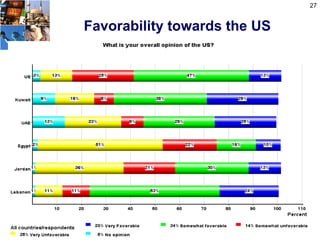
Favorability towards the US
28


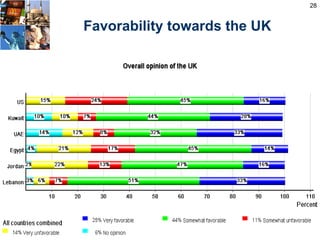
Favorability towards the UK
29


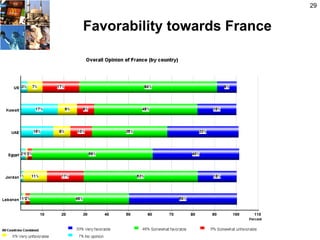
Favorability towards France
30


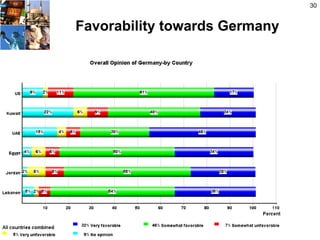
Favorability towards Germany
31


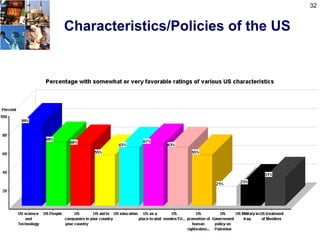
           Prism of National Perception

–   Science and technology
–   People
–   Companies in their country
–   Aid to their country
–   Education
–   Place to visit
–   Movies/TV/Entertainment
–   Promotion of Human Rights/democracy
–   Government policy in Israeli/Palestinian conflict
–   Military presence in Iraq
–   Treatment of Muslims
32


Characteristics/Policies of the US
33


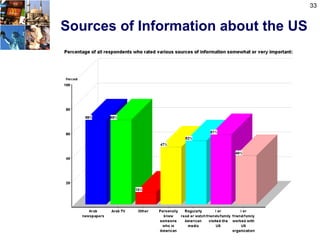
Sources of Information about the US
34


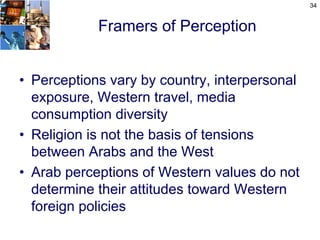
            Framers of Perception


• Perceptions vary by country, interpersonal
  exposure, Western travel, media
  consumption diversity
• Religion is not the basis of tensions
  between Arabs and the West
• Arab perceptions of Western values do not
  determine their attitudes toward Western
  foreign policies
35

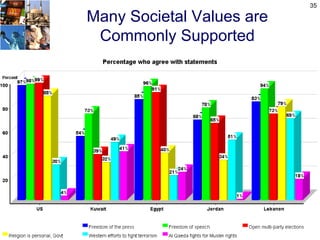
Many Societal Values are
 Commonly Supported
36


       The Role of Western Foreign Policy


• Arabs support the professed goals of the West’s
  foreign policies toward the Arab world
• Arabs disagree fundamentally with US positions on
  the definition of terrorism, the Palestinians, Iraq
  occupation, support of autocratic regimes
• Hypocrisy of US professed values and “situation on
  the ground”
37


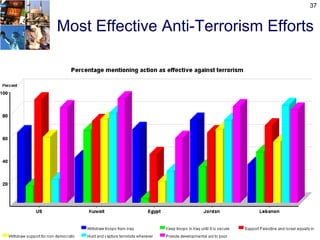
Most Effective Anti-Terrorism Efforts
38


               Media has a Critical Role

• Arab TV and Newspapers
  news are the most
  influential information
  sources on the West
• 3/4 of respondents believe
  that the media depicts the
  US accurately only HALF
  OF THE TIME OR LESS.
39

     Improving Perception: What the US
       and EU Governments can do:

• Evolve Middle East Foreign Policy.
• Rethink how the US and EU governments
  formulate and communicate their foreign
  policy.
• Develop new institutions to strengthen
  public diplomacy efforts.
• Improve practices of public diplomacy.
• Increase funding and resources.
40

           9/11/01: 5 year report card: US
            Battle for Hearts and Minds
•   Accomplishments
    – Elevated democracy promotion on U.S. foreign policy agenda
    – Organized State Department to strengthen public diplomacy
    – Created Millennium Challenge Corporation/increased foreign assistance
      funding
    – Launched “Transformational Diplomacy”

•   Continuing Challenges
    – Public diplomacy undermined by perceived U.S. unilateralism
    – U.S. moral authority/image eroded by Guantanamo, Abu Ghraib, etc.
    – Public diplomacy weakened by domestic security paranoia (visa
      frustrations, Dubai Ports, etc.)
    – Democracy and development assistance agendas viewed skeptically in
      many countries
    – Fortress mentality at embassies stifl es public access and outreach
    – Failure to create counternarrative to global radicalism
41


                 What NGO’s can do:

• Build and maintain Arabic and English translation entities
  and training programs
• Build and maintain student, scientific, sports, cultural,
  interfaith exchange programs.
• Fund and produce books, documentaries, videos using
  advanced digital technology, to improve inter-cultural
  understanding and appreciation.
• Fund and facilitate the development of dialogue
  programs and digital community building
• Use call in programs and interactive programs on
  satellite TV to engage Arab and American audiences.
42


          What Arab Governments can do:

• Build and resource public diplomacy programs
• Encourage and facilitate a free media.
• Encourage translations and digital access of the
  best English (and other language) books into
  Arabic.
• Encourage freedom of expression, opinion and
  association.
• Popularize ICT as a tool for knowledge
  acquisition.
• Promote literacy, especially among women.
• Lower barriers on information access,
  especially Internet access costs.
43


          What Media Organizations can do:

• Break the cycle of mutually reinforcing animosity
• Provide context around Western foreign policy news
• Avoid story images that are sensational or inflammatory
  that do not improve context
• Promote professional journalist training and Western
  journalist exchanges
• Encourage open, free, objective editorial coverage.
• Open and expand sources for unbiased Western
  experts and spokespeople
• Look for Western diversity stories
• Showcase Arab Americans or Arab
  British success stories
44


           Thank you!
              Chris Yalonis
             + 415-309-0331
chris.yalonis@communiquepartners.com


      www.islamperceptions.org

Arab-Western perceptions-kuwait grand mosque.yalonis

  • 1.
    Cross Cultural Perceptions between Arab Muslims and the West Kuwait Grand Mosque Presentation, June 13, 2006 Chris Yalonis, Communique Partners
  • 2.
    2 Agenda • Study/Campaign Objectives, Background, Methodology • Western Perception of Islam and Muslims • Arab Perception of the West • Drivers of Perception • Awqaf Campaigns and Other Initiatives • What can be done to Improve Perception? • Q&A
  • 3.
    3 Background • Early 2005 impetus was recognition of worsening perceptions between Middle East Muslims and the West • 2 Perception studies lay the foundation for long term initiatives to improve Islamic-Arab World- West understanding and perception – 2005 study on Western Perception of Islam and Muslims – 2006 study on Arab Perception of the West • Studies sponsored by Kuwait’s Ministry of Awqaf and Islamic Affairs
  • 4.
    4 Objectives: • 2005 Western Perception of Islam study: – Better understand the image and perception of Islam and Muslims in Western Europe and the US • 2006 Arab Perception of the West Study – Better understand Arab Perception of the West, drivers, foreign policy vs other “products” and values of the West. • Identify the key drivers and influences • Uncover the role of the media and other sources of information • Identify means of improving perception and intercultural understanding between Arab Muslims and the Western public
  • 5.
    5 Study components • Public opinion poll of 2750 US and European citizens (Western Perception study) and 2000 Arabs (2006 study on Arab Perceptions) • Interviews of Islamic, media, public diplomacy experts • An analysis of online and offline media and articles and topical association with Islam • A review and summary of important research sources, reports, reports • A review and summary of other third party public polls
  • 6.
    6 Western Perception ofIslam Study Highlights
  • 7.
    7 Public Opinion Survey Results • Muslims rated the lowest in overall favorability among various religious groups. • 26% overall had a very or somewhat unfavorable opinion of “Muslims who live inside my country” – 37% of US respondents-unfavorable opinion – 19% and 24% of UK and French respondents respectively • For “Muslims who live outside my country”, and “Arab Muslims”, 5-10% more respondents (depending on country) had a unfavorable opinion
  • 8.
    8 Ignorance of and lack of empathy with Islam is widespread • Half of the respondents say they have very little or no knowledge • 80% said that “my religion and Islam are very different” or that they “do not know enough to determine if their religion and Islam have a lot in common” • 46% believe that Islam is more likely than other religions to encourage violence • 34% believe that the US is fighting a war on Islam or both Islam and terrorism • 60% do not know the difference between Arab Muslims and non-Arab Muslims
  • 9.
    9 Framers of Perception • Stereotyping in movies, TV shows, cartoons, and other media. • Television: “If it bleeds, it leads”. Simplistic depiction of “Islamic terrorists” • Anti-Western Islamist extremists who condemn the West in the name of Islam • “Experts” in academia and thinktanks
  • 10.
    10 Framers of Perception • Christian Fundamentalists, Jewish Lobby • The absence of a countering view. • Western Muslim communities do not have strong PR or lobbying efforts. • Lack of personal interaction between American Muslims and non-Muslims
  • 11.
    11 Media has a Critical Role • TV documentaries and news are the most influential followed by newspapers • 40% have very limited exposure to news and information about Islam and Muslims (once every 2 months or more or never in the past year) • 3/4 of respondents believe that the media depicts Arab Muslims and Islam accurately only half of the time, not often or never
  • 12.
    12 Personal Interactions Shape Perceptions • 60-70% are comfortable with having Arab Muslims as neighbors, friends, co-workers • Only a quarter of the US and UK respondents have Arab Muslims friends, colleagues or family members (versus 59% of the French) • Very small percentage (<5% have ever participated in an Islamic activity (such as Ramadan)
  • 13.
    13 Issues in Resetting the Perception Frame • Islam is not a Monolith. • Who speaks for Islam? • Is Islam inherently extremist and militant? • Is Islam anti-West? • Women’s empowerment • Religious tolerance/pluralism • Modernism • Democracy • Reducing the root causes of violent extremism.
  • 14.
    14 Recommendations on Improving Perception: Practitioners and Scholars • Build a message consensus among Muslims and friends – A moderate and balanced view of Islam – Objective debate on contentious issues • Create balanced content on Islam – Supply proper information nationwide – Counter the lack of good, objective books about Islam • Show Muslims as normal, professional, modern, diverse, anti-militant: have spokespeople reflect these images • Call for more media balance and more positive coverage, not just negatives
  • 15.
    15 Improving Perception • Invest in media-tours and campaigns, PSA’s, press relations • Encourage Muslims groups to share more educational and celebration interactions with local communities • Build and resource more Islamic cultural centers and museums • Encourage business and cultural exchanges between Islamic states (especially ME) and US/EU
  • 16.
    16 “Drying up the Swamp” of Extremism • Address the root causes of extremist violence to reduce it long term • Marginalize religious zealotry by extremists-return to peaceful teachings • Continue to encourage Arab region development (UN Arab Human Development Report (2002,03,04,05) recommendations
  • 17.
    17 Guidelines for Journalists • Use language that is informatory and not inflammatory • Portray Muslims and Islam in its richness and diversity • Seek truth through a full, balanced Outlook database and help convey Islam complexities and ME-West relations • Do not represent Arabs and Muslims as monolithic groups • Use photos and features to demystify veils, turbans, and cultural articles/customs
  • 18.
    18 Guidelines for Journalists • Avoid using word combinations such as “Islamic terrorist” or “Muslim extremist” that are misleading • Do not use religious characterizations as shorthand • Include olive complexioned and darker men and women, Sikhs, Muslims, and devote religious groups in the arts, business, society columns, and other news and features, not just in terrorist coverage • Ask Muslims to review your coverage and make suggestions
  • 19.
    19 Resources • www.islamperceptions.org – Journalist’s Guide to Islam and Muslims – Western Perceptions of Islam and Muslims – Arab Perceptions of The West • Professor John Esposito’s – What Everyone should Know about Islam – Unholy War • Q&A
  • 20.
    20 Follow-Up Actions • NewsXchange (Media conference) in Amsterdam in November, 2005 and to US Muslim Leaders, coverage of Western Perception study • Presented Arab Perception study at the first annual Arab Broadcaster’s Forum in Abu Dhabi last week • Moderation Conferences in EU, US,Russia (tentative), – Build internal Muslim community consensus (London in May) – Key external stakeholders (London in May, more planned for late 2006/2007 • Moderation Center in Grand Mosque • Distribution of books and DVD’s • Translation Center • Cultural Centers • Debate Centers in London • www.islamperceptions.org
  • 21.
    21 Insights into IslamCampaign (Proposed):
  • 22.
    22 The Campaign Live Web Discussions Event & Agenda International Launch of Study Management The Media Campaign Interview Features & Placement Documentary Campaign Monitoring & Evaluation
  • 23.
    23 Other 2006 Initiatives • The Speakup.com – ME’s first Online Opinion Panel of 50,000 consumers, opinion leaders in government, business, education, religion • Used by government, NGO’s and corporations for public policy polls, community needs, social/developmental program assessments • Representative “Voice of the Arab Public” • More insightful, faster and economical alternative to offline and anecdotal reporting/research
  • 24.
    24 Institute for East-West Perception Research • First fact-tank focusing on monitoring and strategic consul for Middle East-West cross cultural perceptions • Online panel of 4 million consumers and opinion leaders in the EU, US and Middle East • Serving decision makers in public diplomacy, NGO’s, business, interfaith entities • Manage improvements in perception and relations through ROI measurements • Looking for advisory board members and founding sponsors
  • 25.
    Arab Perceptions ofthe West: Study Highlights
  • 26.
    26 Why does Arab Perception of the West Matter? • Popular negative resentment has strong negative consequences for the US and EU governments. • Limits long term cooperation for business, educational, cultural and religious groups. • Jeopardizes formal government-to-government relations. • Broad anti-Americanism facilitates broad base recruiting for extremist groups and financial and political support • Arab governments cannot ignore popular sentiment indefinitely. Public opinion affects policy making. • Cycle of mutually reinforcing animosity.
  • 27.
  • 28.
  • 29.
  • 30.
  • 31.
    31 Prism of National Perception – Science and technology – People – Companies in their country – Aid to their country – Education – Place to visit – Movies/TV/Entertainment – Promotion of Human Rights/democracy – Government policy in Israeli/Palestinian conflict – Military presence in Iraq – Treatment of Muslims
  • 32.
  • 33.
  • 34.
    34 Framers of Perception • Perceptions vary by country, interpersonal exposure, Western travel, media consumption diversity • Religion is not the basis of tensions between Arabs and the West • Arab perceptions of Western values do not determine their attitudes toward Western foreign policies
  • 35.
    35 Many Societal Valuesare Commonly Supported
  • 36.
    36 The Role of Western Foreign Policy • Arabs support the professed goals of the West’s foreign policies toward the Arab world • Arabs disagree fundamentally with US positions on the definition of terrorism, the Palestinians, Iraq occupation, support of autocratic regimes • Hypocrisy of US professed values and “situation on the ground”
  • 37.
  • 38.
    38 Media has a Critical Role • Arab TV and Newspapers news are the most influential information sources on the West • 3/4 of respondents believe that the media depicts the US accurately only HALF OF THE TIME OR LESS.
  • 39.
    39 Improving Perception: What the US and EU Governments can do: • Evolve Middle East Foreign Policy. • Rethink how the US and EU governments formulate and communicate their foreign policy. • Develop new institutions to strengthen public diplomacy efforts. • Improve practices of public diplomacy. • Increase funding and resources.
  • 40.
    40 9/11/01: 5 year report card: US Battle for Hearts and Minds • Accomplishments – Elevated democracy promotion on U.S. foreign policy agenda – Organized State Department to strengthen public diplomacy – Created Millennium Challenge Corporation/increased foreign assistance funding – Launched “Transformational Diplomacy” • Continuing Challenges – Public diplomacy undermined by perceived U.S. unilateralism – U.S. moral authority/image eroded by Guantanamo, Abu Ghraib, etc. – Public diplomacy weakened by domestic security paranoia (visa frustrations, Dubai Ports, etc.) – Democracy and development assistance agendas viewed skeptically in many countries – Fortress mentality at embassies stifl es public access and outreach – Failure to create counternarrative to global radicalism
  • 41.
    41 What NGO’s can do: • Build and maintain Arabic and English translation entities and training programs • Build and maintain student, scientific, sports, cultural, interfaith exchange programs. • Fund and produce books, documentaries, videos using advanced digital technology, to improve inter-cultural understanding and appreciation. • Fund and facilitate the development of dialogue programs and digital community building • Use call in programs and interactive programs on satellite TV to engage Arab and American audiences.
  • 42.
    42 What Arab Governments can do: • Build and resource public diplomacy programs • Encourage and facilitate a free media. • Encourage translations and digital access of the best English (and other language) books into Arabic. • Encourage freedom of expression, opinion and association. • Popularize ICT as a tool for knowledge acquisition. • Promote literacy, especially among women. • Lower barriers on information access, especially Internet access costs.
  • 43.
    43 What Media Organizations can do: • Break the cycle of mutually reinforcing animosity • Provide context around Western foreign policy news • Avoid story images that are sensational or inflammatory that do not improve context • Promote professional journalist training and Western journalist exchanges • Encourage open, free, objective editorial coverage. • Open and expand sources for unbiased Western experts and spokespeople • Look for Western diversity stories • Showcase Arab Americans or Arab British success stories
  • 44.
    44 Thank you! Chris Yalonis + 415-309-0331 chris.yalonis@communiquepartners.com www.islamperceptions.org