Scanning for emerging science and
technology issues
Project funded under the Socio-
economic Sciences and Humanities
The SESTI project is funded under the European FP7 and researches the application of weak
signals and emerging issues for improving the anticipatory intelligence of the European
Commission and the EU Member States on future developments and issues
[On Concepts and Methods in Horizon
Scanning: Lessons from initiating Policy
Dialogues on Emerging Issues]
Effie Amanatidou, Maurits Butter, Vicente Carabias,
Totti Könnölä, Miriam Leis, Ozcan Saritas, Petra
Schaper-Rinkel, Victor van Rij
12-05-2011
Scanning for emerging science and
technology issues
Project funded under the Socio-
economic Sciences and Humanities
3/18/2022
SESTI presentation at the FTA 2011 conference
2
2
Objectives of the SESTI project
• Researching the added value of early warning
signal scanning to identify emerging issues
• Assessing the pro’s and con’s of several scanning
methods
• Identifying ways to connect scanning to the policy
community
Scanning for emerging science and
technology issues
Project funded under the Socio-
economic Sciences and Humanities
3/18/2022
SESTI presentation at the FTA 2011 conference
3
3
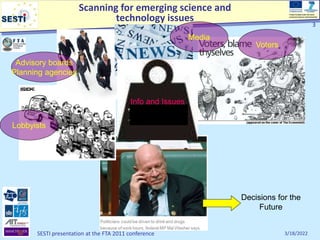
Lobbyists
Advisory boards
Planning agencies
Voters
Decisions for the
Future
Media
Info and Issues
Scanning for emerging science and
technology issues
Project funded under the Socio-
economic Sciences and Humanities
3/18/2022
SESTI presentation at the FTA 2011 conference
4
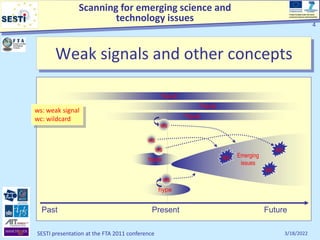
Weak signals and other concepts
Past Present Future
Trend
hype
hype
Trend
Trend
ws: weak signal
wc: wildcard
wc
wc
wc
ws
Emerging
issues
ws
ws
ws
Scanning for emerging science and
technology issues
Project funded under the Socio-
economic Sciences and Humanities
3/18/2022
SESTI presentation at the FTA 2011 conference
5
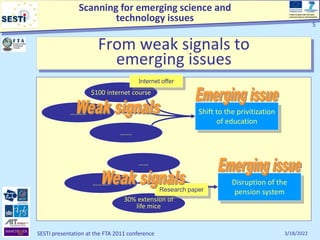
From weak signals to
emerging issues
$100 internet course
……….
…….
Shift to the privitization
of education
……
……….
30% extension of
life mice
Disruption of the
pension system
Internet offer
Research paper
Scanning for emerging science and
technology issues
Project funded under the Socio-
economic Sciences and Humanities
3/18/2022
SESTI presentation at the FTA 2011 conference
6
6
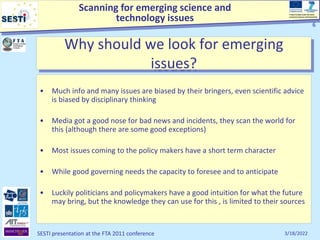
Why should we look for emerging
issues?
• Much info and many issues are biased by their bringers, even scientific advice
is biased by disciplinary thinking
• Media got a good nose for bad news and incidents, they scan the world for
this (although there are some good exceptions)
• Most issues coming to the policy makers have a short term character
• While good governing needs the capacity to foresee and to anticipate
• Luckily politicians and policymakers have a good intuition for what the future
may bring, but the knowledge they can use for this , is limited to their sources
Scanning for emerging science and
technology issues
Project funded under the Socio-
economic Sciences and Humanities
3/18/2022
SESTI presentation at the FTA 2011 conference
7
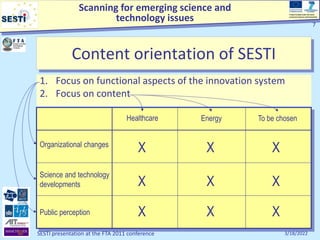
Content orientation of SESTI
1. Focus on functional aspects of the innovation system
2. Focus on content
Public perception
Science and technology
developments
Organizational changes
Healthcare Energy To be chosen
X X X
X X X
X X X
Scanning for emerging science and
technology issues
Project funded under the Socio-
economic Sciences and Humanities
3/18/2022
SESTI presentation at the FTA 2011 conference
8
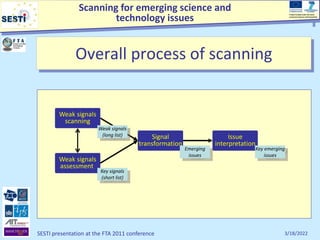
Overall process of scanning
Weak signals
assessment
Weak signals
scanning
Signal
transformation
Issue
interpretation
Weak signals
(long list)
Key signals
(short list)
Key emerging
issues
Emerging
issues
Scanning for emerging science and
technology issues
Project funded under the Socio-
economic Sciences and Humanities
3/18/2022
SESTI presentation at the FTA 2011 conference
9
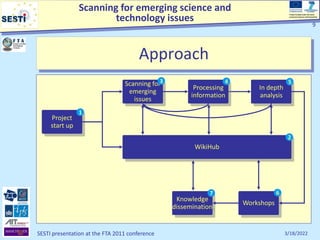
Approach
Project
start up
Scanning for
emerging
issues
In depth
analysis
Workshops
Knowledge
dissemination
Processing
information
WikiHub
7
1
3 4 5
2
6
Scanning for emerging science and
technology issues
Project funded under the Socio-
economic Sciences and Humanities
3/18/2022
SESTI presentation at the FTA 2011 conference
1
0
1
0
SESTI project
• Are there ways to improve the information basis
to identify the most important future issues that
need policy attention today?
• Are there early warning (weak) signals that can be
used to identify them?
• If so where and how to find them and how to use
them to feed them into the policymakers agenda?
Scanning for emerging science and
technology issues
Project funded under the Socio-
economic Sciences and Humanities
3/18/2022
SESTI presentation at the FTA 2011 conference
1
1
1
1
Definition and criteria emerging issue
Emerging issues are storylines (Future Narratives) with:
• High impact (on society, economy, ecology and the domain)
• Plausible storyline (including factual basis –reliable sources )
• Novelty (is the issue described really new for the policy makers)
• Emotional aspects and critical aspects (does the issue appeal or
concern emotional and or ethical legal aspects)
• Interests at stake (commonalities and or conflicts)
• Changeability (Can the story or its impact be altered by human action)
• Policy relevance (does the issue relate to present day decision
making and action and on different levels)
Scanning for emerging science and
technology issues
Project funded under the Socio-
economic Sciences and Humanities
3/18/2022
SESTI presentation at the FTA 2011 conference
1
2
1
2
Sources and tools for scanning
Non participative / (digital) written sources
• Systematic manual scanning (internet –search engines)
• Literature study
• Text mining
Participative / stakeholders & experts
• Survey
• Wiki
• Blogs/linked In /and others like Facebook
• Twitter
• Workshops etc
Scanning for emerging science and
technology issues
Project funded under the Socio-
economic Sciences and Humanities
3/18/2022
SESTI presentation at the FTA 2011 conference
1
3
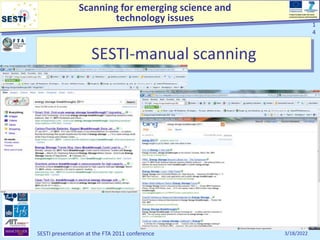
Systematic Internet scanning
• Internet Search on internet using search engines
provided by : google / bing
• Google selects all pages (texts & vids) with the
“search string”
• sorts the pages that are most connected/central
Needed:
• Qualified scanners (fast interpretation)
• Frame of reference (coordinates/for which
domain does the scan take place/criteria)
• Intelligent questions
• Workshops
1
3
Scanning for emerging science and
technology issues
Project funded under the Socio-
economic Sciences and Humanities
3/18/2022
SESTI presentation at the FTA 2011 conference
1
4
1
4
SESTI-manual scanning
Scanning for emerging science and
technology issues
Project funded under the Socio-
economic Sciences and Humanities
3/18/2022
SESTI presentation at the FTA 2011 conference
1
5
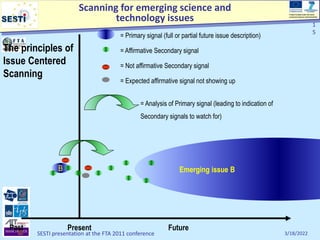
Past Present Future
Emerging issue B
B
= Primary signal (full or partial future issue description)
= Affirmative Secondary signal
= Not affirmative Secondary signal
= Expected affirmative signal not showing up
= Analysis of Primary signal (leading to indication of
Secondary signals to watch for)
The principles of
Issue Centered
Scanning
Scanning for emerging science and
technology issues
Project funded under the Socio-
economic Sciences and Humanities
3/18/2022
SESTI presentation at the FTA 2011 conference
1
6
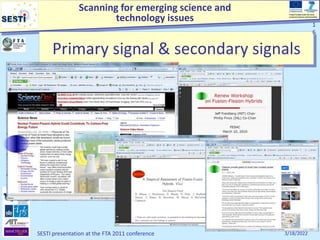
Primary signal & secondary signals
1
6
Scanning for emerging science and
technology issues
Project funded under the Socio-
economic Sciences and Humanities
3/18/2022
SESTI presentation at the FTA 2011 conference
1
7
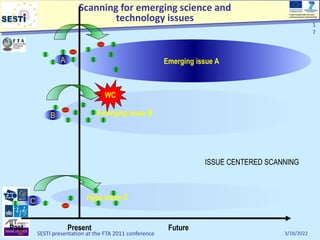
Emerging issue A
Emerging issue B
Hype issue C
Past Present Future
B
C
A
WC
ISSUE CENTERED SCANNING
Scanning for emerging science and
technology issues
Project funded under the Socio-
economic Sciences and Humanities
3/18/2022
SESTI presentation at the FTA 2011 conference
1
8
Wiki/Blog/linked In/Twitter
• An invitation is send to experts- stakeholders :
Q what they see as new emerging issues /early
warning signals?
Needed:
• own website (SESTI-wiki – blog ) or account on
existing platform (Linked In , Face book, Twitter)
• Wide variety, qualified willing contribuants
• Open /structured set up
• Analysts to interpret data (text mining)
1
8
Scanning for emerging science and
technology issues
Project funded under the Socio-
economic Sciences and Humanities
3/18/2022
SESTI presentation at the FTA 2011 conference
1
9
1
9
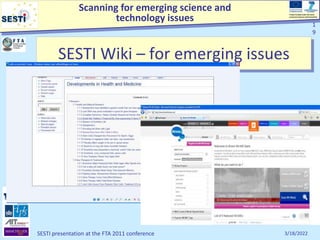
SESTI Wiki – for emerging issues
Scanning for emerging science and
technology issues
Project funded under the Socio-
economic Sciences and Humanities
3/18/2022
SESTI presentation at the FTA 2011 conference
2
0
2
0
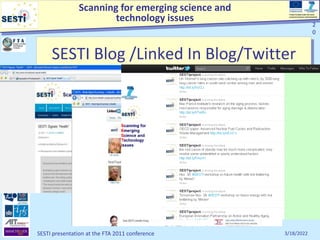
SESTI Blog /Linked In Blog/Twitter
Scanning for emerging science and
technology issues
Project funded under the Socio-
economic Sciences and Humanities
3/18/2022
SESTI presentation at the FTA 2011 conference
2
1
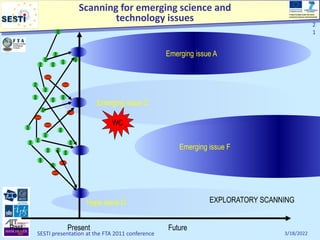
Emerging issue F
Emerging issue A
Emerging issue C
Hype issue D
Past Present Future
WC
EXPLORATORY SCANNING
Scanning for emerging science and
technology issues
Project funded under the Socio-
economic Sciences and Humanities
3/18/2022
SESTI presentation at the FTA 2011 conference
2
2
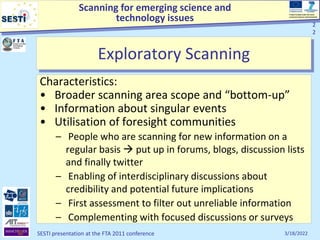
Exploratory Scanning
Characteristics:
• Broader scanning area scope and “bottom-up”
• Information about singular events
• Utilisation of foresight communities
– People who are scanning for new information on a
regular basis  put up in forums, blogs, discussion lists
and finally twitter
– Enabling of interdisciplinary discussions about
credibility and potential future implications
– First assessment to filter out unreliable information
– Complementing with focused discussions or surveys
2
2
Scanning for emerging science and
technology issues
Project funded under the Socio-
economic Sciences and Humanities
3/18/2022
SESTI presentation at the FTA 2011 conference
2
3
Conclusions of Exploratory Scanning
• Emerging issue identification and analysis is a
complex social process  Interests, agendas and
selective perception need to be kept in mind
• Human communication with experts/scanners and
clients/policy-makers is essential
• Quality of original source and transparency of
processes impact the interpretation and
conclusions
• Social networking can provide added value for
identification and assessment of signals and
emerging issues (but resource constraints exist!)
2
3
Scanning for emerging science and
technology issues
Project funded under the Socio-
economic Sciences and Humanities
3/18/2022
SESTI presentation at the FTA 2011 conference
2
4
Conclusions of Exploratory Scanning
Different approaches can be strategically combined
• broaden the spectrum of possible signals
(e.g. through crowd sourcing like twitter and blogs for
exploratory scanning);
• improving the credibility assessment (e.g. by establishing
interdisciplinary discussion groups for validation);
• complementing the validation process (e.g. by performing
issue-centred scans, surveys, workshops etc.) utilising
automated tools for clustering and network analysis of
issues;
• maintaining an interaction between the clients of the
analysis (e.g. decision/policy maters) and those who look
for the information.
2
4
Scanning for emerging science and
technology issues
Project funded under the Socio-
economic Sciences and Humanities
3/18/2022
SESTI presentation at the FTA 2011 conference
2
5
2
5
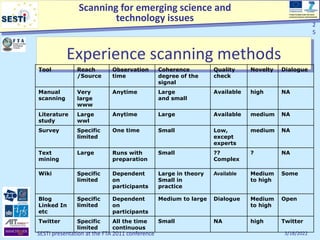
Experience scanning methods
Tool Reach
/Source
Observation
time
Coherence
degree of the
signal
Quality
check
Novelty Dialogue
Manual
scanning
Very
large
www
Anytime Large
and small
Available high NA
Literature
study
Large
wwl
Anytime Large Available medium NA
Survey Specific
limited
One time Small Low,
except
experts
medium NA
Text
mining
Large Runs with
preparation
Small ??
Complex
? NA
Wiki Specific
limited
Dependent
on
participants
Large in theory
Small in
practice
Available Medium
to high
Some
Blog
Linked In
etc
Specific
limited
Dependent
on
participants
Medium to large Dialogue Medium
to high
Open
Twitter Specific
limited
All the time
continuous
Small NA high Twitter
Scanning for emerging science and
technology issues
Project funded under the Socio-
economic Sciences and Humanities
3/18/2022
SESTI presentation at the FTA 2011 conference
2
6
2
6
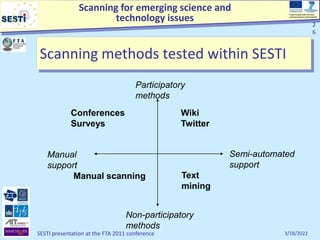
Scanning methods tested within SESTI
Participatory
methods
Non-participatory
methods
Conferences
Surveys
Wiki
Twitter
Manual
support
Semi-automated
support
Text
mining
Manual scanning
Scanning for emerging science and
technology issues
Project funded under the Socio-
economic Sciences and Humanities
3/18/2022
SESTI presentation at the FTA 2011 conference
2
7
Evaluation criteria
Policy – makers noted importance of scanning to identify:
• the connections, clustering of weak signals and the degree
of relevance to a specific area;
• the duration of the ‘weakness’ of the signal associated also
with the time the signal is observed, the origin and the
novelty of the weak signals;
• any rising ethical, legal, societal or cultural issues;
• the existence of a strategy already concerned with the
specific weak signal(s) / emerging issues by a government
or industry, lobby or international organisation;
• positive and negative impacts and associated policy
implications;
• policy recommendations.
2
7
Scanning for emerging science and
technology issues
Project funded under the Socio-
economic Sciences and Humanities
3/18/2022
SESTI presentation at the FTA 2011 conference
2
8
Conclusions of Evaluation
• Need different approaches as all have advantages and
disadvantages
• Overall, participatory methods are of crucial importance
for the last stages of the scanning process enabling
verification and filtering of results as well as policy
implication and recommendations.
• Semi-automated methods are appreciated especially those
drawing on large expert communities in terms of enabling
systematic scanning and retrieval of ‘inside’ information in
the first scanning phases as well as in verifying the results.
• The value of the more ‘conventional’ methods like expert
surveys, literature review and conference visits is more
relevant for targeted tasks requiring expert inputs.
2
8
Scanning for emerging science and
technology issues
Project funded under the Socio-
economic Sciences and Humanities
3/18/2022
SESTI presentation at the FTA 2011 conference
2
9
2
9
• TNO: Main coordinator
• MinOCW: Scanning (v.vanrij@minocw.nl)
• AIT: Processing of information
• UniMan: In depth analysis
• IPTS: Policy workshops
• MCST: Knowledge dissemination
SESTI-Partners [www.sesti.info]

Scanning for emerging s&t issues

  • 1.
    Scanning for emergingscience and technology issues Project funded under the Socio- economic Sciences and Humanities The SESTI project is funded under the European FP7 and researches the application of weak signals and emerging issues for improving the anticipatory intelligence of the European Commission and the EU Member States on future developments and issues [On Concepts and Methods in Horizon Scanning: Lessons from initiating Policy Dialogues on Emerging Issues] Effie Amanatidou, Maurits Butter, Vicente Carabias, Totti Könnölä, Miriam Leis, Ozcan Saritas, Petra Schaper-Rinkel, Victor van Rij 12-05-2011
  • 2.
    Scanning for emergingscience and technology issues Project funded under the Socio- economic Sciences and Humanities 3/18/2022 SESTI presentation at the FTA 2011 conference 2 2 Objectives of the SESTI project • Researching the added value of early warning signal scanning to identify emerging issues • Assessing the pro’s and con’s of several scanning methods • Identifying ways to connect scanning to the policy community
  • 3.
    Scanning for emergingscience and technology issues Project funded under the Socio- economic Sciences and Humanities 3/18/2022 SESTI presentation at the FTA 2011 conference 3 3 Lobbyists Advisory boards Planning agencies Voters Decisions for the Future Media Info and Issues
  • 4.
    Scanning for emergingscience and technology issues Project funded under the Socio- economic Sciences and Humanities 3/18/2022 SESTI presentation at the FTA 2011 conference 4 Weak signals and other concepts Past Present Future Trend hype hype Trend Trend ws: weak signal wc: wildcard wc wc wc ws Emerging issues ws ws ws
  • 5.
    Scanning for emergingscience and technology issues Project funded under the Socio- economic Sciences and Humanities 3/18/2022 SESTI presentation at the FTA 2011 conference 5 From weak signals to emerging issues $100 internet course ………. ……. Shift to the privitization of education …… ………. 30% extension of life mice Disruption of the pension system Internet offer Research paper
  • 6.
    Scanning for emergingscience and technology issues Project funded under the Socio- economic Sciences and Humanities 3/18/2022 SESTI presentation at the FTA 2011 conference 6 6 Why should we look for emerging issues? • Much info and many issues are biased by their bringers, even scientific advice is biased by disciplinary thinking • Media got a good nose for bad news and incidents, they scan the world for this (although there are some good exceptions) • Most issues coming to the policy makers have a short term character • While good governing needs the capacity to foresee and to anticipate • Luckily politicians and policymakers have a good intuition for what the future may bring, but the knowledge they can use for this , is limited to their sources
  • 7.
    Scanning for emergingscience and technology issues Project funded under the Socio- economic Sciences and Humanities 3/18/2022 SESTI presentation at the FTA 2011 conference 7 Content orientation of SESTI 1. Focus on functional aspects of the innovation system 2. Focus on content Public perception Science and technology developments Organizational changes Healthcare Energy To be chosen X X X X X X X X X
  • 8.
    Scanning for emergingscience and technology issues Project funded under the Socio- economic Sciences and Humanities 3/18/2022 SESTI presentation at the FTA 2011 conference 8 Overall process of scanning Weak signals assessment Weak signals scanning Signal transformation Issue interpretation Weak signals (long list) Key signals (short list) Key emerging issues Emerging issues
  • 9.
    Scanning for emergingscience and technology issues Project funded under the Socio- economic Sciences and Humanities 3/18/2022 SESTI presentation at the FTA 2011 conference 9 Approach Project start up Scanning for emerging issues In depth analysis Workshops Knowledge dissemination Processing information WikiHub 7 1 3 4 5 2 6
  • 10.
    Scanning for emergingscience and technology issues Project funded under the Socio- economic Sciences and Humanities 3/18/2022 SESTI presentation at the FTA 2011 conference 1 0 1 0 SESTI project • Are there ways to improve the information basis to identify the most important future issues that need policy attention today? • Are there early warning (weak) signals that can be used to identify them? • If so where and how to find them and how to use them to feed them into the policymakers agenda?
  • 11.
    Scanning for emergingscience and technology issues Project funded under the Socio- economic Sciences and Humanities 3/18/2022 SESTI presentation at the FTA 2011 conference 1 1 1 1 Definition and criteria emerging issue Emerging issues are storylines (Future Narratives) with: • High impact (on society, economy, ecology and the domain) • Plausible storyline (including factual basis –reliable sources ) • Novelty (is the issue described really new for the policy makers) • Emotional aspects and critical aspects (does the issue appeal or concern emotional and or ethical legal aspects) • Interests at stake (commonalities and or conflicts) • Changeability (Can the story or its impact be altered by human action) • Policy relevance (does the issue relate to present day decision making and action and on different levels)
  • 12.
    Scanning for emergingscience and technology issues Project funded under the Socio- economic Sciences and Humanities 3/18/2022 SESTI presentation at the FTA 2011 conference 1 2 1 2 Sources and tools for scanning Non participative / (digital) written sources • Systematic manual scanning (internet –search engines) • Literature study • Text mining Participative / stakeholders & experts • Survey • Wiki • Blogs/linked In /and others like Facebook • Twitter • Workshops etc
  • 13.
    Scanning for emergingscience and technology issues Project funded under the Socio- economic Sciences and Humanities 3/18/2022 SESTI presentation at the FTA 2011 conference 1 3 Systematic Internet scanning • Internet Search on internet using search engines provided by : google / bing • Google selects all pages (texts & vids) with the “search string” • sorts the pages that are most connected/central Needed: • Qualified scanners (fast interpretation) • Frame of reference (coordinates/for which domain does the scan take place/criteria) • Intelligent questions • Workshops 1 3
  • 14.
    Scanning for emergingscience and technology issues Project funded under the Socio- economic Sciences and Humanities 3/18/2022 SESTI presentation at the FTA 2011 conference 1 4 1 4 SESTI-manual scanning
  • 15.
    Scanning for emergingscience and technology issues Project funded under the Socio- economic Sciences and Humanities 3/18/2022 SESTI presentation at the FTA 2011 conference 1 5 Past Present Future Emerging issue B B = Primary signal (full or partial future issue description) = Affirmative Secondary signal = Not affirmative Secondary signal = Expected affirmative signal not showing up = Analysis of Primary signal (leading to indication of Secondary signals to watch for) The principles of Issue Centered Scanning
  • 16.
    Scanning for emergingscience and technology issues Project funded under the Socio- economic Sciences and Humanities 3/18/2022 SESTI presentation at the FTA 2011 conference 1 6 Primary signal & secondary signals 1 6
  • 17.
    Scanning for emergingscience and technology issues Project funded under the Socio- economic Sciences and Humanities 3/18/2022 SESTI presentation at the FTA 2011 conference 1 7 Emerging issue A Emerging issue B Hype issue C Past Present Future B C A WC ISSUE CENTERED SCANNING
  • 18.
    Scanning for emergingscience and technology issues Project funded under the Socio- economic Sciences and Humanities 3/18/2022 SESTI presentation at the FTA 2011 conference 1 8 Wiki/Blog/linked In/Twitter • An invitation is send to experts- stakeholders : Q what they see as new emerging issues /early warning signals? Needed: • own website (SESTI-wiki – blog ) or account on existing platform (Linked In , Face book, Twitter) • Wide variety, qualified willing contribuants • Open /structured set up • Analysts to interpret data (text mining) 1 8
  • 19.
    Scanning for emergingscience and technology issues Project funded under the Socio- economic Sciences and Humanities 3/18/2022 SESTI presentation at the FTA 2011 conference 1 9 1 9 SESTI Wiki – for emerging issues
  • 20.
    Scanning for emergingscience and technology issues Project funded under the Socio- economic Sciences and Humanities 3/18/2022 SESTI presentation at the FTA 2011 conference 2 0 2 0 SESTI Blog /Linked In Blog/Twitter
  • 21.
    Scanning for emergingscience and technology issues Project funded under the Socio- economic Sciences and Humanities 3/18/2022 SESTI presentation at the FTA 2011 conference 2 1 Emerging issue F Emerging issue A Emerging issue C Hype issue D Past Present Future WC EXPLORATORY SCANNING
  • 22.
    Scanning for emergingscience and technology issues Project funded under the Socio- economic Sciences and Humanities 3/18/2022 SESTI presentation at the FTA 2011 conference 2 2 Exploratory Scanning Characteristics: • Broader scanning area scope and “bottom-up” • Information about singular events • Utilisation of foresight communities – People who are scanning for new information on a regular basis  put up in forums, blogs, discussion lists and finally twitter – Enabling of interdisciplinary discussions about credibility and potential future implications – First assessment to filter out unreliable information – Complementing with focused discussions or surveys 2 2
  • 23.
    Scanning for emergingscience and technology issues Project funded under the Socio- economic Sciences and Humanities 3/18/2022 SESTI presentation at the FTA 2011 conference 2 3 Conclusions of Exploratory Scanning • Emerging issue identification and analysis is a complex social process  Interests, agendas and selective perception need to be kept in mind • Human communication with experts/scanners and clients/policy-makers is essential • Quality of original source and transparency of processes impact the interpretation and conclusions • Social networking can provide added value for identification and assessment of signals and emerging issues (but resource constraints exist!) 2 3
  • 24.
    Scanning for emergingscience and technology issues Project funded under the Socio- economic Sciences and Humanities 3/18/2022 SESTI presentation at the FTA 2011 conference 2 4 Conclusions of Exploratory Scanning Different approaches can be strategically combined • broaden the spectrum of possible signals (e.g. through crowd sourcing like twitter and blogs for exploratory scanning); • improving the credibility assessment (e.g. by establishing interdisciplinary discussion groups for validation); • complementing the validation process (e.g. by performing issue-centred scans, surveys, workshops etc.) utilising automated tools for clustering and network analysis of issues; • maintaining an interaction between the clients of the analysis (e.g. decision/policy maters) and those who look for the information. 2 4
  • 25.
    Scanning for emergingscience and technology issues Project funded under the Socio- economic Sciences and Humanities 3/18/2022 SESTI presentation at the FTA 2011 conference 2 5 2 5 Experience scanning methods Tool Reach /Source Observation time Coherence degree of the signal Quality check Novelty Dialogue Manual scanning Very large www Anytime Large and small Available high NA Literature study Large wwl Anytime Large Available medium NA Survey Specific limited One time Small Low, except experts medium NA Text mining Large Runs with preparation Small ?? Complex ? NA Wiki Specific limited Dependent on participants Large in theory Small in practice Available Medium to high Some Blog Linked In etc Specific limited Dependent on participants Medium to large Dialogue Medium to high Open Twitter Specific limited All the time continuous Small NA high Twitter
  • 26.
    Scanning for emergingscience and technology issues Project funded under the Socio- economic Sciences and Humanities 3/18/2022 SESTI presentation at the FTA 2011 conference 2 6 2 6 Scanning methods tested within SESTI Participatory methods Non-participatory methods Conferences Surveys Wiki Twitter Manual support Semi-automated support Text mining Manual scanning
  • 27.
    Scanning for emergingscience and technology issues Project funded under the Socio- economic Sciences and Humanities 3/18/2022 SESTI presentation at the FTA 2011 conference 2 7 Evaluation criteria Policy – makers noted importance of scanning to identify: • the connections, clustering of weak signals and the degree of relevance to a specific area; • the duration of the ‘weakness’ of the signal associated also with the time the signal is observed, the origin and the novelty of the weak signals; • any rising ethical, legal, societal or cultural issues; • the existence of a strategy already concerned with the specific weak signal(s) / emerging issues by a government or industry, lobby or international organisation; • positive and negative impacts and associated policy implications; • policy recommendations. 2 7
  • 28.
    Scanning for emergingscience and technology issues Project funded under the Socio- economic Sciences and Humanities 3/18/2022 SESTI presentation at the FTA 2011 conference 2 8 Conclusions of Evaluation • Need different approaches as all have advantages and disadvantages • Overall, participatory methods are of crucial importance for the last stages of the scanning process enabling verification and filtering of results as well as policy implication and recommendations. • Semi-automated methods are appreciated especially those drawing on large expert communities in terms of enabling systematic scanning and retrieval of ‘inside’ information in the first scanning phases as well as in verifying the results. • The value of the more ‘conventional’ methods like expert surveys, literature review and conference visits is more relevant for targeted tasks requiring expert inputs. 2 8
  • 29.
    Scanning for emergingscience and technology issues Project funded under the Socio- economic Sciences and Humanities 3/18/2022 SESTI presentation at the FTA 2011 conference 2 9 2 9 • TNO: Main coordinator • MinOCW: Scanning (v.vanrij@minocw.nl) • AIT: Processing of information • UniMan: In depth analysis • IPTS: Policy workshops • MCST: Knowledge dissemination SESTI-Partners [www.sesti.info]