What future for ICT?
Alexandre Monnin
GDS eco-Info (CNRS)
ESC-Clermont-Ferrand
Origens Medialab
Prédictions or
Recommendations?
Numbers → Predictions
Trends → Recommendations
Numbers or trends?
Apparaising with numbers is
important but it is always possible
to question a specific point, a
methodology or data collection,
etc.
It therefore seems to me crucial
to identify long-term trends and
the reasons behind or them. This
approach is less prone to be
countered by ad hoc "solutionist"
counter-arguments (techno-fixes).
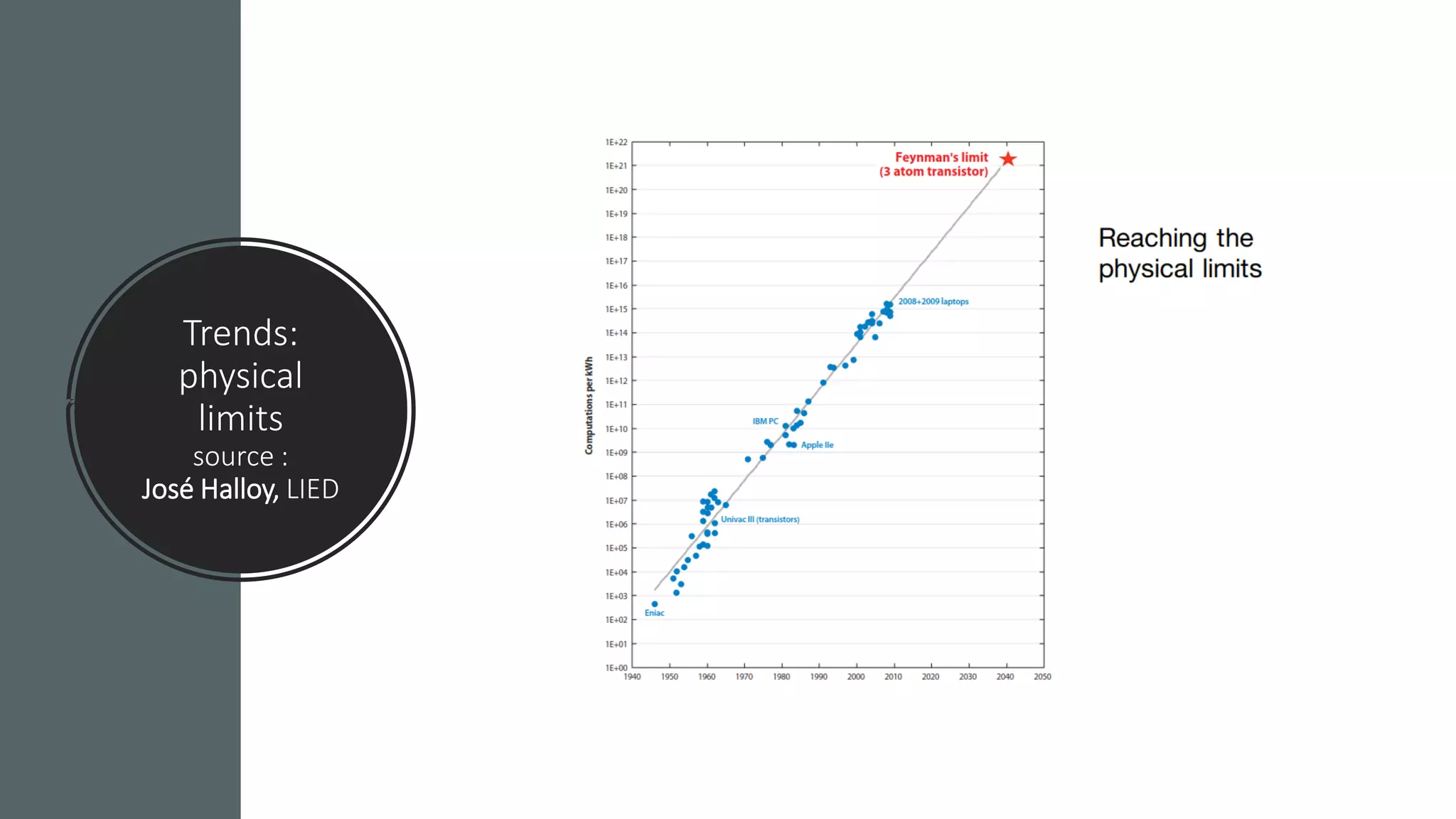
Trends:
physical
limits
source :
José Halloy, LIED
Trends: the
rebound
effect
https://ecoinfo.cnrs.fr/2015/12/23/les-effets-rebond-du-numerique/
Trends: the
availability of
ore
source:
José Halloy, LIED
Extraction is often secondary
Source: José Halloy, LIED
… and costly!
source :
José Halloy, LIED
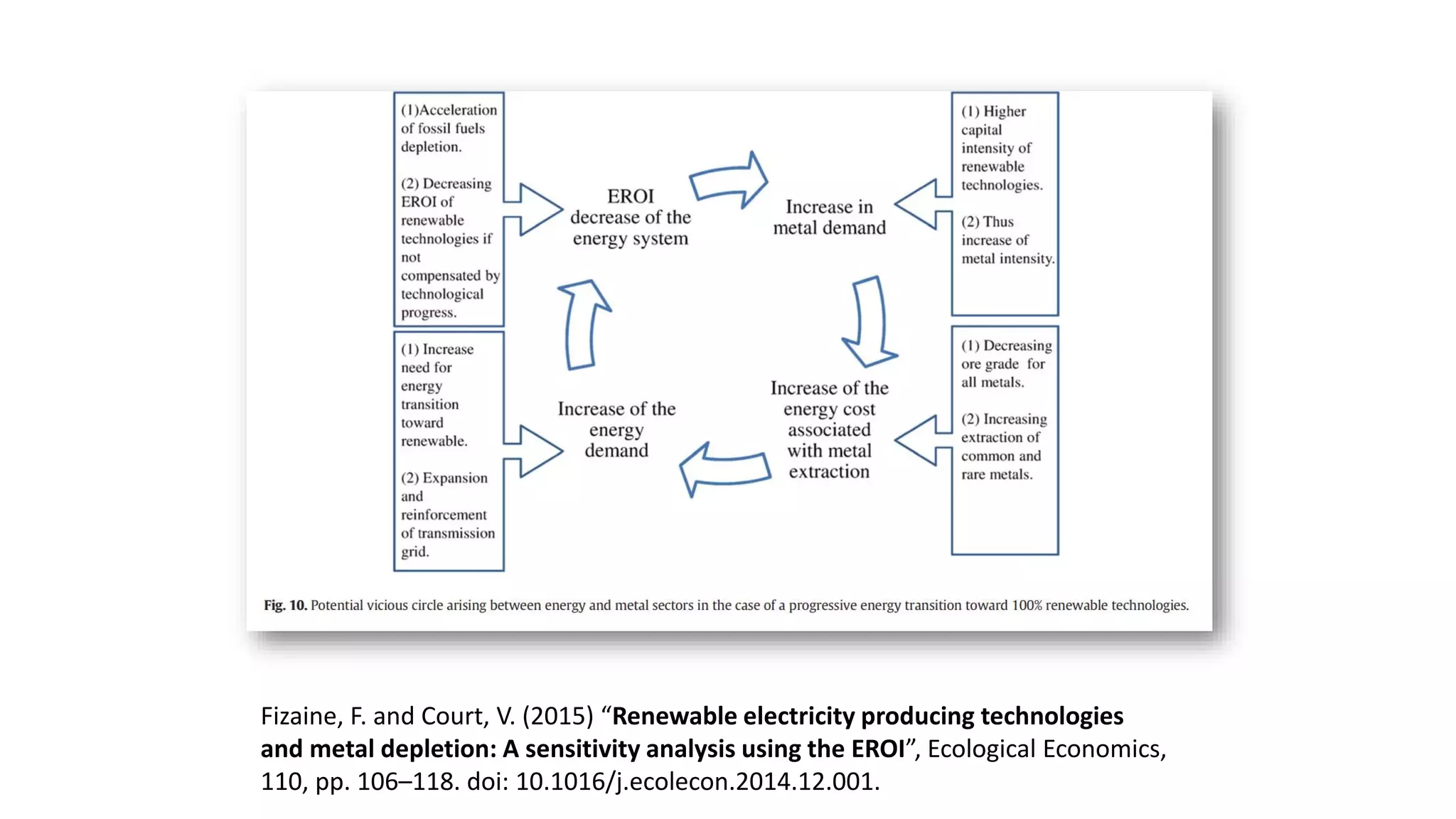
Trends: a
vicious circle
source :
José Halloy, LIED
Fizaine, F. and Court, V. (2015) “Renewable electricity producing technologies
and metal depletion: A sensitivity analysis using the EROI”, Ecological Economics,
110, pp. 106–118. doi: 10.1016/j.ecolecon.2014.12.001.
Temporality:
a time for
action?
• Energy transition: Recent studies conducted at
MIT have shown that at the current rate this
transition would take 363 years to implement:
https://www.technologyreview.com/s/610457/
at-this-rate-its-going-to-take-nearly-400-years-
to-transform-the-energy-system/ (which is very
insufficient).
Temporality:
a time for
action?
• In this calculation, in addition, the cost of installing
the RE must be taken into account. Because what is
targeted with RE is obviously to reduce CO2
emissions, but the installation work will bring its
share of emissions. We are therefore counting on
future savings, but this in turn requires that the
window of opportunity to act must be large enough
(cf. 3, 10 or 20 years?...). Another example: solar
panels. A study showed that taking into account the
lifetime of the panels and the ecological cost of their
production, a growth of more than 12% per year in
the sector would have a negative carbon footprint
(factoring both emissions and savings).
Temporality:
a time for
action?
• Fusion (ITER): the latest EUROfusion roadmap does not
foresee the commissioning of nuclear fusion reactor
demonstrators until "the beginning of the second half of
the 21st century" (2054 according to another document -
an assessment considered optimistic by the experts
themselves. One of them adds "it is vital to demonstrate
electricity generation from fusion "not too far after the
middle of the century". Otherwise, there may no longer
be a nuclear industry able to build the commercial fusion
plants that would follow, and the public may lose
patience. ", http://www.bbc.com/news/science-
environment-40558758).
• Important for connected objects:
https://www.inria.fr/centre/grenoble/actualites/en-2067-
chaque-centimetre-carre-produira-de-la-donnee
Temporality and
« defuturation »
• Tony Fry proposes the concept of defuturation to
describe the current situation. According to him,
design is normally a work of futuration, it produces
a habitable future (on a species scale).
• Today, he adds, innovation and design no longer
produce a future but its opposite; they are therefore
factors of "defuturation".
• Indeed, innovations come largely from a past in
which the Anthropocene had no place, a past giving
birth to an obsolete, stillborn, future...
Ex. : Carbon budget and ICT
evolution
• Two antagonistic tendencies;
• ICT represents about 3% of greenhouse gas
emissions, but by 2025 it will represent around
8 to 9%;
• In addition, the sector's energy growth is 9%
per year....;
• However, if we look at the commitments of a
country like France, these trends are
absolutely not compatible with the
commitments made...
Another ICT?
• Photonics (based on photons)?
• Quantum computer?
• Biomimicry/neuromorphism (sensitive
machines)?
• New architectures (adiabatic calculation -
rewritable)? New logics? New languages?
• New materials (carbon-based
microprocessors)?
The 30th
birthday of
Web
• WWW : the Inrupt project.
• retro-futurist nostalgia?
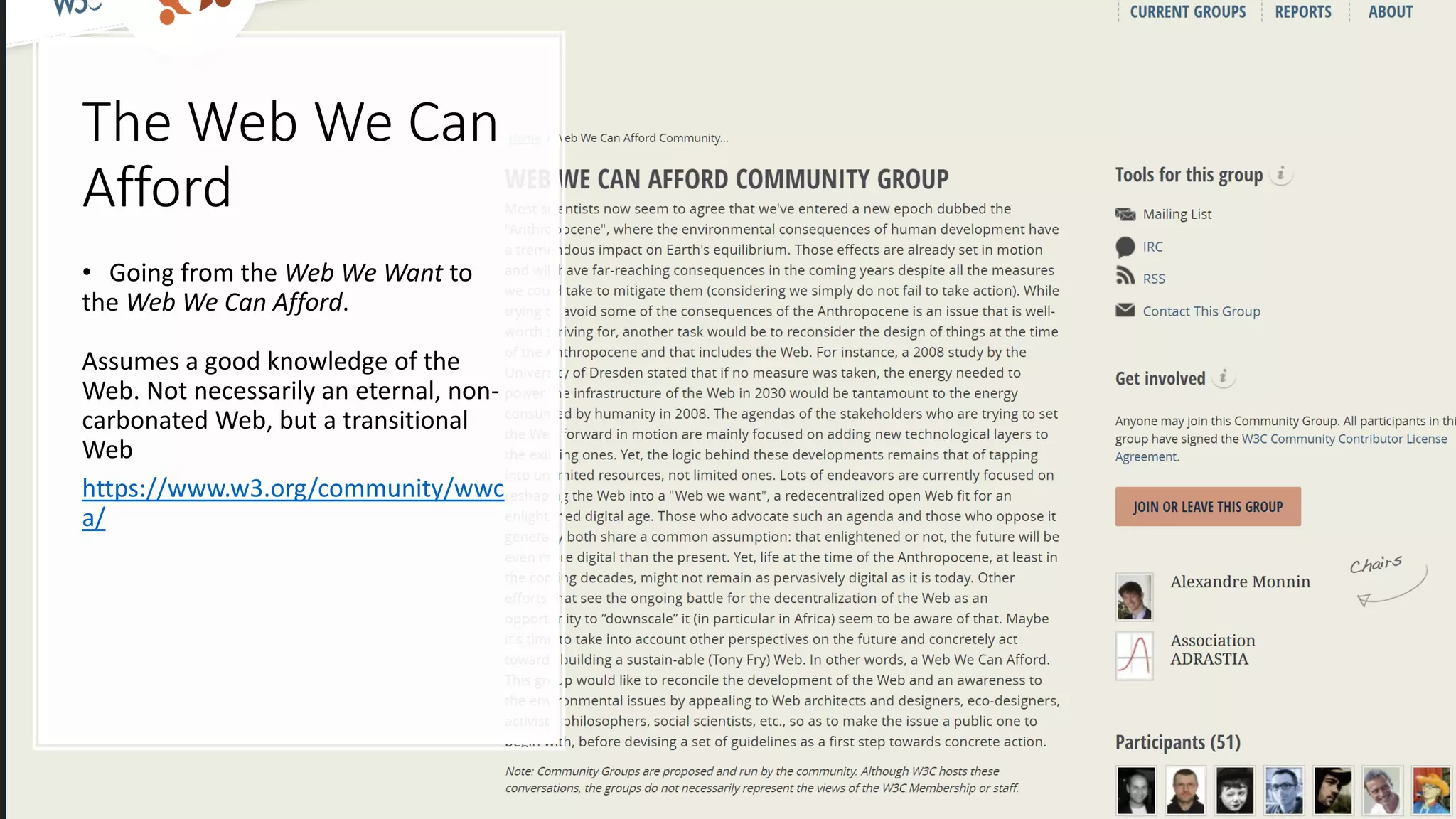
The Web We Can
Afford
• Going from the Web We Want to
the Web We Can Afford.
Assumes a good knowledge of the
Web. Not necessarily an eternal, non-
carbonated Web, but a transitional
Web
https://www.w3.org/community/wwc
a/
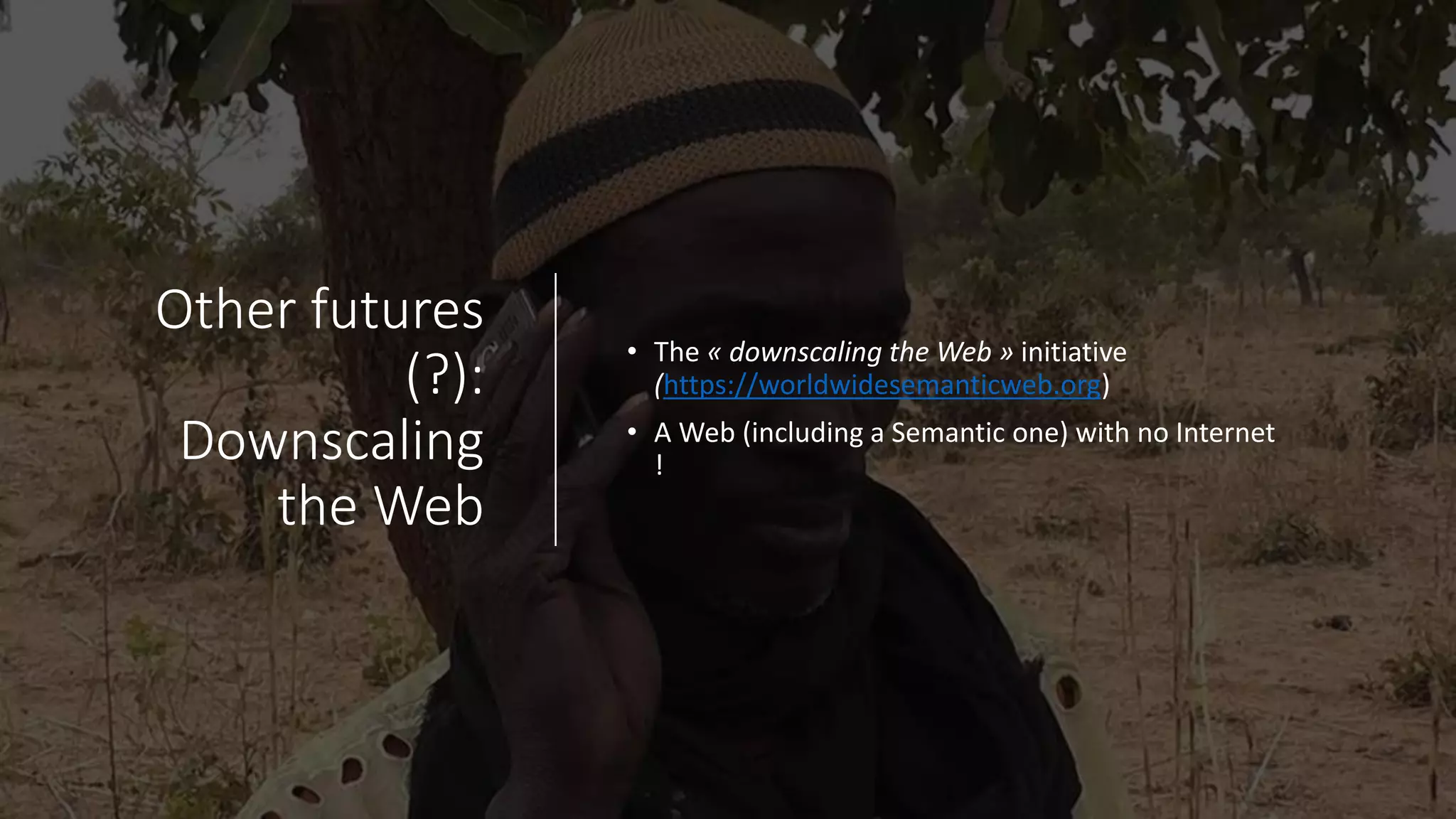
Other futures
(?):
Downscaling
the Web
• The « downscaling the Web » initiative
(https://worldwidesemanticweb.org)
• A Web (including a Semantic one) with no Internet
!
Other futures
(?):
low-tech
• Here an intermittent site powered by solar
panels....
Other future (?): offline
sites
• No connexion is needed!
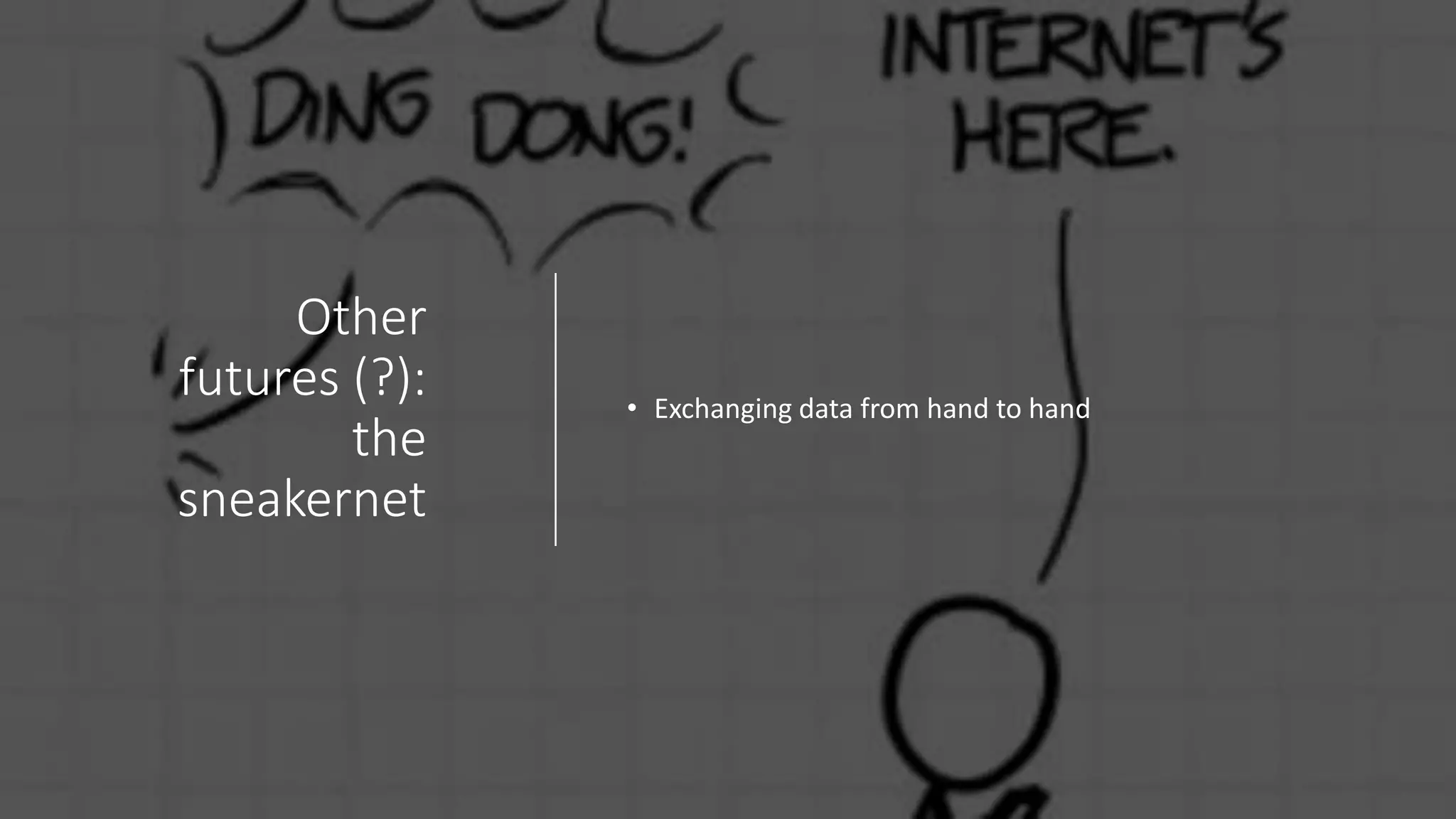
Other
futures (?):
the
sneakernet
• Exchanging data from hand to hand
Other futures
(?) : other
networks
• Community wireless networks
• Depicted here is a MESH network deployment in
Detroit in 2011.
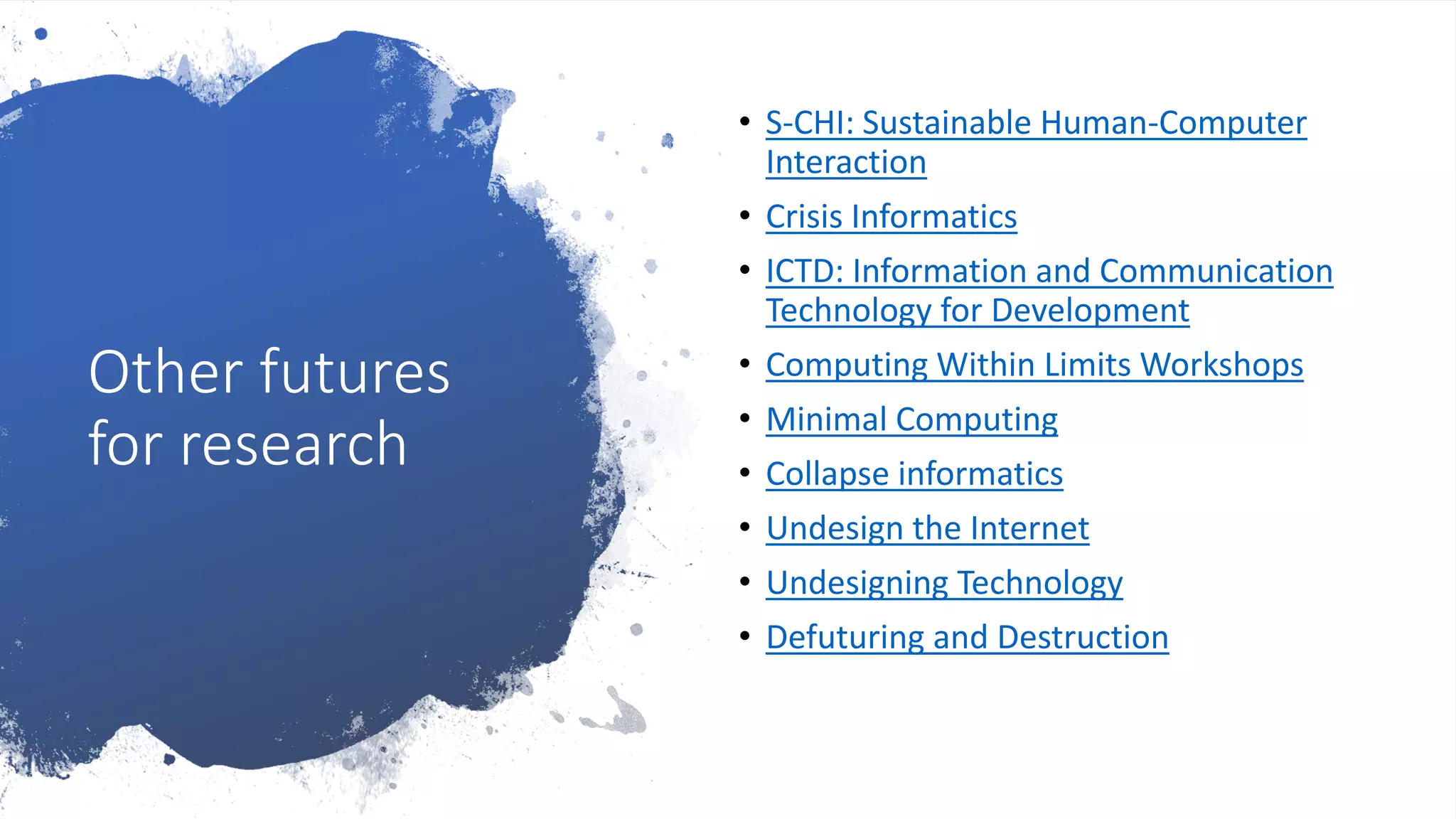
Other futures
for research
• S-CHI: Sustainable Human-Computer
Interaction
• Crisis Informatics
• ICTD: Information and Communication
Technology for Development
• Computing Within Limits Workshops
• Minimal Computing
• Collapse informatics
• Undesign the Internet
• Undesigning Technology
• Defuturing and Destruction
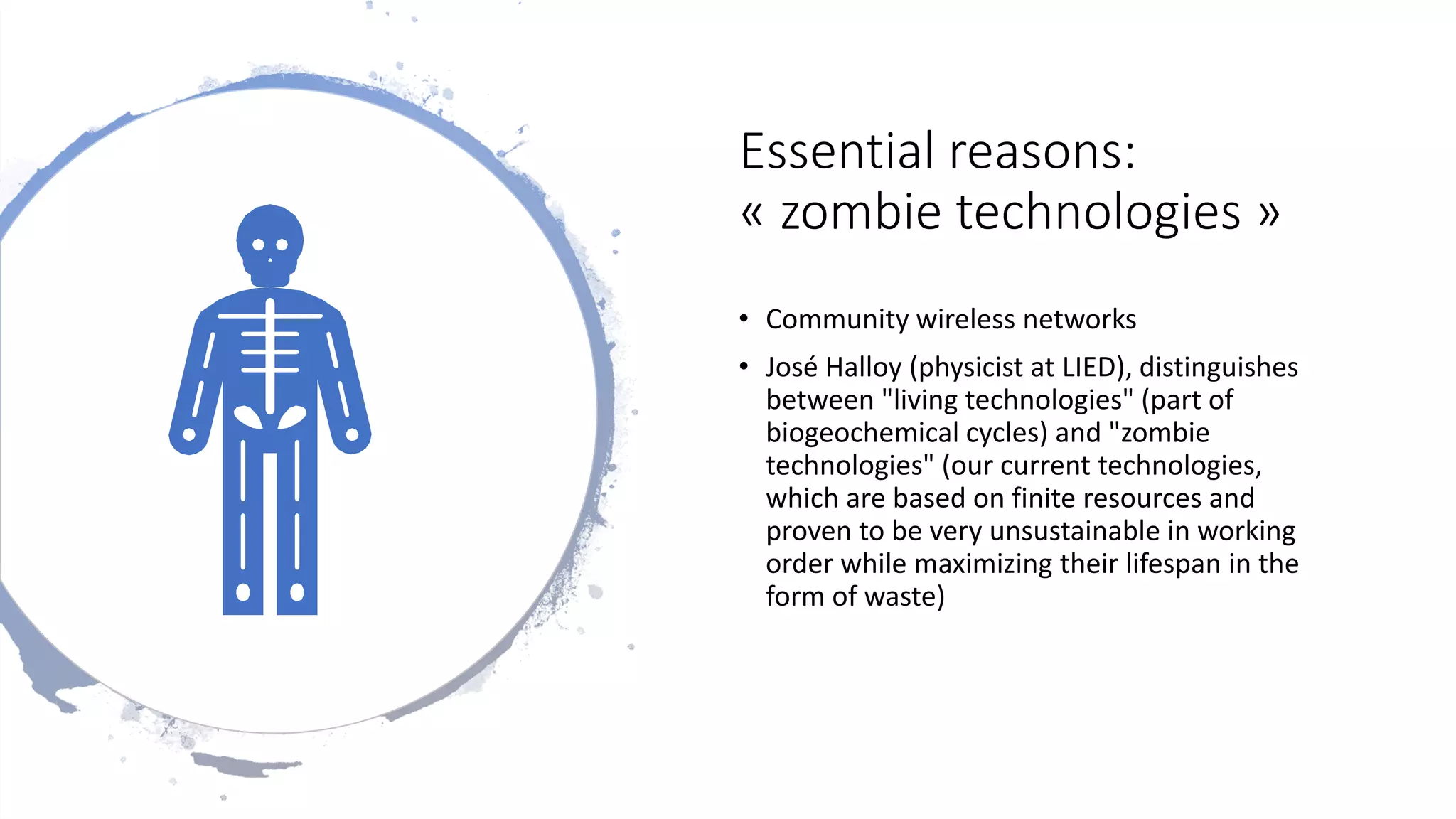
Essential reasons:
« zombie technologies »
• Community wireless networks
• José Halloy (physicist at LIED), distinguishes
between "living technologies" (part of
biogeochemical cycles) and "zombie
technologies" (our current technologies,
which are based on finite resources and
proven to be very unsustainable in working
order while maximizing their lifespan in the
form of waste)
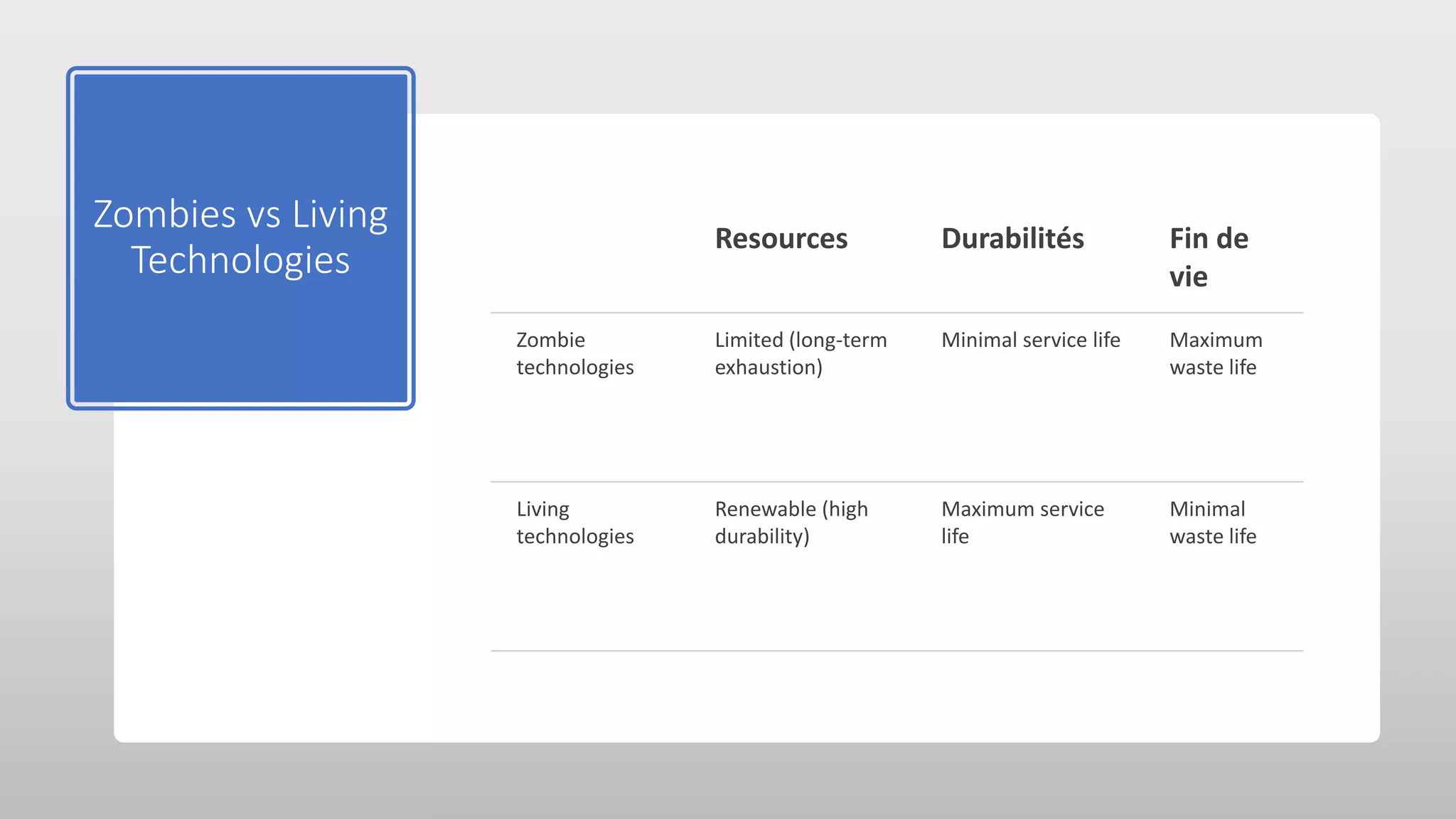
Zombies vs Living
Technologies
Resources Durabilités Fin de
vie
Zombie
technologies
Limited (long-term
exhaustion)
Minimal service life Maximum
waste life
Living
technologies
Renewable (high
durability)
Maximum service
life
Minimal
waste life
• This distinction points to certain "essential"
reasons (and therefore not correlated to
uses and not compensable in the long term)
explaining the current impasses, particularly
in the digital age.
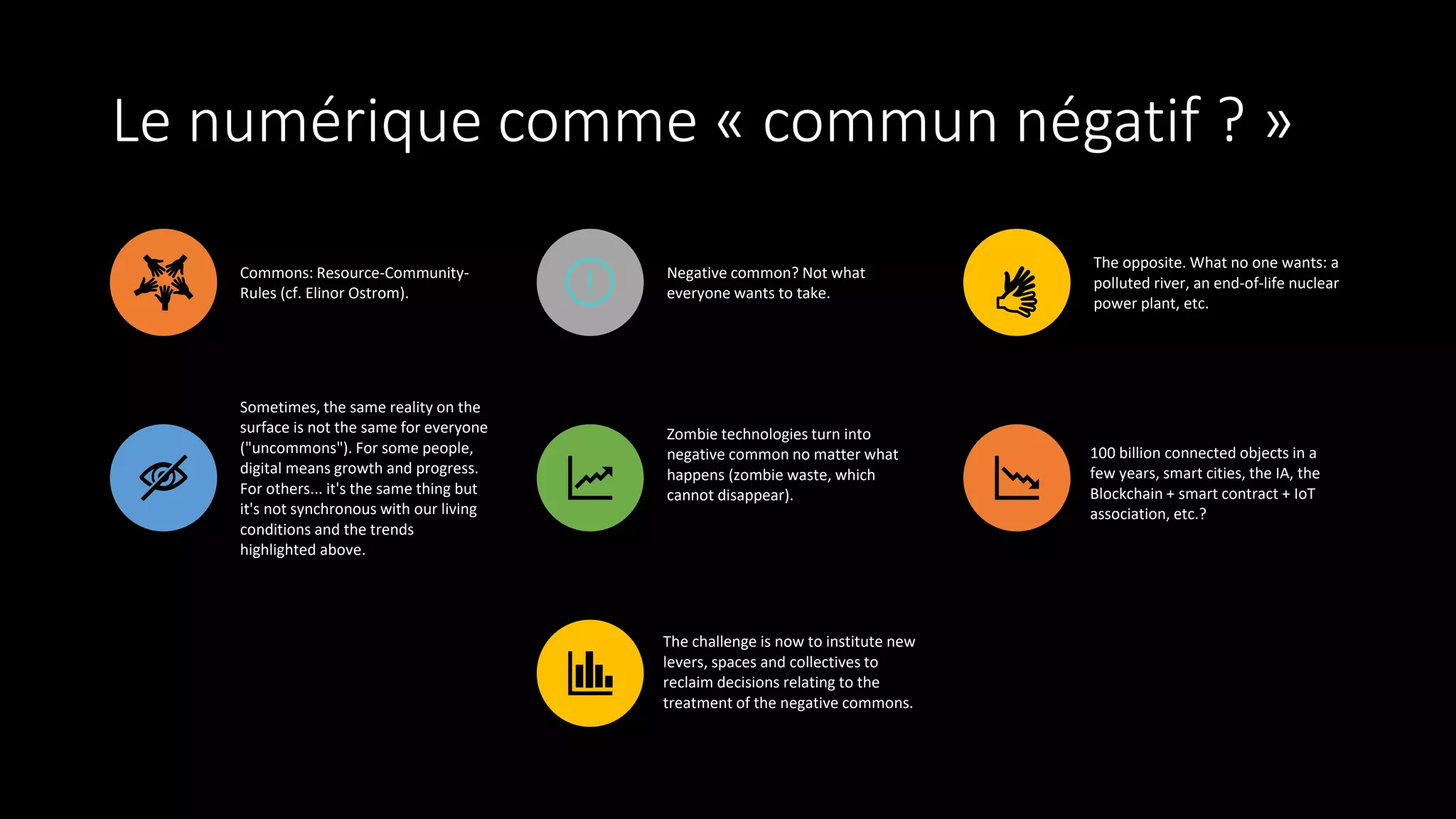
Le numérique comme « commun négatif ? »
Commons: Resource-Community-
Rules (cf. Elinor Ostrom).
Negative common? Not what
everyone wants to take.
The opposite. What no one wants: a
polluted river, an end-of-life nuclear
power plant, etc.
Sometimes, the same reality on the
surface is not the same for everyone
("uncommons"). For some people,
digital means growth and progress.
For others... it's the same thing but
it's not synchronous with our living
conditions and the trends
highlighted above.
Zombie technologies turn into
negative common no matter what
happens (zombie waste, which
cannot disappear).
100 billion connected objects in a
few years, smart cities, the IA, the
Blockchain + smart contract + IoT
association, etc.?
The challenge is now to institute new
levers, spaces and collectives to
reclaim decisions relating to the
treatment of the negative commons.
Pre-conclusion
• The futures: multiple and asynchronous
• The future synchronizes future divergences
• Our revolutions are temporary
• End of linear and cumulative progress
• Our technologies/infrastructure/research resources are not sustainable but are
there: what should we use them for before the effects of the new age (the
Anthropocene) are fully felt?
Closing
Worlds
Initiative

What Future for ICT?

  • 1.
    What future forICT? Alexandre Monnin GDS eco-Info (CNRS) ESC-Clermont-Ferrand Origens Medialab
  • 2.
    Prédictions or Recommendations? Numbers →Predictions Trends → Recommendations
  • 3.
    Numbers or trends? Apparaisingwith numbers is important but it is always possible to question a specific point, a methodology or data collection, etc. It therefore seems to me crucial to identify long-term trends and the reasons behind or them. This approach is less prone to be countered by ad hoc "solutionist" counter-arguments (techno-fixes).
  • 4.
  • 5.
  • 6.
  • 7.
    Extraction is oftensecondary Source: José Halloy, LIED
  • 8.
    … and costly! source: José Halloy, LIED
  • 9.
    Trends: a vicious circle source: José Halloy, LIED
  • 10.
    Fizaine, F. andCourt, V. (2015) “Renewable electricity producing technologies and metal depletion: A sensitivity analysis using the EROI”, Ecological Economics, 110, pp. 106–118. doi: 10.1016/j.ecolecon.2014.12.001.
  • 11.
    Temporality: a time for action? •Energy transition: Recent studies conducted at MIT have shown that at the current rate this transition would take 363 years to implement: https://www.technologyreview.com/s/610457/ at-this-rate-its-going-to-take-nearly-400-years- to-transform-the-energy-system/ (which is very insufficient).
  • 12.
    Temporality: a time for action? •In this calculation, in addition, the cost of installing the RE must be taken into account. Because what is targeted with RE is obviously to reduce CO2 emissions, but the installation work will bring its share of emissions. We are therefore counting on future savings, but this in turn requires that the window of opportunity to act must be large enough (cf. 3, 10 or 20 years?...). Another example: solar panels. A study showed that taking into account the lifetime of the panels and the ecological cost of their production, a growth of more than 12% per year in the sector would have a negative carbon footprint (factoring both emissions and savings).
  • 13.
    Temporality: a time for action? •Fusion (ITER): the latest EUROfusion roadmap does not foresee the commissioning of nuclear fusion reactor demonstrators until "the beginning of the second half of the 21st century" (2054 according to another document - an assessment considered optimistic by the experts themselves. One of them adds "it is vital to demonstrate electricity generation from fusion "not too far after the middle of the century". Otherwise, there may no longer be a nuclear industry able to build the commercial fusion plants that would follow, and the public may lose patience. ", http://www.bbc.com/news/science- environment-40558758). • Important for connected objects: https://www.inria.fr/centre/grenoble/actualites/en-2067- chaque-centimetre-carre-produira-de-la-donnee
  • 14.
    Temporality and « defuturation» • Tony Fry proposes the concept of defuturation to describe the current situation. According to him, design is normally a work of futuration, it produces a habitable future (on a species scale). • Today, he adds, innovation and design no longer produce a future but its opposite; they are therefore factors of "defuturation". • Indeed, innovations come largely from a past in which the Anthropocene had no place, a past giving birth to an obsolete, stillborn, future...
  • 15.
    Ex. : Carbonbudget and ICT evolution • Two antagonistic tendencies; • ICT represents about 3% of greenhouse gas emissions, but by 2025 it will represent around 8 to 9%; • In addition, the sector's energy growth is 9% per year....; • However, if we look at the commitments of a country like France, these trends are absolutely not compatible with the commitments made...
  • 16.
    Another ICT? • Photonics(based on photons)? • Quantum computer? • Biomimicry/neuromorphism (sensitive machines)? • New architectures (adiabatic calculation - rewritable)? New logics? New languages? • New materials (carbon-based microprocessors)?
  • 17.
    The 30th birthday of Web •WWW : the Inrupt project. • retro-futurist nostalgia?
  • 18.
    The Web WeCan Afford • Going from the Web We Want to the Web We Can Afford. Assumes a good knowledge of the Web. Not necessarily an eternal, non- carbonated Web, but a transitional Web https://www.w3.org/community/wwc a/
  • 19.
    Other futures (?): Downscaling the Web •The « downscaling the Web » initiative (https://worldwidesemanticweb.org) • A Web (including a Semantic one) with no Internet !
  • 20.
    Other futures (?): low-tech • Herean intermittent site powered by solar panels....
  • 21.
    Other future (?):offline sites • No connexion is needed!
  • 22.
  • 23.
    Other futures (?) :other networks • Community wireless networks • Depicted here is a MESH network deployment in Detroit in 2011.
  • 24.
    Other futures for research •S-CHI: Sustainable Human-Computer Interaction • Crisis Informatics • ICTD: Information and Communication Technology for Development • Computing Within Limits Workshops • Minimal Computing • Collapse informatics • Undesign the Internet • Undesigning Technology • Defuturing and Destruction
  • 25.
    Essential reasons: « zombietechnologies » • Community wireless networks • José Halloy (physicist at LIED), distinguishes between "living technologies" (part of biogeochemical cycles) and "zombie technologies" (our current technologies, which are based on finite resources and proven to be very unsustainable in working order while maximizing their lifespan in the form of waste)
  • 26.
    Zombies vs Living Technologies ResourcesDurabilités Fin de vie Zombie technologies Limited (long-term exhaustion) Minimal service life Maximum waste life Living technologies Renewable (high durability) Maximum service life Minimal waste life
  • 27.
    • This distinctionpoints to certain "essential" reasons (and therefore not correlated to uses and not compensable in the long term) explaining the current impasses, particularly in the digital age.
  • 28.
    Le numérique comme« commun négatif ? » Commons: Resource-Community- Rules (cf. Elinor Ostrom). Negative common? Not what everyone wants to take. The opposite. What no one wants: a polluted river, an end-of-life nuclear power plant, etc. Sometimes, the same reality on the surface is not the same for everyone ("uncommons"). For some people, digital means growth and progress. For others... it's the same thing but it's not synchronous with our living conditions and the trends highlighted above. Zombie technologies turn into negative common no matter what happens (zombie waste, which cannot disappear). 100 billion connected objects in a few years, smart cities, the IA, the Blockchain + smart contract + IoT association, etc.? The challenge is now to institute new levers, spaces and collectives to reclaim decisions relating to the treatment of the negative commons.
  • 29.
    Pre-conclusion • The futures:multiple and asynchronous • The future synchronizes future divergences • Our revolutions are temporary • End of linear and cumulative progress • Our technologies/infrastructure/research resources are not sustainable but are there: what should we use them for before the effects of the new age (the Anthropocene) are fully felt?
  • 30.