CONFIDENTIAL: The information in this document belongs to Boston Institute of Analytics LLC. Any unauthorized sharing of this
material is prohibited and subject to legal action under breach of IP and confidentiality clauses.
Password Management System
By PRAVEEN S
CONFIDENTIAL: The information in this document belongs to Boston Institute of Analytics LLC. Any unauthorized sharing of this
material is prohibited and subject to legal action under breach of IP and confidentiality clauses.
AGENDA
CONFIDENTIAL: The information in this document belongs to Boston Institute of Analytics LLC. Any unauthorized sharing of this
material is prohibited and subject to legal action under breach of IP and confidentiality clauses.
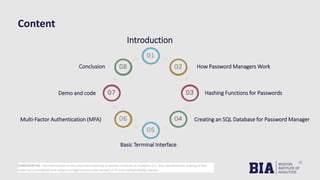
Content
Introduction
How Password Managers Work
Hashing Functions for Passwords
Creating an SQL Database for Password Manager
Basic Terminal Interface
Demo and code
Conclusion
Multi-Factor Authentication (MFA)
CONFIDENTIAL: The information in this document belongs to Boston Institute of Analytics LLC. Any unauthorized sharing of this
material is prohibited and subject to legal action under breach of IP and confidentiality clauses.
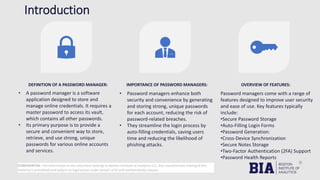
Introduction
DEFINITION OF A PASSWORD MANAGER: IMPORTANCE OF PASSWORD MANAGERS: OVERVIEW OF FEATURES:
• A password manager is a software
application designed to store and
manage online credentials. It requires a
master password to access its vault,
which contains all other passwords.
• Its primary purpose is to provide a
secure and convenient way to store,
retrieve, and use strong, unique
passwords for various online accounts
and services.
• Password managers enhance both
security and convenience by generating
and storing strong, unique passwords
for each account, reducing the risk of
password-related breaches.
• They streamline the login process by
auto-filling credentials, saving users
time and reducing the likelihood of
phishing attacks.
Password managers come with a range of
features designed to improve user security
and ease of use. Key features typically
include:
•Secure Password Storage
•Auto-Filling Login Forms
•Password Generation:
•Cross-Device Synchronization
•Secure Notes Storage
•Two-Factor Authentication (2FA) Support
•Password Health Reports
CONFIDENTIAL: The information in this document belongs to Boston Institute of Analytics LLC. Any unauthorized sharing of this
material is prohibited and subject to legal action under breach of IP and confidentiality clauses.
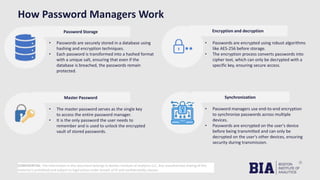
Password Storage Encryption and decryption
Master Password Synchronization
How Password Managers Work
• Passwords are securely stored in a database using
hashing and encryption techniques.
• Each password is transformed into a hashed format
with a unique salt, ensuring that even if the
database is breached, the passwords remain
protected.
• Passwords are encrypted using robust algorithms
like AES-256 before storage.
• The encryption process converts passwords into
cipher text, which can only be decrypted with a
specific key, ensuring secure access.
• The master password serves as the single key
to access the entire password manager.
• It is the only password the user needs to
remember and is used to unlock the encrypted
vault of stored passwords.
• Password managers use end-to-end encryption
to synchronize passwords across multiple
devices.
• Passwords are encrypted on the user's device
before being transmitted and can only be
decrypted on the user's other devices, ensuring
security during transmission.
CONFIDENTIAL: The information in this document belongs to Boston Institute of Analytics LLC. Any unauthorized sharing of this
material is prohibited and subject to legal action under breach of IP and confidentiality clauses.
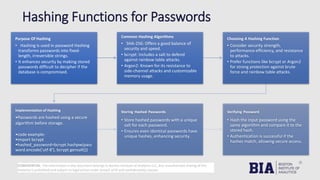
Hashing Functions for Passwords
Purpose Of Hashing
• Hashing is used in password Hashing
transforms passwords into fixed-
length, irreversible strings.
• It enhances security by making stored
passwords difficult to decipher if the
database is compromised.
Common Hashing Algorithms
• SHA-256: Offers a good balance of
security and speed.
• bcrypt: Includes a salt to defend
against rainbow table attacks.
• Argon2: Known for its resistance to
side-channel attacks and customizable
memory usage.
Choosing A Hashing Function
• Consider security strength,
performance efficiency, and resistance
to attacks.
• Prefer functions like bcrypt or Argon2
for strong protection against brute
force and rainbow table attacks.
Implementation of Hashing
•Passwords are hashed using a secure
algorithm before storage.
•code example:
•import bcrypt
•hashed_password=bcrypt.hashpw(pass
word.encode('utf-8'), bcrypt.gensalt())
Storing Hashed Passwords
• Store hashed passwords with a unique
salt for each password.
• Ensures even identical passwords have
unique hashes, enhancing security.
Verifying Password
• Hash the input password using the
same algorithm and compare it to the
stored hash.
• Authentication is successful if the
hashes match, allowing secure access.
CONFIDENTIAL: The information in this document belongs to Boston Institute of Analytics LLC. Any unauthorized sharing of this
material is prohibited and subject to legal action under breach of IP and confidentiality clauses.
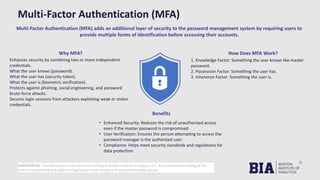
How Does MFA Work?
1. Knowledge Factor: Something the user knows like master
password.
2. Possession Factor: Something the user has.
3. Inherence Factor: Something the user is.
Why MFA?
Enhances security by combining two or more independent
credentials.
What the user knows (password).
What the user has (security token).
What the user is (biometric verification).
Protects against phishing, social engineering, and password
brute-force attacks.
Secures login sessions from attackers exploiting weak or stolen
credentials..
Multi-Factor Authentication (MFA) adds an additional layer of security to the password management system by requiring users to
provide multiple forms of identification before accessing their accounts.
Benefits
• Enhanced Security: Reduces the risk of unauthorized access
even if the master password is compromised.
• User Verification: Ensures the person attempting to access the
password manager is the authorized user.
• Compliance: Helps meet security standards and regulations for
data protection.
Multi-Factor Authentication (MFA)
CONFIDENTIAL: The information in this document belongs to Boston Institute of Analytics LLC. Any unauthorized sharing of this
material is prohibited and subject to legal action under breach of IP and confidentiality clauses.
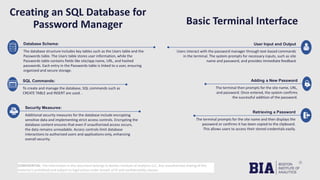
To create and manage the database, SQL commands such as
CREATE TABLE and INSERT are used. .
SQL Commands:
The database structure includes key tables such as the Users table and the
Passwords table. The Users table stores user information, while the
Passwords table contains fields like site/app name, URL, and hashed
passwords. Each entry in the Passwords table is linked to a user, ensuring
organized and secure storage.
Database Schema:
Additional security measures for the database include encrypting
sensitive data and implementing strict access controls. Encrypting the
database content ensures that even if unauthorized access occurs,
the data remains unreadable. Access controls limit database
interactions to authorized users and applications only, enhancing
overall security.
Security Measures:
Creating an SQL Database for
Password Manager
The terminal then prompts for the site name, URL,
and password. Once entered, the system confirms
the successful addition of the password.
Adding a New Password
Users interact with the password manager through text-based commands
in the terminal. The system prompts for necessary inputs, such as site
name and password, and provides immediate feedback
User Input and Output
The terminal prompts for the site name and then displays the
password or confirms it has been copied to the clipboard.
This allows users to access their stored credentials easily.
Retrieving a Password
Basic Terminal Interface
CONFIDENTIAL: The information in this document belongs to Boston Institute of Analytics LLC. Any unauthorized sharing of this
material is prohibited and subject to legal action under breach of IP and confidentiality clauses.
Demo
CONFIDENTIAL: The information in this document belongs to Boston Institute of Analytics LLC. Any unauthorized sharing of this
material is prohibited and subject to legal action under breach of IP and confidentiality clauses.
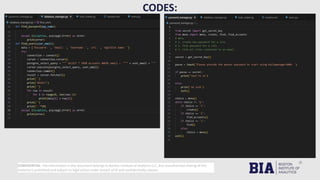
CODES:
CONFIDENTIAL: The information in this document belongs to Boston Institute of Analytics LLC. Any unauthorized sharing of this
material is prohibited and subject to legal action under breach of IP and confidentiality clauses.
CODES:
CONFIDENTIAL: The information in this document belongs to Boston Institute of Analytics LLC. Any unauthorized sharing of this
material is prohibited and subject to legal action under breach of IP and confidentiality clauses.
Conclusion
We have explored the fundamentals of password management systems,
including secure password storage, hashing functions, SQL database setup,
terminal interface commands, and essential security best practices. Emphasizing
strong master passwords, regular software updates, and two-factor
authentication ensures robust protection of user credentials.
CONFIDENTIAL: The information in this document belongs to Boston Institute of Analytics LLC. Any unauthorized sharing of this
material is prohibited and subject to legal action under breach of IP and confidentiality clauses.
Questions ?
CONFIDENTIAL: The information in this document belongs to Boston Institute of Analytics LLC. Any unauthorized sharing of this
material is prohibited and subject to legal action under breach of IP and confidentiality clauses.
Thank You!

Password Management System: Enhancing Security and Efficiency

  • 1.
    CONFIDENTIAL: The informationin this document belongs to Boston Institute of Analytics LLC. Any unauthorized sharing of this material is prohibited and subject to legal action under breach of IP and confidentiality clauses. Password Management System By PRAVEEN S
  • 2.
    CONFIDENTIAL: The informationin this document belongs to Boston Institute of Analytics LLC. Any unauthorized sharing of this material is prohibited and subject to legal action under breach of IP and confidentiality clauses. AGENDA
  • 3.
    CONFIDENTIAL: The informationin this document belongs to Boston Institute of Analytics LLC. Any unauthorized sharing of this material is prohibited and subject to legal action under breach of IP and confidentiality clauses. Content Introduction How Password Managers Work Hashing Functions for Passwords Creating an SQL Database for Password Manager Basic Terminal Interface Demo and code Conclusion Multi-Factor Authentication (MFA)
  • 4.
    CONFIDENTIAL: The informationin this document belongs to Boston Institute of Analytics LLC. Any unauthorized sharing of this material is prohibited and subject to legal action under breach of IP and confidentiality clauses. Introduction DEFINITION OF A PASSWORD MANAGER: IMPORTANCE OF PASSWORD MANAGERS: OVERVIEW OF FEATURES: • A password manager is a software application designed to store and manage online credentials. It requires a master password to access its vault, which contains all other passwords. • Its primary purpose is to provide a secure and convenient way to store, retrieve, and use strong, unique passwords for various online accounts and services. • Password managers enhance both security and convenience by generating and storing strong, unique passwords for each account, reducing the risk of password-related breaches. • They streamline the login process by auto-filling credentials, saving users time and reducing the likelihood of phishing attacks. Password managers come with a range of features designed to improve user security and ease of use. Key features typically include: •Secure Password Storage •Auto-Filling Login Forms •Password Generation: •Cross-Device Synchronization •Secure Notes Storage •Two-Factor Authentication (2FA) Support •Password Health Reports
  • 5.
    CONFIDENTIAL: The informationin this document belongs to Boston Institute of Analytics LLC. Any unauthorized sharing of this material is prohibited and subject to legal action under breach of IP and confidentiality clauses. Password Storage Encryption and decryption Master Password Synchronization How Password Managers Work • Passwords are securely stored in a database using hashing and encryption techniques. • Each password is transformed into a hashed format with a unique salt, ensuring that even if the database is breached, the passwords remain protected. • Passwords are encrypted using robust algorithms like AES-256 before storage. • The encryption process converts passwords into cipher text, which can only be decrypted with a specific key, ensuring secure access. • The master password serves as the single key to access the entire password manager. • It is the only password the user needs to remember and is used to unlock the encrypted vault of stored passwords. • Password managers use end-to-end encryption to synchronize passwords across multiple devices. • Passwords are encrypted on the user's device before being transmitted and can only be decrypted on the user's other devices, ensuring security during transmission.
  • 6.
    CONFIDENTIAL: The informationin this document belongs to Boston Institute of Analytics LLC. Any unauthorized sharing of this material is prohibited and subject to legal action under breach of IP and confidentiality clauses. Hashing Functions for Passwords Purpose Of Hashing • Hashing is used in password Hashing transforms passwords into fixed- length, irreversible strings. • It enhances security by making stored passwords difficult to decipher if the database is compromised. Common Hashing Algorithms • SHA-256: Offers a good balance of security and speed. • bcrypt: Includes a salt to defend against rainbow table attacks. • Argon2: Known for its resistance to side-channel attacks and customizable memory usage. Choosing A Hashing Function • Consider security strength, performance efficiency, and resistance to attacks. • Prefer functions like bcrypt or Argon2 for strong protection against brute force and rainbow table attacks. Implementation of Hashing •Passwords are hashed using a secure algorithm before storage. •code example: •import bcrypt •hashed_password=bcrypt.hashpw(pass word.encode('utf-8'), bcrypt.gensalt()) Storing Hashed Passwords • Store hashed passwords with a unique salt for each password. • Ensures even identical passwords have unique hashes, enhancing security. Verifying Password • Hash the input password using the same algorithm and compare it to the stored hash. • Authentication is successful if the hashes match, allowing secure access.
  • 7.
    CONFIDENTIAL: The informationin this document belongs to Boston Institute of Analytics LLC. Any unauthorized sharing of this material is prohibited and subject to legal action under breach of IP and confidentiality clauses. How Does MFA Work? 1. Knowledge Factor: Something the user knows like master password. 2. Possession Factor: Something the user has. 3. Inherence Factor: Something the user is. Why MFA? Enhances security by combining two or more independent credentials. What the user knows (password). What the user has (security token). What the user is (biometric verification). Protects against phishing, social engineering, and password brute-force attacks. Secures login sessions from attackers exploiting weak or stolen credentials.. Multi-Factor Authentication (MFA) adds an additional layer of security to the password management system by requiring users to provide multiple forms of identification before accessing their accounts. Benefits • Enhanced Security: Reduces the risk of unauthorized access even if the master password is compromised. • User Verification: Ensures the person attempting to access the password manager is the authorized user. • Compliance: Helps meet security standards and regulations for data protection. Multi-Factor Authentication (MFA)
  • 8.
    CONFIDENTIAL: The informationin this document belongs to Boston Institute of Analytics LLC. Any unauthorized sharing of this material is prohibited and subject to legal action under breach of IP and confidentiality clauses. To create and manage the database, SQL commands such as CREATE TABLE and INSERT are used. . SQL Commands: The database structure includes key tables such as the Users table and the Passwords table. The Users table stores user information, while the Passwords table contains fields like site/app name, URL, and hashed passwords. Each entry in the Passwords table is linked to a user, ensuring organized and secure storage. Database Schema: Additional security measures for the database include encrypting sensitive data and implementing strict access controls. Encrypting the database content ensures that even if unauthorized access occurs, the data remains unreadable. Access controls limit database interactions to authorized users and applications only, enhancing overall security. Security Measures: Creating an SQL Database for Password Manager The terminal then prompts for the site name, URL, and password. Once entered, the system confirms the successful addition of the password. Adding a New Password Users interact with the password manager through text-based commands in the terminal. The system prompts for necessary inputs, such as site name and password, and provides immediate feedback User Input and Output The terminal prompts for the site name and then displays the password or confirms it has been copied to the clipboard. This allows users to access their stored credentials easily. Retrieving a Password Basic Terminal Interface
  • 9.
    CONFIDENTIAL: The informationin this document belongs to Boston Institute of Analytics LLC. Any unauthorized sharing of this material is prohibited and subject to legal action under breach of IP and confidentiality clauses. Demo
  • 10.
    CONFIDENTIAL: The informationin this document belongs to Boston Institute of Analytics LLC. Any unauthorized sharing of this material is prohibited and subject to legal action under breach of IP and confidentiality clauses. CODES:
  • 11.
    CONFIDENTIAL: The informationin this document belongs to Boston Institute of Analytics LLC. Any unauthorized sharing of this material is prohibited and subject to legal action under breach of IP and confidentiality clauses. CODES:
  • 12.
    CONFIDENTIAL: The informationin this document belongs to Boston Institute of Analytics LLC. Any unauthorized sharing of this material is prohibited and subject to legal action under breach of IP and confidentiality clauses. Conclusion We have explored the fundamentals of password management systems, including secure password storage, hashing functions, SQL database setup, terminal interface commands, and essential security best practices. Emphasizing strong master passwords, regular software updates, and two-factor authentication ensures robust protection of user credentials.
  • 13.
    CONFIDENTIAL: The informationin this document belongs to Boston Institute of Analytics LLC. Any unauthorized sharing of this material is prohibited and subject to legal action under breach of IP and confidentiality clauses. Questions ?
  • 14.
    CONFIDENTIAL: The informationin this document belongs to Boston Institute of Analytics LLC. Any unauthorized sharing of this material is prohibited and subject to legal action under breach of IP and confidentiality clauses. Thank You!