What are scalable best practices to
spread smart health?
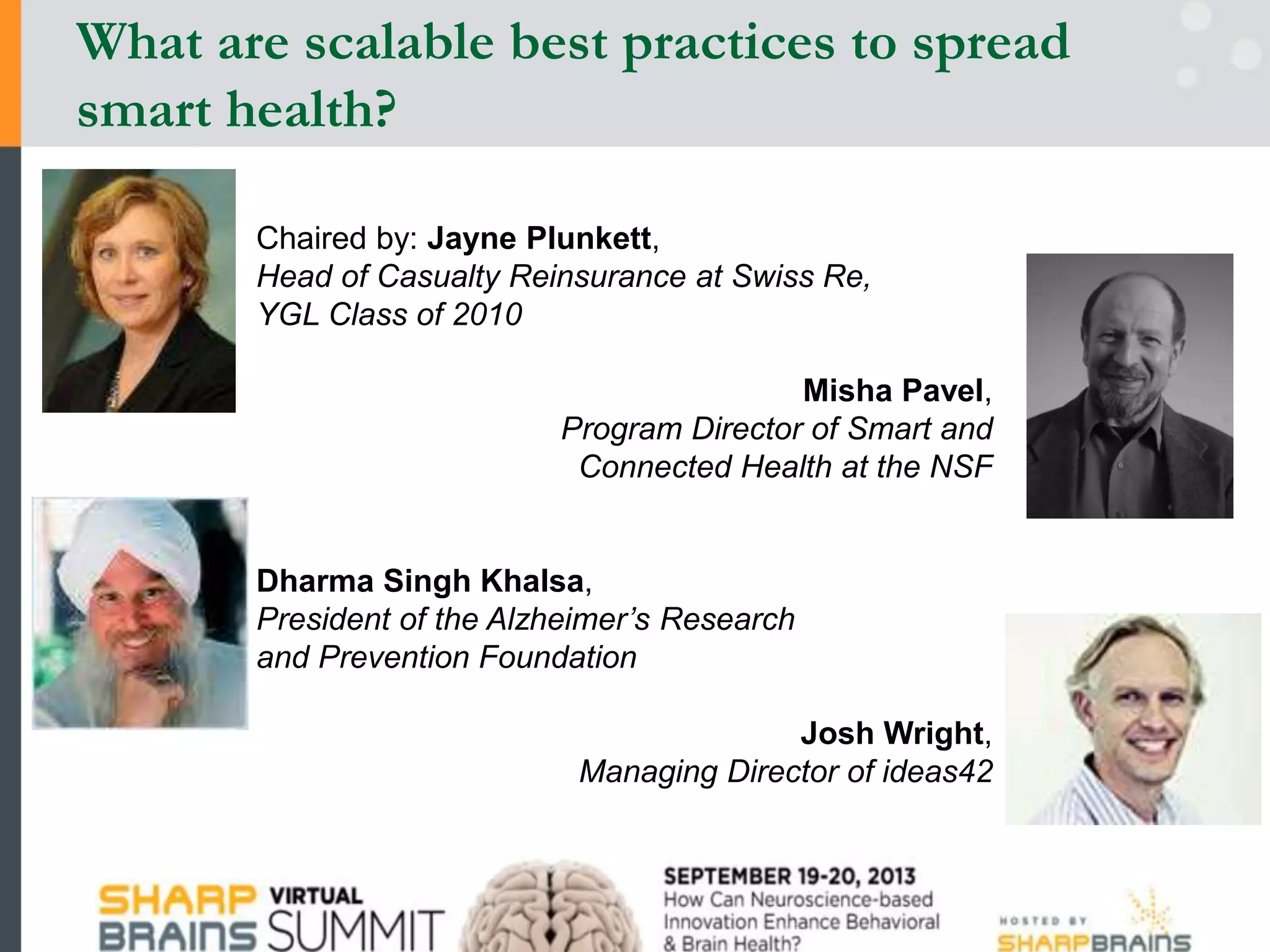
Chaired by: Jayne Plunkett,
Head of Casualty Reinsurance at Swiss Re,
YGL Class of 2010
Misha Pavel,
Program Director of Smart and
Connected Health at the NSF
Dharma Singh Khalsa,
President of the Alzheimer’s Research
and Prevention Foundation
Josh Wright,
Managing Director of ideas42
What are scalable best practices to spread
smart health?
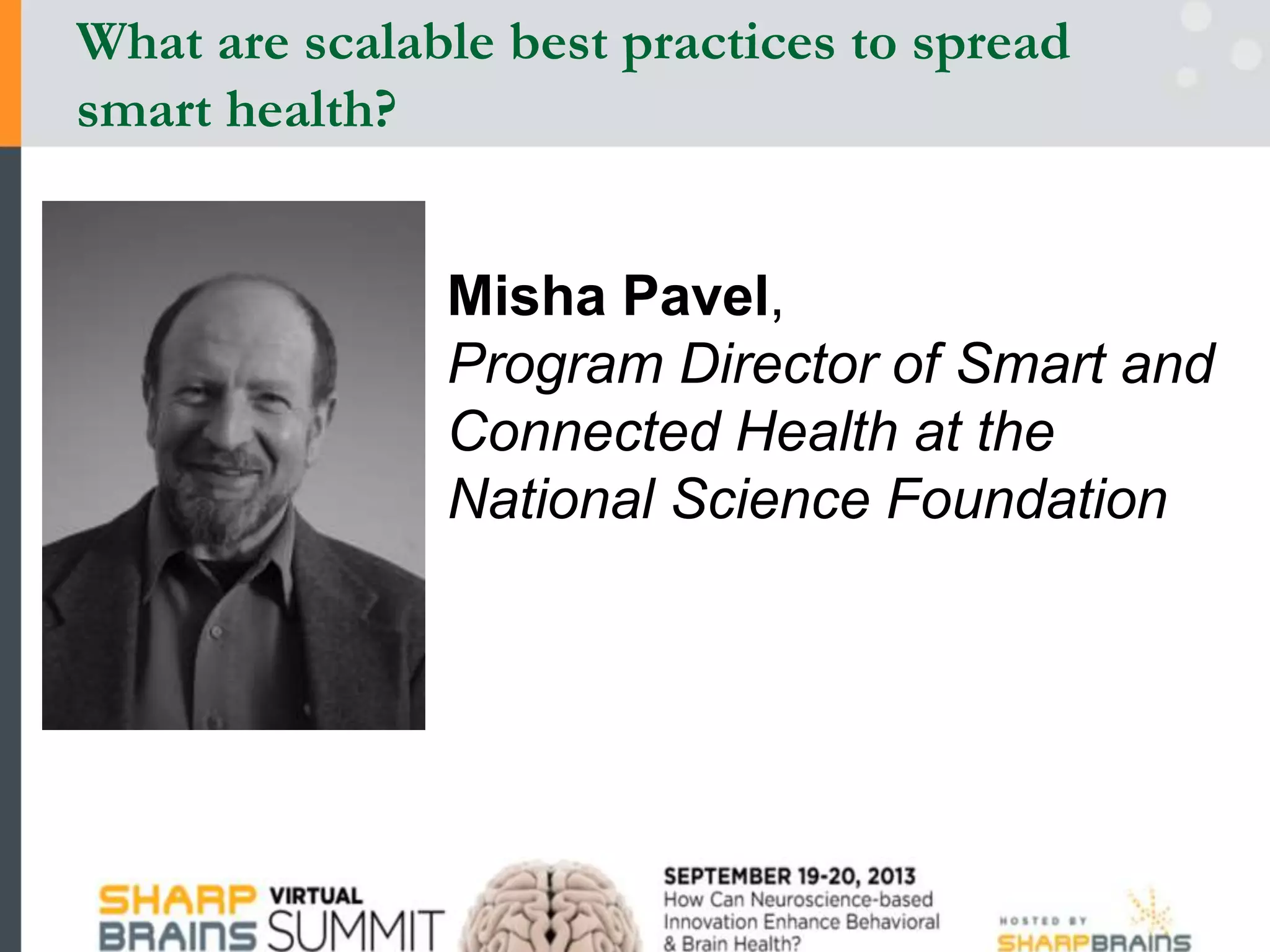
Misha Pavel,
Program Director of Smart and
Connected Health at the
National Science Foundation
What are scalable best practices to spread
smart health?
4
Smart and Connected Health
Misha Pavel
College of Computer and Information Science
Bouvé College of Health Sciences
Northeastern University
&
National Science Foundation
Computer & Information Science & Engineering Directorate
Information and Intelligent Systems Division
Any opinion, finding, and conclusions or recommendations expressed in this
material; are those of the author and do not necessarily reflect the views of
the National Science Foundation
Road ahead
I. Healthcare in Crisis
II. Smart & Connected Health
III. Behaviors including Big Data
5
Wactlar H., Pavel M., and Barkis W., "Can Computer Science Save Healthcare?,"
Intelligent Systems, IEEE, vol. 26, pp. 79-83, Sept. 2011.
PART I:
Healthcare in Crisis
Advances in Technology
6
The healthcare crisis – Some troubling statistics
• The cost of healthcare in the U.S. is the highest in the world
(> $8,000 per capita, 16% GDP)
• The U.S. ranked 37th in the 2000 WHO study of healthcare
system performance (8 underlying measures)
• 98,000 deaths per year due to medical errors
• Current individual medical records have an error rate of 20%
• 50% Americans have 1 or more chronic diseases; age of
onset is getting younger
• Medicare and Medicaid costs to be at a staggering 25% of
the U.S. economy by 2050
• 3 lifestyle behaviors (poor diet, lack of exercise, smoking)
cause estimated 1/3rd of U.S. deaths
7
Dependency Ratio: Retired/Working
1950 1960 1970 1980 1990 2000 2010 2020 2030 2040 2050
0
0.05
0.1
0.15
0.2
0.25
0.3
0.35
0.4
0.45
0.5
Dependency
Ratio
[Over
64]
/[20-65]
Year
Estimates Projections
Silver Tsunami
A sample of recent strategic visions & activities
Focus on transforming healthcare with technology and innovation
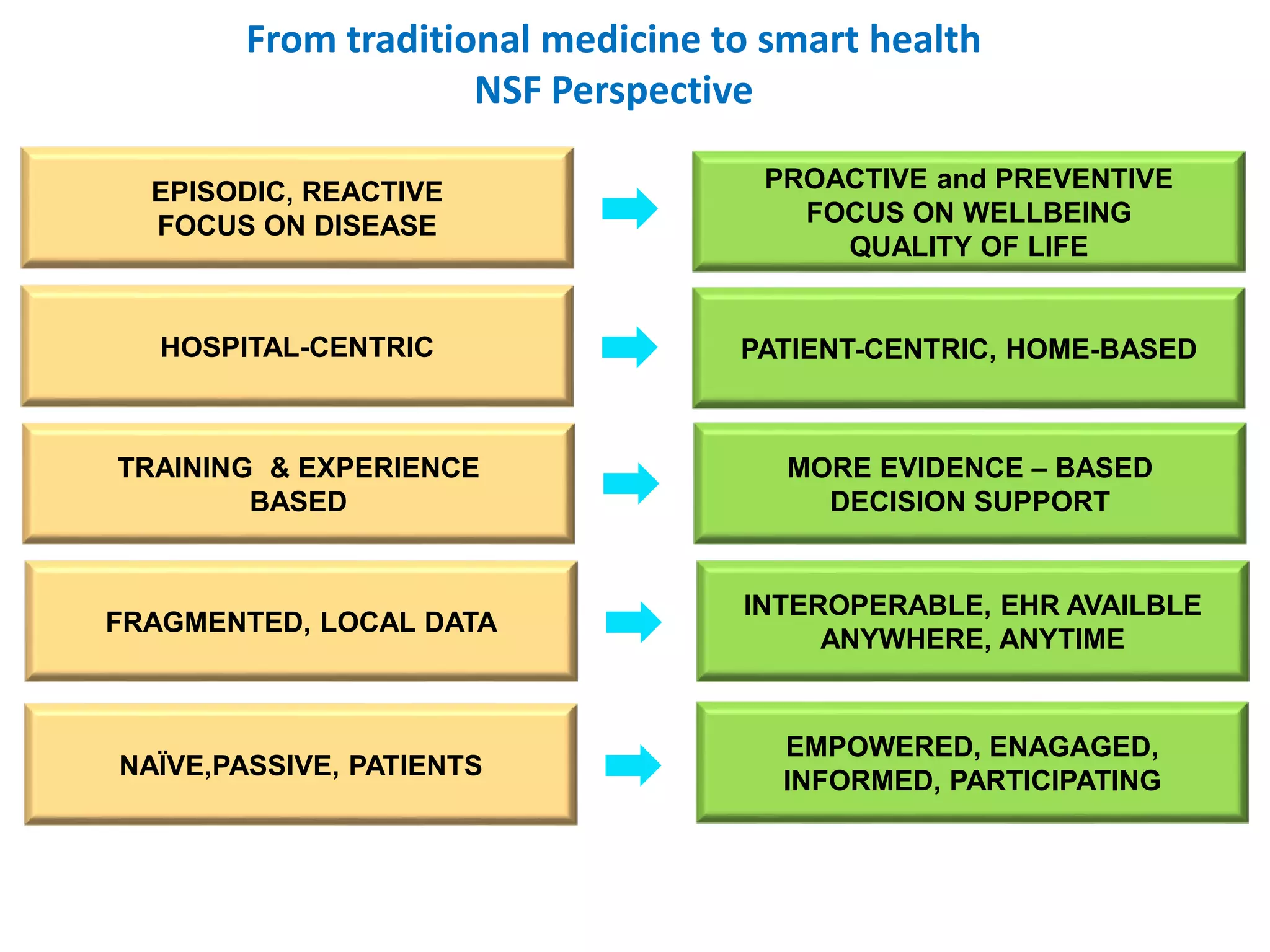
From traditional medicine to smart health
NSF Perspective
EPISODIC, REACTIVE
FOCUS ON DISEASE
PROACTIVE and PREVENTIVE
FOCUS ON WELLBEING
QUALITY OF LIFE
HOSPITAL-CENTRIC PATIENT-CENTRIC, HOME-BASED
FRAGMENTED, LOCAL DATA
INTEROPERABLE, EHR AVAILBLE
ANYWHERE, ANYTIME
NAÏVE,PASSIVE, PATIENTS
EMPOWERED, ENAGAGED,
INFORMED, PARTICIPATING
TRAINING & EXPERIENCE
BASED
MORE EVIDENCE – BASED
DECISION SUPPORT
Quality of Life over Life-Span
0 20 40 60 80 100 120
Age [Years]
Quality
of
Life
Rectangularization
after Fries, 1983
11
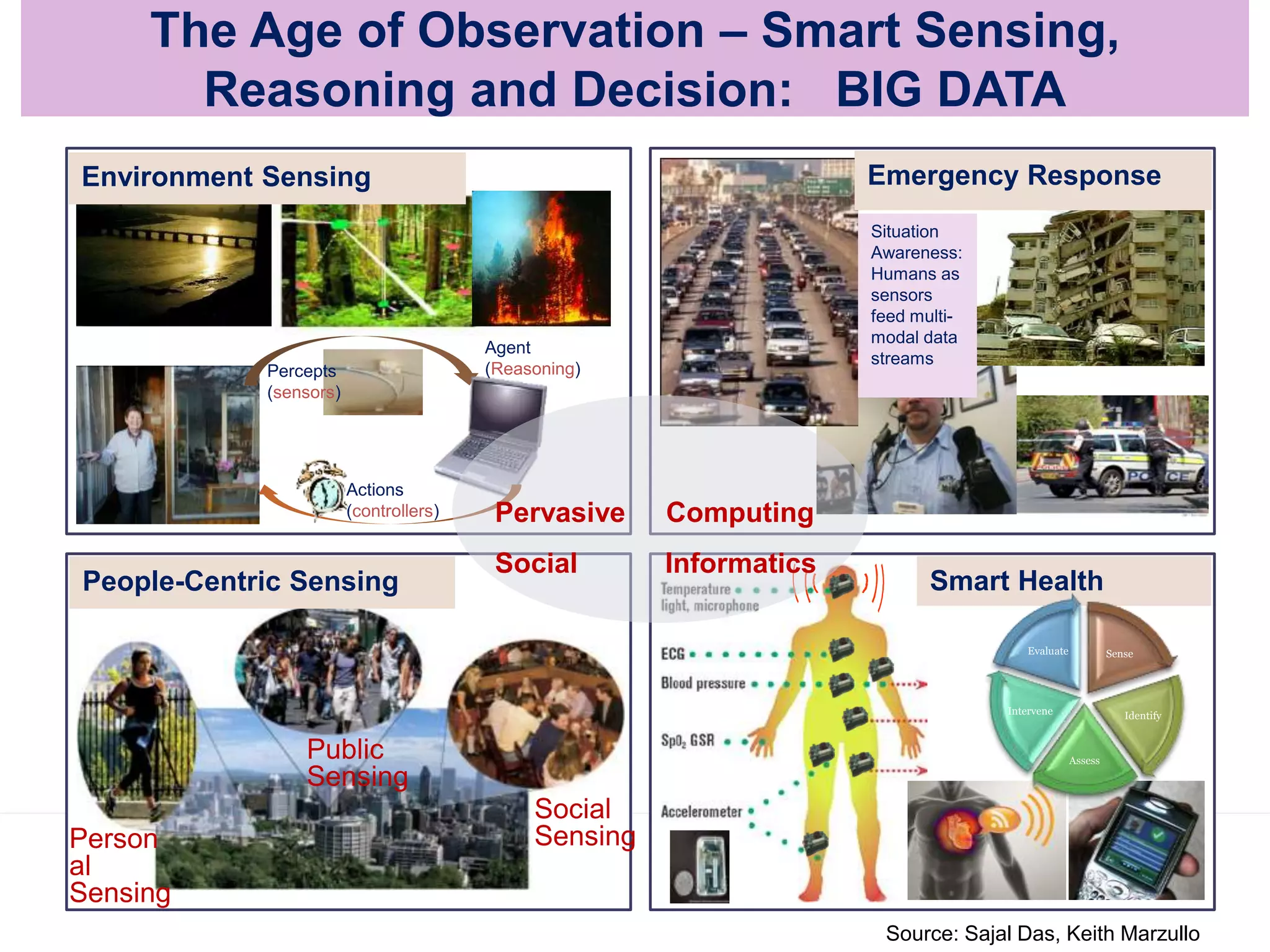
Source: Sajal Das, Keith Marzullo
Person
al
Sensing
Public
Sensing
Social
Sensing
People-Centric Sensing
Actions
(controllers)
Percepts
(sensors)
Agent
(Reasoning)
Smart Health
Situation
Awareness:
Humans as
sensors
feed multi-
modal data
streams
Pervasive Computing
Social Informatics
Sense
Identify
Assess
Intervene
Evaluate
Emergency Response
Environment Sensing
The Age of Observation – Smart Sensing,
Reasoning and Decision: BIG DATA
PART II:
Smart & Connected Health (SCH)
Inter-Agency Program
National Institutes of Health
National Science Foundation
13
NSF Solicitation: NSF-13-543
NIH Notice Number: NOT-OD-13-041
Objectives of the Smart and Connected Health Program
• To fill in research gaps that exist in science and
technology in support of health and wellness
• To advance the fields of health, wellness,
improve quality of care and reduce cost by
leveraging the fundamental science research
Seek improvements in safe, effective, efficient, equitable, and
patient-centered health and wellness services through
innovations in computer and information science, engineering,
social, behavioral and economic science and medical science
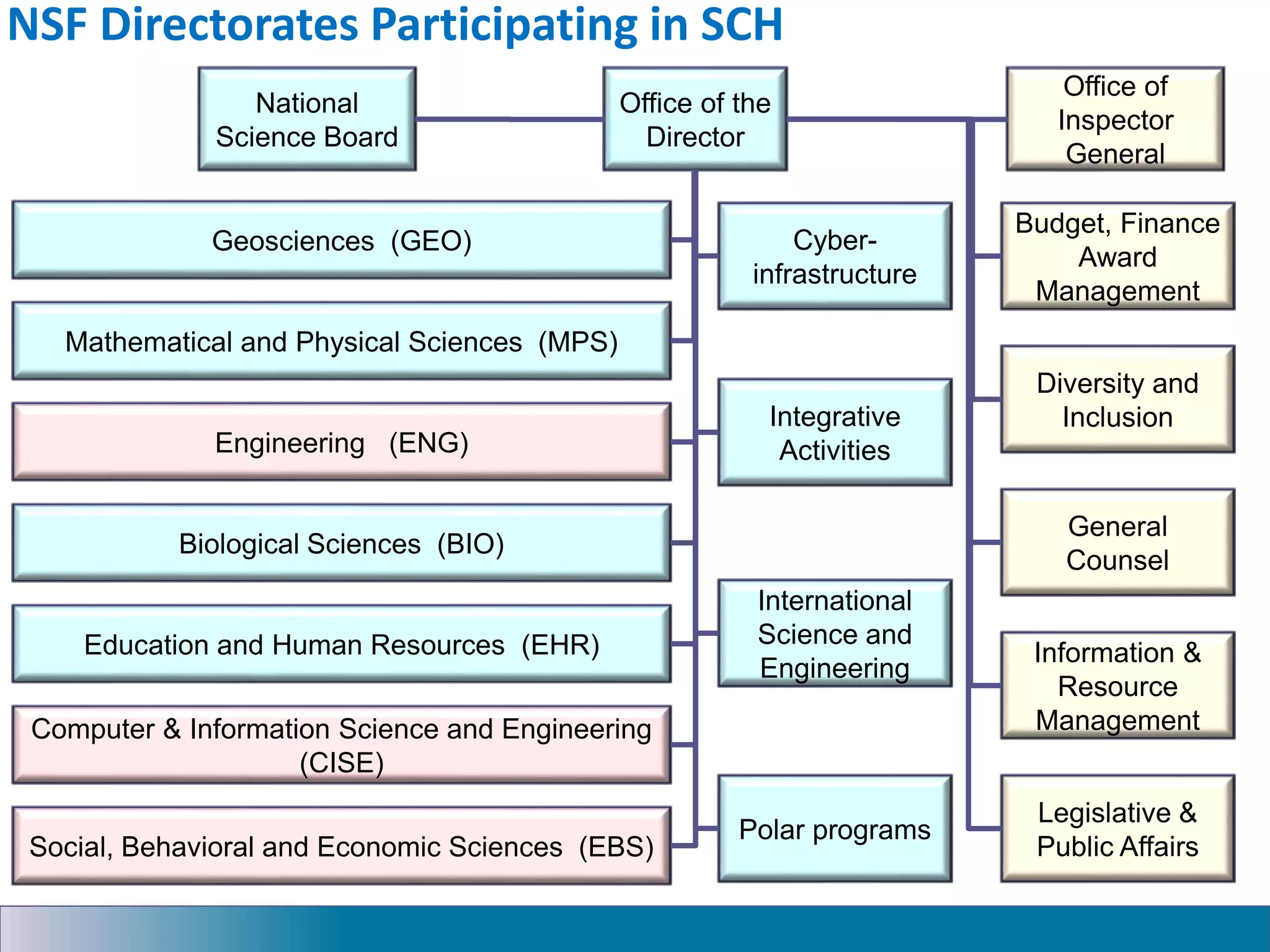
NSF Directorates Participating in SCH
15
Office of the
Director
Engineering (ENG)
Geosciences (GEO)
Mathematical and Physical Sciences (MPS)
Budget, Finance
Award
Management
Computer & Information Science and Engineering
(CISE)
Biological Sciences (BIO)
Diversity and
Inclusion
Social, Behavioral and Economic Sciences (EBS)
Education and Human Resources (EHR)
General
Counsel
Information &
Resource
Management
Legislative &
Public Affairs
National
Science Board
Office of
Inspector
General
Cyber-
infrastructure
Integrative
Activities
International
Science and
Engineering
Polar programs
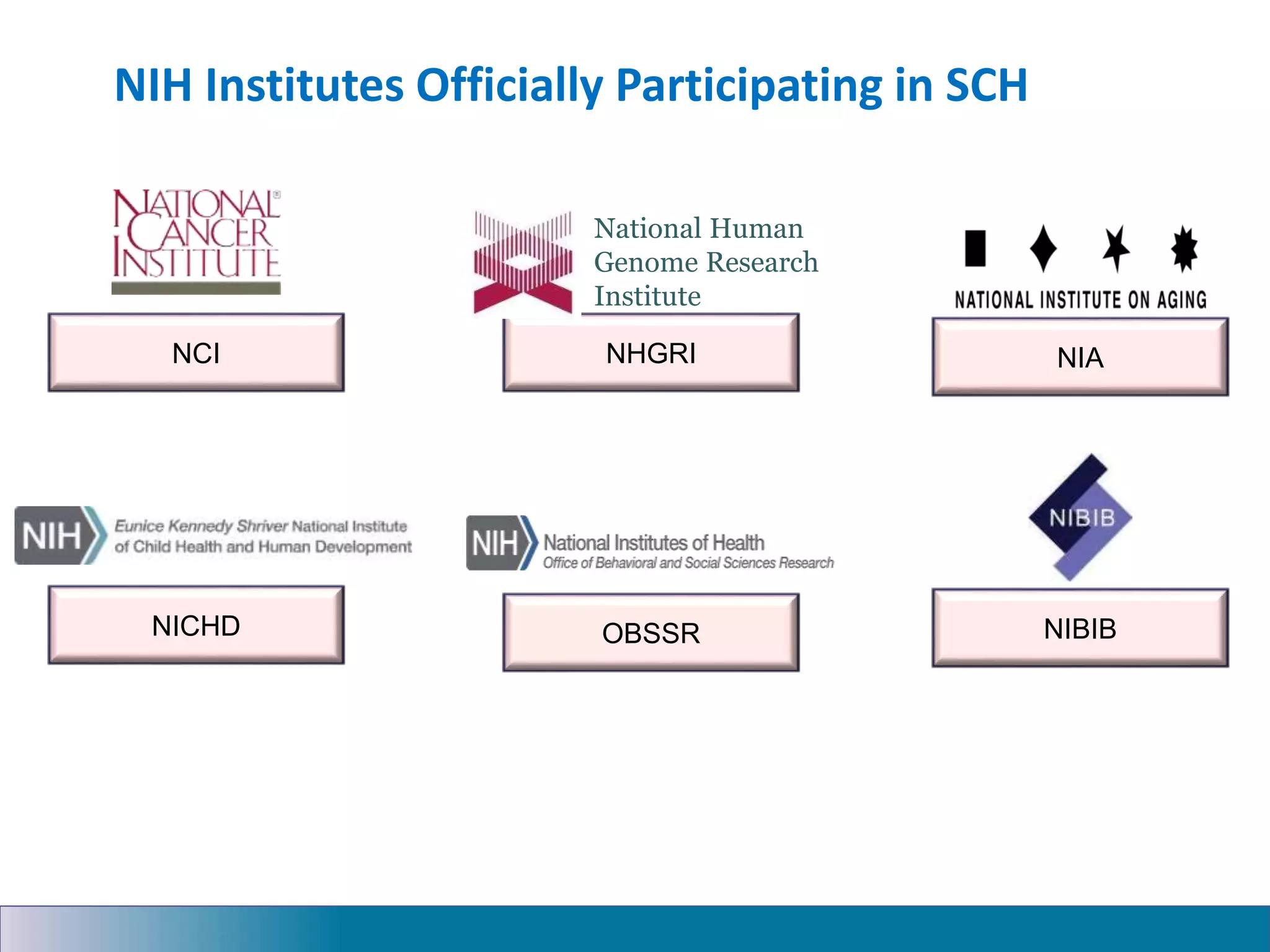
NIH Institutes Officially Participating in SCH
OBSSR
NCI
NIBIB
NIA
NHGRI
NICHD
National Human
Genome Research
Institute
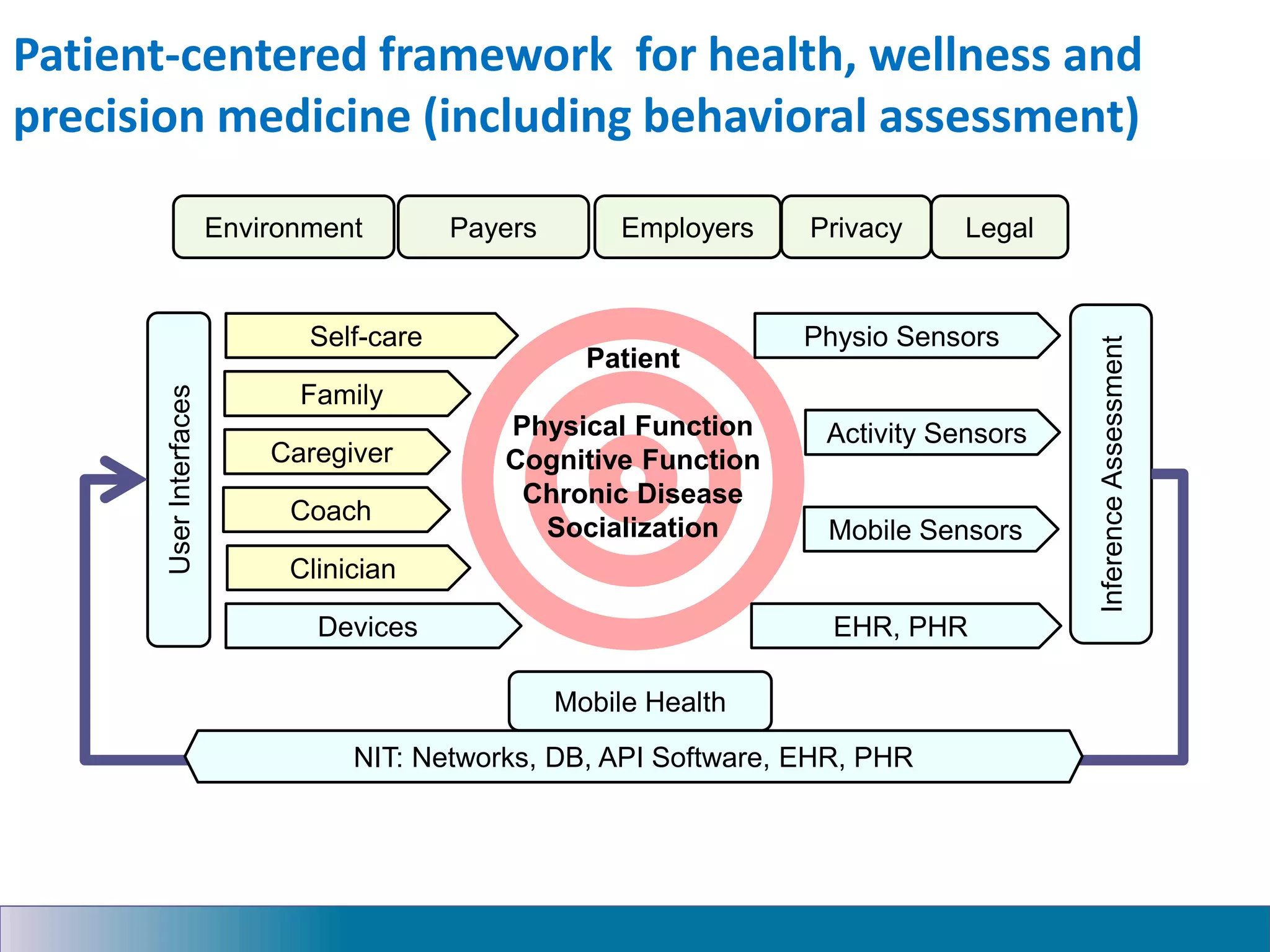
Family
Caregiver
Coach
Clinician
Devices
User
Interfaces
Inference
Assessment
Patient-centered framework for health, wellness and
precision medicine (including behavioral assessment)
Payers Employers Legal
Environment Privacy
Self-care
Patient
Physical Function
Cognitive Function
Chronic Disease
Socialization
Physio Sensors
Activity Sensors
Mobile Sensors
EHR, PHR
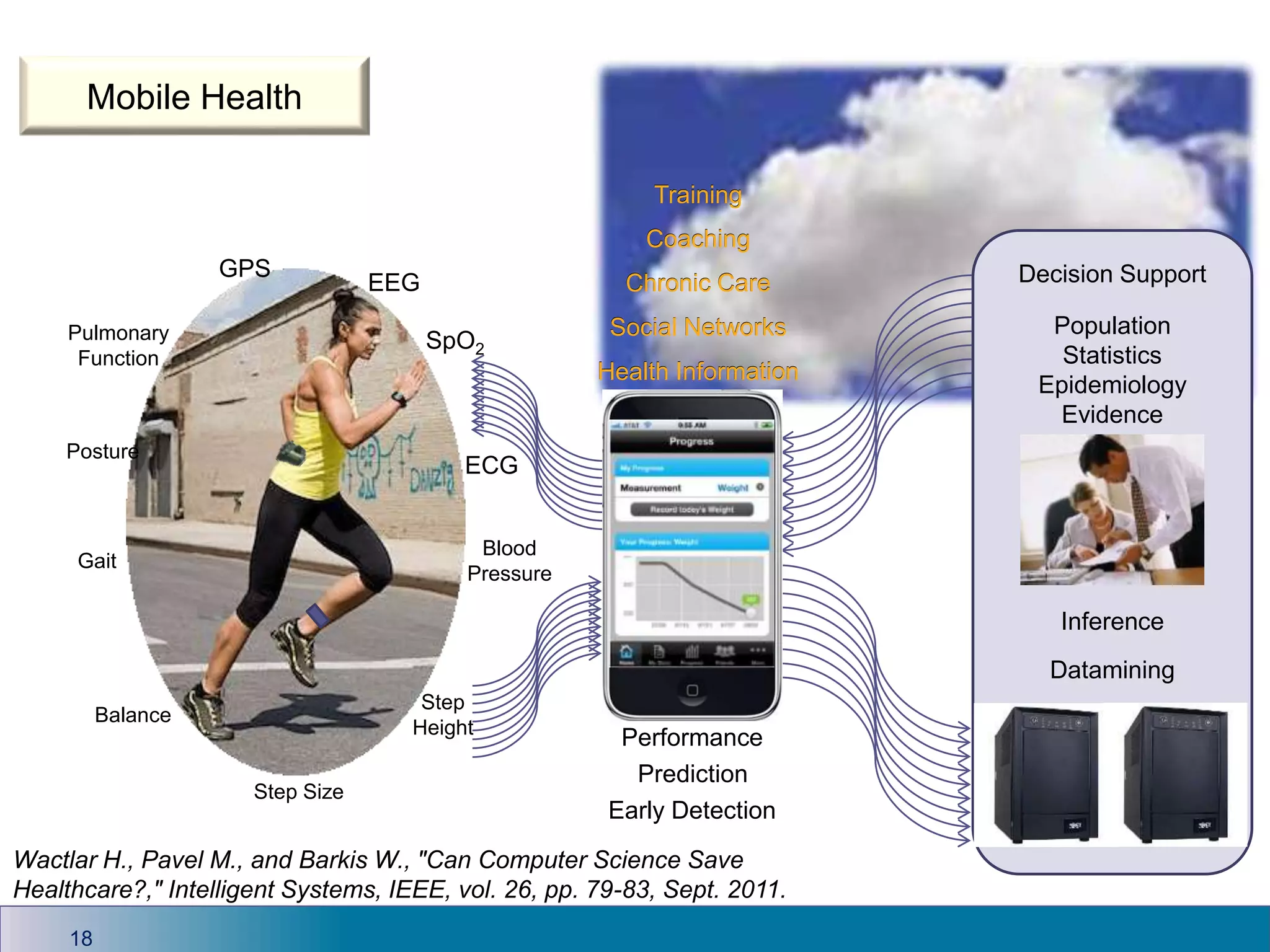
Mobile Health
NIT: Networks, DB, API Software, EHR, PHR
ECG
EEG
Pulmonary
Function
Gait
Balance
Step Size
Blood
Pressure
SpO2
Posture
Step
Height
GPS
Performance
Early Detection
Prediction
Inference
Datamining
Training
Health Information
Coaching
Chronic Care
Social Networks
Decision Support
Population
Statistics
Epidemiology
Evidence
Mobile Health
18
Training
Health Information
Coaching
Chronic Care
Social Networks
Wactlar H., Pavel M., and Barkis W., "Can Computer Science Save
Healthcare?," Intelligent Systems, IEEE, vol. 26, pp. 79-83, Sept. 2011.
Smart and Connected Health Research Areas
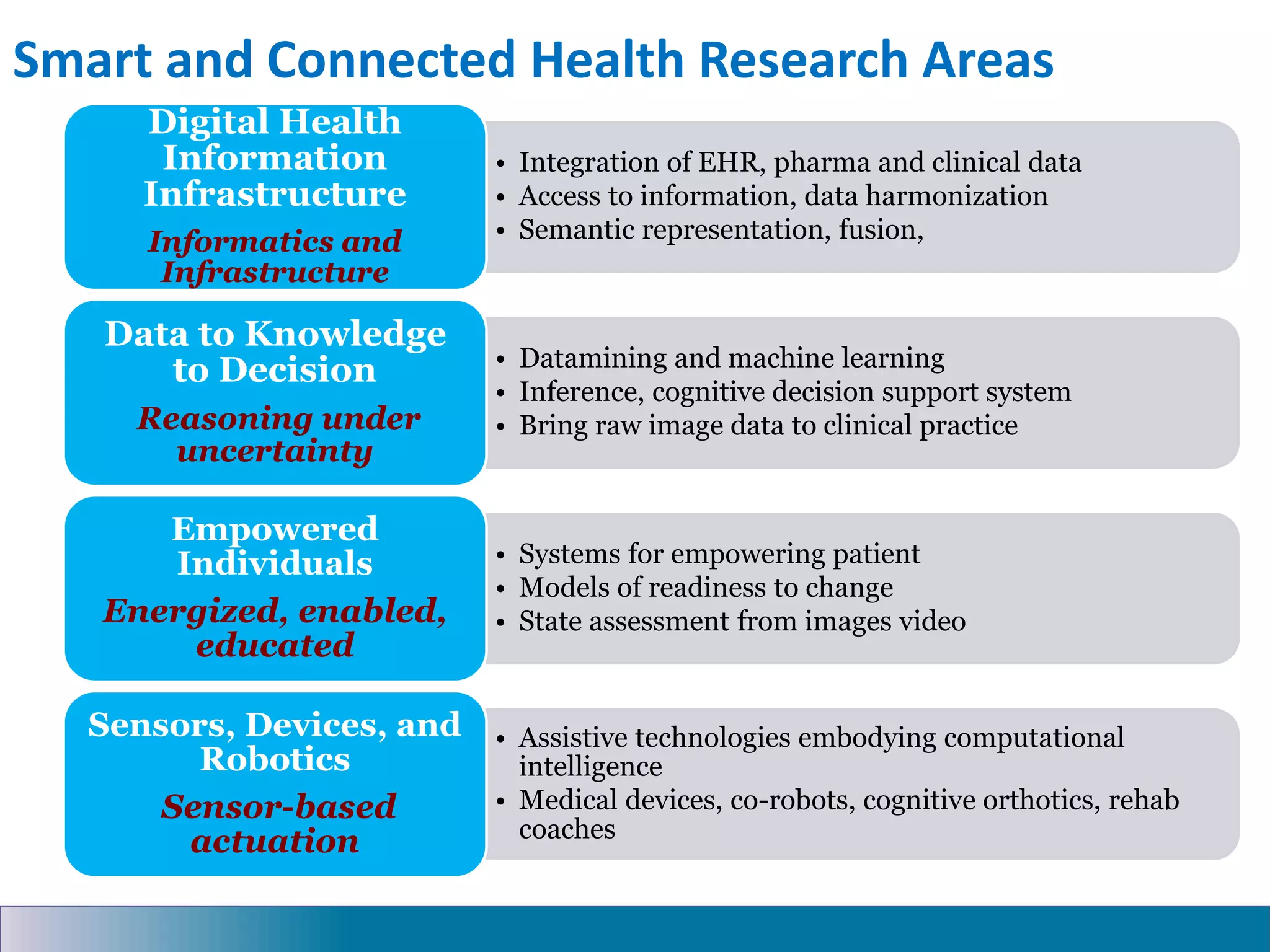
• Integration of EHR, pharma and clinical data
• Access to information, data harmonization
• Semantic representation, fusion,
Digital Health
Information
Infrastructure
Informatics and
Infrastructure
• Datamining and machine learning
• Inference, cognitive decision support system
• Bring raw image data to clinical practice
Data to Knowledge
to Decision
Reasoning under
uncertainty
• Systems for empowering patient
• Models of readiness to change
• State assessment from images video
Empowered
Individuals
Energized, enabled,
educated
• Assistive technologies embodying computational
intelligence
• Medical devices, co-robots, cognitive orthotics, rehab
coaches
Sensors, Devices, and
Robotics
Sensor-based
actuation
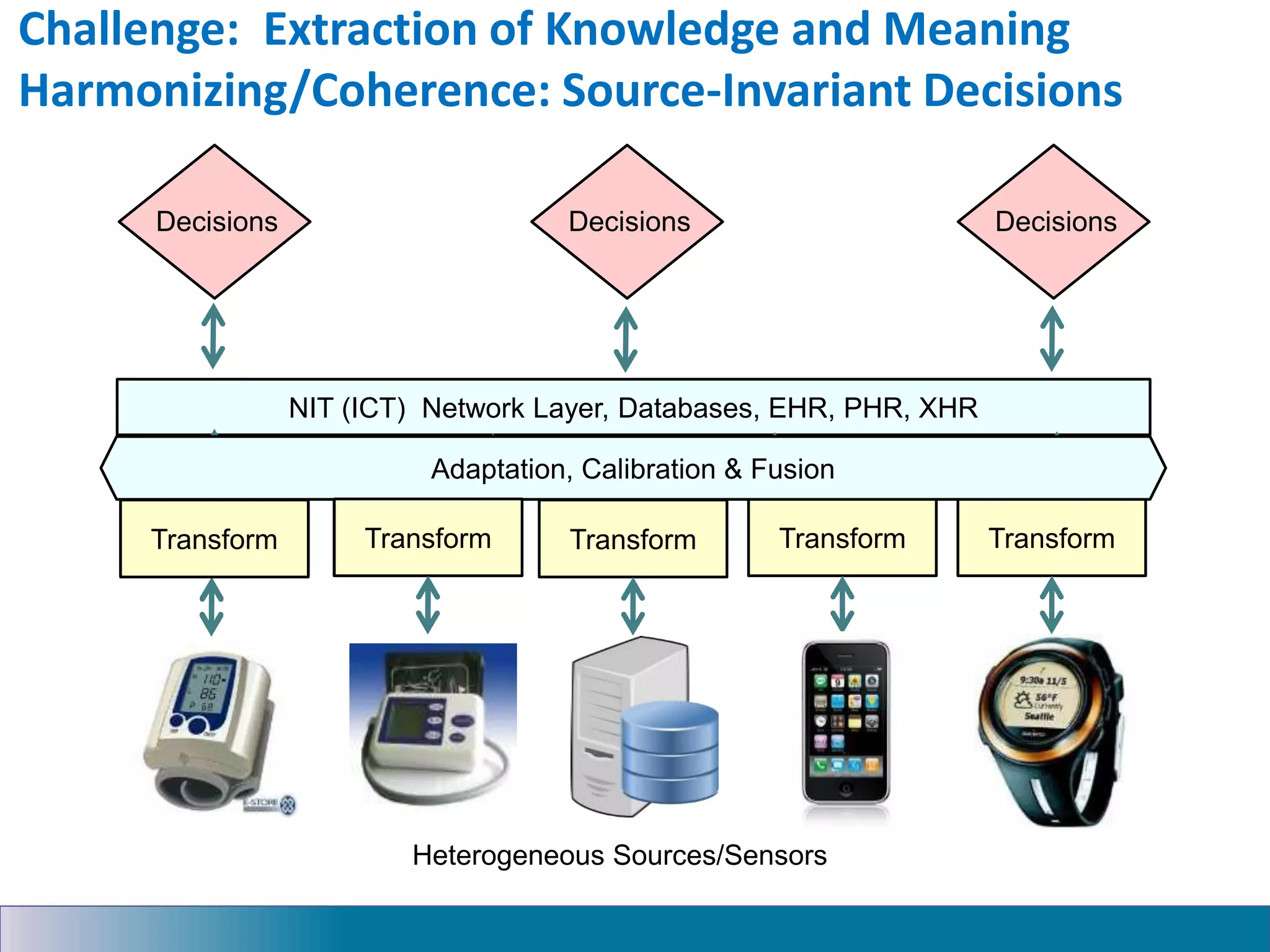
Challenge: Extraction of Knowledge and Meaning
Harmonizing/Coherence: Source-Invariant Decisions
NIT (ICT) Network Layer, Databases, EHR, PHR, XHR
Decisions
Transform
Decisions Decisions
Transform Transform
Transform
Heterogeneous Sources/Sensors
Adaptation, Calibration & Fusion
Transform
Transform
Transform
PART III
Focus on Behaviors
Big Data
Any opinion, finding, and conclusions or recommendations expressed in
this material are those of the author and do not necessarily reflect the
views of the National Science Foundation
21
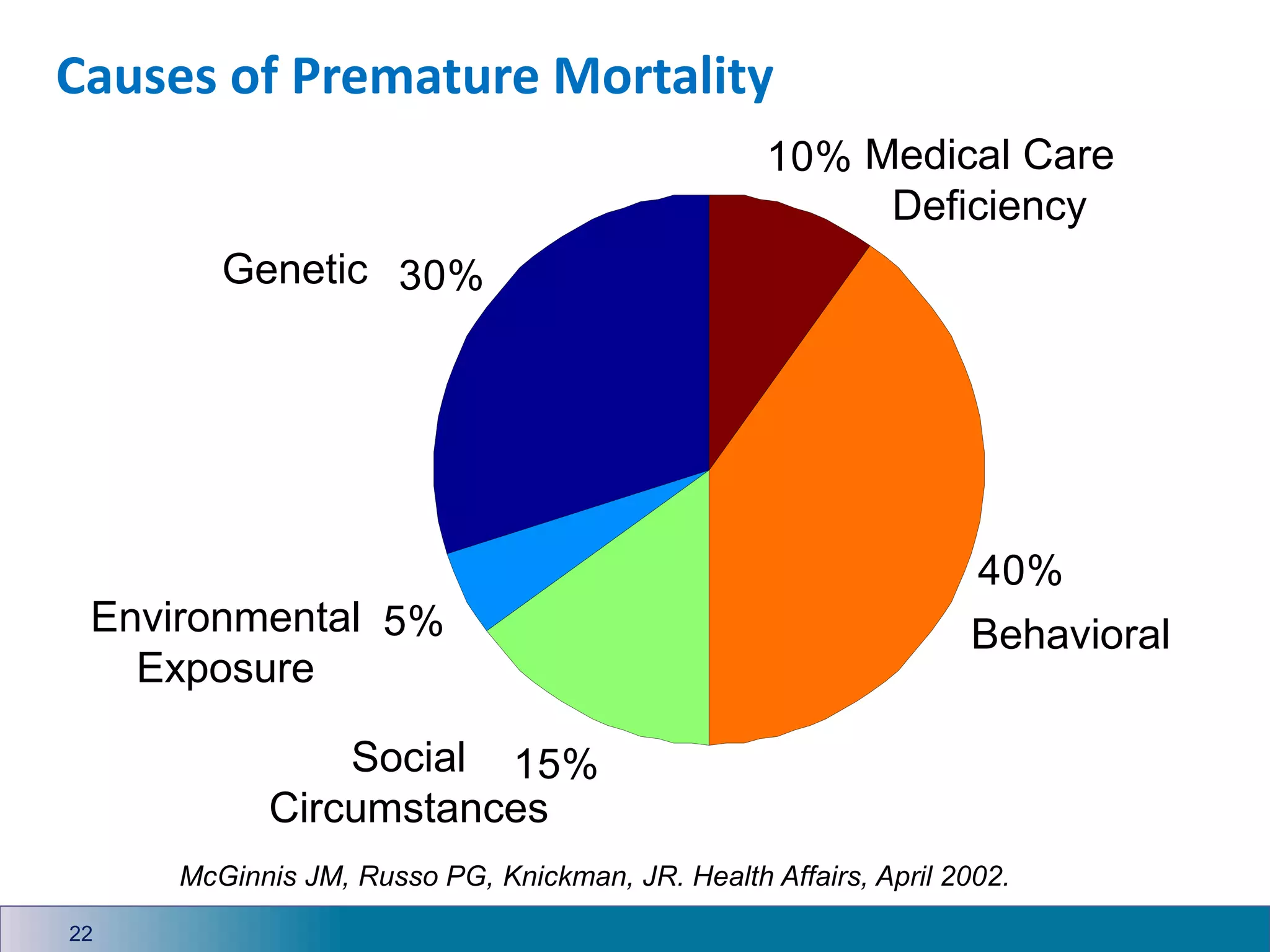
Causes of Premature Mortality
22
30%
5%
15%
40%
10%
Behavioral
Social
Circumstances
Environmental
Exposure
Genetic
Medical Care
Deficiency
McGinnis JM, Russo PG, Knickman, JR. Health Affairs, April 2002.
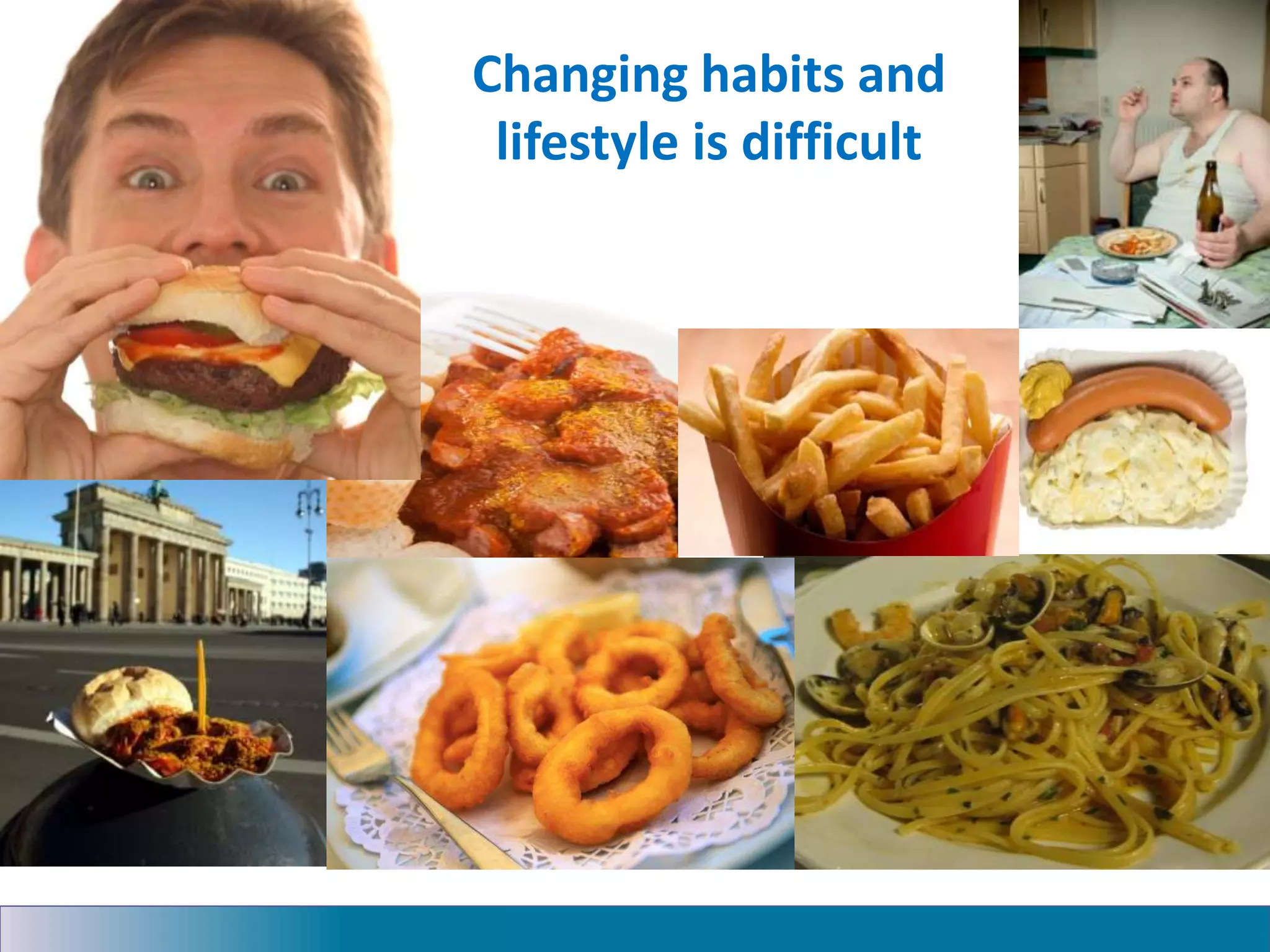
Changing habits and
lifestyle is difficult
23
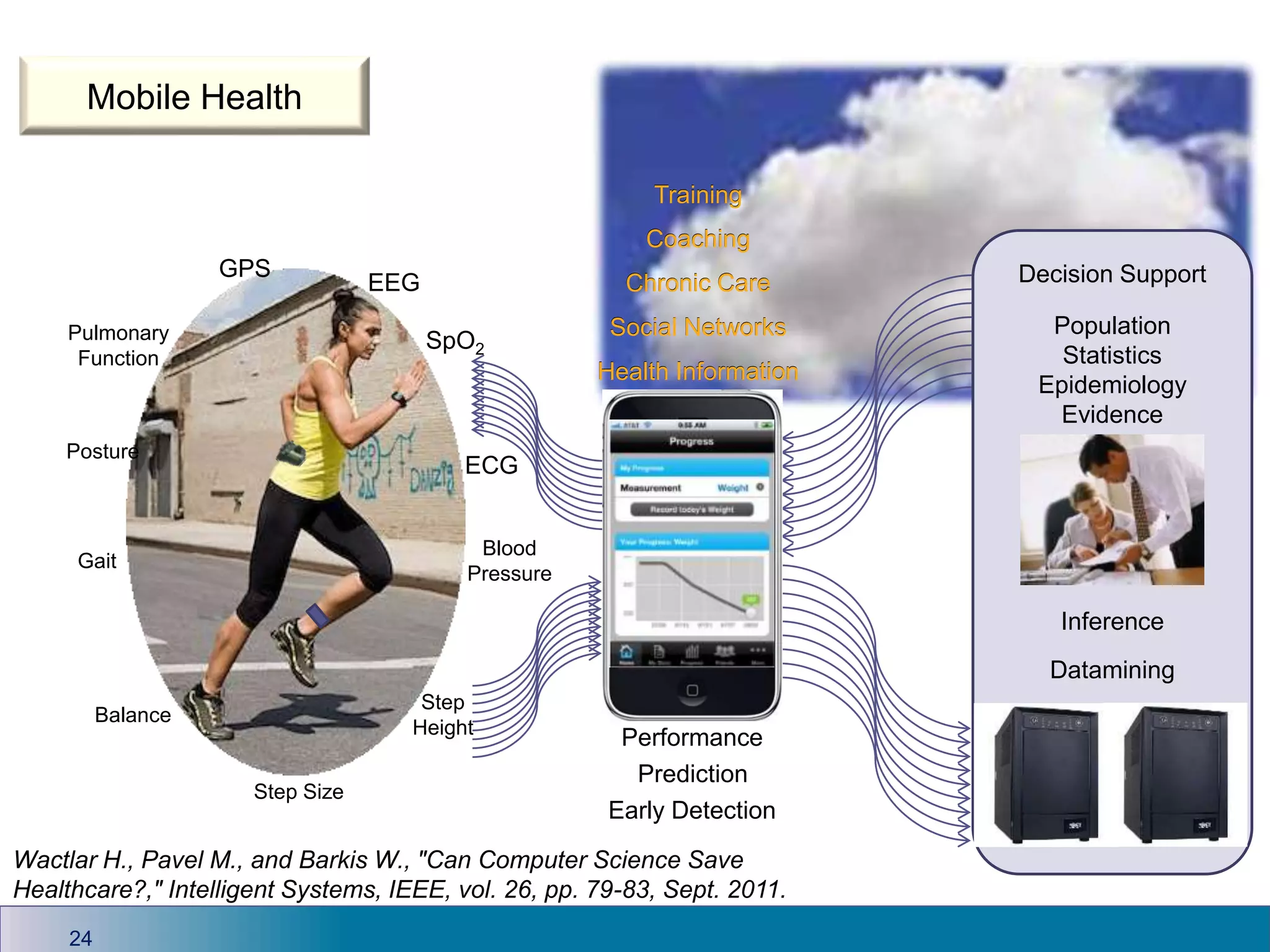
ECG
EEG
Pulmonary
Function
Gait
Balance
Step Size
Blood
Pressure
SpO2
Posture
Step
Height
GPS
Performance
Early Detection
Prediction
Inference
Datamining
Training
Health Information
Coaching
Chronic Care
Social Networks
Decision Support
Population
Statistics
Epidemiology
Evidence
Mobile Health
24
Training
Health Information
Coaching
Chronic Care
Social Networks
Wactlar H., Pavel M., and Barkis W., "Can Computer Science Save
Healthcare?," Intelligent Systems, IEEE, vol. 26, pp. 79-83, Sept. 2011.
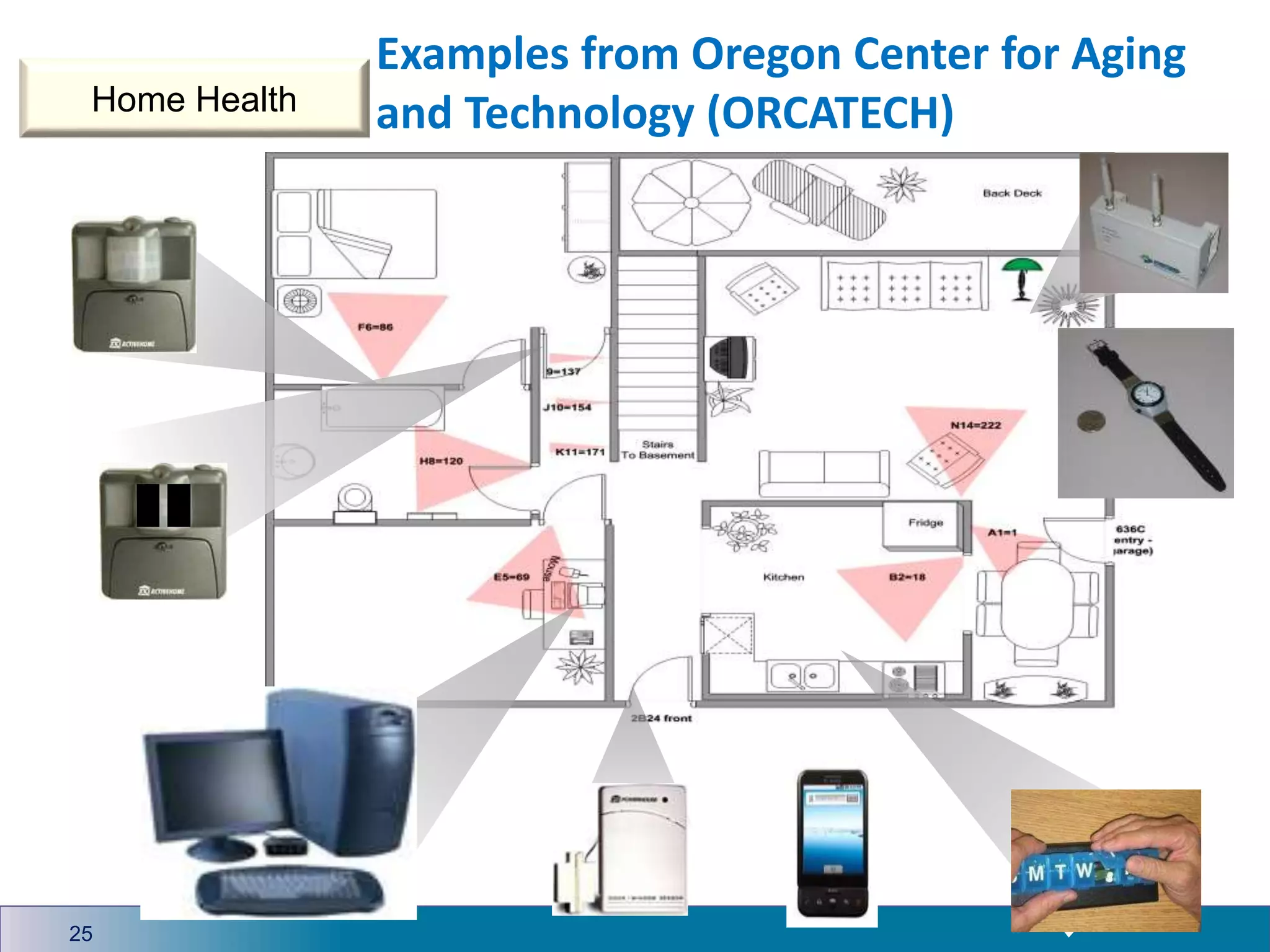
Examples from Oregon Center for Aging
and Technology (ORCATECH)
25
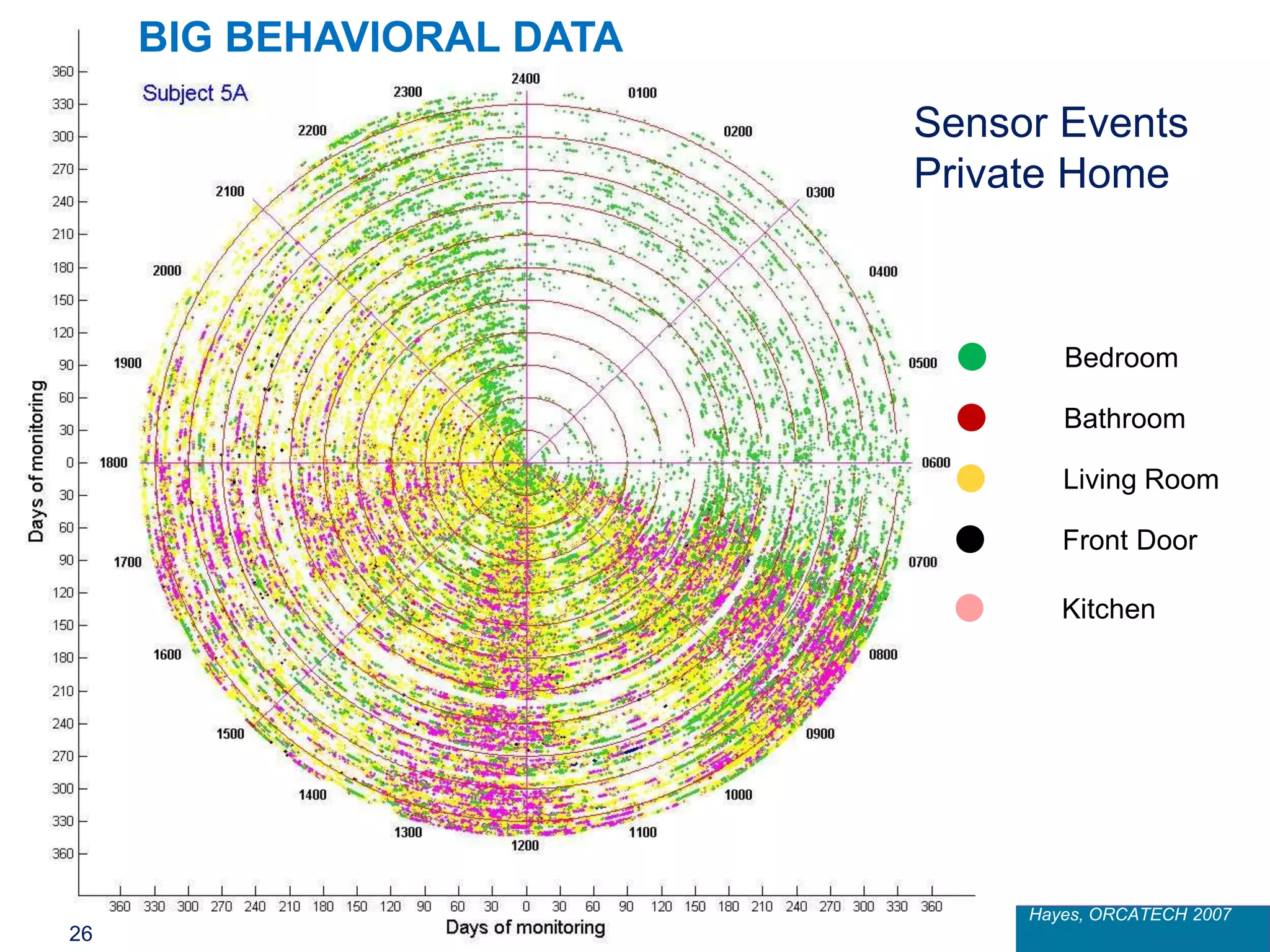
Home Health
Hayes, ORCATECH 2007
26
Bedroom
Bathroom
Living Room
Front Door
Kitchen
Sensor Events
Private Home
BIG BEHAVIORAL DATA
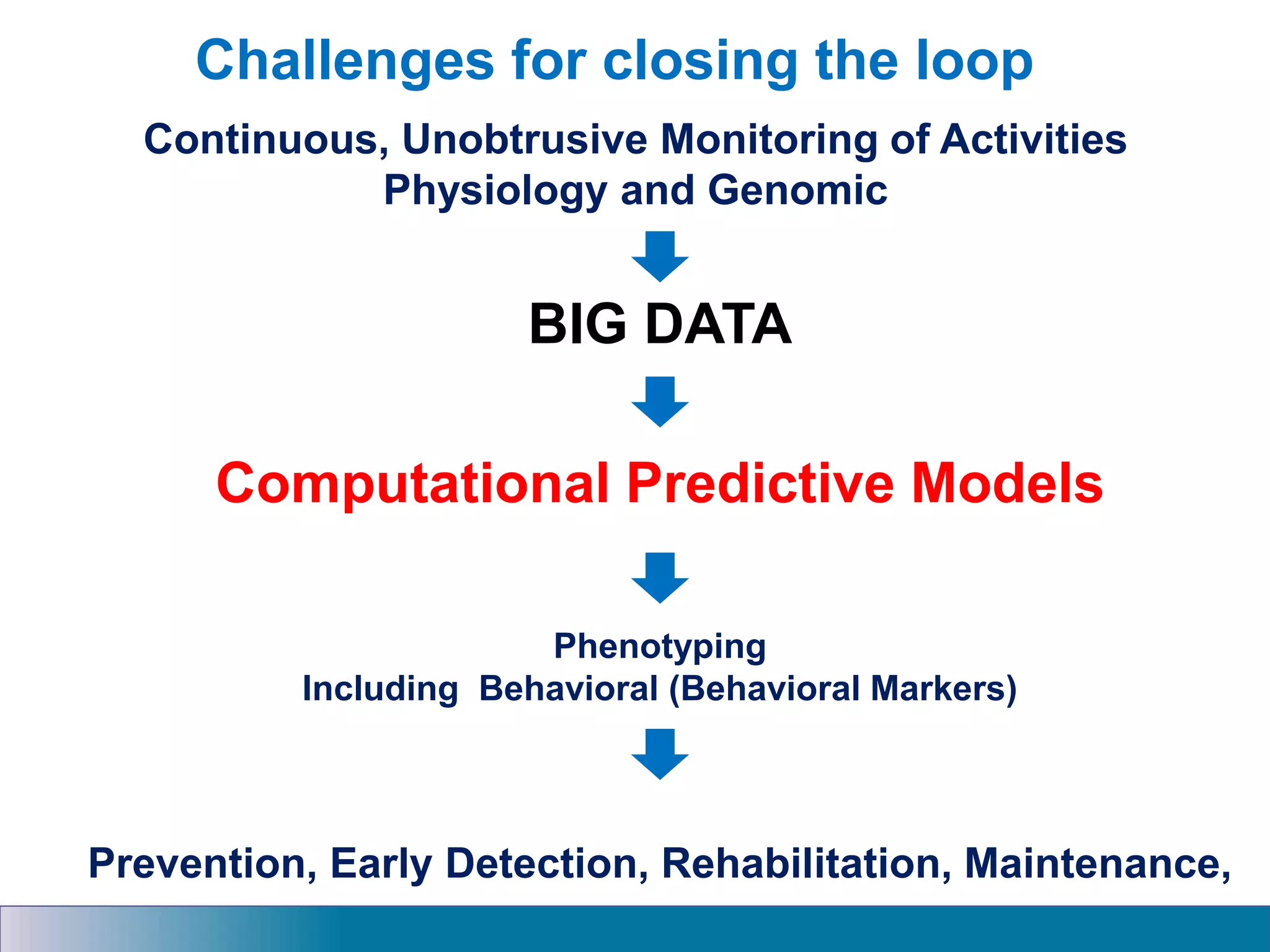
Challenges for closing the loop
Continuous, Unobtrusive Monitoring of Activities
Physiology and Genomic
BIG DATA
Computational Predictive Models
Phenotyping
Including Behavioral (Behavioral Markers)
Prevention, Early Detection, Rehabilitation, Maintenance,
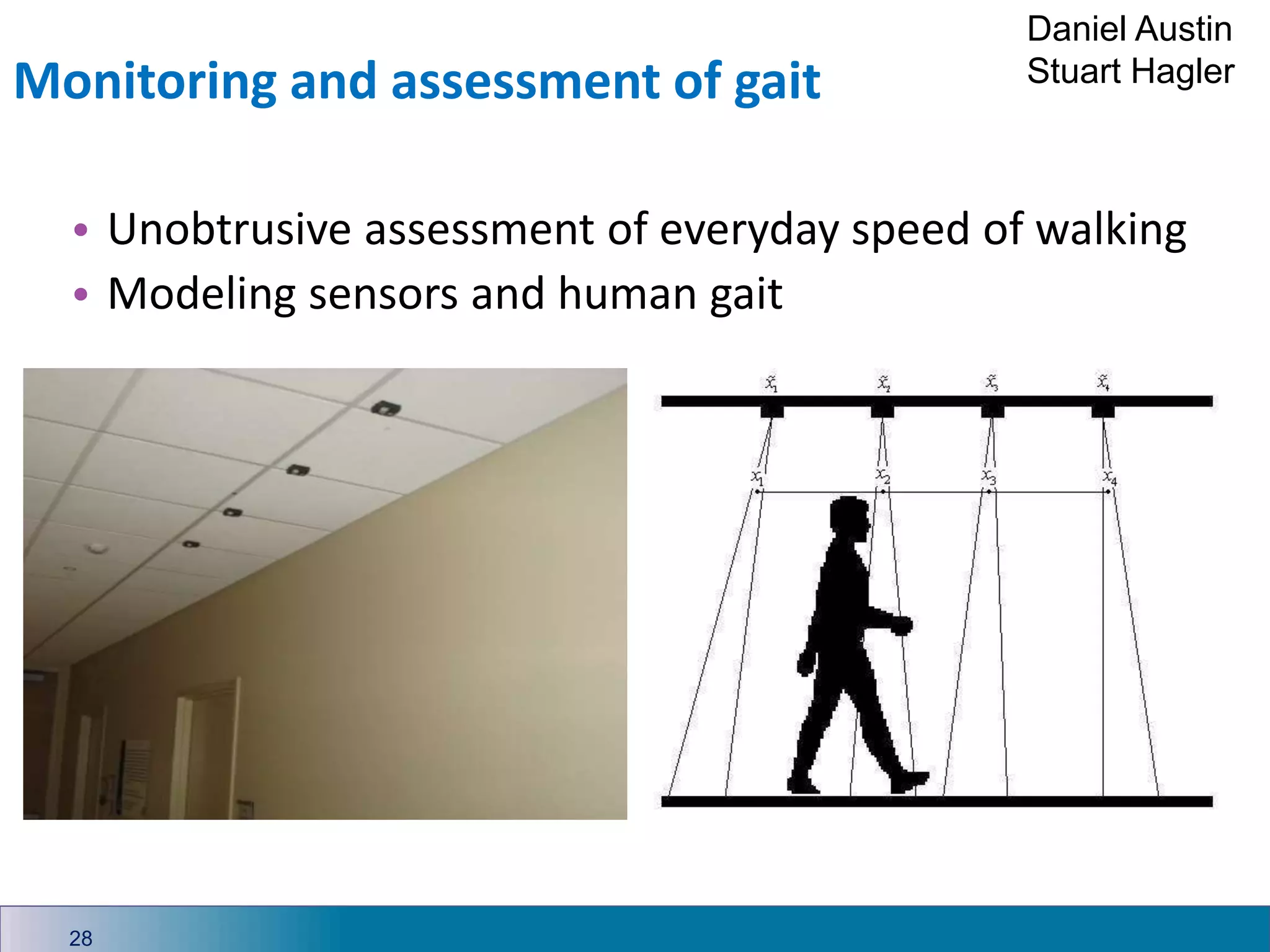
Monitoring and assessment of gait
28
• Unobtrusive assessment of everyday speed of walking
• Modeling sensors and human gait
Daniel Austin
Stuart Hagler
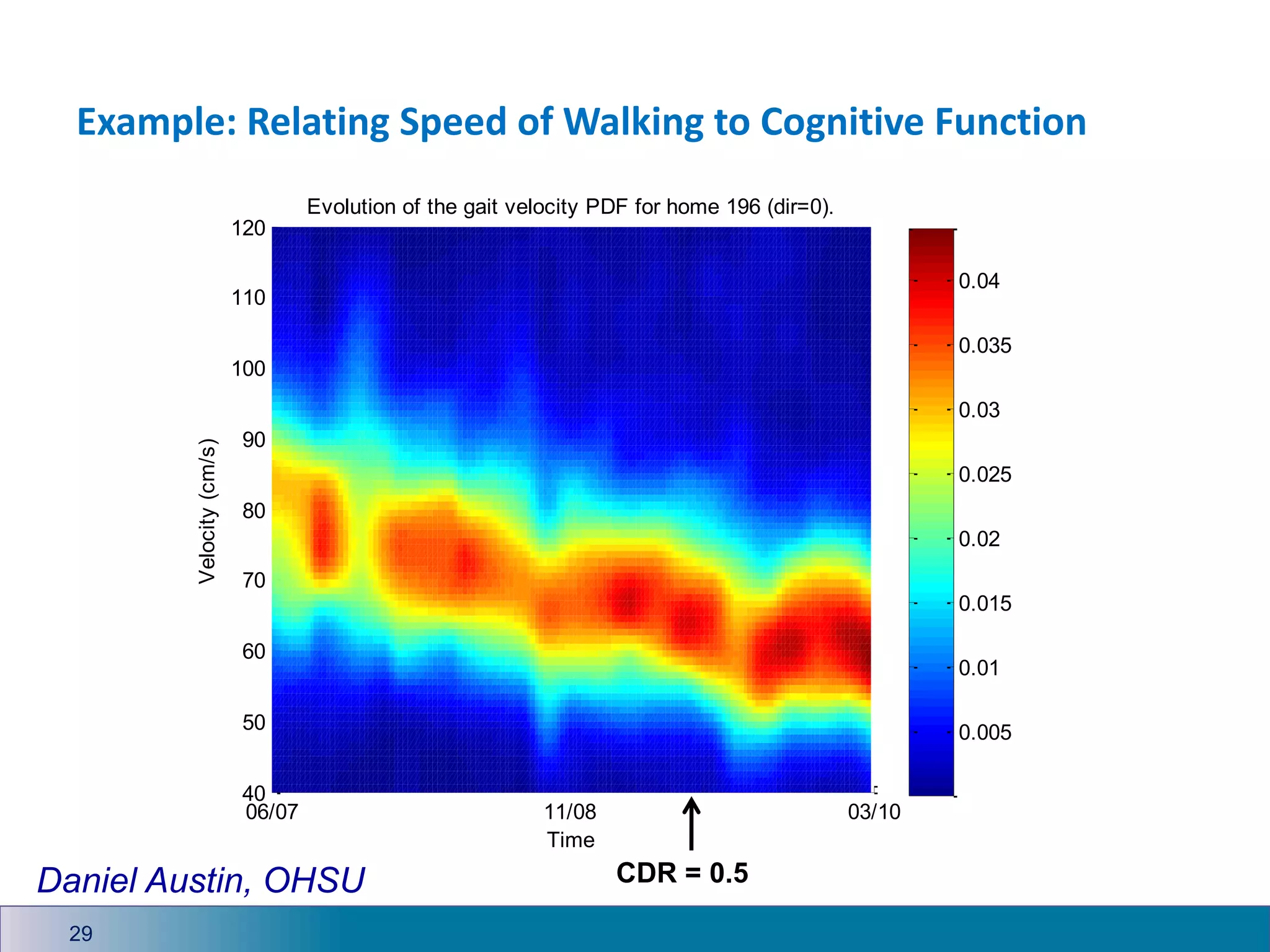
Example: Relating Speed of Walking to Cognitive Function
06/07 11/08 03/10
40
50
60
70
80
90
100
110
120
Time
Evolution of the gait velocity PDF for home 196 (dir=0).
Velocity
(cm/s)
0.005
0.01
0.015
0.02
0.025
0.03
0.035
0.04
CDR = 0.5
29
Daniel Austin, OHSU
Gait
Sensors
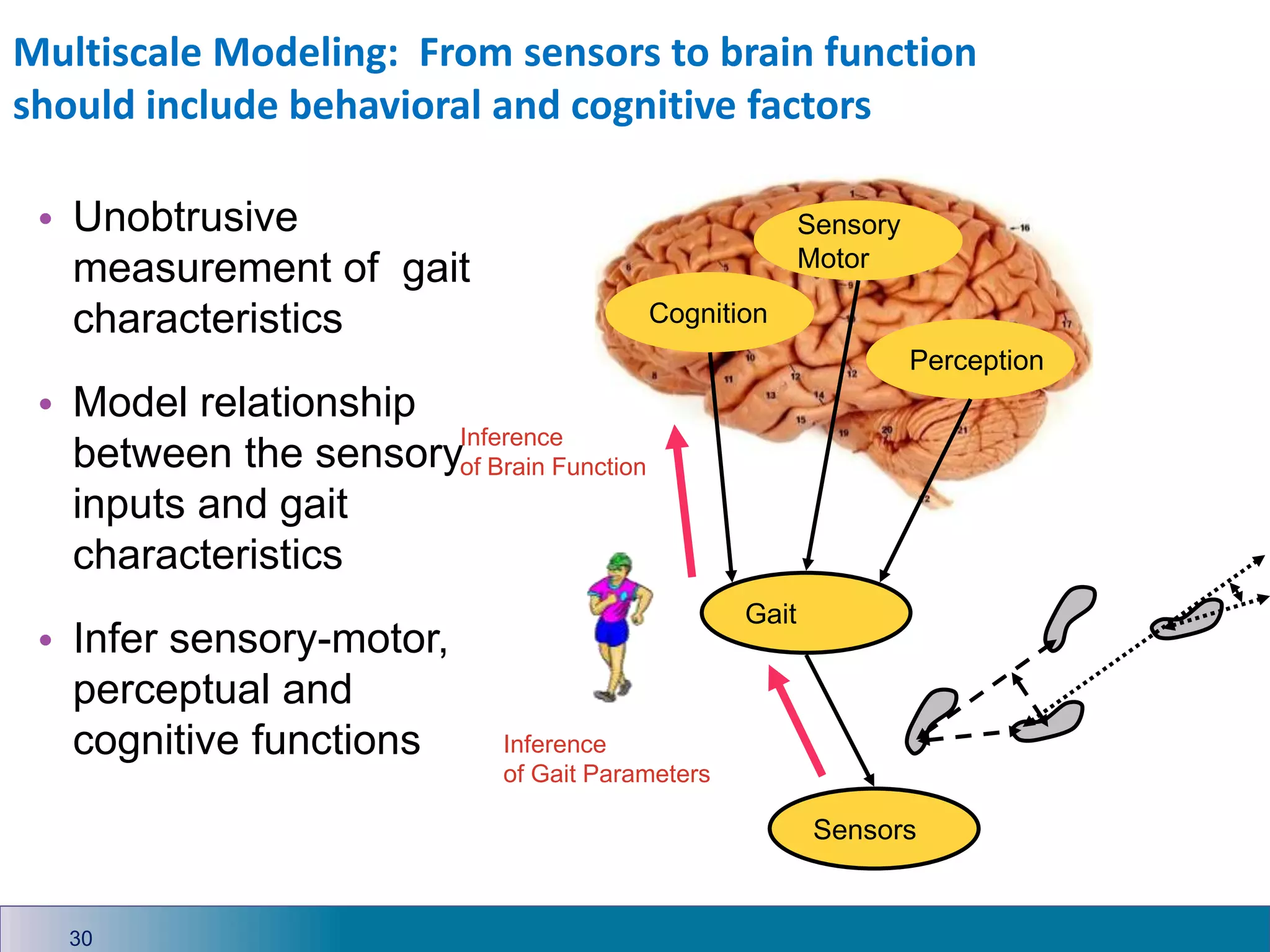
Multiscale Modeling: From sensors to brain function
should include behavioral and cognitive factors
• Unobtrusive
measurement of gait
characteristics
• Model relationship
between the sensory
inputs and gait
characteristics
• Infer sensory-motor,
perceptual and
cognitive functions
Cognition
Perception
Sensory
Motor
Inference
of Gait Parameters
Cognition
Perception
Sensory
Motor
Inference
of Brain Function
30
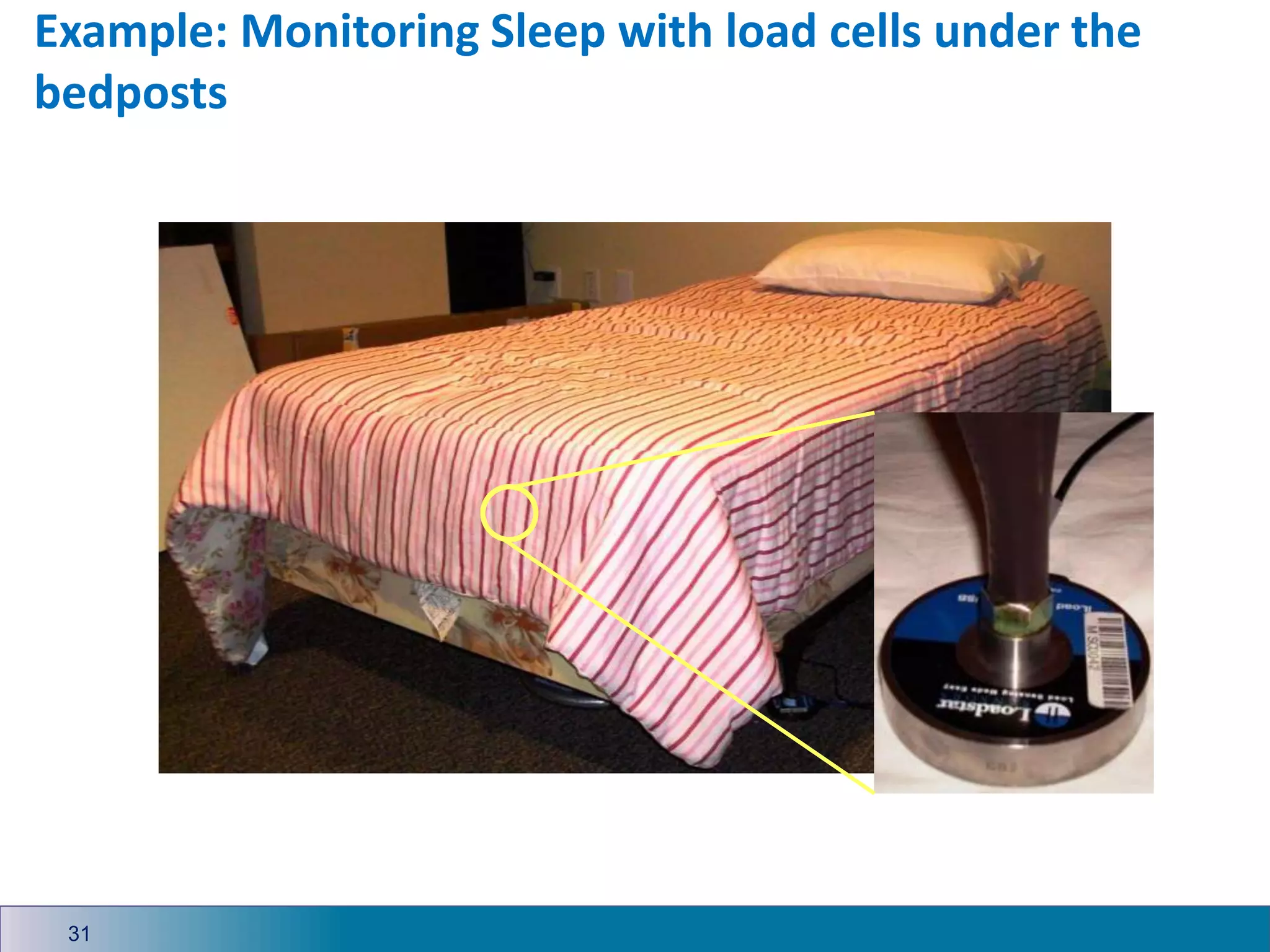
Example: Monitoring Sleep with load cells under the
bedposts
31
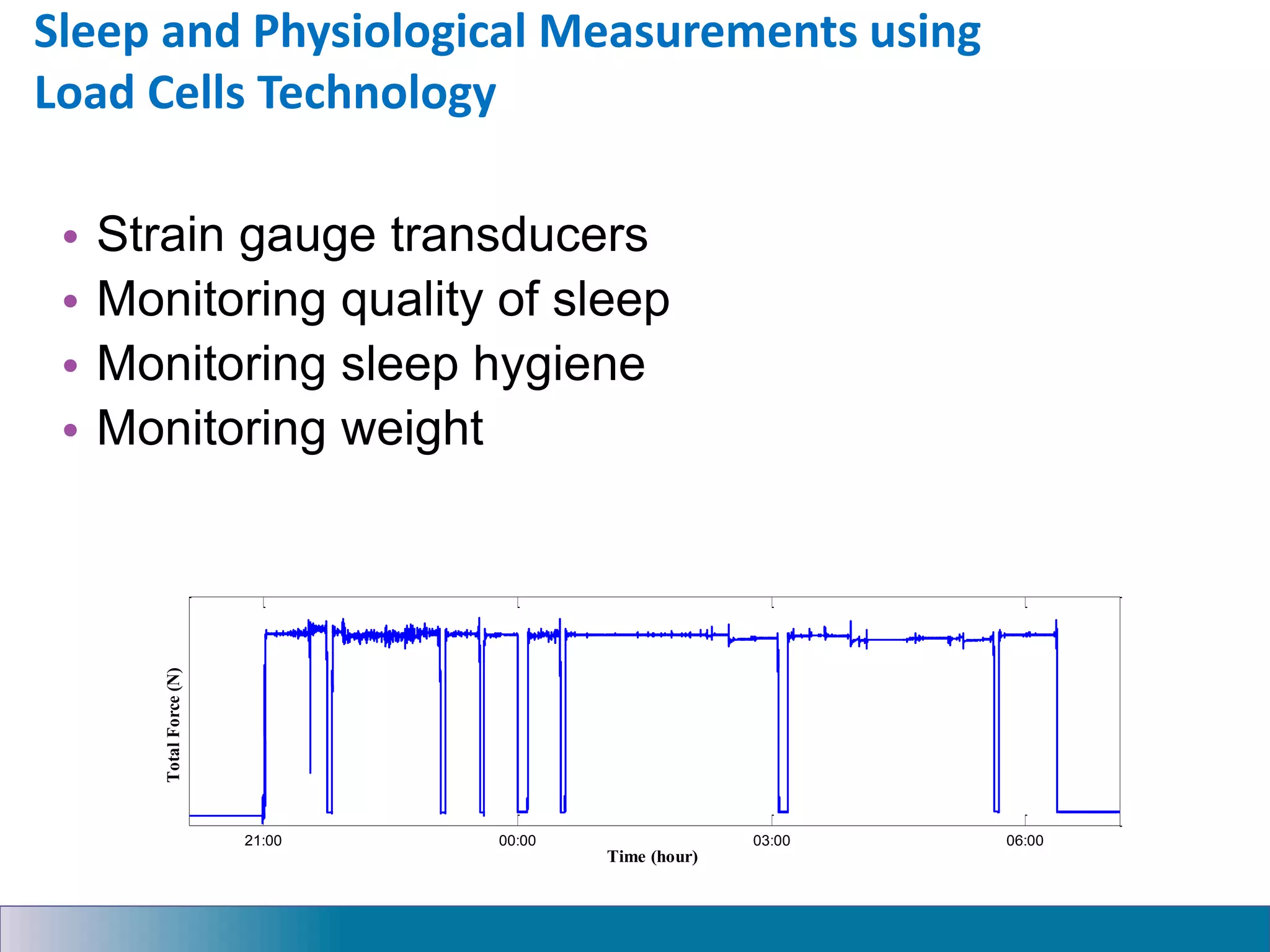
Sleep and Physiological Measurements using
Load Cells Technology
• Strain gauge transducers
• Monitoring quality of sleep
• Monitoring sleep hygiene
• Monitoring weight
21:00 00:00 03:00 06:00
Time (hour)
Total
Force
(N)
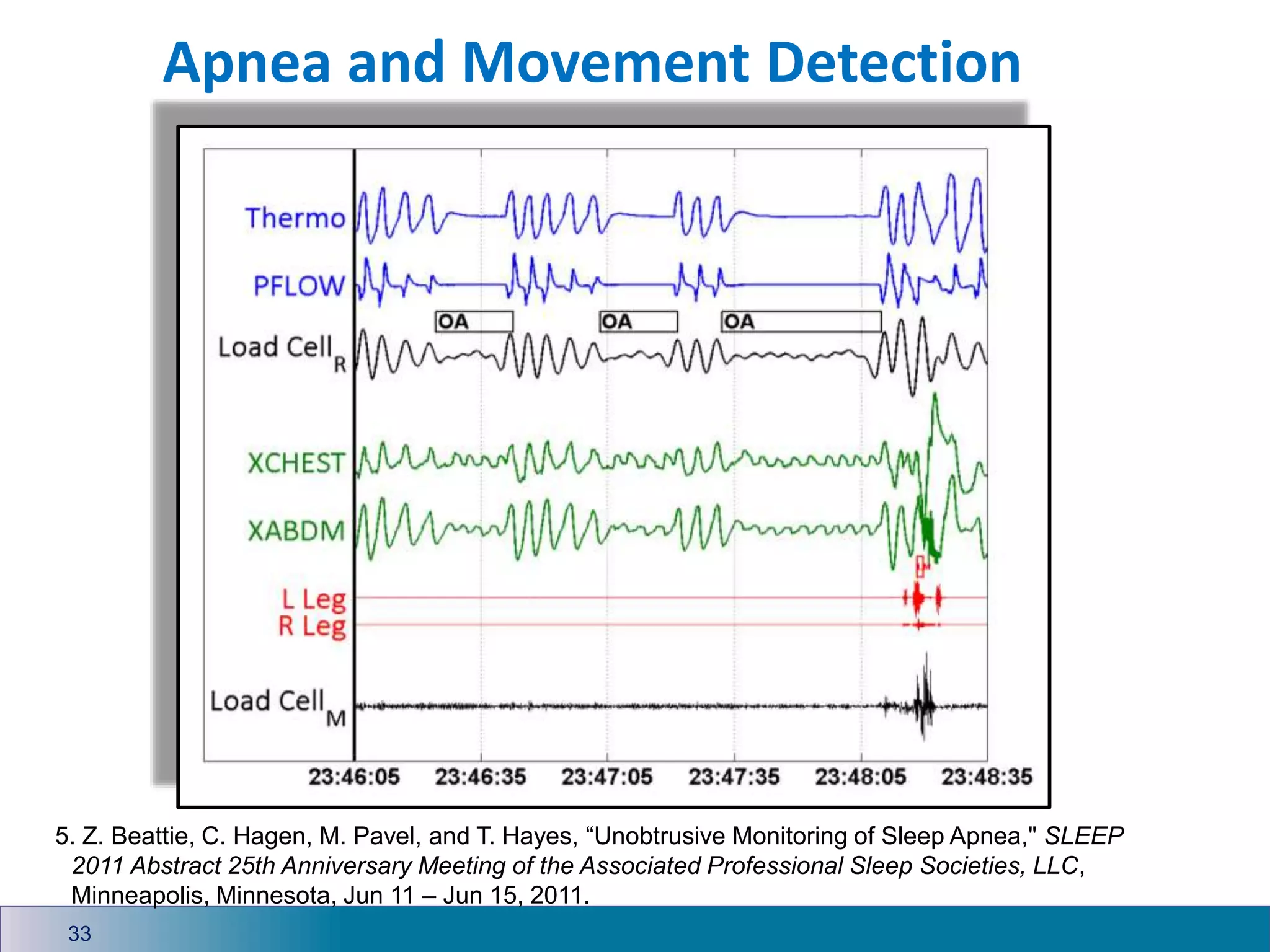
Apnea and Movement Detection
33
5. Z. Beattie, C. Hagen, M. Pavel, and T. Hayes, “Unobtrusive Monitoring of Sleep Apnea," SLEEP
2011 Abstract 25th Anniversary Meeting of the Associated Professional Sleep Societies, LLC,
Minneapolis, Minnesota, Jun 11 – Jun 15, 2011.
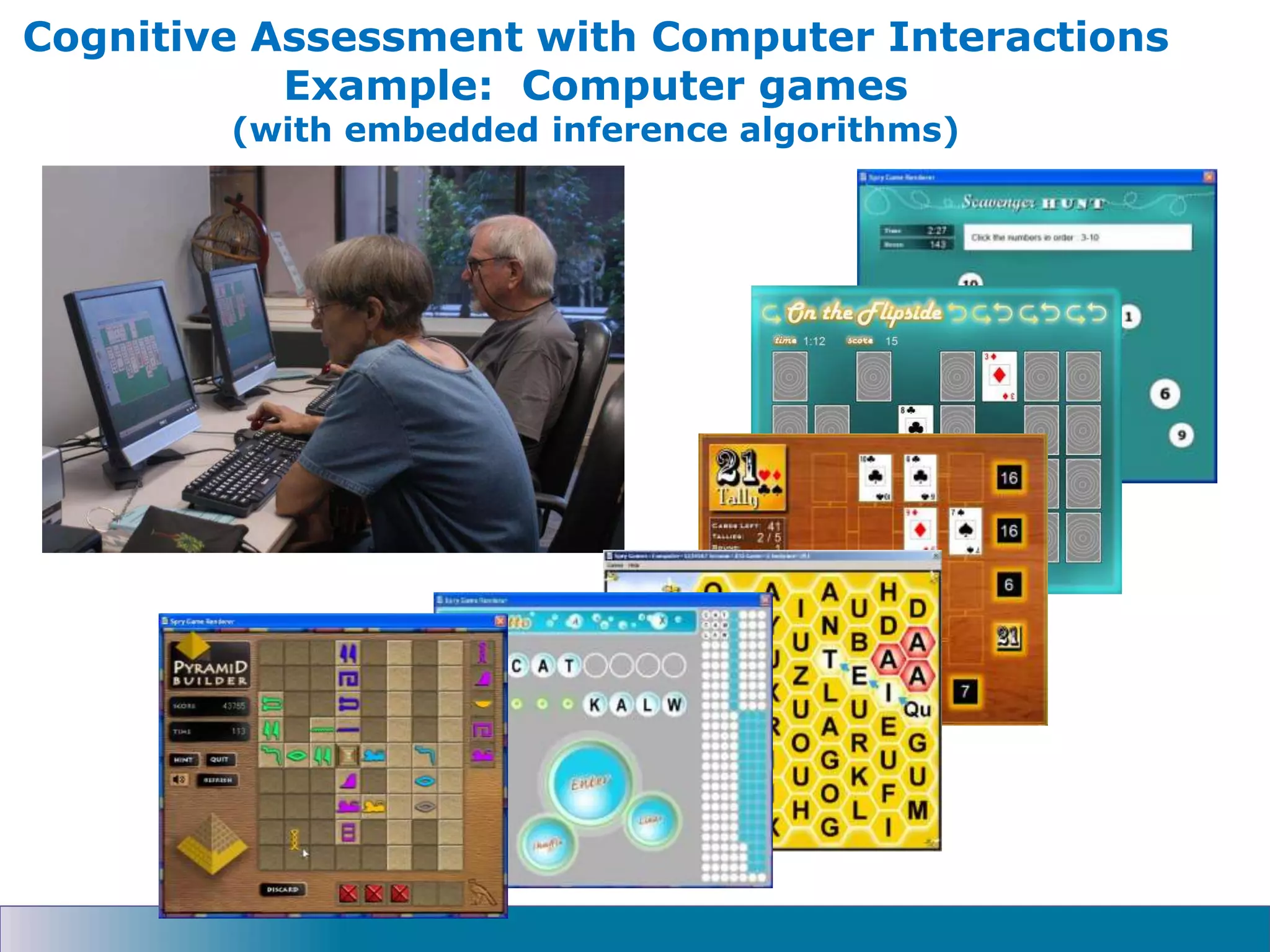
Cognitive Assessment with Computer Interactions
Example: Computer games
(with embedded inference algorithms)
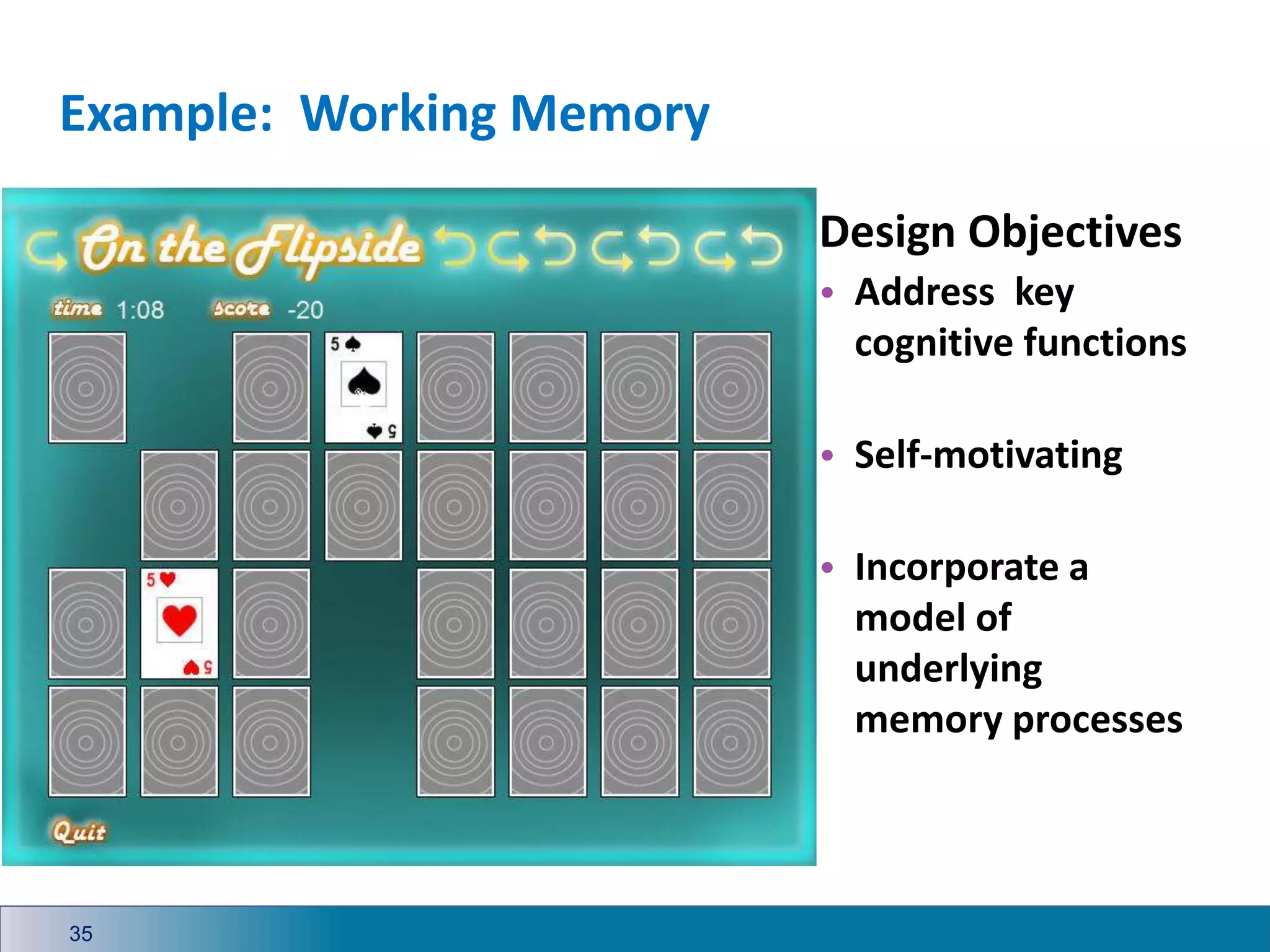
Example: Working Memory
35
Design Objectives
• Address key
cognitive functions
• Self-motivating
• Incorporate a
model of
underlying
memory processes
Memory Model: Survival Analysis
36
0 5 10 15
0
0.5
1
Subject 1020, N = 8687
Probability
of
Correct
Intervening Number of Events
0 5 10 15 20 25
0
0.5
1
Probability
of
Correct
Intervening Time [sec]
   
1
b
t
a
M t F t e
 
 
 
  
Collaborators and Support Teams
OHSU Team UCB Team
• Holly Jimison
• Tamara Hayes
• Jeff Kaye
• Jennifer Marcoe
• Krystal Klein, Post-doc
• Stuart Hagler,
• Daniel Austin
• Zephy McKanna
• Steve Williamson
• Tracy Zitleberger
• Nicole Larimer
• Don Young
• Yves Vimegnon,
• Jon Yeargers
• Devin Williams
• Ruzena Bajcsy, PI
• Edmund Seto, Co-I
• Gregorij Kurillo, Senior
Researcher
• Ferda Olfi, PhD Student
• Štěpán Obdržálek, Post-doc
37
3/18/2022
Oregon Research Center for
Aging and Technology
Take Home Messages
38
I. Healthcare is in crisis
II. Smart & Connected Health is focused on
developing technology-based solutions that can
help making healthcare preventive and focused on
quality of life
III. Focus on behaviors using monitoring as well as
cognitive and physical exercise can have a huge
impact on improving quality of life
IV. Analytics and computational modeling will play an
essential component of the emerging technology
39
Thank You
• Copyrighted material used under Fair Use. If you are the copyright
holder and believe your material has been used unfairly, or if you have
any suggestions, feedback, or support, please contact:
ciseitsupport@nsf.gov
• Except where otherwise indicated, permission is granted to copy,
distribute, and/or modify all images in this document under the terms of
the GNU Free Documentation license, Version 1.2 or any later version
published by the Free Software Foundation; with no Invariant Sections,
no Front-Cover Texts, and no Back-Cover Texts. A copy of the license
is included in the section entitled “GNU Free Documentation license”
(http://commons.wikimedia.org/wiki/Commons:GNU_Free_Documentati
on_License)
• The inclusion of a logo does not express or imply the endorsement by
NSF of the entities' products, services or enterprises.
Credits
40
Q&A
10 minutes
(Included in session
recording)
Dharma Singh Khalsa,
President of the Alzheimer’s
Research and Prevention
Foundation
What are scalable best practices to spread
smart health?
Alzheimer’s Prevention 2013:
From Drugs to Lifestyle
Dharma Singh Khalsa, M.D.
President/Medical Director
Alzheimer’s Research and Prevention Foundation
www.alzheimersprevention.org
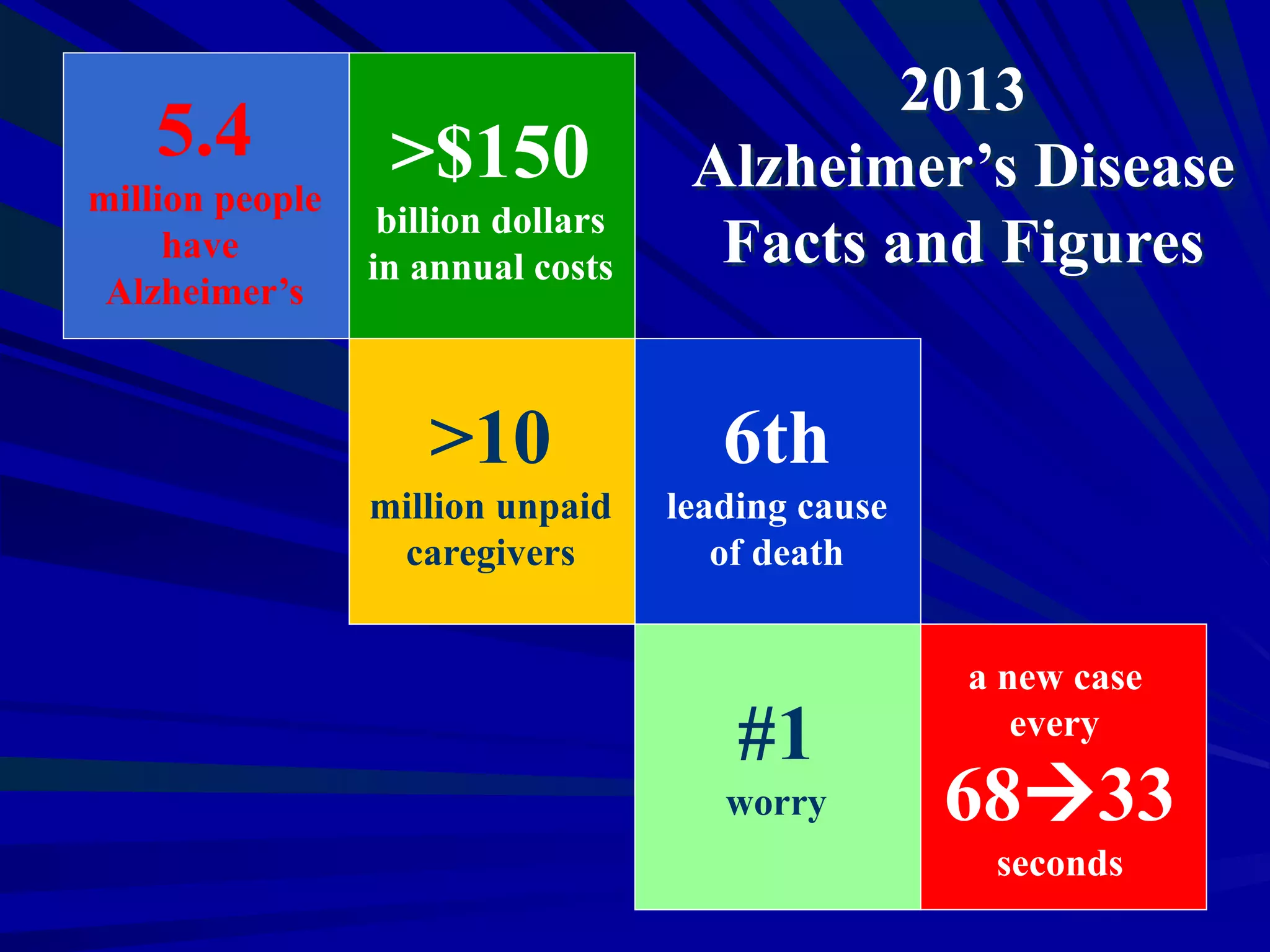
5.4
million people
have
Alzheimer’s
>$150
billion dollars
in annual costs
>10
million unpaid
caregivers
6th
leading cause
of death
#1
worry
a new case
every
6833
seconds
2013
Alzheimer’s Disease
Facts and Figures
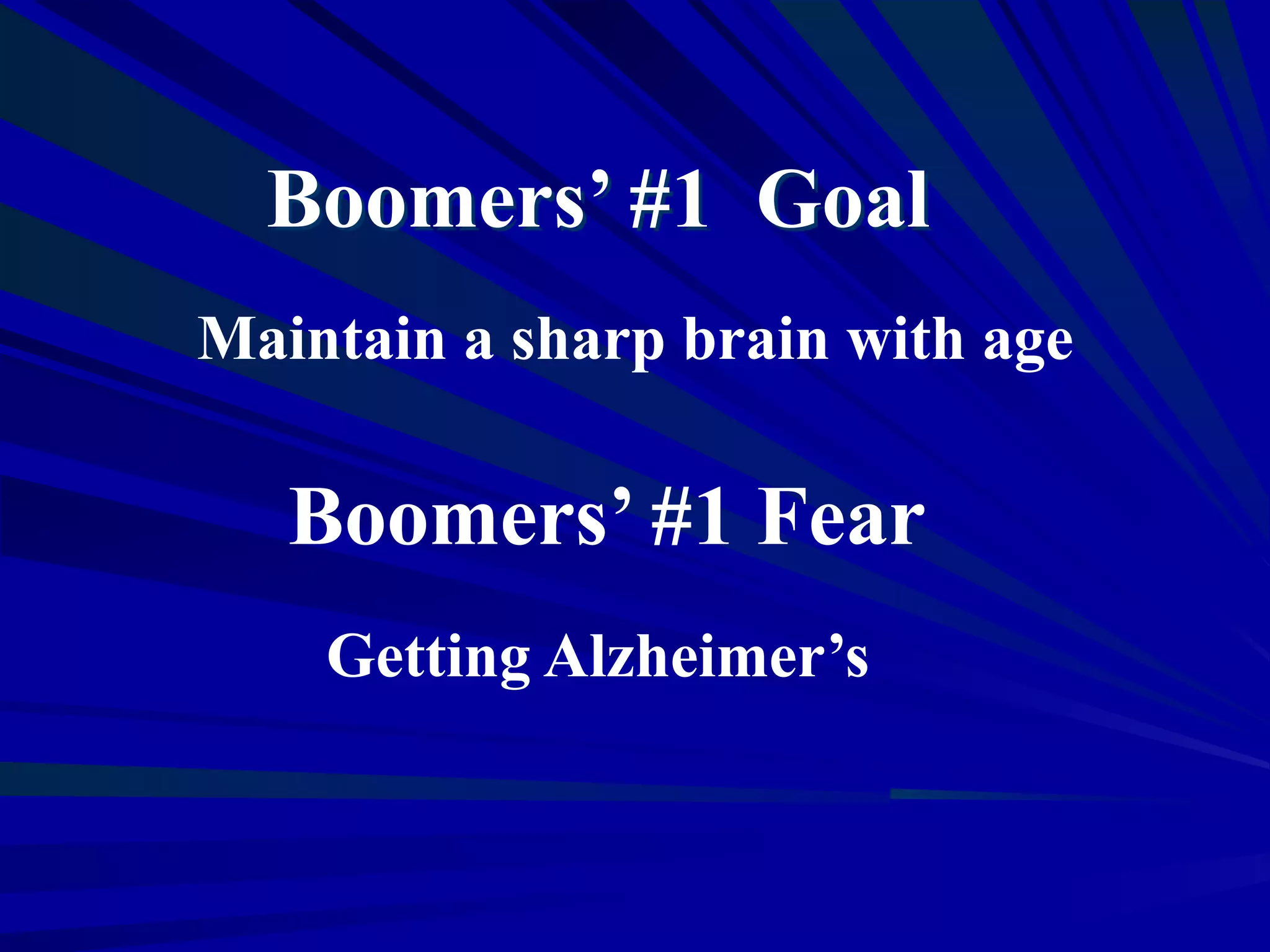
Maintain a sharp brain with age
Boomers’ #1 Fear
Getting Alzheimer’s
Boomers’ #1 Goal
FOR IMMEDIATE RELEASE
May 15, 2012
Contact: HHS Press Office
(202) 690-6343
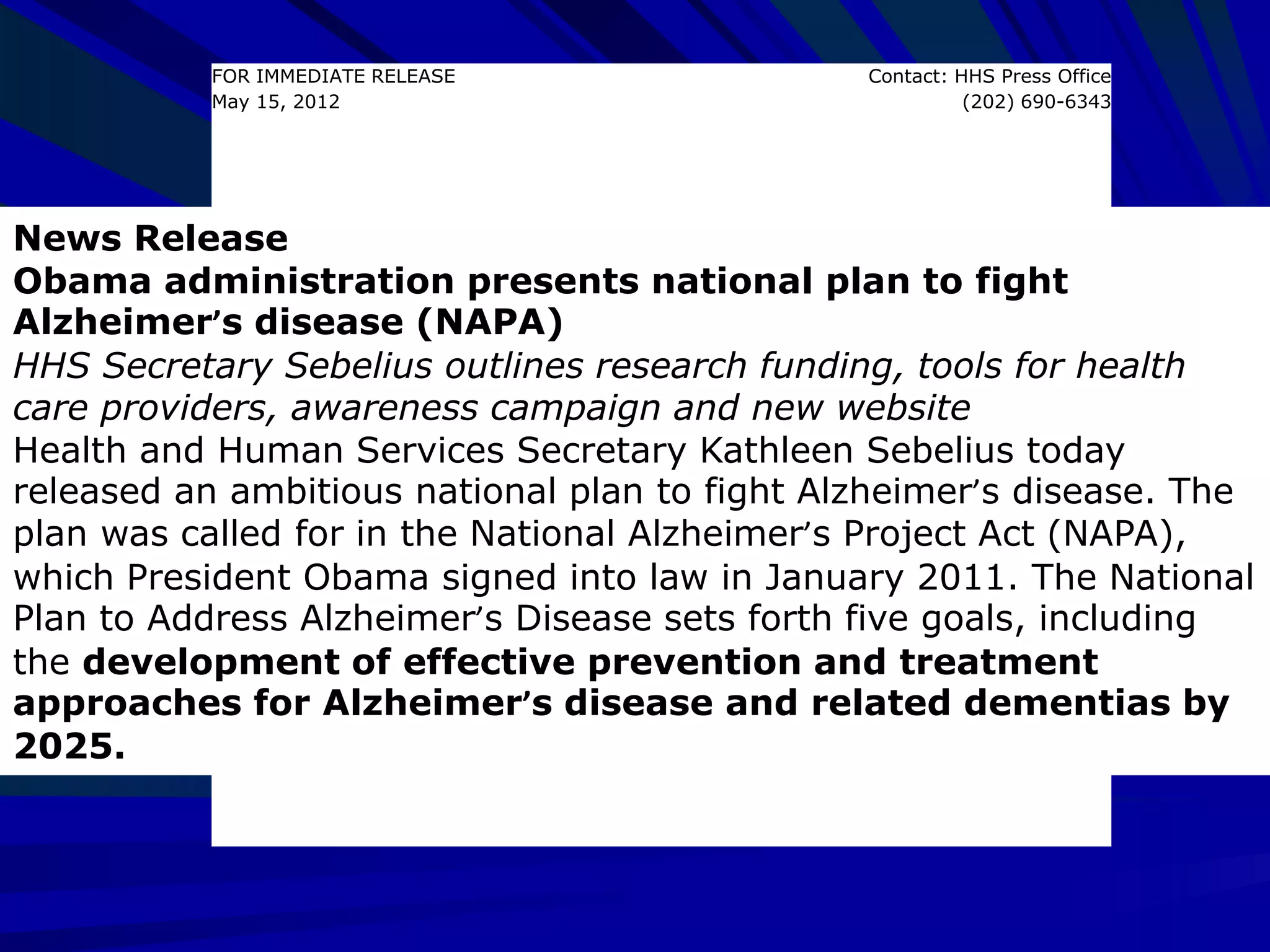
News Release
Obama administration presents national plan to fight
Alzheimer’s disease (NAPA)
HHS Secretary Sebelius outlines research funding, tools for health
care providers, awareness campaign and new website
Health and Human Services Secretary Kathleen Sebelius today
released an ambitious national plan to fight Alzheimer’s disease. The
plan was called for in the National Alzheimer’s Project Act (NAPA),
which President Obama signed into law in January 2011. The National
Plan to Address Alzheimer’s Disease sets forth five goals, including
the development of effective prevention and treatment
approaches for Alzheimer’s disease and related dementias by
2025.
Until 2012, Lifestyle Included in
National Discussion
2013: Drugs and Genetics
We need to re-introduce
lifestyle into the
conversation
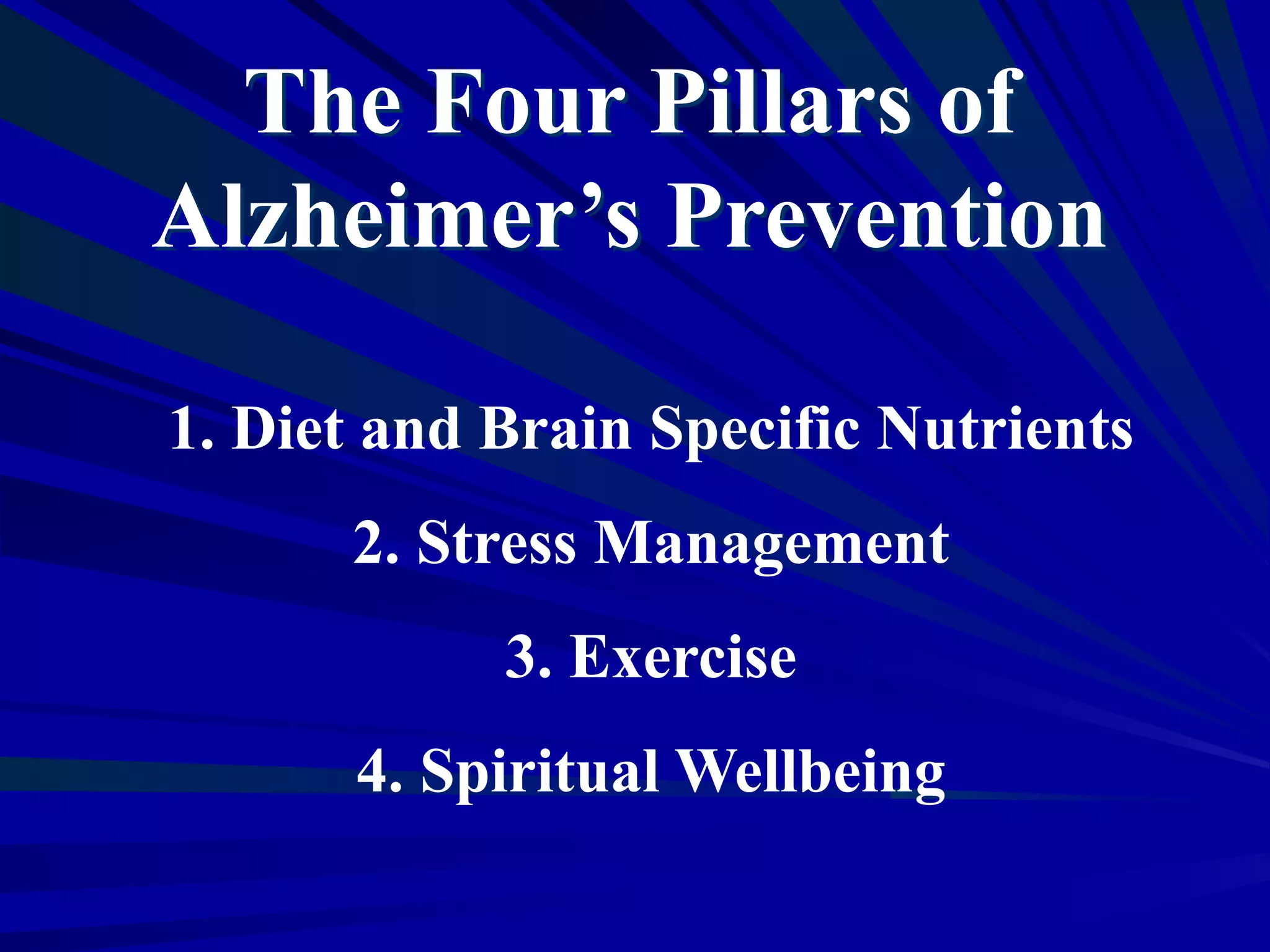
The Four Pillars of
Alzheimer’s Prevention
1. Diet and Brain Specific Nutrients
2. Stress Management
3. Exercise
4. Spiritual Wellbeing
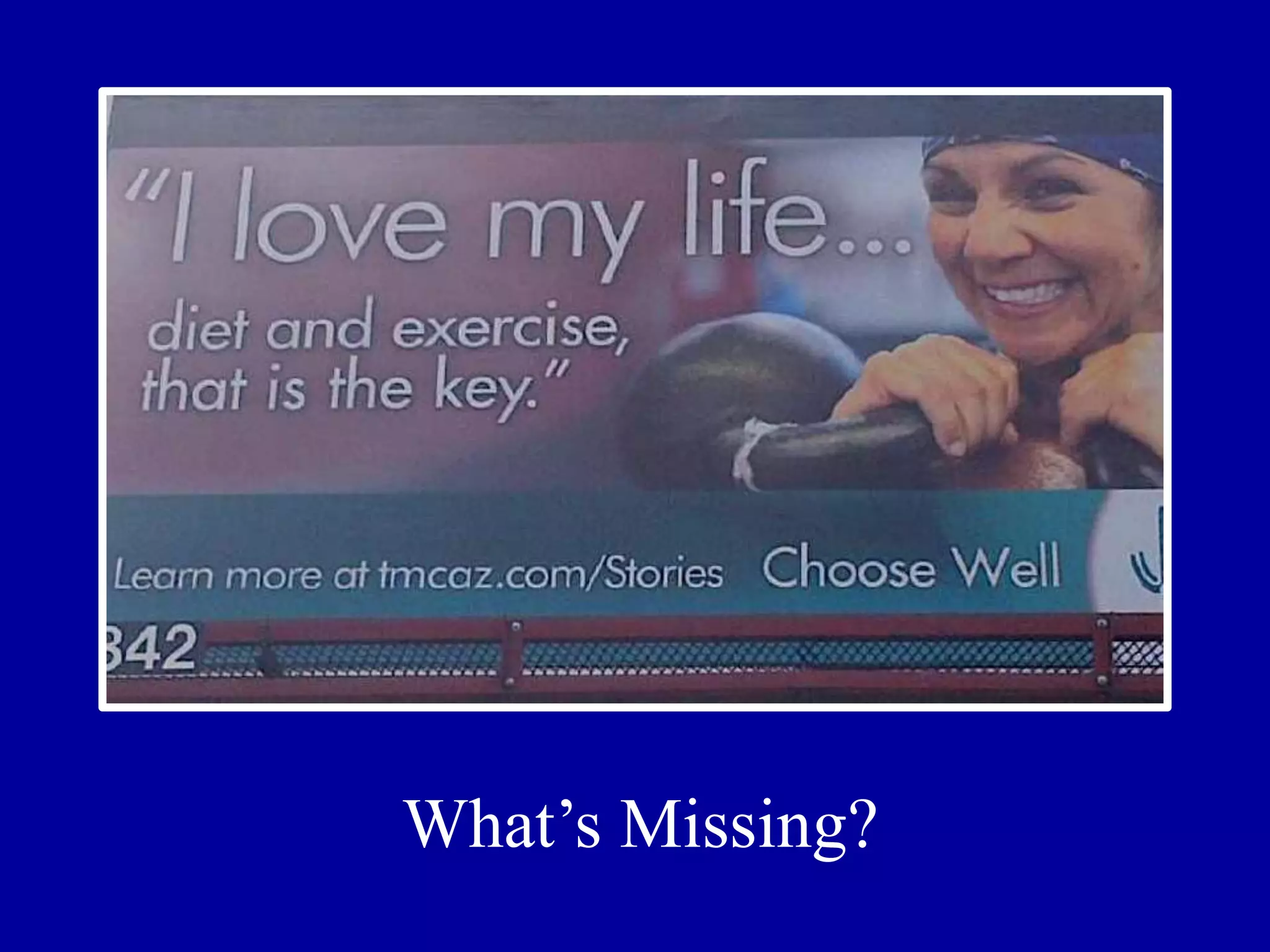
What’s Missing?
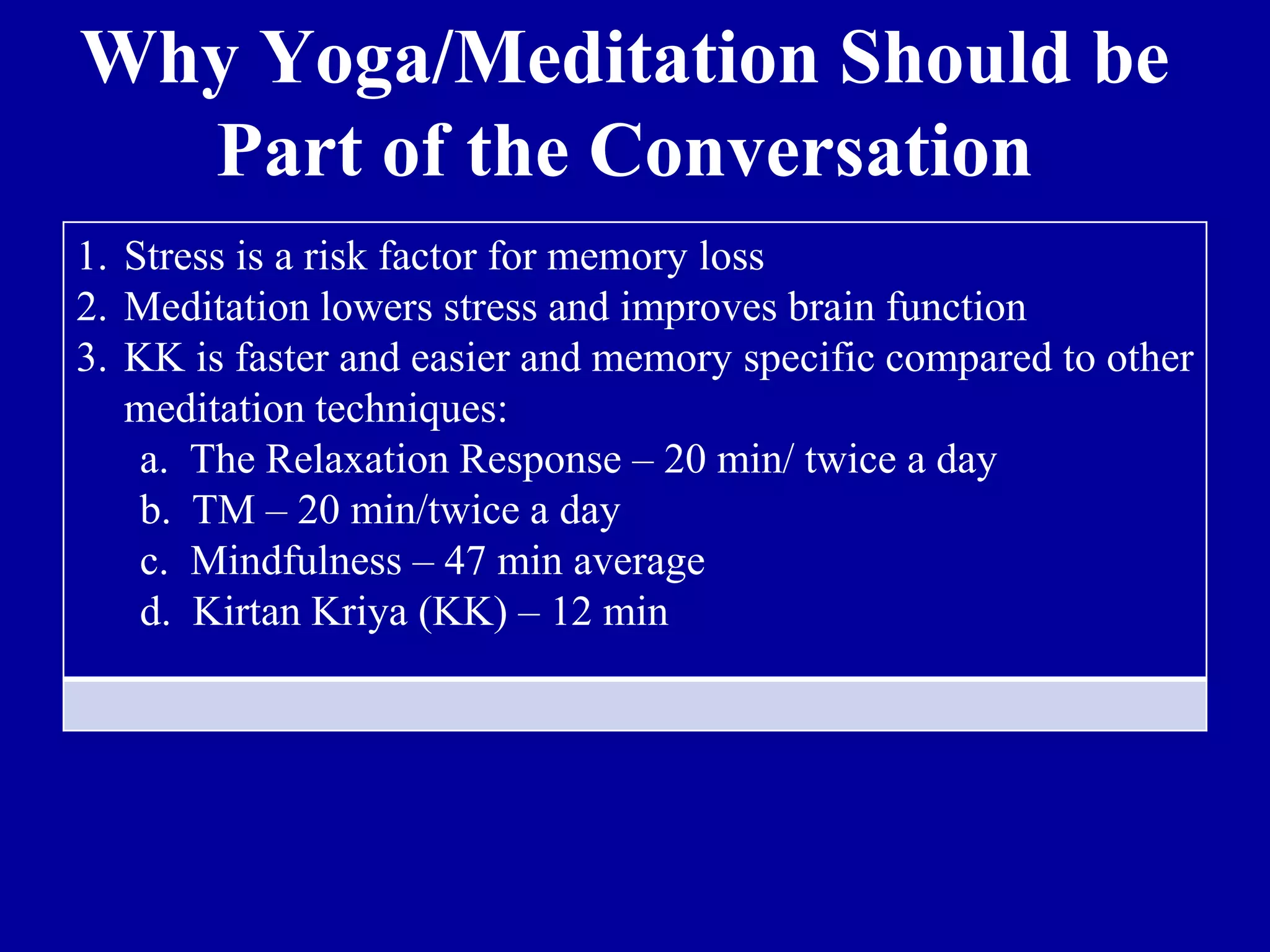
Why Yoga/Meditation Should be
Part of the Conversation
1. Stress is a risk factor for memory loss
2. Meditation lowers stress and improves brain function
3. KK is faster and easier and memory specific compared to other
meditation techniques:
a. The Relaxation Response – 20 min/ twice a day
b. TM – 20 min/twice a day
c. Mindfulness – 47 min average
d. Kirtan Kriya (KK) – 12 min
The Benefits of KK in 12 Min/Day
1. Can be easily learned and practiced at home
with a CD
2.Strengthens the brain, like going to the gym
strengthens the body
3.Improves attention, concentration, focus and
memory
4. Better mood, less depression and anxiety
5. More mental and physical energy
6. Enhanced Genetic Health
Demonstration on Sept 27th
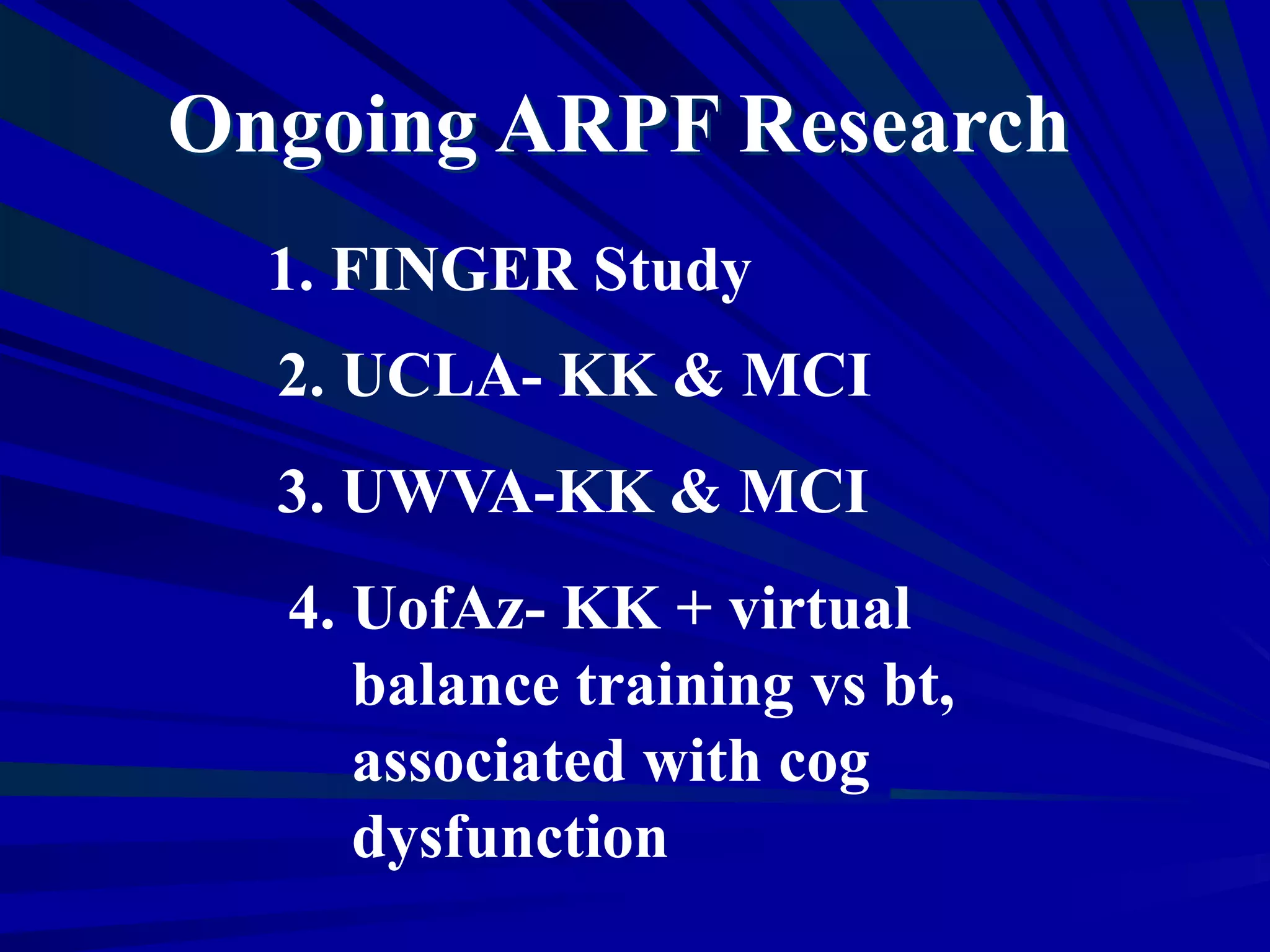
1. FINGER Study
2. UCLA- KK & MCI
3. UWVA-KK & MCI
Ongoing ARPF Research
4. UofAz- KK + virtual
balance training vs bt,
associated with cog
dysfunction
And In The End…
Spirit and Wisdom
To Be Continued on Sept
27th….
Q&A
10 minutes
(Included in session
recording)
Josh Wright,
Managing Director of ideas42
What are scalable best practices to spread
smart health?
Using Behavioral Economics
To Improve Health
2013 SmartBrains Summit
September 20th – 8:30-10:30 What are scalable best practices to spread smart health?
Josh Wright
josh@ideas42.org
WHAT IS IDEAS42?
©2013
ideas42 57
58
FOUNDED BY VISIONARY ACADEMICS…
©2013
ideas42
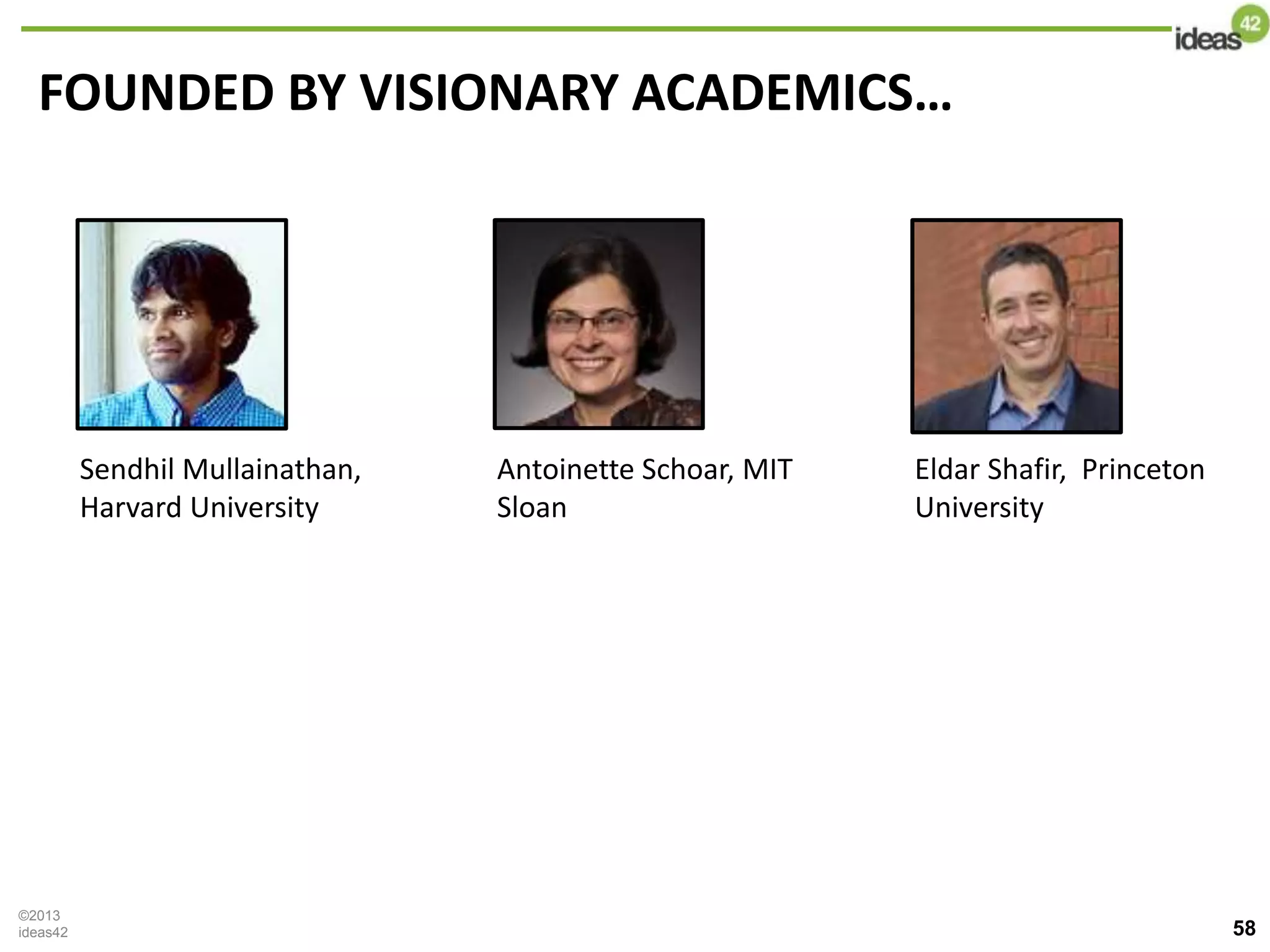
Sendhil Mullainathan,
Harvard University
Antoinette Schoar, MIT
Sloan
Eldar Shafir, Princeton
University
59
…A BEHAVIORAL IDEAS LAB AND CONSULTING
FIRM (501c3) WITH AN AMBITIOUS GOAL
©2013
ideas42 59
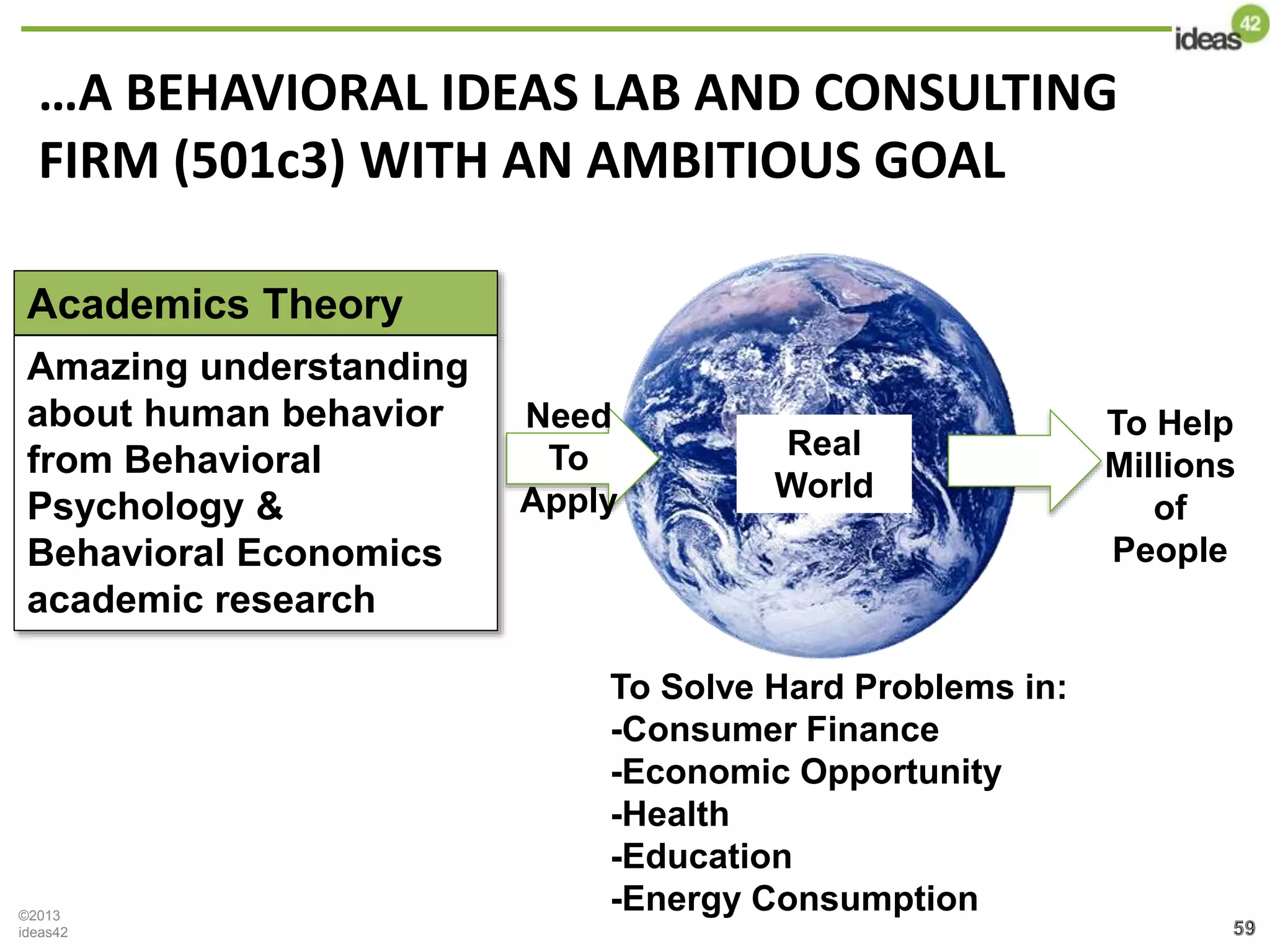
Academics Theory
Amazing understanding
about human behavior
from Behavioral
Psychology &
Behavioral Economics
academic research
Need
To
Apply
Real
World
To Solve Hard Problems in:
-Consumer Finance
-Economic Opportunity
-Health
-Education
-Energy Consumption
To Help
Millions
of
People
©2013 ideas42 60
61
©2012 ideas42
62
©2012 ideas42
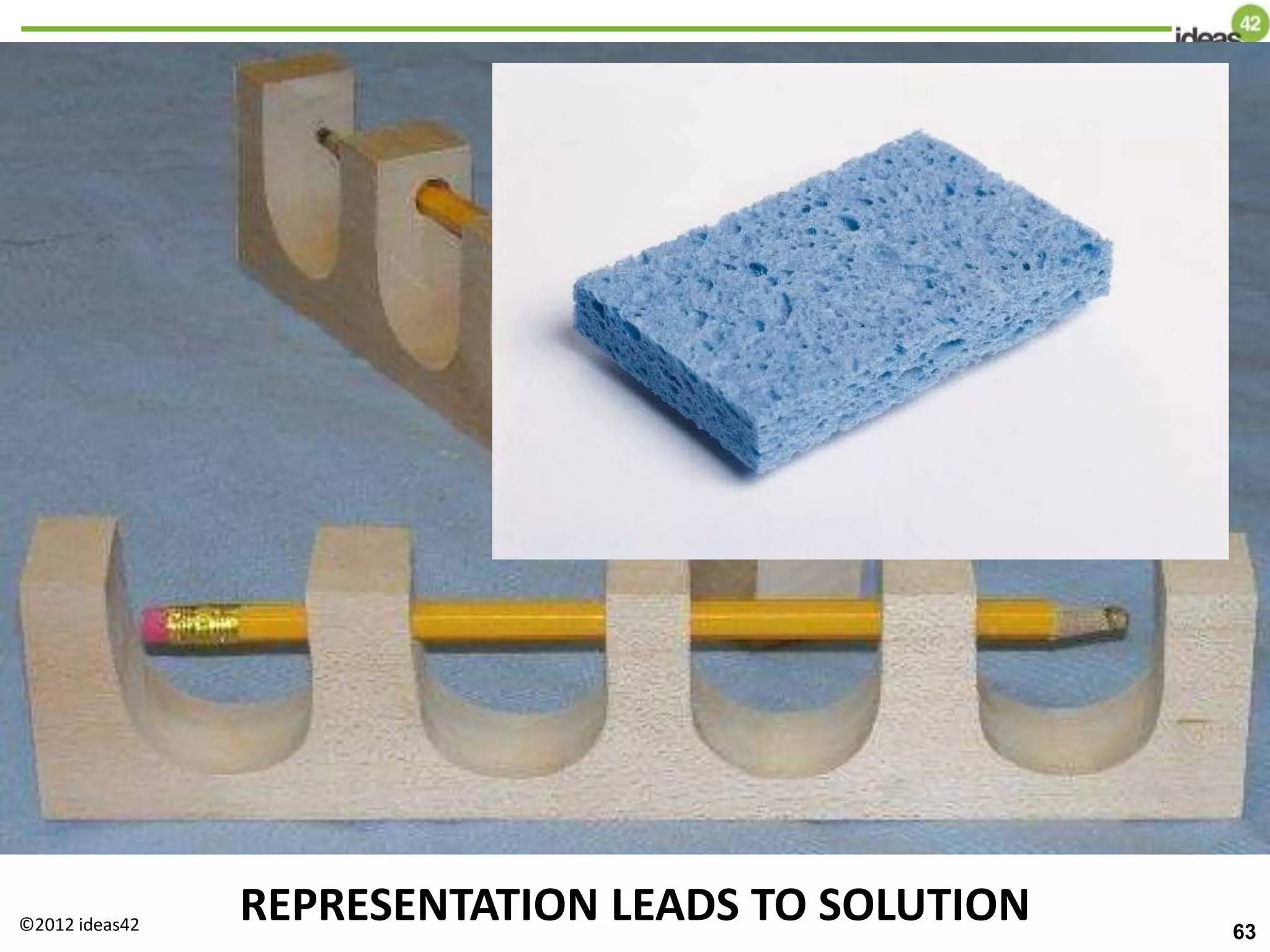
REPRESENTATION LEADS TO SOLUTION 63
©2012 ideas42
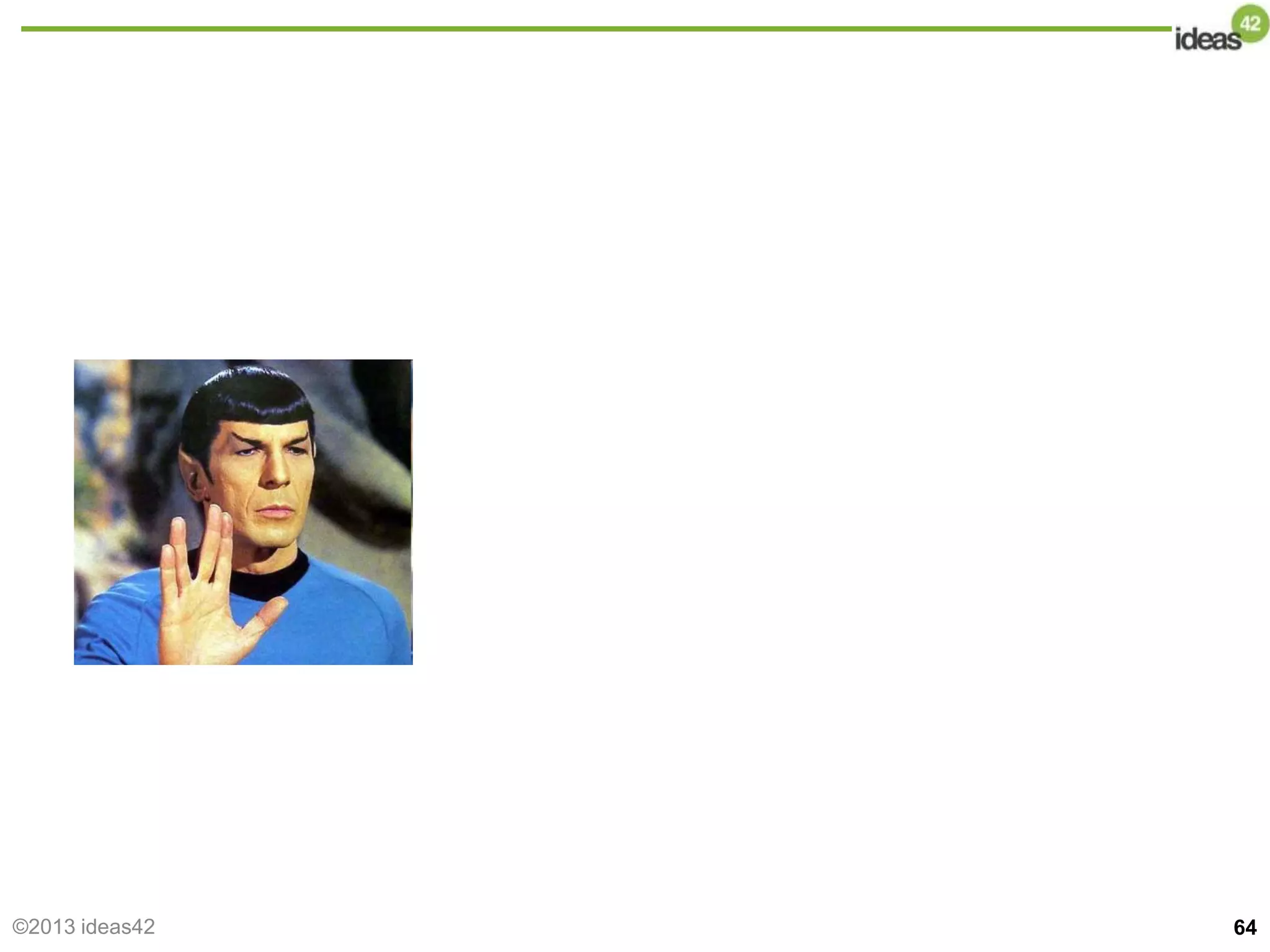
64
©2013 ideas42
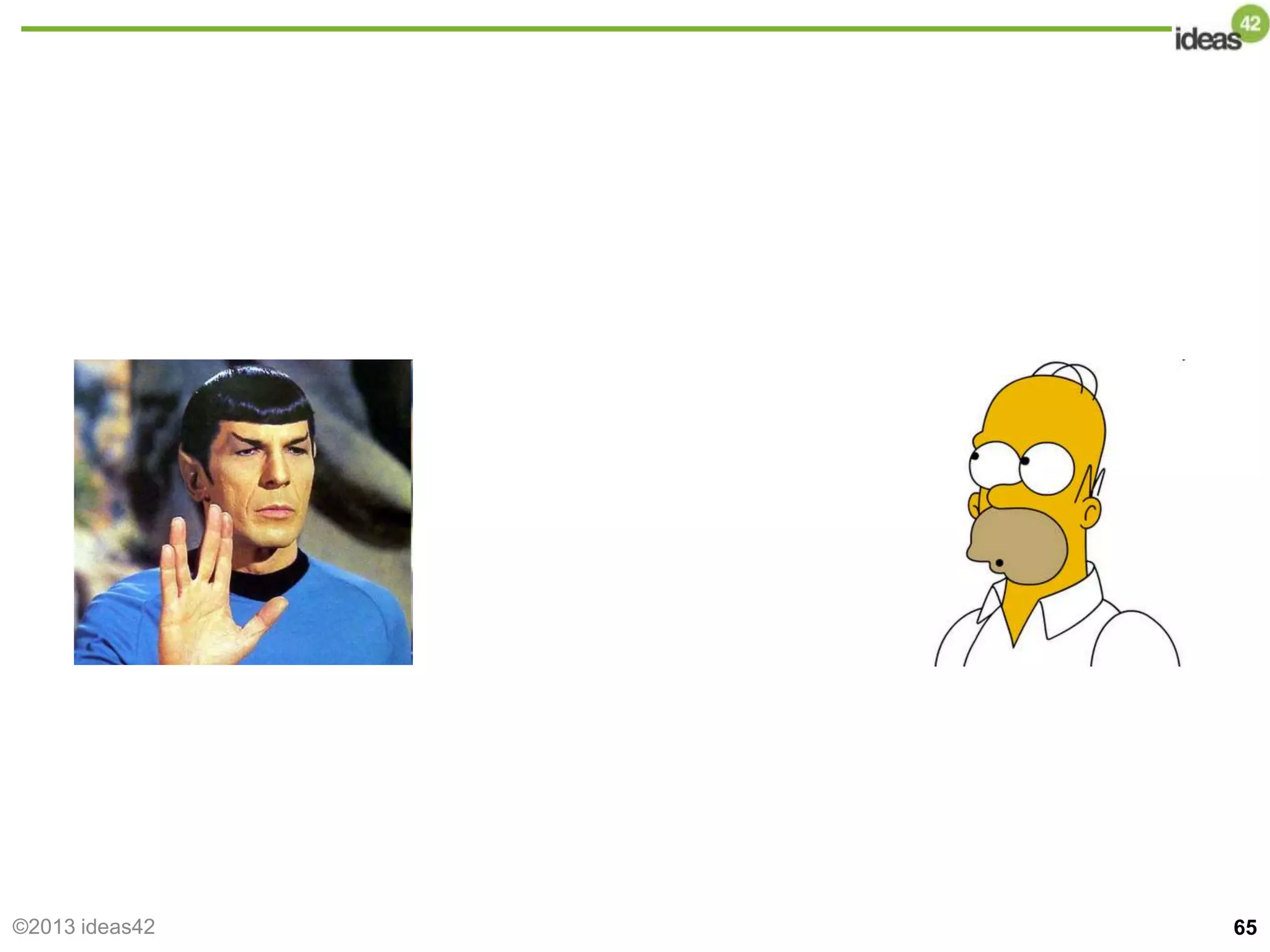
65
©2013 ideas42
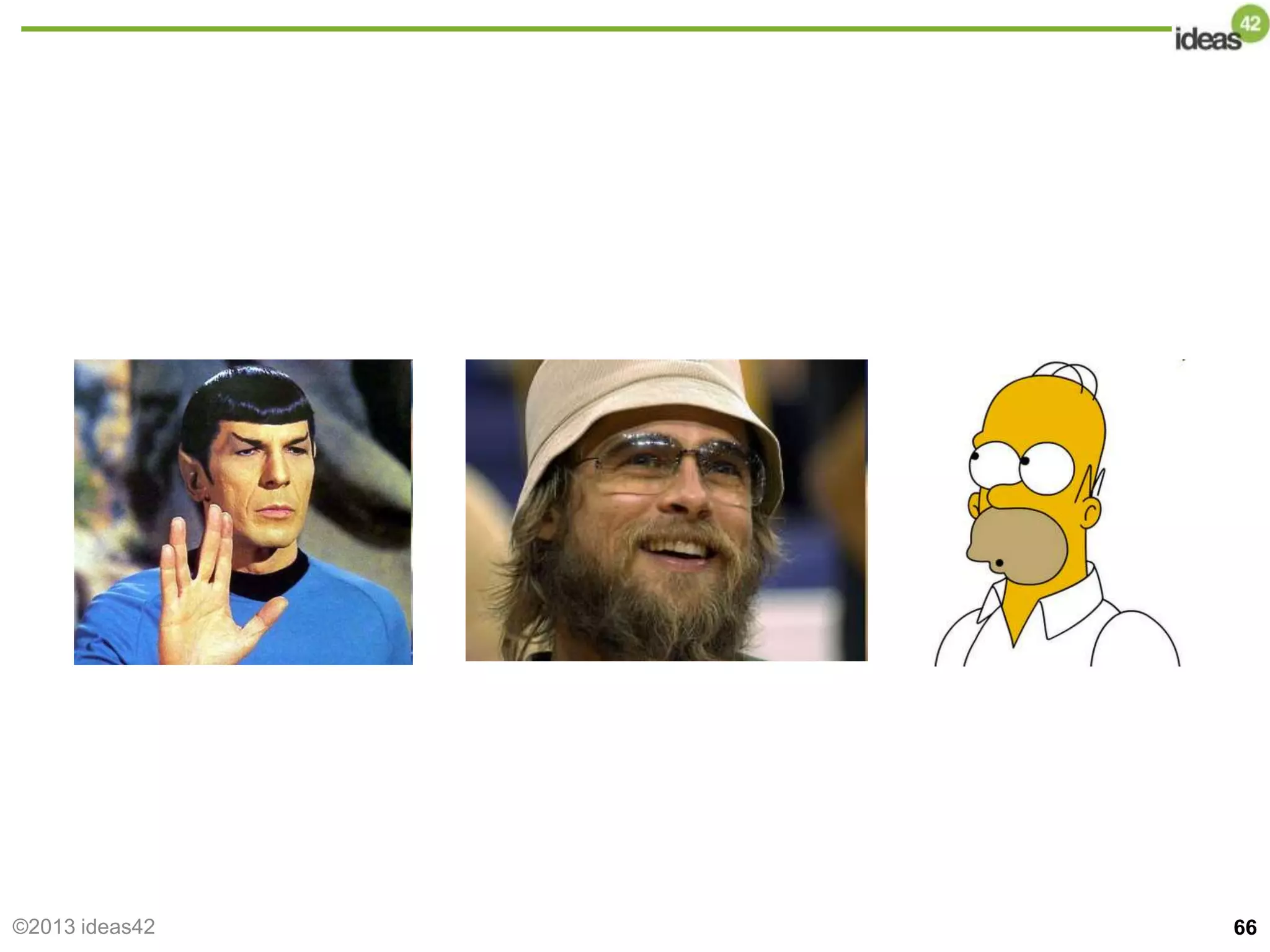
66
©2013 ideas42
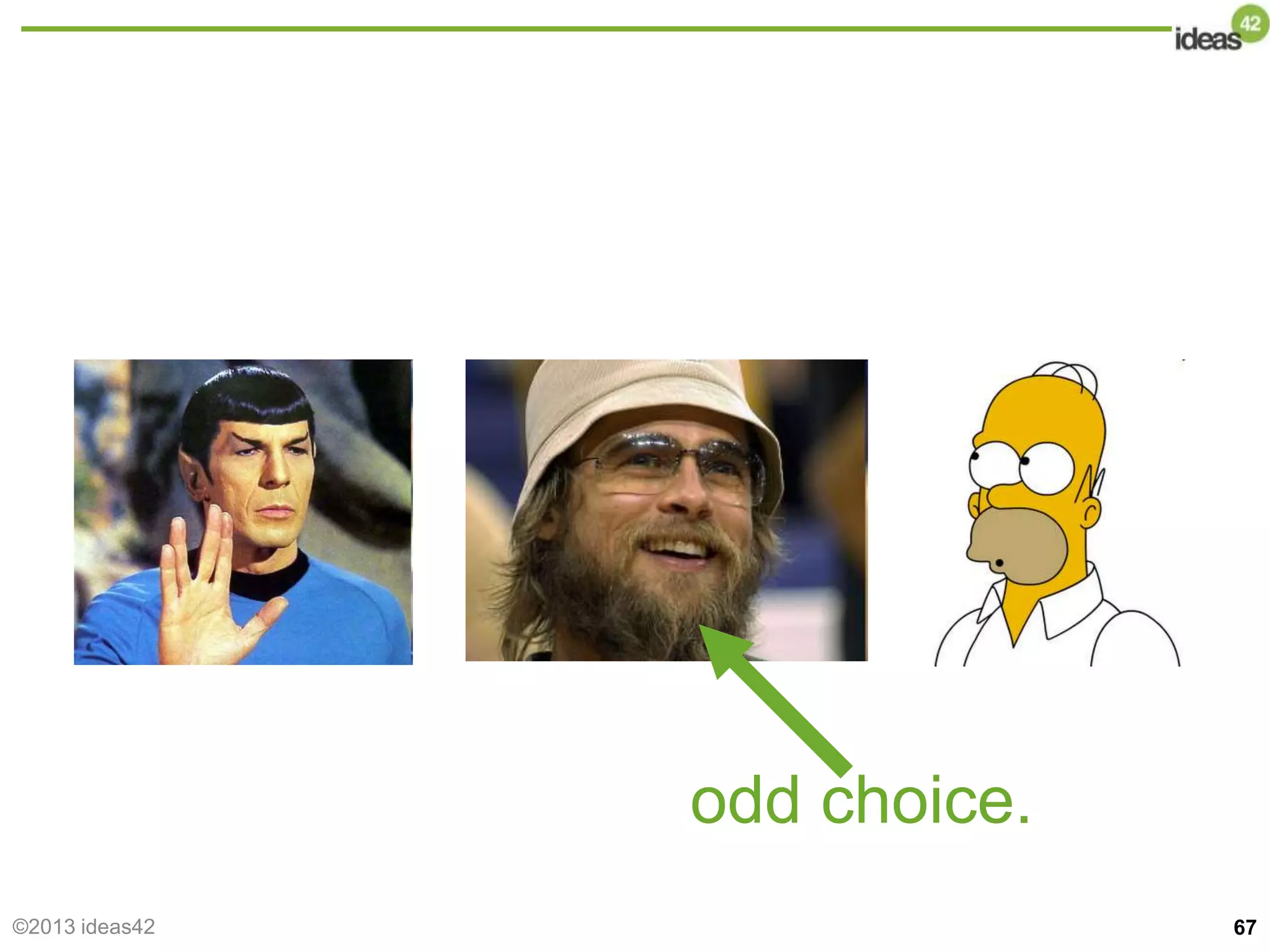
odd choice.
©2013 ideas42 67
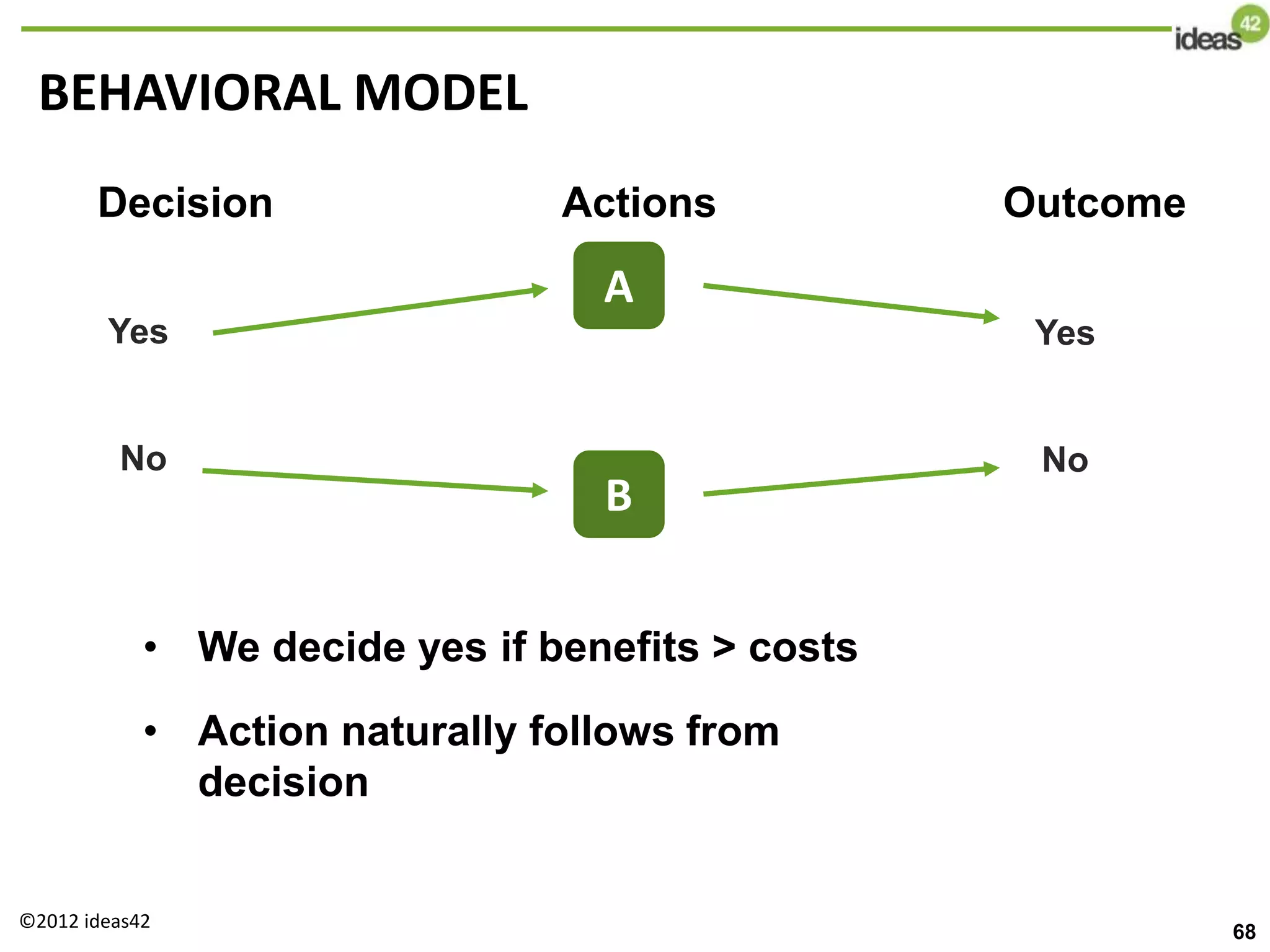
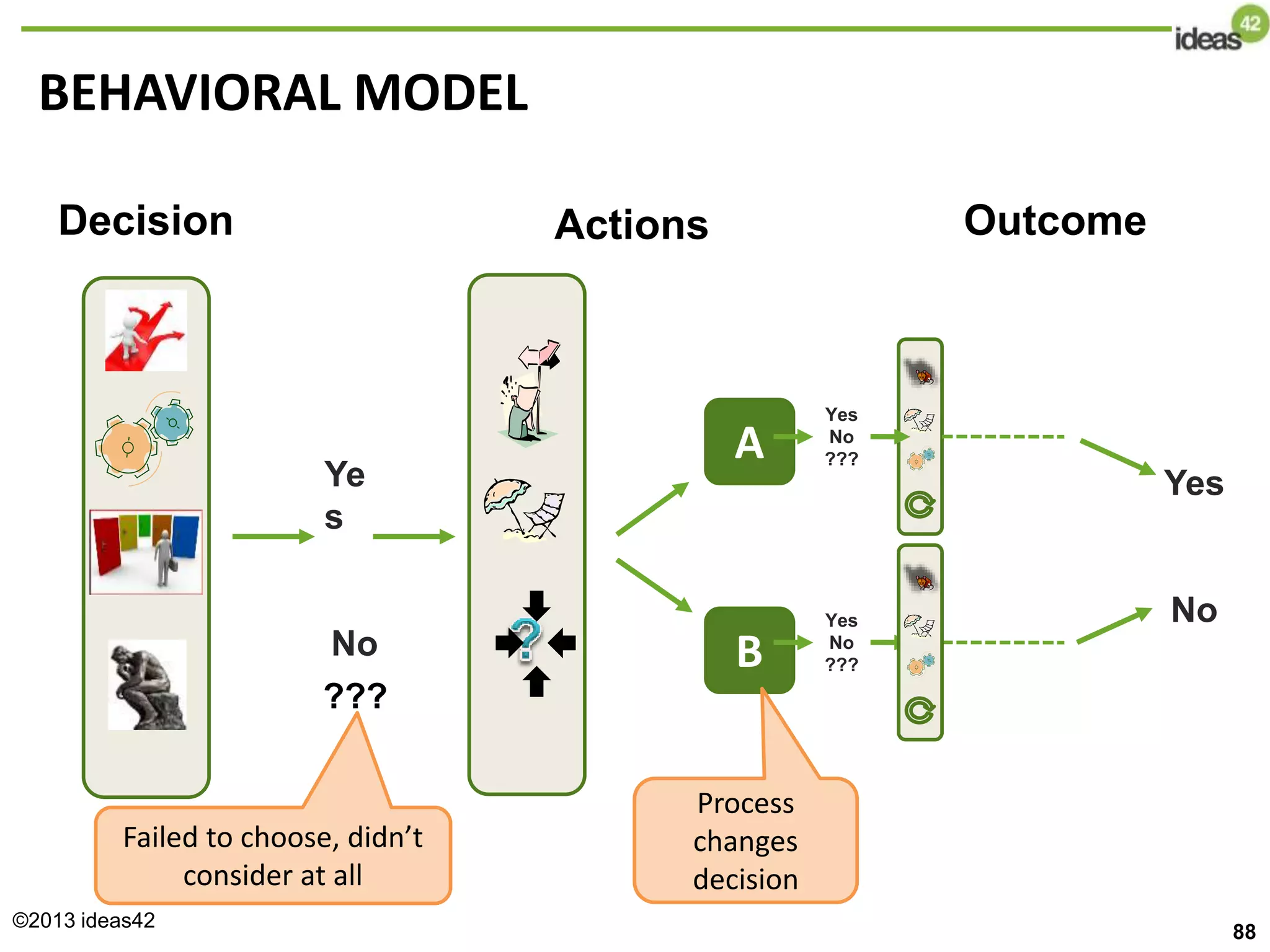
BEHAVIORAL MODEL
A
B
Decision Actions
Yes
No
Outcome
Yes
No
• We decide yes if benefits > costs
• Action naturally follows from
decision
©2012 ideas42
68
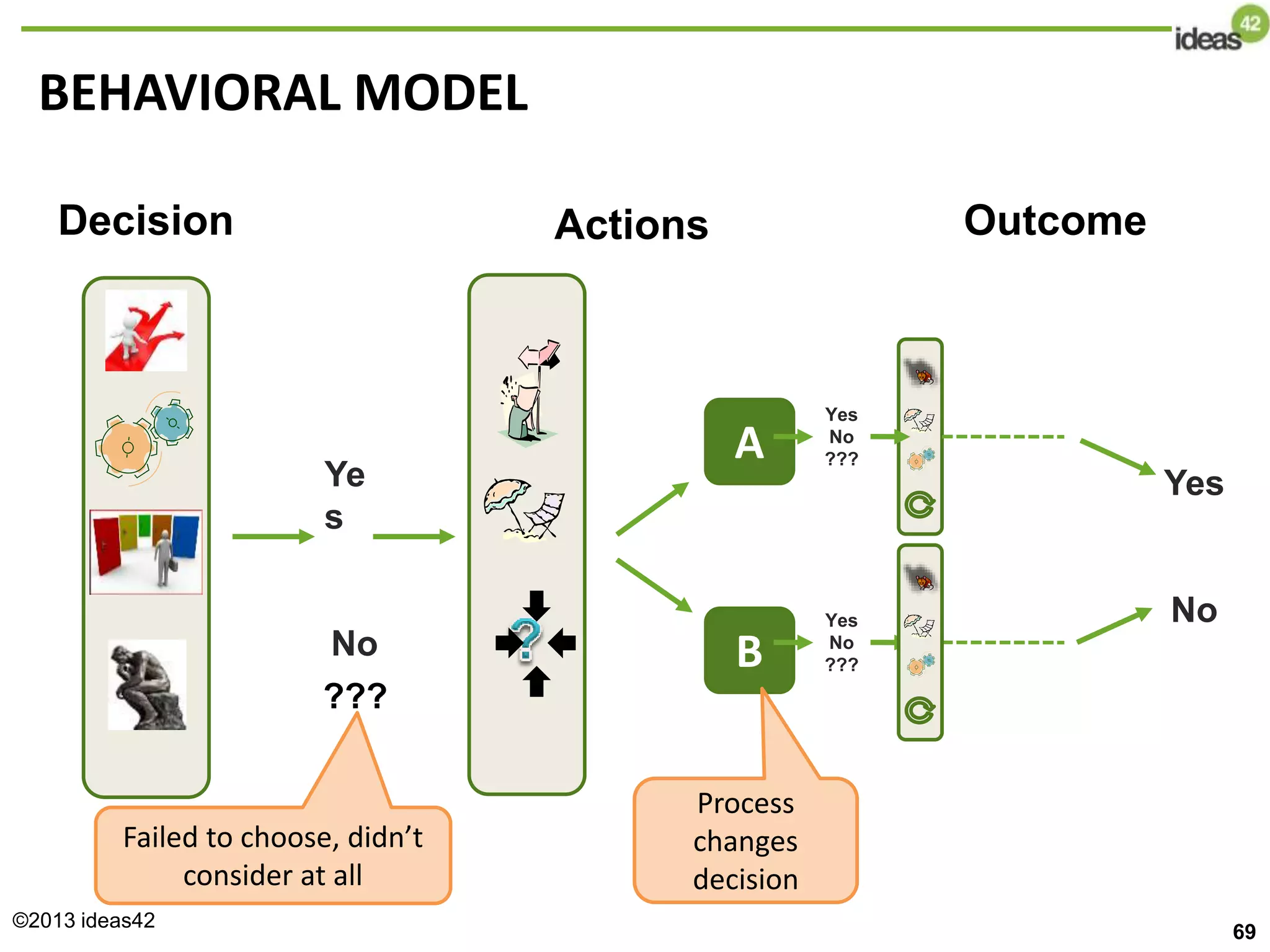
69
A
B
Decision Actions Outcome
Failed to choose, didn’t
consider at all
???
Ye
s
No
Process
changes
decision
Yes
No
???
Yes
No
???
Yes
No
BEHAVIORAL MODEL
©2013 ideas42
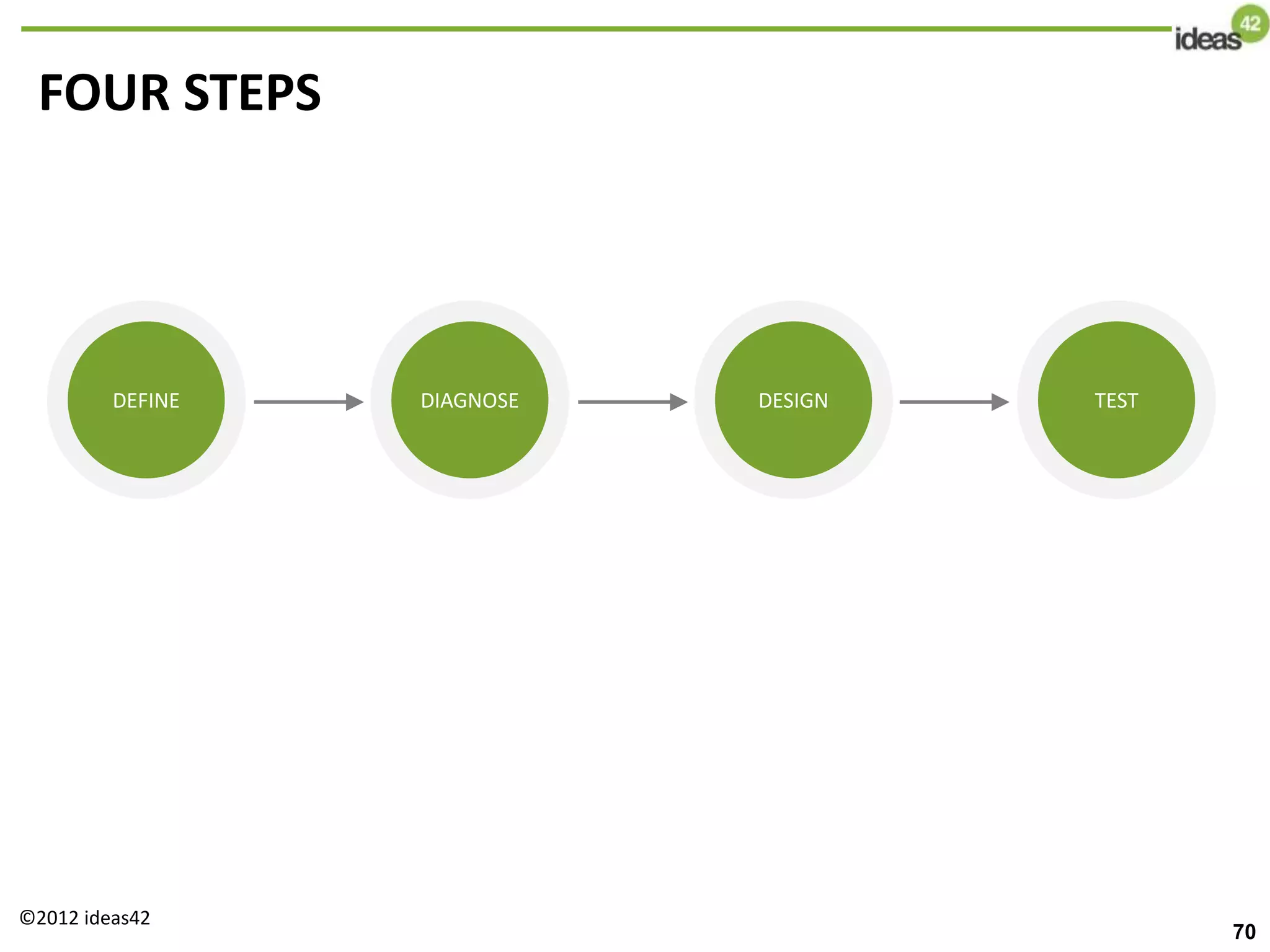
DEFINE DIAGNOSE DESIGN TEST
FOUR STEPS
70
©2012 ideas42
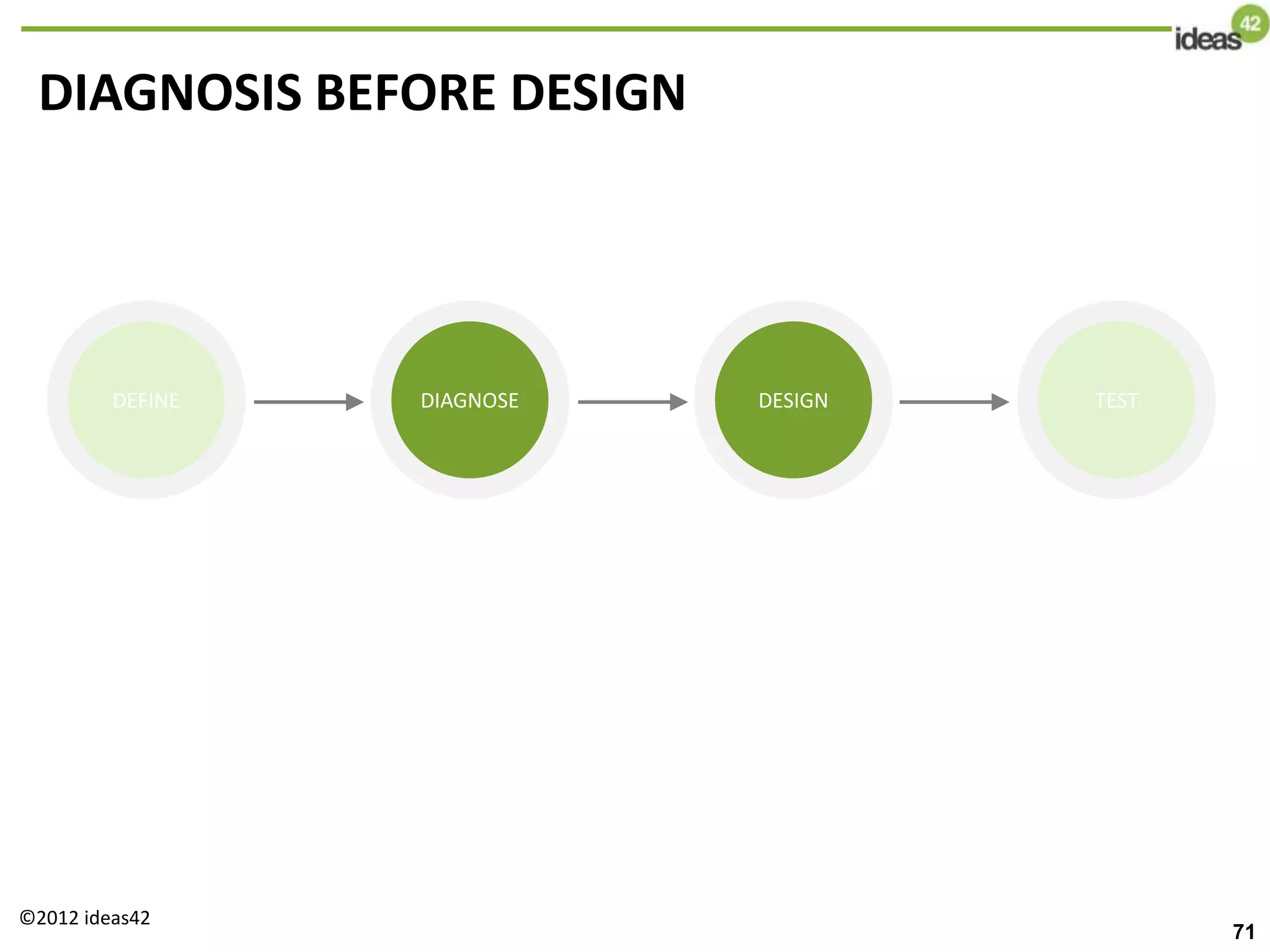
DEFINE DIAGNOSE DESIGN TEST
DIAGNOSIS BEFORE DESIGN
71
©2012 ideas42
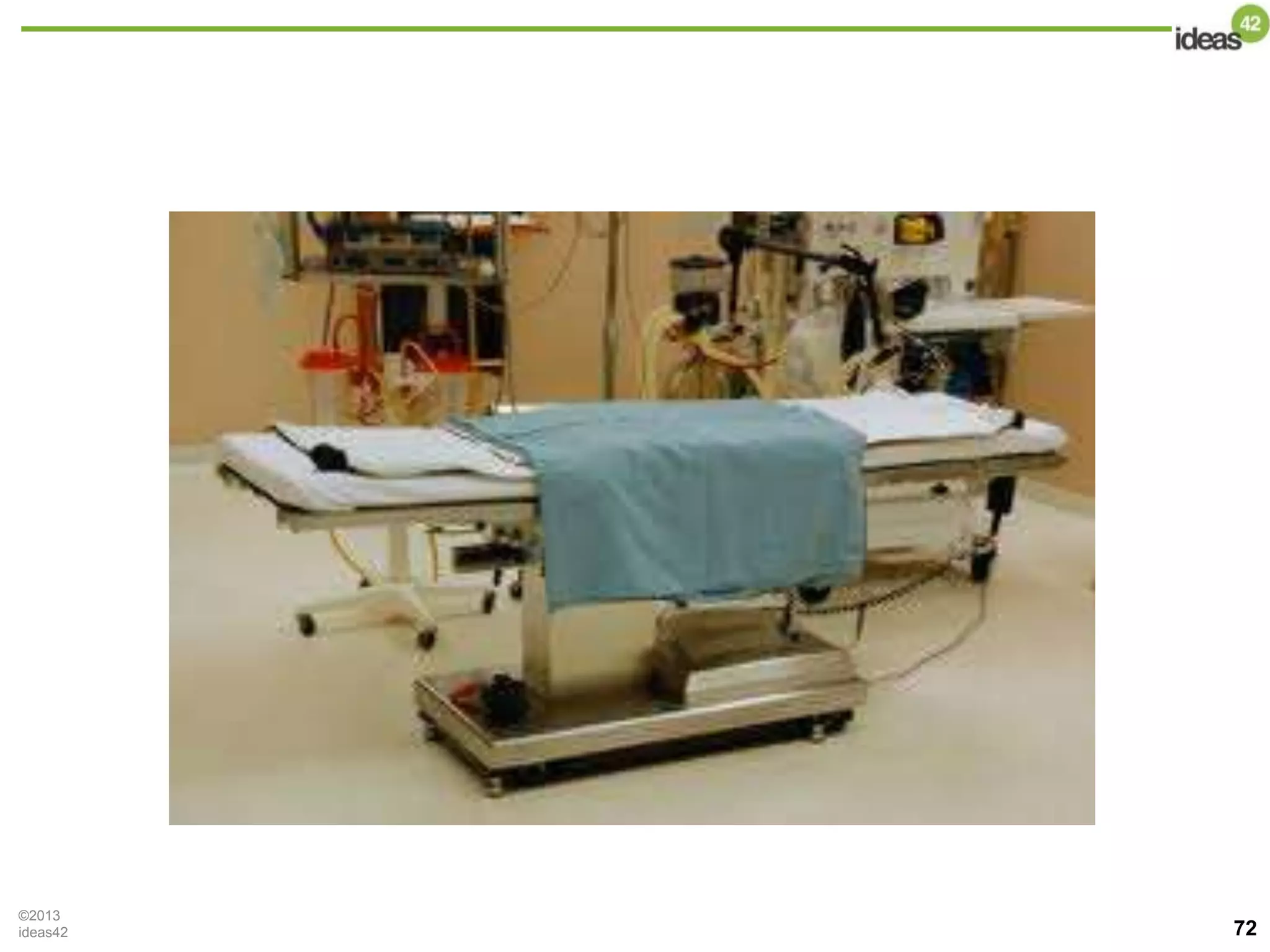
72
©2013
ideas42
73
©2013
ideas42
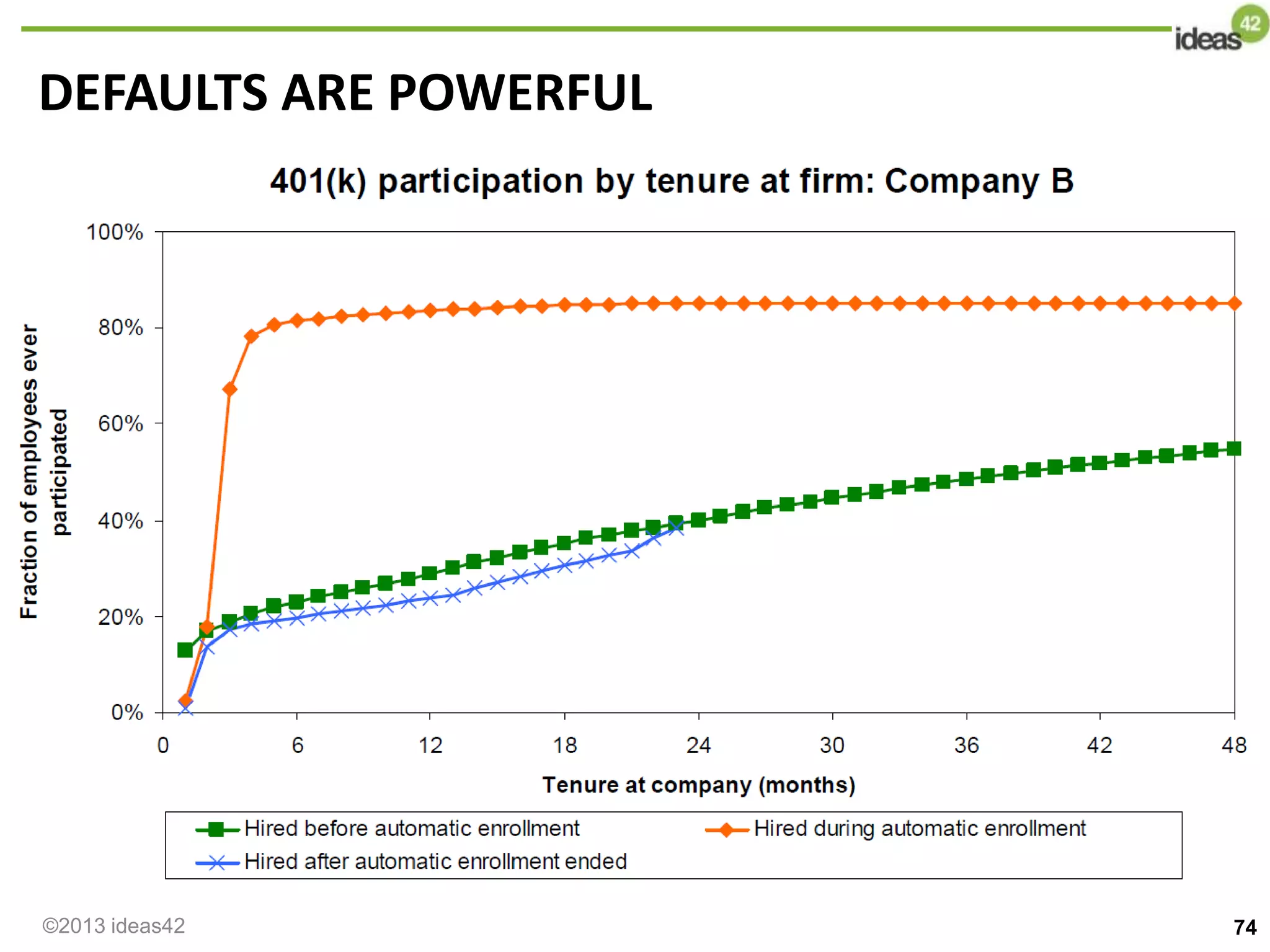
74
DEFAULTS ARE POWERFUL
©2013 ideas42
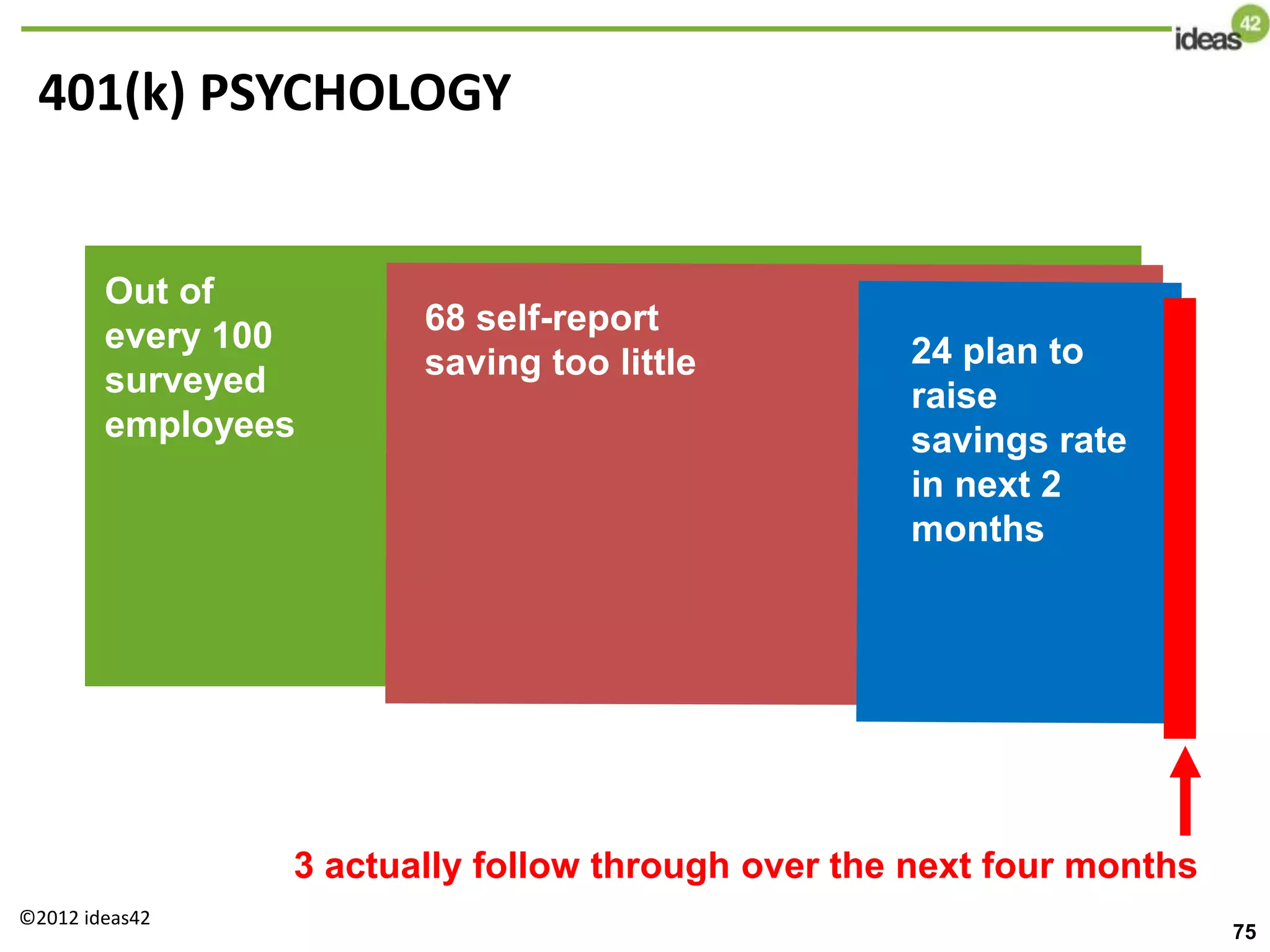
401(k) PSYCHOLOGY
Out of
every 100
surveyed
employees
68 self-report
saving too little 24 plan to
raise
savings rate
in next 2
months
3 actually follow through over the next four months
©2012 ideas42
75
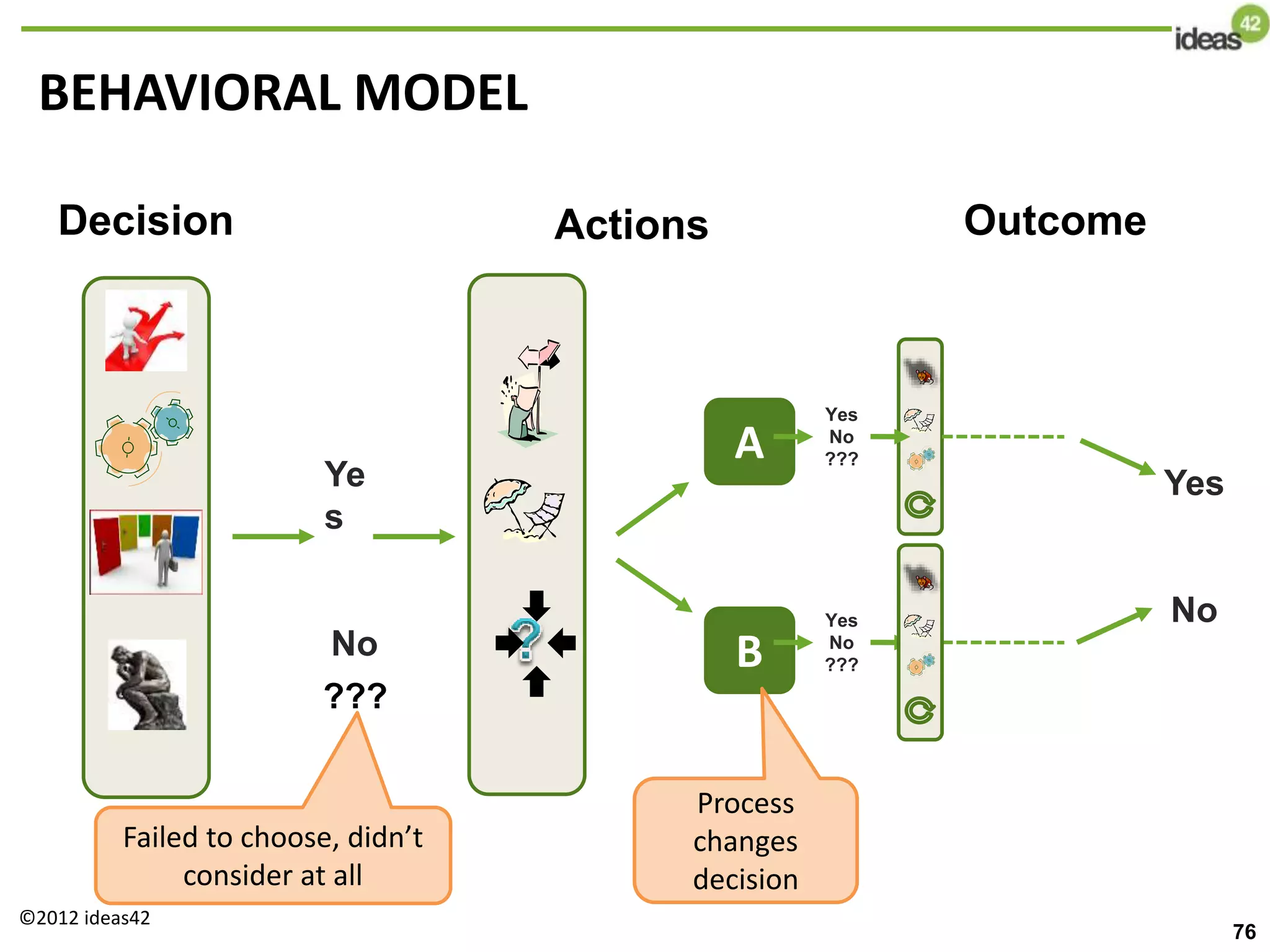
76
A
B
Decision Actions Outcome
Failed to choose, didn’t
consider at all
???
Ye
s
No
Process
changes
decision
Yes
No
???
Yes
No
???
Yes
No
©2012 ideas42
BEHAVIORAL MODEL
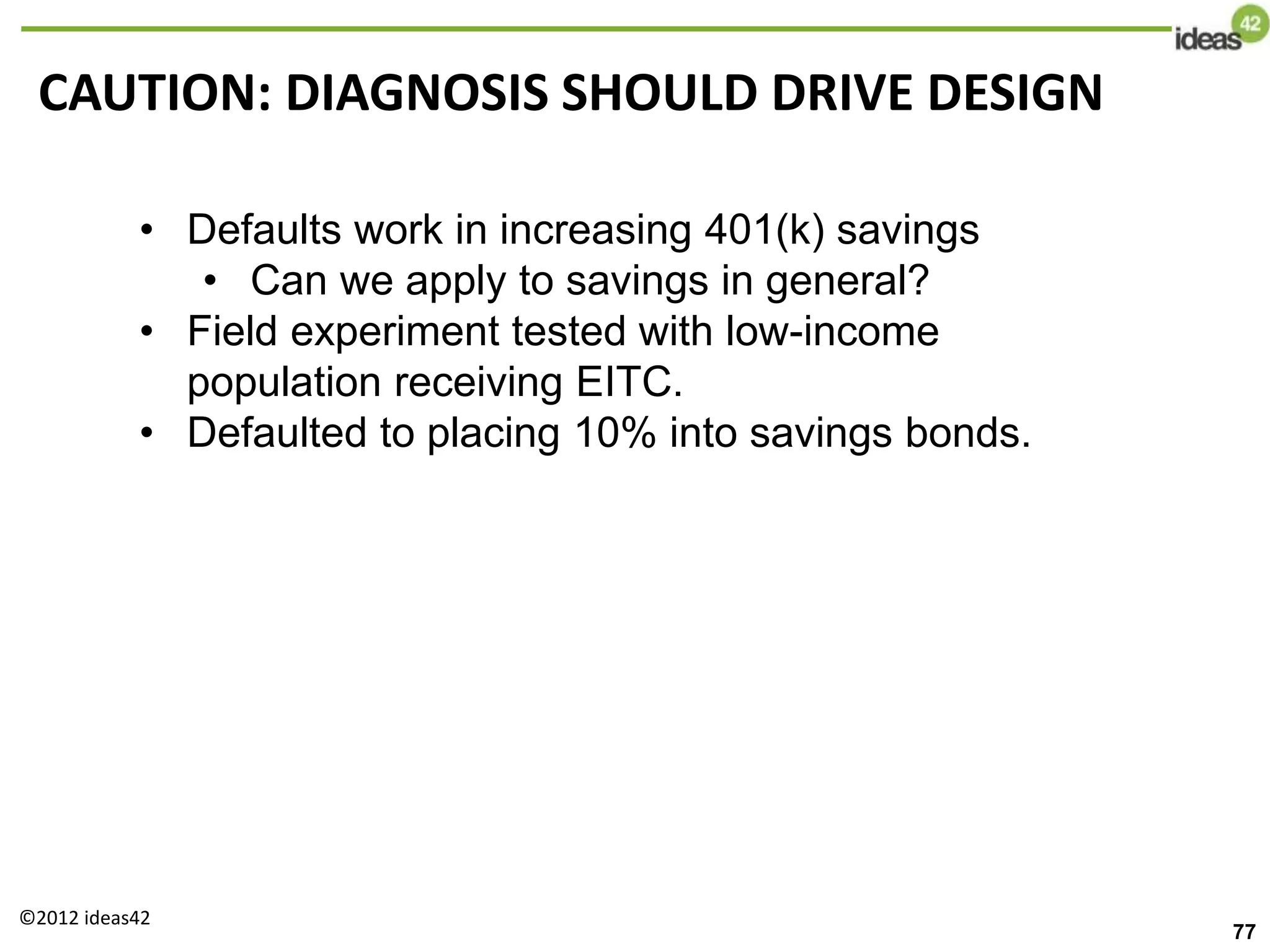
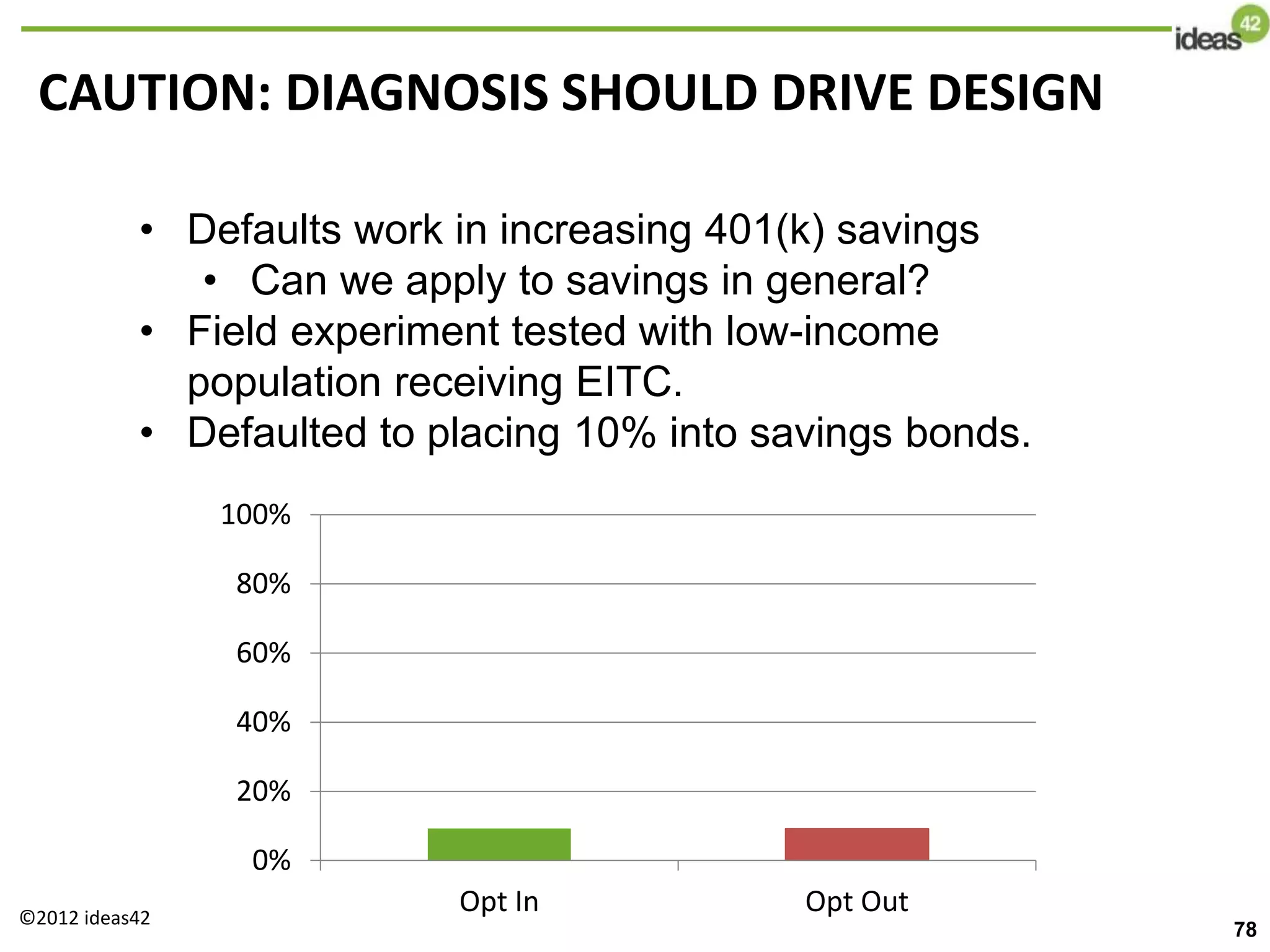
CAUTION: DIAGNOSIS SHOULD DRIVE DESIGN
• Defaults work in increasing 401(k) savings
• Can we apply to savings in general?
• Field experiment tested with low-income
population receiving EITC.
• Defaulted to placing 10% into savings bonds.
©2012 ideas42
77
• Defaults work in increasing 401(k) savings
• Can we apply to savings in general?
• Field experiment tested with low-income
population receiving EITC.
• Defaulted to placing 10% into savings bonds.
0%
20%
40%
60%
80%
100%
Opt In Opt Out
78
©2012 ideas42
CAUTION: DIAGNOSIS SHOULD DRIVE DESIGN
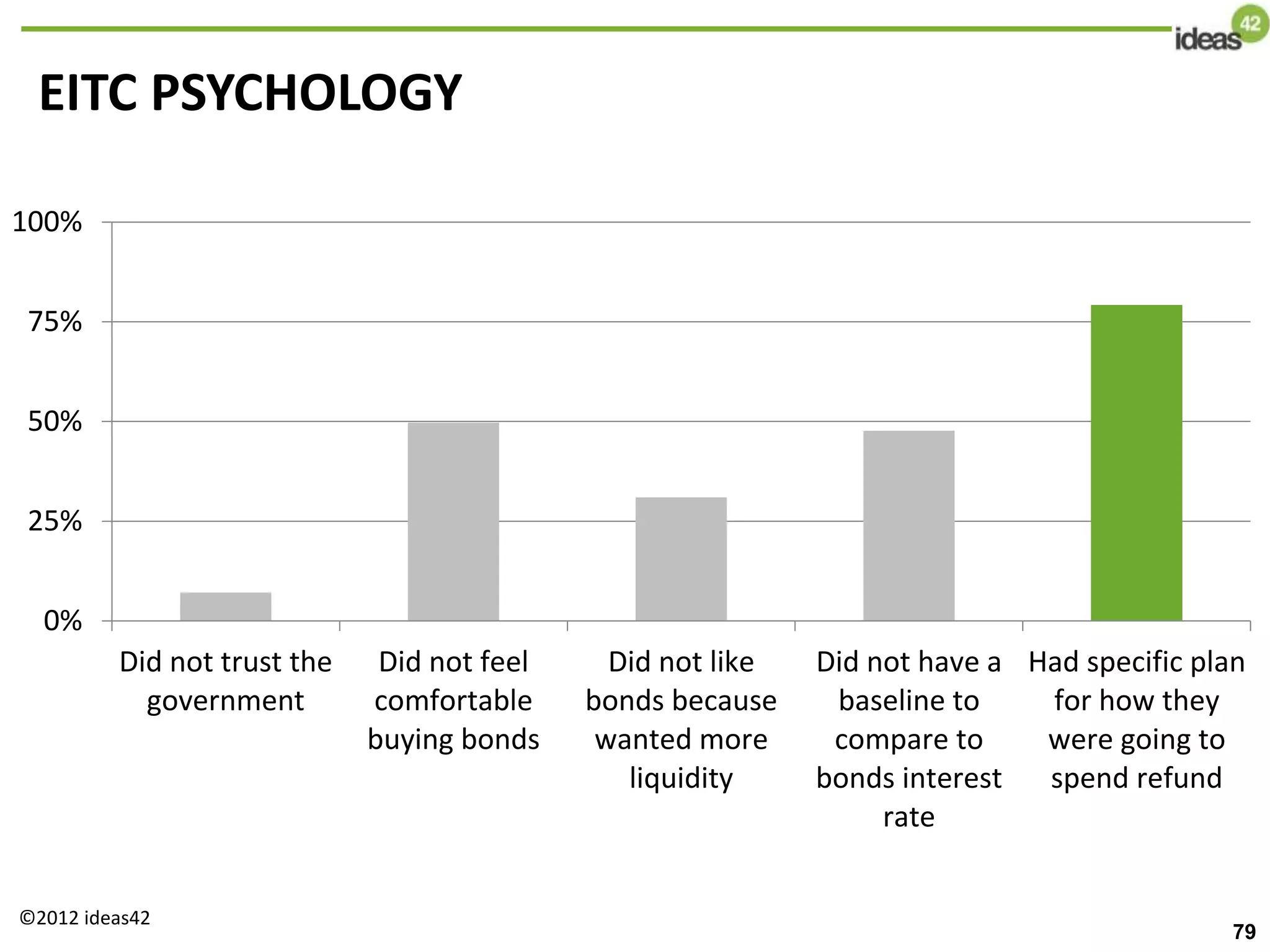
EITC PSYCHOLOGY
0%
25%
50%
75%
100%
Did not trust the
government
Did not feel
comfortable
buying bonds
Did not like
bonds because
wanted more
liquidity
Did not have a
baseline to
compare to
bonds interest
rate
Had specific plan
for how they
were going to
spend refund
©2012 ideas42
79
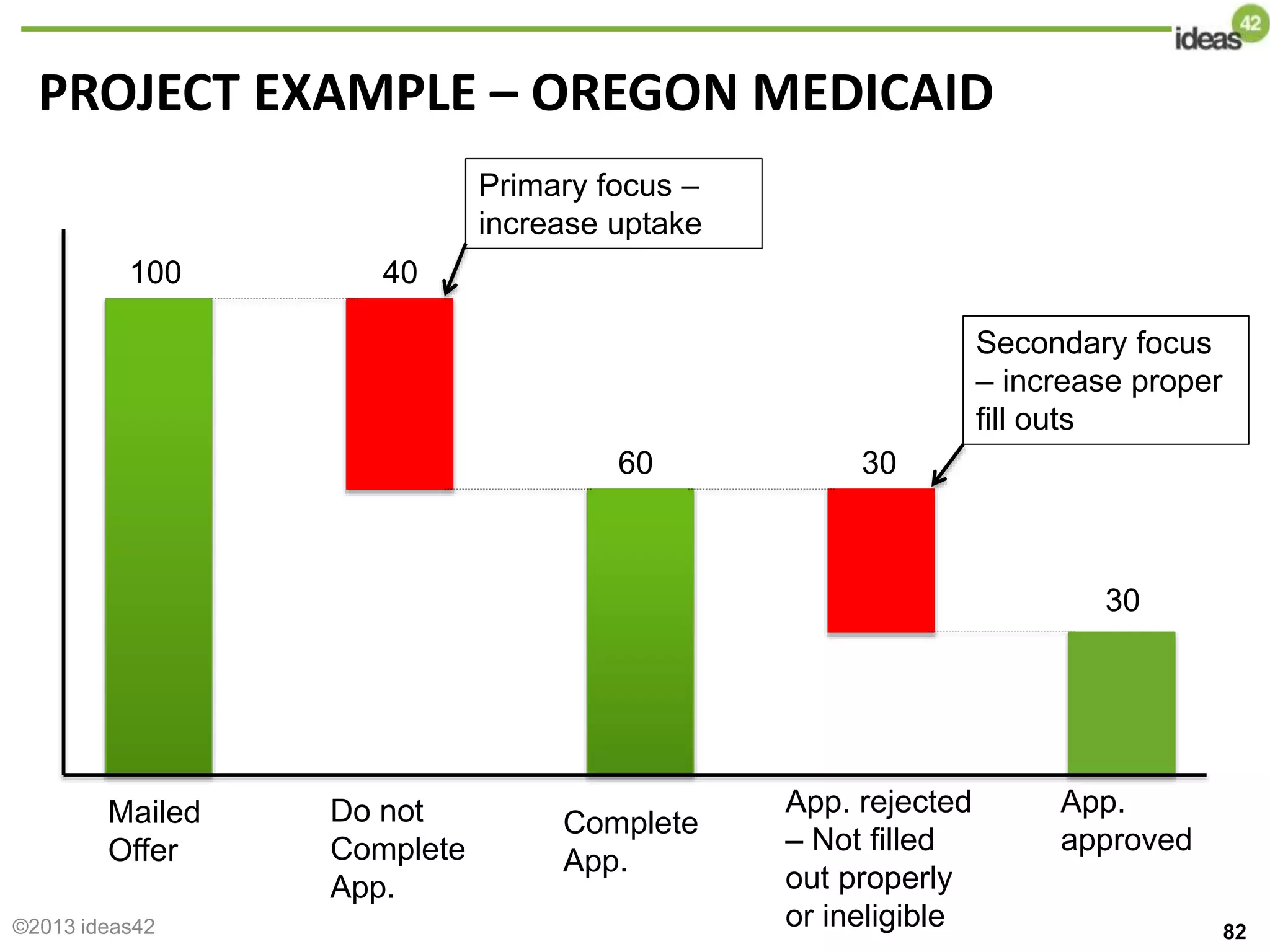
PROJECT EXAMPLE – OREGON MEDICAID
 Oregon had to limit the number of people who could receive
Medicaid because of budget constraints.
 Budget resources situation improved, Oregon could add more
people to Medicaid program, but not everyone that is eligible.
 Asked people to submit request to be put on wait list and to be
selected at random for Medicaid.
 People who are selected at random are asked by mail to fill out
full application, and eligible applicants receive healthcare.
80
©2013 ideas42
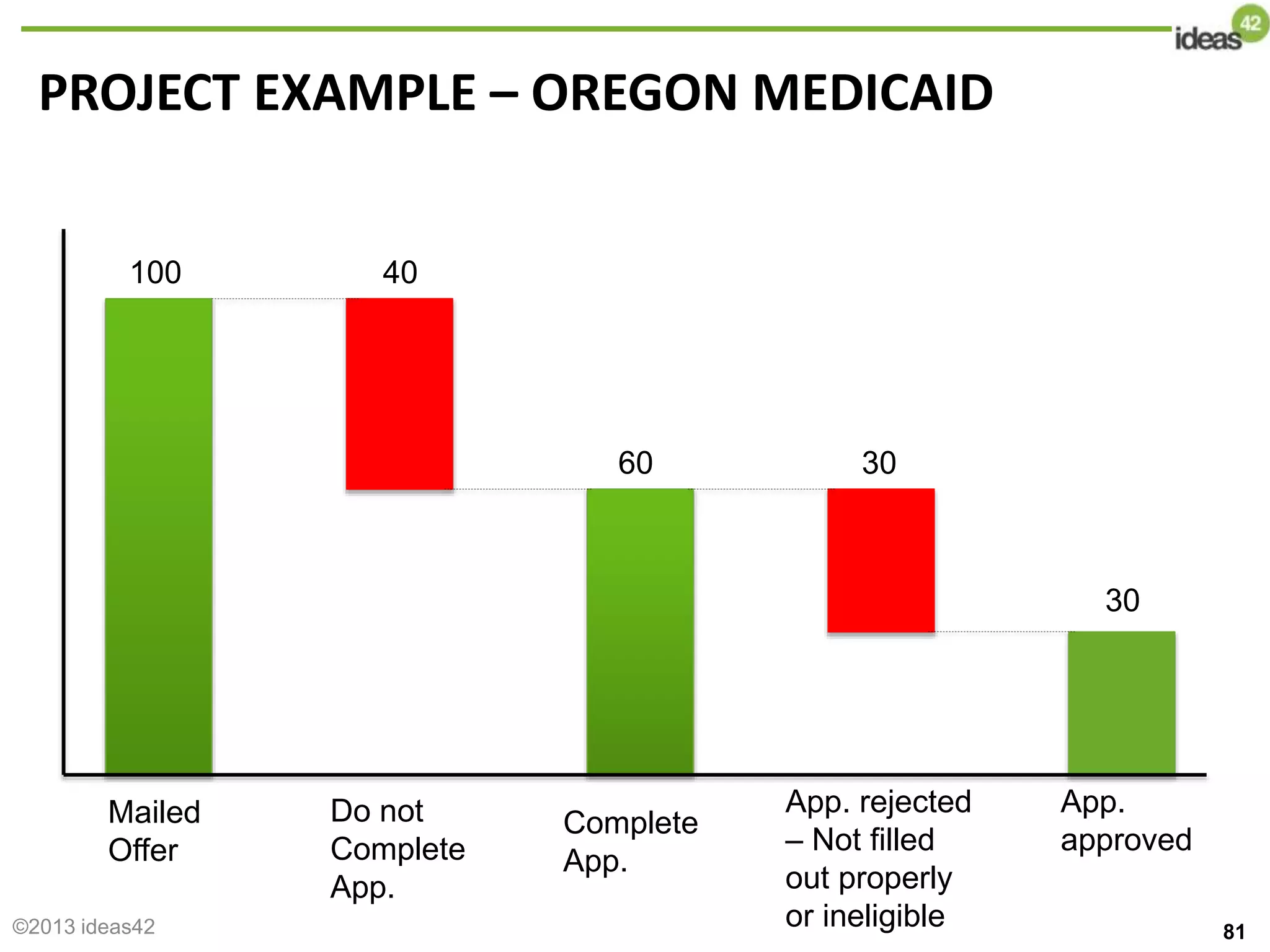
PROJECT EXAMPLE – OREGON MEDICAID
81
Mailed
Offer
100
Do not
Complete
App.
40
60
Complete
App.
App. rejected
– Not filled
out properly
or ineligible
30
30
App.
approved
©2013 ideas42
PROJECT EXAMPLE – OREGON MEDICAID
82
Mailed
Offer
100
Do not
Complete
App.
40
60
Complete
App.
App. rejected
– Not filled
out properly
or ineligible
30
30
App.
approved
Primary focus –
increase uptake
Secondary focus
– increase proper
fill outs
©2013 ideas42
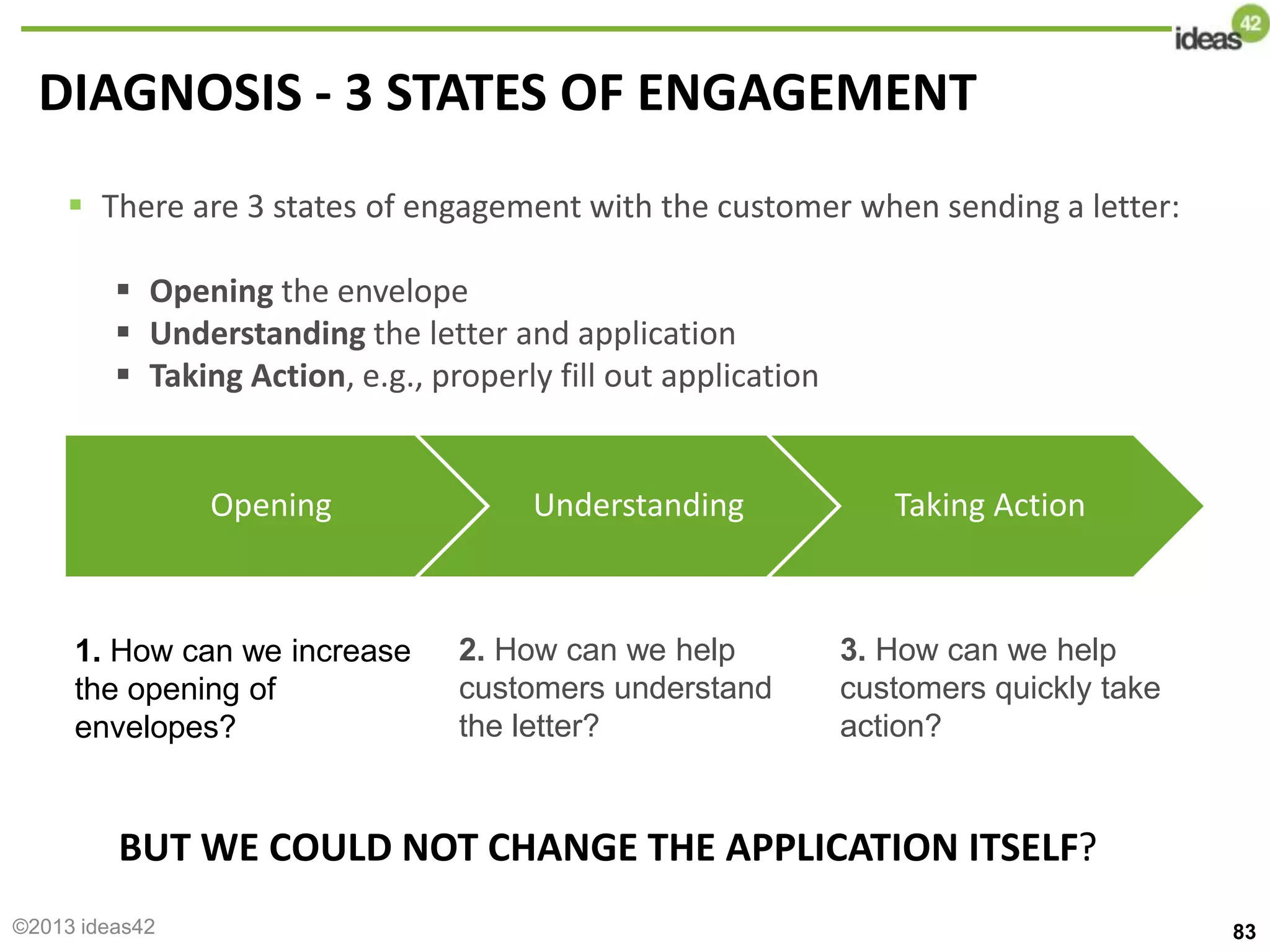
DIAGNOSIS - 3 STATES OF ENGAGEMENT
1. How can we increase
the opening of
envelopes?
Opening Understanding Taking Action
2. How can we help
customers understand
the letter?
3. How can we help
customers quickly take
action?
 There are 3 states of engagement with the customer when sending a letter:
 Opening the envelope
 Understanding the letter and application
 Taking Action, e.g., properly fill out application
83
BUT WE COULD NOT CHANGE THE APPLICATION ITSELF?
©2013 ideas42
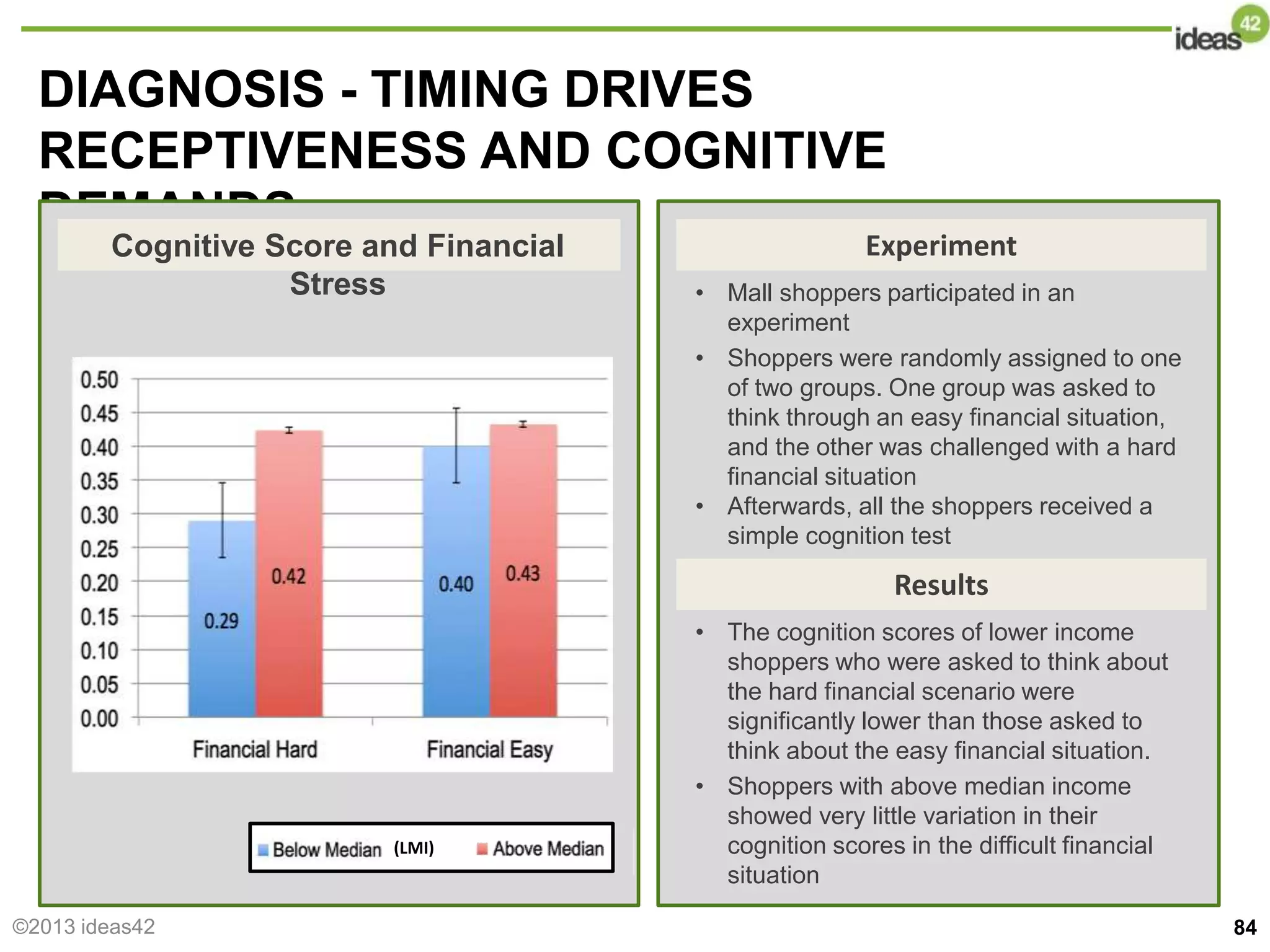
DIAGNOSIS - TIMING DRIVES
RECEPTIVENESS AND COGNITIVE
DEMANDS
84
(LMI)
Results
Experiment
• Mall shoppers participated in an
experiment
• Shoppers were randomly assigned to one
of two groups. One group was asked to
think through an easy financial situation,
and the other was challenged with a hard
financial situation
• Afterwards, all the shoppers received a
simple cognition test
Cognitive Score and Financial
Stress
• The cognition scores of lower income
shoppers who were asked to think about
the hard financial scenario were
significantly lower than those asked to
think about the easy financial situation.
• Shoppers with above median income
showed very little variation in their
cognition scores in the difficult financial
situation
©2013 ideas42
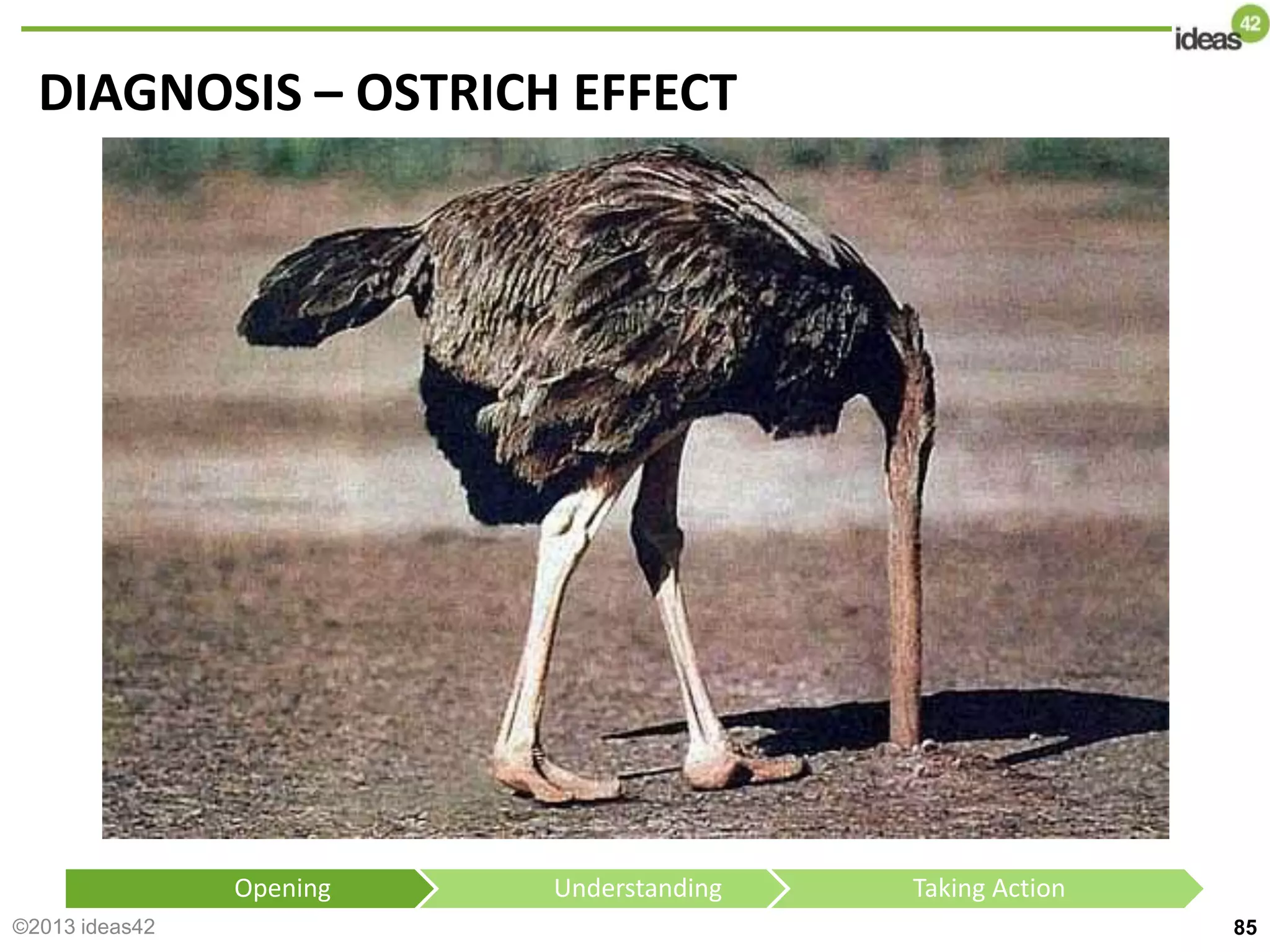
DIAGNOSIS – OSTRICH EFFECT
85
Opening Understanding Taking Action
©2013 ideas42
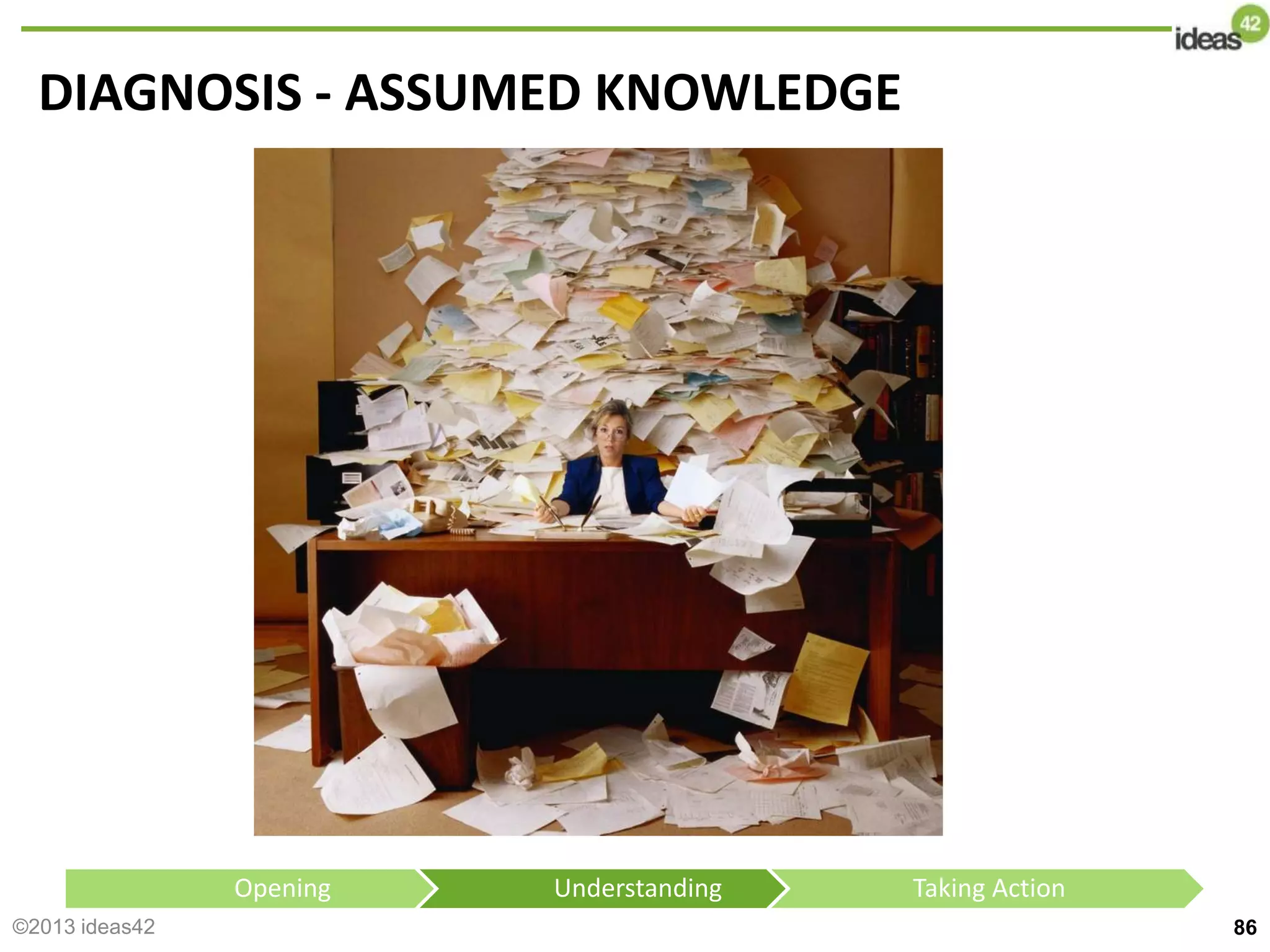
DIAGNOSIS - ASSUMED KNOWLEDGE
86
Opening Understanding Taking Action
©2013 ideas42
DIAGNOSIS – HASSLE FACTOR
87
Opening Understanding Taking Action
©2013 ideas42
88
A
B
Decision Actions Outcome
Failed to choose, didn’t
consider at all
???
Ye
s
No
Process
changes
decision
Yes
No
???
Yes
No
???
Yes
No
BEHAVIORAL MODEL
©2013 ideas42
DESIGN – FOUR ELEMENTS
• Timing – Try to have some items hit during 1st week of
the month, when financial cognition demands are
lowest
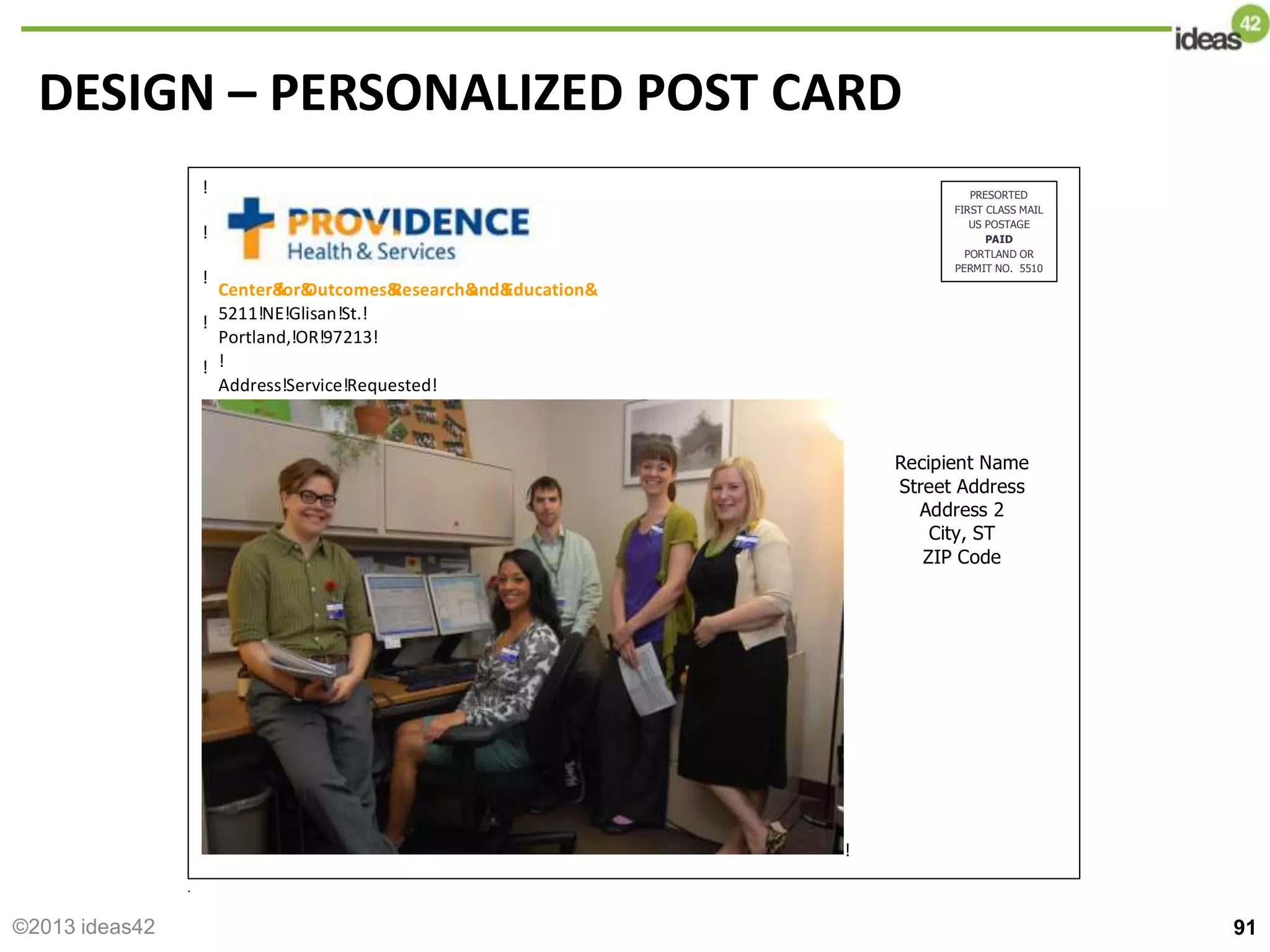
• Personalized/Humanized Post Card 7 days prior to
application from the State
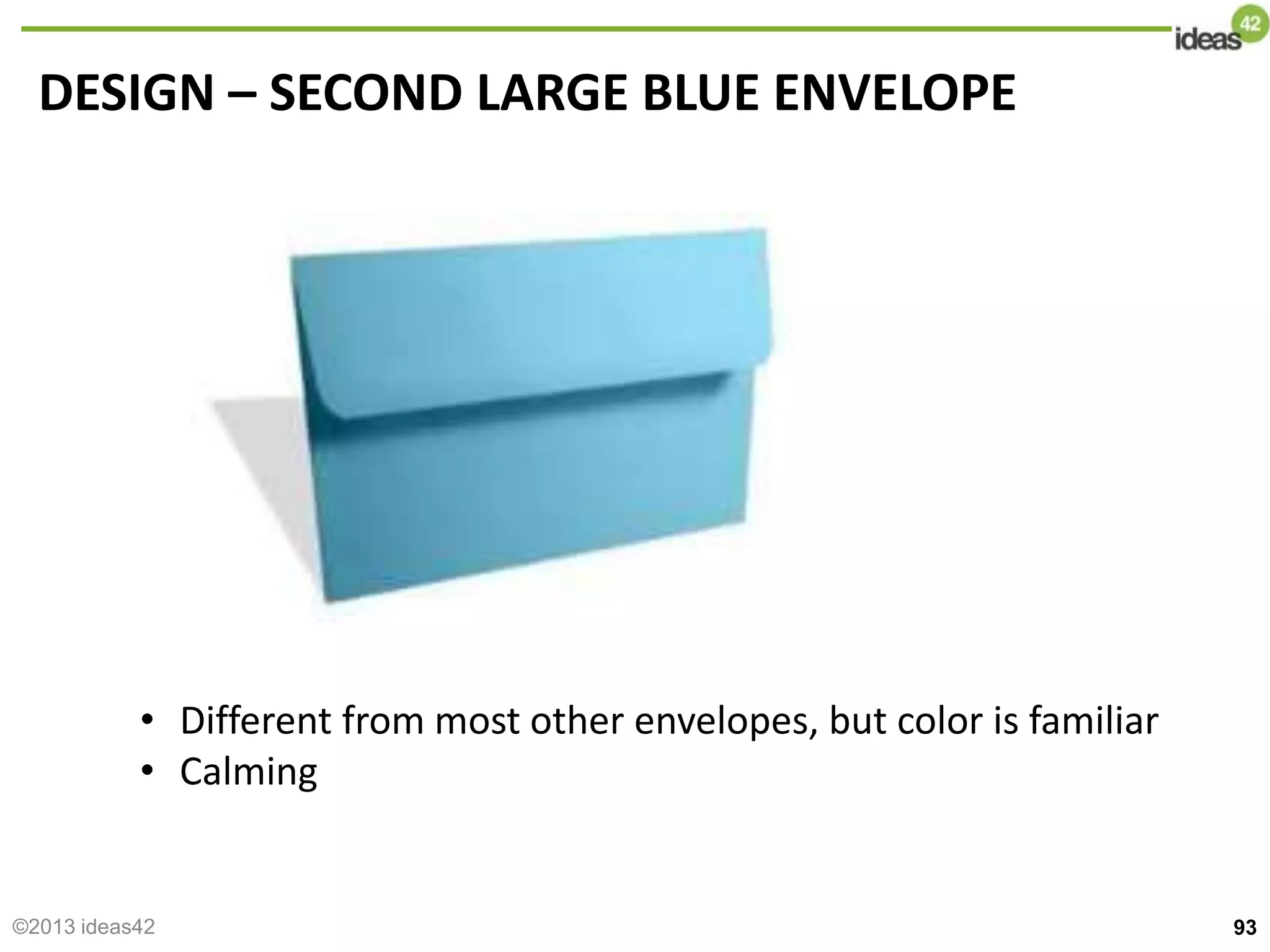
• Second Application in a large blue envelope
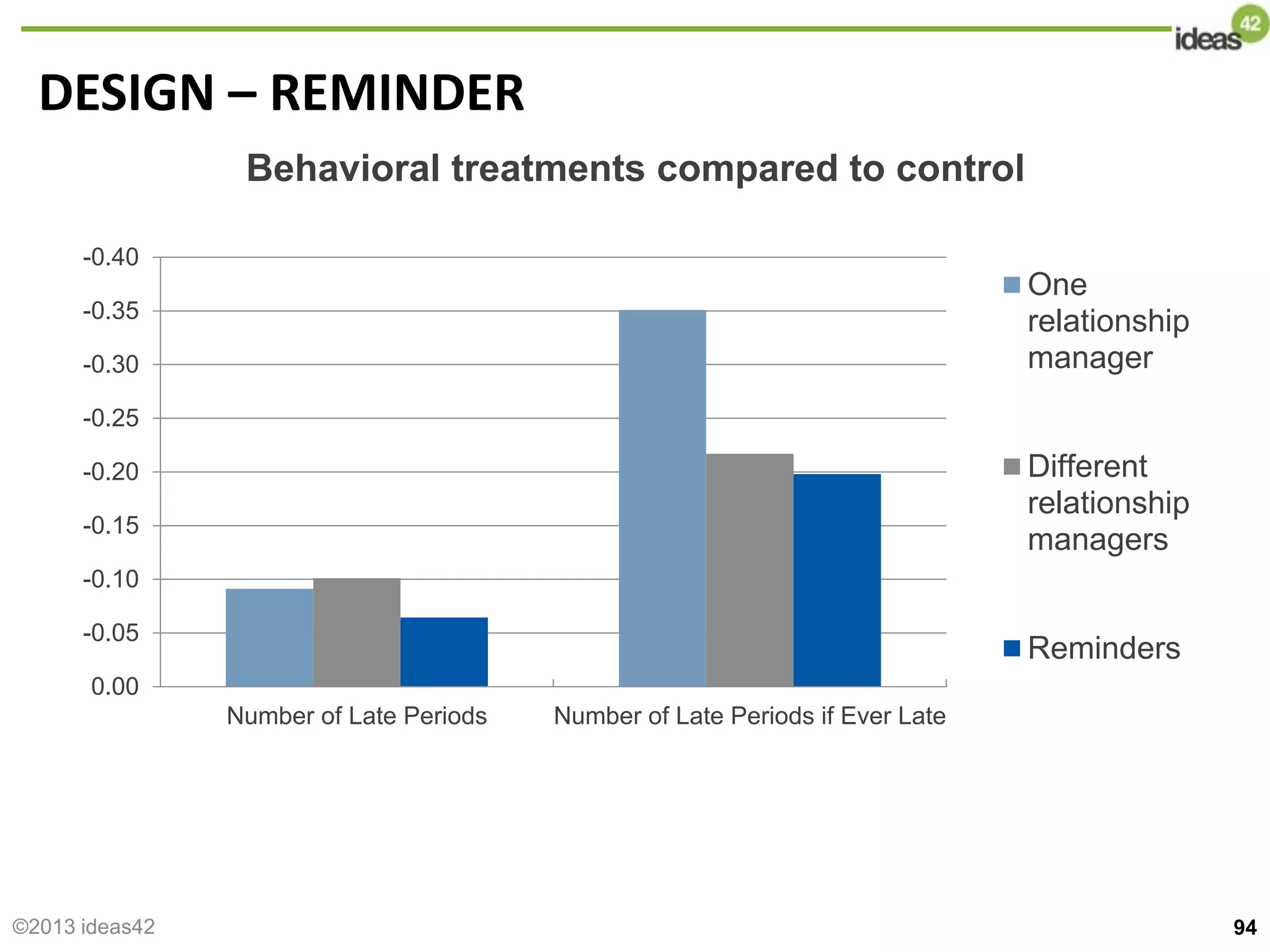
• Reminder post card with personalization and number
to call
89
©2013 ideas42
DESIGN - TIMING
90
©2013 ideas42
DESIGN – PERSONALIZED POST CARD
91
!
!
!
!
!
!
!
!
!
!
!
!
!
!
!
!
!
!
!!!!!!!!!!!!!!!!!!
!
!
!
!
!
Center&
for&
Outcomes&
Research&
and&
Education&
5211!NE!Glisan!St.!
Portland,!OR!97213!
!
Address!Service!Requested!
PRESORTED
FIRST CLASS MAIL
US POSTAGE
PAID
PORTLAND OR
PERMIT NO. 5510
Recipient Name
Street Address
Address 2
City, ST
ZIP Code
©2013 ideas42
92
before& &
You’ve'won'the'lottery'you'entered FREE&
HEALTH&
CARE Oregon&
Health&
Plan
Call&
toll&
free&
1=877=215=0686&
or&
email&
me&
at& 'with&
any&
questions—&
I&
am&
here&
to&
help!&
&
&
[RA&
circles&
photo&
and&
handwrites&
signature]
DESIGN – PERSONALIZED POST CARD
©2013 ideas42
DESIGN – SECOND LARGE BLUE ENVELOPE
93
• Different from most other envelopes, but color is familiar
• Calming
©2013 ideas42
DESIGN – REMINDER
94
-0.40
-0.35
-0.30
-0.25
-0.20
-0.15
-0.10
-0.05
0.00
Number of Late Periods Number of Late Periods if Ever Late
Behavioral treatments compared to control
One
relationship
manager
Different
relationship
managers
Reminders
©2013 ideas42
PROJECT IS IN THE FIELD
95
©2013 ideas42
Q&A
10 minutes
(Included in session
recording)
Sponsors
Partners
Thank You for
Joining Us!
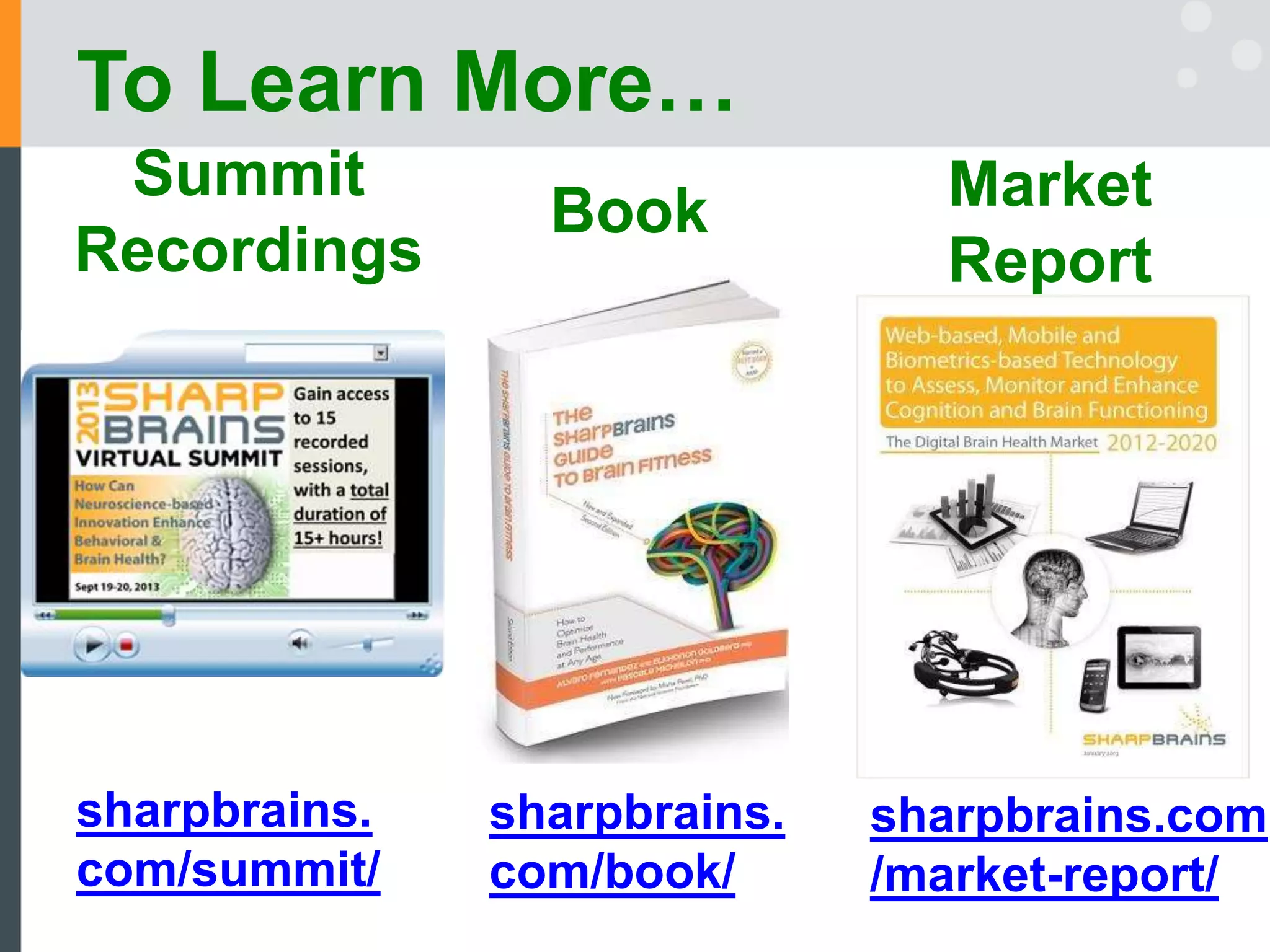
To Learn More…
Summit
Recordings
Book Market
Report
sharpbrains.
com/book/
sharpbrains.
com/summit/
sharpbrains.com
/market-report/

What are scal­able best prac­tices to spread smart health?

  • 1.
    What are scalablebest practices to spread smart health?
  • 2.
    Chaired by: JaynePlunkett, Head of Casualty Reinsurance at Swiss Re, YGL Class of 2010 Misha Pavel, Program Director of Smart and Connected Health at the NSF Dharma Singh Khalsa, President of the Alzheimer’s Research and Prevention Foundation Josh Wright, Managing Director of ideas42 What are scalable best practices to spread smart health?
  • 3.
    Misha Pavel, Program Directorof Smart and Connected Health at the National Science Foundation What are scalable best practices to spread smart health?
  • 4.
    4 Smart and ConnectedHealth Misha Pavel College of Computer and Information Science Bouvé College of Health Sciences Northeastern University & National Science Foundation Computer & Information Science & Engineering Directorate Information and Intelligent Systems Division Any opinion, finding, and conclusions or recommendations expressed in this material; are those of the author and do not necessarily reflect the views of the National Science Foundation
  • 5.
    Road ahead I. Healthcarein Crisis II. Smart & Connected Health III. Behaviors including Big Data 5 Wactlar H., Pavel M., and Barkis W., "Can Computer Science Save Healthcare?," Intelligent Systems, IEEE, vol. 26, pp. 79-83, Sept. 2011.
  • 6.
    PART I: Healthcare inCrisis Advances in Technology 6
  • 7.
    The healthcare crisis– Some troubling statistics • The cost of healthcare in the U.S. is the highest in the world (> $8,000 per capita, 16% GDP) • The U.S. ranked 37th in the 2000 WHO study of healthcare system performance (8 underlying measures) • 98,000 deaths per year due to medical errors • Current individual medical records have an error rate of 20% • 50% Americans have 1 or more chronic diseases; age of onset is getting younger • Medicare and Medicaid costs to be at a staggering 25% of the U.S. economy by 2050 • 3 lifestyle behaviors (poor diet, lack of exercise, smoking) cause estimated 1/3rd of U.S. deaths 7
  • 8.
    Dependency Ratio: Retired/Working 19501960 1970 1980 1990 2000 2010 2020 2030 2040 2050 0 0.05 0.1 0.15 0.2 0.25 0.3 0.35 0.4 0.45 0.5 Dependency Ratio [Over 64] /[20-65] Year Estimates Projections Silver Tsunami
  • 9.
    A sample ofrecent strategic visions & activities Focus on transforming healthcare with technology and innovation
  • 10.
    From traditional medicineto smart health NSF Perspective EPISODIC, REACTIVE FOCUS ON DISEASE PROACTIVE and PREVENTIVE FOCUS ON WELLBEING QUALITY OF LIFE HOSPITAL-CENTRIC PATIENT-CENTRIC, HOME-BASED FRAGMENTED, LOCAL DATA INTEROPERABLE, EHR AVAILBLE ANYWHERE, ANYTIME NAÏVE,PASSIVE, PATIENTS EMPOWERED, ENAGAGED, INFORMED, PARTICIPATING TRAINING & EXPERIENCE BASED MORE EVIDENCE – BASED DECISION SUPPORT
  • 11.
    Quality of Lifeover Life-Span 0 20 40 60 80 100 120 Age [Years] Quality of Life Rectangularization after Fries, 1983 11
  • 12.
    Source: Sajal Das,Keith Marzullo Person al Sensing Public Sensing Social Sensing People-Centric Sensing Actions (controllers) Percepts (sensors) Agent (Reasoning) Smart Health Situation Awareness: Humans as sensors feed multi- modal data streams Pervasive Computing Social Informatics Sense Identify Assess Intervene Evaluate Emergency Response Environment Sensing The Age of Observation – Smart Sensing, Reasoning and Decision: BIG DATA
  • 13.
    PART II: Smart &Connected Health (SCH) Inter-Agency Program National Institutes of Health National Science Foundation 13 NSF Solicitation: NSF-13-543 NIH Notice Number: NOT-OD-13-041
  • 14.
    Objectives of theSmart and Connected Health Program • To fill in research gaps that exist in science and technology in support of health and wellness • To advance the fields of health, wellness, improve quality of care and reduce cost by leveraging the fundamental science research Seek improvements in safe, effective, efficient, equitable, and patient-centered health and wellness services through innovations in computer and information science, engineering, social, behavioral and economic science and medical science
  • 15.
    NSF Directorates Participatingin SCH 15 Office of the Director Engineering (ENG) Geosciences (GEO) Mathematical and Physical Sciences (MPS) Budget, Finance Award Management Computer & Information Science and Engineering (CISE) Biological Sciences (BIO) Diversity and Inclusion Social, Behavioral and Economic Sciences (EBS) Education and Human Resources (EHR) General Counsel Information & Resource Management Legislative & Public Affairs National Science Board Office of Inspector General Cyber- infrastructure Integrative Activities International Science and Engineering Polar programs
  • 16.
    NIH Institutes OfficiallyParticipating in SCH OBSSR NCI NIBIB NIA NHGRI NICHD National Human Genome Research Institute
  • 17.
    Family Caregiver Coach Clinician Devices User Interfaces Inference Assessment Patient-centered framework forhealth, wellness and precision medicine (including behavioral assessment) Payers Employers Legal Environment Privacy Self-care Patient Physical Function Cognitive Function Chronic Disease Socialization Physio Sensors Activity Sensors Mobile Sensors EHR, PHR Mobile Health NIT: Networks, DB, API Software, EHR, PHR
  • 18.
    ECG EEG Pulmonary Function Gait Balance Step Size Blood Pressure SpO2 Posture Step Height GPS Performance Early Detection Prediction Inference Datamining Training HealthInformation Coaching Chronic Care Social Networks Decision Support Population Statistics Epidemiology Evidence Mobile Health 18 Training Health Information Coaching Chronic Care Social Networks Wactlar H., Pavel M., and Barkis W., "Can Computer Science Save Healthcare?," Intelligent Systems, IEEE, vol. 26, pp. 79-83, Sept. 2011.
  • 19.
    Smart and ConnectedHealth Research Areas • Integration of EHR, pharma and clinical data • Access to information, data harmonization • Semantic representation, fusion, Digital Health Information Infrastructure Informatics and Infrastructure • Datamining and machine learning • Inference, cognitive decision support system • Bring raw image data to clinical practice Data to Knowledge to Decision Reasoning under uncertainty • Systems for empowering patient • Models of readiness to change • State assessment from images video Empowered Individuals Energized, enabled, educated • Assistive technologies embodying computational intelligence • Medical devices, co-robots, cognitive orthotics, rehab coaches Sensors, Devices, and Robotics Sensor-based actuation
  • 20.
    Challenge: Extraction ofKnowledge and Meaning Harmonizing/Coherence: Source-Invariant Decisions NIT (ICT) Network Layer, Databases, EHR, PHR, XHR Decisions Transform Decisions Decisions Transform Transform Transform Heterogeneous Sources/Sensors Adaptation, Calibration & Fusion Transform Transform Transform
  • 21.
    PART III Focus onBehaviors Big Data Any opinion, finding, and conclusions or recommendations expressed in this material are those of the author and do not necessarily reflect the views of the National Science Foundation 21
  • 22.
    Causes of PrematureMortality 22 30% 5% 15% 40% 10% Behavioral Social Circumstances Environmental Exposure Genetic Medical Care Deficiency McGinnis JM, Russo PG, Knickman, JR. Health Affairs, April 2002.
  • 23.
  • 24.
    ECG EEG Pulmonary Function Gait Balance Step Size Blood Pressure SpO2 Posture Step Height GPS Performance Early Detection Prediction Inference Datamining Training HealthInformation Coaching Chronic Care Social Networks Decision Support Population Statistics Epidemiology Evidence Mobile Health 24 Training Health Information Coaching Chronic Care Social Networks Wactlar H., Pavel M., and Barkis W., "Can Computer Science Save Healthcare?," Intelligent Systems, IEEE, vol. 26, pp. 79-83, Sept. 2011.
  • 25.
    Examples from OregonCenter for Aging and Technology (ORCATECH) 25 Home Health
  • 26.
    Hayes, ORCATECH 2007 26 Bedroom Bathroom LivingRoom Front Door Kitchen Sensor Events Private Home BIG BEHAVIORAL DATA
  • 27.
    Challenges for closingthe loop Continuous, Unobtrusive Monitoring of Activities Physiology and Genomic BIG DATA Computational Predictive Models Phenotyping Including Behavioral (Behavioral Markers) Prevention, Early Detection, Rehabilitation, Maintenance,
  • 28.
    Monitoring and assessmentof gait 28 • Unobtrusive assessment of everyday speed of walking • Modeling sensors and human gait Daniel Austin Stuart Hagler
  • 29.
    Example: Relating Speedof Walking to Cognitive Function 06/07 11/08 03/10 40 50 60 70 80 90 100 110 120 Time Evolution of the gait velocity PDF for home 196 (dir=0). Velocity (cm/s) 0.005 0.01 0.015 0.02 0.025 0.03 0.035 0.04 CDR = 0.5 29 Daniel Austin, OHSU
  • 30.
    Gait Sensors Multiscale Modeling: Fromsensors to brain function should include behavioral and cognitive factors • Unobtrusive measurement of gait characteristics • Model relationship between the sensory inputs and gait characteristics • Infer sensory-motor, perceptual and cognitive functions Cognition Perception Sensory Motor Inference of Gait Parameters Cognition Perception Sensory Motor Inference of Brain Function 30
  • 31.
    Example: Monitoring Sleepwith load cells under the bedposts 31
  • 32.
    Sleep and PhysiologicalMeasurements using Load Cells Technology • Strain gauge transducers • Monitoring quality of sleep • Monitoring sleep hygiene • Monitoring weight 21:00 00:00 03:00 06:00 Time (hour) Total Force (N)
  • 33.
    Apnea and MovementDetection 33 5. Z. Beattie, C. Hagen, M. Pavel, and T. Hayes, “Unobtrusive Monitoring of Sleep Apnea," SLEEP 2011 Abstract 25th Anniversary Meeting of the Associated Professional Sleep Societies, LLC, Minneapolis, Minnesota, Jun 11 – Jun 15, 2011.
  • 34.
    Cognitive Assessment withComputer Interactions Example: Computer games (with embedded inference algorithms)
  • 35.
    Example: Working Memory 35 DesignObjectives • Address key cognitive functions • Self-motivating • Incorporate a model of underlying memory processes
  • 36.
    Memory Model: SurvivalAnalysis 36 0 5 10 15 0 0.5 1 Subject 1020, N = 8687 Probability of Correct Intervening Number of Events 0 5 10 15 20 25 0 0.5 1 Probability of Correct Intervening Time [sec]     1 b t a M t F t e         
  • 37.
    Collaborators and SupportTeams OHSU Team UCB Team • Holly Jimison • Tamara Hayes • Jeff Kaye • Jennifer Marcoe • Krystal Klein, Post-doc • Stuart Hagler, • Daniel Austin • Zephy McKanna • Steve Williamson • Tracy Zitleberger • Nicole Larimer • Don Young • Yves Vimegnon, • Jon Yeargers • Devin Williams • Ruzena Bajcsy, PI • Edmund Seto, Co-I • Gregorij Kurillo, Senior Researcher • Ferda Olfi, PhD Student • Štěpán Obdržálek, Post-doc 37 3/18/2022 Oregon Research Center for Aging and Technology
  • 38.
    Take Home Messages 38 I.Healthcare is in crisis II. Smart & Connected Health is focused on developing technology-based solutions that can help making healthcare preventive and focused on quality of life III. Focus on behaviors using monitoring as well as cognitive and physical exercise can have a huge impact on improving quality of life IV. Analytics and computational modeling will play an essential component of the emerging technology
  • 39.
  • 40.
    • Copyrighted materialused under Fair Use. If you are the copyright holder and believe your material has been used unfairly, or if you have any suggestions, feedback, or support, please contact: ciseitsupport@nsf.gov • Except where otherwise indicated, permission is granted to copy, distribute, and/or modify all images in this document under the terms of the GNU Free Documentation license, Version 1.2 or any later version published by the Free Software Foundation; with no Invariant Sections, no Front-Cover Texts, and no Back-Cover Texts. A copy of the license is included in the section entitled “GNU Free Documentation license” (http://commons.wikimedia.org/wiki/Commons:GNU_Free_Documentati on_License) • The inclusion of a logo does not express or imply the endorsement by NSF of the entities' products, services or enterprises. Credits 40
  • 41.
    Q&A 10 minutes (Included insession recording)
  • 42.
    Dharma Singh Khalsa, Presidentof the Alzheimer’s Research and Prevention Foundation What are scalable best practices to spread smart health?
  • 43.
    Alzheimer’s Prevention 2013: FromDrugs to Lifestyle Dharma Singh Khalsa, M.D. President/Medical Director Alzheimer’s Research and Prevention Foundation www.alzheimersprevention.org
  • 44.
    5.4 million people have Alzheimer’s >$150 billion dollars inannual costs >10 million unpaid caregivers 6th leading cause of death #1 worry a new case every 6833 seconds 2013 Alzheimer’s Disease Facts and Figures
  • 45.
    Maintain a sharpbrain with age Boomers’ #1 Fear Getting Alzheimer’s Boomers’ #1 Goal
  • 46.
    FOR IMMEDIATE RELEASE May15, 2012 Contact: HHS Press Office (202) 690-6343 News Release Obama administration presents national plan to fight Alzheimer’s disease (NAPA) HHS Secretary Sebelius outlines research funding, tools for health care providers, awareness campaign and new website Health and Human Services Secretary Kathleen Sebelius today released an ambitious national plan to fight Alzheimer’s disease. The plan was called for in the National Alzheimer’s Project Act (NAPA), which President Obama signed into law in January 2011. The National Plan to Address Alzheimer’s Disease sets forth five goals, including the development of effective prevention and treatment approaches for Alzheimer’s disease and related dementias by 2025.
  • 47.
    Until 2012, LifestyleIncluded in National Discussion 2013: Drugs and Genetics We need to re-introduce lifestyle into the conversation
  • 48.
    The Four Pillarsof Alzheimer’s Prevention 1. Diet and Brain Specific Nutrients 2. Stress Management 3. Exercise 4. Spiritual Wellbeing
  • 49.
  • 50.
    Why Yoga/Meditation Shouldbe Part of the Conversation 1. Stress is a risk factor for memory loss 2. Meditation lowers stress and improves brain function 3. KK is faster and easier and memory specific compared to other meditation techniques: a. The Relaxation Response – 20 min/ twice a day b. TM – 20 min/twice a day c. Mindfulness – 47 min average d. Kirtan Kriya (KK) – 12 min
  • 51.
    The Benefits ofKK in 12 Min/Day 1. Can be easily learned and practiced at home with a CD 2.Strengthens the brain, like going to the gym strengthens the body 3.Improves attention, concentration, focus and memory 4. Better mood, less depression and anxiety 5. More mental and physical energy 6. Enhanced Genetic Health Demonstration on Sept 27th
  • 52.
    1. FINGER Study 2.UCLA- KK & MCI 3. UWVA-KK & MCI Ongoing ARPF Research 4. UofAz- KK + virtual balance training vs bt, associated with cog dysfunction
  • 53.
    And In TheEnd… Spirit and Wisdom To Be Continued on Sept 27th….
  • 54.
    Q&A 10 minutes (Included insession recording)
  • 55.
    Josh Wright, Managing Directorof ideas42 What are scalable best practices to spread smart health?
  • 56.
    Using Behavioral Economics ToImprove Health 2013 SmartBrains Summit September 20th – 8:30-10:30 What are scalable best practices to spread smart health? Josh Wright josh@ideas42.org
  • 57.
  • 58.
    58 FOUNDED BY VISIONARYACADEMICS… ©2013 ideas42 Sendhil Mullainathan, Harvard University Antoinette Schoar, MIT Sloan Eldar Shafir, Princeton University
  • 59.
    59 …A BEHAVIORAL IDEASLAB AND CONSULTING FIRM (501c3) WITH AN AMBITIOUS GOAL ©2013 ideas42 59 Academics Theory Amazing understanding about human behavior from Behavioral Psychology & Behavioral Economics academic research Need To Apply Real World To Solve Hard Problems in: -Consumer Finance -Economic Opportunity -Health -Education -Energy Consumption To Help Millions of People
  • 60.
  • 61.
  • 62.
  • 63.
    REPRESENTATION LEADS TOSOLUTION 63 ©2012 ideas42
  • 64.
  • 65.
  • 66.
  • 67.
  • 68.
    BEHAVIORAL MODEL A B Decision Actions Yes No Outcome Yes No •We decide yes if benefits > costs • Action naturally follows from decision ©2012 ideas42 68
  • 69.
    69 A B Decision Actions Outcome Failedto choose, didn’t consider at all ??? Ye s No Process changes decision Yes No ??? Yes No ??? Yes No BEHAVIORAL MODEL ©2013 ideas42
  • 70.
    DEFINE DIAGNOSE DESIGNTEST FOUR STEPS 70 ©2012 ideas42
  • 71.
    DEFINE DIAGNOSE DESIGNTEST DIAGNOSIS BEFORE DESIGN 71 ©2012 ideas42
  • 72.
  • 73.
  • 74.
  • 75.
    401(k) PSYCHOLOGY Out of every100 surveyed employees 68 self-report saving too little 24 plan to raise savings rate in next 2 months 3 actually follow through over the next four months ©2012 ideas42 75
  • 76.
    76 A B Decision Actions Outcome Failedto choose, didn’t consider at all ??? Ye s No Process changes decision Yes No ??? Yes No ??? Yes No ©2012 ideas42 BEHAVIORAL MODEL
  • 77.
    CAUTION: DIAGNOSIS SHOULDDRIVE DESIGN • Defaults work in increasing 401(k) savings • Can we apply to savings in general? • Field experiment tested with low-income population receiving EITC. • Defaulted to placing 10% into savings bonds. ©2012 ideas42 77
  • 78.
    • Defaults workin increasing 401(k) savings • Can we apply to savings in general? • Field experiment tested with low-income population receiving EITC. • Defaulted to placing 10% into savings bonds. 0% 20% 40% 60% 80% 100% Opt In Opt Out 78 ©2012 ideas42 CAUTION: DIAGNOSIS SHOULD DRIVE DESIGN
  • 79.
    EITC PSYCHOLOGY 0% 25% 50% 75% 100% Did nottrust the government Did not feel comfortable buying bonds Did not like bonds because wanted more liquidity Did not have a baseline to compare to bonds interest rate Had specific plan for how they were going to spend refund ©2012 ideas42 79
  • 80.
    PROJECT EXAMPLE –OREGON MEDICAID  Oregon had to limit the number of people who could receive Medicaid because of budget constraints.  Budget resources situation improved, Oregon could add more people to Medicaid program, but not everyone that is eligible.  Asked people to submit request to be put on wait list and to be selected at random for Medicaid.  People who are selected at random are asked by mail to fill out full application, and eligible applicants receive healthcare. 80 ©2013 ideas42
  • 81.
    PROJECT EXAMPLE –OREGON MEDICAID 81 Mailed Offer 100 Do not Complete App. 40 60 Complete App. App. rejected – Not filled out properly or ineligible 30 30 App. approved ©2013 ideas42
  • 82.
    PROJECT EXAMPLE –OREGON MEDICAID 82 Mailed Offer 100 Do not Complete App. 40 60 Complete App. App. rejected – Not filled out properly or ineligible 30 30 App. approved Primary focus – increase uptake Secondary focus – increase proper fill outs ©2013 ideas42
  • 83.
    DIAGNOSIS - 3STATES OF ENGAGEMENT 1. How can we increase the opening of envelopes? Opening Understanding Taking Action 2. How can we help customers understand the letter? 3. How can we help customers quickly take action?  There are 3 states of engagement with the customer when sending a letter:  Opening the envelope  Understanding the letter and application  Taking Action, e.g., properly fill out application 83 BUT WE COULD NOT CHANGE THE APPLICATION ITSELF? ©2013 ideas42
  • 84.
    DIAGNOSIS - TIMINGDRIVES RECEPTIVENESS AND COGNITIVE DEMANDS 84 (LMI) Results Experiment • Mall shoppers participated in an experiment • Shoppers were randomly assigned to one of two groups. One group was asked to think through an easy financial situation, and the other was challenged with a hard financial situation • Afterwards, all the shoppers received a simple cognition test Cognitive Score and Financial Stress • The cognition scores of lower income shoppers who were asked to think about the hard financial scenario were significantly lower than those asked to think about the easy financial situation. • Shoppers with above median income showed very little variation in their cognition scores in the difficult financial situation ©2013 ideas42
  • 85.
    DIAGNOSIS – OSTRICHEFFECT 85 Opening Understanding Taking Action ©2013 ideas42
  • 86.
    DIAGNOSIS - ASSUMEDKNOWLEDGE 86 Opening Understanding Taking Action ©2013 ideas42
  • 87.
    DIAGNOSIS – HASSLEFACTOR 87 Opening Understanding Taking Action ©2013 ideas42
  • 88.
    88 A B Decision Actions Outcome Failedto choose, didn’t consider at all ??? Ye s No Process changes decision Yes No ??? Yes No ??? Yes No BEHAVIORAL MODEL ©2013 ideas42
  • 89.
    DESIGN – FOURELEMENTS • Timing – Try to have some items hit during 1st week of the month, when financial cognition demands are lowest • Personalized/Humanized Post Card 7 days prior to application from the State • Second Application in a large blue envelope • Reminder post card with personalization and number to call 89 ©2013 ideas42
  • 90.
  • 91.
    DESIGN – PERSONALIZEDPOST CARD 91 ! ! ! ! ! ! ! ! ! ! ! ! ! ! ! ! ! ! !!!!!!!!!!!!!!!!!! ! ! ! ! ! Center& for& Outcomes& Research& and& Education& 5211!NE!Glisan!St.! Portland,!OR!97213! ! Address!Service!Requested! PRESORTED FIRST CLASS MAIL US POSTAGE PAID PORTLAND OR PERMIT NO. 5510 Recipient Name Street Address Address 2 City, ST ZIP Code ©2013 ideas42
  • 92.
    92 before& & You’ve'won'the'lottery'you'entered FREE& HEALTH& CAREOregon& Health& Plan Call& toll& free& 1=877=215=0686& or& email& me& at& 'with& any& questions—& I& am& here& to& help!& & & [RA& circles& photo& and& handwrites& signature] DESIGN – PERSONALIZED POST CARD ©2013 ideas42
  • 93.
    DESIGN – SECONDLARGE BLUE ENVELOPE 93 • Different from most other envelopes, but color is familiar • Calming ©2013 ideas42
  • 94.
    DESIGN – REMINDER 94 -0.40 -0.35 -0.30 -0.25 -0.20 -0.15 -0.10 -0.05 0.00 Numberof Late Periods Number of Late Periods if Ever Late Behavioral treatments compared to control One relationship manager Different relationship managers Reminders ©2013 ideas42
  • 95.
    PROJECT IS INTHE FIELD 95 ©2013 ideas42
  • 96.
    Q&A 10 minutes (Included insession recording)
  • 97.
  • 98.
    To Learn More… Summit Recordings BookMarket Report sharpbrains. com/book/ sharpbrains. com/summit/ sharpbrains.com /market-report/

Editor's Notes

  • #11 On this slide we illustrate a number of key transformations that would make healthcare deliver more effective and economically feasible Having good health increasingly means managing our long-erm care rather than sporadic treatment of acute conditions; it places greater emphasis on the management of wellness rather than healing illness; it acknowledges the role of home, family, and community as significant contributors to individual health and wellbeing as well as the changing demographics of an increasingly aging population; and it recognizes the technical feasibility of diagnosis, treatment, and care based on an individual‘s genetic makeup and lifestyle.The question is how can we achieve this transformation on a national scale?
  • #15 This need for solving fundamental scientific questions, and making new discoveries that would enable the transformation of healthcare was the motivation for the Smart Health and Wellbeing program. The goals of this program include Bridging the gaps that exist in science and technology in support of health and wellness, and leveraging fundamental science research supported by NSF. In this solicitation NSF is looking for highly innovative, high risk – high payoff proposals concerned with transformation of healthcare and focused on prevention and wellbeing.
  • #18 This slide illustrates a framework - a conceptual architecture - for how the different components contribute to the individual-centered care, with a focus on technology implementing the smart healthcare.  On the right is the multimodal data collection system feeding a variety of applications that convert raw data to knowledge. On the bottom is the infrastructure  including mobile health. The components on the left represent various forms of intervention and care. These includes the members of the care team, but also the patient's own care and his robotic devices. On the top is a number of components pertaining to economic, political and legal factors that also play key roles in the transformation of healthcare.
  • #20 The fundamental research issues appear to naturally cluster into four broad research areas. I would like to emphasize that these are not mutually exclusive and do not represent a unique classification. Rather this classification should be used as a guide in selecting fundamental questions to be addressed by the SHB research.Digital health information infrastructure is associated with continuous accrual and integration of Electronic Health Records (EHR), pharma and clinical research data in a distributed but federated system. The ultimate goal of this research area is to bring data such as EHR to where it is needed, when it is needed.The second area Data-to-Knowledge-to-Decision comprises research concerned with making the best possible use of the data in support of evidence-based healthcare.The third area is focused on how technology could empowered individuals to participate in their own healthcare that could lead to better and more affordable care.Sensors, devices, and robotics represent technology for sensing and intervention that enables closing the loop using intelligent technologies I will describe briefly each of these four areas in more detail
  • #21 Context: Elevated blood pressure in the context of high-energy activity vs quiet as measured by the accelerometers in the watch and phone.Calibration of “like” measuremetns is a pre-requisite for interoperability
  • #23 McGinnis JM, Russo PG, Knickman, JR. Health Affairs, April 2002.
  • #24 Berlin, Brandenburg GateIn any case, changing behaviors is a very difficult thing to do, so we may need all the help there is…. Call on technology for help
  • #28 The combination of mobile and home monitoring, genetic data, health-related imaging data, etc. will give rise to unprecedented amounts of raw data. To use these data to optimize care, preventive interventions and individual decisions would benefit from the development of multiscale, computational predictive models. The modeling processes will then enable optimization of information fusion, the development of behavioral phenotyping, and establishment of behavioral markers. These, in turn may be used for assessment, prediction and ultimately for coaching, maintenance and rehabilitation.
  • #29 Add reference here
  • #30 NP 1.0, CDR = 0.0 (4-30-07); at NP 2.0, CDR = 0.0 (5-6-08); at NP 3.0, CDR=0.5 (5-1-09)
  • #38 http://www.starstore.com/acatalog/iceberg-poster.jpg