PSAT Preparation Online
The PSAT (Preliminary SAT) is an official examination used in the United States to get
students ready for the SAT (Scholastic Assessment Test). It is often taken by high
school sophomores and juniors in preparation for the SAT. Furthermore the PSAT
serves as the qualifying exam for the National Merit Scholarship program, making it
essential for students seeking scholarships. The test measures reading, writing and
mathematical abilities.
Tips to Prepare for the PSAT
● Understand the Test: Familiarize yourself with the PSAT format and question
types.
● Take Practice Tests: Use timed practice tests to build stamina and identify
weaknesses.
● Focus on Weak Areas: Review and practice topics where you struggle the
most.
● Review Key Concepts: Strengthen your knowledge of math, grammar, and
reading skills.
● Use Quality Resources: Utilize reputable SAT study materials at
testprepkart.com/sat/.
● Create a Study Schedule: Plan your study sessions in advance to avoid
cramming.
● Learn Test Strategies: Practice time management and question strategies.
● Pace Yourself: Manage your time effectively during the test.
● Stay Positive: Confidence and calmness are key on test day.
● Get Rest: Ensure you’re well-rested before the test.
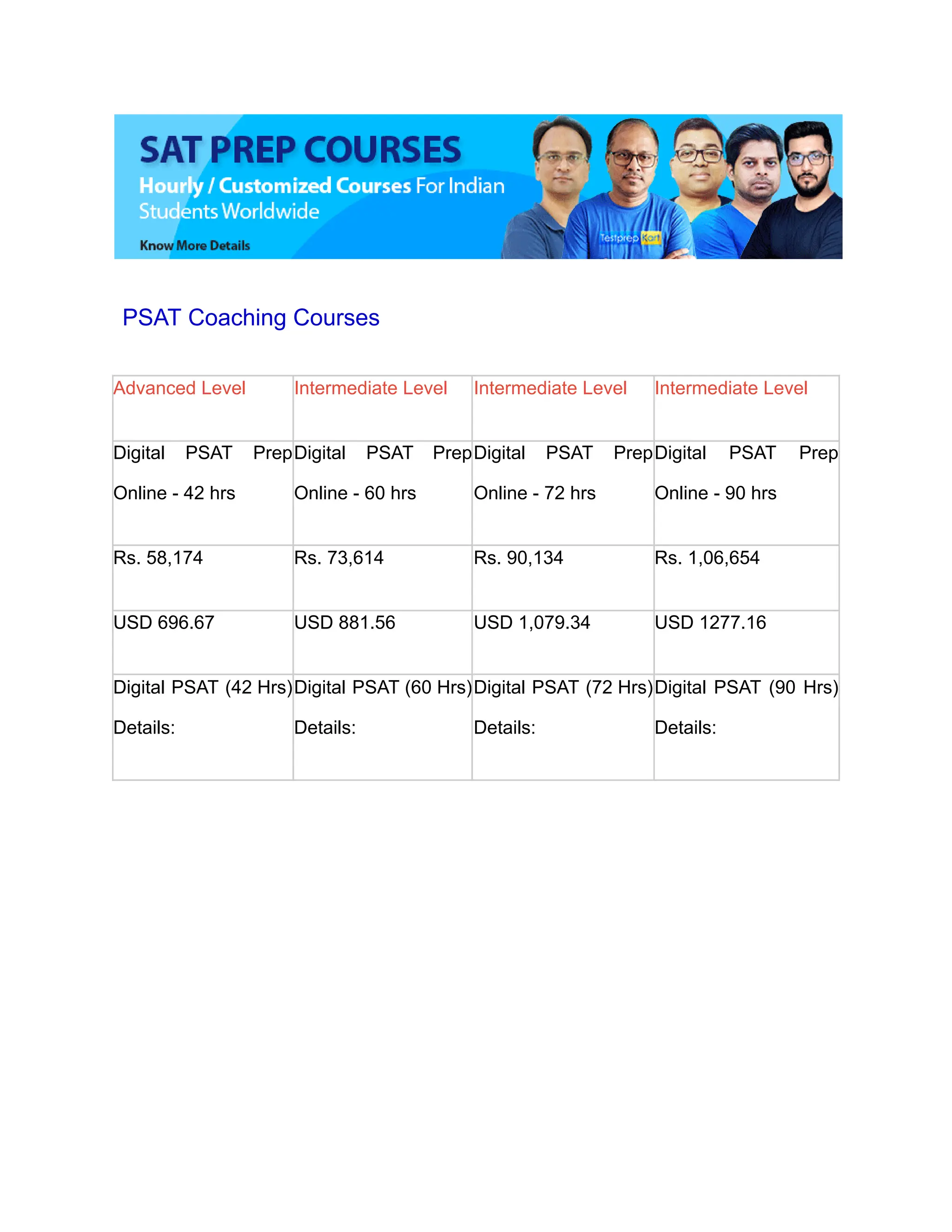
PSAT Coaching Courses
Advanced Level Intermediate Level Intermediate Level Intermediate Level
Digital PSAT Prep
Online - 42 hrs
Digital PSAT Prep
Online - 60 hrs
Digital PSAT Prep
Online - 72 hrs
Digital PSAT Prep
Online - 90 hrs
Rs. 58,174 Rs. 73,614 Rs. 90,134 Rs. 1,06,654
USD 696.67 USD 881.56 USD 1,079.34 USD 1277.16
Digital PSAT (42 Hrs)
Details:
Digital PSAT (60 Hrs)
Details:
Digital PSAT (72 Hrs)
Details:
Digital PSAT (90 Hrs)
Details:
1. Live & Interactive
Real Time Sessions
2. Best English and
Maths Experts For
Digital PSAT
3. High Score Course
Modules
4. Session Wise
Assignments
5. 3 Types of Tests -
Online, Offline and
Hard Copy
6. Practice of 3600
questions during the
entire course
1. Live & Interactive
Real Time Sessions
2. Best English and
Maths Experts For
Digital SAT
3. High Score Course
Modules
4. Session Wise
Assignments
5. 3 Types of Tests -
Online, Offline and
Hard Copy
6. Practice of 3600
questions during the
entire course
1. Live & Interactive
Real Time Sessions
2. Best English &
Maths Experts For
PSAT
3. Scientifically
Designed Course
Modules
4. Session Wise
Assignments
5. 3 Types of Tests -
Online, Offline and
Hard Copy
6. Practice of 3600
questions during the
entire course
1. Live & Interactive
Real Time Sessions
2. Best English &
Mathematics Experts
For Digital PSAT
3. Scientifically
Designed Course
Modules
4. Session Wise
Assignments
5. 3 Types of Tests -
Online, Offline and
Hard Copy
6. Practice of 3600
questions during the
entire course
7. Comprehensive
Study Material -
Module Wise
8. Regular Doubt
Removal Sessions
9. Rapid Reading
Exercises
10. Suggested
Reading Sessions
11. Special Tips and
Techniques to get a
perfect score
12. Group sessions
7. Comprehensive
Study Material -
Module Wise
8. Regular Doubt
Removal Sessions
9. Group sessions
7. Comprehensive
Study Material -
Module Wise
8. Regular Doubt
Removal Sessions
9. Rapid Reading
Exercises
10. Suggested
Reading Sessions
11. Special Tips and
Techniques to get a
perfect score
12. One-on-one
sessions
7. Comprehensive
Study Material -
Module Wise
8. Regular Doubt
Removal Sessions
9. Rapid Reading
Exercises
10. Suggested
Reading Sessions
11. Special Tips and
Techniques to get a
perfect score
12. One-on-one
sessions
Learn More Learn More Learn More Learn More
The PSAT/NMSQT (Preliminary SAT/National Merit Scholarship Qualifying Test) is a
standardized test in Unites States that serves two main purposes:
1. Practice for the SAT: The PSAT/NMSQT is often taken by high school juniors as a
practice test for the SAT, a college entrance exam. It helps students familiarize
themselves with the format, question types, and timing of the sat.
2. Qualification fir the National Merit Scholarship Program: The PSAT/NMSQT is also
the qualifying test for the National Merit Scholarship Program. High scores can become
National Merit Scholars and may be eligible for scholarships.
Difference NMSQT, PSAT & SAT
The SAT and PSAT/NMSQT are organized tests administered by the College Board, but
they have different meanings and purposes.
Feature PSAT
NMSQT (National Merit
Scholarship Qualifying
Test)
SAT
Purpose
Practice test for the
SAT
Qualifying test for the
National Merit
Scholarship, also serves
as practice for the SAT
College admissions
test
When Taken Primarily 10th and 11th
grades, but younger
Taken during 11th grade
(in October) as part of the
Typically taken during
11th and 12th grades
students can take it for
practice
PSAT to qualify for
National Merit
Scholarships
Content
Covers
Evidence-Based
Reading and Writing,
and Math (no essay)
Identical to the PSAT, with
scores used to determine
eligibility for scholarships
Covers
Evidence-Based
Reading and Writing,
Math, and an optional
Essay section
Score Range 320 to 1520 320 to 1520 400 to 1600
Use of Scores
Diagnostic tool for SAT
preparation, provides
insight into strengths
and weaknesses
Used to determine
eligibility for National
Merit Scholarships; also
provides SAT practice
Used by colleges and
universities for
admissions decisions
Test Length
2 hours and 45
minutes
2 hours and 45 minutes
3 hours (plus 50
minutes for optional
Essay)
Sections - Reading (60 minutes)- Reading (60 minutes) - Reading (65 minutes)
- Writing and
Language (35
minutes)
- Writing and Language
(35 minutes)
- Writing and
Language (35
minutes)
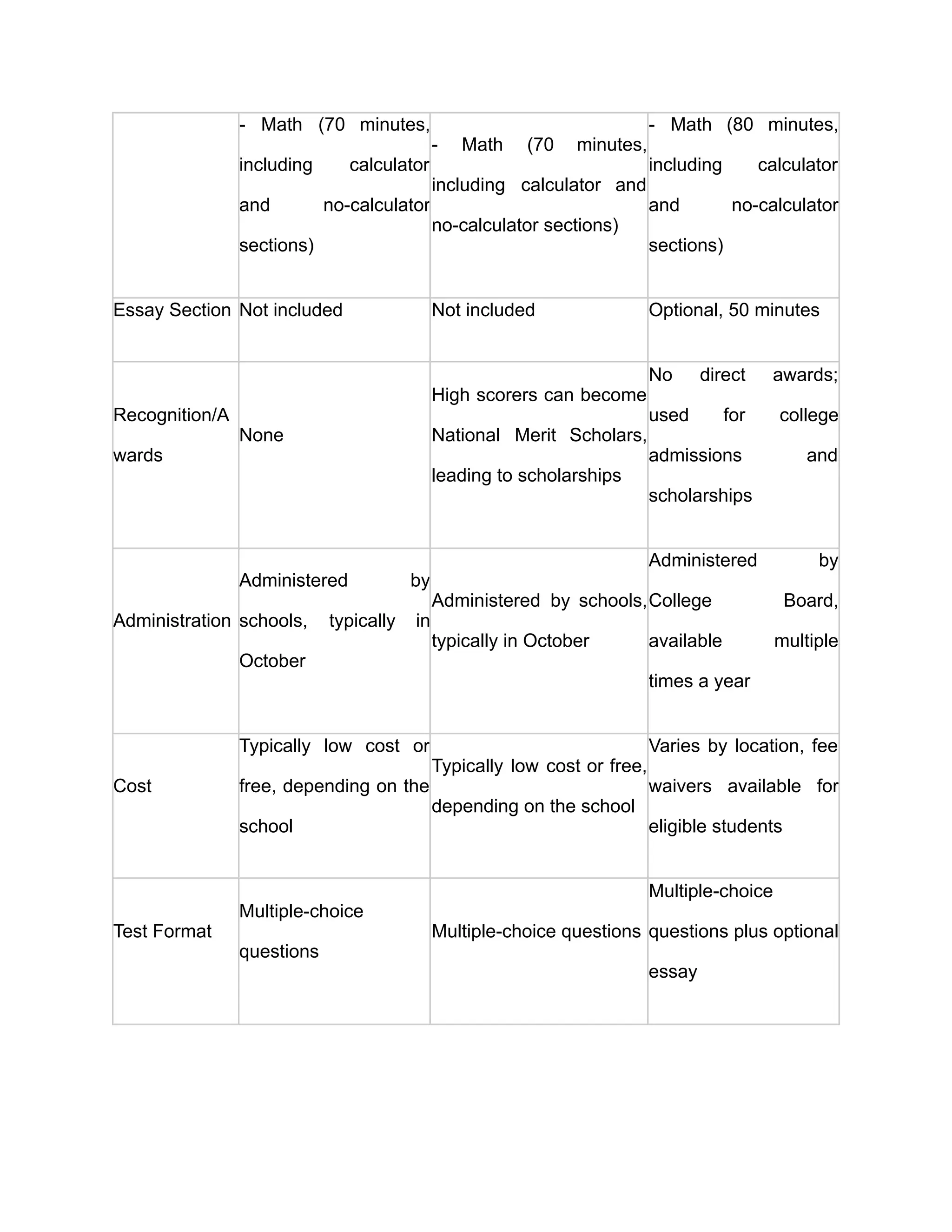
- Math (70 minutes,
including calculator
and no-calculator
sections)
- Math (70 minutes,
including calculator and
no-calculator sections)
- Math (80 minutes,
including calculator
and no-calculator
sections)
Essay Section Not included Not included Optional, 50 minutes
Recognition/A
wards
None
High scorers can become
National Merit Scholars,
leading to scholarships
No direct awards;
used for college
admissions and
scholarships
Administration
Administered by
schools, typically in
October
Administered by schools,
typically in October
Administered by
College Board,
available multiple
times a year
Cost
Typically low cost or
free, depending on the
school
Typically low cost or free,
depending on the school
Varies by location, fee
waivers available for
eligible students
Test Format
Multiple-choice
questions
Multiple-choice questions
Multiple-choice
questions plus optional
essay
"Top Reasons to Choose Testprepkart for Your PSAT Coaching"
Here is a reasons why Testprepkart could be valuable resource for the Coaching of
PSAT -
Feature Description
Specialization in
International
Curriculums
Emphasis on preparing international students for standardized
tests like the PSAT, considering the unique challenges faced by
non-U.S. curriculum students.
Experienced Faculty
Offers expert instructors with significant experience in their
respective fields, helping students grasp complex concepts
effectively.
Structured Courses
and Study Plans
Provides a clear, structured approach to covering the entire PSAT
syllabus, ensuring comprehensive preparation and organization.
Online Flexibility
Offers online classes, making it accessible to students worldwide,
especially beneficial for those without local PSAT prep resources.
Practice Tests and
Resources
Supplies a variety of practice tests and materials that closely
mimic the actual PSAT, helping students familiarize themselves
with the test format and timing.
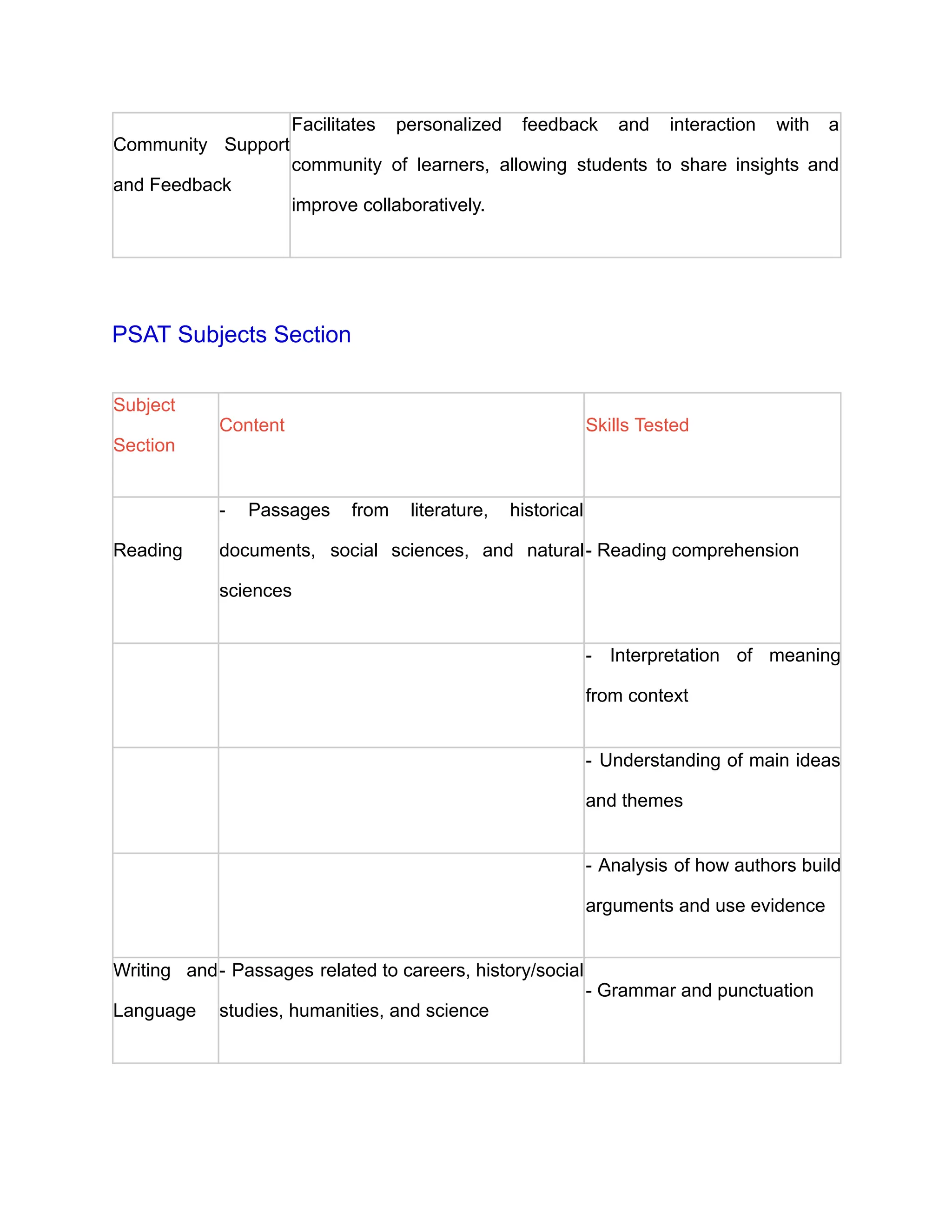
Community Support
and Feedback
Facilitates personalized feedback and interaction with a
community of learners, allowing students to share insights and
improve collaboratively.
PSAT Subjects Section
Subject
Section
Content Skills Tested
Reading
- Passages from literature, historical
documents, social sciences, and natural
sciences
- Reading comprehension
- Interpretation of meaning
from context
- Understanding of main ideas
and themes
- Analysis of how authors build
arguments and use evidence
Writing and
Language
- Passages related to careers, history/social
studies, humanities, and science
- Grammar and punctuation
- Sentence structure
- Improving organization and
clarity of written text
- Effective language use
- Recognizing and fixing errors
in writing
Math - Calculator and non-calculator sections - Mathematical reasoning
- Topics: Algebra, problem-solving and data
analysis, advanced math, geometry,
trigonometry
-Understanding of math
concepts
- Application of math concepts
to solve problems
Understanding the PSAT Suite of Assessment
The SAT suite of Assessment is a combination of tests that helps to develop a root
cause for getting admission in college of your dream and career readiness, track
students progress, and identifies areas for improvement. Here is an overview of the SAT
Suite of Assessment -
1. PSAT for 8 & 9 Grade
● Purpose - The PSAT 8 & 9 Grade is the first test in the SAT Suite of
Assessment, designed for students in the 8th and 9th grades. It establishes a
baseline for college and career readiness as students enter high school.
● Subjects
1. Reading: Passages that test reading comprehension and understanding of
vocabulary in context.
2. Writing and Language: Focuses on grammar, punctuation, sentence structure,
and understanding how to revise and edit text.
3. Math: Covers basic algebra, problem-solving, data analysis, and some
geometry.
● Scoring - The PSAT for 8 & 9 grade is scored on a scale of 240 to 1440.
Scores give early feedback on students strengths and areas for improvement.
2. PSAT for 10 Grade
● Purpose - The PSAT for grade 10th is designed and similar to the
PSAT/NMSQT but administered at a different time of year mostly in spring It
provides a practice opportunity and offers feedback on academic progress.
● Subjects - Identical to the PSAT/NMSQT, covering Reading, Writing and
Language, and math.
● Scoring - Scored on the same scale as the PSAT/NMSQT (320 to1520). It
does not qualify students for the National Merit Scholarship Program but helps
them prepare for the SAT.
3. PSAT/NMSQT (Preliminary SAT/ National Merit Scholarship Qualifying Test)
● Purpose - Taken primarily by juniors, the PSAT/NMSQT is both a practice test
for the SAT and the qualifying test for the National Merit Scholarship Program.
● Subjects - Covers Reading, Writing and Language, and Math, with a slightly
easier level of difficulty compared to the SAT.
● Scoring - Scored on a scale of 320 to 1520. The Selection Index, which is
used to determine National Merit Scholarship eligibility, is calculated by
doubling the sum of the Reading, Writing, and Math scores.
● National Merit Scholarship - High scores on the PSAT/NMSQT can qualify
students for recognition and scholarships through the National Merit
Scholarship program.
Purpose of SAT and PSAT: Why Take Them?
Test Purpose Why Take It?
SAT
College
Admissions
- Key component of the college admissions process
Scholarship
Opportunities
- Qualify for merit-based scholarships
Academic
Benchmarking
- Indicator of readiness for college coursework which is
essential part of the SAT exam
College Placement - Placement in advanced courses or remedial classes
National
Comparison
- Standardized measure to compare academic ability
across students
PSAT SAT Preparation
- Practice test for the SAT to familiarize with format and
content
National Merit
Scholarship
Qualification
- Opportunity to qualify for the National Merit
Scholarship Program
Academic Progress
Tracking
- Provides feedback on strengths and areas for
improvement
College Readiness
Benchmark
- Early indicator of college readiness
Course Planning
- Guides selection of high school courses and academic
planning
Who Takes Them and When?
Test Who Takes It? When Is It Taken?
SAT
- High school juniors and
seniors (11th and 12th grades)
- Multiple times a year (usually in August,
October, November, December, March, May, and
June)
- Students applying for college
admissions
- Scheduling can vary, but most commonly in
junior and senior years of high school
PSAT
- High school sophomores and
juniors (10th and 11th grades)
- Once a year (typically in October)
- Primarily juniors for National
Merit Scholarship
consideration
- Typically administered in October during the
school day
Administration and Registration Differences: PSAT & SAT
Aspect SAT PSAT
Administration - Administered by the College Board
- Administered by the College
Board
- Held at designated testing centers
nationwide
- Administered at participating
high schools
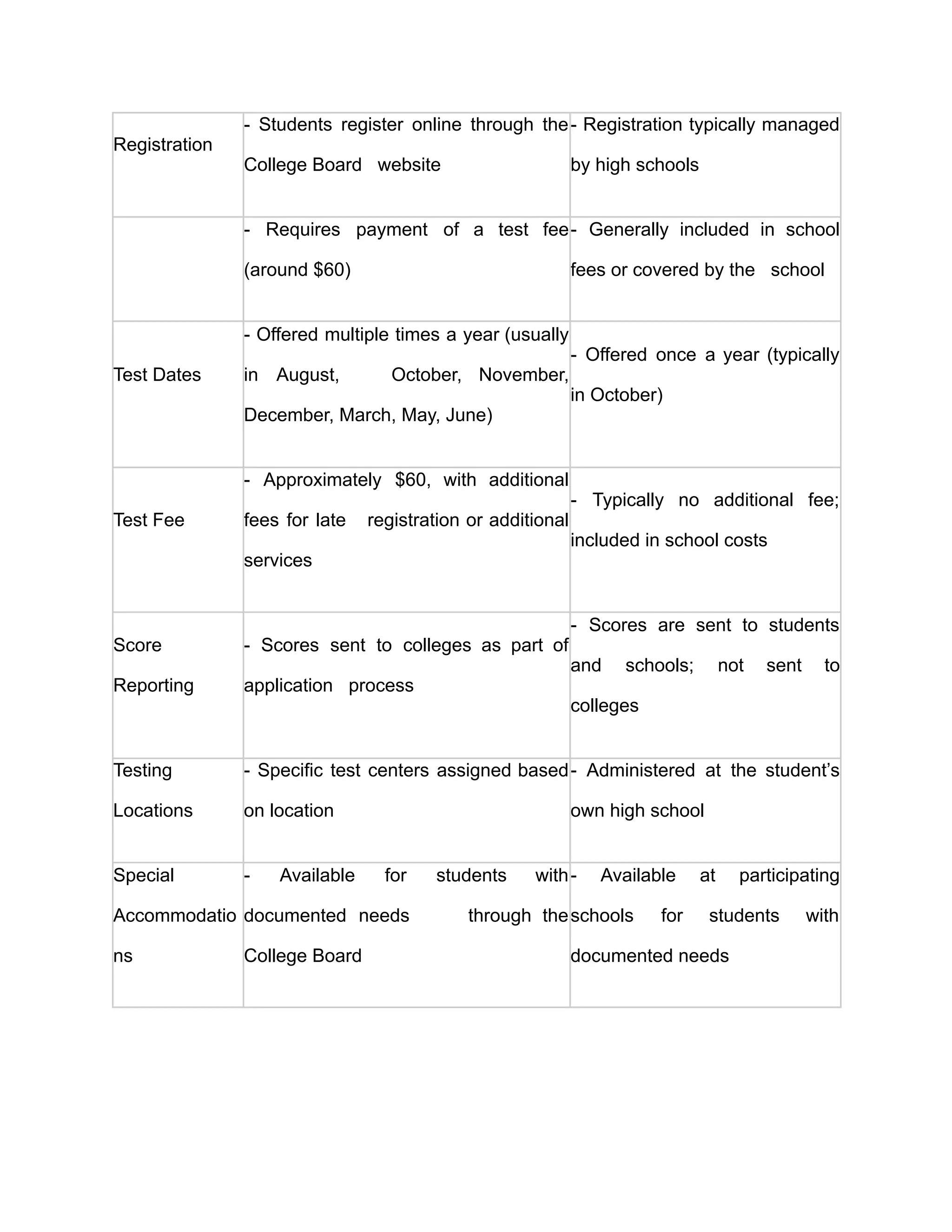
Registration
- Students register online through the
College Board website
- Registration typically managed
by high schools
- Requires payment of a test fee
(around $60)
- Generally included in school
fees or covered by the school
Test Dates
- Offered multiple times a year (usually
in August, October, November,
December, March, May, June)
- Offered once a year (typically
in October)
Test Fee
- Approximately $60, with additional
fees for late registration or additional
services
- Typically no additional fee;
included in school costs
Score
Reporting
- Scores sent to colleges as part of
application process
- Scores are sent to students
and schools; not sent to
colleges
Testing
Locations
- Specific test centers assigned based
on location
- Administered at the student’s
own high school
Special
Accommodatio
ns
- Available for students with
documented needs through the
College Board
- Available at participating
schools for students with
documented needs
Registration
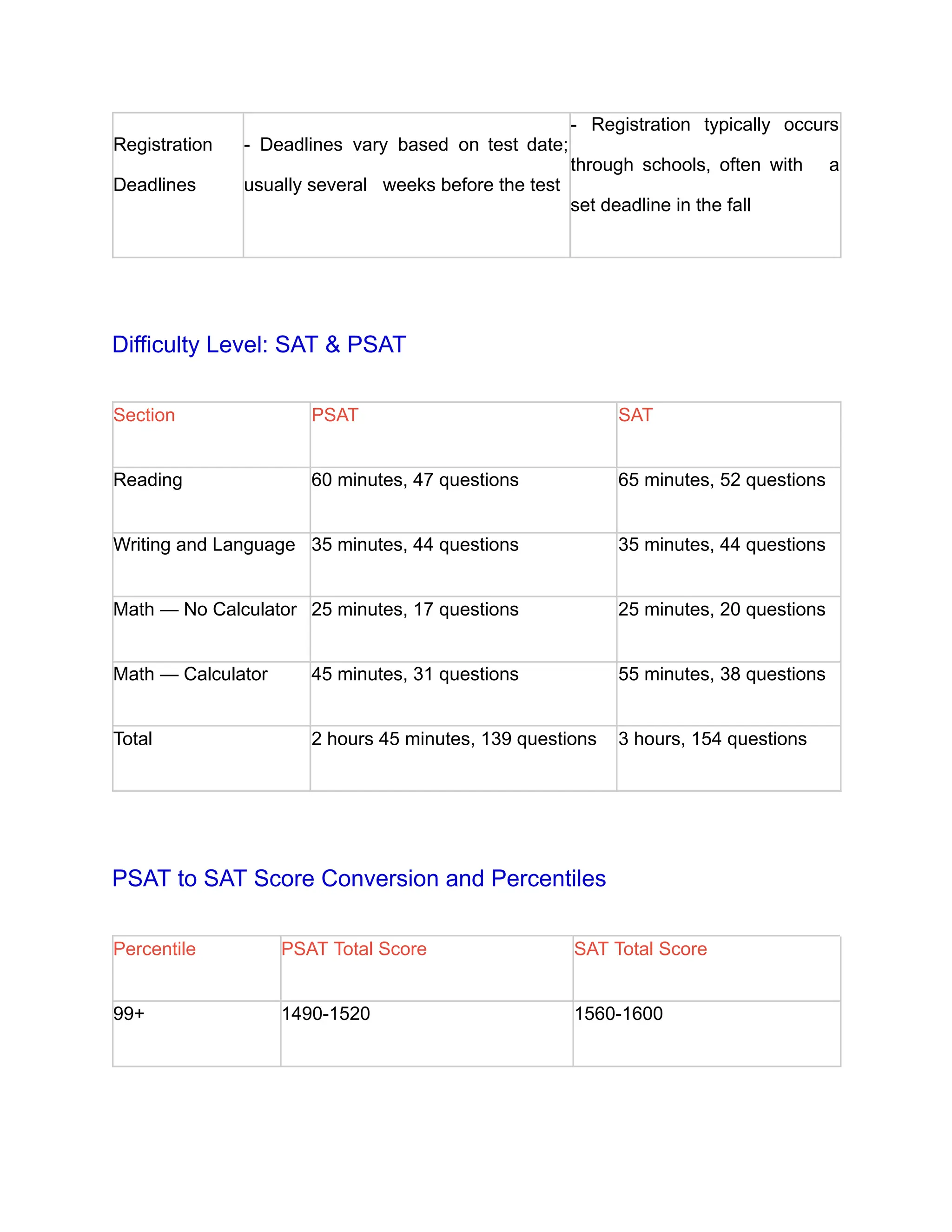
Deadlines
- Deadlines vary based on test date;
usually several weeks before the test
- Registration typically occurs
through schools, often with a
set deadline in the fall
Difficulty Level: SAT & PSAT
Section PSAT SAT
Reading 60 minutes, 47 questions 65 minutes, 52 questions
Writing and Language 35 minutes, 44 questions 35 minutes, 44 questions
Math — No Calculator 25 minutes, 17 questions 25 minutes, 20 questions
Math — Calculator 45 minutes, 31 questions 55 minutes, 38 questions
Total 2 hours 45 minutes, 139 questions 3 hours, 154 questions
PSAT to SAT Score Conversion and Percentiles
Percentile PSAT Total Score SAT Total Score
99+ 1490-1520 1560-1600
99 1460-1480 1520-1550
95 1360-1370 1430-1440
90 1280 1350
85 1230 1290
80 1190 1240-1250
75 1150 1200-1210
50 1000-1010 1040-1050
When to attempt the NMSQT exam?
● The PSAT/NMSQT exam is typically taken during a student's junior year of
high school, specifically in the fall. Here are some details on when to attempt
the NMSQT:
● Primary Test Date: The main test date for the PSAT/NMSQT usually falls in
mid-October.
● Alternate Test Date: There is often an alternate test date in October for
students who cannot attend on the primary date.
● Sophomore Year (Optional): Some students choose to take the PSAT/NMSQT
in their sophomore year as a practice run. However, only the score from the
junior year attempt counts for the National Merit Scholarship Program.
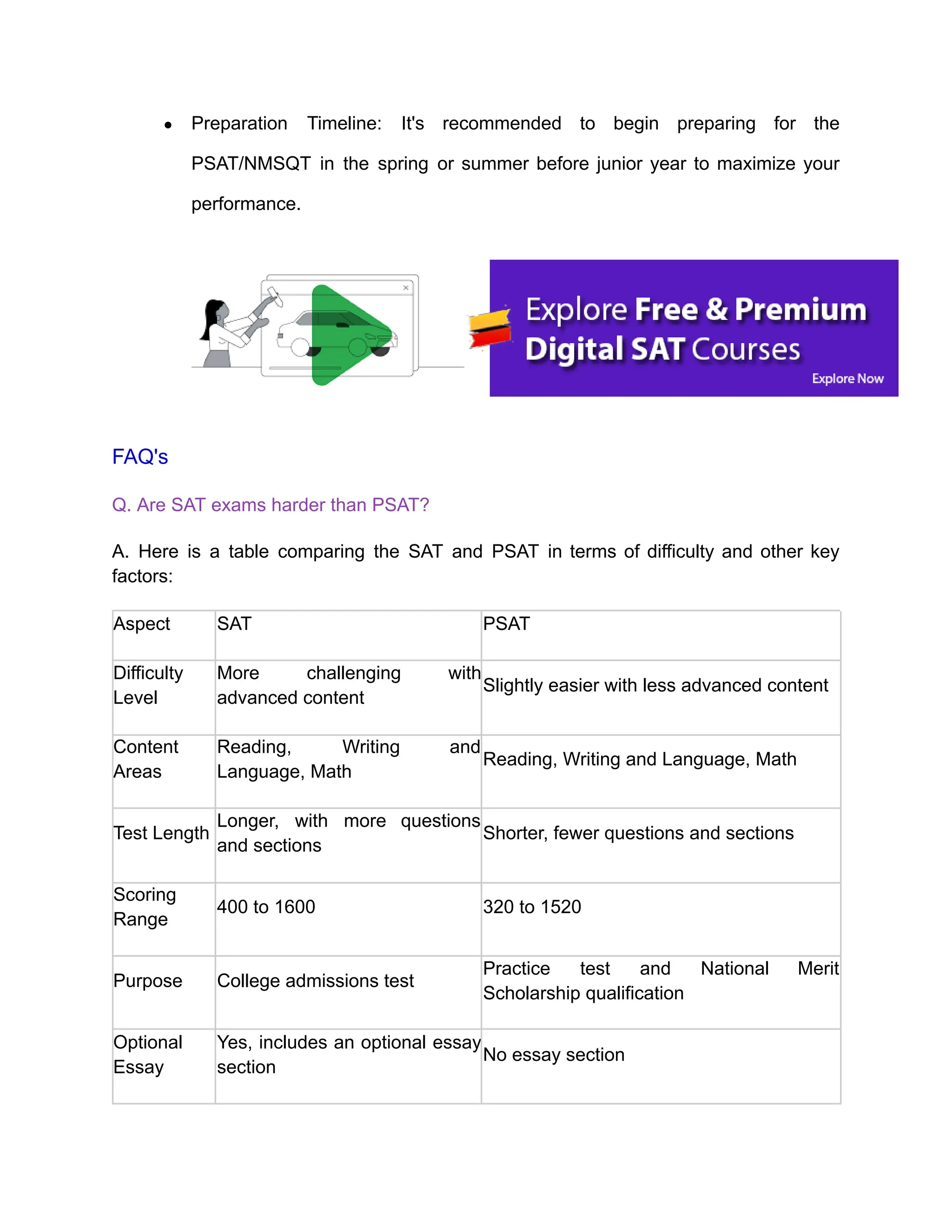
● Preparation Timeline: It's recommended to begin preparing for the
PSAT/NMSQT in the spring or summer before junior year to maximize your
performance.
FAQ's
Q. Are SAT exams harder than PSAT?
A. Here is a table comparing the SAT and PSAT in terms of difficulty and other key
factors:
Aspect SAT PSAT
Difficulty
Level
More challenging with
advanced content
Slightly easier with less advanced content
Content
Areas
Reading, Writing and
Language, Math
Reading, Writing and Language, Math
Test Length
Longer, with more questions
and sections
Shorter, fewer questions and sections
Scoring
Range
400 to 1600 320 to 1520
Purpose College admissions test
Practice test and National Merit
Scholarship qualification
Optional
Essay
Yes, includes an optional essay
section
No essay section
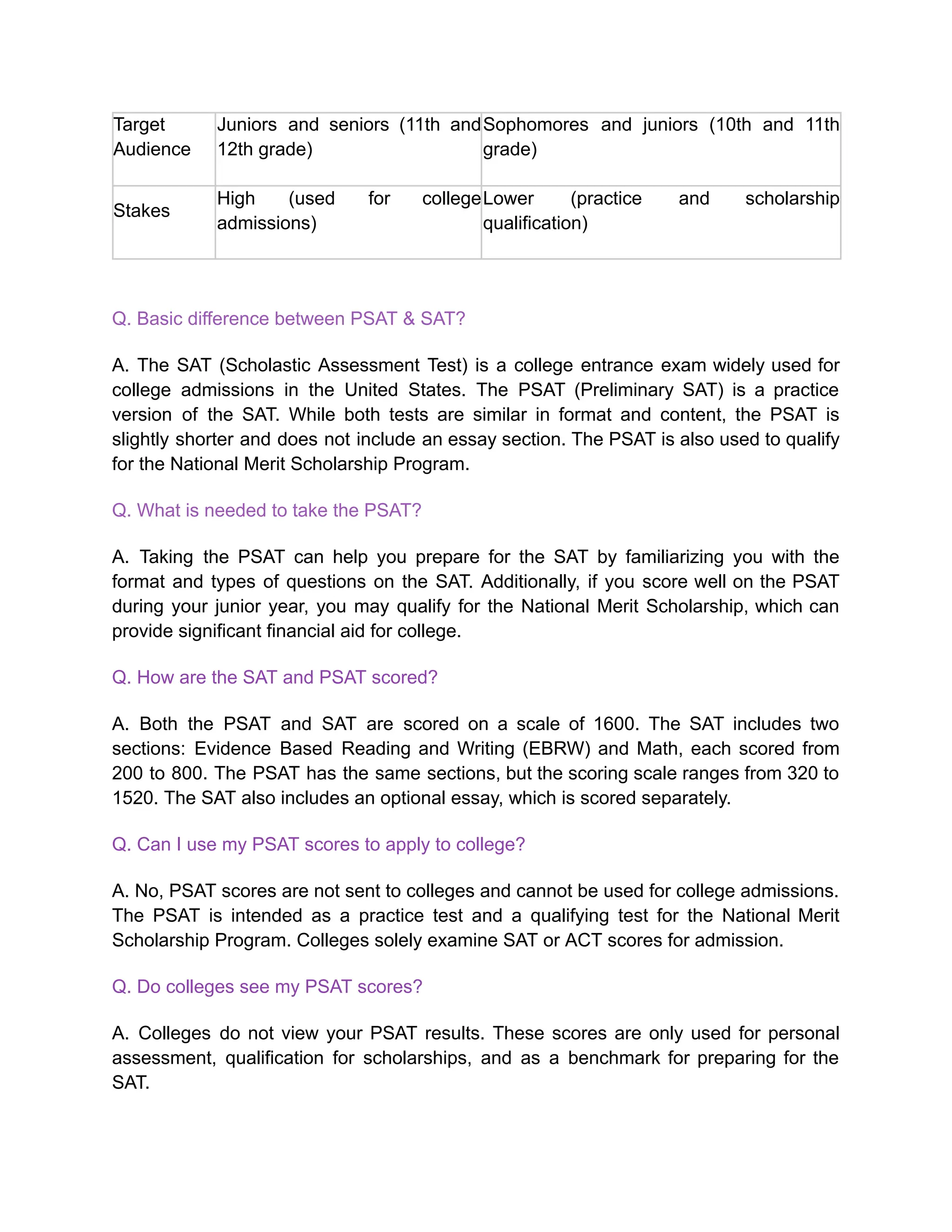
Target
Audience
Juniors and seniors (11th and
12th grade)
Sophomores and juniors (10th and 11th
grade)
Stakes
High (used for college
admissions)
Lower (practice and scholarship
qualification)
Q. Basic difference between PSAT & SAT?
A. The SAT (Scholastic Assessment Test) is a college entrance exam widely used for
college admissions in the United States. The PSAT (Preliminary SAT) is a practice
version of the SAT. While both tests are similar in format and content, the PSAT is
slightly shorter and does not include an essay section. The PSAT is also used to qualify
for the National Merit Scholarship Program.
Q. What is needed to take the PSAT?
A. Taking the PSAT can help you prepare for the SAT by familiarizing you with the
format and types of questions on the SAT. Additionally, if you score well on the PSAT
during your junior year, you may qualify for the National Merit Scholarship, which can
provide significant financial aid for college.
Q. How are the SAT and PSAT scored?
A. Both the PSAT and SAT are scored on a scale of 1600. The SAT includes two
sections: Evidence Based Reading and Writing (EBRW) and Math, each scored from
200 to 800. The PSAT has the same sections, but the scoring scale ranges from 320 to
1520. The SAT also includes an optional essay, which is scored separately.
Q. Can I use my PSAT scores to apply to college?
A. No, PSAT scores are not sent to colleges and cannot be used for college admissions.
The PSAT is intended as a practice test and a qualifying test for the National Merit
Scholarship Program. Colleges solely examine SAT or ACT scores for admission.
Q. Do colleges see my PSAT scores?
A. Colleges do not view your PSAT results. These scores are only used for personal
assessment, qualification for scholarships, and as a benchmark for preparing for the
SAT.
Q. How much does it cost to take the SAT and PSAT?
A. The PSAT typically costs around $18, though some schools cover the fee for
students. The SAT costs around $60, with additional fees if you register late or wish to
send scores to colleges after the initial registration.
Q. What is the National Merit Scholarship program, and how does the PSAT relate to it?
A. The National Merit Scholarship Program is a nationwide scholarship competition
based on PSAT/NMSQT scores. High-scoring students on the PSAT in their junior year
may qualify as National Merit Semifinalists and, if they meet additional criteria, can
become Finalists eligible for scholarships.
SAT eBook
It is very important to know minor to major facts when starting your preparation for an
aptitude-based exam like SAT, with updates that can help with your SAT preparation.
We are pleased to announce the release of TestprepKart's free SAT study guide for the
new SAT. This free SAT ebook gives you everything you need to know about the test,
from content to content mastery, among the top practice goals you need.
Download SAT eBook

Effective PSAT Preparation Online Guide"

  • 1.
    PSAT Preparation Online ThePSAT (Preliminary SAT) is an official examination used in the United States to get students ready for the SAT (Scholastic Assessment Test). It is often taken by high school sophomores and juniors in preparation for the SAT. Furthermore the PSAT serves as the qualifying exam for the National Merit Scholarship program, making it essential for students seeking scholarships. The test measures reading, writing and mathematical abilities. Tips to Prepare for the PSAT ● Understand the Test: Familiarize yourself with the PSAT format and question types. ● Take Practice Tests: Use timed practice tests to build stamina and identify weaknesses. ● Focus on Weak Areas: Review and practice topics where you struggle the most. ● Review Key Concepts: Strengthen your knowledge of math, grammar, and reading skills. ● Use Quality Resources: Utilize reputable SAT study materials at testprepkart.com/sat/. ● Create a Study Schedule: Plan your study sessions in advance to avoid cramming. ● Learn Test Strategies: Practice time management and question strategies. ● Pace Yourself: Manage your time effectively during the test. ● Stay Positive: Confidence and calmness are key on test day. ● Get Rest: Ensure you’re well-rested before the test.
  • 2.
    PSAT Coaching Courses AdvancedLevel Intermediate Level Intermediate Level Intermediate Level Digital PSAT Prep Online - 42 hrs Digital PSAT Prep Online - 60 hrs Digital PSAT Prep Online - 72 hrs Digital PSAT Prep Online - 90 hrs Rs. 58,174 Rs. 73,614 Rs. 90,134 Rs. 1,06,654 USD 696.67 USD 881.56 USD 1,079.34 USD 1277.16 Digital PSAT (42 Hrs) Details: Digital PSAT (60 Hrs) Details: Digital PSAT (72 Hrs) Details: Digital PSAT (90 Hrs) Details:
  • 3.
    1. Live &Interactive Real Time Sessions 2. Best English and Maths Experts For Digital PSAT 3. High Score Course Modules 4. Session Wise Assignments 5. 3 Types of Tests - Online, Offline and Hard Copy 6. Practice of 3600 questions during the entire course 1. Live & Interactive Real Time Sessions 2. Best English and Maths Experts For Digital SAT 3. High Score Course Modules 4. Session Wise Assignments 5. 3 Types of Tests - Online, Offline and Hard Copy 6. Practice of 3600 questions during the entire course 1. Live & Interactive Real Time Sessions 2. Best English & Maths Experts For PSAT 3. Scientifically Designed Course Modules 4. Session Wise Assignments 5. 3 Types of Tests - Online, Offline and Hard Copy 6. Practice of 3600 questions during the entire course 1. Live & Interactive Real Time Sessions 2. Best English & Mathematics Experts For Digital PSAT 3. Scientifically Designed Course Modules 4. Session Wise Assignments 5. 3 Types of Tests - Online, Offline and Hard Copy 6. Practice of 3600 questions during the entire course
  • 4.
    7. Comprehensive Study Material- Module Wise 8. Regular Doubt Removal Sessions 9. Rapid Reading Exercises 10. Suggested Reading Sessions 11. Special Tips and Techniques to get a perfect score 12. Group sessions 7. Comprehensive Study Material - Module Wise 8. Regular Doubt Removal Sessions 9. Group sessions 7. Comprehensive Study Material - Module Wise 8. Regular Doubt Removal Sessions 9. Rapid Reading Exercises 10. Suggested Reading Sessions 11. Special Tips and Techniques to get a perfect score 12. One-on-one sessions 7. Comprehensive Study Material - Module Wise 8. Regular Doubt Removal Sessions 9. Rapid Reading Exercises 10. Suggested Reading Sessions 11. Special Tips and Techniques to get a perfect score 12. One-on-one sessions Learn More Learn More Learn More Learn More
  • 5.
    The PSAT/NMSQT (PreliminarySAT/National Merit Scholarship Qualifying Test) is a standardized test in Unites States that serves two main purposes: 1. Practice for the SAT: The PSAT/NMSQT is often taken by high school juniors as a practice test for the SAT, a college entrance exam. It helps students familiarize themselves with the format, question types, and timing of the sat. 2. Qualification fir the National Merit Scholarship Program: The PSAT/NMSQT is also the qualifying test for the National Merit Scholarship Program. High scores can become National Merit Scholars and may be eligible for scholarships. Difference NMSQT, PSAT & SAT The SAT and PSAT/NMSQT are organized tests administered by the College Board, but they have different meanings and purposes. Feature PSAT NMSQT (National Merit Scholarship Qualifying Test) SAT Purpose Practice test for the SAT Qualifying test for the National Merit Scholarship, also serves as practice for the SAT College admissions test When Taken Primarily 10th and 11th grades, but younger Taken during 11th grade (in October) as part of the Typically taken during 11th and 12th grades
  • 6.
    students can takeit for practice PSAT to qualify for National Merit Scholarships Content Covers Evidence-Based Reading and Writing, and Math (no essay) Identical to the PSAT, with scores used to determine eligibility for scholarships Covers Evidence-Based Reading and Writing, Math, and an optional Essay section Score Range 320 to 1520 320 to 1520 400 to 1600 Use of Scores Diagnostic tool for SAT preparation, provides insight into strengths and weaknesses Used to determine eligibility for National Merit Scholarships; also provides SAT practice Used by colleges and universities for admissions decisions Test Length 2 hours and 45 minutes 2 hours and 45 minutes 3 hours (plus 50 minutes for optional Essay) Sections - Reading (60 minutes)- Reading (60 minutes) - Reading (65 minutes) - Writing and Language (35 minutes) - Writing and Language (35 minutes) - Writing and Language (35 minutes)
  • 7.
    - Math (70minutes, including calculator and no-calculator sections) - Math (70 minutes, including calculator and no-calculator sections) - Math (80 minutes, including calculator and no-calculator sections) Essay Section Not included Not included Optional, 50 minutes Recognition/A wards None High scorers can become National Merit Scholars, leading to scholarships No direct awards; used for college admissions and scholarships Administration Administered by schools, typically in October Administered by schools, typically in October Administered by College Board, available multiple times a year Cost Typically low cost or free, depending on the school Typically low cost or free, depending on the school Varies by location, fee waivers available for eligible students Test Format Multiple-choice questions Multiple-choice questions Multiple-choice questions plus optional essay
  • 8.
    "Top Reasons toChoose Testprepkart for Your PSAT Coaching" Here is a reasons why Testprepkart could be valuable resource for the Coaching of PSAT - Feature Description Specialization in International Curriculums Emphasis on preparing international students for standardized tests like the PSAT, considering the unique challenges faced by non-U.S. curriculum students. Experienced Faculty Offers expert instructors with significant experience in their respective fields, helping students grasp complex concepts effectively. Structured Courses and Study Plans Provides a clear, structured approach to covering the entire PSAT syllabus, ensuring comprehensive preparation and organization. Online Flexibility Offers online classes, making it accessible to students worldwide, especially beneficial for those without local PSAT prep resources. Practice Tests and Resources Supplies a variety of practice tests and materials that closely mimic the actual PSAT, helping students familiarize themselves with the test format and timing.
  • 9.
    Community Support and Feedback Facilitatespersonalized feedback and interaction with a community of learners, allowing students to share insights and improve collaboratively. PSAT Subjects Section Subject Section Content Skills Tested Reading - Passages from literature, historical documents, social sciences, and natural sciences - Reading comprehension - Interpretation of meaning from context - Understanding of main ideas and themes - Analysis of how authors build arguments and use evidence Writing and Language - Passages related to careers, history/social studies, humanities, and science - Grammar and punctuation
  • 10.
    - Sentence structure -Improving organization and clarity of written text - Effective language use - Recognizing and fixing errors in writing Math - Calculator and non-calculator sections - Mathematical reasoning - Topics: Algebra, problem-solving and data analysis, advanced math, geometry, trigonometry -Understanding of math concepts - Application of math concepts to solve problems Understanding the PSAT Suite of Assessment The SAT suite of Assessment is a combination of tests that helps to develop a root cause for getting admission in college of your dream and career readiness, track students progress, and identifies areas for improvement. Here is an overview of the SAT Suite of Assessment -
  • 11.
    1. PSAT for8 & 9 Grade ● Purpose - The PSAT 8 & 9 Grade is the first test in the SAT Suite of Assessment, designed for students in the 8th and 9th grades. It establishes a baseline for college and career readiness as students enter high school. ● Subjects 1. Reading: Passages that test reading comprehension and understanding of vocabulary in context. 2. Writing and Language: Focuses on grammar, punctuation, sentence structure, and understanding how to revise and edit text. 3. Math: Covers basic algebra, problem-solving, data analysis, and some geometry. ● Scoring - The PSAT for 8 & 9 grade is scored on a scale of 240 to 1440. Scores give early feedback on students strengths and areas for improvement. 2. PSAT for 10 Grade ● Purpose - The PSAT for grade 10th is designed and similar to the PSAT/NMSQT but administered at a different time of year mostly in spring It provides a practice opportunity and offers feedback on academic progress. ● Subjects - Identical to the PSAT/NMSQT, covering Reading, Writing and Language, and math. ● Scoring - Scored on the same scale as the PSAT/NMSQT (320 to1520). It does not qualify students for the National Merit Scholarship Program but helps them prepare for the SAT.
  • 12.
    3. PSAT/NMSQT (PreliminarySAT/ National Merit Scholarship Qualifying Test) ● Purpose - Taken primarily by juniors, the PSAT/NMSQT is both a practice test for the SAT and the qualifying test for the National Merit Scholarship Program. ● Subjects - Covers Reading, Writing and Language, and Math, with a slightly easier level of difficulty compared to the SAT. ● Scoring - Scored on a scale of 320 to 1520. The Selection Index, which is used to determine National Merit Scholarship eligibility, is calculated by doubling the sum of the Reading, Writing, and Math scores. ● National Merit Scholarship - High scores on the PSAT/NMSQT can qualify students for recognition and scholarships through the National Merit Scholarship program. Purpose of SAT and PSAT: Why Take Them? Test Purpose Why Take It? SAT College Admissions - Key component of the college admissions process Scholarship Opportunities - Qualify for merit-based scholarships Academic Benchmarking - Indicator of readiness for college coursework which is essential part of the SAT exam College Placement - Placement in advanced courses or remedial classes
  • 13.
    National Comparison - Standardized measureto compare academic ability across students PSAT SAT Preparation - Practice test for the SAT to familiarize with format and content National Merit Scholarship Qualification - Opportunity to qualify for the National Merit Scholarship Program Academic Progress Tracking - Provides feedback on strengths and areas for improvement College Readiness Benchmark - Early indicator of college readiness Course Planning - Guides selection of high school courses and academic planning Who Takes Them and When?
  • 14.
    Test Who TakesIt? When Is It Taken? SAT - High school juniors and seniors (11th and 12th grades) - Multiple times a year (usually in August, October, November, December, March, May, and June) - Students applying for college admissions - Scheduling can vary, but most commonly in junior and senior years of high school PSAT - High school sophomores and juniors (10th and 11th grades) - Once a year (typically in October) - Primarily juniors for National Merit Scholarship consideration - Typically administered in October during the school day Administration and Registration Differences: PSAT & SAT Aspect SAT PSAT Administration - Administered by the College Board - Administered by the College Board - Held at designated testing centers nationwide - Administered at participating high schools
  • 15.
    Registration - Students registeronline through the College Board website - Registration typically managed by high schools - Requires payment of a test fee (around $60) - Generally included in school fees or covered by the school Test Dates - Offered multiple times a year (usually in August, October, November, December, March, May, June) - Offered once a year (typically in October) Test Fee - Approximately $60, with additional fees for late registration or additional services - Typically no additional fee; included in school costs Score Reporting - Scores sent to colleges as part of application process - Scores are sent to students and schools; not sent to colleges Testing Locations - Specific test centers assigned based on location - Administered at the student’s own high school Special Accommodatio ns - Available for students with documented needs through the College Board - Available at participating schools for students with documented needs
  • 16.
    Registration Deadlines - Deadlines varybased on test date; usually several weeks before the test - Registration typically occurs through schools, often with a set deadline in the fall Difficulty Level: SAT & PSAT Section PSAT SAT Reading 60 minutes, 47 questions 65 minutes, 52 questions Writing and Language 35 minutes, 44 questions 35 minutes, 44 questions Math — No Calculator 25 minutes, 17 questions 25 minutes, 20 questions Math — Calculator 45 minutes, 31 questions 55 minutes, 38 questions Total 2 hours 45 minutes, 139 questions 3 hours, 154 questions PSAT to SAT Score Conversion and Percentiles Percentile PSAT Total Score SAT Total Score 99+ 1490-1520 1560-1600
  • 17.
    99 1460-1480 1520-1550 951360-1370 1430-1440 90 1280 1350 85 1230 1290 80 1190 1240-1250 75 1150 1200-1210 50 1000-1010 1040-1050 When to attempt the NMSQT exam? ● The PSAT/NMSQT exam is typically taken during a student's junior year of high school, specifically in the fall. Here are some details on when to attempt the NMSQT: ● Primary Test Date: The main test date for the PSAT/NMSQT usually falls in mid-October. ● Alternate Test Date: There is often an alternate test date in October for students who cannot attend on the primary date. ● Sophomore Year (Optional): Some students choose to take the PSAT/NMSQT in their sophomore year as a practice run. However, only the score from the junior year attempt counts for the National Merit Scholarship Program.
  • 18.
    ● Preparation Timeline:It's recommended to begin preparing for the PSAT/NMSQT in the spring or summer before junior year to maximize your performance. FAQ's Q. Are SAT exams harder than PSAT? A. Here is a table comparing the SAT and PSAT in terms of difficulty and other key factors: Aspect SAT PSAT Difficulty Level More challenging with advanced content Slightly easier with less advanced content Content Areas Reading, Writing and Language, Math Reading, Writing and Language, Math Test Length Longer, with more questions and sections Shorter, fewer questions and sections Scoring Range 400 to 1600 320 to 1520 Purpose College admissions test Practice test and National Merit Scholarship qualification Optional Essay Yes, includes an optional essay section No essay section
  • 19.
    Target Audience Juniors and seniors(11th and 12th grade) Sophomores and juniors (10th and 11th grade) Stakes High (used for college admissions) Lower (practice and scholarship qualification) Q. Basic difference between PSAT & SAT? A. The SAT (Scholastic Assessment Test) is a college entrance exam widely used for college admissions in the United States. The PSAT (Preliminary SAT) is a practice version of the SAT. While both tests are similar in format and content, the PSAT is slightly shorter and does not include an essay section. The PSAT is also used to qualify for the National Merit Scholarship Program. Q. What is needed to take the PSAT? A. Taking the PSAT can help you prepare for the SAT by familiarizing you with the format and types of questions on the SAT. Additionally, if you score well on the PSAT during your junior year, you may qualify for the National Merit Scholarship, which can provide significant financial aid for college. Q. How are the SAT and PSAT scored? A. Both the PSAT and SAT are scored on a scale of 1600. The SAT includes two sections: Evidence Based Reading and Writing (EBRW) and Math, each scored from 200 to 800. The PSAT has the same sections, but the scoring scale ranges from 320 to 1520. The SAT also includes an optional essay, which is scored separately. Q. Can I use my PSAT scores to apply to college? A. No, PSAT scores are not sent to colleges and cannot be used for college admissions. The PSAT is intended as a practice test and a qualifying test for the National Merit Scholarship Program. Colleges solely examine SAT or ACT scores for admission. Q. Do colleges see my PSAT scores? A. Colleges do not view your PSAT results. These scores are only used for personal assessment, qualification for scholarships, and as a benchmark for preparing for the SAT.
  • 20.
    Q. How muchdoes it cost to take the SAT and PSAT? A. The PSAT typically costs around $18, though some schools cover the fee for students. The SAT costs around $60, with additional fees if you register late or wish to send scores to colleges after the initial registration. Q. What is the National Merit Scholarship program, and how does the PSAT relate to it? A. The National Merit Scholarship Program is a nationwide scholarship competition based on PSAT/NMSQT scores. High-scoring students on the PSAT in their junior year may qualify as National Merit Semifinalists and, if they meet additional criteria, can become Finalists eligible for scholarships. SAT eBook It is very important to know minor to major facts when starting your preparation for an aptitude-based exam like SAT, with updates that can help with your SAT preparation. We are pleased to announce the release of TestprepKart's free SAT study guide for the new SAT. This free SAT ebook gives you everything you need to know about the test, from content to content mastery, among the top practice goals you need. Download SAT eBook