SURBANES-OXLEY ACT (2002)
Apoorva G
1st M.Com
Under the guidance of
Sundar B. N.
Asst. Prof. & Course Co-ordinator
GFGCW, PG Studies in Commerce
Holenarasipura
CONTENTS
• Introduction
• Features of SOX-act 2002
• Important highlights (or) sections
• Major provisions sox
• Goals of sox
• Conclusion
• Reference
INTRODUCTION
Enacted July 30/2002. also known as the “Public Company
Accounting Reform” and “Investor Protection Act”
It help protect shareholders, employees and the Public
from accounting errors and fraudulent financial practices.
IMPORTANT FEATURES
• Establishment of public company accounting oversight Board (PCAOB)
• Audit committee
• Conflict of interest
• Audit partner rotation
• Improper influence on conduct of audit’s
• Loans to directors
• Penalties
• Securities analysts
• Prohibitions of non audit services
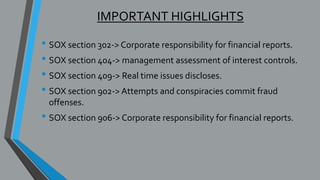
IMPORTANT HIGHLIGHTS
• SOX section 302-> Corporate responsibility for financial reports.
• SOX section 404-> management assessment of interest controls.
• SOX section 409-> Real time issues discloses.
• SOX section 902-> Attempts and conspiracies commit fraud
offenses.
• SOX section 906-> Corporate responsibility for financial reports.
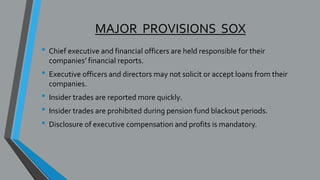
MAJOR PROVISIONS SOX
• Chief executive and financial officers are held responsible for their
companies’ financial reports.
• Executive officers and directors may not solicit or accept loans from their
companies.
• Insider trades are reported more quickly.
• Insider trades are prohibited during pension fund blackout periods.
• Disclosure of executive compensation and profits is mandatory.
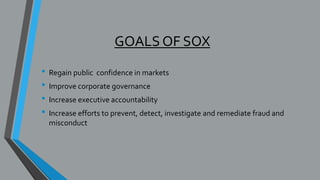
GOALS OF SOX
• Regain public confidence in markets
• Improve corporate governance
• Increase executive accountability
• Increase efforts to prevent, detect, investigate and remediate fraud and
misconduct
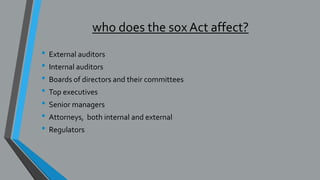
who does the sox Act affect?
• External auditors
• Internal auditors
• Boards of directors and their committees
• Top executives
• Senior managers
• Attorneys, both internal and external
• Regulators
CONCLUSION
The united states congress passed the sarbanes – oxley act in 2002
and established rules to protect the from fraudulent (or) erroneous
practices by corporations and other business entities.
Its main goal is increase transparency in the financial report.
REFERENCE
• RelatedText book:
corporate governance
• Oxley act (2002) (Retrieved from, https://en.m.Wikipedia.org)

SURBANES-OXLEY ACT (2002)

  • 1.
    SURBANES-OXLEY ACT (2002) ApoorvaG 1st M.Com Under the guidance of Sundar B. N. Asst. Prof. & Course Co-ordinator GFGCW, PG Studies in Commerce Holenarasipura
  • 2.
    CONTENTS • Introduction • Featuresof SOX-act 2002 • Important highlights (or) sections • Major provisions sox • Goals of sox • Conclusion • Reference
  • 3.
    INTRODUCTION Enacted July 30/2002.also known as the “Public Company Accounting Reform” and “Investor Protection Act” It help protect shareholders, employees and the Public from accounting errors and fraudulent financial practices.
  • 4.
    IMPORTANT FEATURES • Establishmentof public company accounting oversight Board (PCAOB) • Audit committee • Conflict of interest • Audit partner rotation • Improper influence on conduct of audit’s • Loans to directors • Penalties • Securities analysts • Prohibitions of non audit services
  • 5.
    IMPORTANT HIGHLIGHTS • SOXsection 302-> Corporate responsibility for financial reports. • SOX section 404-> management assessment of interest controls. • SOX section 409-> Real time issues discloses. • SOX section 902-> Attempts and conspiracies commit fraud offenses. • SOX section 906-> Corporate responsibility for financial reports.
  • 6.
    MAJOR PROVISIONS SOX •Chief executive and financial officers are held responsible for their companies’ financial reports. • Executive officers and directors may not solicit or accept loans from their companies. • Insider trades are reported more quickly. • Insider trades are prohibited during pension fund blackout periods. • Disclosure of executive compensation and profits is mandatory.
  • 7.
    GOALS OF SOX •Regain public confidence in markets • Improve corporate governance • Increase executive accountability • Increase efforts to prevent, detect, investigate and remediate fraud and misconduct
  • 8.
    who does thesox Act affect? • External auditors • Internal auditors • Boards of directors and their committees • Top executives • Senior managers • Attorneys, both internal and external • Regulators
  • 9.
    CONCLUSION The united statescongress passed the sarbanes – oxley act in 2002 and established rules to protect the from fraudulent (or) erroneous practices by corporations and other business entities. Its main goal is increase transparency in the financial report.
  • 10.
    REFERENCE • RelatedText book: corporategovernance • Oxley act (2002) (Retrieved from, https://en.m.Wikipedia.org)