Net Employment Benefits from
Onshore Wind in 2020
SEAI / IEA Wind RD&D Seminar
26th May 2014
Sarah Stanley
ESRI/SEAI Fellow,
Economic Modelling Department,
SEAI
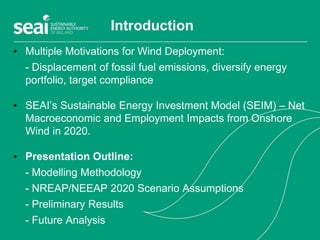
Introduction
• Multiple Motivations for Wind Deployment:
- Displacement of fossil fuel emissions, diversify energy
portfolio, target compliance
• SEAI’s Sustainable Energy Investment Model (SEIM) – Net
Macroeconomic and Employment Impacts from Onshore
Wind in 2020.
• Presentation Outline:
- Modelling Methodology
- NREAP/NEEAP 2020 Scenario Assumptions
- Preliminary Results
- Future Analysis
Introduction to the Sustainable
Energy Investment Model (SEIM)
• SEIM based on REMI. Widely applied in the US.
Combines I-O and econometric methodology.
• Core function is Impact Analysis (not forecasting).
• Insights into how investment in renewable energy
can affect employment, output, and expenditure.
• Net Impact Analysis rather than Gross.
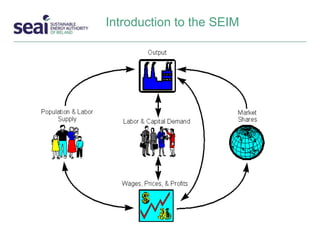
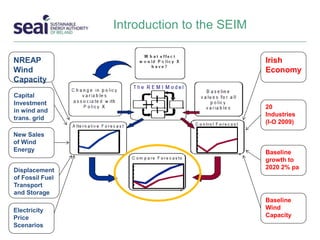
Introduction to the SEIM
NREAP
Wind
Capacity
Capital
Investment
in wind and
trans. grid
New Sales
of Wind
Energy
Displacement
of Fossil Fuel
Transport
and Storage
Electricity
Price
Scenarios
Irish
Economy
20
Industries
(I-O 2009)
Baseline
growth to
2020 2% pa
Baseline
Wind
Capacity
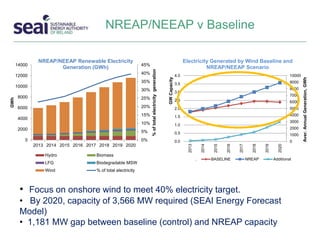
NREAP/NEEAP v Baseline
0%
5%
10%
15%
20%
25%
30%
35%
40%
45%
0
2000
4000
6000
8000
10000
12000
14000
2013 2014 2015 2016 2017 2018 2019 2020
%oftotalelectricitygeneration
GWh
NREAP/NEEAP Renewable Electricity
Generation (GWh)
Hydro Biomass
LFG Biodegradable MSW
Wind % of total electricity
• Focus on onshore wind to meet 40% electricity target.
• By 2020, capacity of 3,566 MW required (SEAI Energy Forecast
Model)
• 1,181 MW gap between baseline (control) and NREAP capacity
0
1000
2000
3000
4000
5000
6000
7000
8000
9000
10000
0.0
0.5
1.0
1.5
2.0
2.5
3.0
3.5
4.0
2013
2014
2015
2016
2017
2018
2019
2020
Aver.AnnualGeneration,GWh
GWCapacity
Electricity Generated by Wind Baseline and
NREAP/NEEAP Scenario
. BASELINE NREAP Additional
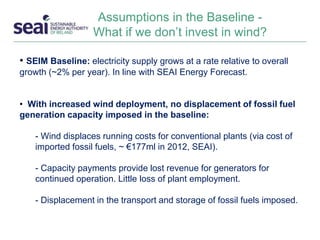
Assumptions in the Baseline -
What if we don’t invest in wind?
• SEIM Baseline: electricity supply grows at a rate relative to overall
growth (~2% per year). In line with SEAI Energy Forecast.
• With increased wind deployment, no displacement of fossil fuel
generation capacity imposed in the baseline:
- Wind displaces running costs for conventional plants (via cost of
imported fossil fuels, ~ €177ml in 2012, SEAI).
- Capacity payments provide lost revenue for generators for
continued operation. Little loss of plant employment.
- Displacement in the transport and storage of fossil fuels imposed.
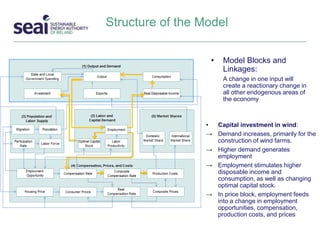
• Capital investment in wind:
→ Demand increases, primarily for the
construction of wind farms.
→ Higher demand generates
employment
→ Employment stimulates higher
disposable income and
consumption, as well as changing
optimal capital stock.
→ In price block, employment feeds
into a change in employment
opportunities, compensation,
production costs, and prices
Structure of the Model
• Model Blocks and
Linkages:
A change in one input will
create a reactionary change in
all other endogenous areas of
the economy
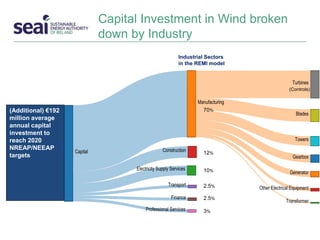
Capital Investment in Wind broken
down by Industry
70%(Additional) €192
million average
annual capital
investment to
reach 2020
NREAP/NEEAP
targets 12%
10%
2.5%
2.5%
3%
(Controls)
Industrial Sectors
in the REMI model
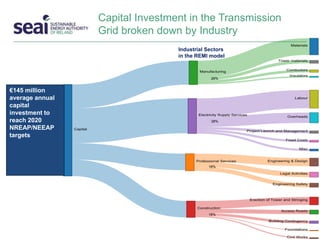
Capital Investment in the Transmission
Grid broken down by Industry
€145 million
average annual
capital
investment to
reach 2020
NREAP/NEEAP
targets
26%
38%
18%
18%
Industrial Sectors
in the REMI model
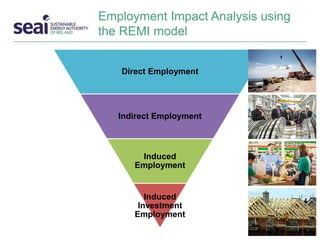
Employment Impact Analysis using
the REMI model
Induced
Investment
Employment
Induced
Employment
Indirect Employment
Direct Employment
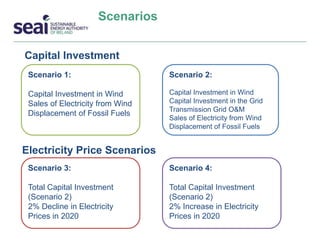
Scenarios
Scenario 1:
Capital Investment in Wind
Sales of Electricity from Wind
Displacement of Fossil Fuels
Scenario 2:
Capital Investment in Wind
Capital Investment in the Grid
Transmission Grid O&M
Sales of Electricity from Wind
Displacement of Fossil Fuels
Scenario 3:
Total Capital Investment
(Scenario 2)
2% Decline in Electricity
Prices in 2020
Scenario 4:
Total Capital Investment
(Scenario 2)
2% Increase in Electricity
Prices in 2020
Electricity Price Scenarios
Capital Investment
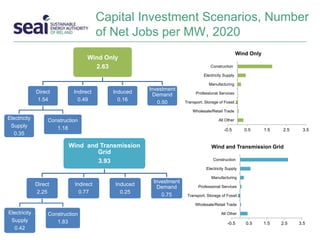
Capital Investment Scenarios, Number
of Net Jobs per MW, 2020
Wind Only
2.63
Direct
1.54
Electricity
Supply
0.35
Construction
1.18
Indirect
0.49
Induced
0.16
Investment
Demand
0.50
Wind and Transmission
Grid
3.93
Direct
2.25
Electricity
Supply
0.42
Construction
1.83
Indirect
0.77
Induced
0.25
Investment
Demand
0.75
-0.5 0.5 1.5 2.5 3.5
All Other
Wholesale/Retail Trade
Transport, Storage of Fossil…
Professional Services
Manufacturing
Electricity Supply
Construction
Wind Only
-0.5 0.5 1.5 2.5 3.5
All Other
Wholesale/Retail Trade
Transport, Storage of Fossil…
Professional Services
Manufacturing
Electricity Supply
Construction
Wind and Transmission Grid
1282087
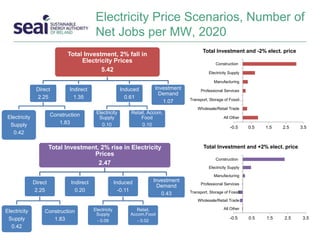
Electricity Price Scenarios, Number of
Net Jobs per MW, 2020
Total Investment, 2% rise in Electricity
Prices
2.47
Direct
2.25
Electricity
Supply
0.42
Construction
1.83
Indirect
0.20
Induced
-0.11
Electricity
Supply
- 0.09
Retail,
Accom,Food
- 0.02
Investment
Demand
0.43
-0.5 0.5 1.5 2.5 3.5
All Other
Wholesale/Retail Trade
Transport, Storage of Fossil…
Professional Services
Manufacturing
Electricity Supply
Construction
Total Investment and -2% elect. price
-0.5 0.5 1.5 2.5 3.5
All Other
Wholesale/Retail Trade
Transport, Storage of Fossil…
Professional Services
Manufacturing
Electricity Supply
Construction
Total Investment and +2% elect. price
Total Investment, 2% fall in
Electricity Prices
5.42
Direct
2.25
Electricity
Supply
0.42
Construction
1.83
Indirect
1.35
Induced
0.61
Electricity
Supply
0.10
Retail, Accom,
Food
0.10
Investment
Demand
1.07
Electricity Supply Net Employment
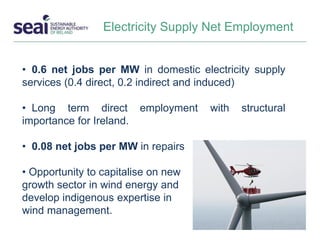
• 0.6 net jobs per MW in domestic electricity supply
services (0.4 direct, 0.2 indirect and induced)
• Long term direct employment with structural
importance for Ireland.
• 0.08 net jobs per MW in repairs
• Opportunity to capitalise on new
growth sector in wind energy and
develop indigenous expertise in
wind management.
Construction of Wind and
Transmission Grid Net Employment
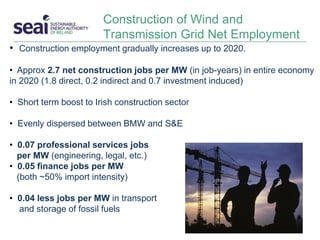
• Construction employment gradually increases up to 2020.
• Approx 2.7 net construction jobs per MW (in job-years) in entire economy
in 2020 (1.8 direct, 0.2 indirect and 0.7 investment induced)
• Short term boost to Irish construction sector
• Evenly dispersed between BMW and S&E
• 0.07 professional services jobs
per MW (engineering, legal, etc.)
• 0.05 finance jobs per MW
(both ~50% import intensity)
• 0.04 less jobs per MW in transport
and storage of fossil fuels
Manufacturing Net Employment
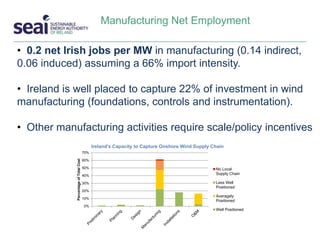
• 0.2 net Irish jobs per MW in manufacturing (0.14 indirect,
0.06 induced) assuming a 66% import intensity.
• Ireland is well placed to capture 22% of investment in wind
manufacturing (foundations, controls and instrumentation).
• Other manufacturing activities require scale/policy incentives
0%
10%
20%
30%
40%
50%
60%
70%
PercentageofTotalCost
Ireland's Capacity to Capture Onshore Wind Supply Chain
No Local
Supply Chain
Less Well
Positioned
Averagely
Positioned
Well Positioned
Findings, Other Factors &
Future Analysis
• In addition to environmental and security of supply benefits,
wind deployment has positive impact on GDP & Net
Employment
Other Factors
• Omits impacts on amenity value, housing prices, tourism.
• Similarly ignores ancillary benefits:
- supply chain development, target penalty cost, security of
supply, avoided environmental costs.
Future Analysis
• Comparison between various forms of RE investment
• Further electricity price sensitivities
• Post 2020 capacity projections and impacts on employment,
taking into account projected future investment and duration
of feed-in tariffs.
Sarah.Stanley@seai.ie
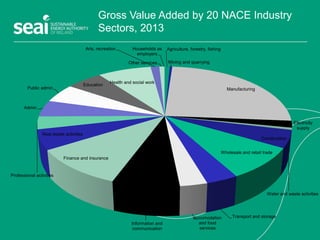
Gross Value Added by 20 NACE Industry
Sectors, 2013
Agriculture, forestry, fishing
Mining and quarrying
Manufacturing
Electricity
supply
Water and waste activities
Construction
Wholesale and retail trade
Transport and storageAccomodation
and food
services
Information and
communication
Finance and insurance
Real estate activities
Professional activities
Admin
Public admin
Education
Health and social work
Arts, recreation
Other services
Households as
employers
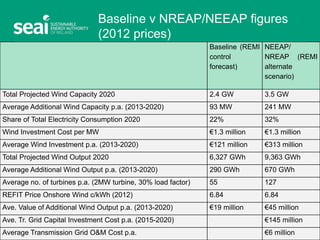
Baseline v NREAP/NEEAP figures
(2012 prices)
Baseline (REMI
control
forecast)
NEEAP/
NREAP (REMI
alternate
scenario)
Total Projected Wind Capacity 2020 2.4 GW 3.5 GW
Average Additional Wind Capacity p.a. (2013-2020) 93 MW 241 MW
Share of Total Electricity Consumption 2020 22% 32%
Wind Investment Cost per MW €1.3 million €1.3 million
Average Wind Investment p.a. (2013-2020) €121 million €313 million
Total Projected Wind Output 2020 6,327 GWh 9,363 GWh
Average Additional Wind Output p.a. (2013-2020) 290 GWh 670 GWh
Average no. of turbines p.a. (2MW turbine, 30% load factor) 55 127
REFIT Price Onshore Wind c/kWh (2012) 6.84 6.84
Ave. Value of Additional Wind Output p.a. (2013-2020) €19 million €45 million
Ave. Tr. Grid Capital Investment Cost p.a. (2015-2020) €145 million
Average Transmission Grid O&M Cost p.a. €6 million

Net Employment Benefits from Onshore Wind in 2020, Sarah Stanley, SEAI

  • 1.
    Net Employment Benefitsfrom Onshore Wind in 2020 SEAI / IEA Wind RD&D Seminar 26th May 2014 Sarah Stanley ESRI/SEAI Fellow, Economic Modelling Department, SEAI
  • 2.
    Introduction • Multiple Motivationsfor Wind Deployment: - Displacement of fossil fuel emissions, diversify energy portfolio, target compliance • SEAI’s Sustainable Energy Investment Model (SEIM) – Net Macroeconomic and Employment Impacts from Onshore Wind in 2020. • Presentation Outline: - Modelling Methodology - NREAP/NEEAP 2020 Scenario Assumptions - Preliminary Results - Future Analysis
  • 3.
    Introduction to theSustainable Energy Investment Model (SEIM) • SEIM based on REMI. Widely applied in the US. Combines I-O and econometric methodology. • Core function is Impact Analysis (not forecasting). • Insights into how investment in renewable energy can affect employment, output, and expenditure. • Net Impact Analysis rather than Gross.
  • 4.
  • 5.
    Introduction to theSEIM NREAP Wind Capacity Capital Investment in wind and trans. grid New Sales of Wind Energy Displacement of Fossil Fuel Transport and Storage Electricity Price Scenarios Irish Economy 20 Industries (I-O 2009) Baseline growth to 2020 2% pa Baseline Wind Capacity
  • 6.
    NREAP/NEEAP v Baseline 0% 5% 10% 15% 20% 25% 30% 35% 40% 45% 0 2000 4000 6000 8000 10000 12000 14000 20132014 2015 2016 2017 2018 2019 2020 %oftotalelectricitygeneration GWh NREAP/NEEAP Renewable Electricity Generation (GWh) Hydro Biomass LFG Biodegradable MSW Wind % of total electricity • Focus on onshore wind to meet 40% electricity target. • By 2020, capacity of 3,566 MW required (SEAI Energy Forecast Model) • 1,181 MW gap between baseline (control) and NREAP capacity 0 1000 2000 3000 4000 5000 6000 7000 8000 9000 10000 0.0 0.5 1.0 1.5 2.0 2.5 3.0 3.5 4.0 2013 2014 2015 2016 2017 2018 2019 2020 Aver.AnnualGeneration,GWh GWCapacity Electricity Generated by Wind Baseline and NREAP/NEEAP Scenario . BASELINE NREAP Additional
  • 7.
    Assumptions in theBaseline - What if we don’t invest in wind? • SEIM Baseline: electricity supply grows at a rate relative to overall growth (~2% per year). In line with SEAI Energy Forecast. • With increased wind deployment, no displacement of fossil fuel generation capacity imposed in the baseline: - Wind displaces running costs for conventional plants (via cost of imported fossil fuels, ~ €177ml in 2012, SEAI). - Capacity payments provide lost revenue for generators for continued operation. Little loss of plant employment. - Displacement in the transport and storage of fossil fuels imposed.
  • 8.
    • Capital investmentin wind: → Demand increases, primarily for the construction of wind farms. → Higher demand generates employment → Employment stimulates higher disposable income and consumption, as well as changing optimal capital stock. → In price block, employment feeds into a change in employment opportunities, compensation, production costs, and prices Structure of the Model • Model Blocks and Linkages: A change in one input will create a reactionary change in all other endogenous areas of the economy
  • 9.
    Capital Investment inWind broken down by Industry 70%(Additional) €192 million average annual capital investment to reach 2020 NREAP/NEEAP targets 12% 10% 2.5% 2.5% 3% (Controls) Industrial Sectors in the REMI model
  • 10.
    Capital Investment inthe Transmission Grid broken down by Industry €145 million average annual capital investment to reach 2020 NREAP/NEEAP targets 26% 38% 18% 18% Industrial Sectors in the REMI model
  • 11.
    Employment Impact Analysisusing the REMI model Induced Investment Employment Induced Employment Indirect Employment Direct Employment
  • 12.
    Scenarios Scenario 1: Capital Investmentin Wind Sales of Electricity from Wind Displacement of Fossil Fuels Scenario 2: Capital Investment in Wind Capital Investment in the Grid Transmission Grid O&M Sales of Electricity from Wind Displacement of Fossil Fuels Scenario 3: Total Capital Investment (Scenario 2) 2% Decline in Electricity Prices in 2020 Scenario 4: Total Capital Investment (Scenario 2) 2% Increase in Electricity Prices in 2020 Electricity Price Scenarios Capital Investment
  • 13.
    Capital Investment Scenarios,Number of Net Jobs per MW, 2020 Wind Only 2.63 Direct 1.54 Electricity Supply 0.35 Construction 1.18 Indirect 0.49 Induced 0.16 Investment Demand 0.50 Wind and Transmission Grid 3.93 Direct 2.25 Electricity Supply 0.42 Construction 1.83 Indirect 0.77 Induced 0.25 Investment Demand 0.75 -0.5 0.5 1.5 2.5 3.5 All Other Wholesale/Retail Trade Transport, Storage of Fossil… Professional Services Manufacturing Electricity Supply Construction Wind Only -0.5 0.5 1.5 2.5 3.5 All Other Wholesale/Retail Trade Transport, Storage of Fossil… Professional Services Manufacturing Electricity Supply Construction Wind and Transmission Grid 1282087
  • 14.
    Electricity Price Scenarios,Number of Net Jobs per MW, 2020 Total Investment, 2% rise in Electricity Prices 2.47 Direct 2.25 Electricity Supply 0.42 Construction 1.83 Indirect 0.20 Induced -0.11 Electricity Supply - 0.09 Retail, Accom,Food - 0.02 Investment Demand 0.43 -0.5 0.5 1.5 2.5 3.5 All Other Wholesale/Retail Trade Transport, Storage of Fossil… Professional Services Manufacturing Electricity Supply Construction Total Investment and -2% elect. price -0.5 0.5 1.5 2.5 3.5 All Other Wholesale/Retail Trade Transport, Storage of Fossil… Professional Services Manufacturing Electricity Supply Construction Total Investment and +2% elect. price Total Investment, 2% fall in Electricity Prices 5.42 Direct 2.25 Electricity Supply 0.42 Construction 1.83 Indirect 1.35 Induced 0.61 Electricity Supply 0.10 Retail, Accom, Food 0.10 Investment Demand 1.07
  • 15.
    Electricity Supply NetEmployment • 0.6 net jobs per MW in domestic electricity supply services (0.4 direct, 0.2 indirect and induced) • Long term direct employment with structural importance for Ireland. • 0.08 net jobs per MW in repairs • Opportunity to capitalise on new growth sector in wind energy and develop indigenous expertise in wind management.
  • 16.
    Construction of Windand Transmission Grid Net Employment • Construction employment gradually increases up to 2020. • Approx 2.7 net construction jobs per MW (in job-years) in entire economy in 2020 (1.8 direct, 0.2 indirect and 0.7 investment induced) • Short term boost to Irish construction sector • Evenly dispersed between BMW and S&E • 0.07 professional services jobs per MW (engineering, legal, etc.) • 0.05 finance jobs per MW (both ~50% import intensity) • 0.04 less jobs per MW in transport and storage of fossil fuels
  • 17.
    Manufacturing Net Employment •0.2 net Irish jobs per MW in manufacturing (0.14 indirect, 0.06 induced) assuming a 66% import intensity. • Ireland is well placed to capture 22% of investment in wind manufacturing (foundations, controls and instrumentation). • Other manufacturing activities require scale/policy incentives 0% 10% 20% 30% 40% 50% 60% 70% PercentageofTotalCost Ireland's Capacity to Capture Onshore Wind Supply Chain No Local Supply Chain Less Well Positioned Averagely Positioned Well Positioned
  • 18.
    Findings, Other Factors& Future Analysis • In addition to environmental and security of supply benefits, wind deployment has positive impact on GDP & Net Employment Other Factors • Omits impacts on amenity value, housing prices, tourism. • Similarly ignores ancillary benefits: - supply chain development, target penalty cost, security of supply, avoided environmental costs. Future Analysis • Comparison between various forms of RE investment • Further electricity price sensitivities • Post 2020 capacity projections and impacts on employment, taking into account projected future investment and duration of feed-in tariffs.
  • 19.
  • 20.
    Gross Value Addedby 20 NACE Industry Sectors, 2013 Agriculture, forestry, fishing Mining and quarrying Manufacturing Electricity supply Water and waste activities Construction Wholesale and retail trade Transport and storageAccomodation and food services Information and communication Finance and insurance Real estate activities Professional activities Admin Public admin Education Health and social work Arts, recreation Other services Households as employers
  • 21.
    Baseline v NREAP/NEEAPfigures (2012 prices) Baseline (REMI control forecast) NEEAP/ NREAP (REMI alternate scenario) Total Projected Wind Capacity 2020 2.4 GW 3.5 GW Average Additional Wind Capacity p.a. (2013-2020) 93 MW 241 MW Share of Total Electricity Consumption 2020 22% 32% Wind Investment Cost per MW €1.3 million €1.3 million Average Wind Investment p.a. (2013-2020) €121 million €313 million Total Projected Wind Output 2020 6,327 GWh 9,363 GWh Average Additional Wind Output p.a. (2013-2020) 290 GWh 670 GWh Average no. of turbines p.a. (2MW turbine, 30% load factor) 55 127 REFIT Price Onshore Wind c/kWh (2012) 6.84 6.84 Ave. Value of Additional Wind Output p.a. (2013-2020) €19 million €45 million Ave. Tr. Grid Capital Investment Cost p.a. (2015-2020) €145 million Average Transmission Grid O&M Cost p.a. €6 million