Pro Bono Data Consulting for the Social Sector
● Introduction to Delta Analytics
● Technical Deep dive - Rainforest
Connection
Sara Hooker
Executive Director
Delta Analytics
sara@deltanalytics.org
twitter: sarahookr
Sean McPherson
Delta Data Science
Fellow
sean@deltanalytics.org
twitter: PhaseAnalytics
Delta
Analytics
Delta teaching fellow:
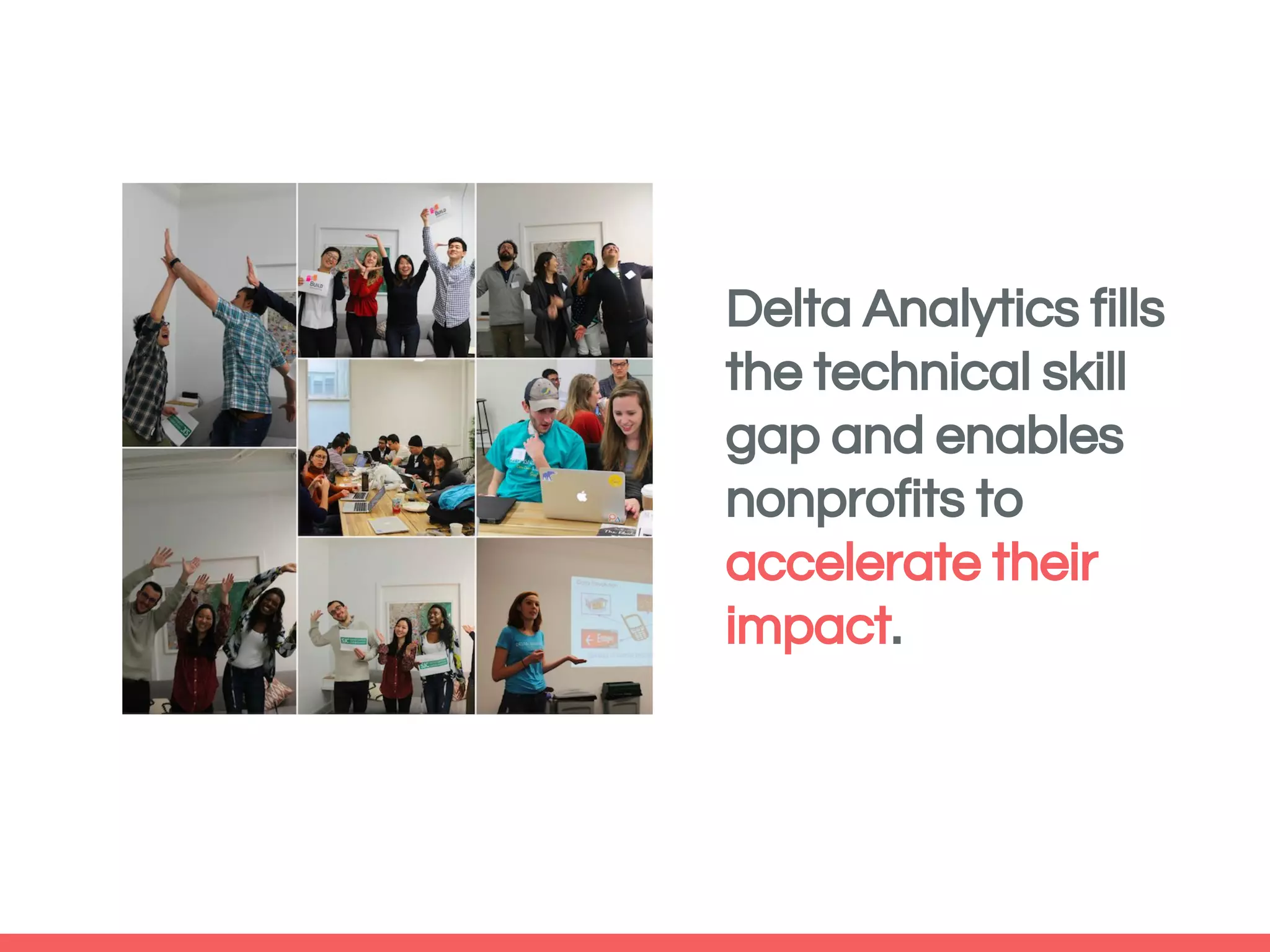
Delta Analytics fills
the technical skill
gap and enables
nonprofits to
accelerate their
impact.
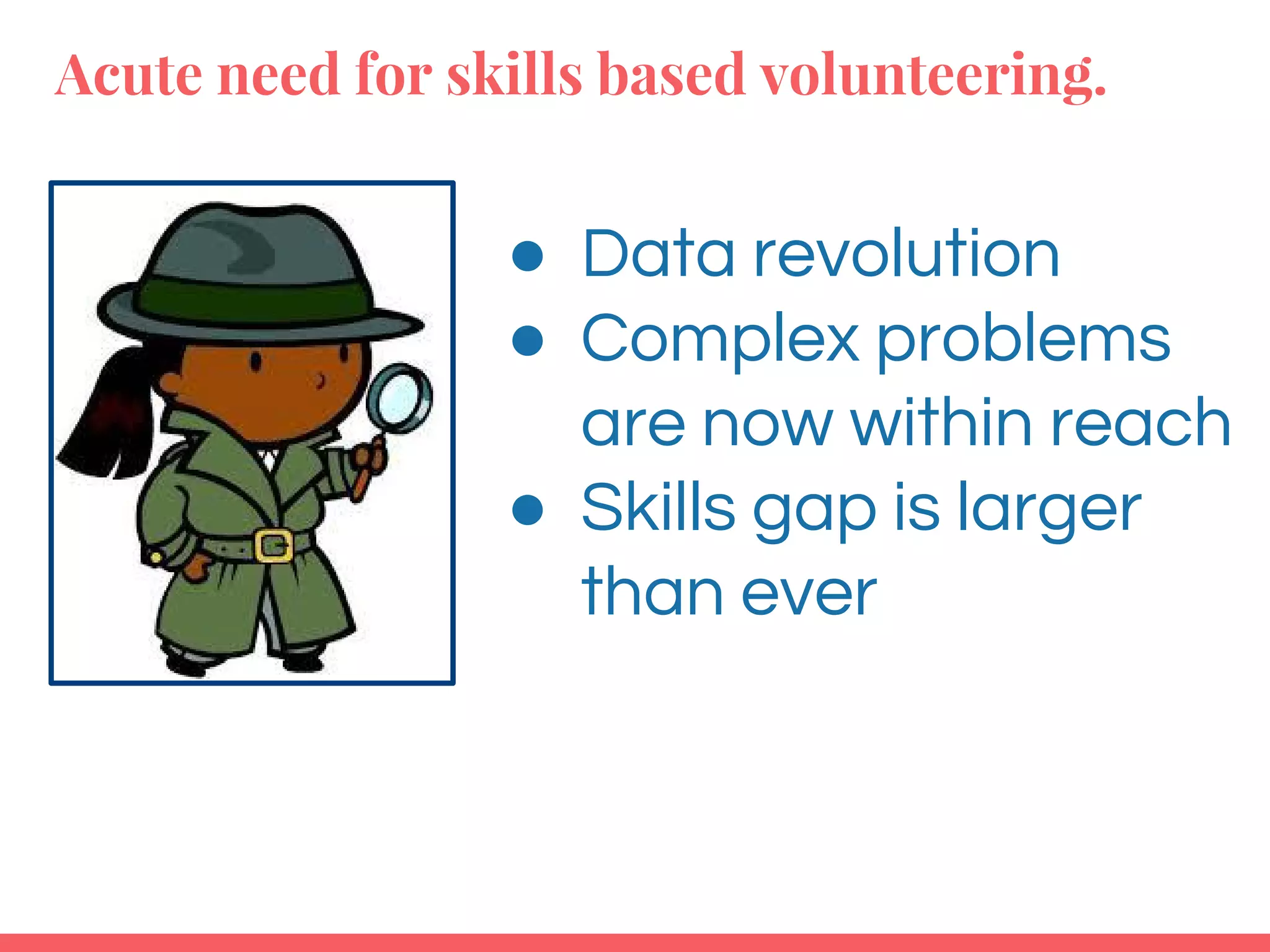
Acute need for skills based volunteering.
Delta teaching fellow:
● Data revolution
● Complex problems
are now within reach
● Skills gap is larger
than ever
Nonprofits are pushing the hardest for data
● focus on accountability
● desire to understand impact
Organizations bridging the skill gap. And
most importantly… you.
Delta teaching fellow:
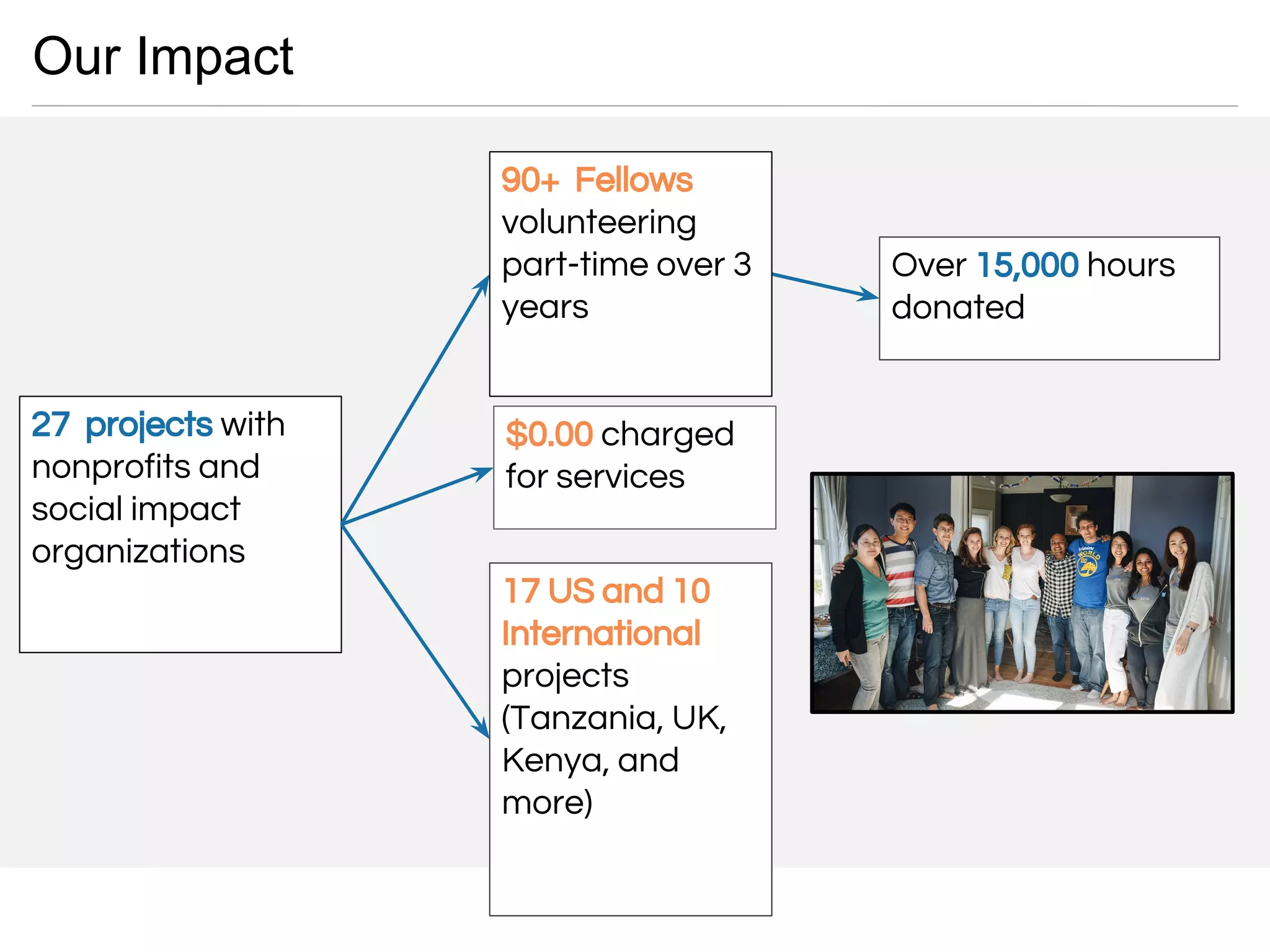
27 projects with
nonprofits and
social impact
organizations
90+ Fellows
volunteering
part-time over 3
years
$0.00 charged
for services
17 US and 10
International
projects
(Tanzania, UK,
Kenya, and
more)
Over 15,000 hours
donated
Our Impact
Community
Engagement
Education Economic
Development
Environmental
Some of our grant recipients:
Where do Delta Fellows work?
… and many more
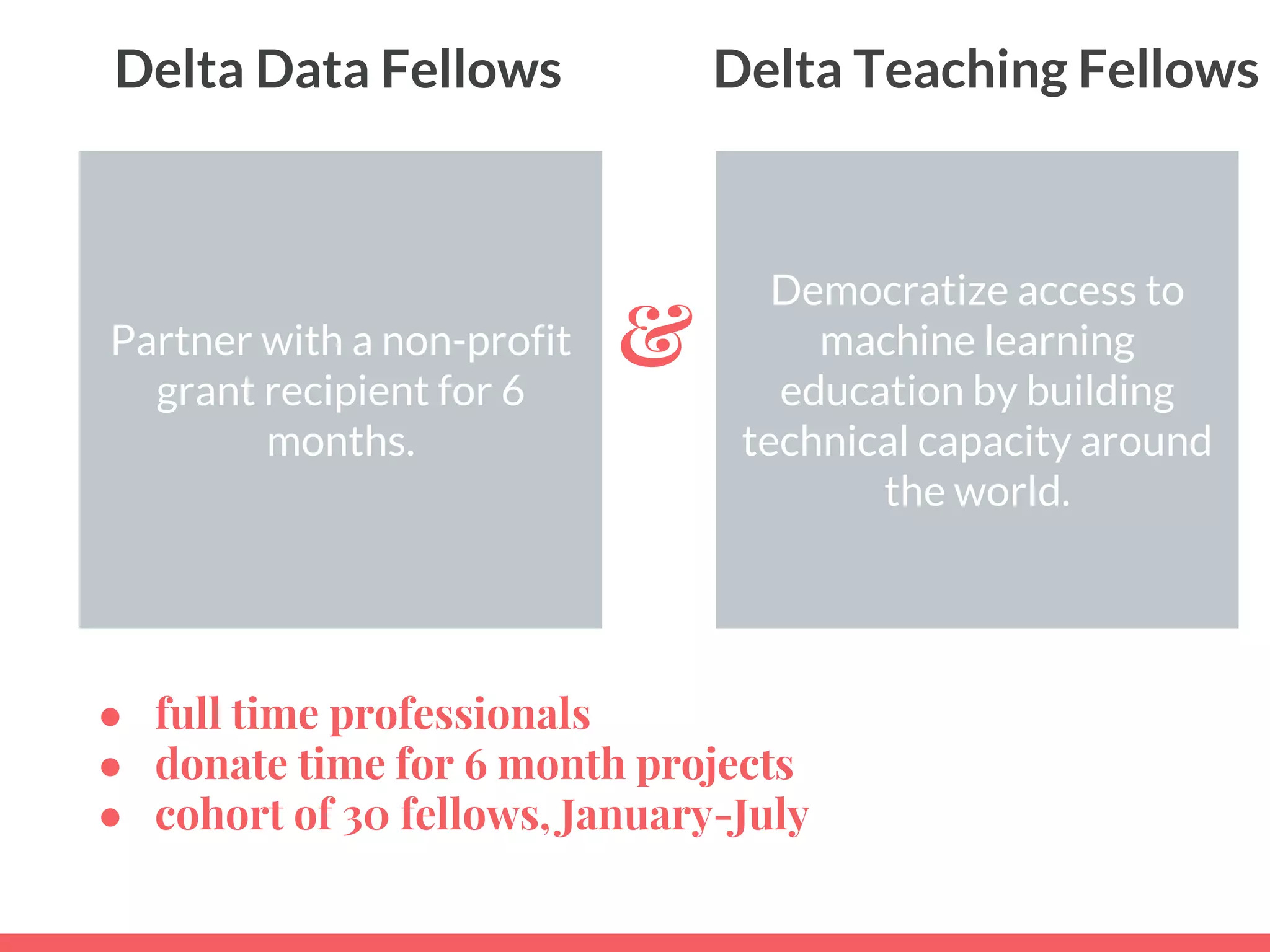
Partner with a non-profit
grant recipient for 6
months.
● full time professionals
● donate time for 6 month projects
● cohort of 30 fellows, January-July
Democratize access to
machine learning
education by building
technical capacity around
the world.
&
Delta Data Fellows Delta Teaching Fellows
Delta teaching fellows believe that data is
powerful, and that anybody should be able to
harness it for change in their community.
2017 Grant Recipients
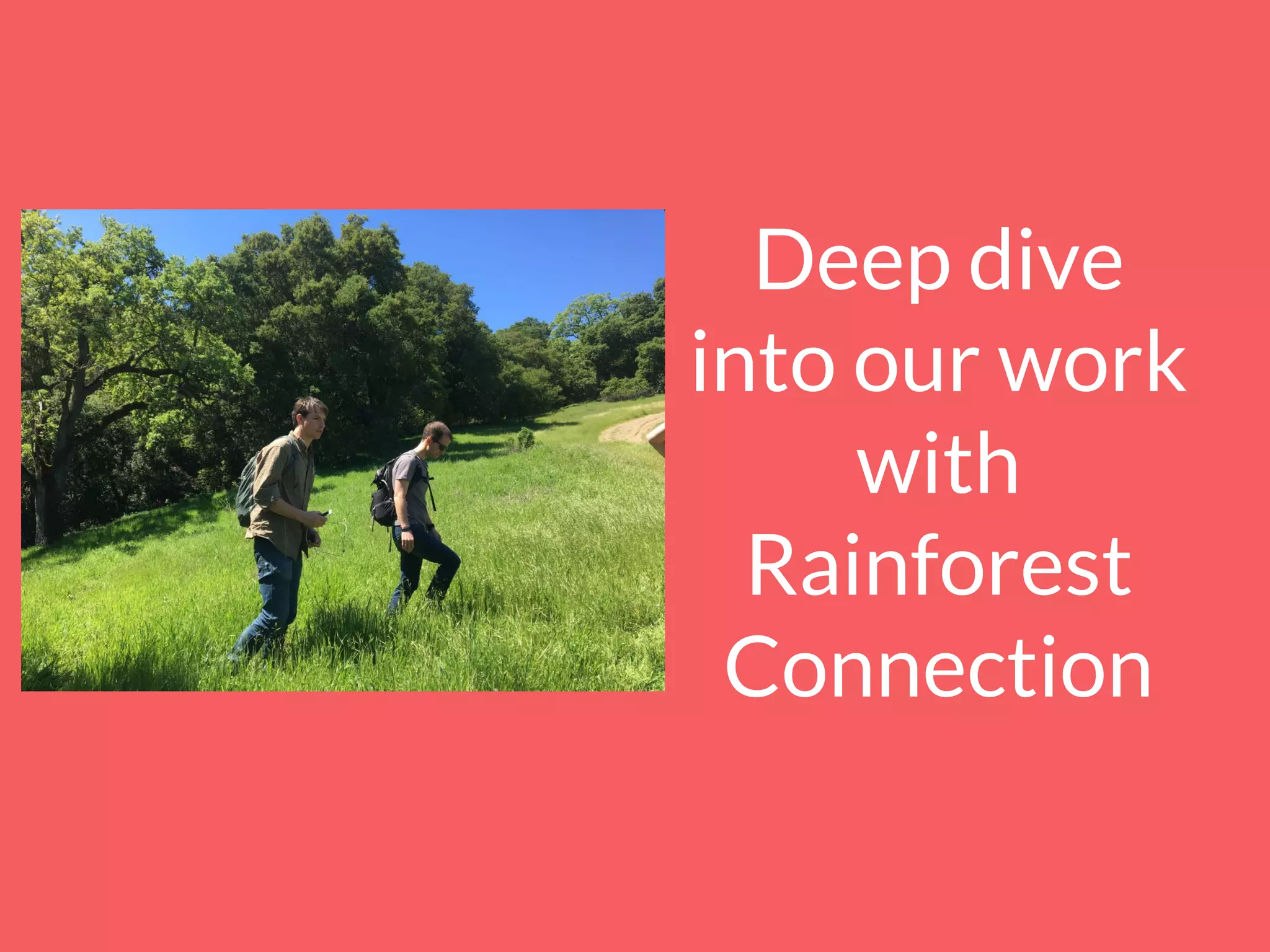
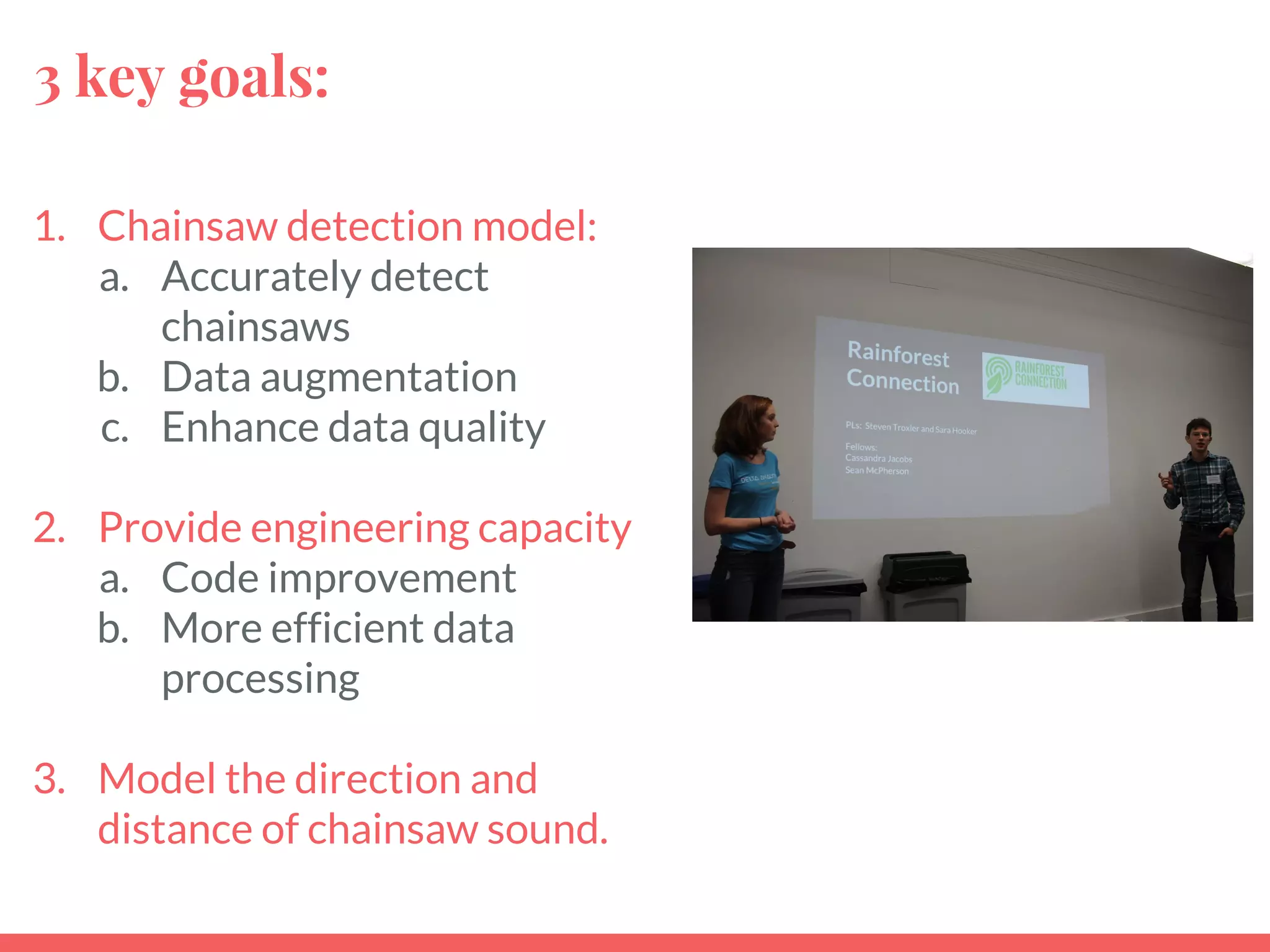
Deep dive
into our work
with
Rainforest
Connection
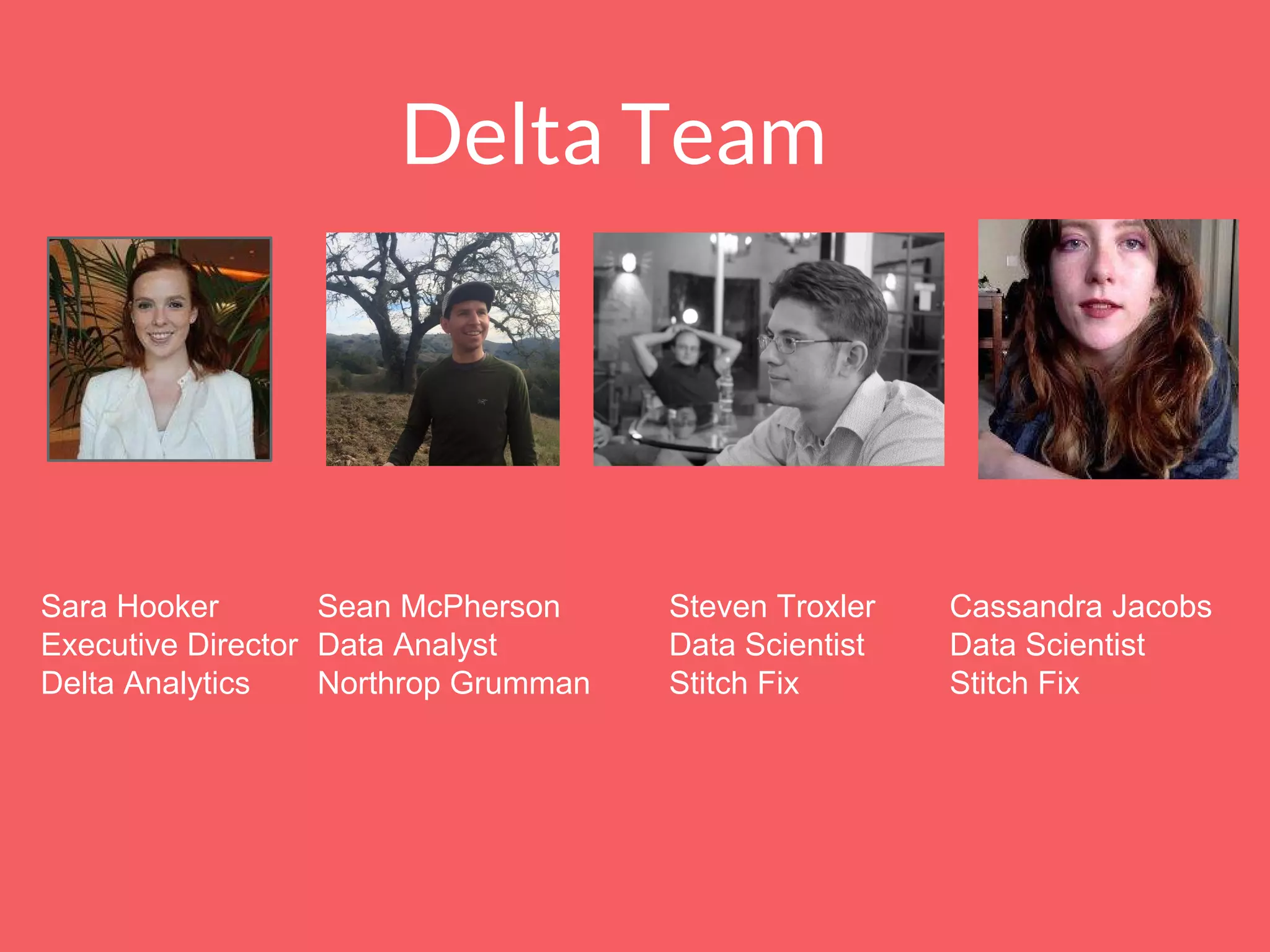
Delta Team
Sara Hooker
Executive Director
Delta Analytics
Sean McPherson
Data Analyst
Northrop Grumman
Steven Troxler
Data Scientist
Stitch Fix
Cassandra Jacobs
Data Scientist
Stitch Fix
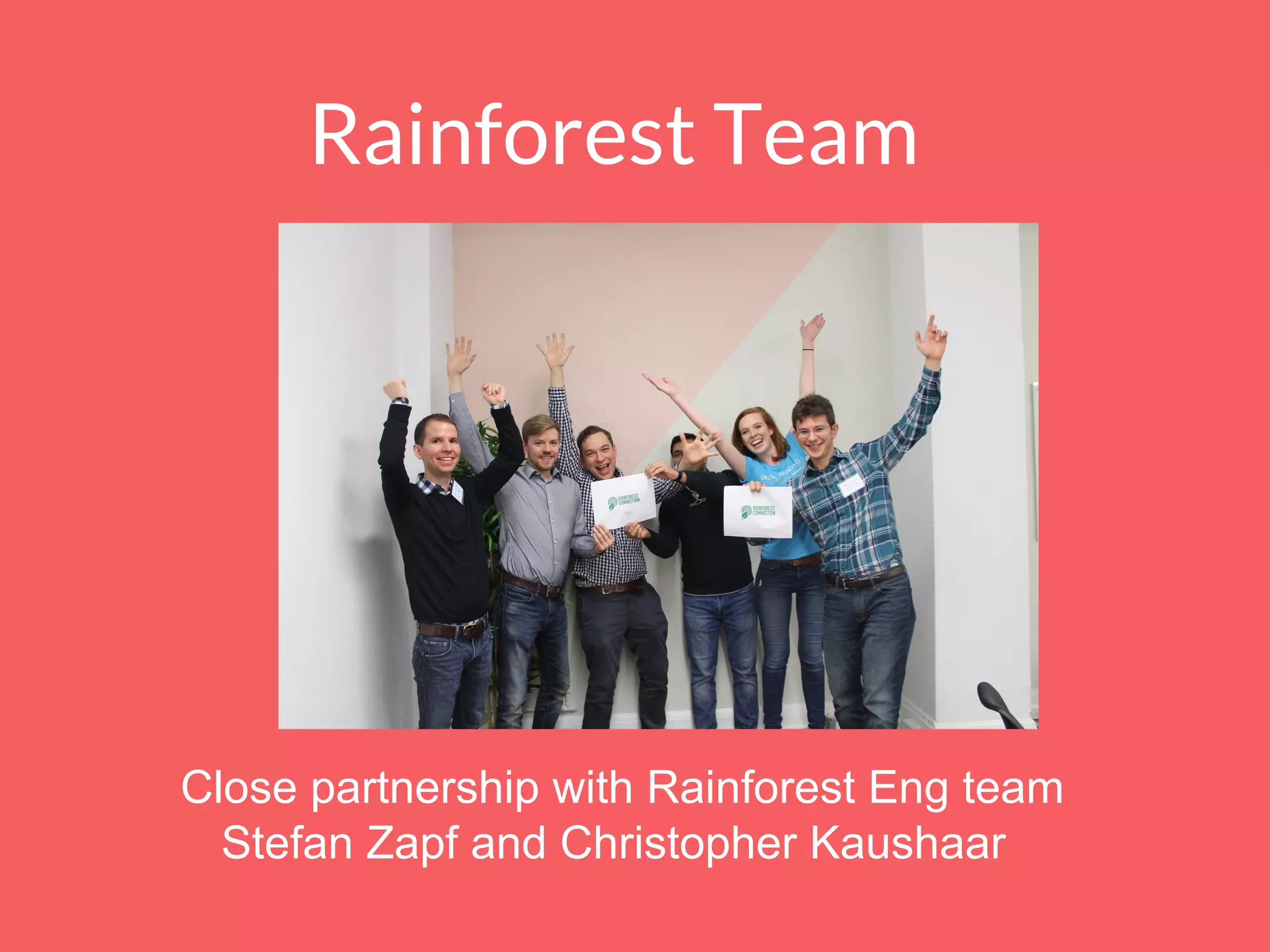
Rainforest Team
Close partnership with Rainforest Eng team
Stefan Zapf and Christopher Kaushaar
Rainforest Connection collects and deploys recycled cells to
rainforests around the world. The cellphones stream audio 24/7,
and advanced deep learning models detect when the sound of a
chainsaw occurs.
Within minutes, an alert is sent to conservationists.
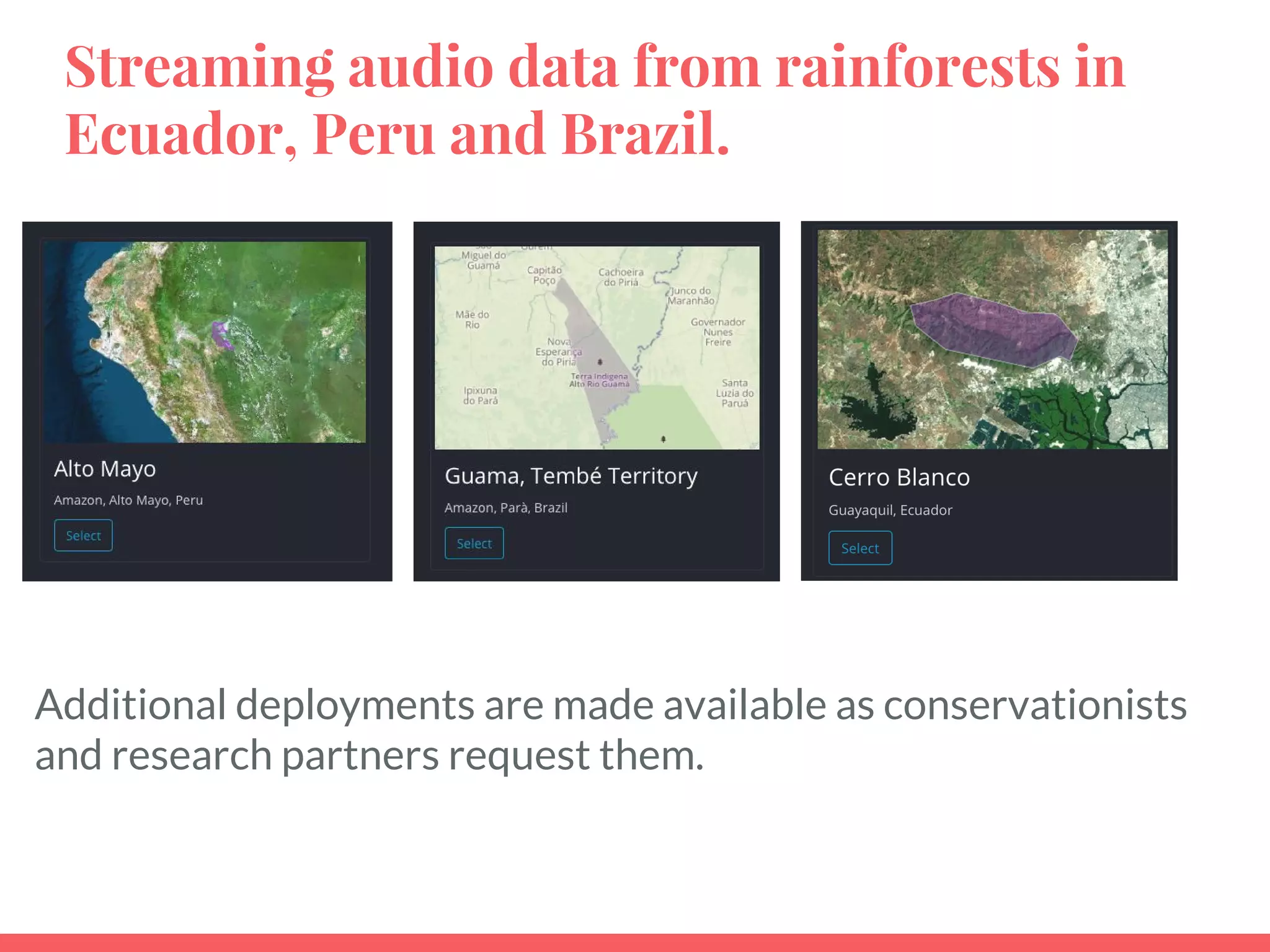
Streaming audio data from rainforests in
Ecuador, Peru and Brazil.
Additional deployments are made available as conservationists
and research partners request them.
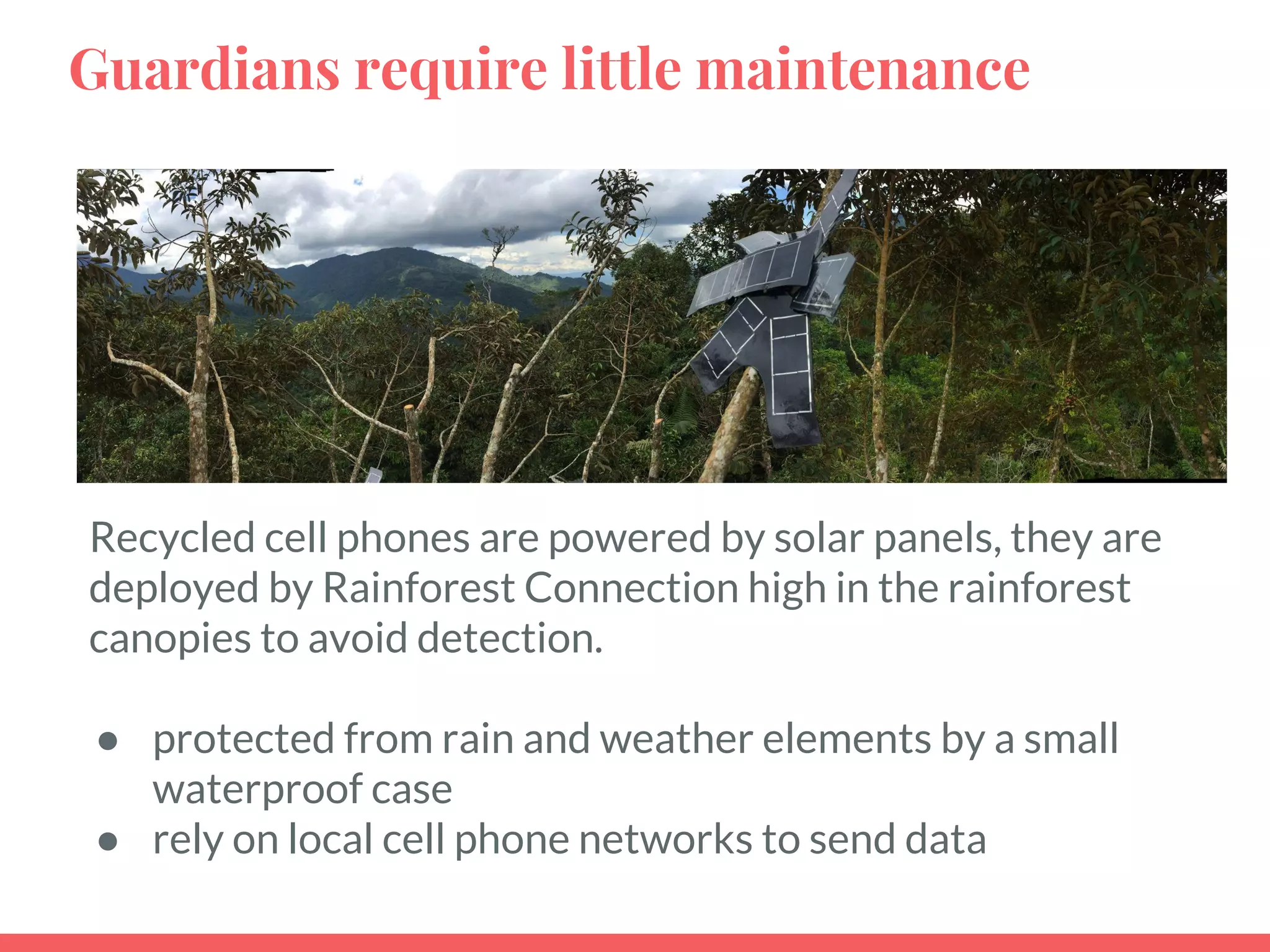
Guardians require little maintenance
Recycled cell phones are powered by solar panels, they are
deployed by Rainforest Connection high in the rainforest
canopies to avoid detection.
● protected from rain and weather elements by a small
waterproof case
● rely on local cell phone networks to send data
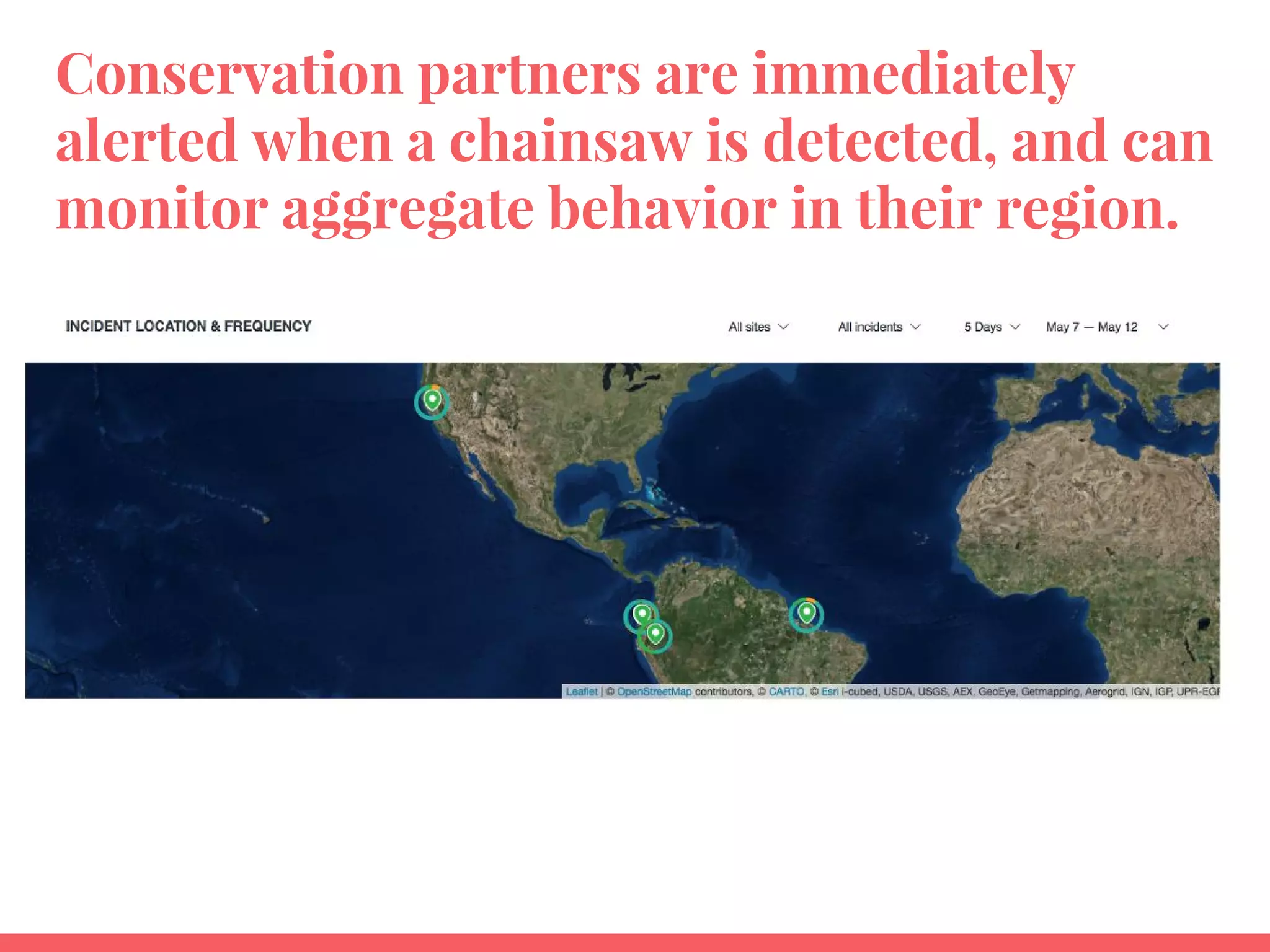
Conservation partners are immediately
alerted when a chainsaw is detected, and can
monitor aggregate behavior in their region.
3 key goals:
1. Chainsaw detection model:
a. Accurately detect
chainsaws
b. Data augmentation
c. Enhance data quality
2. Provide engineering capacity
a. Code improvement
b. More efficient data
processing
3. Model the direction and
distance of chainsaw sound.
1. Accurately detect
chainsaws
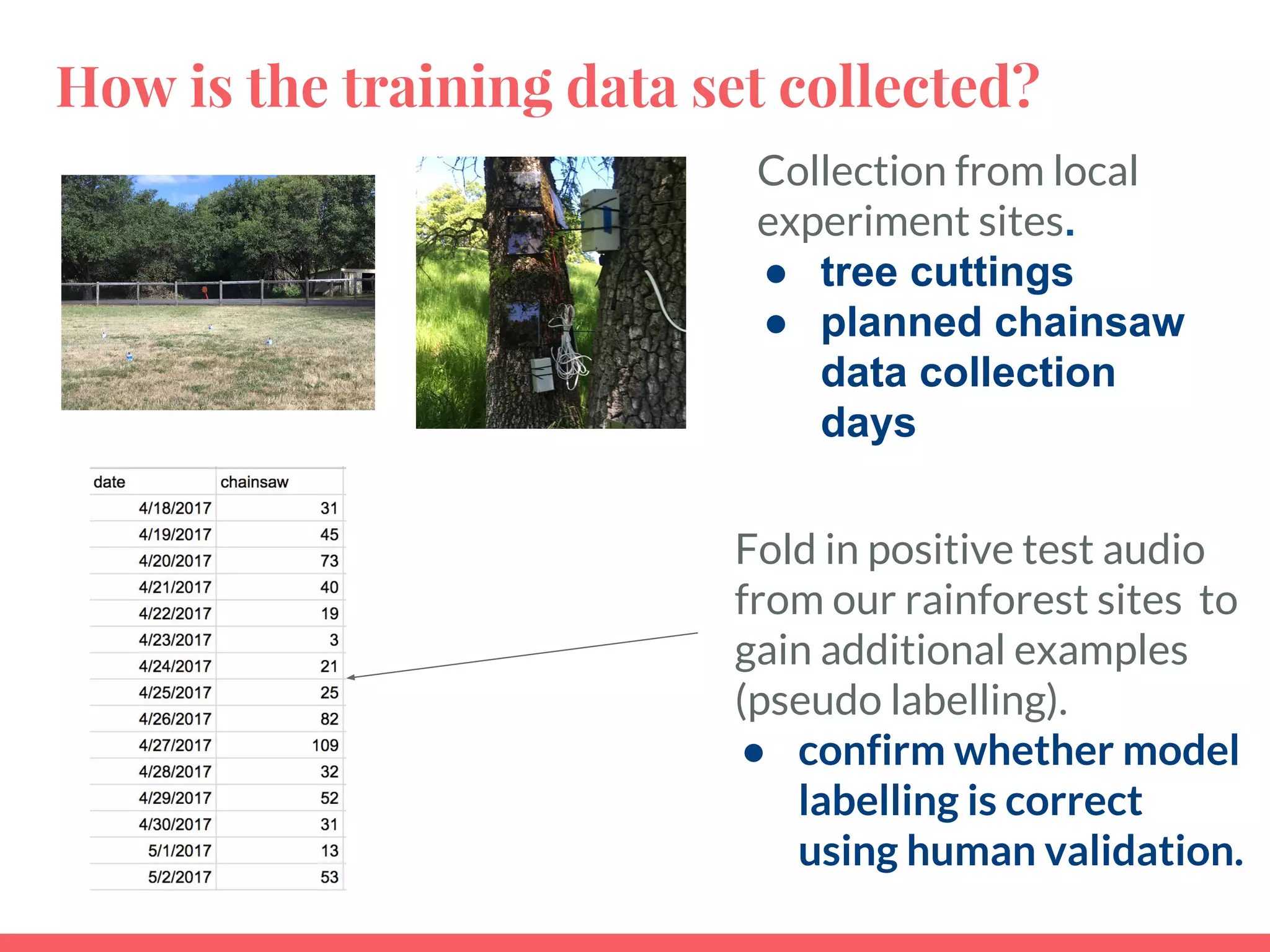
How is the training data set collected?
Collection from local
experiment sites.
● tree cuttings
● planned chainsaw
data collection
days
Fold in positive test audio
from our rainforest sites to
gain additional examples
(pseudo labelling).
● confirm whether model
labelling is correct
using human validation.
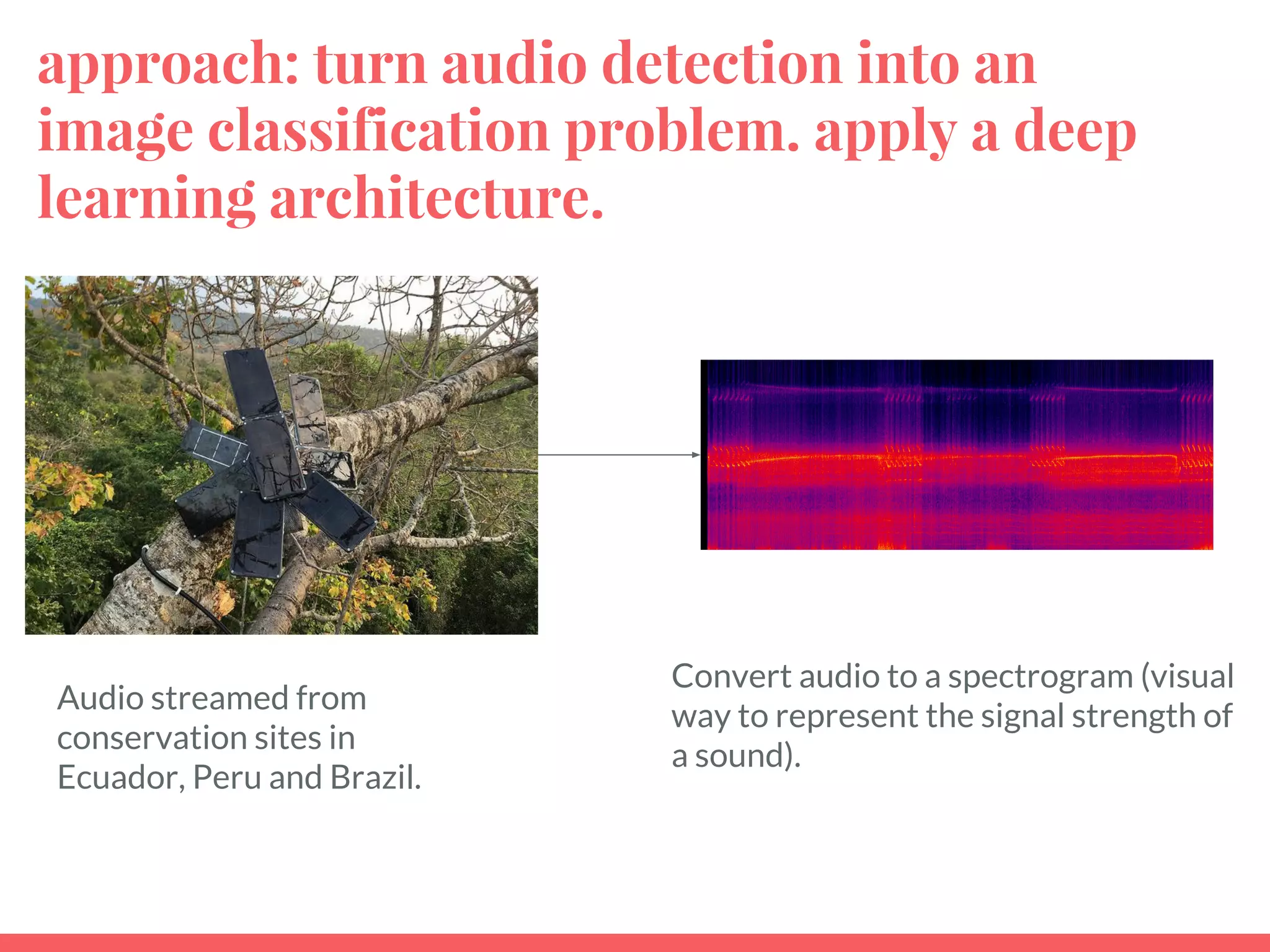
approach: turn audio detection into an
image classification problem. apply a deep
learning architecture.
Audio streamed from
conservation sites in
Ecuador, Peru and Brazil.
Convert audio to a spectrogram (visual
way to represent the signal strength of
a sound).
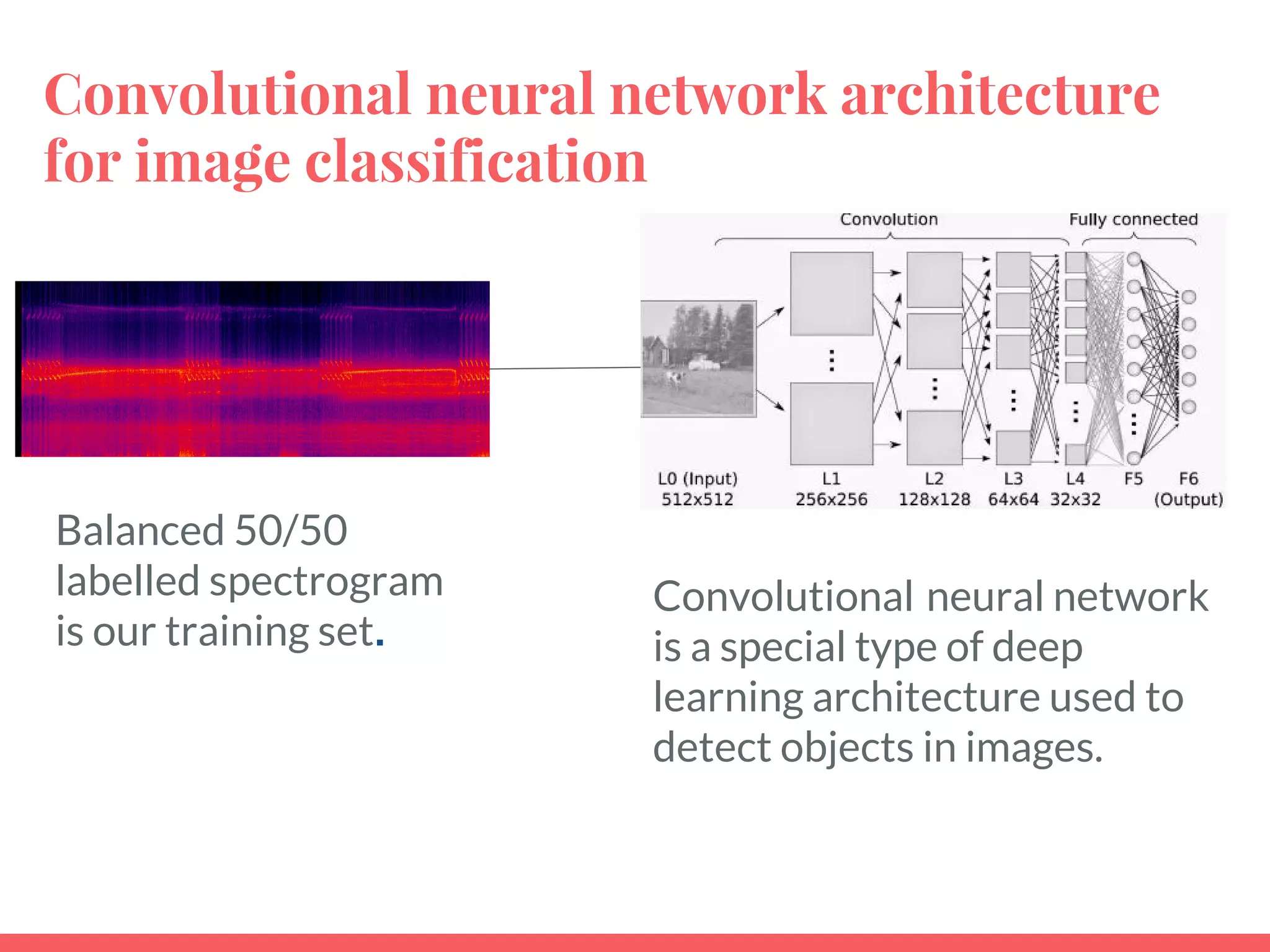
Convolutional neural network architecture
for image classification
Balanced 50/50
labelled spectrogram
is our training set.
Convolutional neural network
is a special type of deep
learning architecture used to
detect objects in images.
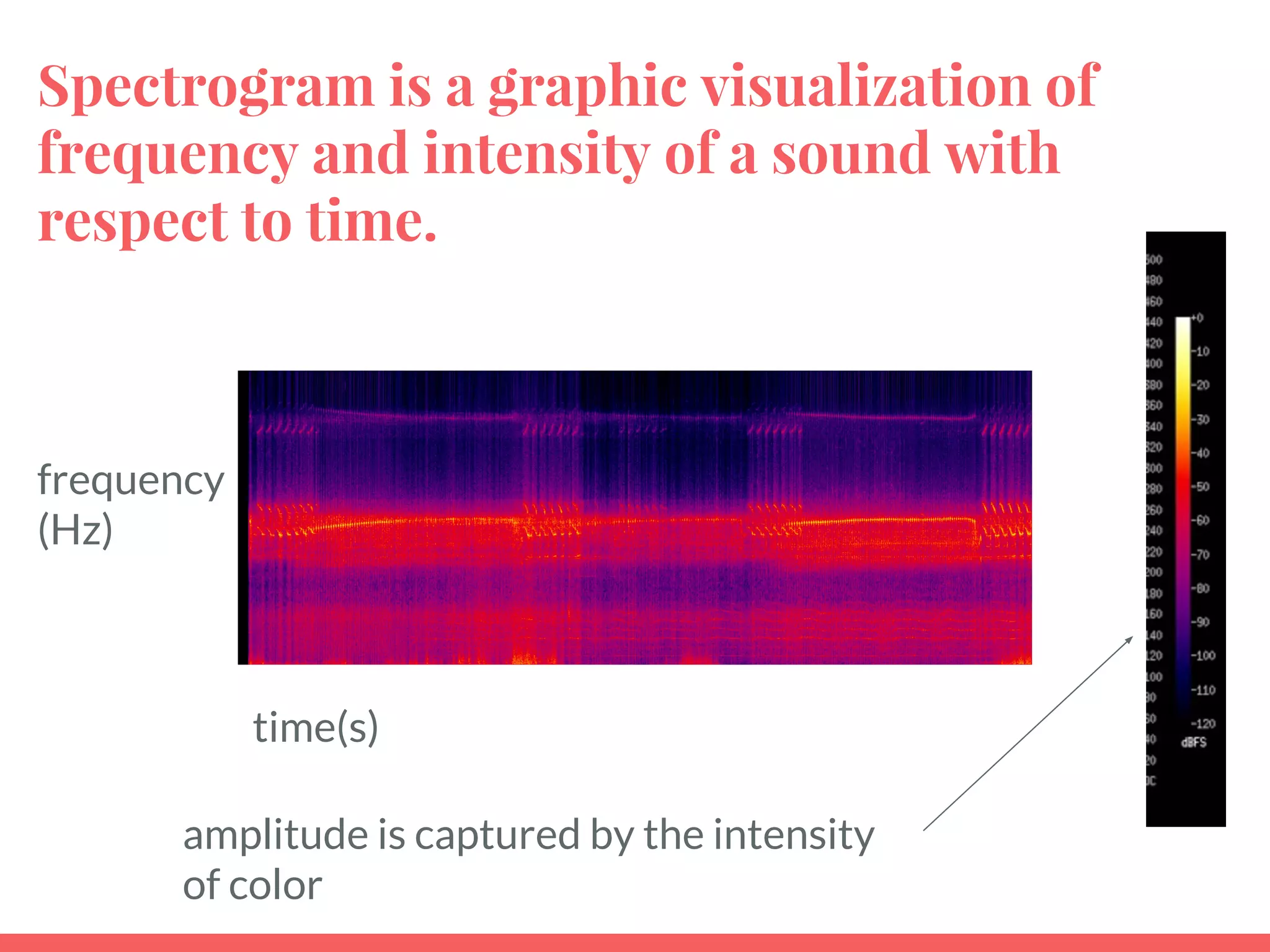
Spectrogram is a graphic visualization of
frequency and intensity of a sound with
respect to time.
time(s)
frequency
(Hz)
amplitude is captured by the intensity
of color
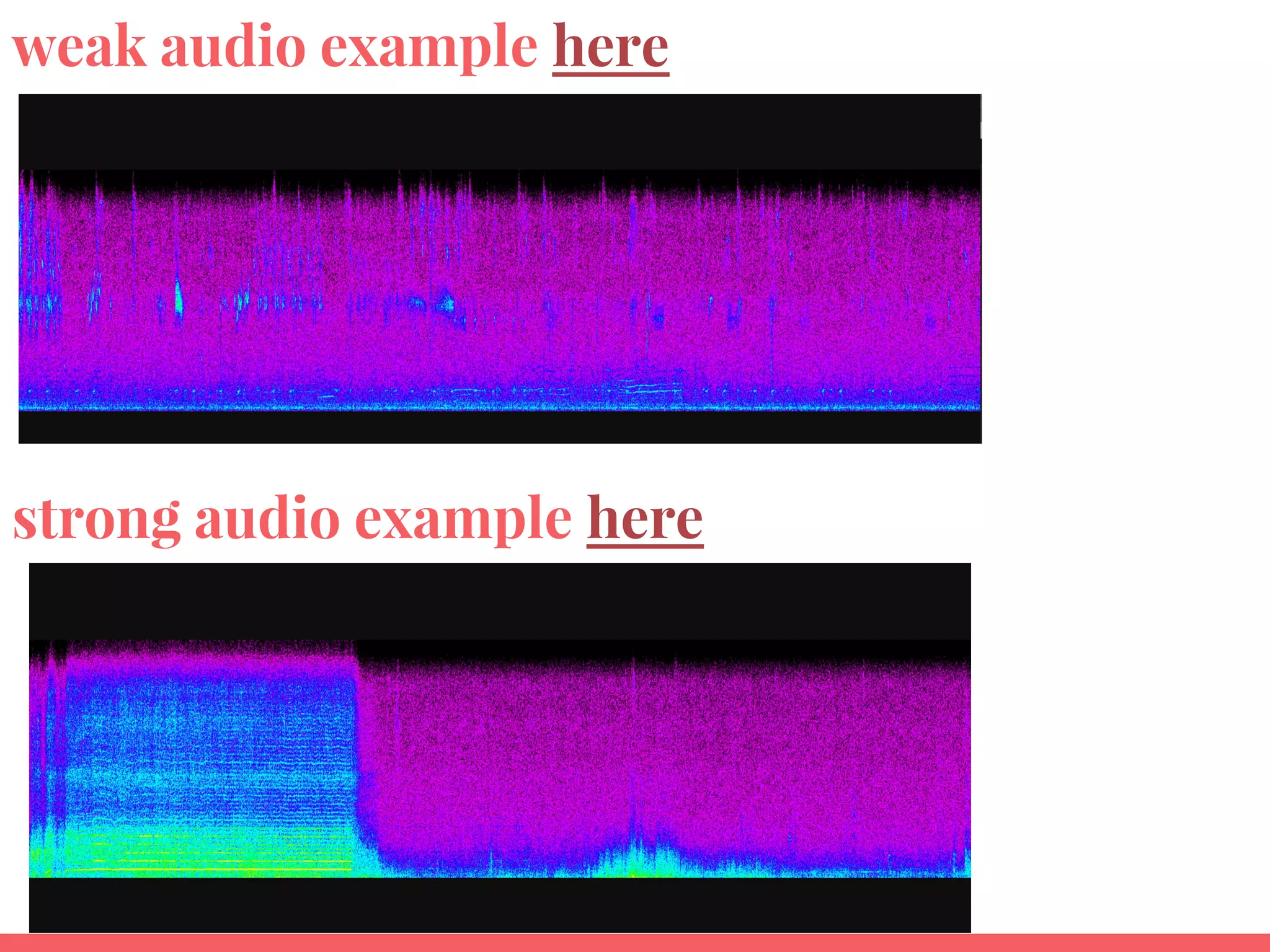
weak audio example here
strong audio example here
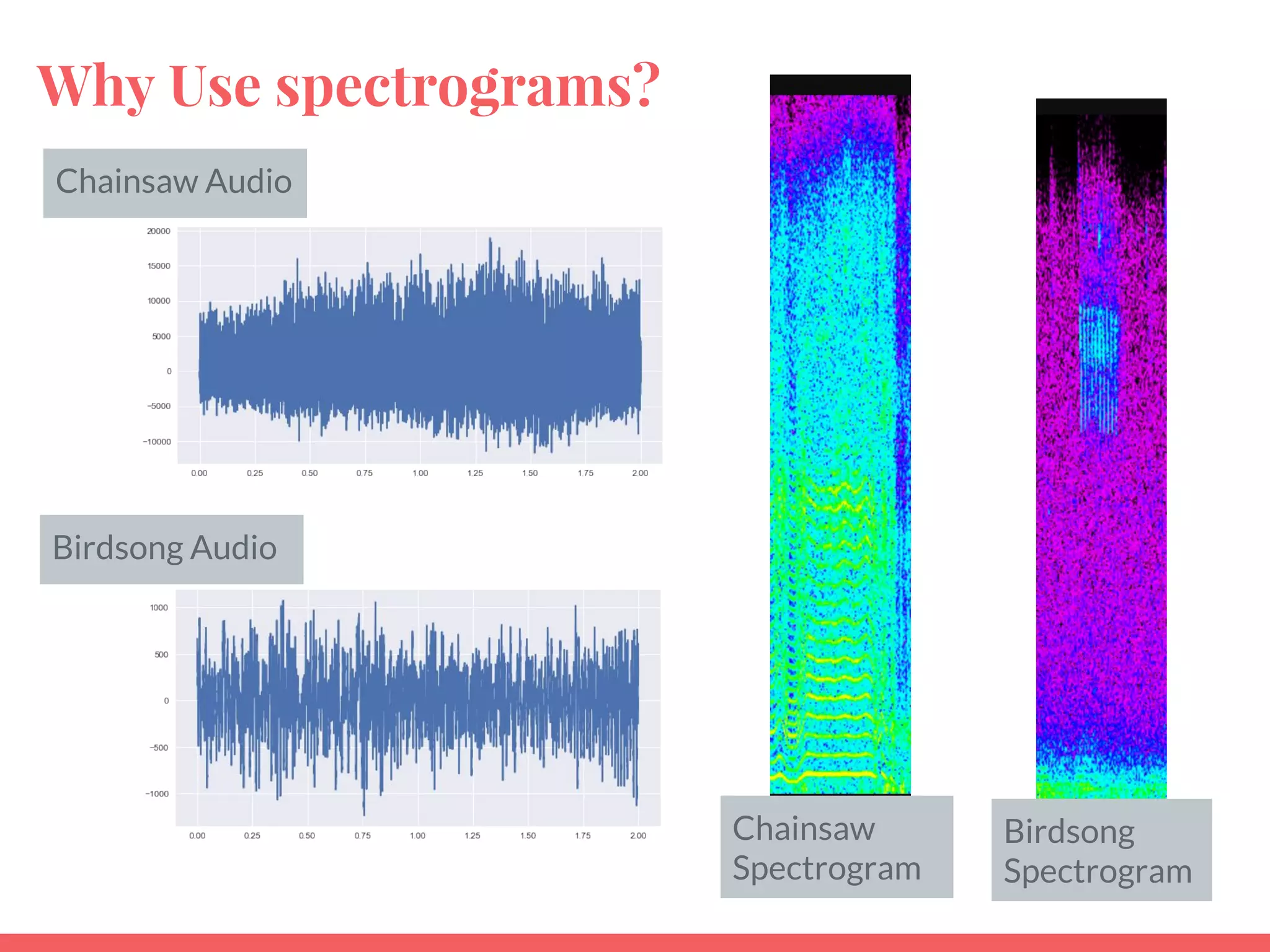
Why Use spectrograms?
Chainsaw Audio
Birdsong Audio
Birdsong
Spectrogram
Chainsaw
Spectrogram
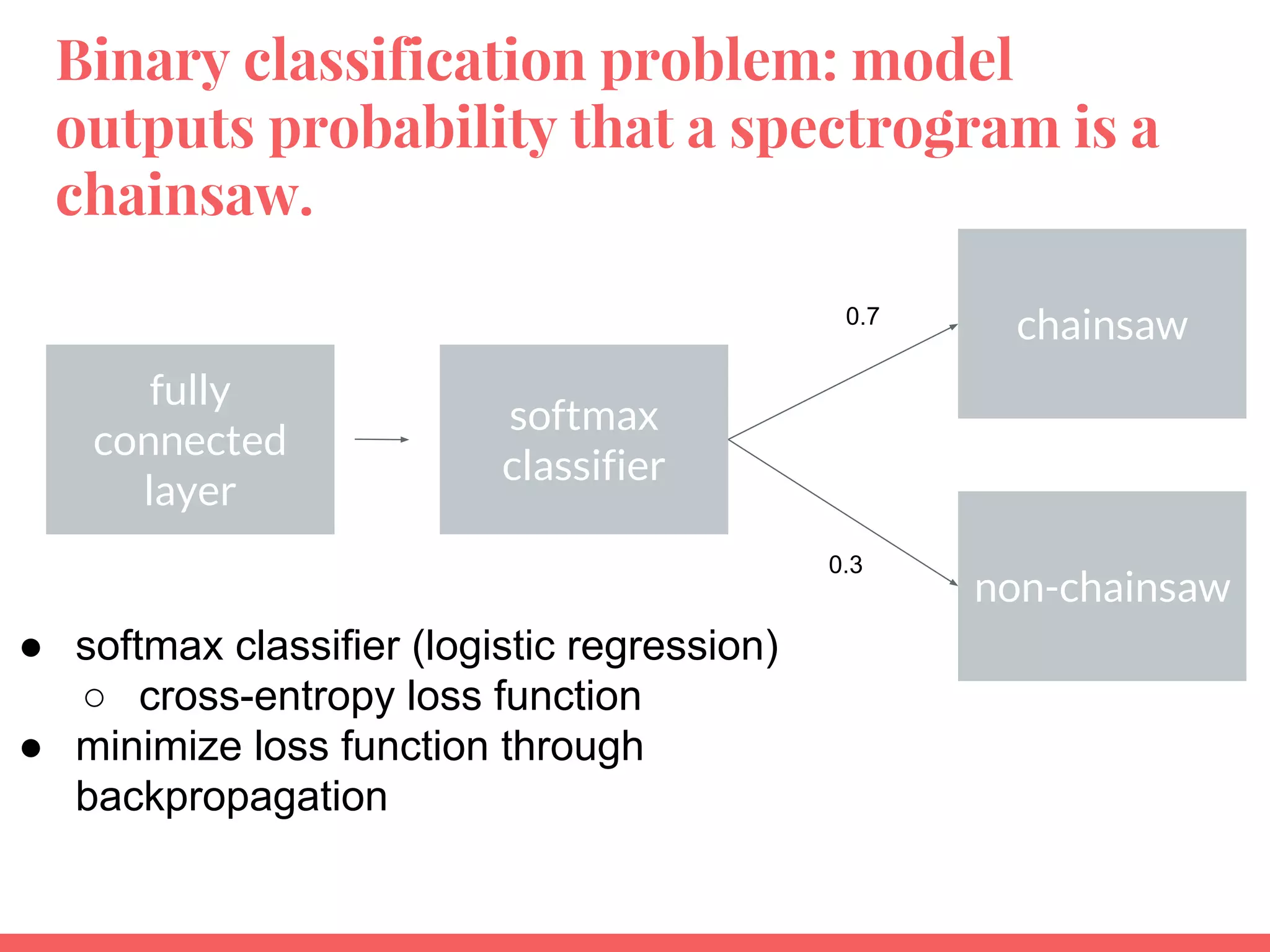
Binary classification problem: model
outputs probability that a spectrogram is a
chainsaw.
chainsaw
non-chainsaw
● softmax classifier (logistic regression)
○ cross-entropy loss function
● minimize loss function through
backpropagation
softmax
classifier
0.7
0.3
fully
connected
layer
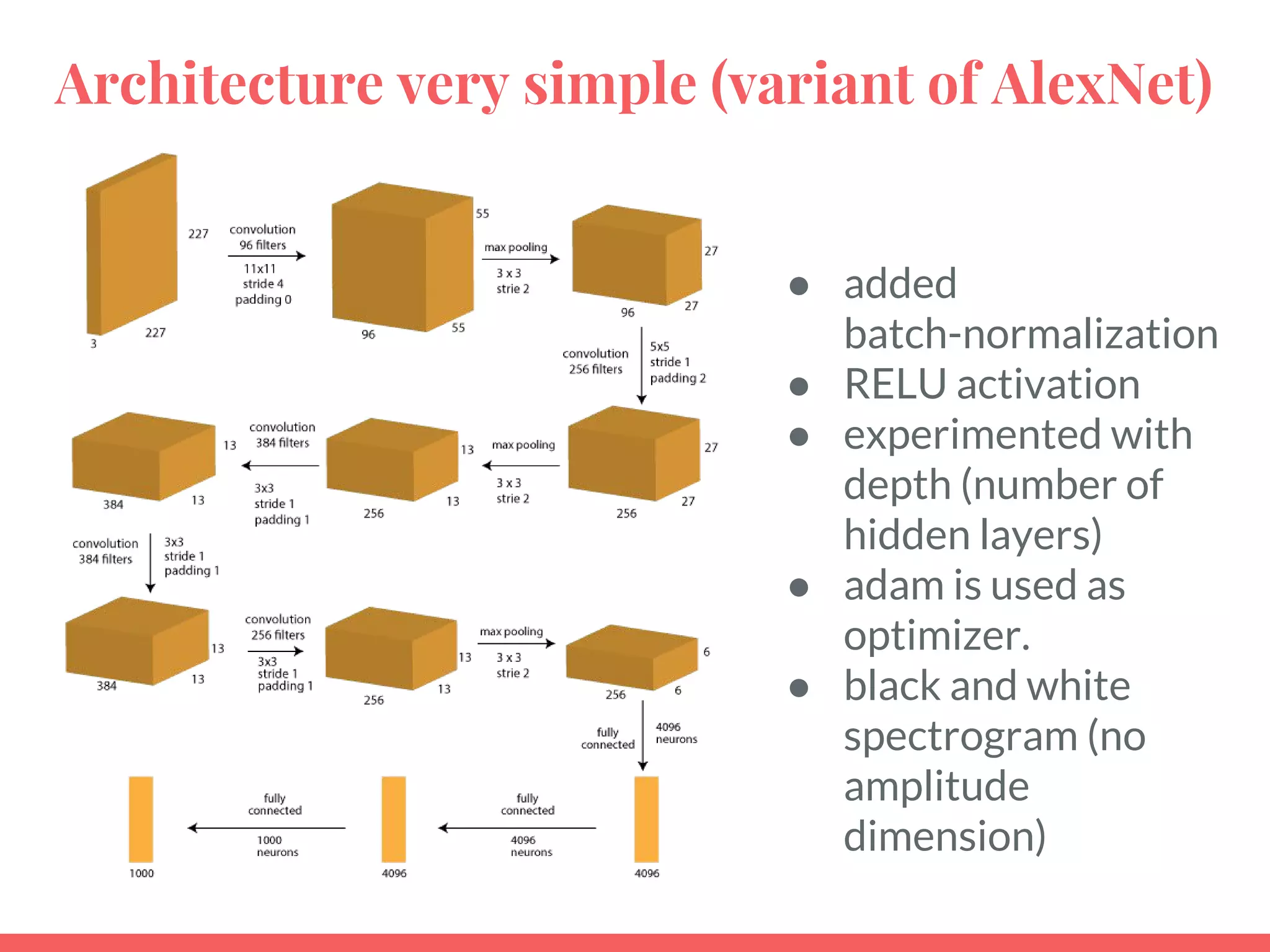
Architecture very simple (variant of AlexNet)
● added
batch-normalization
● RELU activation
● experimented with
depth (number of
hidden layers)
● adam is used as
optimizer.
● black and white
spectrogram (no
amplitude
dimension)
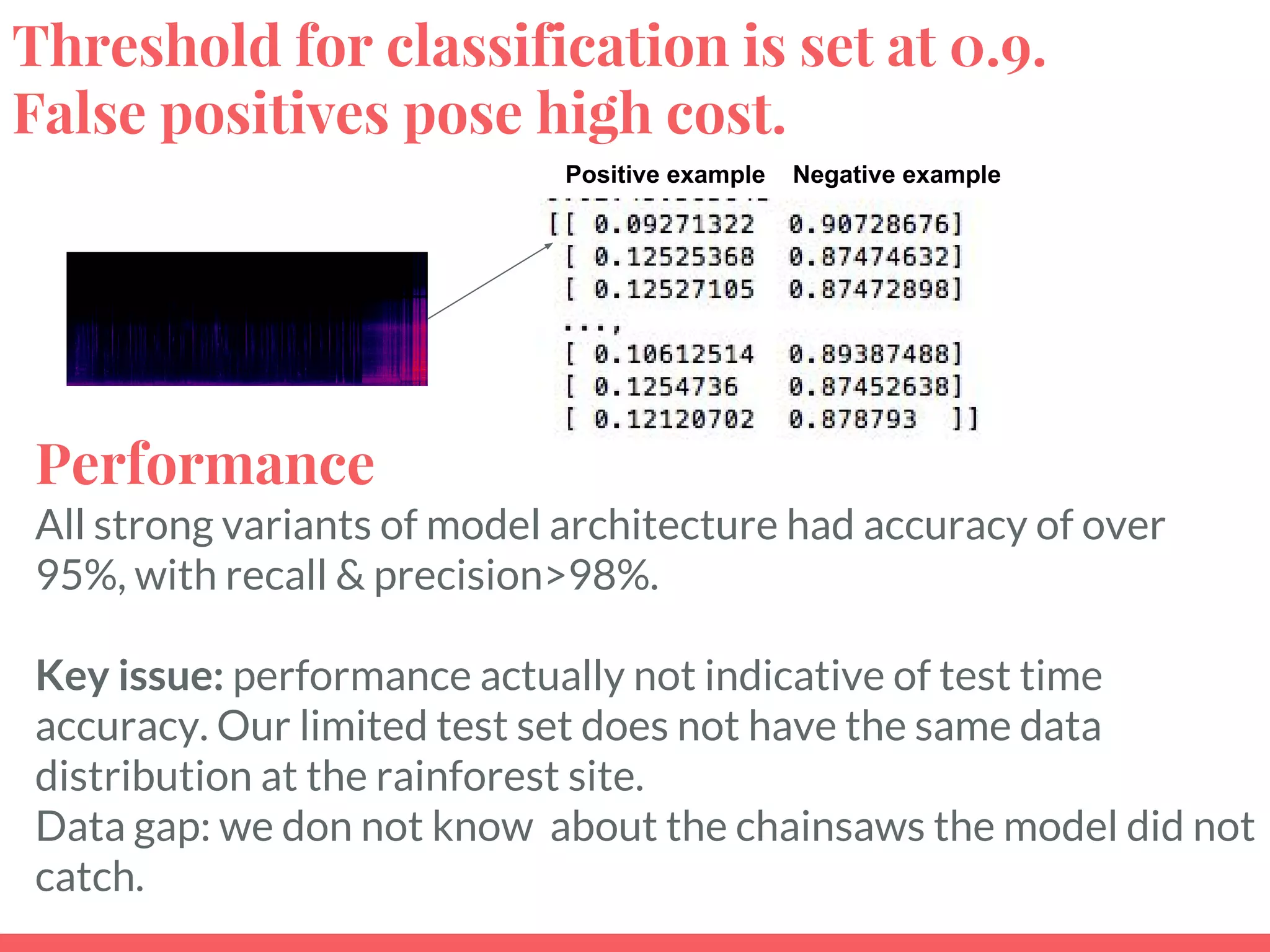
Threshold for classification is set at 0.9.
False positives pose high cost.
Positive example Negative example
Performance
All strong variants of model architecture had accuracy of over
95%, with recall & precision>98%.
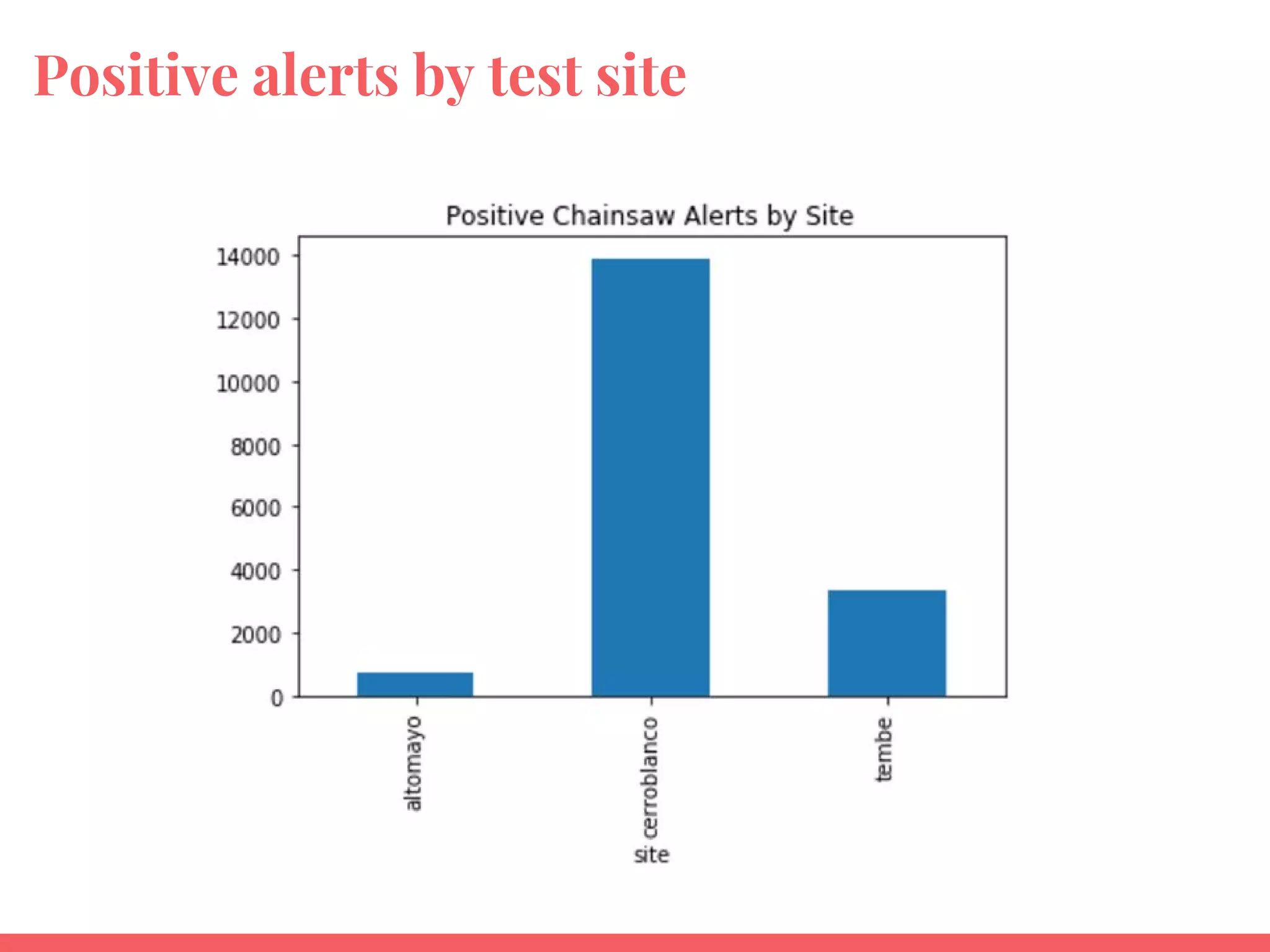
Key issue: performance actually not indicative of test time
accuracy. Our limited test set does not have the same data
distribution at the rainforest site.
Data gap: we don not know about the chainsaws the model did not
catch.
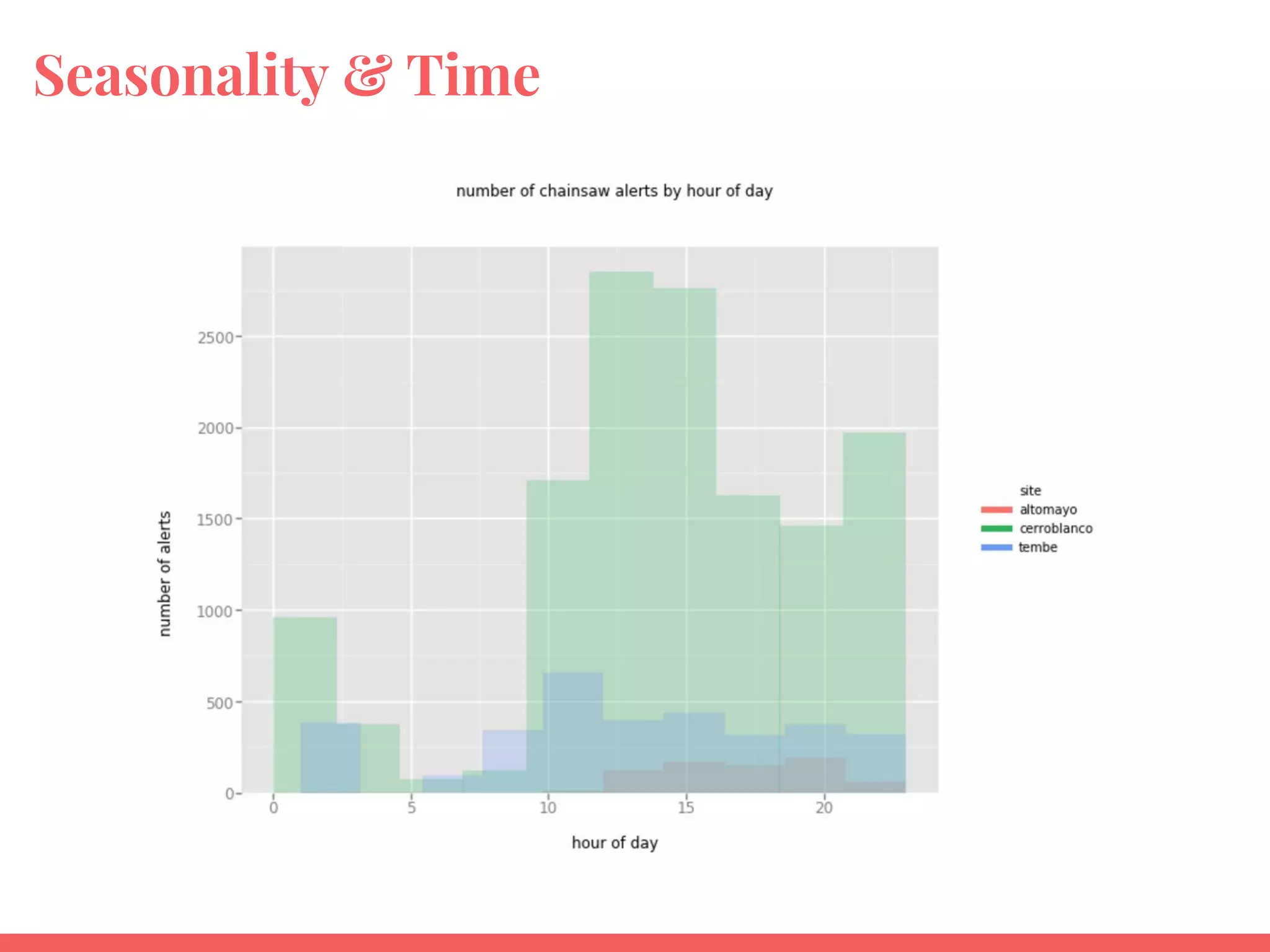
Positive alerts by test site
Seasonality & Time
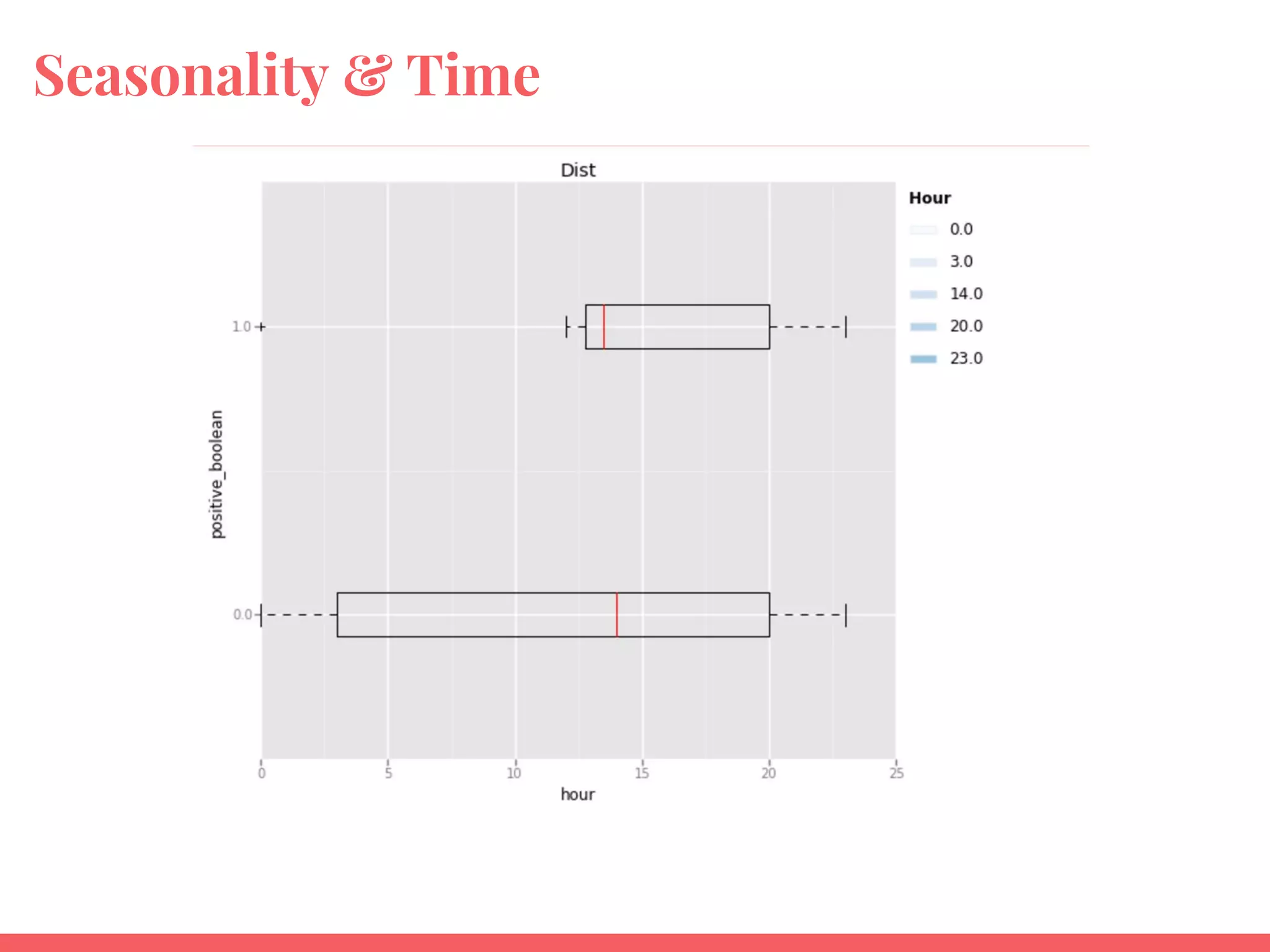
Seasonality & Time
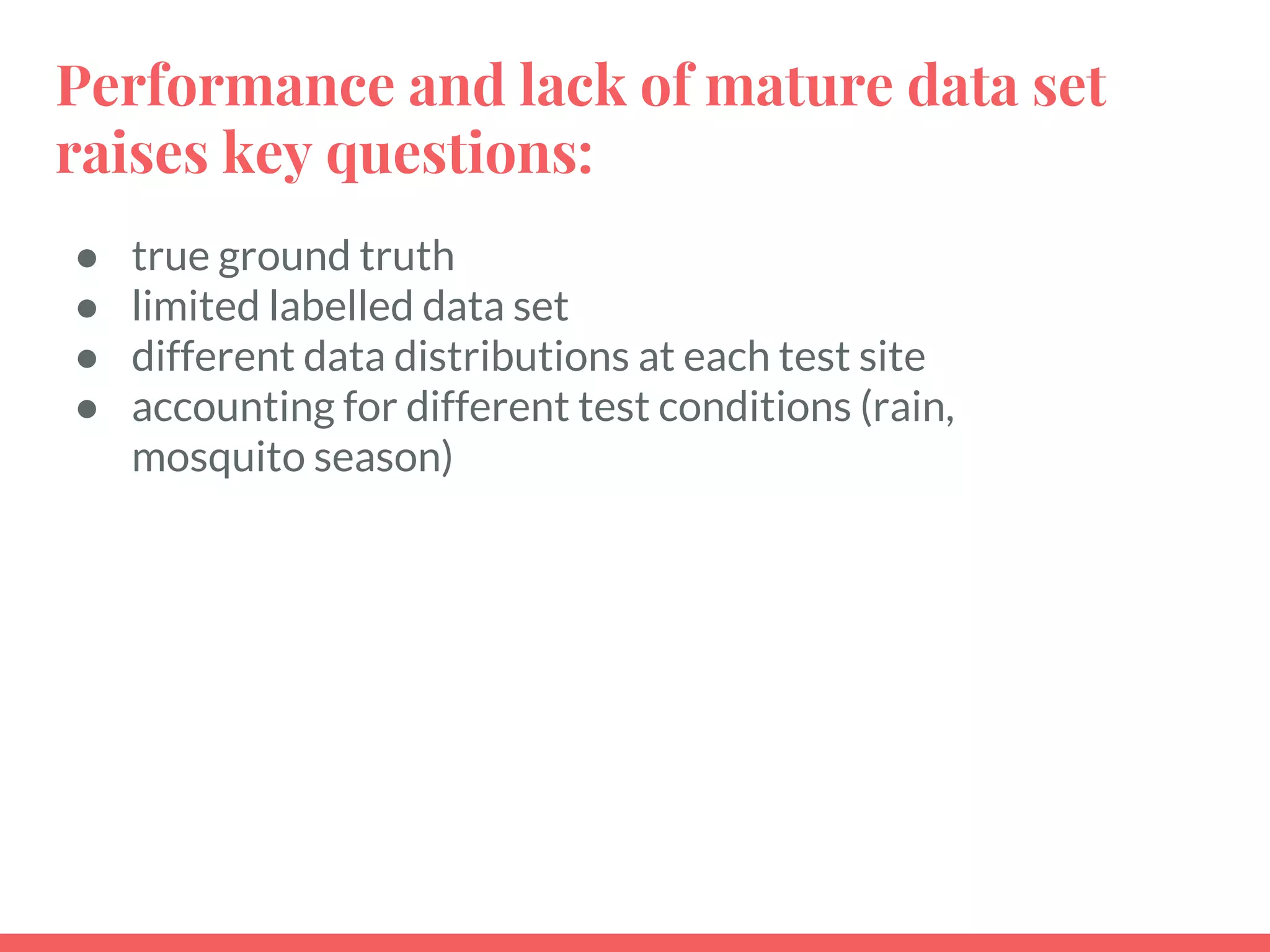
Performance and lack of mature data set
raises key questions:
● true ground truth
● limited labelled data set
● different data distributions at each test site
● accounting for different test conditions (rain,
mosquito season)
Ways to address this:
● use ensembles of models (models in production
are ensembles)
● incorporate metadata
Data Augmentation
Limited labelled data set:
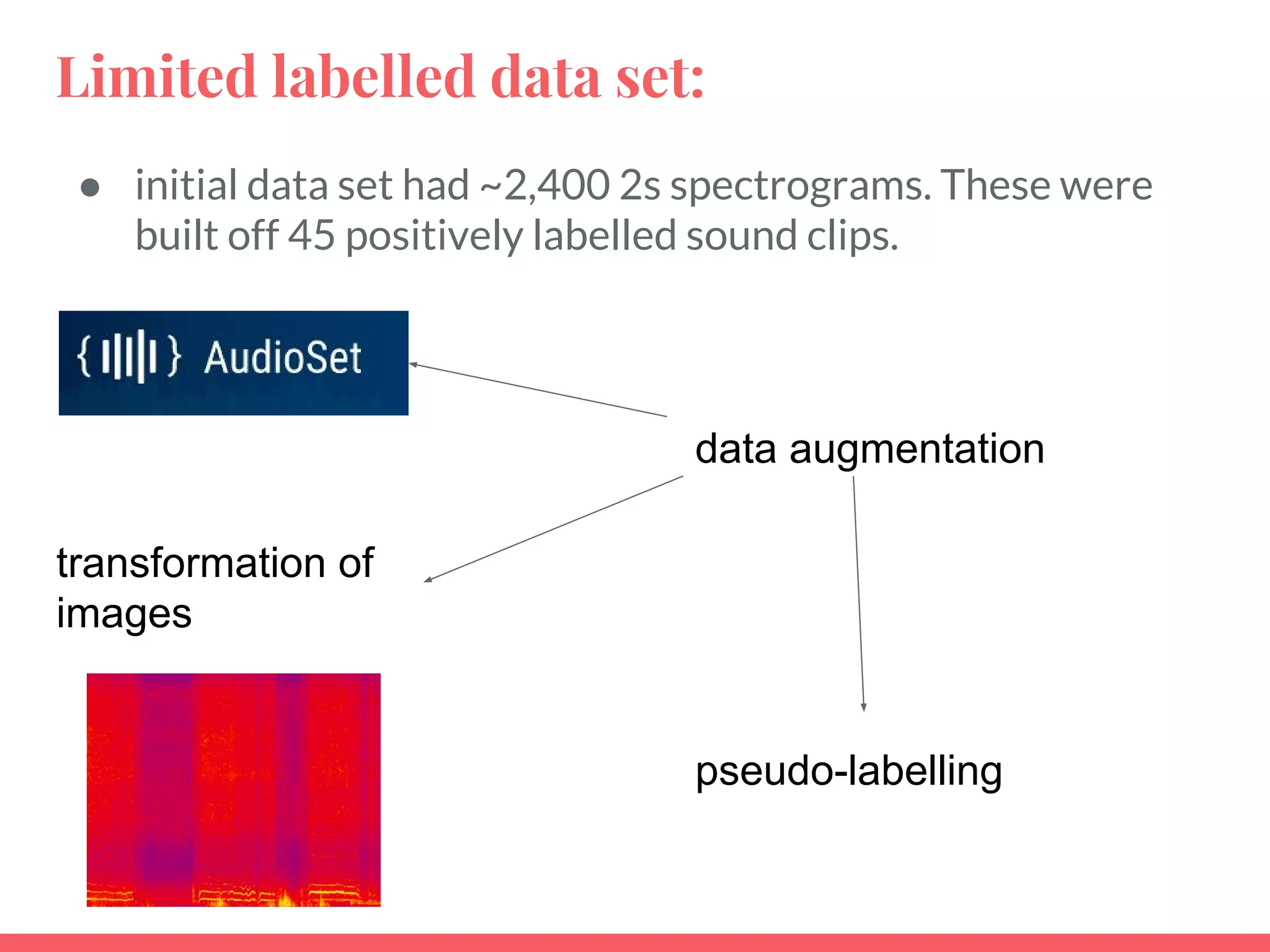
● initial data set had ~2,400 2s spectrograms. These were
built off 45 positively labelled sound clips.
data augmentation
transformation of
images
pseudo-labelling
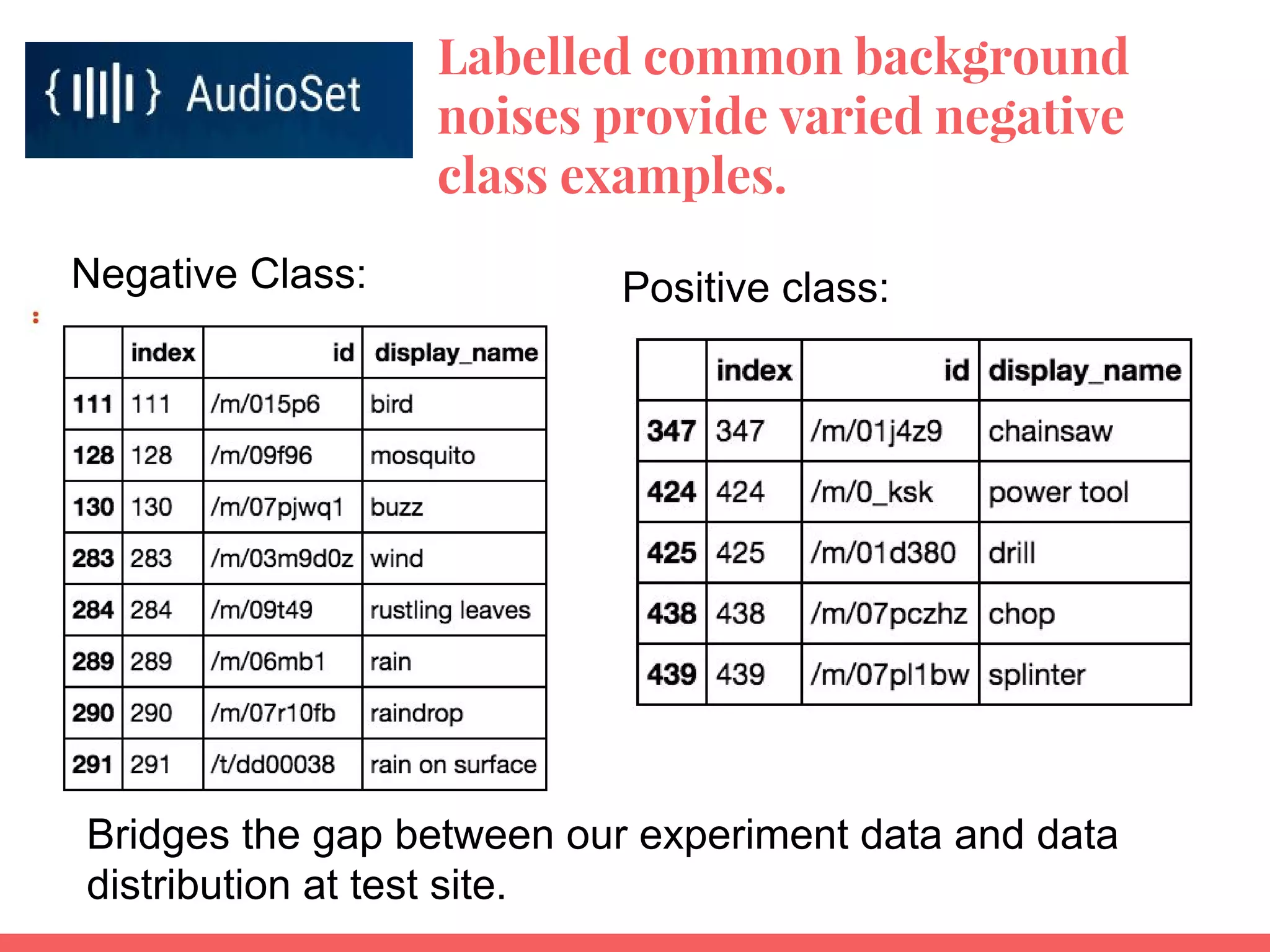
Negative Class:
Labelled common background
noises provide varied negative
class examples.
Positive class:
Bridges the gap between our experiment data and data
distribution at test site.
10 sec labelled clips.
extremely valuable: chainsaw
less valuable: rustling leaves
Overall, at this stage of research quantity of data is more
important. Particularly for providing stratified examples
of the negative class (for example mosquito).
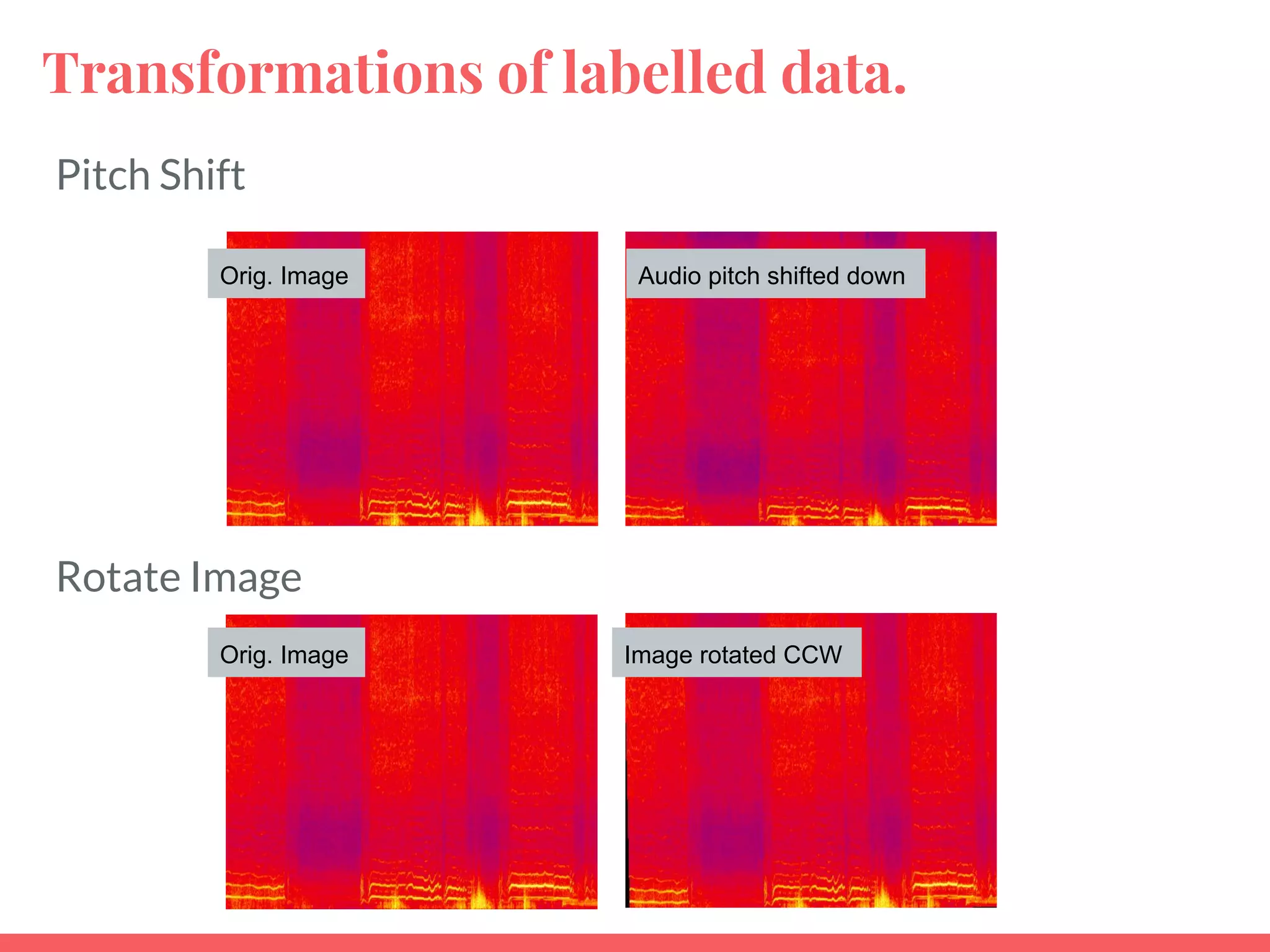
Transformations of labelled data.
Pitch Shift
Rotate Image
Orig. Image Image rotated CCW
Audio pitch shifted downOrig. Image
Improve Data
Preprocessing
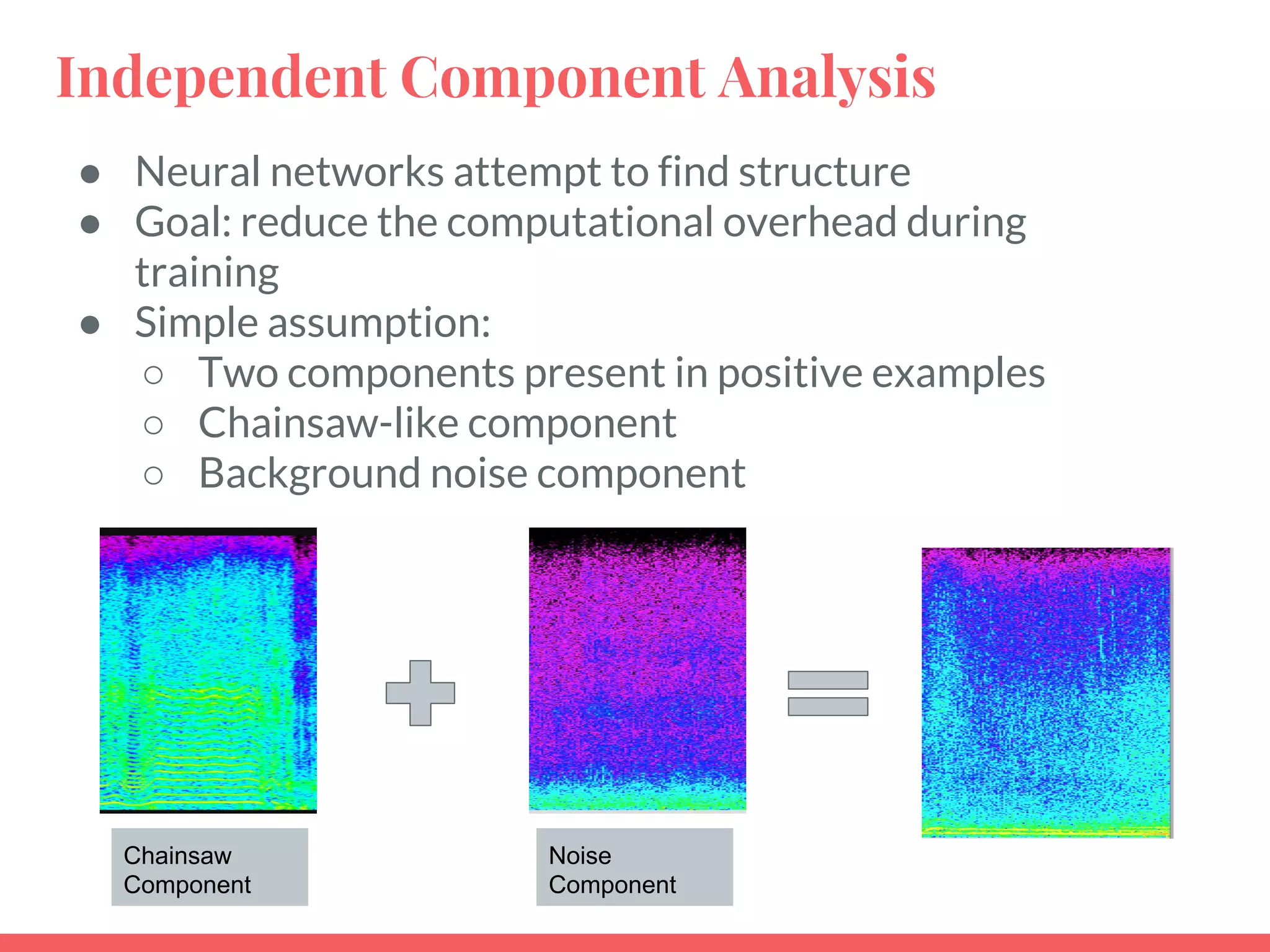
Independent Component Analysis
● Neural networks attempt to find structure
● Goal: reduce the computational overhead during
training
● Simple assumption:
○ Two components present in positive examples
○ Chainsaw-like component
○ Background noise component
Chainsaw
Component
Noise
Component
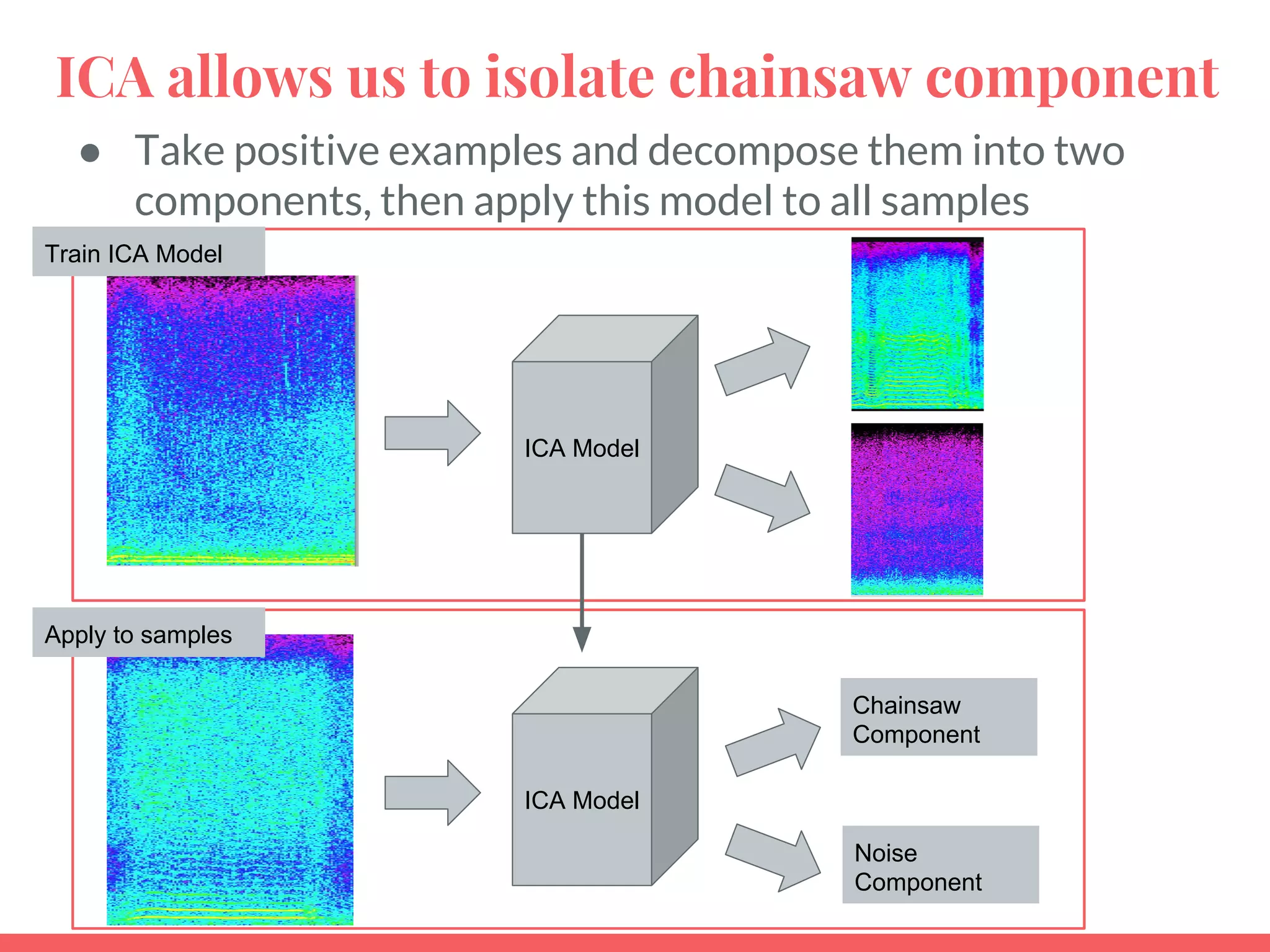
● Take positive examples and decompose them into two
components, then apply this model to all samples
ICA allows us to isolate chainsaw component
ICA Model
ICA Model
Train ICA Model
Chainsaw
Component
Noise
Component
Apply to samples
Independent Components Analysis
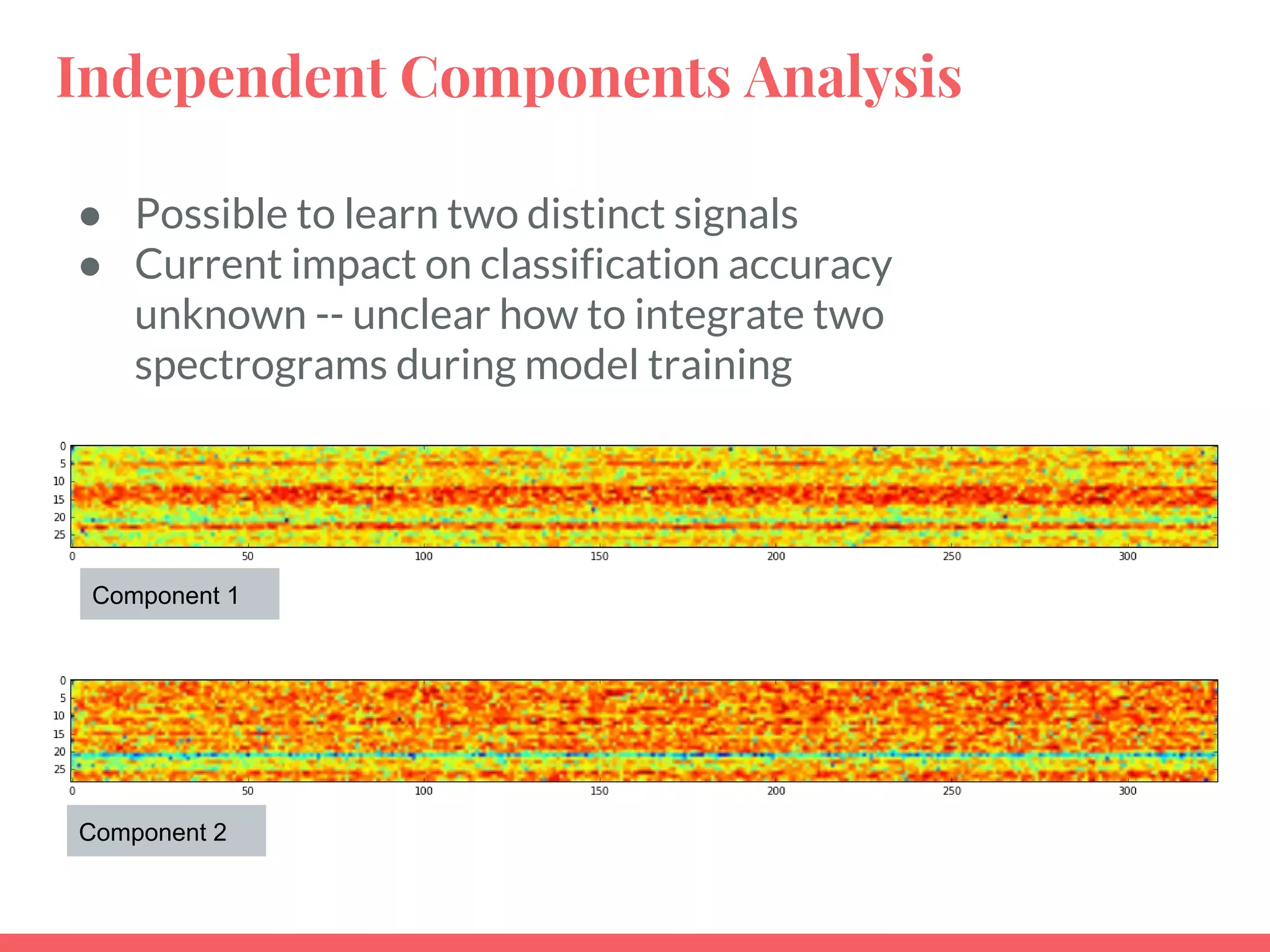
● Possible to learn two distinct signals
● Current impact on classification accuracy
unknown -- unclear how to integrate two
spectrograms during model training
Component 1
Component 2
2. Model
Directionality of
Sound
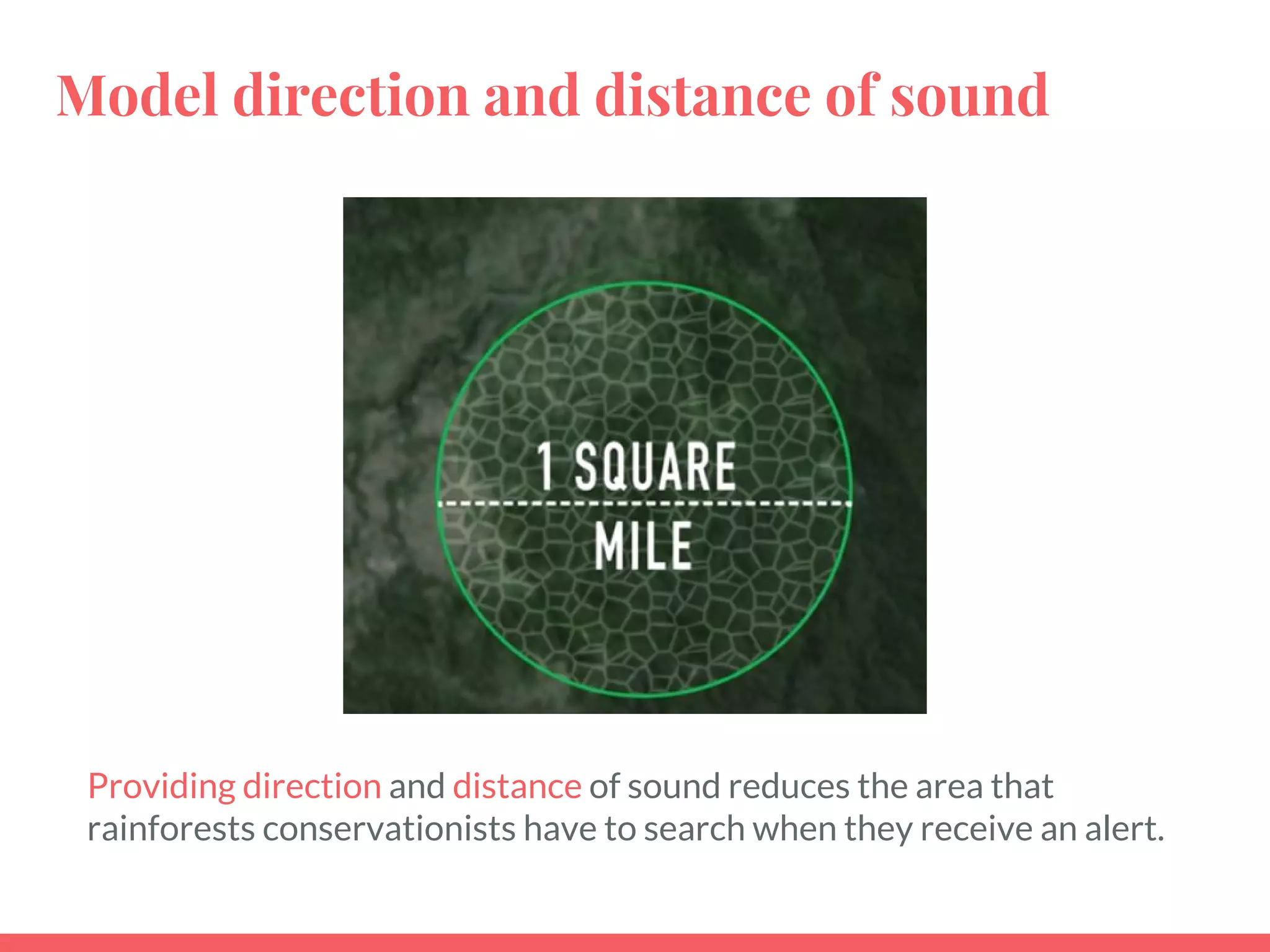
Model direction and distance of sound
Providing direction and distance of sound reduces the area that
rainforests conservationists have to search when they receive an alert.
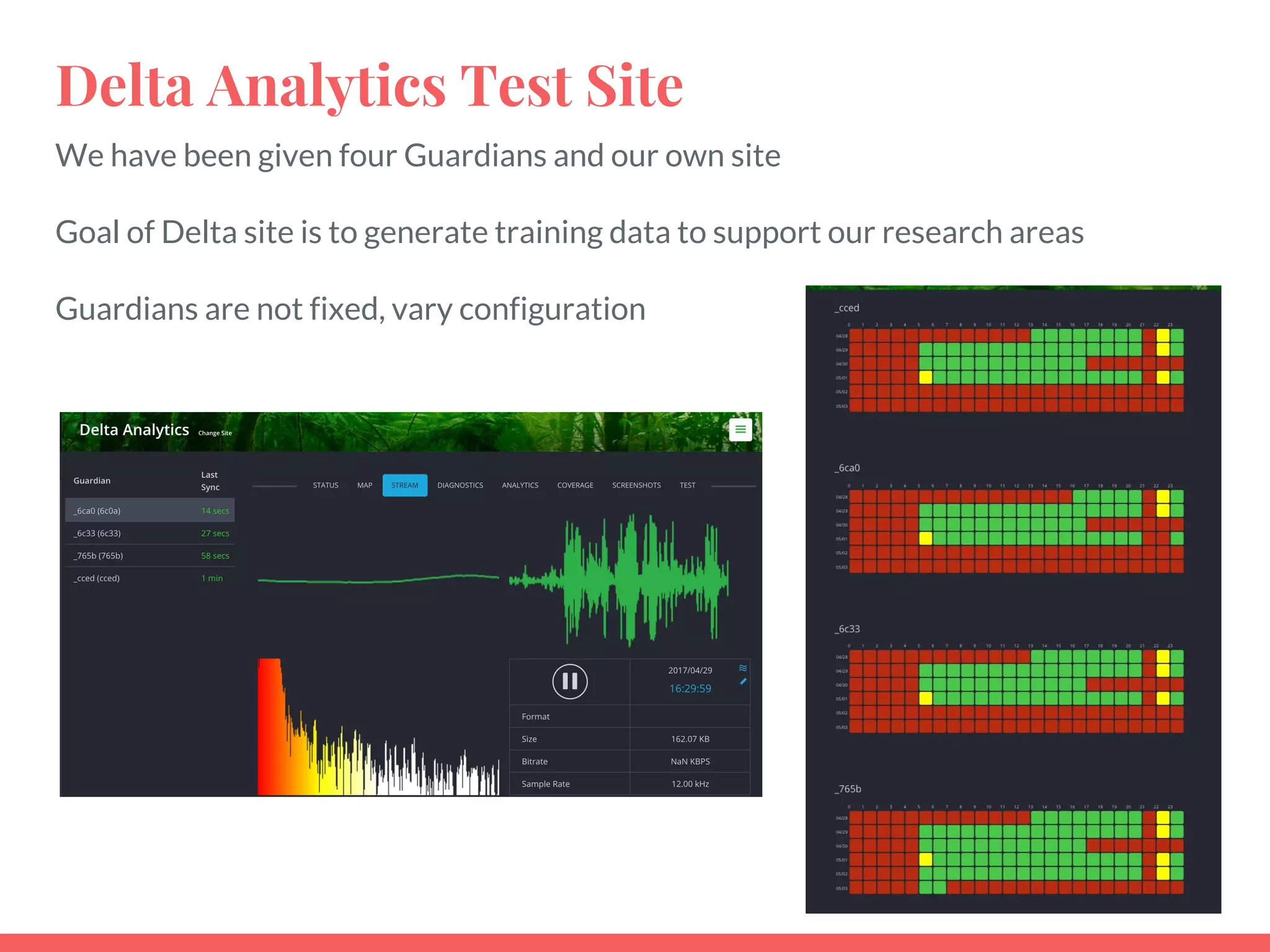
Delta Analytics Test Site
We have been given four Guardians and our own site
Goal of Delta site is to generate training data to support our research areas
Guardians are not fixed, vary configuration
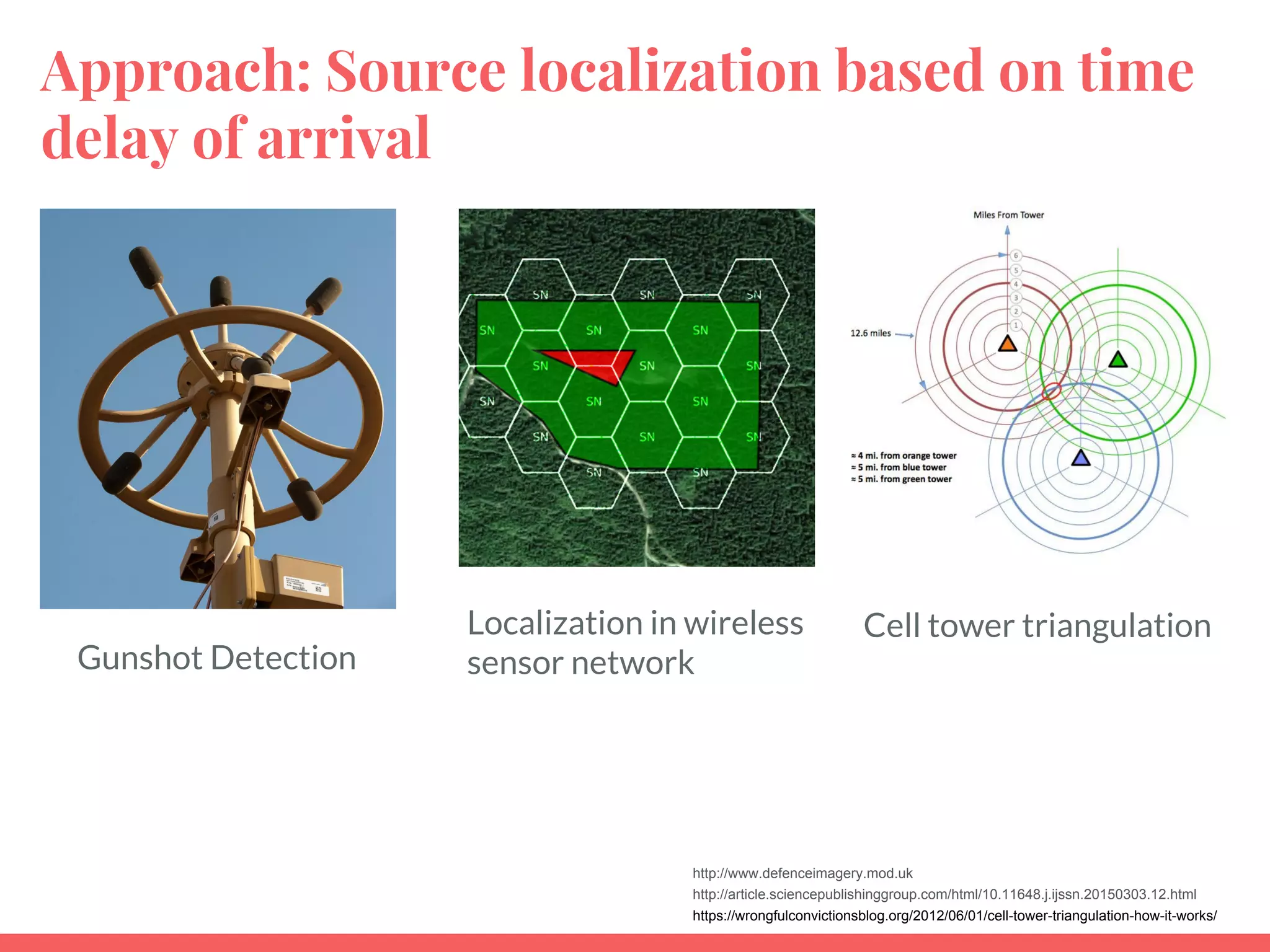
Approach: Source localization based on time
delay of arrival
Gunshot Detection
https://wrongfulconvictionsblog.org/2012/06/01/cell-tower-triangulation-how-it-works/
http://www.defenceimagery.mod.uk
http://article.sciencepublishinggroup.com/html/10.11648.j.ijssn.20150303.12.html
Cell tower triangulationLocalization in wireless
sensor network
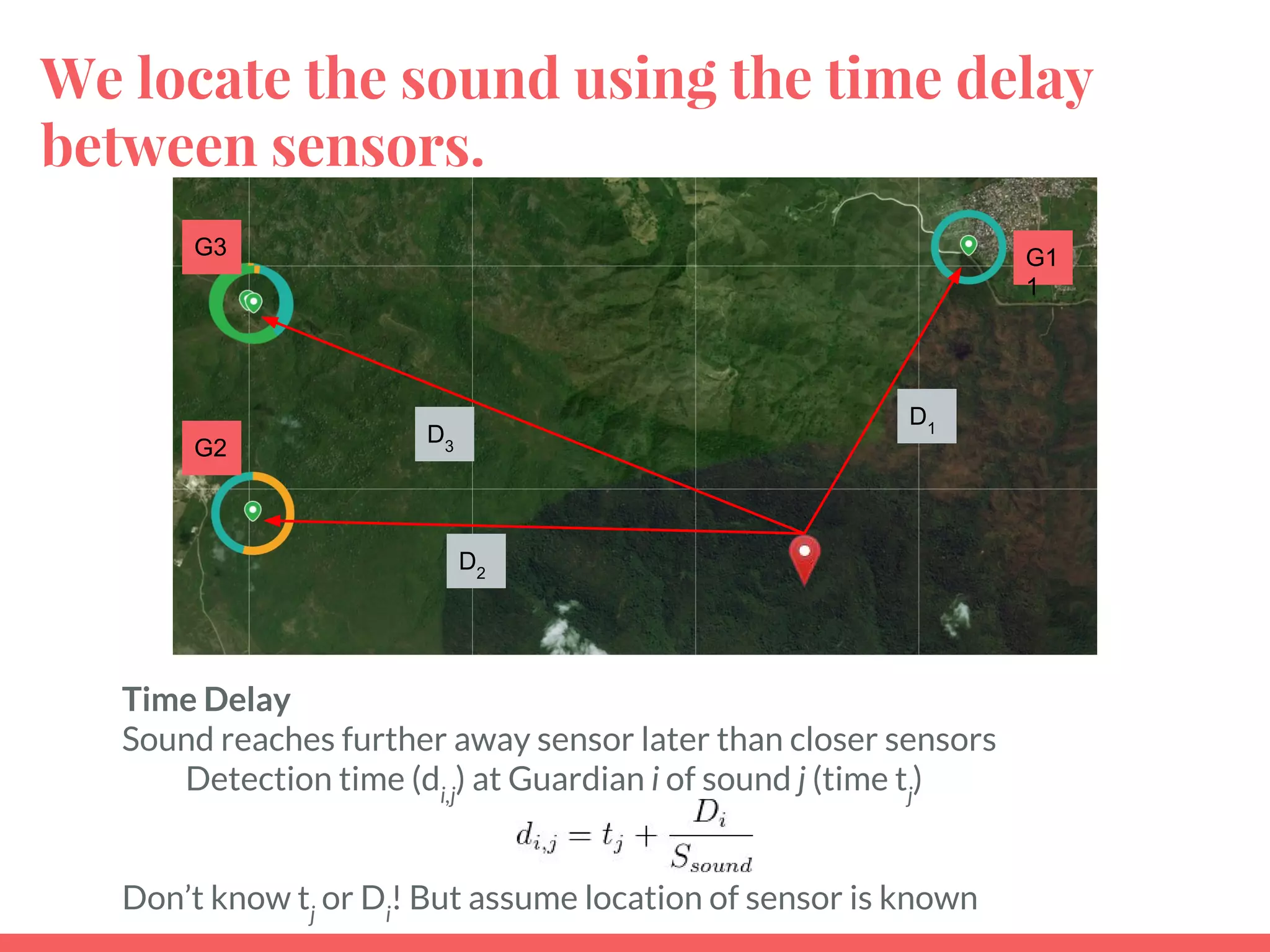
We locate the sound using the time delay
between sensors.
Time Delay
Sound reaches further away sensor later than closer sensors
Detection time (di,j
) at Guardian i of sound j (time tj
)
Don’t know tj
or Di
! But assume location of sensor is known
G1
1
G3
G2
D1
D3
D2
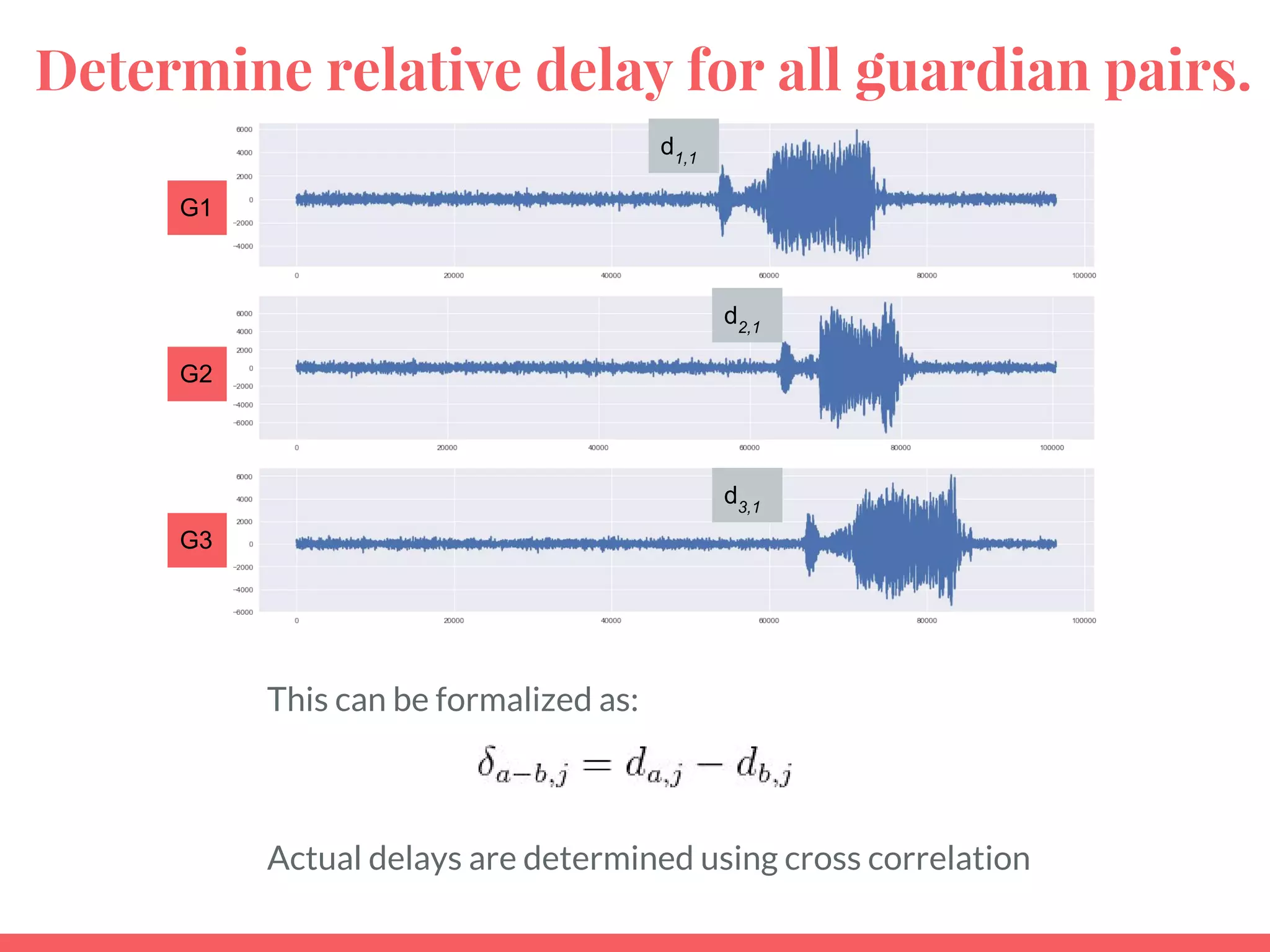
Determine relative delay for all guardian pairs.
This can be formalized as:
Actual delays are determined using cross correlation
G1
G3
G2
d1,1
d2,1
d3,1
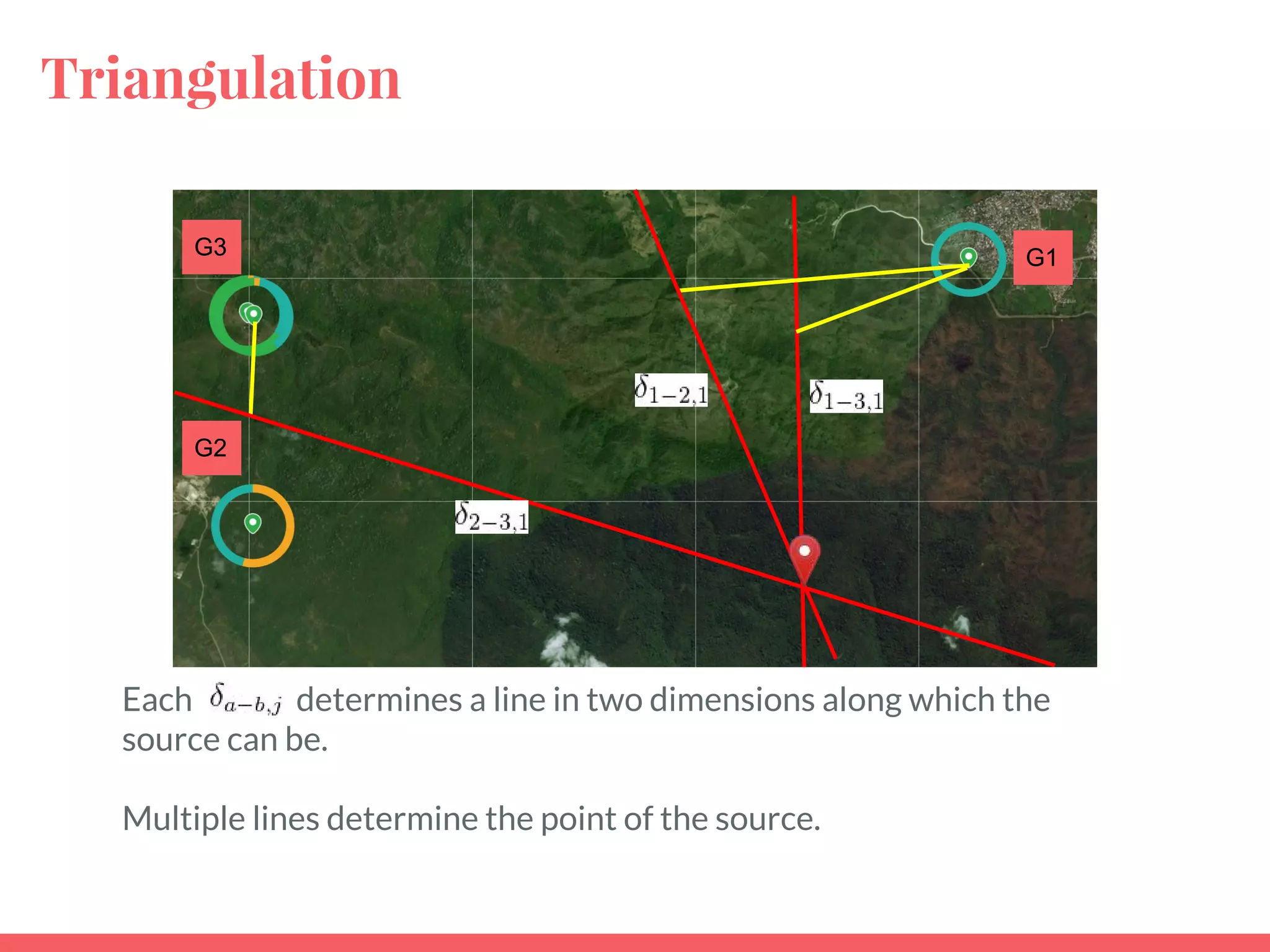
Triangulation
Each determines a line in two dimensions along which the
source can be.
Multiple lines determine the point of the source.
G1G3
G2
System End-to-End
Positive Detections Only
-> Direction estimate
-> Alert ranger
G1
G3
G2
Record audio at sites Transmit audio and metadata
Classify audio using CNN
Provide alert and direction estimate
Unique Challenges
Posed by Our
Environment
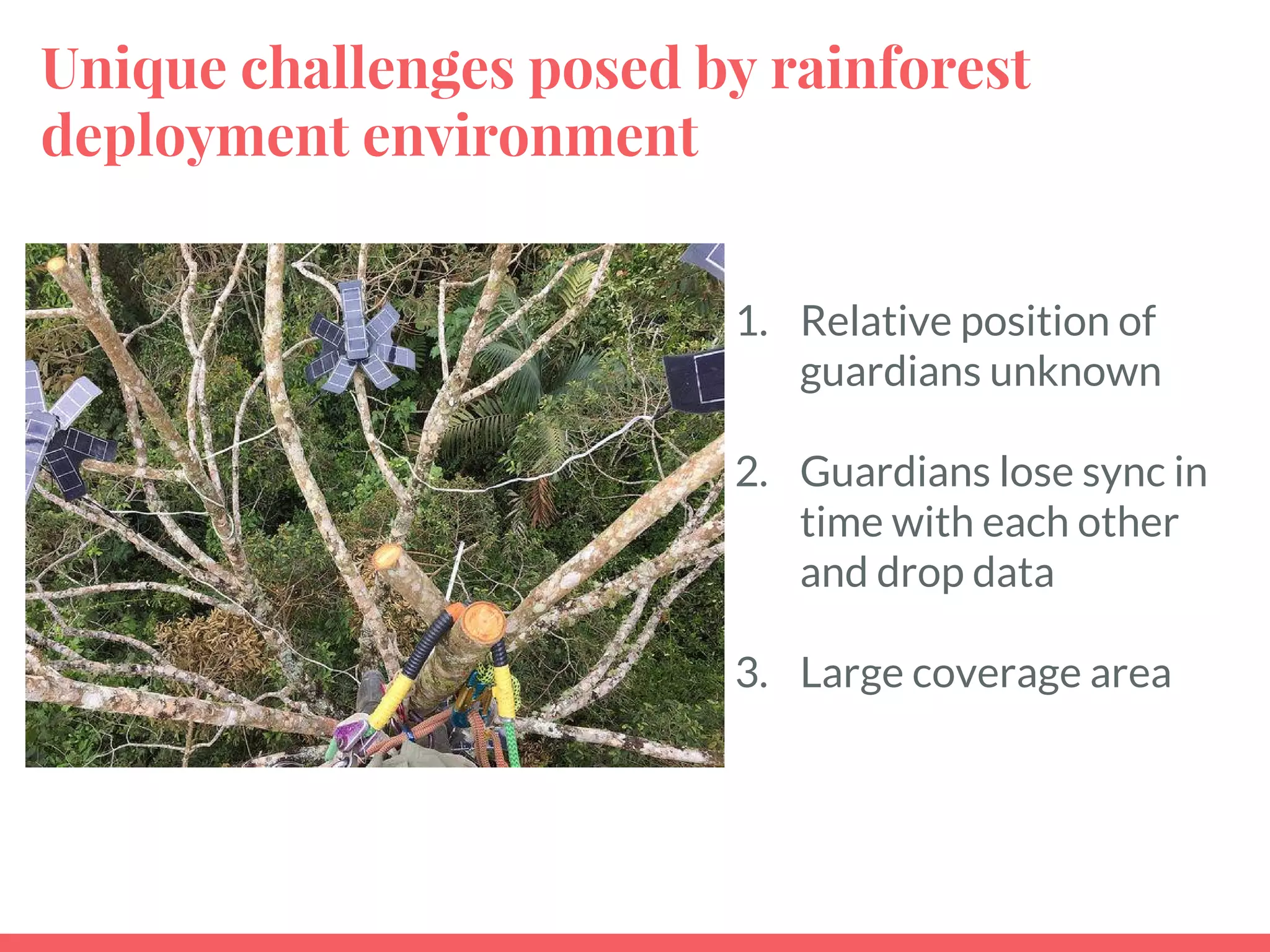
Unique challenges posed by rainforest
deployment environment
1. Relative position of
guardians unknown
2. Guardians lose sync in
time with each other
and drop data
3. Large coverage area
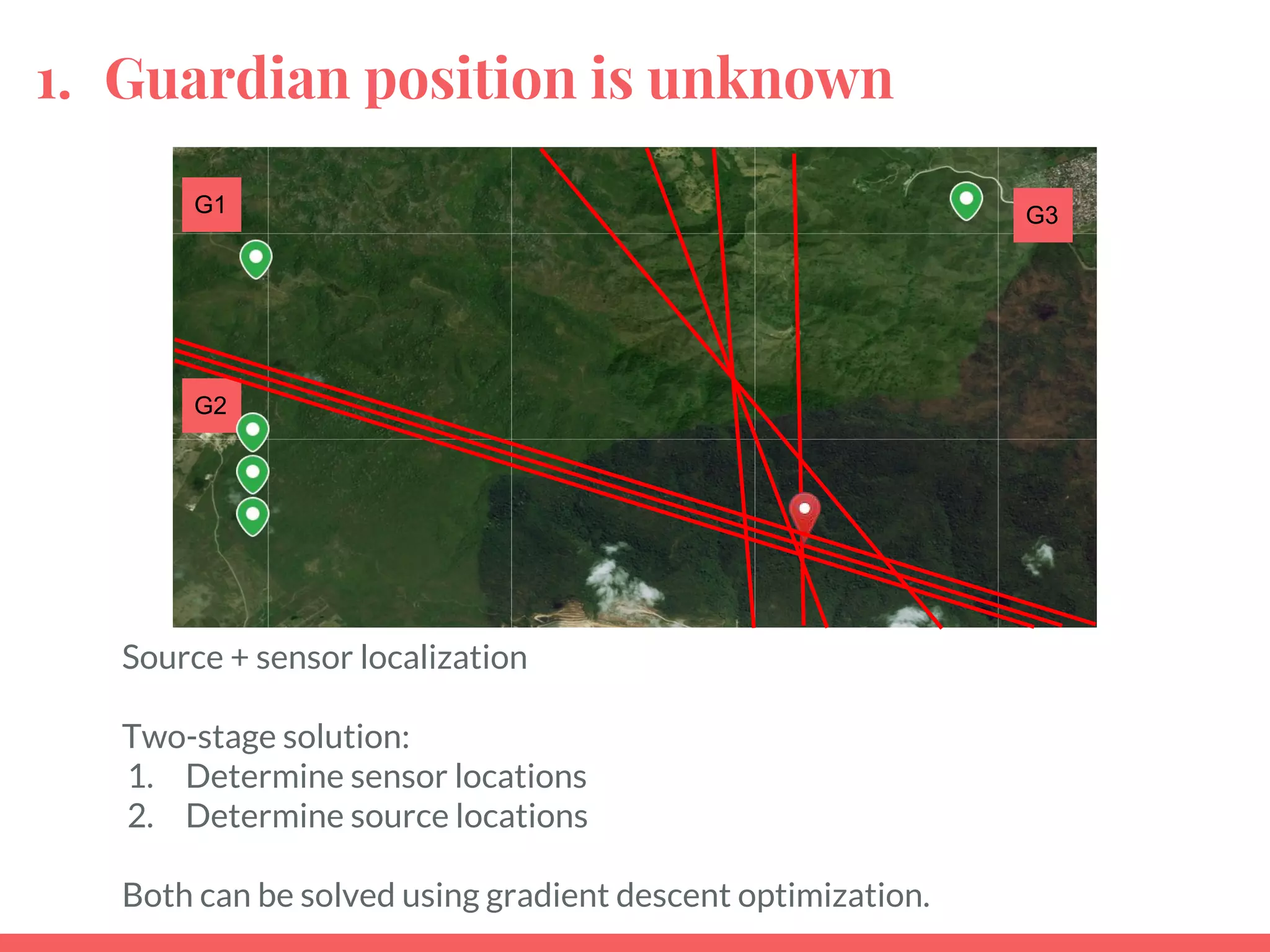
1. Guardian position is unknown
Source + sensor localization
Two-stage solution:
1. Determine sensor locations
2. Determine source locations
Both can be solved using gradient descent optimization.
G3G1
G2
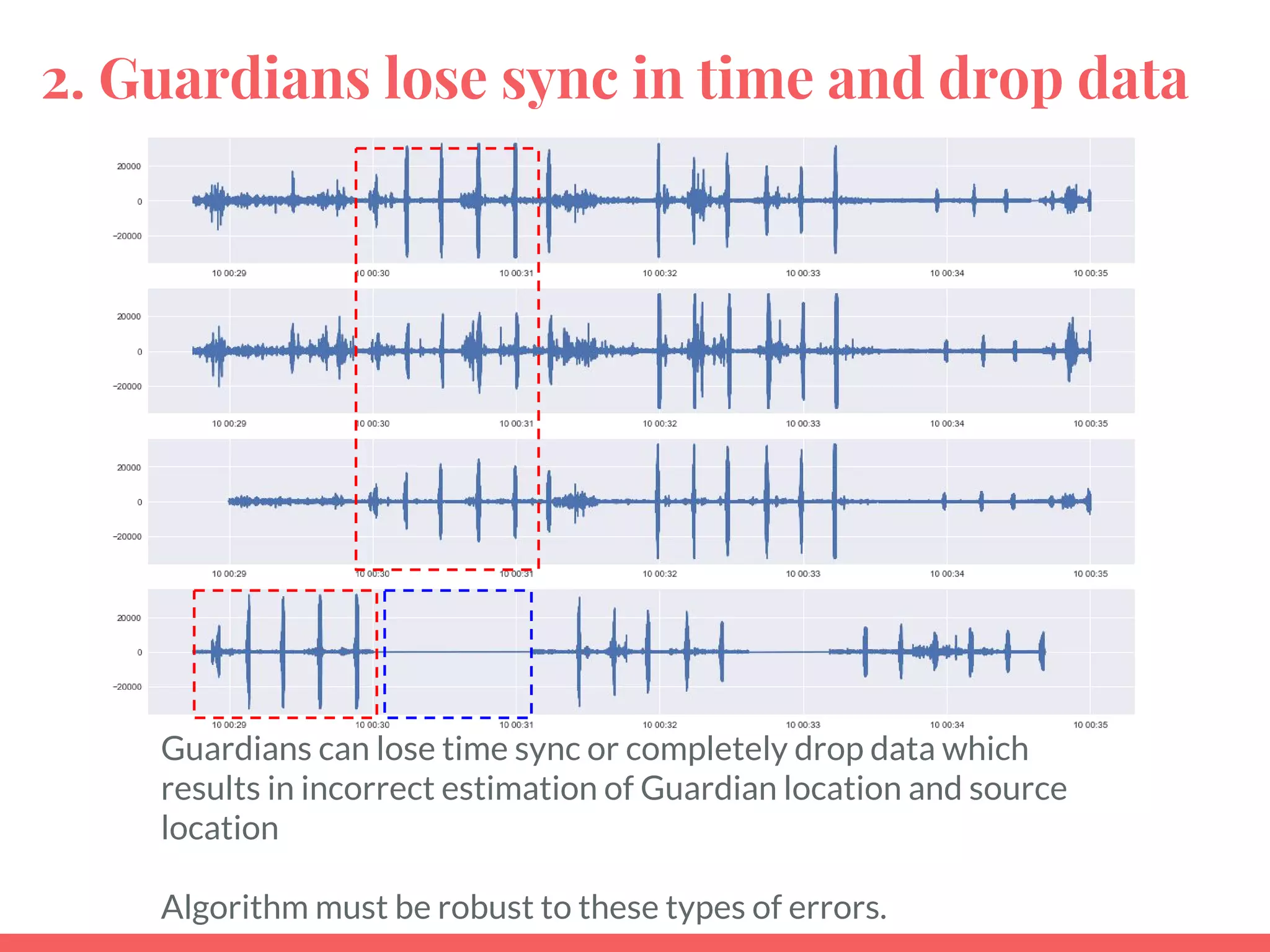
2. Guardians lose sync in time and drop data
Guardians can lose time sync or completely drop data which
results in incorrect estimation of Guardian location and source
location
Algorithm must be robust to these types of errors.
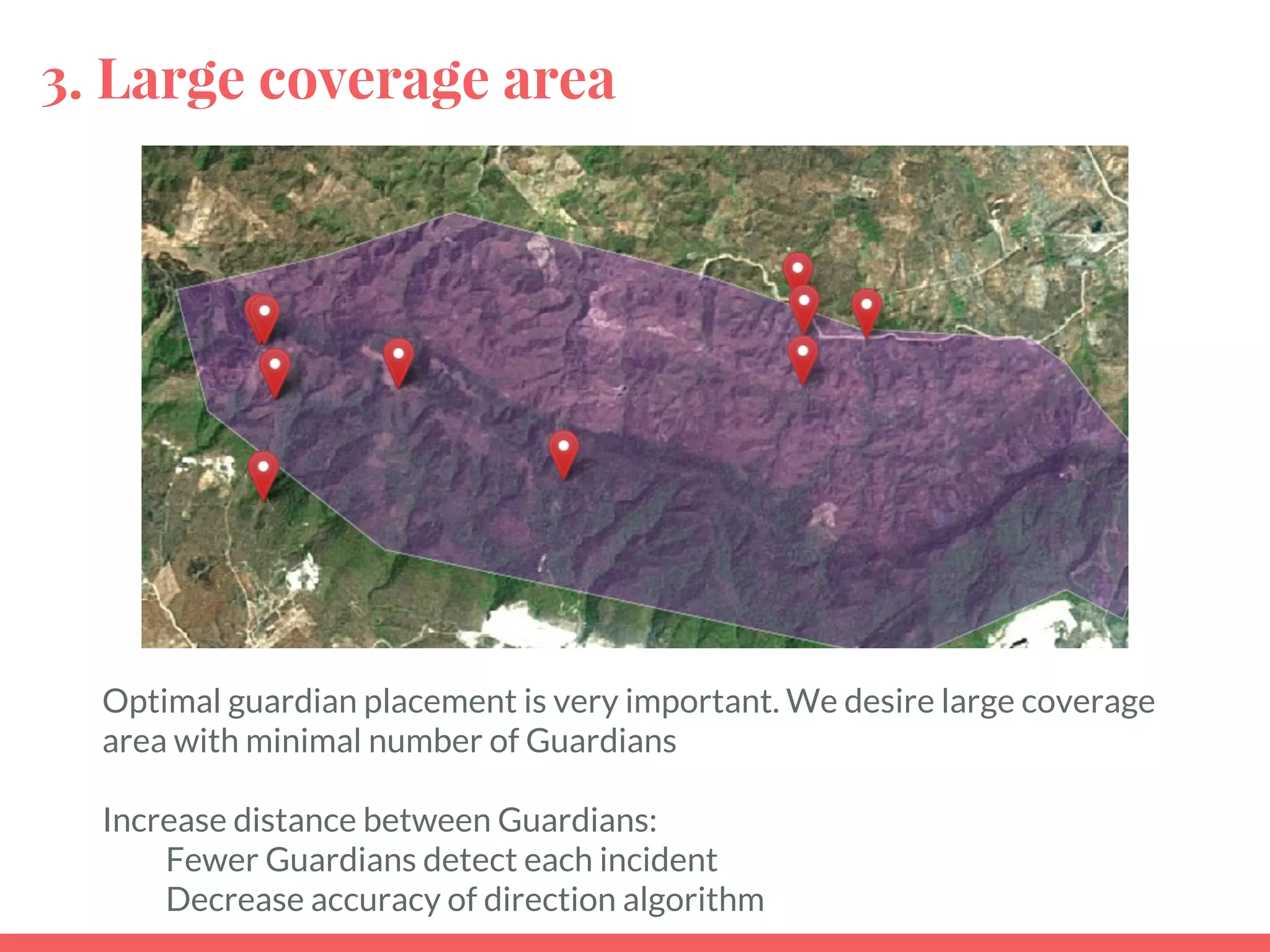
3. Large coverage area
Optimal guardian placement is very important. We desire large coverage
area with minimal number of Guardians
Increase distance between Guardians:
Fewer Guardians detect each incident
Decrease accuracy of direction algorithm
Directional
Experiments
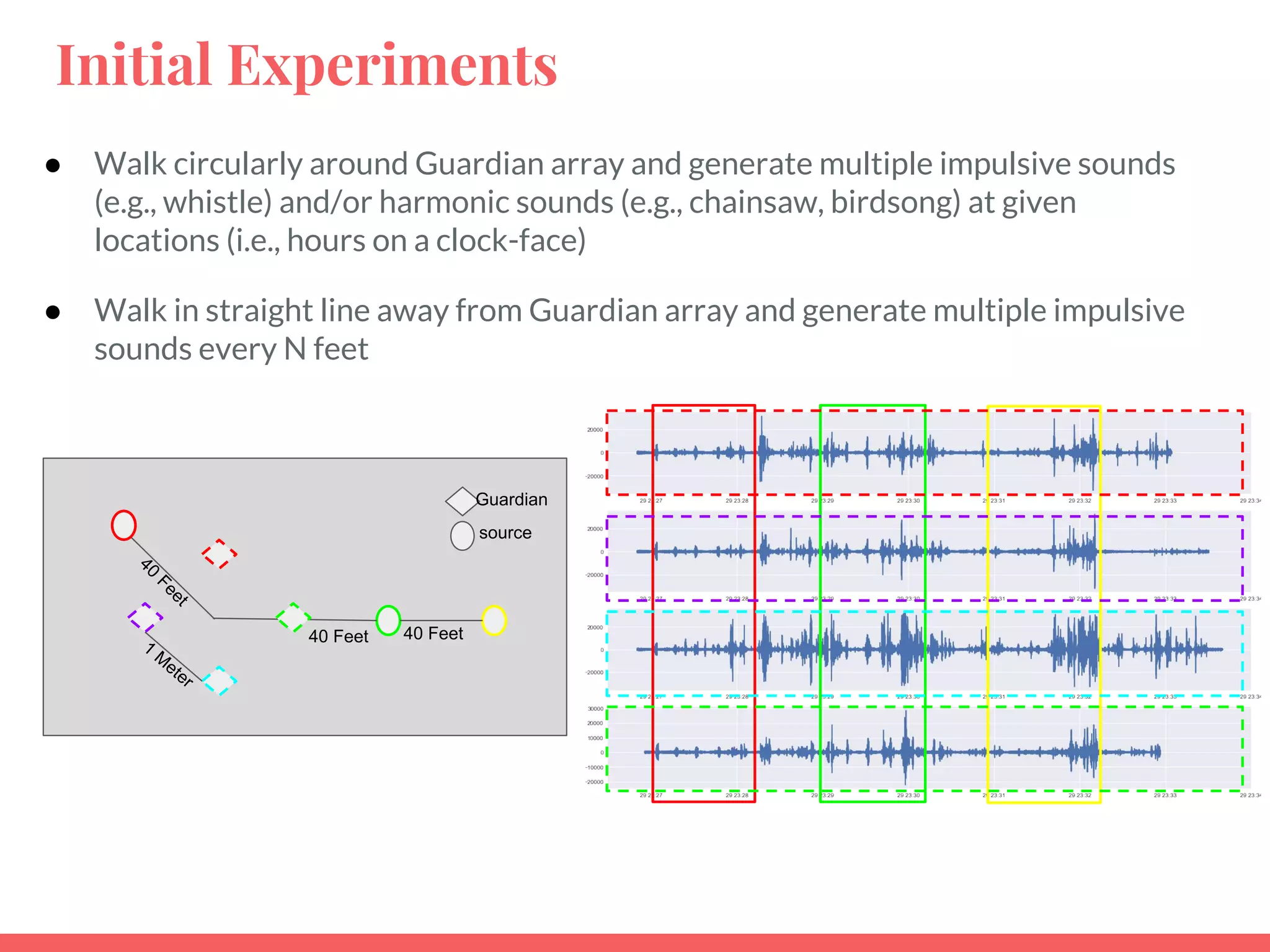
Initial Experiments
● Walk circularly around Guardian array and generate multiple impulsive sounds
(e.g., whistle) and/or harmonic sounds (e.g., chainsaw, birdsong) at given
locations (i.e., hours on a clock-face)
● Walk in straight line away from Guardian array and generate multiple impulsive
sounds every N feet
source
Guardian
1
M
eter
40
Feet
40 Feet 40 Feet
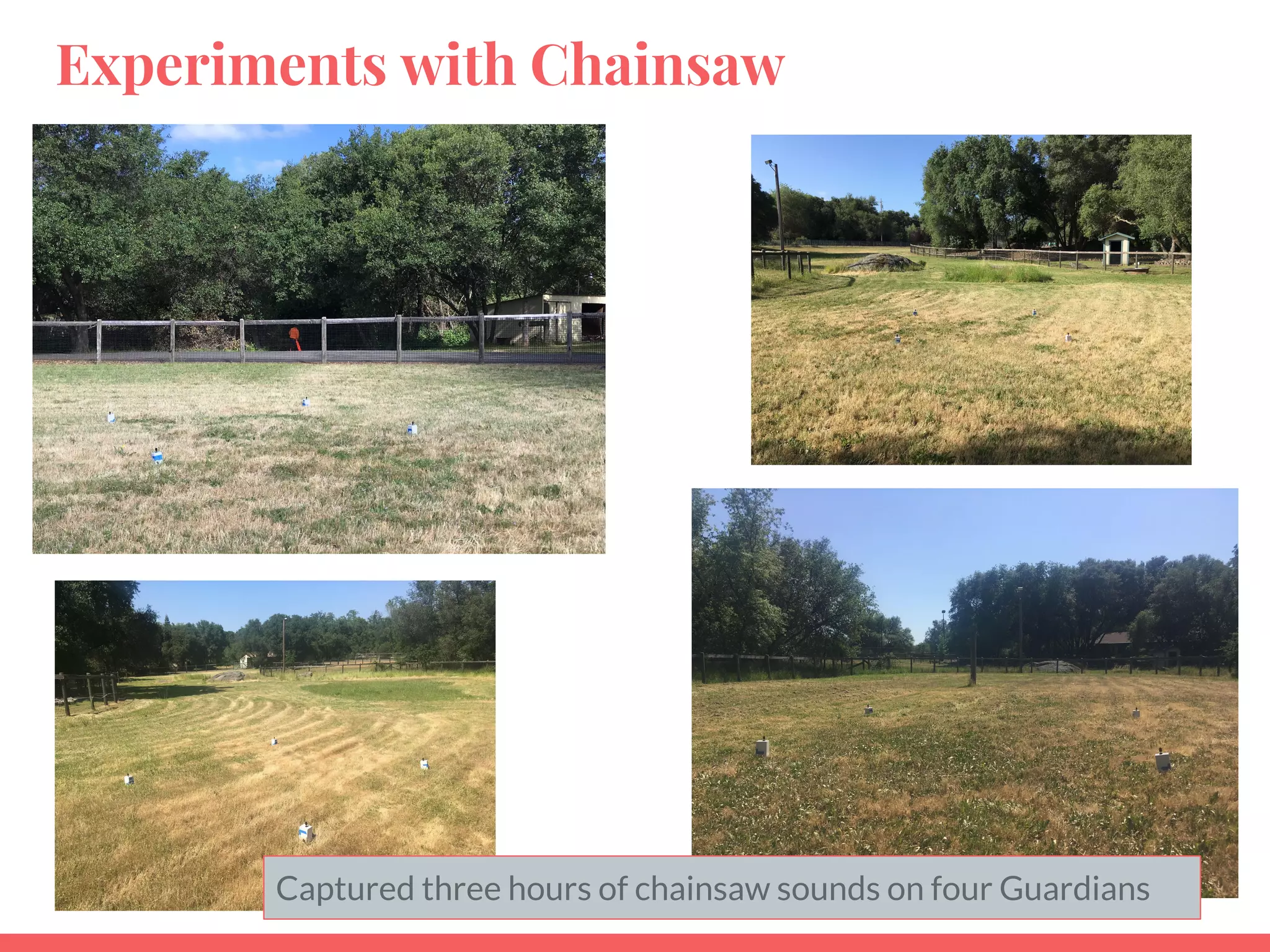
Experiments with Chainsaw
Captured three hours of chainsaw sounds on four Guardians
Chainsaw Experiments
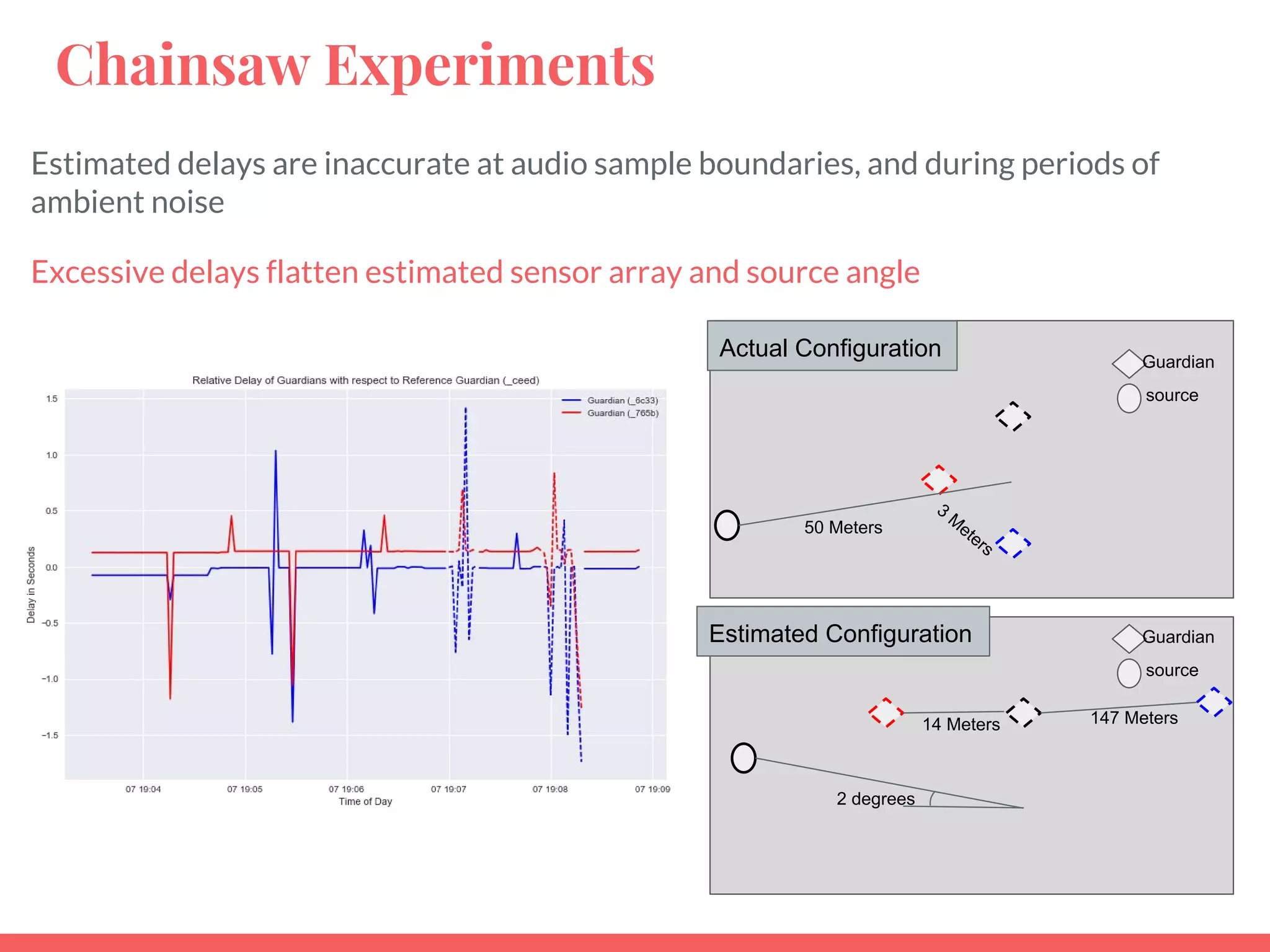
Estimated delays are inaccurate at audio sample boundaries, and during periods of
ambient noise
Excessive delays flatten estimated sensor array and source angle
source
Guardian
3
M
eters
50 Meters
source
Guardian
14 Meters
2 degrees
147 Meters
Actual Configuration
Estimated Configuration
Next steps!
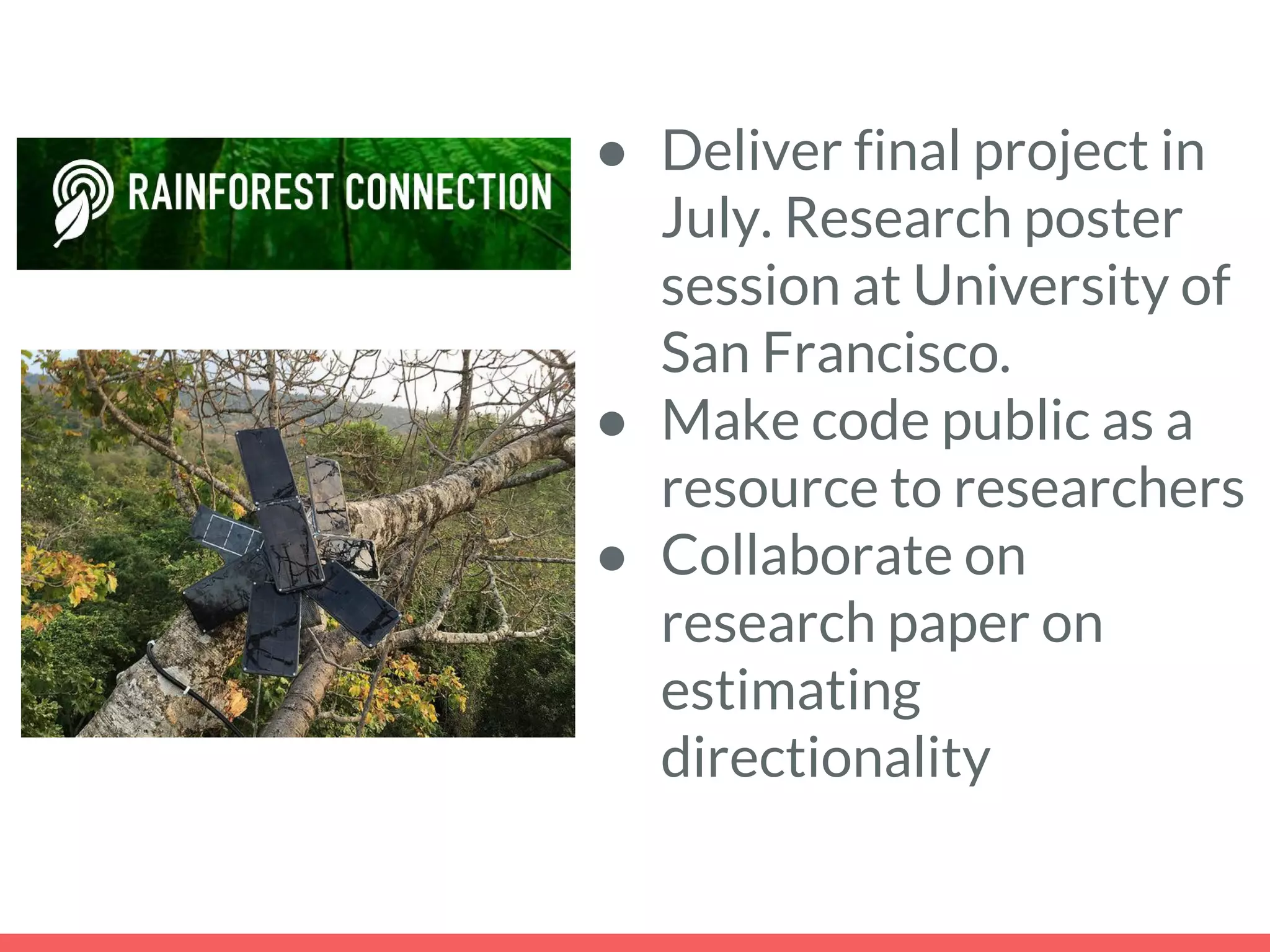
● Deliver final project in
July. Research poster
session at University of
San Francisco.
● Make code public as a
resource to researchers
● Collaborate on
research paper on
estimating
directionality
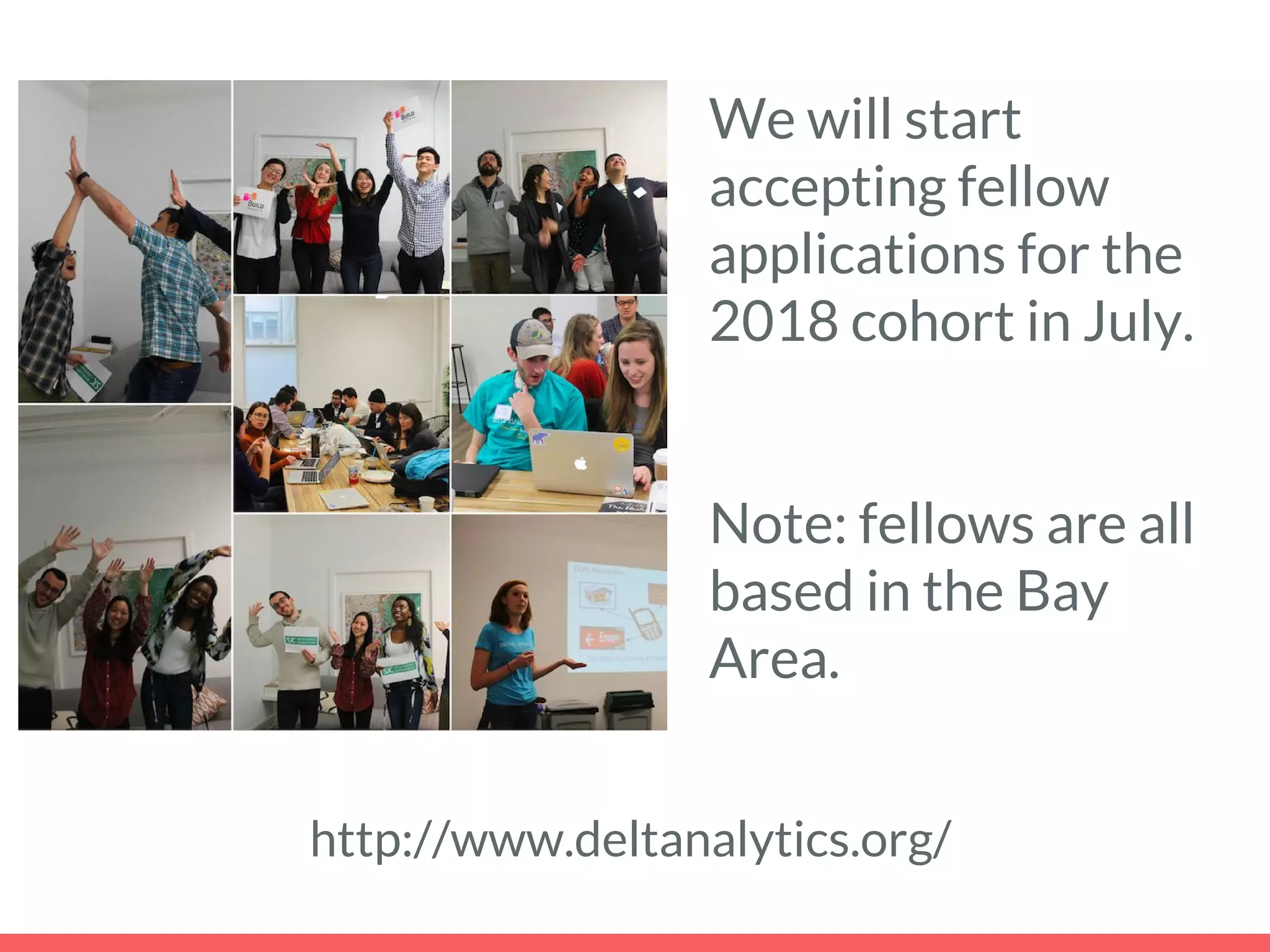
We will start
accepting fellow
applications for the
2018 cohort in July.
Note: fellows are all
based in the Bay
Area.
http://www.deltanalytics.org/
Questions?
Appendix
Model Training Interface
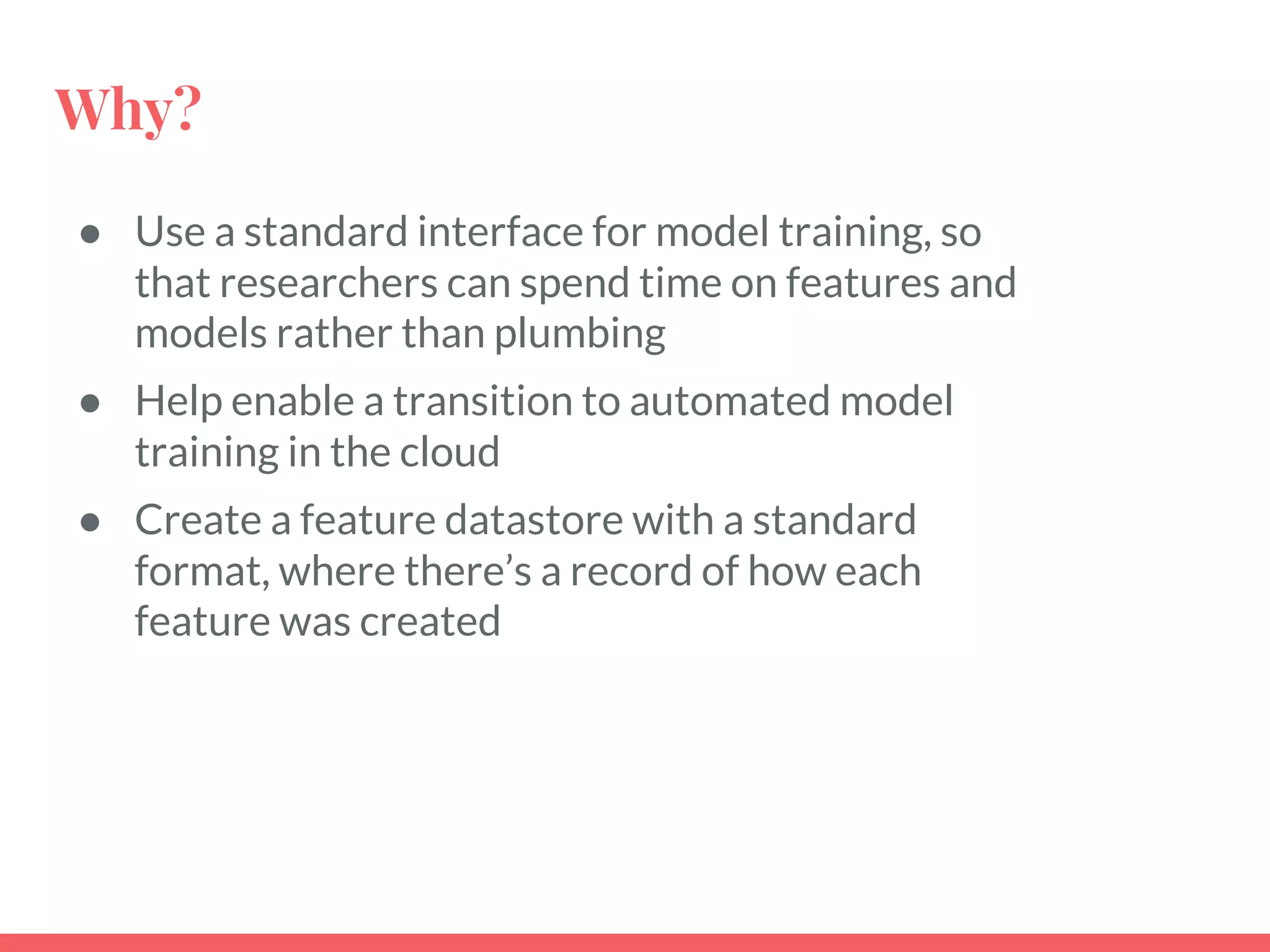
Why?
● Use a standard interface for model training, so
that researchers can spend time on features and
models rather than plumbing
● Help enable a transition to automated model
training in the cloud
● Create a feature datastore with a standard
format, where there’s a record of how each
feature was created
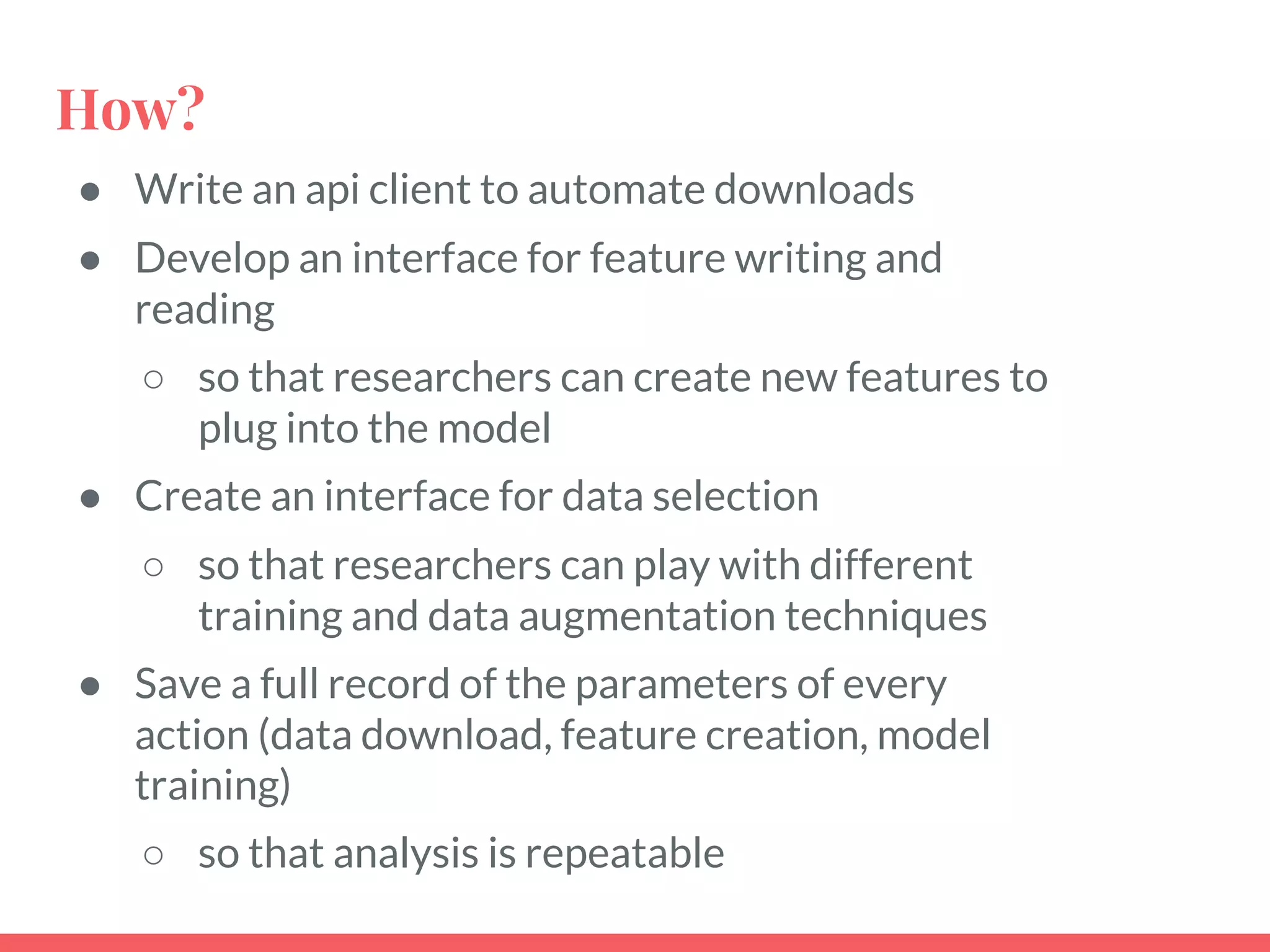
How?
● Write an api client to automate downloads
● Develop an interface for feature writing and
reading
○ so that researchers can create new features to
plug into the model
● Create an interface for data selection
○ so that researchers can play with different
training and data augmentation techniques
● Save a full record of the parameters of every
action (data download, feature creation, model
training)
○ so that analysis is repeatable
CNN architecture with a few hidden layers
(similar to AlexNet)
● RELU activation function
● Multiple convolutional layers interspersed with pooling layers
● Multiple fully connected layers
● Dropout used to avoid overfitting
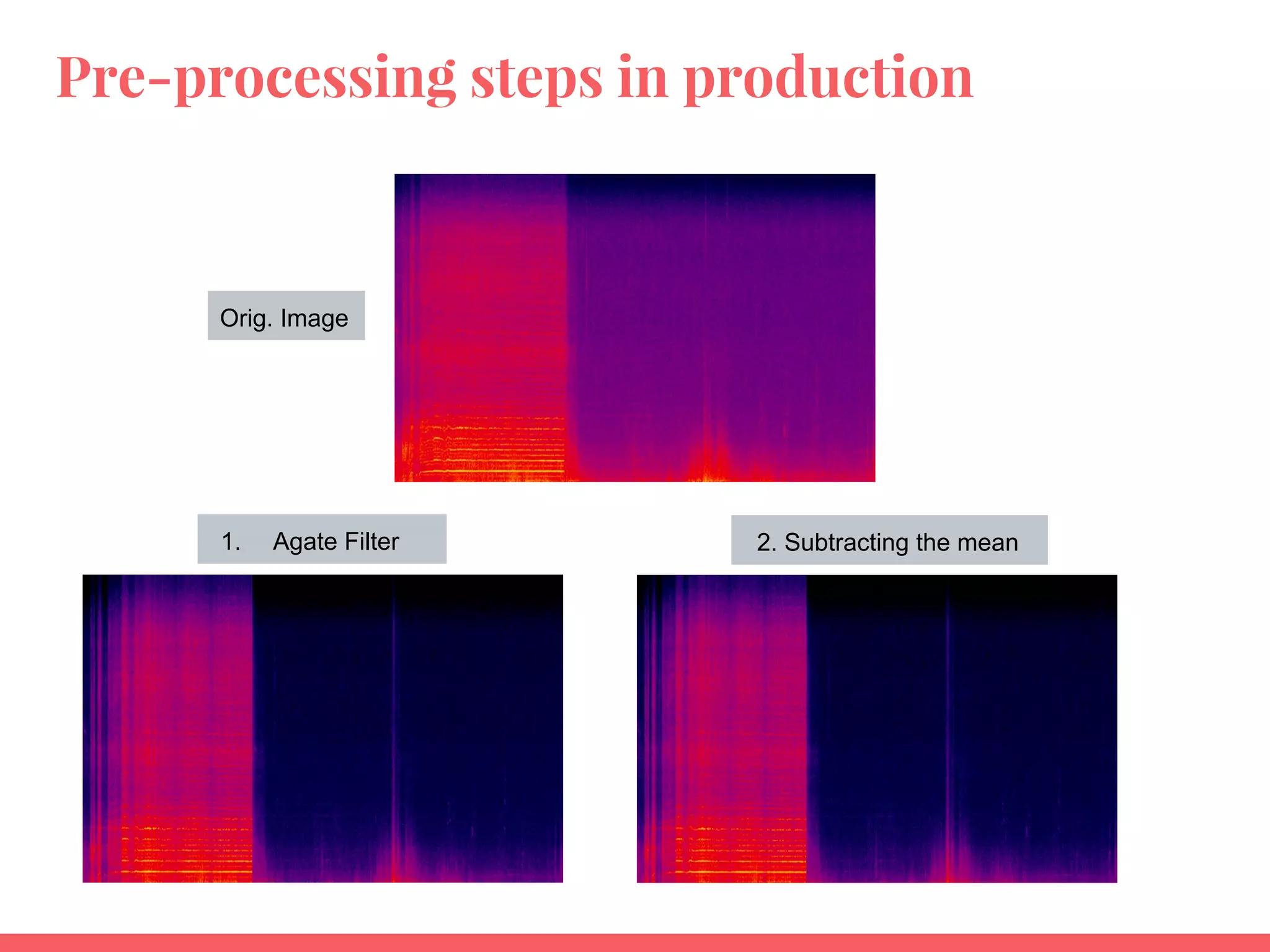
Pre-processing steps in production
Orig. Image
1. Agate Filter 2. Subtracting the mean

Sara Hooker & Sean McPherson, Delta Analytics, at MLconf Seattle 2017

  • 1.
    Pro Bono DataConsulting for the Social Sector
  • 2.
    ● Introduction toDelta Analytics ● Technical Deep dive - Rainforest Connection
  • 3.
    Sara Hooker Executive Director DeltaAnalytics sara@deltanalytics.org twitter: sarahookr Sean McPherson Delta Data Science Fellow sean@deltanalytics.org twitter: PhaseAnalytics
  • 4.
  • 5.
    Delta teaching fellow: DeltaAnalytics fills the technical skill gap and enables nonprofits to accelerate their impact.
  • 6.
    Acute need forskills based volunteering. Delta teaching fellow: ● Data revolution ● Complex problems are now within reach ● Skills gap is larger than ever
  • 7.
    Nonprofits are pushingthe hardest for data ● focus on accountability ● desire to understand impact
  • 8.
    Organizations bridging theskill gap. And most importantly… you. Delta teaching fellow:
  • 9.
    27 projects with nonprofitsand social impact organizations 90+ Fellows volunteering part-time over 3 years $0.00 charged for services 17 US and 10 International projects (Tanzania, UK, Kenya, and more) Over 15,000 hours donated Our Impact
  • 10.
  • 11.
    Where do DeltaFellows work? … and many more
  • 12.
    Partner with anon-profit grant recipient for 6 months. ● full time professionals ● donate time for 6 month projects ● cohort of 30 fellows, January-July Democratize access to machine learning education by building technical capacity around the world. & Delta Data Fellows Delta Teaching Fellows
  • 13.
    Delta teaching fellowsbelieve that data is powerful, and that anybody should be able to harness it for change in their community.
  • 14.
  • 16.
    Deep dive into ourwork with Rainforest Connection
  • 17.
    Delta Team Sara Hooker ExecutiveDirector Delta Analytics Sean McPherson Data Analyst Northrop Grumman Steven Troxler Data Scientist Stitch Fix Cassandra Jacobs Data Scientist Stitch Fix
  • 18.
    Rainforest Team Close partnershipwith Rainforest Eng team Stefan Zapf and Christopher Kaushaar
  • 19.
    Rainforest Connection collectsand deploys recycled cells to rainforests around the world. The cellphones stream audio 24/7, and advanced deep learning models detect when the sound of a chainsaw occurs. Within minutes, an alert is sent to conservationists.
  • 20.
    Streaming audio datafrom rainforests in Ecuador, Peru and Brazil. Additional deployments are made available as conservationists and research partners request them.
  • 21.
    Guardians require littlemaintenance Recycled cell phones are powered by solar panels, they are deployed by Rainforest Connection high in the rainforest canopies to avoid detection. ● protected from rain and weather elements by a small waterproof case ● rely on local cell phone networks to send data
  • 22.
    Conservation partners areimmediately alerted when a chainsaw is detected, and can monitor aggregate behavior in their region.
  • 23.
    3 key goals: 1.Chainsaw detection model: a. Accurately detect chainsaws b. Data augmentation c. Enhance data quality 2. Provide engineering capacity a. Code improvement b. More efficient data processing 3. Model the direction and distance of chainsaw sound.
  • 24.
  • 25.
    How is thetraining data set collected? Collection from local experiment sites. ● tree cuttings ● planned chainsaw data collection days Fold in positive test audio from our rainforest sites to gain additional examples (pseudo labelling). ● confirm whether model labelling is correct using human validation.
  • 26.
    approach: turn audiodetection into an image classification problem. apply a deep learning architecture. Audio streamed from conservation sites in Ecuador, Peru and Brazil. Convert audio to a spectrogram (visual way to represent the signal strength of a sound).
  • 27.
    Convolutional neural networkarchitecture for image classification Balanced 50/50 labelled spectrogram is our training set. Convolutional neural network is a special type of deep learning architecture used to detect objects in images.
  • 28.
    Spectrogram is agraphic visualization of frequency and intensity of a sound with respect to time. time(s) frequency (Hz) amplitude is captured by the intensity of color
  • 29.
    weak audio examplehere strong audio example here
  • 30.
    Why Use spectrograms? ChainsawAudio Birdsong Audio Birdsong Spectrogram Chainsaw Spectrogram
  • 31.
    Binary classification problem:model outputs probability that a spectrogram is a chainsaw. chainsaw non-chainsaw ● softmax classifier (logistic regression) ○ cross-entropy loss function ● minimize loss function through backpropagation softmax classifier 0.7 0.3 fully connected layer
  • 32.
    Architecture very simple(variant of AlexNet) ● added batch-normalization ● RELU activation ● experimented with depth (number of hidden layers) ● adam is used as optimizer. ● black and white spectrogram (no amplitude dimension)
  • 33.
    Threshold for classificationis set at 0.9. False positives pose high cost. Positive example Negative example Performance All strong variants of model architecture had accuracy of over 95%, with recall & precision>98%. Key issue: performance actually not indicative of test time accuracy. Our limited test set does not have the same data distribution at the rainforest site. Data gap: we don not know about the chainsaws the model did not catch.
  • 34.
  • 35.
  • 36.
  • 37.
    Performance and lackof mature data set raises key questions: ● true ground truth ● limited labelled data set ● different data distributions at each test site ● accounting for different test conditions (rain, mosquito season)
  • 38.
    Ways to addressthis: ● use ensembles of models (models in production are ensembles) ● incorporate metadata
  • 39.
  • 40.
    Limited labelled dataset: ● initial data set had ~2,400 2s spectrograms. These were built off 45 positively labelled sound clips. data augmentation transformation of images pseudo-labelling
  • 41.
    Negative Class: Labelled commonbackground noises provide varied negative class examples. Positive class: Bridges the gap between our experiment data and data distribution at test site.
  • 42.
    10 sec labelledclips. extremely valuable: chainsaw less valuable: rustling leaves Overall, at this stage of research quantity of data is more important. Particularly for providing stratified examples of the negative class (for example mosquito).
  • 43.
    Transformations of labelleddata. Pitch Shift Rotate Image Orig. Image Image rotated CCW Audio pitch shifted downOrig. Image
  • 44.
  • 45.
    Independent Component Analysis ●Neural networks attempt to find structure ● Goal: reduce the computational overhead during training ● Simple assumption: ○ Two components present in positive examples ○ Chainsaw-like component ○ Background noise component Chainsaw Component Noise Component
  • 46.
    ● Take positiveexamples and decompose them into two components, then apply this model to all samples ICA allows us to isolate chainsaw component ICA Model ICA Model Train ICA Model Chainsaw Component Noise Component Apply to samples
  • 47.
    Independent Components Analysis ●Possible to learn two distinct signals ● Current impact on classification accuracy unknown -- unclear how to integrate two spectrograms during model training Component 1 Component 2
  • 48.
  • 49.
    Model direction anddistance of sound Providing direction and distance of sound reduces the area that rainforests conservationists have to search when they receive an alert.
  • 50.
    Delta Analytics TestSite We have been given four Guardians and our own site Goal of Delta site is to generate training data to support our research areas Guardians are not fixed, vary configuration
  • 51.
    Approach: Source localizationbased on time delay of arrival Gunshot Detection https://wrongfulconvictionsblog.org/2012/06/01/cell-tower-triangulation-how-it-works/ http://www.defenceimagery.mod.uk http://article.sciencepublishinggroup.com/html/10.11648.j.ijssn.20150303.12.html Cell tower triangulationLocalization in wireless sensor network
  • 52.
    We locate thesound using the time delay between sensors. Time Delay Sound reaches further away sensor later than closer sensors Detection time (di,j ) at Guardian i of sound j (time tj ) Don’t know tj or Di ! But assume location of sensor is known G1 1 G3 G2 D1 D3 D2
  • 53.
    Determine relative delayfor all guardian pairs. This can be formalized as: Actual delays are determined using cross correlation G1 G3 G2 d1,1 d2,1 d3,1
  • 54.
    Triangulation Each determines aline in two dimensions along which the source can be. Multiple lines determine the point of the source. G1G3 G2
  • 55.
    System End-to-End Positive DetectionsOnly -> Direction estimate -> Alert ranger G1 G3 G2 Record audio at sites Transmit audio and metadata Classify audio using CNN Provide alert and direction estimate
  • 56.
  • 57.
    Unique challenges posedby rainforest deployment environment 1. Relative position of guardians unknown 2. Guardians lose sync in time with each other and drop data 3. Large coverage area
  • 58.
    1. Guardian positionis unknown Source + sensor localization Two-stage solution: 1. Determine sensor locations 2. Determine source locations Both can be solved using gradient descent optimization. G3G1 G2
  • 59.
    2. Guardians losesync in time and drop data Guardians can lose time sync or completely drop data which results in incorrect estimation of Guardian location and source location Algorithm must be robust to these types of errors.
  • 60.
    3. Large coveragearea Optimal guardian placement is very important. We desire large coverage area with minimal number of Guardians Increase distance between Guardians: Fewer Guardians detect each incident Decrease accuracy of direction algorithm
  • 61.
  • 62.
    Initial Experiments ● Walkcircularly around Guardian array and generate multiple impulsive sounds (e.g., whistle) and/or harmonic sounds (e.g., chainsaw, birdsong) at given locations (i.e., hours on a clock-face) ● Walk in straight line away from Guardian array and generate multiple impulsive sounds every N feet source Guardian 1 M eter 40 Feet 40 Feet 40 Feet
  • 63.
    Experiments with Chainsaw Capturedthree hours of chainsaw sounds on four Guardians
  • 64.
    Chainsaw Experiments Estimated delaysare inaccurate at audio sample boundaries, and during periods of ambient noise Excessive delays flatten estimated sensor array and source angle source Guardian 3 M eters 50 Meters source Guardian 14 Meters 2 degrees 147 Meters Actual Configuration Estimated Configuration
  • 65.
  • 66.
    ● Deliver finalproject in July. Research poster session at University of San Francisco. ● Make code public as a resource to researchers ● Collaborate on research paper on estimating directionality
  • 67.
    We will start acceptingfellow applications for the 2018 cohort in July. Note: fellows are all based in the Bay Area. http://www.deltanalytics.org/
  • 68.
  • 69.
  • 70.
  • 71.
    Why? ● Use astandard interface for model training, so that researchers can spend time on features and models rather than plumbing ● Help enable a transition to automated model training in the cloud ● Create a feature datastore with a standard format, where there’s a record of how each feature was created
  • 72.
    How? ● Write anapi client to automate downloads ● Develop an interface for feature writing and reading ○ so that researchers can create new features to plug into the model ● Create an interface for data selection ○ so that researchers can play with different training and data augmentation techniques ● Save a full record of the parameters of every action (data download, feature creation, model training) ○ so that analysis is repeatable
  • 73.
    CNN architecture witha few hidden layers (similar to AlexNet) ● RELU activation function ● Multiple convolutional layers interspersed with pooling layers ● Multiple fully connected layers ● Dropout used to avoid overfitting
  • 74.
    Pre-processing steps inproduction Orig. Image 1. Agate Filter 2. Subtracting the mean