09/05/2024 1
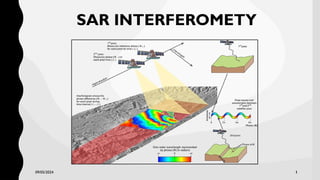
SAR INTERFEROMETY
09/05/2024 2
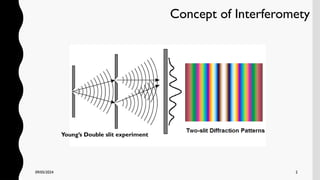
Concept of Interferomety
Young’s Double slit experiment
09/05/2024 3
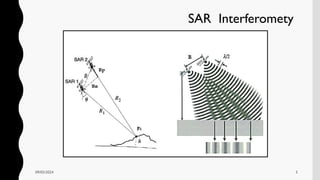
SAR Interferomety
09/05/2024 4
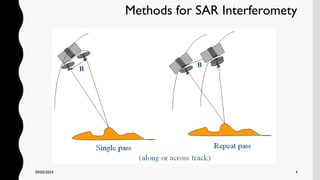
Methods for SAR Interferomety
09/05/2024 5
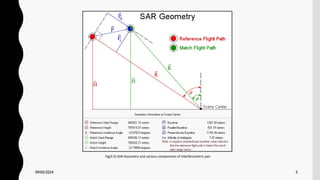
Fig(3.5) SAR Geometry and various components of Interferometric pair
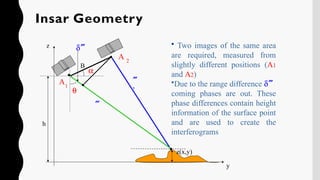
B
A1
A 2
• Two images of the same area
are required, measured from
slightly different positions (A1
and A2)
•Due to the range difference d
coming phases are out. These
phase differences contain height
information of the surface point
and are used to create the
interferograms
q


’
h
z(x,y)
y
z
a
d
Insar Geometry
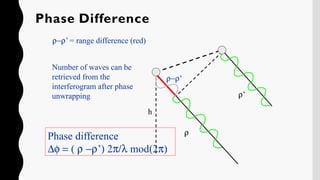
h
r
r-r’
r-r’ = range difference (red)
Number of waves can be
retrieved from the
interferogram after phase
unwrapping r’
Phase difference
Df = ( r -r’) 2p/l mod(2p)
Phase Difference
[Number of waves]
r-r’ [Meters]
l
Phase Difference
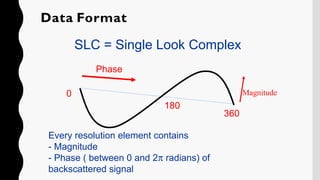
Data Format
SLC = Single Look Complex
Every resolution element contains
- Magnitude
- Phase ( between 0 and 2p radians) of
backscattered signal
Phase
0
180
360
Magnitude
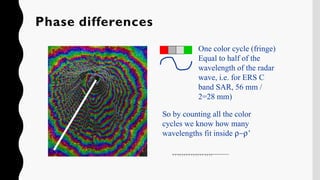
One color cycle (fringe)
Equal to half of the
wavelength of the radar
wave, i.e. for ERS C
band SAR, 56 mm /
2=28 mm)
So by counting all the color
cycles we know how many
wavelengths fit inside r-r’
Phase differences
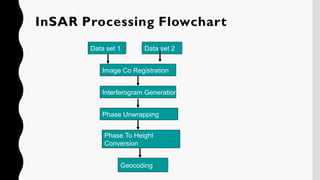
Data set 1
Phase Unwrapping
Image Co Registration
Data set 2
Interferogram Generation
Phase To Height
Conversion
Geocoding
InSAR Processing Flowchart
09/05/2024 13
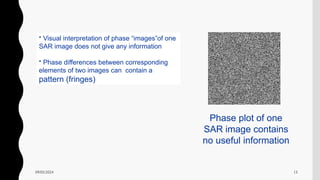
• Visual interpretation of phase “images”of one
SAR image does not give any information
• Phase differences between corresponding
elements of two images can contain a
pattern (fringes)
Phase plot of one
SAR image contains
no useful information
09/05/2024 15
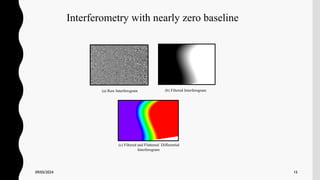
(a) Raw Interferogram (b) Filtered Interferogram
(c) Filtered and Flattened Differential
Interferogram
Interferometry with nearly zero baseline
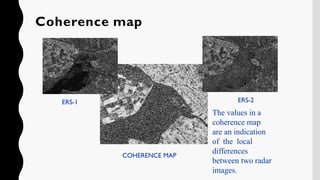
COHERENCE MAP
ERS-1 ERS-2
The values in a
coherence map
are an indication
of the local
differences
between two radar
images.
Coherence map
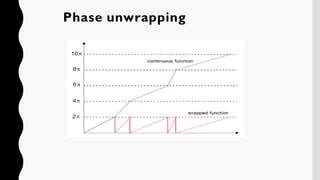
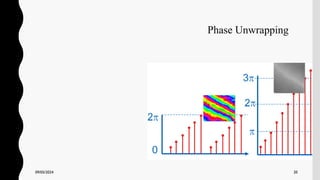
Phase unwrapping
 Interferometric system does not measure the total pixel phase
difference. Rather, it measures only the phase difference that
remains after subtracting all full 2 intervals present (modulo
2). It is called a wrapped phase and has to be unwrapped or
calculated back to its real values.
 Unwrapped phase difference is used to calculate height.
Phase unwrapping
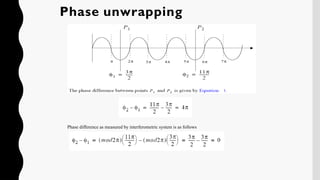
Phase difference as measured by interferometric system is as follows
Phase unwrapping
09/05/2024 20
Phase Unwrapping
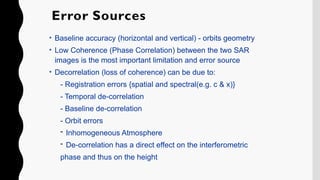
Error Sources
• Baseline accuracy (horizontal and vertical) - orbits geometry
• Low Coherence (Phase Correlation) between the two SAR
images is the most important limitation and error source
• Decorrelation (loss of coherence) can be due to:
- Registration errors {spatial and spectral(e.g. c & x)}
- Temporal de-correlation
- Baseline de-correlation
- Orbit errors
- Inhomogeneous Atmosphere
- De-correlation has a direct effect on the interferometric
phase and thus on the height
09/05/2024 22
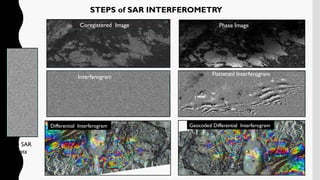
Non-Interferometric SAR Data Interferometric Pair
Raw SAR
Data
Coregistered Image
Interferogram
Phase Image
Flattened Interferogram
Differential Interferogram Geocoded Differential Interferogram
STEPS of SAR INTERFEROMETRY
23
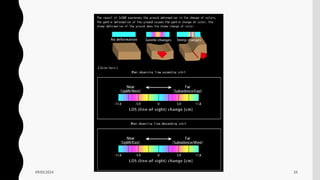
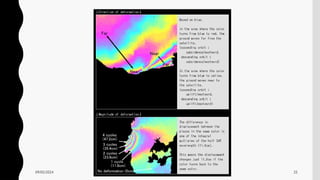
09/05/2024 24
09/05/2024 25
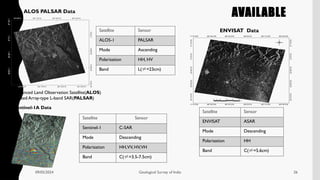
09/05/2024 Geological Survey of India 26
AVAILABLE
Sentinel-1A Data
ENVISAT Data
ALOS PALSAR Data
Satellite Sensor
ALOS-1 PALSAR
Mode Ascending
Polarisation HH, HV
Band L(=23cm)
Satellite Sensor
ENVISAT ASAR
Mode Descending
Polarisation HH
Band C(=5.6cm)
Satellite Sensor
Sentinel-1 C-SAR
Mode Descending
Polarisation HH,VV, HV,VH
Band C(=3.5-7.5cm)
Advanced Land Observation Satellite(ALOS)
Phased Array-type L-band SAR(PALSAR)
APPLICATION AREAS
• Digital elevation mapping
– Slopemaps (e.g. landslide hazards)
– DEM’s
• Deformation mapping
– Crustal motion
– Monitoring
• Use of temporal coherence information
– Classification
– Change detection
09/05/2024 28

SAR Interferometry Fundamental and applications

  • 1.
  • 2.
    09/05/2024 2 Concept ofInterferomety Young’s Double slit experiment
  • 3.
  • 4.
    09/05/2024 4 Methods forSAR Interferomety
  • 5.
    09/05/2024 5 Fig(3.5) SARGeometry and various components of Interferometric pair
  • 6.
    B A1 A 2 • Twoimages of the same area are required, measured from slightly different positions (A1 and A2) •Due to the range difference d coming phases are out. These phase differences contain height information of the surface point and are used to create the interferograms q   ’ h z(x,y) y z a d Insar Geometry
  • 7.
    h r r-r’ r-r’ = rangedifference (red) Number of waves can be retrieved from the interferogram after phase unwrapping r’ Phase difference Df = ( r -r’) 2p/l mod(2p) Phase Difference
  • 8.
    [Number of waves] r-r’[Meters] l Phase Difference
  • 9.
    Data Format SLC =Single Look Complex Every resolution element contains - Magnitude - Phase ( between 0 and 2p radians) of backscattered signal Phase 0 180 360 Magnitude
  • 10.
    One color cycle(fringe) Equal to half of the wavelength of the radar wave, i.e. for ERS C band SAR, 56 mm / 2=28 mm) So by counting all the color cycles we know how many wavelengths fit inside r-r’ Phase differences
  • 11.
    Data set 1 PhaseUnwrapping Image Co Registration Data set 2 Interferogram Generation Phase To Height Conversion Geocoding InSAR Processing Flowchart
  • 12.
    09/05/2024 13 • Visualinterpretation of phase “images”of one SAR image does not give any information • Phase differences between corresponding elements of two images can contain a pattern (fringes) Phase plot of one SAR image contains no useful information
  • 13.
    09/05/2024 15 (a) RawInterferogram (b) Filtered Interferogram (c) Filtered and Flattened Differential Interferogram Interferometry with nearly zero baseline
  • 14.
    COHERENCE MAP ERS-1 ERS-2 Thevalues in a coherence map are an indication of the local differences between two radar images. Coherence map
  • 15.
    Phase unwrapping  Interferometricsystem does not measure the total pixel phase difference. Rather, it measures only the phase difference that remains after subtracting all full 2 intervals present (modulo 2). It is called a wrapped phase and has to be unwrapped or calculated back to its real values.  Unwrapped phase difference is used to calculate height.
  • 16.
    Phase unwrapping Phase differenceas measured by interferometric system is as follows
  • 17.
  • 18.
  • 19.
    Error Sources • Baselineaccuracy (horizontal and vertical) - orbits geometry • Low Coherence (Phase Correlation) between the two SAR images is the most important limitation and error source • Decorrelation (loss of coherence) can be due to: - Registration errors {spatial and spectral(e.g. c & x)} - Temporal de-correlation - Baseline de-correlation - Orbit errors - Inhomogeneous Atmosphere - De-correlation has a direct effect on the interferometric phase and thus on the height
  • 20.
    09/05/2024 22 Non-Interferometric SARData Interferometric Pair
  • 21.
    Raw SAR Data Coregistered Image Interferogram PhaseImage Flattened Interferogram Differential Interferogram Geocoded Differential Interferogram STEPS of SAR INTERFEROMETRY 23
  • 22.
  • 23.
  • 24.
    09/05/2024 Geological Surveyof India 26 AVAILABLE Sentinel-1A Data ENVISAT Data ALOS PALSAR Data Satellite Sensor ALOS-1 PALSAR Mode Ascending Polarisation HH, HV Band L(=23cm) Satellite Sensor ENVISAT ASAR Mode Descending Polarisation HH Band C(=5.6cm) Satellite Sensor Sentinel-1 C-SAR Mode Descending Polarisation HH,VV, HV,VH Band C(=3.5-7.5cm) Advanced Land Observation Satellite(ALOS) Phased Array-type L-band SAR(PALSAR)
  • 25.
    APPLICATION AREAS • Digitalelevation mapping – Slopemaps (e.g. landslide hazards) – DEM’s • Deformation mapping – Crustal motion – Monitoring • Use of temporal coherence information – Classification – Change detection
  • 26.