SAP FICO Online Training:
Introduction to SAP R/3
• Introduction to
ERP, Advantages of SAP
over other ERP Packages
• Introduction to SAP R/3
FICO
Financial Accounting Basic Settings
• Definition of company
• Definition of company code
• Assignment of company to company code
• Definition of business area
• Definition of fiscal year variant
• Assignment of fiscal year variant to company code
• Definition of posting period variant
• Assignment of posting period variant to company code
• Open and close posting period
• Defining document type & number ranges
• Maintenance of field status variants
• Assignment of field status variant to company code
• Definition of tolerance groups for GL accounts
• Definition of tolerance groups for employees
• Assignment of tolerance groups to users
• Taxes on Sales & Purchases (input & output)
• Creation of chart of Accounts
• Defining Accounts Groups
• Defining Retained Earnings Account.
General Ledger Accounting:
• Creation of General Ledger Master (with and with out reference)
• Display/Change/Block/Unblock of general ledger master
• Document Entry posting normal postings and posting with reference
• Display and change of documents
• Display of GL balances
• Display GL account line items
• Parked documents
• Hold documents
• Creation of Sample Document and postings with sample documents
• Defining recurring entry document and postings with recurring doc.
• Creation of account assignment model and posting
• Configuration of line layouts for display of GL line items
• Reversal of individual documents, mass reversal , reversal of cleared items and reversal of accrual
and deferral document
• Defining Exchange Rate types and Translation ratios
• Define Exchange rates & posting of foreign currency transactions
• Interest calculations on term loans
• Accrual and Deferral documents
Accounts Payable
• Creation of vendor account groups
• creation of number ranges for vendor master records
• assignment of number ranges to vendor account groups
• Creation of tolerance group for venders
• Creation of vendor master (display/change/block/unblock of vender master)
• Posting of vendor transactions (invoice posting, payment posting, credit memo)
• Settings for advance payments to parties (down payment) and clearing of down payment against invoices (special
GL transactions)
• Posting of partial Payment & Residual Payment
• Creation of payment terms,
• Creation of house banks and account ids.
• Creation of check lots and maintenance of check register
• display check register
• cancellation of un issued checks
• creation of void reasons
• cancellation of issued checks
• posting of purchase returns
• Configuration of automatic payment program
• Payment to vendors through APP
• Defining correspondence & party statement of accounts
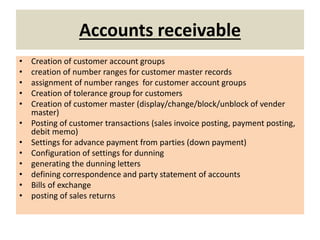
Accounts receivable
• Creation of customer account groups
• creation of number ranges for customer master records
• assignment of number ranges for customer account groups
• Creation of tolerance group for customers
• Creation of customer master (display/change/block/unblock of vender
master)
• Posting of customer transactions (sales invoice posting, payment posting,
debit memo)
• Settings for advance payment from parties (down payment)
• Configuration of settings for dunning
• generating the dunning letters
• defining correspondence and party statement of accounts
• Bills of exchange
• posting of sales returns
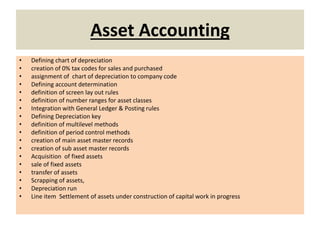
Asset Accounting
• Defining chart of depreciation
• creation of 0% tax codes for sales and purchased
• assignment of chart of depreciation to company code
• Defining account determination
• definition of screen lay out rules
• definition of number ranges for asset classes
• Integration with General Ledger & Posting rules
• Defining Depreciation key
• definition of multilevel methods
• definition of period control methods
• creation of main asset master records
• creation of sub asset master records
• Acquisition of fixed assets
• sale of fixed assets
• transfer of assets
• Scrapping of assets,
• Depreciation run
• Line item Settlement of assets under construction of capital work in progress
New General ledger accounting
• Parallel ledgers
• document splitting
• Segments
Reports
• Financial statement version
• General Ledger, Accounts Payable, Accounts
Receivable and Assets Reports
END OF FI Information of
training content
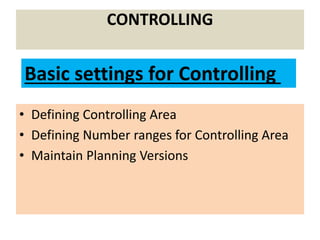
CONTROLLING
• Defining Controlling Area
• Defining Number ranges for Controlling Area
• Maintain Planning Versions
Basic settings for Controlling
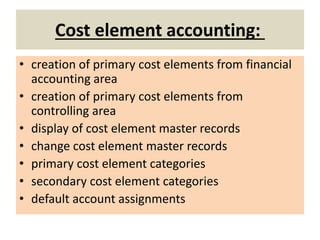
Cost element accounting:
• creation of primary cost elements from financial
accounting area
• creation of primary cost elements from
controlling area
• display of cost element master records
• change cost element master records
• primary cost element categories
• secondary cost element categories
• default account assignments
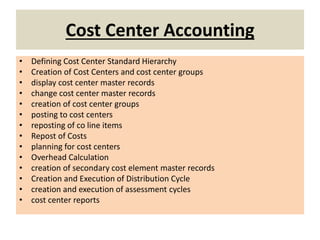
Cost Center Accounting
• Defining Cost Center Standard Hierarchy
• Creation of Cost Centers and cost center groups
• display cost center master records
• change cost center master records
• creation of cost center groups
• posting to cost centers
• reposting of co line items
• Repost of Costs
• planning for cost centers
• Overhead Calculation
• creation of secondary cost element master records
• Creation and Execution of Distribution Cycle
• creation and execution of assessment cycles
• cost center reports
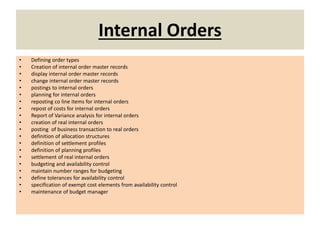
Internal Orders
• Defining order types
• Creation of internal order master records
• display internal order master records
• change internal order master records
• postings to internal orders
• planning for internal orders
• reposting co line items for internal orders
• repost of costs for internal orders
• Report of Variance analysis for internal orders
• creation of real internal orders
• posting of business transaction to real orders
• definition of allocation structures
• definition of settlement profiles
• definition of planning profiles
• settlement of real internal orders
• budgeting and availability control
• maintain number ranges for budgeting
• define tolerances for availability control
• specification of exempt cost elements from availability control
• maintenance of budget manager
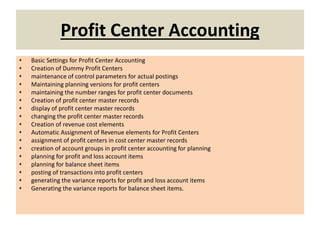
Profit Center Accounting
• Basic Settings for Profit Center Accounting
• Creation of Dummy Profit Centers
• maintenance of control parameters for actual postings
• Maintaining planning versions for profit centers
• maintaining the number ranges for profit center documents
• Creation of profit center master records
• display of profit center master records
• changing the profit center master records
• Creation of revenue cost elements
• Automatic Assignment of Revenue elements for Profit Centers
• assignment of profit centers in cost center master records
• creation of account groups in profit center accounting for planning
• planning for profit and loss account items
• planning for balance sheet items
• posting of transactions into profit centers
• generating the variance reports for profit and loss account items
• Generating the variance reports for balance sheet items.
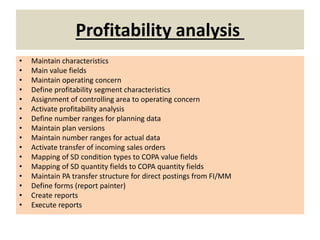
Profitability analysis
• Maintain characteristics
• Main value fields
• Maintain operating concern
• Define profitability segment characteristics
• Assignment of controlling area to operating concern
• Activate profitability analysis
• Define number ranges for planning data
• Maintain plan versions
• Maintain number ranges for actual data
• Activate transfer of incoming sales orders
• Mapping of SD condition types to COPA value fields
• Mapping of SD quantity fields to COPA quantity fields
• Maintain PA transfer structure for direct postings from FI/MM
• Define forms (report painter)
• Create reports
• Execute reports
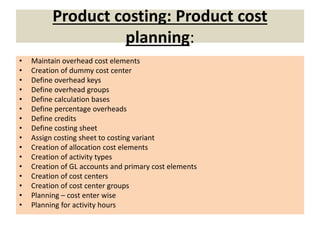
Product costing: Product cost
planning:
• Maintain overhead cost elements
• Creation of dummy cost center
• Define overhead keys
• Define overhead groups
• Define calculation bases
• Define percentage overheads
• Define credits
• Define costing sheet
• Assign costing sheet to costing variant
• Creation of allocation cost elements
• Creation of activity types
• Creation of GL accounts and primary cost elements
• Creation of cost centers
• Creation of cost center groups
• Planning – cost enter wise
• Planning for activity hours
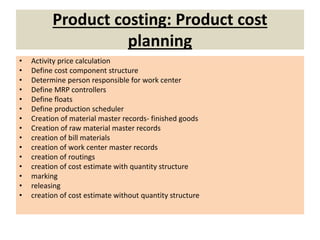
Product costing: Product cost
planning
• Activity price calculation
• Define cost component structure
• Determine person responsible for work center
• Define MRP controllers
• Define floats
• Define production scheduler
• Creation of material master records- finished goods
• Creation of raw material master records
• creation of bill materials
• creation of work center master records
• creation of routings
• creation of cost estimate with quantity structure
• marking
• releasing
• creation of cost estimate without quantity structure
Integration of financial accounting
with materials management:
• Definition of organizational units in materials management i.e. plant, storage location and purchase
organization
• Assignemnt of organizational units to each other
• Definition of tolerance groups for purchase orders
• Definition of tolerance groups for goods receipt
• Definition of tolerance groups for invoice verification
• Definition of vendor specific tolerances
• Creation, display and change of material master records
• Creation of plant parameters
• Maintenance of posting periods for materials management
• Mainternace of parameters for invoice verification
• Maintenance of plant parameters for inventory management and physical inventory
• Definition of attributes for material types
• Assignment of GL accounts for material transactions in financial accounting
• Creation of purchase order
• posting of goods receipt
• invoice verification
• Goods issue for production
Integration of financial accounting
with sales and distributioin:
• Definition of sales organization
• definition of distribution channels
• definition of divisions
• assignment among various organizational units in SD
• definition of partner functions
• definitions of shipping point and loading points
• definition of pricing procedures
• determining the shipping points
• determining the pricing procedures
• maintenance of SD condition types
• maintenance of condition records
• assignment of GL accounts for sales transactions
• creation of sales order
• initialization of stock
• posting the delivery of goods
• creating the sales invoice
SAP FICO Online Training
• Thank you for your attention, if
you would like to know more
about us, please feel free to
reach us at
http://klakshmanaswamy.com/

SAP FICO Online Training- Syllabus

  • 2.
    SAP FICO OnlineTraining: Introduction to SAP R/3 • Introduction to ERP, Advantages of SAP over other ERP Packages • Introduction to SAP R/3 FICO
  • 3.
    Financial Accounting BasicSettings • Definition of company • Definition of company code • Assignment of company to company code • Definition of business area • Definition of fiscal year variant • Assignment of fiscal year variant to company code • Definition of posting period variant • Assignment of posting period variant to company code • Open and close posting period • Defining document type & number ranges • Maintenance of field status variants • Assignment of field status variant to company code • Definition of tolerance groups for GL accounts • Definition of tolerance groups for employees • Assignment of tolerance groups to users • Taxes on Sales & Purchases (input & output) • Creation of chart of Accounts • Defining Accounts Groups • Defining Retained Earnings Account.
  • 4.
    General Ledger Accounting: •Creation of General Ledger Master (with and with out reference) • Display/Change/Block/Unblock of general ledger master • Document Entry posting normal postings and posting with reference • Display and change of documents • Display of GL balances • Display GL account line items • Parked documents • Hold documents • Creation of Sample Document and postings with sample documents • Defining recurring entry document and postings with recurring doc. • Creation of account assignment model and posting • Configuration of line layouts for display of GL line items • Reversal of individual documents, mass reversal , reversal of cleared items and reversal of accrual and deferral document • Defining Exchange Rate types and Translation ratios • Define Exchange rates & posting of foreign currency transactions • Interest calculations on term loans • Accrual and Deferral documents
  • 5.
    Accounts Payable • Creationof vendor account groups • creation of number ranges for vendor master records • assignment of number ranges to vendor account groups • Creation of tolerance group for venders • Creation of vendor master (display/change/block/unblock of vender master) • Posting of vendor transactions (invoice posting, payment posting, credit memo) • Settings for advance payments to parties (down payment) and clearing of down payment against invoices (special GL transactions) • Posting of partial Payment & Residual Payment • Creation of payment terms, • Creation of house banks and account ids. • Creation of check lots and maintenance of check register • display check register • cancellation of un issued checks • creation of void reasons • cancellation of issued checks • posting of purchase returns • Configuration of automatic payment program • Payment to vendors through APP • Defining correspondence & party statement of accounts
  • 6.
    Accounts receivable • Creationof customer account groups • creation of number ranges for customer master records • assignment of number ranges for customer account groups • Creation of tolerance group for customers • Creation of customer master (display/change/block/unblock of vender master) • Posting of customer transactions (sales invoice posting, payment posting, debit memo) • Settings for advance payment from parties (down payment) • Configuration of settings for dunning • generating the dunning letters • defining correspondence and party statement of accounts • Bills of exchange • posting of sales returns
  • 7.
    Asset Accounting • Definingchart of depreciation • creation of 0% tax codes for sales and purchased • assignment of chart of depreciation to company code • Defining account determination • definition of screen lay out rules • definition of number ranges for asset classes • Integration with General Ledger & Posting rules • Defining Depreciation key • definition of multilevel methods • definition of period control methods • creation of main asset master records • creation of sub asset master records • Acquisition of fixed assets • sale of fixed assets • transfer of assets • Scrapping of assets, • Depreciation run • Line item Settlement of assets under construction of capital work in progress
  • 8.
    New General ledgeraccounting • Parallel ledgers • document splitting • Segments
  • 9.
    Reports • Financial statementversion • General Ledger, Accounts Payable, Accounts Receivable and Assets Reports END OF FI Information of training content
  • 10.
    CONTROLLING • Defining ControllingArea • Defining Number ranges for Controlling Area • Maintain Planning Versions Basic settings for Controlling
  • 11.
    Cost element accounting: •creation of primary cost elements from financial accounting area • creation of primary cost elements from controlling area • display of cost element master records • change cost element master records • primary cost element categories • secondary cost element categories • default account assignments
  • 12.
    Cost Center Accounting •Defining Cost Center Standard Hierarchy • Creation of Cost Centers and cost center groups • display cost center master records • change cost center master records • creation of cost center groups • posting to cost centers • reposting of co line items • Repost of Costs • planning for cost centers • Overhead Calculation • creation of secondary cost element master records • Creation and Execution of Distribution Cycle • creation and execution of assessment cycles • cost center reports
  • 13.
    Internal Orders • Definingorder types • Creation of internal order master records • display internal order master records • change internal order master records • postings to internal orders • planning for internal orders • reposting co line items for internal orders • repost of costs for internal orders • Report of Variance analysis for internal orders • creation of real internal orders • posting of business transaction to real orders • definition of allocation structures • definition of settlement profiles • definition of planning profiles • settlement of real internal orders • budgeting and availability control • maintain number ranges for budgeting • define tolerances for availability control • specification of exempt cost elements from availability control • maintenance of budget manager
  • 14.
    Profit Center Accounting •Basic Settings for Profit Center Accounting • Creation of Dummy Profit Centers • maintenance of control parameters for actual postings • Maintaining planning versions for profit centers • maintaining the number ranges for profit center documents • Creation of profit center master records • display of profit center master records • changing the profit center master records • Creation of revenue cost elements • Automatic Assignment of Revenue elements for Profit Centers • assignment of profit centers in cost center master records • creation of account groups in profit center accounting for planning • planning for profit and loss account items • planning for balance sheet items • posting of transactions into profit centers • generating the variance reports for profit and loss account items • Generating the variance reports for balance sheet items.
  • 15.
    Profitability analysis • Maintaincharacteristics • Main value fields • Maintain operating concern • Define profitability segment characteristics • Assignment of controlling area to operating concern • Activate profitability analysis • Define number ranges for planning data • Maintain plan versions • Maintain number ranges for actual data • Activate transfer of incoming sales orders • Mapping of SD condition types to COPA value fields • Mapping of SD quantity fields to COPA quantity fields • Maintain PA transfer structure for direct postings from FI/MM • Define forms (report painter) • Create reports • Execute reports
  • 16.
    Product costing: Productcost planning: • Maintain overhead cost elements • Creation of dummy cost center • Define overhead keys • Define overhead groups • Define calculation bases • Define percentage overheads • Define credits • Define costing sheet • Assign costing sheet to costing variant • Creation of allocation cost elements • Creation of activity types • Creation of GL accounts and primary cost elements • Creation of cost centers • Creation of cost center groups • Planning – cost enter wise • Planning for activity hours
  • 17.
    Product costing: Productcost planning • Activity price calculation • Define cost component structure • Determine person responsible for work center • Define MRP controllers • Define floats • Define production scheduler • Creation of material master records- finished goods • Creation of raw material master records • creation of bill materials • creation of work center master records • creation of routings • creation of cost estimate with quantity structure • marking • releasing • creation of cost estimate without quantity structure
  • 18.
    Integration of financialaccounting with materials management: • Definition of organizational units in materials management i.e. plant, storage location and purchase organization • Assignemnt of organizational units to each other • Definition of tolerance groups for purchase orders • Definition of tolerance groups for goods receipt • Definition of tolerance groups for invoice verification • Definition of vendor specific tolerances • Creation, display and change of material master records • Creation of plant parameters • Maintenance of posting periods for materials management • Mainternace of parameters for invoice verification • Maintenance of plant parameters for inventory management and physical inventory • Definition of attributes for material types • Assignment of GL accounts for material transactions in financial accounting • Creation of purchase order • posting of goods receipt • invoice verification • Goods issue for production
  • 19.
    Integration of financialaccounting with sales and distributioin: • Definition of sales organization • definition of distribution channels • definition of divisions • assignment among various organizational units in SD • definition of partner functions • definitions of shipping point and loading points • definition of pricing procedures • determining the shipping points • determining the pricing procedures • maintenance of SD condition types • maintenance of condition records • assignment of GL accounts for sales transactions • creation of sales order • initialization of stock • posting the delivery of goods • creating the sales invoice
  • 20.
    SAP FICO OnlineTraining • Thank you for your attention, if you would like to know more about us, please feel free to reach us at http://klakshmanaswamy.com/