Sampling Procedure-Part-2
Vipul Shankar MGLI,Ahmedabad
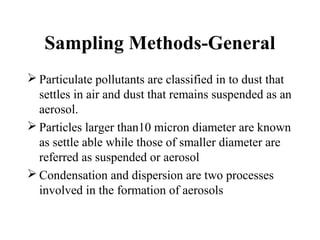
Sampling Methods-General
 Particulate pollutants are classified in to dust that
settles in air and dust that remains suspended as an
aerosol.
 Particles larger than10 micron diameter are known
as settle able while those of smaller diameter are
referred as suspended or aerosol
 Condensation and dispersion are two processes
involved in the formation of aerosols
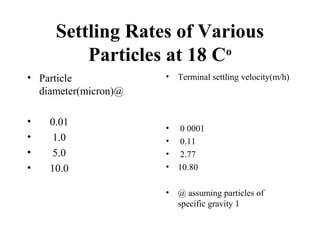
Settling Rates of Various
Particles at 18 Co
• Particle
diameter(micron)@
• 0.01
• 1.0
• 5.0
• 10.0
• Terminal settling velocity(m/h)
• 0 0001
• 0.11
• 2.77
• 10.80
• @ assuming particles of
specific gravity 1
Sampling Methods
Sedimentation
Filtration
Impingement
Electrostatic Precipitation
Thermal Precipitation
Centrifugal
Solution Impingers
Sedimentation
 Simplest technique for collection of particulate
matter
 Method useful for collection of more than 10
micron particulates
 It can be kept in outdoor area,free from overall
obstruction,and collect on horizontal surfaces
 Method is widely used in the determination of
particle fall out or dust fall in community
atmosphere
Sedimentation(cont)
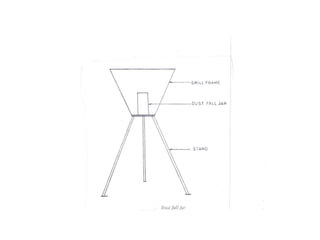
 Collectors are constructed of polyethylene ,glass
or stainless steel since the inside walls must be
inert to atmospheric oxidative flaking(see figure).
 Plastic make dust fall containers or jar prepared
which is 20-32 cm high and 10-15 cm in
diameter,base with a slight inward taper of the
walls from top to bottom
 In this jar, water containing algaecide(1 mg of
CuSO4/liter of water) is added up to 500ml to
facilitate retention of particles
Sedimentation(cont)
 Jar is exposed for a month,the soluble and
insoluble matter is determined and total solids
collected are expressed in terms of weight per
unit area per 30 days.
 One dust fall container is required for every
2600 hectares of land for community
monitoring
 For industrial complex or industry,container
may be placed as close as a few hundred
meters from the industry
Site selection criteria for placing dust fall
container/or jar
 Site should be free from over head obstruction and
may be free from local sources like incinerators
or chi many
 Month of dust fall collectors should be no less
than 2.5 m and more than16 m above ground
level,with a standard height of 6 m as
recommended elevation
 When sampling urban areas the dust fall collector
should be set no less than 10 stack lengths from an
operating stack & closer to a vertical wall than the
distance that provide a 300
angle from the sampler
to the top of the wall or roof
Advantages of dust fall sampling
 Easy to collect 1-5 gram of weighable sample on
which number of chemical & physical analysis
can be performed
 Method is simple, inexpensive,required no
electrical power or moving parts
 Collected dust representative of a industry or
community
 Survey of a community to determine areas of
high verses low levels of dust pollution
 Detection of process changes of a given
industry
Dis advantages of dust fall sampling
 Lack of precision & inability to distinguish
episodes of peak dust fall due to integration of
the total sample weight over the entire 30 days
sampling period
 Collected particles are more or less
agglomerated & consequently may not be
representative of the original form and size of
particulate matter suspended in a
contaminated atmosphere
Filtration
 Particulates having diameter of less than 10
micron are referred as suspended
particulates.Since these particulates is
respirable it is more harmful to man.Hence it
is necessary to separate both particulates
through sampling procedures.
 The most commonly used methods of
particulate sampling employ the principal of
filtration,where by particles are quantitatively
removed from an air stream
Filtration(cont)
Particle collection is achieved by a
combination of five distinct processes
(1)direct interception(2)internal
deposition(3)diffusional
deposition(4)electrical
attraction(5)gravitational attraction
Generally all types of particles can be
collected through above processes
Filtration(cont)
 Air sampling filters can collects particles to a
lower size limit of 0.1-1.0 m micron diameter.
 The best use of to follow a course filter with a
finer filter so that wide range of particle size is
collected
 If a sample of rather high temp air,
temperature resistant filter should be used(eg
glass or polyolefin fiber )in preference to paper
or a polyester type synthetic material
Impingement Methods
 Basic principal of this method is to separate the
particulates from an air stream by abrupt collision
against a flat surface.
 Wet and dry impingers are employed
 Wet impingers collect particles by causing them to
impinge a surface submerged in a liquid while dry
impingers work as impactors , collect particles by
impaction on a dry surface
Impingement Methods(cont)
 Efficiency of collection by impingement or
impaction is high for particles whose diameter
is 1 micron or greater.For collection of sub
micron particles,the impinger should be
operated at high velocities
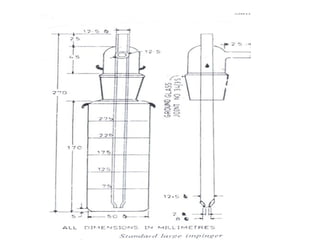
 Greenburg-Smith standard impinger(see fig)is
of wet collectors.Air sample is drawn through
an orifice 2.3 mm in diameter and impingers
against a flat surface 5mm distant, with a jet
velocity of about 113 m/s at as sampling rate of
28.3 liters/min
Impingement Methods(cont)
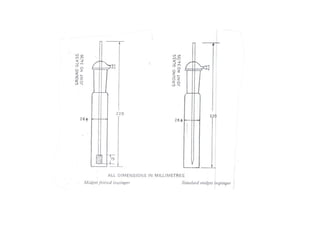
This impinger draws air at the rate of 2.8
liters/min through an orifice 1mm in
diameter and impinges against the flat
surface 5mm distant at a jet velocity of
about 60m/s.The collection efficiency is
low for particles less than o.7 micron in
diameter( see figures)
Dry cascade impactors( dry
impinges)
 They are useful for simultaneous collecting and
size differentiating of an aerosol
 Different size of particles are collected in this
device.
 Large particles may tend to fracture or
separate into smaller particles at the high
impact velocities attained, leading to the
formation of many more fine particles than the
were present in the original sample
Electrostatic Precipitator
 In this method,relatively high collection
efficiencies(greater than 98%) are possible for many type
of dusts and fumes of sub micron size.( diameter 0.2-
2.0micron)
 The effectiveness of a precipitant depends upon the extent
to which a charge can be acquired by the particles ,it will
not remove suspended solids or liquids that can volatile as
its operating temperature
 Instrument use high air flow rate compare to other
equipments,hence collect more and sizable weight
quantities of particles in comparatively short time
 It is used for source sampling or monitoring atmosphere
with relatively high particulate loading
Thermal Precipitation
 The gas containing particles in suspension is brought in
to contact with a heated surface, a dust free space
develops between the surface and the particles,due to
thermal action ,particles migrate from high temp zone
to low temp zone,in thermal gradient
 The collection efficiency of thermal precipitator is a
wide ranges of particles sizes from less than
0.01microm to 10 microns.It can be used for size
distributes of aerosol particles by microscopic
examination
 Disadvantages is low sampling rates of about 0.02-02
lit/min
Centrifugal Methods
 This device is based on the principal of the
cyclone
 Dust laden gas moving at high velocity,is directed
tangentially into a cylinder chamber,in which it
forms a confined vortex .The centrifugal forces
tend to drive the suspended particles to the walls
of the cyclone body ,from which they drop in to a
dust collection chamber.
 Advantage of this sampling device include
procurement of a dry chemically pure sample
 Disadvantage of this method is the limit of this
method to the particle sizes greater than 5 micron
Solution Impingers
 This consist of a drawn out tube through which air
containing particles flows in to a solution,where
particles are trapped.Acidic oxidizing solution is used
to collect both particulates and vapour species together
in this method.
 This sampler is used in situation where high
atmospheric particulates loading exist
 The application of this method is limited because the
collecting solution can be operated at 20lit/min(low
flow rates)

Sampling procedure part-2

  • 1.
  • 2.
    Sampling Methods-General  Particulatepollutants are classified in to dust that settles in air and dust that remains suspended as an aerosol.  Particles larger than10 micron diameter are known as settle able while those of smaller diameter are referred as suspended or aerosol  Condensation and dispersion are two processes involved in the formation of aerosols
  • 3.
    Settling Rates ofVarious Particles at 18 Co • Particle diameter(micron)@ • 0.01 • 1.0 • 5.0 • 10.0 • Terminal settling velocity(m/h) • 0 0001 • 0.11 • 2.77 • 10.80 • @ assuming particles of specific gravity 1
  • 4.
  • 5.
    Sedimentation  Simplest techniquefor collection of particulate matter  Method useful for collection of more than 10 micron particulates  It can be kept in outdoor area,free from overall obstruction,and collect on horizontal surfaces  Method is widely used in the determination of particle fall out or dust fall in community atmosphere
  • 7.
    Sedimentation(cont)  Collectors areconstructed of polyethylene ,glass or stainless steel since the inside walls must be inert to atmospheric oxidative flaking(see figure).  Plastic make dust fall containers or jar prepared which is 20-32 cm high and 10-15 cm in diameter,base with a slight inward taper of the walls from top to bottom  In this jar, water containing algaecide(1 mg of CuSO4/liter of water) is added up to 500ml to facilitate retention of particles
  • 8.
    Sedimentation(cont)  Jar isexposed for a month,the soluble and insoluble matter is determined and total solids collected are expressed in terms of weight per unit area per 30 days.  One dust fall container is required for every 2600 hectares of land for community monitoring  For industrial complex or industry,container may be placed as close as a few hundred meters from the industry
  • 9.
    Site selection criteriafor placing dust fall container/or jar  Site should be free from over head obstruction and may be free from local sources like incinerators or chi many  Month of dust fall collectors should be no less than 2.5 m and more than16 m above ground level,with a standard height of 6 m as recommended elevation  When sampling urban areas the dust fall collector should be set no less than 10 stack lengths from an operating stack & closer to a vertical wall than the distance that provide a 300 angle from the sampler to the top of the wall or roof
  • 10.
    Advantages of dustfall sampling  Easy to collect 1-5 gram of weighable sample on which number of chemical & physical analysis can be performed  Method is simple, inexpensive,required no electrical power or moving parts  Collected dust representative of a industry or community  Survey of a community to determine areas of high verses low levels of dust pollution  Detection of process changes of a given industry
  • 11.
    Dis advantages ofdust fall sampling  Lack of precision & inability to distinguish episodes of peak dust fall due to integration of the total sample weight over the entire 30 days sampling period  Collected particles are more or less agglomerated & consequently may not be representative of the original form and size of particulate matter suspended in a contaminated atmosphere
  • 12.
    Filtration  Particulates havingdiameter of less than 10 micron are referred as suspended particulates.Since these particulates is respirable it is more harmful to man.Hence it is necessary to separate both particulates through sampling procedures.  The most commonly used methods of particulate sampling employ the principal of filtration,where by particles are quantitatively removed from an air stream
  • 13.
    Filtration(cont) Particle collection isachieved by a combination of five distinct processes (1)direct interception(2)internal deposition(3)diffusional deposition(4)electrical attraction(5)gravitational attraction Generally all types of particles can be collected through above processes
  • 14.
    Filtration(cont)  Air samplingfilters can collects particles to a lower size limit of 0.1-1.0 m micron diameter.  The best use of to follow a course filter with a finer filter so that wide range of particle size is collected  If a sample of rather high temp air, temperature resistant filter should be used(eg glass or polyolefin fiber )in preference to paper or a polyester type synthetic material
  • 15.
    Impingement Methods  Basicprincipal of this method is to separate the particulates from an air stream by abrupt collision against a flat surface.  Wet and dry impingers are employed  Wet impingers collect particles by causing them to impinge a surface submerged in a liquid while dry impingers work as impactors , collect particles by impaction on a dry surface
  • 17.
    Impingement Methods(cont)  Efficiencyof collection by impingement or impaction is high for particles whose diameter is 1 micron or greater.For collection of sub micron particles,the impinger should be operated at high velocities  Greenburg-Smith standard impinger(see fig)is of wet collectors.Air sample is drawn through an orifice 2.3 mm in diameter and impingers against a flat surface 5mm distant, with a jet velocity of about 113 m/s at as sampling rate of 28.3 liters/min
  • 18.
    Impingement Methods(cont) This impingerdraws air at the rate of 2.8 liters/min through an orifice 1mm in diameter and impinges against the flat surface 5mm distant at a jet velocity of about 60m/s.The collection efficiency is low for particles less than o.7 micron in diameter( see figures)
  • 20.
    Dry cascade impactors(dry impinges)  They are useful for simultaneous collecting and size differentiating of an aerosol  Different size of particles are collected in this device.  Large particles may tend to fracture or separate into smaller particles at the high impact velocities attained, leading to the formation of many more fine particles than the were present in the original sample
  • 21.
    Electrostatic Precipitator  Inthis method,relatively high collection efficiencies(greater than 98%) are possible for many type of dusts and fumes of sub micron size.( diameter 0.2- 2.0micron)  The effectiveness of a precipitant depends upon the extent to which a charge can be acquired by the particles ,it will not remove suspended solids or liquids that can volatile as its operating temperature  Instrument use high air flow rate compare to other equipments,hence collect more and sizable weight quantities of particles in comparatively short time  It is used for source sampling or monitoring atmosphere with relatively high particulate loading
  • 22.
    Thermal Precipitation  Thegas containing particles in suspension is brought in to contact with a heated surface, a dust free space develops between the surface and the particles,due to thermal action ,particles migrate from high temp zone to low temp zone,in thermal gradient  The collection efficiency of thermal precipitator is a wide ranges of particles sizes from less than 0.01microm to 10 microns.It can be used for size distributes of aerosol particles by microscopic examination  Disadvantages is low sampling rates of about 0.02-02 lit/min
  • 23.
    Centrifugal Methods  Thisdevice is based on the principal of the cyclone  Dust laden gas moving at high velocity,is directed tangentially into a cylinder chamber,in which it forms a confined vortex .The centrifugal forces tend to drive the suspended particles to the walls of the cyclone body ,from which they drop in to a dust collection chamber.  Advantage of this sampling device include procurement of a dry chemically pure sample  Disadvantage of this method is the limit of this method to the particle sizes greater than 5 micron
  • 24.
    Solution Impingers  Thisconsist of a drawn out tube through which air containing particles flows in to a solution,where particles are trapped.Acidic oxidizing solution is used to collect both particulates and vapour species together in this method.  This sampler is used in situation where high atmospheric particulates loading exist  The application of this method is limited because the collecting solution can be operated at 20lit/min(low flow rates)