Sampling Fundamentals 1Sampling Fundamentals 1
Sampling Fundamentals
• Population
• Sample
• Census
• Parameter
• Statistic
The One and Only Goal in Sampling!!
Select a sample
that is as
representative
as possible.
So that an accurate inference about the population
can be made – goal of marketing research
Sampling Fundamentals
• When Is Census Appropriate?
• When Is Sample Appropriate?
Error in Sampling
• Total Error
• Sampling Error
• Non-sampling Error (dealt with in chapter 4)
Sampling Process: Identify Population
• Question: For a toy store in RH
• Question: For a small bookstore in RH
specializing in romance novels
Sampling Process: Determine sampling
frame
• List and contact information of population
members used to obtain the sample from
• Example – to address a population of all
advertising agencies in the US, the sampling
frame would be the Standard Directory of
Advertising Agencies
• Availability of lists is limited, lists may be obsolete
and incomplete
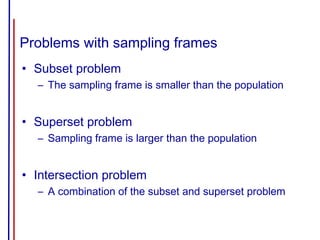
Problems with sampling frames
• Subset problem
– The sampling frame is smaller than the population
• Superset problem
– Sampling frame is larger than the population
• Intersection problem
– A combination of the subset and superset problem
Problems with sampling frames
Sampling Process: Sampling Procedure
Probability Sampling
Nonprobability Sampling
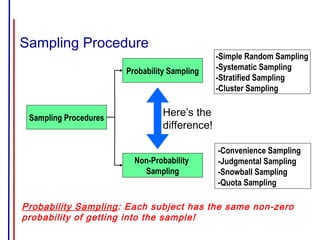
Sampling Procedure
Sampling Procedures
Non-Probability
Sampling
Probability Sampling
-Simple Random Sampling
-Systematic Sampling
-Stratified Sampling
-Cluster Sampling
-Convenience Sampling
-Judgmental Sampling
-Snowball Sampling
-Quota Sampling
Here’s the
difference!
Probability Sampling: Each subject has the same non-zero
probability of getting into the sample!
Probability Sampling Techniques
Simple Random Sampling
• Each population member has equal, non-zero
probability of being selected
• Equivalent to choosing with replacement
Probability Sampling Techniques
• Accuracy – cost trade off
• Sampling Efficiency = Accuracy/Cost
– Sampling efficiency can be increased by
either reducing the cost, increasing the
accuracy or doing both
– This has led to modifying simple random
sampling procedures
Probability Sampling Techniques
Stratified Sampling
• The chosen sample is forced to contain units from each of
the segments or strata of the population
• Sometimes groups (strata) are naturally present in the
population
• Between-group differences on the variable of interest are
high and within-group differences are low
• Then it makes better sense to do simple random sampling
within each group and vary within-group sample size
according to
– Variation on variable of interest
– Cost of generating the sample
– Size of group in population
• Increases accuracy at a faster rate than cost
Stratified Sampling – what strata are naturally
present
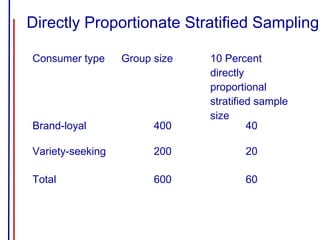
Consumer type Group size 10 Percent
directly
proportional
stratified sample
size
Brand-loyal 400 40
Variety-seeking 200 20
Total 600 60
Directly Proportionate Stratified Sampling
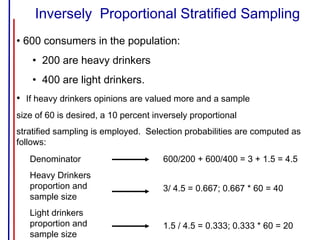
• 600 consumers in the population:
• 200 are heavy drinkers
• 400 are light drinkers.
• If heavy drinkers opinions are valued more and a sample
size of 60 is desired, a 10 percent inversely proportional
stratified sampling is employed. Selection probabilities are computed as
follows:
Denominator
Heavy Drinkers
proportion and
sample size
Light drinkers
proportion and
sample size
600/200 + 600/400 = 3 + 1.5 = 4.5
3/ 4.5 = 0.667; 0.667 * 60 = 40
1.5 / 4.5 = 0.333; 0.333 * 60 = 20
Inversely Proportional Stratified Sampling
Probability Sampling Techniques
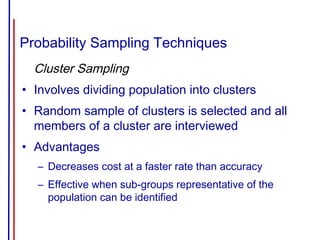
Cluster Sampling
• Involves dividing population into clusters
• Random sample of clusters is selected and all
members of a cluster are interviewed
• Advantages
– Decreases cost at a faster rate than accuracy
– Effective when sub-groups representative of the
population can be identified
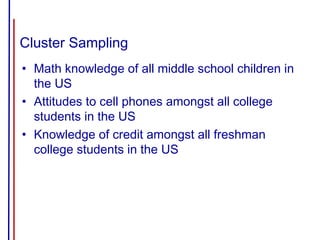
Cluster Sampling
• Math knowledge of all middle school children in
the US
• Attitudes to cell phones amongst all college
students in the US
• Knowledge of credit amongst all freshman
college students in the US
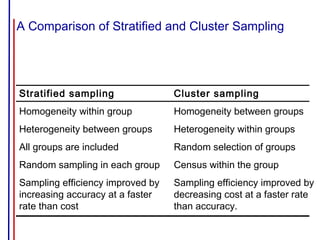
A Comparison of Stratified and Cluster Sampling
Stratified sampling
Homogeneity within group
Heterogeneity between groups
All groups are included
Random sampling in each group
Sampling efficiency improved by
increasing accuracy at a faster
rate than cost
Cluster sampling
Homogeneity between groups
Heterogeneity within groups
Random selection of groups
Census within the group
Sampling efficiency improved by
decreasing cost at a faster rate
than accuracy.
Probability Sampling Techniques
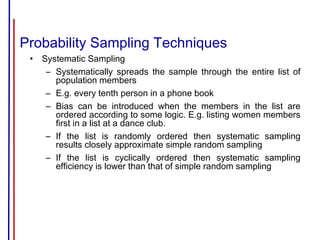
• Systematic Sampling
– Systematically spreads the sample through the entire list of
population members
– E.g. every tenth person in a phone book
– Bias can be introduced when the members in the list are
ordered according to some logic. E.g. listing women members
first in a list at a dance club.
– If the list is randomly ordered then systematic sampling
results closely approximate simple random sampling
– If the list is cyclically ordered then systematic sampling
efficiency is lower than that of simple random sampling
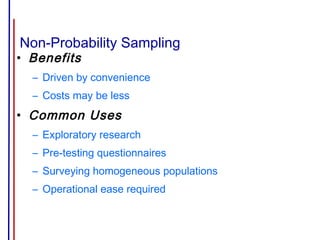
Non-Probability Sampling
• Benefits
– Driven by convenience
– Costs may be less
• Common Uses
– Exploratory research
– Pre-testing questionnaires
– Surveying homogeneous populations
– Operational ease required
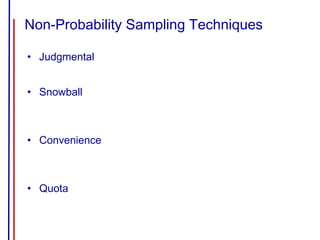
Non-Probability Sampling Techniques
• Judgmental
• Snowball
• Convenience
• Quota

Chapter11ws sampling

  • 1.
  • 2.
    Sampling Fundamentals • Population •Sample • Census • Parameter • Statistic
  • 3.
    The One andOnly Goal in Sampling!! Select a sample that is as representative as possible. So that an accurate inference about the population can be made – goal of marketing research
  • 4.
    Sampling Fundamentals • WhenIs Census Appropriate? • When Is Sample Appropriate?
  • 5.
    Error in Sampling •Total Error • Sampling Error • Non-sampling Error (dealt with in chapter 4)
  • 6.
    Sampling Process: IdentifyPopulation • Question: For a toy store in RH • Question: For a small bookstore in RH specializing in romance novels
  • 7.
    Sampling Process: Determinesampling frame • List and contact information of population members used to obtain the sample from • Example – to address a population of all advertising agencies in the US, the sampling frame would be the Standard Directory of Advertising Agencies • Availability of lists is limited, lists may be obsolete and incomplete
  • 8.
    Problems with samplingframes • Subset problem – The sampling frame is smaller than the population • Superset problem – Sampling frame is larger than the population • Intersection problem – A combination of the subset and superset problem
  • 9.
  • 10.
    Sampling Process: SamplingProcedure Probability Sampling Nonprobability Sampling
  • 11.
    Sampling Procedure Sampling Procedures Non-Probability Sampling ProbabilitySampling -Simple Random Sampling -Systematic Sampling -Stratified Sampling -Cluster Sampling -Convenience Sampling -Judgmental Sampling -Snowball Sampling -Quota Sampling Here’s the difference! Probability Sampling: Each subject has the same non-zero probability of getting into the sample!
  • 12.
    Probability Sampling Techniques SimpleRandom Sampling • Each population member has equal, non-zero probability of being selected • Equivalent to choosing with replacement
  • 13.
    Probability Sampling Techniques •Accuracy – cost trade off • Sampling Efficiency = Accuracy/Cost – Sampling efficiency can be increased by either reducing the cost, increasing the accuracy or doing both – This has led to modifying simple random sampling procedures
  • 14.
    Probability Sampling Techniques StratifiedSampling • The chosen sample is forced to contain units from each of the segments or strata of the population • Sometimes groups (strata) are naturally present in the population • Between-group differences on the variable of interest are high and within-group differences are low • Then it makes better sense to do simple random sampling within each group and vary within-group sample size according to – Variation on variable of interest – Cost of generating the sample – Size of group in population • Increases accuracy at a faster rate than cost
  • 15.
    Stratified Sampling –what strata are naturally present
  • 16.
    Consumer type Groupsize 10 Percent directly proportional stratified sample size Brand-loyal 400 40 Variety-seeking 200 20 Total 600 60 Directly Proportionate Stratified Sampling
  • 17.
    • 600 consumersin the population: • 200 are heavy drinkers • 400 are light drinkers. • If heavy drinkers opinions are valued more and a sample size of 60 is desired, a 10 percent inversely proportional stratified sampling is employed. Selection probabilities are computed as follows: Denominator Heavy Drinkers proportion and sample size Light drinkers proportion and sample size 600/200 + 600/400 = 3 + 1.5 = 4.5 3/ 4.5 = 0.667; 0.667 * 60 = 40 1.5 / 4.5 = 0.333; 0.333 * 60 = 20 Inversely Proportional Stratified Sampling
  • 18.
    Probability Sampling Techniques ClusterSampling • Involves dividing population into clusters • Random sample of clusters is selected and all members of a cluster are interviewed • Advantages – Decreases cost at a faster rate than accuracy – Effective when sub-groups representative of the population can be identified
  • 19.
    Cluster Sampling • Mathknowledge of all middle school children in the US • Attitudes to cell phones amongst all college students in the US • Knowledge of credit amongst all freshman college students in the US
  • 20.
    A Comparison ofStratified and Cluster Sampling Stratified sampling Homogeneity within group Heterogeneity between groups All groups are included Random sampling in each group Sampling efficiency improved by increasing accuracy at a faster rate than cost Cluster sampling Homogeneity between groups Heterogeneity within groups Random selection of groups Census within the group Sampling efficiency improved by decreasing cost at a faster rate than accuracy.
  • 21.
    Probability Sampling Techniques •Systematic Sampling – Systematically spreads the sample through the entire list of population members – E.g. every tenth person in a phone book – Bias can be introduced when the members in the list are ordered according to some logic. E.g. listing women members first in a list at a dance club. – If the list is randomly ordered then systematic sampling results closely approximate simple random sampling – If the list is cyclically ordered then systematic sampling efficiency is lower than that of simple random sampling
  • 22.
    Non-Probability Sampling • Benefits –Driven by convenience – Costs may be less • Common Uses – Exploratory research – Pre-testing questionnaires – Surveying homogeneous populations – Operational ease required
  • 23.
    Non-Probability Sampling Techniques •Judgmental • Snowball • Convenience • Quota