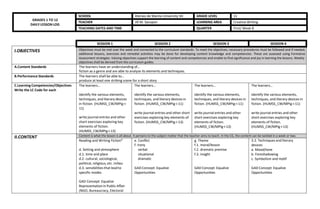
GRADES 1 TO 12
DAILY LESSON LOG
SCHOOL Ateneo de Manila University SH GRADE LEVEL 11
TEACHER Jill M. Sacopon LEARNING AREA Creative Writing
TEACHING DATES AND TIME QUARTER First/ Week 8
SESSION 1 SESSION 2 SESSION 3 SESSION 4
I.OBJECTIVES Objectives must be met over the week and connected to the curriculum standards. To meet the objectives, necessary procedures must be followed and if needed,
additional lessons, exercises and remedial activities may be done for developing content knowledge and competencies. These are assessed using Formative
Assessment strategies. Valuing objectives support the learning of content and competencies and enable to find significance and joy in learning the lessons. Weekly
objectives shall be derived from the curriculum guides.
A.Content Standards The learners have an understanding of…
fiction as a genre and are able to analyze its elements and techniques.
B.Performance Standards The learners shall be able to…
produce at least one striking scene for a short story
C.Learning Competencies/Objectives
Write the LC Code for each
The learners…
identify the various elements,
techniques, and literary devices
in fiction. (HUMSS_CW/MPIg-i-
11)
write journal entries and other
short exercises exploring key
elements of fiction.
(HUMSS_CW/MPIg-i-13)
The learners…
identify the various elements,
techniques, and literary devices in
fiction. (HUMSS_CW/MPIg-i-11)
write journal entries and other short
exercises exploring key elements of
fiction. (HUMSS_CW/MPIg-i-13)
The learners…
identify the various elements,
techniques, and literary devices in
fiction. (HUMSS_CW/MPIg-i-11)
write journal entries and other
short exercises exploring key
elements of fiction.
(HUMSS_CW/MPIg-i-13)
The learners…
identify the various elements,
techniques, and literary devices in
fiction. (HUMSS_CW/MPIg-i-11)
write journal entries and other
short exercises exploring key
elements of fiction.
(HUMSS_CW/MPIg-i-13)
II.CONTENT Content is what the lesson is all about. It pertains to the subject matter that the teacher aims to teach. In the CG, the content can be tackled in a week or two.
Reading and Writing Fiction*
d. Setting and atmosphere
d.1. time and place
d.2. cultural, sociological,
political, religious, etc. milieu
d.3. sensibilities that lead to
specific modes
GAD Concept: Equalize
Representation in Public Affair
(NGO, Bureaucracy, Electoral
e. Conflict
f. Irony
verbal
situational
dramatic
GAD Concept: Equalize
Opportunities
g. Theme
f.1. moral/lesson
f.2. dramatic premise
f.3. insight
GAD Concept: Equalize
Opportunities
3.2. Techniques and literary
devices
a. Mood/tone
b. Foreshadowing
c. Symbolism and motif
GAD Concept: Equalize
Opportunities
Politics, Business) and Enhance
Participation
III.LEARNING RESOURCES List the materials to be used in different days. Varied sources of materials sustain children’s interest in the lesson and in learning. Ensure that there is a mix of
concrete and manipulative materials as well as paper- based materials. Hands- on learning promotes concept development.
A.References
1.Teacher’s Guides/Pages
2.Learner’s Materials Pages
3.Textbook Pages
4.Additional Materials from Learning
Resources (LR) portal
B.Other Learning Resources Creative Writing by Arnold Jarn
Ford Buhisan and Ayesha
Sayseng, pp. 58- 61
Elements of Fiction downloaded
from slideshare.com
Elements of Fiction downloaded
from slideshare.com
Creative Writing by Arnold Jarn
Ford Buhisan and Ayesha Sayseng,
pp. 92- 94
Elements of Fiction downloaded
from slideshare.com
IV.PROCEDURES These steps should be done across the week. Spread out the activities appropriately so that students will learn well. Always be guided by demonstration of learning
by the students which you can infer from formative assessment activities. Sustain learning systematically by providing students with multiple ways to learn new
things, practice their learning processes, and draw conclusions about what they learned in relation to their life experiences and previous knowledge, indicate the
time allotment for each step.
A.Reviewing previous lesson or
presenting the new lesson
Review the previous lesson. Review the previous lesson. Review the previous lesson. Review the previous lesson.
B.Establishing a purpose for the lesson Do Warm Up Activity, pp. 60- 61
Direction: Identify the place as
suggested by the following
images (Refer to the book).
Watch two news video clips.
Determine the cause of the problem
reported.
Watch the video, Kindness
Boomerang. Determine the
message of the video.
Object, Your Honor Activity
To the learners:
Directions: Get a thing from your
bag and tell what the thing
symbolizes.
C.Presenting examples/instances of
the new lesson
Tell that objects can determine
the place the story is set.
Tell that conflicts are inevitable in
reality and also in the story.
Tell that every story, there is a
central topic of the story.
Introduce theme.
Tell that in a story, there are
objects that can give you clue what
is the story all about.
D.Discussing new concepts and
practicing new skills #1
Discuss setting and its aspects.
a. Physical world
b. Characters revealed by
setting
c. Settings revealed by
characters
d. Plot
e. Atmospheric setting
Discuss different types of conflict. Discuss theme. Discuss techniques and literary
devices
a. Mood/tone
b. Foreshadowing
c. Symbolism and motif
f. Theme
E.Discussing new concepts and
practicing new skills #2
Discuss irony.
F.Developing mastery
(Leads to formative assessment)
Answer an exercise about aspects
of setting. There will be
worksheet provided for this
activity.
Answer exercises about types of
conflict and irony. There will be
slides for this activity.
Select a drama series or a movie
you have watched and determine
the theme of the story.
Answer exercises about mood,
foreshadowing, symbolism and
other literary techniques and
devices.
G.Finding practical/applications of
concepts and skills in daily living
Ask:
How the different aspects of
setting can help you to present
situations of various people?
Ask:
How the types of conflict can help
you deal with other people equally
and peacefully?
Ask:
How theme can help you to
convey message to everyone?
Ask:
How the literary devices can help
you to value future?
H. Making generalizations and
abstractions about the lesson
The learners synthesize the
concepts being discussed.
The learners synthesize the
concepts being discussed.
The learners synthesize the
concepts being discussed.
The learners synthesize the
concepts being discussed.
I.Evaluating Learning Determine the setting of the
story. “Gift of the Magi,”
Determine the conflict and if there
are parts of the story “Gift of the
Magi” that show an irony.
Determine the theme of the story
“The Gift of the Magi”.
Determine the literary techniques
used in the story “Gift of the
Magi”.
J.Additional activities for application
or remediation
To the learners:
In your story, integrate now
settings.
To the learners:
In your story, integrate now conflict
and irony.
To the learners:
In your story, integrate theme.
To the learners:
In your story, integrate literary
techniques.
V.REMARKS Creative Writing is taken four times a week.
VI.REFLECTION Reflect on your teaching and assess yourself as a teacher. Think about your students, progress this week. What works? What else needs to be done
to help the students learn? Identify what help your instructional supervisors can provide for you so when you meet them, you can ask relevant
questions.
A.No. of learners who earned 80% of
the formative assessment
B.No. of learners who require
additional activities to remediation
C.Did the remedial lessons work? No.
of learners who have caught up with
the lesson
D.No. of learners who continue to
require remediation
E.Which of my teaching strategies
worked well? Why did these work?
F.What difficulties did I encounter
which my principal or supervisor can
help me solve?
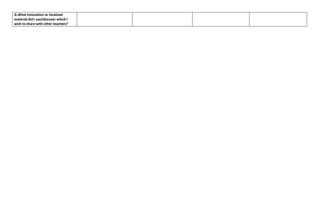
G.What innovation or localized
material did I use/discover which I
wish to share with other teachers?

sample-dll for creative writing docx.docx

  • 1.
    GRADES 1 TO12 DAILY LESSON LOG SCHOOL Ateneo de Manila University SH GRADE LEVEL 11 TEACHER Jill M. Sacopon LEARNING AREA Creative Writing TEACHING DATES AND TIME QUARTER First/ Week 8 SESSION 1 SESSION 2 SESSION 3 SESSION 4 I.OBJECTIVES Objectives must be met over the week and connected to the curriculum standards. To meet the objectives, necessary procedures must be followed and if needed, additional lessons, exercises and remedial activities may be done for developing content knowledge and competencies. These are assessed using Formative Assessment strategies. Valuing objectives support the learning of content and competencies and enable to find significance and joy in learning the lessons. Weekly objectives shall be derived from the curriculum guides. A.Content Standards The learners have an understanding of… fiction as a genre and are able to analyze its elements and techniques. B.Performance Standards The learners shall be able to… produce at least one striking scene for a short story C.Learning Competencies/Objectives Write the LC Code for each The learners… identify the various elements, techniques, and literary devices in fiction. (HUMSS_CW/MPIg-i- 11) write journal entries and other short exercises exploring key elements of fiction. (HUMSS_CW/MPIg-i-13) The learners… identify the various elements, techniques, and literary devices in fiction. (HUMSS_CW/MPIg-i-11) write journal entries and other short exercises exploring key elements of fiction. (HUMSS_CW/MPIg-i-13) The learners… identify the various elements, techniques, and literary devices in fiction. (HUMSS_CW/MPIg-i-11) write journal entries and other short exercises exploring key elements of fiction. (HUMSS_CW/MPIg-i-13) The learners… identify the various elements, techniques, and literary devices in fiction. (HUMSS_CW/MPIg-i-11) write journal entries and other short exercises exploring key elements of fiction. (HUMSS_CW/MPIg-i-13) II.CONTENT Content is what the lesson is all about. It pertains to the subject matter that the teacher aims to teach. In the CG, the content can be tackled in a week or two. Reading and Writing Fiction* d. Setting and atmosphere d.1. time and place d.2. cultural, sociological, political, religious, etc. milieu d.3. sensibilities that lead to specific modes GAD Concept: Equalize Representation in Public Affair (NGO, Bureaucracy, Electoral e. Conflict f. Irony verbal situational dramatic GAD Concept: Equalize Opportunities g. Theme f.1. moral/lesson f.2. dramatic premise f.3. insight GAD Concept: Equalize Opportunities 3.2. Techniques and literary devices a. Mood/tone b. Foreshadowing c. Symbolism and motif GAD Concept: Equalize Opportunities
  • 2.
    Politics, Business) andEnhance Participation III.LEARNING RESOURCES List the materials to be used in different days. Varied sources of materials sustain children’s interest in the lesson and in learning. Ensure that there is a mix of concrete and manipulative materials as well as paper- based materials. Hands- on learning promotes concept development. A.References 1.Teacher’s Guides/Pages 2.Learner’s Materials Pages 3.Textbook Pages 4.Additional Materials from Learning Resources (LR) portal B.Other Learning Resources Creative Writing by Arnold Jarn Ford Buhisan and Ayesha Sayseng, pp. 58- 61 Elements of Fiction downloaded from slideshare.com Elements of Fiction downloaded from slideshare.com Creative Writing by Arnold Jarn Ford Buhisan and Ayesha Sayseng, pp. 92- 94 Elements of Fiction downloaded from slideshare.com IV.PROCEDURES These steps should be done across the week. Spread out the activities appropriately so that students will learn well. Always be guided by demonstration of learning by the students which you can infer from formative assessment activities. Sustain learning systematically by providing students with multiple ways to learn new things, practice their learning processes, and draw conclusions about what they learned in relation to their life experiences and previous knowledge, indicate the time allotment for each step. A.Reviewing previous lesson or presenting the new lesson Review the previous lesson. Review the previous lesson. Review the previous lesson. Review the previous lesson. B.Establishing a purpose for the lesson Do Warm Up Activity, pp. 60- 61 Direction: Identify the place as suggested by the following images (Refer to the book). Watch two news video clips. Determine the cause of the problem reported. Watch the video, Kindness Boomerang. Determine the message of the video. Object, Your Honor Activity To the learners: Directions: Get a thing from your bag and tell what the thing symbolizes. C.Presenting examples/instances of the new lesson Tell that objects can determine the place the story is set. Tell that conflicts are inevitable in reality and also in the story. Tell that every story, there is a central topic of the story. Introduce theme. Tell that in a story, there are objects that can give you clue what is the story all about. D.Discussing new concepts and practicing new skills #1 Discuss setting and its aspects. a. Physical world b. Characters revealed by setting c. Settings revealed by characters d. Plot e. Atmospheric setting Discuss different types of conflict. Discuss theme. Discuss techniques and literary devices a. Mood/tone b. Foreshadowing c. Symbolism and motif
  • 3.
    f. Theme E.Discussing newconcepts and practicing new skills #2 Discuss irony. F.Developing mastery (Leads to formative assessment) Answer an exercise about aspects of setting. There will be worksheet provided for this activity. Answer exercises about types of conflict and irony. There will be slides for this activity. Select a drama series or a movie you have watched and determine the theme of the story. Answer exercises about mood, foreshadowing, symbolism and other literary techniques and devices. G.Finding practical/applications of concepts and skills in daily living Ask: How the different aspects of setting can help you to present situations of various people? Ask: How the types of conflict can help you deal with other people equally and peacefully? Ask: How theme can help you to convey message to everyone? Ask: How the literary devices can help you to value future? H. Making generalizations and abstractions about the lesson The learners synthesize the concepts being discussed. The learners synthesize the concepts being discussed. The learners synthesize the concepts being discussed. The learners synthesize the concepts being discussed. I.Evaluating Learning Determine the setting of the story. “Gift of the Magi,” Determine the conflict and if there are parts of the story “Gift of the Magi” that show an irony. Determine the theme of the story “The Gift of the Magi”. Determine the literary techniques used in the story “Gift of the Magi”. J.Additional activities for application or remediation To the learners: In your story, integrate now settings. To the learners: In your story, integrate now conflict and irony. To the learners: In your story, integrate theme. To the learners: In your story, integrate literary techniques. V.REMARKS Creative Writing is taken four times a week. VI.REFLECTION Reflect on your teaching and assess yourself as a teacher. Think about your students, progress this week. What works? What else needs to be done to help the students learn? Identify what help your instructional supervisors can provide for you so when you meet them, you can ask relevant questions. A.No. of learners who earned 80% of the formative assessment B.No. of learners who require additional activities to remediation C.Did the remedial lessons work? No. of learners who have caught up with the lesson D.No. of learners who continue to require remediation E.Which of my teaching strategies worked well? Why did these work? F.What difficulties did I encounter which my principal or supervisor can help me solve?
  • 4.
    G.What innovation orlocalized material did I use/discover which I wish to share with other teachers?