ativ
e
Writ
ing
Lesson 1
Directions:
Rank the given text types from 1 to 10
based on your level of familiarity with
them with 10 as the most familiar to you
and 1 as the least or not familiar at all.
See the table below for interpretation of
your level of familiarity.
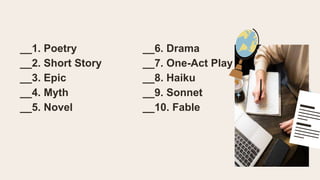
__1. Poetry __6. Drama
__2. Short Story __7. One-Act Play
__3. Epic __8. Haiku
__4. Myth __9. Sonnet
__5. Novel __10. Fable
● Also known as 'the art of making things up,'
creative writing is a vital part of modern society.
● Traditionally referred to as literature, creative
writing is an art of sorts - the art of making things
up. It's writing done in a way that is not
academic or technical but still attracts an
audience.
What is Creative Writing?
• Creative Writing is the style of writing that goes
beyond the conventions of technical literature.
• Also called as Imaginative Writing, this style
can be any writing – fiction, poetry, even non-
fiction – that uses literary devices like imagery
diction, idioms, figures of speech, etc.. It is
guided more by the writer’s need to express
feelings and ideas than by restrictive demands
of factual and logical progression of expository
writing
The purpose…
• The purpose of creative writing is to both entertain and
share human experience, like love or loss.
• Writers attempt to get at a truth about humanity
through poetics and storytelling.
• If you'd like to try your hand at creative writing, just
keep in mind that whether you are trying to express a
feeling or a thought, the first step is to use your
imagination.
Technic
al
Creativ
vs.
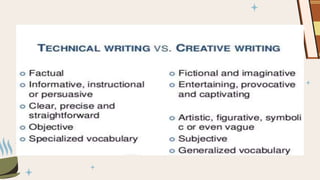
Key Differences:
• In creative writing the most of the part is self-created,
although the idea might be inspired but in technical writing
the facts are to be obliged and the note is delivered from
leading on what previously other greats have concluded.
• Most commonly, the creative writing is for general
audience or for masses but technical writing is for specific
audience.
• The creative writing entertains people as it has poetry or
some illustrations or another idea, whereas the technical
writing causes boredom as it follows the strong pattern
based on facts and is just to transfer the information to the
Key Differences:
• In technical writing the specialized vocabulary,
such like scientific terms and other are used
while in creative writing, one can go with slang
or evocative phrases or even something which
can be perceived well by the audience.
• Humor, satire might be the useful essences in
creative writing but such thoughts or ideas have
no link with the technical writing.
ive
Writing
Acade
mic
Writing
The Principal Difference
Style is the chief difference between academic and creative
writing.
Creative writing need not adhere to any specific
style parameters. Academic writing is different.
Academic writing needs to be structured and
executed adhering to a series of guidelines.
Indeed, so stringent are these guidelines that
academic institutions include these guidelines as part
CREATIVE WRITING VS. TECHNICAL/ACADEMIC WRITING

CREATIVE WRITING VS. TECHNICAL/ACADEMIC WRITING

  • 1.
  • 2.
    Directions: Rank the giventext types from 1 to 10 based on your level of familiarity with them with 10 as the most familiar to you and 1 as the least or not familiar at all. See the table below for interpretation of your level of familiarity.
  • 4.
    __1. Poetry __6.Drama __2. Short Story __7. One-Act Play __3. Epic __8. Haiku __4. Myth __9. Sonnet __5. Novel __10. Fable
  • 5.
    ● Also knownas 'the art of making things up,' creative writing is a vital part of modern society. ● Traditionally referred to as literature, creative writing is an art of sorts - the art of making things up. It's writing done in a way that is not academic or technical but still attracts an audience. What is Creative Writing?
  • 6.
    • Creative Writingis the style of writing that goes beyond the conventions of technical literature. • Also called as Imaginative Writing, this style can be any writing – fiction, poetry, even non- fiction – that uses literary devices like imagery diction, idioms, figures of speech, etc.. It is guided more by the writer’s need to express feelings and ideas than by restrictive demands of factual and logical progression of expository writing
  • 7.
    The purpose… • Thepurpose of creative writing is to both entertain and share human experience, like love or loss. • Writers attempt to get at a truth about humanity through poetics and storytelling. • If you'd like to try your hand at creative writing, just keep in mind that whether you are trying to express a feeling or a thought, the first step is to use your imagination.
  • 8.
  • 10.
    Key Differences: • Increative writing the most of the part is self-created, although the idea might be inspired but in technical writing the facts are to be obliged and the note is delivered from leading on what previously other greats have concluded. • Most commonly, the creative writing is for general audience or for masses but technical writing is for specific audience. • The creative writing entertains people as it has poetry or some illustrations or another idea, whereas the technical writing causes boredom as it follows the strong pattern based on facts and is just to transfer the information to the
  • 11.
    Key Differences: • Intechnical writing the specialized vocabulary, such like scientific terms and other are used while in creative writing, one can go with slang or evocative phrases or even something which can be perceived well by the audience. • Humor, satire might be the useful essences in creative writing but such thoughts or ideas have no link with the technical writing.
  • 12.
  • 13.
    The Principal Difference Styleis the chief difference between academic and creative writing. Creative writing need not adhere to any specific style parameters. Academic writing is different. Academic writing needs to be structured and executed adhering to a series of guidelines. Indeed, so stringent are these guidelines that academic institutions include these guidelines as part