SAMHITA MICROFINANCE Praseeda Kunam Srijan  Microfinance Business Plan Competition  Final Round Presentations, July   3 rd , 2008 Economic  Initiatives  for  Life  Essentials
Overview Entrepreneurs’ profiles Business Proposition Financial Analysis Management and Human Resources
Entrepreneurs’ Profiles Praseeda Kunam MBA & MIM from Washington University, St. Louis Managed ABN AMRO Foundation’s capacity building initiative for start-up MFIs in underserved regions (Jan 2006 – May 2007) Managed operations for SKS Microfinance (2003-2005) Bala Krishnamurthy 10 years US investment industry experience  McKinsey & Company (Chicago) Zacks Investment Research (Chicago) Wellington Management Company (Boston) Architect of technology solutions at SKS Microfinance, Cashpor-India and RKMHOS Multimedia Health Promotion University of Chicago, MBA (Finance); Virginia Tech, MS (Computer Science); IIT Delhi, BTech (Mech. Engg.)
Business Proposition
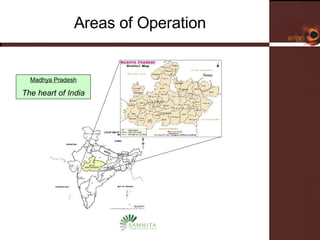
Areas of Operation Madhya Pradesh The heart of India
The Identified Problem Madhya Pradesh is one of the poorest states of India Poverty rate estimated at 37% (vs. India average of 27%) Population of over 20 million poor in MP alone Ranked extremely low in the areas of nutrition, primary health, education and essential infrastructure 90% of rural population associated with agriculture – mostly rain-fed irrigation 25% of cities fall under slums (vs. All-India 14%) Women’s literacy 50% (rural women close to 43%) Infant mortality 70 per 1000 (vs. All-India 57) Population density 196 / sq. km (vs. All-India 324, and UP 689) Forested / Tribal state – Naturally difficult to deliver services A market in critical need for provision of microfinance, education and primary health services
Solution through Samhita Microfinance Samhita Microfinance is the microfinance initiative of its parent,  Samhita Community Development Services [SCDS]. 3 Cornerstones of the SCDS broader strategy Common Appropriate Technology Platform Generate service efficiencies, cost reduction and product innovation through technology.  In-house, live, responsive common solutions to multiple developmental needs. Network affiliate eCubeH Research Labs is the technology partner. Economic Initiatives Provision of capital for small enterprises Undertaking livelihood projects to further increase income from the small enterprises Primary Health Initiatives Begin with multimedia health education. Revenue-based self-managed health service network. Tele-medicine
Starting with Economic Services Every interaction on the field highlights the highest priority of poor households – the need for livelihood opportunity.  Samhita’s strategy is to launch economic services to the target population first. The established distribution channel will be used for later delivery of non-financial services The Microfinance program has been launched and is scaling rapidly Parallel rural and urban operations Business plans for the first Micro Enterprise programs are under development
Target Market and Customer Base Target Customer – Rural   Average annual income under Rs. 20-24k (under $1 PPP) Mostly landless Primarily agricultural wage laborers Limited livelihood opportunities  Loan usage mostly for goats, cows, petty stores From households with migrant family members Most customers have not engaged in microfinance before and require training Target Customer – Urban Average annual income under Rs. 60k  Many own government granted housing in slums Largely migrant population from rural areas Women primarily employed as domestic labor  Men primarily employed as street vendors, some laborers Loan usage mostly working capital for small vendors Cash flow is variable and requires flexibility in loan product
Microfinance Methodology Model Adaptation of Grameen / ASA models Joint Liability Groups Training Group Recognition Test Center Meetings Loan Proposals / Appraisals / Disbursement Loan Follow-ups Target Market Exclusive Targeting - Women of Poor Households Samhita Poverty Assessment Score [SPAS] mechanism More conservative than international USD1 PPP cutoff Factors housing quality, land and animal holdings, other assets, stability of income sources, family size, and access to basic services
Product Offerings A. Productive Loans Amounts: Rs. 1,000 to 12,000 Tenor: 50 weeks, 25 weeks, 13 weeks B. Social Loans (client demand-driven; being introduced) Education Loans  Amounts: Rs. 1,000 to 4,000 Tenor: 13 weeks Prior-Debt Retirement Loans Amounts: Rs. 1,000 to 6,000 Tenor: 50 weeks, 25 weeks, 13 weeks Cost to Client Rural: 1% LPF, 15% flat Urban: 2% LPF, 12.5% flat Competitive in the market
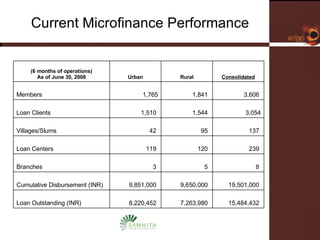
Current Microfinance Performance 8  5  3  Branches 19,501,000  9,650,000  9,851,000  Cumulative Disbursement (INR) 15,484,432  7,263,980  8,220,452  Loan Outstanding (INR) 239  120  119  Loan Centers 137  95  42  Villages/Slums 3,054 1,544  1,510  Loan Clients 3,606  1,841  1,765 Members Consolidated Rural Urban (6 months of operations) As of June 30, 2008
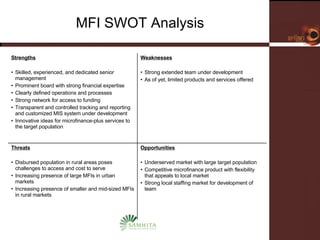
MFI SWOT Analysis Strengths Skilled, experienced, and dedicated senior management Prominent board with strong financial expertise Clearly defined operations and processes Strong network for access to funding Transparent and controlled tracking and reporting and customized MIS system under development Innovative ideas for microfinance-plus services to the target population Weaknesses Strong extended team under development As of yet, limited products and services offered Threats Disbursed population in rural areas poses challenges to access and cost to serve Increasing presence of large MFIs in urban markets Increasing presence of smaller and mid-sized MFIs in rural markets Opportunities Underserved market with large target population Competitive microfinance product with flexibility that appeals to local market Strong local staffing market for development of team
Competition Competitors  Large players expanding nationally (e.g., SKS, SHARE, Spandana)  Downscaling banks and financial institutions (e.g., Fullerton) Smaller and mid-sized regional MFIs Government banks offering loans  Retailers, Telecom service providers [potential] Competitive Assessment  Scale of bigger competitors allows for  Ease of access to capital and human resources  Defined and scalable processes and operations Capacity to saturate new market rapidly Product offerings across competitors Limited differentiation on microfinance product offerings Some insurance services offered also with limited differentiation Little to no micro enterprise Service Little differentiation on customer service between market players (potential opportunity for differentiation)
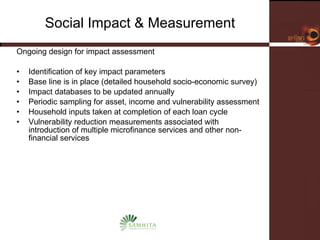
Social Impact & Measurement Ongoing design for impact assessment Identification of key impact parameters Base line is in place (detailed household socio-economic survey) Impact databases to be updated annually Periodic sampling for asset, income and vulnerability assessment Household inputs taken at completion of each loan cycle Vulnerability reduction measurements associated with introduction of multiple microfinance services and other non-financial services
Financial Analysis
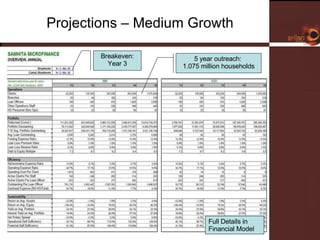
Projections – Medium Growth Please insert  your logo here 5 year outreach:  1.075 million households Breakeven: Year 3 Full Details in Financial Model
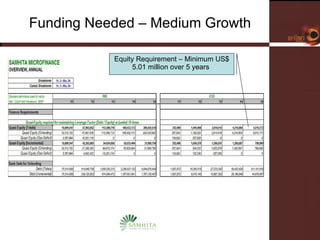
Funding Needed – Medium Growth Equity Requirement – Minimum US$ 5.01 million over 5 years
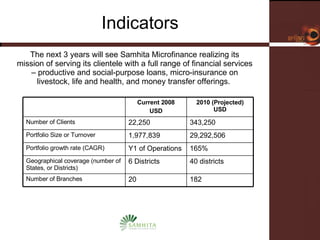
Indicators The next 3 years will see Samhita Microfinance realizing its mission of serving its clientele with a full range of financial services – productive and social-purpose loans, micro-insurance on livestock, life and health, and money transfer offerings.  Current 2008 USD 2010 (Projected) USD Number of Clients 22,250 343,250 Portfolio Size or Turnover 1,977,839 29,292,506 Portfolio growth rate (CAGR) Y1 of Operations 165% Geographical coverage (number of States, or Districts) 6 Districts 40 districts Number of Branches 20 182
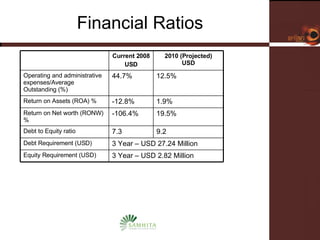
Financial Ratios Current 2008 USD 2010 (Projected) USD Operating and administrative expenses/Average Outstanding (%) 44.7% 12.5% Return on Assets (ROA) % -12.8% 1.9% Return on Net worth (RONW) % -106.4% 19.5% Debt to Equity ratio 7.3 9.2 Debt Requirement (USD) 3 Year – USD 27.24 Million Equity Requirement (USD) 3 Year – USD 2.82 Million
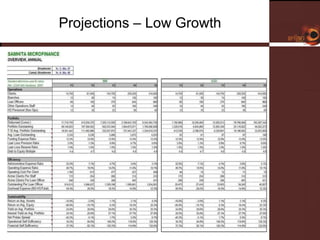
Projections – Low Growth
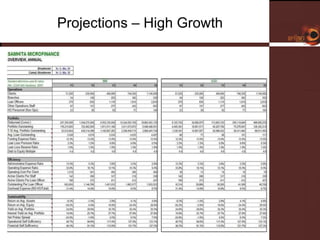
Projections – High Growth
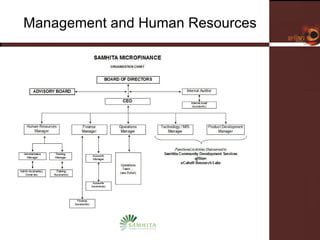
Management and Human Resources
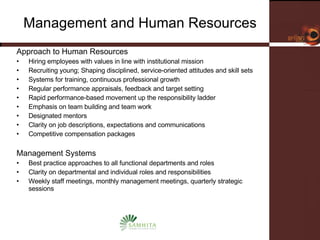
Management and Human Resources Approach to Human Resources Hiring employees with values in line with institutional mission Recruiting young; Shaping disciplined, service-oriented attitudes and skill sets Systems for training, continuous professional growth Regular performance appraisals, feedback and target setting Rapid performance-based movement up the responsibility ladder Emphasis on team building and team work  Designated mentors Clarity on job descriptions, expectations and communications Competitive compensation packages Management Systems Best practice approaches to all functional departments and roles Clarity on departmental and individual roles and responsibilities Weekly staff meetings, monthly management meetings, quarterly strategic sessions
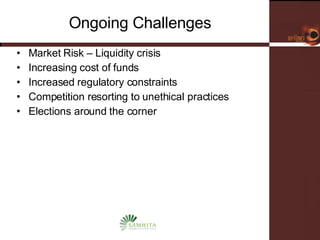
Ongoing Challenges Market Risk – Liquidity crisis Increasing cost of funds Increased regulatory constraints Competition resorting to unethical practices Elections around the corner
Micro-Enterprise ME - The 2 nd  stage economic intervention Activities that are natural to local communities Building on demand / supply aggregations with value-adds Samhita provides initial management guidance, capital and technology Community participation initially as wage labor, transitioning into ownership Serves to hold together local communities, develop local capacity, and provide exposure to global developments, communities and markets Exploratory stage project Production of goat cheese as a livelihood option for the tribal community members Discussions ongoing with interested European partner for goat cheese technologies and markets
Primary Health Initiative 3 phase delivery of primary health services Phase I - Promotional Multimedia Participatory Health Education Nutrition Intervention Phase II – Revenues based services Low-intensive distributed investigative services Ambulance services Phase III – Revenue based service delivery Network of Community Health Workers & Trained Birth Attendants, with low-cost bulk medicine distribution Training, Certification, Monitoring and Support Services Referral services with secondary and tertiary care hospitals Mobile clinics Tele-medicine and innovative health technologies
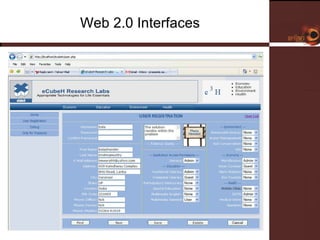
Technology eCubeH Research Labs Appropriate Technologies for Life Essentials eCubeH is the Network Technology Partner Common Appropriate Technology Platform TM Web 2.0 Technologies – Collaborative, Participative, Responsive, Rich Multi-Media Complete platform built on LAMP stack / FOSS Full range of web-based back-office applications for microfinance and primary health Mobile - Secure multimedia applications for microfinance and primary health Distributed, synchronized, intelligent servers – information on demand Regional capacity building for solution development
Microfinance Applications Microfinance Technology Solutions being designed Portfolio Nautilus Bean Counter Accounts Insurance Traction Swift Mobility Transfers Morning Performance Monitors Risk Management Analytics Equalizer Mobile Rich Media Interface <Example – Using mobile instrument multimedia capabilities> Multimedia clips promoting new microfinance products Soliciting video customer feedback on new products Visual transmissions as a security measure Recording and forwarding patient images for health referrals Collaborative member activities across distributed facilities Immediate Timeline Portfolio Nautilus development begins September 2008 First prototype by December 2008
Web 2.0 Interfaces
In Conclusion 3 cornerstones of Samhita’s approach Economic Initiatives (Microfinance and Micro-Enterprise) Network Partner - Primary Health Service Delivery Network Partner – Technology Affiliate for service efficiency and product innovations Samhita Microfinance has set up its foundation with parallel rural and urban operations. In its first 6 months of operations, Over 3,600 households with Rs. 1.8 crore portfolio. Getting ready for first phase of rapid expansion Samhita expects to roll out its first micro-enterprise initiative, in coming months. Samhita has experienced leadership in place, and continues to build a well-knit, capable, motivated and committed team. Samhita’s multi-dimensional approach should yield unique advantages in a competitive market in terms of price, efficiency and product offerings.
Thank You Praseeda Kunam [email_address] Samhita Community Development Services 2/16/504, Nehru Nagar Rewa, MP 500026, India [email_address] Ph: (07662) 406101

Samhita

  • 1.
    SAMHITA MICROFINANCE PraseedaKunam Srijan Microfinance Business Plan Competition Final Round Presentations, July 3 rd , 2008 Economic Initiatives for Life Essentials
  • 2.
    Overview Entrepreneurs’ profilesBusiness Proposition Financial Analysis Management and Human Resources
  • 3.
    Entrepreneurs’ Profiles PraseedaKunam MBA & MIM from Washington University, St. Louis Managed ABN AMRO Foundation’s capacity building initiative for start-up MFIs in underserved regions (Jan 2006 – May 2007) Managed operations for SKS Microfinance (2003-2005) Bala Krishnamurthy 10 years US investment industry experience McKinsey & Company (Chicago) Zacks Investment Research (Chicago) Wellington Management Company (Boston) Architect of technology solutions at SKS Microfinance, Cashpor-India and RKMHOS Multimedia Health Promotion University of Chicago, MBA (Finance); Virginia Tech, MS (Computer Science); IIT Delhi, BTech (Mech. Engg.)
  • 4.
  • 5.
    Areas of OperationMadhya Pradesh The heart of India
  • 6.
    The Identified ProblemMadhya Pradesh is one of the poorest states of India Poverty rate estimated at 37% (vs. India average of 27%) Population of over 20 million poor in MP alone Ranked extremely low in the areas of nutrition, primary health, education and essential infrastructure 90% of rural population associated with agriculture – mostly rain-fed irrigation 25% of cities fall under slums (vs. All-India 14%) Women’s literacy 50% (rural women close to 43%) Infant mortality 70 per 1000 (vs. All-India 57) Population density 196 / sq. km (vs. All-India 324, and UP 689) Forested / Tribal state – Naturally difficult to deliver services A market in critical need for provision of microfinance, education and primary health services
  • 7.
    Solution through SamhitaMicrofinance Samhita Microfinance is the microfinance initiative of its parent, Samhita Community Development Services [SCDS]. 3 Cornerstones of the SCDS broader strategy Common Appropriate Technology Platform Generate service efficiencies, cost reduction and product innovation through technology. In-house, live, responsive common solutions to multiple developmental needs. Network affiliate eCubeH Research Labs is the technology partner. Economic Initiatives Provision of capital for small enterprises Undertaking livelihood projects to further increase income from the small enterprises Primary Health Initiatives Begin with multimedia health education. Revenue-based self-managed health service network. Tele-medicine
  • 8.
    Starting with EconomicServices Every interaction on the field highlights the highest priority of poor households – the need for livelihood opportunity. Samhita’s strategy is to launch economic services to the target population first. The established distribution channel will be used for later delivery of non-financial services The Microfinance program has been launched and is scaling rapidly Parallel rural and urban operations Business plans for the first Micro Enterprise programs are under development
  • 9.
    Target Market andCustomer Base Target Customer – Rural Average annual income under Rs. 20-24k (under $1 PPP) Mostly landless Primarily agricultural wage laborers Limited livelihood opportunities Loan usage mostly for goats, cows, petty stores From households with migrant family members Most customers have not engaged in microfinance before and require training Target Customer – Urban Average annual income under Rs. 60k Many own government granted housing in slums Largely migrant population from rural areas Women primarily employed as domestic labor Men primarily employed as street vendors, some laborers Loan usage mostly working capital for small vendors Cash flow is variable and requires flexibility in loan product
  • 10.
    Microfinance Methodology ModelAdaptation of Grameen / ASA models Joint Liability Groups Training Group Recognition Test Center Meetings Loan Proposals / Appraisals / Disbursement Loan Follow-ups Target Market Exclusive Targeting - Women of Poor Households Samhita Poverty Assessment Score [SPAS] mechanism More conservative than international USD1 PPP cutoff Factors housing quality, land and animal holdings, other assets, stability of income sources, family size, and access to basic services
  • 11.
    Product Offerings A.Productive Loans Amounts: Rs. 1,000 to 12,000 Tenor: 50 weeks, 25 weeks, 13 weeks B. Social Loans (client demand-driven; being introduced) Education Loans Amounts: Rs. 1,000 to 4,000 Tenor: 13 weeks Prior-Debt Retirement Loans Amounts: Rs. 1,000 to 6,000 Tenor: 50 weeks, 25 weeks, 13 weeks Cost to Client Rural: 1% LPF, 15% flat Urban: 2% LPF, 12.5% flat Competitive in the market
  • 12.
    Current Microfinance Performance8 5 3 Branches 19,501,000 9,650,000 9,851,000 Cumulative Disbursement (INR) 15,484,432 7,263,980 8,220,452 Loan Outstanding (INR) 239 120 119 Loan Centers 137 95 42 Villages/Slums 3,054 1,544 1,510 Loan Clients 3,606 1,841 1,765 Members Consolidated Rural Urban (6 months of operations) As of June 30, 2008
  • 13.
    MFI SWOT AnalysisStrengths Skilled, experienced, and dedicated senior management Prominent board with strong financial expertise Clearly defined operations and processes Strong network for access to funding Transparent and controlled tracking and reporting and customized MIS system under development Innovative ideas for microfinance-plus services to the target population Weaknesses Strong extended team under development As of yet, limited products and services offered Threats Disbursed population in rural areas poses challenges to access and cost to serve Increasing presence of large MFIs in urban markets Increasing presence of smaller and mid-sized MFIs in rural markets Opportunities Underserved market with large target population Competitive microfinance product with flexibility that appeals to local market Strong local staffing market for development of team
  • 14.
    Competition Competitors Large players expanding nationally (e.g., SKS, SHARE, Spandana) Downscaling banks and financial institutions (e.g., Fullerton) Smaller and mid-sized regional MFIs Government banks offering loans Retailers, Telecom service providers [potential] Competitive Assessment Scale of bigger competitors allows for Ease of access to capital and human resources Defined and scalable processes and operations Capacity to saturate new market rapidly Product offerings across competitors Limited differentiation on microfinance product offerings Some insurance services offered also with limited differentiation Little to no micro enterprise Service Little differentiation on customer service between market players (potential opportunity for differentiation)
  • 15.
    Social Impact &Measurement Ongoing design for impact assessment Identification of key impact parameters Base line is in place (detailed household socio-economic survey) Impact databases to be updated annually Periodic sampling for asset, income and vulnerability assessment Household inputs taken at completion of each loan cycle Vulnerability reduction measurements associated with introduction of multiple microfinance services and other non-financial services
  • 16.
  • 17.
    Projections – MediumGrowth Please insert your logo here 5 year outreach: 1.075 million households Breakeven: Year 3 Full Details in Financial Model
  • 18.
    Funding Needed –Medium Growth Equity Requirement – Minimum US$ 5.01 million over 5 years
  • 19.
    Indicators The next3 years will see Samhita Microfinance realizing its mission of serving its clientele with a full range of financial services – productive and social-purpose loans, micro-insurance on livestock, life and health, and money transfer offerings. Current 2008 USD 2010 (Projected) USD Number of Clients 22,250 343,250 Portfolio Size or Turnover 1,977,839 29,292,506 Portfolio growth rate (CAGR) Y1 of Operations 165% Geographical coverage (number of States, or Districts) 6 Districts 40 districts Number of Branches 20 182
  • 20.
    Financial Ratios Current2008 USD 2010 (Projected) USD Operating and administrative expenses/Average Outstanding (%) 44.7% 12.5% Return on Assets (ROA) % -12.8% 1.9% Return on Net worth (RONW) % -106.4% 19.5% Debt to Equity ratio 7.3 9.2 Debt Requirement (USD) 3 Year – USD 27.24 Million Equity Requirement (USD) 3 Year – USD 2.82 Million
  • 21.
  • 22.
  • 23.
  • 24.
  • 25.
    Management and HumanResources Approach to Human Resources Hiring employees with values in line with institutional mission Recruiting young; Shaping disciplined, service-oriented attitudes and skill sets Systems for training, continuous professional growth Regular performance appraisals, feedback and target setting Rapid performance-based movement up the responsibility ladder Emphasis on team building and team work Designated mentors Clarity on job descriptions, expectations and communications Competitive compensation packages Management Systems Best practice approaches to all functional departments and roles Clarity on departmental and individual roles and responsibilities Weekly staff meetings, monthly management meetings, quarterly strategic sessions
  • 26.
    Ongoing Challenges MarketRisk – Liquidity crisis Increasing cost of funds Increased regulatory constraints Competition resorting to unethical practices Elections around the corner
  • 27.
    Micro-Enterprise ME -The 2 nd stage economic intervention Activities that are natural to local communities Building on demand / supply aggregations with value-adds Samhita provides initial management guidance, capital and technology Community participation initially as wage labor, transitioning into ownership Serves to hold together local communities, develop local capacity, and provide exposure to global developments, communities and markets Exploratory stage project Production of goat cheese as a livelihood option for the tribal community members Discussions ongoing with interested European partner for goat cheese technologies and markets
  • 28.
    Primary Health Initiative3 phase delivery of primary health services Phase I - Promotional Multimedia Participatory Health Education Nutrition Intervention Phase II – Revenues based services Low-intensive distributed investigative services Ambulance services Phase III – Revenue based service delivery Network of Community Health Workers & Trained Birth Attendants, with low-cost bulk medicine distribution Training, Certification, Monitoring and Support Services Referral services with secondary and tertiary care hospitals Mobile clinics Tele-medicine and innovative health technologies
  • 29.
    Technology eCubeH ResearchLabs Appropriate Technologies for Life Essentials eCubeH is the Network Technology Partner Common Appropriate Technology Platform TM Web 2.0 Technologies – Collaborative, Participative, Responsive, Rich Multi-Media Complete platform built on LAMP stack / FOSS Full range of web-based back-office applications for microfinance and primary health Mobile - Secure multimedia applications for microfinance and primary health Distributed, synchronized, intelligent servers – information on demand Regional capacity building for solution development
  • 30.
    Microfinance Applications MicrofinanceTechnology Solutions being designed Portfolio Nautilus Bean Counter Accounts Insurance Traction Swift Mobility Transfers Morning Performance Monitors Risk Management Analytics Equalizer Mobile Rich Media Interface <Example – Using mobile instrument multimedia capabilities> Multimedia clips promoting new microfinance products Soliciting video customer feedback on new products Visual transmissions as a security measure Recording and forwarding patient images for health referrals Collaborative member activities across distributed facilities Immediate Timeline Portfolio Nautilus development begins September 2008 First prototype by December 2008
  • 31.
  • 32.
    In Conclusion 3cornerstones of Samhita’s approach Economic Initiatives (Microfinance and Micro-Enterprise) Network Partner - Primary Health Service Delivery Network Partner – Technology Affiliate for service efficiency and product innovations Samhita Microfinance has set up its foundation with parallel rural and urban operations. In its first 6 months of operations, Over 3,600 households with Rs. 1.8 crore portfolio. Getting ready for first phase of rapid expansion Samhita expects to roll out its first micro-enterprise initiative, in coming months. Samhita has experienced leadership in place, and continues to build a well-knit, capable, motivated and committed team. Samhita’s multi-dimensional approach should yield unique advantages in a competitive market in terms of price, efficiency and product offerings.
  • 33.
    Thank You PraseedaKunam [email_address] Samhita Community Development Services 2/16/504, Nehru Nagar Rewa, MP 500026, India [email_address] Ph: (07662) 406101