INTRODUCTION TO THE REPORT 
The present Report has been prepared with the objective of searching for the 
business opportunities for the bank by collecting and analyzing information from 
various sources and making strategies for the same. 
Report has valuable information which has been carefully 
collected and analysis on the same has been made to reach at the appropriate 
conclusion. 
Survey has been done of the various charitable institutes with appropriate 
questionnaire framed with the objective kept in mind. Questions were asked to the 
officials to the various organizations and necessary information was collected as a 
primary source to the subject. Detail study of Foreign Contribution Regulation Act 
1976 is done to have the deep theoretical and practical knowledge of the project. 
Project is to study the requirements of the charitable institutions in the banking 
product which is done by meeting different charitable institutions and asking them 
about their present banker and their needs. A comparison of the banking product 
offered by the Standard Chartered Bank and HDFC Bank is also done by meeting 
the two Banks officials in Delhi region. 
1
1.1 COMPANY PROFILE 
Country India 
Industry Banking 
NSE/BSE Listing NSE Code -532648 
Regd.& corporate office Nehru centre,9th floor, Discovery of India, 
Dr.A.B.Road, worli, Mumbai 400018 Tel:- 
+91(22) 6669 9000 
Northern Regional Corporate Office 48,Nyaya Marg, Chanakyapuri, New Delhi 
110021 Tel:-+91(11) 6656 9000 
Website www.yesbank.in 
Table 1.1 
Company Detail 
Yes Bank, India’s new age private sector Bank is the outcome of the professional 
commitment of its founder Mr. Rana Kapoor supported by his highly competent top 
management team to establish a high quality, customer centric, service driven, 
private Indian Bank catering to the “Future Industries of India”. 
Yes Bank has adopted international best practices, the highest standards of service 
quality and operational excellence, and offers comprehensive banking and financial 
solutions to all its valued customers. A key strength and differentiating feature of 
Yes Bank is its knowledge driven approach to banking and an unprecedented 
customer experience for its retail and wealth management clients. 
Yes Bank is steadily building corporate and institutional banking, financial markets, 
investment banking, corporate finance, business (Small &Medium Enterprises) and 
2
transaction banking, international banking, retail banking and wealth management 
business lines across the country. The Bank’s constant endeavour is to provide a 
delightful banking experience expressed with simplicity, empathy, and totality. 
Yes Bank understands the financial needs of the Government of India, in its 
progress and development role of a ‘Growing India’ through Yes Bank’s 
Knowledge Banking approach and the objective of being the “Bank for an Emerging 
India”. Yes Bank remains committed to serving this specialized segment. Yes 
Bank’s knowledge Banker’s deliver innovative, structured and comprehensive 
solutions through a “Money Doctor” approach focusing on diagnostic and 
prescriptive attention to detail. This is facilitated through Yes Bank’s Technology 
leadership –delivering proven, easy-to-use solutions for Government Undertakings 
and agencies. Yes Bank has provided financial and advisory services to Ministries 
of the Union Government, State Governments, Central and State Public Sector 
Undertakings (PSU’s) and Agencies. 
In a short span of over three and a half years the Government Relationship 
Management (GRM) team has developed robust relationships with over 100 entities. 
The GRM team is committed to the core values of client orientation, innovation and 
superior service experience that exemplify all Businesses at Yes Bank. GRM team is 
providing the Knowledge Advisory, Liquidity Management and Investment 
Products, Transaction Banking, trade finances, cash management services, Treasury 
services, Forex Remittances, debt capital markets, investment managements, 
corporate salary accounts, Advisory structured transactions, term loans, and cash 
credit limits to various government operations like IFFCO, SAIL, Airport Authority 
of India, IOCL, NDPL, HPCL, Bridge & Roof co.(India) ltd and many more. 
3
1.1.1Business Strategy 
Knowledge Banking: - 
One of the strengths and differentiating features of Yes Bank is its knowledge 
banking approach that is the essence of all offerings to its customers. Knowledge 
has been institutionalized as a key ingredient in all internal and external processes 
and utilized to create customized solutions for the clients’ specific requirements. 
Technology and Operations: - 
As a new generation Bank, Yes Bank has the advantage of accessing the latest 
available technology. The Bank has taken a calibrated decision to invest in the best 
IT system and practices in order to make its technology platform a strategic business 
tool for building a competitive advantage. 
Responsible Banking: - 
Yes Bank has a vision to champion ‘Responsible Banking’ in India, where the 
concepts of Corporate Social Responsibility (‘CSR’) and sustainability are 
integrated in its Business focus. 
Business Lines: - 
Yes Bank has four distinct business segments to effectively service the 
differentiated needs of its targeted customers. 
Corporate and Institutional Banking (C&IB): - 
4
To cater to the needs of large corporate & institutional clients, MNC’s, government 
companies and PSU’s. Bank targets C&IB customers through its multifunctional 
branches in the key metropolitican cities. 
Emerging Corporate Banking (ECB) : - 
It is dedicated to partner with growth-focused, fast-paced enterprises, which are 
emerging as a leader in their respective business areas. 
Business Banking : - 
To cater to the needs of the small and medium enterprises (SME), Yes Bank has set 
up a dedicated business unit to focus on delivering superior banking solutions 
specially designed to meet the varying and dynamic needs of its SME clients. 
5
Retail Banking and Wealth Management : - 
The Bank intends to develop Retail Banking into a key value driver. Yes Bank 
offers its customers choice & convenience, reflected in its branch layout & design, 
product feature /design, options of distribution channels and superior technology 
enabled service quality. Yes Bank predominantly offers value added retail liability 
and third party wealth management products as well as retail asset offerings through 
its sales and service network linked to its branches. 
6
Private Banking : - 
Yes Bank is focusing on personalized relationship banking for its top end High Net 
worth customers, supported by structured financial solutions tailor-made to suit the 
needs of such customers. 
Product lines: - 
Yes Bank offers a wide range of fee-based products to corporate and business 
banking customers to ensure a high degree of cross-sell to clients. 
Financial Markets : - 
Yes Bank financial markets was ranked second in the ‘Best for currency strategy’ 
and ‘best for technical analysis’ categories at the Asia Money 2005 foreign 
exchange poll for India. 
Transaction Banking : - 
Yes Bank Transaction banking group has adopted a consultative approach and focus 
on knowledge and relationship banking to enable customers to address strategic 
financial and operating needs in the domain of: 
7
· Working capital and liquidity management 
· Asset management 
· Treasury integration 
· Exposure and risk management 
Yes Bank proposes to apply industry knowledge and superior technology for 
offering innovative structured solutions integral to a company’s financial supply 
chain. 
8
Yes International Banking : - 
It offers a complete suite of international banking products and services, driven by 
state-of-the art technology, which includes Debt, Trade finance, corporate finance, 
Investment banking and business advisory services, treasury and global Indian 
banking. The Bank also plans to leverage its international presence, for its capital 
raising activities. These services will initially be through partnerships with 
international banks and financial institutions followed by the establishments of 
branches and representative offices, as per regulatory approvals. 
Brand Creation : - 
9
The Bank believes that its differentiation begins with its service and trust mark 
’YES’. ‘YES’ represents the bank true spirit of being service-oriented. The ‘YES’ 
brand creation effort is supported by ‘Triton Communications’, the principal 
advertising agency and ‘Ad factors PR’, the Bank’s public relation consultant. 
1.1.2 Key Members of Yes Bank Management Team 
NAME DESIGNATION 
Mr. Rana Kapoor Managing Director & CEO 
Mr. Sunil Gulati Group President - C&IB, Transaction 
Banking 
Mr. Deepak Gaddhyan Group President GRM Team. 
10
Mr. Sumit Gupta Country Head – Emerging Corporate 
Banking 
Mr. Alok Gupta Country Head – life sciences & 
technology 
Mr. Rajnish Datta Country Head –Small business banking 
group 
Mr. Subir Bisht Chief Risk Officer 
Mr. Sanjay Aggarwal Country Head –Credit Risk, Business 
Banking 
Mr. Varun Tuli President Business Banking 
Table (1.2) 
Management Team 
1.1.3 Key Highlights & Milestones of Yes Bank. 
Nov 2003 Incorporation of YES BANK Limited 
May 2004 RBI License to commence banking 
business 
11
Dec 2006 Ranked No.3 in the Business World 
Survey of India’s Best listed Banks 
Mar 2007 Ranked No.2 among New Private Sector 
Banks in the Financial Express survey 
Dec 2007 Won ‘Best CSR practice award 2007’ 
Dec 2007 Won ‘IT people award 2007’ 
Jan 2008 60 operational branches across India 
Mar 2008 Ranked No.3 among New Private Sector 
Banks in the Financial Express-E&Y 
survey & overall #1 on credit quality & 
#2 on Growth 
Apr 2008 67 operational branches across India 
Table (1.3) 
Milestones 
1.2 INTRODUCTION TO THE TOPIC 
An Overview to the Foreign Contribution (Regulation) Act 
FCRA 1976. 
12
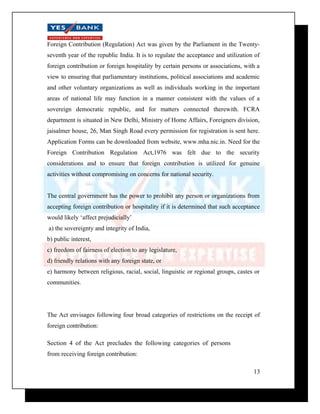
Foreign Contribution (Regulation) Act was given by the Parliament in the Twenty-seventh 
year of the republic India. It is to regulate the acceptance and utilization of 
foreign contribution or foreign hospitality by certain persons or associations, with a 
view to ensuring that parliamentary institutions, political associations and academic 
and other voluntary organizations as well as individuals working in the important 
areas of national life may function in a manner consistent with the values of a 
sovereign democratic republic, and for matters connected therewith. FCRA 
department is situated in New Delhi, Ministry of Home Affairs, Foreigners division, 
jaisalmer house, 26, Man Singh Road every permission for registration is sent here. 
Application Forms can be downloaded from website, www.mha.nic.in. Need for the 
Foreign Contribution Regulation Act,1976 was felt due to the security 
considerations and to ensure that foreign contribution is utilized for genuine 
activities without compromising on concerns for national security. 
The central government has the power to prohibit any person or organizations from 
accepting foreign contribution or hospitality if it is determined that such acceptance 
would likely ‘affect prejudicially’ 
a) the sovereignty and integrity of India, 
b) public interest, 
c) freedom of fairness of election to any legislature, 
d) friendly relations with any foreign state, or 
e) harmony between religious, racial, social, linguistic or regional groups, castes or 
communities. 
The Act envisages following four broad categories of restrictions on the receipt of 
foreign contribution: 
Section 4 of the Act precludes the following categories of persons 
from receiving foreign contribution: 
13
(a) candidates for election, 
(b) correspondents, columnists, cartoonists, editors, owners, printers or 
publishers of the registered newspapers, 
(c) Judges, Government servants or employees of any 
Corporation, 
(d) members of any legislature, 
(e) political parties or office-bearers thereof. 
Section 5 of the Act provides that no organization of political nature shall 
accept any foreign contribution without the prior permission of the 
Central Government. Such organizations are not permitted to receive 
any foreign fund since they are essentially involved in political 
activities. However, these organizations, which are notified in the 
official Gazette, can receive foreign contribution with the prior 
approval of the Central Government. 
Registration and permission 
An association having a definite cultural, economic, educational, religious or social 
programme can receive foreign contribution after it obtains either 
· The prior permission of the central Government, or 
· Gets it self registered with the central Government. 
Prior permission 
Prior permission is required 
· Where the association does not have a FCRA registration , 
· Where the association is kept under prior permission category, 
14
· Where registration is frozen 
· Association of political nature not being political party. 
Accounts 
In the Act it is mentioned that registered associations may only receive foreign 
contribution in a single account of a specified Bank branch. 
Every association so registered shall give within such time & in such manner as may 
be prescribed, intimation to the central government as to the amount of each foreign 
contribution received by it. 
A separate set of accounts and records shall be maintained, exclusively for foreign 
contribution received and utilized. Every account shall be maintained on a yearly 
basis duly certified by a chartered accountant along with a balance sheet & 
statement of receipt& payment account to MHA. 
Foreign Hospitality 
The Act regulates receipt and utilization of foreign hospitality by certain individuals 
which includes members of legislature, office-bearers of political party, judges, 
government servants, employees of Corporation, while visiting any foreign country 
or territory outside India. Such individuals can receive foreign hospitality only with 
the prior permission of the Central Government. Prior permission is not required 
when such individuals are required to receive any emergent medical aid needed on 
account of sudden illness contracted during foreign visit, but, they are mandated to 
intimate the Central Government within one month from the date of such foreign 
visit/receipt of foreign hospitality. The intimation shall include the source from 
which and the manner in 
which such hospitality was availed by the recipient. Foreign hospitality includes 
cost of travel, boarding, lodging, free transportation, free medical treatment, etc. 
15
Over 34,035 associations have been registered under FCRA as on 28th February, 
2007 to receive and utilize foreign contribution. These associations are broadly 
divided into 5 categories viz. Religious, Cultural, Economic, Educational & Social. 
Many of these associations are simultaneously engaged in activities falling within 
two or more categories. 
No bank should credit any foreign contribution to the account of an 
association/NGO unless it produces documentary evidence of having obtained 
registration/prior permission from the Central Government for the same. In case any 
foreign contribution is credited to the account of an NGO/Association/Trust directly, 
the bank should not allow utilization of such fund and inform the 
NGO/Association/Trust concerned to obtain necessary permission/registration from 
the Central Government for the same. Simultaneously, the bank should inform the 
Deputy Secretary (FCRA), Ministry of Home Affairs, Govt. of India, New Delhi 
about such receipt. Non-compliance of the above by the bank will constitute a 
violation and will render the defaulting bank liable for appropriate action by the 
Reserve Bank of India. 
Monitoring of utilization of foreign contribution 
The primary purpose of Foreign Contribution (Regulation) Act, 1976 is to ensure 
that the foreign contribution that is received for specific tasks is not misused for 
activities detrimental to national interest. The associations registered under FCRA 
and those granted prior permission, are required to submit audited FC-3 returns to 
MHA within 4 months of close of the financial year. The information pertains to 
details of receipt and utilization of foreign funds along with corresponding 
Balance Sheets, Income & Expenditure Account, Receipts & Payments Account, 
Schedule of Assets created out of foreign contribution etc. A certificate from a 
Chartered Accountant that the accounts of the association have been maintained as 
prescribed by the Foreign Contribution (Regulation) Act, 1976, is mandatory. The 
16
accounts are required to be authenticated by the Chartered Accountant. 
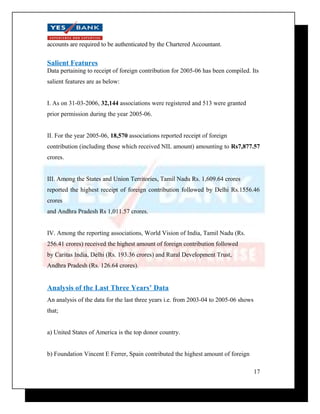
Salient Features 
Data pertaining to receipt of foreign contribution for 2005-06 has been compiled. Its 
salient features are as below: 
I. As on 31-03-2006, 32,144 associations were registered and 513 were granted 
prior permission during the year 2005-06. 
II. For the year 2005-06, 18,570 associations reported receipt of foreign 
contribution (including those which received NIL amount) amounting to Rs7,877.57 
crores. 
III. Among the States and Union Territories, Tamil Nadu Rs. 1,609.64 crores 
reported the highest receipt of foreign contribution followed by Delhi Rs.1556.46 
crores 
and Andhra Pradesh Rs 1,011.57 crores. 
IV. Among the reporting associations, World Vision of India, Tamil Nadu (Rs. 
256.41 crores) received the highest amount of foreign contribution followed 
by Caritas India, Delhi (Rs. 193.36 crores) and Rural Development Trust, 
Andhra Pradesh (Rs. 126.64 crores). 
Analysis of the Last Three Years’ Data 
An analysis of the data for the last three years i.e. from 2003-04 to 2005-06 shows 
that; 
a) United States of America is the top donor country. 
b) Foundation Vincent E Ferrer, Spain contributed the highest amount of foreign 
17
contribution. 
c) Tamilnadu received the highest amount of foreign contribution. 
d) Chennai district received the highest amount of foreign contribution. 
e) World Vision of India, Tamil Nadu received the highest amount of foreign 
contribution. 
f) Among the purposes, the highest amount was received for Establishment 
purposes. 
RECEIPT OF FOREIGN CONTRIBUTION IN INDIA 
Year Amount 
( Rs. in Crores ) 
% Increase over 
previous year 
2001-02 4871.90 7.42 
2002-03 5046.50 3.58 
2003-04 5105.50 1.17 
2004-05 6256.68 22.55 
2005-06 7877.57 25.91 
Table (1.4) 
18
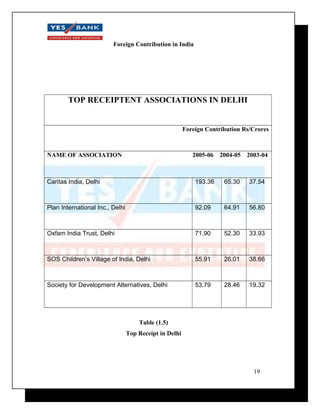
Foreign Contribution in India 
TOP RECEIPTENT ASSOCIATIONS IN DELHI 
Foreign Contribution Rs/Crores 
NAME OF ASSOCIATION 2005-06 2004-05 2003-04 
Caritas India, Delhi 193.36 65.30 37.54 
Plan International Inc., Delhi 92.09 64.91 56.80 
Oxfam India Trust, Delhi 71.90 52.30 33.93 
SOS Children’s Village of India, Delhi 55.91 26.01 38.66 
Society for Development Alternatives, Delhi 53.79 28.46 19.32 
Table (1.5) 
Top Receipt in Delhi 
19
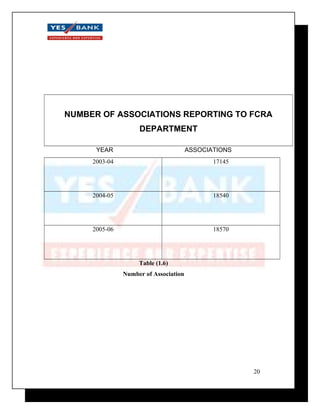
NUMBER OF ASSOCIATIONS REPORTING TO FCRA 
DEPARTMENT 
YEAR ASSOCIATIONS 
2003-04 17145 
2004-05 18540 
2005-06 18570 
Table (1.6) 
Number of Association 
20
FOREIGN FUNDS COMING TO DELHI 
Foreign Contribution Rs/crores 
2003-04 857.12 
2004-05 1075.23 
2005-06 1556.46 
Table (1.7) 
Foreign funds to Delhi 
21
2.1 INDUSTRY PROFILE 
The oldest bank in Indian Banking industry is the “State Bank of India” being 
established as the “Bank of Bengal” in Calcutta in June 1806. The first fully Indian 
owned Bank was the “Allahbad Bank”, which was established in 1865. By the 
1900s, the market expanded with the establishment of Banks such as “Punjab 
National Bank”, in 1895 in Lahore and Bank of India, in 1906, in Mumbai. The 
“Reserve Bank of India” formally took on the responsibility of regulating the Indian 
banking sector from 1935. After India’s independence in 1947, the Reserve Bank 
was nationalized and given broader powers. In the early 1990’s the then Narsimha 
Rao government embarked on a policy of liberalization and gave licenses to a small 
number of private Banks, which came to be known as New Generation tech-savvy 
banks, which included banks such as Global Trust Bank (the first of such generation 
banks to be set up) which later amalgamated with Oriental Bank of Commerce, UTI 
Bank (Now re named as Axis Bank), ICICI Bank and HDFC Bank. This move, 
along with the rapid growth in the economy of India, kick started the Banking sector 
22
in India, which has seen rapid growth with strong contribution from all the three 
sectors of Banks, namely: 
· Government Banks, 
· Private Banks, and 
· Foreign Banks 
The next stage for the Indian Banking has been set up with the proposed relaxation 
in the norms for Foreign Direct Investment (F.D.I.), where all foreign investors in 
banks may be given voting rights which could exceed the present cap of 10%, at 
present it has gone up to 49% with some restrictions. The new policy shocks the 
banking sector in India completely. Bankers, till this time, were used to the 4-6-4 
method (borrowing at 4%; lend at 6%; go home at 4) of functioning. The new wave 
ushered in a modern outlook and tech-savvy methods of working for traditional 
Banks. All this led to boom in India. People just not demanded more from their 
Banks but also received more. 
In March 2006, the Reserve Bank of India allowed Warburg Pincus to increase its 
stake in Kotak Mahindra Bank (a private sector bank) to 10%. This is the first time 
an investor has been allowed to hold more than 5% in the private sector Bank since 
the RBI announced norms in 2005 that any stake exceeding 5% in the private sector 
banks would need to be vetted by them. In (2007), banking in India is generally 
fairly mature in terms of supply, product range and reach-even, though reach in rural 
India still remains a challenge for the private sector and foreign Banks. In terms of 
quality of assets and capital adequacy, Indian Banks are considered to have clean, 
strong and transparent balance sheets relative to other Banks in comparable 
economies in its region. The Reserve Bank of India is an autonomous body, with 
minimal pressure from the government. The stated policy of the Bank on the Indian 
Rupee is to manage volatility but without any fixed exchange rate and this has 
23
mostly been true. With the growth in the 
Indian economy expected to be strong for quite some time especially in its service 
sector-the demand for Banking services, especially retail banking, mortgages and 
investment services are expected to be strong. One may also expect M&A’s, 
takeovers, and asset sales. 
Currently, India has 88 scheduled commercial banks (SCBs) 
- 28 public sector banks (that is with the government of India holding a stake), 
- 29 private banks (these do not have government stake; they may be publicly 
listed and traded on stock exchanges) 
- And 31 foreign banks. 
They have a combined network of over 53,000 branches and 17,000 ATM’s. 
According to a report by ICRA limited, a rating agency, the public sector banks hold 
75% of total assets of the banking industry, with the private and foreign banks 
holding 18.2% and 6.5% respectively. The annual growth in bank credit to the 
commercial sector is at 25.4% as on March 31, 2007 and was lower than 27.2% 
against previous year. Till 2010, retail banking is expected to grow at a CAGR 
(compounded average growth rate) of 28% 
to touch a figure of INR 9,700 billion. This requires expansion and diversification of 
retail product portfolio, better penetration and faster service mechanism. 
The report on Retail Banking industry in India covers industry segments like 
housing loan, auto loan, personal loan, education loan, consumer durable loan, 
credit card and regulatory frame work for retail Banks is also discussed. The report 
gives retail banking industry’s current performance and future outlook. Total 22 
major retail Banks in India are covered in terms of their performance, strategy and 
outlook. In absolute terms, India’s banking sector enjoyed reasonable growth 
24
through the year to December 31 2007. In local currency terms, total assets, total 
loans and total deposits increased by 23%, 21%, and 26%, respectively. The 
loan/deposit, loan/asset ratio fell while the loan/GDP ratio rose. 
2.1.1 State Bank of India (SBI) 
 State Bank of India is the India’s largest Bank. It has largest branch network all over 
the country with its special products like 
· Personal Banking 
25
Deposit Schemes 
Personal Finance 
· Agricultural/Rural Banking 
Micro Credit 
Regional Rural Bank 
· NRI Services 
· International Banking 
Trade Finance 
Merchant Banking 
Correspondent Banking 
· Corporate Banking 
Mid Corporate Group 
Project Finance 
Small & Medium Enterprises (SME’s) 
· Government Business 
Public Provident Fund 
SBI e-Tax 
· Services 
Internet Banking 
Mobile Banking 
The SBI’s powerful corporate banking formation deploys multiple channels to 
deliver integrated solutions for all financial challenges faced by the corporate 
universe. The Corporate Banking group and the National Banking group are the 
primary delivery channels for corporate banking products. The Corporate Banking 
Group consists of dedicated Strategic Business Units that cater exclusively to 
specific client groups or specialize in particular product clusters. Foremost among 
26
these specialized groups is the Corporate Accounts Group (CAG), focusing on the 
prime corporate and institutional clients of the country’s biggest business centers. 
The others are the Project Finance unit and the Leasing Unit. The National Banking 
Group also delivers the entire spectrum of corporate banking products to other 
corporate clients, on a nationwide platform. 
Complete Range of Products and Services 
The SBI offers an exhaustive range of financial products and services that answers 
any business or market circumstance, backed by an assublack expertise in 
customizing the product to meet the most sensitive specificities of each client and 
each business context. 
Its team of highly skilled and experienced product specialists can help its customers 
in forecast structure complex transaction requirements. 
The SBI Edge 
Commanding unsurpassed respect and legacy in the Indian financial expanse, the 
SBI is committed to provide the financial solutions that extract maximum value 
from business and market situations. 
While the Bank is strongly positioned to structure financial packages that anticipate 
the changing business environment, its vast network-the world’s largest-ensures 
delivery channels of unmatched reach, both in India and abroad. 
Working Capital Finance 
SBI offers working capital finance to meet the entire range of short term fund 
requirements that arise within a corporate day to day operational cycle. The SBI 
27
working capital loans help the companies in financing inventories, managing 
internal cash flows, supporting supply chains, funding production, and marketing 
operations, providing cash support to business expansion and carrying current 
assets. 
SBI’s working finance products comprise a spectrum of funded and non-funded 
facilities ranging from cash credit to structured loans, to meet the different demands 
from all segments of industry, trade and the services sector. Funded facilities 
include cash credit, demand loan and bill discounting. Demand loans are considered 
also under the FCNR (B) (Foreign currency from Non Resident) scheme. Non-funded 
instruments comprise letters of credit (inland and overseas) as well as bank 
guarantees (performance and financial) to cover advance payments, bid bonds etc. 
Project Finance 
The SBI has formed a dedicated Project Finance Strategic Business Unit to assess 
credit proposals from and extend term loans for large industrial and infrastructure 
projects. Apart from this, project term loans for medium sized projects and similar 
clients are delivered through the CAG (Corporate Accounts Group) and NBG 
(National Banking group). 
In general, project finance covers Greenfield industrial projects, capacity expansion 
at existing manufacturing units, construction ventures or other infrastructure 
projects. Capital intensive business expansion and diversification as well as 
replacement of equipment may be financed through the project term loans. 
28
Project finance is quite often channeled through special purpose vehicles and 
arranged against the future cash streams to emerge from the project. The loans are 
approved on the basis of strong in house appraisal of the cost and viability of the 
ventures as well as the credit standing of promoters. 
Deferred Payment Guarantee (DPG) 
SBI can extend deferred payment guarantees to industrial projects for obtaining 
imported equipment. The DPG is a standby credit guaranteeing deferred payments, 
usually for payments for capital goods, turnkey contracts etc. 
Corporate Term Loan 
The SBI corporate term loans can support company in funding ongoing business 
expansion, repaying high cost debt, technology up gradation, R&D expenditure, 
leveraging specific cash streams that accrue into the company, implementing early 
retirement schemes and supplementing working capital. Corporate term loans can be 
structured under the FCNR (B) scheme as well, with the option of switching the 
currency denomination at the end of the interest periods. This will help you take 
advantage of global interest rate trends vis-à-vis domestic rates to minimize your 
debt cost. The Bank’s corporate term loans are generally available for tenures from 
three to five years, synchronized with your specific needs. SBI corporate term loans 
can have a bullet or periodic repayment schedule as required by the client. The 
repayment mode may be linked to the cash accruals of the company. The Bank’s 
expert credit crew gauges the applicant’s particular fund requirements and evaluates 
the company’s credit worthiness, factoring in the cash flows generated by it. 
Structured Finance 
SBI structured finance involves assembling unique credit configurations to meet the 
complex fund requirements of large industrial and infrastructure projects. Structured 
finance can be a combination of funded and non-funded facilities as well as other 
29
credit enhancement tools, lease contracts for instance, to fit the multi layer financial 
requirements of large and long-gestation projects. 
Being India’s largest bank and with the rich experience that it brings with it, SBI 
commands formidable expertise in engineering financial packages that address 
complex requirements with minimum risk. Further, SBI has firm relationships 
across the financial map of the world, which can be leveraged to structure solutions 
that may necessitate the participation of several credit agencies. 
Dealer Financing 
SBI extends financial support to the corporate distribution network, by providing 
both working capital finance and term loans to select dealers of identified 
companies. This gives dealers to leverage their business relationship with major 
corporate to avail low cost credit. Also, this type of financial solutions allows the 
corporate negotiate a better price with dealers. Dealer financing may be extended in 
the bill discounting form or simply as cash credit. 
Channel Financing 
Channel financing is an innovative finance mechanism by which the bank meets the 
various fund necessities along customer supply chain at the supplier’s end itself, 
thus helping them sustain a seamless business flow along the arteries of the 
enterprise. Channel finance ensures the immediate realization of sales proceeds for 
the SBI client’s supplier, making it practically a cash sale. On the other hand, the 
corporate gets credit for a duration equaling the tenure of the loan, enabling 
smoother liquidity management. SBI has the world’s largest banking network of 
over 9,000 branches and this enables it to deliver the financial solution at suppliers 
doorstep, across the span of the country. 
Equipment Leasing 
The SBI’s has deployed a dedicated strategic business unit for lease financing that is 
richly experienced in arranging lease contracts for procuring expensive equipment 
30
for clients project or plant. At SBI, lease agreements as stand alone contracts or as 
part of a structured package are arranged. 
Loan Syndication 
The SBI leverages its vast network of relationships to arrange syndicated credit 
products for corporate clients and industrial projects. With its rich experience and 
strong reputation, SBI’s syndication desk can assemble large loan packages 
involving a ring of reputed financial entities, domestic and international, that match 
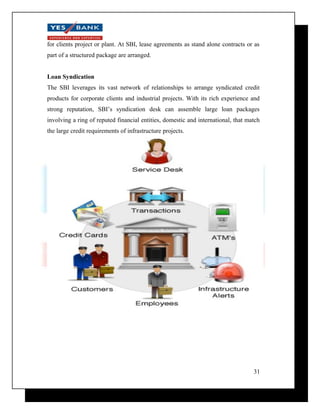
the large credit requirements of infrastructure projects. 
31
32
2.1.2 Industrial Credit& Investment Corporation of India 
ICICI Bank 
ICICI Bank is India’s second largest bank with total assets of Rs.3, 997.95 Billion 
(US$100 billion) at March 31, 2008 and profit after tax of Rs.41.58 billion for the 
year ended March 31, 2008. ICICI Bank is second amongst all the companies listed 
on the Indian stock exchanges in terms of free float market capitalization. The Bank 
has a network of about 1308 branches and 3950 ATMs in India and presence in 18 
countries. ICICI Bank offers a wide range of banking products and financial 
services to corporate and retail customers through a variety of delivery channels and 
through its specialized subsidiaries and affiliates in the areas of Investment banking, 
life and non life insurance, venture capital and asset management. The Bank 
currently has subsidiaries in the United Kingdom, Russia, and Canada, branches in 
United States, Singapore, Bahrain, Hong Kong, Sri Lanka, Qatar and Dubai 
International finance centre and representative offices in United Arab Emirates, 
China, South Africa, Bangladesh, Thailand, Malaysia and Indonesia. UK subsidiary 
has established branches in Belgium and Germany. 
ICICI Bank’s equity shares are listed in India on Bombay Stock Exchange and the 
National Stock Exchange of India Limited and its American Depositary Receipts 
(ADR’s) are listed on the New York Stock Exchange (NYSE). 
ICICI Bank was originally promoted in 1994 by ICICI Limited, an Indian financial 
institution, and was its wholly-owned subsidiary. ICICI’s shareholding in ICICI 
Bank was reduced to 46% through a public offering of shares in India in fiscal 1998, 
33
an equity offering in the form of ADRs listed on the NYSE in fiscal 2000, ICICI 
Bank’s acquisition of Bank of Madura Limited in all stock amalgamation in fiscal 
2001, and secondary market sales by ICICI to institutional investor in fiscal 2001 
and fiscal 2002. ICICI was 
formed to in 1955 at the initiative of the World Bank, the Government of India and 
representatives of Indian Industry. The principal objective was to create a 
development financial institution for providing medium term and long term project 
financing to Indian 
businesses. 
In the 1990s, ICICI transformed its business from a development financial 
institution offering only project finance to a diversified financial services group 
offering a wide range of products and services, both directly and through a number 
of subsidiaries and affiliates like ICICI Bank in 1999, ICICI become the first Indian 
company and the first bank or financial institution from non-Japan Asia to be listed 
on the NYSE. 
After consideration of various corporate structuring alternatives in the context of the 
emerging competitive scenario in the Indian Banking industry, and the move 
towards universal banking, the managements of ICICI and ICICI Bank formed the 
view that the merger of ICICI with ICICI Bank would be the optimal legal structure 
for the ICICI group’s universal banking strategy. The merger would enhance value 
for ICICI shareholders through the merged entity’s access to low cost deposits, 
greater opportunities for earning fee based income and the ability to participate in 
the payment system and provide transaction banking services. The merger would 
enhance value for ICICI Bank shareholders through a large capital base and scale of 
operations, seamless access to ICICI’s strong corporate relationships built up over 
five decades, entry into new business segments, higher market share in various 
business segments, particularly fee-based services, and access to the vast talent pool 
34
of ICICI and its subsidiaries. In October 2001, the boards of directors of ICICI and 
ICICI bank approved the merger of ICICI and two of its wholly-owned retail 
finance subsidiaries, ICICI personal financial services limited and ICICI capital 
services limited with ICICI bank. The merger was approved by shareholders of 
ICICI and ICICI bank in January 2002, by the high court of Gujarat at Ahmedabad 
in March 2002, and by the high court of judicature at Mumbai and the Reserve Bank 
of India in April 2002. Consequent to the merger, the ICICI group’s financing and 
banking operations, both wholesale and retail, have been integrated in a single 
entity. 
35
RESEARCH METHODOLOGY 
Research in general refers to the search of knowledge. One can also define research 
as a scientific & systematic collection of information. 
In simple words research is the careful investigation or enquiry of markets 
especially through search for new facts in any branch of knowledge. 
Analytical Tools 
Microsoft Excel (PivotChart Reports). A PivotChart Report is an 
interactive chart that quickly combines and compares large amounts of 
data from tables in excel. PivotChart report was used here to analyze 
related totals, because there was a long list of figures to sum and there 
was a need to compare several facts about each figure. Because a 
PivotChart report is interactive, it has flexibility to change the 
view of the data to see more details or calculate different 
summaries, such as counts or averages. Drop fields feature was 
extensively used for the report creation. Essentially it is an area in a 
PivotChart report where we can drop fields from the Field List dialog 
box to display the data in the field. 
36
37
3.1 Justification of the Study 
Topic allotted to me for the summer training project completed at YES BANK LTD. 
is related to the knowledge of FCRA act i.e. Foreign Contribution Regulation Act 
1976, as the bank is interested to enter into the segment of FCRA I completed my 
project by three different surveys i.e. FCRA department at Ministry of Home 
Affairs, three different banks, and different charitable institutions. As it was 
interesting topic to be worked upon, I learned a lot of new things during this period 
which will help me in my career. 
38
3.2 OBJECTIVES OF THE STUDY 
Main objective: 
Objective of the study is to look for the banking opportunities in FCRA accounts of 
charitable institutions for the Yes Bank. 
With the increasing number of organizations taking the FCRA registration, Bank is 
interested in having the business with the NGO’s in Delhi and NCR. 
Sub objectives: 
1. Objective of the study aims at the 360 degree knowledge to the target business. It 
includes the MHA (Ministry of Home Affairs), NGO’s and various banks giving 
such type of services to take detail know how and should reach at a decision to be 
taken by the bank after concluding the study. 
2. To operate the FCRA accounts in accordance with the rules and guidelines 
mentioned in the FCRA 1976. 
39
3.3 DATA COLLECTION 
Data can be collected by using two well known methods: Primary & Secondary. In 
primary data collection, you collect the data yourself using methods such as 
interviews and questionnaires. The key point here is that the data you collect is 
unique to you and your research and, until you publish, no one else has access to it. 
There are many methods of collecting primary data and the main methods include: 
· Questionnaires 
· One-to-one interviews 
· Group interviews 
· Observation 
· Case-studies 
· Diaries 
· Critical incidents 
· Portfolios 
Secondary data is data that has already been collected by someone else for a 
different purpose to yours. For example, this could mean using: 
· Data collected by a hotel on its customers through its guest history system 
· Data supplied by a marketing organization 
· Annual company reports 
· Government statistics. 
40
Primary data collection method used for this project. 
I used questionnaire method which is also known as scheduling method for primary 
data collection in the research process. To know the exact details regarding FCRA 
accounts in Banks 360 degree approach is being used as the FCRA department, 
Banks, and NGO’s are surveyed to take the required 
Secondary Data is also used for the purpose of completion of project which includes 
Internet, Centre for policy Research, and FCRA department. 
41
3.4 SAMPLING AND SAMPLING DESIGN 
The procedure by which a few fields are chosen from the data to be studied in such 
as way that the sample can be used to estimate the same characteristics in the total is 
referred to as sampling. 
The advantages of using samples are that it is much less costly, quicker and, if 
selected properly, gives results with known accuracy that can be calculated 
mathematically. Even for relatively small samples, accuracy does not suffer even 
though precision or the amount of detailed information obtained, might. These are 
important considerations, since most research projects have both budget and time 
constraints. 
Sampling process is taking a sample out of the universe population to take a 
decision regarding the population. Instead of surveying the whole population we 
take only a few persons for our topic to have a general idea of the subject related. 
In the project I took a sample of three Banks for a general idea of the FCRA 
accounts and made our study reach a conclusion. 
These three banks are 
1. HDFC BANK 
2. STANDARD CHARTERED 
3. CORPORATION BANK 
42
For the charitable institutions and NGO’s who are reporting to the FCRA 
Department to be studied I took a sample of 11 organizations from the NCR. 
3.5 TIME PERIOD OF STUDY 
June, 9-19, 2008 
Gathering information regarding the Act, Rules, Bill, with help of the secondary 
mediums. 
June, 20-30, 2008 
Meeting FCRA, Ministry of Home Affairs official 
collecting the necessary &current information regarding the Act. 
July, 1-11, 2008 
Visiting various banks like Standard Charted Bank, HDFC Bank, Corporation Bank 
and other banks which offer special services to the charitable institutions in regards 
to FCRA & collecting the necessary details. 
July, 14-29, 2008 
Meeting the officials of various charitable trusts and such institutions who are 
registered with FCRA and having the present banking arrangements. 
43
3.6 AREAS OF STUDY 
Study of the project started from the Regional office of the Bank at 48, Nayaya 
Marg Chanakyapuri New Delhi. Main centre of the study was around the office like 
visiting the FCRA office from the Bank and then meeting the different charitable 
institutions and also the different Banks providing the same services in the area of 
Delhi and NCR. 
Area includes the different parts of New Delhi few of them are 
· Connaught Circus 
· Safdarjung Enclave 
· Janakpuri 
· Ashok palace 
· Bhai Veer Singh Marg 
· Lodhi Road 
44
3.7 LIMITATIONS OF THE STUDY 
1. General survey is more biased: General Survey is more biased because few 
charitable institutions were not ready to give the exact financial details. 
2. Less responsive communication: General Survey was found to be less 
responsive because of the reason that institutions &organizations did not want to 
respond to the questionnaire due to lack of time & non willingness. 
3. Time consuming: The General Survey was time consuming because it take 
time to reach to different charitable institutions & ask them certain related questions 
in there different areas. 
45
1. Foreign receipt in the present year. 
Figure (4.1) 
Percentage of foreign receipt in present 
46
No Foreign Receipt in Present 27% 
Foreign Receipt in Present 73% 
Never received foreign funds 0% 
Table (4.1) 
Percentage of foreign receipt in present 
Interpretation: This pie chart shows that only 27% of the organizations have not 
received any foreign funds in the current year and 73% organizations are receiving 
funds continuously and there is no organization (0%) which has never received any 
foreign fund so far. 
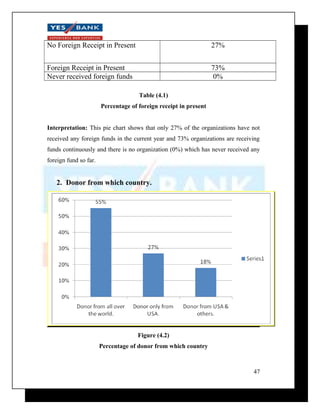
2. Donor from which country. 
Figure (4.2) 
Percentage of donor from which country 
47
Donor from all over the world. 55% 
Donor only from USA. 27% 
Donor from USA & others. 18% 
Table (4.2) 
Percentage of donor from which country 
Interpretation: The figure gives an idea of the sample that 55% of the 
organizations surveyed are receiving funds from all over the world where as the 
27% organizations are having foreign receipts or donations or members sending 
funds to India are only from USA. 18% of the organizations are as such they 
receiving funds from USA & others like UK, Netherlands etc. 
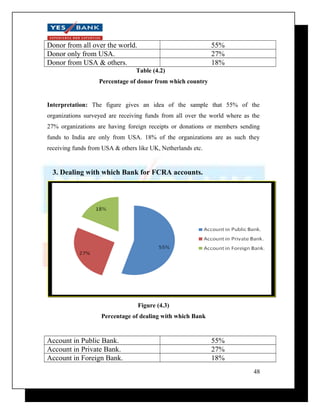
3. Dealing with which Bank for FCRA accounts. 
Figure (4.3) 
Percentage of dealing with which Bank 
Account in Public Bank. 55% 
Account in Private Bank. 27% 
Account in Foreign Bank. 18% 
48
Table: (4.3) 
Percentage of dealing with which Bank 
Interpretation: From the study of various organizations it has been concluded that 
the 55% organizations are dealing with the public sector Banks which include 
Indian overseas Bank, State Bank of Hyderabad, PNB, P&S Bank and 27% 
organizations reported to have their Bank account with the private sector Banks it 
has ICICI Bank, Federal Bank, Catholic Syrian Bank Ltd. Only 18% of the 
organizations are having Bank Account in Foreign Banks which has ABN AMRO, 
American express Bank. 
4. Satisfaction level with present Banker. 
Table (4.4) 
Percentage of satisfaction level 
Poor 9% 
49
Average 9% 
Good 73% 
Excellent 9% 
Table (4.4) 
Percentage of satisfaction level 
Interpretation: From the figure shown above it is clear that most of the 
organizations visited are satisfied with the services of present Banker as the 73% of 
the institutions have marked their Banker as good service provider and 9% each has 
been given to the Poor service, average,& excellent respectively. 
5. Foreign Exchange conversion charges taken by Bank. 
Figure (4.5) 
Percentage of For-Ex Conversion Charges 
No extra charges. 27% 
Charge, but Nominal. 55% 
50
Charge Heavily. 18% 
Table (4.5) 
Percentage of For-Ex Conversion Charges 
Interpretation: Analysis for the foreign exchange charges is shown in the figure 
that 27% of the organizations are not paying any extra charges for the foreign 
receipts in their FCRA accounts, 55% of the organizations are paying the charges 
but they take them as a nominal charge for the transaction, only 18% of the 
organizations are paying heavily on the foreign exchange conversion to the Banks. 
6. More Services desired from the Banking sector. 
Figure (4.6) 
Percentage of services Desired 
Just Satisfied need more. 46% 
Well satisfied. 27% 
51
Desire more benefits. 27% 
Table (4.6) 
Percentage of services Desired 
Interpretation: Most of the Organizations visited report to be just satisfied with the 
services provided by their present banker as the figure reaches up to 46% and also 
they need more from the banking industry. 27% of the institutions reported to be 
well satisfied with their banker, same is the percentage (27%) in the category which 
desires more from the banking sector in their product. 
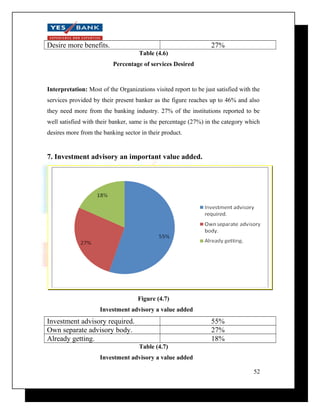
7. Investment advisory an important value added. 
Figure (4.7) 
Investment advisory a value added 
Investment advisory required. 55% 
Own separate advisory body. 27% 
Already getting. 18% 
Table (4.7) 
Investment advisory a value added 
52
Interpretation: Figure above shows about the 55% of the organizations are 
interested in the investment advisory and 27% of the organizations are having their 
own separate body for the purpose of investments, 18% of the organizations are 
already receiving such types of advices. 
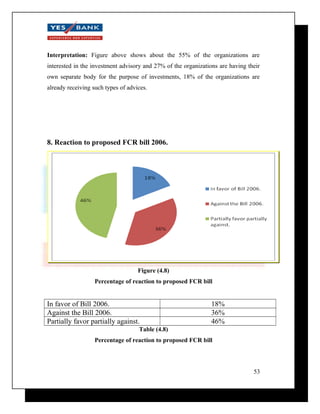
8. Reaction to proposed FCR bill 2006. 
Figure (4.8) 
Percentage of reaction to proposed FCR bill 
In favor of Bill 2006. 18% 
Against the Bill 2006. 36% 
Partially favor partially against. 46% 
Table (4.8) 
Percentage of reaction to proposed FCR bill 
53
Interpretation: A major proportion of the organizations have two sided opinion on 
the FCR Bill 2006 as few of the proposals like multiple bank accounts instead of 
single bank account at present, are good for the organizations but few proposals are 
not favorable for the working of the organizations so it is 46% who are partially 
favoring it and partially opposing it. But 36% of the organizations are totally against 
the Bill, & 18% are in the favor of the Bill they say what government do is fine. 
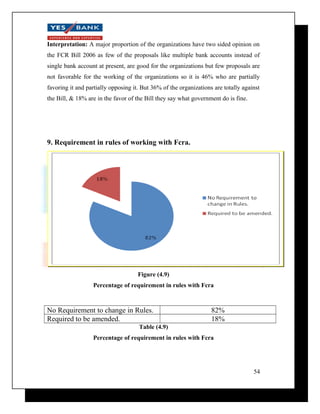
9. Requirement in rules of working with Fcra. 
Figure (4.9) 
Percentage of requirement in rules with Fcra 
No Requirement to change in Rules. 82% 
Required to be amended. 18% 
Table (4.9) 
Percentage of requirement in rules with Fcra 
54
Interpretation: Most of the organizations are well satisfied with the current rules of 
the department as 82% of the organizations do not need any change in rules of 
FCRA only a small proportion i.e. 18% wants to have some amendments in the rules 
of FCRA. 
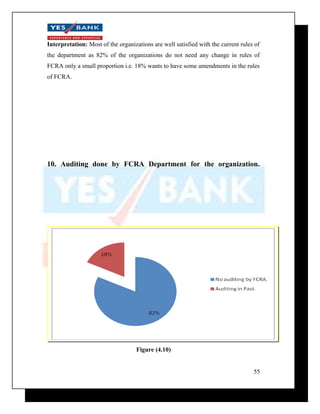
10. Auditing done by FCRA Department for the organization. 
Figure (4.10) 
55
Percentage of auditing done by FCRA Department for organization 
No auditing by FCRA. 82% 
Auditing in Past. 18% 
Table (4.10) 
Percentage of auditing done by FCRA Department for organization 
Interpretation: According to the 82% organizations in the NCR area no auditing is 
done by the FCRA department separately for their organizations, the only thing is 
they file the FC-3 return at the end of each year audited by the certified chartered 
accountant and for the 18% organizations FCRA department has done auditing some 
time in past. 
11. Problem faced in working with FCRA. 
56
Figure (4.11) 
Percentage of problems faced in working with FCRA 
No Problem faced 100% 
Problem Faced 0% 
Table (4.11) 
Percentage of problems faced in working with FCRA 
Interpretation: Survey tells there is no problem in working for the organizations 
with the FCRA department as 100% of the organizations told that there is no 
problem in working as per rules of MHA. 
12. Response level of FCRA department. 
57
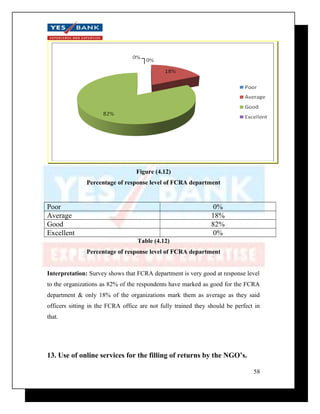
Figure (4.12) 
Percentage of response level of FCRA department 
Poor 0% 
Average 18% 
Good 82% 
Excellent 0% 
Table (4.12) 
Percentage of response level of FCRA department 
Interpretation: Survey shows that FCRA department is very good at response level 
to the organizations as 82% of the respondents have marked as good for the FCRA 
department & only 18% of the organizations mark them as average as they said 
officers sitting in the FCRA office are not fully trained they should be perfect in 
that. 
13. Use of online services for the filling of returns by the NGO’s. 
58
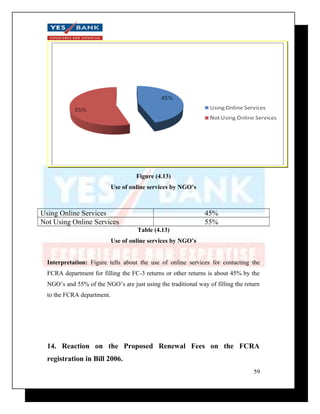
Figure (4.13) 
Use of online services by NGO’s 
Using Online Services 45% 
Not Using Online Services 55% 
Table (4.13) 
Use of online services by NGO’s 
Interpretation: Figure tells about the use of online services for contacting the 
FCRA department for filling the FC-3 returns or other returns is about 45% by the 
NGO’s and 55% of the NGO’s are just using the traditional way of filling the return 
to the FCRA department. 
14. Reaction on the Proposed Renewal Fees on the FCRA 
registration in Bill 2006. 
59
Figure (4.14) 
Reaction on the Proposed Renewal Fees 
Against the Bill. 64% 
Favor the Bill. 9% 
Neutral for Bill. 27% 
Table (4.14) 
Reaction on the Proposed Renewal Fees 
Interpretation: Figure tells about the view point of the organizations towards the 
proposal of renewal fees on the certificate of the FCRA after every five years in 
order to eliminate the organizations from the certification those who are not 
responding to the department regularly, 64% of the organizations are against the 
renewal proposal as they are regularly reporting to the department, 9% are in favor 
as they say whatever government do is alright, 27% of the sample respond that they 
are neutral towards Bill2006. 
5.1 CONCLUSION 
60
On the basis of study it is concluded that going towards the FCRA product will be a 
good move by the bank as there is large number of NGO’s in NCR region which are 
actively performing their projects, as they are receiving foreign funds through 
FCRA accounts in banks then it can be a source of foreign funds for the bank. There 
can be large income source from the float income. All charitable institutions and 
associations in NCR can be targeted with the help of special team to gain more 
business. There is also a benefit of foreign exchange income and conversion charges 
in FCRA accounts. 
VANI (Voluntary Action Network India) is the active NGO forum in NCR, It 
is better to introduce our new product through Forum and target our potential 
customers through this platform. In this forum most of the NGO’s and charitable 
institution are members, in this way Yes Bank can have business with them. 
61
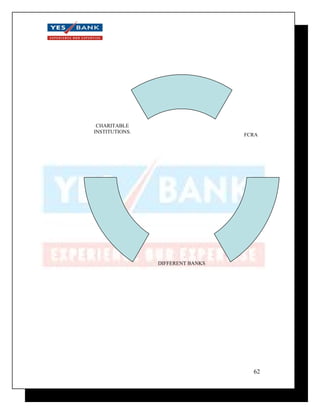
FCRA 
62 
DIFFERENT BANKS 
CHARITABLE 
INSTITUTIONS.
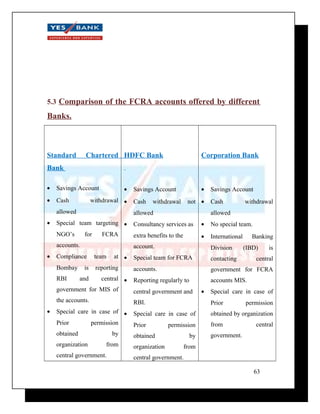
5.3 Comparison of the FCRA accounts offered by different 
Banks. 
Standard Chartered 
Bank 
· Savings Account 
· Cash withdrawal 
allowed 
· Special team targeting 
NGO’s for FCRA 
accounts. 
· Compliance team at 
Bombay is reporting 
RBI and central 
government for MIS of 
the accounts. 
· Special care in case of 
Prior permission 
obtained by 
organization from 
central government. 
HDFC Bank 
· Savings Account 
· Cash withdrawal not 
allowed 
· Consultancy services as 
extra benefits to the 
account. 
· Special team for FCRA 
accounts. 
· Reporting regularly to 
central government and 
RBI. 
· Special care in case of 
Prior permission 
obtained by 
organization from 
central government. 
Corporation Bank 
· Savings Account 
· Cash withdrawal 
allowed 
· No special team. 
· International Banking 
Division (IBD) is 
contacting central 
government for FCRA 
accounts MIS. 
· Special care in case of 
Prior permission 
obtained by organization 
from central 
government. 
63
64

yes bank report

  • 1.
    INTRODUCTION TO THEREPORT The present Report has been prepared with the objective of searching for the business opportunities for the bank by collecting and analyzing information from various sources and making strategies for the same. Report has valuable information which has been carefully collected and analysis on the same has been made to reach at the appropriate conclusion. Survey has been done of the various charitable institutes with appropriate questionnaire framed with the objective kept in mind. Questions were asked to the officials to the various organizations and necessary information was collected as a primary source to the subject. Detail study of Foreign Contribution Regulation Act 1976 is done to have the deep theoretical and practical knowledge of the project. Project is to study the requirements of the charitable institutions in the banking product which is done by meeting different charitable institutions and asking them about their present banker and their needs. A comparison of the banking product offered by the Standard Chartered Bank and HDFC Bank is also done by meeting the two Banks officials in Delhi region. 1
  • 2.
    1.1 COMPANY PROFILE Country India Industry Banking NSE/BSE Listing NSE Code -532648 Regd.& corporate office Nehru centre,9th floor, Discovery of India, Dr.A.B.Road, worli, Mumbai 400018 Tel:- +91(22) 6669 9000 Northern Regional Corporate Office 48,Nyaya Marg, Chanakyapuri, New Delhi 110021 Tel:-+91(11) 6656 9000 Website www.yesbank.in Table 1.1 Company Detail Yes Bank, India’s new age private sector Bank is the outcome of the professional commitment of its founder Mr. Rana Kapoor supported by his highly competent top management team to establish a high quality, customer centric, service driven, private Indian Bank catering to the “Future Industries of India”. Yes Bank has adopted international best practices, the highest standards of service quality and operational excellence, and offers comprehensive banking and financial solutions to all its valued customers. A key strength and differentiating feature of Yes Bank is its knowledge driven approach to banking and an unprecedented customer experience for its retail and wealth management clients. Yes Bank is steadily building corporate and institutional banking, financial markets, investment banking, corporate finance, business (Small &Medium Enterprises) and 2
  • 3.
    transaction banking, internationalbanking, retail banking and wealth management business lines across the country. The Bank’s constant endeavour is to provide a delightful banking experience expressed with simplicity, empathy, and totality. Yes Bank understands the financial needs of the Government of India, in its progress and development role of a ‘Growing India’ through Yes Bank’s Knowledge Banking approach and the objective of being the “Bank for an Emerging India”. Yes Bank remains committed to serving this specialized segment. Yes Bank’s knowledge Banker’s deliver innovative, structured and comprehensive solutions through a “Money Doctor” approach focusing on diagnostic and prescriptive attention to detail. This is facilitated through Yes Bank’s Technology leadership –delivering proven, easy-to-use solutions for Government Undertakings and agencies. Yes Bank has provided financial and advisory services to Ministries of the Union Government, State Governments, Central and State Public Sector Undertakings (PSU’s) and Agencies. In a short span of over three and a half years the Government Relationship Management (GRM) team has developed robust relationships with over 100 entities. The GRM team is committed to the core values of client orientation, innovation and superior service experience that exemplify all Businesses at Yes Bank. GRM team is providing the Knowledge Advisory, Liquidity Management and Investment Products, Transaction Banking, trade finances, cash management services, Treasury services, Forex Remittances, debt capital markets, investment managements, corporate salary accounts, Advisory structured transactions, term loans, and cash credit limits to various government operations like IFFCO, SAIL, Airport Authority of India, IOCL, NDPL, HPCL, Bridge & Roof co.(India) ltd and many more. 3
  • 4.
    1.1.1Business Strategy KnowledgeBanking: - One of the strengths and differentiating features of Yes Bank is its knowledge banking approach that is the essence of all offerings to its customers. Knowledge has been institutionalized as a key ingredient in all internal and external processes and utilized to create customized solutions for the clients’ specific requirements. Technology and Operations: - As a new generation Bank, Yes Bank has the advantage of accessing the latest available technology. The Bank has taken a calibrated decision to invest in the best IT system and practices in order to make its technology platform a strategic business tool for building a competitive advantage. Responsible Banking: - Yes Bank has a vision to champion ‘Responsible Banking’ in India, where the concepts of Corporate Social Responsibility (‘CSR’) and sustainability are integrated in its Business focus. Business Lines: - Yes Bank has four distinct business segments to effectively service the differentiated needs of its targeted customers. Corporate and Institutional Banking (C&IB): - 4
  • 5.
    To cater tothe needs of large corporate & institutional clients, MNC’s, government companies and PSU’s. Bank targets C&IB customers through its multifunctional branches in the key metropolitican cities. Emerging Corporate Banking (ECB) : - It is dedicated to partner with growth-focused, fast-paced enterprises, which are emerging as a leader in their respective business areas. Business Banking : - To cater to the needs of the small and medium enterprises (SME), Yes Bank has set up a dedicated business unit to focus on delivering superior banking solutions specially designed to meet the varying and dynamic needs of its SME clients. 5
  • 6.
    Retail Banking andWealth Management : - The Bank intends to develop Retail Banking into a key value driver. Yes Bank offers its customers choice & convenience, reflected in its branch layout & design, product feature /design, options of distribution channels and superior technology enabled service quality. Yes Bank predominantly offers value added retail liability and third party wealth management products as well as retail asset offerings through its sales and service network linked to its branches. 6
  • 7.
    Private Banking :- Yes Bank is focusing on personalized relationship banking for its top end High Net worth customers, supported by structured financial solutions tailor-made to suit the needs of such customers. Product lines: - Yes Bank offers a wide range of fee-based products to corporate and business banking customers to ensure a high degree of cross-sell to clients. Financial Markets : - Yes Bank financial markets was ranked second in the ‘Best for currency strategy’ and ‘best for technical analysis’ categories at the Asia Money 2005 foreign exchange poll for India. Transaction Banking : - Yes Bank Transaction banking group has adopted a consultative approach and focus on knowledge and relationship banking to enable customers to address strategic financial and operating needs in the domain of: 7
  • 8.
    · Working capitaland liquidity management · Asset management · Treasury integration · Exposure and risk management Yes Bank proposes to apply industry knowledge and superior technology for offering innovative structured solutions integral to a company’s financial supply chain. 8
  • 9.
    Yes International Banking: - It offers a complete suite of international banking products and services, driven by state-of-the art technology, which includes Debt, Trade finance, corporate finance, Investment banking and business advisory services, treasury and global Indian banking. The Bank also plans to leverage its international presence, for its capital raising activities. These services will initially be through partnerships with international banks and financial institutions followed by the establishments of branches and representative offices, as per regulatory approvals. Brand Creation : - 9
  • 10.
    The Bank believesthat its differentiation begins with its service and trust mark ’YES’. ‘YES’ represents the bank true spirit of being service-oriented. The ‘YES’ brand creation effort is supported by ‘Triton Communications’, the principal advertising agency and ‘Ad factors PR’, the Bank’s public relation consultant. 1.1.2 Key Members of Yes Bank Management Team NAME DESIGNATION Mr. Rana Kapoor Managing Director & CEO Mr. Sunil Gulati Group President - C&IB, Transaction Banking Mr. Deepak Gaddhyan Group President GRM Team. 10
  • 11.
    Mr. Sumit GuptaCountry Head – Emerging Corporate Banking Mr. Alok Gupta Country Head – life sciences & technology Mr. Rajnish Datta Country Head –Small business banking group Mr. Subir Bisht Chief Risk Officer Mr. Sanjay Aggarwal Country Head –Credit Risk, Business Banking Mr. Varun Tuli President Business Banking Table (1.2) Management Team 1.1.3 Key Highlights & Milestones of Yes Bank. Nov 2003 Incorporation of YES BANK Limited May 2004 RBI License to commence banking business 11
  • 12.
    Dec 2006 RankedNo.3 in the Business World Survey of India’s Best listed Banks Mar 2007 Ranked No.2 among New Private Sector Banks in the Financial Express survey Dec 2007 Won ‘Best CSR practice award 2007’ Dec 2007 Won ‘IT people award 2007’ Jan 2008 60 operational branches across India Mar 2008 Ranked No.3 among New Private Sector Banks in the Financial Express-E&Y survey & overall #1 on credit quality & #2 on Growth Apr 2008 67 operational branches across India Table (1.3) Milestones 1.2 INTRODUCTION TO THE TOPIC An Overview to the Foreign Contribution (Regulation) Act FCRA 1976. 12
  • 13.
    Foreign Contribution (Regulation)Act was given by the Parliament in the Twenty-seventh year of the republic India. It is to regulate the acceptance and utilization of foreign contribution or foreign hospitality by certain persons or associations, with a view to ensuring that parliamentary institutions, political associations and academic and other voluntary organizations as well as individuals working in the important areas of national life may function in a manner consistent with the values of a sovereign democratic republic, and for matters connected therewith. FCRA department is situated in New Delhi, Ministry of Home Affairs, Foreigners division, jaisalmer house, 26, Man Singh Road every permission for registration is sent here. Application Forms can be downloaded from website, www.mha.nic.in. Need for the Foreign Contribution Regulation Act,1976 was felt due to the security considerations and to ensure that foreign contribution is utilized for genuine activities without compromising on concerns for national security. The central government has the power to prohibit any person or organizations from accepting foreign contribution or hospitality if it is determined that such acceptance would likely ‘affect prejudicially’ a) the sovereignty and integrity of India, b) public interest, c) freedom of fairness of election to any legislature, d) friendly relations with any foreign state, or e) harmony between religious, racial, social, linguistic or regional groups, castes or communities. The Act envisages following four broad categories of restrictions on the receipt of foreign contribution: Section 4 of the Act precludes the following categories of persons from receiving foreign contribution: 13
  • 14.
    (a) candidates forelection, (b) correspondents, columnists, cartoonists, editors, owners, printers or publishers of the registered newspapers, (c) Judges, Government servants or employees of any Corporation, (d) members of any legislature, (e) political parties or office-bearers thereof. Section 5 of the Act provides that no organization of political nature shall accept any foreign contribution without the prior permission of the Central Government. Such organizations are not permitted to receive any foreign fund since they are essentially involved in political activities. However, these organizations, which are notified in the official Gazette, can receive foreign contribution with the prior approval of the Central Government. Registration and permission An association having a definite cultural, economic, educational, religious or social programme can receive foreign contribution after it obtains either · The prior permission of the central Government, or · Gets it self registered with the central Government. Prior permission Prior permission is required · Where the association does not have a FCRA registration , · Where the association is kept under prior permission category, 14
  • 15.
    · Where registrationis frozen · Association of political nature not being political party. Accounts In the Act it is mentioned that registered associations may only receive foreign contribution in a single account of a specified Bank branch. Every association so registered shall give within such time & in such manner as may be prescribed, intimation to the central government as to the amount of each foreign contribution received by it. A separate set of accounts and records shall be maintained, exclusively for foreign contribution received and utilized. Every account shall be maintained on a yearly basis duly certified by a chartered accountant along with a balance sheet & statement of receipt& payment account to MHA. Foreign Hospitality The Act regulates receipt and utilization of foreign hospitality by certain individuals which includes members of legislature, office-bearers of political party, judges, government servants, employees of Corporation, while visiting any foreign country or territory outside India. Such individuals can receive foreign hospitality only with the prior permission of the Central Government. Prior permission is not required when such individuals are required to receive any emergent medical aid needed on account of sudden illness contracted during foreign visit, but, they are mandated to intimate the Central Government within one month from the date of such foreign visit/receipt of foreign hospitality. The intimation shall include the source from which and the manner in which such hospitality was availed by the recipient. Foreign hospitality includes cost of travel, boarding, lodging, free transportation, free medical treatment, etc. 15
  • 16.
    Over 34,035 associationshave been registered under FCRA as on 28th February, 2007 to receive and utilize foreign contribution. These associations are broadly divided into 5 categories viz. Religious, Cultural, Economic, Educational & Social. Many of these associations are simultaneously engaged in activities falling within two or more categories. No bank should credit any foreign contribution to the account of an association/NGO unless it produces documentary evidence of having obtained registration/prior permission from the Central Government for the same. In case any foreign contribution is credited to the account of an NGO/Association/Trust directly, the bank should not allow utilization of such fund and inform the NGO/Association/Trust concerned to obtain necessary permission/registration from the Central Government for the same. Simultaneously, the bank should inform the Deputy Secretary (FCRA), Ministry of Home Affairs, Govt. of India, New Delhi about such receipt. Non-compliance of the above by the bank will constitute a violation and will render the defaulting bank liable for appropriate action by the Reserve Bank of India. Monitoring of utilization of foreign contribution The primary purpose of Foreign Contribution (Regulation) Act, 1976 is to ensure that the foreign contribution that is received for specific tasks is not misused for activities detrimental to national interest. The associations registered under FCRA and those granted prior permission, are required to submit audited FC-3 returns to MHA within 4 months of close of the financial year. The information pertains to details of receipt and utilization of foreign funds along with corresponding Balance Sheets, Income & Expenditure Account, Receipts & Payments Account, Schedule of Assets created out of foreign contribution etc. A certificate from a Chartered Accountant that the accounts of the association have been maintained as prescribed by the Foreign Contribution (Regulation) Act, 1976, is mandatory. The 16
  • 17.
    accounts are requiredto be authenticated by the Chartered Accountant. Salient Features Data pertaining to receipt of foreign contribution for 2005-06 has been compiled. Its salient features are as below: I. As on 31-03-2006, 32,144 associations were registered and 513 were granted prior permission during the year 2005-06. II. For the year 2005-06, 18,570 associations reported receipt of foreign contribution (including those which received NIL amount) amounting to Rs7,877.57 crores. III. Among the States and Union Territories, Tamil Nadu Rs. 1,609.64 crores reported the highest receipt of foreign contribution followed by Delhi Rs.1556.46 crores and Andhra Pradesh Rs 1,011.57 crores. IV. Among the reporting associations, World Vision of India, Tamil Nadu (Rs. 256.41 crores) received the highest amount of foreign contribution followed by Caritas India, Delhi (Rs. 193.36 crores) and Rural Development Trust, Andhra Pradesh (Rs. 126.64 crores). Analysis of the Last Three Years’ Data An analysis of the data for the last three years i.e. from 2003-04 to 2005-06 shows that; a) United States of America is the top donor country. b) Foundation Vincent E Ferrer, Spain contributed the highest amount of foreign 17
  • 18.
    contribution. c) Tamilnadureceived the highest amount of foreign contribution. d) Chennai district received the highest amount of foreign contribution. e) World Vision of India, Tamil Nadu received the highest amount of foreign contribution. f) Among the purposes, the highest amount was received for Establishment purposes. RECEIPT OF FOREIGN CONTRIBUTION IN INDIA Year Amount ( Rs. in Crores ) % Increase over previous year 2001-02 4871.90 7.42 2002-03 5046.50 3.58 2003-04 5105.50 1.17 2004-05 6256.68 22.55 2005-06 7877.57 25.91 Table (1.4) 18
  • 19.
    Foreign Contribution inIndia TOP RECEIPTENT ASSOCIATIONS IN DELHI Foreign Contribution Rs/Crores NAME OF ASSOCIATION 2005-06 2004-05 2003-04 Caritas India, Delhi 193.36 65.30 37.54 Plan International Inc., Delhi 92.09 64.91 56.80 Oxfam India Trust, Delhi 71.90 52.30 33.93 SOS Children’s Village of India, Delhi 55.91 26.01 38.66 Society for Development Alternatives, Delhi 53.79 28.46 19.32 Table (1.5) Top Receipt in Delhi 19
  • 20.
    NUMBER OF ASSOCIATIONSREPORTING TO FCRA DEPARTMENT YEAR ASSOCIATIONS 2003-04 17145 2004-05 18540 2005-06 18570 Table (1.6) Number of Association 20
  • 21.
    FOREIGN FUNDS COMINGTO DELHI Foreign Contribution Rs/crores 2003-04 857.12 2004-05 1075.23 2005-06 1556.46 Table (1.7) Foreign funds to Delhi 21
  • 22.
    2.1 INDUSTRY PROFILE The oldest bank in Indian Banking industry is the “State Bank of India” being established as the “Bank of Bengal” in Calcutta in June 1806. The first fully Indian owned Bank was the “Allahbad Bank”, which was established in 1865. By the 1900s, the market expanded with the establishment of Banks such as “Punjab National Bank”, in 1895 in Lahore and Bank of India, in 1906, in Mumbai. The “Reserve Bank of India” formally took on the responsibility of regulating the Indian banking sector from 1935. After India’s independence in 1947, the Reserve Bank was nationalized and given broader powers. In the early 1990’s the then Narsimha Rao government embarked on a policy of liberalization and gave licenses to a small number of private Banks, which came to be known as New Generation tech-savvy banks, which included banks such as Global Trust Bank (the first of such generation banks to be set up) which later amalgamated with Oriental Bank of Commerce, UTI Bank (Now re named as Axis Bank), ICICI Bank and HDFC Bank. This move, along with the rapid growth in the economy of India, kick started the Banking sector 22
  • 23.
    in India, whichhas seen rapid growth with strong contribution from all the three sectors of Banks, namely: · Government Banks, · Private Banks, and · Foreign Banks The next stage for the Indian Banking has been set up with the proposed relaxation in the norms for Foreign Direct Investment (F.D.I.), where all foreign investors in banks may be given voting rights which could exceed the present cap of 10%, at present it has gone up to 49% with some restrictions. The new policy shocks the banking sector in India completely. Bankers, till this time, were used to the 4-6-4 method (borrowing at 4%; lend at 6%; go home at 4) of functioning. The new wave ushered in a modern outlook and tech-savvy methods of working for traditional Banks. All this led to boom in India. People just not demanded more from their Banks but also received more. In March 2006, the Reserve Bank of India allowed Warburg Pincus to increase its stake in Kotak Mahindra Bank (a private sector bank) to 10%. This is the first time an investor has been allowed to hold more than 5% in the private sector Bank since the RBI announced norms in 2005 that any stake exceeding 5% in the private sector banks would need to be vetted by them. In (2007), banking in India is generally fairly mature in terms of supply, product range and reach-even, though reach in rural India still remains a challenge for the private sector and foreign Banks. In terms of quality of assets and capital adequacy, Indian Banks are considered to have clean, strong and transparent balance sheets relative to other Banks in comparable economies in its region. The Reserve Bank of India is an autonomous body, with minimal pressure from the government. The stated policy of the Bank on the Indian Rupee is to manage volatility but without any fixed exchange rate and this has 23
  • 24.
    mostly been true.With the growth in the Indian economy expected to be strong for quite some time especially in its service sector-the demand for Banking services, especially retail banking, mortgages and investment services are expected to be strong. One may also expect M&A’s, takeovers, and asset sales. Currently, India has 88 scheduled commercial banks (SCBs) - 28 public sector banks (that is with the government of India holding a stake), - 29 private banks (these do not have government stake; they may be publicly listed and traded on stock exchanges) - And 31 foreign banks. They have a combined network of over 53,000 branches and 17,000 ATM’s. According to a report by ICRA limited, a rating agency, the public sector banks hold 75% of total assets of the banking industry, with the private and foreign banks holding 18.2% and 6.5% respectively. The annual growth in bank credit to the commercial sector is at 25.4% as on March 31, 2007 and was lower than 27.2% against previous year. Till 2010, retail banking is expected to grow at a CAGR (compounded average growth rate) of 28% to touch a figure of INR 9,700 billion. This requires expansion and diversification of retail product portfolio, better penetration and faster service mechanism. The report on Retail Banking industry in India covers industry segments like housing loan, auto loan, personal loan, education loan, consumer durable loan, credit card and regulatory frame work for retail Banks is also discussed. The report gives retail banking industry’s current performance and future outlook. Total 22 major retail Banks in India are covered in terms of their performance, strategy and outlook. In absolute terms, India’s banking sector enjoyed reasonable growth 24
  • 25.
    through the yearto December 31 2007. In local currency terms, total assets, total loans and total deposits increased by 23%, 21%, and 26%, respectively. The loan/deposit, loan/asset ratio fell while the loan/GDP ratio rose. 2.1.1 State Bank of India (SBI)  State Bank of India is the India’s largest Bank. It has largest branch network all over the country with its special products like · Personal Banking 25
  • 26.
    Deposit Schemes PersonalFinance · Agricultural/Rural Banking Micro Credit Regional Rural Bank · NRI Services · International Banking Trade Finance Merchant Banking Correspondent Banking · Corporate Banking Mid Corporate Group Project Finance Small & Medium Enterprises (SME’s) · Government Business Public Provident Fund SBI e-Tax · Services Internet Banking Mobile Banking The SBI’s powerful corporate banking formation deploys multiple channels to deliver integrated solutions for all financial challenges faced by the corporate universe. The Corporate Banking group and the National Banking group are the primary delivery channels for corporate banking products. The Corporate Banking Group consists of dedicated Strategic Business Units that cater exclusively to specific client groups or specialize in particular product clusters. Foremost among 26
  • 27.
    these specialized groupsis the Corporate Accounts Group (CAG), focusing on the prime corporate and institutional clients of the country’s biggest business centers. The others are the Project Finance unit and the Leasing Unit. The National Banking Group also delivers the entire spectrum of corporate banking products to other corporate clients, on a nationwide platform. Complete Range of Products and Services The SBI offers an exhaustive range of financial products and services that answers any business or market circumstance, backed by an assublack expertise in customizing the product to meet the most sensitive specificities of each client and each business context. Its team of highly skilled and experienced product specialists can help its customers in forecast structure complex transaction requirements. The SBI Edge Commanding unsurpassed respect and legacy in the Indian financial expanse, the SBI is committed to provide the financial solutions that extract maximum value from business and market situations. While the Bank is strongly positioned to structure financial packages that anticipate the changing business environment, its vast network-the world’s largest-ensures delivery channels of unmatched reach, both in India and abroad. Working Capital Finance SBI offers working capital finance to meet the entire range of short term fund requirements that arise within a corporate day to day operational cycle. The SBI 27
  • 28.
    working capital loanshelp the companies in financing inventories, managing internal cash flows, supporting supply chains, funding production, and marketing operations, providing cash support to business expansion and carrying current assets. SBI’s working finance products comprise a spectrum of funded and non-funded facilities ranging from cash credit to structured loans, to meet the different demands from all segments of industry, trade and the services sector. Funded facilities include cash credit, demand loan and bill discounting. Demand loans are considered also under the FCNR (B) (Foreign currency from Non Resident) scheme. Non-funded instruments comprise letters of credit (inland and overseas) as well as bank guarantees (performance and financial) to cover advance payments, bid bonds etc. Project Finance The SBI has formed a dedicated Project Finance Strategic Business Unit to assess credit proposals from and extend term loans for large industrial and infrastructure projects. Apart from this, project term loans for medium sized projects and similar clients are delivered through the CAG (Corporate Accounts Group) and NBG (National Banking group). In general, project finance covers Greenfield industrial projects, capacity expansion at existing manufacturing units, construction ventures or other infrastructure projects. Capital intensive business expansion and diversification as well as replacement of equipment may be financed through the project term loans. 28
  • 29.
    Project finance isquite often channeled through special purpose vehicles and arranged against the future cash streams to emerge from the project. The loans are approved on the basis of strong in house appraisal of the cost and viability of the ventures as well as the credit standing of promoters. Deferred Payment Guarantee (DPG) SBI can extend deferred payment guarantees to industrial projects for obtaining imported equipment. The DPG is a standby credit guaranteeing deferred payments, usually for payments for capital goods, turnkey contracts etc. Corporate Term Loan The SBI corporate term loans can support company in funding ongoing business expansion, repaying high cost debt, technology up gradation, R&D expenditure, leveraging specific cash streams that accrue into the company, implementing early retirement schemes and supplementing working capital. Corporate term loans can be structured under the FCNR (B) scheme as well, with the option of switching the currency denomination at the end of the interest periods. This will help you take advantage of global interest rate trends vis-à-vis domestic rates to minimize your debt cost. The Bank’s corporate term loans are generally available for tenures from three to five years, synchronized with your specific needs. SBI corporate term loans can have a bullet or periodic repayment schedule as required by the client. The repayment mode may be linked to the cash accruals of the company. The Bank’s expert credit crew gauges the applicant’s particular fund requirements and evaluates the company’s credit worthiness, factoring in the cash flows generated by it. Structured Finance SBI structured finance involves assembling unique credit configurations to meet the complex fund requirements of large industrial and infrastructure projects. Structured finance can be a combination of funded and non-funded facilities as well as other 29
  • 30.
    credit enhancement tools,lease contracts for instance, to fit the multi layer financial requirements of large and long-gestation projects. Being India’s largest bank and with the rich experience that it brings with it, SBI commands formidable expertise in engineering financial packages that address complex requirements with minimum risk. Further, SBI has firm relationships across the financial map of the world, which can be leveraged to structure solutions that may necessitate the participation of several credit agencies. Dealer Financing SBI extends financial support to the corporate distribution network, by providing both working capital finance and term loans to select dealers of identified companies. This gives dealers to leverage their business relationship with major corporate to avail low cost credit. Also, this type of financial solutions allows the corporate negotiate a better price with dealers. Dealer financing may be extended in the bill discounting form or simply as cash credit. Channel Financing Channel financing is an innovative finance mechanism by which the bank meets the various fund necessities along customer supply chain at the supplier’s end itself, thus helping them sustain a seamless business flow along the arteries of the enterprise. Channel finance ensures the immediate realization of sales proceeds for the SBI client’s supplier, making it practically a cash sale. On the other hand, the corporate gets credit for a duration equaling the tenure of the loan, enabling smoother liquidity management. SBI has the world’s largest banking network of over 9,000 branches and this enables it to deliver the financial solution at suppliers doorstep, across the span of the country. Equipment Leasing The SBI’s has deployed a dedicated strategic business unit for lease financing that is richly experienced in arranging lease contracts for procuring expensive equipment 30
  • 31.
    for clients projector plant. At SBI, lease agreements as stand alone contracts or as part of a structured package are arranged. Loan Syndication The SBI leverages its vast network of relationships to arrange syndicated credit products for corporate clients and industrial projects. With its rich experience and strong reputation, SBI’s syndication desk can assemble large loan packages involving a ring of reputed financial entities, domestic and international, that match the large credit requirements of infrastructure projects. 31
  • 32.
  • 33.
    2.1.2 Industrial Credit&Investment Corporation of India ICICI Bank ICICI Bank is India’s second largest bank with total assets of Rs.3, 997.95 Billion (US$100 billion) at March 31, 2008 and profit after tax of Rs.41.58 billion for the year ended March 31, 2008. ICICI Bank is second amongst all the companies listed on the Indian stock exchanges in terms of free float market capitalization. The Bank has a network of about 1308 branches and 3950 ATMs in India and presence in 18 countries. ICICI Bank offers a wide range of banking products and financial services to corporate and retail customers through a variety of delivery channels and through its specialized subsidiaries and affiliates in the areas of Investment banking, life and non life insurance, venture capital and asset management. The Bank currently has subsidiaries in the United Kingdom, Russia, and Canada, branches in United States, Singapore, Bahrain, Hong Kong, Sri Lanka, Qatar and Dubai International finance centre and representative offices in United Arab Emirates, China, South Africa, Bangladesh, Thailand, Malaysia and Indonesia. UK subsidiary has established branches in Belgium and Germany. ICICI Bank’s equity shares are listed in India on Bombay Stock Exchange and the National Stock Exchange of India Limited and its American Depositary Receipts (ADR’s) are listed on the New York Stock Exchange (NYSE). ICICI Bank was originally promoted in 1994 by ICICI Limited, an Indian financial institution, and was its wholly-owned subsidiary. ICICI’s shareholding in ICICI Bank was reduced to 46% through a public offering of shares in India in fiscal 1998, 33
  • 34.
    an equity offeringin the form of ADRs listed on the NYSE in fiscal 2000, ICICI Bank’s acquisition of Bank of Madura Limited in all stock amalgamation in fiscal 2001, and secondary market sales by ICICI to institutional investor in fiscal 2001 and fiscal 2002. ICICI was formed to in 1955 at the initiative of the World Bank, the Government of India and representatives of Indian Industry. The principal objective was to create a development financial institution for providing medium term and long term project financing to Indian businesses. In the 1990s, ICICI transformed its business from a development financial institution offering only project finance to a diversified financial services group offering a wide range of products and services, both directly and through a number of subsidiaries and affiliates like ICICI Bank in 1999, ICICI become the first Indian company and the first bank or financial institution from non-Japan Asia to be listed on the NYSE. After consideration of various corporate structuring alternatives in the context of the emerging competitive scenario in the Indian Banking industry, and the move towards universal banking, the managements of ICICI and ICICI Bank formed the view that the merger of ICICI with ICICI Bank would be the optimal legal structure for the ICICI group’s universal banking strategy. The merger would enhance value for ICICI shareholders through the merged entity’s access to low cost deposits, greater opportunities for earning fee based income and the ability to participate in the payment system and provide transaction banking services. The merger would enhance value for ICICI Bank shareholders through a large capital base and scale of operations, seamless access to ICICI’s strong corporate relationships built up over five decades, entry into new business segments, higher market share in various business segments, particularly fee-based services, and access to the vast talent pool 34
  • 35.
    of ICICI andits subsidiaries. In October 2001, the boards of directors of ICICI and ICICI bank approved the merger of ICICI and two of its wholly-owned retail finance subsidiaries, ICICI personal financial services limited and ICICI capital services limited with ICICI bank. The merger was approved by shareholders of ICICI and ICICI bank in January 2002, by the high court of Gujarat at Ahmedabad in March 2002, and by the high court of judicature at Mumbai and the Reserve Bank of India in April 2002. Consequent to the merger, the ICICI group’s financing and banking operations, both wholesale and retail, have been integrated in a single entity. 35
  • 36.
    RESEARCH METHODOLOGY Researchin general refers to the search of knowledge. One can also define research as a scientific & systematic collection of information. In simple words research is the careful investigation or enquiry of markets especially through search for new facts in any branch of knowledge. Analytical Tools Microsoft Excel (PivotChart Reports). A PivotChart Report is an interactive chart that quickly combines and compares large amounts of data from tables in excel. PivotChart report was used here to analyze related totals, because there was a long list of figures to sum and there was a need to compare several facts about each figure. Because a PivotChart report is interactive, it has flexibility to change the view of the data to see more details or calculate different summaries, such as counts or averages. Drop fields feature was extensively used for the report creation. Essentially it is an area in a PivotChart report where we can drop fields from the Field List dialog box to display the data in the field. 36
  • 37.
  • 38.
    3.1 Justification ofthe Study Topic allotted to me for the summer training project completed at YES BANK LTD. is related to the knowledge of FCRA act i.e. Foreign Contribution Regulation Act 1976, as the bank is interested to enter into the segment of FCRA I completed my project by three different surveys i.e. FCRA department at Ministry of Home Affairs, three different banks, and different charitable institutions. As it was interesting topic to be worked upon, I learned a lot of new things during this period which will help me in my career. 38
  • 39.
    3.2 OBJECTIVES OFTHE STUDY Main objective: Objective of the study is to look for the banking opportunities in FCRA accounts of charitable institutions for the Yes Bank. With the increasing number of organizations taking the FCRA registration, Bank is interested in having the business with the NGO’s in Delhi and NCR. Sub objectives: 1. Objective of the study aims at the 360 degree knowledge to the target business. It includes the MHA (Ministry of Home Affairs), NGO’s and various banks giving such type of services to take detail know how and should reach at a decision to be taken by the bank after concluding the study. 2. To operate the FCRA accounts in accordance with the rules and guidelines mentioned in the FCRA 1976. 39
  • 40.
    3.3 DATA COLLECTION Data can be collected by using two well known methods: Primary & Secondary. In primary data collection, you collect the data yourself using methods such as interviews and questionnaires. The key point here is that the data you collect is unique to you and your research and, until you publish, no one else has access to it. There are many methods of collecting primary data and the main methods include: · Questionnaires · One-to-one interviews · Group interviews · Observation · Case-studies · Diaries · Critical incidents · Portfolios Secondary data is data that has already been collected by someone else for a different purpose to yours. For example, this could mean using: · Data collected by a hotel on its customers through its guest history system · Data supplied by a marketing organization · Annual company reports · Government statistics. 40
  • 41.
    Primary data collectionmethod used for this project. I used questionnaire method which is also known as scheduling method for primary data collection in the research process. To know the exact details regarding FCRA accounts in Banks 360 degree approach is being used as the FCRA department, Banks, and NGO’s are surveyed to take the required Secondary Data is also used for the purpose of completion of project which includes Internet, Centre for policy Research, and FCRA department. 41
  • 42.
    3.4 SAMPLING ANDSAMPLING DESIGN The procedure by which a few fields are chosen from the data to be studied in such as way that the sample can be used to estimate the same characteristics in the total is referred to as sampling. The advantages of using samples are that it is much less costly, quicker and, if selected properly, gives results with known accuracy that can be calculated mathematically. Even for relatively small samples, accuracy does not suffer even though precision or the amount of detailed information obtained, might. These are important considerations, since most research projects have both budget and time constraints. Sampling process is taking a sample out of the universe population to take a decision regarding the population. Instead of surveying the whole population we take only a few persons for our topic to have a general idea of the subject related. In the project I took a sample of three Banks for a general idea of the FCRA accounts and made our study reach a conclusion. These three banks are 1. HDFC BANK 2. STANDARD CHARTERED 3. CORPORATION BANK 42
  • 43.
    For the charitableinstitutions and NGO’s who are reporting to the FCRA Department to be studied I took a sample of 11 organizations from the NCR. 3.5 TIME PERIOD OF STUDY June, 9-19, 2008 Gathering information regarding the Act, Rules, Bill, with help of the secondary mediums. June, 20-30, 2008 Meeting FCRA, Ministry of Home Affairs official collecting the necessary &current information regarding the Act. July, 1-11, 2008 Visiting various banks like Standard Charted Bank, HDFC Bank, Corporation Bank and other banks which offer special services to the charitable institutions in regards to FCRA & collecting the necessary details. July, 14-29, 2008 Meeting the officials of various charitable trusts and such institutions who are registered with FCRA and having the present banking arrangements. 43
  • 44.
    3.6 AREAS OFSTUDY Study of the project started from the Regional office of the Bank at 48, Nayaya Marg Chanakyapuri New Delhi. Main centre of the study was around the office like visiting the FCRA office from the Bank and then meeting the different charitable institutions and also the different Banks providing the same services in the area of Delhi and NCR. Area includes the different parts of New Delhi few of them are · Connaught Circus · Safdarjung Enclave · Janakpuri · Ashok palace · Bhai Veer Singh Marg · Lodhi Road 44
  • 45.
    3.7 LIMITATIONS OFTHE STUDY 1. General survey is more biased: General Survey is more biased because few charitable institutions were not ready to give the exact financial details. 2. Less responsive communication: General Survey was found to be less responsive because of the reason that institutions &organizations did not want to respond to the questionnaire due to lack of time & non willingness. 3. Time consuming: The General Survey was time consuming because it take time to reach to different charitable institutions & ask them certain related questions in there different areas. 45
  • 46.
    1. Foreign receiptin the present year. Figure (4.1) Percentage of foreign receipt in present 46
  • 47.
    No Foreign Receiptin Present 27% Foreign Receipt in Present 73% Never received foreign funds 0% Table (4.1) Percentage of foreign receipt in present Interpretation: This pie chart shows that only 27% of the organizations have not received any foreign funds in the current year and 73% organizations are receiving funds continuously and there is no organization (0%) which has never received any foreign fund so far. 2. Donor from which country. Figure (4.2) Percentage of donor from which country 47
  • 48.
    Donor from allover the world. 55% Donor only from USA. 27% Donor from USA & others. 18% Table (4.2) Percentage of donor from which country Interpretation: The figure gives an idea of the sample that 55% of the organizations surveyed are receiving funds from all over the world where as the 27% organizations are having foreign receipts or donations or members sending funds to India are only from USA. 18% of the organizations are as such they receiving funds from USA & others like UK, Netherlands etc. 3. Dealing with which Bank for FCRA accounts. Figure (4.3) Percentage of dealing with which Bank Account in Public Bank. 55% Account in Private Bank. 27% Account in Foreign Bank. 18% 48
  • 49.
    Table: (4.3) Percentageof dealing with which Bank Interpretation: From the study of various organizations it has been concluded that the 55% organizations are dealing with the public sector Banks which include Indian overseas Bank, State Bank of Hyderabad, PNB, P&S Bank and 27% organizations reported to have their Bank account with the private sector Banks it has ICICI Bank, Federal Bank, Catholic Syrian Bank Ltd. Only 18% of the organizations are having Bank Account in Foreign Banks which has ABN AMRO, American express Bank. 4. Satisfaction level with present Banker. Table (4.4) Percentage of satisfaction level Poor 9% 49
  • 50.
    Average 9% Good73% Excellent 9% Table (4.4) Percentage of satisfaction level Interpretation: From the figure shown above it is clear that most of the organizations visited are satisfied with the services of present Banker as the 73% of the institutions have marked their Banker as good service provider and 9% each has been given to the Poor service, average,& excellent respectively. 5. Foreign Exchange conversion charges taken by Bank. Figure (4.5) Percentage of For-Ex Conversion Charges No extra charges. 27% Charge, but Nominal. 55% 50
  • 51.
    Charge Heavily. 18% Table (4.5) Percentage of For-Ex Conversion Charges Interpretation: Analysis for the foreign exchange charges is shown in the figure that 27% of the organizations are not paying any extra charges for the foreign receipts in their FCRA accounts, 55% of the organizations are paying the charges but they take them as a nominal charge for the transaction, only 18% of the organizations are paying heavily on the foreign exchange conversion to the Banks. 6. More Services desired from the Banking sector. Figure (4.6) Percentage of services Desired Just Satisfied need more. 46% Well satisfied. 27% 51
  • 52.
    Desire more benefits.27% Table (4.6) Percentage of services Desired Interpretation: Most of the Organizations visited report to be just satisfied with the services provided by their present banker as the figure reaches up to 46% and also they need more from the banking industry. 27% of the institutions reported to be well satisfied with their banker, same is the percentage (27%) in the category which desires more from the banking sector in their product. 7. Investment advisory an important value added. Figure (4.7) Investment advisory a value added Investment advisory required. 55% Own separate advisory body. 27% Already getting. 18% Table (4.7) Investment advisory a value added 52
  • 53.
    Interpretation: Figure aboveshows about the 55% of the organizations are interested in the investment advisory and 27% of the organizations are having their own separate body for the purpose of investments, 18% of the organizations are already receiving such types of advices. 8. Reaction to proposed FCR bill 2006. Figure (4.8) Percentage of reaction to proposed FCR bill In favor of Bill 2006. 18% Against the Bill 2006. 36% Partially favor partially against. 46% Table (4.8) Percentage of reaction to proposed FCR bill 53
  • 54.
    Interpretation: A majorproportion of the organizations have two sided opinion on the FCR Bill 2006 as few of the proposals like multiple bank accounts instead of single bank account at present, are good for the organizations but few proposals are not favorable for the working of the organizations so it is 46% who are partially favoring it and partially opposing it. But 36% of the organizations are totally against the Bill, & 18% are in the favor of the Bill they say what government do is fine. 9. Requirement in rules of working with Fcra. Figure (4.9) Percentage of requirement in rules with Fcra No Requirement to change in Rules. 82% Required to be amended. 18% Table (4.9) Percentage of requirement in rules with Fcra 54
  • 55.
    Interpretation: Most ofthe organizations are well satisfied with the current rules of the department as 82% of the organizations do not need any change in rules of FCRA only a small proportion i.e. 18% wants to have some amendments in the rules of FCRA. 10. Auditing done by FCRA Department for the organization. Figure (4.10) 55
  • 56.
    Percentage of auditingdone by FCRA Department for organization No auditing by FCRA. 82% Auditing in Past. 18% Table (4.10) Percentage of auditing done by FCRA Department for organization Interpretation: According to the 82% organizations in the NCR area no auditing is done by the FCRA department separately for their organizations, the only thing is they file the FC-3 return at the end of each year audited by the certified chartered accountant and for the 18% organizations FCRA department has done auditing some time in past. 11. Problem faced in working with FCRA. 56
  • 57.
    Figure (4.11) Percentageof problems faced in working with FCRA No Problem faced 100% Problem Faced 0% Table (4.11) Percentage of problems faced in working with FCRA Interpretation: Survey tells there is no problem in working for the organizations with the FCRA department as 100% of the organizations told that there is no problem in working as per rules of MHA. 12. Response level of FCRA department. 57
  • 58.
    Figure (4.12) Percentageof response level of FCRA department Poor 0% Average 18% Good 82% Excellent 0% Table (4.12) Percentage of response level of FCRA department Interpretation: Survey shows that FCRA department is very good at response level to the organizations as 82% of the respondents have marked as good for the FCRA department & only 18% of the organizations mark them as average as they said officers sitting in the FCRA office are not fully trained they should be perfect in that. 13. Use of online services for the filling of returns by the NGO’s. 58
  • 59.
    Figure (4.13) Useof online services by NGO’s Using Online Services 45% Not Using Online Services 55% Table (4.13) Use of online services by NGO’s Interpretation: Figure tells about the use of online services for contacting the FCRA department for filling the FC-3 returns or other returns is about 45% by the NGO’s and 55% of the NGO’s are just using the traditional way of filling the return to the FCRA department. 14. Reaction on the Proposed Renewal Fees on the FCRA registration in Bill 2006. 59
  • 60.
    Figure (4.14) Reactionon the Proposed Renewal Fees Against the Bill. 64% Favor the Bill. 9% Neutral for Bill. 27% Table (4.14) Reaction on the Proposed Renewal Fees Interpretation: Figure tells about the view point of the organizations towards the proposal of renewal fees on the certificate of the FCRA after every five years in order to eliminate the organizations from the certification those who are not responding to the department regularly, 64% of the organizations are against the renewal proposal as they are regularly reporting to the department, 9% are in favor as they say whatever government do is alright, 27% of the sample respond that they are neutral towards Bill2006. 5.1 CONCLUSION 60
  • 61.
    On the basisof study it is concluded that going towards the FCRA product will be a good move by the bank as there is large number of NGO’s in NCR region which are actively performing their projects, as they are receiving foreign funds through FCRA accounts in banks then it can be a source of foreign funds for the bank. There can be large income source from the float income. All charitable institutions and associations in NCR can be targeted with the help of special team to gain more business. There is also a benefit of foreign exchange income and conversion charges in FCRA accounts. VANI (Voluntary Action Network India) is the active NGO forum in NCR, It is better to introduce our new product through Forum and target our potential customers through this platform. In this forum most of the NGO’s and charitable institution are members, in this way Yes Bank can have business with them. 61
  • 62.
    FCRA 62 DIFFERENTBANKS CHARITABLE INSTITUTIONS.
  • 63.
    5.3 Comparison ofthe FCRA accounts offered by different Banks. Standard Chartered Bank · Savings Account · Cash withdrawal allowed · Special team targeting NGO’s for FCRA accounts. · Compliance team at Bombay is reporting RBI and central government for MIS of the accounts. · Special care in case of Prior permission obtained by organization from central government. HDFC Bank · Savings Account · Cash withdrawal not allowed · Consultancy services as extra benefits to the account. · Special team for FCRA accounts. · Reporting regularly to central government and RBI. · Special care in case of Prior permission obtained by organization from central government. Corporation Bank · Savings Account · Cash withdrawal allowed · No special team. · International Banking Division (IBD) is contacting central government for FCRA accounts MIS. · Special care in case of Prior permission obtained by organization from central government. 63
  • 64.