1
Shoulder Biomechanics
Lecture originally developed by
Bryan Morrison, Ph.D. candidate
Arizona State University
Fall 2000
2
Outline
„ Anatomy
„ Biomechanics
„ Problems
3
Shoulder Complex
„ Greatest ____________
„ Greatest Predisposition for Dislocation
„ Little _____ Stability (Mainly Ligaments)
„ Range of Motion Starts at _____° or
Greater in all Planes and Decreases
with Age (activity slows this process)
4
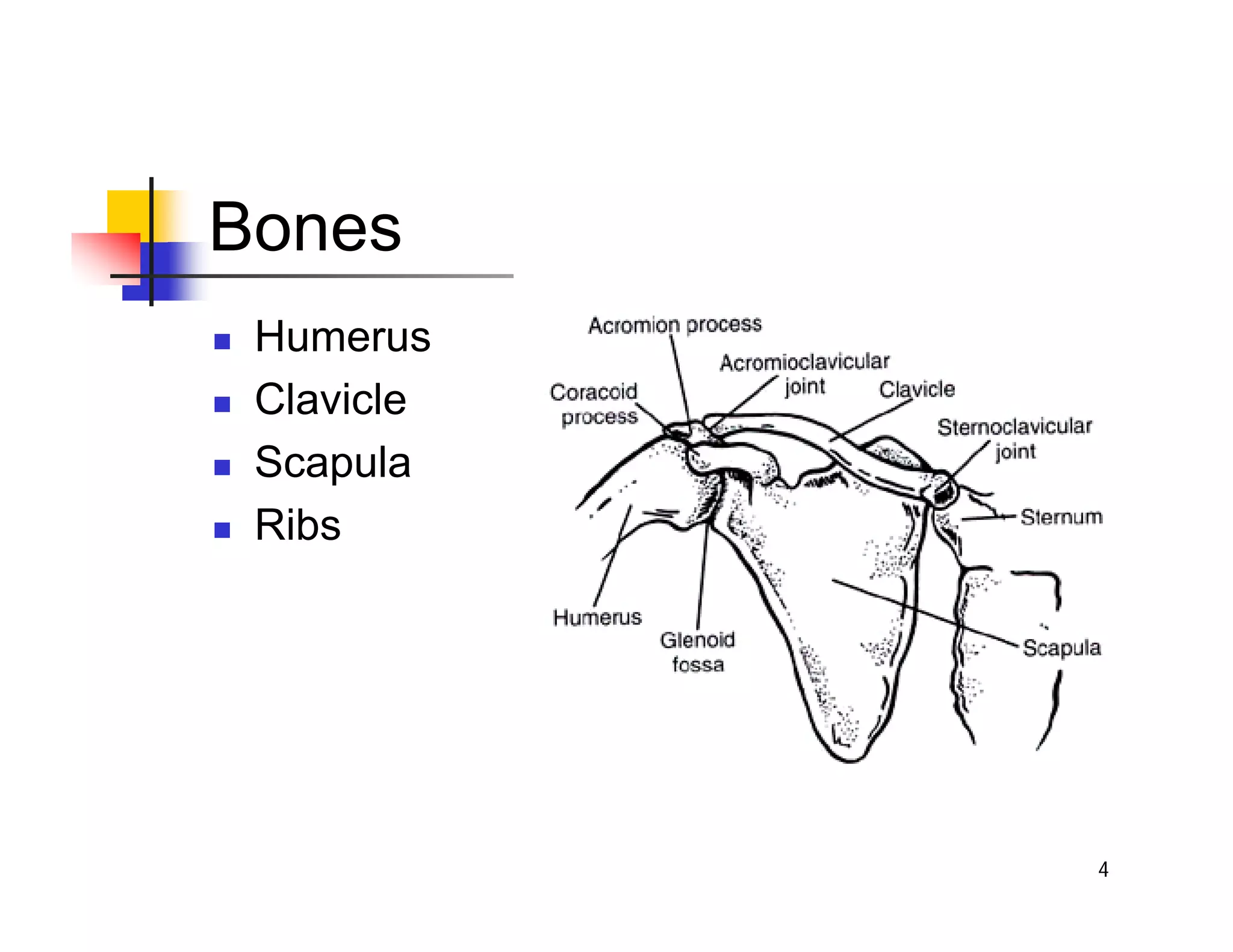
Bones
„ Humerus
„ Clavicle
„ Scapula
„ Ribs
5
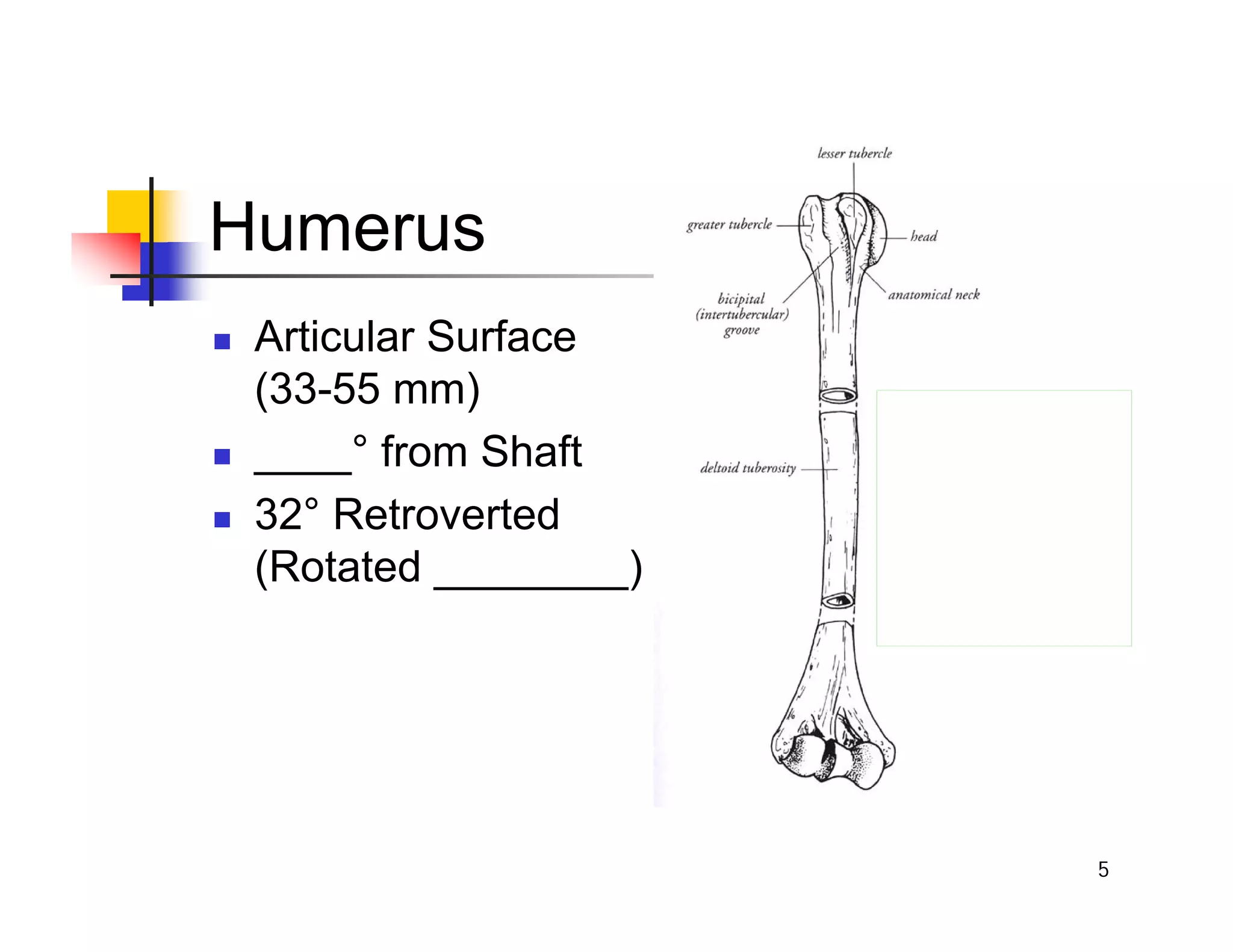
Humerus
„ Articular Surface
(33-55 mm)
„ ____° from Shaft
„ 32° Retroverted
(Rotated ________)
6
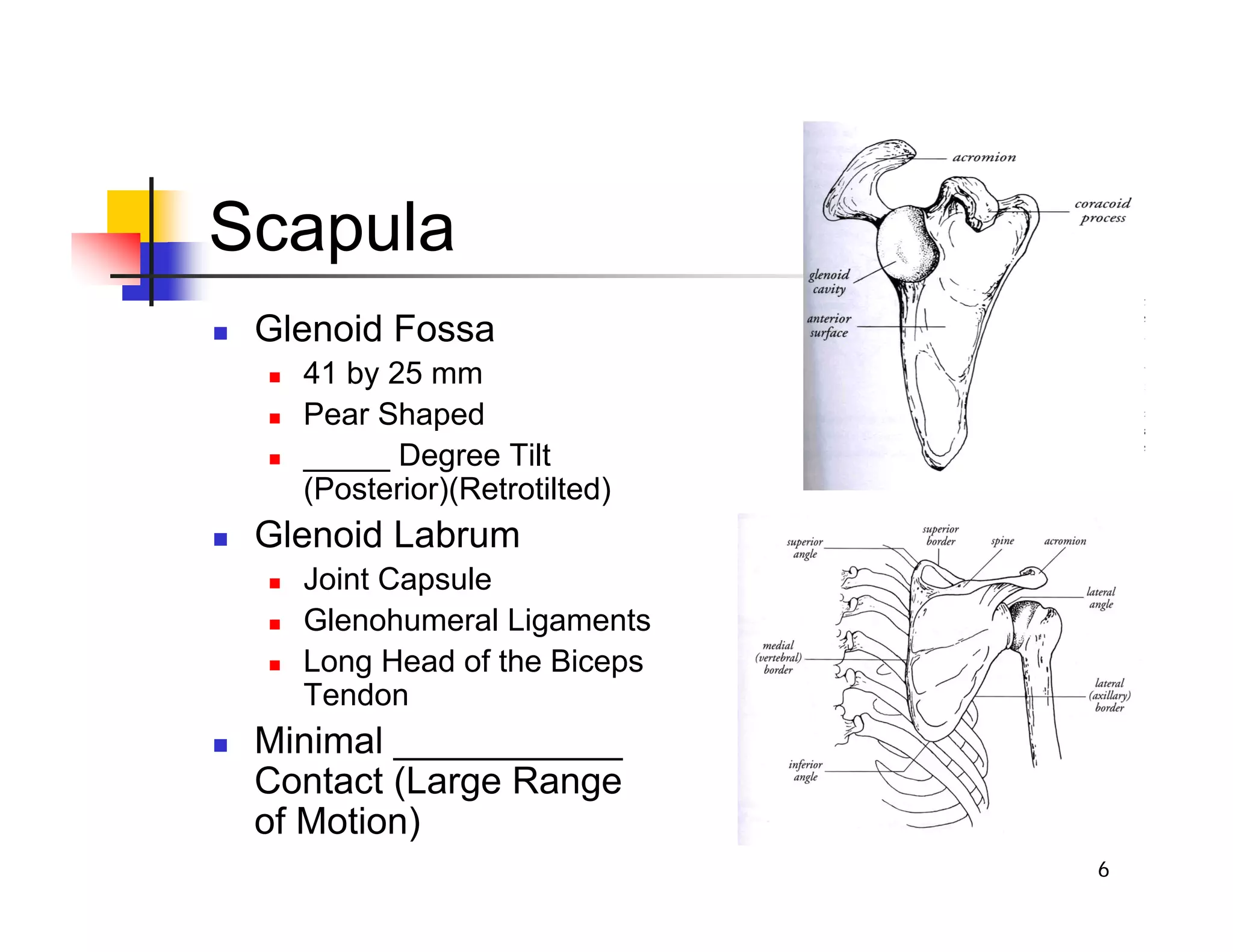
Scapula
„ Glenoid Fossa
„ 41 by 25 mm
„ Pear Shaped
„ _____ Degree Tilt
(Posterior)(Retrotilted)
„ Glenoid Labrum
„ Joint Capsule
„ Glenohumeral Ligaments
„ Long Head of the Biceps
Tendon
„ Minimal ___________
Contact (Large Range
of Motion)
7
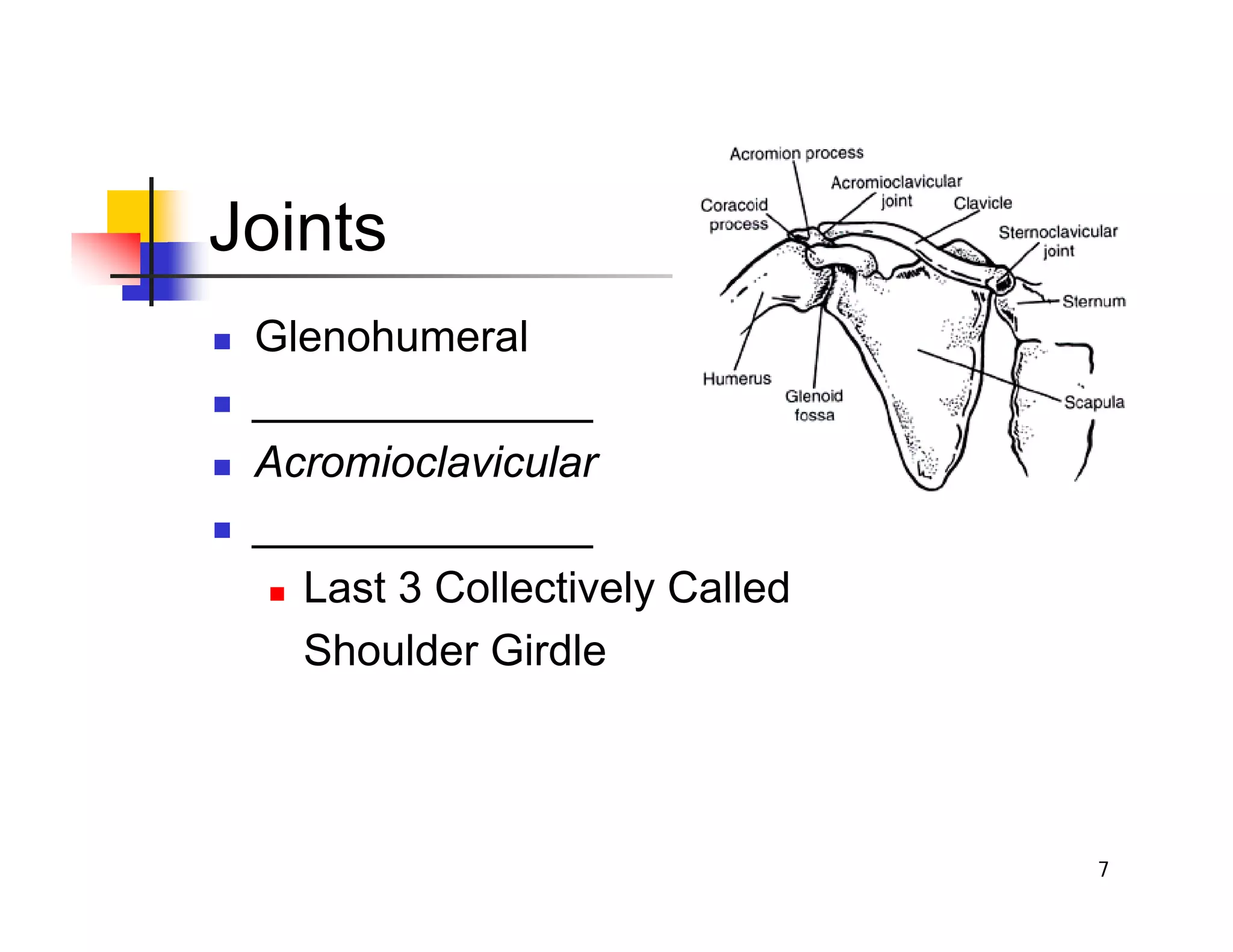
Joints
„ Glenohumeral
„ ______________
„ Acromioclavicular
„ ______________
„ Last 3 Collectively Called
Shoulder Girdle
8
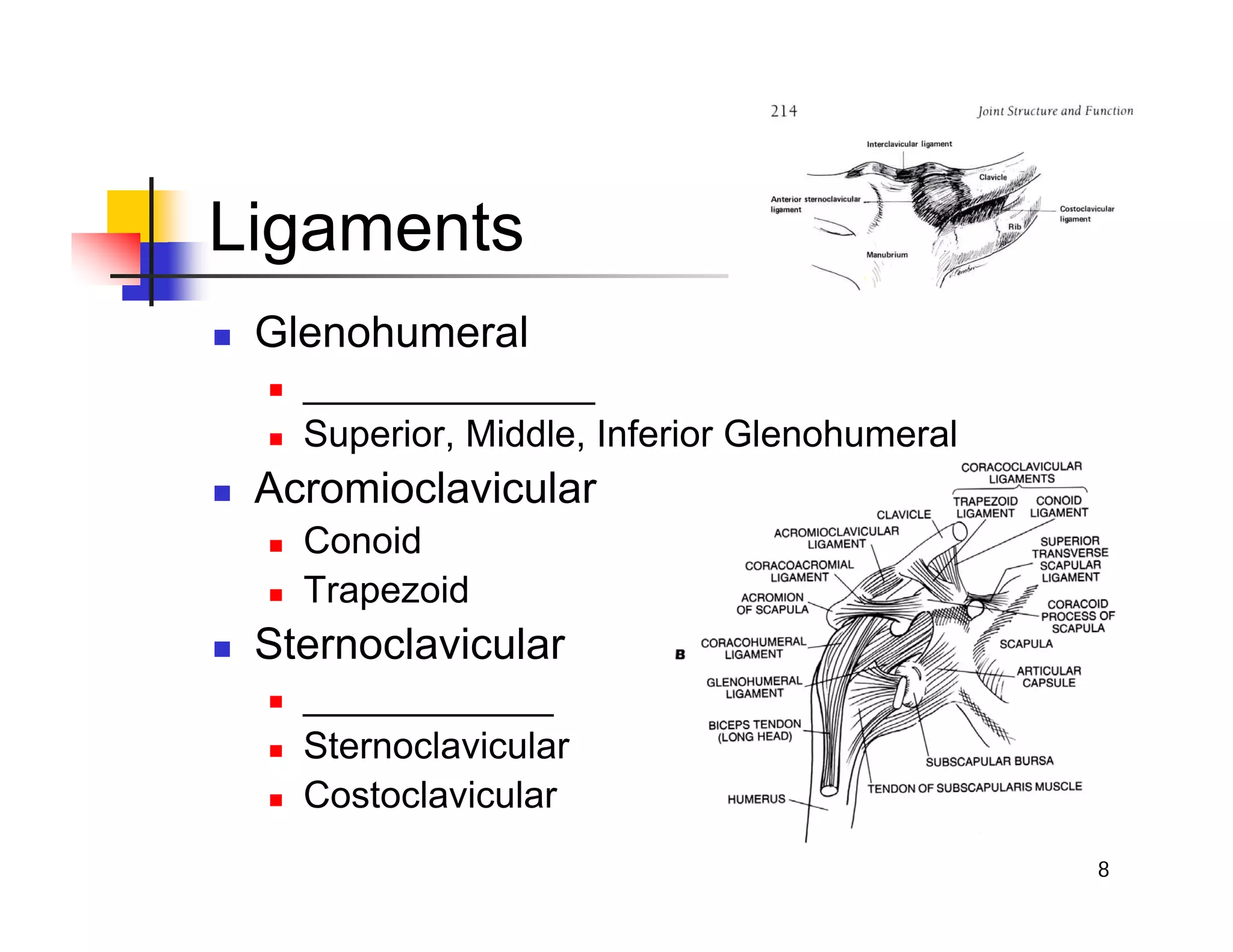
Ligaments
„ Glenohumeral
„ ______________
„ Superior, Middle, Inferior Glenohumeral
„ Acromioclavicular
„ Conoid
„ Trapezoid
„ Sternoclavicular
„ ____________
„ Sternoclavicular
„ Costoclavicular
9
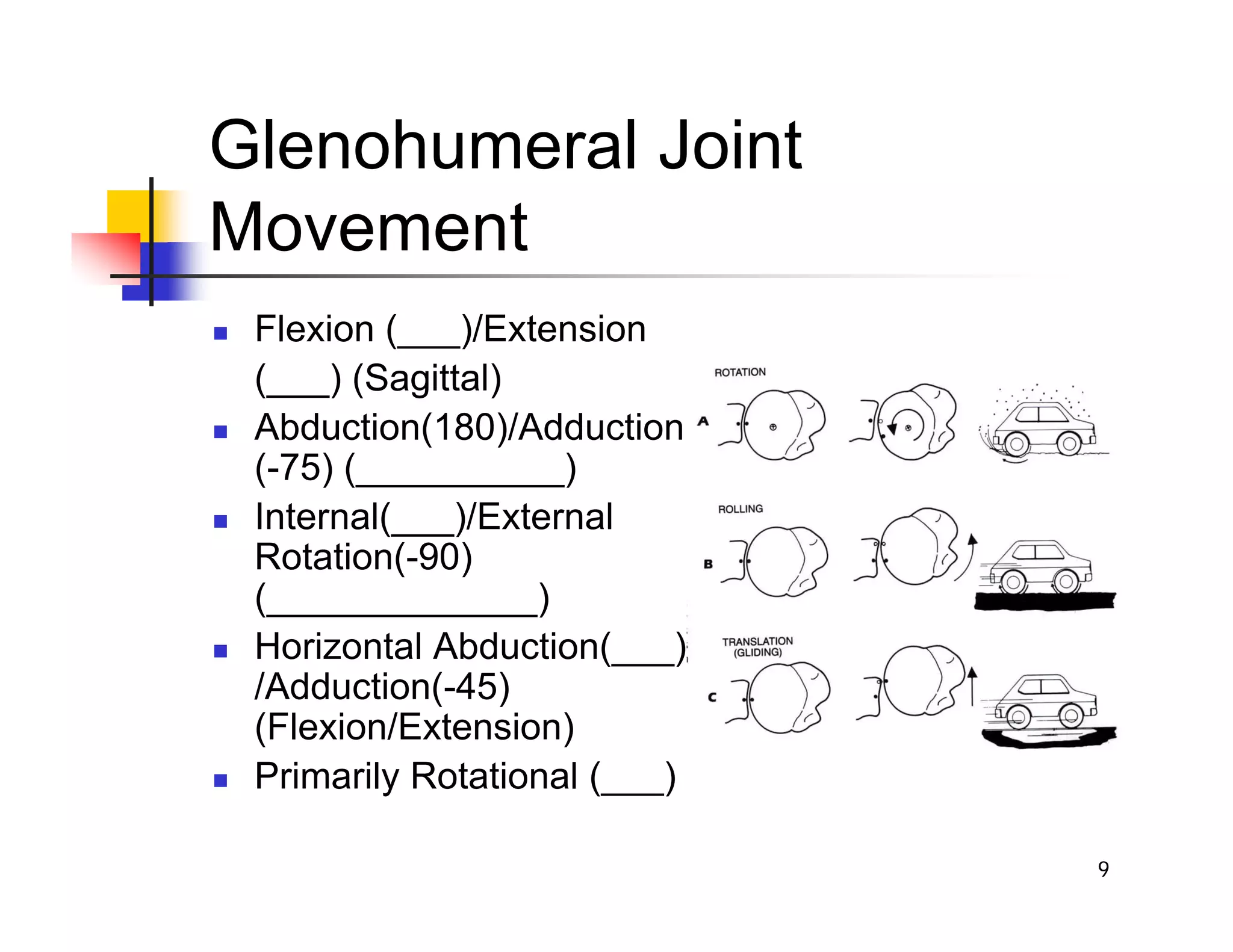
Glenohumeral Joint
Movement
„ Flexion (___)/Extension
(___) (Sagittal)
„ Abduction(180)/Adduction
(-75) (__________)
„ Internal(___)/External
Rotation(-90)
(_____________)
„ Horizontal Abduction(___)
/Adduction(-45)
(Flexion/Extension)
„ Primarily Rotational (___)
10
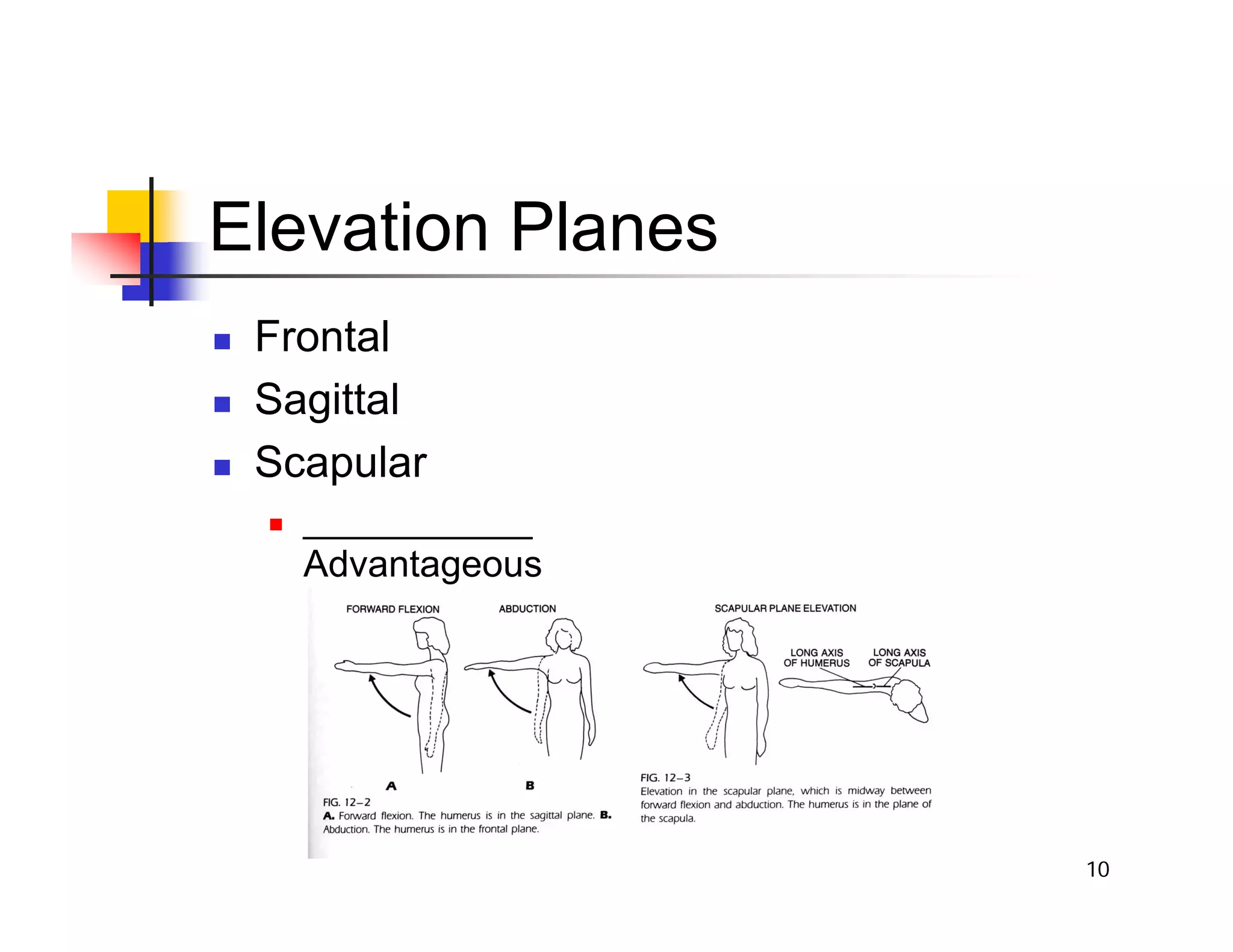
Elevation Planes
„ Frontal
„ Sagittal
„ Scapular
„ ___________
Advantageous
11
Shoulder Girdle Movement
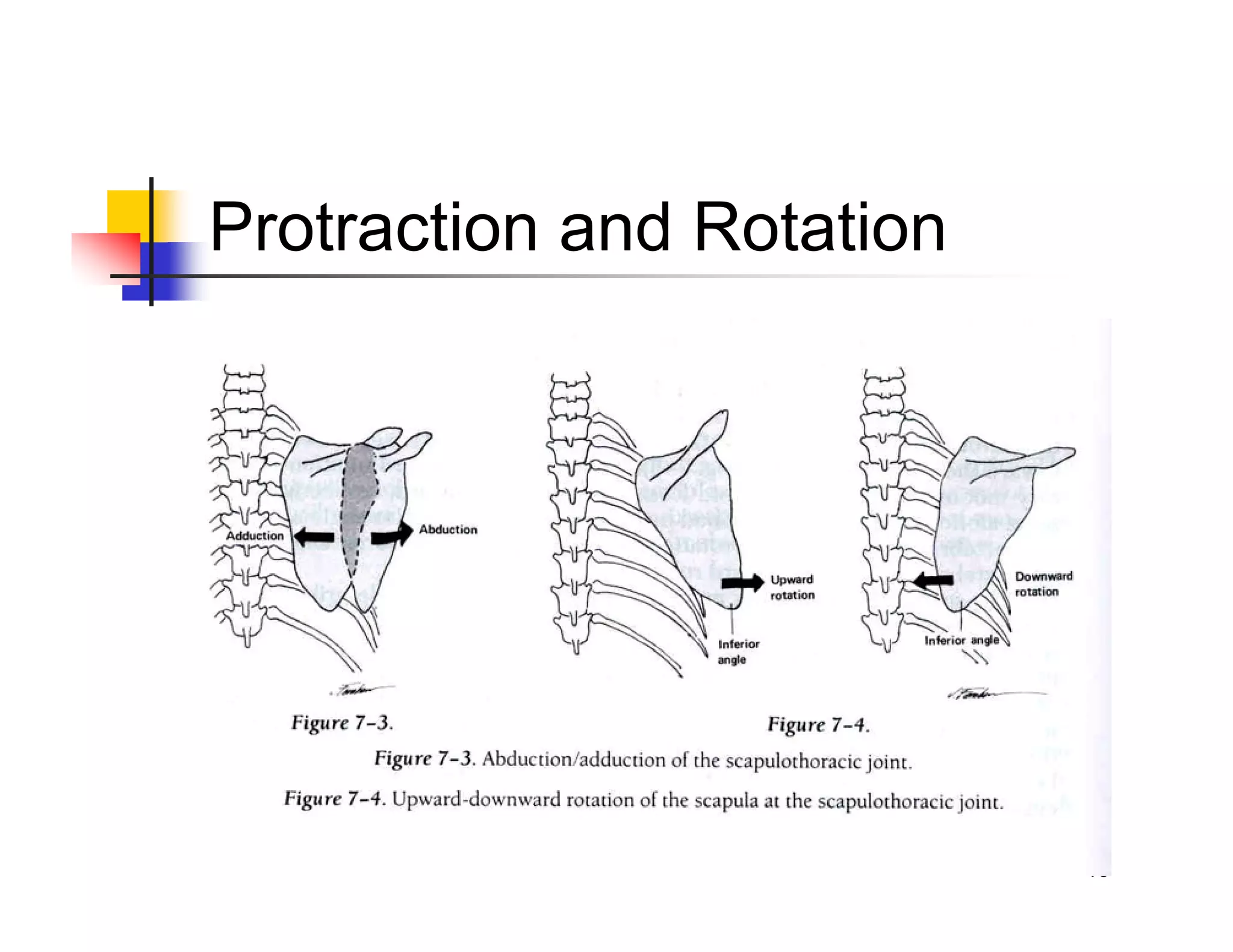
„ Upward/ Downward Rotation (______)
„ Protraction/Retraction
(________/________)(Transverse)
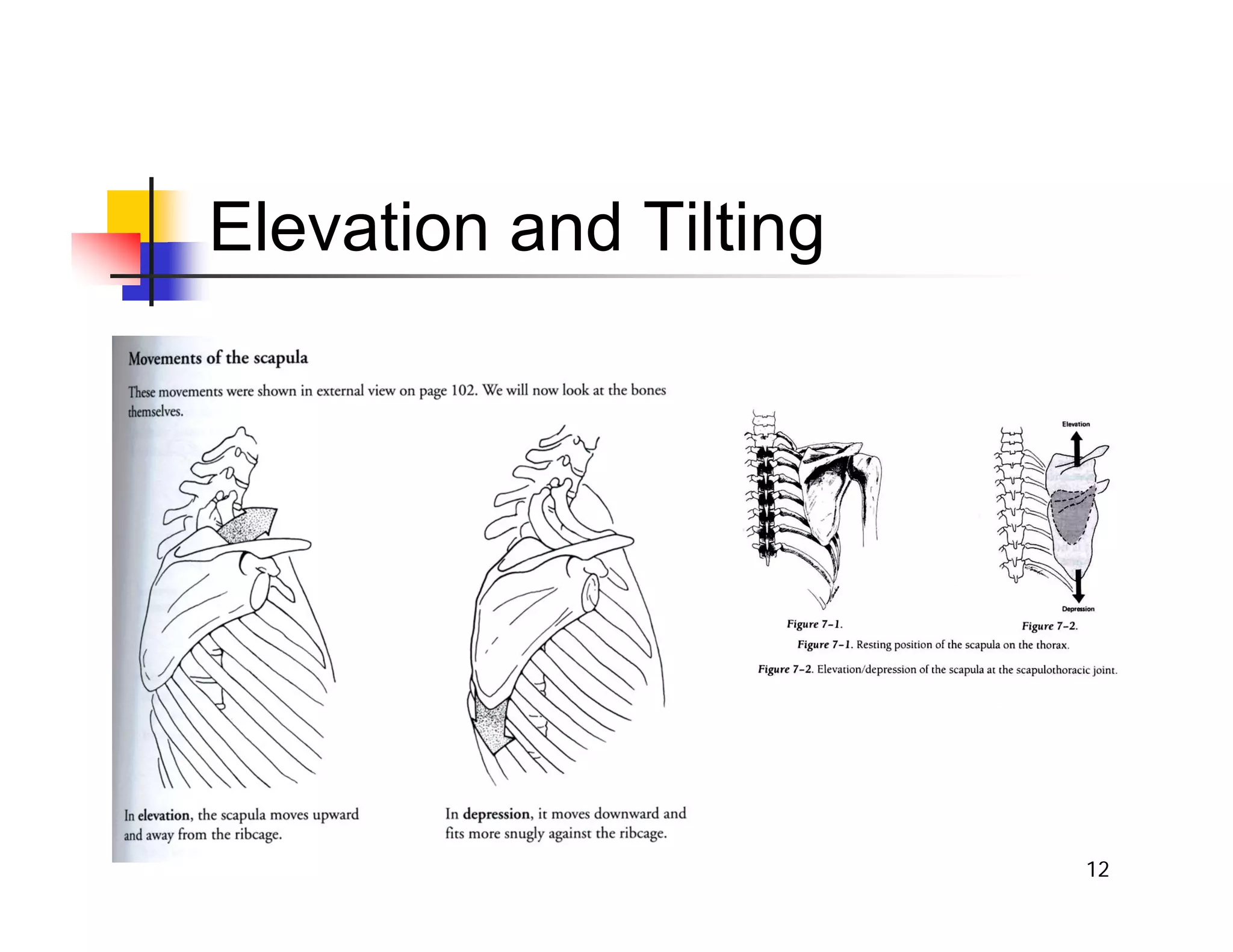
„ Upward/ Downward Tilt (________)
„ Elevation/Depression (_________)
12
Elevation and Tilting
13
Protraction and Rotation
14
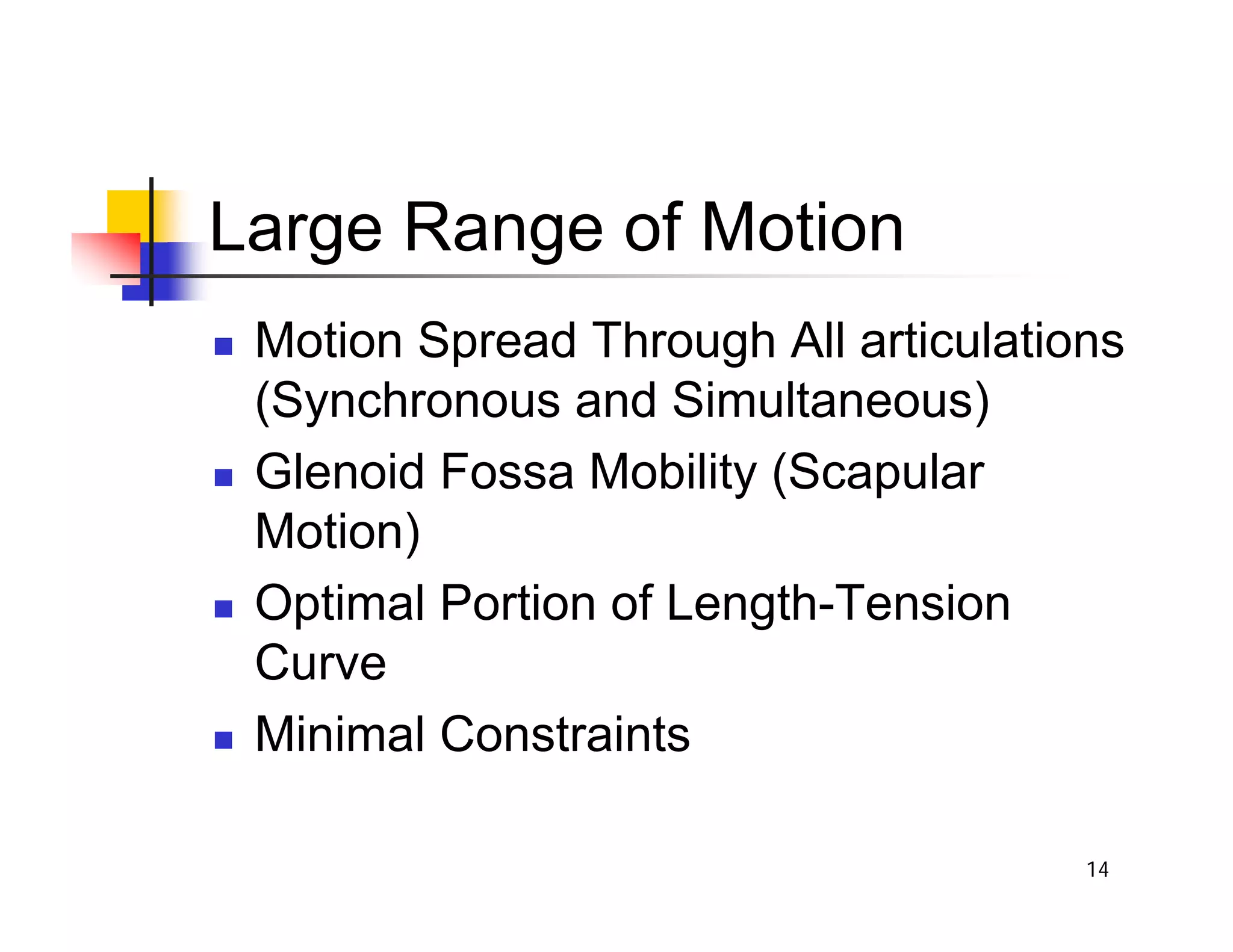
Large Range of Motion
„ Motion Spread Through All articulations
(Synchronous and Simultaneous)
„ Glenoid Fossa Mobility (Scapular
Motion)
„ Optimal Portion of Length-Tension
Curve
„ Minimal Constraints
15
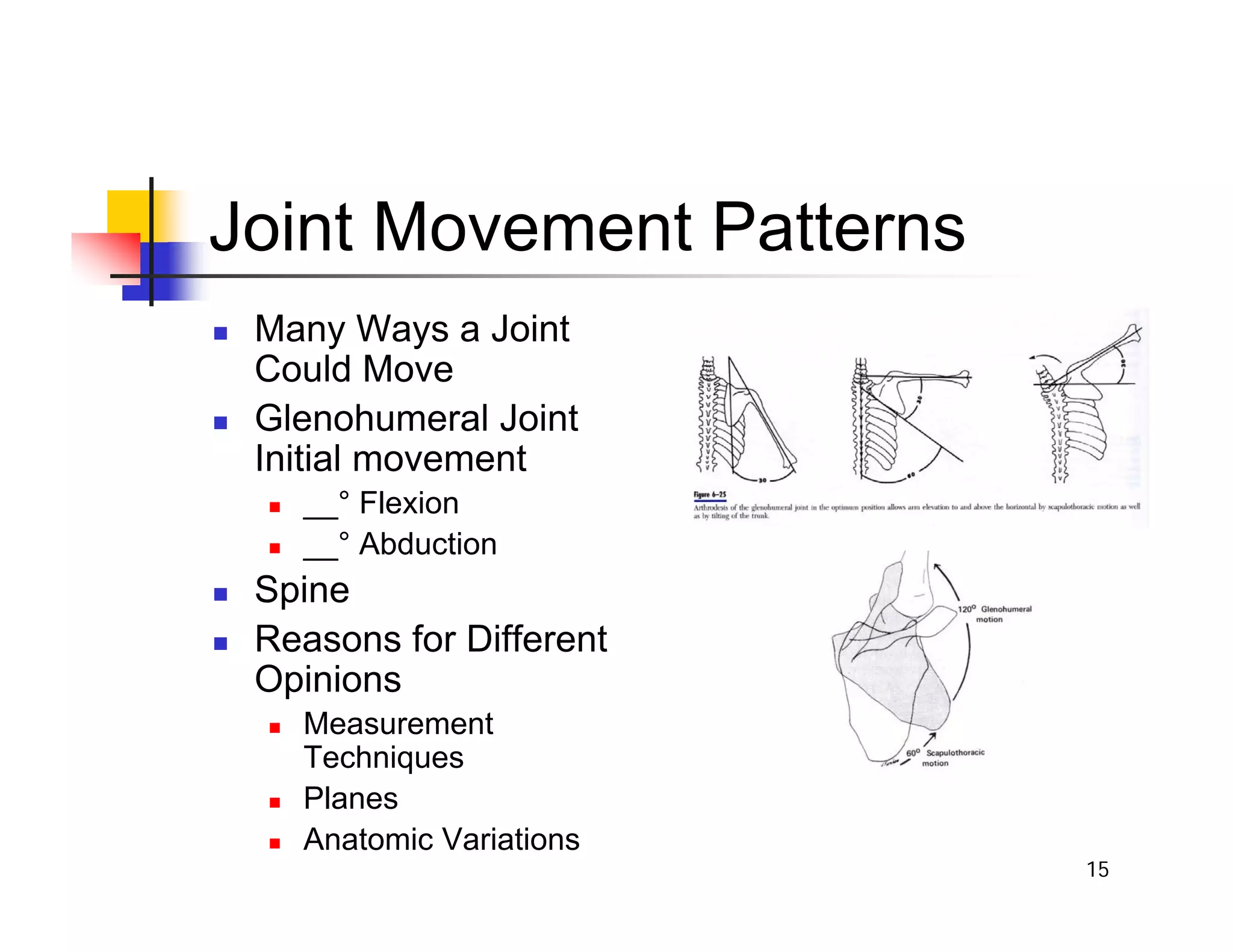
Joint Movement Patterns
„ Many Ways a Joint
Could Move
„ Glenohumeral Joint
Initial movement
„ __° Flexion
„ __° Abduction
„ Spine
„ Reasons for Different
Opinions
„ Measurement
Techniques
„ Planes
„ Anatomic Variations
16
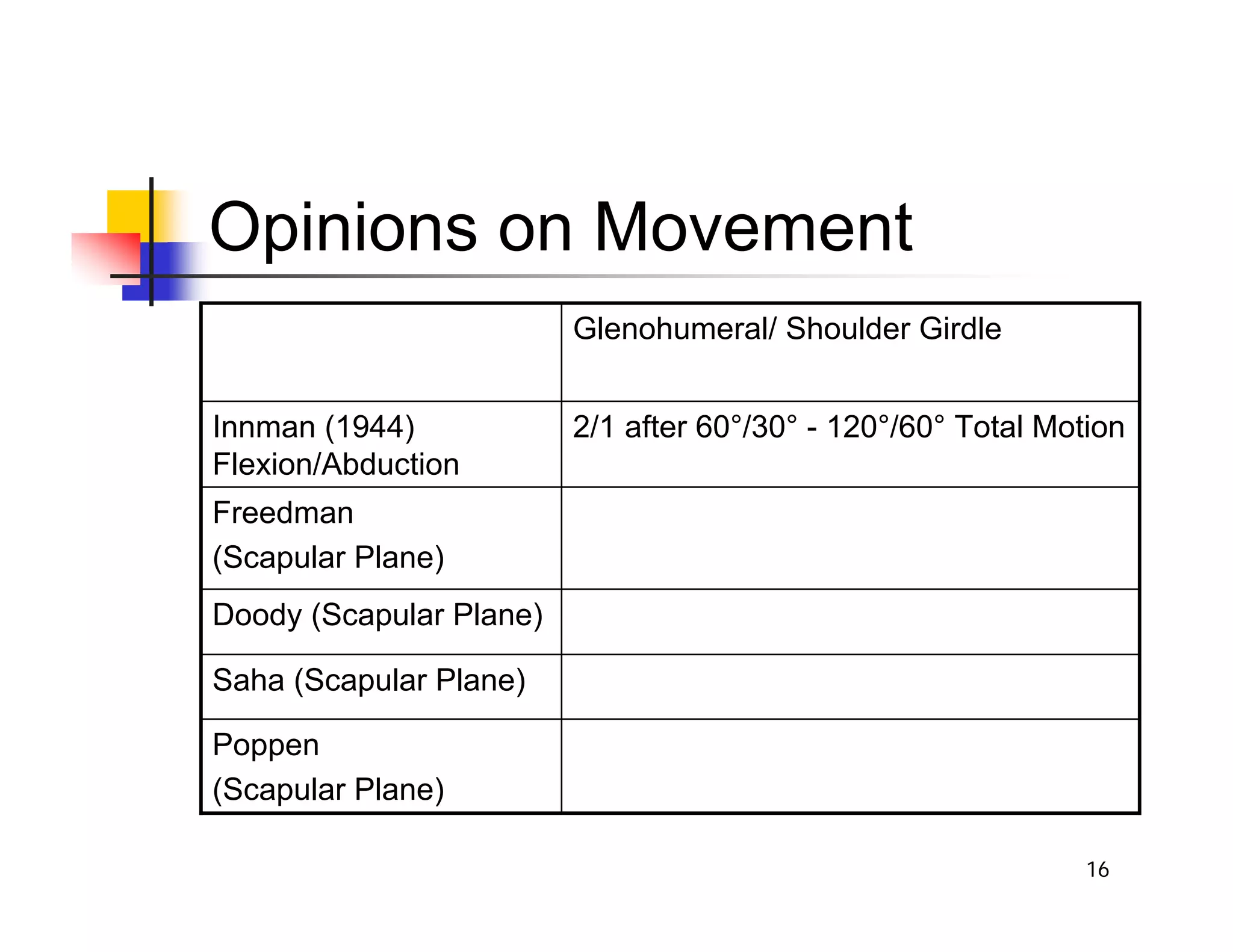
Opinions on Movement
Doody (Scapular Plane)
Saha (Scapular Plane)
Poppen
(Scapular Plane)
Freedman
(Scapular Plane)
2/1 after 60°/30° - 120°/60° Total Motion
Innman (1944)
Flexion/Abduction
Glenohumeral/ Shoulder Girdle
17
Codman’s Paradox
„ Flex
„ Horizontally Abduct
„ Adduct
„ Rotation with out Rotation
18
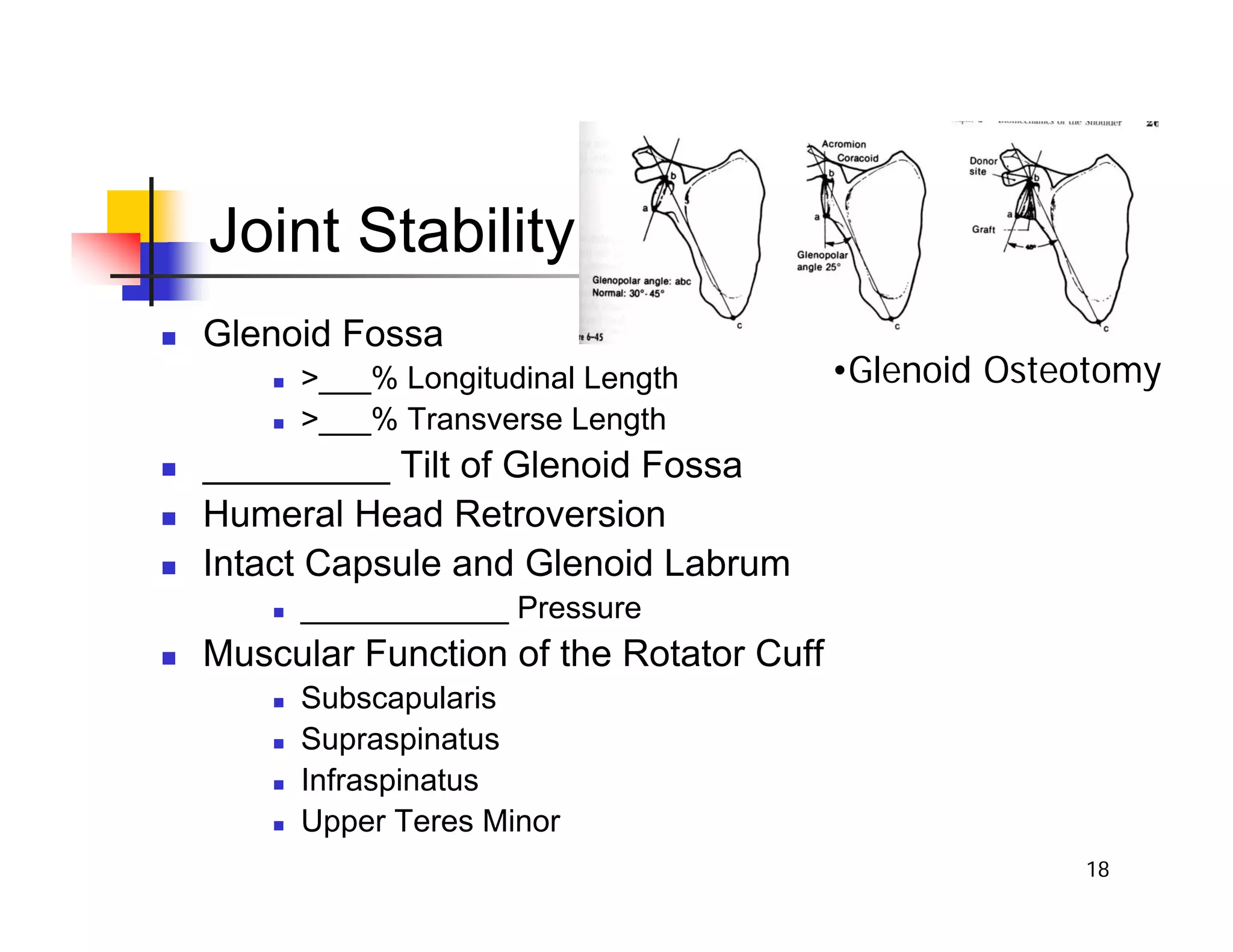
Joint Stability
„ Glenoid Fossa
„ >___% Longitudinal Length
„ >___% Transverse Length
„ _________ Tilt of Glenoid Fossa
„ Humeral Head Retroversion
„ Intact Capsule and Glenoid Labrum
„ ____________ Pressure
„ Muscular Function of the Rotator Cuff
„ Subscapularis
„ Supraspinatus
„ Infraspinatus
„ Upper Teres Minor
•Glenoid Osteotomy
19
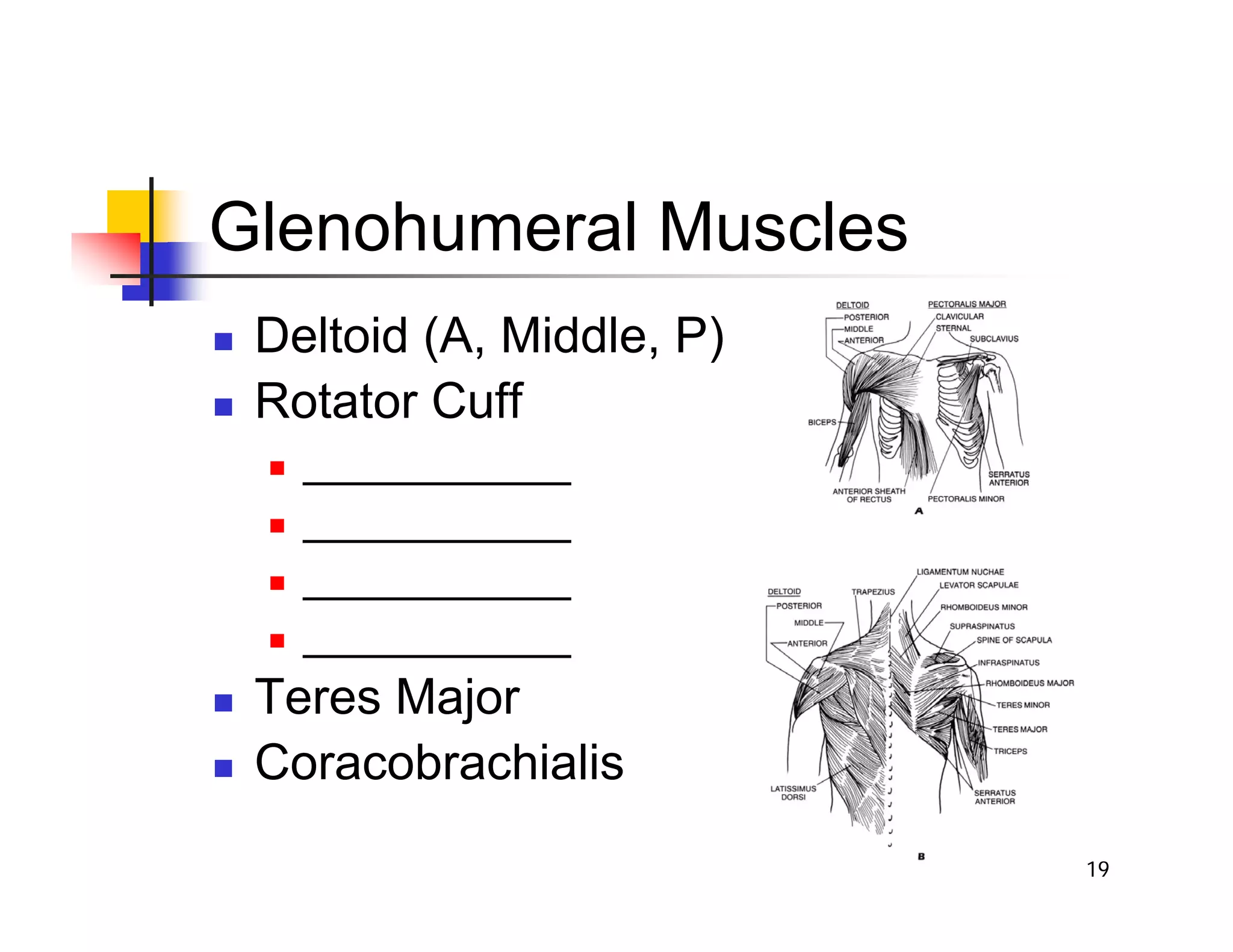
Glenohumeral Muscles
„ Deltoid (A, Middle, P)
„ Rotator Cuff
„ ___________
„ ___________
„ ___________
„ ___________
„ Teres Major
„ Coracobrachialis
20
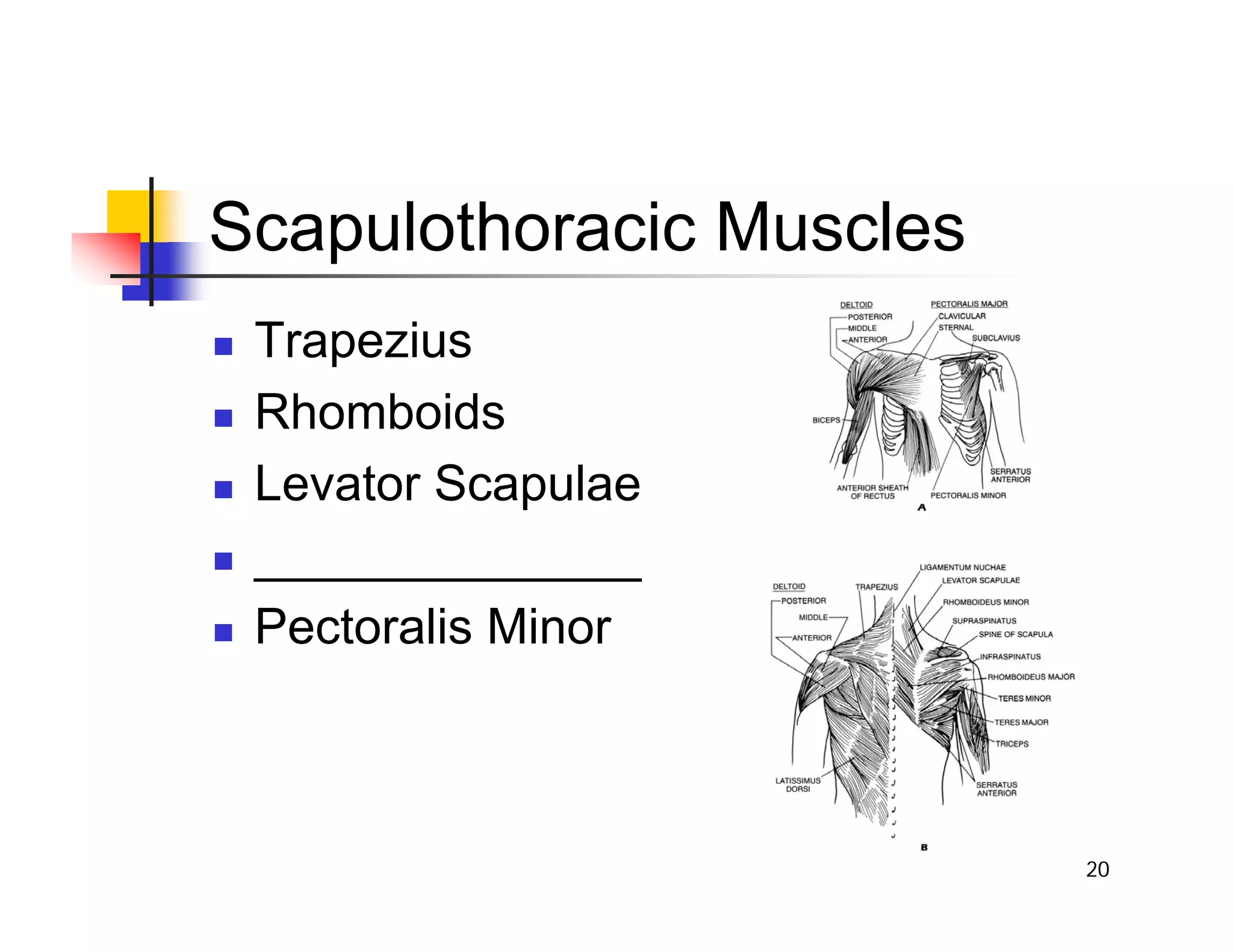
Scapulothoracic Muscles
„ Trapezius
„ Rhomboids
„ Levator Scapulae
„ ______________
„ Pectoralis Minor
21
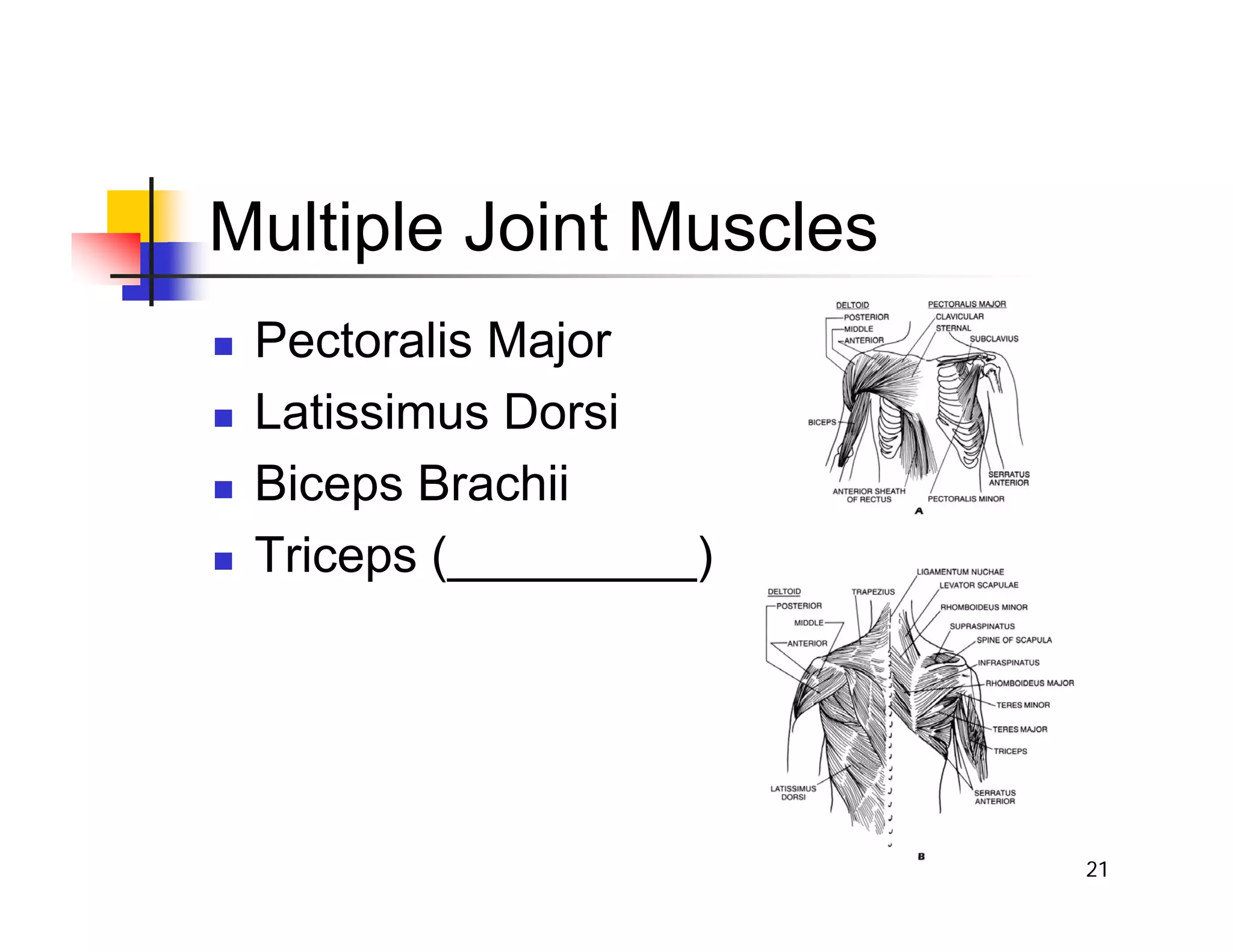
Multiple Joint Muscles
„ Pectoralis Major
„ Latissimus Dorsi
„ Biceps Brachii
„ Triceps (_________)
22
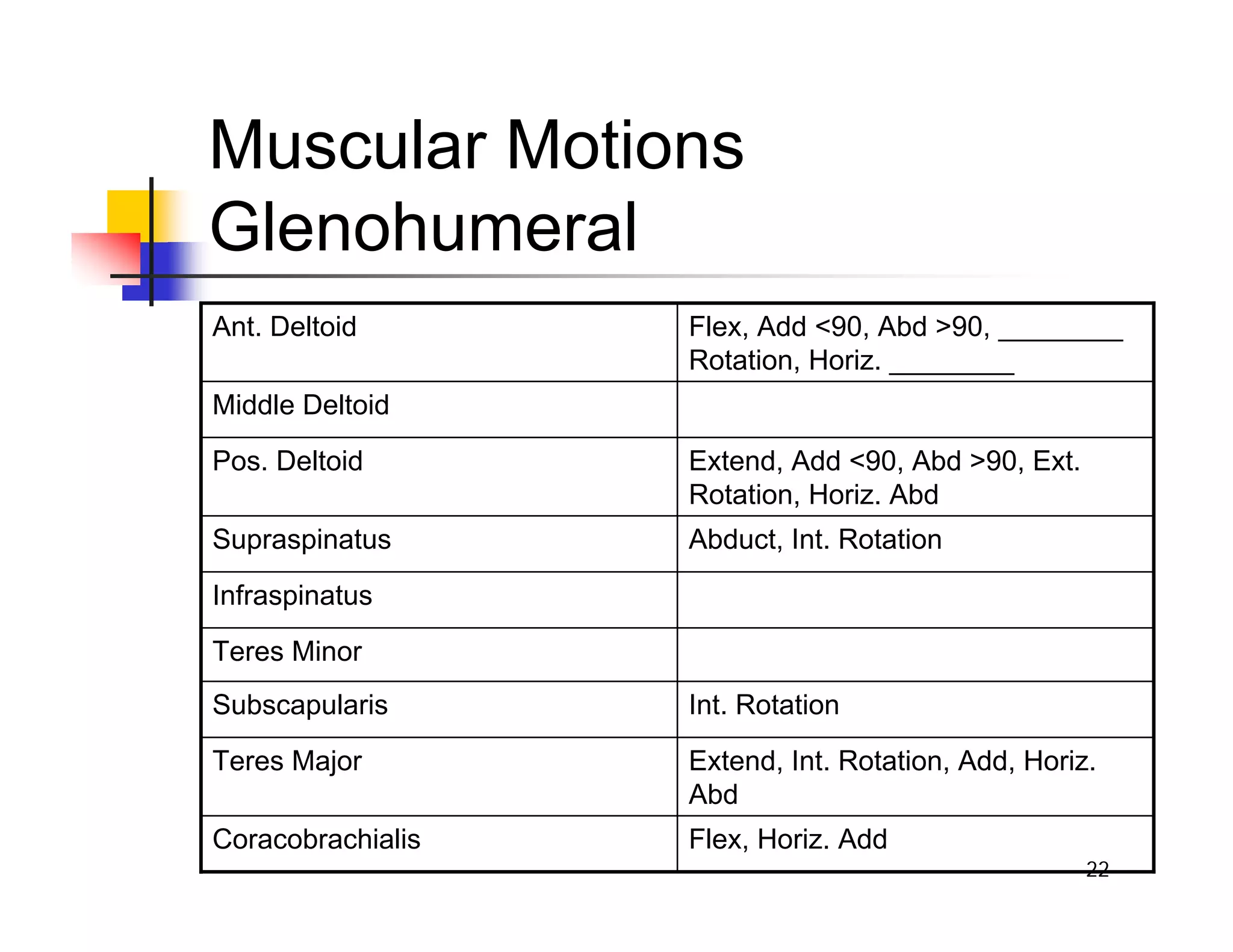
Muscular Motions
Glenohumeral
Flex, Horiz. Add
Coracobrachialis
Extend, Int. Rotation, Add, Horiz.
Abd
Teres Major
Int. Rotation
Subscapularis
Teres Minor
Infraspinatus
Abduct, Int. Rotation
Supraspinatus
Extend, Add <90, Abd >90, Ext.
Rotation, Horiz. Abd
Pos. Deltoid
Middle Deltoid
Flex, Add <90, Abd >90, ________
Rotation, Horiz. ________
Ant. Deltoid
23
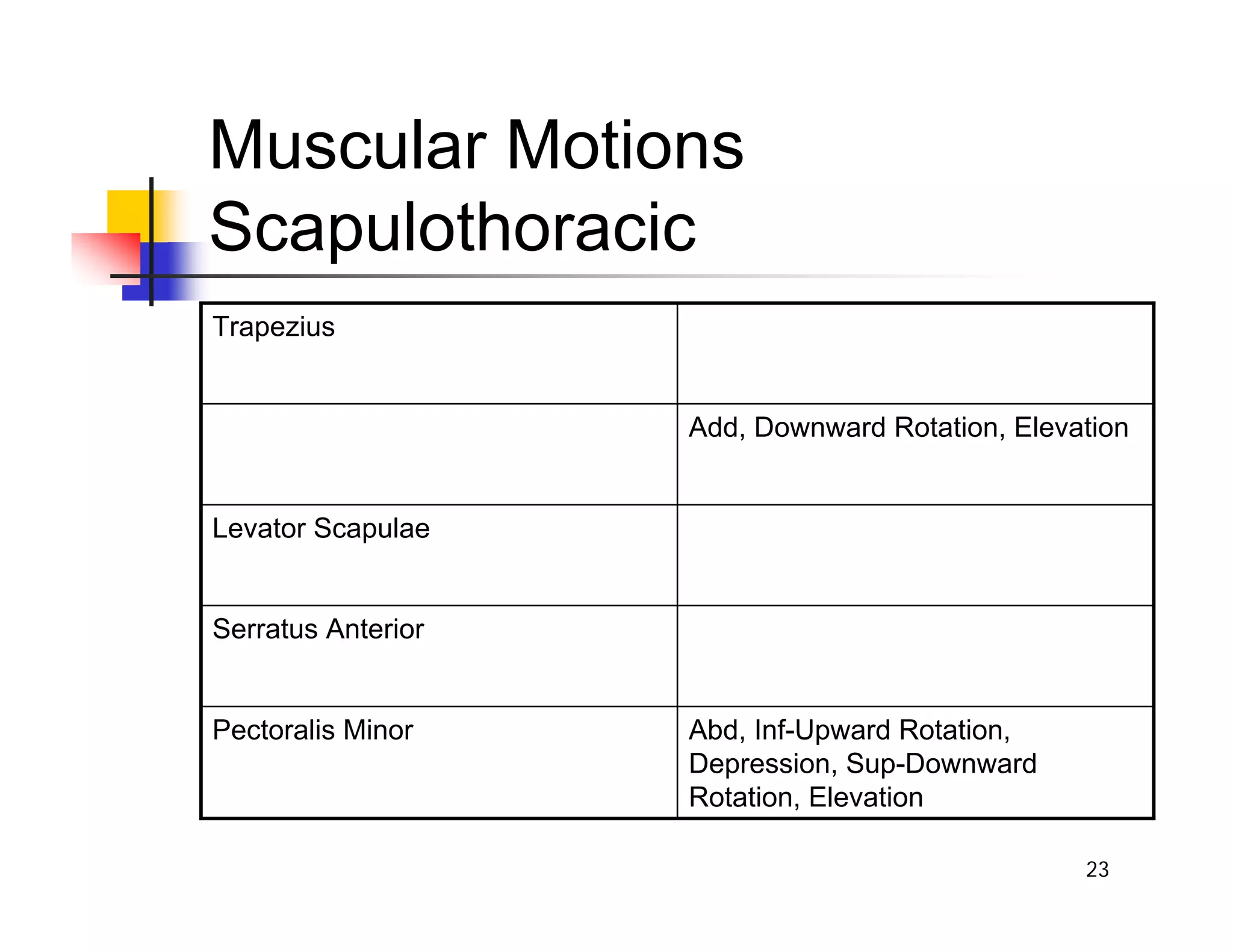
Muscular Motions
Scapulothoracic
Abd, Inf-Upward Rotation,
Depression, Sup-Downward
Rotation, Elevation
Pectoralis Minor
Serratus Anterior
Levator Scapulae
Add, Downward Rotation, Elevation
Trapezius
24
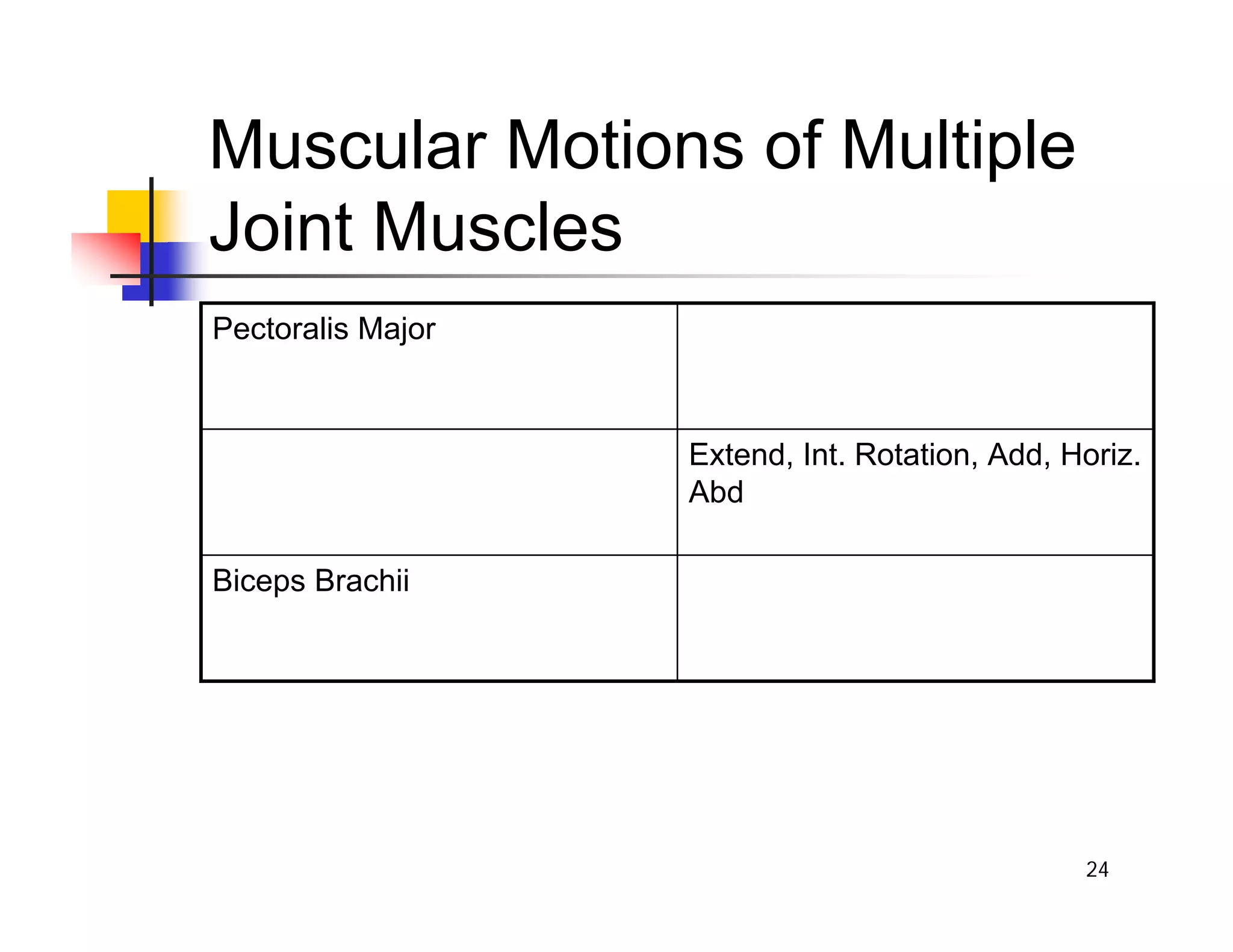
Muscular Motions of Multiple
Joint Muscles
Biceps Brachii
Extend, Int. Rotation, Add, Horiz.
Abd
Pectoralis Major
25
Outline
„ Anatomy
„ Biomechanics
„ Problems
26
Reasons for Biomechanical
Analysis
„ Rehabilitation
„ Therapy Loads
„ Repair Strengths
„ Injury
„ Motions That Transfer Higher Loads
„ Injury Mechanisms
„ Dislocation
„ Prosthetic Design
„ Stress (Load) Analysis
27
Injuries
„ Broken Bones
„ Clavicle
„ Scapula
„ Humerus
„ Impingement
„ ____________
„ Biceps Tendon
„ Bursitis
„ Dislocation
„ Subluxation
„ Tendon Ruptures
„ __________
„ Biceps
28
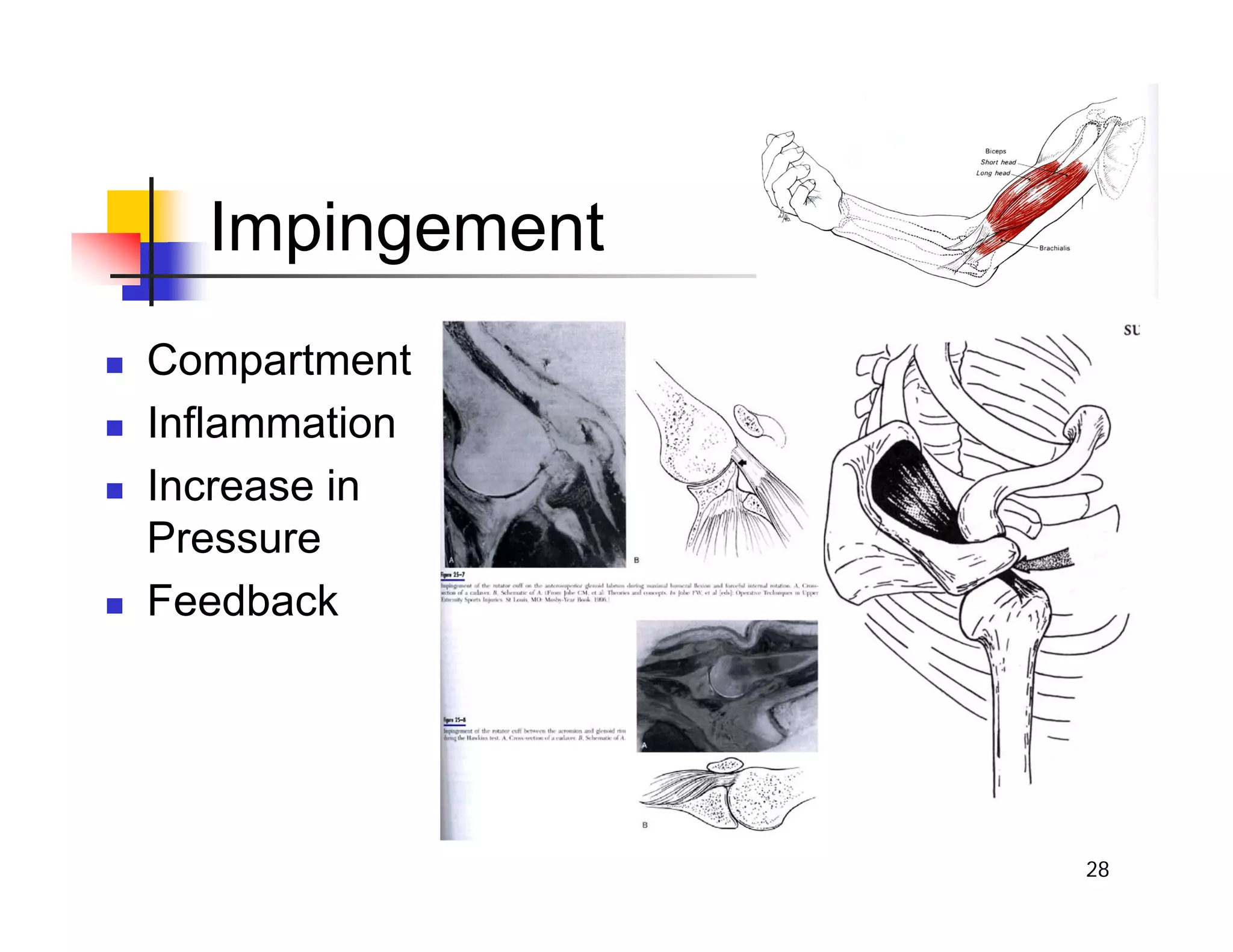
Impingement
„ Compartment
„ Inflammation
„ Increase in
Pressure
„ Feedback
29
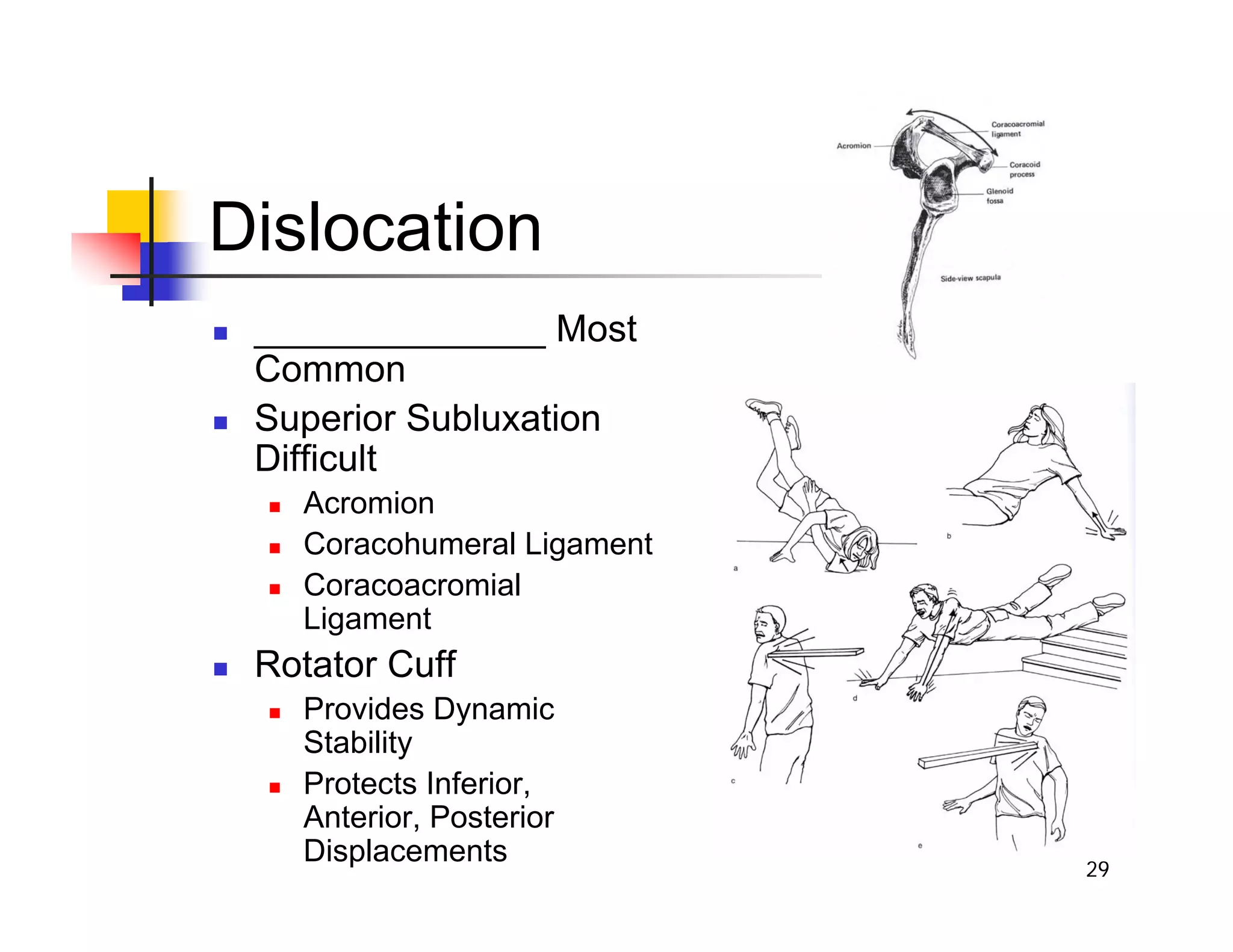
Dislocation
„ ______________ Most
Common
„ Superior Subluxation
Difficult
„ Acromion
„ Coracohumeral Ligament
„ Coracoacromial
Ligament
„ Rotator Cuff
„ Provides Dynamic
Stability
„ Protects Inferior,
Anterior, Posterior
Displacements
30
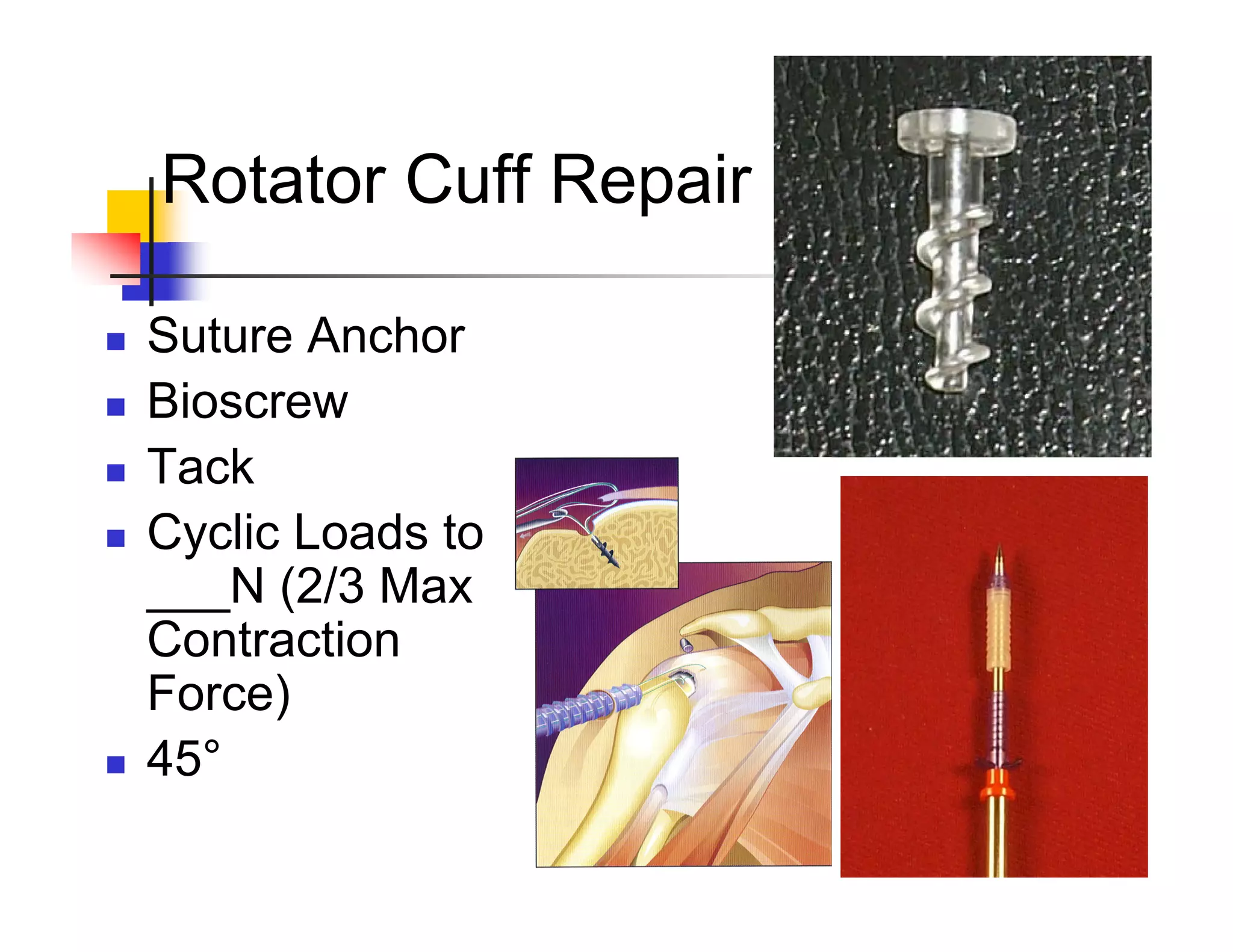
Rotator Cuff Repair
„ Suture Anchor
„ Bioscrew
„ Tack
„ Cyclic Loads to
___N (2/3 Max
Contraction
Force)
„ 45°
31
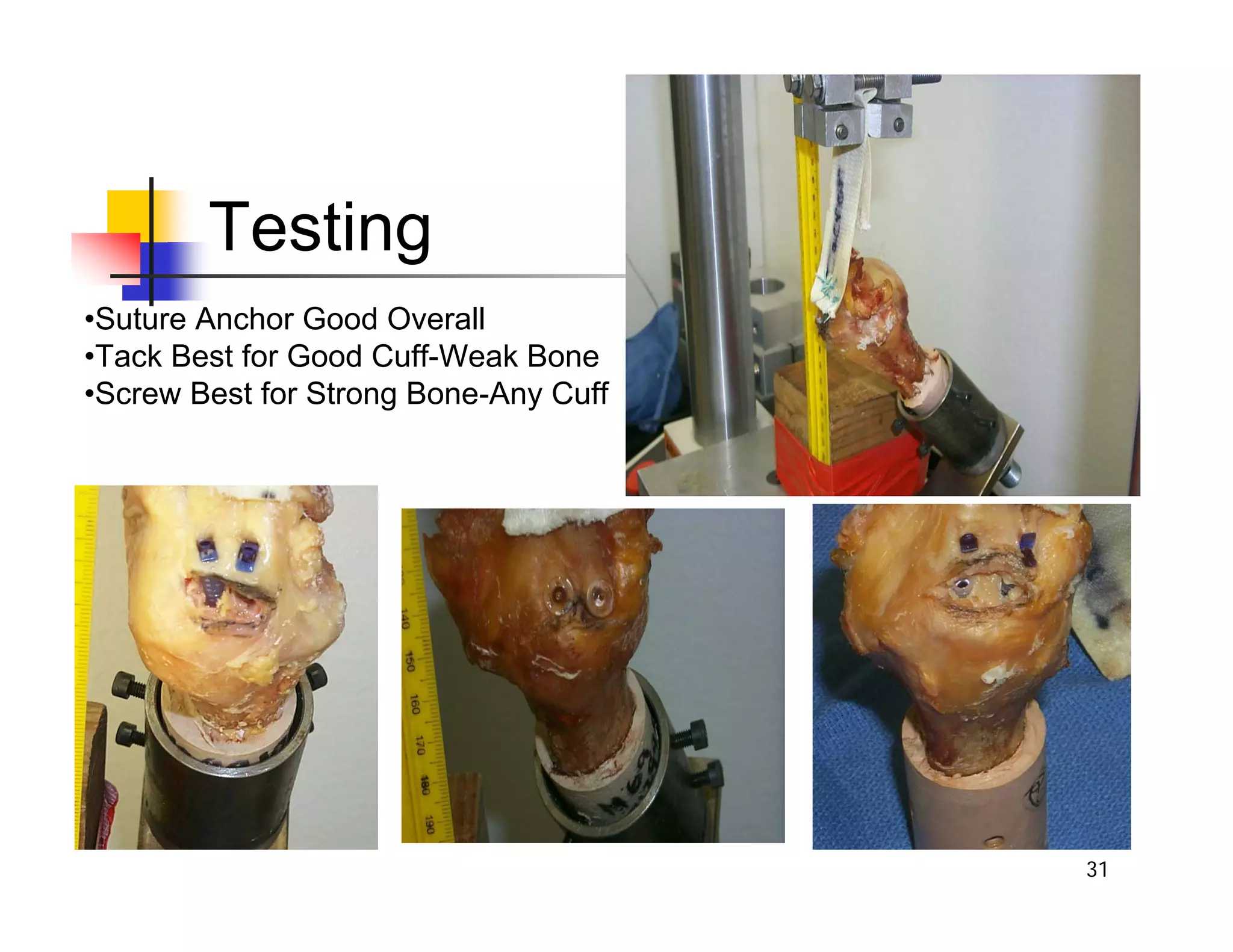
Testing
•Suture Anchor Good Overall
•Tack Best for Good Cuff-Weak Bone
•Screw Best for Strong Bone-Any Cuff
32
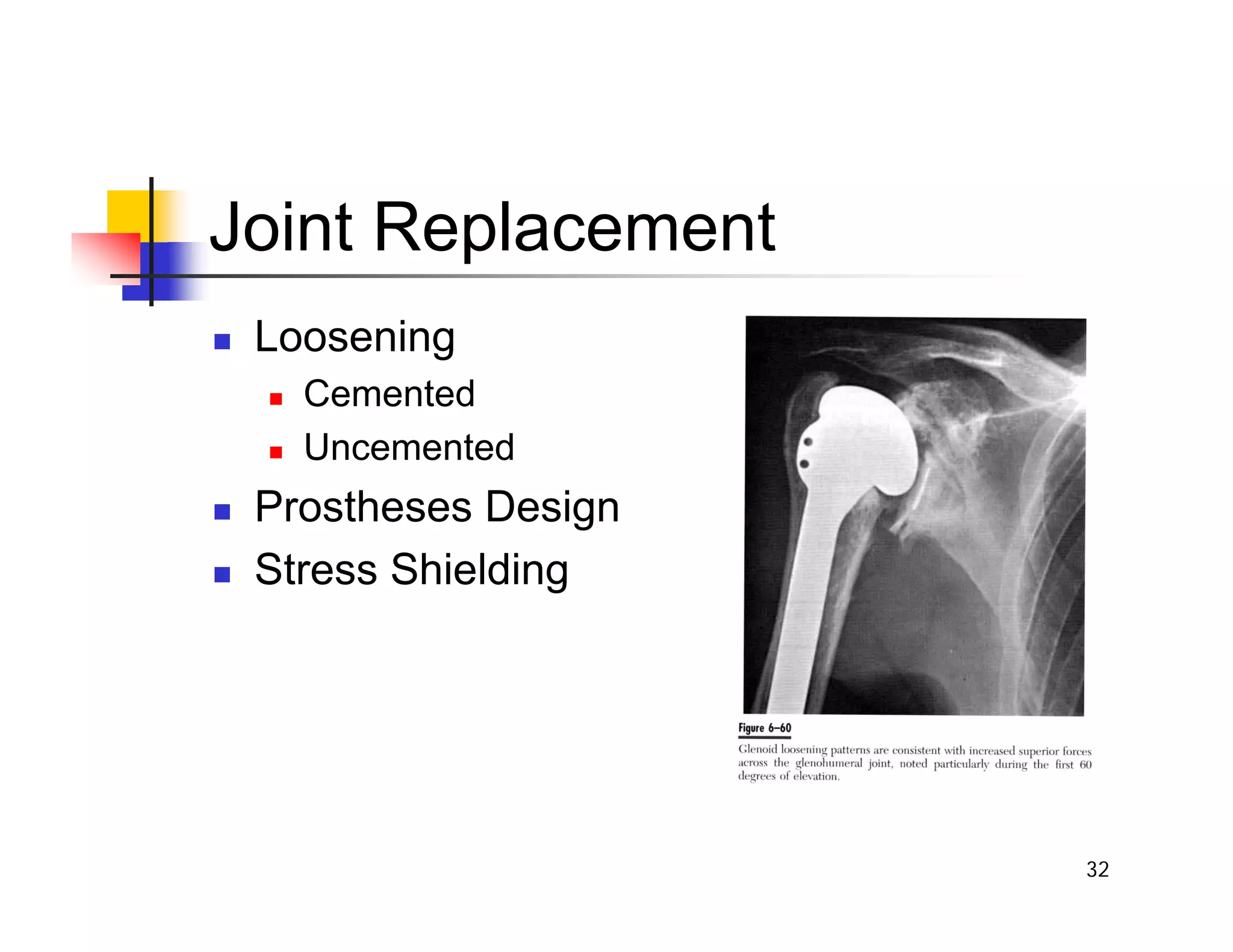
Joint Replacement
„ Loosening
„ Cemented
„ Uncemented
„ Prostheses Design
„ Stress Shielding
33
Troubles with Biomechanical
Analysis
„ Mobility
„ High Number of Degrees of Freedom
„ Muscles
„ Large Number of Muscles Contributing
„ Different Contributions
„ .
„ .
„ Angle of Elevation
„ Multiple Movements
„ Arm Position (example: Biceps)
„ Abductor while humerus is Externally Rotated
34
Multiple Motions of Single
Muscle
„ Anterior Deltoid - Muscle
Flexion/Internal Rotation
„ Teres Major - Muscle Extension/Internal
Rotation
„ .
35
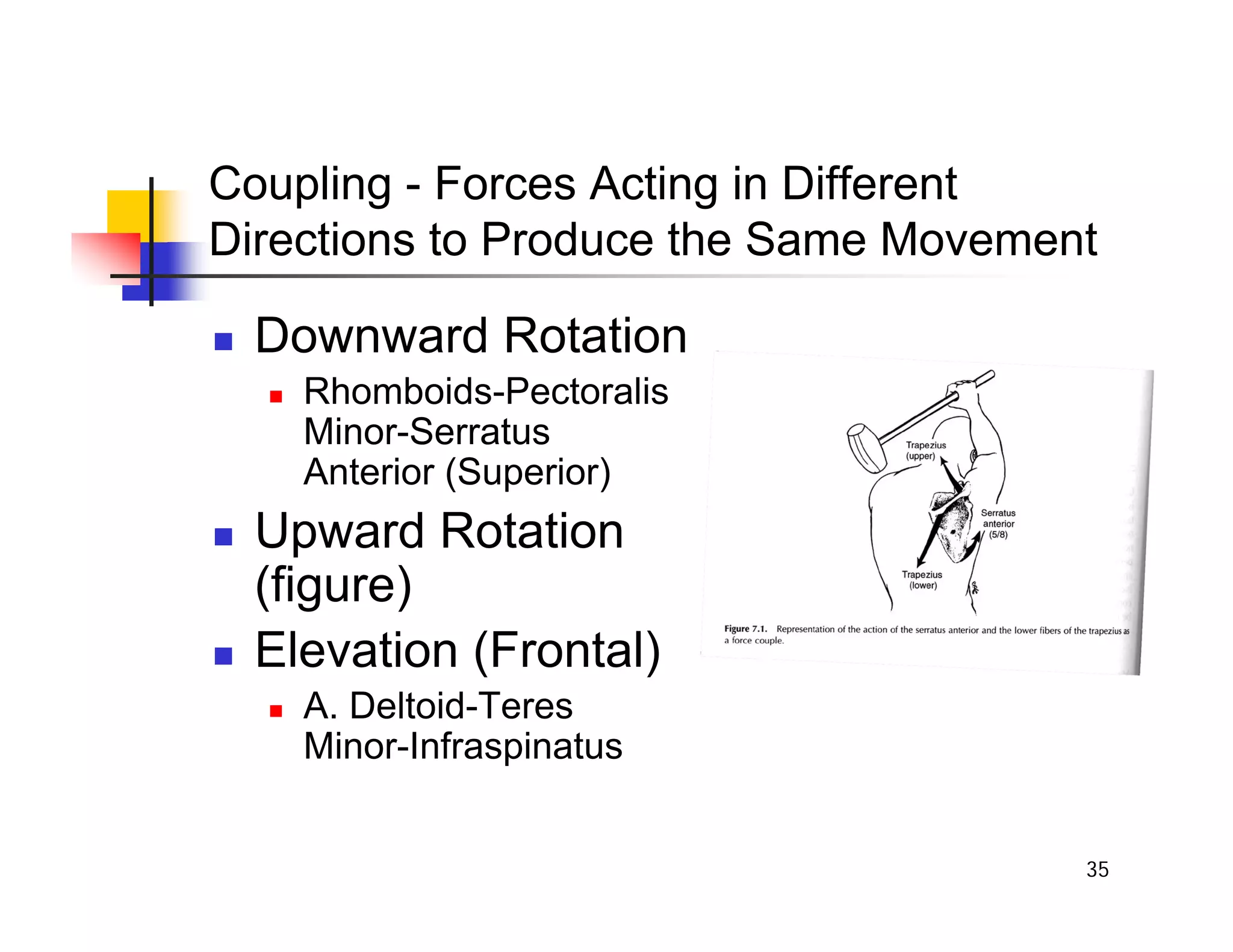
Coupling - Forces Acting in Different
Directions to Produce the Same Movement
„ Downward Rotation
„ Rhomboids-Pectoralis
Minor-Serratus
Anterior (Superior)
„ Upward Rotation
(figure)
„ Elevation (Frontal)
„ A. Deltoid-Teres
Minor-Infraspinatus
36
Muscle Pair Ratios
„ Flex:Extension ( )
„ Abd:Add ( )
„ Internal:External ( )
„ Adduction-Extension-Flexion-Abduction-
Internal Rotation-External Rotation
37
Forces at the Shoulder
(Innman et al., 1944)
„ 90° Abduction
„ Deltoid Extremity Weight (70% BW)
„ GH Joint EW (90% BW)
„ Rotator Cuff EW (85% BW)
„ Load Bearing (Approximately 1BW)
38
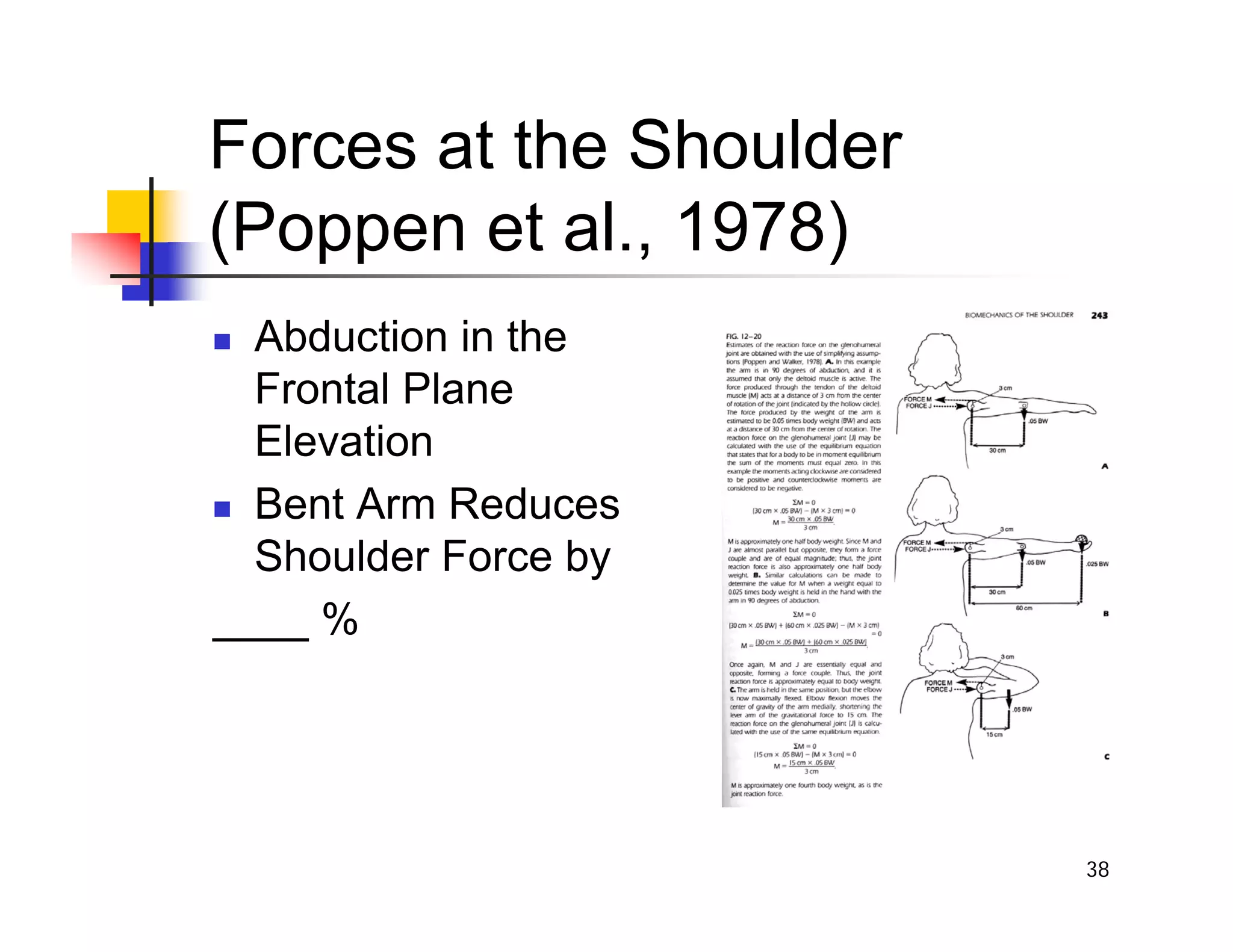
Forces at the Shoulder
(Poppen et al., 1978)
„ Abduction in the
Frontal Plane
Elevation
„ Bent Arm Reduces
Shoulder Force by
%
39
Shoulder Dynamics
„ Fatigue and Injury (Working with Arm Elevated)
„ Supraspinatus
„ Trapezius
„ Supraspinatus Tendonitis
„ Neck Pain (Trapezius Fatigue)
„ Less Fatigue (Herberts, 1980)
„ A. Deltoid (45° and 90°)
„ Supraspinatus (45°)
„ Trapezius (45°)
„ had Highest Fatigue
40
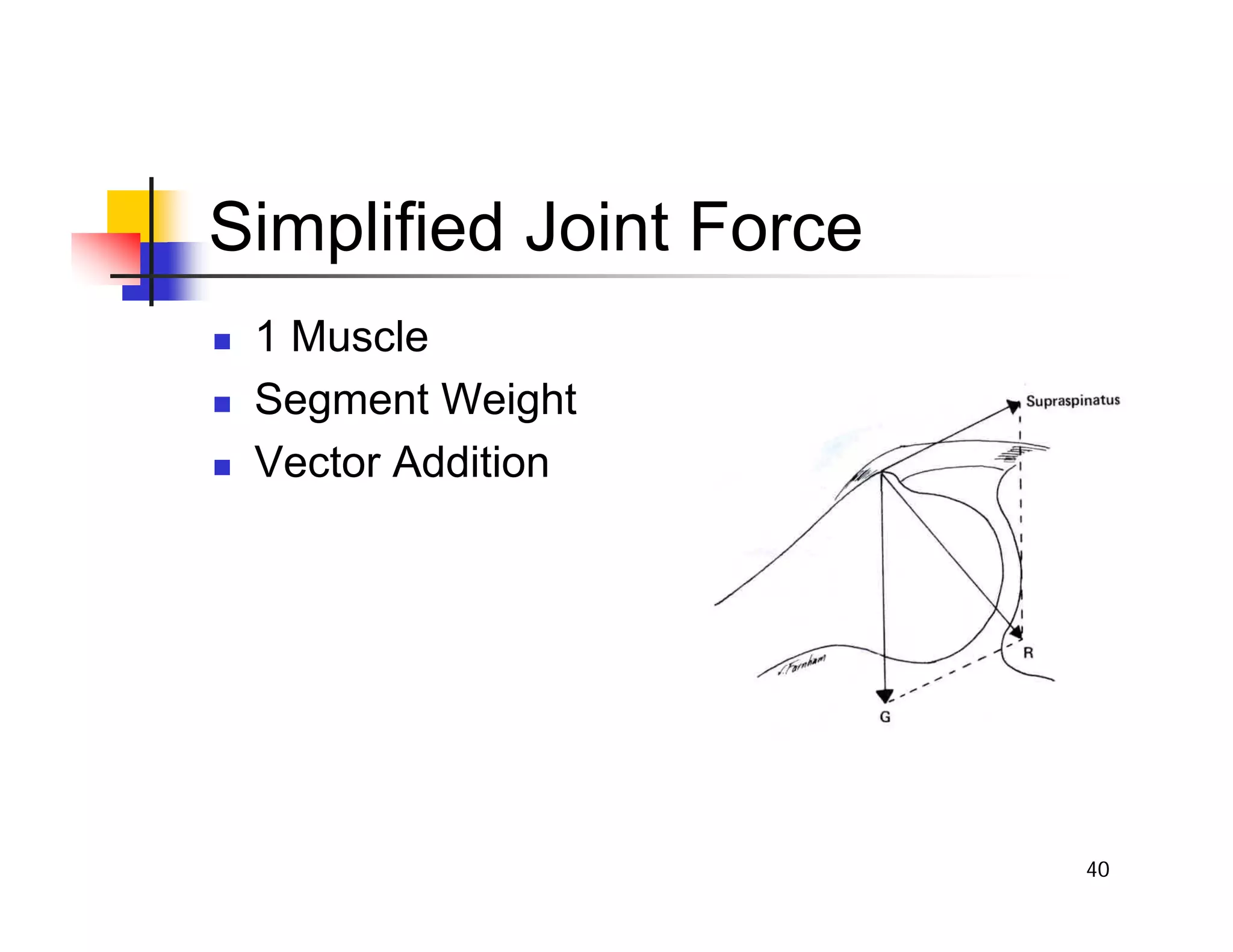
Simplified Joint Force
„ 1 Muscle
„ Segment Weight
„ Vector Addition
41
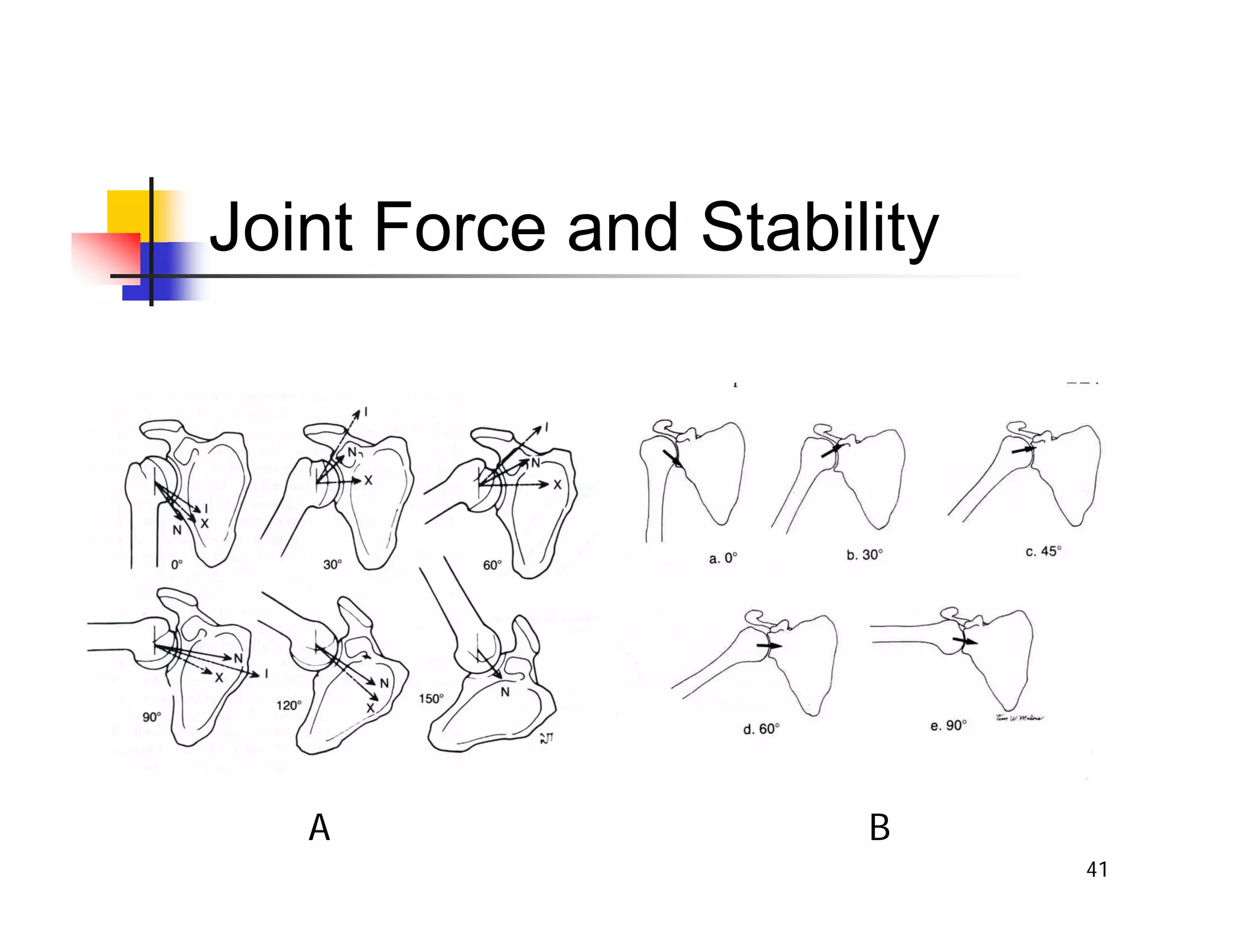
Joint Force and Stability
A B
42
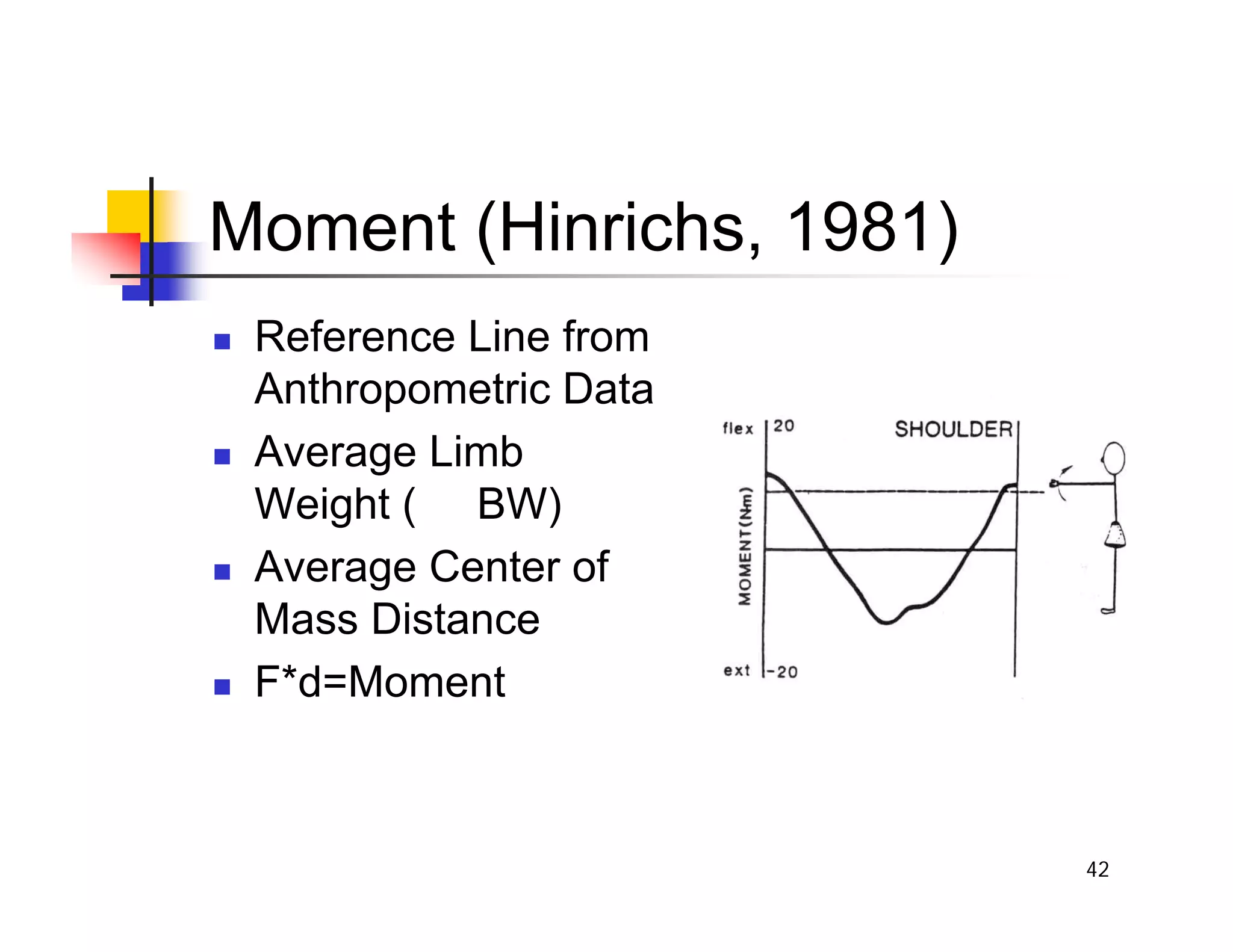
Moment (Hinrichs, 1981)
„ Reference Line from
Anthropometric Data
„ Average Limb
Weight ( BW)
„ Average Center of
Mass Distance
„ F*d=Moment
43
Outline
„ Anatomy
„ Biomechanics
„ Problems
44
Problem #1 (1-D)
„ ΣM=0
45
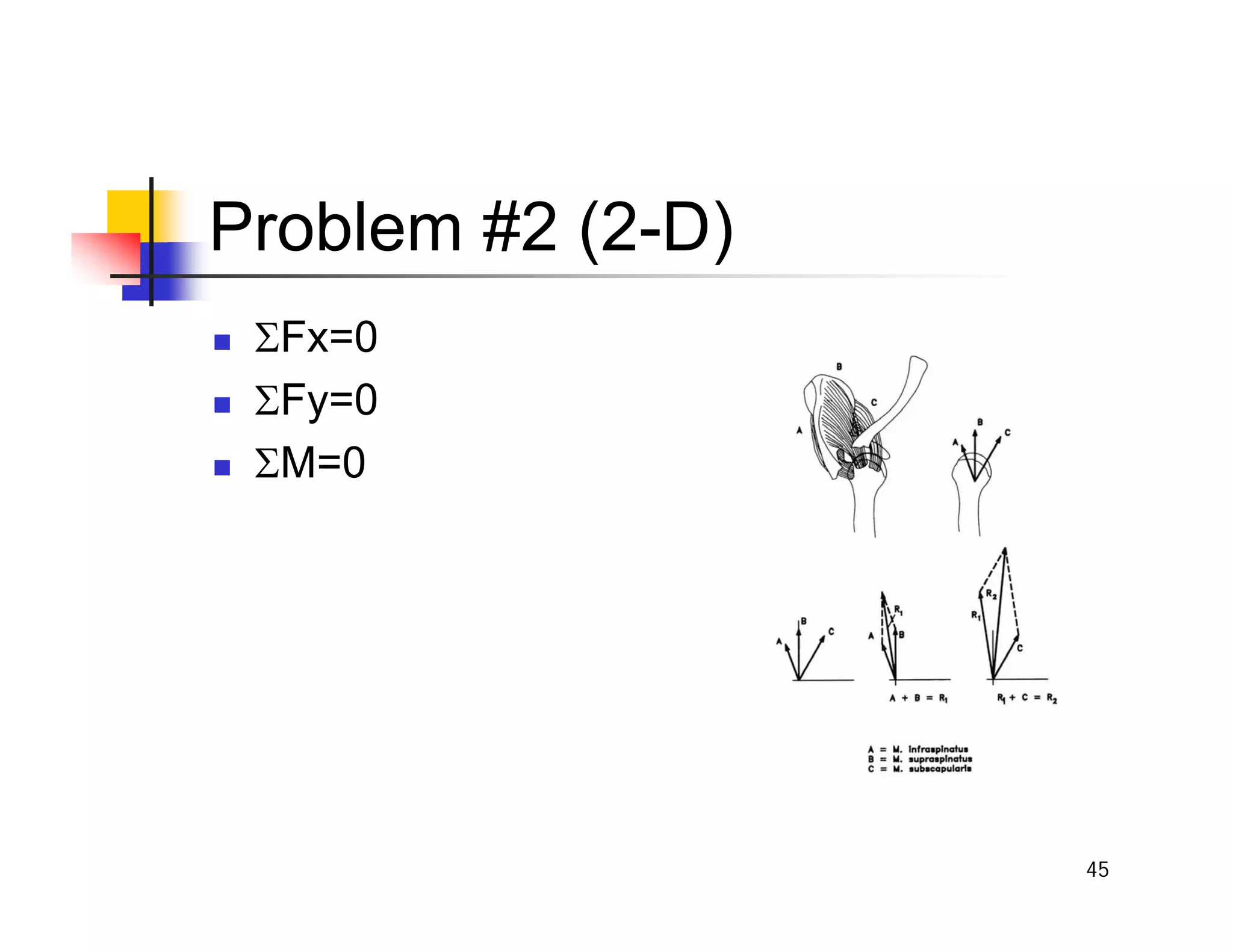
Problem #2 (2-D)
„ ΣFx=0
„ ΣFy=0
„ ΣM=0
46
Problem #3 (3-D)
„ ΣFx=0
„ ΣFy=0
„ ΣFz=0
„ ΣM=0

Shoulder_notes_1perpage.pdf