

PRESENTED BY:
Taniya Kharbanda
Karishma Punj
A

sales territory is a grouping of customers
and prospects assigned to an individual
salesperson
 To

obtain thorough coverage of the market.
 To establish a salesperson’s responsibility.
 To evaluate performance.
 To improve customer relations.
 To reduce sales expense.
 To allow better matching of salesperson to
customer.
 To benefit salespeople and the company.
 Salespeople

may be more motivated if they
are not restricted.
 The company may be too small.
 Management may not want to take the time,
or have the know-how.
 Personal friendship may be the basis for
attracting customers.
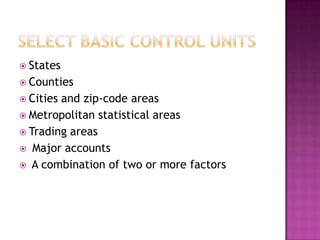
 States
 Counties
 Cities

and zip-code areas
 Metropolitan statistical areas
 Trading areas
 Major accounts
 A combination of two or more factors
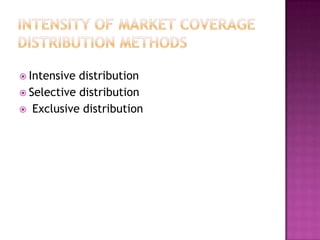
 Intensive

distribution
 Selective distribution
 Exclusive distribution
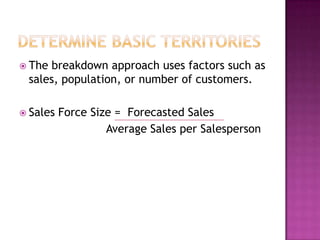
 The

breakdown approach uses factors such as
sales, population, or number of customers.

 Sales

Force Size = Forecasted Sales
Average Sales per Salesperson
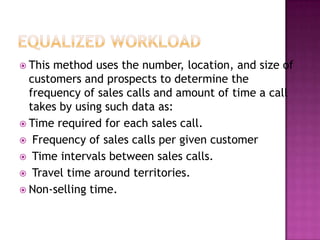
 This

method uses the number, location, and size of
customers and prospects to determine the
frequency of sales calls and amount of time a call
takes by using such data as:
 Time required for each sales call.
 Frequency of sales calls per given customer
 Time intervals between sales calls.
 Travel time around territories.
 Non-selling time.
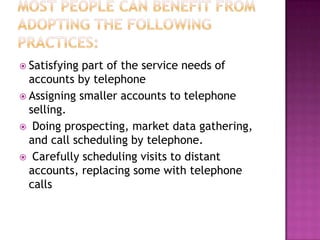
 Satisfying

part of the service needs of
accounts by telephone
 Assigning smaller accounts to telephone
selling.
 Doing prospecting, market data gathering,
and call scheduling by telephone.
 Carefully scheduling visits to distant
accounts, replacing some with telephone
calls
Sales territory

Sales territory

  • 1.
  • 2.
    A sales territory isa grouping of customers and prospects assigned to an individual salesperson
  • 3.
     To obtain thoroughcoverage of the market.  To establish a salesperson’s responsibility.  To evaluate performance.  To improve customer relations.  To reduce sales expense.  To allow better matching of salesperson to customer.  To benefit salespeople and the company.
  • 4.
     Salespeople may bemore motivated if they are not restricted.  The company may be too small.  Management may not want to take the time, or have the know-how.  Personal friendship may be the basis for attracting customers.
  • 6.
     States  Counties Cities and zip-code areas  Metropolitan statistical areas  Trading areas  Major accounts  A combination of two or more factors
  • 7.
     Intensive distribution  Selectivedistribution  Exclusive distribution
  • 8.
     The breakdown approachuses factors such as sales, population, or number of customers.  Sales Force Size = Forecasted Sales Average Sales per Salesperson
  • 10.
     This method usesthe number, location, and size of customers and prospects to determine the frequency of sales calls and amount of time a call takes by using such data as:  Time required for each sales call.  Frequency of sales calls per given customer  Time intervals between sales calls.  Travel time around territories.  Non-selling time.
  • 15.
     Satisfying part ofthe service needs of accounts by telephone  Assigning smaller accounts to telephone selling.  Doing prospecting, market data gathering, and call scheduling by telephone.  Carefully scheduling visits to distant accounts, replacing some with telephone calls