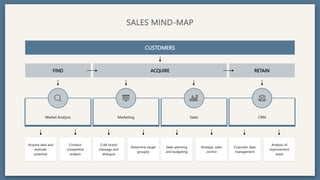
SALES MIND-MAP
Market Analysis
Acquire data and
evaluate
potential
Conduct
competitive
analysis
Marketing
Craft brand
message and
dialogue
Determine target
group(s)
Sales
Sales planning
and budgeting
Strategic sales
control
CRM
Customer data
management
Analysis of
improvement
areas
FIND ACQUIRE RETAIN
CUSTOMERS
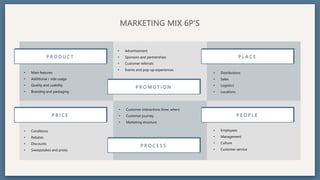
MARKETING MIX 6P’S
• Main features
• Additional / side usage
• Quality and usability
• Branding and packaging
• Conditions
• Rebates
• Discounts
• Sweepstakes and prizes
• Customer interactions (how, when)
• Customer journey
• Marketing structure
• Employees
• Management
• Culture
• Customer service
• Advertisement
• Sponsors and partnerships
• Customer referrals
• Events and pop-up experiences
• Distributions
• Sales
• Logistics
• Locations
P R O D U C T
P R O M O T I O N
P L A C E
P R I C E
P R O C E S S
P E O P L E
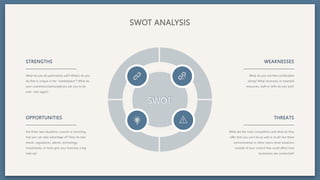
SWOT ANALYSIS
What do you do particularly well? What’s do you
do that is unique in the “marketplace”? What do
your customers/clients/patrons ask you to do
over over again?
STRENGTHS
Are there new situations, current or incoming,
that you can take advantage of? How do new
trends, regulations, talents, technology,
investments, or tools give your business a big
step up?
OPPORTUNITIES
What do you not feel comfortable
doing? What necessary or essential
resources, staff or skills do you lack?
WEAKNESSES
What are the main competitors and what do they
offer that you can’t do as well or at all? Are there
environmental or other macro-level situations
outside of your control that could affect how
businesses are conducted?
THREATS
SWOT
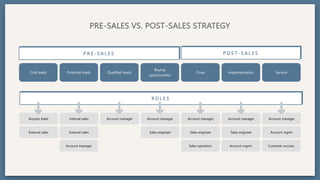
PRE-SALES VS. POST-SALES STRATEGY
Cold leads Potential leads Qualified leads
Buying
opportunities
Close Implementation Service
Acquire leads Internal sales Account manager Account manager Account manager Account manager Account manager
External sales External sales Sales engineer Sales engineer Sales engineer Account mgmt.
Account manager Sales operation Account mgmt. Customer success.
P R E - S A L E S P O S T - S A L E S
R O L E S
SALES
CYCLE
08
09 01
02
03
04
05
06
07
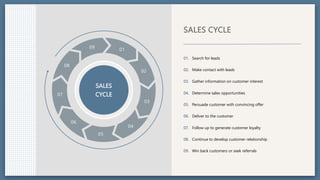
SALES CYCLE
09. Win back customers or seek referrals
01. Search for leads
02. Make contact with leads
03. Gather information on customer interest
04. Determine sales opportunities
05. Persuade customer with convincing offer
06. Deliver to the customer
07. Follow up to generate customer loyalty
08. Continue to develop customer relationship
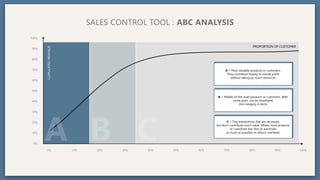
SALES CONTROL TOOL : ABC ANALYSIS
0%
10%
20%
30%
40%
50%
60%
70%
80%
90%
100%
0% 100%
10% 20% 30% 40% 50% 60% 70% 80% 90%
CUMULATED
REVENUE
PROPORTION OF CUSTOMER
A = Most valuable products or customers.
They contribute heavily to overall profit
without taking up much resources
B = Middle-of-the-road products or customers. With
some push, can be developed
into category A items
C = Tiny transactions that are necessary
but don’t contribute much value. Where most products
or customers live. Aim to automate
as much as possible to reduce overhead.
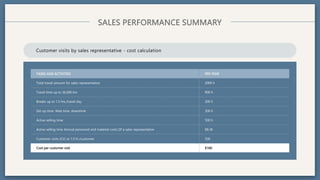
SALES PERFORMANCE SUMMARY
Customer visits by sales representative - cost calculation
TASKS AND ACTIVITIES PER YEAR
Total travel amount for sales representative 2000 h
Travel time up to 36,000 km 900 h
Breaks up to 1.5 hrs./travel day 300 h
Set-up time. Wait time, downtime 300 h
Active selling time 500 h
Active selling time Annual personnel and material costs Of a sales representative $8.3K
Customer visits (CV) at 1.0 hr./customer 500
Cost per customer visit $160

Sales Strategy.pptx

  • 1.
    SALES MIND-MAP Market Analysis Acquiredata and evaluate potential Conduct competitive analysis Marketing Craft brand message and dialogue Determine target group(s) Sales Sales planning and budgeting Strategic sales control CRM Customer data management Analysis of improvement areas FIND ACQUIRE RETAIN CUSTOMERS
  • 2.
    MARKETING MIX 6P’S •Main features • Additional / side usage • Quality and usability • Branding and packaging • Conditions • Rebates • Discounts • Sweepstakes and prizes • Customer interactions (how, when) • Customer journey • Marketing structure • Employees • Management • Culture • Customer service • Advertisement • Sponsors and partnerships • Customer referrals • Events and pop-up experiences • Distributions • Sales • Logistics • Locations P R O D U C T P R O M O T I O N P L A C E P R I C E P R O C E S S P E O P L E
  • 3.
    SWOT ANALYSIS What doyou do particularly well? What’s do you do that is unique in the “marketplace”? What do your customers/clients/patrons ask you to do over over again? STRENGTHS Are there new situations, current or incoming, that you can take advantage of? How do new trends, regulations, talents, technology, investments, or tools give your business a big step up? OPPORTUNITIES What do you not feel comfortable doing? What necessary or essential resources, staff or skills do you lack? WEAKNESSES What are the main competitors and what do they offer that you can’t do as well or at all? Are there environmental or other macro-level situations outside of your control that could affect how businesses are conducted? THREATS SWOT
  • 4.
    PRE-SALES VS. POST-SALESSTRATEGY Cold leads Potential leads Qualified leads Buying opportunities Close Implementation Service Acquire leads Internal sales Account manager Account manager Account manager Account manager Account manager External sales External sales Sales engineer Sales engineer Sales engineer Account mgmt. Account manager Sales operation Account mgmt. Customer success. P R E - S A L E S P O S T - S A L E S R O L E S
  • 5.
    SALES CYCLE 08 09 01 02 03 04 05 06 07 SALES CYCLE 09.Win back customers or seek referrals 01. Search for leads 02. Make contact with leads 03. Gather information on customer interest 04. Determine sales opportunities 05. Persuade customer with convincing offer 06. Deliver to the customer 07. Follow up to generate customer loyalty 08. Continue to develop customer relationship
  • 6.
    SALES CONTROL TOOL: ABC ANALYSIS 0% 10% 20% 30% 40% 50% 60% 70% 80% 90% 100% 0% 100% 10% 20% 30% 40% 50% 60% 70% 80% 90% CUMULATED REVENUE PROPORTION OF CUSTOMER A = Most valuable products or customers. They contribute heavily to overall profit without taking up much resources B = Middle-of-the-road products or customers. With some push, can be developed into category A items C = Tiny transactions that are necessary but don’t contribute much value. Where most products or customers live. Aim to automate as much as possible to reduce overhead.
  • 7.
    SALES PERFORMANCE SUMMARY Customervisits by sales representative - cost calculation TASKS AND ACTIVITIES PER YEAR Total travel amount for sales representative 2000 h Travel time up to 36,000 km 900 h Breaks up to 1.5 hrs./travel day 300 h Set-up time. Wait time, downtime 300 h Active selling time 500 h Active selling time Annual personnel and material costs Of a sales representative $8.3K Customer visits (CV) at 1.0 hr./customer 500 Cost per customer visit $160