Sales Management
Vinit Khandelwal
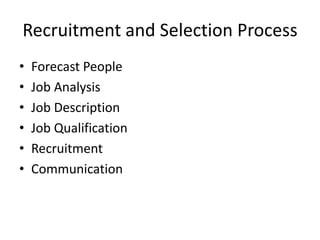
Recruitment and Selection Process
• Forecast People
• Job Analysis
• Job Description
• Job Qualification
• Recruitment
• Communication
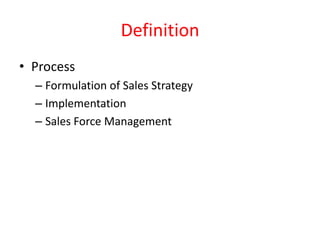
Definition
• Process
– Formulation of Sales Strategy
– Implementation
– Sales Force Management
Recruitment and Selection Process
• Number
• Job Description
• Sources
• Application form
• Interviewing
• Offer
Forecast People
• Plans
• Current Strength
• Promotions n Transfers
• Quits n Retirements
Job Analysis
• Duties and Responsibilities
• Activities
• Behaviour
of Sales Person
Preparation of Job Description
• Product/Service Nature
• Customer Type
• Frequency to contact
• Duties and Responsibilities
• Reporting Pattern
• Intellectual and Physical Demands
• Location and area
• Compensation
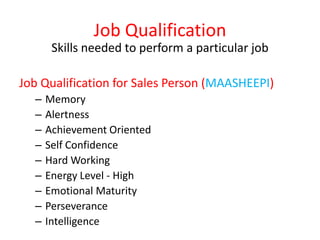
Job Qualification
Skills needed to perform a particular job
Job Qualification for Sales Person (MAASHEEPI)
– Memory
– Alertness
– Achievement Oriented
– Self Confidence
– Hard Working
– Energy Level - High
– Emotional Maturity
– Perseverance
– Intelligence
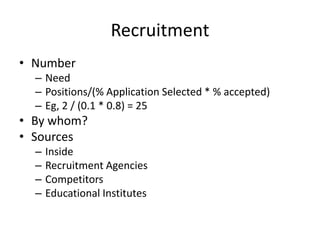
Recruitment
• Number
– Need
– Positions/(% Application Selected * % accepted)
– Eg, 2 / (0.1 * 0.8) = 25
• By whom?
• Sources
– Inside
– Recruitment Agencies
– Competitors
– Educational Institutes
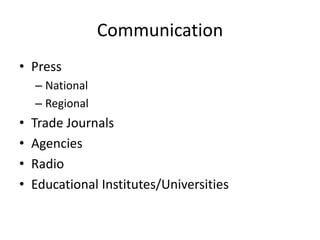
Communication
• Press
– National
– Regional
• Trade Journals
• Agencies
• Radio
• Educational Institutes/Universities
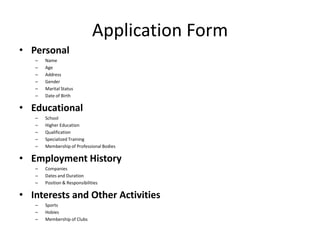
Application Form
• Personal
– Name
– Age
– Address
– Gender
– Marital Status
– Date of Birth
• Educational
– School
– Higher Education
– Qualification
– Specialized Training
– Membership of Professional Bodies
• Employment History
– Companies
– Dates and Duration
– Position & Responsibilities
• Interests and Other Activities
– Sports
– Hobies
– Membership of Clubs
Interview
• Tests
– Personality
– Intelligence
– Ability
– Aptitude
– Emotional Intelligence
• Interview
– Probes
– Silence
– Neutral Questions
Types of Interviews
• Structured
• Semi-Structured
• Group
• Panel
• Stress
• Field
Job Offer
• Formal Letter
• Deadline acceptance
• Salary Description
• Additional Facilities Description
• Training Schedule / Probation Period
• Performance Review Timeline
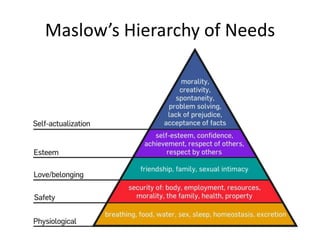
Maslow’s Hierarchy of Needs
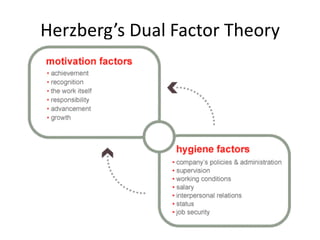
Herzberg’s Dual Factor Theory
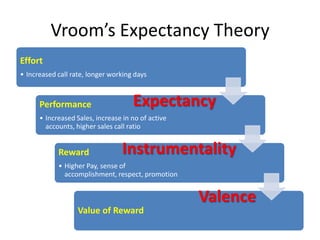
Vroom’s Expectancy Theory
Effort
• Increased call rate, longer working days
Performance
• Increased Sales, increase in no of active
accounts, higher sales call ratio
Reward
• Higher Pay, sense of
accomplishment, respect, promotion
Value of Reward
Expectancy
Instrumentality
Valence
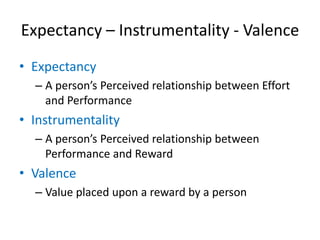
Expectancy – Instrumentality - Valence
• Expectancy
– A person’s Perceived relationship between Effort
and Performance
• Instrumentality
– A person’s Perceived relationship between
Performance and Reward
• Valence
– Value placed upon a reward by a person
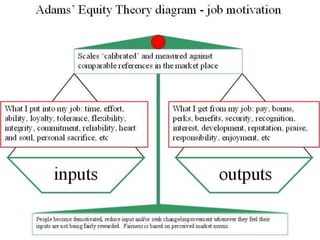
A Salesperson can feel inequity
• Monetary rewards
• Workload
• Promotion
• Degree of recognition
• Supervisory behaviour
• Targets
• Tasks
Motivation
• Monetary Incentives
• Quota
• Meetings
• Contests
• Employee Promotion
Training
• Performance Improvement
– Definite
– Fast
• Increased Output per Employee
• Reduced Recruitment and Selection Cost
• Improved Customer Relationship
Definition (SACK)
The effort an employer puts forth to provide
salespeople job-related
• Skills
• Attitudes
• Culture
• Knowledge
that should result in improved performance in
the selling environments
Why Train?
• Decreased Sales – Increase
• Customer Relationship Enhancement
• Reduce Cost
• Morale Boosting
• Time and Effort Efficiency
• New Sales Personnel
• Knowledge
• Feedback
Training Program (PACTMANS)
• Aim Where to reach
• Needs What is missing
• Contents What to add
• Method How
• Trainer Who
• Schedule When
• Place Where
• Aids Using what material
2. Training Needs
• Job Specifications
• Trainees’ background and experience
• Marketing Policies related to Sales
• Continuing Training Needs Identification
• Performance Measure
• Sales Volume
• Objectives of Organization
• Observation of Skills
3. Training Content
• Product Details
– Application
– Drawbacks
– Competitors
– Substitutes
• Sales Techniques
• Market Segments
– Demographical
– Geographical
– Psychological
• Company Details
– History
– Unions
– Competitors
– Image
– Policies
– Compensation
4. Methods (LCD COCRG)
1. Lecture
2. Case Study
3. Demonstration
4. Conferences
5. On the Job Training
6. Correspondence Courses
7. Role Playing
8. Group Discussions
5. Trainer – Who?
• Top Sales Executive
• Managers
– Assistant Sales Manager
– District Sales Manager
• Directors
– Personnel Director
– Sales Training Director
• Outside Experts
Evaluation
• Performance Against Standards
• Before and After
• Written Test
• Rating on Role Playing
• On the job observation
Key to Successful Selling
• Ask
• Share Product Information
• Compare
• Show Evidence
• Acknowledge Customer’s Viewpoint
• Comfort Customer
Knowledge
Product
1. Product Development History
2. Product Performance
3. Maintenance and Service Contracts
4. Price
5. Delivery
6. Quality
7. Cost-Benefit Analysis
Competition
1. Attitude towards Competition
2. SWOT
Knowledge
Company
1. Culture
2. Structure
3. Support for Product
4. Image
5. SWOT
Customer
1. Behavior
2. Response
3. Interest
Buyer’s Behavior
• Needs
• Motives
– Rational
• Quality
• Price
• Design
– Emotional
• Brand Preference
• Social factors
• Cultural factors
• Personal factors
Buyer’s Decision Making Process
• Need Recognition
• Information Search
• Evaluation of Alternatives
• Purchase Decision
• Post Purchase Behavior
– Satisfaction
– Dissatisfaction
Personal Selling Process
1. Opening
2. Need/Problem Identification
3. Presentation/Demonstration
4. Dealing with Objectives
5. Negotiations
6. Closing
7. Follow Up
Presentation/Demonstration
• Objectives
– Aware
– Persuade
– Remind
Important Points for Demonstration
• Customize
• Balance Verbal and Visual
• One Idea at a time
• Need to Desire to buy Conversion
• Purchasing Benefits – display
• Involve prospect
• Ask to check understanding
• Summarize imp points
• Re-emphasize purchase benefits
• Ask for Order/Further communication
QUOTAS
Types (PEAS C)
• Profit
– Gross Sales – COGS
– Net Sales – (COGS + Direct Expenses)
• Expense eg, 4% of sales
• Activity No of activities to be done
• Sales Volume eg, 1000 units in a month
• Combination
How Quotas are Set
• Forecast
• Forecast and Potential
• Past Experience
• Judgment
• Compensation equivalent
Administer Quota System
• Set Quota - Accurate, Fair & Attainable
• Acceptance by Salesperson
• Control
Purposes of Compensation
• Connect individual with Organisation
• Influence work behavior
• Organisational choice
• Influence satisfaction.
• Feedback on performance
• Reinforcement
Sales Force Compensation
Pay dissatisfaction may lead to
1. Poor performance
2. Absenteeism
3. Grievances
4. Job dissatisfaction
5. Increased Atteration
6. Psychological withdrawal
7. Stress anxiety
8. Poor mental health
Compensation Types
• Straight Salary
Advantages
– Sense of Security
– Simple to administer
– Projection of Compensation Expense is possible
Disadvantages
– Lacks Motivation
– Fixed Expense, Cannot reduce in bad times
When to use?
– More like delivery
– Pre-sales and post-sales services major part
– Team oriented Sales efforts
Compensation Types
• Straight Commission
Types
– Amount per sales
– %age of Sales amount
– Level Changing amount
Advantages
– Motivation
– Sense of Achievement
– Selling cost in proportion to sales
Disadvantages
– Uncertainty of Sales
– Salesperson pressurize customer for sales
– Reluctances in transfers
When to use?
– Low Expense affordability
– High Convincing Job
Compensation Types
• Combination
Design
– Able to live on Salary alone
– Top performer: 25%-50% of salary
– Commission (as per sales)
or Bonus (as per sales and time)
– Set lower and upper Limit
– Consider profitability
CRM Cycle
• Customer Need and Acquisition
• Customer Development through
Personalization and Customization
• Customer Equity through cross selling and up
selling

Sales management

  • 1.
  • 2.
    Recruitment and SelectionProcess • Forecast People • Job Analysis • Job Description • Job Qualification • Recruitment • Communication
  • 3.
    Definition • Process – Formulationof Sales Strategy – Implementation – Sales Force Management
  • 4.
    Recruitment and SelectionProcess • Number • Job Description • Sources • Application form • Interviewing • Offer
  • 5.
    Forecast People • Plans •Current Strength • Promotions n Transfers • Quits n Retirements
  • 6.
    Job Analysis • Dutiesand Responsibilities • Activities • Behaviour of Sales Person
  • 7.
    Preparation of JobDescription • Product/Service Nature • Customer Type • Frequency to contact • Duties and Responsibilities • Reporting Pattern • Intellectual and Physical Demands • Location and area • Compensation
  • 8.
    Job Qualification Skills neededto perform a particular job Job Qualification for Sales Person (MAASHEEPI) – Memory – Alertness – Achievement Oriented – Self Confidence – Hard Working – Energy Level - High – Emotional Maturity – Perseverance – Intelligence
  • 9.
    Recruitment • Number – Need –Positions/(% Application Selected * % accepted) – Eg, 2 / (0.1 * 0.8) = 25 • By whom? • Sources – Inside – Recruitment Agencies – Competitors – Educational Institutes
  • 10.
    Communication • Press – National –Regional • Trade Journals • Agencies • Radio • Educational Institutes/Universities
  • 11.
    Application Form • Personal –Name – Age – Address – Gender – Marital Status – Date of Birth • Educational – School – Higher Education – Qualification – Specialized Training – Membership of Professional Bodies • Employment History – Companies – Dates and Duration – Position & Responsibilities • Interests and Other Activities – Sports – Hobies – Membership of Clubs
  • 12.
    Interview • Tests – Personality –Intelligence – Ability – Aptitude – Emotional Intelligence • Interview – Probes – Silence – Neutral Questions
  • 13.
    Types of Interviews •Structured • Semi-Structured • Group • Panel • Stress • Field
  • 14.
    Job Offer • FormalLetter • Deadline acceptance • Salary Description • Additional Facilities Description • Training Schedule / Probation Period • Performance Review Timeline
  • 15.
  • 16.
  • 17.
    Vroom’s Expectancy Theory Effort •Increased call rate, longer working days Performance • Increased Sales, increase in no of active accounts, higher sales call ratio Reward • Higher Pay, sense of accomplishment, respect, promotion Value of Reward Expectancy Instrumentality Valence
  • 18.
    Expectancy – Instrumentality- Valence • Expectancy – A person’s Perceived relationship between Effort and Performance • Instrumentality – A person’s Perceived relationship between Performance and Reward • Valence – Value placed upon a reward by a person
  • 20.
    A Salesperson canfeel inequity • Monetary rewards • Workload • Promotion • Degree of recognition • Supervisory behaviour • Targets • Tasks
  • 21.
    Motivation • Monetary Incentives •Quota • Meetings • Contests • Employee Promotion
  • 22.
    Training • Performance Improvement –Definite – Fast • Increased Output per Employee • Reduced Recruitment and Selection Cost • Improved Customer Relationship
  • 23.
    Definition (SACK) The effortan employer puts forth to provide salespeople job-related • Skills • Attitudes • Culture • Knowledge that should result in improved performance in the selling environments
  • 24.
    Why Train? • DecreasedSales – Increase • Customer Relationship Enhancement • Reduce Cost • Morale Boosting • Time and Effort Efficiency • New Sales Personnel • Knowledge • Feedback
  • 25.
    Training Program (PACTMANS) •Aim Where to reach • Needs What is missing • Contents What to add • Method How • Trainer Who • Schedule When • Place Where • Aids Using what material
  • 26.
    2. Training Needs •Job Specifications • Trainees’ background and experience • Marketing Policies related to Sales • Continuing Training Needs Identification • Performance Measure • Sales Volume • Objectives of Organization • Observation of Skills
  • 27.
    3. Training Content •Product Details – Application – Drawbacks – Competitors – Substitutes • Sales Techniques • Market Segments – Demographical – Geographical – Psychological • Company Details – History – Unions – Competitors – Image – Policies – Compensation
  • 28.
    4. Methods (LCDCOCRG) 1. Lecture 2. Case Study 3. Demonstration 4. Conferences 5. On the Job Training 6. Correspondence Courses 7. Role Playing 8. Group Discussions
  • 29.
    5. Trainer –Who? • Top Sales Executive • Managers – Assistant Sales Manager – District Sales Manager • Directors – Personnel Director – Sales Training Director • Outside Experts
  • 30.
    Evaluation • Performance AgainstStandards • Before and After • Written Test • Rating on Role Playing • On the job observation
  • 31.
    Key to SuccessfulSelling • Ask • Share Product Information • Compare • Show Evidence • Acknowledge Customer’s Viewpoint • Comfort Customer
  • 32.
    Knowledge Product 1. Product DevelopmentHistory 2. Product Performance 3. Maintenance and Service Contracts 4. Price 5. Delivery 6. Quality 7. Cost-Benefit Analysis Competition 1. Attitude towards Competition 2. SWOT
  • 33.
    Knowledge Company 1. Culture 2. Structure 3.Support for Product 4. Image 5. SWOT Customer 1. Behavior 2. Response 3. Interest
  • 34.
    Buyer’s Behavior • Needs •Motives – Rational • Quality • Price • Design – Emotional • Brand Preference • Social factors • Cultural factors • Personal factors
  • 35.
    Buyer’s Decision MakingProcess • Need Recognition • Information Search • Evaluation of Alternatives • Purchase Decision • Post Purchase Behavior – Satisfaction – Dissatisfaction
  • 36.
    Personal Selling Process 1.Opening 2. Need/Problem Identification 3. Presentation/Demonstration 4. Dealing with Objectives 5. Negotiations 6. Closing 7. Follow Up
  • 37.
  • 38.
    Important Points forDemonstration • Customize • Balance Verbal and Visual • One Idea at a time • Need to Desire to buy Conversion • Purchasing Benefits – display • Involve prospect • Ask to check understanding • Summarize imp points • Re-emphasize purchase benefits • Ask for Order/Further communication
  • 39.
    QUOTAS Types (PEAS C) •Profit – Gross Sales – COGS – Net Sales – (COGS + Direct Expenses) • Expense eg, 4% of sales • Activity No of activities to be done • Sales Volume eg, 1000 units in a month • Combination
  • 40.
    How Quotas areSet • Forecast • Forecast and Potential • Past Experience • Judgment • Compensation equivalent
  • 41.
    Administer Quota System •Set Quota - Accurate, Fair & Attainable • Acceptance by Salesperson • Control
  • 42.
    Purposes of Compensation •Connect individual with Organisation • Influence work behavior • Organisational choice • Influence satisfaction. • Feedback on performance • Reinforcement
  • 43.
    Sales Force Compensation Paydissatisfaction may lead to 1. Poor performance 2. Absenteeism 3. Grievances 4. Job dissatisfaction 5. Increased Atteration 6. Psychological withdrawal 7. Stress anxiety 8. Poor mental health
  • 44.
    Compensation Types • StraightSalary Advantages – Sense of Security – Simple to administer – Projection of Compensation Expense is possible Disadvantages – Lacks Motivation – Fixed Expense, Cannot reduce in bad times When to use? – More like delivery – Pre-sales and post-sales services major part – Team oriented Sales efforts
  • 45.
    Compensation Types • StraightCommission Types – Amount per sales – %age of Sales amount – Level Changing amount Advantages – Motivation – Sense of Achievement – Selling cost in proportion to sales Disadvantages – Uncertainty of Sales – Salesperson pressurize customer for sales – Reluctances in transfers When to use? – Low Expense affordability – High Convincing Job
  • 46.
    Compensation Types • Combination Design –Able to live on Salary alone – Top performer: 25%-50% of salary – Commission (as per sales) or Bonus (as per sales and time) – Set lower and upper Limit – Consider profitability
  • 47.
    CRM Cycle • CustomerNeed and Acquisition • Customer Development through Personalization and Customization • Customer Equity through cross selling and up selling