Motivation &
Evaluation
Sales Management
Compiled & Presented By:
Anuj Sharma
Text Book: Fundamentals of Selling –
Customers for life through services by
Charles M. Futrell (12th Edition)
Pre-Class Reading – Chapter 17 Presented to the students of Tolani
Institute of Management Studies
Motivation of the Sales Force
 Motivation of the individual salesperson
 Motivation of the entire sales force
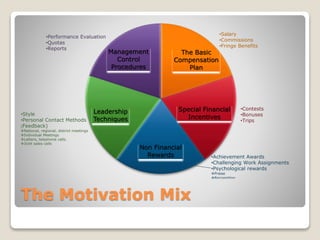
The Motivation Mix
The Basic
Compensation
Plan
Special Financial
Incentives
Non Financial
Rewards
Leadership
Techniques
Management
Control
Procedures
•Salary
•Commissions
•Fringe Benefits
•Contests
•Bonuses
•Trips
•Achievement Awards
•Challenging Work Assignments
•Psychological rewards
Praise
Recognition
•Style
•Personal Contact Methods
(Feedback)
National, regional, district meetings
Individual Meetings
Letters, telephone calls.
Joint sales calls
•Performance Evaluation
•Quotas
•Reports
Compensation is more than money
 Direct Financial Rewards
 Career Advancement
 Nonfinancial compensation
Straight Salary Plans
 Advantages to Salesperson
◦ Provides a sense of security
◦ Preferred by new recruits & inexperienced salespeople
 Advantages to Management
◦ Simple & Economical to administer
◦ Can give selling duties that may not immediately result
in sales
◦ Less resistance to reassignment of accounts
◦ Salespeople less likely to pressure customers
◦ Better sales cost projection and budgeting
Straight Salary Plans
 Disadvantages
◦ Lack of direct monetary incentive
◦ No difference between high & low performers
◦ Lower work norms
◦ Average job – Meet or not greatly exceed sales quotas
◦ Salary a fixed expense – Cannot be adjusted for
downturns in economy
Straight Salary Plans
 When to use?
◦ Jobs involving non selling activities
◦ Performance evaluation is difficult
◦ Routine selling jobs
◦ Jobs requiring lengthy pre-sale negotiations and post-
sale services
◦ During training – Salary first year and then commission
Commission Plans
 Straight Commission Plan
◦ If you do not sell anything, you do not earn anything
◦ Single commission rates
◦ Multiple commission rates
◦ Progressive
◦ Regressive
◦ Drawing Accounts
Commission Plans
 Advantages to Salesperson
◦ Maximum incentive for salespeople
◦ Salespeople use their sales time wisely
◦ Perform at maximum capacity
◦ Only their abilities limit earning potential
◦ Management cannot make arbitrary earning decisions
◦ They are in business for themselves
 Advantages to Management
◦ Selling costs are kept in proportion to sales
◦ Helpful for a new firm or a start-up
Commission Plans
 Disadvantages
◦ Discourages people from seeking sales careers
◦ Not feasible for “Big Ticket” Sales
◦ Salespeople develop little loyalty for company
◦ Use high pressure techniques to close sales
◦ Reluctant to split territories
◦ Issues in customer selection
◦ Cost of sales may be greater
◦ Salespeople are hired without proper selection
 Administrative Problems
◦ Multiple Salespeople – Fair distribution of commission
◦ Bad debts on sale accounts
Combination Plans
 Salary & Commission
 Salary & Bonus – Individual or Group
 Salary, commission and bonus
Combination Plans
 Advantages
◦ Motivates the sales force
◦ Attracts and holds good people
◦ Can direct the salesforce in profitable direction
Bonus – Individual or Group
 Across-the-board bonus
 Performance Bonus
 Sales Contests
Nonfinancial Rewards
 Achievement or Recognition Awards
 Transfer to larger, more challenging
territories
 Promoted to key account managers
 Sales manager’s praise
Leadership
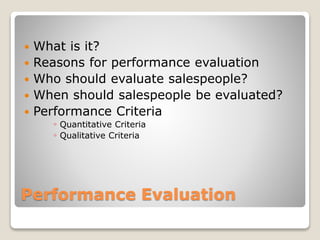
Performance Evaluation
 What is it?
 Reasons for performance evaluation
 Who should evaluate salespeople?
 When should salespeople be evaluated?
 Performance Criteria
◦ Quantitative Criteria
◦ Qualitative Criteria
Conducting the Evaluation Session
 Both manager & salesperson should be
prepared
 Be Positive
 Actually Review Performance
 Finalize the Performance Evaluation
 Summarize the Total Performance Evaluation
 Develop Mutually Agreed-on Objectives
 Formalize evaluation and Objectives
Sales Management Quiz
1A – Communication is a major problem
1B – Communication is a symptom of other
issues.
Sales Management Quiz
2A – Words are more important than
actions
2B – Actions are more important than
words
Sales Management Quiz
3A – Listening is more important than
telling
3B – Telling is more important than
listening
Sales Management Quiz
4A – Human Relations is more important
than logic
4B – Logic is more important than listening
Sales Management Quiz
5A – Effective communication is persuasive
5B – Effective communication is
understanding
Sales Management Quiz
6A – Disagreements represent
communication problems
6B – Disagreements represent conflict
problems
Sales Management Quiz - Results
1B
2B
3A
4A
5B
6B
Score of 40 or more – You have an effective
communication philosophy
Thank You!!!
25
 Grazie
 Gracias
 Domo Arigato
 Merci
 Danke
 Obrigado
 Mahalo
 शुक्रिया

Motivation & Evaluation

  • 1.
    Motivation & Evaluation Sales Management Compiled& Presented By: Anuj Sharma Text Book: Fundamentals of Selling – Customers for life through services by Charles M. Futrell (12th Edition) Pre-Class Reading – Chapter 17 Presented to the students of Tolani Institute of Management Studies
  • 2.
    Motivation of theSales Force  Motivation of the individual salesperson  Motivation of the entire sales force
  • 3.
    The Motivation Mix TheBasic Compensation Plan Special Financial Incentives Non Financial Rewards Leadership Techniques Management Control Procedures •Salary •Commissions •Fringe Benefits •Contests •Bonuses •Trips •Achievement Awards •Challenging Work Assignments •Psychological rewards Praise Recognition •Style •Personal Contact Methods (Feedback) National, regional, district meetings Individual Meetings Letters, telephone calls. Joint sales calls •Performance Evaluation •Quotas •Reports
  • 4.
    Compensation is morethan money  Direct Financial Rewards  Career Advancement  Nonfinancial compensation
  • 5.
    Straight Salary Plans Advantages to Salesperson ◦ Provides a sense of security ◦ Preferred by new recruits & inexperienced salespeople  Advantages to Management ◦ Simple & Economical to administer ◦ Can give selling duties that may not immediately result in sales ◦ Less resistance to reassignment of accounts ◦ Salespeople less likely to pressure customers ◦ Better sales cost projection and budgeting
  • 6.
    Straight Salary Plans Disadvantages ◦ Lack of direct monetary incentive ◦ No difference between high & low performers ◦ Lower work norms ◦ Average job – Meet or not greatly exceed sales quotas ◦ Salary a fixed expense – Cannot be adjusted for downturns in economy
  • 7.
    Straight Salary Plans When to use? ◦ Jobs involving non selling activities ◦ Performance evaluation is difficult ◦ Routine selling jobs ◦ Jobs requiring lengthy pre-sale negotiations and post- sale services ◦ During training – Salary first year and then commission
  • 8.
    Commission Plans  StraightCommission Plan ◦ If you do not sell anything, you do not earn anything ◦ Single commission rates ◦ Multiple commission rates ◦ Progressive ◦ Regressive ◦ Drawing Accounts
  • 9.
    Commission Plans  Advantagesto Salesperson ◦ Maximum incentive for salespeople ◦ Salespeople use their sales time wisely ◦ Perform at maximum capacity ◦ Only their abilities limit earning potential ◦ Management cannot make arbitrary earning decisions ◦ They are in business for themselves  Advantages to Management ◦ Selling costs are kept in proportion to sales ◦ Helpful for a new firm or a start-up
  • 10.
    Commission Plans  Disadvantages ◦Discourages people from seeking sales careers ◦ Not feasible for “Big Ticket” Sales ◦ Salespeople develop little loyalty for company ◦ Use high pressure techniques to close sales ◦ Reluctant to split territories ◦ Issues in customer selection ◦ Cost of sales may be greater ◦ Salespeople are hired without proper selection  Administrative Problems ◦ Multiple Salespeople – Fair distribution of commission ◦ Bad debts on sale accounts
  • 11.
    Combination Plans  Salary& Commission  Salary & Bonus – Individual or Group  Salary, commission and bonus
  • 12.
    Combination Plans  Advantages ◦Motivates the sales force ◦ Attracts and holds good people ◦ Can direct the salesforce in profitable direction
  • 13.
    Bonus – Individualor Group  Across-the-board bonus  Performance Bonus  Sales Contests
  • 14.
    Nonfinancial Rewards  Achievementor Recognition Awards  Transfer to larger, more challenging territories  Promoted to key account managers  Sales manager’s praise
  • 15.
  • 16.
    Performance Evaluation  Whatis it?  Reasons for performance evaluation  Who should evaluate salespeople?  When should salespeople be evaluated?  Performance Criteria ◦ Quantitative Criteria ◦ Qualitative Criteria
  • 17.
    Conducting the EvaluationSession  Both manager & salesperson should be prepared  Be Positive  Actually Review Performance  Finalize the Performance Evaluation  Summarize the Total Performance Evaluation  Develop Mutually Agreed-on Objectives  Formalize evaluation and Objectives
  • 18.
    Sales Management Quiz 1A– Communication is a major problem 1B – Communication is a symptom of other issues.
  • 19.
    Sales Management Quiz 2A– Words are more important than actions 2B – Actions are more important than words
  • 20.
    Sales Management Quiz 3A– Listening is more important than telling 3B – Telling is more important than listening
  • 21.
    Sales Management Quiz 4A– Human Relations is more important than logic 4B – Logic is more important than listening
  • 22.
    Sales Management Quiz 5A– Effective communication is persuasive 5B – Effective communication is understanding
  • 23.
    Sales Management Quiz 6A– Disagreements represent communication problems 6B – Disagreements represent conflict problems
  • 24.
    Sales Management Quiz- Results 1B 2B 3A 4A 5B 6B Score of 40 or more – You have an effective communication philosophy
  • 25.
    Thank You!!! 25  Grazie Gracias  Domo Arigato  Merci  Danke  Obrigado  Mahalo  शुक्रिया