The Sales Cycle Supporting website The Sales Cycle http://flickr.com/photos/meanestindian/2151907298/ http://flickr.com/photos/meanestindian/2151907298/
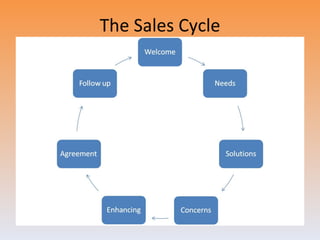
The Sales Cycle
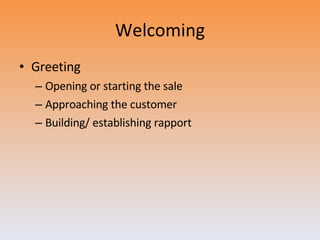
Welcoming Greeting Opening or starting the sale Approaching the customer Building/ establishing rapport
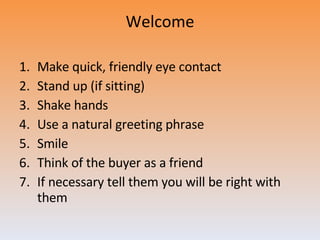
Welcome Make quick, friendly eye contact Stand up (if sitting) Shake hands Use a natural greeting phrase Smile Think of the buyer as a friend If necessary tell them you will be right with them
Welcome Invite them to sit down Use the client’s name Use the most powerful word Echo their words, mirror their mood Professional Appearance and Environment
Determining Needs Questioning Probing Assessing the situation Gathering information Obtaining information Uncovering needs
Determining Needs You meet someone from out of town and they ask “Where should I have dinner”. What would you recommend?
Determining Needs Did you provide a recommendation? If you did how did you know what this person would like? What questions should you have asked?
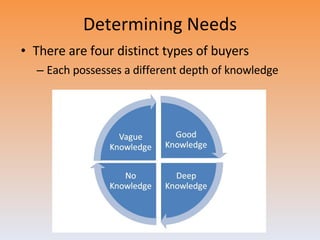
Determining Needs There are four distinct types of buyers Each possesses a different depth of knowledge
Buyers Don’t take it for granted that a client with a good or deep knowledge knows everything Take this test and see how much you know
Assumptions a well-informed client might have Answer the following questions: A direct flight and a non-stop flight are the same thing – True or False Adjoining rooms in a hotel have a door between them – True or False If you’re on a “hosted tour”, a tour manager will take care of your needs – True or False An intermediate care is usually the same as a mid-size car – True or False
Assumptions Hawaii is rainiest in summer – True or False A cruise ship’s inside staterooms don’t have windows – True or False Airplanes take people faster from city to city than trains do – True or False Car rentals always cost more if you pick up in one city and drop off in another – True or False
Determining Needs Regardless of how good their knowledge is You should spend a little time exploring what and where the client’s knowledge has come from eg. friends, internet, personal experience In tourism you should try to apply a consultative technique of selling (needs and desires) As probing questions – form a relationship
Determining Needs Now you have ascertained their knowledge base – just what kind of clients are they: A shopper A browser Or a buyer
Determining Needs Shopper Usually know what they want and are looking for a good deal Strategies for dealing with them Fear based closing tactic – “these reservations may not last” Muddy the waters – offer alternatives the client may not have considered Match the best price they have received Ask qualifying questions – shows you care makes you stand out from the other salespeople Offer to make a reservation without immediate financial commitment
Determining Needs Browser Don’t really know what they want Require a lot of personal attention Divulge lots of personal information to you May not be too serious about their trip or tour – now or ever Use careful but limited questioning to see if they can become a buyer
Determining Needs Buyer They definitely want to make a booking May have once been browsers or shoppers but now want to close the deal with you You must have impressed that client with your skills and careful question enough to make them come back to you
Recommending Solutions Presenting recommendations Delivering your ideas Linking solutions to needs Sharing knowledge Making a sales presentation Matching needs with products
Addressing Concerns Countering Objections Overcoming obstacles Handling objections Reducing resistance Providing reassurance Responding to concerns
Enhancing the Sale Upselling Cross selling Adding Value Making additional recommendations
Achieving an Agreement Closing Getting the business Earning a commitment Making the sale
Follow up Ensuring satisfaction Obtaining feedback Creating loyalty

Sales Cycle

  • 1.
    The Sales CycleSupporting website The Sales Cycle http://flickr.com/photos/meanestindian/2151907298/ http://flickr.com/photos/meanestindian/2151907298/
  • 2.
  • 3.
    Welcoming Greeting Openingor starting the sale Approaching the customer Building/ establishing rapport
  • 4.
    Welcome Make quick,friendly eye contact Stand up (if sitting) Shake hands Use a natural greeting phrase Smile Think of the buyer as a friend If necessary tell them you will be right with them
  • 5.
    Welcome Invite themto sit down Use the client’s name Use the most powerful word Echo their words, mirror their mood Professional Appearance and Environment
  • 6.
    Determining Needs QuestioningProbing Assessing the situation Gathering information Obtaining information Uncovering needs
  • 7.
    Determining Needs Youmeet someone from out of town and they ask “Where should I have dinner”. What would you recommend?
  • 8.
    Determining Needs Didyou provide a recommendation? If you did how did you know what this person would like? What questions should you have asked?
  • 9.
    Determining Needs Thereare four distinct types of buyers Each possesses a different depth of knowledge
  • 10.
    Buyers Don’t takeit for granted that a client with a good or deep knowledge knows everything Take this test and see how much you know
  • 11.
    Assumptions a well-informedclient might have Answer the following questions: A direct flight and a non-stop flight are the same thing – True or False Adjoining rooms in a hotel have a door between them – True or False If you’re on a “hosted tour”, a tour manager will take care of your needs – True or False An intermediate care is usually the same as a mid-size car – True or False
  • 12.
    Assumptions Hawaii israiniest in summer – True or False A cruise ship’s inside staterooms don’t have windows – True or False Airplanes take people faster from city to city than trains do – True or False Car rentals always cost more if you pick up in one city and drop off in another – True or False
  • 13.
    Determining Needs Regardlessof how good their knowledge is You should spend a little time exploring what and where the client’s knowledge has come from eg. friends, internet, personal experience In tourism you should try to apply a consultative technique of selling (needs and desires) As probing questions – form a relationship
  • 14.
    Determining Needs Nowyou have ascertained their knowledge base – just what kind of clients are they: A shopper A browser Or a buyer
  • 15.
    Determining Needs ShopperUsually know what they want and are looking for a good deal Strategies for dealing with them Fear based closing tactic – “these reservations may not last” Muddy the waters – offer alternatives the client may not have considered Match the best price they have received Ask qualifying questions – shows you care makes you stand out from the other salespeople Offer to make a reservation without immediate financial commitment
  • 16.
    Determining Needs BrowserDon’t really know what they want Require a lot of personal attention Divulge lots of personal information to you May not be too serious about their trip or tour – now or ever Use careful but limited questioning to see if they can become a buyer
  • 17.
    Determining Needs BuyerThey definitely want to make a booking May have once been browsers or shoppers but now want to close the deal with you You must have impressed that client with your skills and careful question enough to make them come back to you
  • 18.
    Recommending Solutions Presentingrecommendations Delivering your ideas Linking solutions to needs Sharing knowledge Making a sales presentation Matching needs with products
  • 19.
    Addressing Concerns CounteringObjections Overcoming obstacles Handling objections Reducing resistance Providing reassurance Responding to concerns
  • 20.
    Enhancing the SaleUpselling Cross selling Adding Value Making additional recommendations
  • 21.
    Achieving an AgreementClosing Getting the business Earning a commitment Making the sale
  • 22.
    Follow up Ensuringsatisfaction Obtaining feedback Creating loyalty