Blue Wisdom
Business Management Pvt. Ltd.
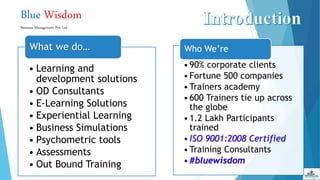
• Learning and
development solutions
• OD Consultants
• E-Learning Solutions
• Experiential Learning
• Business Simulations
• Psychometric tools
• Assessments
• Out Bound Training
What we do…
•90% corporate clients
•Fortune 500 companies
•Trainers academy
•600 Trainers tie up across
the globe
•1.2 Lakh Participants
trained
•ISO 9001:2008 Certified
•Training Consultants
•#bluewisdom
Who We’re
Introduction
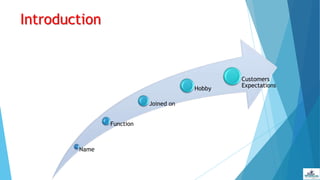
Name
Function
Joined on
Hobby
Customers
Expectations
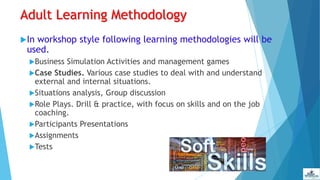
Adult Learning Methodology
In workshop style following learning methodologies will be
used.
Business Simulation Activities and management games
Case Studies. Various case studies to deal with and understand
external and internal situations.
Situations analysis, Group discussion
Role Plays. Drill & practice, with focus on skills and on the job
coaching.
Participants Presentations
Assignments
Tests
Individuals or Teams?
Team’s name
Captain
Slogan, Punch Line
50 Marks
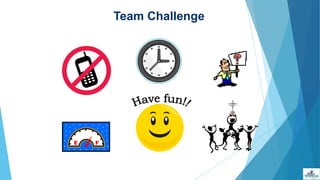
Team Challenge
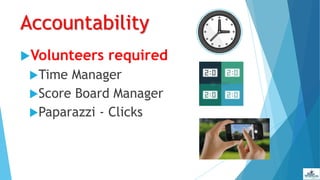
Accountability
Volunteers required
Time Manager
Score Board Manager
Paparazzi - Clicks
Expectation from the program
 Why are you here today?
 What you want to learn?
 What knowledge and skill you want to carry home today?
 What are the major challenges at work?
• What are the related Issues?
• How lack of skill effects performance?
Program objectives
Communication, Interpersonal, Presentation and
Reporting skills
Basic Leadership Skills, Proactivity, Team Building
Time Management, Prioritization & Stress Management
Customer Orientation
Selling Skills, Market Intelligence, Objection Handling,
Managing in adverse situations
Planning, Contingency Plans & Execution Skills

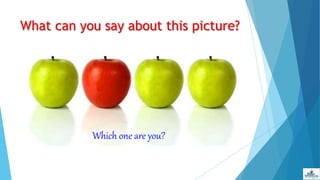
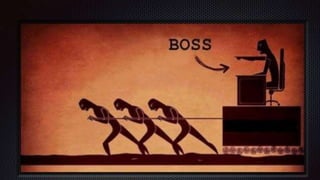
What can you say about this picture?
Which one are you?
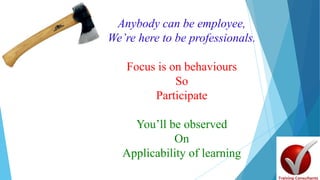
Anybody can be employee,
We’re here to be professionals.
Focus is on behaviours
So
Participate
You’ll be observed
On
Applicability of learning
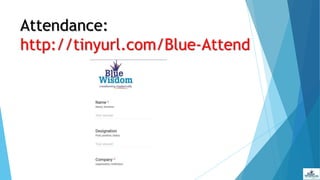
Attendance:
http://tinyurl.com/Blue-Attend
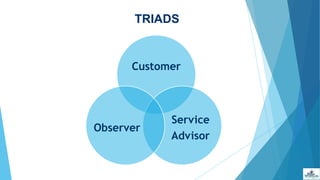
Customer
Service
Advisor
Observer
TRIADS
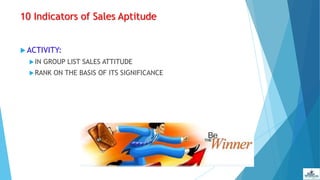
10 Indicators of Sales Aptitude
 ACTIVITY:
IN GROUP LIST SALES ATTITUDE
RANK ON THE BASIS OF ITS SIGNIFICANCE
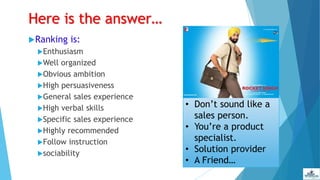
Here is the answer…
Ranking is:
Enthusiasm
Well organized
Obvious ambition
High persuasiveness
General sales experience
High verbal skills
Specific sales experience
Highly recommended
Follow instruction
sociability
• Don’t sound like a
sales person.
• You’re a product
specialist.
• Solution provider
• A Friend…
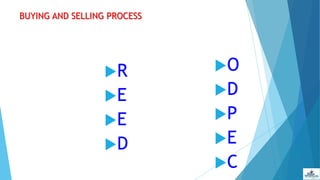
BUYING AND SELLING PROCESS
R
E
E
D
O
D
P
E
C
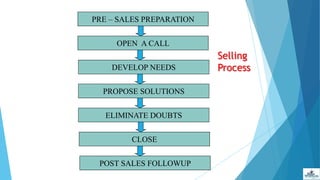
Selling
Process
OPEN A CALL
DEVELOP NEEDS
PROPOSE SOLUTIONS
ELIMINATE DOUBTS
CLOSE
PRE – SALES PREPARATION
POST SALES FOLLOWUP
My days schedule
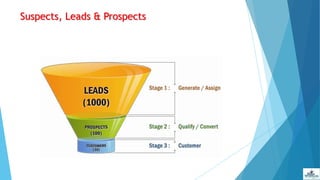
Suspects, Leads & Prospects
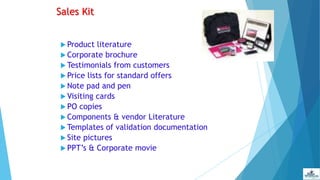
Sales Kit
 Product literature
 Corporate brochure
 Testimonials from customers
 Price lists for standard offers
 Note pad and pen
 Visiting cards
 PO copies
 Components & vendor Literature
 Templates of validation documentation
 Site pictures
 PPT’s & Corporate movie
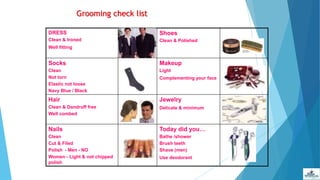
Grooming check list
DRESS
Clean & Ironed
Well fitting
Shoes
Clean & Polished
Socks
Clean
Not torn
Elastic not loose
Navy Blue / Black
Makeup
Light
Complementing your face
Hair
Clean & Dandruff free
Well combed
Jewelry
Delicate & minimum
Nails
Clean
Cut & Filed
Polish - Men - NO
Women - Light & not chipped
polish
Today did you…
Bathe /shower
Brush teeth
Shave (men)
Use deodorant
OPENING
&
DEVELOPING A CALL
Opening a Sales Call
 Greeting with a smile
 Welcome
 Self introduction
 Fact finding
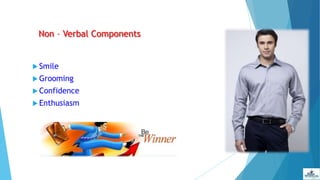
Non – Verbal Components
 Smile
 Grooming
 Confidence
 Enthusiasm
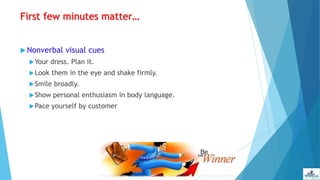
First few minutes matter…
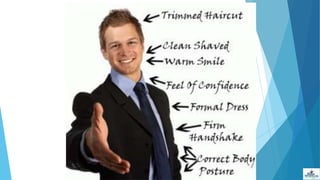
 Nonverbal visual cues
Your dress. Plan it.
Look them in the eye and shake firmly.
Smile broadly.
Show personal enthusiasm in body language.
Pace yourself by customer
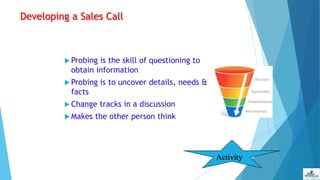
Developing a Sales Call
 Probing is the skill of questioning to
obtain information
 Probing is to uncover details, needs &
facts
 Change tracks in a discussion
 Makes the other person think
Activity
Ask Powerful Questions
 Develop a questioning strategy
 Prepare your questions
 Create high impact need dialogues
 Questions before answers
 Focus on how skillfully you ask questions
 And then….. Listen effectively.
 Listen to learn… Best sales persons are best listeners
“The question mark is the most important punctuation mark in sales
grammar”.
Proposing solution
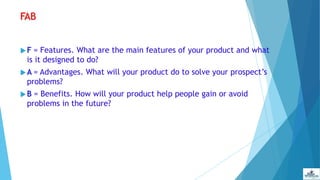
FAB
 F = Features. What are the main features of your product and what
is it designed to do?
 A = Advantages. What will your product do to solve your prospect’s
problems?
 B = Benefits. How will your product help people gain or avoid
problems in the future?
Eliminating Doubts
Objection Handling
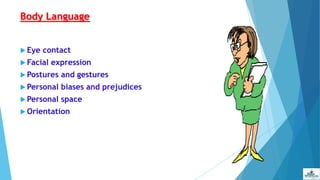
Concerns/Objections
Typically a natural part of any call
An opportunity for more dialogue
Helps both parties in buying process.
“this is a buying process”
Customer “indifference” is the killer
not active objections
Handling Objections
Listen
Agree/restate without prejudice
Get clear about the real issue
Discuss solutions
Ask for a commitment
Buying Signals And
Closing The Sale
Close a Sale
It is essential to close a sale by asking the
customer to purchase as:
The buyer needs a ‘push’ to make that final
commitment. She is comfortable postponing the
decision, due to apprehensions and is looking for
reassurance
You cannot go on selling when the customer is
ready to buy
You have been working for this firm commitment
from the buyer
Buying Signals
Buyer’s often indicate that they want to
buy what you are selling by giving
signals, instead of actually saying so
These signals are of two kinds :
Verbal signals
Non-verbal signals
Closing a Sale
Spot Buying Signals
Ask for Commitment to prescribe
The moment you have spotted clear buying signals,
you need to ask for a commitment to buy. This is called
CLOSING the sale
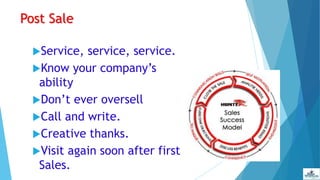
Post Sale
Service, service, service.
Know your company’s
ability
Don’t ever oversell
Call and write.
Creative thanks.
Visit again soon after first
Sales.
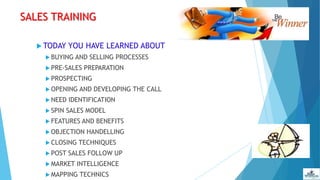
SALES TRAINING
 TODAY YOU HAVE LEARNED ABOUT
 BUYING AND SELLING PROCESSES
 PRE-SALES PREPARATION
 PROSPECTING
 OPENING AND DEVELOPING THE CALL
 NEED IDENTIFICATION
 SPIN SALES MODEL
 FEATURES AND BENEFITS
 OBJECTION HANDELLING
 CLOSING TECHNIQUES
 POST SALES FOLLOW UP
 MARKET INTELLIGENCE
 MAPPING TECHNICS
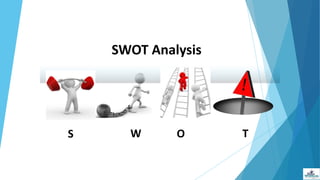
SWOT Analysis
S W O T
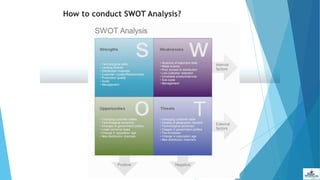
How to conduct SWOT Analysis?
51
What Is Customer Care?
 It is simply providing satisfaction by fulfilling customer’s
requirement/need consistently
 The customers get an impression of the company from the moment
of their contact with any representative of the company
 If what they perceive meets their expectations, then they would
be more than satisfied
52
What Is Customer Service?
 It is –
 Systems & Processes –Related to agreement of customer service
levels,customer grievances,etc
 Service Level Agreements – Arising due to interdependencies on
departments to resolve customer issues as per customer
expectations
 Customer Responsiveness – Turn around time as expected by the
customer and offered by the competition
 Reports & Analysis – To monitor and maintain the customer service
levels
53
Customer Care Vs Customer Service
 Customer Care is an attitude whereas Customer Service is
a process
 Customer Care is personality driven while Customer
Service is system and process driven
 Customer Care takes care of the immediate and short
term needs while Customer Service has long term
objectives
54
Why Customer Care?
 To maximize customer retention leading to an increase in
Sale
Service revenue
Profits
Earning
 To create or increase loyalty for your product/ brand or
service
55
Customer Care – The Critical Edge
 Competition has products and services similar to ours
 The personal element i.e. YOU are the differentiator
 You need to address the Emotional needs of customers
 Remember
Customers tell twice as many people about a bad experience
over a good one
In an average company’s 65% of its business comes from its
presently satisfied customers
Changing Dimensions
Yesterday
Today
Tomorrow
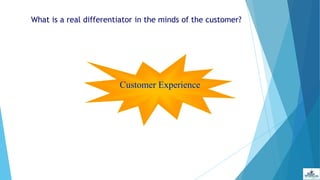
What is a real differentiator in the minds of the customer?
Customer Experience
Brand Loyalty
Brand Loyalty
Four levels:
• Devoted
• Delighted
• Satisfied
• Dissatisfied
Brand Loyalty - Facts……….
• A Delighted Customer refers to three others
• A Dis-satisfied Customer tells his experience to ten others
Critical Success Factors
• Knowledge
• Right Mental Attitude
• Approach
• Administrative skills, and
• Communication skills
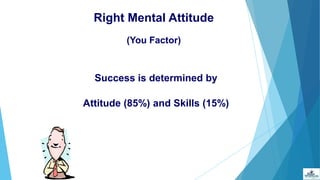
Right Mental Attitude
(You Factor)
Success is determined by
Attitude (85%) and Skills (15%)
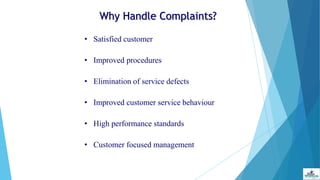
Why Handle Complaints?
• Satisfied customer
• Improved procedures
• Elimination of service defects
• Improved customer service behaviour
• High performance standards
• Customer focused management
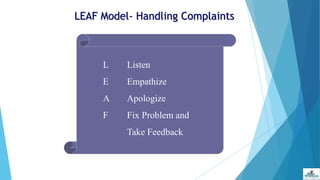
LEAF Model- Handling Complaints
L Listen
E Empathize
A Apologize
F Fix Problem and
Take Feedback
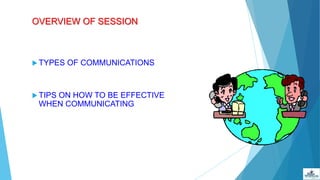
OVERVIEW OF SESSION
 TYPES OF COMMUNICATIONS
 TIPS ON HOW TO BE EFFECTIVE
WHEN COMMUNICATING
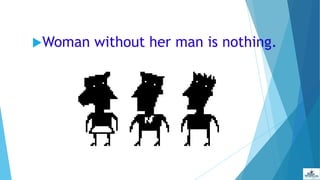
Woman without her man is nothing.
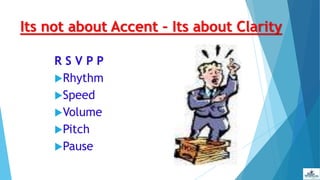
Its not about Accent – Its about Clarity
R S V P P
Rhythm
Speed
Volume
Pitch
Pause
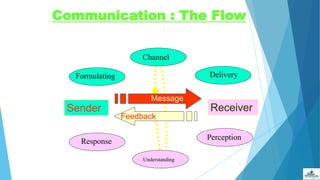
Communication : The Flow
71
Sender Receiver
Message
Feedback
Channel
Perception
DeliveryFormulating
Response
Understanding
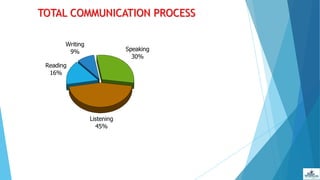
TOTAL COMMUNICATION PROCESS
Reading
16%
Writing
9% Speaking
30%
Listening
45%
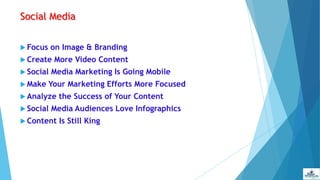
Social Media
 Focus on Image & Branding
 Create More Video Content
 Social Media Marketing Is Going Mobile
 Make Your Marketing Efforts More Focused
 Analyze the Success of Your Content
 Social Media Audiences Love Infographics
 Content Is Still King
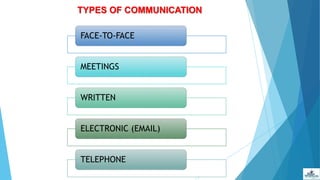
TYPES OF COMMUNICATION
FACE-TO-FACE
MEETINGS
WRITTEN
ELECTRONIC (EMAIL)
TELEPHONE
76
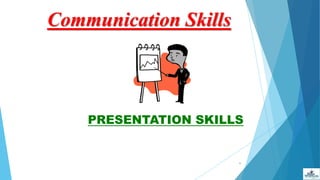
PRESENTATION SKILLS
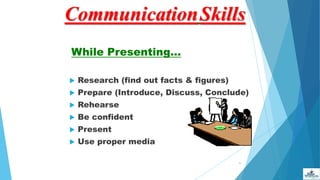
Communication Skills
 Research (find out facts & figures)
 Prepare (Introduce, Discuss, Conclude)
 Rehearse
 Be confident
 Present
 Use proper media
77
While Presenting…
CommunicationSkills
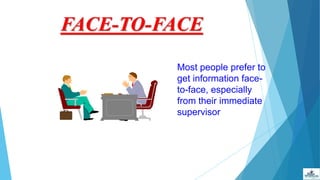
FACE-TO-FACE
Most people prefer to
get information face-
to-face, especially
from their immediate
supervisor
Communication is not over
when you finish delivering
your message
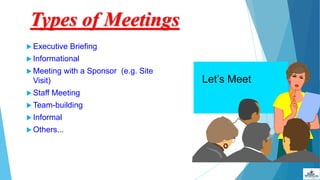
Types of Meetings
 Executive Briefing
 Informational
 Meeting with a Sponsor (e.g. Site
Visit)
 Staff Meeting
 Team-building
 Informal
 Others...
Let’s Meet
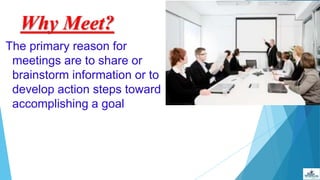
Why Meet?
The primary reason for
meetings are to share or
brainstorm information or to
develop action steps toward
accomplishing a goal
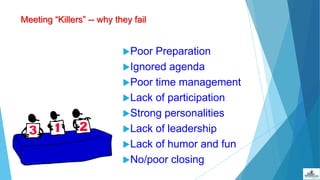
Meeting “Killers” -- why they fail
Poor Preparation
Ignored agenda
Poor time management
Lack of participation
Strong personalities
Lack of leadership
Lack of humor and fun
No/poor closing
WRITTEN COMMUNICATION
MEMOS
REPORTS
BULLETINS
LETTERS
NEWSLETTERS
HANDWRITTEN NOTES
The Benefits (written)
Creates a permanent record
Allows you to store information for future reference
Easily distributed
All recipients receive the same information
Necessary for legal and binding documentation
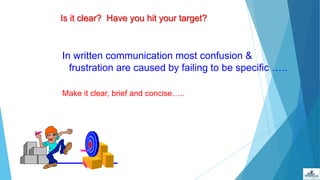
Is it clear? Have you hit your target?
In written communication most confusion &
frustration are caused by failing to be specific …..
Make it clear, brief and concise…..
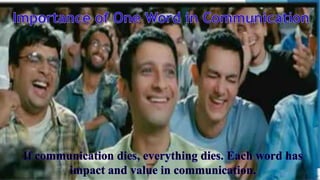
Single spelling mistake led to
divorce.
A man went to goa and sent sms 2 wife
"Having the most amazing and wonderful
time
I wish you were her."._,_.___
3 idiots
EMAIL ETIQUETTES
Email is now the dominant method
of communicating in business.
It is quick, inexpensive, flexible and
convenient
The biggest difference in
the quality of your email
messages is made by you
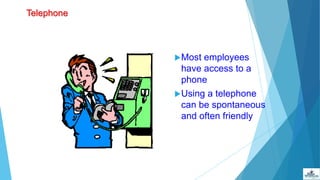
Telephone
Most employees
have access to a
phone
Using a telephone
can be spontaneous
and often friendly
Benefits
 Immediate access to audience
 Communication is direct and timely
 Takes advantage of tone of voice and language
 Allows for immediate response to questions, feedback, etc.
LISTENING SKILLS
91
Communication
Skills
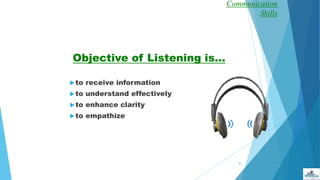
to receive information
to understand effectively
to enhance clarity
to empathize
92
Objective of Listening is…
Communication
Skills
5 Basic reasons we Do Not Listen
 Listening is Hard Work
 Competition
 The Rush for Action
 Speed differences (120 wpm v/s 360 wpm)
 Lack of Training
4 Levels of Listening
 The Non-Listener
 The Marginal Listener
 The Evaluative Listener
 The Active Listener
Improving Listening Skills
 By not being Preoccupied
 Being Open Minded & Non Defensive
 Minimizing Interruptions
 Effective Listening is: Hearing, interpreting when necessary,
understanding the message and relating to it.
 By Asking Questions
Communication
 Techniques
Define Acronyms
Reduce Jargon
Level Objections
Use Humor
Anecdotes and Stories
Ask for feedback
Increase your vocabulary
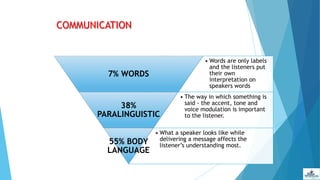
COMMUNICATION
• Words are only labels
and the listeners put
their own
interpretation on
speakers words
7% WORDS
• The way in which something is
said - the accent, tone and
voice modulation is important
to the listener.
38%
PARALINGUISTIC
• What a speaker looks like while
delivering a message affects the
listener’s understanding most.
55% BODY
LANGUAGE
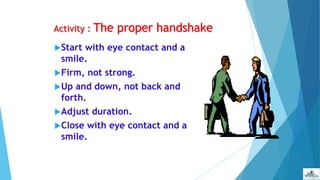
Body Language
 Eye contact
 Facial expression
 Postures and gestures
 Personal biases and prejudices
 Personal space
 Orientation
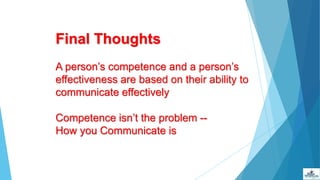
Activity : The proper handshake
Start with eye contact and a
smile.
Firm, not strong.
Up and down, not back and
forth.
Adjust duration.
Close with eye contact and a
smile.
Final Thoughts
A person’s competence and a person’s
effectiveness are based on their ability to
communicate effectively
Competence isn’t the problem --
How you Communicate is
Set 1
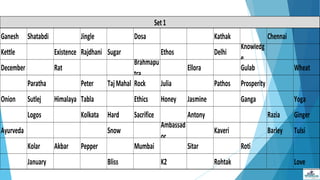
Ganesh Shatabdi Jingle Dosa Kathak Chennai
Kettle Existence Rajdhani Sugar Ethos Delhi
Knowledg
e
December Rat
Brahmapu
tra
Ellora Gulab Wheat
Paratha Peter TajMahal Rock Julia Pathos Prosperity
Onion Sutlej Himalaya Tabla Ethics Honey Jasmine Ganga Yoga
Logos Kolkata Hard Sacrifice Antony Razia Ginger
Ayurveda Snow
Ambassad
or
Kaveri Barley Tulsi
Kolar Akbar Pepper Mumbai Sitar Roti
January Bliss K2 Rohtak Love
Set1
Bollywood Jar Goodness Geyser
Bay of
Bengal
Gazal
Maharaja Champak Cricket Symphony Rani
Amul India Gate Post Elephant Signal
Sheep Harmony Sari Tinkle Santoor Chirapunji
Fiat
Horse
Shoe
Indian
Ocean
Basmati Synthetic HMV
Jugalband
hi
Zen Jigsaw Big B Truth
Qutub
Minar
Golconda Lassi Banyan Local Kesar
Metro
Arabian
Sea
Promise Red Fort Cotton
Pepal Jovial Sharbat Talkies Beauty Malai
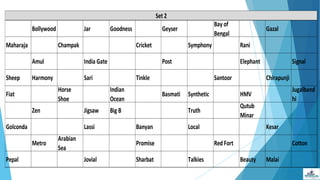
Set 2
www.tinyurl.com/blue-attend
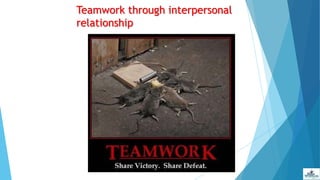
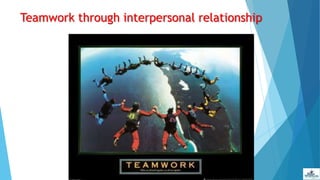
Teamwork through interpersonal
relationship
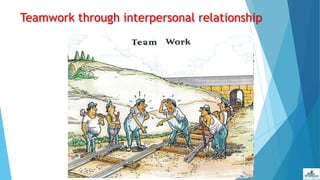
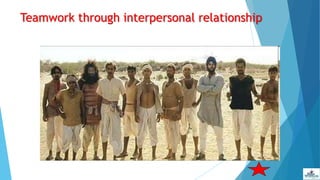
Teamwork through interpersonal relationship
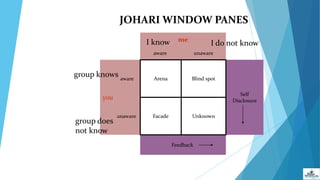
Feedback
UnknownFacadeunaware
Self
Disclosure
Blind spotArenaaware
you
unawareaware
me
JOHARI WINDOW PANES
I know I do not know
group knows
group does
not know
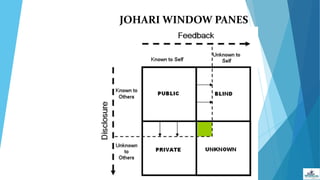
JOHARI WINDOW PANES
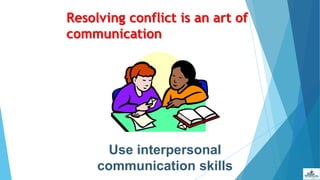
Resolving conflict is an art of
communication
Use interpersonal
communication skills
Tips for resolving conflicts
Make sure that you remain calm at all
times.
Speak with a non-provoking tone of
voice; quietly, slowly, and calmly.
Listen to the other person carefully
without interrupting them.
Tips for resolving conflicts
Respect the other person when voicing your
own opinion or point of view.
Let the other person know that you
understand them fully by asking questions
pertaining to his or her understanding and
repeating what the person is saying.
Use humor if possible.
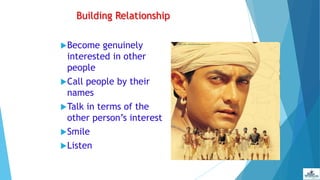
Building Relationship
Become genuinely
interested in other
people
Call people by their
names
Talk in terms of the
other person’s interest
Smile
Listen
Objectives
To understand various aspects of
Leadership so as to Develop sensitivity
while Managing People
Assess and Hence Develop an Insight into
One’s Own Style of Leadership, Style
Range and Flexibility.
Develop Subordinates by way of
Achievement Motivation.
What Is Leadership?
A Leader is a person whom people choose
to follow to a place where they wouldn’t go
by themselves.
What is Leadership ?
A leader articulates and embodies a vision and goals, and
enables others to share and achieve them
Leadership is a state of mind….leadership is about
vision, spirit, and character; getting diverse individuals
to work together as a team
Why Is Leadership Style Situational ?
 Individual behaviour is not consistent
 Different people behave differently
 Certain situations may demand a specific style
E.g. An Army officer facing attack at the front would need to
take an instant decision
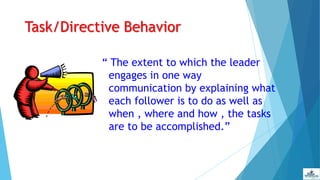
Task/Directive Behavior
“ The extent to which the leader
engages in one way
communication by explaining what
each follower is to do as well as
when , where and how , the tasks
are to be accomplished.”
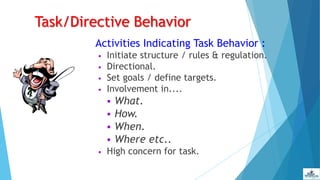
Task/Directive Behavior
Activities Indicating Task Behavior :
• Initiate structure / rules & regulation.
• Directional.
• Set goals / define targets.
• Involvement in....
 What.
 How.
 When.
 Where etc..
• High concern for task.
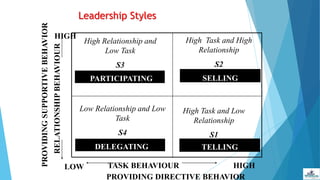
Leadership Styles
High Relationship and
Low Task
S3
High Task and High
Relationship
S2
Low Relationship and Low
Task
S4
High Task and Low
Relationship
S1
PARTICIPATING SELLING
DELEGATING TELLING
RELATIONSHIPBEHAVIOUR
HIGH
LOW TASK BEHAVIOUR HIGH
PROVIDINGSUPPORTIVEBEHAVIOR
PROVIDING DIRECTIVE BEHAVIOR
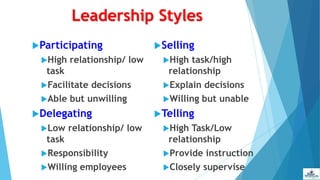
Leadership Styles
Participating
High relationship/ low
task
Facilitate decisions
Able but unwilling
Delegating
Low relationship/ low
task
Responsibility
Willing employees
Selling
High task/high
relationship
Explain decisions
Willing but unable
Telling
High Task/Low
relationship
Provide instruction
Closely supervise
Leadership Variables
 Follower
 Boss
 Associates/Peers
 Organization
 Job Demands
 Time
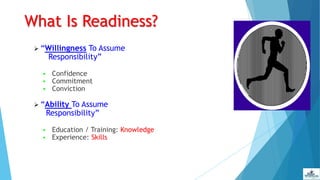
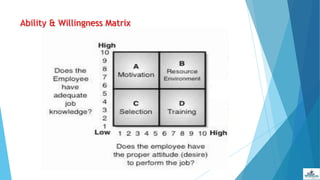
What Is Readiness?
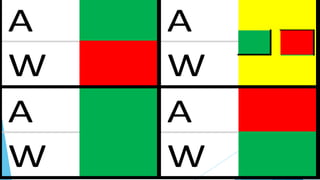
 “Willingness To Assume
Responsibility”
 Confidence
 Commitment
 Conviction
 “Ability To Assume
Responsibility”
 Education / Training: Knowledge
 Experience: Skills
A A
W W
A A
W W
Ability & Willingness Matrix
Time Management
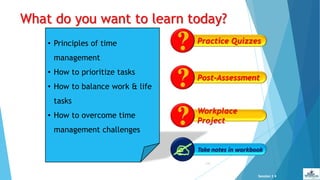
What do you want to learn today?
{134}
• Principles of time
management
• How to prioritize tasks
• How to balance work & life
tasks
• How to overcome time
management challenges
Session 1
Practice Quizzes
Post-Assessment
Workplace
Project
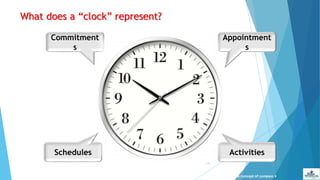
What does a “clock” represent?
{135}
The concept of compass
Commitment
s
Appointment
s
Schedules Activities
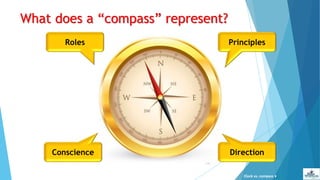
What does a “compass” represent?
{136}
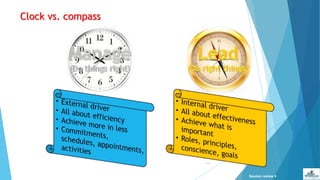
Clock vs. compass
Roles Principles
Conscience Direction
Clock vs. compass
{137}
Session review
How is task prioritized?
{138}
Urgency
Importance
Has value &
consequence
s to your
work or life
Demands
your
attention &
compels your
action
Categorizing priorities
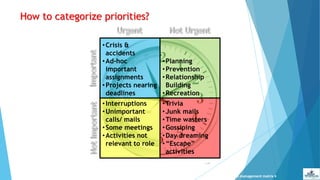
How to categorize priorities?
{139}
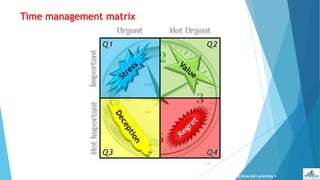
Time management matrix
•Crisis &
accidents
•Ad-hoc
important
assignments
•Projects nearing
deadlines
•Planning
•Prevention
•Relationship
Building
•Recreation
•Interruptions
•Unimportant
calls/ mails
•Some meetings
•Activities not
relevant to role
•Trivia
•Junk mails
•Time wasters
•Gossiping
•Day dreaming
•“Escape”
activities
Time management matrix
{140}
Activity 4: How did I prioritize
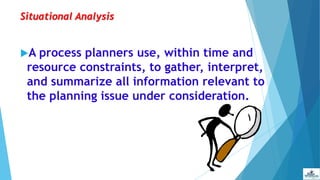
Situational Analysis
A process planners use, within time and
resource constraints, to gather, interpret,
and summarize all information relevant to
the planning issue under consideration.
Alternative Goals and Plans
 Stress creativity and encourage managers and employees to think
in broad terms about their jobs.
 Goal
A target or end that management desires to reach
Specific, measurable, attainable, relevant, time-bound - SMART
Alternative Goals and Plans
 Plans
The actions or means managers intend to use to achieve organizational
goals
 Contingency plans
sets of actions to be taken when a company’s initial plans have not
worked well or if events in the external environment require a sudden
change
Benefits of Planning
 Focus and flexibility
 Action orientation
 Coordination
 Time management
 Control
Strategic Planning
 Strategic planning
A set of procedures for making decisions about the organization’s long-
term goals and strategies
 Strategic goals
major targets or end results that relate to the long-term survival, value,
and growth of the organization.
SWOT Analysis and Strategy
Formulation
SWOT analysis
A comparison of strengths,
weaknesses, opportunities, and
threats that helps executives
formulate strategy.
Strategy Implementation
1. Define strategic risks
2. Assess organization capabilities
3. Develop an implementation agenda
4. Create an implementation plan
Self motivation is the
inspiration behind your
behavior and actions. It is an
important mechanism that
will help you to reach your
goal, without external
influence.
Self motivation improves
your confidence and self-
esteem, as well as gives you
strength to achieve your
goal…..
Self-motivation is a more efficient method. Reading motivational
books will inspire you temporarily, If you can motivate yourself,
you do not have to depend on any external factors, Self motivation
is the best inspirational technique….
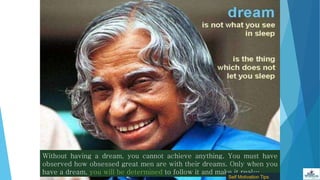
Without having a dream, you cannot achieve anything. You must have
observed how obsessed great men are with their dreams. Only when you
have a dream, you will be determined to follow it and make it real….
Self Motivation Tips
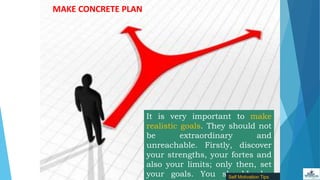
MAKE CONCRETE PLAN
It is very important to make
realistic goals. They should not
be extraordinary and
unreachable. Firstly, discover
your strengths, your fortes and
also your limits; only then, set
your goals. You should alsoSelf Motivation Tips
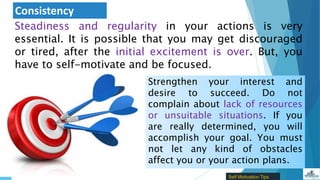
Consistency
Steadiness and regularity in your actions is very
essential. It is possible that you may get discouraged
or tired, after the initial excitement is over. But, you
have to self-motivate and be focused.
Strengthen your interest and
desire to succeed. Do not
complain about lack of resources
or unsuitable situations. If you
are really determined, you will
accomplish your goal. You must
not let any kind of obstacles
affect you or your action plans.
Self Motivation Tips
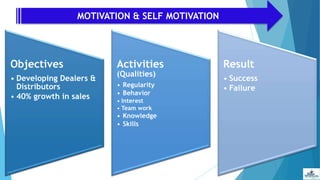
MOTIVATION & SELF MOTIVATION
Objectives
• Developing Dealers &
Distributors
• 40% growth in sales
Activities
(Qualities)
• Regularity
• Behavior
• Interest
• Team work
• Knowledge
• Skills
Result
• Success
• Failure
Neeraj Bhardwaj
neerajnis@gmail.com
WWW.BLUEWISDOM.NET
9725479188

11'16 Nagarjuna Sales Training

  • 2.
    Blue Wisdom Business ManagementPvt. Ltd. • Learning and development solutions • OD Consultants • E-Learning Solutions • Experiential Learning • Business Simulations • Psychometric tools • Assessments • Out Bound Training What we do… •90% corporate clients •Fortune 500 companies •Trainers academy •600 Trainers tie up across the globe •1.2 Lakh Participants trained •ISO 9001:2008 Certified •Training Consultants •#bluewisdom Who We’re
  • 4.
  • 5.
    Adult Learning Methodology Inworkshop style following learning methodologies will be used. Business Simulation Activities and management games Case Studies. Various case studies to deal with and understand external and internal situations. Situations analysis, Group discussion Role Plays. Drill & practice, with focus on skills and on the job coaching. Participants Presentations Assignments Tests
  • 6.
    Individuals or Teams? Team’sname Captain Slogan, Punch Line 50 Marks
  • 7.
  • 8.
  • 9.
    Expectation from theprogram  Why are you here today?  What you want to learn?  What knowledge and skill you want to carry home today?  What are the major challenges at work? • What are the related Issues? • How lack of skill effects performance?
  • 10.
    Program objectives Communication, Interpersonal,Presentation and Reporting skills Basic Leadership Skills, Proactivity, Team Building Time Management, Prioritization & Stress Management Customer Orientation Selling Skills, Market Intelligence, Objection Handling, Managing in adverse situations Planning, Contingency Plans & Execution Skills 
  • 11.
    What can yousay about this picture? Which one are you?
  • 14.
    Anybody can beemployee, We’re here to be professionals. Focus is on behaviours So Participate You’ll be observed On Applicability of learning
  • 16.
  • 19.
  • 20.
    10 Indicators ofSales Aptitude  ACTIVITY: IN GROUP LIST SALES ATTITUDE RANK ON THE BASIS OF ITS SIGNIFICANCE
  • 21.
    Here is theanswer… Ranking is: Enthusiasm Well organized Obvious ambition High persuasiveness General sales experience High verbal skills Specific sales experience Highly recommended Follow instruction sociability • Don’t sound like a sales person. • You’re a product specialist. • Solution provider • A Friend…
  • 22.
    BUYING AND SELLINGPROCESS R E E D O D P E C
  • 23.
    Selling Process OPEN A CALL DEVELOPNEEDS PROPOSE SOLUTIONS ELIMINATE DOUBTS CLOSE PRE – SALES PREPARATION POST SALES FOLLOWUP
  • 24.
  • 25.
  • 26.
    Sales Kit  Productliterature  Corporate brochure  Testimonials from customers  Price lists for standard offers  Note pad and pen  Visiting cards  PO copies  Components & vendor Literature  Templates of validation documentation  Site pictures  PPT’s & Corporate movie
  • 27.
    Grooming check list DRESS Clean& Ironed Well fitting Shoes Clean & Polished Socks Clean Not torn Elastic not loose Navy Blue / Black Makeup Light Complementing your face Hair Clean & Dandruff free Well combed Jewelry Delicate & minimum Nails Clean Cut & Filed Polish - Men - NO Women - Light & not chipped polish Today did you… Bathe /shower Brush teeth Shave (men) Use deodorant
  • 29.
  • 30.
    Opening a SalesCall  Greeting with a smile  Welcome  Self introduction  Fact finding
  • 31.
    Non – VerbalComponents  Smile  Grooming  Confidence  Enthusiasm
  • 32.
    First few minutesmatter…  Nonverbal visual cues Your dress. Plan it. Look them in the eye and shake firmly. Smile broadly. Show personal enthusiasm in body language. Pace yourself by customer
  • 34.
    Developing a SalesCall  Probing is the skill of questioning to obtain information  Probing is to uncover details, needs & facts  Change tracks in a discussion  Makes the other person think Activity
  • 35.
    Ask Powerful Questions Develop a questioning strategy  Prepare your questions  Create high impact need dialogues  Questions before answers  Focus on how skillfully you ask questions  And then….. Listen effectively.  Listen to learn… Best sales persons are best listeners “The question mark is the most important punctuation mark in sales grammar”.
  • 36.
  • 37.
    FAB  F =Features. What are the main features of your product and what is it designed to do?  A = Advantages. What will your product do to solve your prospect’s problems?  B = Benefits. How will your product help people gain or avoid problems in the future?
  • 38.
  • 39.
    Concerns/Objections Typically a naturalpart of any call An opportunity for more dialogue Helps both parties in buying process. “this is a buying process” Customer “indifference” is the killer not active objections
  • 40.
    Handling Objections Listen Agree/restate withoutprejudice Get clear about the real issue Discuss solutions Ask for a commitment
  • 41.
  • 42.
    Close a Sale Itis essential to close a sale by asking the customer to purchase as: The buyer needs a ‘push’ to make that final commitment. She is comfortable postponing the decision, due to apprehensions and is looking for reassurance You cannot go on selling when the customer is ready to buy You have been working for this firm commitment from the buyer
  • 43.
    Buying Signals Buyer’s oftenindicate that they want to buy what you are selling by giving signals, instead of actually saying so These signals are of two kinds : Verbal signals Non-verbal signals
  • 44.
    Closing a Sale SpotBuying Signals Ask for Commitment to prescribe The moment you have spotted clear buying signals, you need to ask for a commitment to buy. This is called CLOSING the sale
  • 45.
    Post Sale Service, service,service. Know your company’s ability Don’t ever oversell Call and write. Creative thanks. Visit again soon after first Sales.
  • 46.
    SALES TRAINING  TODAYYOU HAVE LEARNED ABOUT  BUYING AND SELLING PROCESSES  PRE-SALES PREPARATION  PROSPECTING  OPENING AND DEVELOPING THE CALL  NEED IDENTIFICATION  SPIN SALES MODEL  FEATURES AND BENEFITS  OBJECTION HANDELLING  CLOSING TECHNIQUES  POST SALES FOLLOW UP  MARKET INTELLIGENCE  MAPPING TECHNICS
  • 48.
  • 49.
    How to conductSWOT Analysis?
  • 51.
    51 What Is CustomerCare?  It is simply providing satisfaction by fulfilling customer’s requirement/need consistently  The customers get an impression of the company from the moment of their contact with any representative of the company  If what they perceive meets their expectations, then they would be more than satisfied
  • 52.
    52 What Is CustomerService?  It is –  Systems & Processes –Related to agreement of customer service levels,customer grievances,etc  Service Level Agreements – Arising due to interdependencies on departments to resolve customer issues as per customer expectations  Customer Responsiveness – Turn around time as expected by the customer and offered by the competition  Reports & Analysis – To monitor and maintain the customer service levels
  • 53.
    53 Customer Care VsCustomer Service  Customer Care is an attitude whereas Customer Service is a process  Customer Care is personality driven while Customer Service is system and process driven  Customer Care takes care of the immediate and short term needs while Customer Service has long term objectives
  • 54.
    54 Why Customer Care? To maximize customer retention leading to an increase in Sale Service revenue Profits Earning  To create or increase loyalty for your product/ brand or service
  • 55.
    55 Customer Care –The Critical Edge  Competition has products and services similar to ours  The personal element i.e. YOU are the differentiator  You need to address the Emotional needs of customers  Remember Customers tell twice as many people about a bad experience over a good one In an average company’s 65% of its business comes from its presently satisfied customers
  • 56.
  • 57.
    What is areal differentiator in the minds of the customer? Customer Experience
  • 58.
  • 59.
    Brand Loyalty Four levels: •Devoted • Delighted • Satisfied • Dissatisfied
  • 60.
    Brand Loyalty -Facts………. • A Delighted Customer refers to three others • A Dis-satisfied Customer tells his experience to ten others
  • 61.
    Critical Success Factors •Knowledge • Right Mental Attitude • Approach • Administrative skills, and • Communication skills
  • 62.
    Right Mental Attitude (YouFactor) Success is determined by Attitude (85%) and Skills (15%)
  • 63.
    Why Handle Complaints? •Satisfied customer • Improved procedures • Elimination of service defects • Improved customer service behaviour • High performance standards • Customer focused management
  • 64.
    LEAF Model- HandlingComplaints L Listen E Empathize A Apologize F Fix Problem and Take Feedback
  • 66.
    OVERVIEW OF SESSION TYPES OF COMMUNICATIONS  TIPS ON HOW TO BE EFFECTIVE WHEN COMMUNICATING
  • 67.
    Woman without herman is nothing.
  • 68.
    Its not aboutAccent – Its about Clarity R S V P P Rhythm Speed Volume Pitch Pause
  • 70.
    Communication : TheFlow 71 Sender Receiver Message Feedback Channel Perception DeliveryFormulating Response Understanding
  • 71.
  • 72.
    Social Media  Focuson Image & Branding  Create More Video Content  Social Media Marketing Is Going Mobile  Make Your Marketing Efforts More Focused  Analyze the Success of Your Content  Social Media Audiences Love Infographics  Content Is Still King
  • 74.
  • 75.
  • 76.
     Research (findout facts & figures)  Prepare (Introduce, Discuss, Conclude)  Rehearse  Be confident  Present  Use proper media 77 While Presenting… CommunicationSkills
  • 77.
    FACE-TO-FACE Most people preferto get information face- to-face, especially from their immediate supervisor
  • 78.
    Communication is notover when you finish delivering your message
  • 79.
    Types of Meetings Executive Briefing  Informational  Meeting with a Sponsor (e.g. Site Visit)  Staff Meeting  Team-building  Informal  Others... Let’s Meet
  • 80.
    Why Meet? The primaryreason for meetings are to share or brainstorm information or to develop action steps toward accomplishing a goal
  • 81.
    Meeting “Killers” --why they fail Poor Preparation Ignored agenda Poor time management Lack of participation Strong personalities Lack of leadership Lack of humor and fun No/poor closing
  • 82.
  • 83.
    The Benefits (written) Createsa permanent record Allows you to store information for future reference Easily distributed All recipients receive the same information Necessary for legal and binding documentation
  • 84.
    Is it clear?Have you hit your target? In written communication most confusion & frustration are caused by failing to be specific ….. Make it clear, brief and concise…..
  • 85.
    Single spelling mistakeled to divorce. A man went to goa and sent sms 2 wife "Having the most amazing and wonderful time I wish you were her."._,_.___ 3 idiots
  • 86.
    EMAIL ETIQUETTES Email isnow the dominant method of communicating in business. It is quick, inexpensive, flexible and convenient
  • 87.
    The biggest differencein the quality of your email messages is made by you
  • 88.
    Telephone Most employees have accessto a phone Using a telephone can be spontaneous and often friendly
  • 89.
    Benefits  Immediate accessto audience  Communication is direct and timely  Takes advantage of tone of voice and language  Allows for immediate response to questions, feedback, etc.
  • 90.
  • 91.
    to receive information tounderstand effectively to enhance clarity to empathize 92 Objective of Listening is… Communication Skills
  • 92.
    5 Basic reasonswe Do Not Listen  Listening is Hard Work  Competition  The Rush for Action  Speed differences (120 wpm v/s 360 wpm)  Lack of Training
  • 93.
    4 Levels ofListening  The Non-Listener  The Marginal Listener  The Evaluative Listener  The Active Listener
  • 94.
    Improving Listening Skills By not being Preoccupied  Being Open Minded & Non Defensive  Minimizing Interruptions  Effective Listening is: Hearing, interpreting when necessary, understanding the message and relating to it.  By Asking Questions
  • 95.
    Communication  Techniques Define Acronyms ReduceJargon Level Objections Use Humor Anecdotes and Stories Ask for feedback Increase your vocabulary
  • 96.
    COMMUNICATION • Words areonly labels and the listeners put their own interpretation on speakers words 7% WORDS • The way in which something is said - the accent, tone and voice modulation is important to the listener. 38% PARALINGUISTIC • What a speaker looks like while delivering a message affects the listener’s understanding most. 55% BODY LANGUAGE
  • 97.
    Body Language  Eyecontact  Facial expression  Postures and gestures  Personal biases and prejudices  Personal space  Orientation
  • 98.
    Activity : Theproper handshake Start with eye contact and a smile. Firm, not strong. Up and down, not back and forth. Adjust duration. Close with eye contact and a smile.
  • 99.
    Final Thoughts A person’scompetence and a person’s effectiveness are based on their ability to communicate effectively Competence isn’t the problem -- How you Communicate is
  • 100.
  • 101.
    Ganesh Shatabdi JingleDosa Kathak Chennai Kettle Existence Rajdhani Sugar Ethos Delhi Knowledg e December Rat Brahmapu tra Ellora Gulab Wheat Paratha Peter TajMahal Rock Julia Pathos Prosperity Onion Sutlej Himalaya Tabla Ethics Honey Jasmine Ganga Yoga Logos Kolkata Hard Sacrifice Antony Razia Ginger Ayurveda Snow Ambassad or Kaveri Barley Tulsi Kolar Akbar Pepper Mumbai Sitar Roti January Bliss K2 Rohtak Love Set1
  • 102.
    Bollywood Jar GoodnessGeyser Bay of Bengal Gazal Maharaja Champak Cricket Symphony Rani Amul India Gate Post Elephant Signal Sheep Harmony Sari Tinkle Santoor Chirapunji Fiat Horse Shoe Indian Ocean Basmati Synthetic HMV Jugalband hi Zen Jigsaw Big B Truth Qutub Minar Golconda Lassi Banyan Local Kesar Metro Arabian Sea Promise Red Fort Cotton Pepal Jovial Sharbat Talkies Beauty Malai Set 2
  • 103.
  • 105.
  • 106.
  • 107.
  • 108.
  • 109.
  • 110.
  • 111.
    Resolving conflict isan art of communication Use interpersonal communication skills
  • 112.
    Tips for resolvingconflicts Make sure that you remain calm at all times. Speak with a non-provoking tone of voice; quietly, slowly, and calmly. Listen to the other person carefully without interrupting them.
  • 113.
    Tips for resolvingconflicts Respect the other person when voicing your own opinion or point of view. Let the other person know that you understand them fully by asking questions pertaining to his or her understanding and repeating what the person is saying. Use humor if possible.
  • 114.
    Building Relationship Become genuinely interestedin other people Call people by their names Talk in terms of the other person’s interest Smile Listen
  • 117.
    Objectives To understand variousaspects of Leadership so as to Develop sensitivity while Managing People Assess and Hence Develop an Insight into One’s Own Style of Leadership, Style Range and Flexibility. Develop Subordinates by way of Achievement Motivation.
  • 118.
    What Is Leadership? ALeader is a person whom people choose to follow to a place where they wouldn’t go by themselves.
  • 119.
    What is Leadership? A leader articulates and embodies a vision and goals, and enables others to share and achieve them Leadership is a state of mind….leadership is about vision, spirit, and character; getting diverse individuals to work together as a team
  • 120.
    Why Is LeadershipStyle Situational ?  Individual behaviour is not consistent  Different people behave differently  Certain situations may demand a specific style E.g. An Army officer facing attack at the front would need to take an instant decision
  • 121.
    Task/Directive Behavior “ Theextent to which the leader engages in one way communication by explaining what each follower is to do as well as when , where and how , the tasks are to be accomplished.”
  • 122.
    Task/Directive Behavior Activities IndicatingTask Behavior : • Initiate structure / rules & regulation. • Directional. • Set goals / define targets. • Involvement in....  What.  How.  When.  Where etc.. • High concern for task.
  • 123.
    Leadership Styles High Relationshipand Low Task S3 High Task and High Relationship S2 Low Relationship and Low Task S4 High Task and Low Relationship S1 PARTICIPATING SELLING DELEGATING TELLING RELATIONSHIPBEHAVIOUR HIGH LOW TASK BEHAVIOUR HIGH PROVIDINGSUPPORTIVEBEHAVIOR PROVIDING DIRECTIVE BEHAVIOR
  • 124.
    Leadership Styles Participating High relationship/low task Facilitate decisions Able but unwilling Delegating Low relationship/ low task Responsibility Willing employees Selling High task/high relationship Explain decisions Willing but unable Telling High Task/Low relationship Provide instruction Closely supervise
  • 125.
    Leadership Variables  Follower Boss  Associates/Peers  Organization  Job Demands  Time
  • 126.
    What Is Readiness? “Willingness To Assume Responsibility”  Confidence  Commitment  Conviction  “Ability To Assume Responsibility”  Education / Training: Knowledge  Experience: Skills
  • 127.
    A A W W AA W W
  • 128.
  • 131.
  • 132.
    What do youwant to learn today? {134} • Principles of time management • How to prioritize tasks • How to balance work & life tasks • How to overcome time management challenges Session 1 Practice Quizzes Post-Assessment Workplace Project
  • 133.
    What does a“clock” represent? {135} The concept of compass Commitment s Appointment s Schedules Activities
  • 134.
    What does a“compass” represent? {136} Clock vs. compass Roles Principles Conscience Direction
  • 135.
  • 136.
    How is taskprioritized? {138} Urgency Importance Has value & consequence s to your work or life Demands your attention & compels your action Categorizing priorities
  • 137.
    How to categorizepriorities? {139} Time management matrix •Crisis & accidents •Ad-hoc important assignments •Projects nearing deadlines •Planning •Prevention •Relationship Building •Recreation •Interruptions •Unimportant calls/ mails •Some meetings •Activities not relevant to role •Trivia •Junk mails •Time wasters •Gossiping •Day dreaming •“Escape” activities
  • 138.
    Time management matrix {140} Activity4: How did I prioritize
  • 140.
    Situational Analysis A processplanners use, within time and resource constraints, to gather, interpret, and summarize all information relevant to the planning issue under consideration.
  • 141.
    Alternative Goals andPlans  Stress creativity and encourage managers and employees to think in broad terms about their jobs.  Goal A target or end that management desires to reach Specific, measurable, attainable, relevant, time-bound - SMART
  • 142.
    Alternative Goals andPlans  Plans The actions or means managers intend to use to achieve organizational goals  Contingency plans sets of actions to be taken when a company’s initial plans have not worked well or if events in the external environment require a sudden change
  • 143.
    Benefits of Planning Focus and flexibility  Action orientation  Coordination  Time management  Control
  • 144.
    Strategic Planning  Strategicplanning A set of procedures for making decisions about the organization’s long- term goals and strategies  Strategic goals major targets or end results that relate to the long-term survival, value, and growth of the organization.
  • 145.
    SWOT Analysis andStrategy Formulation SWOT analysis A comparison of strengths, weaknesses, opportunities, and threats that helps executives formulate strategy.
  • 146.
    Strategy Implementation 1. Definestrategic risks 2. Assess organization capabilities 3. Develop an implementation agenda 4. Create an implementation plan
  • 149.
    Self motivation isthe inspiration behind your behavior and actions. It is an important mechanism that will help you to reach your goal, without external influence. Self motivation improves your confidence and self- esteem, as well as gives you strength to achieve your goal…..
  • 150.
    Self-motivation is amore efficient method. Reading motivational books will inspire you temporarily, If you can motivate yourself, you do not have to depend on any external factors, Self motivation is the best inspirational technique….
  • 151.
    Without having adream, you cannot achieve anything. You must have observed how obsessed great men are with their dreams. Only when you have a dream, you will be determined to follow it and make it real…. Self Motivation Tips
  • 152.
    MAKE CONCRETE PLAN Itis very important to make realistic goals. They should not be extraordinary and unreachable. Firstly, discover your strengths, your fortes and also your limits; only then, set your goals. You should alsoSelf Motivation Tips
  • 153.
    Consistency Steadiness and regularityin your actions is very essential. It is possible that you may get discouraged or tired, after the initial excitement is over. But, you have to self-motivate and be focused. Strengthen your interest and desire to succeed. Do not complain about lack of resources or unsuitable situations. If you are really determined, you will accomplish your goal. You must not let any kind of obstacles affect you or your action plans. Self Motivation Tips
  • 154.
    MOTIVATION & SELFMOTIVATION Objectives • Developing Dealers & Distributors • 40% growth in sales Activities (Qualities) • Regularity • Behavior • Interest • Team work • Knowledge • Skills Result • Success • Failure
  • 156.