SUBARACHNOID HAEMORRHAGE:
PATHOPHYSIOLOGY, GRADING,
ASSESSMENT, COMPLICATION AND
ICU MANAGEMENT
Presented by Baby Pegu
Definition
Clinical features
Risk factor
Pathophysiology
Grading
Anesthetic considerations
Subarchnoid hemorrhage (SAH) is an acute
cerebrovascular disorder that encompasses various
sources of usually diffuse bleeding into the
subarachnoid space.
SAH accounts for only 5% of all strokes but is a
worldwide health burden with high rates of fatality
and permanent disability rates.
In most population the incidence is 6-7 per 100000
person –years with regional variation. It is around 20
per 100000 in Finland and Japan.
ETIOLOGY
1.Aneurysm (85 %)
2. Non aneurysmal perimesencephalic
hemorrhage (10%)
3. Rare causes (5%)
• Inflammatory causes of cerebral arteries
• Non inflammatory lesions of intracerebral vessels
• Tumours
• Drugs : cocaine abuse , anticoagulant drugs.
RISK FACTORS
• Hypertension
• Smoking
• Chronic alcohol abuse
• Female sex
• Family history of intracranial aneurysm in first
degree relatives.
• Inherited diseases: autosomal dominant polycystic
kidney disease,marfan syndrome, neurofibromatosis type
1, ehler danols syndrome, fibromuscular dysplasia
CLINICAL FEATURES
1. Sudden severe headache, sentinal headache
2. Nausea and vomiting.
3. Stiff neck and photophobia
4. A brief loss of consciousness , seizure episode.
5. Focal neurological deficit including cranial
nerve palsy, hemiparesis and even coma.
7. Systemic features include severe
hypertension, hypoxemia, neurogenic pulmonary
edema, cardiac manifestations including ecg
changes mimicking acute MI.
Clinical features of intracranial
aneurysms based on location
Location of Aneurysm Clinical features
Anterior communicating artery Bilateral temporal hemianopia
Bilateral lower extrimity weakness
Posterior communicating artery Third nerve palsy
Intercavernous internal carotid artery Facial or orbital pain
Progressive vision loss or opthalmoplegia
Posterior circulation aneurysms Brainstem dysfunction, occipital or
posterior cervical pain
PATHOPHYSIOLOGY
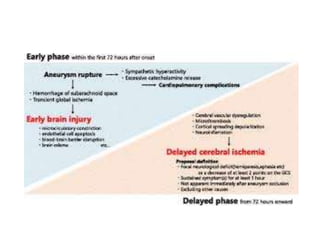
Aneurysmal SAH is a neurological
syndrome with complex
complication. The hemorrhage
triggers a cascade of complex events
which can result in early brain injury ,
delayed cerebral ischaemia and
systemic complication.
Early brain injury
Delayed cerebral ischaemia
Systemic effects
Cardiac effects : The effects of SAH on the
mycardium can range from alteration in the ecg , to
leakage of cardiac troponins, to wall motion
abnormalities. The mechanism of myocardial
dysfunction is due to increased release of localised
catecholamine in the mycardium. This intense
stimulation leads to contraction band necrosis and
subsequent myocardial dysfunction. However the
prognosis of SAH induced ventricular dysfuction is
good and generally reversible.
ECG changes: ECG abnormalities occur in 40%
to 100% of patients with SAH. These
abnormalites include sinus bradycardia , sinus
tacchycardia. AV dissociation to ventricular
tachycardia and fibrillation.
Morphological changes include t wave
inversion, depression of st segment,
appearance of U wave , prolongation of QT
interval.
Respiratory system
Pulmonary edema has been observed to accompany SAH in 8%
to 28% of cases which correlate closely with clinical grades.
Aspiration and peumonia are potential complication.
Intravascular volume status and electrolyt
abnormalities.
The intravascular volume status has been found to be abnormally
low in 36% to 100% of patients with SAH and correlates with the
clinical grading.
Hyponatremia is observed in 30% to 57% of cases with SAH.
Hyponatremia is related to SIADH and cerebral salt wasting
syndrome.
Other significant electrolyte abnormality include hypokalemia and
hypocalcemia
GRADING OF SAH
1. Botterells clinical grading
2. Modified hunt and hess clinical
grades for patient with SAH
3. World Federation of Neurological
Surgeons’s Grades
4. Fisher Grades for Computed
Tomography (CT) Findings in SAH.
Botterell’s clinical grades for patients
with SAH
GRADE CRITERIA
I Conscious with or without meningeal signs
II Drowsy without significant neurologicac deficit
III Drowsy with neurologic deficit and probable cerebral
clot
IV Major neurologic deficit present
V moribund with failing vital centres and extensor rigidity
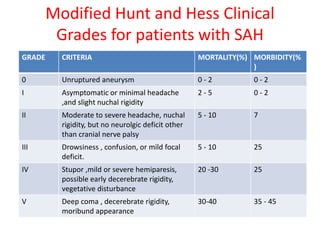
Modified Hunt and Hess Clinical
Grades for patients with SAH
GRADE CRITERIA MORTALITY(%) MORBIDITY(%
)
0 Unruptured aneurysm 0 - 2 0 - 2
I Asymptomatic or minimal headache
,and slight nuchal rigidity
2 - 5 0 - 2
II Moderate to severe headache, nuchal
rigidity, but no neurolgic deficit other
than cranial nerve palsy
5 - 10 7
III Drowsiness , confusion, or mild focal
deficit.
5 - 10 25
IV Stupor ,mild or severe hemiparesis,
possible early decerebrate rigidity,
vegetative disturbance
20 -30 25
V Deep coma , decerebrate rigidity,
moribund appearance
30-40 35 - 45
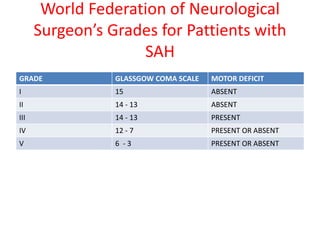
World Federation of Neurological
Surgeon’s Grades for Pattients with
SAH
GRADE GLASSGOW COMA SCALE MOTOR DEFICIT
I 15 ABSENT
II 14 - 13 ABSENT
III 14 - 13 PRESENT
IV 12 - 7 PRESENT OR ABSENT
V 6 - 3 PRESENT OR ABSENT
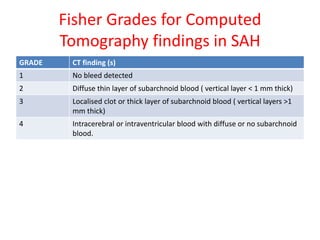
Fisher Grades for Computed
Tomography findings in SAH
GRADE CT finding (s)
1 No bleed detected
2 Diffuse thin layer of subarchnoid blood ( vertical layer < 1 mm thick)
3 Localised clot or thick layer of subarchnoid blood ( vertical layers >1
mm thick)
4 Intracerebral or intraventricular blood with diffuse or no subarchnoid
blood.
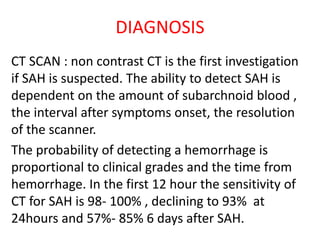
DIAGNOSIS
CT SCAN : non contrast CT is the first investigation
if SAH is suspected. The ability to detect SAH is
dependent on the amount of subarchnoid blood ,
the interval after symptoms onset, the resolution
of the scanner.
The probability of detecting a hemorrhage is
proportional to clinical grades and the time from
hemorrhage. In the first 12 hour the sensitivity of
CT for SAH is 98- 100% , declining to 93% at
24hours and 57%- 85% 6 days after SAH.
LUMBAR PUNCTURE : a lumbar puncture is
necessary in any patient with sudden onset
headache and a normal head CT scan. Csf include
cell count , the presence of xanthochromia and
detection of bilirubun.
MRI : after the initial days when hyperdensity on CT
scan decreases MR is better for detecting blood with
fluid attenuation inversion recovery.
ANGIOGRAPHY: angiographic study serve to identify
one or more aneurysm and also anatomical
configuration of the aneurysm in relation to
adjoining arteries.
MANAGEMENT
PHARMACOLOGICAL NONPHARMACOLICAL
1.Calcium channel blockers 1. Surgical
2.Magnesium sulphate 2. Reduction of ICP
3.Endothelin receptor 3. Hypervolumic,
antagonist hypertensive and
4.Tirilazide hemodilution
5.Nicaraven therapy
Hypervolemic, hypertensive, and
hemodilution therapy (triple H
therapy)
The ischaemic areas of the brain have impaired autoregulation and
thus CBF depends on perfusion pressure which partly depends on
intravascular volume and mean arterial pressure.
Hypervolumia is achieved with infusion of crystalloids as well as
colloids . Although iv fluid loading is sufficient to raise BP
,vasopressors such as dopamine , dobutamine and phenylephrine
etc can also be added.
The BP is titrated to a level necessary to reverse signds and symptoms
of vasospasm or a max of 160 to 200mmhg in patients whose
aneurysm has been clipped.or 120 to 150mmhg in unclipped
patients.
S/E : Worsening of cerebral edema , increase ICP , hemorrhage into an
infarcted area, pulmonary edema , myacardial infarction, dilutional
hyponatremia, and coagulopathy.
Hemodilution is the last componentt of triple H
therapy, is based on correlation of hematocrit and
whole blood viscosity. As the hematocrit and
viscosity diminishes, the cerebrovascular
resistance correspondently decreases and CBF
increases. Hematocrit of 33% (27% to 30%)
provide an optimal balance between viscocity and
oxygen carrying capacity.
S/E : oxygen carrying capacity is reduced by
hemodilution.
SURGERY
CLIP vs COIL
The ISAT ( International subarchnoid Aneurysm trial
) a prospective multicentric RCT.
ISAT reported that outcome ( death or dependency
ratio ) was better with coiling group compared
with surgical clipping .
However rate of rebleeding was higher in coiling
group as compared to clipping group.
Also risk of seizure was less in coiling as compared
to clilpping.
ANESTHETIC MANAGEMENT
PREMEDICATION : premedication should be
individualised. Patients with a good cliniical grade
may receive Morphine 1 to 5 mg or Midazolam 1
to 5 mg for sedation.
Intraoperative consideration and induction of
anaesthesia.
Monitorings requirements:
Ecg tracings, NIBP , pulse oximetry, capnoghraphy,
neuromuscular monitoring, intra areterial blood
pressure monitoring,central venous pressure
catheter and pulmonary artery catheter.
Induction
Induction consist of two phases
Induction to achieve loss of consciouness
 prophylaxis to prevent rise in blood pressure
in response to laryngoscopy and intubation.
Achieving loss of consciousness
propofol ( 1.5 -2 mg/kg) or thiopental (3-
5mg/kg) in combination with fentanyl or
remifentanyl is suitable.
Etomidate (.3 to0.4mg/kg) and midazolam ( 0.1
-0.2 mg/kg) are other alternative.
Prophylactic against a rise In ICP
during laryngoscopy

SAH FINAL.pptx

  • 1.
    SUBARACHNOID HAEMORRHAGE: PATHOPHYSIOLOGY, GRADING, ASSESSMENT,COMPLICATION AND ICU MANAGEMENT Presented by Baby Pegu
  • 2.
  • 3.
    Subarchnoid hemorrhage (SAH)is an acute cerebrovascular disorder that encompasses various sources of usually diffuse bleeding into the subarachnoid space. SAH accounts for only 5% of all strokes but is a worldwide health burden with high rates of fatality and permanent disability rates. In most population the incidence is 6-7 per 100000 person –years with regional variation. It is around 20 per 100000 in Finland and Japan.
  • 4.
    ETIOLOGY 1.Aneurysm (85 %) 2.Non aneurysmal perimesencephalic hemorrhage (10%) 3. Rare causes (5%) • Inflammatory causes of cerebral arteries • Non inflammatory lesions of intracerebral vessels • Tumours • Drugs : cocaine abuse , anticoagulant drugs.
  • 5.
    RISK FACTORS • Hypertension •Smoking • Chronic alcohol abuse • Female sex • Family history of intracranial aneurysm in first degree relatives. • Inherited diseases: autosomal dominant polycystic kidney disease,marfan syndrome, neurofibromatosis type 1, ehler danols syndrome, fibromuscular dysplasia
  • 6.
    CLINICAL FEATURES 1. Suddensevere headache, sentinal headache 2. Nausea and vomiting. 3. Stiff neck and photophobia 4. A brief loss of consciousness , seizure episode. 5. Focal neurological deficit including cranial nerve palsy, hemiparesis and even coma. 7. Systemic features include severe hypertension, hypoxemia, neurogenic pulmonary edema, cardiac manifestations including ecg changes mimicking acute MI.
  • 7.
    Clinical features ofintracranial aneurysms based on location Location of Aneurysm Clinical features Anterior communicating artery Bilateral temporal hemianopia Bilateral lower extrimity weakness Posterior communicating artery Third nerve palsy Intercavernous internal carotid artery Facial or orbital pain Progressive vision loss or opthalmoplegia Posterior circulation aneurysms Brainstem dysfunction, occipital or posterior cervical pain
  • 9.
    PATHOPHYSIOLOGY Aneurysmal SAH isa neurological syndrome with complex complication. The hemorrhage triggers a cascade of complex events which can result in early brain injury , delayed cerebral ischaemia and systemic complication.
  • 11.
  • 12.
  • 13.
    Systemic effects Cardiac effects: The effects of SAH on the mycardium can range from alteration in the ecg , to leakage of cardiac troponins, to wall motion abnormalities. The mechanism of myocardial dysfunction is due to increased release of localised catecholamine in the mycardium. This intense stimulation leads to contraction band necrosis and subsequent myocardial dysfunction. However the prognosis of SAH induced ventricular dysfuction is good and generally reversible.
  • 14.
    ECG changes: ECGabnormalities occur in 40% to 100% of patients with SAH. These abnormalites include sinus bradycardia , sinus tacchycardia. AV dissociation to ventricular tachycardia and fibrillation. Morphological changes include t wave inversion, depression of st segment, appearance of U wave , prolongation of QT interval.
  • 15.
    Respiratory system Pulmonary edemahas been observed to accompany SAH in 8% to 28% of cases which correlate closely with clinical grades. Aspiration and peumonia are potential complication. Intravascular volume status and electrolyt abnormalities. The intravascular volume status has been found to be abnormally low in 36% to 100% of patients with SAH and correlates with the clinical grading. Hyponatremia is observed in 30% to 57% of cases with SAH. Hyponatremia is related to SIADH and cerebral salt wasting syndrome. Other significant electrolyte abnormality include hypokalemia and hypocalcemia
  • 16.
    GRADING OF SAH 1.Botterells clinical grading 2. Modified hunt and hess clinical grades for patient with SAH 3. World Federation of Neurological Surgeons’s Grades 4. Fisher Grades for Computed Tomography (CT) Findings in SAH.
  • 17.
    Botterell’s clinical gradesfor patients with SAH GRADE CRITERIA I Conscious with or without meningeal signs II Drowsy without significant neurologicac deficit III Drowsy with neurologic deficit and probable cerebral clot IV Major neurologic deficit present V moribund with failing vital centres and extensor rigidity
  • 18.
    Modified Hunt andHess Clinical Grades for patients with SAH GRADE CRITERIA MORTALITY(%) MORBIDITY(% ) 0 Unruptured aneurysm 0 - 2 0 - 2 I Asymptomatic or minimal headache ,and slight nuchal rigidity 2 - 5 0 - 2 II Moderate to severe headache, nuchal rigidity, but no neurolgic deficit other than cranial nerve palsy 5 - 10 7 III Drowsiness , confusion, or mild focal deficit. 5 - 10 25 IV Stupor ,mild or severe hemiparesis, possible early decerebrate rigidity, vegetative disturbance 20 -30 25 V Deep coma , decerebrate rigidity, moribund appearance 30-40 35 - 45
  • 19.
    World Federation ofNeurological Surgeon’s Grades for Pattients with SAH GRADE GLASSGOW COMA SCALE MOTOR DEFICIT I 15 ABSENT II 14 - 13 ABSENT III 14 - 13 PRESENT IV 12 - 7 PRESENT OR ABSENT V 6 - 3 PRESENT OR ABSENT
  • 20.
    Fisher Grades forComputed Tomography findings in SAH GRADE CT finding (s) 1 No bleed detected 2 Diffuse thin layer of subarchnoid blood ( vertical layer < 1 mm thick) 3 Localised clot or thick layer of subarchnoid blood ( vertical layers >1 mm thick) 4 Intracerebral or intraventricular blood with diffuse or no subarchnoid blood.
  • 21.
    DIAGNOSIS CT SCAN :non contrast CT is the first investigation if SAH is suspected. The ability to detect SAH is dependent on the amount of subarchnoid blood , the interval after symptoms onset, the resolution of the scanner. The probability of detecting a hemorrhage is proportional to clinical grades and the time from hemorrhage. In the first 12 hour the sensitivity of CT for SAH is 98- 100% , declining to 93% at 24hours and 57%- 85% 6 days after SAH.
  • 22.
    LUMBAR PUNCTURE :a lumbar puncture is necessary in any patient with sudden onset headache and a normal head CT scan. Csf include cell count , the presence of xanthochromia and detection of bilirubun. MRI : after the initial days when hyperdensity on CT scan decreases MR is better for detecting blood with fluid attenuation inversion recovery. ANGIOGRAPHY: angiographic study serve to identify one or more aneurysm and also anatomical configuration of the aneurysm in relation to adjoining arteries.
  • 23.
    MANAGEMENT PHARMACOLOGICAL NONPHARMACOLICAL 1.Calcium channelblockers 1. Surgical 2.Magnesium sulphate 2. Reduction of ICP 3.Endothelin receptor 3. Hypervolumic, antagonist hypertensive and 4.Tirilazide hemodilution 5.Nicaraven therapy
  • 24.
    Hypervolemic, hypertensive, and hemodilutiontherapy (triple H therapy) The ischaemic areas of the brain have impaired autoregulation and thus CBF depends on perfusion pressure which partly depends on intravascular volume and mean arterial pressure. Hypervolumia is achieved with infusion of crystalloids as well as colloids . Although iv fluid loading is sufficient to raise BP ,vasopressors such as dopamine , dobutamine and phenylephrine etc can also be added. The BP is titrated to a level necessary to reverse signds and symptoms of vasospasm or a max of 160 to 200mmhg in patients whose aneurysm has been clipped.or 120 to 150mmhg in unclipped patients. S/E : Worsening of cerebral edema , increase ICP , hemorrhage into an infarcted area, pulmonary edema , myacardial infarction, dilutional hyponatremia, and coagulopathy.
  • 25.
    Hemodilution is thelast componentt of triple H therapy, is based on correlation of hematocrit and whole blood viscosity. As the hematocrit and viscosity diminishes, the cerebrovascular resistance correspondently decreases and CBF increases. Hematocrit of 33% (27% to 30%) provide an optimal balance between viscocity and oxygen carrying capacity. S/E : oxygen carrying capacity is reduced by hemodilution.
  • 26.
    SURGERY CLIP vs COIL TheISAT ( International subarchnoid Aneurysm trial ) a prospective multicentric RCT. ISAT reported that outcome ( death or dependency ratio ) was better with coiling group compared with surgical clipping . However rate of rebleeding was higher in coiling group as compared to clipping group. Also risk of seizure was less in coiling as compared to clilpping.
  • 28.
    ANESTHETIC MANAGEMENT PREMEDICATION :premedication should be individualised. Patients with a good cliniical grade may receive Morphine 1 to 5 mg or Midazolam 1 to 5 mg for sedation. Intraoperative consideration and induction of anaesthesia. Monitorings requirements: Ecg tracings, NIBP , pulse oximetry, capnoghraphy, neuromuscular monitoring, intra areterial blood pressure monitoring,central venous pressure catheter and pulmonary artery catheter.
  • 29.
    Induction Induction consist oftwo phases Induction to achieve loss of consciouness  prophylaxis to prevent rise in blood pressure in response to laryngoscopy and intubation. Achieving loss of consciousness propofol ( 1.5 -2 mg/kg) or thiopental (3- 5mg/kg) in combination with fentanyl or remifentanyl is suitable. Etomidate (.3 to0.4mg/kg) and midazolam ( 0.1 -0.2 mg/kg) are other alternative.
  • 30.
    Prophylactic against arise In ICP during laryngoscopy