AFMAG Evolution –
Expanding Limits
MobileMT
from innovations to discoveries
A.Bagrianski, P.Kuzmin,
A.Prikhodko*
(Expert Geophysics Limited)
info@expertgeophysics.com www.expertgeophysics.com
Presentation Outline
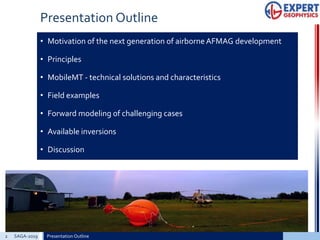
• Motivation of the next generation of airborne AFMAG development
• Principles
• MobileMT - technical solutions and characteristics
• Field examples
• Forward modeling of challenging cases
• Available inversions
• Discussion
2 SAGA-2019 Presentation Outline
motivation
• Limited depth of investigation of systems with controlled EM
field sources, especially in conductive environment or complex
terrain;
• Limited resolution, bandwidth, and sensitivity to any direction
of geoelectrical boundaries of previous airborneAFMAG
systems in commercial use;
• Latest achievements generally in electronics, digital
technologies for the last 10-15 years, since the lastAFMAG
development.
3 Motivation of the next generation of airborne AFMAG developmentSAGA-2019
principles
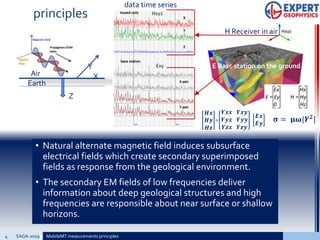
• Natural alternate magnetic field induces subsurface
electrical fields which create secondary superimposed
fields as response from the geological environment.
• The secondary EM fields of low frequencies deliver
information about deep geological structures and high
frequencies are responsible about near surface or shallow
horizons.
4 SAGA-2019 MobileMT measurements principles
Air
Earth
X
Y
Z
H Receiver in air
E Base station on the ground
𝑯𝒙
𝑯𝒚
𝑯𝒛
=
𝒀𝒙𝒙 𝒀𝒙𝒚
𝒀𝒚𝒙 𝒀𝒚𝒚
𝒀𝒛𝒙 𝒀𝒛𝒚
𝑬𝒙
𝑬𝒚
𝛔 = 𝛍𝛚|𝒀 𝟐
|
data time series
Technical features and advantages
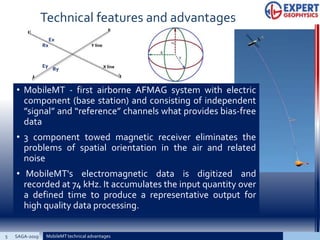
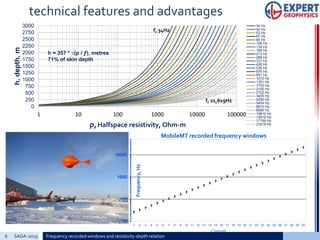
• MobileMT - first airborne AFMAG system with electric
component (base station) and consisting of independent
”signal” and “reference” channels what provides bias-free
data
• 3 component towed magnetic receiver eliminates the
problems of spatial orientation in the air and related
noise
• MobileMT's electromagnetic data is digitized and
recorded at 74 kHz. It accumulates the input quantity over
a defined time to produce a representative output for
high quality data processing.
5 SAGA-2019 MobileMT technical advantages
Ex
Rx
Ey
Ry
0
250
500
750
1000
1250
1500
1750
2000
2250
2500
2750
3000
1 10 100 1000 10000 100000
h,depth,m
ρ,Halfspace resistivity, Ohm-m
34 Hz
42 Hz
53 Hz
67 Hz
84 Hz
106 Hz
134 Hz
169 Hz
213 Hz
268 Hz
337 Hz
426 Hz
536 Hz
676 Hz
851 Hz
1072 Hz
1351 Hz
1702 Hz
2145 Hz
2702 Hz
3405 Hz
4290 Hz
5404 Hz
6810 Hz
8580 Hz
10810 Hz
13619 Hz
17159 Hz
21619 Hz
f, 34Hz
f, 21,619Hz
technical features and advantages
6 Frequency recorded windows and resistivity-depth relationSAGA-2019
h = 357 * √(ρ / ƒ), metres
71% of skin depth
10
100
1000
10000
1 2 3 4 5 6 7 8 9 10 11 12 13 14 15 16 17 18 19 20 21 22 23 24 25 26 27 28 29 30
Frequency,Hz
Channel
MobileMT recorded frequency windows
Field examples- Shea Creek, Athabasca
7 Add a footer
Kianna Zone
SAGA-2019
Basement boundary
Basement boundary
Full range depth
Sandstone depth range
Alteration zone
MobileMT
apparent conductivity
profiles
8 Add a footerSAGA-2019
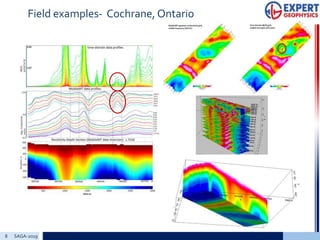
Field examples- Cochrane, Ontario
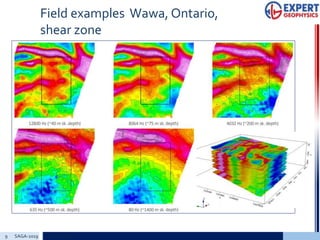
Field examples Wawa, Ontario,
shear zone
9 SAGA-2019 Add a footer
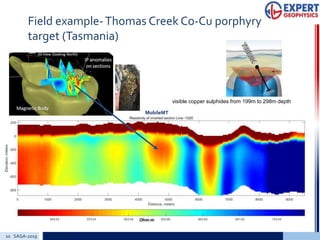
Field example-Thomas Creek Co-Cu porphyry
target (Tasmania)
10 SAGA-2019 Add a footer
MobileMT
visible copper sulphides from 199m to 298m depth
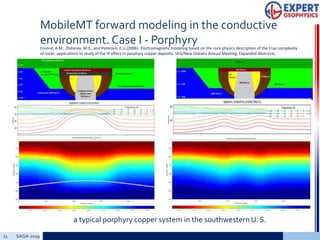
MobileMT forward modeling in the conductive
environment. Case I - Porphyry
11 SAGA-2019 Add a footer
Emond, A.M., Zhdanov, M.S., and Petersen, E.U.(2006). Electromagnetic modeling based on the rock physics description of the true complexity
of rocks: applications to study of the IP effect in porphyry copper deposits. SEG/New Orleans Annual Meeting. Expanded Abstracts.
a typical porphyry copper system in the southwestern U. S.
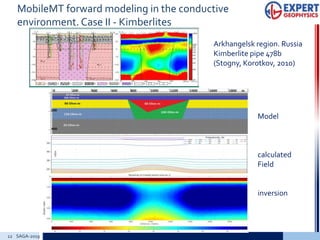
MobileMT forward modeling in the conductive
environment. Case II - Kimberlites
12 SAGA-2019 Add a footer
Arkhangelsk region. Russia
Kimberlite pipe 478b
(Stogny, Korotkov, 2010)
Model
calculated
Field
inversion
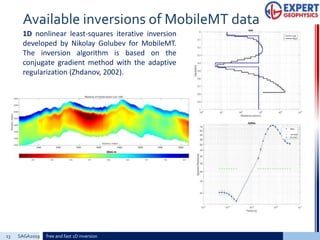
Available inversions of MobileMT data
13 SAGA2019 free and fast 1D inversion a footer
1D nonlinear least-squares iterative inversion
developed by Nikolay Golubev for MobileMT.
The inversion algorithm is based on the
conjugate gradient method with the adaptive
regularization (Zhdanov, 2002).
1 10/16/201
2D inversions
Available inversions of MobileMT data
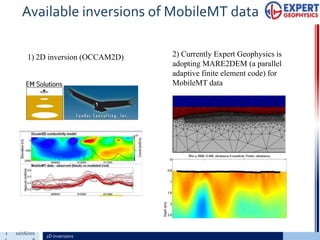
1) 2D inversion (OCCAM2D) 2) Currently Expert Geophysics is
adopting MARE2DEM (a parallel
adaptive finite element code) for
MobileMT data
15 SAGA2019 3D inversions
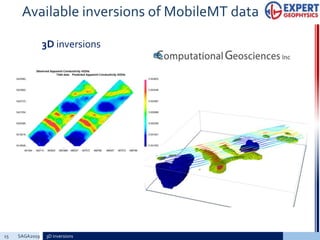
Available inversions of MobileMT data
3D inversions
Conclusions
The latest development in airborne EM passive fields,
MobileMT, has the following advanced features:
• 4 orders of frequency measurement range reflecting near
surface and deep geological structures;
• the broadband range is divided on up to 30 collected
frequency windows what provides with good choice of
data selection and high in-depth resolution;
• Inferring geoelectrical structures in absolute conductivity
units (magnetic and electric components);
• Resolving resistivity contrasts between geological units in
any direction including layered geology (total field
through three geometrical components).
16 SAGA-2019 Add a footer
Thank you!
info@expertgeophysics.com www.expertgeophysics.com
acknowledgements:
Accelerate Resources Ltd.,
MacDonald Mines Exploration Ltd.,
Promiseland Exploration Ltd.
(data and permission)
2019-021

SAGA-2019 - AFMAG Evolution – Expanding Limits

  • 1.
    AFMAG Evolution – ExpandingLimits MobileMT from innovations to discoveries A.Bagrianski, P.Kuzmin, A.Prikhodko* (Expert Geophysics Limited) info@expertgeophysics.com www.expertgeophysics.com
  • 2.
    Presentation Outline • Motivationof the next generation of airborne AFMAG development • Principles • MobileMT - technical solutions and characteristics • Field examples • Forward modeling of challenging cases • Available inversions • Discussion 2 SAGA-2019 Presentation Outline
  • 3.
    motivation • Limited depthof investigation of systems with controlled EM field sources, especially in conductive environment or complex terrain; • Limited resolution, bandwidth, and sensitivity to any direction of geoelectrical boundaries of previous airborneAFMAG systems in commercial use; • Latest achievements generally in electronics, digital technologies for the last 10-15 years, since the lastAFMAG development. 3 Motivation of the next generation of airborne AFMAG developmentSAGA-2019
  • 4.
    principles • Natural alternatemagnetic field induces subsurface electrical fields which create secondary superimposed fields as response from the geological environment. • The secondary EM fields of low frequencies deliver information about deep geological structures and high frequencies are responsible about near surface or shallow horizons. 4 SAGA-2019 MobileMT measurements principles Air Earth X Y Z H Receiver in air E Base station on the ground 𝑯𝒙 𝑯𝒚 𝑯𝒛 = 𝒀𝒙𝒙 𝒀𝒙𝒚 𝒀𝒚𝒙 𝒀𝒚𝒚 𝒀𝒛𝒙 𝒀𝒛𝒚 𝑬𝒙 𝑬𝒚 𝛔 = 𝛍𝛚|𝒀 𝟐 | data time series
  • 5.
    Technical features andadvantages • MobileMT - first airborne AFMAG system with electric component (base station) and consisting of independent ”signal” and “reference” channels what provides bias-free data • 3 component towed magnetic receiver eliminates the problems of spatial orientation in the air and related noise • MobileMT's electromagnetic data is digitized and recorded at 74 kHz. It accumulates the input quantity over a defined time to produce a representative output for high quality data processing. 5 SAGA-2019 MobileMT technical advantages Ex Rx Ey Ry
  • 6.
    0 250 500 750 1000 1250 1500 1750 2000 2250 2500 2750 3000 1 10 1001000 10000 100000 h,depth,m ρ,Halfspace resistivity, Ohm-m 34 Hz 42 Hz 53 Hz 67 Hz 84 Hz 106 Hz 134 Hz 169 Hz 213 Hz 268 Hz 337 Hz 426 Hz 536 Hz 676 Hz 851 Hz 1072 Hz 1351 Hz 1702 Hz 2145 Hz 2702 Hz 3405 Hz 4290 Hz 5404 Hz 6810 Hz 8580 Hz 10810 Hz 13619 Hz 17159 Hz 21619 Hz f, 34Hz f, 21,619Hz technical features and advantages 6 Frequency recorded windows and resistivity-depth relationSAGA-2019 h = 357 * √(ρ / ƒ), metres 71% of skin depth 10 100 1000 10000 1 2 3 4 5 6 7 8 9 10 11 12 13 14 15 16 17 18 19 20 21 22 23 24 25 26 27 28 29 30 Frequency,Hz Channel MobileMT recorded frequency windows
  • 7.
    Field examples- SheaCreek, Athabasca 7 Add a footer Kianna Zone SAGA-2019 Basement boundary Basement boundary Full range depth Sandstone depth range Alteration zone MobileMT apparent conductivity profiles
  • 8.
    8 Add afooterSAGA-2019 Field examples- Cochrane, Ontario
  • 9.
    Field examples Wawa,Ontario, shear zone 9 SAGA-2019 Add a footer
  • 10.
    Field example-Thomas CreekCo-Cu porphyry target (Tasmania) 10 SAGA-2019 Add a footer MobileMT visible copper sulphides from 199m to 298m depth
  • 11.
    MobileMT forward modelingin the conductive environment. Case I - Porphyry 11 SAGA-2019 Add a footer Emond, A.M., Zhdanov, M.S., and Petersen, E.U.(2006). Electromagnetic modeling based on the rock physics description of the true complexity of rocks: applications to study of the IP effect in porphyry copper deposits. SEG/New Orleans Annual Meeting. Expanded Abstracts. a typical porphyry copper system in the southwestern U. S.
  • 12.
    MobileMT forward modelingin the conductive environment. Case II - Kimberlites 12 SAGA-2019 Add a footer Arkhangelsk region. Russia Kimberlite pipe 478b (Stogny, Korotkov, 2010) Model calculated Field inversion
  • 13.
    Available inversions ofMobileMT data 13 SAGA2019 free and fast 1D inversion a footer 1D nonlinear least-squares iterative inversion developed by Nikolay Golubev for MobileMT. The inversion algorithm is based on the conjugate gradient method with the adaptive regularization (Zhdanov, 2002).
  • 14.
    1 10/16/201 2D inversions Availableinversions of MobileMT data 1) 2D inversion (OCCAM2D) 2) Currently Expert Geophysics is adopting MARE2DEM (a parallel adaptive finite element code) for MobileMT data
  • 15.
    15 SAGA2019 3Dinversions Available inversions of MobileMT data 3D inversions
  • 16.
    Conclusions The latest developmentin airborne EM passive fields, MobileMT, has the following advanced features: • 4 orders of frequency measurement range reflecting near surface and deep geological structures; • the broadband range is divided on up to 30 collected frequency windows what provides with good choice of data selection and high in-depth resolution; • Inferring geoelectrical structures in absolute conductivity units (magnetic and electric components); • Resolving resistivity contrasts between geological units in any direction including layered geology (total field through three geometrical components). 16 SAGA-2019 Add a footer
  • 17.
    Thank you! info@expertgeophysics.com www.expertgeophysics.com acknowledgements: AccelerateResources Ltd., MacDonald Mines Exploration Ltd., Promiseland Exploration Ltd. (data and permission) 2019-021

Editor's Notes

  • #2 This talk is about the next generation of airborne EM technology based on natural fields developed in Expert Geophysics Limited. I have to acknowledge other participated people – AB, the president of EGL, and PK, well a known inventor and developer in our fairly small airborne electromagnetic industry.
  • #3 2
  • #4 The main three factors which motivated the new development in the AFMAG family systems are the next: 1) Limited depth of investigation of systems with controlled EM field sources, especially in conductive environment or complex terrain; 2) Limited resolution, bandwidth, and sensitivity to any direction of geoelectrical boundaries of previous airborne AFMAG systems in commercial use; 3) And the latest achievements generally in electronics, digital technologies for the last 10-15 years, since the last AFMAG development.
  • #5 In general, principles of MobileMT technology are basically similar to ground MT – it’s passive measurements of the Earth’s natural electrical (on the ground) and magnetic (in the air) fields in the frequency range 30 Hz-20kHz. Fast Fourie Transform technique is applied to the merged recordings with calculation of six admittances matrixes on the different time bases and in different frequency bands. In the result of modular computation of the matrixes determinants, as rotation invariant parameters, we calculate apparent conductivity as a parameter of MobileMT mapping.
  • #6 The main technical features and advantages include: - Electrical component consisting of independent signal and reference channels what provides bias-free data. This is extremely useful technique described in 1985 by Victor Labson. - 3 components of the towed magnetic receiver what solves problems with orientation control, S/N ratio, and sensitivity to any direction of geoelectrical boundaries. - Electromagnetic data digitized and recorded at 74 kHz to produce a representative output for high quality data processing.
  • #7 The next very important technical feature is the frequency bandwidth from 30 Hz to 20kHz divided by 20 or 30 (optional) frequency windows. It doesn’t mean that we accept data of all generated freq windows but we always have a choice of a number windows with best quality and best signal.
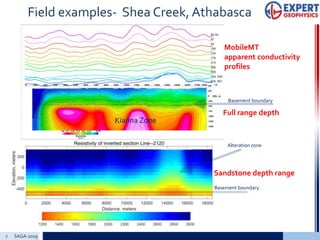
  • #8 The first field example of MobileMT data is from Athabasca basin in Canada. It is resistive environment and roughly consists of an assemblage of basement and sandstone package on the top. Here we can see the contact between them and known graphite zone. If we look at zoom-in sandstone thickness we can see the alteration zone reflected in high frequencies.
  • #9 8
  • #10 This example shows how the known shear zone (outlined by the square) on the gold prospecting site is reflected in the high frequencies of MobileMT data.
  • #11 This is a MobileMT resistivity section. It’s a porphyry target previously surveyed by ground IP. It’s a discrete target about 300x300 m on plan.
  • #12 The next couple slides demonstrate MobileMT forward modeling in very challenging for EM methods environments. This is a typical for southwestern US porphyry system under very thick (150 m) conductive overburden. In the case of existing of the 10 Ohm-m enriched zone, we have this response and corresponded inverted section. The case without the conductive enriched zone is on the right.
  • #13 Another very challenging case, because of conductive environment with conductive overburden, is from Arkhangelsk kimberlite region. Based on the forward modeling exercise we can predict that MobileMT will be able to recover kimberlite structures here.