Inversions
of MobileMT data
and forward
modelling
from innovations to discoveries
info@expertgeophysics.com www.expertgeophysics.com
I. Massive and fast inversions
II. Detail and goal-oriented
inversions
III. Forward Modeling
EM data inversion capability is the top of
EGL service offering
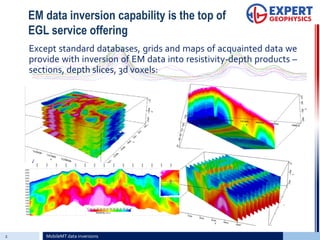
Except standard databases, grids and maps of acquainted data we
provide with inversion of EM data into resistivity-depth products –
sections, depth slices, 3d voxels:
2 MobileMT data inversions
3 Massive and Fast Inversion
The first stage of the data inversion process is applying a nonlinear least-squares iterative
1d inversion algorithm based on the conjugate gradient method with the adaptive
regularization (M.Zhdanov, 2002). The algorithm uses weighting of the inverted
parameters, so sensitivity of the data to resistivity of each layer is remaining equal for
different depths. This way provides high resolution in the deep part of a model as well as in
the upper part. (the software development by N.Golubev)
An inversion is an ill-posed problem, and the algorithm uses regularization to get stable
and geologically meaning solution.We minimize parametric functional P which consists of
I. Massive and fast inversion
data misfit φ and stabilizer S (L2 norm of difference initial and fitted model) multiplied on parameter of
regularization α.
P(m)=φ(m)+αS(m) where
Φ(m)=‖dobs-dmod‖² is a data misfit and S(m)=‖m-mini‖² - stabilizer
The inversion is applied to each station without any resampling manipulations and without any limitations in
frequencies number and stations number along a line.
The fast inversion results are used for:
- Estimation of data quality and noise, if any, in particular frequency windows and stations;
- Compiling 3d resistivity-depth databases, voxels, 2d sections along lines, depth slices;
- Choosing anomaly zones and structures for detail and goal-oriented inversions;
- Developing optimal mesh-grids and starting model parametrization for further detail and goal-oriented
inversions.
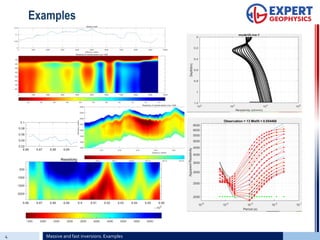
4 Massive and fast inversions. Examples
Examples
5 Detail goal-oriented inversions footer
II. Detail and goal-oriented inversions
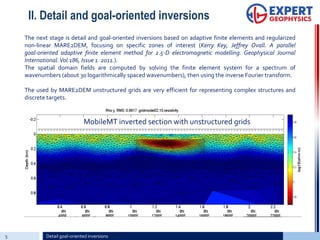
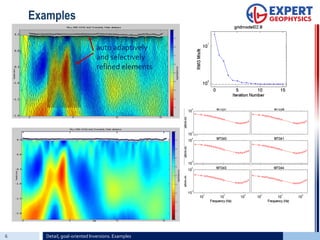
The next stage is detail and goal-oriented inversions based on adaptive finite elements and regularized
non-linear MARE2DEM, focusing on specific zones of interest (Kerry Key, Jeffrey Ovall. A parallel
goal‐oriented adaptive finite element method for 2.5‐D electromagnetic modelling. Geophysical Journal
International.Vol.186, Issue 1. 2011.).
The spatial domain fields are computed by solving the finite element system for a spectrum of
wavenumbers (about 30 logarithmically spaced wavenumbers), then using the inverse Fourier transform.
The used by MARE2DEM unstructured grids are very efficient for representing complex structures and
discrete targets.
MobileMT inverted section with unstructured grids
6 Detail, goal-oriented Inversions. Examples
Examples
auto adaptively
and selectively
refined elements
7 2/27/2020Add a footer
III. Forward Modeling
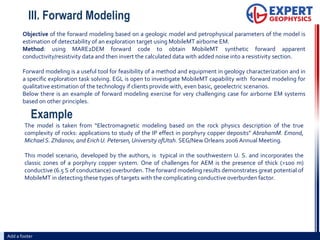
Objective of the forward modeling based on a geologic model and petrophysical parameters of the model is
estimation of detectability of an exploration target using MobileMT airborne EM.
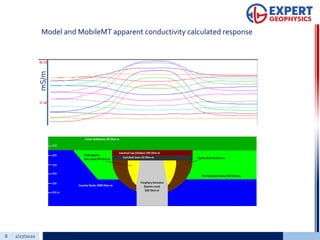
Method: using MARE2DEM forward code to obtain MobileMT synthetic forward apparent
conductivity/resistivity data and then invert the calculated data with added noise into a resistivity section.
Forward modeling is a useful tool for feasibility of a method and equipment in geology characterization and in
a specific exploration task solving. EGL is open to investigate MobileMT capability with forward modeling for
qualitative estimation of the technology if clients provide with, even basic, geoelectric scenarios.
Below there is an example of forward modeling exercise for very challenging case for airborne EM systems
based on other principles.
Example
The model is taken from “Electromagnetic modeling based on the rock physics description of the true
complexity of rocks: applications to study of the IP effect in porphyry copper deposits” AbrahamM. Emond,
Michael S. Zhdanov, and Erich U. Petersen, University ofUtah. SEG/New Orleans 2006Annual Meeting.
This model scenario, developed by the authors, is typical in the southwestern U. S. and incorporates the
classic zones of a porphyry copper system. One of challenges for AEM is the presence of thick (>100 m)
conductive (6.5 S of conductance) overburden. The forward modeling results demonstrates great potential of
MobileMT in detecting these types of targets with the complicating conductive overburden factor.
8 2/27/2020 Add a footer
Model and MobileMT apparent conductivity calculated response
mS/m
9 2/27/2020 Add a footer
Inverted resistivity section with projected model boundaries
(unconstrained inversion with half space initial model)
Expert Geophysics Limited
info@expertgeophysics.com www.expertgeophysics.com

Inversions of MobileMT data and forward modelling

  • 1.
    Inversions of MobileMT data andforward modelling from innovations to discoveries info@expertgeophysics.com www.expertgeophysics.com I. Massive and fast inversions II. Detail and goal-oriented inversions III. Forward Modeling
  • 2.
    EM data inversioncapability is the top of EGL service offering Except standard databases, grids and maps of acquainted data we provide with inversion of EM data into resistivity-depth products – sections, depth slices, 3d voxels: 2 MobileMT data inversions
  • 3.
    3 Massive andFast Inversion The first stage of the data inversion process is applying a nonlinear least-squares iterative 1d inversion algorithm based on the conjugate gradient method with the adaptive regularization (M.Zhdanov, 2002). The algorithm uses weighting of the inverted parameters, so sensitivity of the data to resistivity of each layer is remaining equal for different depths. This way provides high resolution in the deep part of a model as well as in the upper part. (the software development by N.Golubev) An inversion is an ill-posed problem, and the algorithm uses regularization to get stable and geologically meaning solution.We minimize parametric functional P which consists of I. Massive and fast inversion data misfit φ and stabilizer S (L2 norm of difference initial and fitted model) multiplied on parameter of regularization α. P(m)=φ(m)+αS(m) where Φ(m)=‖dobs-dmod‖² is a data misfit and S(m)=‖m-mini‖² - stabilizer The inversion is applied to each station without any resampling manipulations and without any limitations in frequencies number and stations number along a line. The fast inversion results are used for: - Estimation of data quality and noise, if any, in particular frequency windows and stations; - Compiling 3d resistivity-depth databases, voxels, 2d sections along lines, depth slices; - Choosing anomaly zones and structures for detail and goal-oriented inversions; - Developing optimal mesh-grids and starting model parametrization for further detail and goal-oriented inversions.
  • 4.
    4 Massive andfast inversions. Examples Examples
  • 5.
    5 Detail goal-orientedinversions footer II. Detail and goal-oriented inversions The next stage is detail and goal-oriented inversions based on adaptive finite elements and regularized non-linear MARE2DEM, focusing on specific zones of interest (Kerry Key, Jeffrey Ovall. A parallel goal‐oriented adaptive finite element method for 2.5‐D electromagnetic modelling. Geophysical Journal International.Vol.186, Issue 1. 2011.). The spatial domain fields are computed by solving the finite element system for a spectrum of wavenumbers (about 30 logarithmically spaced wavenumbers), then using the inverse Fourier transform. The used by MARE2DEM unstructured grids are very efficient for representing complex structures and discrete targets. MobileMT inverted section with unstructured grids
  • 6.
    6 Detail, goal-orientedInversions. Examples Examples auto adaptively and selectively refined elements
  • 7.
    7 2/27/2020Add afooter III. Forward Modeling Objective of the forward modeling based on a geologic model and petrophysical parameters of the model is estimation of detectability of an exploration target using MobileMT airborne EM. Method: using MARE2DEM forward code to obtain MobileMT synthetic forward apparent conductivity/resistivity data and then invert the calculated data with added noise into a resistivity section. Forward modeling is a useful tool for feasibility of a method and equipment in geology characterization and in a specific exploration task solving. EGL is open to investigate MobileMT capability with forward modeling for qualitative estimation of the technology if clients provide with, even basic, geoelectric scenarios. Below there is an example of forward modeling exercise for very challenging case for airborne EM systems based on other principles. Example The model is taken from “Electromagnetic modeling based on the rock physics description of the true complexity of rocks: applications to study of the IP effect in porphyry copper deposits” AbrahamM. Emond, Michael S. Zhdanov, and Erich U. Petersen, University ofUtah. SEG/New Orleans 2006Annual Meeting. This model scenario, developed by the authors, is typical in the southwestern U. S. and incorporates the classic zones of a porphyry copper system. One of challenges for AEM is the presence of thick (>100 m) conductive (6.5 S of conductance) overburden. The forward modeling results demonstrates great potential of MobileMT in detecting these types of targets with the complicating conductive overburden factor.
  • 8.
    8 2/27/2020 Adda footer Model and MobileMT apparent conductivity calculated response mS/m
  • 9.
    9 2/27/2020 Adda footer Inverted resistivity section with projected model boundaries (unconstrained inversion with half space initial model)
  • 10.