Advanced Culinary Arts

Kitchen Safety:
 Accidents &
    Injuries
8/27 Amuse Bouche
         Write on your Slates

List common causes of typical
  accidents and injuries in the
      food service industry.
 http://animoto.com/play/wzbzYmMr3BvaTiKN6owu1g
Announcements:


• Procedures, Equipment, Safety,
  Sanitation Exam: Mark Your
  Calendar!
• 2nd Tardy Reminders
• Building Entrances
• H2O… Reminder
Objectives
    Students will be able to:

    • Determine the purpose of healthcodes
      and violations.
     Identify common causes of typical
      accidents and injuries in the food
      service industry.
     Explain appropriate procedures to
      prevent injuries in the workplace.
Health Inspection
First Inspection of the Year: Friday during lunch
service

• E=Excellent Rating
• Warnings/Positive Feedback

• Congratulations to Christian Norris, Lizette Lopez,
  and Monica – these 3 students were under
  intense scrutiny and passed with raving reviews!!!
Think/Write/Share


• How often do health inspections occur?
  How do food service establishments know
  when a health inspector will be visiting?
• How should employees behave when a
  health inspector is visiting the facility?
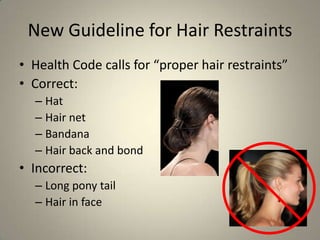
New Guideline for Hair Restraints
• Health Code calls for “proper hair restraints”
• Correct:
  – Hat
  – Hair net
  – Bandana
  – Hair back and bond
• Incorrect:
  – Long pony tail
  – Hair in face
Warning from Inspector—Food
               Storage
• Where do eggs go?
• Along with Chicken!
Notes on Defrosting
• 4 Ways to Defrost:
  – In the refrigerator
  – Microwave
  – Cool running water
  – Part of the cooking process
• Ideal way?
Reminder-Can Opener
• Clean after each use
• Disassemble and clean
on a regular basis
Positive Feedback from our Friendly
        Local Health Inspector
• Hand washing
  – Frequent
  – Before and after glove use
  – Between tasks
Positive-Fridge Temperature
• Items in fridge properly cooled between 32
  degrees F and 41 degrees F
Ergonomics
 Ergonomics is the science
 concerned with the efficient and
 safe interaction between people
 and things in their environment.

This involves safe use of equipment
 and work space
Food Service Hazards

 Workplace accidents cost the
  foodservice industry over $48 billion
  per year
 Fatigue, poor kitchen design, and
  minimal training all contribute to
  these accidents
 Despite the frequency of workplace
  accidents, they can be controlled
Think-Pair-Share
How can ergonomics
reduce the cost of
accidents in the
foodservice industry?
Kitchen Equipment

• What type of equipment would a food
  service worker use and need to clean?

Stoves, Mixers, Steamers, Slicers,
  Grinders, Dish Machines, Grills, Fryers,
  Steam Baths, Knives
Kitchen Equipment

    What hazards could occur while employees
    are using or cleaning kitchen equipment?

•   Slips & Trips
•   Cuts
•   Back Strain
•   Burns and Scalds
•   Chemical Hazards
The Art Institute Presents….

Using a 3 Compartment Sink
Hobart Commercial
   Dishwasher
   Training &
 Operation Video
What Items NEVER go in a
Commercial Dishwasher?

         Why?
   (Think-Pair-Share)
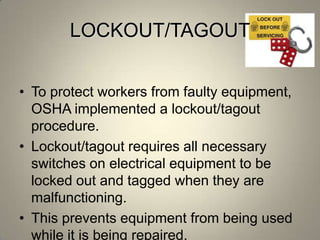
LOCKOUT/TAGOUT


• To protect workers from faulty equipment,
  OSHA implemented a lockout/tagout
  procedure.
• Lockout/tagout requires all necessary
  switches on electrical equipment to be
  locked out and tagged when they are
  malfunctioning.
• This prevents equipment from being used
  while it is being repaired.
LOCKOUT/TAGOUT Examples
One Minute Summary: summarize
when lockout/tagout is used, why,
  and how it protects workers.
What precautions do managers need to
         take to prevent slips and trips from
                     occurring?

• Clean spills immediately
• Keep walkways clear of boxes or other items an
  employee may trip over
• Require employees to wear slip proof, close-toed,
  supportive shoes
• Use non-slip floor mats


http://www.youtube.com/watch?v=I6a4p6L-wuI
*IMPORTANT: KITCHEN
      LANGUAGE
• To prevent injuries & mishaps, Use
  “Restaurant Lingo” to Indicate your
  proximity to other workers:
• Coming Through
• Behind
• Door
• Hot Food, Coming Through
Think-Pair-Share:
 When would these phrases be used?

 Why?

 What additional signals should restaurant
  workers use to prevent injuries?
What precautions need to be taken
         to prevent cuts?

 Provide mesh gloves for employees
  to wear when cutting or using sharp
  knives or working near blades.

 Train employees in proper use of
  knives.
What precautions do employers need
   to take to prevent strains from
              occurring?
• Organize work areas- Keep frequently
  used items closest to them and store
  seldom used items further away.
• Train employees as to proper lifting
  techniques
• Provide back braces to employees for
  lifting heavy objects
• Rotate tasks
What precautions need to be taken
           to prevent burns and scalds?

• Train employees with guidelines to be
  followed when working with hot food
  and equipment
• Never leave food unmonitored.
• Provide and require use of protective
  clothing
• Instruct employees to cool cooking
  equipment and vents before cleaning
Emergency
Procedures


         31
PLAY!
               OR

Pass…
Emergencies in the Commercial Kitchen…


     Define Emergencies-
Preparing for Emergencies
                    Checklist
       Given that an emergency is a
       potentially life-threatening situation,
       the first step is to call for medical
       assistance.
       Respond quickly, but remain calm
       Locate first aid kit or emergency kit
       Assess the situation then follow the
       guidelines on the following slides while
       waiting for help to arrive
8/25/2012                            33
First Aid for Burns
• Cool the burned skin to stop the burning

• Bandage the burn

• Minimize the risk of shock
FIRST AID FOR
WOUNDS
    Put on disposable gloves
    Clean cut with soap and rinse under
water
    Place bandage over the cut
    If bleeding doesn’t stop, elevate the
limb above the heart to reduce the amount
of blood going to the cut area
    Apply pressure using sterile gauze or
clean cloth
    Wash hands thoroughly after treating
the wound
First Aid for Choking
• If the person is conscious and choking but
  cannot verbally respond, use the Heimlich
  Maneuver to unlodge the object blocking
  the person’s airway.
• CPR is to be used on unresponsive
  victims.
• The sooner these procedures are
  performed, the greater the victim’s chance
  of survival
DRILL!!!


  Turn to your neighbor and drill
 Each other on facts, procedures,
   and vocabulary identification
Covered so far in the presentation.


                         37
Closure:


   create a checklist…


        Be prepared to
            share!
Commercial Equipment Crossword


       Bonus… complete as
many answers as possible by Friday!
       Turn in with your test
Commercial Equipment
          Terminology
Microwave Oven             Food Processor
Griddles                   Roasting Pan
Conventional Oven          Deep Fryers
Range                      Tilt Kettle
Grill                      Saucepan
Salamander                 Steamer
Tilt Skillet               Sauté Pan
Hotel Pan                  Broiler
Saucepot                   Rondeau
Deck oven                  Sheet Pan
Steam-Jacketed Kettle      Convection Oven
 Wok                       Electric Slicer
Stockpot

Accidents & Injuries in the Commercial Kitchen

  • 1.
    Advanced Culinary Arts KitchenSafety: Accidents & Injuries
  • 2.
    8/27 Amuse Bouche Write on your Slates List common causes of typical accidents and injuries in the food service industry. http://animoto.com/play/wzbzYmMr3BvaTiKN6owu1g
  • 3.
    Announcements: • Procedures, Equipment,Safety, Sanitation Exam: Mark Your Calendar! • 2nd Tardy Reminders • Building Entrances • H2O… Reminder
  • 4.
    Objectives Students will be able to: • Determine the purpose of healthcodes and violations.  Identify common causes of typical accidents and injuries in the food service industry.  Explain appropriate procedures to prevent injuries in the workplace.
  • 6.
    Health Inspection First Inspectionof the Year: Friday during lunch service • E=Excellent Rating • Warnings/Positive Feedback • Congratulations to Christian Norris, Lizette Lopez, and Monica – these 3 students were under intense scrutiny and passed with raving reviews!!!
  • 7.
    Think/Write/Share • How oftendo health inspections occur? How do food service establishments know when a health inspector will be visiting? • How should employees behave when a health inspector is visiting the facility?
  • 8.
    New Guideline forHair Restraints • Health Code calls for “proper hair restraints” • Correct: – Hat – Hair net – Bandana – Hair back and bond • Incorrect: – Long pony tail – Hair in face
  • 9.
    Warning from Inspector—Food Storage • Where do eggs go? • Along with Chicken!
  • 10.
    Notes on Defrosting •4 Ways to Defrost: – In the refrigerator – Microwave – Cool running water – Part of the cooking process • Ideal way?
  • 11.
    Reminder-Can Opener • Cleanafter each use • Disassemble and clean on a regular basis
  • 12.
    Positive Feedback fromour Friendly Local Health Inspector • Hand washing – Frequent – Before and after glove use – Between tasks
  • 13.
    Positive-Fridge Temperature • Itemsin fridge properly cooled between 32 degrees F and 41 degrees F
  • 14.
    Ergonomics Ergonomics isthe science concerned with the efficient and safe interaction between people and things in their environment. This involves safe use of equipment and work space
  • 15.
    Food Service Hazards Workplace accidents cost the foodservice industry over $48 billion per year  Fatigue, poor kitchen design, and minimal training all contribute to these accidents  Despite the frequency of workplace accidents, they can be controlled
  • 16.
    Think-Pair-Share How can ergonomics reducethe cost of accidents in the foodservice industry?
  • 17.
    Kitchen Equipment • Whattype of equipment would a food service worker use and need to clean? Stoves, Mixers, Steamers, Slicers, Grinders, Dish Machines, Grills, Fryers, Steam Baths, Knives
  • 18.
    Kitchen Equipment What hazards could occur while employees are using or cleaning kitchen equipment? • Slips & Trips • Cuts • Back Strain • Burns and Scalds • Chemical Hazards
  • 19.
    The Art InstitutePresents…. Using a 3 Compartment Sink
  • 20.
    Hobart Commercial Dishwasher Training & Operation Video
  • 21.
    What Items NEVERgo in a Commercial Dishwasher? Why? (Think-Pair-Share)
  • 22.
    LOCKOUT/TAGOUT • To protectworkers from faulty equipment, OSHA implemented a lockout/tagout procedure. • Lockout/tagout requires all necessary switches on electrical equipment to be locked out and tagged when they are malfunctioning. • This prevents equipment from being used while it is being repaired.
  • 23.
  • 24.
    One Minute Summary:summarize when lockout/tagout is used, why, and how it protects workers.
  • 25.
    What precautions domanagers need to take to prevent slips and trips from occurring? • Clean spills immediately • Keep walkways clear of boxes or other items an employee may trip over • Require employees to wear slip proof, close-toed, supportive shoes • Use non-slip floor mats http://www.youtube.com/watch?v=I6a4p6L-wuI
  • 26.
    *IMPORTANT: KITCHEN LANGUAGE • To prevent injuries & mishaps, Use “Restaurant Lingo” to Indicate your proximity to other workers: • Coming Through • Behind • Door • Hot Food, Coming Through
  • 27.
    Think-Pair-Share:  When wouldthese phrases be used?  Why?  What additional signals should restaurant workers use to prevent injuries?
  • 28.
    What precautions needto be taken to prevent cuts?  Provide mesh gloves for employees to wear when cutting or using sharp knives or working near blades.  Train employees in proper use of knives.
  • 29.
    What precautions doemployers need to take to prevent strains from occurring? • Organize work areas- Keep frequently used items closest to them and store seldom used items further away. • Train employees as to proper lifting techniques • Provide back braces to employees for lifting heavy objects • Rotate tasks
  • 30.
    What precautions needto be taken to prevent burns and scalds? • Train employees with guidelines to be followed when working with hot food and equipment • Never leave food unmonitored. • Provide and require use of protective clothing • Instruct employees to cool cooking equipment and vents before cleaning
  • 31.
  • 32.
    PLAY! OR Pass… Emergencies in the Commercial Kitchen… Define Emergencies-
  • 33.
    Preparing for Emergencies Checklist Given that an emergency is a potentially life-threatening situation, the first step is to call for medical assistance. Respond quickly, but remain calm Locate first aid kit or emergency kit Assess the situation then follow the guidelines on the following slides while waiting for help to arrive 8/25/2012 33
  • 34.
    First Aid forBurns • Cool the burned skin to stop the burning • Bandage the burn • Minimize the risk of shock
  • 35.
    FIRST AID FOR WOUNDS Put on disposable gloves Clean cut with soap and rinse under water Place bandage over the cut If bleeding doesn’t stop, elevate the limb above the heart to reduce the amount of blood going to the cut area Apply pressure using sterile gauze or clean cloth Wash hands thoroughly after treating the wound
  • 36.
    First Aid forChoking • If the person is conscious and choking but cannot verbally respond, use the Heimlich Maneuver to unlodge the object blocking the person’s airway. • CPR is to be used on unresponsive victims. • The sooner these procedures are performed, the greater the victim’s chance of survival
  • 37.
    DRILL!!! Turnto your neighbor and drill Each other on facts, procedures, and vocabulary identification Covered so far in the presentation. 37
  • 38.
    Closure: create a checklist… Be prepared to share!
  • 39.
    Commercial Equipment Crossword Bonus… complete as many answers as possible by Friday! Turn in with your test
  • 40.
    Commercial Equipment Terminology Microwave Oven  Food Processor Griddles  Roasting Pan Conventional Oven  Deep Fryers Range  Tilt Kettle Grill  Saucepan Salamander  Steamer Tilt Skillet  Sauté Pan Hotel Pan  Broiler Saucepot  Rondeau Deck oven  Sheet Pan Steam-Jacketed Kettle  Convection Oven  Wok  Electric Slicer Stockpot

Editor's Notes

  • #3 2. Whiteboards/Slatesstudent writes answer or solution to a question posed by the teacherteacher solicits all students to show at the same timeteacher gives feedback to the students
  • #9 Have students record these reminders on back of notetaker
  • #13 Remind students about washing dishes/ washing hands between loading dirty dishes and unstacking clean dishes
  • #15 Notetaker
  • #17 3. Think-pair-shareteacher presents a questionteacher gives wait time for student to form answerteacher instructs students to share their answer with a partnerteacher calls on non-volunteers to share with the class
  • #26 If liquids are spilled on the floor, they should be mopped up and a wet floor warning sign posted.Wear slip proof, close-toed, supportive shoes. Shoes should have cushioned insteps and slip-resistant solesMake sure proper matting is covering floors- non-slip floor mats ensure that spills don’t become slips
  • #29 Knife safety will be reviewed in depth during the knife skills unit, this is a brief reminder
  • #30 Comfortable, supportive shoes are essential for kitchen workers due to long periods of standing.Moving and stretching frequently and rotating tasks can help workers avoid static postures and fatigue. To reduce overreaching, workers should keep their frequently used items closest to them and store seldom used items further away. Proper lifting techniques when moving heavy pots and food items can prevent strains.
  • #31 . Cooking equipment and vents should be cooled before cleaning them; it is best to clean equipment at the start of a shift.Fire safety will be covered in depth later in the unit.Other heat sources include boiling water, steam baths, sinks and dish washers. Reaching over boiling pots and hot water sources can lead to severe burns from steam. When opening pots or steam baths, workers should stand to the side and use the lid as a shield.To prevent fires, workers should monitor cooking food carefully. Hot grease and oil should never be left unattended. Oils and grease should be cooled before transporting them. Grease traps and grill surfaces should be cleaned frequently and flammable items should not be kept near flames or heat sources. It is important to know and practice emergency procedures, first aid, and how to use a fire extinguisher.Wearing close-fitting sleeves prevents catching them on pot handles, oven and stove knobs, or dangling them in flames or hot oil. Shoes should have cushioned insteps and slip-resistant soles. Aprons provide an added layer of protection from splashes of hot water or grease. Hand mitts and pot holders should be used when handling hot items
  • #33 5. Pass or Playteacher poses a question and gives wait timeteacher calls on a student and asks them “pass or play?”student says “play” if they wish to answer the question or “pass to__________” if they want to pass to a specific classmateteacher provides feedback
  • #34 An emergency is a potentially life-threatening situation that usually occurs suddenly and unexpectedly. It is important to be prepared so you know how to respond. When an emergency happens, how you react may make all the difference. Remind students to alsway post telephone numbers of emergency services such as fire department, poison control, police department (in the event foul play was involved) and an emergency response system.
  • #35 Cool the burned skin by applying cold water over the affected area. You can use water from a faucet or soaked towels. Do not use ice or ice water. Never apply ointments, sprays, antiseptics, or remedies unless instructed to do so by a medical professionalBandage burn as directed in first aid manual.Minimize the risk of shock by keeping the victim from getting chilled or overheated. Have the victim rest.
  • #36 If wound is deep, do not waste time with cleaning first
  • #37 Instruct students to locate the heimlich maneuver and CPR procedures while doing the research portion of today’s lessonCPR helps keep oxygen flowing to the brain and heart. This is done until advanced care can restore normal heart function.
  • #39 21. Draw a picture, design a t-shirt, bumper sticker or create a logoteacher instructs students to create a picture to summarize information, a demonstration that has been given, etc.teacher may have students share or may collect the products
  • #40 Time Permitting…