Safety &Healthy Environment
Accidents and their Prevention
 How accidents are caused?


 Approaches to Reduce accidents


 Safe Work environment


 Basic Safety Programming


 Promotion of health and safety.
Health & Safety At Workplaces
 Factories
 Mines
 Constructions
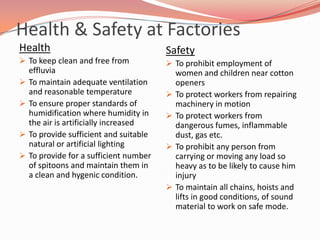
Health & Safety at Factories
Health                                   Safety
 To keep clean and free from             To prohibit employment of
    effluvia                                 women and children near cotton
   To maintain adequate ventilation         openers
    and reasonable temperature              To protect workers from repairing
   To ensure proper standards of            machinery in motion
    humidification where humidity in        To protect workers from
    the air is artificially increased        dangerous fumes, inflammable
   To provide sufficient and suitable       dust, gas etc.
    natural or artificial lighting          To prohibit any person from
   To provide for a sufficient number       carrying or moving any load so
    of spitoons and maintain them in         heavy as to be likely to cause him
    a clean and hygenic condition.           injury
                                            To maintain all chains, hoists and
                                             lifts in good conditions, of sound
                                             material to work on safe mode.
Health & Safety At Mines
Drinking water
Machinery
Slips and falls of persons
Sanitation
Medical Appliances
First –aid & Rescue
Construction
The term construction referes to the building and civil
engineering activites.
       Buildings and civil engineering may be divided into 4
main parts:
1. Work above grounds
2. Works in open excavation
3. Underground work
4. Under water work
Characteristic of Construction
 Large number of small firm involved
 A chain of contractors ranging from the principal
    contractor to sub-contractors and petty contractors
   Competitive tendering
   High turnover of contract labour
   Seasonal and migrant labour
   Unorganised labour
   Low level of awarness and poverty resulting in their
    exploitation
   Working in the open and all weather conditions
   Difficulties in the absorption of imported technology
Causes of accidents in civil
engineering
 Person falling

 Person being struck or trapped by object in motion

 Person stepping on or striking against objects

 Person handling objects in such a way so as to cause injury

 Person using hand tools
Construction hazards
 Exposure to asbestos dust in demolition and construction
 Exposure to harmful ground treatment chemical, or
    potentially harmful chemical used on construction sites at
    waste tips
   Exposure to radiation
   Fire
   Collapse of uncompleted structure
   Exposure to excessive noise
   Air or gas pressure in underwater or underground work
Cause of Accidents in construction
 Defects in technical planning
 Tiredness is a major cause of accidents
 Assigning work to incompetent contractors
 Insufficient or defective supervision of the work
 Lack of cooperation between different trades
 Construction defect
 Use of unsuitable materials
 Lack of equipment
 Lack of safety device and measures
 Inadequate examination of equipment
Prevention of accidents in
construction
Mechanical Maintenance


Electrical Installation


Housekeeping and Fire Protection


Checklist
Safety Management
 Design Safety


 Construction Safety


 Safety while executing/constructing


 Fire safety


 Safety against natural calamities
Job Safety Analysis
Job safety analysis is an accident prevention technique that should be used
  with safety instruction, safety system of work and job safety training. This
  technique are used known as – SREDIM
 Select ( work to be studied)
 Record ( how work is done)
 Examine ( the total situation)
 Develop ( best method for doing work)
 Install ( this method into the company’s operational)
 Maintain ( this defined and measured method)
Safety which should also be taken
care-
 Clients and contractor compliance with their agreed
    safety plan
   Level of clients supervision
   Clients & contractor safety management structures
   Construction safety audits
   Construction safety requirements
   On the job safety training
   Duty of care to general public
Thank you

Safety &healthy environment

  • 1.
  • 2.
    Accidents and theirPrevention  How accidents are caused?  Approaches to Reduce accidents  Safe Work environment  Basic Safety Programming  Promotion of health and safety.
  • 3.
    Health & SafetyAt Workplaces  Factories  Mines  Constructions
  • 4.
    Health & Safetyat Factories Health Safety  To keep clean and free from  To prohibit employment of effluvia women and children near cotton  To maintain adequate ventilation openers and reasonable temperature  To protect workers from repairing  To ensure proper standards of machinery in motion humidification where humidity in  To protect workers from the air is artificially increased dangerous fumes, inflammable  To provide sufficient and suitable dust, gas etc. natural or artificial lighting  To prohibit any person from  To provide for a sufficient number carrying or moving any load so of spitoons and maintain them in heavy as to be likely to cause him a clean and hygenic condition. injury  To maintain all chains, hoists and lifts in good conditions, of sound material to work on safe mode.
  • 5.
    Health & SafetyAt Mines Drinking water Machinery Slips and falls of persons Sanitation Medical Appliances First –aid & Rescue
  • 6.
    Construction The term constructionreferes to the building and civil engineering activites. Buildings and civil engineering may be divided into 4 main parts: 1. Work above grounds 2. Works in open excavation 3. Underground work 4. Under water work
  • 7.
    Characteristic of Construction Large number of small firm involved  A chain of contractors ranging from the principal contractor to sub-contractors and petty contractors  Competitive tendering  High turnover of contract labour  Seasonal and migrant labour  Unorganised labour  Low level of awarness and poverty resulting in their exploitation  Working in the open and all weather conditions  Difficulties in the absorption of imported technology
  • 8.
    Causes of accidentsin civil engineering  Person falling  Person being struck or trapped by object in motion  Person stepping on or striking against objects  Person handling objects in such a way so as to cause injury  Person using hand tools
  • 9.
    Construction hazards  Exposureto asbestos dust in demolition and construction  Exposure to harmful ground treatment chemical, or potentially harmful chemical used on construction sites at waste tips  Exposure to radiation  Fire  Collapse of uncompleted structure  Exposure to excessive noise  Air or gas pressure in underwater or underground work
  • 10.
    Cause of Accidentsin construction  Defects in technical planning  Tiredness is a major cause of accidents  Assigning work to incompetent contractors  Insufficient or defective supervision of the work  Lack of cooperation between different trades  Construction defect  Use of unsuitable materials  Lack of equipment  Lack of safety device and measures  Inadequate examination of equipment
  • 11.
    Prevention of accidentsin construction Mechanical Maintenance Electrical Installation Housekeeping and Fire Protection Checklist
  • 12.
    Safety Management  DesignSafety  Construction Safety  Safety while executing/constructing  Fire safety  Safety against natural calamities
  • 13.
    Job Safety Analysis Jobsafety analysis is an accident prevention technique that should be used with safety instruction, safety system of work and job safety training. This technique are used known as – SREDIM  Select ( work to be studied)  Record ( how work is done)  Examine ( the total situation)  Develop ( best method for doing work)  Install ( this method into the company’s operational)  Maintain ( this defined and measured method)
  • 14.
    Safety which shouldalso be taken care-  Clients and contractor compliance with their agreed safety plan  Level of clients supervision  Clients & contractor safety management structures  Construction safety audits  Construction safety requirements  On the job safety training  Duty of care to general public
  • 15.