September 2018
Miguel Pardal
INESC-ID
miguel.pardal@tecnico.ulisboa.pt
WP1: Secure Communication
Outline
• Objectives and summary
• Secure communication solutions
• Achievements
WP1 — 2018-09 » 2
WP1 — objectives and summary
• Provide middleware services to improve the
privacy and security of cloud communications in
the SafeCloud platform
• Protect data when downloading (and uploading)
from the cloud
• Provide same properties as secure channels:
confidentiality, integrity, authenticity
• But assuming more powerful adversaries that may break
some assumptions that make existing channels secure
WP1 — 2018-09 » 3
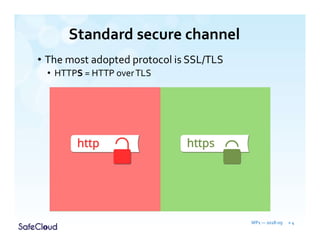
Standard secure channel
• The most adopted protocol is SSL/TLS
• HTTPS = HTTP overTLS
WP1 — 2018-09 » 4
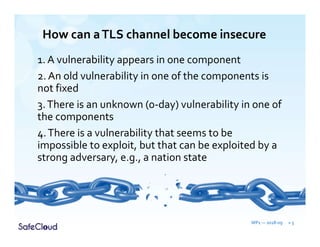
How can aTLS channel become insecure
1. A vulnerability appears in one component
2. An old vulnerability in one of the components is
not fixed
3.There is an unknown (0-day) vulnerability in one of
the components
4.There is a vulnerability that seems to be
impossible to exploit, but that can be exploited by a
strong adversary, e.g., a nation state
WP1 — 2018-09 » 5
Specific threats
• Weak cryptographic components
• DES, RC4, MD5, SHA-1
• Service identification
• Well-known ports are vulnerable to port scanning and
fingerprinting
• Route attacks
• Man-in-the-middle attacks
• Attacker intercepts communication
• Route hijacking
• Traffic may be deviated and then eavesdropped
WP1 — 2018-09 » 6
Summary of security requirements
• For the attacker to break the confidentiality,
privacy or integrity of a secure channel, he must:
(i) find a vulnerability in the channel
(ii) gain access to the endpoint machines
(iii) intercept communication path
WP1 — 2018-09 » 7
SafeCloud solutions
Secure Communication
WP1 — 2018-09 » 8
Middleware requirements
• Two forms of communication:
• Machine-to-cloud and
• Cloud-to-cloud
• Unicast communication between two endpoints
• Endpoints: clients, machines in clouds
• We do not envisage the need to protect data privacy in multicast,
anycast or broadcast communications
• Connection-oriented
• Similar to protocols likeTLS overTCP
• Implemented at application layer of the OSI model
• Difficult to deploy mechanisms at lower layers in the Internet
WP1 — 2018-09 » 9
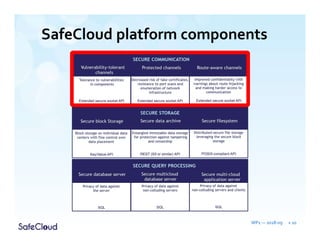
SafeCloud platform components
WP1 — 2018-09 » 10
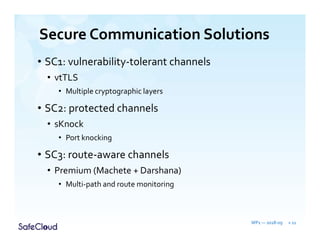
Secure Communication Solutions
• SC1: vulnerability-tolerant channels
• vtTLS
• Multiple cryptographic layers
• SC2: protected channels
• sKnock
• Port knocking
• SC3: route-aware channels
• Premium (Machete + Darshana)
• Multi-path and route monitoring
WP1 — 2018-09 » 11
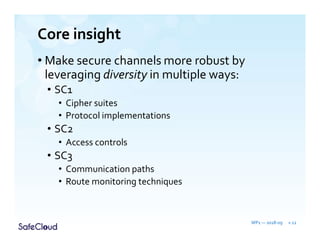
Core insight
• Make secure channels more robust by
leveraging diversity in multiple ways:
• SC1
• Cipher suites
• Protocol implementations
• SC2
• Access controls
• SC3
• Communication paths
• Route monitoring techniques
WP1 — 2018-09 » 12
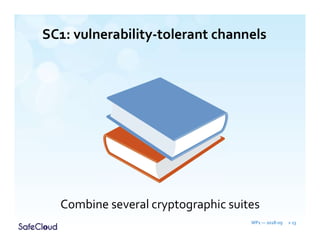
SC1: vulnerability-tolerant channels
WP1 — 2018-09 » 13
Combine several cryptographic suites
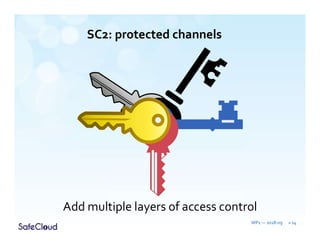
SC2: protected channels
WP1 — 2018-09 » 14
Add multiple layers of access control
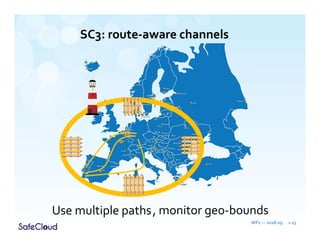
SC3: route-aware channels
WP1 — 2018-09 » 15
Use multiple paths, monitor geo-bounds
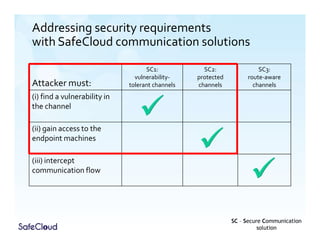
Addressing security requirements
with SafeCloud communication solutions
Attacker must:
SC1:
vulnerability-
tolerant channels
SC2:
protected
channels
SC3:
route-aware
channels
(i) find a vulnerability in
the channel
(ii) gain access to the
endpoint machines
(iii) intercept
communication flow
SC – Secure Communication
solution
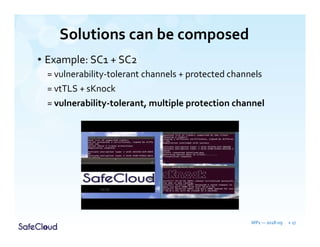
Solutions can be composed
• Example: SC1 + SC2
= vulnerability-tolerant channels + protected channels
= vtTLS + sKnock
= vulnerability-tolerant, multiple protection channel
WP1 — 2018-09 » 17
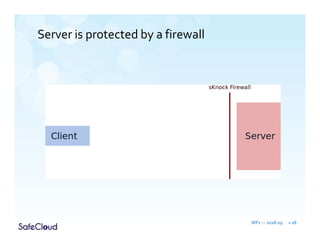
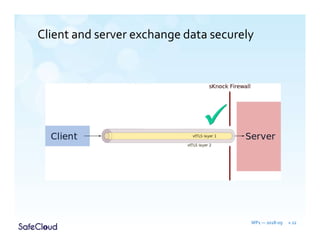
Server is protected by a firewall
WP1 — 2018-09 » 18
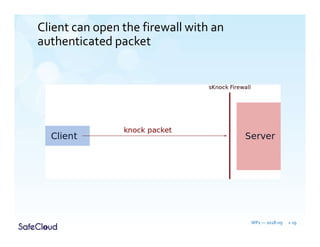
Client can open the firewall with an
authenticated packet
WP1 — 2018-09 » 19
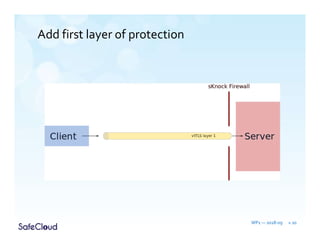
Add first layer of protection
WP1 — 2018-09 » 20
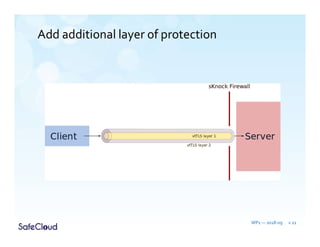
Add additional layer of protection
WP1 — 2018-09 » 21
Client and server exchange data securely
WP1 — 2018-09 » 22
SafeCloudWP1
achievements
Scientific,Technological, Exploitation
WP1 — 2018-09 » 23
All tasks completed
• T1.1 — Communication architecture [M1-M6]
• T1.2 —Vulnerability-tolerant channels [M1-30]
• T1.3 — Protected service provisioning [M1-30]
• T1.4 — Route monitoring [M1-30]
• T1.5 — Multi-path communication [M1-30]
WP1 — 2018-09 » 24
All deliverables completed
• D1.1 — Private communication middleware
architecture [M6; IN-ID]
• D1.2 — First version of the private communication
middleware components [M18; IN-ID]
• D1.3 — Final version of the private communication
middleware [M30; IN-ID]
WP1 — 2018-09 » 25
Scientific work
• Graduations
• 5 students at INESC-ID
• 10 students atTUM
• Publications
• 4 conference papers
• 2 workshop papers
• Credit to the students for all their great work!
WP1 — 2018-09 » 26
• SC1: vulnerability-tolerant channels
• vtTLS evaluation
• Evaluated: handshake, data transfer overhead
• SC2: protected channels
• sKnock
• Evaluated: latency, scalability
• SC3: route-aware channels
• Premium (Machete + Darshana)
• Evaluated: best number of multiple paths, multi-homing
• Evaluated: thresholds, false positives, false negatives
Testing and Evaluation
WP1 — 2018-09 » 27
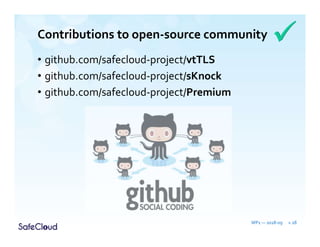
• github.com/safecloud-project/vtTLS
• github.com/safecloud-project/sKnock
• github.com/safecloud-project/Premium
Contributions to open-source community
WP1 — 2018-09 » 28
Conclusion
WP1 — 2018-09 » 29
Conclusion
• SafeCloud made secure channels more robust by
leveraging diversity in multiple ways
• Solutions can be combined
• Better security:
• Between endpoints and clouds
• Between people and the services they use
• Both for personal and corporate data
WP1 — 2018-09 » 30
Thank you!
WP 1: Secure Communication

SafeCloud Secure Communication solutions (WP1 overview)

  • 1.
  • 2.
    Outline • Objectives andsummary • Secure communication solutions • Achievements WP1 — 2018-09 » 2
  • 3.
    WP1 — objectivesand summary • Provide middleware services to improve the privacy and security of cloud communications in the SafeCloud platform • Protect data when downloading (and uploading) from the cloud • Provide same properties as secure channels: confidentiality, integrity, authenticity • But assuming more powerful adversaries that may break some assumptions that make existing channels secure WP1 — 2018-09 » 3
  • 4.
    Standard secure channel •The most adopted protocol is SSL/TLS • HTTPS = HTTP overTLS WP1 — 2018-09 » 4
  • 5.
    How can aTLSchannel become insecure 1. A vulnerability appears in one component 2. An old vulnerability in one of the components is not fixed 3.There is an unknown (0-day) vulnerability in one of the components 4.There is a vulnerability that seems to be impossible to exploit, but that can be exploited by a strong adversary, e.g., a nation state WP1 — 2018-09 » 5
  • 6.
    Specific threats • Weakcryptographic components • DES, RC4, MD5, SHA-1 • Service identification • Well-known ports are vulnerable to port scanning and fingerprinting • Route attacks • Man-in-the-middle attacks • Attacker intercepts communication • Route hijacking • Traffic may be deviated and then eavesdropped WP1 — 2018-09 » 6
  • 7.
    Summary of securityrequirements • For the attacker to break the confidentiality, privacy or integrity of a secure channel, he must: (i) find a vulnerability in the channel (ii) gain access to the endpoint machines (iii) intercept communication path WP1 — 2018-09 » 7
  • 8.
  • 9.
    Middleware requirements • Twoforms of communication: • Machine-to-cloud and • Cloud-to-cloud • Unicast communication between two endpoints • Endpoints: clients, machines in clouds • We do not envisage the need to protect data privacy in multicast, anycast or broadcast communications • Connection-oriented • Similar to protocols likeTLS overTCP • Implemented at application layer of the OSI model • Difficult to deploy mechanisms at lower layers in the Internet WP1 — 2018-09 » 9
  • 10.
  • 11.
    Secure Communication Solutions •SC1: vulnerability-tolerant channels • vtTLS • Multiple cryptographic layers • SC2: protected channels • sKnock • Port knocking • SC3: route-aware channels • Premium (Machete + Darshana) • Multi-path and route monitoring WP1 — 2018-09 » 11
  • 12.
    Core insight • Makesecure channels more robust by leveraging diversity in multiple ways: • SC1 • Cipher suites • Protocol implementations • SC2 • Access controls • SC3 • Communication paths • Route monitoring techniques WP1 — 2018-09 » 12
  • 13.
    SC1: vulnerability-tolerant channels WP1— 2018-09 » 13 Combine several cryptographic suites
  • 14.
    SC2: protected channels WP1— 2018-09 » 14 Add multiple layers of access control
  • 15.
    SC3: route-aware channels WP1— 2018-09 » 15 Use multiple paths, monitor geo-bounds
  • 16.
    Addressing security requirements withSafeCloud communication solutions Attacker must: SC1: vulnerability- tolerant channels SC2: protected channels SC3: route-aware channels (i) find a vulnerability in the channel (ii) gain access to the endpoint machines (iii) intercept communication flow SC – Secure Communication solution
  • 17.
    Solutions can becomposed • Example: SC1 + SC2 = vulnerability-tolerant channels + protected channels = vtTLS + sKnock = vulnerability-tolerant, multiple protection channel WP1 — 2018-09 » 17
  • 18.
    Server is protectedby a firewall WP1 — 2018-09 » 18
  • 19.
    Client can openthe firewall with an authenticated packet WP1 — 2018-09 » 19
  • 20.
    Add first layerof protection WP1 — 2018-09 » 20
  • 21.
    Add additional layerof protection WP1 — 2018-09 » 21
  • 22.
    Client and serverexchange data securely WP1 — 2018-09 » 22
  • 23.
  • 24.
    All tasks completed •T1.1 — Communication architecture [M1-M6] • T1.2 —Vulnerability-tolerant channels [M1-30] • T1.3 — Protected service provisioning [M1-30] • T1.4 — Route monitoring [M1-30] • T1.5 — Multi-path communication [M1-30] WP1 — 2018-09 » 24
  • 25.
    All deliverables completed •D1.1 — Private communication middleware architecture [M6; IN-ID] • D1.2 — First version of the private communication middleware components [M18; IN-ID] • D1.3 — Final version of the private communication middleware [M30; IN-ID] WP1 — 2018-09 » 25
  • 26.
    Scientific work • Graduations •5 students at INESC-ID • 10 students atTUM • Publications • 4 conference papers • 2 workshop papers • Credit to the students for all their great work! WP1 — 2018-09 » 26
  • 27.
    • SC1: vulnerability-tolerantchannels • vtTLS evaluation • Evaluated: handshake, data transfer overhead • SC2: protected channels • sKnock • Evaluated: latency, scalability • SC3: route-aware channels • Premium (Machete + Darshana) • Evaluated: best number of multiple paths, multi-homing • Evaluated: thresholds, false positives, false negatives Testing and Evaluation WP1 — 2018-09 » 27
  • 28.
    • github.com/safecloud-project/vtTLS • github.com/safecloud-project/sKnock •github.com/safecloud-project/Premium Contributions to open-source community WP1 — 2018-09 » 28
  • 29.
  • 30.
    Conclusion • SafeCloud madesecure channels more robust by leveraging diversity in multiple ways • Solutions can be combined • Better security: • Between endpoints and clouds • Between people and the services they use • Both for personal and corporate data WP1 — 2018-09 » 30
  • 31.
    Thank you! WP 1:Secure Communication