Miguel Pardal
Feb. 2017
LEIC 2000
Unisys Portugal
Lecturer at Técnico since 2002
MEIC 2006
Visiting Student at MIT in 2009
DEIC 2014
First publication in 2004
Since then, about 30 more
http://web.tecnico.ulisboa.pt/miguel.pardal
Share experience
Provide tools
Learn from you
Best thing about being
a teacher 
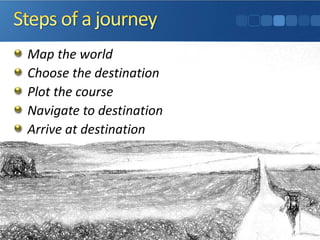
Map the world
Choose the destination
Plot the course
Navigate to destination
Arrive at destination
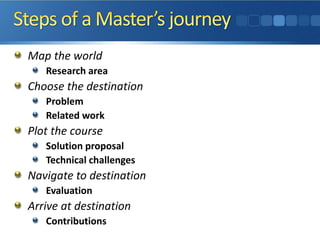
Map the world
Research area
Choose the destination
Problem
Related work
Plot the course
Solution proposal
Technical challenges
Navigate to destination
Evaluation
Arrive at destination
Contributions
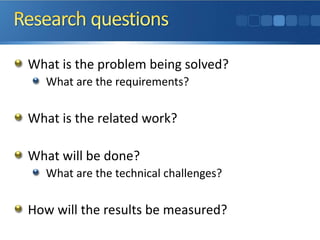
What is the problem being solved?
What are the requirements?
What is the related work?
What will be done?
What are the technical challenges?
How will the results be measured?
“X is better than Y!”
How do you know that?
From your own work
Experimental results
Statistically valid
From the work of others
Citations
How to name the authors in text
1 name: Smith
2 names: Smith and Williams
3+ names: Smith et al.
Presenting a new system/result
“Smith et al. [22] proposed a new system to…”
Supporting a statement
“Indeed system X was evaluated as the fastest [22]”
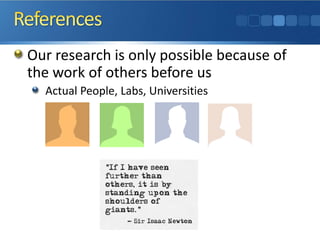
Our research is only possible because of
the work of others before us
Actual People, Labs, Universities
From the start,
keep a reference repository
Save the PDF
Identify each paper
Author name
Year
Journal/Conference acronym
Keywords
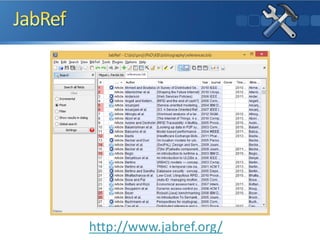
http://www.jabref.org/
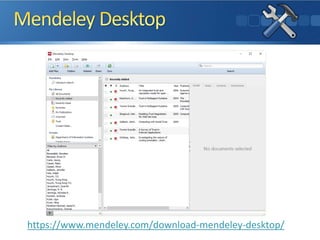
https://www.mendeley.com/download-mendeley-desktop/
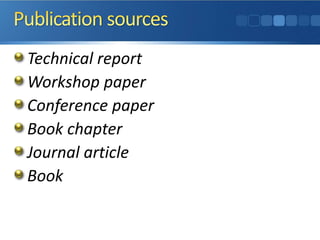
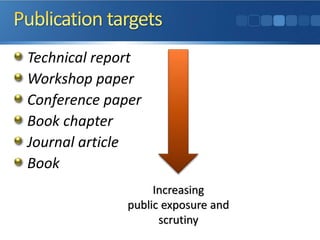
Technical report
Workshop paper
Conference paper
Book chapter
Journal article
Book
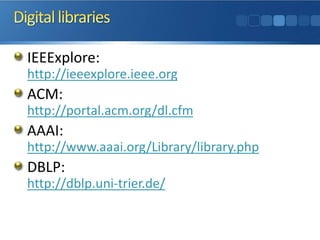
IEEExplore:
http://ieeexplore.ieee.org
ACM:
http://portal.acm.org/dl.cfm
AAAI:
http://www.aaai.org/Library/library.php
DBLP:
http://dblp.uni-trier.de/
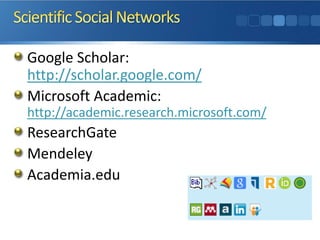
Google Scholar:
http://scholar.google.com/
Microsoft Academic:
http://academic.research.microsoft.com/
ResearchGate
Mendeley
Academia.edu
Choose top sources
ACM
IEEE
Usenix
Start with most recent papers
They will cite other relevant works
Go to where the research community meets
Good conference ?
Accept rate < 20%
Only 1 in 5 submitted papers gets accepted
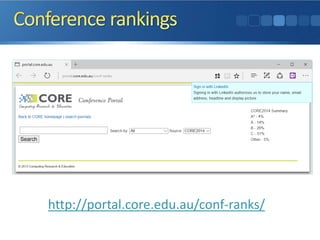
Check conference rankings
Good journal ?
Impact factor: average number of citations to
recent articles published in the journal
http://portal.core.edu.au/conf-ranks/
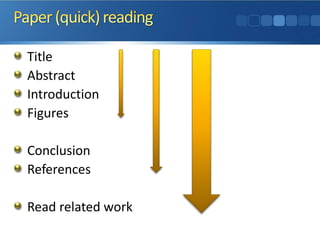
Title
Abstract
Introduction
Figures
Conclusion
References
Read related work
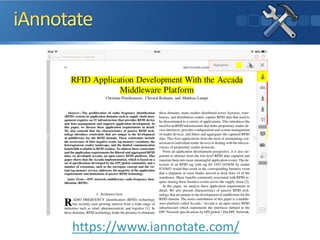
https://www.iannotate.com/
Write a short summary of paper
Should fit in an index card
What is relevant?
System characteristics
Assumptions
Examples/scenarios
...
State strong and
weak points
Use note taking app with search
OneNote, EverNote, …
https://www.onenote.com/
https://evernote.com
Tables are great for comparing things
Start with existing columns, or
think of your own
Add more columns if you need
Empty cells remind you of what you don’t know yet
System Initial Release Latest Version …
Windows
[Gates83]
1983 10.0
Mac [Jobs84] 1984 10.11 (El Capitan)
Linux [Torvalds91] 1991
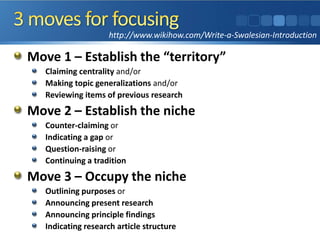
Move 1 – Establish the “territory”
Claiming centrality and/or
Making topic generalizations and/or
Reviewing items of previous research
Move 2 – Establish the niche
Counter-claiming or
Indicating a gap or
Question-raising or
Continuing a tradition
Move 3 – Occupy the niche
Outlining purposes or
Announcing present research
Announcing principle findings
Indicating research article structure
http://www.wikihow.com/Write-a-Swalesian-Introduction
A model is a simplification/abstraction of
a complex object
To show relevant characteristics
Easier to manipulate than the actual object
Represent:
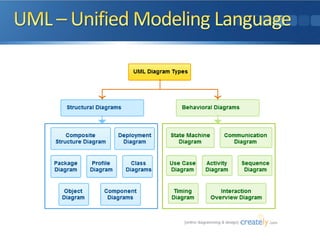
Structure
Behavior
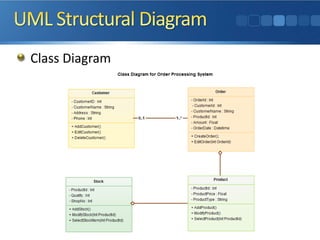
Class Diagram
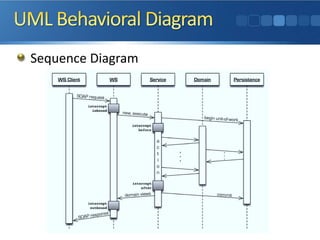
Sequence Diagram
Asking questions
Finding answers
Checking if answers are good enough
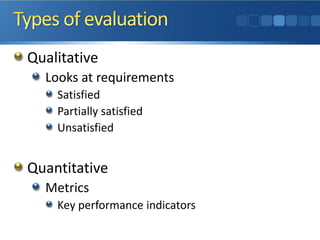
Qualitative
Looks at requirements
Satisfied
Partially satisfied
Unsatisfied
Quantitative
Metrics
Key performance indicators
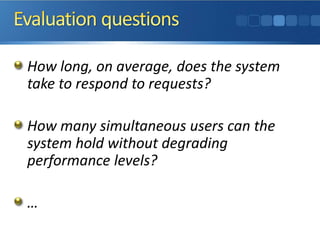
How long, on average, does the system
take to respond to requests?
How many simultaneous users can the
system hold without degrading
performance levels?
…
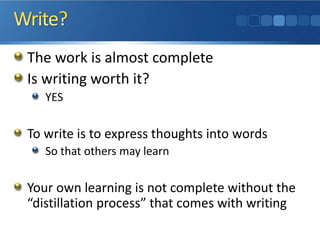
The work is almost complete
Is writing worth it?
YES
To write is to express thoughts into words
So that others may learn
Your own learning is not complete without the
“distillation process” that comes with writing
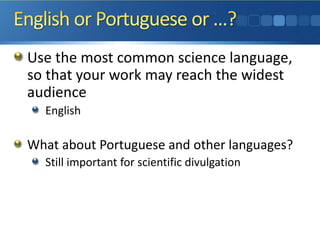
Use the most common science language,
so that your work may reach the widest
audience
English
What about Portuguese and other languages?
Still important for scientific divulgation
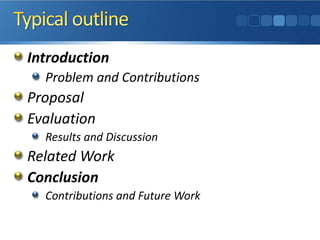
Introduction
Problem and Contributions
Proposal
Evaluation
Results and Discussion
Related Work
Conclusion
Contributions and Future Work
3 tells
Say what you will say
Say
Say what you said
Provide guidance and context to the reader
Each “middle” chapter in a dissertation
should have:
Introduction text
Main content sections
Summary section
Highlight most important points to carry forward
Transition to next chapter
Most important ideas first
Should appear in the beginning of the
paragraph
Details and alternatives should appear later
Be direct, to the point
“There are many important systems in computer
history, in particular, regarding remote graphical
systems, one of the first widely used contributions was
the X system [22]”
->
“The X system [22] was the first widely used remote
graphical system”
Use more formal language
Avoid oral contractions
We’re -> we are
Don’t -> do not
Gonna -> going to
Ain’t -> am not
Avoid possessives
Joana’s work
-> The work by Joana
The system’s characteristics
-> The characteristics of the system
Use correct tense
Proposal – future tense – will do
Dissertation – past tense – did
Use the third person
Sometimes first person plural is OK – we
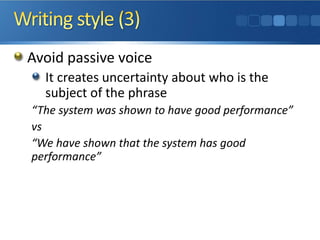
Avoid passive voice
It creates uncertainty about who is the
subject of the phrase
“The system was shown to have good performance”
vs
“We have shown that the system has good
performance”
Avoid informal (colloquial) expressions
“At the end of the day, the best system is …”
“It is a matter of life and death that…”
“There’s more than one way to skin a cat, so a
different approach was attempted…”
“The performance has hit a wall…”
Avoid exaggerations (hyperboles)
"infinite“
Infinity is not a large number
"innumerable“
It means uncountable
“impossible”
It means outside the realm of possibility
Avoid non-rigorous terms
“Ultra”
“Super”
“Critical”
“Elastic”
“Agile”
Avoid possibly rigorous terms used in a
non-rigorous way
“scalable”
It means that the system can sustain a
performance level when the number of users
increases by orders of magnitude (10, 100, 1000)
Not that it supports many users
“real-time“
It means subject to specific time constraints
Not that the system is fast
Process to increase the quality of the writing
Follow sound science practices
Reviews are not always constructive…
Do not get offended by it, the comments are not
about you, they are about your work
You should be the first to know that there is always
something to improve…
Blind review
You will not know who the reviewer is
Double blind review
The reviewer also does not know who you are
English quality
Structure
Literature review
Complete and to the point
Motivation for decisions
Rigor
Avoid misunderstandings
Identify the limitations of your own work
They will be found anyway (sooner or later)
They are future work opportunities
Technical report
Workshop paper
Conference paper
Book chapter
Journal article
Book
Increasing
public exposure and
scrutiny
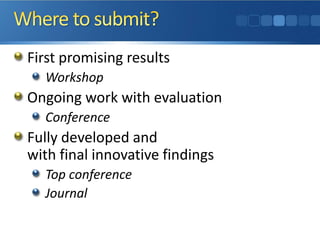
First promising results
Workshop
Ongoing work with evaluation
Conference
Fully developed and
with final innovative findings
Top conference
Journal
Science is personal and social
People and communities
are central
Reading related work
Learn from other authors
Cite them
Compare what they did
Writing about your work
Explain in a concise way
Learn from the reviewers
Share with others
Miguel.Pardal@tecnico.ulisboa.pt
Obrigado
Thank you
“The traveler sees what he sees.
The tourist sees what he has come to see.”
― G.K. Chesterton
IEEE Authorship Series and toolbox:
http://www.ieee.org/publications_standards/publications/
authors/authors_journals.html
Guide by Miguel and Joana Pardal:
http://web.tecnico.ulisboa.pt/miguel.pardal/www/doc/
quick-guide-research.pdf
Thanks to Miguel P. Correia for the review
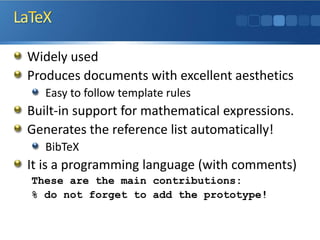
Widely used
Produces documents with excellent aesthetics
Easy to follow template rules
Built-in support for mathematical expressions.
Generates the reference list automatically!
BibTeX
It is a programming language (with comments)
These are the main contributions:
% do not forget to add the prototype!
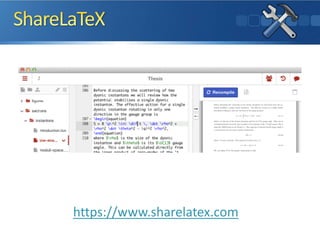
https://www.sharelatex.com
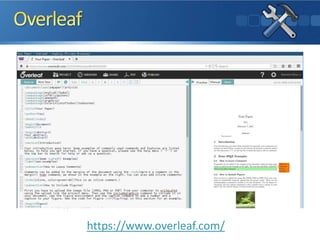
https://www.overleaf.com/

Master Beginners