© 2008 Eaton Corporation. All rights reserved.
This is a photographic template – your
photograph should fit precisely within this rectangle.
Spray Modeling for Lean NOx Trap
Aftertreatment System Design
Lokanath Mohanta
Milind S Kulkarni
Eaton Technologies Pvt Ltd, Pune, India
James McCarthy, Jr.
Eaton Corporation, Southfield, MI, USA
SAE INDIA
International Mobility Engineering
Congress & Exposition, Chennai
2009
2
2SAE INDIA International Mobility Engineering Congress & Exposition, 2009, Chennai
Topics
• Introduction to Eaton Aftertreatment System
• Modeling Approach
• Test based Injection Modeling
• Injection Modeling through CFD
• Validation of Computational Model
• Results
• Performance Comparison of Injectors
• Mixer Selection
• Conclusion
3
3SAE INDIA International Mobility Engineering Congress & Exposition, 2009, Chennai
Introduction
Eaton Aftertreatment system
NOx < 0.27 gm/kW-h
PM < 0.02 gm/kW-h
Working
• Lean NOX Trap (LNT) stores the NOX
• During LNT regeneration, Reformer produces H2
and CO, which are used to purge the LNT
• LNT releases the NOX as Nitrogen and NH3
• Selective Catalytic Reduction (SCR) uses the
released NH3 and treats the slipped NOX
• Diesel Particulate Filter (DPF) traps the Particulate
Matter (PM)
Product Differentiator
• Single fluid system [Dosing System needed]
• Independent of urea infrastructure
• Flexible, customized and smaller packaging
• Scalable with engine power (size)
# Ref: Hu, DEER Conf 2006, McCarthy, SAE2009-01-2835
Emission Regulation for Highway Vehicle#
Eaton Aftertreatment System#
4
4SAE INDIA International Mobility Engineering Congress & Exposition, 2009, Chennai
Topics
• Introduction to Eaton Aftertreatment System
• Modeling Approach
• Test based Injection Modeling
• Injection Modeling through CFD
• Validation of Computational Model
• Results
• Performance Comparison of Injectors
• Mixer Selection
• Conclusion
5
5SAE INDIA International Mobility Engineering Congress & Exposition, 2009, Chennai
EAS modeling Approach…
Role of CFD
• Optimize fuel preparation path
• 100% fuel vaporization
• Uniform flow and fuel distribution
Challenges
• Fuel injection modeling
Computational Domain
Exh Flow In
InjectorMixer-1Mixer-2Reformer
Boundary Condition
• Inlet – Transient Profile
• Reformer - Porous media
• Mixers: Zero Thickness wall
• Walls: Convective in steady
environment
Fuel Droplet Tracking
• Lagrangian method [DPM]
Exh Flow Out
Inlet: Transient Profile Boundary Condition
0
5
10
15
20
25
30
0 5 10 15 20 25 30
Time [sec]
ExhMassFlux[kg/m^2-s]
0
100
200
300
400
500
600
Fueling[gpm];Temperature[K]
B25 Exhaust Mass Flux (kg/m^2-2) B25 Exhaust Temperature (K)
B25 Exhaust O2 Concentration (%) B25 Fuel Mass Flow (grams/min)
0
2
4
6
8
10
O2Concentration[%]
6
6SAE INDIA International Mobility Engineering Congress & Exposition, 2009, Chennai
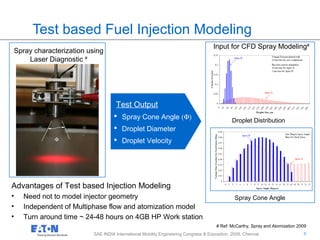
Test based Fuel Injection Modeling
Advantages of Test based Injection Modeling
• Need not to model injector geometry
• Independent of Multiphase flow and atomization model
• Turn around time ~ 24-48 hours on 4GB HP Work station
Input for CFD Spray Modeling#
Droplet Distribution
Spray Cone Angle
Spray characterization using
Laser Diagnostic #
Test Output
 Spray Cone Angle (Φ)
 Droplet Diameter
 Droplet Velocity
# Ref: McCarthy, Spray and Atomization 2009
Φ
7
7SAE INDIA International Mobility Engineering Congress & Exposition, 2009, Chennai
Axis
Spool wall
Wall
SwirlChamber Point of
Injection
Axis
Direction Vector
• Axial
• Swirl
Axis
Spool wall
Wall
SwirlChamber Point of
Injection
Axis
Injection Modeling through CFD
Step -1 : Geometry Details
Multiphase Flow Simulation
(Volume of Fluids -- VOF)
Step-2: Droplet Modeling [DPM]
Pressure Swirl Atomizer (Break up
& Coalescence)
• Droplet Distribution
• Droplet Diameter
• Spray Cone Angle
• Pressure Drop
2- D Axisymmetric VOF Domain 2- D Axisymmetric DPM Domain
Injector Geometry
Step-1 - VOF Step-2
Computational Domain
for Droplet Modeling
8
8SAE INDIA International Mobility Engineering Congress & Exposition, 2009, Chennai
0
10
20
30
40
50
60
70
80
Half Cone Angle ( Deg) SMD(Micron)
Experiment
Simulation
fuel
Air
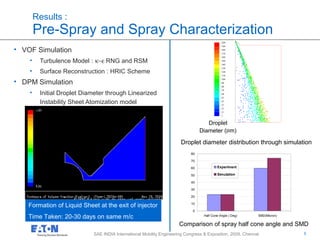
• VOF Simulation
• Turbulence Model : κ−ε RNG and RSM
• Surface Reconstruction : HRIC Scheme
• DPM Simulation
• Initial Droplet Diameter through Linearized
Instability Sheet Atomization model
• Initial distribution follows the Rosin-Rammler
Distribution
Results :
Pre-Spray and Spray Characterization
Effect of turbulence model: a) κ−ε model b)
RSM model
Formation of Liquid Sheet at the exit of injector
Time Taken: 20-30 days on same m/c
Comparison of spray half cone angle and SMD
Droplet diameter distribution through simulation
Droplet
Diameter (µm)
9
9SAE INDIA International Mobility Engineering Congress & Exposition, 2009, Chennai
Topics
• Introduction to Eaton Aftertreatment System
• Modeling Approach
• Test based Injection Modeling
• Injection Modeling through CFD
• Validation of Computational Model
• Results
• Performance Comparison of Injectors
• Mixer Selection
• Conclusion
10
10SAE INDIA International Mobility Engineering Congress & Exposition, 2009, Chennai
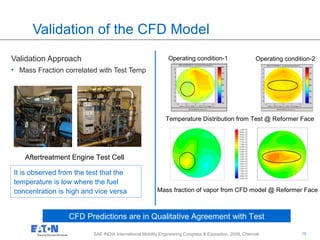
Validation of the CFD Model
Validation Approach
• Mass Fraction correlated with Test Temp
Temperature Distribution from Test @ Reformer Face
Mass fraction of vapor from CFD model @ Reformer Face
Operating condition-1 Operating condition-2
CFD Predictions are in Qualitative Agreement with Test
Aftertreatment Engine Test Cell
It is observed from the test that the
temperature is low where the fuel
concentration is high and vice versa
11
11SAE INDIA International Mobility Engineering Congress & Exposition, 2009, Chennai
Topics
• Introduction to Eaton Aftertreatment System
• Modeling Approach
• Test based Injection Modeling
• Injection Modeling through CFD
• Validation of Computational Model
• Results
• Performance Comparison of Injectors
• Mixer Selection
• Conclusion
12
12SAE INDIA International Mobility Engineering Congress & Exposition, 2009, Chennai
Results :
Performance Comparison of Injectors
Comparison of wall wetting and Mass Fraction contour
Exhaust System with Spray A
Exhaust System with Spray B
Smaller droplets : Higher fuel uniformity and Better vaporization
• Spray A [ Large Droplets ]
• Fuel uniformity is low
• Higher wall wetting
• Spray B [ Small Droplets]
• Higher fuel uniformity
• Low wall wetting
Diameter distribution of droplets
Spray B
Spray A
High
Low
13
13SAE INDIA International Mobility Engineering Congress & Exposition, 2009, Chennai
Results :
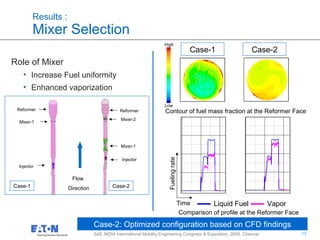
Mixer Selection
Case-1
Contour of fuel mass fraction at the Reformer Face
Comparison of profile at the Reformer Face
Case-2
Liquid Fuel Vapor
Case-2: Optimized configuration based on CFD findings
Injector
Mixer-1
Mixer-2
Reformer
Injector
Mixer-1
Reformer
Case-1 Case-2
Flow
Direction
Role of Mixer
• Increase Fuel uniformity
• Enhanced vaporization
Fuelingrate
Time
Low
High
14
14SAE INDIA International Mobility Engineering Congress & Exposition, 2009, Chennai
Topics
• Introduction to Eaton Aftertreatment System
• Modeling Approach
• Test based Injection Modeling
• Injection Modeling through CFD
• Validation of Computational Model
• Results
• Performance Comparison of Injectors
• Mixer Selection
• Conclusion
15
15SAE INDIA International Mobility Engineering Congress & Exposition, 2009, Chennai
Conclusion
• Test based Injection modeling proved successful to model the
spray behavior. Results validated on aftertreatment hardware.
• Injection modeling through CFD
• 2-D Axi-symmetric VOF model predicted the spray cone angle
accurately.
• DPM Model predicted a representative distribution of the droplets.
• CFD with Test based injection Modeling was used to optimize the
mixing and fuel distribution in the exhaust.
• Injection modeling through CFD can be used independent of test
to generate the spray characteristics.
16
16SAE INDIA International Mobility Engineering Congress & Exposition, 2009, Chennai
Acknowledgement
• EATON Aftertreatment Team,
• Pune, India
• Southfield, USA
• Galesburg, USA
• Santa Clara, USA
• Fluent Support
• FLUENT Support, MI, USA
• Fluent Support, Pune India
SAE_CONF_v1-7

SAE_CONF_v1-7

  • 1.
    © 2008 EatonCorporation. All rights reserved. This is a photographic template – your photograph should fit precisely within this rectangle. Spray Modeling for Lean NOx Trap Aftertreatment System Design Lokanath Mohanta Milind S Kulkarni Eaton Technologies Pvt Ltd, Pune, India James McCarthy, Jr. Eaton Corporation, Southfield, MI, USA SAE INDIA International Mobility Engineering Congress & Exposition, Chennai 2009
  • 2.
    2 2SAE INDIA InternationalMobility Engineering Congress & Exposition, 2009, Chennai Topics • Introduction to Eaton Aftertreatment System • Modeling Approach • Test based Injection Modeling • Injection Modeling through CFD • Validation of Computational Model • Results • Performance Comparison of Injectors • Mixer Selection • Conclusion
  • 3.
    3 3SAE INDIA InternationalMobility Engineering Congress & Exposition, 2009, Chennai Introduction Eaton Aftertreatment system NOx < 0.27 gm/kW-h PM < 0.02 gm/kW-h Working • Lean NOX Trap (LNT) stores the NOX • During LNT regeneration, Reformer produces H2 and CO, which are used to purge the LNT • LNT releases the NOX as Nitrogen and NH3 • Selective Catalytic Reduction (SCR) uses the released NH3 and treats the slipped NOX • Diesel Particulate Filter (DPF) traps the Particulate Matter (PM) Product Differentiator • Single fluid system [Dosing System needed] • Independent of urea infrastructure • Flexible, customized and smaller packaging • Scalable with engine power (size) # Ref: Hu, DEER Conf 2006, McCarthy, SAE2009-01-2835 Emission Regulation for Highway Vehicle# Eaton Aftertreatment System#
  • 4.
    4 4SAE INDIA InternationalMobility Engineering Congress & Exposition, 2009, Chennai Topics • Introduction to Eaton Aftertreatment System • Modeling Approach • Test based Injection Modeling • Injection Modeling through CFD • Validation of Computational Model • Results • Performance Comparison of Injectors • Mixer Selection • Conclusion
  • 5.
    5 5SAE INDIA InternationalMobility Engineering Congress & Exposition, 2009, Chennai EAS modeling Approach… Role of CFD • Optimize fuel preparation path • 100% fuel vaporization • Uniform flow and fuel distribution Challenges • Fuel injection modeling Computational Domain Exh Flow In InjectorMixer-1Mixer-2Reformer Boundary Condition • Inlet – Transient Profile • Reformer - Porous media • Mixers: Zero Thickness wall • Walls: Convective in steady environment Fuel Droplet Tracking • Lagrangian method [DPM] Exh Flow Out Inlet: Transient Profile Boundary Condition 0 5 10 15 20 25 30 0 5 10 15 20 25 30 Time [sec] ExhMassFlux[kg/m^2-s] 0 100 200 300 400 500 600 Fueling[gpm];Temperature[K] B25 Exhaust Mass Flux (kg/m^2-2) B25 Exhaust Temperature (K) B25 Exhaust O2 Concentration (%) B25 Fuel Mass Flow (grams/min) 0 2 4 6 8 10 O2Concentration[%]
  • 6.
    6 6SAE INDIA InternationalMobility Engineering Congress & Exposition, 2009, Chennai Test based Fuel Injection Modeling Advantages of Test based Injection Modeling • Need not to model injector geometry • Independent of Multiphase flow and atomization model • Turn around time ~ 24-48 hours on 4GB HP Work station Input for CFD Spray Modeling# Droplet Distribution Spray Cone Angle Spray characterization using Laser Diagnostic # Test Output  Spray Cone Angle (Φ)  Droplet Diameter  Droplet Velocity # Ref: McCarthy, Spray and Atomization 2009 Φ
  • 7.
    7 7SAE INDIA InternationalMobility Engineering Congress & Exposition, 2009, Chennai Axis Spool wall Wall SwirlChamber Point of Injection Axis Direction Vector • Axial • Swirl Axis Spool wall Wall SwirlChamber Point of Injection Axis Injection Modeling through CFD Step -1 : Geometry Details Multiphase Flow Simulation (Volume of Fluids -- VOF) Step-2: Droplet Modeling [DPM] Pressure Swirl Atomizer (Break up & Coalescence) • Droplet Distribution • Droplet Diameter • Spray Cone Angle • Pressure Drop 2- D Axisymmetric VOF Domain 2- D Axisymmetric DPM Domain Injector Geometry Step-1 - VOF Step-2 Computational Domain for Droplet Modeling
  • 8.
    8 8SAE INDIA InternationalMobility Engineering Congress & Exposition, 2009, Chennai 0 10 20 30 40 50 60 70 80 Half Cone Angle ( Deg) SMD(Micron) Experiment Simulation fuel Air • VOF Simulation • Turbulence Model : κ−ε RNG and RSM • Surface Reconstruction : HRIC Scheme • DPM Simulation • Initial Droplet Diameter through Linearized Instability Sheet Atomization model • Initial distribution follows the Rosin-Rammler Distribution Results : Pre-Spray and Spray Characterization Effect of turbulence model: a) κ−ε model b) RSM model Formation of Liquid Sheet at the exit of injector Time Taken: 20-30 days on same m/c Comparison of spray half cone angle and SMD Droplet diameter distribution through simulation Droplet Diameter (µm)
  • 9.
    9 9SAE INDIA InternationalMobility Engineering Congress & Exposition, 2009, Chennai Topics • Introduction to Eaton Aftertreatment System • Modeling Approach • Test based Injection Modeling • Injection Modeling through CFD • Validation of Computational Model • Results • Performance Comparison of Injectors • Mixer Selection • Conclusion
  • 10.
    10 10SAE INDIA InternationalMobility Engineering Congress & Exposition, 2009, Chennai Validation of the CFD Model Validation Approach • Mass Fraction correlated with Test Temp Temperature Distribution from Test @ Reformer Face Mass fraction of vapor from CFD model @ Reformer Face Operating condition-1 Operating condition-2 CFD Predictions are in Qualitative Agreement with Test Aftertreatment Engine Test Cell It is observed from the test that the temperature is low where the fuel concentration is high and vice versa
  • 11.
    11 11SAE INDIA InternationalMobility Engineering Congress & Exposition, 2009, Chennai Topics • Introduction to Eaton Aftertreatment System • Modeling Approach • Test based Injection Modeling • Injection Modeling through CFD • Validation of Computational Model • Results • Performance Comparison of Injectors • Mixer Selection • Conclusion
  • 12.
    12 12SAE INDIA InternationalMobility Engineering Congress & Exposition, 2009, Chennai Results : Performance Comparison of Injectors Comparison of wall wetting and Mass Fraction contour Exhaust System with Spray A Exhaust System with Spray B Smaller droplets : Higher fuel uniformity and Better vaporization • Spray A [ Large Droplets ] • Fuel uniformity is low • Higher wall wetting • Spray B [ Small Droplets] • Higher fuel uniformity • Low wall wetting Diameter distribution of droplets Spray B Spray A High Low
  • 13.
    13 13SAE INDIA InternationalMobility Engineering Congress & Exposition, 2009, Chennai Results : Mixer Selection Case-1 Contour of fuel mass fraction at the Reformer Face Comparison of profile at the Reformer Face Case-2 Liquid Fuel Vapor Case-2: Optimized configuration based on CFD findings Injector Mixer-1 Mixer-2 Reformer Injector Mixer-1 Reformer Case-1 Case-2 Flow Direction Role of Mixer • Increase Fuel uniformity • Enhanced vaporization Fuelingrate Time Low High
  • 14.
    14 14SAE INDIA InternationalMobility Engineering Congress & Exposition, 2009, Chennai Topics • Introduction to Eaton Aftertreatment System • Modeling Approach • Test based Injection Modeling • Injection Modeling through CFD • Validation of Computational Model • Results • Performance Comparison of Injectors • Mixer Selection • Conclusion
  • 15.
    15 15SAE INDIA InternationalMobility Engineering Congress & Exposition, 2009, Chennai Conclusion • Test based Injection modeling proved successful to model the spray behavior. Results validated on aftertreatment hardware. • Injection modeling through CFD • 2-D Axi-symmetric VOF model predicted the spray cone angle accurately. • DPM Model predicted a representative distribution of the droplets. • CFD with Test based injection Modeling was used to optimize the mixing and fuel distribution in the exhaust. • Injection modeling through CFD can be used independent of test to generate the spray characteristics.
  • 16.
    16 16SAE INDIA InternationalMobility Engineering Congress & Exposition, 2009, Chennai Acknowledgement • EATON Aftertreatment Team, • Pune, India • Southfield, USA • Galesburg, USA • Santa Clara, USA • Fluent Support • FLUENT Support, MI, USA • Fluent Support, Pune India