1
A.A. 2015/2016 – UNIMORE, MSc INTERNATIONAL MANAGEMENT
BORSARI MARCO
PIOLANTI CAMILLA
Internationalization
2
INDEX
INTRODUCTION 3
1 BUSINESS/MARKET ANALYSIS 4
1.1 Business definition and segmentation 4
1.2 Industry context (domestic vs international) 6
1.3 Supply and demand’s structure and trends 7
1.4 Rules of competition and competitive (5) forces 10
1.5 Business attractiveness 13
2 COMPETITIVE COMPANY PROFILE 13
2.1 Company History 13
2.2 Market positioning 16
2.3 Business, functional and corporate strategies 18
2.4 Market, economic and financial performances 21
2.5 Company competitive profile & GE matrix 23
3 COMPANY INTERNATIONAL TRACK 26
3.1 Internationalization motives 26
3.2 International market’s approaches 27
3.3 International strategy and market orientation 28
3.4 Results and performances 29
3.5 Internationalization’s model 30
4 FOREIGN MARKET ANALYSIS – BRAZIL 32
4.1 Market structure & environment 32
4.2 Opportunities and drawbacks 36
4.3 Country risks 38
4.4 Entry barriers 42
4.5 Entry options strategies 43
5 INTERNATIONAL FDI – GREENFIELD 44
5.1 Motivations 44
5.2 Factory location choices 44
5.3 The building process of SACMI DO BRASIL 45
5.4 Activities and operations 46
5.5 Performances 46
5.6 Competitors reaction 48
6 FUTURE PERSPECTIVES 49
7 BIBLIOGRAFY 50
3
INTRODUCTION
SACMI is a multinational group in manufacturing machines and complete plants for the
Ceramics, Packaging (Beverage and Closures&Containers), Food and Automation
industries. The Company is a world leader in its businesses thanks to the application of
innovative technologies, the well-established position in the international markets and its
commitment to research in order to ensure consistent top quality and service to the clients.
The Sacmi Group has over 80 companies in 28 countries, production plants, distribution
firms and service ones controlled by the parent company in Imola. A far-reaching presence
that explains why over 89% of Group sales come from exports. The Sacmi Group provides
efficient assistance and services all over the world thanks to a network which offers fast,
efficient, direct service on every continent.1
The aim of this paper is to examine the internationalization of Sacmi. At the beginning it is
presented the businesses and markets in which Sacmi operates, with a particular focus on
the Ceramic industry, which is the core business of the company. Therefore, it is described
the business and its segmentation, the domestic and international context of the industry,
the supply and demand’s structure and trends, the competitive arena of the Ceramic
industry and finally a focus on the business attractiveness.
Then, the discussion moves to the company profile. The section starts with a brief view of
the company’s history, with particular focus on the market positioning. Then, the business,
functional, and corporate strategies analyzed through the value chain, the diversification
growth, the competitive advantage, and the differentiation strategy. Next, in this section, is
possible to find a quick financial view of the company with attention to the market,
economic, and financial performances. Finally, this section ends with the competitive
profile of the company and the building of the GE Matrix.
In the third section, is possible to find the company international track. It starts with the
internationalization motives of the Group, then moves to focus on the international
market’s approaches: a timeline graph and the most relevant examples. A description of
the results and performances of Sacmi in the international market follows. Finally, the
Uppsala model, which is basically the internationalization model used by Sacmi.
The fourth section concerns a foreign market analysis. In this project it has been selected
the Brazilian market as a very interesting case among the international operations of
Sacmi abroad. So, it has been discussed the market structure and environment with a
particular attention to the Ceramic industry. Then, the opportunities and drawbacks, the
country risks such as political, economic and operating risks, with a brief view of SACE
country risk. Finally, the focus moves to the entry barriers in Brazil and then to possible
entry option strategies.
The next section focuses on the specific FDI operation of Sacmi in Brazil: Greenfield. It is
examined the motivations of this choice, the decision of the location, the building process
of Sacmi Do Brazil, which activities and operations Sacmi does in this factory, how it
performs, and the competitors reaction of this strategic choice of Sacmi.
Finally, the paper ends with a section dedicated to future perspectives of Sacmi in all its
three main businesses and some previsions about how will be the Group in ten years.
A particular thank to Pietro Cassani for the willingness, the dedication, providing vital
information for this work.
1
http://www.sacmi.com/it-IT/Chi-siamo.aspx?idc=810&ln=it-IT
4
1 BUSINESS/MARKET ANALYSIS
1.1 Business definition and segmentation
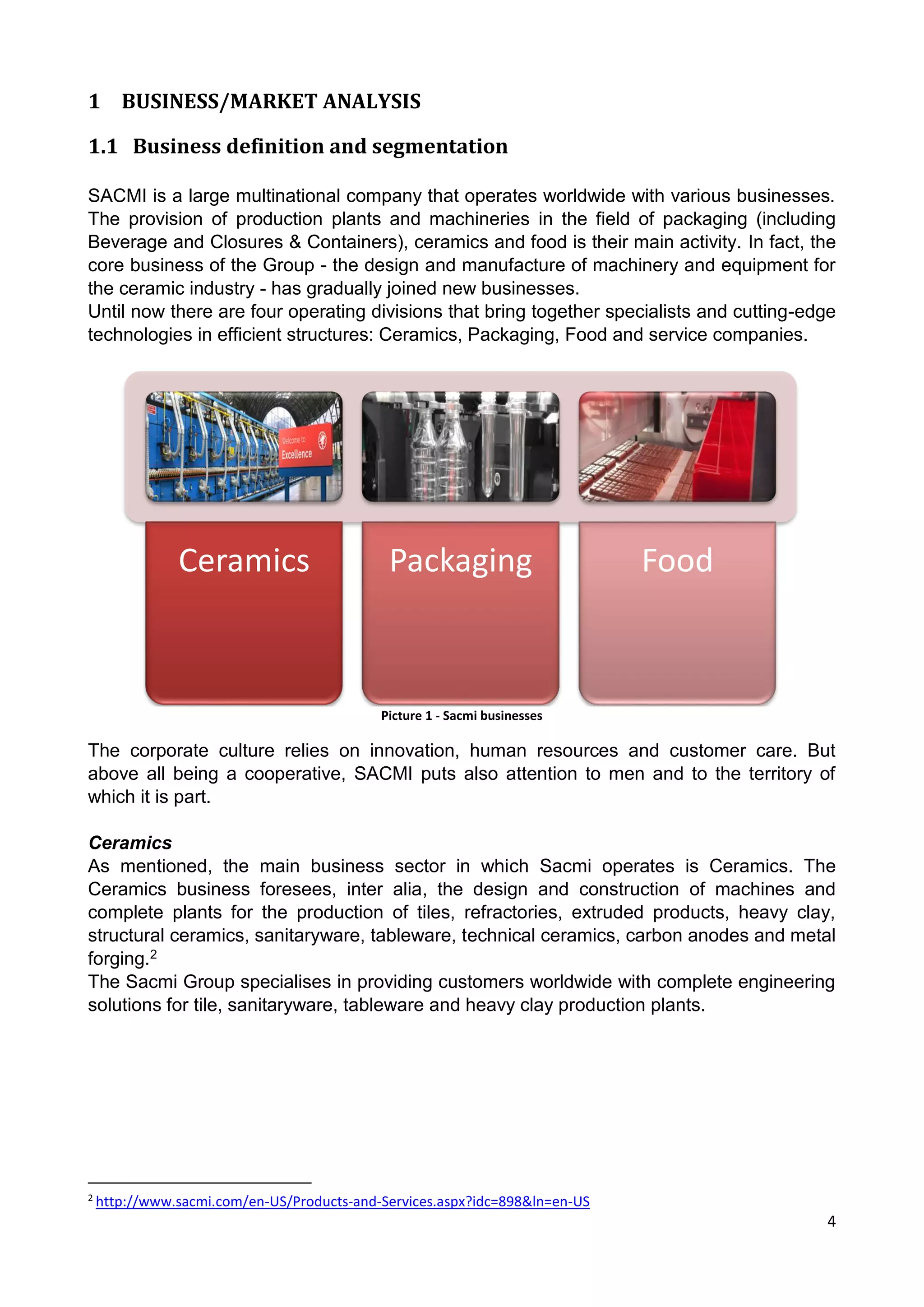
SACMI is a large multinational company that operates worldwide with various businesses.
The provision of production plants and machineries in the field of packaging (including
Beverage and Closures & Containers), ceramics and food is their main activity. In fact, the
core business of the Group - the design and manufacture of machinery and equipment for
the ceramic industry - has gradually joined new businesses.
Until now there are four operating divisions that bring together specialists and cutting-edge
technologies in efficient structures: Ceramics, Packaging, Food and service companies.
Picture 1 - Sacmi businesses
The corporate culture relies on innovation, human resources and customer care. But
above all being a cooperative, SACMI puts also attention to men and to the territory of
which it is part.
Ceramics
As mentioned, the main business sector in which Sacmi operates is Ceramics. The
Ceramics business foresees, inter alia, the design and construction of machines and
complete plants for the production of tiles, refractories, extruded products, heavy clay,
structural ceramics, sanitaryware, tableware, technical ceramics, carbon anodes and metal
forging.2
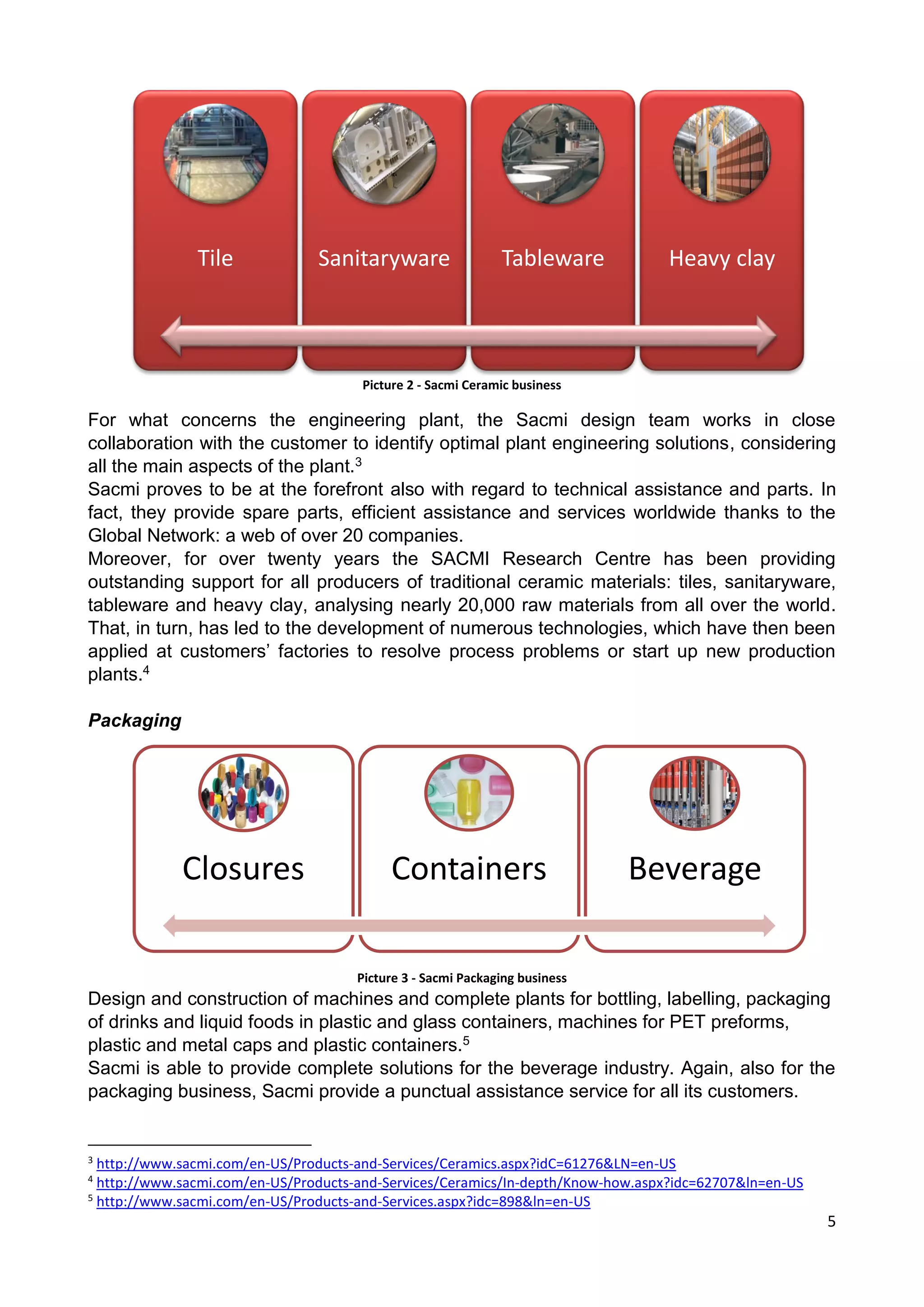
The Sacmi Group specialises in providing customers worldwide with complete engineering
solutions for tile, sanitaryware, tableware and heavy clay production plants.
2
http://www.sacmi.com/en-US/Products-and-Services.aspx?idc=898&ln=en-US
Ceramics Packaging Food
5
Picture 2 - Sacmi Ceramic business
For what concerns the engineering plant, the Sacmi design team works in close
collaboration with the customer to identify optimal plant engineering solutions, considering
all the main aspects of the plant.3
Sacmi proves to be at the forefront also with regard to technical assistance and parts. In
fact, they provide spare parts, efficient assistance and services worldwide thanks to the
Global Network: a web of over 20 companies.
Moreover, for over twenty years the SACMI Research Centre has been providing
outstanding support for all producers of traditional ceramic materials: tiles, sanitaryware,
tableware and heavy clay, analysing nearly 20,000 raw materials from all over the world.
That, in turn, has led to the development of numerous technologies, which have then been
applied at customers’ factories to resolve process problems or start up new production
plants.4
Packaging
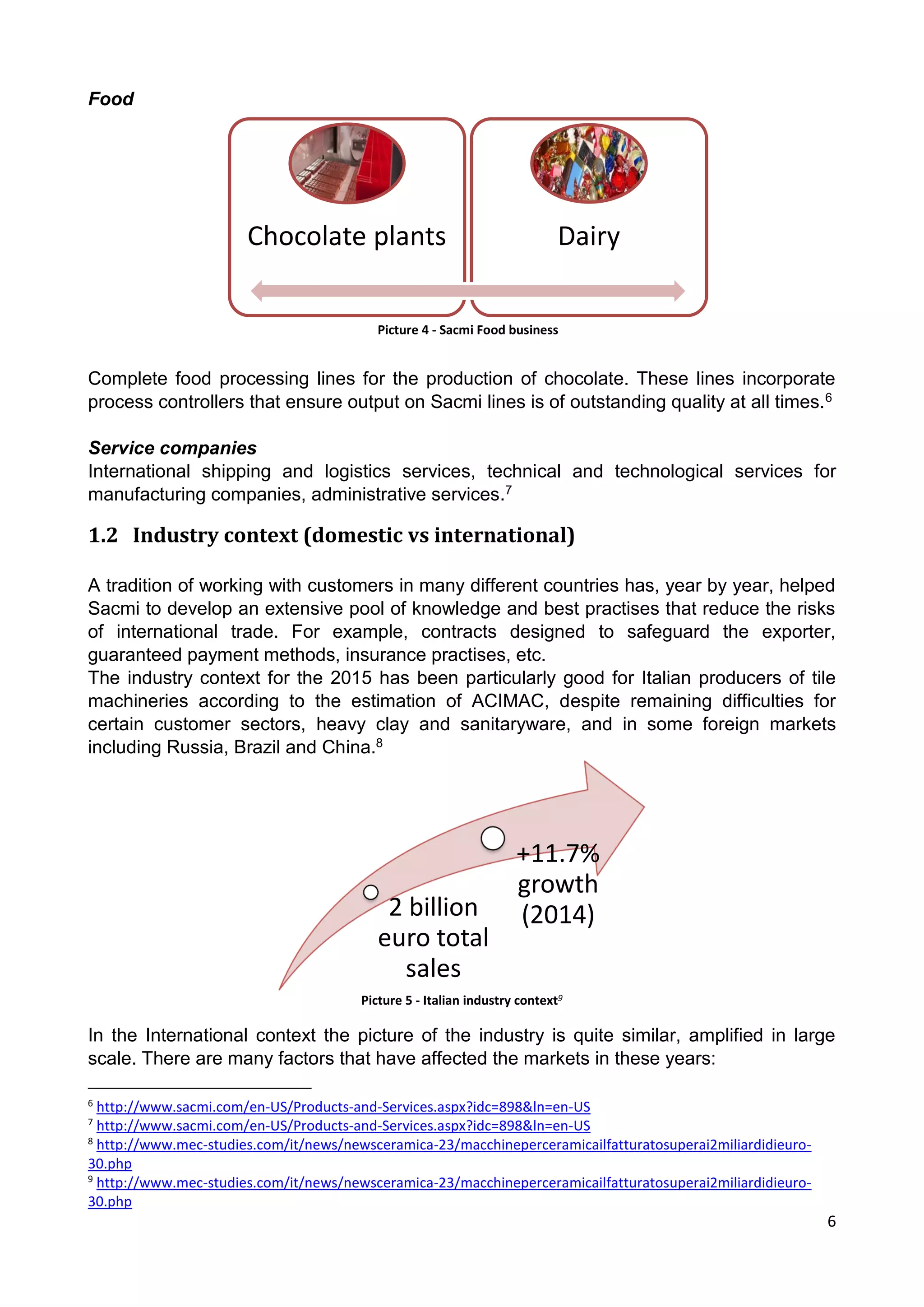
Design and construction of machines and complete plants for bottling, labelling, packaging
of drinks and liquid foods in plastic and glass containers, machines for PET preforms,
plastic and metal caps and plastic containers.5
Sacmi is able to provide complete solutions for the beverage industry. Again, also for the
packaging business, Sacmi provide a punctual assistance service for all its customers.
3
http://www.sacmi.com/en-US/Products-and-Services/Ceramics.aspx?idC=61276&LN=en-US
4
http://www.sacmi.com/en-US/Products-and-Services/Ceramics/In-depth/Know-how.aspx?idc=62707&ln=en-US
5
http://www.sacmi.com/en-US/Products-and-Services.aspx?idc=898&ln=en-US
Tile Sanitaryware Tableware Heavy clay
Closures Containers Beverage
Picture 3 - Sacmi Packaging business
6
Food
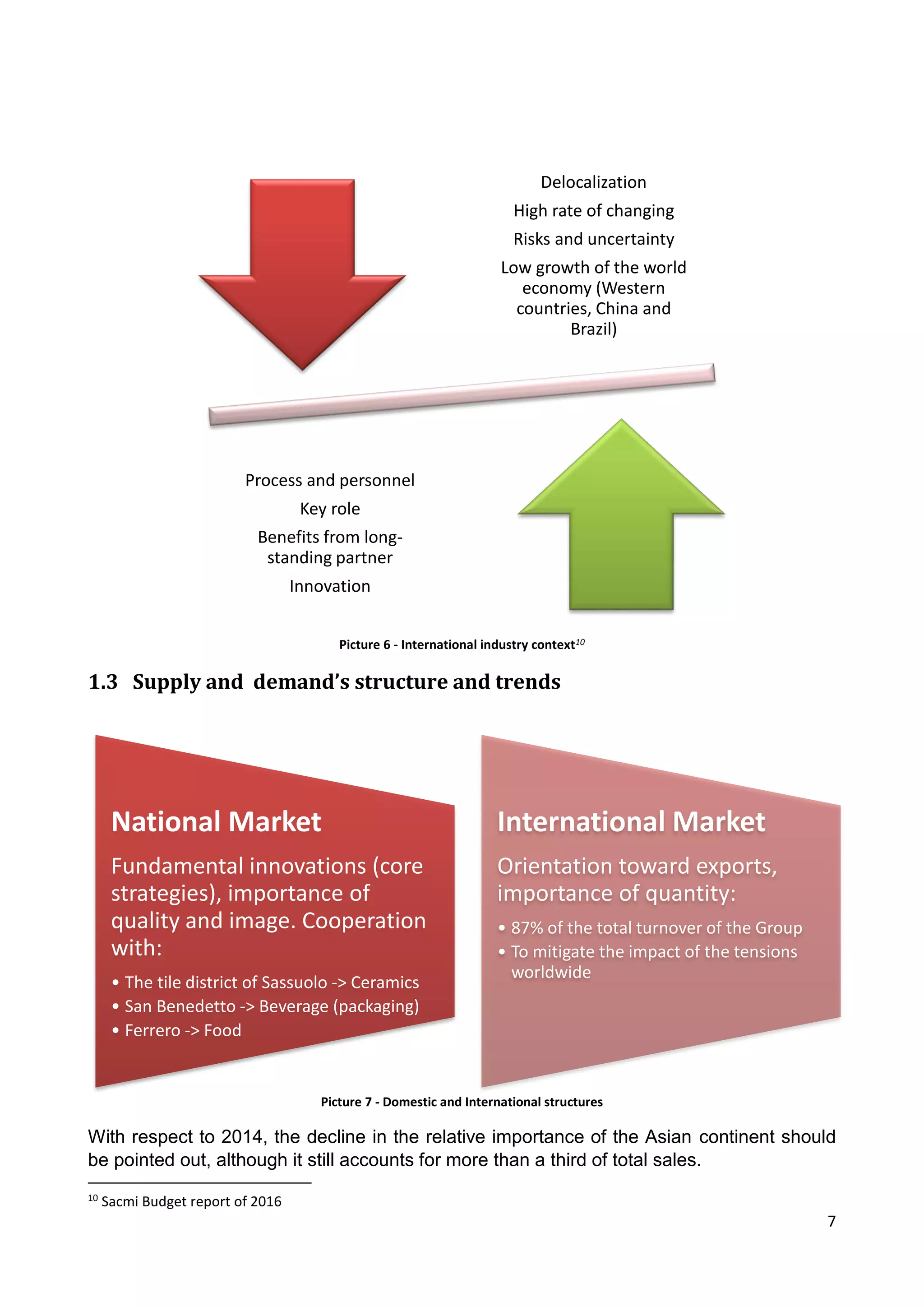
Complete food processing lines for the production of chocolate. These lines incorporate
process controllers that ensure output on Sacmi lines is of outstanding quality at all times.6
Service companies
International shipping and logistics services, technical and technological services for
manufacturing companies, administrative services.7
1.2 Industry context (domestic vs international)
A tradition of working with customers in many different countries has, year by year, helped
Sacmi to develop an extensive pool of knowledge and best practises that reduce the risks
of international trade. For example, contracts designed to safeguard the exporter,
guaranteed payment methods, insurance practises, etc.
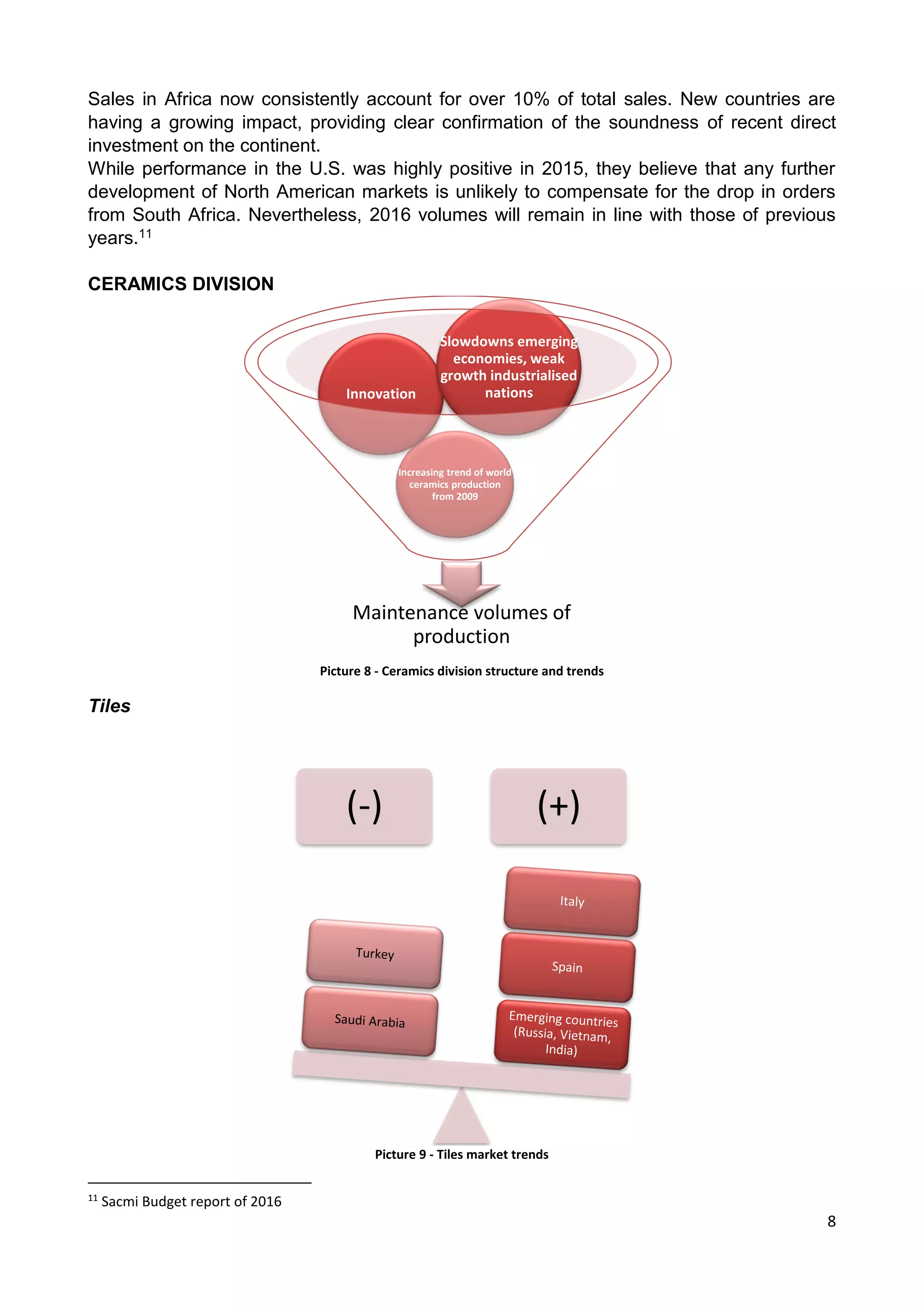
The industry context for the 2015 has been particularly good for Italian producers of tile
machineries according to the estimation of ACIMAC, despite remaining difficulties for
certain customer sectors, heavy clay and sanitaryware, and in some foreign markets
including Russia, Brazil and China.8
Picture 5 - Italian industry context9
In the International context the picture of the industry is quite similar, amplified in large
scale. There are many factors that have affected the markets in these years:
6
http://www.sacmi.com/en-US/Products-and-Services.aspx?idc=898&ln=en-US
7
http://www.sacmi.com/en-US/Products-and-Services.aspx?idc=898&ln=en-US
8
http://www.mec-studies.com/it/news/newsceramica-23/macchineperceramicailfatturatosuperai2miliardidieuro-
30.php
9
http://www.mec-studies.com/it/news/newsceramica-23/macchineperceramicailfatturatosuperai2miliardidieuro-
30.php
2 billion
euro total
sales
+11.7%
growth
(2014)
Chocolate plants Dairy
Picture 4 - Sacmi Food business
7
Picture 6 - International industry context10
1.3 Supply and demand’s structure and trends
Picture 7 - Domestic and International structures
With respect to 2014, the decline in the relative importance of the Asian continent should
be pointed out, although it still accounts for more than a third of total sales.
10
Sacmi Budget report of 2016
Delocalization
High rate of changing
Risks and uncertainty
Low growth of the world
economy (Western
countries, China and
Brazil)
Process and personnel
Key role
Benefits from long-
standing partner
Innovation
National Market
Fundamental innovations (core
strategies), importance of
quality and image. Cooperation
with:
• The tile district of Sassuolo -> Ceramics
• San Benedetto -> Beverage (packaging)
• Ferrero -> Food
International Market
Orientation toward exports,
importance of quantity:
• 87% of the total turnover of the Group
• To mitigate the impact of the tensions
worldwide
8
Sales in Africa now consistently account for over 10% of total sales. New countries are
having a growing impact, providing clear confirmation of the soundness of recent direct
investment on the continent.
While performance in the U.S. was highly positive in 2015, they believe that any further
development of North American markets is unlikely to compensate for the drop in orders
from South Africa. Nevertheless, 2016 volumes will remain in line with those of previous
years.11
CERAMICS DIVISION
Picture 8 - Ceramics division structure and trends
Tiles
Picture 9 - Tiles market trends
11
Sacmi Budget report of 2016
Maintenance volumes of
production
Increasing trend of world
ceramics production
from 2009
Innovation
Slowdowns emerging
economies, weak
growth industrialised
nations
(-) (+)
9
 For high-end customers, differentiation is a must; for example, they tend to focus on
large tile sizes and white bodies.
 There is still room for improvement, especially on the digital front.
 In an ever-more globalised market, excessively low-priced, low quality machines
are a recipe for a long-term failure. For example the Chinese model has partially
failed: buyers are shunning Chinese tile-making products in ever greater numbers,
also in neighbouring countries, largely on account of their low quality.
 While attentiveness to cost is a must, it is important to maintain a qualitative
difference.
Sanitaryware and tableware12
 In Europe producers have confirmed their intention to boost factory automation and
focus on the production of those large-size pieces that are most in demand.
 Key players are investing continuously and heavily in new machines, both in Europe
and the rest of the world.
 Positive indicators abound in the form of repeat orders from numerous customers
 Further good new comes from customers in Algeria and China who have invested in
large-scale automation projects.
Heavy clay and technical ceramic13
 Annual volumes generated by this business are in line with last year’s performance.
 Unfavourable global situation persists: those parts of the world where the
construction industry is growing are few and far between. (e.g. Algeria)
 Despite falling oil prices the general outlook remains confident and the next
two/three years should see significant opportunities for new plant sales.
As always, the driving force behind the ceramic business has been all-round innovation,
reaffirming Sacmi’s leading role as a global player in the industry.14
12
Sacmi Budget report of 2016
13
Sacmi Budget report of 2016
14
Progress Report 2014 - http://www.sacmi.com/en-US/About-us/Financial-Information.aspx?idC=62551&LN=en-US
10
PACKAGING DIVISION15
 Overall volumes for the Closures & Containers sector are, in 2016, expected to be
considerably higher than in 2015.
 China, Mexico, Italy, U.S. and Southeast Asia will perform well, while Russia
remains extremely challenging.
 The various political crises or full-blown conflicts that risk to have a considerable
impact on business in some areas.
 The entire beverage industry is expected to experience substantial growth in 2016.
FOOD PROCESSING DIVISION16
 The global economic and geopolitical situation remains a complex, difficult one for
this business.
 Brazil and Russia continue to desert the C&C investment market, whereas India,
Turkey, the Middle East and North Africa continue to do business at levels similar to
those of last years.
 At this time, though, the global orders acquisition process may still be defined as
stable and satisfactory. Erratic performance in various geographical areas have
partially been offset by the business that has stemmed from developing preferential
partnerships with certain key accounts.
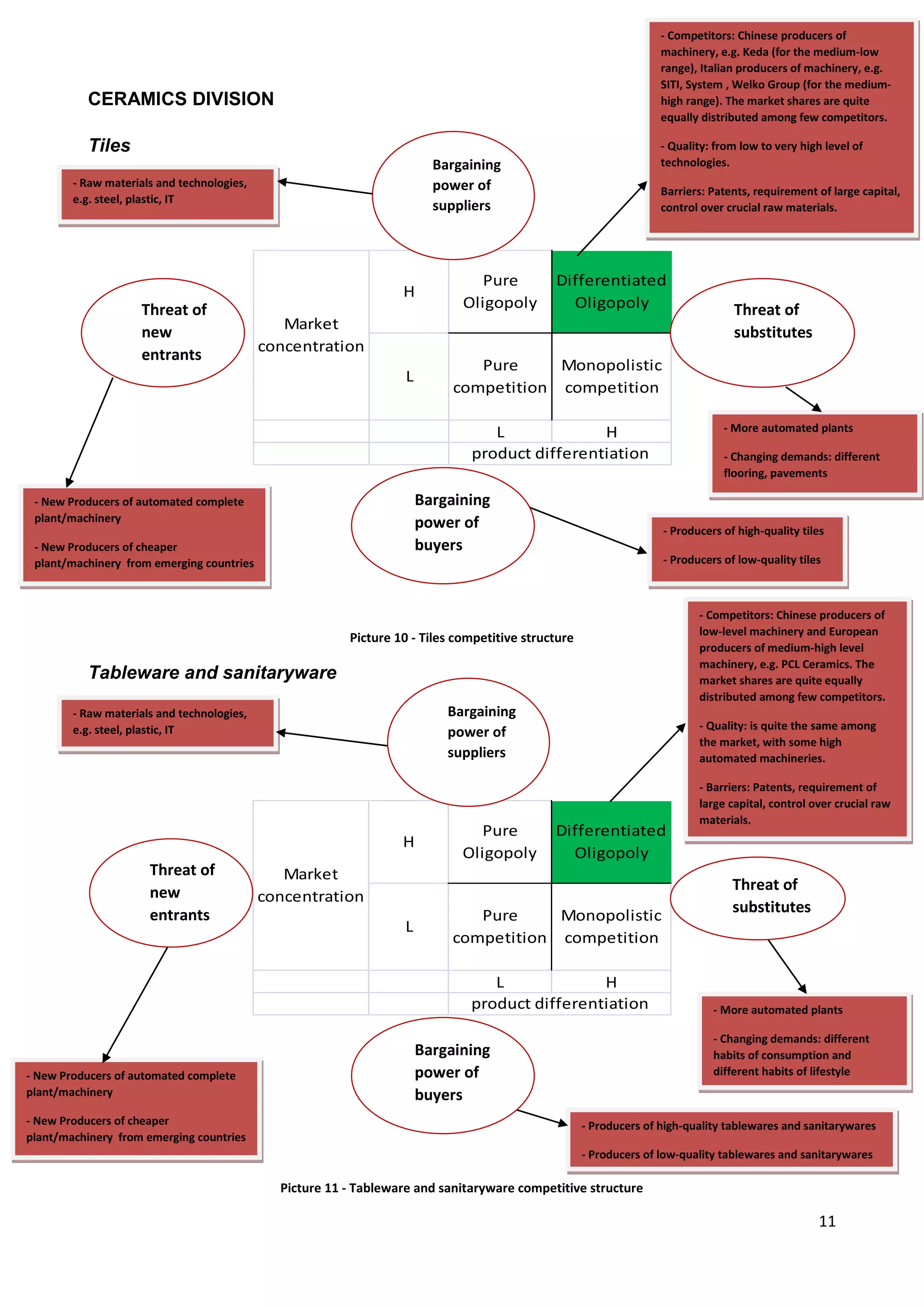
1.4 Rules of competition and competitive (5) forces
Fierce competition on global markets has shown that product quality does not, in itself,
ensure success. It needs, in fact, to be combined with the development of outstanding
technological and plant engineering solutions, plus efficient customer and market-oriented
organisation.17
Depending on the business that is considered, Sacmi faces different competitors. The core
business of the Group is the ceramic sector, which breaks into several subsectors, such as
tiles, tableware, sanitaryware and heavy clay.
15
Sacmi Budget report of 2016
16
Sacmi Budget report of 2016
17
Progress Report 2014 - http://www.sacmi.com/en-US/About-us/Financial-Information.aspx?idC=62551&LN=en-US
11
CERAMICS DIVISION
Tiles
L H
Market
concentration
H
L
product differentiation
Pure
Oligopoly
Differentiated
Oligopoly
Pure
competition
Monopolistic
competition
Picture 10 - Tiles competitive structure
Tableware and sanitaryware
L H
Market
concentration
H
L
product differentiation
Pure
Oligopoly
Differentiated
Oligopoly
Pure
competition
Monopolistic
competition
Picture 11 - Tableware and sanitaryware competitive structure
- Competitors: Chinese producers of
machinery, e.g. Keda (for the medium-low
range), Italian producers of machinery, e.g.
SITI, System , Welko Group (for the medium-
high range). The market shares are quite
equally distributed among few competitors.
- Quality: from low to very high level of
technologies.
Barriers: Patents, requirement of large capital,
control over crucial raw materials.
- New Producers of automated complete
plant/machinery
- New Producers of cheaper
plant/machinery from emerging countries
- Producers of high-quality tiles
- Producers of low-quality tiles
- More automated plants
- Changing demands: different
flooring, pavements
- Raw materials and technologies,
e.g. steel, plastic, IT
- Competitors: Chinese producers of
low-level machinery and European
producers of medium-high level
machinery, e.g. PCL Ceramics. The
market shares are quite equally
distributed among few competitors.
- Quality: is quite the same among
the market, with some high
automated machineries.
- Barriers: Patents, requirement of
large capital, control over crucial raw
materials.
- More automated plants
- Changing demands: different
habits of consumption and
different habits of lifestyle
- Producers of high-quality tablewares and sanitarywares
- Producers of low-quality tablewares and sanitarywares
- New Producers of automated complete
plant/machinery
- New Producers of cheaper
plant/machinery from emerging countries
- Raw materials and technologies,
e.g. steel, plastic, IT
Bargaining
power of
suppliers
Threat of
new
entrants
Threat of
substitutes
Bargaining
power of
buyers
Bargaining
power of
suppliers
Threat of
substitutes
Threat of
new
entrants
Bargaining
power of
buyers
12
Heavy clay
L H
Market
concentration
H
L
product differentiation
Pure
Oligopoly
Differentiated
Oligopoly
Pure
competition
Monopolistic
competition
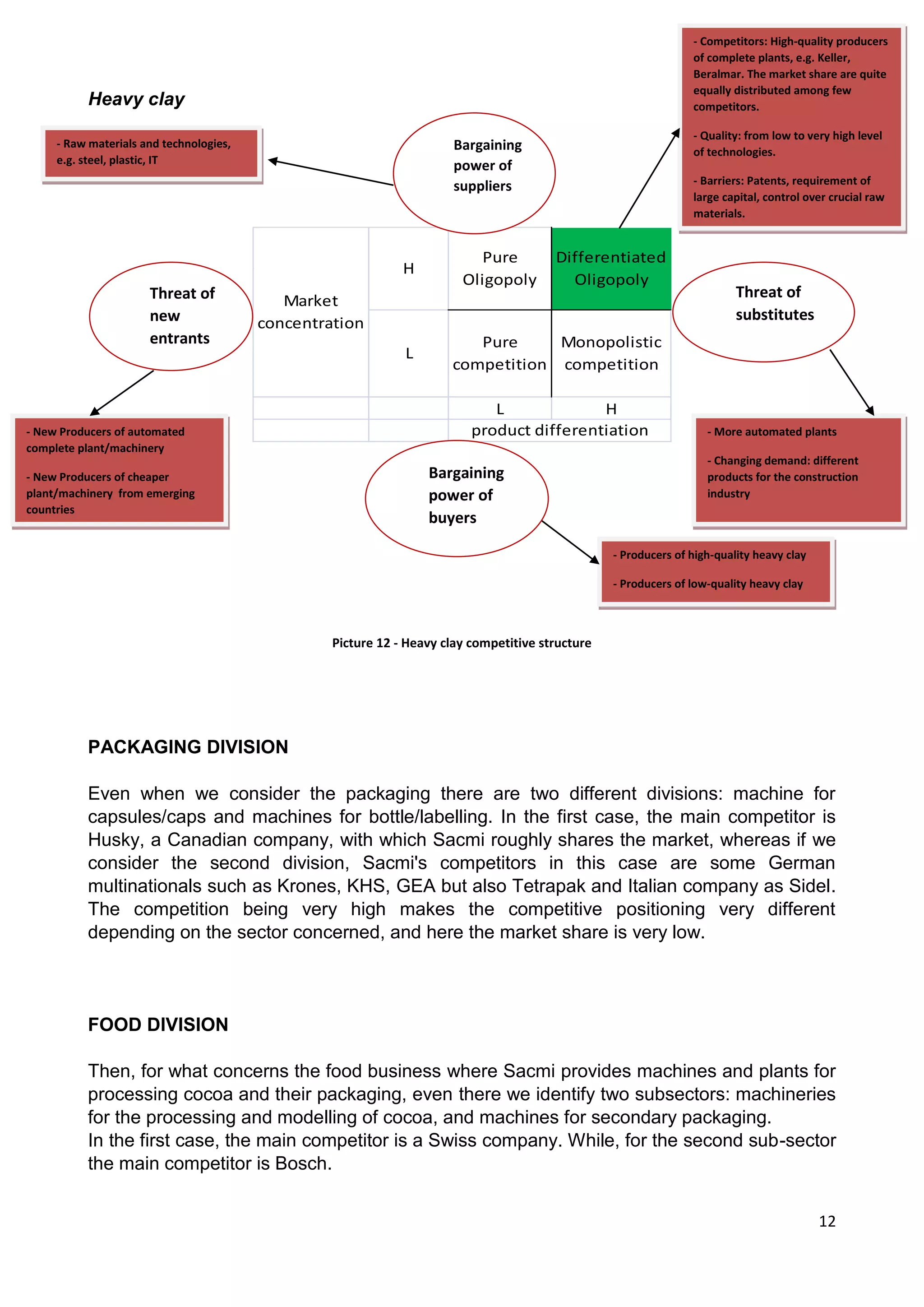
Picture 12 - Heavy clay competitive structure
PACKAGING DIVISION
Even when we consider the packaging there are two different divisions: machine for
capsules/caps and machines for bottle/labelling. In the first case, the main competitor is
Husky, a Canadian company, with which Sacmi roughly shares the market, whereas if we
consider the second division, Sacmi's competitors in this case are some German
multinationals such as Krones, KHS, GEA but also Tetrapak and Italian company as Sidel.
The competition being very high makes the competitive positioning very different
depending on the sector concerned, and here the market share is very low.
FOOD DIVISION
Then, for what concerns the food business where Sacmi provides machines and plants for
processing cocoa and their packaging, even there we identify two subsectors: machineries
for the processing and modelling of cocoa, and machines for secondary packaging.
In the first case, the main competitor is a Swiss company. While, for the second sub-sector
the main competitor is Bosch.
- Competitors: High-quality producers
of complete plants, e.g. Keller,
Beralmar. The market share are quite
equally distributed among few
competitors.
- Quality: from low to very high level
of technologies.
- Barriers: Patents, requirement of
large capital, control over crucial raw
materials.
- More automated plants
- Changing demand: different
products for the construction
industry
- Producers of high-quality heavy clay
- Producers of low-quality heavy clay
- New Producers of automated
complete plant/machinery
- New Producers of cheaper
plant/machinery from emerging
countries
- Raw materials and technologies,
e.g. steel, plastic, IT
Bargaining
power of
suppliers
Bargaining
power of
buyers
Threat of
substitutes
Threat of
new
entrants
13
1.5 Business attractiveness
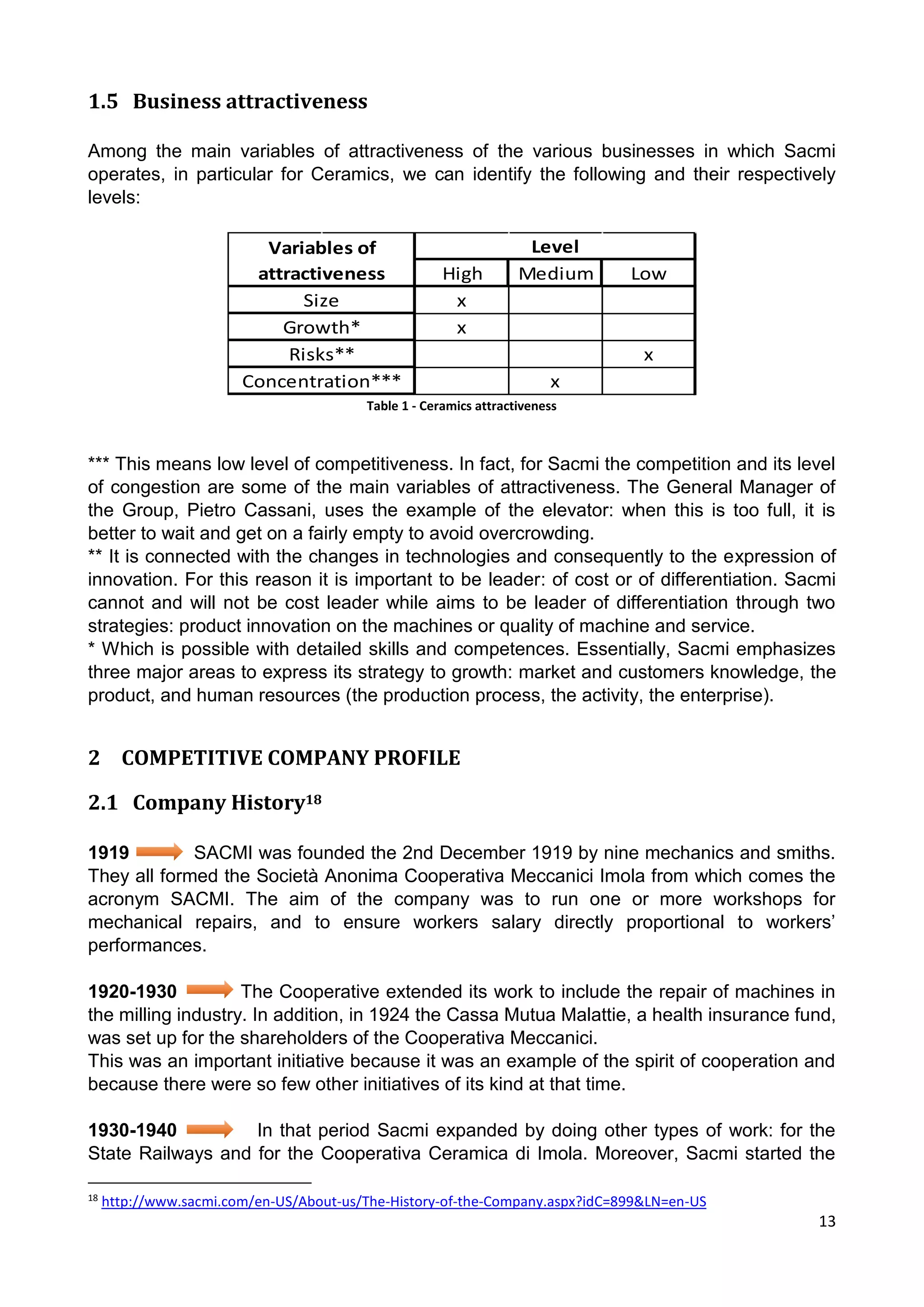
Among the main variables of attractiveness of the various businesses in which Sacmi
operates, in particular for Ceramics, we can identify the following and their respectively
levels:
High Medium Low
x
x
x
x
Variables of
attractiveness
Level
Size
Growth*
Risks**
Concentration***
Table 1 - Ceramics attractiveness
*** This means low level of competitiveness. In fact, for Sacmi the competition and its level
of congestion are some of the main variables of attractiveness. The General Manager of
the Group, Pietro Cassani, uses the example of the elevator: when this is too full, it is
better to wait and get on a fairly empty to avoid overcrowding.
** It is connected with the changes in technologies and consequently to the expression of
innovation. For this reason it is important to be leader: of cost or of differentiation. Sacmi
cannot and will not be cost leader while aims to be leader of differentiation through two
strategies: product innovation on the machines or quality of machine and service.
* Which is possible with detailed skills and competences. Essentially, Sacmi emphasizes
three major areas to express its strategy to growth: market and customers knowledge, the
product, and human resources (the production process, the activity, the enterprise).
2 COMPETITIVE COMPANY PROFILE
2.1 Company History18
1919 SACMI was founded the 2nd December 1919 by nine mechanics and smiths.
They all formed the Società Anonima Cooperativa Meccanici Imola from which comes the
acronym SACMI. The aim of the company was to run one or more workshops for
mechanical repairs, and to ensure workers salary directly proportional to workers’
performances.
1920-1930 The Cooperative extended its work to include the repair of machines in
the milling industry. In addition, in 1924 the Cassa Mutua Malattie, a health insurance fund,
was set up for the shareholders of the Cooperativa Meccanici.
This was an important initiative because it was an example of the spirit of cooperation and
because there were so few other initiatives of its kind at that time.
1930-1940 In that period Sacmi expanded by doing other types of work: for the
State Railways and for the Cooperativa Ceramica di Imola. Moreover, Sacmi started the
18
http://www.sacmi.com/en-US/About-us/The-History-of-the-Company.aspx?idC=899&LN=en-US
14
orange machines production (washing and brushing units). Before the war Sacmi
continued its production, the machines for oranges were going well but the company also
started to manufacture mixing machines for food and chemical products.
1940-1948 The factories had been damaged during the last months of the war.
From repairing machines damaged during the war Sacmi built a new machine bearing the
Sacmi trademark. The company designed a new machine and succeeded in making a
prototype of a clutch press with manual controls.
1949 At that time it was possible for the company to open its frontier overseas which
would enable the Cooperative to compete, though on a modest scale, with rival
companies. In this year, a crown caps manufacturer from Bologna came to Sacmi’s
technicians to propose a plan to design and manufacture a semi-automatic multi-punch
press because of the industry lacked a specialized high-production machine.
1951-1960 By this time, it was becoming clear what were to be the two principal
lines of production (without abandoning the manufacture of machines for citrus fruits):
 The ceramics sector
 The crown caps field
1960-1980 In 1960 the company decided to look for premises in Milan to set up an
overseas sales office and increased the number of Sacmi’s representatives abroad. The
export quota reached 43% of the total production.
From 1975 to 1980, the overseas expansion strategy in about 80 countries in the world
was a winning policy and the balance sheets were remarkably good.
1980-1990 Sacmi’s expansion was going on both abroad setting up companies as
Sacmi Deutschland, Sacmi Portuguesa, Sacmi Singapore, Sacmi Mexico and in Italy
establishing Sacmi Forni in Casalgrande.
1990-2000 Computerisation and the era of IT, real time, Internet and satellite
communications have speeded up Sacmi’s lifestyles.
2000-2014 Growth
Diversification
Integration
Research
It is thanks to this strategy that Sacmi generates 88% of its revenues abroad, maintaining
its technological and productive core in Italy and in particular at the parent company in
Imola.
Fifteen challenging years in which Sacmi has been able to improve its ability to develop
process and product innovations with particular attention to operational efficiency, group
synergies, cost optimization together with production flexibility, in order to better respond
to market cycles and requirements. An important part of this strategy was the
These are the cornerstones on which the Sacmi
Group found its strength and success.
15
enhancement of the company’s web-based offer, to put on the market advanced training
and post-sales support services on a global scale.19
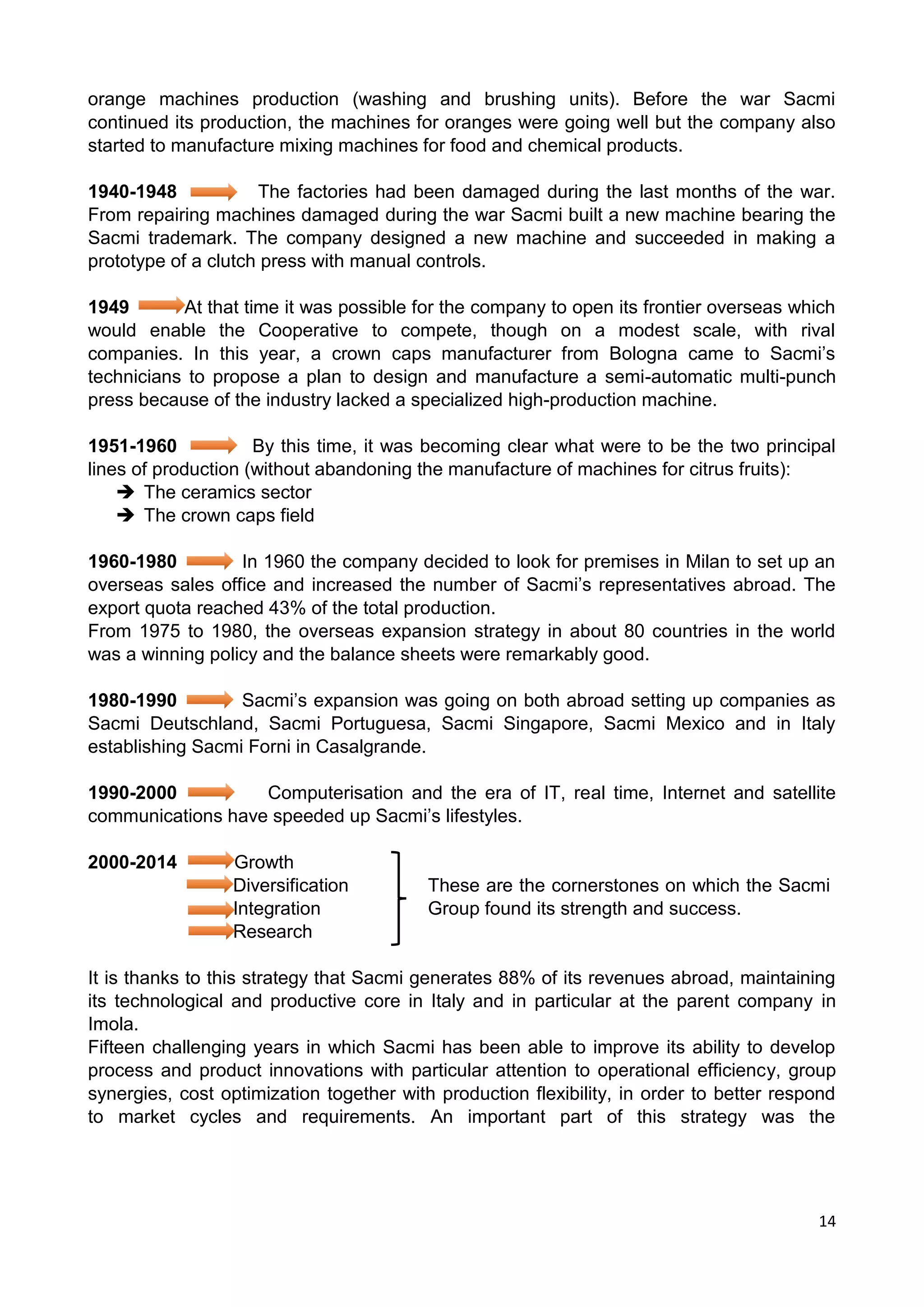
SACMI GROWTH STRATEGY
19
http://www.sacmi.com/en-US/About-us/The-History-of-the-Company.aspx?idC=899&LN=en-US
Foundation
Organic growth (through internal
expansion)
External growth (through merger and
acquisitions)
SACMI opens its frontier overseas
GROWTHSTRATEGIES
YEARS1919 1920 –
1930
1930 –
1940
1949 1950 –
1960
1960 –
1980
1990 –
2000
1980 –
1990
2000 –
today
Table 2 - SACMI growth strategy
16
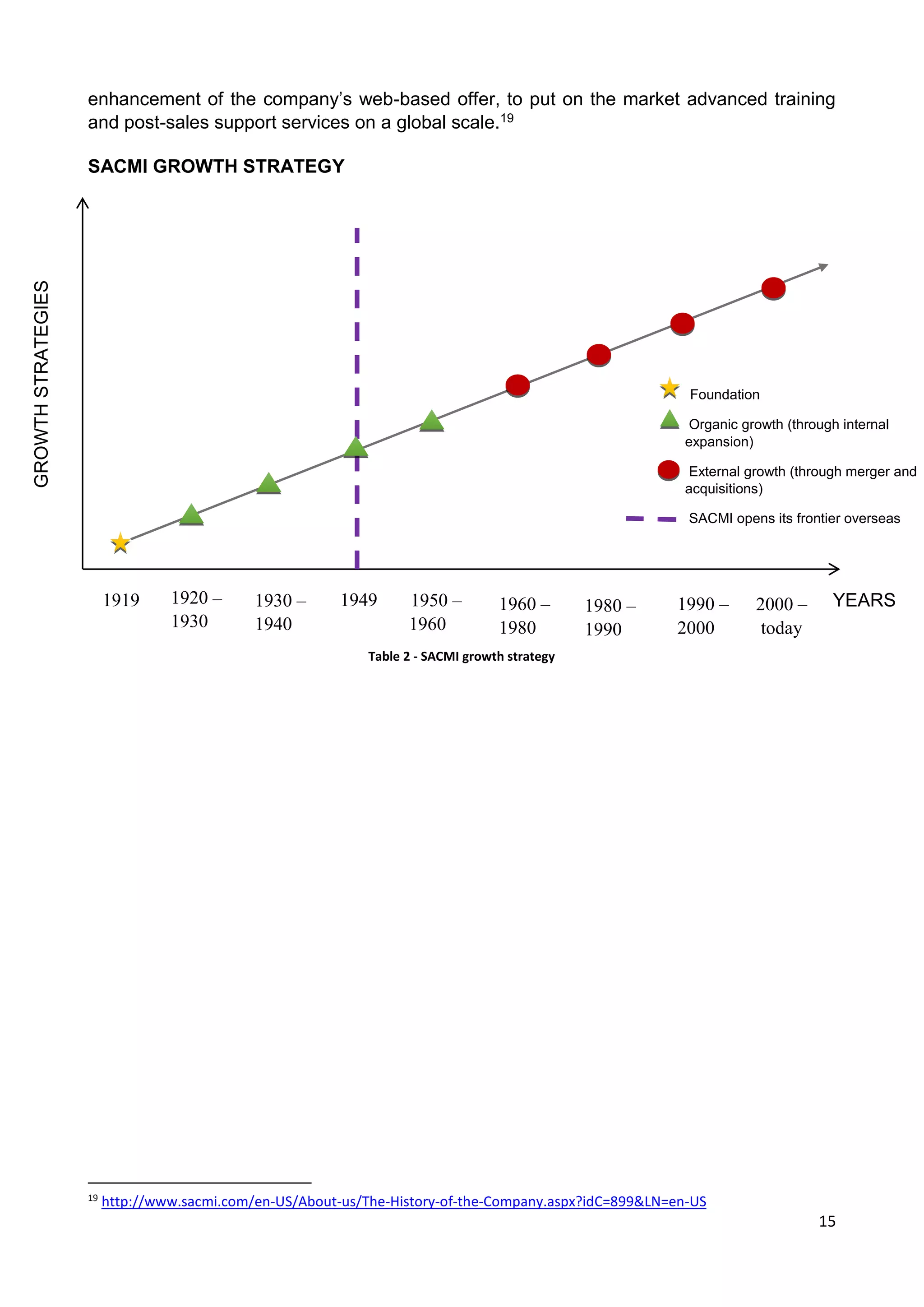
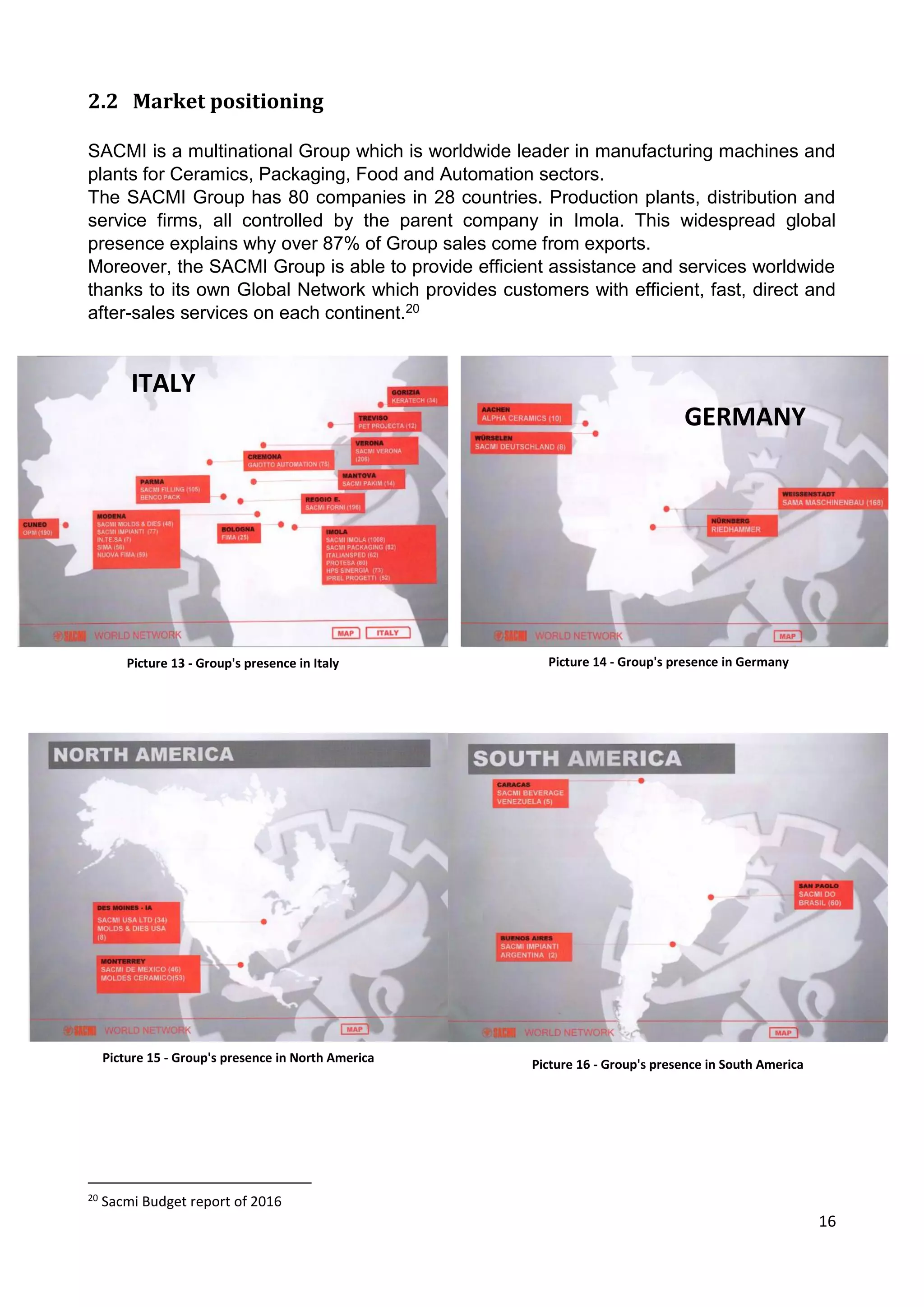
2.2 Market positioning
SACMI is a multinational Group which is worldwide leader in manufacturing machines and
plants for Ceramics, Packaging, Food and Automation sectors.
The SACMI Group has 80 companies in 28 countries. Production plants, distribution and
service firms, all controlled by the parent company in Imola. This widespread global
presence explains why over 87% of Group sales come from exports.
Moreover, the SACMI Group is able to provide efficient assistance and services worldwide
thanks to its own Global Network which provides customers with efficient, fast, direct and
after-sales services on each continent.20
20
Sacmi Budget report of 2016
ITALY
GERMANY
Figure 14 - Group's presence in Italy Picture 14 - Group's presence in Germany
Picture 15 - Group's presence in North America Picture 16 - Group's presence in South America
Picture 13 - Group's presence in Italy
17
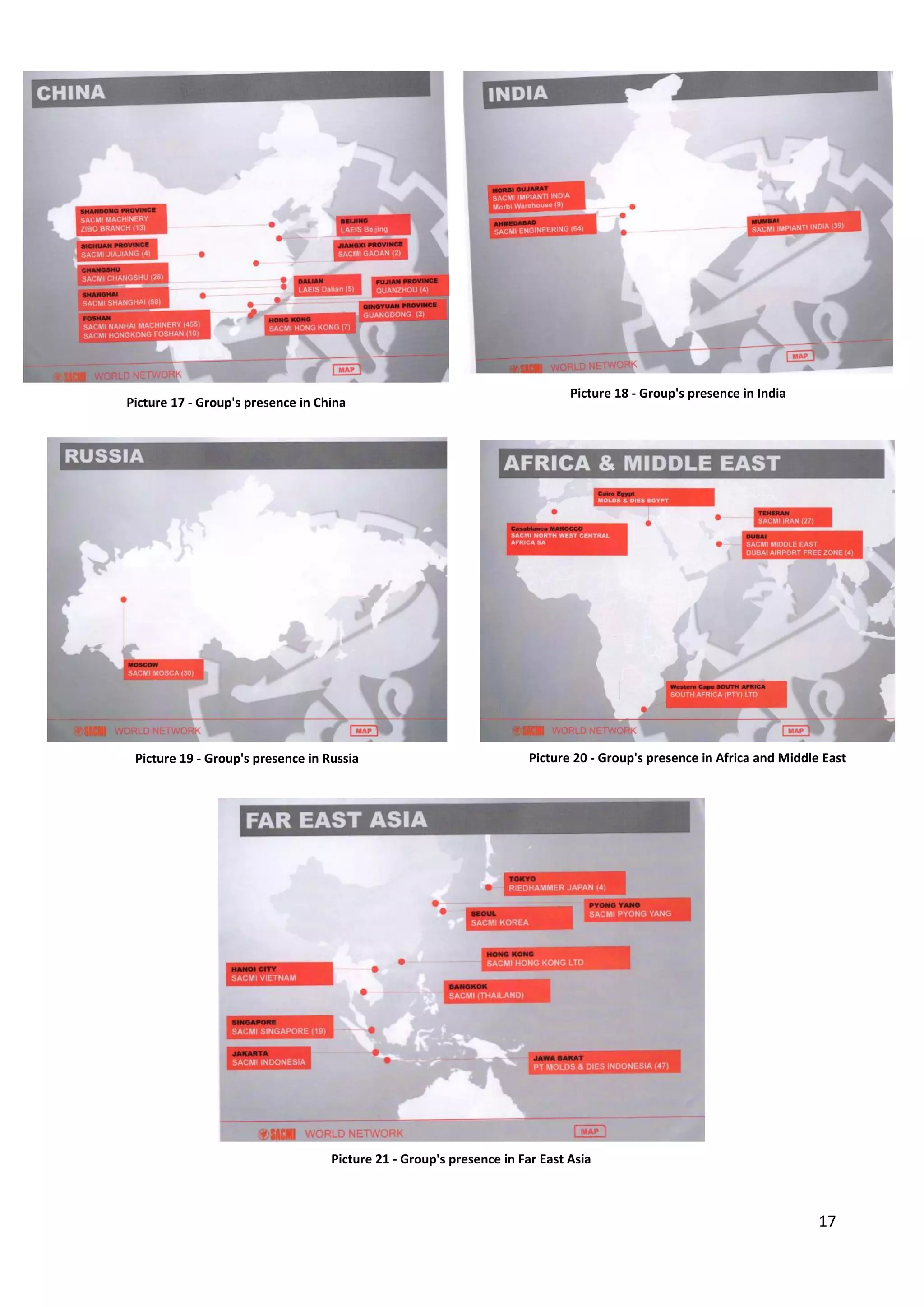
Picture 17 - Group's presence in China
Picture 18 - Group's presence in India
Picture 19 - Group's presence in Russia Picture 20 - Group's presence in Africa and Middle East
Picture 21 - Group's presence in Far East Asia
18
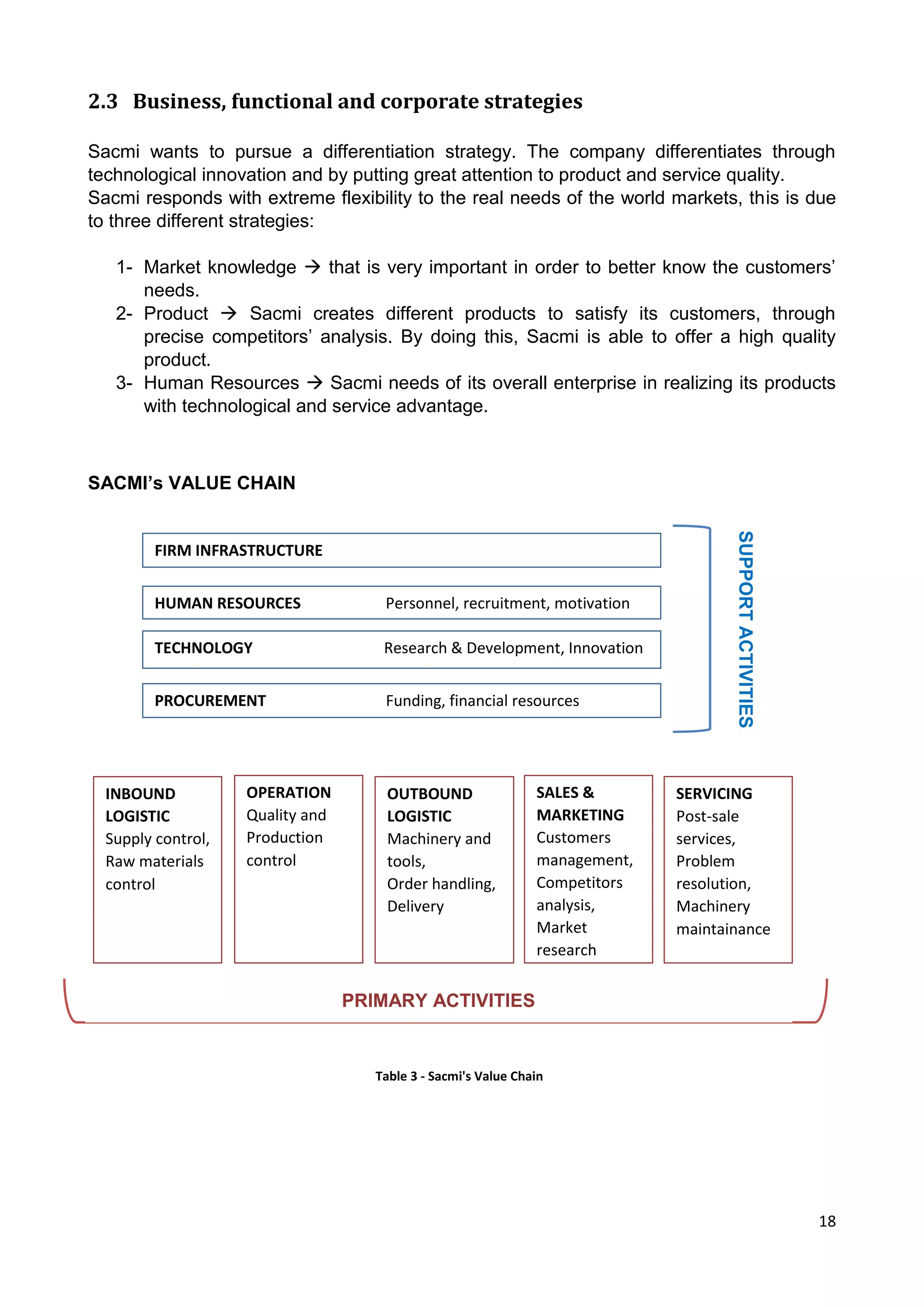
2.3 Business, functional and corporate strategies
Sacmi wants to pursue a differentiation strategy. The company differentiates through
technological innovation and by putting great attention to product and service quality.
Sacmi responds with extreme flexibility to the real needs of the world markets, this is due
to three different strategies:
1- Market knowledge  that is very important in order to better know the customers’
needs.
2- Product  Sacmi creates different products to satisfy its customers, through
precise competitors’ analysis. By doing this, Sacmi is able to offer a high quality
product.
3- Human Resources  Sacmi needs of its overall enterprise in realizing its products
with technological and service advantage.
SACMI’s VALUE CHAIN
FIRM INFRASTRUCTURE
HUMAN RESOURCES Personnel, recruitment, motivation
TECHNOLOGY Research & Development, Innovation
PROCUREMENT Funding, financial resources
INBOUND
LOGISTIC
Supply control,
Raw materials
control
OPERATION
Quality and
Production
control
OUTBOUND
LOGISTIC
Machinery and
tools,
Order handling,
Delivery
SALES &
MARKETING
Customers
management,
Competitors
analysis,
Market
research
SERVICING
Post-sale
services,
Problem
resolution,
Machinery
maintainance
SUPPORTACTIVITIES
PRIMARY ACTIVITIES
Table 3 - Sacmi's Value Chain
19
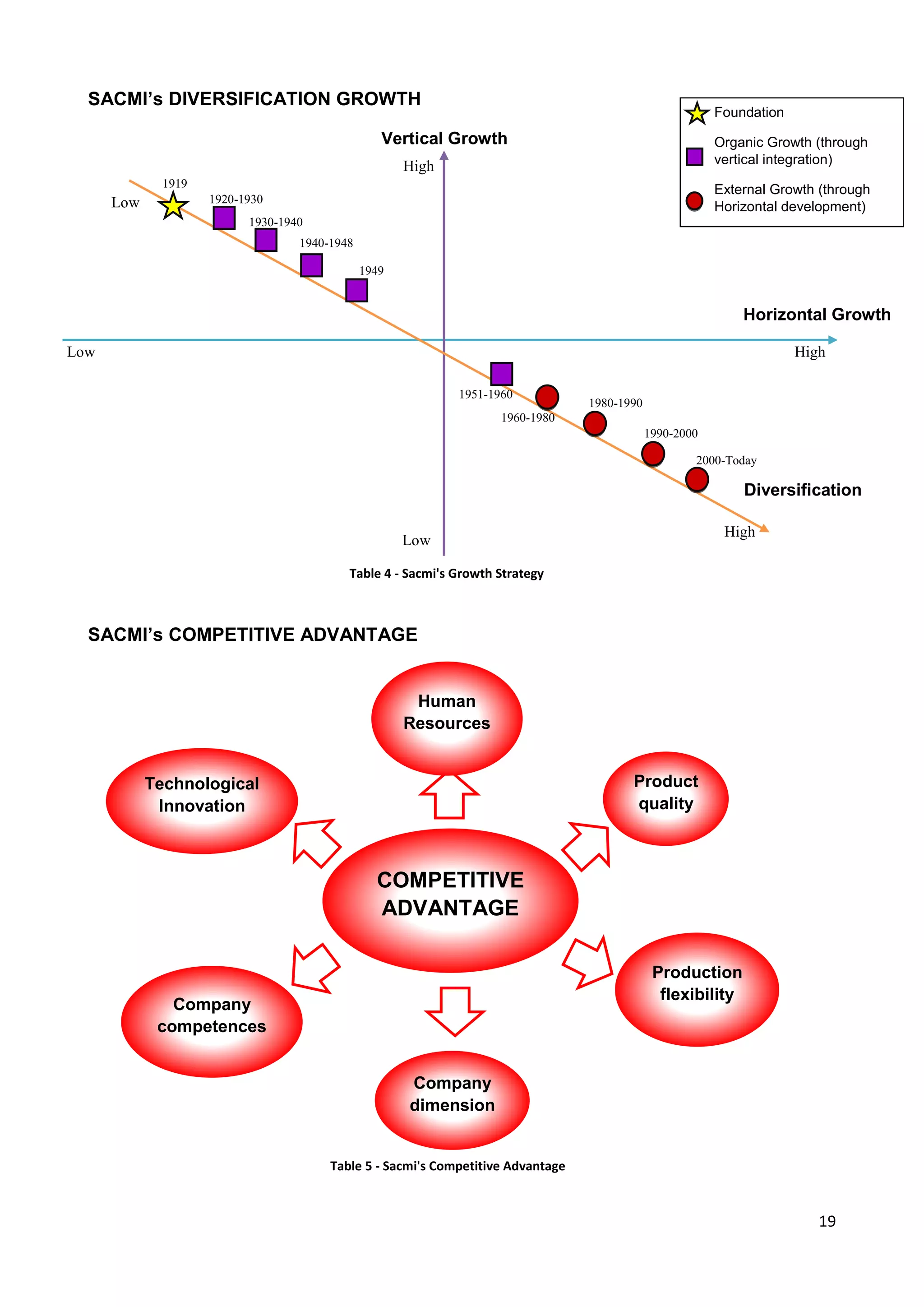
SACMI’s DIVERSIFICATION GROWTH
SACMI’s COMPETITIVE ADVANTAGE
Horizontal Growth
Vertical Growth
Diversification
HighLow
High
Low
High
Low
COMPETITIVE
ADVANTAGE
Company
competences
1919
1920-1930
1930-1940
1940-1948
1949
1951-1960
1960-1980
1980-1990
1990-2000
2000-Today
Foundation
Organic Growth (through
vertical integration)
External Growth (through
Horizontal development)
Human
Resources
Product
quality
Technological
Innovation
Production
flexibility
Company
dimension
Table 4 - Sacmi's Growth Strategy
Table 5 - Sacmi's Competitive Advantage
20
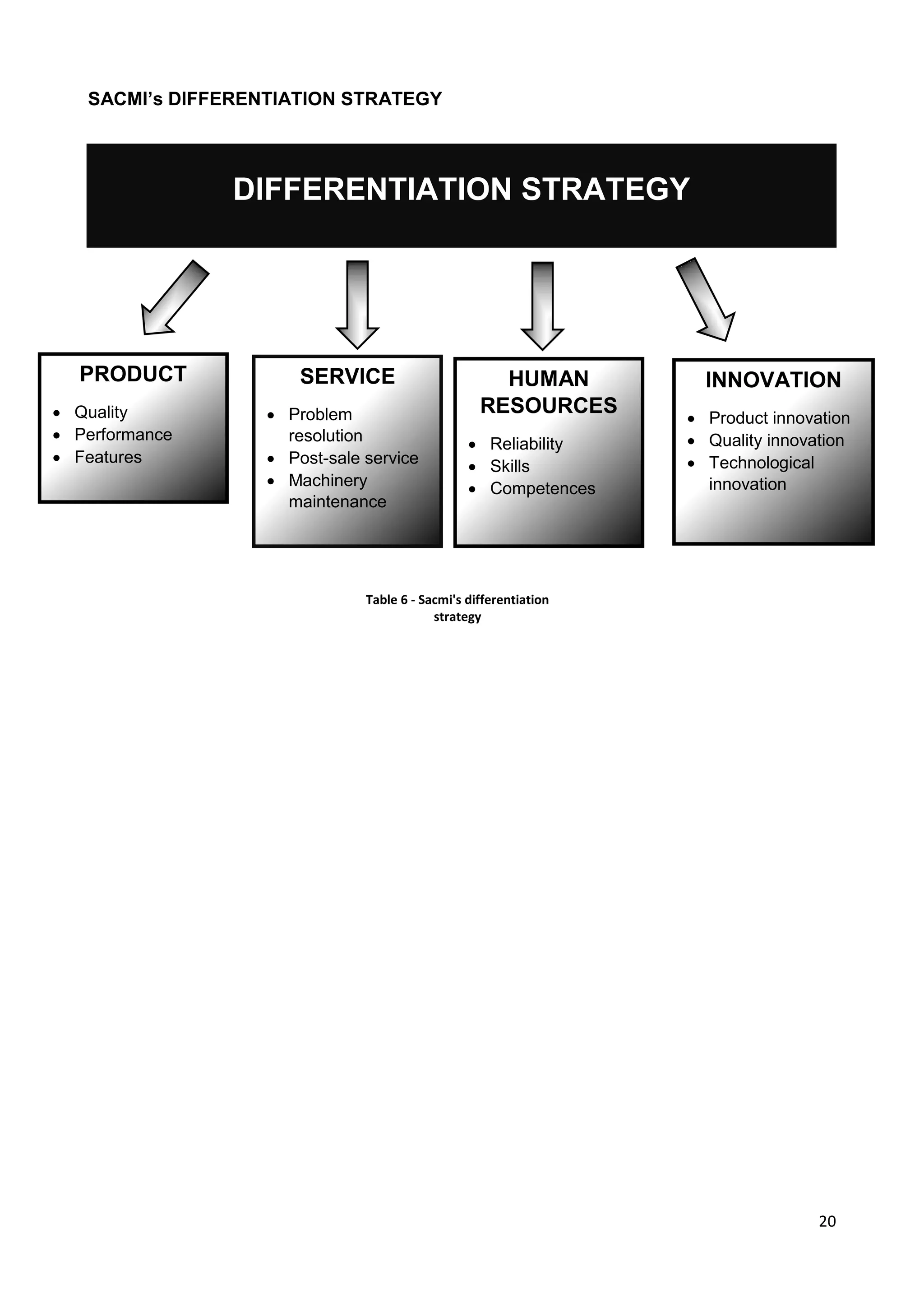
SACMI’s DIFFERENTIATION STRATEGY
DIFFERENTIATION STRATEGY
PRODUCT
 Quality
 Performance
 Features
SERVICE
 Problem
resolution
 Post-sale service
 Machinery
maintenance
HUMAN
RESOURCES
 Reliability
 Skills
 Competences
INNOVATION
 Product innovation
 Quality innovation
 Technological
innovation
Table 6 - Sacmi's differentiation
strategy
21
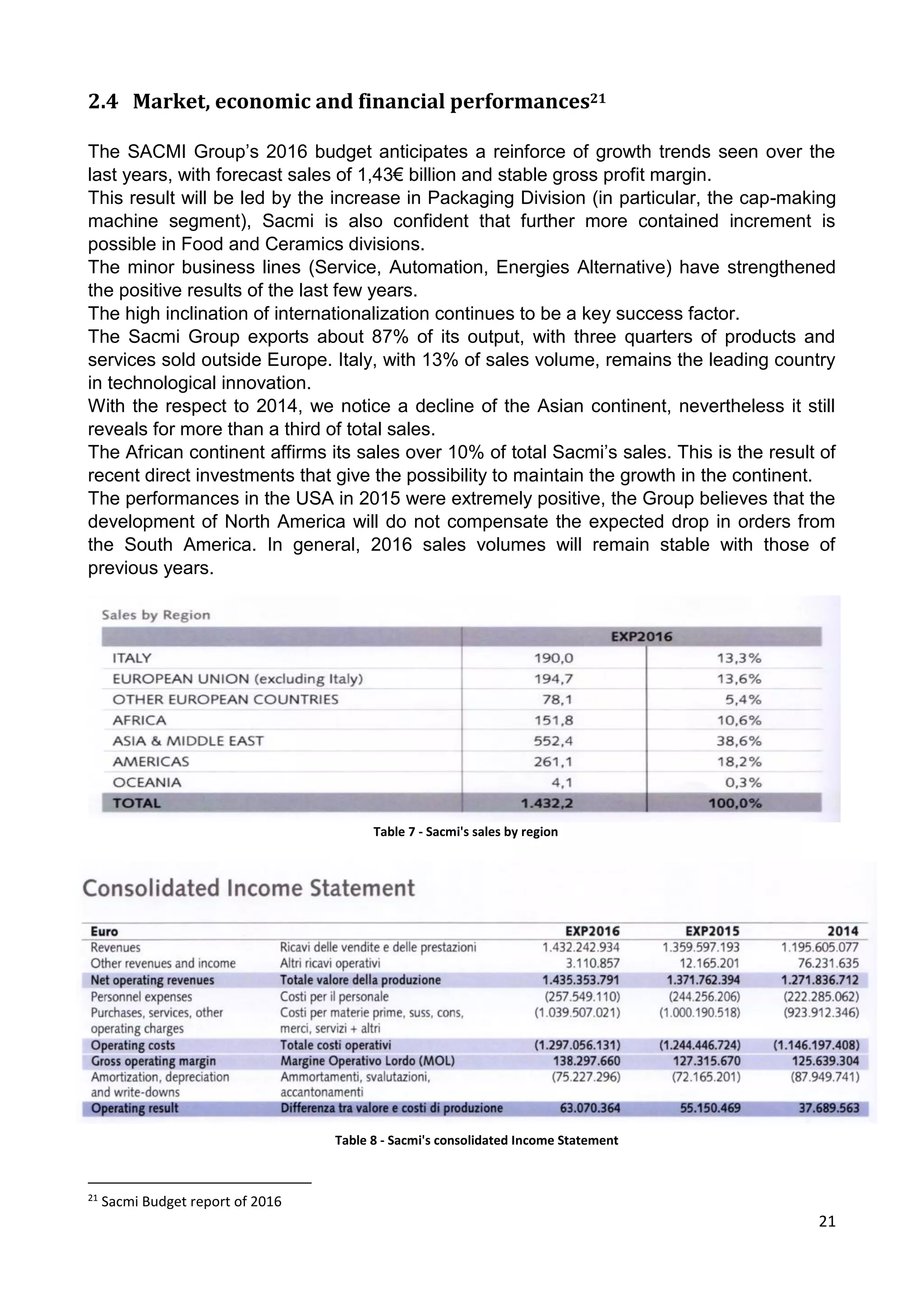
2.4 Market, economic and financial performances21
The SACMI Group’s 2016 budget anticipates a reinforce of growth trends seen over the
last years, with forecast sales of 1,43€ billion and stable gross profit margin.
This result will be led by the increase in Packaging Division (in particular, the cap-making
machine segment), Sacmi is also confident that further more contained increment is
possible in Food and Ceramics divisions.
The minor business lines (Service, Automation, Energies Alternative) have strengthened
the positive results of the last few years.
The high inclination of internationalization continues to be a key success factor.
The Sacmi Group exports about 87% of its output, with three quarters of products and
services sold outside Europe. Italy, with 13% of sales volume, remains the leading country
in technological innovation.
With the respect to 2014, we notice a decline of the Asian continent, nevertheless it still
reveals for more than a third of total sales.
The African continent affirms its sales over 10% of total Sacmi’s sales. This is the result of
recent direct investments that give the possibility to maintain the growth in the continent.
The performances in the USA in 2015 were extremely positive, the Group believes that the
development of North America will do not compensate the expected drop in orders from
the South America. In general, 2016 sales volumes will remain stable with those of
previous years.
21
Sacmi Budget report of 2016
Table 7 - Sacmi's sales by region
Table 8 - Sacmi's consolidated Income Statement
22
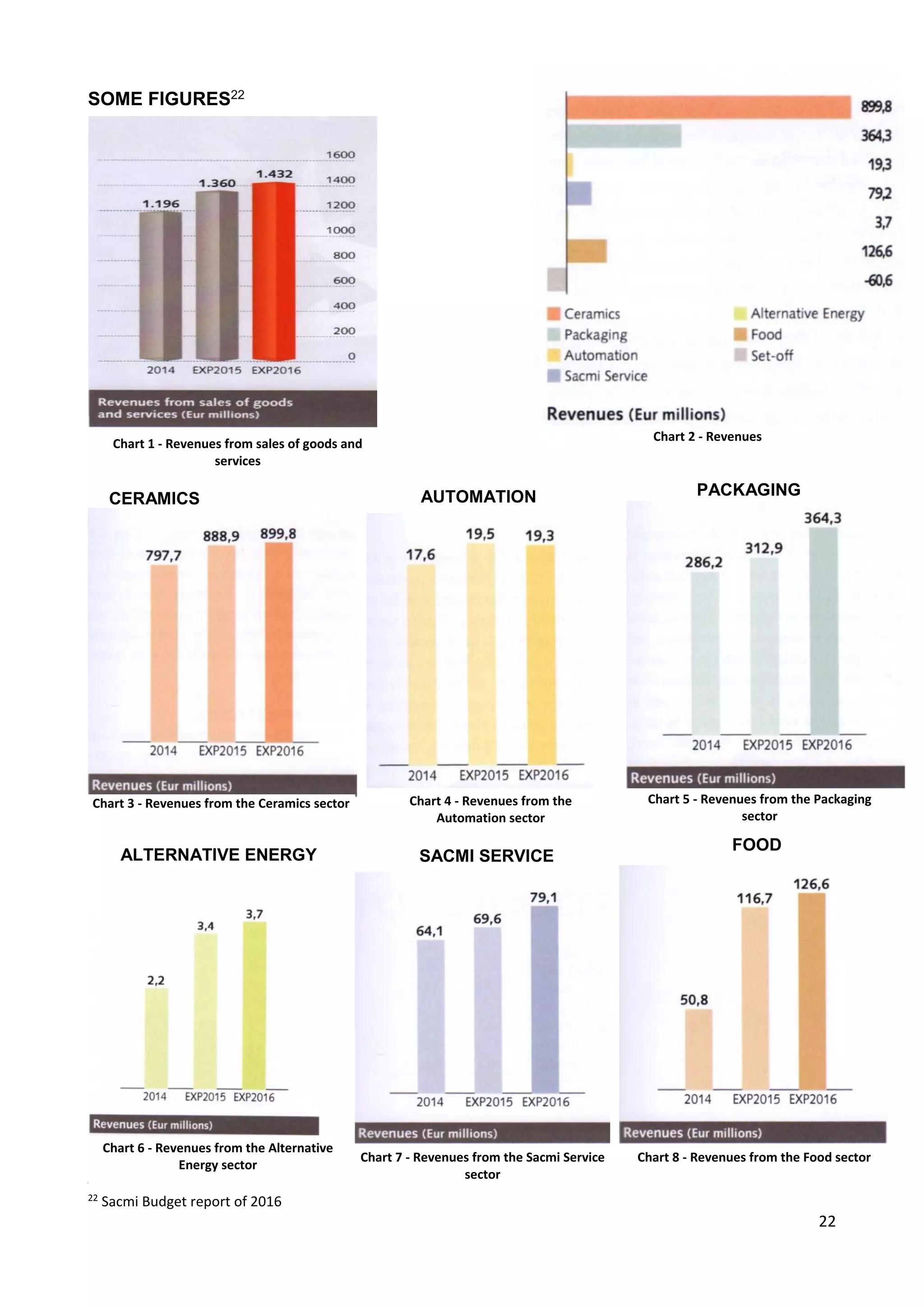
SOME FIGURES22
22
Sacmi Budget report of 2016
CERAMICS
PACKAGINGAUTOMATION
ALTERNATIVE ENERGY SACMI SERVICE
FOOD
Chart 1 - Revenues from sales of goods and
services
Chart 2 - Revenues
Chart 3 - Revenues from the Ceramics sector Chart 4 - Revenues from the
Automation sector
Chart 5 - Revenues from the Packaging
sector
Chart 6 - Revenues from the Alternative
Energy sector
Chart 7 - Revenues from the Sacmi Service
sector
Chart 8 - Revenues from the Food sector
23
2.5 Company competitive profile & GE matrix
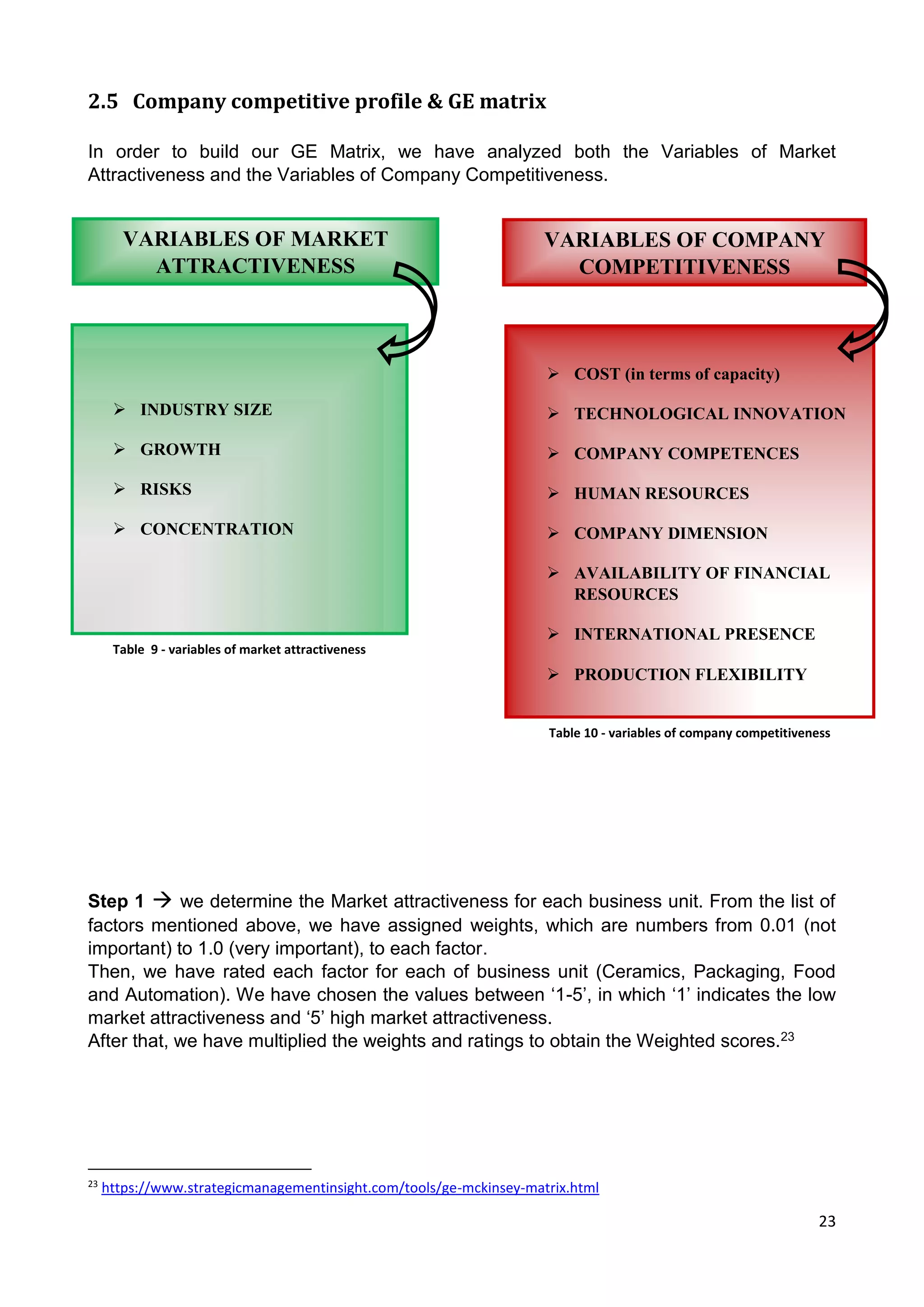
In order to build our GE Matrix, we have analyzed both the Variables of Market
Attractiveness and the Variables of Company Competitiveness.
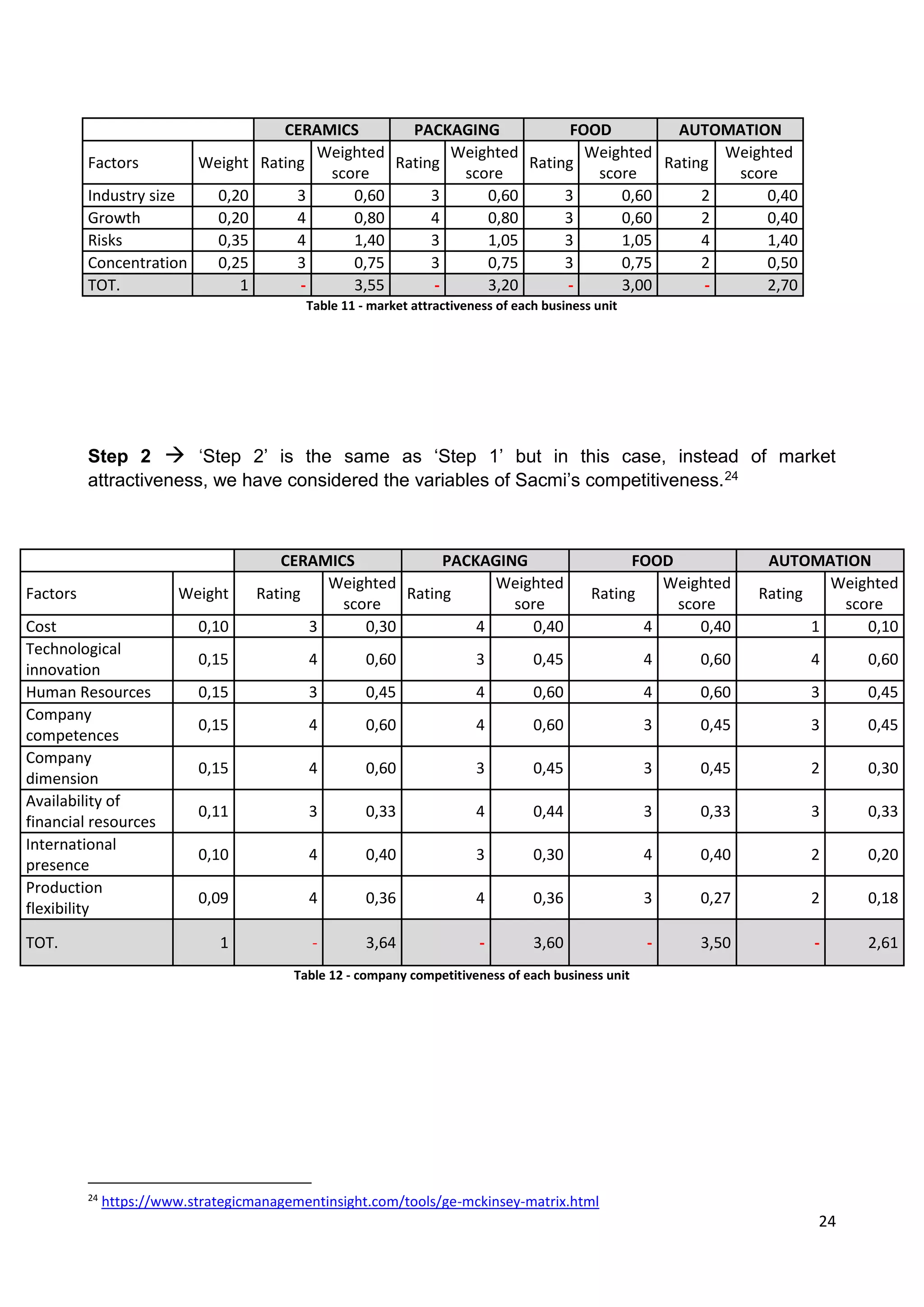
Step 1  we determine the Market attractiveness for each business unit. From the list of
factors mentioned above, we have assigned weights, which are numbers from 0.01 (not
important) to 1.0 (very important), to each factor.
Then, we have rated each factor for each of business unit (Ceramics, Packaging, Food
and Automation). We have chosen the values between ‘1-5’, in which ‘1’ indicates the low
market attractiveness and ‘5’ high market attractiveness.
After that, we have multiplied the weights and ratings to obtain the Weighted scores.23
23
https://www.strategicmanagementinsight.com/tools/ge-mckinsey-matrix.html
 INDUSTRY SIZE
 GROWTH
 RISKS
 CONCENTRATION
VARIABLES OF MARKET
ATTRACTIVENESS
VARIABLES OF COMPANY
COMPETITIVENESS
 COST (in terms of capacity)
 TECHNOLOGICAL INNOVATION
 COMPANY COMPETENCES
 HUMAN RESOURCES
 COMPANY DIMENSION
 AVAILABILITY OF FINANCIAL
RESOURCES
 INTERNATIONAL PRESENCE
 PRODUCTION FLEXIBILITY
Table 9 - variables of market attractiveness
Table 10 - variables of company competitiveness
24
Table 11 - market attractiveness of each business unit
Step 2  ‘Step 2’ is the same as ‘Step 1’ but in this case, instead of market
attractiveness, we have considered the variables of Sacmi’s competitiveness.24
Table 12 - company competitiveness of each business unit
24
https://www.strategicmanagementinsight.com/tools/ge-mckinsey-matrix.html
CERAMICS PACKAGING FOOD AUTOMATION
Factors Weight Rating
Weighted
score
Rating
Weighted
score
Rating
Weighted
score
Rating
Weighted
score
Industry size 0,20 3 0,60 3 0,60 3 0,60 2 0,40
Growth 0,20 4 0,80 4 0,80 3 0,60 2 0,40
Risks 0,35 4 1,40 3 1,05 3 1,05 4 1,40
Concentration 0,25 3 0,75 3 0,75 3 0,75 2 0,50
TOT. 1 - 3,55 - 3,20 - 3,00 - 2,70
CERAMICS PACKAGING FOOD AUTOMATION
Factors Weight Rating
Weighted
score
Rating
Weighted
sore
Rating
Weighted
score
Rating
Weighted
score
Cost 0,10 3 0,30 4 0,40 4 0,40 1 0,10
Technological
innovation
0,15 4 0,60 3 0,45 4 0,60 4 0,60
Human Resources 0,15 3 0,45 4 0,60 4 0,60 3 0,45
Company
competences
0,15 4 0,60 4 0,60 3 0,45 3 0,45
Company
dimension
0,15 4 0,60 3 0,45 3 0,45 2 0,30
Availability of
financial resources
0,11 3 0,33 4 0,44 3 0,33 3 0,33
International
presence
0,10 4 0,40 3 0,30 4 0,40 2 0,20
Production
flexibility
0,09 4 0,36 4 0,36 3 0,27 2 0,18
TOT. 1 - 3,64 - 3,60 - 3,50 - 2,61
25
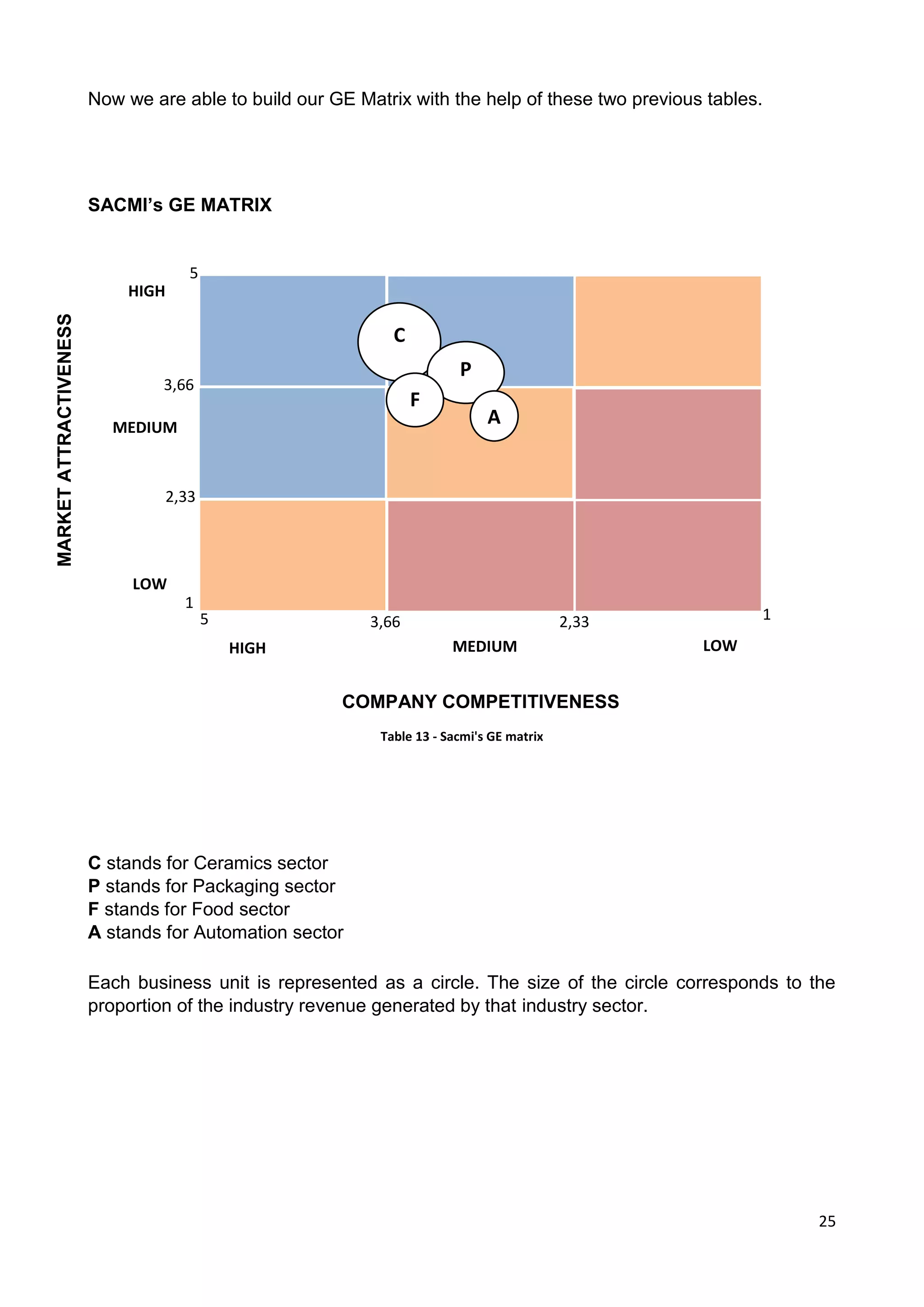
Now we are able to build our GE Matrix with the help of these two previous tables.
SACMI’s GE MATRIX
C stands for Ceramics sector
P stands for Packaging sector
F stands for Food sector
A stands for Automation sector
Each business unit is represented as a circle. The size of the circle corresponds to the
proportion of the industry revenue generated by that industry sector.
MARKETATTRACTIVENESS
COMPANY COMPETITIVENESS
HIGH
LOW
MEDIUM
HIGH MEDIUM LOW
3,66 2,33
2,33
3,66
5
1
5 1
C
P
F
A
Table 13 - Sacmi's GE matrix
26
3 COMPANY INTERNATIONAL TRACK
3.1 Internationalization motives
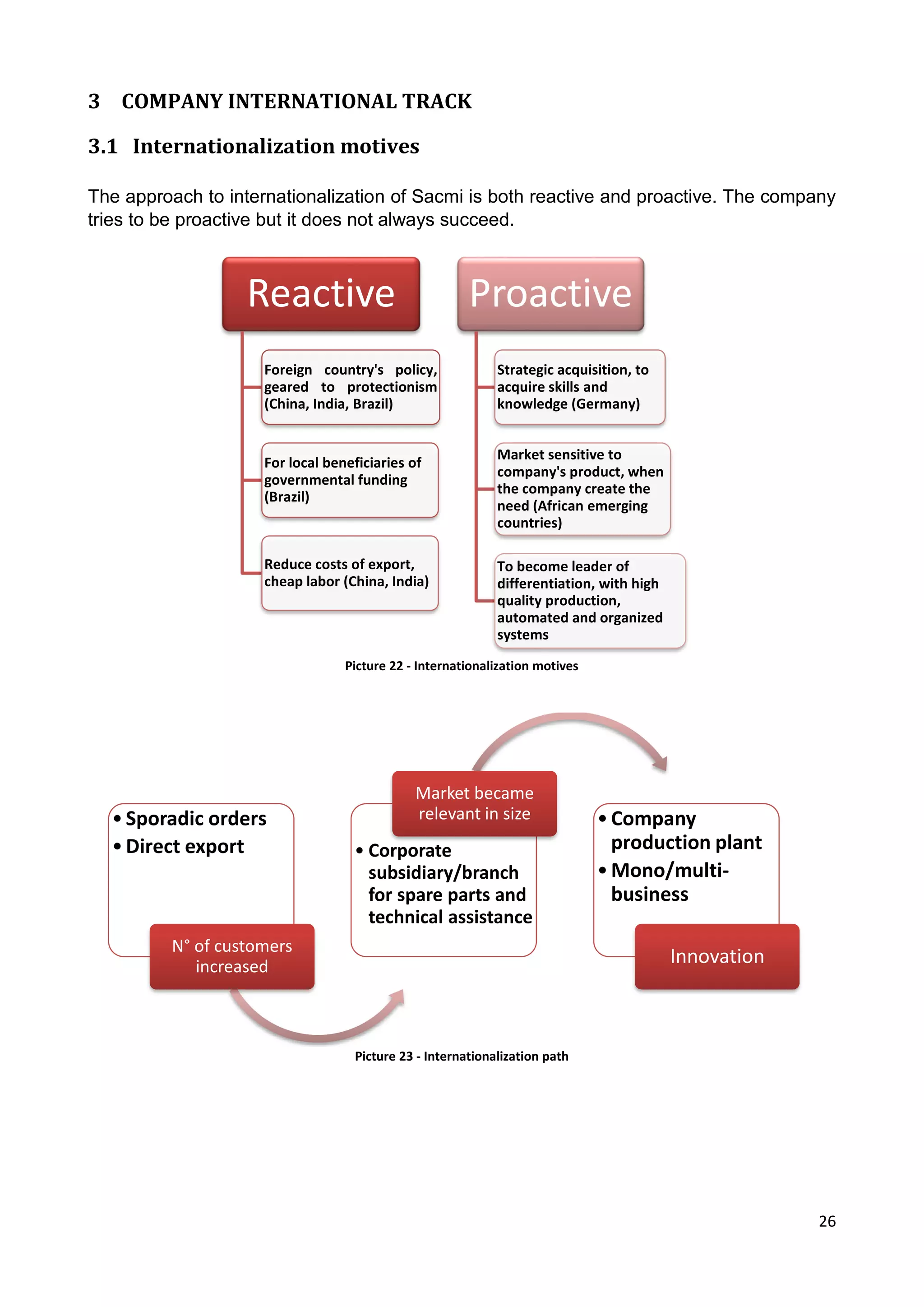
The approach to internationalization of Sacmi is both reactive and proactive. The company
tries to be proactive but it does not always succeed.
Picture 22 - Internationalization motives
Picture 23 - Internationalization path
Reactive
Foreign country's policy,
geared to protectionism
(China, India, Brazil)
For local beneficiaries of
governmental funding
(Brazil)
Reduce costs of export,
cheap labor (China, India)
Proactive
Strategic acquisition, to
acquire skills and
knowledge (Germany)
Market sensitive to
company's product, when
the company create the
need (African emerging
countries)
To become leader of
differentiation, with high
quality production,
automated and organized
systems
•Sporadic orders
•Direct export
N° of customers
increased
• Corporate
subsidiary/branch
for spare parts and
technical assistance
Market became
relevant in size •Company
production plant
•Mono/multi-
business
Innovation
27
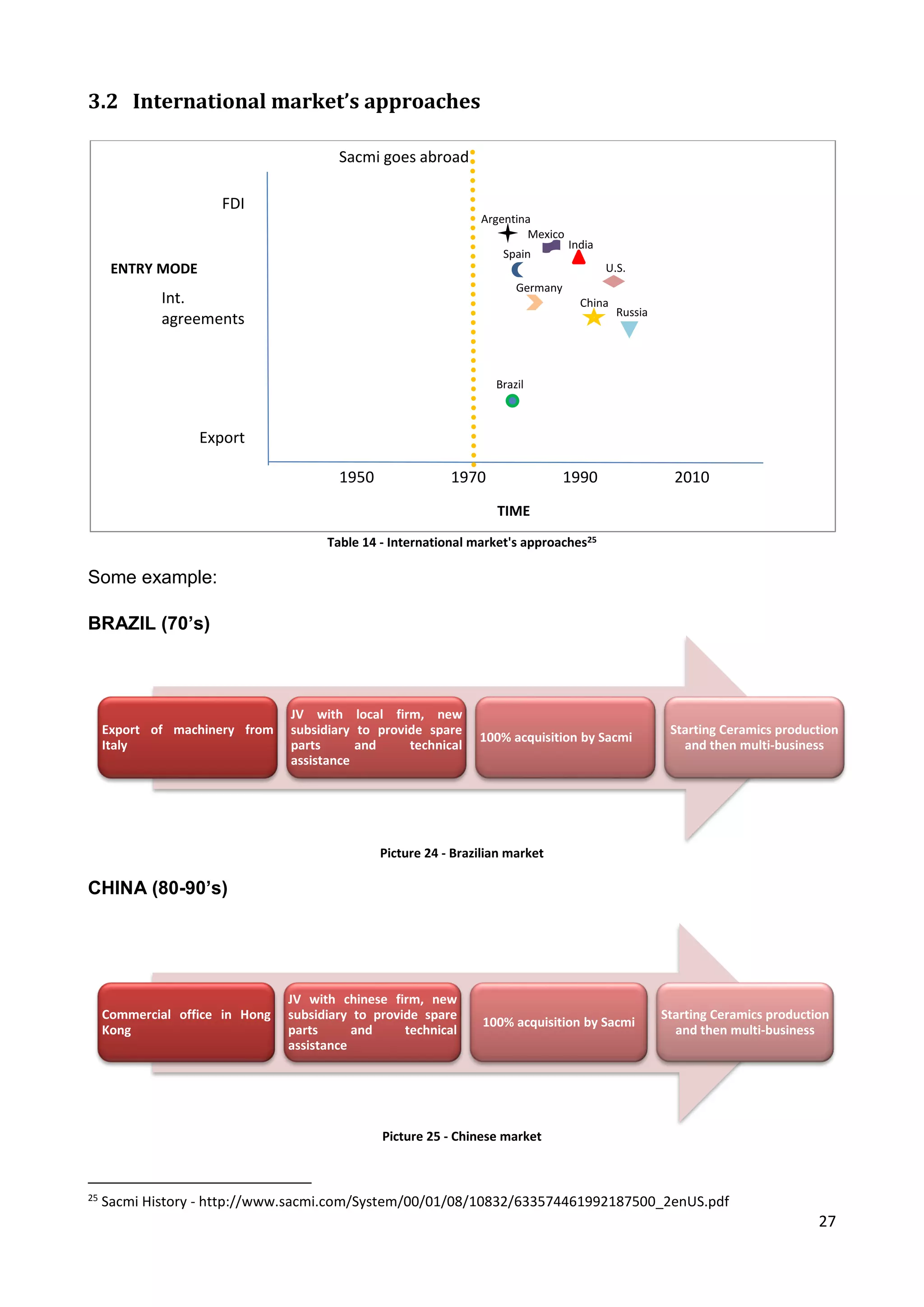
3.2 International market’s approaches
Table 14 - International market's approaches25
Some example:
BRAZIL (70’s)
Picture 24 - Brazilian market
CHINA (80-90’s)
Picture 25 - Chinese market
25
Sacmi History - http://www.sacmi.com/System/00/01/08/10832/633574461992187500_2enUS.pdf
ENTRY MODE
TIME
FDI
Int.
agreements
Export
1950 1970 1990 2010
Argentina
Spain
Germany
Mexico
Sacmi goes abroad
China
Brazil
India
U.S.
Russia
Export of machinery from
Italy
JV with local firm, new
subsidiary to provide spare
parts and technical
assistance
100% acquisition by Sacmi
Starting Ceramics production
and then multi-business
Commercial office in Hong
Kong
JV with chinese firm, new
subsidiary to provide spare
parts and technical
assistance
100% acquisition by Sacmi
Starting Ceramics production
and then multi-business
28
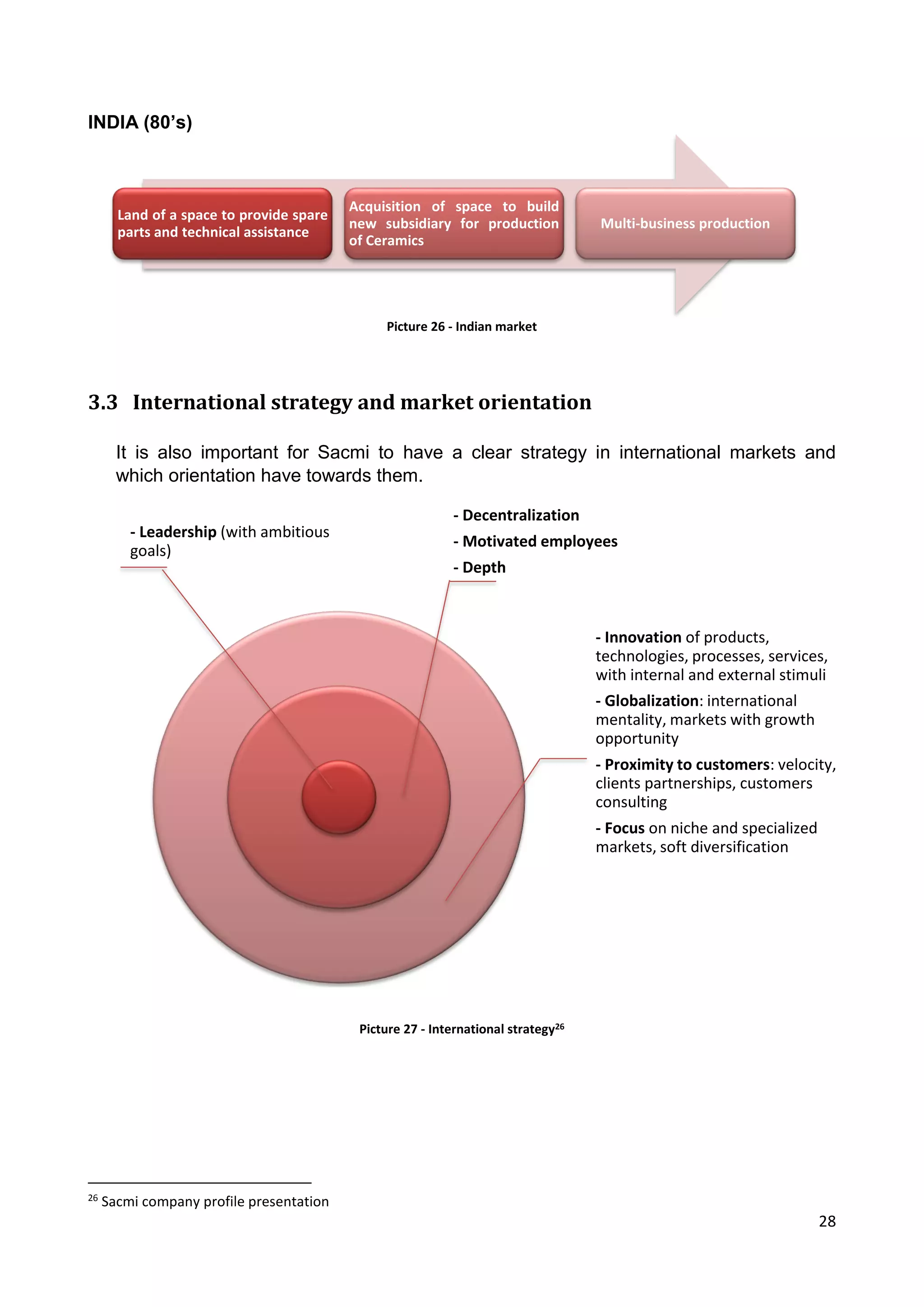
INDIA (80’s)
Picture 26 - Indian market
3.3 International strategy and market orientation
It is also important for Sacmi to have a clear strategy in international markets and
which orientation have towards them.
Picture 27 - International strategy26
26
Sacmi company profile presentation
Land of a space to provide spare
parts and technical assistance
Acquisition of space to build
new subsidiary for production
of Ceramics
Multi-business production
- Leadership (with ambitious
goals)
- Decentralization
- Motivated employees
- Depth
- Innovation of products,
technologies, processes, services,
with internal and external stimuli
- Globalization: international
mentality, markets with growth
opportunity
- Proximity to customers: velocity,
clients partnerships, customers
consulting
- Focus on niche and specialized
markets, soft diversification
29
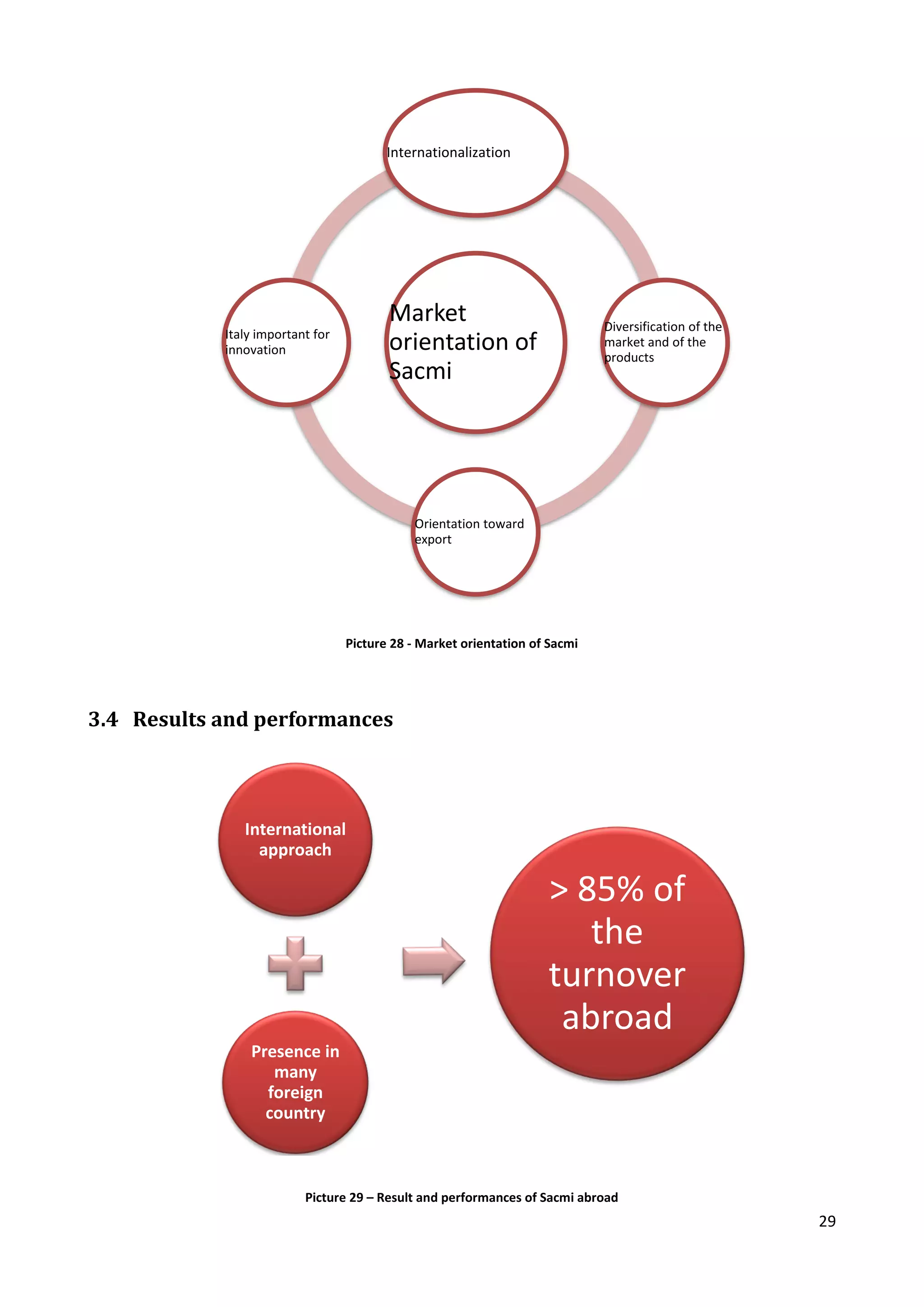
Picture 28 - Market orientation of Sacmi
3.4 Results and performances
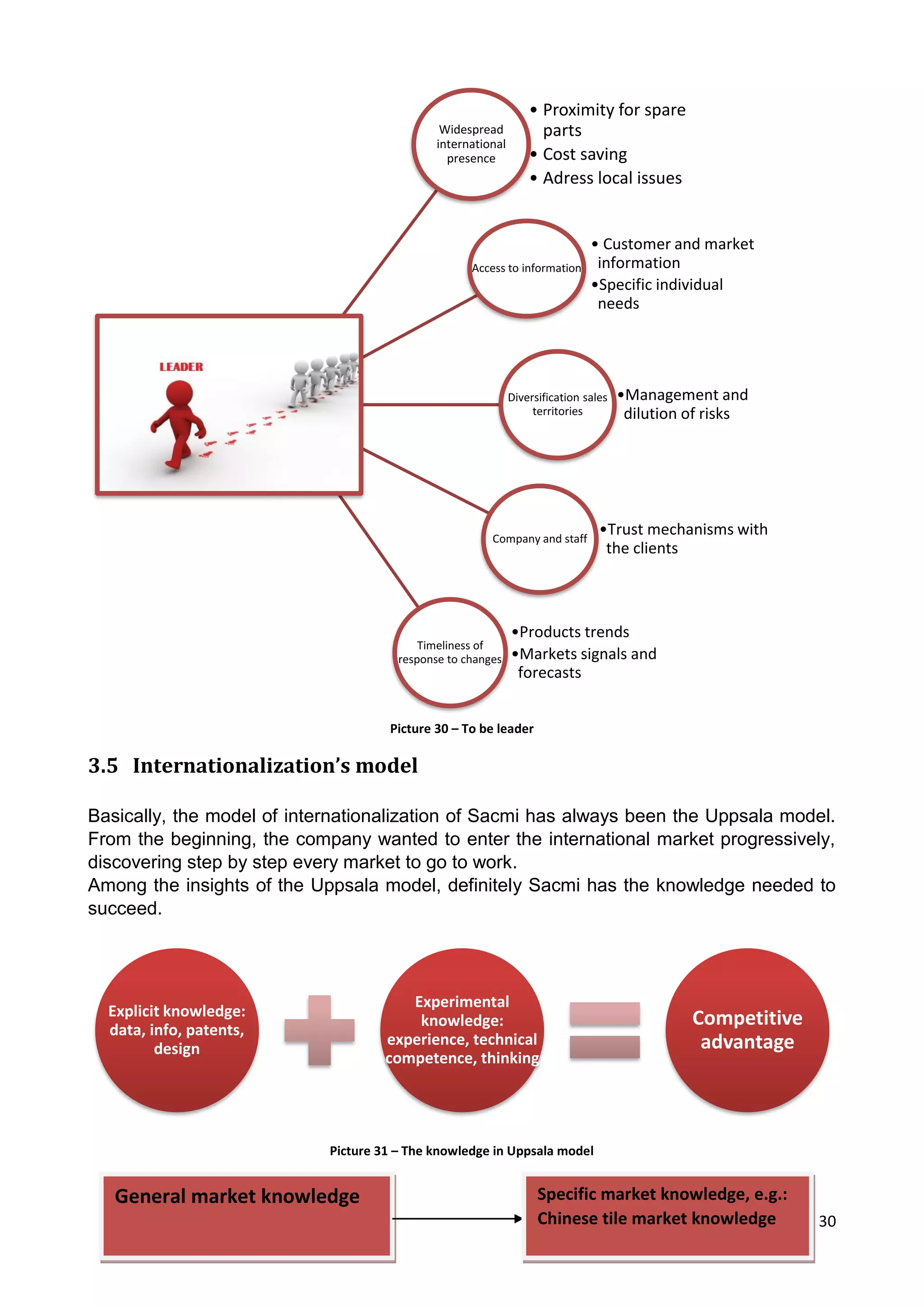
Picture 29 – Result and performances of Sacmi abroad
Market
orientation of
Sacmi
Internationalization
Diversification of the
market and of the
products
Orientation toward
export
Italy important for
innovation
International
approach
Presence in
many
foreign
country
> 85% of
the
turnover
abroad
30
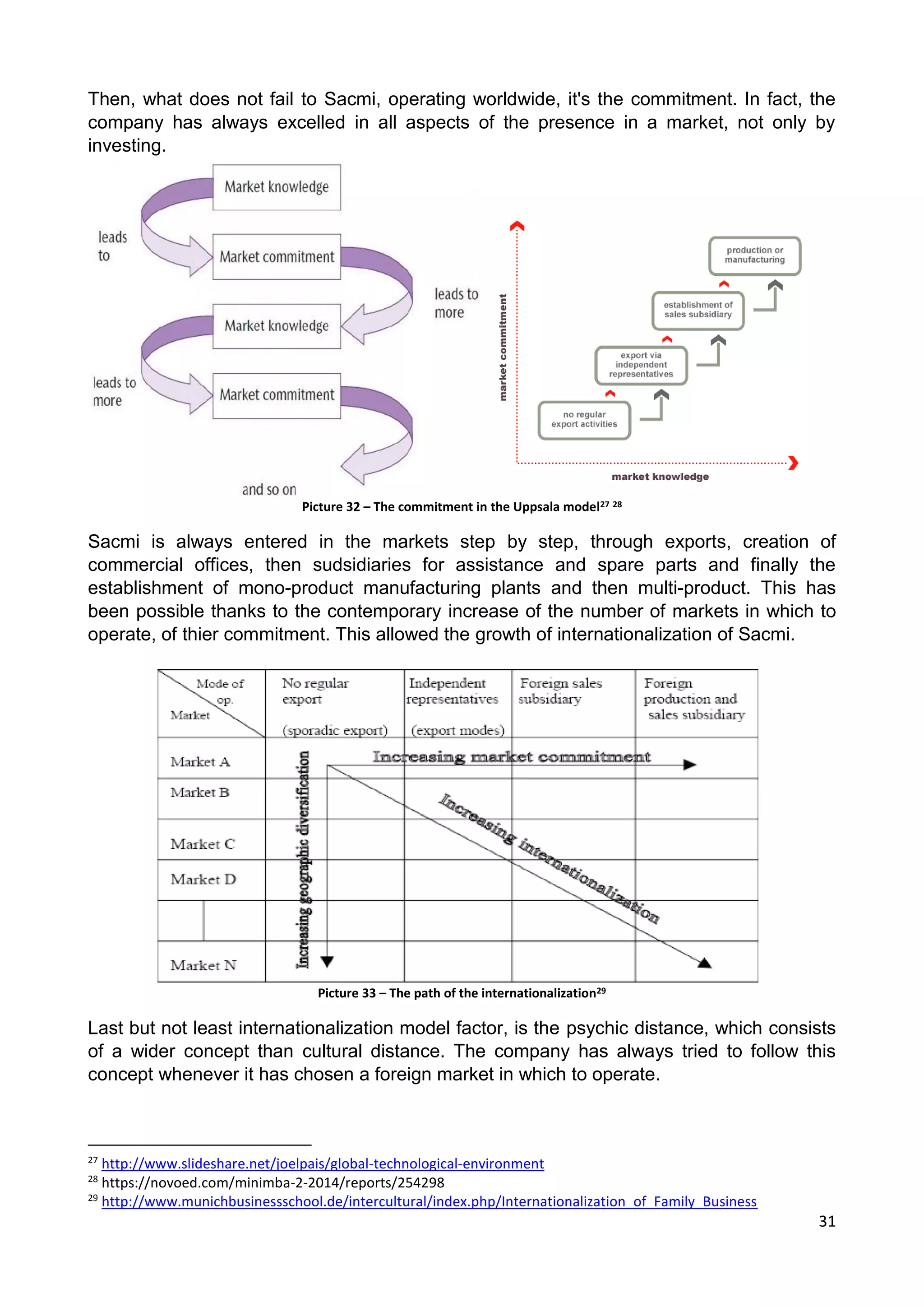
Picture 30 – To be leader
3.5 Internationalization’s model
Basically, the model of internationalization of Sacmi has always been the Uppsala model.
From the beginning, the company wanted to enter the international market progressively,
discovering step by step every market to go to work.
Among the insights of the Uppsala model, definitely Sacmi has the knowledge needed to
succeed.
Picture 31 – The knowledge in Uppsala model
Widespread
international
presence
• Proximity for spare
parts
• Cost saving
• Adress local issues
Access to information
• Customer and market
information
•Specific individual
needs
Diversification sales
territories
•Management and
dilution of risks
Company and staff
•Trust mechanisms with
the clients
Timeliness of
response to changes
•Products trends
•Markets signals and
forecasts
Explicit knowledge:
data, info, patents,
design
Experimental
knowledge:
experience, technical
competence, thinking
Competitive
advantage
General market knowledge Specific market knowledge, e.g.:
Chinese tile market knowledge
31
Then, what does not fail to Sacmi, operating worldwide, it's the commitment. In fact, the
company has always excelled in all aspects of the presence in a market, not only by
investing.
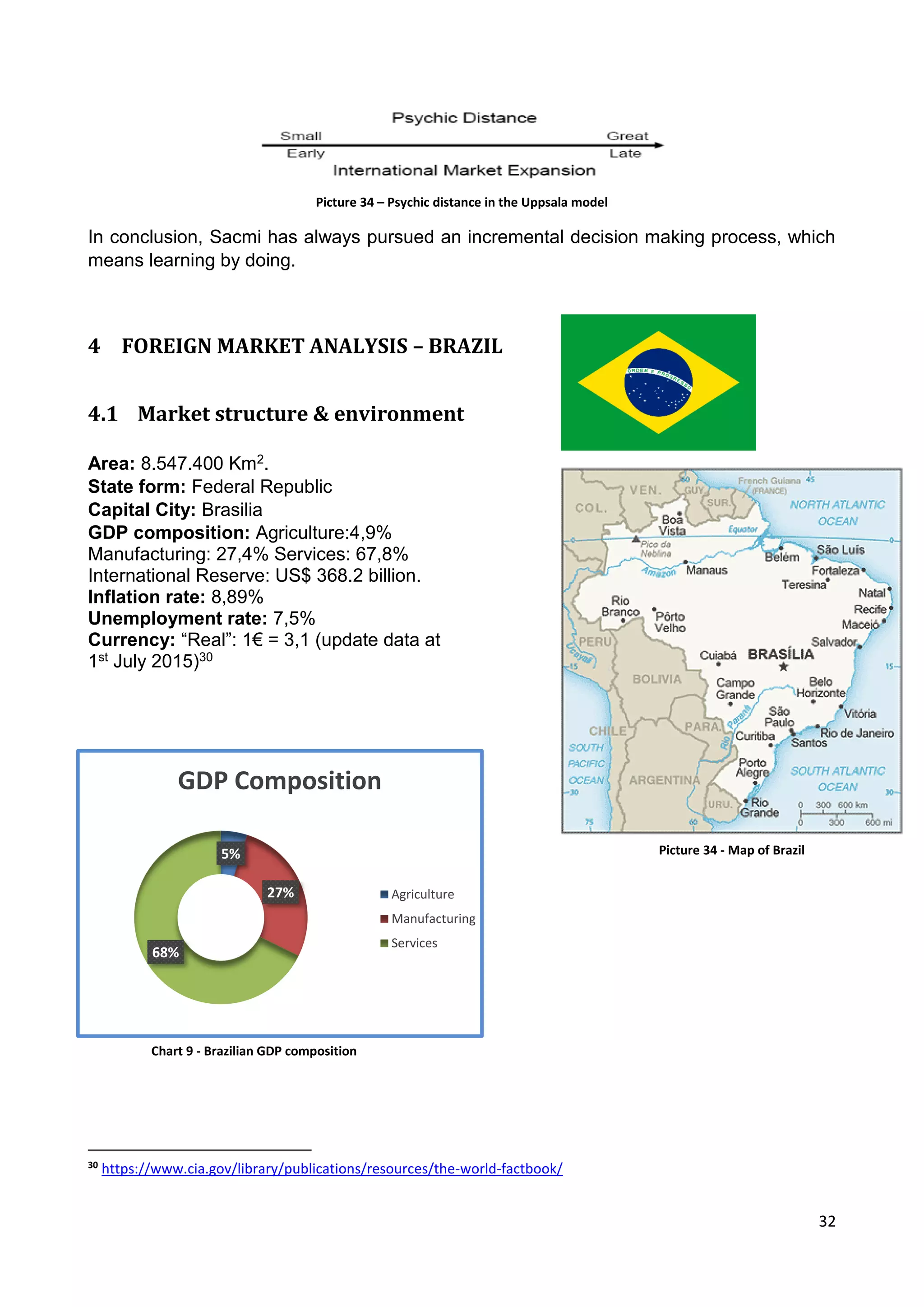
Picture 32 – The commitment in the Uppsala model27 28
Sacmi is always entered in the markets step by step, through exports, creation of
commercial offices, then sudsidiaries for assistance and spare parts and finally the
establishment of mono-product manufacturing plants and then multi-product. This has
been possible thanks to the contemporary increase of the number of markets in which to
operate, of thier commitment. This allowed the growth of internationalization of Sacmi.
Picture 33 – The path of the internationalization29
Last but not least internationalization model factor, is the psychic distance, which consists
of a wider concept than cultural distance. The company has always tried to follow this
concept whenever it has chosen a foreign market in which to operate.
27
http://www.slideshare.net/joelpais/global-technological-environment
28
https://novoed.com/minimba-2-2014/reports/254298
29
http://www.munichbusinessschool.de/intercultural/index.php/Internationalization_of_Family_Business
32
Picture 34 – Psychic distance in the Uppsala model
In conclusion, Sacmi has always pursued an incremental decision making process, which
means learning by doing.
4 FOREIGN MARKET ANALYSIS – BRAZIL
4.1 Market structure & environment
Area: 8.547.400 Km2.
State form: Federal Republic
Capital City: Brasilia
GDP composition: Agriculture:4,9%
Manufacturing: 27,4% Services: 67,8%
International Reserve: US$ 368.2 billion.
Inflation rate: 8,89%
Unemployment rate: 7,5%
Currency: “Real”: 1€ = 3,1 (update data at
1st July 2015)30
30
https://www.cia.gov/library/publications/resources/the-world-factbook/
5%
27%
68%
GDP Composition
Agriculture
Manufacturing
Services
Chart 9 - Brazilian GDP composition
Picture 34 - Map of Brazil
33
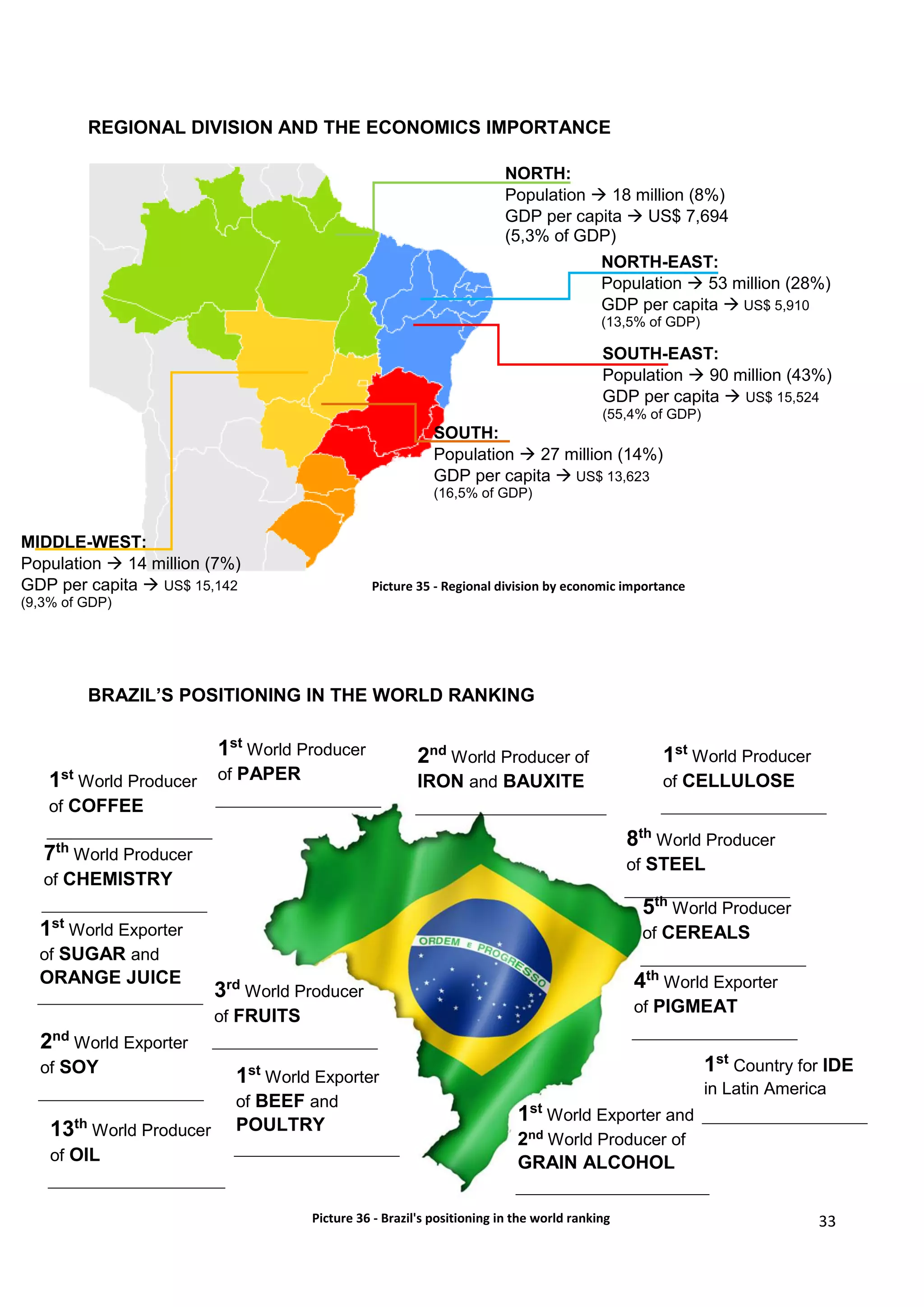
Picture 35 - Regional division by economic importance
REGIONAL DIVISION AND THE ECONOMICS IMPORTANCE
BRAZIL’S POSITIONING IN THE WORLD RANKING
8th
World Producer
of STEEL
1st
World Producer
of CELLULOSE
5th
World Producer
of CEREALS
1st
World Producer
of COFFEE
7th
World Producer
of CHEMISTRY
1st
World Exporter
of SUGAR and
ORANGE JUICE
1st
World Producer
of PAPER
2nd
World Producer of
IRON and BAUXITE
3rd
World Producer
of FRUITS
1st
World Exporter
of BEEF and
POULTRY
SOUTH:
Population  27 million (14%)
GDP per capita  US$ 13,623
(16,5% of GDP)
MIDDLE-WEST:
Population  14 million (7%)
GDP per capita  US$ 15,142
(9,3% of GDP)
4th
World Exporter
of PIGMEAT
NORTH:
Population  18 million (8%)
GDP per capita  US$ 7,694
(5,3% of GDP)
2nd
World Exporter
of SOY
1st
World Exporter and
2nd World Producer of
GRAIN ALCOHOL
NORTH-EAST:
Population  53 million (28%)
GDP per capita  US$ 5,910
(13,5% of GDP)
1st
Country for IDE
in Latin America
13th
World Producer
of OIL
SOUTH-EAST:
Population  90 million (43%)
GDP per capita  US$ 15,524
(55,4% of GDP)
Picture 36 - Brazil's positioning in the world ranking
34
CERAMICS INDUSTRY31
The trend in import/export flows over the years is perfectly consistent with our long-held
belief that tile is a material that tends to be produced close to the place of consumption.
Although world exports stand at 21.6% of production and 22.2% of global consumption,
more than half of this volume consists of exports shipped within the same geographical
area as that of production (87% Of South America’s exports remain in South America,
75% of North America’s exports remain within the NAFTA region, 60% of Asian exports
are shipped to other Asian countries). The EU is a partial exception in that 50% of its
exports are shipped to non-EU countries. This analysis is confirmed by the fact that the
shares of world production and consumption tend to be similar in each continent. In other
words, Asia accounted for 70.5% of production and 67.4% of world consumption, while the
corresponding figures for Europe (EU + non-EU) were 14.2% and 11.5%, for the Americas
12.1% and 14.4% and for Africa 3% and 6%.
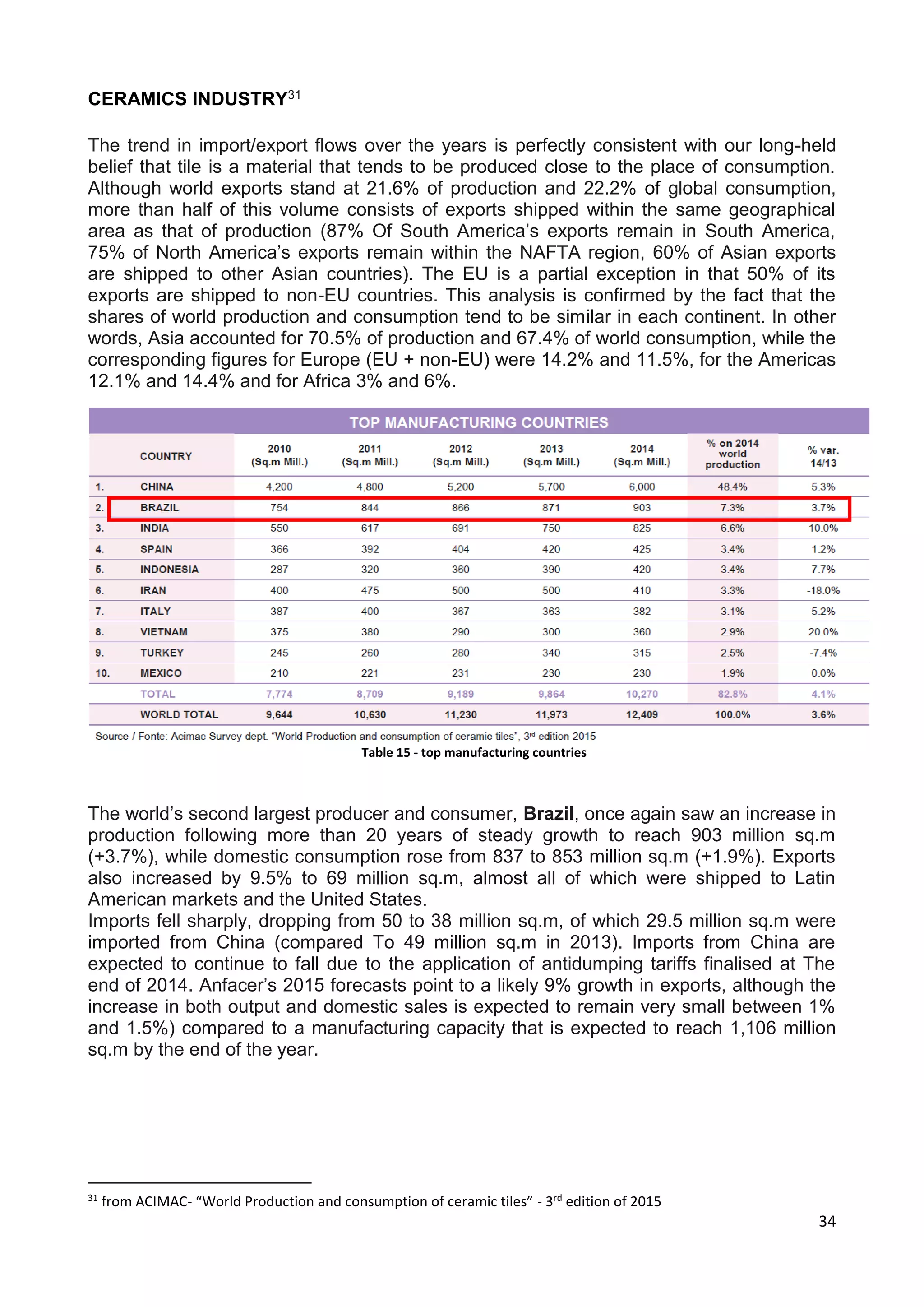
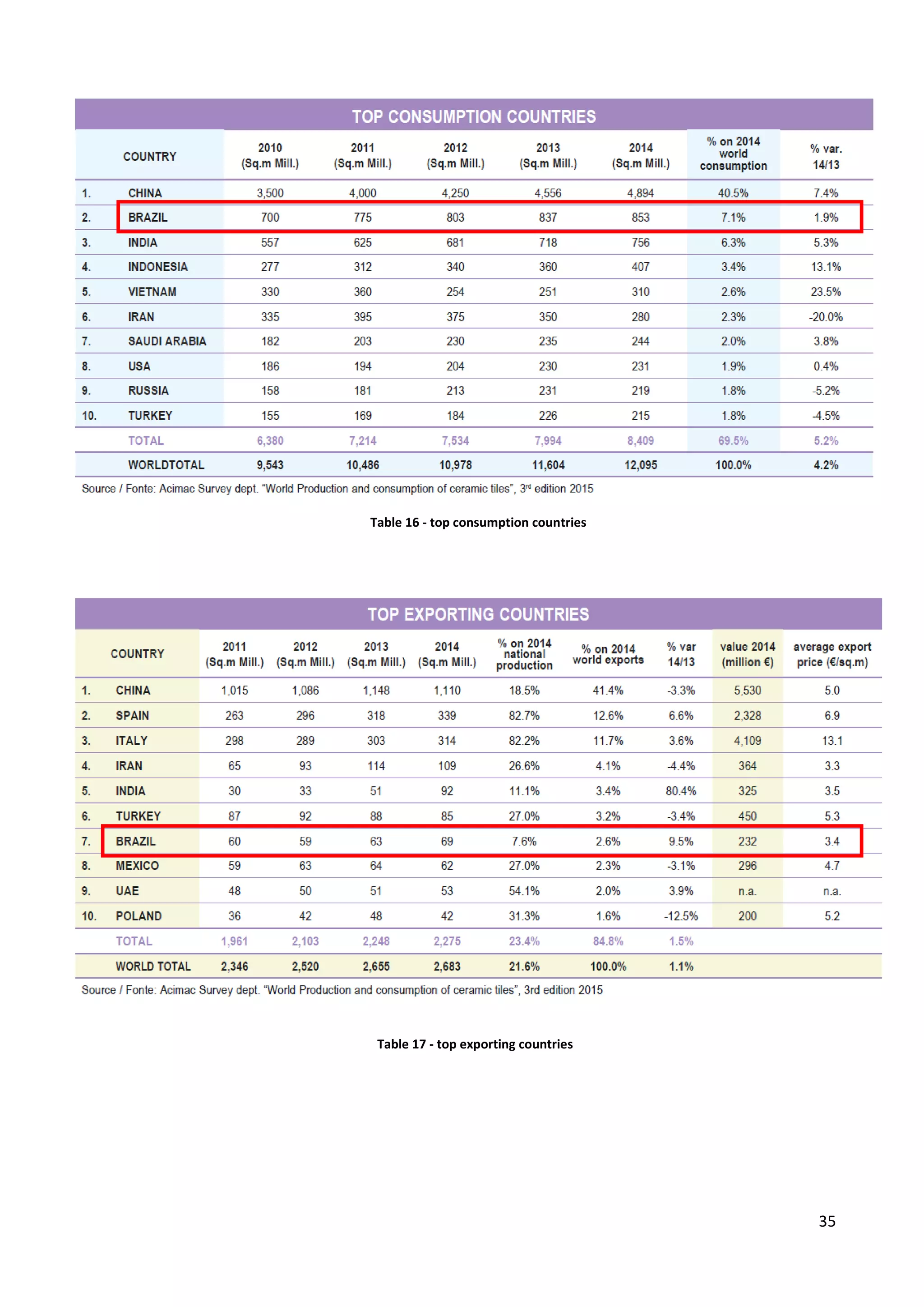
The world’s second largest producer and consumer, Brazil, once again saw an increase in
production following more than 20 years of steady growth to reach 903 million sq.m
(+3.7%), while domestic consumption rose from 837 to 853 million sq.m (+1.9%). Exports
also increased by 9.5% to 69 million sq.m, almost all of which were shipped to Latin
American markets and the United States.
Imports fell sharply, dropping from 50 to 38 million sq.m, of which 29.5 million sq.m were
imported from China (compared To 49 million sq.m in 2013). Imports from China are
expected to continue to fall due to the application of antidumping tariffs finalised at The
end of 2014. Anfacer’s 2015 forecasts point to a likely 9% growth in exports, although the
increase in both output and domestic sales is expected to remain very small between 1%
and 1.5%) compared to a manufacturing capacity that is expected to reach 1,106 million
sq.m by the end of the year.
31
from ACIMAC- “World Production and consumption of ceramic tiles” - 3rd
edition of 2015
Table 15 - top manufacturing countries
35
Table 16 - top consumption countries
Table 17 - top exporting countries
36
4.2 Opportunities and drawbacks
Opportunities32
32
http://www.infomercatiesteri.it/
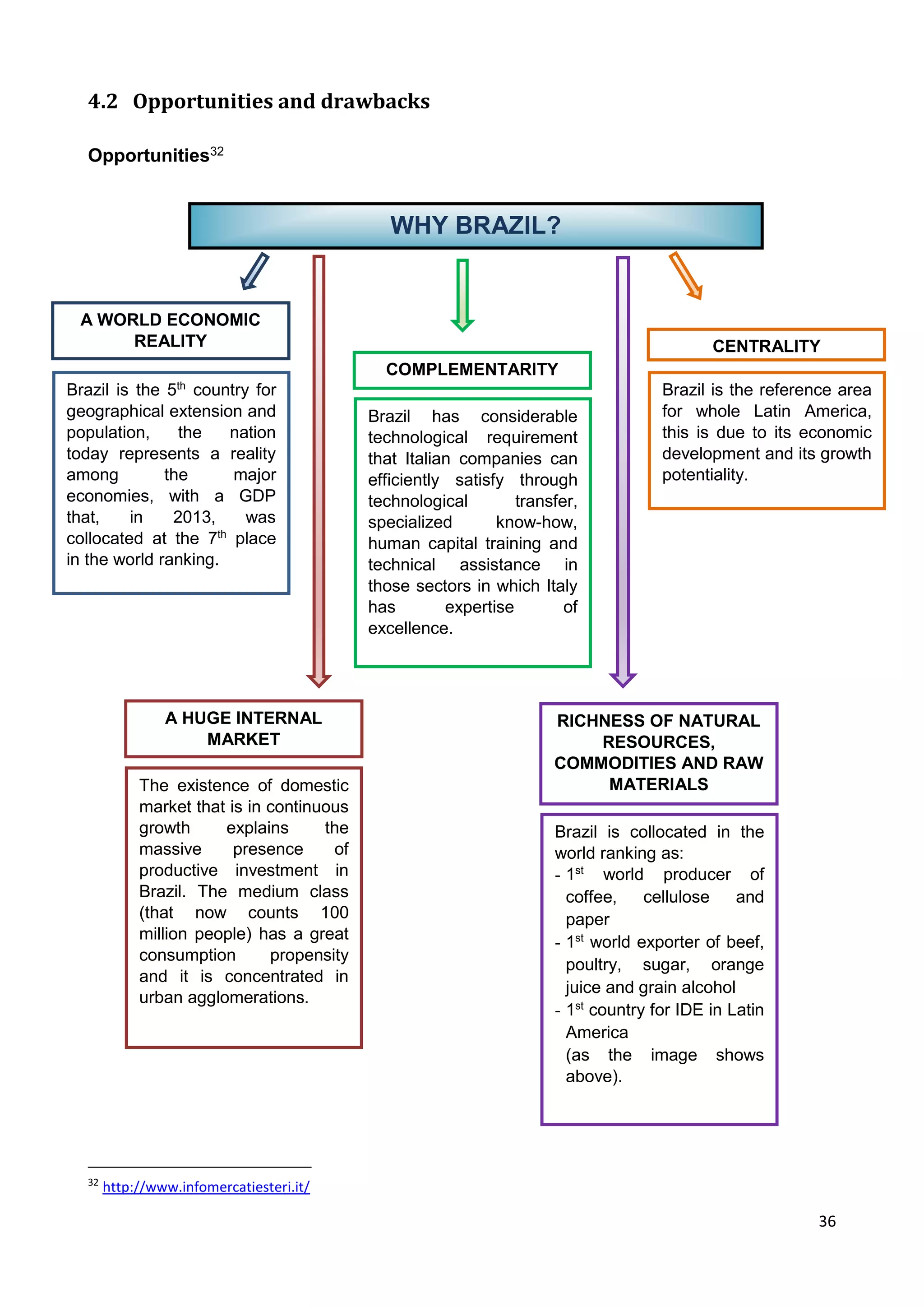
WHY BRAZIL?
A WORLD ECONOMIC
REALITY
Brazil is the 5th
country for
geographical extension and
population, the nation
today represents a reality
among the major
economies, with a GDP
that, in 2013, was
collocated at the 7th
place
in the world ranking.
A HUGE INTERNAL
MARKET
The existence of domestic
market that is in continuous
growth explains the
massive presence of
productive investment in
Brazil. The medium class
(that now counts 100
million people) has a great
consumption propensity
and it is concentrated in
urban agglomerations.
CENTRALITY
Brazil is the reference area
for whole Latin America,
this is due to its economic
development and its growth
potentiality.
RICHNESS OF NATURAL
RESOURCES,
COMMODITIES AND RAW
MATERIALS
Brazil is collocated in the
world ranking as:
- 1st
world producer of
coffee, cellulose and
paper
- 1st
world exporter of beef,
poultry, sugar, orange
juice and grain alcohol
- 1st
country for IDE in Latin
America
(as the image shows
above).
COMPLEMENTARITY
Brazil has considerable
technological requirement
that Italian companies can
efficiently satisfy through
technological transfer,
specialized know-how,
human capital training and
technical assistance in
those sectors in which Italy
has expertise of
excellence.
37
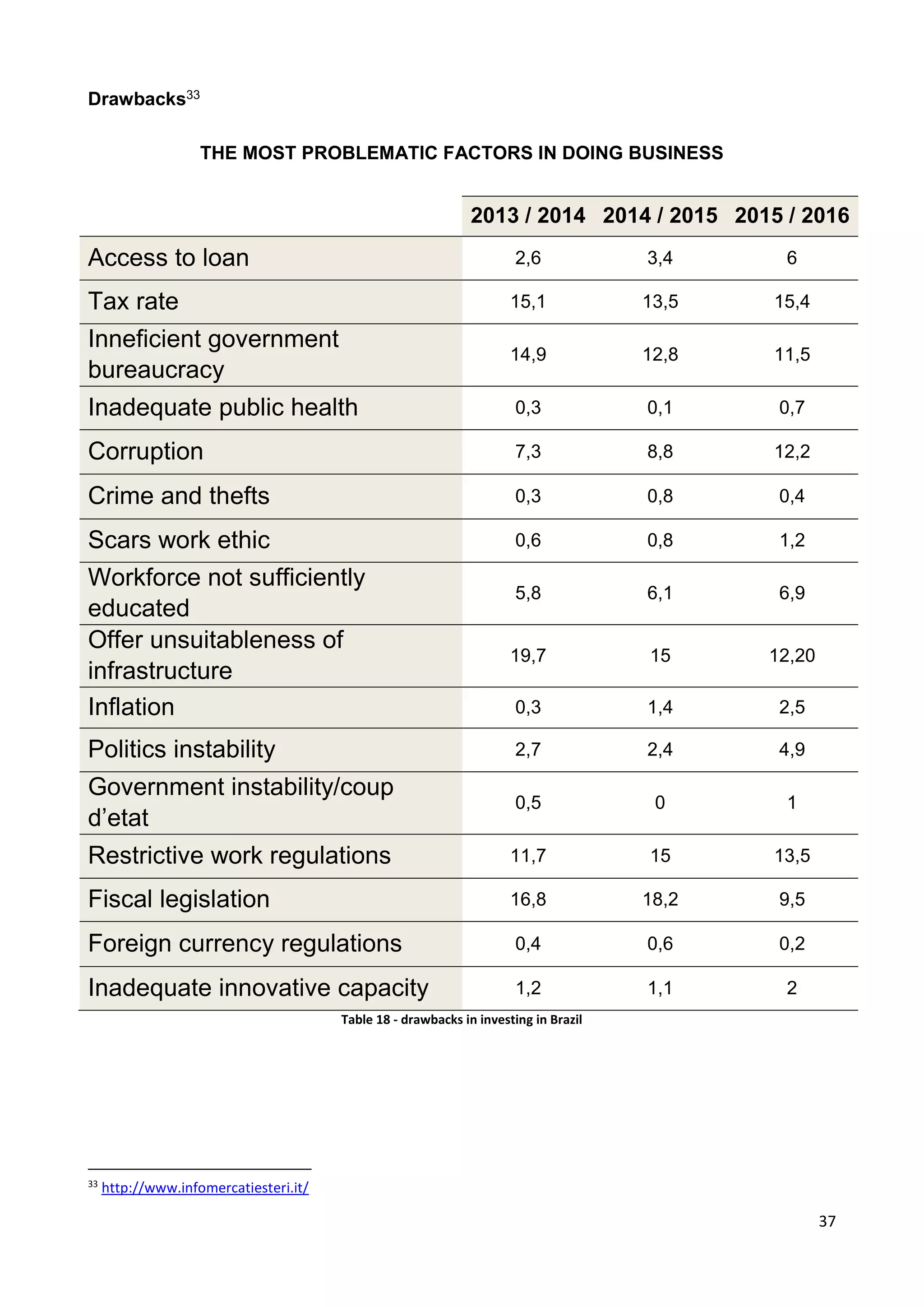
Drawbacks33
THE MOST PROBLEMATIC FACTORS IN DOING BUSINESS
2013 / 2014 2014 / 2015 2015 / 2016
Access to loan 2,6 3,4 6
Tax rate 15,1 13,5 15,4
Inneficient government
bureaucracy
14,9 12,8 11,5
Inadequate public health 0,3 0,1 0,7
Corruption 7,3 8,8 12,2
Crime and thefts 0,3 0,8 0,4
Scars work ethic 0,6 0,8 1,2
Workforce not sufficiently
educated
5,8 6,1 6,9
Offer unsuitableness of
infrastructure
19,7 15 12,20
Inflation 0,3 1,4 2,5
Politics instability 2,7 2,4 4,9
Government instability/coup
d’etat
0,5 0 1
Restrictive work regulations 11,7 15 13,5
Fiscal legislation 16,8 18,2 9,5
Foreign currency regulations 0,4 0,6 0,2
Inadequate innovative capacity 1,2 1,1 2
Table 18 - drawbacks in investing in Brazil
33
http://www.infomercatiesteri.it/
38
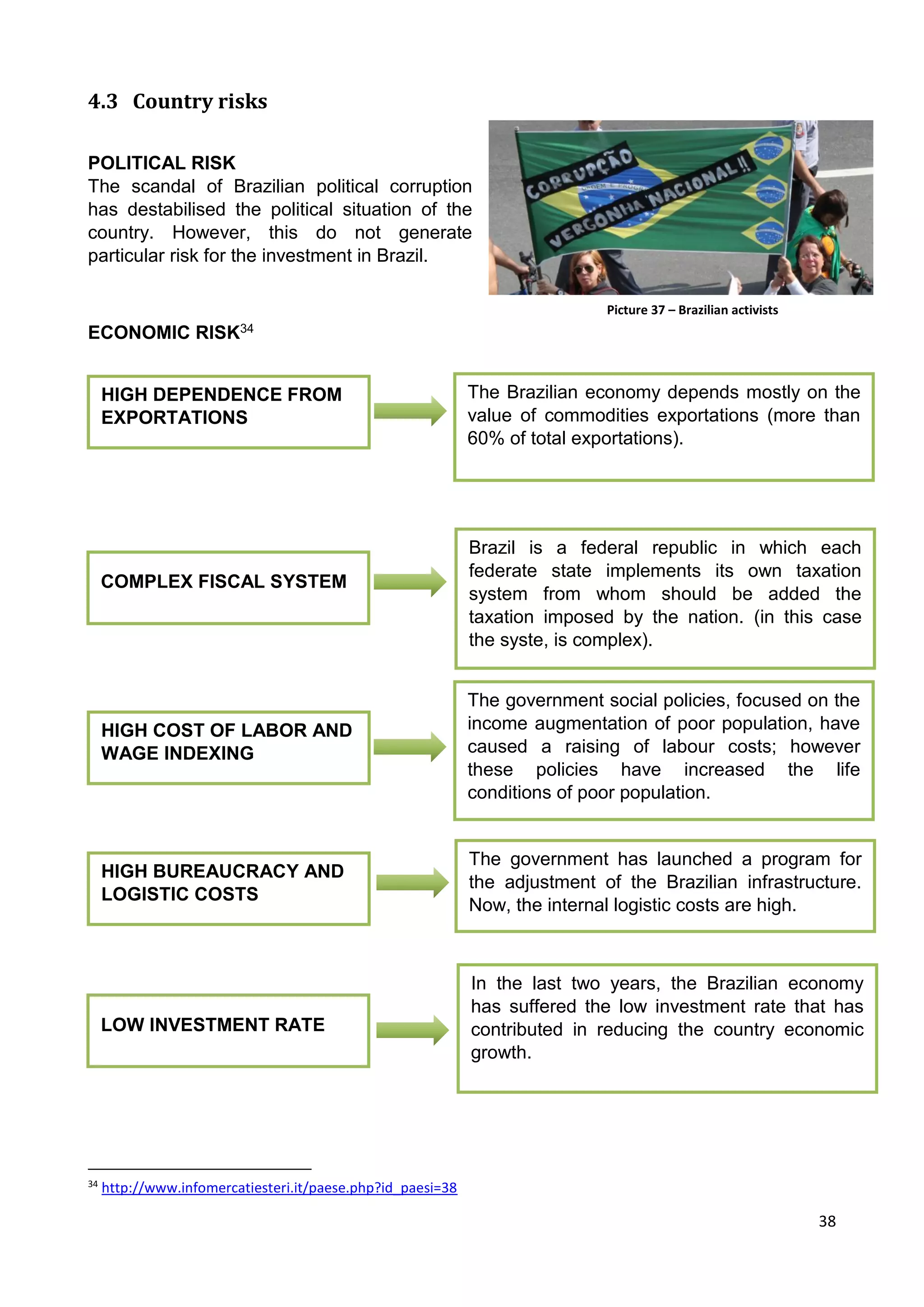
4.3 Country risks
POLITICAL RISK
The scandal of Brazilian political corruption
has destabilised the political situation of the
country. However, this do not generate
particular risk for the investment in Brazil.
ECONOMIC RISK34
34
http://www.infomercatiesteri.it/paese.php?id_paesi=38
HIGH BUREAUCRACY AND
LOGISTIC COSTS
The government has launched a program for
the adjustment of the Brazilian infrastructure.
Now, the internal logistic costs are high.
HIGH DEPENDENCE FROM
EXPORTATIONS
COMPLEX FISCAL SYSTEM
The Brazilian economy depends mostly on the
value of commodities exportations (more than
60% of total exportations).
Brazil is a federal republic in which each
federate state implements its own taxation
system from whom should be added the
taxation imposed by the nation. (in this case
the syste, is complex).
HIGH COST OF LABOR AND
WAGE INDEXING
LOW INVESTMENT RATE
In the last two years, the Brazilian economy
has suffered the low investment rate that has
contributed in reducing the country economic
growth.
The government social policies, focused on the
income augmentation of poor population, have
caused a raising of labour costs; however
these policies have increased the life
conditions of poor population.
Picture 37 – Brazilian activists
39
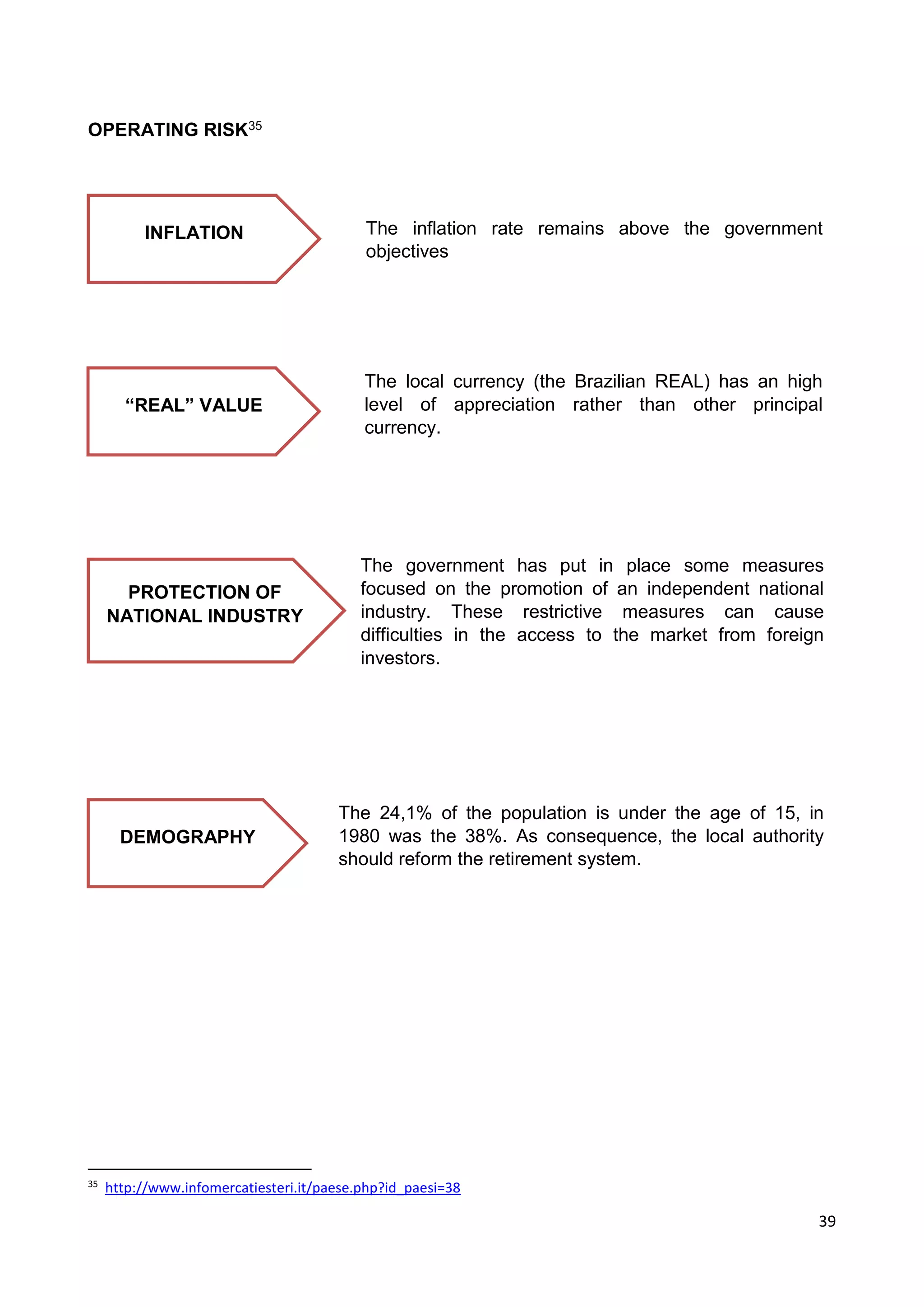
OPERATING RISK35
35
http://www.infomercatiesteri.it/paese.php?id_paesi=38
INFLATION The inflation rate remains above the government
objectives
“REAL” VALUE
The local currency (the Brazilian REAL) has an high
level of appreciation rather than other principal
currency.
PROTECTION OF
NATIONAL INDUSTRY
The government has put in place some measures
focused on the promotion of an independent national
industry. These restrictive measures can cause
difficulties in the access to the market from foreign
investors.
DEMOGRAPHY
The 24,1% of the population is under the age of 15, in
1980 was the 38%. As consequence, the local authority
should reform the retirement system.
40
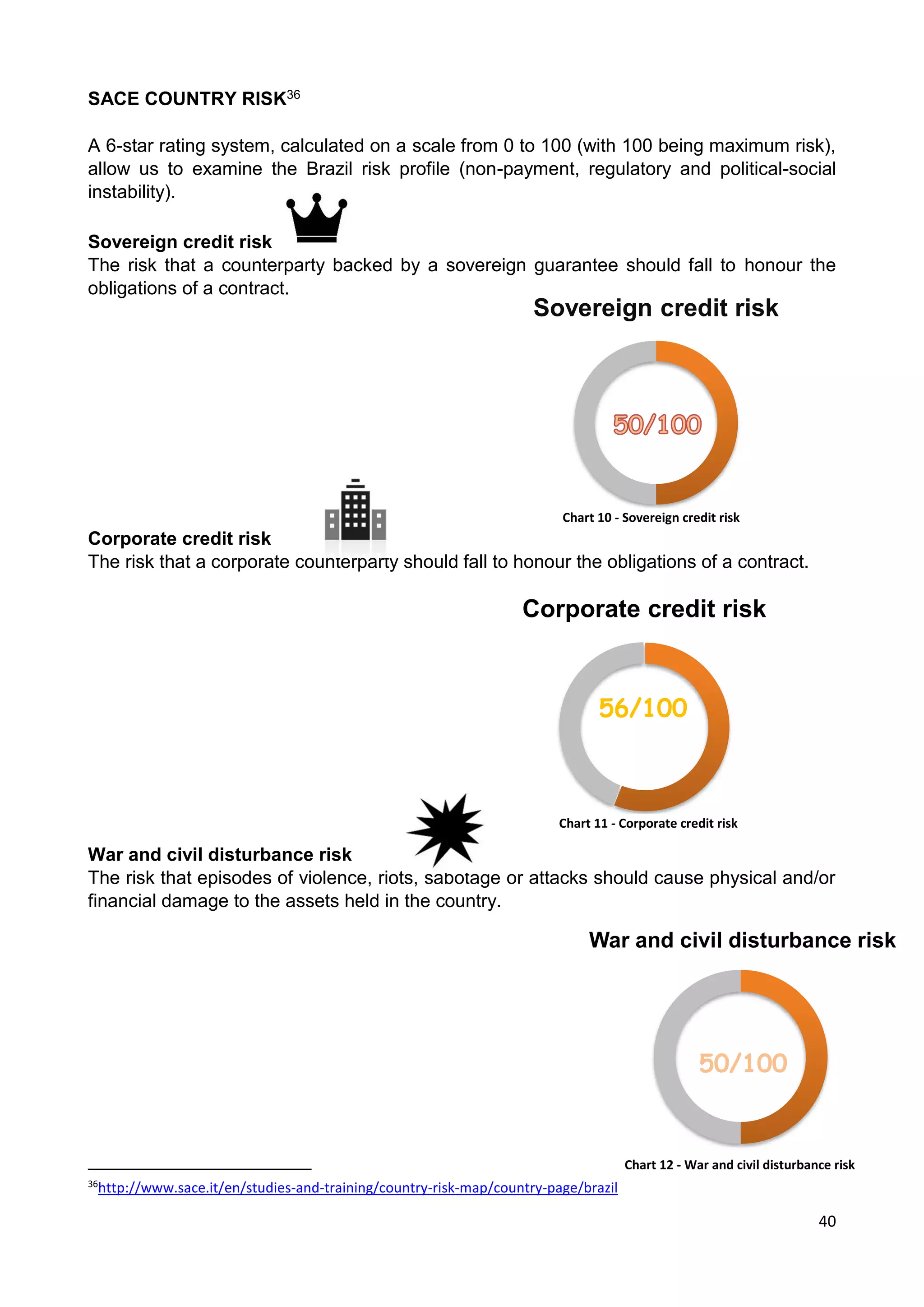
SACE COUNTRY RISK36
A 6-star rating system, calculated on a scale from 0 to 100 (with 100 being maximum risk),
allow us to examine the Brazil risk profile (non-payment, regulatory and political-social
instability).
Sovereign credit risk
The risk that a counterparty backed by a sovereign guarantee should fall to honour the
obligations of a contract.
Corporate credit risk
The risk that a corporate counterparty should fall to honour the obligations of a contract.
War and civil disturbance risk
The risk that episodes of violence, riots, sabotage or attacks should cause physical and/or
financial damage to the assets held in the country.
36
http://www.sace.it/en/studies-and-training/country-risk-map/country-page/brazil
War and civil disturbance risk
Sovereign credit risk
Corporate credit risk
50/100
56/100
Chart 10 - Sovereign credit risk
Chart 11 - Corporate credit risk
Chart 12 - War and civil disturbance risk
41
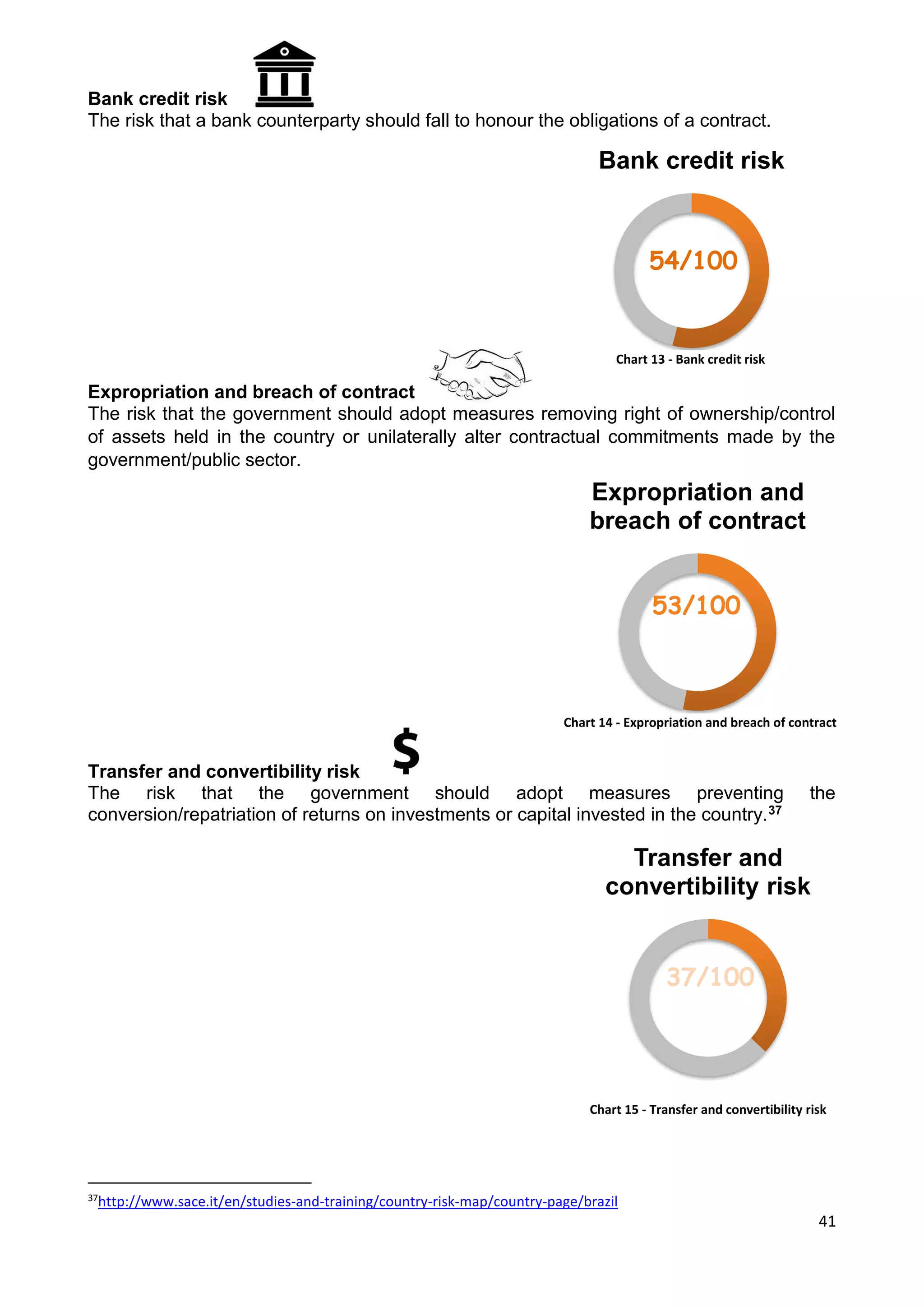
Bank credit risk
The risk that a bank counterparty should fall to honour the obligations of a contract.
Expropriation and breach of contract
The risk that the government should adopt measures removing right of ownership/control
of assets held in the country or unilaterally alter contractual commitments made by the
government/public sector.
Transfer and convertibility risk
The risk that the government should adopt measures preventing the
conversion/repatriation of returns on investments or capital invested in the country.37
37
http://www.sace.it/en/studies-and-training/country-risk-map/country-page/brazil
Bank credit risk
Expropriation and
breach of contract
Transfer and
convertibility risk
54/100
53/100
37/100
Chart 13 - Bank credit risk
Chart 14 - Expropriation and breach of contract
Chart 15 - Transfer and convertibility risk
42
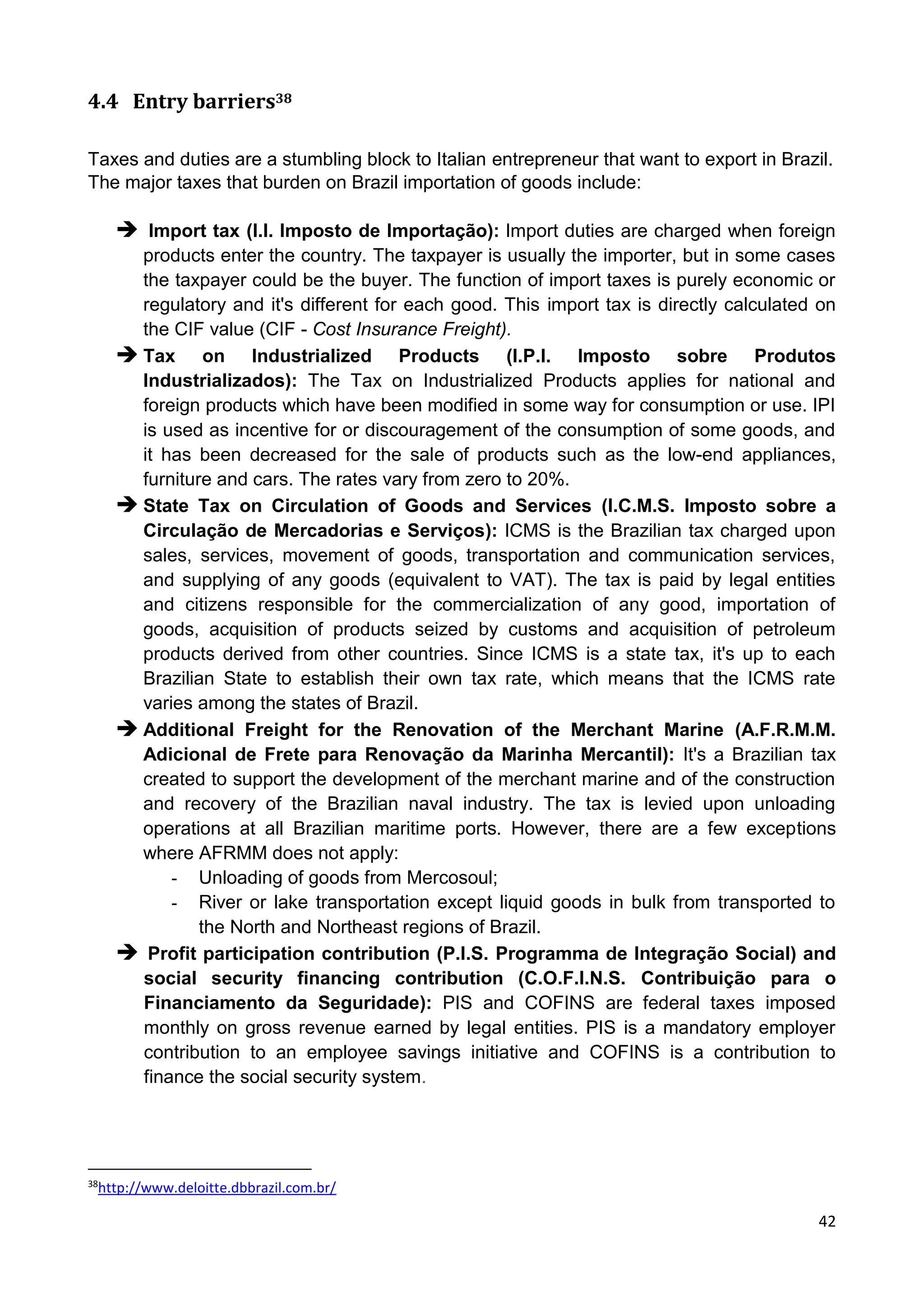
4.4 Entry barriers38
Taxes and duties are a stumbling block to Italian entrepreneur that want to export in Brazil.
The major taxes that burden on Brazil importation of goods include:
 Import tax (I.I. Imposto de Importação): Import duties are charged when foreign
products enter the country. The taxpayer is usually the importer, but in some cases
the taxpayer could be the buyer. The function of import taxes is purely economic or
regulatory and it's different for each good. This import tax is directly calculated on
the CIF value (CIF - Cost Insurance Freight).
 Tax on Industrialized Products (I.P.I. Imposto sobre Produtos
Industrializados): The Tax on Industrialized Products applies for national and
foreign products which have been modified in some way for consumption or use. IPI
is used as incentive for or discouragement of the consumption of some goods, and
it has been decreased for the sale of products such as the low-end appliances,
furniture and cars. The rates vary from zero to 20%.
 State Tax on Circulation of Goods and Services (I.C.M.S. Imposto sobre a
Circulação de Mercadorias e Serviços): ICMS is the Brazilian tax charged upon
sales, services, movement of goods, transportation and communication services,
and supplying of any goods (equivalent to VAT). The tax is paid by legal entities
and citizens responsible for the commercialization of any good, importation of
goods, acquisition of products seized by customs and acquisition of petroleum
products derived from other countries. Since ICMS is a state tax, it's up to each
Brazilian State to establish their own tax rate, which means that the ICMS rate
varies among the states of Brazil.
 Additional Freight for the Renovation of the Merchant Marine (A.F.R.M.M.
Adicional de Frete para Renovação da Marinha Mercantil): It's a Brazilian tax
created to support the development of the merchant marine and of the construction
and recovery of the Brazilian naval industry. The tax is levied upon unloading
operations at all Brazilian maritime ports. However, there are a few exceptions
where AFRMM does not apply:
- Unloading of goods from Mercosoul;
- River or lake transportation except liquid goods in bulk from transported to
the North and Northeast regions of Brazil.
 Profit participation contribution (P.I.S. Programma de Integração Social) and
social security financing contribution (C.O.F.I.N.S. Contribuição para o
Financiamento da Seguridade): PIS and COFINS are federal taxes imposed
monthly on gross revenue earned by legal entities. PIS is a mandatory employer
contribution to an employee savings initiative and COFINS is a contribution to
finance the social security system.
38
http://www.deloitte.dbbrazil.com.br/
43
CERAMIC INDUSTRY
As far as duties are concerned, the ceramic sector is subject to high duties that go from
12% (mosaic not glazed) to a peak of 35% (porcelain stoneware).
Moreover, we notice that Brazil has adopted technical regulations which do not correspond
with the ISO standard (concerning porcelain stoneware), but the country has introduced its
own standard category (0,1 of permeability, while the ISO standard is 0,5%). Furthermore,
we observe high duties also on tableware, ornamental ceramics (20%) and whiteware
(18%).39
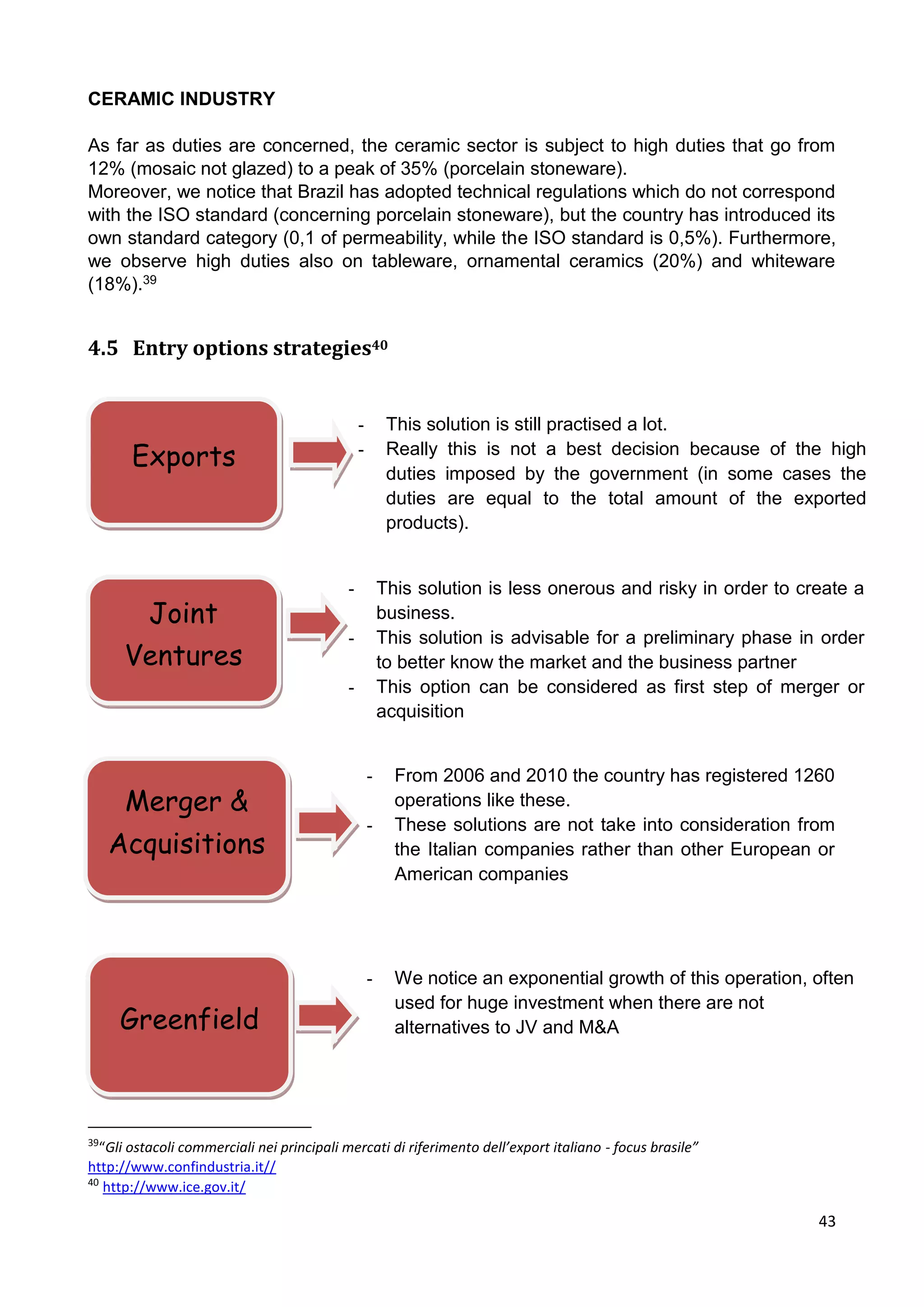
4.5 Entry options strategies40
39
“Gli ostacoli commerciali nei principali mercati di riferimento dell’export italiano - focus brasile”
http://www.confindustria.it//
40
http://www.ice.gov.it/
Exports
- This solution is still practised a lot.
- Really this is not a best decision because of the high
duties imposed by the government (in some cases the
duties are equal to the total amount of the exported
products).
Joint
Ventures
- This solution is less onerous and risky in order to create a
business.
- This solution is advisable for a preliminary phase in order
to better know the market and the business partner
- This option can be considered as first step of merger or
acquisition
Merger &
Acquisitions
- From 2006 and 2010 the country has registered 1260
operations like these.
- These solutions are not take into consideration from
the Italian companies rather than other European or
American companies
- We notice an exponential growth of this operation, often
used for huge investment when there are not
alternatives to JV and M&AGreenfield
44
5 INTERNATIONAL FDI – GREENFIELD
GREENFIELD
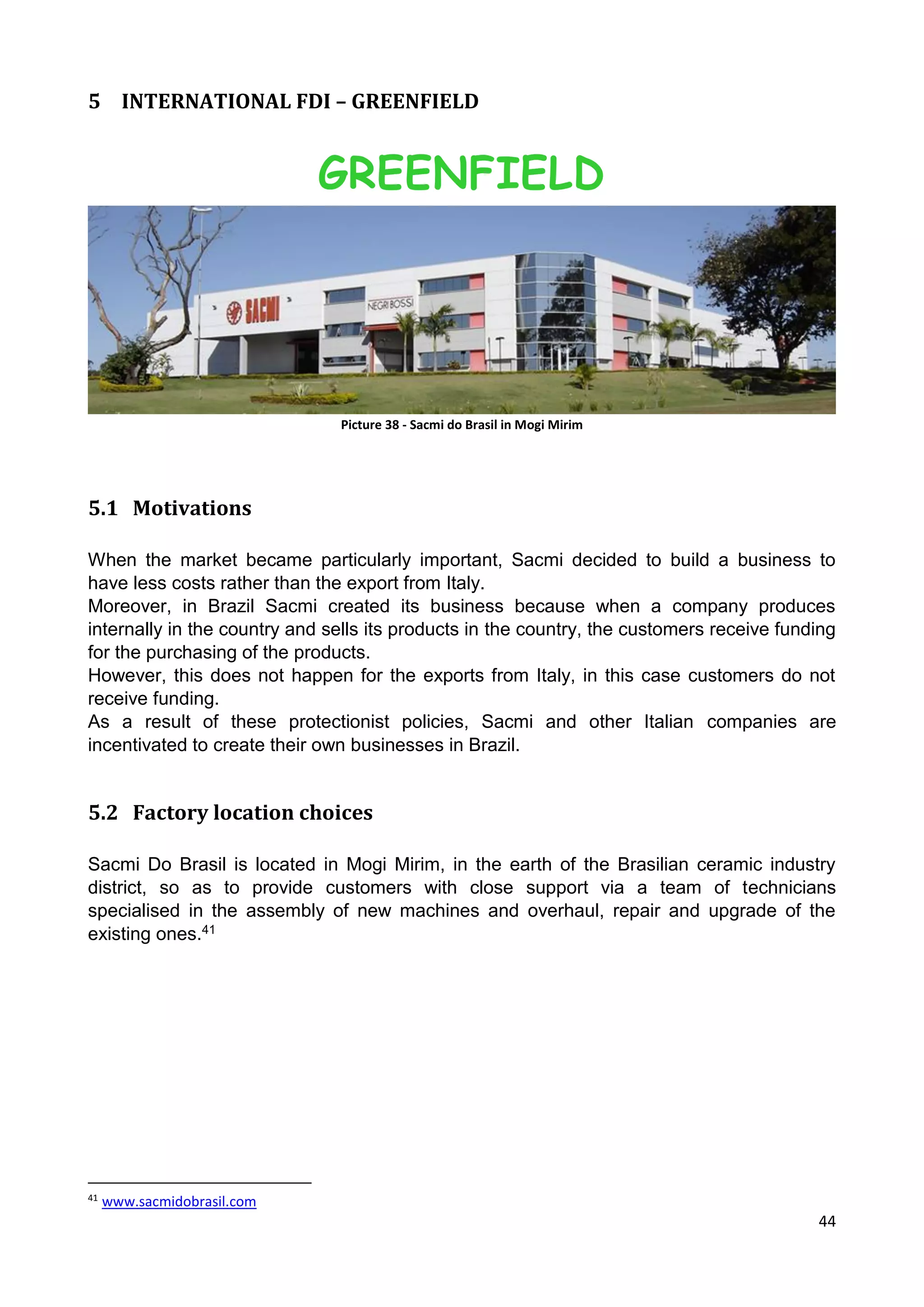
Picture 38 - Sacmi do Brasil in Mogi Mirim
5.1 Motivations
When the market became particularly important, Sacmi decided to build a business to
have less costs rather than the export from Italy.
Moreover, in Brazil Sacmi created its business because when a company produces
internally in the country and sells its products in the country, the customers receive funding
for the purchasing of the products.
However, this does not happen for the exports from Italy, in this case customers do not
receive funding.
As a result of these protectionist policies, Sacmi and other Italian companies are
incentivated to create their own businesses in Brazil.
5.2 Factory location choices
Sacmi Do Brasil is located in Mogi Mirim, in the earth of the Brasilian ceramic industry
district, so as to provide customers with close support via a team of technicians
specialised in the assembly of new machines and overhaul, repair and upgrade of the
existing ones.41
41
www.sacmidobrasil.com
45
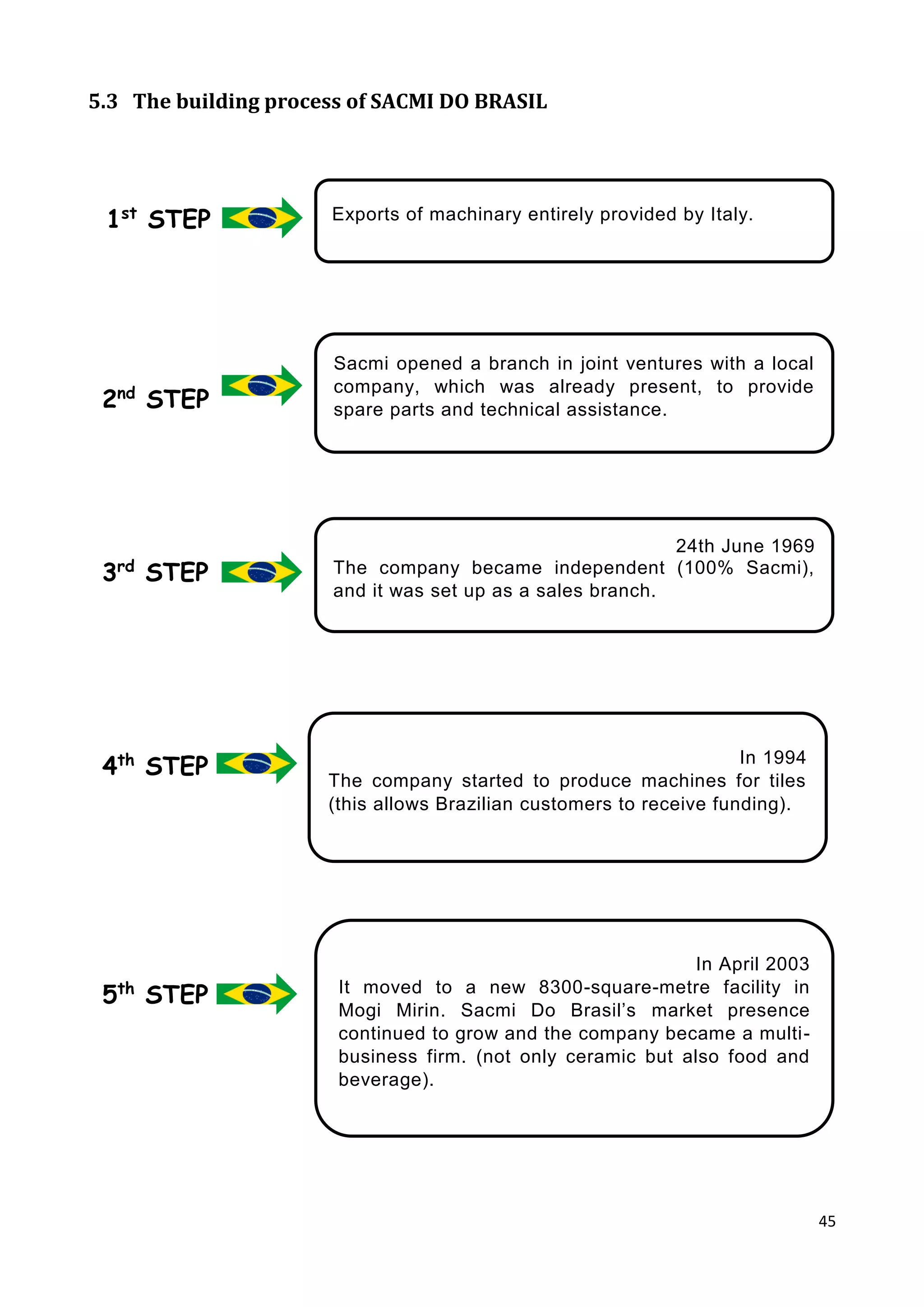
5.3 The building process of SACMI DO BRASIL
1st
STEP Exports of machinary entirely provided by Italy.
2nd
STEP
In 1994
The company started to produce machines for tiles
(this allows Brazilian customers to receive funding).
4th
STEP
Sacmi opened a branch in joint ventures with a local
company, which was already present, to provide
spare parts and technical assistance.
3rd
STEP
24th June 1969
The company became independent (100% Sacmi),
and it was set up as a sales branch.
5th
STEP
In April 2003
It moved to a new 8300-square-metre facility in
Mogi Mirin. Sacmi Do Brasil’s market presence
continued to grow and the company became a multi-
business firm. (not only ceramic but also food and
beverage).
46
5.4 Activities and operations
For its local market Sacmi do Brasil produces multi-channel horizontal dryers and roller
kilns for the ceramic industry and injection for plastics.
Moreover, the company is selling the machines and equipment produced by the Group
companies.
Sacmi do Brasi has also an equipped warehouse facility that stocks original spare parts for
each sector in which it operates (not only ceramic division but also for the Closures and
Beverage Business unit of the Packaging Division), as well as materials from other
companies in ceramic sector.42
5.5 Performances
“Sacmi Do Brasil wins Mundo Ceramico’s supplier of the year award”
Picture 39 – Mundo Ceramico
The Brazilian ceramic magazine “Mundo Ceramico” has assigned the Mundo Ceramico
2006 award to Sacmi do Brasil. This award is granted to suppliers who have
distinguished themselves by providing the market with products, equipment and services
at a level of excellence.
The award is divided into three categories. In the first, reserved for suppliers of machines
and equipment for complete lines, Sacmi Do Brasil won 44% of the votes among the three
candidate companies. In the second, dedicated to suppliers of pressing machines and
equipment, Sacmi Do Brasil obtained, together with another company, 47% of the vote out
of the three companies selected. Suppliers of machines and equipment for drying lines
battled it out in the third category: among the five candidate companies, Sacmi Do Brasil
won a convincing 35% of the votes.43
42
www.sacmidobrasil.com
43
http://www.sacmi.com/en-US/News-Area/News-by-Business/All-the-news/Sacmi-Do-Brasil-wins-Mundo-Ceramico-
s-supplier-of-the-year-award.aspx?idC=61113&idO=11892&LN=en-US
2006
47
Revestir (San Paolo,), is the South America’s main trade fair dedicated to tiles and
sanitaryware producers. The trade fair, gather hundreds of exhibitors with all the latest
innovations in the field of ceramic tiles and sanitaryware, now this fair is a key reference
point for the South American market and usually reaches thousands of visitors from over
60 countries.
The regular presence of Sacmi at this fair, is a further confirmation of the importance of the
Brazilian market for the Imola-headed group.44
 Tiles – 2013
Brazil comes in fifth place (in terms of SACMI group revenues), an area that has
generated much satisfaction for SACMI for years and continues in terms of sales volume
reached in 2013, showing how it values the Group with highly prestigious investments.
In particular, Brazil is experiencing a new investment phase, aimed at porcelain trim
production which requires continuous grinding presses, high tonnage presses, etc.: SACMI
has proven, in the last fiscal year and current one, to be best suited to handle the requests
for these investments amongst all its competitors.45
 Tiles – 2014
An analysis of market distribution shows Asia to be slightly ahead of Europe, with the two
continents accounting for about 80% of the world market. The remaining 20% is split
evenly between the Americas (Brazil first and foremost) and Africa.
Sales in the Americas are almost all accounted for by Brazil, where the investment curve is
a steep one, not only and not so much at the low-medium end (the country has always
been synonymous with dry red bodies) as at the glazed porcelain, technical end that
employs continuous grinding systems. Brazil was also the first country in the Americas to
purchase a Continua+ line.
44
http://www.sacmi.com/en-US/News-Area/News-by-Business/Ceramics/Sacmi-in-Brazil-for-Revestir-
2016.aspx?idC=61115&idO=25516&LN=en-US
45
Sacmi Budget report of 2013
2008 2010 2011 2012 2013 2014 2015 2016
Picture 40 – Expo Revestir
48
Summing up, 2014 was a highly satisfying year for the tile business, in terms of both
volumes – in excess of initial budget expectations – and products, which the market
perceives as being of superior quality and substantial innovative potential.46
 Whiteware – 2014
Markets in Brazil is, for different reasons, currently shrinking; however, in this country
these setbacks can largely be attributed to devaluation of the local currency.47
 Tiles – 2016
Brazil will continue to make a considerable contribution (albeit only in white bodies).48
 Food processing division – 2016
Brazil continues, for different reasons, to desert the C&C investment market.49
5.6 Competitors reaction
 Tiles
Needless to say, Sacmi offers the most suitable range of solutions for this segment yet
there is still room for improvement, especially on digital front.
In an ever-more globalised market, excessively low-priced, low quality machines are a
recipe for long-term failure. The facts indicate that the Chinese models partially failed:
buyers are shunning Chinese tile-making products in ever grater numbers, also in
neighbouring countries, largely on account of their low quality.
While attentiveness to costs is a must, SACMI intends to maintain a qualitative difference
to ensure it stands out from the Chinese competitors.50
46
Sacmi Budget report of 2014
47
Sacmi Budget report of 2014
48
Sacmi Budget report of 2016
49
Sacmi Budget report of 2016
50
Sacmi Budget report of 2016
49
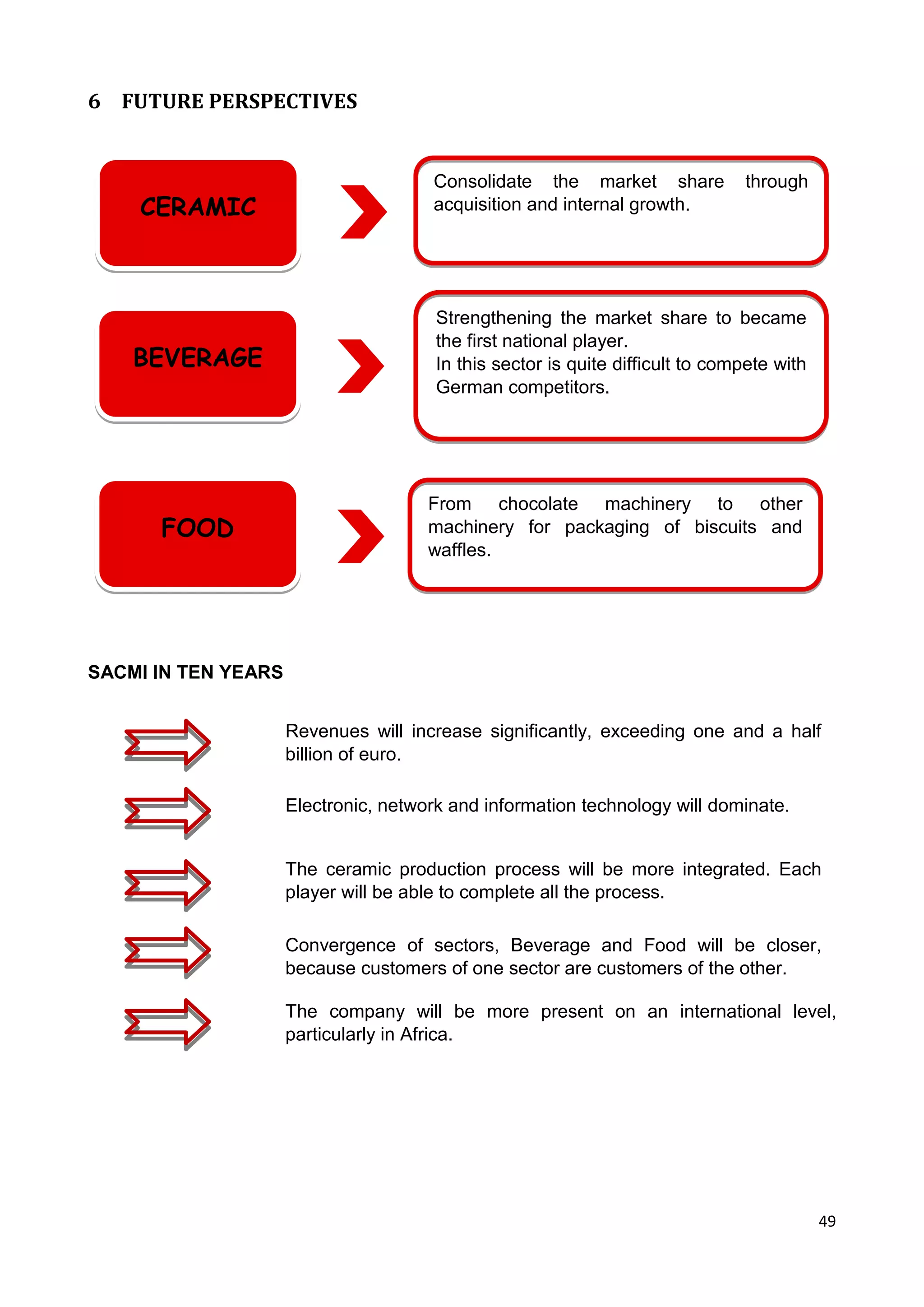
6 FUTURE PERSPECTIVES
SACMI IN TEN YEARS
Revenues will increase significantly, exceeding one and a half
billion of euro.
CERAMIC
Consolidate the market share through
acquisition and internal growth.
Electronic, network and information technology will dominate.
The ceramic production process will be more integrated. Each
player will be able to complete all the process.
Convergence of sectors, Beverage and Food will be closer,
because customers of one sector are customers of the other.
The company will be more present on an international level,
particularly in Africa.
BEVERAGE
Strengthening the market share to became
the first national player.
In this sector is quite difficult to compete with
German competitors.
FOOD
From chocolate machinery to other
machinery for packaging of biscuits and
waffles.
50
7 BIBLIOGRAFY
ACIMAC, World production and consumption of ceramic tiles, 2015
Aureliano Bassani, It all began with nine mechanics. Sacmi - Eighty years of growth and
development, Imola, Editrice La Mandragora, 2000
CIA, The World Factbook, 2016, https://www.cia.gov/library/publications/resources/the-
world-factbook/
Confindustria, Gli ostacoli commerciali nei principali mercati di riferimento dell’export
italiano - Focus Brasile, 2014, http://docplayer.it/9248584-Gli-ostacoli-commerciali-nei-
principali-mercati-di-riferimento-dell-export-italiano-focus-brasile.html
Deloitte.com, Deloitte Brazilian webpage, 2016, http://www.deloitte.dbbrazil.com.br/
Erika Villareal, Internationalization, NovoEd, 2013, https://novoed.com/minimba-2-
2014/reports/254298
ICE.gov.it, ICE webpage, Brazil, 2016, http://www.ice.gov.it/
infoMercatiEsteri.it, infoMercatiEsteri official webpage, 2016,
http://www.infomercatiesteri.it/
Joel Pais, Uppsala model in “Global Technological Environment”, 2012,
http://www.slideshare.net/joelpais/global-technological-environment
MECS, Macchine per ceramica: il fatturato supera i 2 miliardi di Euro, 2015,
http://www.mec-studies.com/it/news/newsceramica-
23/macchineperceramicailfatturatosuperai2miliardidieuro-30.php
Nina Kahn, Internationalization of Family Business, Munich Business School, 2009,
http://www.munichbusinessschool.de/intercultural/index.php?title=Internationalization_of_F
amily_Business&action=history
Pietro Cassani, Sacmi company profile presentation. Le strategie di
internazionalizzazione, 2016
SACE.it, Country reports – Brazil, 2016, http://www.sace.it/en/studies-and-training/country-
risk-map/country-page/brazil
Sacmi.it, Sacmi official webpage, 2016, http://www.sacmi.it/
Sacmi Imola S.C., Budget report, 2013, 2014 and 2016
Strategic Management Insight, GE McKinsey Matrix, 2014,
https://www.strategicmanagementinsight.com/tools/ge-mckinsey-matrix.html

Sacmi - Internationalization

  • 1.
    1 A.A. 2015/2016 –UNIMORE, MSc INTERNATIONAL MANAGEMENT BORSARI MARCO PIOLANTI CAMILLA Internationalization
  • 2.
    2 INDEX INTRODUCTION 3 1 BUSINESS/MARKETANALYSIS 4 1.1 Business definition and segmentation 4 1.2 Industry context (domestic vs international) 6 1.3 Supply and demand’s structure and trends 7 1.4 Rules of competition and competitive (5) forces 10 1.5 Business attractiveness 13 2 COMPETITIVE COMPANY PROFILE 13 2.1 Company History 13 2.2 Market positioning 16 2.3 Business, functional and corporate strategies 18 2.4 Market, economic and financial performances 21 2.5 Company competitive profile & GE matrix 23 3 COMPANY INTERNATIONAL TRACK 26 3.1 Internationalization motives 26 3.2 International market’s approaches 27 3.3 International strategy and market orientation 28 3.4 Results and performances 29 3.5 Internationalization’s model 30 4 FOREIGN MARKET ANALYSIS – BRAZIL 32 4.1 Market structure & environment 32 4.2 Opportunities and drawbacks 36 4.3 Country risks 38 4.4 Entry barriers 42 4.5 Entry options strategies 43 5 INTERNATIONAL FDI – GREENFIELD 44 5.1 Motivations 44 5.2 Factory location choices 44 5.3 The building process of SACMI DO BRASIL 45 5.4 Activities and operations 46 5.5 Performances 46 5.6 Competitors reaction 48 6 FUTURE PERSPECTIVES 49 7 BIBLIOGRAFY 50
  • 3.
    3 INTRODUCTION SACMI is amultinational group in manufacturing machines and complete plants for the Ceramics, Packaging (Beverage and Closures&Containers), Food and Automation industries. The Company is a world leader in its businesses thanks to the application of innovative technologies, the well-established position in the international markets and its commitment to research in order to ensure consistent top quality and service to the clients. The Sacmi Group has over 80 companies in 28 countries, production plants, distribution firms and service ones controlled by the parent company in Imola. A far-reaching presence that explains why over 89% of Group sales come from exports. The Sacmi Group provides efficient assistance and services all over the world thanks to a network which offers fast, efficient, direct service on every continent.1 The aim of this paper is to examine the internationalization of Sacmi. At the beginning it is presented the businesses and markets in which Sacmi operates, with a particular focus on the Ceramic industry, which is the core business of the company. Therefore, it is described the business and its segmentation, the domestic and international context of the industry, the supply and demand’s structure and trends, the competitive arena of the Ceramic industry and finally a focus on the business attractiveness. Then, the discussion moves to the company profile. The section starts with a brief view of the company’s history, with particular focus on the market positioning. Then, the business, functional, and corporate strategies analyzed through the value chain, the diversification growth, the competitive advantage, and the differentiation strategy. Next, in this section, is possible to find a quick financial view of the company with attention to the market, economic, and financial performances. Finally, this section ends with the competitive profile of the company and the building of the GE Matrix. In the third section, is possible to find the company international track. It starts with the internationalization motives of the Group, then moves to focus on the international market’s approaches: a timeline graph and the most relevant examples. A description of the results and performances of Sacmi in the international market follows. Finally, the Uppsala model, which is basically the internationalization model used by Sacmi. The fourth section concerns a foreign market analysis. In this project it has been selected the Brazilian market as a very interesting case among the international operations of Sacmi abroad. So, it has been discussed the market structure and environment with a particular attention to the Ceramic industry. Then, the opportunities and drawbacks, the country risks such as political, economic and operating risks, with a brief view of SACE country risk. Finally, the focus moves to the entry barriers in Brazil and then to possible entry option strategies. The next section focuses on the specific FDI operation of Sacmi in Brazil: Greenfield. It is examined the motivations of this choice, the decision of the location, the building process of Sacmi Do Brazil, which activities and operations Sacmi does in this factory, how it performs, and the competitors reaction of this strategic choice of Sacmi. Finally, the paper ends with a section dedicated to future perspectives of Sacmi in all its three main businesses and some previsions about how will be the Group in ten years. A particular thank to Pietro Cassani for the willingness, the dedication, providing vital information for this work. 1 http://www.sacmi.com/it-IT/Chi-siamo.aspx?idc=810&ln=it-IT
  • 4.
    4 1 BUSINESS/MARKET ANALYSIS 1.1Business definition and segmentation SACMI is a large multinational company that operates worldwide with various businesses. The provision of production plants and machineries in the field of packaging (including Beverage and Closures & Containers), ceramics and food is their main activity. In fact, the core business of the Group - the design and manufacture of machinery and equipment for the ceramic industry - has gradually joined new businesses. Until now there are four operating divisions that bring together specialists and cutting-edge technologies in efficient structures: Ceramics, Packaging, Food and service companies. Picture 1 - Sacmi businesses The corporate culture relies on innovation, human resources and customer care. But above all being a cooperative, SACMI puts also attention to men and to the territory of which it is part. Ceramics As mentioned, the main business sector in which Sacmi operates is Ceramics. The Ceramics business foresees, inter alia, the design and construction of machines and complete plants for the production of tiles, refractories, extruded products, heavy clay, structural ceramics, sanitaryware, tableware, technical ceramics, carbon anodes and metal forging.2 The Sacmi Group specialises in providing customers worldwide with complete engineering solutions for tile, sanitaryware, tableware and heavy clay production plants. 2 http://www.sacmi.com/en-US/Products-and-Services.aspx?idc=898&ln=en-US Ceramics Packaging Food
  • 5.
    5 Picture 2 -Sacmi Ceramic business For what concerns the engineering plant, the Sacmi design team works in close collaboration with the customer to identify optimal plant engineering solutions, considering all the main aspects of the plant.3 Sacmi proves to be at the forefront also with regard to technical assistance and parts. In fact, they provide spare parts, efficient assistance and services worldwide thanks to the Global Network: a web of over 20 companies. Moreover, for over twenty years the SACMI Research Centre has been providing outstanding support for all producers of traditional ceramic materials: tiles, sanitaryware, tableware and heavy clay, analysing nearly 20,000 raw materials from all over the world. That, in turn, has led to the development of numerous technologies, which have then been applied at customers’ factories to resolve process problems or start up new production plants.4 Packaging Design and construction of machines and complete plants for bottling, labelling, packaging of drinks and liquid foods in plastic and glass containers, machines for PET preforms, plastic and metal caps and plastic containers.5 Sacmi is able to provide complete solutions for the beverage industry. Again, also for the packaging business, Sacmi provide a punctual assistance service for all its customers. 3 http://www.sacmi.com/en-US/Products-and-Services/Ceramics.aspx?idC=61276&LN=en-US 4 http://www.sacmi.com/en-US/Products-and-Services/Ceramics/In-depth/Know-how.aspx?idc=62707&ln=en-US 5 http://www.sacmi.com/en-US/Products-and-Services.aspx?idc=898&ln=en-US Tile Sanitaryware Tableware Heavy clay Closures Containers Beverage Picture 3 - Sacmi Packaging business
  • 6.
    6 Food Complete food processinglines for the production of chocolate. These lines incorporate process controllers that ensure output on Sacmi lines is of outstanding quality at all times.6 Service companies International shipping and logistics services, technical and technological services for manufacturing companies, administrative services.7 1.2 Industry context (domestic vs international) A tradition of working with customers in many different countries has, year by year, helped Sacmi to develop an extensive pool of knowledge and best practises that reduce the risks of international trade. For example, contracts designed to safeguard the exporter, guaranteed payment methods, insurance practises, etc. The industry context for the 2015 has been particularly good for Italian producers of tile machineries according to the estimation of ACIMAC, despite remaining difficulties for certain customer sectors, heavy clay and sanitaryware, and in some foreign markets including Russia, Brazil and China.8 Picture 5 - Italian industry context9 In the International context the picture of the industry is quite similar, amplified in large scale. There are many factors that have affected the markets in these years: 6 http://www.sacmi.com/en-US/Products-and-Services.aspx?idc=898&ln=en-US 7 http://www.sacmi.com/en-US/Products-and-Services.aspx?idc=898&ln=en-US 8 http://www.mec-studies.com/it/news/newsceramica-23/macchineperceramicailfatturatosuperai2miliardidieuro- 30.php 9 http://www.mec-studies.com/it/news/newsceramica-23/macchineperceramicailfatturatosuperai2miliardidieuro- 30.php 2 billion euro total sales +11.7% growth (2014) Chocolate plants Dairy Picture 4 - Sacmi Food business
  • 7.
    7 Picture 6 -International industry context10 1.3 Supply and demand’s structure and trends Picture 7 - Domestic and International structures With respect to 2014, the decline in the relative importance of the Asian continent should be pointed out, although it still accounts for more than a third of total sales. 10 Sacmi Budget report of 2016 Delocalization High rate of changing Risks and uncertainty Low growth of the world economy (Western countries, China and Brazil) Process and personnel Key role Benefits from long- standing partner Innovation National Market Fundamental innovations (core strategies), importance of quality and image. Cooperation with: • The tile district of Sassuolo -> Ceramics • San Benedetto -> Beverage (packaging) • Ferrero -> Food International Market Orientation toward exports, importance of quantity: • 87% of the total turnover of the Group • To mitigate the impact of the tensions worldwide
  • 8.
    8 Sales in Africanow consistently account for over 10% of total sales. New countries are having a growing impact, providing clear confirmation of the soundness of recent direct investment on the continent. While performance in the U.S. was highly positive in 2015, they believe that any further development of North American markets is unlikely to compensate for the drop in orders from South Africa. Nevertheless, 2016 volumes will remain in line with those of previous years.11 CERAMICS DIVISION Picture 8 - Ceramics division structure and trends Tiles Picture 9 - Tiles market trends 11 Sacmi Budget report of 2016 Maintenance volumes of production Increasing trend of world ceramics production from 2009 Innovation Slowdowns emerging economies, weak growth industrialised nations (-) (+)
  • 9.
    9  For high-endcustomers, differentiation is a must; for example, they tend to focus on large tile sizes and white bodies.  There is still room for improvement, especially on the digital front.  In an ever-more globalised market, excessively low-priced, low quality machines are a recipe for a long-term failure. For example the Chinese model has partially failed: buyers are shunning Chinese tile-making products in ever greater numbers, also in neighbouring countries, largely on account of their low quality.  While attentiveness to cost is a must, it is important to maintain a qualitative difference. Sanitaryware and tableware12  In Europe producers have confirmed their intention to boost factory automation and focus on the production of those large-size pieces that are most in demand.  Key players are investing continuously and heavily in new machines, both in Europe and the rest of the world.  Positive indicators abound in the form of repeat orders from numerous customers  Further good new comes from customers in Algeria and China who have invested in large-scale automation projects. Heavy clay and technical ceramic13  Annual volumes generated by this business are in line with last year’s performance.  Unfavourable global situation persists: those parts of the world where the construction industry is growing are few and far between. (e.g. Algeria)  Despite falling oil prices the general outlook remains confident and the next two/three years should see significant opportunities for new plant sales. As always, the driving force behind the ceramic business has been all-round innovation, reaffirming Sacmi’s leading role as a global player in the industry.14 12 Sacmi Budget report of 2016 13 Sacmi Budget report of 2016 14 Progress Report 2014 - http://www.sacmi.com/en-US/About-us/Financial-Information.aspx?idC=62551&LN=en-US
  • 10.
    10 PACKAGING DIVISION15  Overallvolumes for the Closures & Containers sector are, in 2016, expected to be considerably higher than in 2015.  China, Mexico, Italy, U.S. and Southeast Asia will perform well, while Russia remains extremely challenging.  The various political crises or full-blown conflicts that risk to have a considerable impact on business in some areas.  The entire beverage industry is expected to experience substantial growth in 2016. FOOD PROCESSING DIVISION16  The global economic and geopolitical situation remains a complex, difficult one for this business.  Brazil and Russia continue to desert the C&C investment market, whereas India, Turkey, the Middle East and North Africa continue to do business at levels similar to those of last years.  At this time, though, the global orders acquisition process may still be defined as stable and satisfactory. Erratic performance in various geographical areas have partially been offset by the business that has stemmed from developing preferential partnerships with certain key accounts. 1.4 Rules of competition and competitive (5) forces Fierce competition on global markets has shown that product quality does not, in itself, ensure success. It needs, in fact, to be combined with the development of outstanding technological and plant engineering solutions, plus efficient customer and market-oriented organisation.17 Depending on the business that is considered, Sacmi faces different competitors. The core business of the Group is the ceramic sector, which breaks into several subsectors, such as tiles, tableware, sanitaryware and heavy clay. 15 Sacmi Budget report of 2016 16 Sacmi Budget report of 2016 17 Progress Report 2014 - http://www.sacmi.com/en-US/About-us/Financial-Information.aspx?idC=62551&LN=en-US
  • 11.
    11 CERAMICS DIVISION Tiles L H Market concentration H L productdifferentiation Pure Oligopoly Differentiated Oligopoly Pure competition Monopolistic competition Picture 10 - Tiles competitive structure Tableware and sanitaryware L H Market concentration H L product differentiation Pure Oligopoly Differentiated Oligopoly Pure competition Monopolistic competition Picture 11 - Tableware and sanitaryware competitive structure - Competitors: Chinese producers of machinery, e.g. Keda (for the medium-low range), Italian producers of machinery, e.g. SITI, System , Welko Group (for the medium- high range). The market shares are quite equally distributed among few competitors. - Quality: from low to very high level of technologies. Barriers: Patents, requirement of large capital, control over crucial raw materials. - New Producers of automated complete plant/machinery - New Producers of cheaper plant/machinery from emerging countries - Producers of high-quality tiles - Producers of low-quality tiles - More automated plants - Changing demands: different flooring, pavements - Raw materials and technologies, e.g. steel, plastic, IT - Competitors: Chinese producers of low-level machinery and European producers of medium-high level machinery, e.g. PCL Ceramics. The market shares are quite equally distributed among few competitors. - Quality: is quite the same among the market, with some high automated machineries. - Barriers: Patents, requirement of large capital, control over crucial raw materials. - More automated plants - Changing demands: different habits of consumption and different habits of lifestyle - Producers of high-quality tablewares and sanitarywares - Producers of low-quality tablewares and sanitarywares - New Producers of automated complete plant/machinery - New Producers of cheaper plant/machinery from emerging countries - Raw materials and technologies, e.g. steel, plastic, IT Bargaining power of suppliers Threat of new entrants Threat of substitutes Bargaining power of buyers Bargaining power of suppliers Threat of substitutes Threat of new entrants Bargaining power of buyers
  • 12.
    12 Heavy clay L H Market concentration H L productdifferentiation Pure Oligopoly Differentiated Oligopoly Pure competition Monopolistic competition Picture 12 - Heavy clay competitive structure PACKAGING DIVISION Even when we consider the packaging there are two different divisions: machine for capsules/caps and machines for bottle/labelling. In the first case, the main competitor is Husky, a Canadian company, with which Sacmi roughly shares the market, whereas if we consider the second division, Sacmi's competitors in this case are some German multinationals such as Krones, KHS, GEA but also Tetrapak and Italian company as Sidel. The competition being very high makes the competitive positioning very different depending on the sector concerned, and here the market share is very low. FOOD DIVISION Then, for what concerns the food business where Sacmi provides machines and plants for processing cocoa and their packaging, even there we identify two subsectors: machineries for the processing and modelling of cocoa, and machines for secondary packaging. In the first case, the main competitor is a Swiss company. While, for the second sub-sector the main competitor is Bosch. - Competitors: High-quality producers of complete plants, e.g. Keller, Beralmar. The market share are quite equally distributed among few competitors. - Quality: from low to very high level of technologies. - Barriers: Patents, requirement of large capital, control over crucial raw materials. - More automated plants - Changing demand: different products for the construction industry - Producers of high-quality heavy clay - Producers of low-quality heavy clay - New Producers of automated complete plant/machinery - New Producers of cheaper plant/machinery from emerging countries - Raw materials and technologies, e.g. steel, plastic, IT Bargaining power of suppliers Bargaining power of buyers Threat of substitutes Threat of new entrants
  • 13.
    13 1.5 Business attractiveness Amongthe main variables of attractiveness of the various businesses in which Sacmi operates, in particular for Ceramics, we can identify the following and their respectively levels: High Medium Low x x x x Variables of attractiveness Level Size Growth* Risks** Concentration*** Table 1 - Ceramics attractiveness *** This means low level of competitiveness. In fact, for Sacmi the competition and its level of congestion are some of the main variables of attractiveness. The General Manager of the Group, Pietro Cassani, uses the example of the elevator: when this is too full, it is better to wait and get on a fairly empty to avoid overcrowding. ** It is connected with the changes in technologies and consequently to the expression of innovation. For this reason it is important to be leader: of cost or of differentiation. Sacmi cannot and will not be cost leader while aims to be leader of differentiation through two strategies: product innovation on the machines or quality of machine and service. * Which is possible with detailed skills and competences. Essentially, Sacmi emphasizes three major areas to express its strategy to growth: market and customers knowledge, the product, and human resources (the production process, the activity, the enterprise). 2 COMPETITIVE COMPANY PROFILE 2.1 Company History18 1919 SACMI was founded the 2nd December 1919 by nine mechanics and smiths. They all formed the Società Anonima Cooperativa Meccanici Imola from which comes the acronym SACMI. The aim of the company was to run one or more workshops for mechanical repairs, and to ensure workers salary directly proportional to workers’ performances. 1920-1930 The Cooperative extended its work to include the repair of machines in the milling industry. In addition, in 1924 the Cassa Mutua Malattie, a health insurance fund, was set up for the shareholders of the Cooperativa Meccanici. This was an important initiative because it was an example of the spirit of cooperation and because there were so few other initiatives of its kind at that time. 1930-1940 In that period Sacmi expanded by doing other types of work: for the State Railways and for the Cooperativa Ceramica di Imola. Moreover, Sacmi started the 18 http://www.sacmi.com/en-US/About-us/The-History-of-the-Company.aspx?idC=899&LN=en-US
  • 14.
    14 orange machines production(washing and brushing units). Before the war Sacmi continued its production, the machines for oranges were going well but the company also started to manufacture mixing machines for food and chemical products. 1940-1948 The factories had been damaged during the last months of the war. From repairing machines damaged during the war Sacmi built a new machine bearing the Sacmi trademark. The company designed a new machine and succeeded in making a prototype of a clutch press with manual controls. 1949 At that time it was possible for the company to open its frontier overseas which would enable the Cooperative to compete, though on a modest scale, with rival companies. In this year, a crown caps manufacturer from Bologna came to Sacmi’s technicians to propose a plan to design and manufacture a semi-automatic multi-punch press because of the industry lacked a specialized high-production machine. 1951-1960 By this time, it was becoming clear what were to be the two principal lines of production (without abandoning the manufacture of machines for citrus fruits):  The ceramics sector  The crown caps field 1960-1980 In 1960 the company decided to look for premises in Milan to set up an overseas sales office and increased the number of Sacmi’s representatives abroad. The export quota reached 43% of the total production. From 1975 to 1980, the overseas expansion strategy in about 80 countries in the world was a winning policy and the balance sheets were remarkably good. 1980-1990 Sacmi’s expansion was going on both abroad setting up companies as Sacmi Deutschland, Sacmi Portuguesa, Sacmi Singapore, Sacmi Mexico and in Italy establishing Sacmi Forni in Casalgrande. 1990-2000 Computerisation and the era of IT, real time, Internet and satellite communications have speeded up Sacmi’s lifestyles. 2000-2014 Growth Diversification Integration Research It is thanks to this strategy that Sacmi generates 88% of its revenues abroad, maintaining its technological and productive core in Italy and in particular at the parent company in Imola. Fifteen challenging years in which Sacmi has been able to improve its ability to develop process and product innovations with particular attention to operational efficiency, group synergies, cost optimization together with production flexibility, in order to better respond to market cycles and requirements. An important part of this strategy was the These are the cornerstones on which the Sacmi Group found its strength and success.
  • 15.
    15 enhancement of thecompany’s web-based offer, to put on the market advanced training and post-sales support services on a global scale.19 SACMI GROWTH STRATEGY 19 http://www.sacmi.com/en-US/About-us/The-History-of-the-Company.aspx?idC=899&LN=en-US Foundation Organic growth (through internal expansion) External growth (through merger and acquisitions) SACMI opens its frontier overseas GROWTHSTRATEGIES YEARS1919 1920 – 1930 1930 – 1940 1949 1950 – 1960 1960 – 1980 1990 – 2000 1980 – 1990 2000 – today Table 2 - SACMI growth strategy
  • 16.
    16 2.2 Market positioning SACMIis a multinational Group which is worldwide leader in manufacturing machines and plants for Ceramics, Packaging, Food and Automation sectors. The SACMI Group has 80 companies in 28 countries. Production plants, distribution and service firms, all controlled by the parent company in Imola. This widespread global presence explains why over 87% of Group sales come from exports. Moreover, the SACMI Group is able to provide efficient assistance and services worldwide thanks to its own Global Network which provides customers with efficient, fast, direct and after-sales services on each continent.20 20 Sacmi Budget report of 2016 ITALY GERMANY Figure 14 - Group's presence in Italy Picture 14 - Group's presence in Germany Picture 15 - Group's presence in North America Picture 16 - Group's presence in South America Picture 13 - Group's presence in Italy
  • 17.
    17 Picture 17 -Group's presence in China Picture 18 - Group's presence in India Picture 19 - Group's presence in Russia Picture 20 - Group's presence in Africa and Middle East Picture 21 - Group's presence in Far East Asia
  • 18.
    18 2.3 Business, functionaland corporate strategies Sacmi wants to pursue a differentiation strategy. The company differentiates through technological innovation and by putting great attention to product and service quality. Sacmi responds with extreme flexibility to the real needs of the world markets, this is due to three different strategies: 1- Market knowledge  that is very important in order to better know the customers’ needs. 2- Product  Sacmi creates different products to satisfy its customers, through precise competitors’ analysis. By doing this, Sacmi is able to offer a high quality product. 3- Human Resources  Sacmi needs of its overall enterprise in realizing its products with technological and service advantage. SACMI’s VALUE CHAIN FIRM INFRASTRUCTURE HUMAN RESOURCES Personnel, recruitment, motivation TECHNOLOGY Research & Development, Innovation PROCUREMENT Funding, financial resources INBOUND LOGISTIC Supply control, Raw materials control OPERATION Quality and Production control OUTBOUND LOGISTIC Machinery and tools, Order handling, Delivery SALES & MARKETING Customers management, Competitors analysis, Market research SERVICING Post-sale services, Problem resolution, Machinery maintainance SUPPORTACTIVITIES PRIMARY ACTIVITIES Table 3 - Sacmi's Value Chain
  • 19.
    19 SACMI’s DIVERSIFICATION GROWTH SACMI’sCOMPETITIVE ADVANTAGE Horizontal Growth Vertical Growth Diversification HighLow High Low High Low COMPETITIVE ADVANTAGE Company competences 1919 1920-1930 1930-1940 1940-1948 1949 1951-1960 1960-1980 1980-1990 1990-2000 2000-Today Foundation Organic Growth (through vertical integration) External Growth (through Horizontal development) Human Resources Product quality Technological Innovation Production flexibility Company dimension Table 4 - Sacmi's Growth Strategy Table 5 - Sacmi's Competitive Advantage
  • 20.
    20 SACMI’s DIFFERENTIATION STRATEGY DIFFERENTIATIONSTRATEGY PRODUCT  Quality  Performance  Features SERVICE  Problem resolution  Post-sale service  Machinery maintenance HUMAN RESOURCES  Reliability  Skills  Competences INNOVATION  Product innovation  Quality innovation  Technological innovation Table 6 - Sacmi's differentiation strategy
  • 21.
    21 2.4 Market, economicand financial performances21 The SACMI Group’s 2016 budget anticipates a reinforce of growth trends seen over the last years, with forecast sales of 1,43€ billion and stable gross profit margin. This result will be led by the increase in Packaging Division (in particular, the cap-making machine segment), Sacmi is also confident that further more contained increment is possible in Food and Ceramics divisions. The minor business lines (Service, Automation, Energies Alternative) have strengthened the positive results of the last few years. The high inclination of internationalization continues to be a key success factor. The Sacmi Group exports about 87% of its output, with three quarters of products and services sold outside Europe. Italy, with 13% of sales volume, remains the leading country in technological innovation. With the respect to 2014, we notice a decline of the Asian continent, nevertheless it still reveals for more than a third of total sales. The African continent affirms its sales over 10% of total Sacmi’s sales. This is the result of recent direct investments that give the possibility to maintain the growth in the continent. The performances in the USA in 2015 were extremely positive, the Group believes that the development of North America will do not compensate the expected drop in orders from the South America. In general, 2016 sales volumes will remain stable with those of previous years. 21 Sacmi Budget report of 2016 Table 7 - Sacmi's sales by region Table 8 - Sacmi's consolidated Income Statement
  • 22.
    22 SOME FIGURES22 22 Sacmi Budgetreport of 2016 CERAMICS PACKAGINGAUTOMATION ALTERNATIVE ENERGY SACMI SERVICE FOOD Chart 1 - Revenues from sales of goods and services Chart 2 - Revenues Chart 3 - Revenues from the Ceramics sector Chart 4 - Revenues from the Automation sector Chart 5 - Revenues from the Packaging sector Chart 6 - Revenues from the Alternative Energy sector Chart 7 - Revenues from the Sacmi Service sector Chart 8 - Revenues from the Food sector
  • 23.
    23 2.5 Company competitiveprofile & GE matrix In order to build our GE Matrix, we have analyzed both the Variables of Market Attractiveness and the Variables of Company Competitiveness. Step 1  we determine the Market attractiveness for each business unit. From the list of factors mentioned above, we have assigned weights, which are numbers from 0.01 (not important) to 1.0 (very important), to each factor. Then, we have rated each factor for each of business unit (Ceramics, Packaging, Food and Automation). We have chosen the values between ‘1-5’, in which ‘1’ indicates the low market attractiveness and ‘5’ high market attractiveness. After that, we have multiplied the weights and ratings to obtain the Weighted scores.23 23 https://www.strategicmanagementinsight.com/tools/ge-mckinsey-matrix.html  INDUSTRY SIZE  GROWTH  RISKS  CONCENTRATION VARIABLES OF MARKET ATTRACTIVENESS VARIABLES OF COMPANY COMPETITIVENESS  COST (in terms of capacity)  TECHNOLOGICAL INNOVATION  COMPANY COMPETENCES  HUMAN RESOURCES  COMPANY DIMENSION  AVAILABILITY OF FINANCIAL RESOURCES  INTERNATIONAL PRESENCE  PRODUCTION FLEXIBILITY Table 9 - variables of market attractiveness Table 10 - variables of company competitiveness
  • 24.
    24 Table 11 -market attractiveness of each business unit Step 2  ‘Step 2’ is the same as ‘Step 1’ but in this case, instead of market attractiveness, we have considered the variables of Sacmi’s competitiveness.24 Table 12 - company competitiveness of each business unit 24 https://www.strategicmanagementinsight.com/tools/ge-mckinsey-matrix.html CERAMICS PACKAGING FOOD AUTOMATION Factors Weight Rating Weighted score Rating Weighted score Rating Weighted score Rating Weighted score Industry size 0,20 3 0,60 3 0,60 3 0,60 2 0,40 Growth 0,20 4 0,80 4 0,80 3 0,60 2 0,40 Risks 0,35 4 1,40 3 1,05 3 1,05 4 1,40 Concentration 0,25 3 0,75 3 0,75 3 0,75 2 0,50 TOT. 1 - 3,55 - 3,20 - 3,00 - 2,70 CERAMICS PACKAGING FOOD AUTOMATION Factors Weight Rating Weighted score Rating Weighted sore Rating Weighted score Rating Weighted score Cost 0,10 3 0,30 4 0,40 4 0,40 1 0,10 Technological innovation 0,15 4 0,60 3 0,45 4 0,60 4 0,60 Human Resources 0,15 3 0,45 4 0,60 4 0,60 3 0,45 Company competences 0,15 4 0,60 4 0,60 3 0,45 3 0,45 Company dimension 0,15 4 0,60 3 0,45 3 0,45 2 0,30 Availability of financial resources 0,11 3 0,33 4 0,44 3 0,33 3 0,33 International presence 0,10 4 0,40 3 0,30 4 0,40 2 0,20 Production flexibility 0,09 4 0,36 4 0,36 3 0,27 2 0,18 TOT. 1 - 3,64 - 3,60 - 3,50 - 2,61
  • 25.
    25 Now we areable to build our GE Matrix with the help of these two previous tables. SACMI’s GE MATRIX C stands for Ceramics sector P stands for Packaging sector F stands for Food sector A stands for Automation sector Each business unit is represented as a circle. The size of the circle corresponds to the proportion of the industry revenue generated by that industry sector. MARKETATTRACTIVENESS COMPANY COMPETITIVENESS HIGH LOW MEDIUM HIGH MEDIUM LOW 3,66 2,33 2,33 3,66 5 1 5 1 C P F A Table 13 - Sacmi's GE matrix
  • 26.
    26 3 COMPANY INTERNATIONALTRACK 3.1 Internationalization motives The approach to internationalization of Sacmi is both reactive and proactive. The company tries to be proactive but it does not always succeed. Picture 22 - Internationalization motives Picture 23 - Internationalization path Reactive Foreign country's policy, geared to protectionism (China, India, Brazil) For local beneficiaries of governmental funding (Brazil) Reduce costs of export, cheap labor (China, India) Proactive Strategic acquisition, to acquire skills and knowledge (Germany) Market sensitive to company's product, when the company create the need (African emerging countries) To become leader of differentiation, with high quality production, automated and organized systems •Sporadic orders •Direct export N° of customers increased • Corporate subsidiary/branch for spare parts and technical assistance Market became relevant in size •Company production plant •Mono/multi- business Innovation
  • 27.
    27 3.2 International market’sapproaches Table 14 - International market's approaches25 Some example: BRAZIL (70’s) Picture 24 - Brazilian market CHINA (80-90’s) Picture 25 - Chinese market 25 Sacmi History - http://www.sacmi.com/System/00/01/08/10832/633574461992187500_2enUS.pdf ENTRY MODE TIME FDI Int. agreements Export 1950 1970 1990 2010 Argentina Spain Germany Mexico Sacmi goes abroad China Brazil India U.S. Russia Export of machinery from Italy JV with local firm, new subsidiary to provide spare parts and technical assistance 100% acquisition by Sacmi Starting Ceramics production and then multi-business Commercial office in Hong Kong JV with chinese firm, new subsidiary to provide spare parts and technical assistance 100% acquisition by Sacmi Starting Ceramics production and then multi-business
  • 28.
    28 INDIA (80’s) Picture 26- Indian market 3.3 International strategy and market orientation It is also important for Sacmi to have a clear strategy in international markets and which orientation have towards them. Picture 27 - International strategy26 26 Sacmi company profile presentation Land of a space to provide spare parts and technical assistance Acquisition of space to build new subsidiary for production of Ceramics Multi-business production - Leadership (with ambitious goals) - Decentralization - Motivated employees - Depth - Innovation of products, technologies, processes, services, with internal and external stimuli - Globalization: international mentality, markets with growth opportunity - Proximity to customers: velocity, clients partnerships, customers consulting - Focus on niche and specialized markets, soft diversification
  • 29.
    29 Picture 28 -Market orientation of Sacmi 3.4 Results and performances Picture 29 – Result and performances of Sacmi abroad Market orientation of Sacmi Internationalization Diversification of the market and of the products Orientation toward export Italy important for innovation International approach Presence in many foreign country > 85% of the turnover abroad
  • 30.
    30 Picture 30 –To be leader 3.5 Internationalization’s model Basically, the model of internationalization of Sacmi has always been the Uppsala model. From the beginning, the company wanted to enter the international market progressively, discovering step by step every market to go to work. Among the insights of the Uppsala model, definitely Sacmi has the knowledge needed to succeed. Picture 31 – The knowledge in Uppsala model Widespread international presence • Proximity for spare parts • Cost saving • Adress local issues Access to information • Customer and market information •Specific individual needs Diversification sales territories •Management and dilution of risks Company and staff •Trust mechanisms with the clients Timeliness of response to changes •Products trends •Markets signals and forecasts Explicit knowledge: data, info, patents, design Experimental knowledge: experience, technical competence, thinking Competitive advantage General market knowledge Specific market knowledge, e.g.: Chinese tile market knowledge
  • 31.
    31 Then, what doesnot fail to Sacmi, operating worldwide, it's the commitment. In fact, the company has always excelled in all aspects of the presence in a market, not only by investing. Picture 32 – The commitment in the Uppsala model27 28 Sacmi is always entered in the markets step by step, through exports, creation of commercial offices, then sudsidiaries for assistance and spare parts and finally the establishment of mono-product manufacturing plants and then multi-product. This has been possible thanks to the contemporary increase of the number of markets in which to operate, of thier commitment. This allowed the growth of internationalization of Sacmi. Picture 33 – The path of the internationalization29 Last but not least internationalization model factor, is the psychic distance, which consists of a wider concept than cultural distance. The company has always tried to follow this concept whenever it has chosen a foreign market in which to operate. 27 http://www.slideshare.net/joelpais/global-technological-environment 28 https://novoed.com/minimba-2-2014/reports/254298 29 http://www.munichbusinessschool.de/intercultural/index.php/Internationalization_of_Family_Business
  • 32.
    32 Picture 34 –Psychic distance in the Uppsala model In conclusion, Sacmi has always pursued an incremental decision making process, which means learning by doing. 4 FOREIGN MARKET ANALYSIS – BRAZIL 4.1 Market structure & environment Area: 8.547.400 Km2. State form: Federal Republic Capital City: Brasilia GDP composition: Agriculture:4,9% Manufacturing: 27,4% Services: 67,8% International Reserve: US$ 368.2 billion. Inflation rate: 8,89% Unemployment rate: 7,5% Currency: “Real”: 1€ = 3,1 (update data at 1st July 2015)30 30 https://www.cia.gov/library/publications/resources/the-world-factbook/ 5% 27% 68% GDP Composition Agriculture Manufacturing Services Chart 9 - Brazilian GDP composition Picture 34 - Map of Brazil
  • 33.
    33 Picture 35 -Regional division by economic importance REGIONAL DIVISION AND THE ECONOMICS IMPORTANCE BRAZIL’S POSITIONING IN THE WORLD RANKING 8th World Producer of STEEL 1st World Producer of CELLULOSE 5th World Producer of CEREALS 1st World Producer of COFFEE 7th World Producer of CHEMISTRY 1st World Exporter of SUGAR and ORANGE JUICE 1st World Producer of PAPER 2nd World Producer of IRON and BAUXITE 3rd World Producer of FRUITS 1st World Exporter of BEEF and POULTRY SOUTH: Population  27 million (14%) GDP per capita  US$ 13,623 (16,5% of GDP) MIDDLE-WEST: Population  14 million (7%) GDP per capita  US$ 15,142 (9,3% of GDP) 4th World Exporter of PIGMEAT NORTH: Population  18 million (8%) GDP per capita  US$ 7,694 (5,3% of GDP) 2nd World Exporter of SOY 1st World Exporter and 2nd World Producer of GRAIN ALCOHOL NORTH-EAST: Population  53 million (28%) GDP per capita  US$ 5,910 (13,5% of GDP) 1st Country for IDE in Latin America 13th World Producer of OIL SOUTH-EAST: Population  90 million (43%) GDP per capita  US$ 15,524 (55,4% of GDP) Picture 36 - Brazil's positioning in the world ranking
  • 34.
    34 CERAMICS INDUSTRY31 The trendin import/export flows over the years is perfectly consistent with our long-held belief that tile is a material that tends to be produced close to the place of consumption. Although world exports stand at 21.6% of production and 22.2% of global consumption, more than half of this volume consists of exports shipped within the same geographical area as that of production (87% Of South America’s exports remain in South America, 75% of North America’s exports remain within the NAFTA region, 60% of Asian exports are shipped to other Asian countries). The EU is a partial exception in that 50% of its exports are shipped to non-EU countries. This analysis is confirmed by the fact that the shares of world production and consumption tend to be similar in each continent. In other words, Asia accounted for 70.5% of production and 67.4% of world consumption, while the corresponding figures for Europe (EU + non-EU) were 14.2% and 11.5%, for the Americas 12.1% and 14.4% and for Africa 3% and 6%. The world’s second largest producer and consumer, Brazil, once again saw an increase in production following more than 20 years of steady growth to reach 903 million sq.m (+3.7%), while domestic consumption rose from 837 to 853 million sq.m (+1.9%). Exports also increased by 9.5% to 69 million sq.m, almost all of which were shipped to Latin American markets and the United States. Imports fell sharply, dropping from 50 to 38 million sq.m, of which 29.5 million sq.m were imported from China (compared To 49 million sq.m in 2013). Imports from China are expected to continue to fall due to the application of antidumping tariffs finalised at The end of 2014. Anfacer’s 2015 forecasts point to a likely 9% growth in exports, although the increase in both output and domestic sales is expected to remain very small between 1% and 1.5%) compared to a manufacturing capacity that is expected to reach 1,106 million sq.m by the end of the year. 31 from ACIMAC- “World Production and consumption of ceramic tiles” - 3rd edition of 2015 Table 15 - top manufacturing countries
  • 35.
    35 Table 16 -top consumption countries Table 17 - top exporting countries
  • 36.
    36 4.2 Opportunities anddrawbacks Opportunities32 32 http://www.infomercatiesteri.it/ WHY BRAZIL? A WORLD ECONOMIC REALITY Brazil is the 5th country for geographical extension and population, the nation today represents a reality among the major economies, with a GDP that, in 2013, was collocated at the 7th place in the world ranking. A HUGE INTERNAL MARKET The existence of domestic market that is in continuous growth explains the massive presence of productive investment in Brazil. The medium class (that now counts 100 million people) has a great consumption propensity and it is concentrated in urban agglomerations. CENTRALITY Brazil is the reference area for whole Latin America, this is due to its economic development and its growth potentiality. RICHNESS OF NATURAL RESOURCES, COMMODITIES AND RAW MATERIALS Brazil is collocated in the world ranking as: - 1st world producer of coffee, cellulose and paper - 1st world exporter of beef, poultry, sugar, orange juice and grain alcohol - 1st country for IDE in Latin America (as the image shows above). COMPLEMENTARITY Brazil has considerable technological requirement that Italian companies can efficiently satisfy through technological transfer, specialized know-how, human capital training and technical assistance in those sectors in which Italy has expertise of excellence.
  • 37.
    37 Drawbacks33 THE MOST PROBLEMATICFACTORS IN DOING BUSINESS 2013 / 2014 2014 / 2015 2015 / 2016 Access to loan 2,6 3,4 6 Tax rate 15,1 13,5 15,4 Inneficient government bureaucracy 14,9 12,8 11,5 Inadequate public health 0,3 0,1 0,7 Corruption 7,3 8,8 12,2 Crime and thefts 0,3 0,8 0,4 Scars work ethic 0,6 0,8 1,2 Workforce not sufficiently educated 5,8 6,1 6,9 Offer unsuitableness of infrastructure 19,7 15 12,20 Inflation 0,3 1,4 2,5 Politics instability 2,7 2,4 4,9 Government instability/coup d’etat 0,5 0 1 Restrictive work regulations 11,7 15 13,5 Fiscal legislation 16,8 18,2 9,5 Foreign currency regulations 0,4 0,6 0,2 Inadequate innovative capacity 1,2 1,1 2 Table 18 - drawbacks in investing in Brazil 33 http://www.infomercatiesteri.it/
  • 38.
    38 4.3 Country risks POLITICALRISK The scandal of Brazilian political corruption has destabilised the political situation of the country. However, this do not generate particular risk for the investment in Brazil. ECONOMIC RISK34 34 http://www.infomercatiesteri.it/paese.php?id_paesi=38 HIGH BUREAUCRACY AND LOGISTIC COSTS The government has launched a program for the adjustment of the Brazilian infrastructure. Now, the internal logistic costs are high. HIGH DEPENDENCE FROM EXPORTATIONS COMPLEX FISCAL SYSTEM The Brazilian economy depends mostly on the value of commodities exportations (more than 60% of total exportations). Brazil is a federal republic in which each federate state implements its own taxation system from whom should be added the taxation imposed by the nation. (in this case the syste, is complex). HIGH COST OF LABOR AND WAGE INDEXING LOW INVESTMENT RATE In the last two years, the Brazilian economy has suffered the low investment rate that has contributed in reducing the country economic growth. The government social policies, focused on the income augmentation of poor population, have caused a raising of labour costs; however these policies have increased the life conditions of poor population. Picture 37 – Brazilian activists
  • 39.
    39 OPERATING RISK35 35 http://www.infomercatiesteri.it/paese.php?id_paesi=38 INFLATION Theinflation rate remains above the government objectives “REAL” VALUE The local currency (the Brazilian REAL) has an high level of appreciation rather than other principal currency. PROTECTION OF NATIONAL INDUSTRY The government has put in place some measures focused on the promotion of an independent national industry. These restrictive measures can cause difficulties in the access to the market from foreign investors. DEMOGRAPHY The 24,1% of the population is under the age of 15, in 1980 was the 38%. As consequence, the local authority should reform the retirement system.
  • 40.
    40 SACE COUNTRY RISK36 A6-star rating system, calculated on a scale from 0 to 100 (with 100 being maximum risk), allow us to examine the Brazil risk profile (non-payment, regulatory and political-social instability). Sovereign credit risk The risk that a counterparty backed by a sovereign guarantee should fall to honour the obligations of a contract. Corporate credit risk The risk that a corporate counterparty should fall to honour the obligations of a contract. War and civil disturbance risk The risk that episodes of violence, riots, sabotage or attacks should cause physical and/or financial damage to the assets held in the country. 36 http://www.sace.it/en/studies-and-training/country-risk-map/country-page/brazil War and civil disturbance risk Sovereign credit risk Corporate credit risk 50/100 56/100 Chart 10 - Sovereign credit risk Chart 11 - Corporate credit risk Chart 12 - War and civil disturbance risk
  • 41.
    41 Bank credit risk Therisk that a bank counterparty should fall to honour the obligations of a contract. Expropriation and breach of contract The risk that the government should adopt measures removing right of ownership/control of assets held in the country or unilaterally alter contractual commitments made by the government/public sector. Transfer and convertibility risk The risk that the government should adopt measures preventing the conversion/repatriation of returns on investments or capital invested in the country.37 37 http://www.sace.it/en/studies-and-training/country-risk-map/country-page/brazil Bank credit risk Expropriation and breach of contract Transfer and convertibility risk 54/100 53/100 37/100 Chart 13 - Bank credit risk Chart 14 - Expropriation and breach of contract Chart 15 - Transfer and convertibility risk
  • 42.
    42 4.4 Entry barriers38 Taxesand duties are a stumbling block to Italian entrepreneur that want to export in Brazil. The major taxes that burden on Brazil importation of goods include:  Import tax (I.I. Imposto de Importação): Import duties are charged when foreign products enter the country. The taxpayer is usually the importer, but in some cases the taxpayer could be the buyer. The function of import taxes is purely economic or regulatory and it's different for each good. This import tax is directly calculated on the CIF value (CIF - Cost Insurance Freight).  Tax on Industrialized Products (I.P.I. Imposto sobre Produtos Industrializados): The Tax on Industrialized Products applies for national and foreign products which have been modified in some way for consumption or use. IPI is used as incentive for or discouragement of the consumption of some goods, and it has been decreased for the sale of products such as the low-end appliances, furniture and cars. The rates vary from zero to 20%.  State Tax on Circulation of Goods and Services (I.C.M.S. Imposto sobre a Circulação de Mercadorias e Serviços): ICMS is the Brazilian tax charged upon sales, services, movement of goods, transportation and communication services, and supplying of any goods (equivalent to VAT). The tax is paid by legal entities and citizens responsible for the commercialization of any good, importation of goods, acquisition of products seized by customs and acquisition of petroleum products derived from other countries. Since ICMS is a state tax, it's up to each Brazilian State to establish their own tax rate, which means that the ICMS rate varies among the states of Brazil.  Additional Freight for the Renovation of the Merchant Marine (A.F.R.M.M. Adicional de Frete para Renovação da Marinha Mercantil): It's a Brazilian tax created to support the development of the merchant marine and of the construction and recovery of the Brazilian naval industry. The tax is levied upon unloading operations at all Brazilian maritime ports. However, there are a few exceptions where AFRMM does not apply: - Unloading of goods from Mercosoul; - River or lake transportation except liquid goods in bulk from transported to the North and Northeast regions of Brazil.  Profit participation contribution (P.I.S. Programma de Integração Social) and social security financing contribution (C.O.F.I.N.S. Contribuição para o Financiamento da Seguridade): PIS and COFINS are federal taxes imposed monthly on gross revenue earned by legal entities. PIS is a mandatory employer contribution to an employee savings initiative and COFINS is a contribution to finance the social security system. 38 http://www.deloitte.dbbrazil.com.br/
  • 43.
    43 CERAMIC INDUSTRY As faras duties are concerned, the ceramic sector is subject to high duties that go from 12% (mosaic not glazed) to a peak of 35% (porcelain stoneware). Moreover, we notice that Brazil has adopted technical regulations which do not correspond with the ISO standard (concerning porcelain stoneware), but the country has introduced its own standard category (0,1 of permeability, while the ISO standard is 0,5%). Furthermore, we observe high duties also on tableware, ornamental ceramics (20%) and whiteware (18%).39 4.5 Entry options strategies40 39 “Gli ostacoli commerciali nei principali mercati di riferimento dell’export italiano - focus brasile” http://www.confindustria.it// 40 http://www.ice.gov.it/ Exports - This solution is still practised a lot. - Really this is not a best decision because of the high duties imposed by the government (in some cases the duties are equal to the total amount of the exported products). Joint Ventures - This solution is less onerous and risky in order to create a business. - This solution is advisable for a preliminary phase in order to better know the market and the business partner - This option can be considered as first step of merger or acquisition Merger & Acquisitions - From 2006 and 2010 the country has registered 1260 operations like these. - These solutions are not take into consideration from the Italian companies rather than other European or American companies - We notice an exponential growth of this operation, often used for huge investment when there are not alternatives to JV and M&AGreenfield
  • 44.
    44 5 INTERNATIONAL FDI– GREENFIELD GREENFIELD Picture 38 - Sacmi do Brasil in Mogi Mirim 5.1 Motivations When the market became particularly important, Sacmi decided to build a business to have less costs rather than the export from Italy. Moreover, in Brazil Sacmi created its business because when a company produces internally in the country and sells its products in the country, the customers receive funding for the purchasing of the products. However, this does not happen for the exports from Italy, in this case customers do not receive funding. As a result of these protectionist policies, Sacmi and other Italian companies are incentivated to create their own businesses in Brazil. 5.2 Factory location choices Sacmi Do Brasil is located in Mogi Mirim, in the earth of the Brasilian ceramic industry district, so as to provide customers with close support via a team of technicians specialised in the assembly of new machines and overhaul, repair and upgrade of the existing ones.41 41 www.sacmidobrasil.com
  • 45.
    45 5.3 The buildingprocess of SACMI DO BRASIL 1st STEP Exports of machinary entirely provided by Italy. 2nd STEP In 1994 The company started to produce machines for tiles (this allows Brazilian customers to receive funding). 4th STEP Sacmi opened a branch in joint ventures with a local company, which was already present, to provide spare parts and technical assistance. 3rd STEP 24th June 1969 The company became independent (100% Sacmi), and it was set up as a sales branch. 5th STEP In April 2003 It moved to a new 8300-square-metre facility in Mogi Mirin. Sacmi Do Brasil’s market presence continued to grow and the company became a multi- business firm. (not only ceramic but also food and beverage).
  • 46.
    46 5.4 Activities andoperations For its local market Sacmi do Brasil produces multi-channel horizontal dryers and roller kilns for the ceramic industry and injection for plastics. Moreover, the company is selling the machines and equipment produced by the Group companies. Sacmi do Brasi has also an equipped warehouse facility that stocks original spare parts for each sector in which it operates (not only ceramic division but also for the Closures and Beverage Business unit of the Packaging Division), as well as materials from other companies in ceramic sector.42 5.5 Performances “Sacmi Do Brasil wins Mundo Ceramico’s supplier of the year award” Picture 39 – Mundo Ceramico The Brazilian ceramic magazine “Mundo Ceramico” has assigned the Mundo Ceramico 2006 award to Sacmi do Brasil. This award is granted to suppliers who have distinguished themselves by providing the market with products, equipment and services at a level of excellence. The award is divided into three categories. In the first, reserved for suppliers of machines and equipment for complete lines, Sacmi Do Brasil won 44% of the votes among the three candidate companies. In the second, dedicated to suppliers of pressing machines and equipment, Sacmi Do Brasil obtained, together with another company, 47% of the vote out of the three companies selected. Suppliers of machines and equipment for drying lines battled it out in the third category: among the five candidate companies, Sacmi Do Brasil won a convincing 35% of the votes.43 42 www.sacmidobrasil.com 43 http://www.sacmi.com/en-US/News-Area/News-by-Business/All-the-news/Sacmi-Do-Brasil-wins-Mundo-Ceramico- s-supplier-of-the-year-award.aspx?idC=61113&idO=11892&LN=en-US 2006
  • 47.
    47 Revestir (San Paolo,),is the South America’s main trade fair dedicated to tiles and sanitaryware producers. The trade fair, gather hundreds of exhibitors with all the latest innovations in the field of ceramic tiles and sanitaryware, now this fair is a key reference point for the South American market and usually reaches thousands of visitors from over 60 countries. The regular presence of Sacmi at this fair, is a further confirmation of the importance of the Brazilian market for the Imola-headed group.44  Tiles – 2013 Brazil comes in fifth place (in terms of SACMI group revenues), an area that has generated much satisfaction for SACMI for years and continues in terms of sales volume reached in 2013, showing how it values the Group with highly prestigious investments. In particular, Brazil is experiencing a new investment phase, aimed at porcelain trim production which requires continuous grinding presses, high tonnage presses, etc.: SACMI has proven, in the last fiscal year and current one, to be best suited to handle the requests for these investments amongst all its competitors.45  Tiles – 2014 An analysis of market distribution shows Asia to be slightly ahead of Europe, with the two continents accounting for about 80% of the world market. The remaining 20% is split evenly between the Americas (Brazil first and foremost) and Africa. Sales in the Americas are almost all accounted for by Brazil, where the investment curve is a steep one, not only and not so much at the low-medium end (the country has always been synonymous with dry red bodies) as at the glazed porcelain, technical end that employs continuous grinding systems. Brazil was also the first country in the Americas to purchase a Continua+ line. 44 http://www.sacmi.com/en-US/News-Area/News-by-Business/Ceramics/Sacmi-in-Brazil-for-Revestir- 2016.aspx?idC=61115&idO=25516&LN=en-US 45 Sacmi Budget report of 2013 2008 2010 2011 2012 2013 2014 2015 2016 Picture 40 – Expo Revestir
  • 48.
    48 Summing up, 2014was a highly satisfying year for the tile business, in terms of both volumes – in excess of initial budget expectations – and products, which the market perceives as being of superior quality and substantial innovative potential.46  Whiteware – 2014 Markets in Brazil is, for different reasons, currently shrinking; however, in this country these setbacks can largely be attributed to devaluation of the local currency.47  Tiles – 2016 Brazil will continue to make a considerable contribution (albeit only in white bodies).48  Food processing division – 2016 Brazil continues, for different reasons, to desert the C&C investment market.49 5.6 Competitors reaction  Tiles Needless to say, Sacmi offers the most suitable range of solutions for this segment yet there is still room for improvement, especially on digital front. In an ever-more globalised market, excessively low-priced, low quality machines are a recipe for long-term failure. The facts indicate that the Chinese models partially failed: buyers are shunning Chinese tile-making products in ever grater numbers, also in neighbouring countries, largely on account of their low quality. While attentiveness to costs is a must, SACMI intends to maintain a qualitative difference to ensure it stands out from the Chinese competitors.50 46 Sacmi Budget report of 2014 47 Sacmi Budget report of 2014 48 Sacmi Budget report of 2016 49 Sacmi Budget report of 2016 50 Sacmi Budget report of 2016
  • 49.
    49 6 FUTURE PERSPECTIVES SACMIIN TEN YEARS Revenues will increase significantly, exceeding one and a half billion of euro. CERAMIC Consolidate the market share through acquisition and internal growth. Electronic, network and information technology will dominate. The ceramic production process will be more integrated. Each player will be able to complete all the process. Convergence of sectors, Beverage and Food will be closer, because customers of one sector are customers of the other. The company will be more present on an international level, particularly in Africa. BEVERAGE Strengthening the market share to became the first national player. In this sector is quite difficult to compete with German competitors. FOOD From chocolate machinery to other machinery for packaging of biscuits and waffles.
  • 50.
    50 7 BIBLIOGRAFY ACIMAC, Worldproduction and consumption of ceramic tiles, 2015 Aureliano Bassani, It all began with nine mechanics. Sacmi - Eighty years of growth and development, Imola, Editrice La Mandragora, 2000 CIA, The World Factbook, 2016, https://www.cia.gov/library/publications/resources/the- world-factbook/ Confindustria, Gli ostacoli commerciali nei principali mercati di riferimento dell’export italiano - Focus Brasile, 2014, http://docplayer.it/9248584-Gli-ostacoli-commerciali-nei- principali-mercati-di-riferimento-dell-export-italiano-focus-brasile.html Deloitte.com, Deloitte Brazilian webpage, 2016, http://www.deloitte.dbbrazil.com.br/ Erika Villareal, Internationalization, NovoEd, 2013, https://novoed.com/minimba-2- 2014/reports/254298 ICE.gov.it, ICE webpage, Brazil, 2016, http://www.ice.gov.it/ infoMercatiEsteri.it, infoMercatiEsteri official webpage, 2016, http://www.infomercatiesteri.it/ Joel Pais, Uppsala model in “Global Technological Environment”, 2012, http://www.slideshare.net/joelpais/global-technological-environment MECS, Macchine per ceramica: il fatturato supera i 2 miliardi di Euro, 2015, http://www.mec-studies.com/it/news/newsceramica- 23/macchineperceramicailfatturatosuperai2miliardidieuro-30.php Nina Kahn, Internationalization of Family Business, Munich Business School, 2009, http://www.munichbusinessschool.de/intercultural/index.php?title=Internationalization_of_F amily_Business&action=history Pietro Cassani, Sacmi company profile presentation. Le strategie di internazionalizzazione, 2016 SACE.it, Country reports – Brazil, 2016, http://www.sace.it/en/studies-and-training/country- risk-map/country-page/brazil Sacmi.it, Sacmi official webpage, 2016, http://www.sacmi.it/ Sacmi Imola S.C., Budget report, 2013, 2014 and 2016 Strategic Management Insight, GE McKinsey Matrix, 2014, https://www.strategicmanagementinsight.com/tools/ge-mckinsey-matrix.html