SACHARCOMMITTEE
REPORT
ON
Social, Economic andEducationalstatus
of theMuslimCommunityof India
A Summary of major Findings and Some
Observations
Zia Nomani
APPOINTMENT AND
COMPOSITION OF HLC
 A HLC was appointed by the Prime Minister through a
notification issued by his office on March 09, 2005 to prepare
a report on social, economic and educational status of
Muslim community of India.
 The HLC included the following:
1. Justice Rajender Sachar
2. Mr. Saiyid Hamid
3. Mr. M.A. Basith
4. Dr. Rakesh Basant
5. Dr. Akhtar Majeed
6. Dr. Abu Saleh Sharif Member Secretary
TERMS OF REFERENCE
 In Which states, Districts, Blocks do Muslims live
 Geographical pattern of economic activity
 Asset base and Income levels
 Levels of socio economic development
 Educational Progress, Literacy rates, drop out ratios etc.
 Relative Share in Public and Private sector employment
 Proportion of OBC in Muslim community and their
problems.
SUBMISSION OF THE
REPORT
 Presented to the Prime Minister on 17 Nov.
2006.
 Tabled in the Lok Sabha on 30th
Nov. 2006.
 The report is spread to 403 pages in 12
Chapters. Main report is up to P.254.
Supporting material is presented in the
statistical appendices.
Sources Of Data and
Information
 Census of India 2001
 National Sample Survey, Round 61
 Reserve Bank of India
 NABARD, SIDBI, NMDFC,
 Data from government commissions and other
government organizations such as Backward
classes Commission and NCERT
WARNINGS !
 It is a Statistical Report. Should be interpreted
with care.
 Statistical Statements are measures of
tendency and not of the facts.
 The findings may lead to self pity.
 It may also lead to complacency: The
government will do some thing.
ESTABLISHED FACTS
 Relative Social and Economic backwardness of
Indian Muslims is well established through:
 HLC (Sachar Committee) 2006
 Gopal Singh Panel 1983
 Research Studies Ahmad (1992), Khalidi(1993), Zakaria
(1994) etc
 Studies published by the IOS (1980s)
 HLC is not the first to bring out such findings.
Some have said it is old wine in new bottle
QUALITATIVE ANALYSIS AND
PERCEPTIONS
 Discussions with Muslim groups and
intellectuals. The Chapter is based on the
Perceptions of the Muslim Community.
 The Non implementation of several earlier
commissions and committees has made
Muslim community wary of any new initiatives.
QUALITATIVE ANALYSIS AND
PERCEPTIONS
 Markers of Muslims identity : Beard, to pi,
Burq a,
 Markers of Muslim identity while adding to the
distinctiveness of Indian Muslims have been a
cause of concern for them in the Public
Realm.
 Denominational institutions were not supposed
to be only option available.
QUALITATIVE ANALYSIS AND
PERCEPTIONS
 For large number of Muslim women in India
today the safe space is within the boundaries of
her home and community
 Police high handedness: “Whenever any
incident occurs, Muslim boys are picked up by
the Police.” “Every bearded person is
considered an ISI Agent” etc.
 Migration and Ghetto-isation.
POPULATION: SIZE, DISTRIBUTION AND
HEALTH CONDITIONS
 CENSUS 2001: Muslim population: 138
million, Estimate for 2006 150 million
 Population growth has been high for all major
religious minorities.
 The rise in the share of Muslims in total
population has been less than one point a
decade in the previous four decades.
POPULATION: SIZE, DISTRIBUTION AND
HEALTH CONDITIONS
 There has been a decline in the Growth Rate of
Muslims in 1991-2001
 Of 593 districts, 9 districts show more 75%
concentration of Muslims. Muslim population
ranges between 1-10% or more in 458 districts.
 Muslim population is younger with better sex
ratio than other CRGs. Why? More research
required on the issue.
POPULATION: SIZE, DISTRIBUTION
AND HEALTH CONDITIONS
 Muslim population is also predominantly rural
but the level of Urbanization is higher than the
population as a whole.
 Infant and childhood mortality rates are slightly
lower than the average.
 Life expectancy for Muslims is higher than the
average by about one year.
POPULATION: SIZE, DISTRIBUTION
AND HEALTH CONDITIONS
 There has been a large decline in fertility in all
CRGs including the Muslims.
 Muslim fertility rates are a little higher in some
states and in some states it falls within the same
range.
 Muslim Child experiences a significantly higher
risk of being underweight than a child belonging
to other CRGs.
 More chances of Malnutrition.
POPULATION: SIZE, DISTRIBUTION
AND HEALTH CONDITIONS
 Couples take decisions on fertility in their own
interests rather than for raising community’s
share in the population.
 Muslim population growth has slowed down, as
fertility has declined substantially clearly
showing that Muslims are well into a
demographic transition.
EDUCATIONAL CONDITIONS OF
INDIAN MUSLIMS
 Data analyzed have been obtained from Census
2001
 The literacy rates among Muslims in 2001 were
below national average.
 The gap between Muslim and general literacy
rates are higher in Urban areas and among
women. [In rural areas, both Muslims and non-
Muslims are illiterates.]
 Muslims Literacy rates are much lower than
General and Other minorities but almost equal
to SC/ ST
EDUCATIONAL CONDITIONS OF
INDIAN MUSLIMS
 A comparison across SRGs reveals
consistently lower levels of Mean years of
schooling for the Muslim community.
 It is satisfactory to note that enrollment rations
have risen lately. The increase in enrollment has
been highest among SC/ ST followed by
Muslims.
 As many 25% of Muslim Children in 6-14 age
groups have either never attended a school or
have dropped out.
EDUCATIONAL CONDITIONS OF
INDIAN MUSLIMS
 Attainment levels of Muslims are close to or
slightly higher than those of SC/ ST but much
lower than those of other CRGs.
 Primary education is the main hurdle.: Inverse
Pyramid Hypothesis
 Drop out rates are higher at Primary, secondary,
and higher level than other CRGs.
EDUCATIONAL CONDITIONS OF
INDIAN MUSLIMS
 Setting up of JNVs in rural areas was
expected to reduce supply side constraints on
good and quality education …Muslim
participation is not satisfactory.
 Technical training should be provided even to
those who have not completed schooling.
Economy and Employment
 Low Work Participation ratio for men and
women
 Worker Population ratio for Muslim women are
lowest among all CRGs.: A larger proportion of
Muslim women are non-workers.
 High Share of Muslim workers engaged in self
employment. Also in Urban areas and for
women.
 Participation of Muslim workers in salaried jobs
(both public and private Sectors) is quite low
Economy and Employment
 A significantly large proportion of Muslim
workers are engaged in SSE (proprietary
ownership)
 Muslim Participation in the formal sector
employment is significantly less than the
national average
 Percentage of Muslim women workers
undertaking work in their homes (70%) is much
larger than for all workers (51%).
Economy and Employment
 Share of Muslim workers engaged in
Agriculture is much lower than for other
groups
 Participation of Muslims in traditional
manufacturing and crafts is high.
 Among the non manufacturing retail and
wholesale trade has a large proportion of
Muslim presence.
Economy and Employment
 Apparel, Auto repair and Electrical machinery
are important for Muslims.
 Participation of Muslims in security related
activities [Police, Army, Jail] is considerably
lower than their share in population.
 Bidi Workers, tailors, and mechanics need to
provided with safety nets and social security.
Economy and Employment
 The participation of Muslims in professional
and managerial cadre is low.
 Muslim workers are vulnerable with no written
contracts and lack of social security measures.
 Muslim workers get lower daily earning than
other CRGs.
Economy and Employment
 Among Urban male workers, the probability of
Muslim workers taking up regular work is the
lowest while that of SC/ ST worker is the
highest.
 Improvement requires skill development and
flow of credit in those sectors and regions in
which Muslim employment is concentrated.
ACCESS TO BANK CREDIT
 Iniquitous access to public and private banking
institutions across SRGs can perpetuate
disparities.
 Share of Muslims on Amount Outstanding is
only 4.7% against 6.5% for other minorities
 On average, the amount outstanding per
account is half of that of other minorities.
ACCESS TO BANK CREDIT
 RBI efforts under 15 point program to extend
banking facilities benefited only other minorities
marginalizing Muslims.
 The share of Muslims in deposit account is also
much lower than their population share.
 Comment: Extent of Bank Use and Credit
Worthiness, Recent decisions of the RBI
ACCESS TO SOCIAL AND PHYSICAL
INFRASTRUCTURE
 There are noteworthy differentials in the
availability, accessibility and utilization of
infrastructure across SRGs.
 Inverse relationship between prop. of Muslim
population and availability of educational
infrastructure in small villages.
ACCESS TO SOCIAL AND PHYSICAL
INFRASTRUCTURE
 Muslim concentration villages are not well
served with asphalted approach roads and
local bus stops
 Concentration of Muslims in states with poor
infrastructure (Assam, Bihar, Jharkand, UP.
WB) implies that a large portion of the
community without access to basic facilities.
ACCESS TO SOCIAL AND PHYSICAL
INFRASTRUCTURE
 In both, Urban and rural areas, the proportion
of Muslim households living in Pakka houses
is lower than the total population.
 Over all, the access of Muslims to toilets is low
but better than that of both SC/ST and OBCs.
ACCESS TO SOCIAL AND PHYSICAL
INFRASTRUCTURE
 Compared to the Muslim majority areas, the
areas with low Muslims concentration, had
better roads, sewage and drainage and water
facilities.
 About a third of small villages with high
concentration of Muslims do not have any
educational institution.
 About 40% of large villages with Muslim
concentration do not have any medical facility.
POVERTY, CONSUMPTION AND
STANDARD OF LIVING
 A substantially larger proportion of the Muslim
households in Urban areas are in the less than
Rs 500 bracket.
 Inequality is higher in Urban areas than in the
rural areas.
 Incidence of poverty is found to be highest
amongst Muslims. SC/ ST occupy next position.
 Economic conditions of Muslims in Urban areas
did not improve as those of SC/ST
GOVERNMENT EMPLOYMENT AND
PROGAMS
 In a pluralistic society, a reasonable
representation of various communities in
government sector employment is necessary
to enhance participatory governance.
 Presence of Muslims: I.A.S. 3%, IFS 1.8%,
IPS 4% [Data on P.105]
GOVERNMENT EMPLOYMENT AND
PROGAMS
 Muslims constituted 4.9 % of candidates who
appeared in the written examination of Civil
Services in the year 2003 and 2004
 There is no diversion between all candidates
and Muslim candidates in percentages of
those recommended for interviews and
appointments.
GOVERNMENT EMPLOYMENT AND
PROGAMS
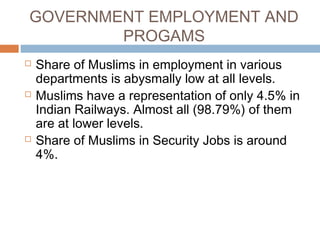
 Share of Muslims in employment in various
departments is abysmally low at all levels.
 Muslims have a representation of only 4.5% in
Indian Railways. Almost all (98.79%) of them
are at lower levels.
 Share of Muslims in Security Jobs is around
4%.
GOVERNMENT EMPLOYMENT AND
PROGAMS
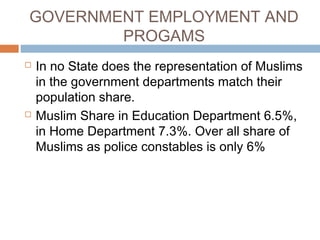
 In no State does the representation of Muslims
in the government departments match their
population share.
 Muslim Share in Education Department 6.5%,
in Home Department 7.3%. Over all share of
Muslims as police constables is only 6%
GOVERNMENT EMPLOYMENT AND
PROGAMS
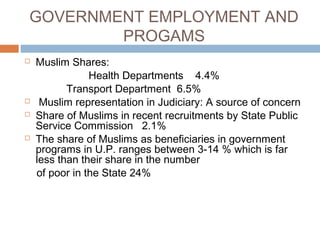
 Muslim Shares:
Health Departments 4.4%
Transport Department 6.5%
 Muslim representation in Judiciary: A source of concern
 Share of Muslims in recent recruitments by State Public
Service Commission 2.1%
 The share of Muslims as beneficiaries in government
programs in U.P. ranges between 3-14 % which is far
less than their share in the number
of poor in the State 24%
MUSLIM OBC and Affirmative
Action
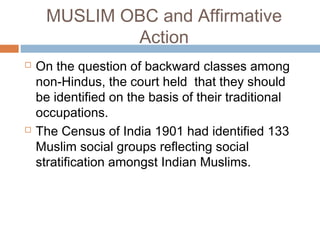
 On the question of backward classes among
non-Hindus, the court held that they should
be identified on the basis of their traditional
occupations.
 The Census of India 1901 had identified 133
Muslim social groups reflecting social
stratification amongst Indian Muslims.
MUSLIM OBC and Affirmative
Action
 Muslim OBC come from the non-ashraf
category.
 The conference on Muslim OBC agreed that
Muslims are a differentiated group and policy
initiatives must reflect it.
 The Mandal commission declared 82 groups
among Muslims as part of the OBC.
MUSLIM OBC and Affirmative
Action
 Kerala and Karnataka extended reservation to
their entire Muslim population
 Havanur Commission, 1972 recommended a
separate category reservation for minorities –
6%
 In Kerala, a separate Muslim share was fixed
at 10% later raised to 12%.
MUSLIM OBC and Affirmative
Action
 Tamil Nadu Government has done away with
reservation on ground of religion, yet nearly
95% of the Muslims have been in included in
the fold of Backward classes.
 Present situation of Reservation for Muslims
[ See Table 10.1 p. 198]
MUSLIM OBC and Affirmative
Action
 There are many OBC groups irrespective of
their religion that are present in the state list
but missing in the central list.
 The highest proportion of Muslims declared as
ST is found in Lakshadweep where Muslim
constitute entire ST Population [99.74%]
MUSLIM OBC and Affirmative
Action
 Unemployment rates were the highest among
Muslim OBCs as compared to the other two
SRGs within OBC category.
 Within the formal sector, the share of Muslim
OBC in the government /PSU jobs was much
lower than those of Hindu OBC and Muslim-Gen
categories.
MUSLIM OBC and Affirmative
Action
 The bulk of women in all SRG work in their
own dwellings. However, the proportion of
Muslim OBC Women working within their
dwellings is much higher.
 Out of every 100 workers, about 11 are Hindu
OBC, only three are Muslim-general and one
is Muslim OBC.
MUSLIM OBC and Affirmative
Action
 The abysmally low representation of Muslim
OBC suggests that benefits of entitlements
mean for backward classes did not reach
them.
 The conditions of Muslim –G are also lower
than the Hindu OBC who have the benefit of
reservation.
Leveraging Community Initiatives:
Waqf
 Encroachment by the State who is the custodian
of the Waqf interests is common across the
country.
 The management of the Waqf board is
unsatisfactory due to inadequate empowerment
of State Waqf Boards and Central Waqf Council.
 New institutional support is recommended.
 Non implementation of Recommendations
Leveraging Community Initiatives:
Waqf
 Case Study of Delhi:
 A number of properties acquired without
compensation.
 Delhi Waqf Board has effectively been deprived
of the use of its valuable properties.
 Legislative, Administrative and Judicial reforms
required.
Looking Ahead:
Recommendations
 While there is considerable variation in the
conditions of Muslims across states the
community exhibits deficits and deprivation in
practically all dimensions of development.
 Mechanism to ensure equity and equality of
opportunity to bring about inclusion should be
such that diversity is achieved and at the same
time, the perception of discrimination is
eliminated.
Looking Ahead:
Recommendations
 National Data Bank to restore socio economic
data on SRG
 Assessment and Monitoring Authority
 Strengthen the Legal basis to remove
discrimination.
 Equal Opportunity Commission to look into
grievances.
 Elimination of anomalies with respect to
reserved constituencies.
Looking Ahead:
Recommendations
 Continuous Revision and Monitoring of text
books.
 UGC may directed to link the disbursement of its
funds to diversity of population.
 Alternate admission criteria for the ‘Most
Backward’ in all CRG 60% weight to merit and
40% to backwardness (13% to income, 13%
backward district, 14% to backward classes).
 Hostel facilities at reasonable cost to minorities.
Looking Ahead:
Recommendations
 Teachers training to be made compulsory
 State is required to run Urdu Medium Schools.
 Workout mechanism whereby Madarsahs could be
linked with higher secondary boards.
 Recognition of Madarsah degrees for competitive
exams.
 Promoting and enhancing access to Muslims in priority
sectors.
 Policy initiatives required.
WHERE DO WE GO FROM
HERE?
 Reservation
 Special programs and affirmative action
 Special Urdu Medium Schools in Muslim dominated
areas
 Diversity Index, Special admission formula, Linking
grants to diversity index.
 Equal Opportunity Commission
 Special community action has to be based on the
Correct understanding of the situation and
underlying social dynamics.
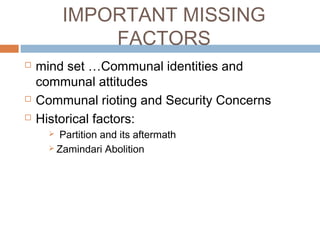
IMPORTANT MISSING
FACTORS
 mind set …Communal identities and
communal attitudes
 Communal rioting and Security Concerns
 Historical factors:
 Partition and its aftermath
 Zamindari Abolition
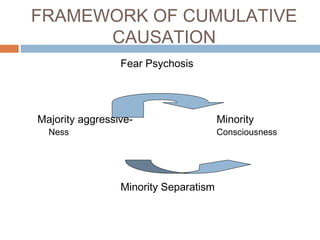
FRAMEWORK OF CUMULATIVE
CAUSATION
Fear Psychosis
Majority aggressive- Minority
Ness Consciousness
Minority Separatism
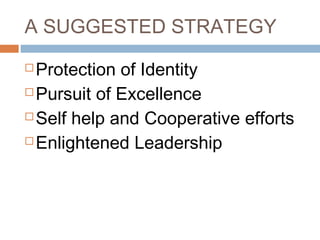
A SUGGESTED STRATEGY
 Protection of Identity
 Pursuit of Excellence
 Self help and Cooperative efforts
 Enlightened Leadership
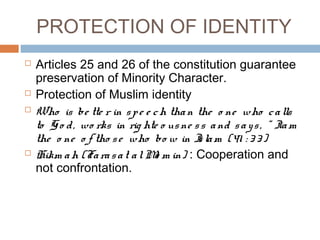
PROTECTION OF IDENTITY
 Articles 25 and 26 of the constitution guarantee
preservation of Minority Character.
 Protection of Muslim identity
 Who is be tte r in spe e ch than the o ne who calls
to Go d, wo rks in rig hte o usne ss and says, “ Iam
the o ne o f tho se who bo w in Islam (41 : 33)
 Hikm ah (Farasat alMo m in) : Cooperation and
not confrontation.
PURSUIT OF EXCELLENCE
 Pursuit of Excellence can break the vicious
circle though it may be a tall order.
 It has to pervade all walks of life.
 A minority can not afford to be mediocre.
 Pursuit of Excellence has to be inculcated as a
value from the very childhood.
 Excellence is the result of hard work and
positive frame of mind.
SELF HELP AND SOCIAL
MOVEMENT
 Ve rily ne ve r willGo d chang e the co nditio n o f a
pe o ple untilthe y chang e it the m se lve s [ 1 3: 1 1 ]
 He lp ye o ne ano the r in rig hte o usne ss and pie ty
but he lp ye no t ano the r in sin and ranco r. [ 5: 2].
 The social life of Muslims in India could be
transformed through a Social Movement. All
Muslim Youths should unite and demand
complete implementation of Sachar Committee
recommendation.
 Muslim NGOs could also be helpful in this
context.
ENLIGHTENED LEADERSHIP
 Reconstruction requires sustained effort,
persistence, hard work and foresight.
 Vision for future
 Micro approach.
 Abstaining from narrow and Parochial political
gains.
 Spread of success story and change of mind
set.

Sachar Committee Report

  • 1.
    SACHARCOMMITTEE REPORT ON Social, Economic andEducationalstatus oftheMuslimCommunityof India A Summary of major Findings and Some Observations Zia Nomani
  • 2.
    APPOINTMENT AND COMPOSITION OFHLC  A HLC was appointed by the Prime Minister through a notification issued by his office on March 09, 2005 to prepare a report on social, economic and educational status of Muslim community of India.  The HLC included the following: 1. Justice Rajender Sachar 2. Mr. Saiyid Hamid 3. Mr. M.A. Basith 4. Dr. Rakesh Basant 5. Dr. Akhtar Majeed 6. Dr. Abu Saleh Sharif Member Secretary
  • 3.
    TERMS OF REFERENCE In Which states, Districts, Blocks do Muslims live  Geographical pattern of economic activity  Asset base and Income levels  Levels of socio economic development  Educational Progress, Literacy rates, drop out ratios etc.  Relative Share in Public and Private sector employment  Proportion of OBC in Muslim community and their problems.
  • 4.
    SUBMISSION OF THE REPORT Presented to the Prime Minister on 17 Nov. 2006.  Tabled in the Lok Sabha on 30th Nov. 2006.  The report is spread to 403 pages in 12 Chapters. Main report is up to P.254. Supporting material is presented in the statistical appendices.
  • 5.
    Sources Of Dataand Information  Census of India 2001  National Sample Survey, Round 61  Reserve Bank of India  NABARD, SIDBI, NMDFC,  Data from government commissions and other government organizations such as Backward classes Commission and NCERT
  • 6.
    WARNINGS !  Itis a Statistical Report. Should be interpreted with care.  Statistical Statements are measures of tendency and not of the facts.  The findings may lead to self pity.  It may also lead to complacency: The government will do some thing.
  • 7.
    ESTABLISHED FACTS  RelativeSocial and Economic backwardness of Indian Muslims is well established through:  HLC (Sachar Committee) 2006  Gopal Singh Panel 1983  Research Studies Ahmad (1992), Khalidi(1993), Zakaria (1994) etc  Studies published by the IOS (1980s)  HLC is not the first to bring out such findings. Some have said it is old wine in new bottle
  • 8.
    QUALITATIVE ANALYSIS AND PERCEPTIONS Discussions with Muslim groups and intellectuals. The Chapter is based on the Perceptions of the Muslim Community.  The Non implementation of several earlier commissions and committees has made Muslim community wary of any new initiatives.
  • 9.
    QUALITATIVE ANALYSIS AND PERCEPTIONS Markers of Muslims identity : Beard, to pi, Burq a,  Markers of Muslim identity while adding to the distinctiveness of Indian Muslims have been a cause of concern for them in the Public Realm.  Denominational institutions were not supposed to be only option available.
  • 10.
    QUALITATIVE ANALYSIS AND PERCEPTIONS For large number of Muslim women in India today the safe space is within the boundaries of her home and community  Police high handedness: “Whenever any incident occurs, Muslim boys are picked up by the Police.” “Every bearded person is considered an ISI Agent” etc.  Migration and Ghetto-isation.
  • 11.
    POPULATION: SIZE, DISTRIBUTIONAND HEALTH CONDITIONS  CENSUS 2001: Muslim population: 138 million, Estimate for 2006 150 million  Population growth has been high for all major religious minorities.  The rise in the share of Muslims in total population has been less than one point a decade in the previous four decades.
  • 12.
    POPULATION: SIZE, DISTRIBUTIONAND HEALTH CONDITIONS  There has been a decline in the Growth Rate of Muslims in 1991-2001  Of 593 districts, 9 districts show more 75% concentration of Muslims. Muslim population ranges between 1-10% or more in 458 districts.  Muslim population is younger with better sex ratio than other CRGs. Why? More research required on the issue.
  • 13.
    POPULATION: SIZE, DISTRIBUTION ANDHEALTH CONDITIONS  Muslim population is also predominantly rural but the level of Urbanization is higher than the population as a whole.  Infant and childhood mortality rates are slightly lower than the average.  Life expectancy for Muslims is higher than the average by about one year.
  • 14.
    POPULATION: SIZE, DISTRIBUTION ANDHEALTH CONDITIONS  There has been a large decline in fertility in all CRGs including the Muslims.  Muslim fertility rates are a little higher in some states and in some states it falls within the same range.  Muslim Child experiences a significantly higher risk of being underweight than a child belonging to other CRGs.  More chances of Malnutrition.
  • 15.
    POPULATION: SIZE, DISTRIBUTION ANDHEALTH CONDITIONS  Couples take decisions on fertility in their own interests rather than for raising community’s share in the population.  Muslim population growth has slowed down, as fertility has declined substantially clearly showing that Muslims are well into a demographic transition.
  • 16.
    EDUCATIONAL CONDITIONS OF INDIANMUSLIMS  Data analyzed have been obtained from Census 2001  The literacy rates among Muslims in 2001 were below national average.  The gap between Muslim and general literacy rates are higher in Urban areas and among women. [In rural areas, both Muslims and non- Muslims are illiterates.]  Muslims Literacy rates are much lower than General and Other minorities but almost equal to SC/ ST
  • 17.
    EDUCATIONAL CONDITIONS OF INDIANMUSLIMS  A comparison across SRGs reveals consistently lower levels of Mean years of schooling for the Muslim community.  It is satisfactory to note that enrollment rations have risen lately. The increase in enrollment has been highest among SC/ ST followed by Muslims.  As many 25% of Muslim Children in 6-14 age groups have either never attended a school or have dropped out.
  • 18.
    EDUCATIONAL CONDITIONS OF INDIANMUSLIMS  Attainment levels of Muslims are close to or slightly higher than those of SC/ ST but much lower than those of other CRGs.  Primary education is the main hurdle.: Inverse Pyramid Hypothesis  Drop out rates are higher at Primary, secondary, and higher level than other CRGs.
  • 19.
    EDUCATIONAL CONDITIONS OF INDIANMUSLIMS  Setting up of JNVs in rural areas was expected to reduce supply side constraints on good and quality education …Muslim participation is not satisfactory.  Technical training should be provided even to those who have not completed schooling.
  • 20.
    Economy and Employment Low Work Participation ratio for men and women  Worker Population ratio for Muslim women are lowest among all CRGs.: A larger proportion of Muslim women are non-workers.  High Share of Muslim workers engaged in self employment. Also in Urban areas and for women.  Participation of Muslim workers in salaried jobs (both public and private Sectors) is quite low
  • 21.
    Economy and Employment A significantly large proportion of Muslim workers are engaged in SSE (proprietary ownership)  Muslim Participation in the formal sector employment is significantly less than the national average  Percentage of Muslim women workers undertaking work in their homes (70%) is much larger than for all workers (51%).
  • 22.
    Economy and Employment Share of Muslim workers engaged in Agriculture is much lower than for other groups  Participation of Muslims in traditional manufacturing and crafts is high.  Among the non manufacturing retail and wholesale trade has a large proportion of Muslim presence.
  • 23.
    Economy and Employment Apparel, Auto repair and Electrical machinery are important for Muslims.  Participation of Muslims in security related activities [Police, Army, Jail] is considerably lower than their share in population.  Bidi Workers, tailors, and mechanics need to provided with safety nets and social security.
  • 24.
    Economy and Employment The participation of Muslims in professional and managerial cadre is low.  Muslim workers are vulnerable with no written contracts and lack of social security measures.  Muslim workers get lower daily earning than other CRGs.
  • 25.
    Economy and Employment Among Urban male workers, the probability of Muslim workers taking up regular work is the lowest while that of SC/ ST worker is the highest.  Improvement requires skill development and flow of credit in those sectors and regions in which Muslim employment is concentrated.
  • 26.
    ACCESS TO BANKCREDIT  Iniquitous access to public and private banking institutions across SRGs can perpetuate disparities.  Share of Muslims on Amount Outstanding is only 4.7% against 6.5% for other minorities  On average, the amount outstanding per account is half of that of other minorities.
  • 27.
    ACCESS TO BANKCREDIT  RBI efforts under 15 point program to extend banking facilities benefited only other minorities marginalizing Muslims.  The share of Muslims in deposit account is also much lower than their population share.  Comment: Extent of Bank Use and Credit Worthiness, Recent decisions of the RBI
  • 28.
    ACCESS TO SOCIALAND PHYSICAL INFRASTRUCTURE  There are noteworthy differentials in the availability, accessibility and utilization of infrastructure across SRGs.  Inverse relationship between prop. of Muslim population and availability of educational infrastructure in small villages.
  • 29.
    ACCESS TO SOCIALAND PHYSICAL INFRASTRUCTURE  Muslim concentration villages are not well served with asphalted approach roads and local bus stops  Concentration of Muslims in states with poor infrastructure (Assam, Bihar, Jharkand, UP. WB) implies that a large portion of the community without access to basic facilities.
  • 30.
    ACCESS TO SOCIALAND PHYSICAL INFRASTRUCTURE  In both, Urban and rural areas, the proportion of Muslim households living in Pakka houses is lower than the total population.  Over all, the access of Muslims to toilets is low but better than that of both SC/ST and OBCs.
  • 31.
    ACCESS TO SOCIALAND PHYSICAL INFRASTRUCTURE  Compared to the Muslim majority areas, the areas with low Muslims concentration, had better roads, sewage and drainage and water facilities.  About a third of small villages with high concentration of Muslims do not have any educational institution.  About 40% of large villages with Muslim concentration do not have any medical facility.
  • 32.
    POVERTY, CONSUMPTION AND STANDARDOF LIVING  A substantially larger proportion of the Muslim households in Urban areas are in the less than Rs 500 bracket.  Inequality is higher in Urban areas than in the rural areas.  Incidence of poverty is found to be highest amongst Muslims. SC/ ST occupy next position.  Economic conditions of Muslims in Urban areas did not improve as those of SC/ST
  • 33.
    GOVERNMENT EMPLOYMENT AND PROGAMS In a pluralistic society, a reasonable representation of various communities in government sector employment is necessary to enhance participatory governance.  Presence of Muslims: I.A.S. 3%, IFS 1.8%, IPS 4% [Data on P.105]
  • 34.
    GOVERNMENT EMPLOYMENT AND PROGAMS Muslims constituted 4.9 % of candidates who appeared in the written examination of Civil Services in the year 2003 and 2004  There is no diversion between all candidates and Muslim candidates in percentages of those recommended for interviews and appointments.
  • 35.
    GOVERNMENT EMPLOYMENT AND PROGAMS Share of Muslims in employment in various departments is abysmally low at all levels.  Muslims have a representation of only 4.5% in Indian Railways. Almost all (98.79%) of them are at lower levels.  Share of Muslims in Security Jobs is around 4%.
  • 36.
    GOVERNMENT EMPLOYMENT AND PROGAMS In no State does the representation of Muslims in the government departments match their population share.  Muslim Share in Education Department 6.5%, in Home Department 7.3%. Over all share of Muslims as police constables is only 6%
  • 37.
    GOVERNMENT EMPLOYMENT AND PROGAMS Muslim Shares: Health Departments 4.4% Transport Department 6.5%  Muslim representation in Judiciary: A source of concern  Share of Muslims in recent recruitments by State Public Service Commission 2.1%  The share of Muslims as beneficiaries in government programs in U.P. ranges between 3-14 % which is far less than their share in the number of poor in the State 24%
  • 38.
    MUSLIM OBC andAffirmative Action  On the question of backward classes among non-Hindus, the court held that they should be identified on the basis of their traditional occupations.  The Census of India 1901 had identified 133 Muslim social groups reflecting social stratification amongst Indian Muslims.
  • 39.
    MUSLIM OBC andAffirmative Action  Muslim OBC come from the non-ashraf category.  The conference on Muslim OBC agreed that Muslims are a differentiated group and policy initiatives must reflect it.  The Mandal commission declared 82 groups among Muslims as part of the OBC.
  • 40.
    MUSLIM OBC andAffirmative Action  Kerala and Karnataka extended reservation to their entire Muslim population  Havanur Commission, 1972 recommended a separate category reservation for minorities – 6%  In Kerala, a separate Muslim share was fixed at 10% later raised to 12%.
  • 41.
    MUSLIM OBC andAffirmative Action  Tamil Nadu Government has done away with reservation on ground of religion, yet nearly 95% of the Muslims have been in included in the fold of Backward classes.  Present situation of Reservation for Muslims [ See Table 10.1 p. 198]
  • 42.
    MUSLIM OBC andAffirmative Action  There are many OBC groups irrespective of their religion that are present in the state list but missing in the central list.  The highest proportion of Muslims declared as ST is found in Lakshadweep where Muslim constitute entire ST Population [99.74%]
  • 43.
    MUSLIM OBC andAffirmative Action  Unemployment rates were the highest among Muslim OBCs as compared to the other two SRGs within OBC category.  Within the formal sector, the share of Muslim OBC in the government /PSU jobs was much lower than those of Hindu OBC and Muslim-Gen categories.
  • 44.
    MUSLIM OBC andAffirmative Action  The bulk of women in all SRG work in their own dwellings. However, the proportion of Muslim OBC Women working within their dwellings is much higher.  Out of every 100 workers, about 11 are Hindu OBC, only three are Muslim-general and one is Muslim OBC.
  • 45.
    MUSLIM OBC andAffirmative Action  The abysmally low representation of Muslim OBC suggests that benefits of entitlements mean for backward classes did not reach them.  The conditions of Muslim –G are also lower than the Hindu OBC who have the benefit of reservation.
  • 46.
    Leveraging Community Initiatives: Waqf Encroachment by the State who is the custodian of the Waqf interests is common across the country.  The management of the Waqf board is unsatisfactory due to inadequate empowerment of State Waqf Boards and Central Waqf Council.  New institutional support is recommended.  Non implementation of Recommendations
  • 47.
    Leveraging Community Initiatives: Waqf Case Study of Delhi:  A number of properties acquired without compensation.  Delhi Waqf Board has effectively been deprived of the use of its valuable properties.  Legislative, Administrative and Judicial reforms required.
  • 48.
    Looking Ahead: Recommendations  Whilethere is considerable variation in the conditions of Muslims across states the community exhibits deficits and deprivation in practically all dimensions of development.  Mechanism to ensure equity and equality of opportunity to bring about inclusion should be such that diversity is achieved and at the same time, the perception of discrimination is eliminated.
  • 49.
    Looking Ahead: Recommendations  NationalData Bank to restore socio economic data on SRG  Assessment and Monitoring Authority  Strengthen the Legal basis to remove discrimination.  Equal Opportunity Commission to look into grievances.  Elimination of anomalies with respect to reserved constituencies.
  • 50.
    Looking Ahead: Recommendations  ContinuousRevision and Monitoring of text books.  UGC may directed to link the disbursement of its funds to diversity of population.  Alternate admission criteria for the ‘Most Backward’ in all CRG 60% weight to merit and 40% to backwardness (13% to income, 13% backward district, 14% to backward classes).  Hostel facilities at reasonable cost to minorities.
  • 51.
    Looking Ahead: Recommendations  Teacherstraining to be made compulsory  State is required to run Urdu Medium Schools.  Workout mechanism whereby Madarsahs could be linked with higher secondary boards.  Recognition of Madarsah degrees for competitive exams.  Promoting and enhancing access to Muslims in priority sectors.  Policy initiatives required.
  • 52.
    WHERE DO WEGO FROM HERE?  Reservation  Special programs and affirmative action  Special Urdu Medium Schools in Muslim dominated areas  Diversity Index, Special admission formula, Linking grants to diversity index.  Equal Opportunity Commission  Special community action has to be based on the Correct understanding of the situation and underlying social dynamics.
  • 53.
    IMPORTANT MISSING FACTORS  mindset …Communal identities and communal attitudes  Communal rioting and Security Concerns  Historical factors:  Partition and its aftermath  Zamindari Abolition
  • 54.
    FRAMEWORK OF CUMULATIVE CAUSATION FearPsychosis Majority aggressive- Minority Ness Consciousness Minority Separatism
  • 55.
    A SUGGESTED STRATEGY Protection of Identity  Pursuit of Excellence  Self help and Cooperative efforts  Enlightened Leadership
  • 56.
    PROTECTION OF IDENTITY Articles 25 and 26 of the constitution guarantee preservation of Minority Character.  Protection of Muslim identity  Who is be tte r in spe e ch than the o ne who calls to Go d, wo rks in rig hte o usne ss and says, “ Iam the o ne o f tho se who bo w in Islam (41 : 33)  Hikm ah (Farasat alMo m in) : Cooperation and not confrontation.
  • 57.
    PURSUIT OF EXCELLENCE Pursuit of Excellence can break the vicious circle though it may be a tall order.  It has to pervade all walks of life.  A minority can not afford to be mediocre.  Pursuit of Excellence has to be inculcated as a value from the very childhood.  Excellence is the result of hard work and positive frame of mind.
  • 58.
    SELF HELP ANDSOCIAL MOVEMENT  Ve rily ne ve r willGo d chang e the co nditio n o f a pe o ple untilthe y chang e it the m se lve s [ 1 3: 1 1 ]  He lp ye o ne ano the r in rig hte o usne ss and pie ty but he lp ye no t ano the r in sin and ranco r. [ 5: 2].  The social life of Muslims in India could be transformed through a Social Movement. All Muslim Youths should unite and demand complete implementation of Sachar Committee recommendation.  Muslim NGOs could also be helpful in this context.
  • 59.
    ENLIGHTENED LEADERSHIP  Reconstructionrequires sustained effort, persistence, hard work and foresight.  Vision for future  Micro approach.  Abstaining from narrow and Parochial political gains.  Spread of success story and change of mind set.