E-mail:morning@bsnl.in 1 17/03/2015
Phone:9847041681
Basic Awareness Training OnBasic Awareness Training OnBasic Awareness Training OnBasic Awareness Training On
Social Accountability StandardSocial Accountability StandardSocial Accountability StandardSocial Accountability Standard
SA 8000SA 8000SA 8000SA 8000
Morning Star Management ServicesMorning Star Management ServicesMorning Star Management ServicesMorning Star Management Services
No: 98, “SIVAM”, Rose Gardens,
Shornur Road, Thrissur – 680 022
PH:0487- 2320365, Mobile: 9847041681
Website:www.veera1.com, e-mail:morning@bsnl.in
E-mail:morning@bsnl.in 2 17/03/2015
Phone:9847041681
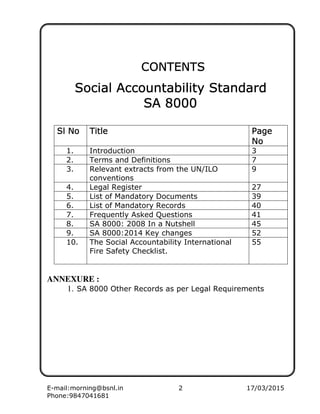
CONTENTSCONTENTSCONTENTSCONTENTS
Social Accountability StandardSocial Accountability StandardSocial Accountability StandardSocial Accountability Standard
SA 8000SA 8000SA 8000SA 8000
ANNEXURE :
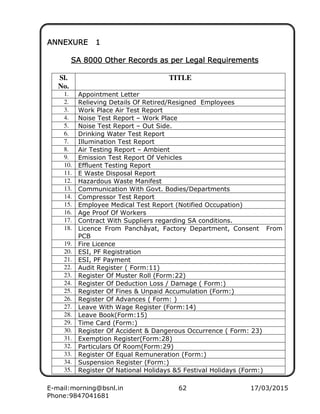
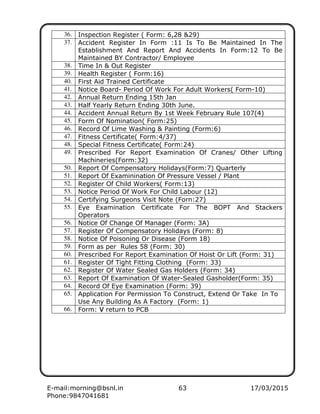
1. SA 8000 Other Records as per Legal Requirements
Sl NoSl NoSl NoSl No TitleTitleTitleTitle PagePagePagePage
NoNoNoNo
1. Introduction 3
2. Terms and Definitions 7
3. Relevant extracts from the UN/ILO
conventions
9
4. Legal Register 27
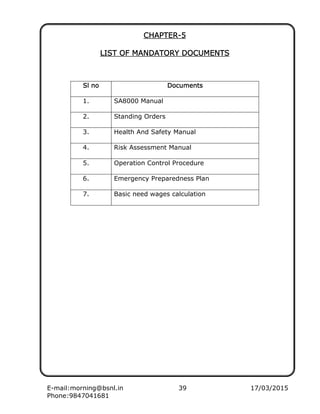
5. List of Mandatory Documents 39
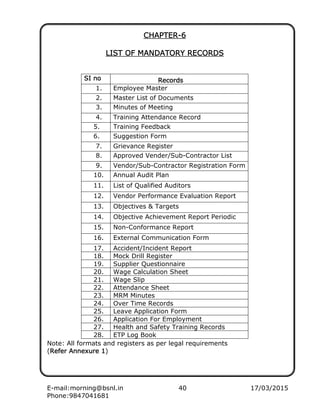
6. List of Mandatory Records 40
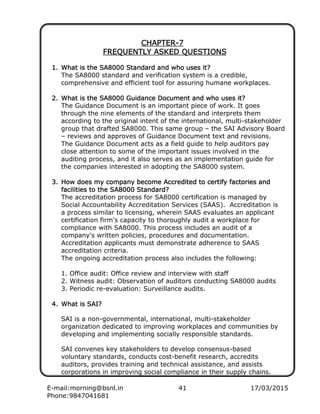
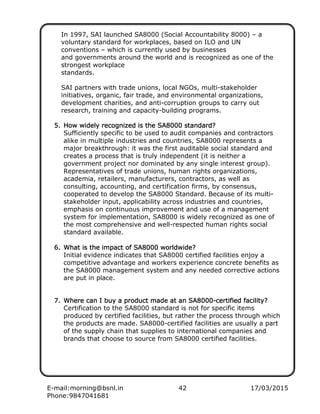
7. Frequently Asked Questions 41
8. SA 8000: 2008 In a Nutshell 45
9. SA 8000:2014 Key changes 52
10. The Social Accountability International
Fire Safety Checklist.
55
E-mail:morning@bsnl.in 3 17/03/2015
Phone:9847041681
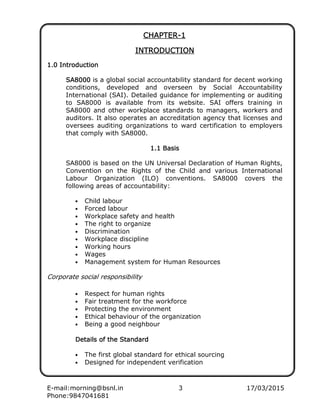
CHAPTERCHAPTERCHAPTERCHAPTER----1111
INTRODUCTIONINTRODUCTIONINTRODUCTIONINTRODUCTION
1.0 Introduction1.0 Introduction1.0 Introduction1.0 Introduction
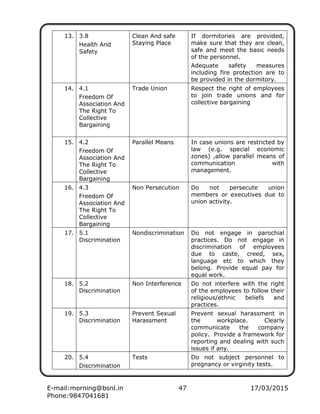
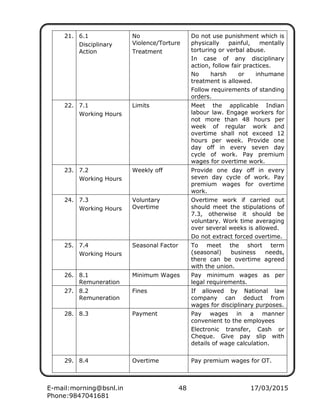
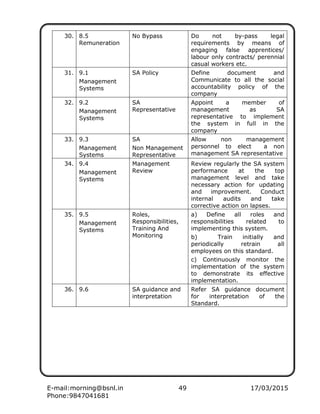
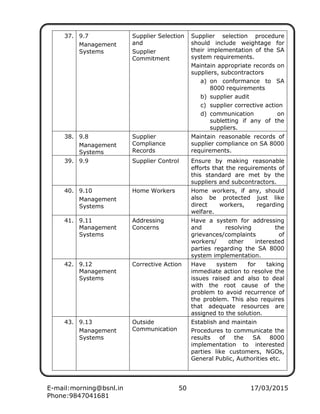
SA8000SA8000SA8000SA8000 is a global social accountability standard for decent working
conditions, developed and overseen by Social Accountability
International (SAI). Detailed guidance for implementing or auditing
to SA8000 is available from its website. SAI offers training in
SA8000 and other workplace standards to managers, workers and
auditors. It also operates an accreditation agency that licenses and
oversees auditing organizations to ward certification to employers
that comply with SA8000.
1.1 Basis1.1 Basis1.1 Basis1.1 Basis
SA8000 is based on the UN Universal Declaration of Human Rights,
Convention on the Rights of the Child and various International
Labour Organization (ILO) conventions. SA8000 covers the
following areas of accountability:
• Child labour
• Forced labour
• Workplace safety and health
• The right to organize
• Discrimination
• Workplace discipline
• Working hours
• Wages
• Management system for Human Resources
Corporate social responsibility
• Respect for human rights
• Fair treatment for the workforce
• Protecting the environment
• Ethical behaviour of the organization
• Being a good neighbour
Details of the SDetails of the SDetails of the SDetails of the Standardtandardtandardtandard
• The first global standard for ethical sourcing
• Designed for independent verification
E-mail:morning@bsnl.in 4 17/03/2015
Phone:9847041681
• A global standard, designed for use by any company,
anywhere in the world
• Has been developed with stakeholders
• Is designed to take local laws and requirements into account
1.2 Certifications1.2 Certifications1.2 Certifications1.2 Certifications
More than 640,000 workers are employed in 1200 facilities certified
to SA8000, in 60 countries and 70 industrial sectors. The industrial
sectors with the most certifications include apparel and textiles;
building materials; agriculture; construction; chemicals; cosmetics;
cleaning services and transportation. The countries with the most
certification to SA8000 include Brazil, India, China and Italy.
The cost of acquiring a certification for a factory, farm or office
varies with the number of employees and the location. It can range
up to 10-12,000 USD for large facilities.
1.3 Significance1.3 Significance1.3 Significance1.3 Significance
Dominic A. Tarantino, Chairman of Price Waterhouse World Firm
described SA8000 in 1998 as "the first ever universal standard for
ethical sourcing... It provides a common framework for ethical
sourcing for companies of any size and any type, anywhere in the
world. SA8000 sets out provisions for issues such as trade union
rights, the use of child labor, working hours, health and safety at
work, and fair pay." However, it does not address broader issues of
ecology or bribery or other issues which may require more
consumer or executive restraint. Tarantino further argued the need
for moral leadership:
"Pricing, products and services are no longer the sole arbiters of
commercial success... it is business that must take the lead in
taming the global frontier. Business must take the lead in
establishing rule of law in emerging markets. Business must take
the lead in stopping bribery. Business must take the lead in
bringing order to cyberspace. Business must take the lead in
ensuring that technology does not split the world into haves and
have nots."
E-mail:morning@bsnl.in 5 17/03/2015
Phone:9847041681
1.4 Benefits1.4 Benefits1.4 Benefits1.4 Benefits
• Fewer accidents
• Enhanced opportunities to be organized
• A way to address and improve the conditions where people
work
• Increased worker awareness about core labor rights
• Enhanced communication to the management
• Evidence that labor rights are good for society and business
• Improved business practices lead to economic growth and
new job opportunities A credible and effective way to put
social responsibility into action
• Enhanced company and brand reputation
• Improved employee recruitment, retention and performance
• Gains in quality and productivity
• Savings from fewer workdays lost and lower insurance bills
• Less expensive than an internal compliance program
• Better relationships among workers, trade unions, companies,
customers, NGOs and government
• Clear, credible information for those who want to make
ethical purchasing decisions
• Useful data for socially responsible investors
• Identification of products made under humane conditions
• Identification of companies making progress toward humane
conditions
• Broad coverage of product categories and production
geography
Why to implement SAWhy to implement SAWhy to implement SAWhy to implement SA 8000?8000?8000?8000?
• To differentiate and offer value to customers.
• Driven by commitment to provide safe workplaces.
• Set a global standard that complies with all local laws and
customs.
1.5 Social Accountability International (SAI)1.5 Social Accountability International (SAI)1.5 Social Accountability International (SAI)1.5 Social Accountability International (SAI)
Established in May 1997
Undertakes impartial assessment of SA certification bodies to
assure competence
Monitors ongoing compliance of certification bodies and their
documented procedures
E-mail:morning@bsnl.in 6 17/03/2015
Phone:9847041681
Maintains list of accredited certification bodies available to the
public
Reviews and resolves complaints against auditors and/or
certification bodies
1.61.61.61.6 SA 8000 MissionSA 8000 MissionSA 8000 MissionSA 8000 Mission
Improve working conditions globally
Provide universal standards in all business and country
sectors
Work in parallel with human rights and labour organizations
worldwide
Provide an incentive which benefits the business and
consumer community through a “win-win” approach
1.7 History of SA 80001.7 History of SA 80001.7 History of SA 80001.7 History of SA 8000
SA 8000 is developed by Social Accountability International (SAI)
and 25 other organisations, such as:
• Amnesty International
• Human Rights Watch
• Avon Products
• Toys R Us
• The Body Shop
• Reebok
• Others
E-mail:morning@bsnl.in 7 17/03/2015
Phone:9847041681
CHAPTERCHAPTERCHAPTERCHAPTER----2222
TERMS AND DEFINITIONSTERMS AND DEFINITIONSTERMS AND DEFINITIONSTERMS AND DEFINITIONS
1.1.1.1. ChildChildChildChild
Any person less than 15 years of age.
2.2.2.2. Child LabourChild LabourChild LabourChild Labour
Any work done by a child for any operation of ORGANISATION.
3.3.3.3. Collective Bargaining AgreementCollective Bargaining AgreementCollective Bargaining AgreementCollective Bargaining Agreement
Any contract, relating to the terms and conditions of employment,
entered between ORGANISATION and its one or more worker
organization.
4.4.4.4. Corrective and Preventive ActionCorrective and Preventive ActionCorrective and Preventive ActionCorrective and Preventive Action
An immediate and continuing remedial action on a non-
conformance to the requirement to SA 8000 standard and/or this
manual.
5.5.5.5. ForForForForced Labourced Labourced Labourced Labour
Any work or service that a person has not voluntarily offered; and
is forced on him/her under the threat of punishment or retaliation,
or as a repayment of some debt.
6.6.6.6. Home WorkerHome WorkerHome WorkerHome Worker
A person who is employed by ORGANISATION or any of its supplier,
sub-supplier, or subcontractor, but who does not work on their
premises. Interested Party Any individual or group concerned with
or affected by the social performance of ORGANISATION.
7.7.7.7. PersonnelPersonnelPersonnelPersonnel
All individuals directly employed or contracted by ORGANISATION,
including its directors, executives, managers, supervisors, and
workers.
8.8.8.8. Remediation Of ChildrenRemediation Of ChildrenRemediation Of ChildrenRemediation Of Children
All the support and actions required ensuring the safety, health,
education, and development of a child found at any work of
ORGANISATION.
9.9.9.9. OrganisationOrganisationOrganisationOrganisation
The company including all its employed personnel, which is
implementing the social accountability management system
E-mail:morning@bsnl.in 8 17/03/2015
Phone:9847041681
10.10.10.10. SubSubSubSub----suppliersuppliersuppliersupplier
Any organisation that directly or indirectly supplies goods and/or
Services to a supplier for the use by ORGANISATION and/or the
supplier.
11.11.11.11. Supplier/SubcontractorSupplier/SubcontractorSupplier/SubcontractorSupplier/Subcontractor
Any organisation that provides goods and/or services to
ORGANISATION for the use in any of its operations.
12.12.12.12. WorkerWorkerWorkerWorker
Any of the non-management personnel of ORGANISATION.
13.13.13.13. Worker OrganizationWorker OrganizationWorker OrganizationWorker Organization
Any recognised union/association of the workers of organisation.
14.14.14.14. Young WorkerYoung WorkerYoung WorkerYoung Worker
Any worker over the age of a child and under the age of 18.
E-mail:morning@bsnl.in 9 17/03/2015
Phone:9847041681
CHAPTERCHAPTERCHAPTERCHAPTER----3333
RELEVANT EXTRACTS FROM THE UN/ILO CONVENTIONSRELEVANT EXTRACTS FROM THE UN/ILO CONVENTIONSRELEVANT EXTRACTS FROM THE UN/ILO CONVENTIONSRELEVANT EXTRACTS FROM THE UN/ILO CONVENTIONS
UN Convention on the Elimination of all Forms of Discrimination against
Women
a. The right to equal remuneration, including benefits, and to
equal treatment in respect of work of equal value, as well as
equality of treatment in the evaluation of the quality of work;
b. The right to social security, particularly in cases of retirement,
unemployment, sickness, invalidity and old age and other
incapacity to work, as well as the right to paid leave;
c. The right to protection of health and to safety in working
conditions, including the safeguarding of the function of
reproduction. To prohibit, subject to the imposition of
sanctions, dismissal on the grounds of pregnancy or of
maternity leave and discrimination in dismissals on the basis
of marital status;
d. To introduce maternity leave with pay or with comparable
social benefits without loss of former employment, seniority
or social allowances;
e. To encourage the provision of the necessary supporting social
services to enable parents to combine family obligations with
work responsibilities and participation in public life, in
particular through promoting the establishment and
development of a network of child-care facilities;
f. To provide special protection to women during pregnancy in
types of work proved to be harmful to them.
UN
Article 32 Convention on the Rights of the Child
1. States Parties recognize the right of the child to be protected from
economic exploitation and from performing any work that is likely to be
hazardous or to interfere with the child's education, or to be harmful to
the child's health or physical, mental, spiritual, moral or social
development.
2. States Parties shall take legislative, administrative, social and
educational measures to ensure the implementation of the present article.
To this end, and having regard to the relevant provisions of other
international instruments, States Parties shall in particular: (a) Provide
for a minimum age or minimum ages for admission to employment;
E-mail:morning@bsnl.in 10 17/03/2015
Phone:9847041681
(b) Provide for appropriate regulation of the hours and conditions of
employment;
(c) Provide for appropriate penalties or other sanctions to ensure the
effective enforcement of the present article.
UNIVERSAL DECLARATION OF HUMAN RIGHTSUNIVERSAL DECLARATION OF HUMAN RIGHTSUNIVERSAL DECLARATION OF HUMAN RIGHTSUNIVERSAL DECLARATION OF HUMAN RIGHTS
Article 4Article 4Article 4Article 4
No one shall be held in slavery or servitude; slavery and the slave trade
shall be prohibited in all their forms.
Article 5Article 5Article 5Article 5
No one shall be subjected to torture or to cruel, inhuman or degrading
treatment or punishment.
Article 23Article 23Article 23Article 23
1. Everyone has the right to work, to free choice of employment, to
just and favourable conditions of work and to protection against
unemployment.
2. Everyone, without any discrimination, has the right to equal pay for
equal work.
3. Everyone who works has the right to just and favourable
remuneration ensuring for himself and his family an existence
worthy of human dignity, and supplemented, if necessary, by other
means of social protection.
4. Everyone has the right to form and to join trade unions for the
protection of his interests.
Article 24Article 24Article 24Article 24
Everyone has the right to rest and leisure, including reasonable limitation
of working hours and periodic holidays with pay.
C182 Worst Forms of Child Labour Convention, 1999C182 Worst Forms of Child Labour Convention, 1999C182 Worst Forms of Child Labour Convention, 1999C182 Worst Forms of Child Labour Convention, 1999
Article 2
For the purposes of this Convention, the term childchildchildchild shall apply to all
persons under the age of 18.
Article 3
E-mail:morning@bsnl.in 11 17/03/2015
Phone:9847041681
For the purposes of this Convention, the term the worst forms of childthe worst forms of childthe worst forms of childthe worst forms of child
labourlabourlabourlabour comprises:
(a) all forms of slavery or practices similar to slavery, such as the sale
and trafficking of children, debt bondage and serfdom and forced or
compulsory labour, including forced or compulsory recruitment of children
for use in armed conflict;
(b) the use, procuring or offering of a child for prostitution, for the
production of pornography or for pornographic performances;
(c) the use, procuring or offering of a child for illicit activities, in particular
for the production and trafficking of drugs as defined in the relevant
international treaties;
(d) work which, by its nature or the circumstances in which it is carried
out, is likely to harm the health, safety or morals of children.
C177 Home Work Convention, 1996
Article 1
For the purposes of this Convention:
(a) the term home workhome workhome workhome work means work carried out by a person, to be
referred to as a homeworker,
(i) in his or her home or in other premises of his or her choice, other than
the workplace of the employer;
(ii) for remuneration;
(iii) which results in a product or service as specified by the employer,
irrespective of who provides the equipment, materials or other inputs
used,
unless this person has the degree of autonomy and of economic
independence necessary to be considered an independent worker under
national laws, regulations or court decisions;
(b) persons with employee status do not become homeworkers within the
meaning of this Convention simply by occasionally performing their work
as employees at home, rather than at their usual workplaces;
E-mail:morning@bsnl.in 12 17/03/2015
Phone:9847041681
(c) the term employeremployeremployeremployer means a person, natural or legal, who, either
directly or through an intermediary, whether or not intermediaries are
provided for in national legislation, gives out home work in pursuance of
his or her business activity.
Article 2
This Convention applies to all persons carrying out home work within the
meaning of Article 1.
Article 3
Each Member which has ratified this Convention shall adopt, implement
and periodically review a national policy on home work aimed at
improving the situation of homeworkers, in consultation with the most
representative organizations of employers and workers and, where they
exist, with organizations concerned with homeworkers and those of
employers of homeworkers.
Article 4
1. The national policy on home work shall promote, as far as possible,
equality of treatment between homeworkers and other wage earners,
taking into account the special characteristics of home work and, where
appropriate, conditions applicable to the same or a similar type of work
carried out in an enterprise.
2. Equality of treatment shall be promoted, in particular, in relation to:
(a) the homeworkers' right to establish or join organizations of their own
choosing and to participate in the activities of such organizations;
(b) protection against discrimination in employment and occupation;
(c) protection in the field of occupational safety and health;
(d) remuneration;
(e) statutory social security protection;
(f) access to training;
(g) minimum age for admission to employment or work; and
(h) maternity protection
E-mail:morning@bsnl.in 13 17/03/2015
Phone:9847041681
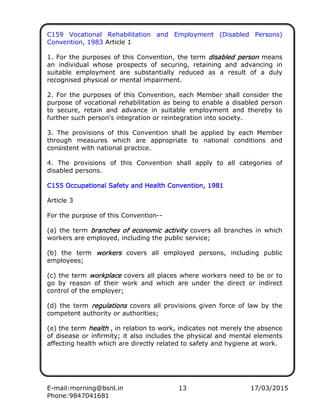
C159 Vocational Rehabilitation and Employment (Disabled Persons)
Convention, 1983 Article 1
1. For the purposes of this Convention, the term disabled persondisabled persondisabled persondisabled person means
an individual whose prospects of securing, retaining and advancing in
suitable employment are substantially reduced as a result of a duly
recognised physical or mental impairment.
2. For the purposes of this Convention, each Member shall consider the
purpose of vocational rehabilitation as being to enable a disabled person
to secure, retain and advance in suitable employment and thereby to
further such person's integration or reintegration into society.
3. The provisions of this Convention shall be applied by each Member
through measures which are appropriate to national conditions and
consistent with national practice.
4. The provisions of this Convention shall apply to all categories of
disabled persons.
C155 Occupational Safety and Health Convention, 1981C155 Occupational Safety and Health Convention, 1981C155 Occupational Safety and Health Convention, 1981C155 Occupational Safety and Health Convention, 1981
Article 3
For the purpose of this Convention--
(a) the term branches of economic activitybranches of economic activitybranches of economic activitybranches of economic activity covers all branches in which
workers are employed, including the public service;
(b) the term workersworkersworkersworkers covers all employed persons, including public
employees;
(c) the term workplaceworkplaceworkplaceworkplace covers all places where workers need to be or to
go by reason of their work and which are under the direct or indirect
control of the employer;
(d) the term regulationsregulationsregulationsregulations covers all provisions given force of law by the
competent authority or authorities;
(e) the term healthhealthhealthhealth , in relation to work, indicates not merely the absence
of disease or infirmity; it also includes the physical and mental elements
affecting health which are directly related to safety and hygiene at work.
E-mail:morning@bsnl.in 14 17/03/2015
Phone:9847041681
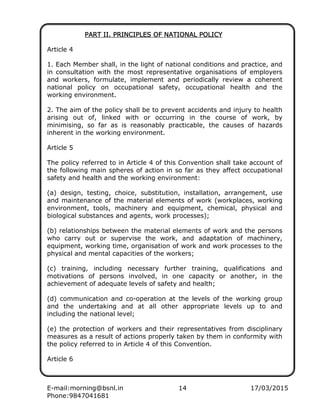
PART II. PRINCIPLES OF NATIONAL POLICYPART II. PRINCIPLES OF NATIONAL POLICYPART II. PRINCIPLES OF NATIONAL POLICYPART II. PRINCIPLES OF NATIONAL POLICY
Article 4
1. Each Member shall, in the light of national conditions and practice, and
in consultation with the most representative organisations of employers
and workers, formulate, implement and periodically review a coherent
national policy on occupational safety, occupational health and the
working environment.
2. The aim of the policy shall be to prevent accidents and injury to health
arising out of, linked with or occurring in the course of work, by
minimising, so far as is reasonably practicable, the causes of hazards
inherent in the working environment.
Article 5
The policy referred to in Article 4 of this Convention shall take account of
the following main spheres of action in so far as they affect occupational
safety and health and the working environment:
(a) design, testing, choice, substitution, installation, arrangement, use
and maintenance of the material elements of work (workplaces, working
environment, tools, machinery and equipment, chemical, physical and
biological substances and agents, work processes);
(b) relationships between the material elements of work and the persons
who carry out or supervise the work, and adaptation of machinery,
equipment, working time, organisation of work and work processes to the
physical and mental capacities of the workers;
(c) training, including necessary further training, qualifications and
motivations of persons involved, in one capacity or another, in the
achievement of adequate levels of safety and health;
(d) communication and co-operation at the levels of the working group
and the undertaking and at all other appropriate levels up to and
including the national level;
(e) the protection of workers and their representatives from disciplinary
measures as a result of actions properly taken by them in conformity with
the policy referred to in Article 4 of this Convention.
Article 6
E-mail:morning@bsnl.in 15 17/03/2015
Phone:9847041681
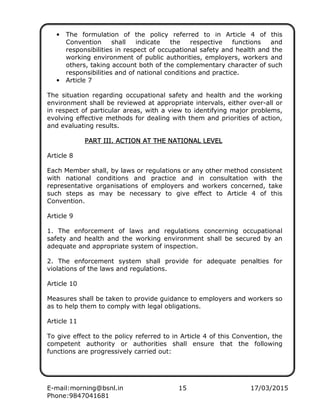
• The formulation of the policy referred to in Article 4 of this
Convention shall indicate the respective functions and
responsibilities in respect of occupational safety and health and the
working environment of public authorities, employers, workers and
others, taking account both of the complementary character of such
responsibilities and of national conditions and practice.
• Article 7
The situation regarding occupational safety and health and the working
environment shall be reviewed at appropriate intervals, either over-all or
in respect of particular areas, with a view to identifying major problems,
evolving effective methods for dealing with them and priorities of action,
and evaluating results.
PART III. ACTION AT THE NATIONAL LEVELPART III. ACTION AT THE NATIONAL LEVELPART III. ACTION AT THE NATIONAL LEVELPART III. ACTION AT THE NATIONAL LEVEL
Article 8
Each Member shall, by laws or regulations or any other method consistent
with national conditions and practice and in consultation with the
representative organisations of employers and workers concerned, take
such steps as may be necessary to give effect to Article 4 of this
Convention.
Article 9
1. The enforcement of laws and regulations concerning occupational
safety and health and the working environment shall be secured by an
adequate and appropriate system of inspection.
2. The enforcement system shall provide for adequate penalties for
violations of the laws and regulations.
Article 10
Measures shall be taken to provide guidance to employers and workers so
as to help them to comply with legal obligations.
Article 11
To give effect to the policy referred to in Article 4 of this Convention, the
competent authority or authorities shall ensure that the following
functions are progressively carried out:
E-mail:morning@bsnl.in 16 17/03/2015
Phone:9847041681
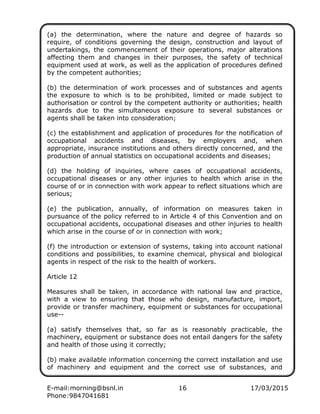
(a) the determination, where the nature and degree of hazards so
require, of conditions governing the design, construction and layout of
undertakings, the commencement of their operations, major alterations
affecting them and changes in their purposes, the safety of technical
equipment used at work, as well as the application of procedures defined
by the competent authorities;
(b) the determination of work processes and of substances and agents
the exposure to which is to be prohibited, limited or made subject to
authorisation or control by the competent authority or authorities; health
hazards due to the simultaneous exposure to several substances or
agents shall be taken into consideration;
(c) the establishment and application of procedures for the notification of
occupational accidents and diseases, by employers and, when
appropriate, insurance institutions and others directly concerned, and the
production of annual statistics on occupational accidents and diseases;
(d) the holding of inquiries, where cases of occupational accidents,
occupational diseases or any other injuries to health which arise in the
course of or in connection with work appear to reflect situations which are
serious;
(e) the publication, annually, of information on measures taken in
pursuance of the policy referred to in Article 4 of this Convention and on
occupational accidents, occupational diseases and other injuries to health
which arise in the course of or in connection with work;
(f) the introduction or extension of systems, taking into account national
conditions and possibilities, to examine chemical, physical and biological
agents in respect of the risk to the health of workers.
Article 12
Measures shall be taken, in accordance with national law and practice,
with a view to ensuring that those who design, manufacture, import,
provide or transfer machinery, equipment or substances for occupational
use--
(a) satisfy themselves that, so far as is reasonably practicable, the
machinery, equipment or substance does not entail dangers for the safety
and health of those using it correctly;
(b) make available information concerning the correct installation and use
of machinery and equipment and the correct use of substances, and
E-mail:morning@bsnl.in 17 17/03/2015
Phone:9847041681
information on hazards of machinery and equipment and dangerous
properties of chemical substances and physical and biological agents or
products, as well as instructions on how known hazards are to be
avoided;
(c) undertake studies and research or otherwise keep abreast of the
scientific and technical knowledge necessary to comply with
subparagraphs (a) and (b) of this Article.
Article 13
A worker who has removed himself from a work situation which he has
reasonable justification to believe presents an imminent and serious
danger to his life or health shall be protected from undue consequences in
accordance with national conditions and practice.
Article 14
Measures shall be taken with a view to promoting in a manner
appropriate to national conditions and practice, the inclusion of questions
of occupational safety and health and the working environment at all
levels of education and training, including higher technical, medical and
professional education, in a manner meeting the training needs of all
workers.
Article 15
1. With a view to ensuring the coherence of the policy referred to in
Article 4 of this Convention and of measures for its application, each
Member shall, after consultation at the earliest possible stage with the
most representative organisations of employers and workers, and with
other bodies as appropriate, make arrangements appropriate to national
conditions and practice to ensure the necessary co-ordination between
various authorities and bodies called upon to give effect to Parts II and III
of this Convention.
2. Whenever circumstances so require and national conditions and
practice permit, these arrangements shall include the establishment of a
central body.
E-mail:morning@bsnl.in 18 17/03/2015
Phone:9847041681
PART IV. ACTION AT TPART IV. ACTION AT TPART IV. ACTION AT TPART IV. ACTION AT THE LEVEL OF THE UNDERTAKINGHE LEVEL OF THE UNDERTAKINGHE LEVEL OF THE UNDERTAKINGHE LEVEL OF THE UNDERTAKING
Article 16
1. Employers shall be required to ensure that, so far as is reasonably
practicable, the workplaces, machinery, equipment and processes under
their control are safe and without risk to health.
2. Employers shall be required to ensure that, so far as is reasonably
practicable, the chemical, physical and biological substances and agents
under their control are without risk to health when the appropriate
measures of protection are taken.
3. Employers shall be required to provide, where necessary, adequate
protective clothing and protective equipment to prevent, so far is
reasonably practicable, risk of accidents or of adverse effects on health.
Article 17
Whenever two or more undertakings engage in activities simultaneously
at one workplace, they shall collaborate in applying the requirements of
this Convention.
Article 18
Employers shall be required to provide, where necessary, for measures to
deal with emergencies and accidents, including adequate first-aid
arrangements.
Article 19
There shall be arrangements at the level of the undertaking under which-
-
(a) workers, in the course of performing their work, co-operate in the
fulfilment by their employer of the obligations placed upon him;
(b) representatives of workers in the undertaking co-operate with the
employer in the field of occupational safety and health;
(c) representatives of workers in an undertaking are given adequate
information on measures taken by the employer to secure occupational
safety and health and may consult their representative organisations
about such information provided they do not disclose commercial secrets;
E-mail:morning@bsnl.in 19 17/03/2015
Phone:9847041681
(d) workers and their representatives in the undertaking are given
appropriate training in occupational safety and health;
(e) workers or their representatives and, as the case may be, their
representative organisations in an undertaking, in accordance with
national law and practice, are enabled to enquire into, and are consulted
by the employer on, all aspects of occupational safety and health
associated with their work; for this purpose technical advisers may, by
mutual agreement, be brought in from outside the undertaking;
(f) a worker reports forthwith to his immediate supervisor any situation
which he has reasonable justification to believe presents an imminent and
serious danger to his life or health; until the employer has taken remedial
action, if necessary, the employer cannot require workers to return to a
work situation where there is continuing imminent and serious danger to
life or health.
Article 20
Co-operation between management and workers and/or their
representatives within the undertaking shall be an essential element of
organisational and other measures taken in pursuance of Articles 16 to 19
of this Convention.
Article 21
Occupational safety and health measures shall not involve any
expenditure for the workers.
C138 Minimum Age Convention, 1973C138 Minimum Age Convention, 1973C138 Minimum Age Convention, 1973C138 Minimum Age Convention, 1973
Article 1
Each Member for which this Convention is in force undertakes to pursue a
national policy designed to ensure the effective abolition of child labour
and to raise progressively the minimum age for admission to employment
or work to a level consistent with the fullest physical and mental
development of young persons.
Article 2
1. Each Member which ratifies this Convention shall specify, in a
declaration appended to its ratification, a minimum age for admission to
employment or work within its territory and on means of transport
registered in its territory; subject to Articles 4 to 8 of this Convention, no
E-mail:morning@bsnl.in 20 17/03/2015
Phone:9847041681
one under that age shall be admitted to employment or work in any
occupation.
2. Each Member which has ratified this Convention may subsequently
notify the Director-General of the International Labour Office, by further
declarations, that it specifies a minimum age higher than that previously
specified.
3. The minimum age specified in pursuance of paragraph 1 of this Article
shall not be less than the age of completion of compulsory schooling and,
in any case, shall not be less than 15 years.
4. Notwithstanding the provisions of paragraph 3 of this Article, a Member
whose economy and educational facilities are insufficiently developed
may, after consultation with the organisations of employers and workers
concerned, where such exist, initially specify a minimum age of 14 years.
5. Each Member which has specified a minimum age of 14 years in
pursuance of the provisions of the preceding paragraph shall include in its
reports on the application of this Convention submitted under article 22 of
the Constitution of the International Labour Organisation a statement--
(a) that its reason for doing so subsists; or
(b) that it renounces its right to avail itself of the provisions in question
as from a stated date.
Article 3
1. The minimum age for admission to any type of employment or work
which by its nature or the circumstances in which it is carried out is likely
to jeopardise the health, safety or morals of young persons shall not be
less than 18 years.
2. The types of employment or work to which paragraph 1 of this Article
applies shall be determined by national laws or regulations or by the
competent authority, after consultation with the organisations of
employers and workers concerned, where such exist.
3. Notwithstanding the provisions of paragraph 1 of this Article, national3. Notwithstanding the provisions of paragraph 1 of this Article, national3. Notwithstanding the provisions of paragraph 1 of this Article, national3. Notwithstanding the provisions of paragraph 1 of this Article, national
laws or regullaws or regullaws or regullaws or regulations or the competent authority may, after consultationations or the competent authority may, after consultationations or the competent authority may, after consultationations or the competent authority may, after consultation
with the organisations of employers and workers concerned, where suchwith the organisations of employers and workers concerned, where suchwith the organisations of employers and workers concerned, where suchwith the organisations of employers and workers concerned, where such
exist, authorise employment or work as from the age of 16 years onexist, authorise employment or work as from the age of 16 years onexist, authorise employment or work as from the age of 16 years onexist, authorise employment or work as from the age of 16 years on
condition that the health, safety and morals of the young percondition that the health, safety and morals of the young percondition that the health, safety and morals of the young percondition that the health, safety and morals of the young personssonssonssons
concerned are fully protected and that the young persons have receivedconcerned are fully protected and that the young persons have receivedconcerned are fully protected and that the young persons have receivedconcerned are fully protected and that the young persons have received
E-mail:morning@bsnl.in 21 17/03/2015
Phone:9847041681
adequate specific instruction or vocational training in the relevant branchadequate specific instruction or vocational training in the relevant branchadequate specific instruction or vocational training in the relevant branchadequate specific instruction or vocational training in the relevant branch
of activity.of activity.of activity.of activity.
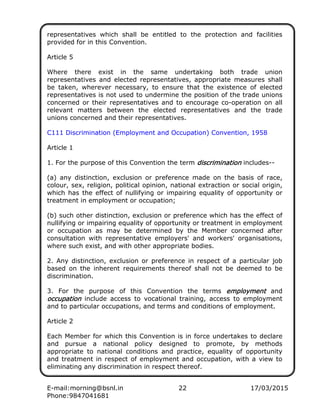
C135 Workers' Representatives Convention, 1971 Article 1
Workers' representatives in the undertaking shall enjoy effective
protection against any act prejudicial to them, including dismissal, based
on their status or activities as a workers' representative or on union
membership or participation in union activities, in so far as they act in
conformity with existing laws or collective agreements or other jointly
agreed arrangements.
Article 2
1. Such facilities in the undertaking shall be afforded to workers'
representatives as may be appropriate in order to enable them to carry
out their functions promptly and efficiently.
2. In this connection account shall be taken of the characteristics of the
industrial relations system of the country and the needs, size and
capabilities of the undertaking concerned.
3. The granting of such facilities shall not impair the efficient operation of
the undertaking concerned.
Article 3
For the purpose of this Convention the term workers' representativesworkers' representativesworkers' representativesworkers' representatives
means persons who are recognised as such under national law or
practice, whether they are--
(a) trade union representatives, namely, representatives designated or
elected by trade unions or by members of such unions; or
(b) elected representatives, namely, representatives who are freely
elected by the workers of the undertaking in accordance with provisions
of national laws or regulations or of collective agreements and whose
functions do not include activities which are recognised as the exclusive
prerogative of trade unions in the country concerned.
Article 4
National laws or regulations, collective agreements, arbitration awards or
court decisions may determine the type or types of workers'
E-mail:morning@bsnl.in 22 17/03/2015
Phone:9847041681
representatives which shall be entitled to the protection and facilities
provided for in this Convention.
Article 5
Where there exist in the same undertaking both trade union
representatives and elected representatives, appropriate measures shall
be taken, wherever necessary, to ensure that the existence of elected
representatives is not used to undermine the position of the trade unions
concerned or their representatives and to encourage co-operation on all
relevant matters between the elected representatives and the trade
unions concerned and their representatives.
C111 Discrimination (Employment and Occupation) Convention, 1958
Article 1
1. For the purpose of this Convention the term discriminationdiscriminationdiscriminationdiscrimination includes--
(a) any distinction, exclusion or preference made on the basis of race,
colour, sex, religion, political opinion, national extraction or social origin,
which has the effect of nullifying or impairing equality of opportunity or
treatment in employment or occupation;
(b) such other distinction, exclusion or preference which has the effect of
nullifying or impairing equality of opportunity or treatment in employment
or occupation as may be determined by the Member concerned after
consultation with representative employers' and workers' organisations,
where such exist, and with other appropriate bodies.
2. Any distinction, exclusion or preference in respect of a particular job
based on the inherent requirements thereof shall not be deemed to be
discrimination.
3. For the purpose of this Convention the terms employmentemploymentemploymentemployment and
occupationoccupationoccupationoccupation include access to vocational training, access to employment
and to particular occupations, and terms and conditions of employment.
Article 2
Each Member for which this Convention is in force undertakes to declare
and pursue a national policy designed to promote, by methods
appropriate to national conditions and practice, equality of opportunity
and treatment in respect of employment and occupation, with a view to
eliminating any discrimination in respect thereof.
E-mail:morning@bsnl.in 23 17/03/2015
Phone:9847041681
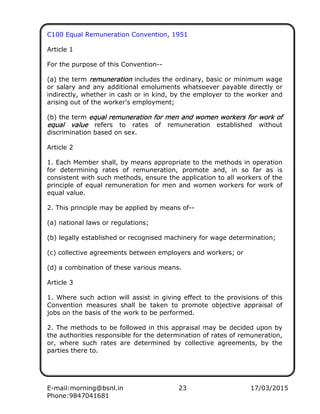
C100 Equal Remuneration Convention, 1951
Article 1
For the purpose of this Convention--
(a) the term remunerationremunerationremunerationremuneration includes the ordinary, basic or minimum wage
or salary and any additional emoluments whatsoever payable directly or
indirectly, whether in cash or in kind, by the employer to the worker and
arising out of the worker's employment;
(b) the term equal remuneration for men and women workers for work ofequal remuneration for men and women workers for work ofequal remuneration for men and women workers for work ofequal remuneration for men and women workers for work of
equal valueequal valueequal valueequal value refers to rates of remuneration established without
discrimination based on sex.
Article 2
1. Each Member shall, by means appropriate to the methods in operation
for determining rates of remuneration, promote and, in so far as is
consistent with such methods, ensure the application to all workers of the
principle of equal remuneration for men and women workers for work of
equal value.
2. This principle may be applied by means of--
(a) national laws or regulations;
(b) legally established or recognised machinery for wage determination;
(c) collective agreements between employers and workers; or
(d) a combination of these various means.
Article 3
1. Where such action will assist in giving effect to the provisions of this
Convention measures shall be taken to promote objective appraisal of
jobs on the basis of the work to be performed.
2. The methods to be followed in this appraisal may be decided upon by
the authorities responsible for the determination of rates of remuneration,
or, where such rates are determined by collective agreements, by the
parties there to.
E-mail:morning@bsnl.in 24 17/03/2015
Phone:9847041681
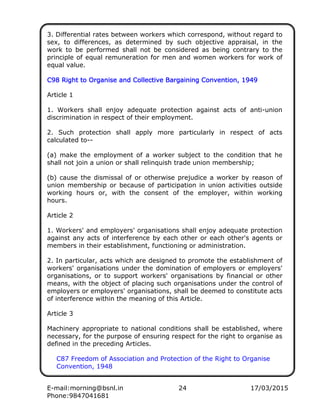
3. Differential rates between workers which correspond, without regard to
sex, to differences, as determined by such objective appraisal, in the
work to be performed shall not be considered as being contrary to the
principle of equal remuneration for men and women workers for work of
equal value.
C98 Right to Organise and Collective Bargaining Convention, 1949C98 Right to Organise and Collective Bargaining Convention, 1949C98 Right to Organise and Collective Bargaining Convention, 1949C98 Right to Organise and Collective Bargaining Convention, 1949
Article 1
1. Workers shall enjoy adequate protection against acts of anti-union
discrimination in respect of their employment.
2. Such protection shall apply more particularly in respect of acts
calculated to--
(a) make the employment of a worker subject to the condition that he
shall not join a union or shall relinquish trade union membership;
(b) cause the dismissal of or otherwise prejudice a worker by reason of
union membership or because of participation in union activities outside
working hours or, with the consent of the employer, within working
hours.
Article 2
1. Workers' and employers' organisations shall enjoy adequate protection
against any acts of interference by each other or each other's agents or
members in their establishment, functioning or administration.
2. In particular, acts which are designed to promote the establishment of
workers' organisations under the domination of employers or employers'
organisations, or to support workers' organisations by financial or other
means, with the object of placing such organisations under the control of
employers or employers' organisations, shall be deemed to constitute acts
of interference within the meaning of this Article.
Article 3
Machinery appropriate to national conditions shall be established, where
necessary, for the purpose of ensuring respect for the right to organise as
defined in the preceding Articles.
C87 Freedom of Association and Protection of the Right to Organise
Convention, 1948
E-mail:morning@bsnl.in 25 17/03/2015
Phone:9847041681
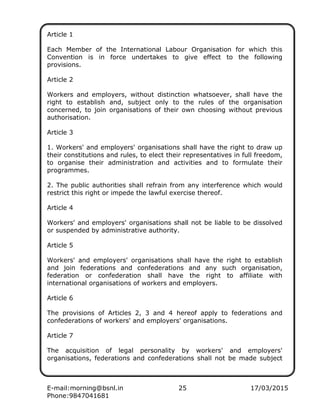
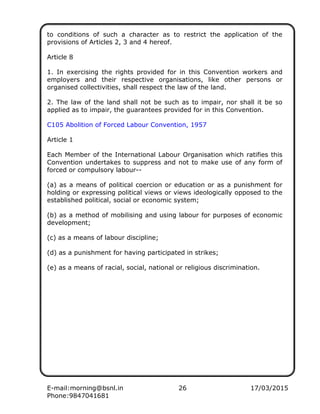
Article 1
Each Member of the International Labour Organisation for which this
Convention is in force undertakes to give effect to the following
provisions.
Article 2
Workers and employers, without distinction whatsoever, shall have the
right to establish and, subject only to the rules of the organisation
concerned, to join organisations of their own choosing without previous
authorisation.
Article 3
1. Workers' and employers' organisations shall have the right to draw up
their constitutions and rules, to elect their representatives in full freedom,
to organise their administration and activities and to formulate their
programmes.
2. The public authorities shall refrain from any interference which would
restrict this right or impede the lawful exercise thereof.
Article 4
Workers' and employers' organisations shall not be liable to be dissolved
or suspended by administrative authority.
Article 5
Workers' and employers' organisations shall have the right to establish
and join federations and confederations and any such organisation,
federation or confederation shall have the right to affiliate with
international organisations of workers and employers.
Article 6
The provisions of Articles 2, 3 and 4 hereof apply to federations and
confederations of workers' and employers' organisations.
Article 7
The acquisition of legal personality by workers' and employers'
organisations, federations and confederations shall not be made subject
E-mail:morning@bsnl.in 26 17/03/2015
Phone:9847041681
to conditions of such a character as to restrict the application of the
provisions of Articles 2, 3 and 4 hereof.
Article 8
1. In exercising the rights provided for in this Convention workers and
employers and their respective organisations, like other persons or
organised collectivities, shall respect the law of the land.
2. The law of the land shall not be such as to impair, nor shall it be so
applied as to impair, the guarantees provided for in this Convention.
C105 Abolition of Forced Labour Convention, 1957
Article 1
Each Member of the International Labour Organisation which ratifies this
Convention undertakes to suppress and not to make use of any form of
forced or compulsory labour--
(a) as a means of political coercion or education or as a punishment for
holding or expressing political views or views ideologically opposed to the
established political, social or economic system;
(b) as a method of mobilising and using labour for purposes of economic
development;
(c) as a means of labour discipline;
(d) as a punishment for having participated in strikes;
(e) as a means of racial, social, national or religious discrimination.
E-mail:morning@bsnl.in 27 17/03/2015
Phone:9847041681
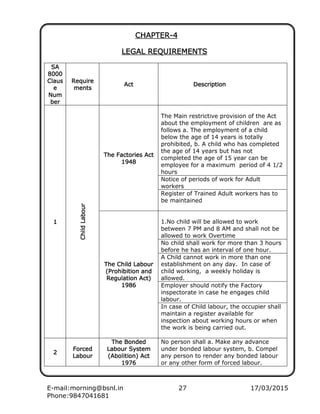
CHAPTERCHAPTERCHAPTERCHAPTER----4444
LEGAL REQUIREMENTSLEGAL REQUIREMENTSLEGAL REQUIREMENTSLEGAL REQUIREMENTS
SASASASA
8000800080008000
ClausClausClausClaus
eeee
NumNumNumNum
berberberber
RequireRequireRequireRequire
mentsmentsmentsments
ActActActAct DescriptionDescriptionDescriptionDescription
1111
ChildLabourChildLabourChildLabourChildLabour
ThThThThe Factories Acte Factories Acte Factories Acte Factories Act
1948194819481948
The Main restrictive provision of the Act
about the employment of children are as
follows a. The employment of a child
below the age of 14 years is totally
prohibited, b. A child who has completed
the age of 14 years but has not
completed the age of 15 year can be
employee for a maximum period of 4 1/2
hours
Notice of periods of work for Adult
workers
Register of Trained Adult workers has to
be maintained
The Child LabourThe Child LabourThe Child LabourThe Child Labour
(Prohibition and(Prohibition and(Prohibition and(Prohibition and
Regulation Act)Regulation Act)Regulation Act)Regulation Act)
1986198619861986
1.No child will be allowed to work
between 7 PM and 8 AM and shall not be
allowed to work Overtime
No child shall work for more than 3 hours
before he has an interval of one hour.
A Child cannot work in more than one
establishment on any day. In case of
child working, a weekly holiday is
allowed.
Employer should notify the Factory
inspectorate in case he engages child
labour.
In case of Child labour, the occupier shall
maintain a register available for
inspection about working hours or when
the work is being carried out.
2222
ForcedForcedForcedForced
LabourLabourLabourLabour
The BondedThe BondedThe BondedThe Bonded
Labour SystemLabour SystemLabour SystemLabour System
(Abolition) Act(Abolition) Act(Abolition) Act(Abolition) Act
1976197619761976
No person shall a. Make any advance
under bonded labour system, b. Compel
any person to render any bonded labour
or any other form of forced labour.
E-mail:morning@bsnl.in 28 17/03/2015
Phone:9847041681
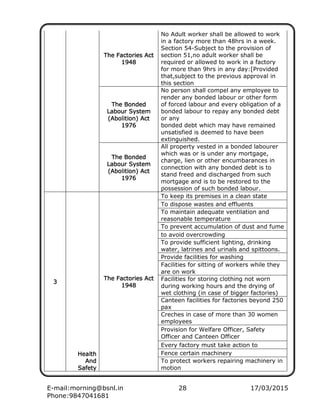
The Factories ActThe Factories ActThe Factories ActThe Factories Act
1948194819481948
No Adult worker shall be allowed to work
in a factory more than 48hrs in a week.
Section 54-Subject to the provision of
section 51,no adult worker shall be
required or allowed to work in a factory
for more than 9hrs in any day:[Provided
that,subject to the previous approval in
this section
The BondedThe BondedThe BondedThe Bonded
Labour SystemLabour SystemLabour SystemLabour System
(Abolition) Act(Abolition) Act(Abolition) Act(Abolition) Act
1976197619761976
No person shall compel any employee to
render any bonded labour or other form
of forced labour and every obligation of a
bonded labour to repay any bonded debt
or any
bonded debt which may have remained
unsatisfied is deemed to have been
extinguished.
The BondedThe BondedThe BondedThe Bonded
Labour SystemLabour SystemLabour SystemLabour System
(Abolition) Act(Abolition) Act(Abolition) Act(Abolition) Act
1976197619761976
All property vested in a bonded labourer
which was or is under any mortgage,
charge, lien or other encumbarances in
connection with any bonded debt is to
stand freed and discharged from such
mortgage and is to be restored to the
possession of such bonded labour.
3333
HealthHealthHealthHealth
AndAndAndAnd
SafetySafetySafetySafety
The Factories ActThe Factories ActThe Factories ActThe Factories Act
1948194819481948
To keep its premises in a clean state
To dispose wastes and effluents
To maintain adequate ventilation and
reasonable temperature
To prevent accumulation of dust and fume
to avoid overcrowding
To provide sufficient lighting, drinking
water, latrines and urinals and spittoons.
Provide facilities for washing
Facilities for sitting of workers while they
are on work
Facilities for storing clothing not worn
during working hours and the drying of
wet clothing (in case of bigger factories)
Canteen facilities for factories beyond 250
pax
Creches in case of more than 30 women
employees
Provision for Welfare Officer, Safety
Officer and Canteen Officer
Every factory must take action to
Fence certain machinery
To protect workers repairing machinery in
motion
E-mail:morning@bsnl.in 29 17/03/2015
Phone:9847041681
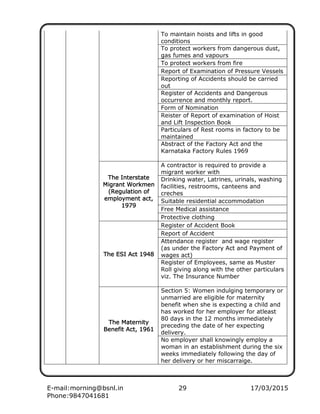
To maintain hoists and lifts in good
conditions
To protect workers from dangerous dust,
gas fumes and vapours
To protect workers from fire
Report of Examination of Pressure Vessels
Reporting of Accidents should be carried
out
Register of Accidents and Dangerous
occurrence and monthly report.
Form of Nomination
Reister of Report of examination of Hoist
and Lift Inspection Book
Particulars of Rest rooms in factory to be
maintained
Abstract of the Factory Act and the
Karnataka Factory Rules 1969
The InterstateThe InterstateThe InterstateThe Interstate
Migrant WorkmenMigrant WorkmenMigrant WorkmenMigrant Workmen
(Regulation of(Regulation of(Regulation of(Regulation of
employment act,employment act,employment act,employment act,
1979197919791979
A contractor is required to provide a
migrant worker with
Drinking water, Latrines, urinals, washing
facilities, restrooms, canteens and
creches
Suitable residential accommodation
Free Medical assistance
Protective clothing
The ESI Act 1948The ESI Act 1948The ESI Act 1948The ESI Act 1948
Register of Accident Book
Report of Accident
Attendance register and wage register
(as under the Factory Act and Payment of
wages act)
Register of Employees, same as Muster
Roll giving along with the other particulars
viz. The Insurance Number
The MaternityThe MaternityThe MaternityThe Maternity
Benefit Act, 1961Benefit Act, 1961Benefit Act, 1961Benefit Act, 1961
Section 5: Women indulging temporary or
unmarried are eligible for maternity
benefit when she is expecting a child and
has worked for her employer for atleast
80 days in the 12 months immediately
preceding the date of her expecting
delivery.
No employer shall knowingly employ a
woman in an establishment during the six
weeks immediately following the day of
her delivery or her miscarraige.
E-mail:morning@bsnl.in 30 17/03/2015
Phone:9847041681
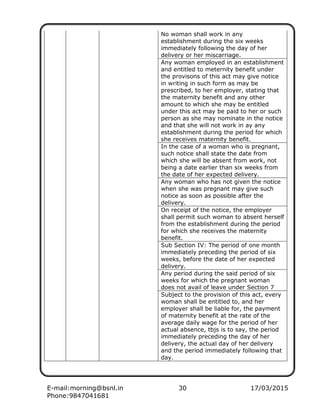
No woman shall work in any
establishment during the six weeks
immediately following the day of her
delivery or her miscarriage.
Any woman employed in an establishment
and entitled to meternity benefit under
the provisons of this act may give notice
in writing in such form as may be
prescribed, to her employer, stating that
the maternity benefit and any other
amount to which she may be entitled
under this act may be paid to her or such
person as she may nominate in the notice
and that she will not work in ay any
establishment during the period for which
she receives maternity benefit.
In the case of a woman who is pregnant,
such notice shall state the date from
which she will be absent from work, not
being a date earlier than six weeks from
the date of her expected delivery.
Any woman who has not given the notice
when she was pregnant may give such
notice as soon as possible after the
delivery.
On receipt of the notice, the employer
shall permit such woman to absent herself
from the establishment during the period
for which she receives the maternity
benefit.
Sub Section IV: The period of one month
immediately preceding the period of six
weeks, before the date of her expected
delivery.
Any period during the said period of six
weeks for which the pregnant woman
does not avail of leave under Section 7
Subject to the provision of this act, every
woman shall be entitled to, and her
employer shall be liable for, the payment
of maternity benefit at the rate of the
average daily wage for the period of her
actual absence, tbjs is to say, the period
immediately preceding the day of her
delivery, the actual day of her delivery
and the period immediately following that
day.
E-mail:morning@bsnl.in 31 17/03/2015
Phone:9847041681
The EmployersThe EmployersThe EmployersThe Employers
Liablity Act, 1938Liablity Act, 1938Liablity Act, 1938Liablity Act, 1938
The employers liability act is closely
related to Chapters IV, V, VA of the ESI
Act 1948 and to section 3 of the Workmen
Compensation Act 1923
4444
FreedomFreedomFreedomFreedom
ooooffff
AssociatiAssociatiAssociatiAssociati
onononon
The IndustrialThe IndustrialThe IndustrialThe Industrial
Dispute Act 1947Dispute Act 1947Dispute Act 1947Dispute Act 1947
Section 2 (kkk) "lay-off" (with its
grammatical variations and cognate
expressions) means the failure, refusal or
inability of an employer on account of
shortage of coal, power or raw materials
or the accumulation of stocks or the
break-down of machinery 39[or natural
calamity or for any other connected
reason] to give employment to a
workman whose name is borne on the
muster rolls of his industrial
establishment and who has not been
retrenched;
2A. Dismissal, etc., of an individual
workman to be deemed to be an
industrial dispute Where any employer
discharges, dismisses, retrenches or
otherwise terminates the services of an
individual workman, any dispute or
difference between that workman and his
employer connected with, or arising out
of, such discharge, dismissal,
retrenchment or termination shall be
deemed to be an industrial dispute
notwithstanding that no other workman
nor any union of workmen is a party to
the dispute.
The Trade UnionThe Trade UnionThe Trade UnionThe Trade Union
Act 1926Act 1926Act 1926Act 1926
Section 4: Registration of Trade Union:
Any 7 or more members of a trade union
may, by subscribing their names to the
rules of the Trade union and its
compliance.
Section 9A: Not less than 10% or 100 of
the workmen, whichever is less, subject
to a minimum of 7, engaged or employed
in an establishment.
5555
DiscriminDiscriminDiscriminDiscrimin
ationationationation
The EqualThe EqualThe EqualThe Equal
Remuneration ActRemuneration ActRemuneration ActRemuneration Act
1976197619761976
Payment of Remuneration should be equal
to men and women workers and the
prevention of discrimination, on the
ground of sex, against women in the
matter of employment and for matters
connnected therewith of incidental
thereto.
E-mail:morning@bsnl.in 32 17/03/2015
Phone:9847041681
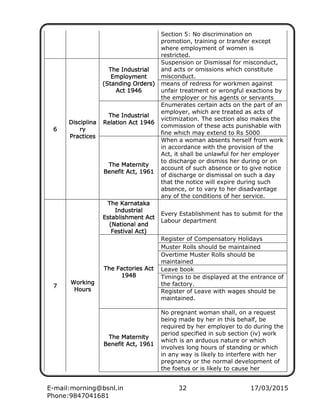
Section 5: No discrimination on
promotion, training or transfer except
where employment of women is
restricted.
6666
DisciplinaDisciplinaDisciplinaDisciplina
ryryryry
PracticesPracticesPracticesPractices
The IndustrialThe IndustrialThe IndustrialThe Industrial
EmploymentEmploymentEmploymentEmployment
(Standing Orders)(Standing Orders)(Standing Orders)(Standing Orders)
AcAcAcAct 1946t 1946t 1946t 1946
Suspension or Dismissal for misconduct,
and acts or omissions which constitute
misconduct.
means of redress for workmen against
unfair treatment or wrongful exactions by
the employer or his agents or servants
The IndustrialThe IndustrialThe IndustrialThe Industrial
Relation Act 1946Relation Act 1946Relation Act 1946Relation Act 1946
Enumerates certain acts on the part of an
employer, which are treated as acts of
victimization. The section also makes the
commission of these acts punishable with
fine which may extend to Rs 5000
The MaternityThe MaternityThe MaternityThe Maternity
Benefit Act, 1961Benefit Act, 1961Benefit Act, 1961Benefit Act, 1961
When a woman absents herself from work
in accordance with the provision of the
Act, it shall be unlawful for her employer
to discharge or dismiss her during or on
account of such absence or to give notice
of discharge or dismissal on such a day
that the notice will expire during such
absence, or to vary to her disadvantage
any of the conditions of her service.
7777
WorkingWorkingWorkingWorking
HoursHoursHoursHours
The KarnatakaThe KarnatakaThe KarnatakaThe Karnataka
IndustrialIndustrialIndustrialIndustrial
Establishment ActEstablishment ActEstablishment ActEstablishment Act
(National and(National and(National and(National and
Festival Act)Festival Act)Festival Act)Festival Act)
Every Establishment has to submit for the
Labour department
The Factories ActThe Factories ActThe Factories ActThe Factories Act
1948194819481948
Register of Compensatory Holidays
Muster Rolls should be maintained
Overtime Muster Rolls should be
maintained
Leave book
Timings to be displayed at the entrance of
the factory.
Register of Leave with wages should be
maintained.
TTTThe Maternityhe Maternityhe Maternityhe Maternity
Benefit Act, 1961Benefit Act, 1961Benefit Act, 1961Benefit Act, 1961
No pregnant woman shall, on a request
being made by her in this behalf, be
required by her employer to do during the
period specified in sub section (iv) work
which is an arduous nature or which
involves long hours of standing or which
in any way is likely to interfere with her
pregnancy or the normal development of
the foetus or is likely to cause her
E-mail:morning@bsnl.in 33 17/03/2015
Phone:9847041681
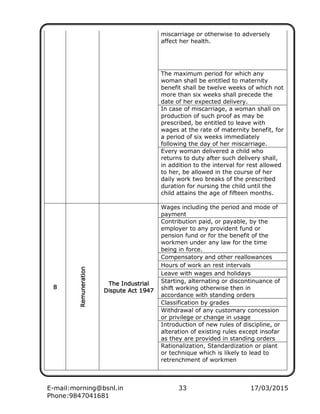
miscarriage or otherwise to adversely
affect her health.
The maximum period for which any
woman shall be entitled to maternity
benefit shall be twelve weeks of which not
more than six weeks shall precede the
date of her expected delivery.
In case of miscarriage, a woman shall on
production of such proof as may be
prescribed, be entitled to leave with
wages at the rate of maternity benefit, for
a period of six weeks immediately
following the day of her miscarriage.
Every woman delivered a child who
returns to duty after such delivery shall,
in addition to the interval for rest allowed
to her, be allowed in the course of her
daily work two breaks of the prescribed
duration for nursing the child until the
child attains the age of fifteen months.
8888
RemunerationRemunerationRemunerationRemuneration
The IndustrialThe IndustrialThe IndustrialThe Industrial
Dispute Act 1947Dispute Act 1947Dispute Act 1947Dispute Act 1947
Wages including the period and mode of
payment
Contribution paid, or payable, by the
employer to any provident fund or
pension fund or for the benefit of the
workmen under any law for the time
being in force.
Compensatory and other reallowances
Hours of work an rest intervals
Leave with wages and holidays
Starting, alternating or discontinuance of
shift working otherwise then in
accordance with standing orders
Classification by grades
Withdrawal of any customary concession
or privilege or change in usage
Introduction of new rules of discipline, or
alteration of existing rules except insofar
as they are provided in standing orders
Rationalization, Standardization or plant
or technique which is likely to lead to
retrenchment of workmen
E-mail:morning@bsnl.in 34 17/03/2015
Phone:9847041681
The Factories actThe Factories actThe Factories actThe Factories act
1948194819481948
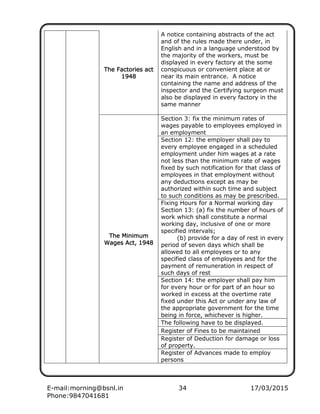
A notice containing abstracts of the act
and of the rules made there under, in
English and in a language understood by
the majority of the workers, must be
displayed in every factory at the some
conspicuous or convenient place at or
near its main entrance. A notice
containing the name and address of the
inspector and the Certifying surgeon must
also be displayed in every factory in the
same manner
The MinimumThe MinimumThe MinimumThe Minimum
Wages Act, 1948Wages Act, 1948Wages Act, 1948Wages Act, 1948
Section 3: fix the minimum rates of
wages payable to employees employed in
an employment
Section 12: the employer shall pay to
every employee engaged in a scheduled
employment under him wages at a rate
not less than the minimum rate of wages
fixed by such notification for that class of
employees in that employment without
any deductions except as may be
authorized within such time and subject
to such conditions as may be prescribed.
Fixing Hours for a Normal working day
Section 13: (a) fix the number of hours of
work which shall constitute a normal
working day, inclusive of one or more
specified intervals;
(b) provide for a day of rest in every
period of seven days which shall be
allowed to all employees or to any
specified class of employees and for the
payment of remuneration in respect of
such days of rest
Section 14: the employer shall pay him
for every hour or for part of an hour so
worked in excess at the overtime rate
fixed under this Act or under any law of
the appropriate government for the time
being in force, whichever is higher.
The following have to be displayed.
Register of Fines to be maintained
Register of Deduction for damage or loss
of property.
Register of Advances made to employ
persons
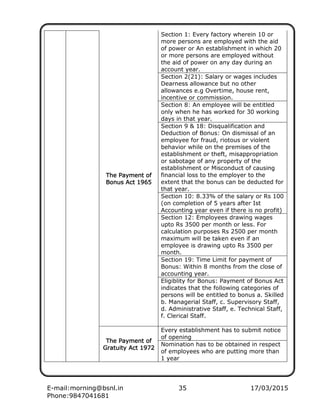
E-mail:morning@bsnl.in 35 17/03/2015
Phone:9847041681
The Payment ofThe Payment ofThe Payment ofThe Payment of
Bonus Act 1965Bonus Act 1965Bonus Act 1965Bonus Act 1965
Section 1: Every factory wherein 10 or
more persons are employed with the aid
of power or An establishment in which 20
or more persons are employed without
the aid of power on any day during an
account year.
Section 2(21): Salary or wages includes
Dearness allowance but no other
allowances e.g Overtime, house rent,
incentive or commission.
Section 8: An employee will be entitled
only when he has worked for 30 working
days in that year.
Section 9 & 18: Disqualification and
Deduction of Bonus: On dismissal of an
employee for fraud, riotous or violent
behavior while on the premises of the
establishment or theft, misappropriation
or sabotage of any property of the
establishment or Misconduct of causing
financial loss to the employer to the
extent that the bonus can be deducted for
that year.
Section 10: 8.33% of the salary or Rs 100
(on completion of 5 years after Ist
Accounting year even if there is no profit)
Section 12: Employees drawing wages
upto Rs 3500 per month or less. For
calculation purposes Rs 2500 per month
maximum will be taken even if an
employee is drawing upto Rs 3500 per
month.
Section 19: Time Limit for payment of
Bonus: Within 8 months from the close of
accounting year.
Eligiblity for Bonus: Payment of Bonus Act
indicates that the following categories of
persons will be entitled to bonus a. Skilled
b. Managerial Staff, c. Supervisory Staff,
d. Administrative Staff, e. Technical Staff,
f. Clerical Staff.
The Payment ofThe Payment ofThe Payment ofThe Payment of
Gratuity Act 1972Gratuity Act 1972Gratuity Act 1972Gratuity Act 1972
Every establishment has to submit notice
of opening
Nomination has to be obtained in respect
of employees who are putting more than
1 year
E-mail:morning@bsnl.in 36 17/03/2015
Phone:9847041681
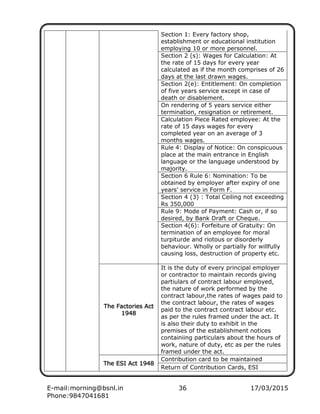
Section 1: Every factory shop,
establishment or educational institution
employing 10 or more personnel.
Section 2 (s): Wages for Calculation: At
the rate of 15 days for every year
calculated as if the month comprises of 26
days at the last drawn wages.
Section 2(e): Entitlement: On completion
of five years service except in case of
death or disablement.
On rendering of 5 years service either
termination, resignation or retirement.
Calculation Piece Rated employee: At the
rate of 15 days wages for every
completed year on an average of 3
months wages.
Rule 4: Display of Notice: On conspicuous
place at the main entrance in English
language or the language understood by
majority.
Section 6 Rule 6: Nomination: To be
obtained by employer after expiry of one
years' service in Form F.
Section 4 (3) : Total Ceiling not exceeding
Rs 350,000
Rule 9: Mode of Payment: Cash or, if so
desired, by Bank Draft or Cheque.
Section 4(6): Forfeiture of Gratuity: On
termination of an employee for moral
turpiturde and riotous or disorderly
behaviour. Wholly or partially for willfully
causing loss, destruction of property etc.
The Factories ActThe Factories ActThe Factories ActThe Factories Act
1948194819481948
It is the duty of every principal employer
or contractor to maintain records giving
partiulars of contract labour employed,
the nature of work performed by the
contract labour,the rates of wages paid to
the contract labour, the rates of wages
paid to the contract contract labour etc.
as per the rules framed under the act. It
is also their duty to exhibit in the
premises of the establishment notices
containiing particulars about the hours of
work, nature of duty, etc as per the rules
framed under the act.
The ESI Act 1948The ESI Act 1948The ESI Act 1948The ESI Act 1948
Contribution card to be maintained
Return of Contribution Cards, ESI
E-mail:morning@bsnl.in 37 17/03/2015
Phone:9847041681
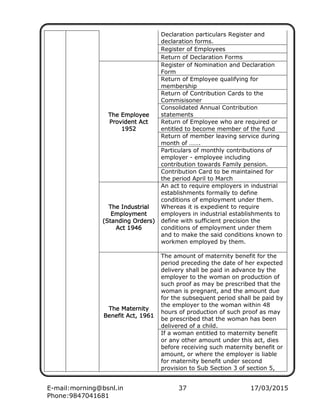
Declaration particulars Register and
declaration forms.
Register of Employees
Return of Declaration Forms
The EmployeeThe EmployeeThe EmployeeThe Employee
Provident ActProvident ActProvident ActProvident Act
1952195219521952
Register of Nomination and Declaration
Form
Return of Employee qualifying for
membership
Return of Contribution Cards to the
Commisisoner
Consolidated Annual Contribution
statements
Return of Employee who are required or
entitled to become member of the fund
Return of member leaving service during
month of …….
Particulars of monthly contributions of
employer - employee including
contribution towards Family pension.
Contribution Card to be maintained for
the period April to March
The IndustrialThe IndustrialThe IndustrialThe Industrial
EmploymentEmploymentEmploymentEmployment
(Standing Orders)(Standing Orders)(Standing Orders)(Standing Orders)
Act 1946Act 1946Act 1946Act 1946
An act to require employers in industrial
establishments formally to define
conditions of employment under them.
Whereas it is expedient to require
employers in industrial establishments to
define with sufficient precision the
conditions of employment under them
and to make the said conditions known to
workmen employed by them.
The MaternityThe MaternityThe MaternityThe Maternity
Benefit Act, 1961Benefit Act, 1961Benefit Act, 1961Benefit Act, 1961
The amount of maternity benefit for the
period preceding the date of her expected
delivery shall be paid in advance by the
employer to the woman on production of
such proof as may be prescribed that the
woman is pregnant, and the amount due
for the subsequent period shall be paid by
the employer to the woman within 48
hours of production of such proof as may
be prescribed that the woman has been
delivered of a child.
If a woman entitled to maternity benefit
or any other amount under this act, dies
before receiving such maternity benefit or
amount, or where the employer is liable
for maternity benefit under second
provision to Sub Section 3 of section 5,
E-mail:morning@bsnl.in 38 17/03/2015
Phone:9847041681
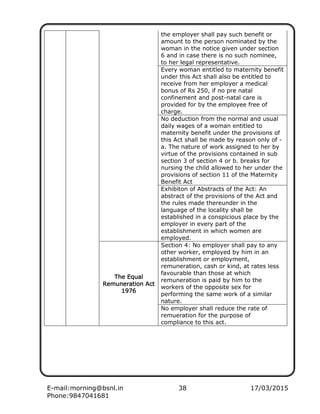
the employer shall pay such benefit or
amount to the person nominated by the
woman in the notice given under section
6 and in case there is no such nominee,
to her legal representative.
Every woman entitled to maternity benefit
under this Act shall also be entitled to
receive from her employer a medical
bonus of Rs 250, if no pre natal
confinement and post-natal care is
provided for by the employee free of
charge.
No deduction from the normal and usual
daily wages of a woman entitled to
maternity benefit under the provisions of
this Act shall be made by reason only of -
a. The nature of work assigned to her by
virtue of the provisions contained in sub
section 3 of section 4 or b. breaks for
nursing the child allowed to her under the
provisions of section 11 of the Maternity
Benefit Act
Exhibiton of Abstracts of the Act: An
abstract of the provisions of the Act and
the rules made thereunder in the
language of the locality shall be
established in a conspicious place by the
employer in every part of the
establishment in which women are
employed.
The EqualThe EqualThe EqualThe Equal
Remuneration ActRemuneration ActRemuneration ActRemuneration Act
1976197619761976
Section 4: No employer shall pay to any
other worker, employed by him in an
establishment or employment,
remuneration, cash or kind, at rates less
favourable than those at which
remuneration is paid by him to the
workers of the opposite sex for
performing the same work of a similar
nature.
No employer shall reduce the rate of
remueration for the purpose of
compliance to this act.
E-mail:morning@bsnl.in 39 17/03/2015
Phone:9847041681
CHCHCHCHAPTERAPTERAPTERAPTER----5555
LIST OF MANDATORY DOCUMENTSLIST OF MANDATORY DOCUMENTSLIST OF MANDATORY DOCUMENTSLIST OF MANDATORY DOCUMENTS
Sl noSl noSl noSl no DocumentDocumentDocumentDocumentssss
1. SA8000 Manual
2. Standing Orders
3. Health And Safety Manual
4. Risk Assessment Manual
5. Operation Control Procedure
6. Emergency Preparedness Plan
7. Basic need wages calculation
E-mail:morning@bsnl.in 40 17/03/2015
Phone:9847041681
CHCHCHCHAPTERAPTERAPTERAPTER----6666
LIST OF MANDATORY RECORDSLIST OF MANDATORY RECORDSLIST OF MANDATORY RECORDSLIST OF MANDATORY RECORDS
Note: All formats and registers as per legal requirements
(Refer Annexure 1Refer Annexure 1Refer Annexure 1Refer Annexure 1)
SISISISI nononono RecordsRecordsRecordsRecords
1. Employee Master
2. Master List of Documents
3. Minutes of Meeting
4. Training Attendance Record
5. Training Feedback
6. Suggestion Form
7. Grievance Register
8. Approved Vender/Sub-Contractor List
9. Vendor/Sub-Contractor Registration Form
10. Annual Audit Plan
11. List of Qualified Auditors
12. Vendor Performance Evaluation Report
13. Objectives & Targets
14. Objective Achievement Report Periodic
15. Non-Conformance Report
16. External Communication Form
17. Accident/Incident Report
18. Mock Drill Register
19. Supplier Questionnaire
20. Wage Calculation Sheet
21. Wage Slip
22. Attendance Sheet
23. MRM Minutes
24. Over Time Records
25. Leave Application Form
26. Application For Employment
27. Health and Safety Training Records
28. ETP Log Book
E-mail:morning@bsnl.in 41 17/03/2015
Phone:9847041681
CHAPTERCHAPTERCHAPTERCHAPTER----7777
FREQUENTLY ASKED QUESTIONSFREQUENTLY ASKED QUESTIONSFREQUENTLY ASKED QUESTIONSFREQUENTLY ASKED QUESTIONS
1.1.1.1. What is the SA8000 Standard and who uses it?What is the SA8000 Standard and who uses it?What is the SA8000 Standard and who uses it?What is the SA8000 Standard and who uses it?
The SA8000 standard and verification system is a credible,
comprehensive and efficient tool for assuring humane workplaces.
2.2.2.2. What is the SA8000 Guidance Document and who uses it?What is the SA8000 Guidance Document and who uses it?What is the SA8000 Guidance Document and who uses it?What is the SA8000 Guidance Document and who uses it?
The Guidance Document is an important piece of work. It goes
through the nine elements of the standard and interprets them
according to the original intent of the international, multi-stakeholder
group that drafted SA8000. This same group – the SAI Advisory Board
– reviews and approves of Guidance Document text and revisions.
The Guidance Document acts as a field guide to help auditors pay
close attention to some of the important issues involved in the
auditing process, and it also serves as an implementation guide for
the companies interested in adopting the SA8000 system.
3.3.3.3. How does my company becomeHow does my company becomeHow does my company becomeHow does my company become AAAAccreditedccreditedccreditedccredited to certify factories andto certify factories andto certify factories andto certify factories and
facilities to thfacilities to thfacilities to thfacilities to the SA8000 Standard?e SA8000 Standard?e SA8000 Standard?e SA8000 Standard?
The accreditation process for SA8000 certification is managed by
Social Accountability Accreditation Services (SAAS). Accreditation is
a process similar to licensing, wherein SAAS evaluates an applicant
certification firm's capacity to thoroughly audit a workplace for
compliance with SA8000. This process includes an audit of a
company's written policies, procedures and documentation.
Accreditation applicants must demonstrate adherence to SAAS
accreditation criteria.
The ongoing accreditation process also includes the following:
1. Office audit: Office review and interview with staff
2. Witness audit: Observation of auditors conducting SA8000 audits
3. Periodic re-evaluation: Surveillance audits.
4.4.4.4. What is SAI?What is SAI?What is SAI?What is SAI?
SAI is a non-governmental, international, multi-stakeholder
organization dedicated to improving workplaces and communities by
developing and implementing socially responsible standards.
SAI convenes key stakeholders to develop consensus-based
voluntary standards, conducts cost-benefit research, accredits
auditors, provides training and technical assistance, and assists
corporations in improving social compliance in their supply chains.
E-mail:morning@bsnl.in 42 17/03/2015
Phone:9847041681
In 1997, SAI launched SA8000 (Social Accountability 8000) – a
voluntary standard for workplaces, based on ILO and UN
conventions – which is currently used by businesses
and governments around the world and is recognized as one of the
strongest workplace
standards.
SAI partners with trade unions, local NGOs, multi-stakeholder
initiatives, organic, fair trade, and environmental organizations,
development charities, and anti-corruption groups to carry out
research, training and capacity-building programs.
5.5.5.5. How widely recognized is the SA8000 standard?How widely recognized is the SA8000 standard?How widely recognized is the SA8000 standard?How widely recognized is the SA8000 standard?
Sufficiently specific to be used to audit companies and contractors
alike in multiple industries and countries, SA8000 represents a
major breakthrough: it was the first auditable social standard and
creates a process that is truly independent (it is neither a
government project nor dominated by any single interest group).
Representatives of trade unions, human rights organizations,
academia, retailers, manufacturers, contractors, as well as
consulting, accounting, and certification firms, by consensus,
cooperated to develop the SA8000 Standard. Because of its multi-
stakeholder input, applicability across industries and countries,
emphasis on continuous improvement and use of a management
system for implementation, SA8000 is widely recognized as one of
the most comprehensive and well-respected human rights social
standard available.
6.6.6.6. What is the impact of SA8000 worldwide?What is the impact of SA8000 worldwide?What is the impact of SA8000 worldwide?What is the impact of SA8000 worldwide?
Initial evidence indicates that SA8000 certified facilities enjoy a
competitive advantage and workers experience concrete benefits as
the SA8000 management system and any needed corrective actions
are put in place.
7.7.7.7. Where can I buy a product made at an SA8000Where can I buy a product made at an SA8000Where can I buy a product made at an SA8000Where can I buy a product made at an SA8000----certified facility?certified facility?certified facility?certified facility?
Certification to the SA8000 standard is not for specific items
produced by certified facilities, but rather the process through which
the products are made. SA8000-certified facilities are usually a part
of the supply chain that supplies to international companies and
brands that choose to source from SA8000 certified facilities.
E-mail:morning@bsnl.in 43 17/03/2015
Phone:9847041681
8.8.8.8. How do I become an SA8000 AHow do I become an SA8000 AHow do I become an SA8000 AHow do I become an SA8000 Auditor?uditor?uditor?uditor?
SAAS does not directly employ SA8000 auditors. Auditors interested
in conducting SA8000 audits may do so in one of two ways:
working directly for a SAAS-accredited Certification Body, or
working as an individual auditor available for hire by accredited
CBs.
9.9.9.9. What are the benefits of certification?What are the benefits of certification?What are the benefits of certification?What are the benefits of certification?
- Putting company values into action.
- Enhancing company and brand reputation.
- Improving communication with employees and recruitment,
retention and productivity.
- Supporting better supply chain management and performance.
- Enhanced opportunities for workers to organize trade unions and
bargain collectively.
- Education about core labor rights.
- A way to generate public awareness of companies committed to
assuring humane working conditions.
10.10.10.10. How long does it take to be certified?How long does it take to be certified?How long does it take to be certified?How long does it take to be certified?
The average length of time for the certification process varies
depending on the readiness of the facility and the systems it has
put in place to meet the requirements of SA8000. Some facilities
require a pre-assessment prior to a certification audit. If it is found
that the facility requires additional procedures to meet the
Standard, corrective actions must then be put in place. Once the
certification audit is conducted, corrective actions may be issued
and again, procedures will need to be put in place to correct them.
Major corrective actions must be evident before certification may
be granted. Therefore, the amount of time needed between
applying to be certified and becoming certified could vary between
several months and several years.
11.11.11.11. What are the average costs of earning certification?What are the average costs of earning certification?What are the average costs of earning certification?What are the average costs of earning certification?
The average costs of earning certification vary for each applicant
facility, depending on the Certification Body to which it applies
location of the facility, facility size and scope of the certification.
12.12.12.12. What Is Certification?What Is Certification?What Is Certification?What Is Certification?
Certification is the process by which individual facilities and
organizations undergo assessment by a third-party auditor. If the
E-mail:morning@bsnl.in 44 17/03/2015
Phone:9847041681
facility meets the requirements set out in the standard or code, it
can earn a certificate attesting to its compliance.
Third party assessment occurs when a facility is voluntarily audited
against a standard or code by an independent, external body that
is neither a direct purchaser nor a consultant. Performance deemed
to be in compliance with the standard is acknowledged by the
granting a certificate. This certificate can be displayed and its
contents communicated to relevant parties such as buyers or
brands.
E-mail:morning@bsnl.in 45 17/03/2015
Phone:9847041681
CHAPTERCHAPTERCHAPTERCHAPTER----8888
SA8000 STANDARD IN A NUTSHELLSA8000 STANDARD IN A NUTSHELLSA8000 STANDARD IN A NUTSHELLSA8000 STANDARD IN A NUTSHELL
Only The Salient Features are included .This Is Not a replacement of the
Standard. This Is Only a Guide to Understand the Standard. These
requirements are in addition to the labour law of our country. Also refer
the relevant UN conventions and ILO conventions
SLSLSLSL NONONONO StandardStandardStandardStandard
Clause NumberClause NumberClause NumberClause Number
And TitleAnd TitleAnd TitleAnd Title
BrieflyBrieflyBrieflyBriefly STIPULATION IN SISTIPULATION IN SISTIPULATION IN SISTIPULATION IN SIMPLEMPLEMPLEMPLE
WORDSWORDSWORDSWORDS
1. 1.1
Child Labour
Minimum age Do not engage labour of age
below 15 years. Keep employee
age proof.
2. 1.2
Child Labour
Policy Document and communicate
your policy on child labour.
everyone should understand
this policy
3. 1.3
Child Labour
Prevention And
Remediation
Develop a procedure for
avoiding child labour in
recruitment. In case found
currently engaging child labour
due to past policies, have a
methodology for remediation of
child labour.
Do not engage young workers
for night work and hazardous
work (work involving chemicals,
radioactive materials etc.)
4. 2.1
Forced Labour
Prevention Do not engage in or support the
use of forced labour(where
work output is against their
free will and not given by
worker voluntarily but by
means of threat of financial
penalty/due to
debt/deposit/holding of workers
documents like certificates)
This means no bonded labour
or concentration camp/slavery.
Give freedom to leave work
place after workday and to
resign and leave from job with
E-mail:morning@bsnl.in 46 17/03/2015
Phone:9847041681
adequate notice.
5. 2.2
Forced Labour
Human Trafficking Do not engage in human
trafficking
6. 3.1
Health And
Safety
Risk Analysis And
Mitigation
Identify by risk analysis, the
hazards inherent in the work
and minimize them by
implementing control measures
(e.g. firefighting, first aid,
emergency preparedness)
necessary for employee health
and safety.
7. 3.2
Health And
Safety
Health And Safety
Officer
Appoint a senior management
representative responsible for
implementing the health and
safety requirements specified
by this standard.
8. 3.3
Health And
Safety
Training Provide to employees regular
and recorded health and safety
training related to the health
and safety aspects of work they
are currently performing.
The training should be effective
and not as a ritual.
Documented instructions also
needed.
9. 3.4
Health And
Safety
Detection
Prevention And
Control
Develop a system to detect,
avoid or respond to potential
threats to health and safety of
all personnel. (e.g. fire)
Consider health and safety
issues when any new
material/chemical or
technology is implemented.
10. 3.5
Health and
Safety
PPE and First Aid Provide adequate PPE and first
aid, medical treatment for work
related injuries.
11. 3.6 New and
expectant
mothers
Assess their risks provide
adequate health and safety
measures to them
12. 3.7
Health And
Safety
Hygiene And
Sanitation
Provide clean bathroom ,
hygienic drinking water and
sanitary facilities for food
storage
E-mail:morning@bsnl.in 47 17/03/2015
Phone:9847041681
13. 3.8
Health And
Safety
Clean And safe
Staying Place
If dormitories are provided,
make sure that they are clean,
safe and meet the basic needs
of the personnel.
Adequate safety measures
including fire protection are to
be provided in the dormitory.
14. 4.1
Freedom Of
Association And
The Right To
Collective
Bargaining
Trade Union Respect the right of employees
to join trade unions and for
collective bargaining
15. 4.2
Freedom Of
Association And
The Right To
Collective
Bargaining
Parallel Means In case unions are restricted by
law (e.g. special economic
zones) ,allow parallel means of
communication with
management.
16. 4.3
Freedom Of
Association And
The Right To
Collective
Bargaining
Non Persecution Do not persecute union
members or executives due to
union activity.
17. 5.1
Discrimination
Nondiscrimination Do not engage in parochial
practices. Do not engage in
discrimination of employees
due to caste, creed, sex,
language etc to which they
belong. Provide equal pay for
equal work.
18. 5.2
Discrimination
Non Interference Do not interfere with the right
of the employees to follow their
religious/ethnic beliefs and
practices.
19. 5.3
Discrimination
Prevent Sexual
Harassment
Prevent sexual harassment in
the workplace. Clearly
communicate the company
policy. Provide a framework for
reporting and dealing with such
issues if any.
20. 5.4
Discrimination
Tests Do not subject personnel to
pregnancy or virginity tests.
E-mail:morning@bsnl.in 48 17/03/2015
Phone:9847041681
21. 6.1
Disciplinary
Action
No
Violence/Torture
Treatment
Do not use punishment which is
physically painful, mentally
torturing or verbal abuse.
In case of any disciplinary
action, follow fair practices.
No harsh or inhumane
treatment is allowed.
Follow requirements of standing
orders.
22. 7.1
Working Hours
Limits Meet the applicable Indian
labour law. Engage workers for
not more than 48 hours per
week of regular work and
overtime shall not exceed 12
hours per week. Provide one
day off in every seven day
cycle of work. Pay premium
wages for overtime work.
23. 7.2
Working Hours
Weekly off Provide one day off in every
seven day cycle of work. Pay
premium wages for overtime
work.
24. 7.3
Working Hours
Voluntary
Overtime
Overtime work if carried out
should meet the stipulations of
7.3, otherwise it should be
voluntary. Work time averaging
over several weeks is allowed.
Do not extract forced overtime.
25. 7.4
Working Hours
Seasonal Factor To meet the short term
(seasonal) business needs,
there can be overtime agreed
with the union.
26. 8.1
Remuneration
Minimum Wages Pay minimum wages as per
legal requirements.
27. 8.2
Remuneration
Fines If allowed by National law
company can deduct from
wages for disciplinary purposes.
28. 8.3 Payment Pay wages in a manner
convenient to the employees
Electronic transfer, Cash or
Cheque. Give pay slip with
details of wage calculation.
29. 8.4 Overtime Pay premium wages for OT.
E-mail:morning@bsnl.in 49 17/03/2015
Phone:9847041681
30. 8.5
Remuneration
No Bypass Do not by-pass legal
requirements by means of
engaging false apprentices/
labour only contracts/ perennial
casual workers etc.
31. 9.1
Management
Systems
SA Policy Define document and
Communicate to all the social
accountability policy of the
company
32. 9.2
Management
Systems
SA
Representative
Appoint a member of
management as SA
representative to implement
the system in full in the
company
33. 9.3
Management
Systems
SA
Non Management
Representative
Allow non management
personnel to elect a non
management SA representative
34. 9.4
Management
Systems
Management
Review
Review regularly the SA system
performance at the top
management level and take
necessary action for updating
and improvement. Conduct
internal audits and take
corrective action on lapses.
35. 9.5
Management
Systems
Roles,
Responsibilities,
Training And
Monitoring
a) Define all roles and
responsibilities related to
implementing this system.
b) Train initially and
periodically retrain all
employees on this standard.
c) Continuously monitor the
implementation of the system
to demonstrate its effective
implementation.
36. 9.6 SA guidance and
interpretation
Refer SA guidance document
for interpretation of the
Standard.
E-mail:morning@bsnl.in 50 17/03/2015
Phone:9847041681
37. 9.7
Management
Systems
Supplier Selection
and
Supplier
Commitment
Supplier selection procedure
should include weightage for
their implementation of the SA
system requirements.
Maintain appropriate records on
suppliers, subcontractors
a) on conformance to SA
8000 requirements
b) supplier audit
c) supplier corrective action
d) communication on
subletting if any of the
suppliers.
38. 9.8
Management
Systems
Supplier
Compliance
Records
Maintain reasonable records of
supplier compliance on SA 8000
requirements.
39. 9.9 Supplier Control Ensure by making reasonable
efforts that the requirements of
this standard are met by the
suppliers and subcontractors.
40. 9.10
Management
Systems
Home Workers Home workers, if any, should
also be protected just like
direct workers, regarding
welfare.
41. 9.11
Management
Systems
Addressing
Concerns
Have a system for addressing
and resolving the
grievances/complaints of
workers/ other interested
parties regarding the SA 8000
system implementation.
42. 9.12
Management
Systems
Corrective Action Have system for taking
immediate action to resolve the
issues raised and also to deal
with the root cause of the
problem to avoid recurrence of
the problem. This also requires
that adequate resources are
assigned to the solution.
43. 9.13
Management
Systems
Outside
Communication
Establish and maintain
Procedures to communicate the
results of the SA 8000
implementation to interested
parties like customers, NGOs,
General Public, Authorities etc.
E-mail:morning@bsnl.in 51 17/03/2015
Phone:9847041681
44. 9.14
Management
System
Stake holder
engagement
Demonstrate willingness to
interact with all interested
stake holders.
45. 9.15
Management
Systems
Access For
Verification
Provide access (when
requested) to interested parties
to verify records of SA 8000
implementation in the company
46. 9.16
Management
Systems
Records Maintain appropriate (self
explanatory )records to prove
compliance to the system in an
objective manner
Note:-
1. Validity of certification: 3 years
2. Periodic audit frequency after certification: Every 6 months one will be a
surprise audit.
3. SAI (Social accountability International) was started in the year 1997.
E-mail:morning@bsnl.in 52 17/03/2015
Phone:9847041681
CHAPTERCHAPTERCHAPTERCHAPTER----9999
SSSSAAAA8000800080008000::::2014201420142014 –––– KKKKEEEEYYYY CCCCHHHHANGESANGESANGESANGES
TTTThhhheeee kkkkeeeeyyyy cccchhhhaaaangngngngeeeessss aaaarrrreeee eeeespspspspeeeeciciciciaaaallyllyllylly rrrreeeelatlatlatlateeeedddd to:to:to:to:
1. IIIInnnnttttentententent aaaandndndnd ScopeScopeScopeScope
The intent of the Standard is unchanged; language has been edited for
clarity. The new phrasing clarifies that SA8000 is a sustainable standard for
ensuring the empowerment and protection of the health and welfare of all
personnel throughout a worksite and a company’s supply chain, while
providing a management system for employers to demonstrate and verify
their compliance with the Standard.
1.1 MMMMaaaannnnaaaagegegegemmmmentententent SSSSyyyyststststemememem
There is a new introductory statement about the Management System
approach and its application to the other eight elements of the Standard.
This addition is intended to emphasize the use of the Management System
as the foundation of correct implementation of, and sustained compliance
with, SA8000. This introduction also emphasizes the importance of a term
newly used in the Standard, “Social Performance,” which seeks continual
improvement when applying, sustaining and Complying with SA8000.
1.2 AddAddAddAdditiitiitiitionsonsonsons
ILO Convention No. 181 has been added because it is the source of the new
SA8000: 2014 definition of “Private Employment Agency” (Definition No. 17,
supra) used in the Management System criterion 9.10.1. This requirement
states that organisations shall conduct due diligence on any and all private
employment agencies they use.
The UN Guiding Principles on Business and Human Rights (UNGP) has been
added because it is the most widely disseminated and cited compilation of
the responsibilities of business to respect human rights that has been
developed over the past few decades. In particular, the concept and
requirement of due diligence in the SA8000:2014 management of suppliers
and contractors requirements (9.10.1) originates from the UNGP. This
mandated tool is intended to strengthen an organisation’s criteria in
selecting and continuing its supplier/contractor relationships.
1.3 IIIInnnntttterperperperprrrreeeettttaaaattttiiiionononon
The international instruments are listed to indicate the source of the
Standard’s requirements.
E-mail:morning@bsnl.in 53 17/03/2015
Phone:9847041681
1.4 DDDDefinefinefinefiniiiittttiiiionsonsonsons
The Definitions section of SA8000: 2014 has been reorganized. The
definitions listing is generally alphabetical but closely inter-related definitions
are grouped together. This
change is intended to make the definitions clearer and easier for the
reader to understand. The re-organization will also make it easier to
research a specific term.
SocSocSocSociaiaiaiallll AAAAcccccouncouncouncountatatatabbbbililililiiiittttyyyy RRRRequequequequiiiirerereremmmmenenenenttttssss
2. FoFoFoForrrrcedcedcedced aaaand cond cond cond commmmpupupupulslslslsoooorrrryyyy lalalalabourbourbourbour
SA8000:2014 makes significant changes to two elements of this
requirement from the previous edition.
2.12.12.12.1 HeHeHeHealtaltaltalthhhh aaaannnndddd sasasasaffffeeeettttyyyy
SA8000: 2014 has reordered several Health and Safety criteria from the
2008 version, e.g. criterion 3.5 has become 3.3, criterion 3.6 has become
3.2 in 2014 version.
The Standard now requires the formation of a Health and Safety Committee
made up of a “balanced group of management representatives and
workers.” Committee members shall be trained, and periodically retrained,
to adequately perform the continuing task of conducting periodic safety and
health risk assessments throughout the organization’s workplace.
2.22.22.22.2 DisDisDisDiscrimicrimicrimicriminnnnaaaattttiiiionononon
Discrimination based on “territorial origin” has been added to the types of
discrimination that are prohibited in SA8000:2014.
2.32.32.32.3 WWWWororororkkkkiiiing Houng Houng Houng Hourrrrssss
SA8000: 2014 explicitly states that organizations shall abide by
collective bargaining agreements with regards to working hours.
2.42.42.42.4 RRRRemuneremuneremuneremuneratiatiatiationononon
SA8000:2014 explicitly requires a living wage to be paid for a normal
work week, “not including overtime,” so that the wage meets at least
“legal or industry minimum Standards” or is derived from “a collective
bargaining agreement.”
2.52.52.52.5 MMMMaaaannnnaaaagegegegemmmmentententent ssssyyyyssssttttemememem
Most of these requirements have been revised in SA8000:2014.
SA8000:2014 eliminates the SA8000:2008 roles of management
representative and SA8000 worker representative. Now, the organisation is
required to create a SocSocSocSociiiiaaaallll PPPPererererfffforororormmmmaaaancencencence TTTTeeeeaaaammmm ((((SSSSPT)PT)PT)PT), comprised of
Management and SA8000 Worker representative(s).
E-mail:morning@bsnl.in 54 17/03/2015
Phone:9847041681
3. IIIIdendendendentitititiffffiiiiccccaaaatitititionononon aaaand And And And Asssssssseeeessssssssmmmment ofent ofent ofent of RRRRisisisiskkkkssss
The SPT is now responsible for identifying and prioritizing current and
potential risks to SA8000 compliance. The new requirement also mandates
that the SPT must periodically produce a written risk assessment of the
current and potential non-conformances to SA8000 and their remediation, as
well as its prioritization of remediation involved, based upon stated criteria.
This is intended to ensure that management respects and carefully reviews
the SPT’s recommended actions and their prioritization.
3.13.13.13.1 IIIInnnntttterererernnnnaaaallll IIIInvonvonvonvollllvementvementvementvement aaaand Cond Cond Cond Commmmmmmmununununiiiiccccatiatiatiationononon
This revision adds new requirements concerning internal communications.
3.23.23.23.2 CoCoCoCommmmpppplailailailaintntntnt MMMMaaaannnnaaaagegegegemmmmeeeentntntnt aaaandndndnd RRRReeeessssoooolllluuuuttttiiiionononon
This revision expands upon the right of personnel to report
SA8000 conformance and non-conformance issues to the
organisation.
3.33.33.33.3 MMMMaaaannnnaaaagegegegemmmmentententent of Suppof Suppof Suppof Supplllliiiiersersersers aaaand Cond Cond Cond Connnnttttrarararactctctctoooorrrrssss
SA8000: 2014 increases the organization’s social accountability
responsibilities in managing its supply chain. The organisation must now
“conduct due diligence” of its suppliers/subcontractors, private employment
agencies and sub-suppliers’ adherence to SA8000 and consider the results
of such due diligence when selecting new supply chain members or
evaluating current ones.
E-mail:morning@bsnl.in 55 17/03/2015
Phone:9847041681
CHAPTERCHAPTERCHAPTERCHAPTER----11110000
The Social Accountability International Fire Safety ChecklistThe Social Accountability International Fire Safety ChecklistThe Social Accountability International Fire Safety ChecklistThe Social Accountability International Fire Safety Checklist
Section A: Management SystemsSection A: Management SystemsSection A: Management SystemsSection A: Management Systems
This category refers to the presence and effectiveness of a management
system within the facility. This includes all policies, procedures and
records- keeping related to occupational health and safety, with a specific
focus on fire safety.
SECTION A MANAGEMENT SYSTEMSSECTION A MANAGEMENT SYSTEMSSECTION A MANAGEMENT SYSTEMSSECTION A MANAGEMENT SYSTEMS
Yes No Comments/
Action Required
1. Does the facility have any kind of fire
safety certificate from a competent
authority (e.g from the local Fire
Department) ?
2. Is the facility regularly inspected
bythe competent authority that issues
the certificate?
3. Does the facility have a current risk
assessment that identifies the fire
risks?
4. Does the facility have procedures that
specifically address fire prevention
related to the identified risks?
5. Does the facility have emergency
response procedures that address the
most likely fire risks?
6. Does the facility conduct an internal
labor standards performance audit,
which includes fire safety, at least
annually?
7. If the facility conducts internals
audits, are the auditors qualified to
perform the audit?
8. Does the facility have a corrective
action system that tracks
unsatisfactory facility conditions until
they are resolved?
9. Does the facility have an emergency
plan in case of fire or other
emergency?
E-mail:morning@bsnl.in 56 17/03/2015
Phone:9847041681
10. Does the emergency plan include
evacuation routes, procedures for
personnel to follow, assembly areas,
fire extinguisher and first aid
locations, telephone numbers for fire
brigade and medical emergency
responders?
11. Are there records that indicate regular
evacuation drills & alarms tests being
conducted to measure the
effectiveness of the plan available for
inspection?
12. Have you confirmed through
interviews that the fire drill and alarm
tests are conducted?
13. Does the facility have an internal
compliance team or a health and
safety committee to monitor fire risks
and prevention?
14. Does the facility management meet to
review the findings of external and
internal social audits on a regular
basis and are these meetings
recorded?
15. Have any fire incidents been recorded
in the company in the past year?
16. Has the facility established aprogram
in which workers can make
suggestions or complaints to
management for the purpose of
improving the operation?
17. Does the facility have records that
provide evidence of suggestions/
complaints made by workers through
the complaint system?
Section B. Worker Awareness and EngagementSection B. Worker Awareness and EngagementSection B. Worker Awareness and EngagementSection B. Worker Awareness and Engagement
This category refers to the occurrence, effectiveness and usefulness of
fire- safety training and coaching within a facility. There is a specific
emphasis on ensuring worker comprehension of the Training.
E-mail:morning@bsnl.in 57 17/03/2015
Phone:9847041681
SECTION B: WORKER AWARENESS AND ENGAGEMENTSECTION B: WORKER AWARENESS AND ENGAGEMENTSECTION B: WORKER AWARENESS AND ENGAGEMENTSECTION B: WORKER AWARENESS AND ENGAGEMENT
Yes No Comments/ Action
Required
1. Does the facility have a worker
representative in place to
communicate the concerns and
needs of the workers to
management?
2. Does the facility have records of
conducting a formal training
through which new and existing
workers are periodically trained
on fire related issues?
3. Have all workers, supervisors
and managers been trained on
issues related to fire risk and
evacuation?
4. Are the workers and supervisors
able to explain one task that is
routinely performed to assist
with fire prevention?
5. Are workers able to explain the
ire evacuation plan and their
assigned role & responsibilities
should a fire take place, and
able to recall the last fire drill?
6. Have workers been trained on
the use of firefighting
equipment (i.e. extinguishers
and water hoses)?
7. During training have all workers
used the equipment in
extinguisher a fire?
8. Do the workers know his or her
assigned assembly area during
a fire drill?
Section C. EvacuationSection C. EvacuationSection C. EvacuationSection C. Evacuation
This Category examines a facility’s capacity to quickly, efficiently and
safety evacuate. The condition and presence of the following will be
examined: emergency exit doors, evacuation routes, assembly areas,
alarm systems.
E-mail:morning@bsnl.in 58 17/03/2015
Phone:9847041681
SECTION C: EVACUATIONSECTION C: EVACUATIONSECTION C: EVACUATIONSECTION C: EVACUATION
Yes No Comments/ Action
Required
1. Are aisles, escape routes and
fire doors free from
obstruction (i.e product or
waste) and clearly
illuminated?
2. Is there proper signage in all
relevant languages in the
facility to clear indicate exists
and escape routes?
3. Is there a functioning fire
alarm system that has been
recently tested
4. If the alarm system is
electrically powdered, does it
have a back-up power
supply?
5. Are there clear instructions,
strategically placed,
reminding workers on how to
operate the fire alarm
system?
6. Are there signs directing all
workers to their respective
assembly areas, in languages
they can understand?
7. Are there signs directing all
workers to their respective
assembly areas, in languages
they can understand?
8. Are there exit signs located
above each exit and are they
clearly illuminated?
9. If there documented evidence
[e.g. valid inspection
certificates] that the fire
doors meet the local code?
10. Do the fire doors have push
bars to open the door
manually?
11. If the push bars are operated
electrically is there an
E-mail:morning@bsnl.in 59 17/03/2015
Phone:9847041681
override in the event that the
facility loses power?
12. Are all fire / exit doors un-
lockable?
13. Are the type and size of the
exists suitable and sufficient
for the number of workers?
14. If more than one floor exists
in the facility, is the staircase
sturdy and sufficient wide
enough to accommodate
fleeing workers in the event
of fire?
15. Have warning signs been
placed on all elevators / lifts
indicating that they must not
be used in case of fire?
16. Do smoke detectors have a
reliable power supply?
Section D: Fire Suppression EquipmentSection D: Fire Suppression EquipmentSection D: Fire Suppression EquipmentSection D: Fire Suppression Equipment
This category examines a facility’s capacity to appropriately respond to a
fire should one occur.
This includes looking at the presence of fire-fighting equipment as well as
the condition and maintenance of such equipment
SECTION D: FIRE SUPPRESSION EQUIPMENTSECTION D: FIRE SUPPRESSION EQUIPMENTSECTION D: FIRE SUPPRESSION EQUIPMENTSECTION D: FIRE SUPPRESSION EQUIPMENT
Yes No Comments/ Action
Required
1. Is there a local fire brigade
that could get to the facility
within the appropriate time in
case of fire?
2. If not, does the facility have
its own fire brigade?
3. Are emergency numbers
posted clearly and
strategically?
4. Does the facility have an
adequate number of fire
extinguishers, charged within
the stated limits, to meet
local codes?
E-mail:morning@bsnl.in 60 17/03/2015
Phone:9847041681
5. Is there documented evidence
that the fire extinguishers are
inspected internally on a
regular basis?
6. Is there documented evidence
that the fire extinguishers are
inspected by a competent
external authority on a
regular basis?
7. Are the fire extinguishers
adequate to address all types
of fire possibilities of the
facility?
8. Are the locations of
extinguishers and fire hoses
clearly identified and
unobstructed?
9. Are sprinkler systems or
water hoses available and
connected to an adequate
water supply
10. In case of fire, is the facility’s
water pump and water
pressure adequate to reach
and maintain water flow to
the highest floors?
11. Are key personnel assigned
and trained to maintain the
firefighting equipment within
normal parameters?
Section E: FlammablesSection E: FlammablesSection E: FlammablesSection E: Flammables
This category refers to the safe management and handling of flammable
products and equipment within a facility
SECTION E: FLAMMABLESSECTION E: FLAMMABLESSECTION E: FLAMMABLESSECTION E: FLAMMABLES
Yes No Comments/ Action
Required
1. If there is a generator on-site,
is the fuel in proper
containers and removed from
E-mail:morning@bsnl.in 61 17/03/2015
Phone:9847041681
any sources of ignition?
2. Are any chemicals on site
properly stored in containers
and labeled correctly?
3. Are any chemicals that can
interact together kept apart in
appropriate storage
containers
4. Are the steam boilers on-site
properly maintained and
inspected on a regular basis?
5. If open flames are in use
during production are
appropriate measures taken
to ensure fire safety with
regards to use of such
equipment ?
6. If there are cooking facilities
and propane gas tanks are
they kept at a safe distance
from an ignition source?
7. If welding is conducted in the
facility is it controlled and
properly managed?
8. Is there any periodical
housekeeping process
conducted in the facility?
9. Are flocks of dust cleaned
from the machinery
periodically
E-mail:morning@bsnl.in 62 17/03/2015
Phone:9847041681
ANNEXURE 1ANNEXURE 1ANNEXURE 1ANNEXURE 1
SA 8000 Other Records as per Legal RequirementsSA 8000 Other Records as per Legal RequirementsSA 8000 Other Records as per Legal RequirementsSA 8000 Other Records as per Legal Requirements
Sl.
No.
TITLE
1. Appointment Letter
2. Relieving Details Of Retired/Resigned Employees
3. Work Place Air Test Report
4. Noise Test Report – Work Place
5. Noise Test Report – Out Side.
6. Drinking Water Test Report
7. Illumination Test Report
8. Air Testing Report – Ambient
9. Emission Test Report Of Vehicles
10. Effluent Testing Report
11. E Waste Disposal Report
12. Hazardous Waste Manifest
13. Communication With Govt. Bodies/Departments
14. Compressor Test Report
15. Employee Medical Test Report (Notified Occupation)
16. Age Proof Of Workers
17. Contract With Suppliers regarding SA conditions.
18. Licence From Panchâyat, Factory Department, Consent From
PCB
19. Fire Licence
20. ESI, PF Registration
21. ESI, PF Payment
22. Audit Register ( Form:11)
23. Register Of Muster Roll (Form:22)
24. Register Of Deduction Loss / Damage ( Form:)
25. Register Of Fines & Unpaid Accumulation (Form:)
26. Register Of Advances ( Form: )
27. Leave With Wage Register (Form:14)
28. Leave Book(Form:15)
29. Time Card (Form:)
30. Register Of Accident & Dangerous Occurrence ( Form: 23)
31. Exemption Register(Form:28)
32. Particulars Of Room(Form:29)
33. Register Of Equal Remuneration (Form:)
34. Suspension Register (Form:)
35. Register Of National Holidays &5 Festival Holidays (Form:)
E-mail:morning@bsnl.in 63 17/03/2015
Phone:9847041681
36. Inspection Register ( Form: 6,28 &29)
37. Accident Register In Form :11 Is To Be Maintained In The
Establishment And Report And Accidents In Form:12 To Be
Maintained BY Contractor/ Employee
38. Time In & Out Register
39. Health Register ( Form:16)
40. First Aid Trained Certificate
41. Notice Board- Period Of Work For Adult Workers( Form-10)
42. Annual Return Ending 15th Jan
43. Half Yearly Return Ending 30th June.
44. Accident Annual Return By 1st Week February Rule 107(4)
45. Form Of Nomination( Form:25)
46. Record Of Lime Washing & Painting (Form:6)
47. Fitness Certificate( Form:4/37)
48. Special Fitness Certificate( Form:24)
49. Prescribed For Report Examination Of Cranes/ Other Lifting
Machineries(Form:32)
50. Report Of Compensatory Holidays(Form:7) Quarterly
51. Report Of Examinination Of Pressure Vessel / Plant
52. Register Of Child Workers( Form:13)
53. Notice Period Of Work For Child Labour (12)
54. Certifying Surgeons Visit Note (Forn:27)
55. Eye Examination Certificate For The BOPT And Stackers
Operators
56. Notice Of Change Of Manager (Form: 3A)
57. Register Of Compensatory Holidays (Form: 8)
58. Notice Of Poisoning Or Disease (Form 18)
59. Form as per Rules 58 (Form: 30)
60. Prescribed For Report Examination Of Hoist Or Lift (Form: 31)
61. Register Of Tight Fitting Clothing (Form: 33)
62. Register Of Water Sealed Gas Holders (Form: 34)
63. Report Of Examination Of Water-Sealed Gasholder(Form: 35)
64. Record Of Eye Examination (Form: 39)
65. Application For Permission To Construct, Extend Or Take In To
Use Any Building As A Factory (Form: 1)
66. Form: VVVV return to PCB

SA 8000 Training Material Latest

  • 1.
    E-mail:morning@bsnl.in 1 17/03/2015 Phone:9847041681 BasicAwareness Training OnBasic Awareness Training OnBasic Awareness Training OnBasic Awareness Training On Social Accountability StandardSocial Accountability StandardSocial Accountability StandardSocial Accountability Standard SA 8000SA 8000SA 8000SA 8000 Morning Star Management ServicesMorning Star Management ServicesMorning Star Management ServicesMorning Star Management Services No: 98, “SIVAM”, Rose Gardens, Shornur Road, Thrissur – 680 022 PH:0487- 2320365, Mobile: 9847041681 Website:www.veera1.com, e-mail:morning@bsnl.in
  • 2.
    E-mail:morning@bsnl.in 2 17/03/2015 Phone:9847041681 CONTENTSCONTENTSCONTENTSCONTENTS SocialAccountability StandardSocial Accountability StandardSocial Accountability StandardSocial Accountability Standard SA 8000SA 8000SA 8000SA 8000 ANNEXURE : 1. SA 8000 Other Records as per Legal Requirements Sl NoSl NoSl NoSl No TitleTitleTitleTitle PagePagePagePage NoNoNoNo 1. Introduction 3 2. Terms and Definitions 7 3. Relevant extracts from the UN/ILO conventions 9 4. Legal Register 27 5. List of Mandatory Documents 39 6. List of Mandatory Records 40 7. Frequently Asked Questions 41 8. SA 8000: 2008 In a Nutshell 45 9. SA 8000:2014 Key changes 52 10. The Social Accountability International Fire Safety Checklist. 55
  • 3.
    E-mail:morning@bsnl.in 3 17/03/2015 Phone:9847041681 CHAPTERCHAPTERCHAPTERCHAPTER----1111 INTRODUCTIONINTRODUCTIONINTRODUCTIONINTRODUCTION 1.0Introduction1.0 Introduction1.0 Introduction1.0 Introduction SA8000SA8000SA8000SA8000 is a global social accountability standard for decent working conditions, developed and overseen by Social Accountability International (SAI). Detailed guidance for implementing or auditing to SA8000 is available from its website. SAI offers training in SA8000 and other workplace standards to managers, workers and auditors. It also operates an accreditation agency that licenses and oversees auditing organizations to ward certification to employers that comply with SA8000. 1.1 Basis1.1 Basis1.1 Basis1.1 Basis SA8000 is based on the UN Universal Declaration of Human Rights, Convention on the Rights of the Child and various International Labour Organization (ILO) conventions. SA8000 covers the following areas of accountability: • Child labour • Forced labour • Workplace safety and health • The right to organize • Discrimination • Workplace discipline • Working hours • Wages • Management system for Human Resources Corporate social responsibility • Respect for human rights • Fair treatment for the workforce • Protecting the environment • Ethical behaviour of the organization • Being a good neighbour Details of the SDetails of the SDetails of the SDetails of the Standardtandardtandardtandard • The first global standard for ethical sourcing • Designed for independent verification
  • 4.
    E-mail:morning@bsnl.in 4 17/03/2015 Phone:9847041681 •A global standard, designed for use by any company, anywhere in the world • Has been developed with stakeholders • Is designed to take local laws and requirements into account 1.2 Certifications1.2 Certifications1.2 Certifications1.2 Certifications More than 640,000 workers are employed in 1200 facilities certified to SA8000, in 60 countries and 70 industrial sectors. The industrial sectors with the most certifications include apparel and textiles; building materials; agriculture; construction; chemicals; cosmetics; cleaning services and transportation. The countries with the most certification to SA8000 include Brazil, India, China and Italy. The cost of acquiring a certification for a factory, farm or office varies with the number of employees and the location. It can range up to 10-12,000 USD for large facilities. 1.3 Significance1.3 Significance1.3 Significance1.3 Significance Dominic A. Tarantino, Chairman of Price Waterhouse World Firm described SA8000 in 1998 as "the first ever universal standard for ethical sourcing... It provides a common framework for ethical sourcing for companies of any size and any type, anywhere in the world. SA8000 sets out provisions for issues such as trade union rights, the use of child labor, working hours, health and safety at work, and fair pay." However, it does not address broader issues of ecology or bribery or other issues which may require more consumer or executive restraint. Tarantino further argued the need for moral leadership: "Pricing, products and services are no longer the sole arbiters of commercial success... it is business that must take the lead in taming the global frontier. Business must take the lead in establishing rule of law in emerging markets. Business must take the lead in stopping bribery. Business must take the lead in bringing order to cyberspace. Business must take the lead in ensuring that technology does not split the world into haves and have nots."
  • 5.
    E-mail:morning@bsnl.in 5 17/03/2015 Phone:9847041681 1.4Benefits1.4 Benefits1.4 Benefits1.4 Benefits • Fewer accidents • Enhanced opportunities to be organized • A way to address and improve the conditions where people work • Increased worker awareness about core labor rights • Enhanced communication to the management • Evidence that labor rights are good for society and business • Improved business practices lead to economic growth and new job opportunities A credible and effective way to put social responsibility into action • Enhanced company and brand reputation • Improved employee recruitment, retention and performance • Gains in quality and productivity • Savings from fewer workdays lost and lower insurance bills • Less expensive than an internal compliance program • Better relationships among workers, trade unions, companies, customers, NGOs and government • Clear, credible information for those who want to make ethical purchasing decisions • Useful data for socially responsible investors • Identification of products made under humane conditions • Identification of companies making progress toward humane conditions • Broad coverage of product categories and production geography Why to implement SAWhy to implement SAWhy to implement SAWhy to implement SA 8000?8000?8000?8000? • To differentiate and offer value to customers. • Driven by commitment to provide safe workplaces. • Set a global standard that complies with all local laws and customs. 1.5 Social Accountability International (SAI)1.5 Social Accountability International (SAI)1.5 Social Accountability International (SAI)1.5 Social Accountability International (SAI) Established in May 1997 Undertakes impartial assessment of SA certification bodies to assure competence Monitors ongoing compliance of certification bodies and their documented procedures
  • 6.
    E-mail:morning@bsnl.in 6 17/03/2015 Phone:9847041681 Maintainslist of accredited certification bodies available to the public Reviews and resolves complaints against auditors and/or certification bodies 1.61.61.61.6 SA 8000 MissionSA 8000 MissionSA 8000 MissionSA 8000 Mission Improve working conditions globally Provide universal standards in all business and country sectors Work in parallel with human rights and labour organizations worldwide Provide an incentive which benefits the business and consumer community through a “win-win” approach 1.7 History of SA 80001.7 History of SA 80001.7 History of SA 80001.7 History of SA 8000 SA 8000 is developed by Social Accountability International (SAI) and 25 other organisations, such as: • Amnesty International • Human Rights Watch • Avon Products • Toys R Us • The Body Shop • Reebok • Others
  • 7.
    E-mail:morning@bsnl.in 7 17/03/2015 Phone:9847041681 CHAPTERCHAPTERCHAPTERCHAPTER----2222 TERMSAND DEFINITIONSTERMS AND DEFINITIONSTERMS AND DEFINITIONSTERMS AND DEFINITIONS 1.1.1.1. ChildChildChildChild Any person less than 15 years of age. 2.2.2.2. Child LabourChild LabourChild LabourChild Labour Any work done by a child for any operation of ORGANISATION. 3.3.3.3. Collective Bargaining AgreementCollective Bargaining AgreementCollective Bargaining AgreementCollective Bargaining Agreement Any contract, relating to the terms and conditions of employment, entered between ORGANISATION and its one or more worker organization. 4.4.4.4. Corrective and Preventive ActionCorrective and Preventive ActionCorrective and Preventive ActionCorrective and Preventive Action An immediate and continuing remedial action on a non- conformance to the requirement to SA 8000 standard and/or this manual. 5.5.5.5. ForForForForced Labourced Labourced Labourced Labour Any work or service that a person has not voluntarily offered; and is forced on him/her under the threat of punishment or retaliation, or as a repayment of some debt. 6.6.6.6. Home WorkerHome WorkerHome WorkerHome Worker A person who is employed by ORGANISATION or any of its supplier, sub-supplier, or subcontractor, but who does not work on their premises. Interested Party Any individual or group concerned with or affected by the social performance of ORGANISATION. 7.7.7.7. PersonnelPersonnelPersonnelPersonnel All individuals directly employed or contracted by ORGANISATION, including its directors, executives, managers, supervisors, and workers. 8.8.8.8. Remediation Of ChildrenRemediation Of ChildrenRemediation Of ChildrenRemediation Of Children All the support and actions required ensuring the safety, health, education, and development of a child found at any work of ORGANISATION. 9.9.9.9. OrganisationOrganisationOrganisationOrganisation The company including all its employed personnel, which is implementing the social accountability management system
  • 8.
    E-mail:morning@bsnl.in 8 17/03/2015 Phone:9847041681 10.10.10.10.SubSubSubSub----suppliersuppliersuppliersupplier Any organisation that directly or indirectly supplies goods and/or Services to a supplier for the use by ORGANISATION and/or the supplier. 11.11.11.11. Supplier/SubcontractorSupplier/SubcontractorSupplier/SubcontractorSupplier/Subcontractor Any organisation that provides goods and/or services to ORGANISATION for the use in any of its operations. 12.12.12.12. WorkerWorkerWorkerWorker Any of the non-management personnel of ORGANISATION. 13.13.13.13. Worker OrganizationWorker OrganizationWorker OrganizationWorker Organization Any recognised union/association of the workers of organisation. 14.14.14.14. Young WorkerYoung WorkerYoung WorkerYoung Worker Any worker over the age of a child and under the age of 18.
  • 9.
    E-mail:morning@bsnl.in 9 17/03/2015 Phone:9847041681 CHAPTERCHAPTERCHAPTERCHAPTER----3333 RELEVANTEXTRACTS FROM THE UN/ILO CONVENTIONSRELEVANT EXTRACTS FROM THE UN/ILO CONVENTIONSRELEVANT EXTRACTS FROM THE UN/ILO CONVENTIONSRELEVANT EXTRACTS FROM THE UN/ILO CONVENTIONS UN Convention on the Elimination of all Forms of Discrimination against Women a. The right to equal remuneration, including benefits, and to equal treatment in respect of work of equal value, as well as equality of treatment in the evaluation of the quality of work; b. The right to social security, particularly in cases of retirement, unemployment, sickness, invalidity and old age and other incapacity to work, as well as the right to paid leave; c. The right to protection of health and to safety in working conditions, including the safeguarding of the function of reproduction. To prohibit, subject to the imposition of sanctions, dismissal on the grounds of pregnancy or of maternity leave and discrimination in dismissals on the basis of marital status; d. To introduce maternity leave with pay or with comparable social benefits without loss of former employment, seniority or social allowances; e. To encourage the provision of the necessary supporting social services to enable parents to combine family obligations with work responsibilities and participation in public life, in particular through promoting the establishment and development of a network of child-care facilities; f. To provide special protection to women during pregnancy in types of work proved to be harmful to them. UN Article 32 Convention on the Rights of the Child 1. States Parties recognize the right of the child to be protected from economic exploitation and from performing any work that is likely to be hazardous or to interfere with the child's education, or to be harmful to the child's health or physical, mental, spiritual, moral or social development. 2. States Parties shall take legislative, administrative, social and educational measures to ensure the implementation of the present article. To this end, and having regard to the relevant provisions of other international instruments, States Parties shall in particular: (a) Provide for a minimum age or minimum ages for admission to employment;
  • 10.
    E-mail:morning@bsnl.in 10 17/03/2015 Phone:9847041681 (b)Provide for appropriate regulation of the hours and conditions of employment; (c) Provide for appropriate penalties or other sanctions to ensure the effective enforcement of the present article. UNIVERSAL DECLARATION OF HUMAN RIGHTSUNIVERSAL DECLARATION OF HUMAN RIGHTSUNIVERSAL DECLARATION OF HUMAN RIGHTSUNIVERSAL DECLARATION OF HUMAN RIGHTS Article 4Article 4Article 4Article 4 No one shall be held in slavery or servitude; slavery and the slave trade shall be prohibited in all their forms. Article 5Article 5Article 5Article 5 No one shall be subjected to torture or to cruel, inhuman or degrading treatment or punishment. Article 23Article 23Article 23Article 23 1. Everyone has the right to work, to free choice of employment, to just and favourable conditions of work and to protection against unemployment. 2. Everyone, without any discrimination, has the right to equal pay for equal work. 3. Everyone who works has the right to just and favourable remuneration ensuring for himself and his family an existence worthy of human dignity, and supplemented, if necessary, by other means of social protection. 4. Everyone has the right to form and to join trade unions for the protection of his interests. Article 24Article 24Article 24Article 24 Everyone has the right to rest and leisure, including reasonable limitation of working hours and periodic holidays with pay. C182 Worst Forms of Child Labour Convention, 1999C182 Worst Forms of Child Labour Convention, 1999C182 Worst Forms of Child Labour Convention, 1999C182 Worst Forms of Child Labour Convention, 1999 Article 2 For the purposes of this Convention, the term childchildchildchild shall apply to all persons under the age of 18. Article 3
  • 11.
    E-mail:morning@bsnl.in 11 17/03/2015 Phone:9847041681 Forthe purposes of this Convention, the term the worst forms of childthe worst forms of childthe worst forms of childthe worst forms of child labourlabourlabourlabour comprises: (a) all forms of slavery or practices similar to slavery, such as the sale and trafficking of children, debt bondage and serfdom and forced or compulsory labour, including forced or compulsory recruitment of children for use in armed conflict; (b) the use, procuring or offering of a child for prostitution, for the production of pornography or for pornographic performances; (c) the use, procuring or offering of a child for illicit activities, in particular for the production and trafficking of drugs as defined in the relevant international treaties; (d) work which, by its nature or the circumstances in which it is carried out, is likely to harm the health, safety or morals of children. C177 Home Work Convention, 1996 Article 1 For the purposes of this Convention: (a) the term home workhome workhome workhome work means work carried out by a person, to be referred to as a homeworker, (i) in his or her home or in other premises of his or her choice, other than the workplace of the employer; (ii) for remuneration; (iii) which results in a product or service as specified by the employer, irrespective of who provides the equipment, materials or other inputs used, unless this person has the degree of autonomy and of economic independence necessary to be considered an independent worker under national laws, regulations or court decisions; (b) persons with employee status do not become homeworkers within the meaning of this Convention simply by occasionally performing their work as employees at home, rather than at their usual workplaces;
  • 12.
    E-mail:morning@bsnl.in 12 17/03/2015 Phone:9847041681 (c)the term employeremployeremployeremployer means a person, natural or legal, who, either directly or through an intermediary, whether or not intermediaries are provided for in national legislation, gives out home work in pursuance of his or her business activity. Article 2 This Convention applies to all persons carrying out home work within the meaning of Article 1. Article 3 Each Member which has ratified this Convention shall adopt, implement and periodically review a national policy on home work aimed at improving the situation of homeworkers, in consultation with the most representative organizations of employers and workers and, where they exist, with organizations concerned with homeworkers and those of employers of homeworkers. Article 4 1. The national policy on home work shall promote, as far as possible, equality of treatment between homeworkers and other wage earners, taking into account the special characteristics of home work and, where appropriate, conditions applicable to the same or a similar type of work carried out in an enterprise. 2. Equality of treatment shall be promoted, in particular, in relation to: (a) the homeworkers' right to establish or join organizations of their own choosing and to participate in the activities of such organizations; (b) protection against discrimination in employment and occupation; (c) protection in the field of occupational safety and health; (d) remuneration; (e) statutory social security protection; (f) access to training; (g) minimum age for admission to employment or work; and (h) maternity protection
  • 13.
    E-mail:morning@bsnl.in 13 17/03/2015 Phone:9847041681 C159Vocational Rehabilitation and Employment (Disabled Persons) Convention, 1983 Article 1 1. For the purposes of this Convention, the term disabled persondisabled persondisabled persondisabled person means an individual whose prospects of securing, retaining and advancing in suitable employment are substantially reduced as a result of a duly recognised physical or mental impairment. 2. For the purposes of this Convention, each Member shall consider the purpose of vocational rehabilitation as being to enable a disabled person to secure, retain and advance in suitable employment and thereby to further such person's integration or reintegration into society. 3. The provisions of this Convention shall be applied by each Member through measures which are appropriate to national conditions and consistent with national practice. 4. The provisions of this Convention shall apply to all categories of disabled persons. C155 Occupational Safety and Health Convention, 1981C155 Occupational Safety and Health Convention, 1981C155 Occupational Safety and Health Convention, 1981C155 Occupational Safety and Health Convention, 1981 Article 3 For the purpose of this Convention-- (a) the term branches of economic activitybranches of economic activitybranches of economic activitybranches of economic activity covers all branches in which workers are employed, including the public service; (b) the term workersworkersworkersworkers covers all employed persons, including public employees; (c) the term workplaceworkplaceworkplaceworkplace covers all places where workers need to be or to go by reason of their work and which are under the direct or indirect control of the employer; (d) the term regulationsregulationsregulationsregulations covers all provisions given force of law by the competent authority or authorities; (e) the term healthhealthhealthhealth , in relation to work, indicates not merely the absence of disease or infirmity; it also includes the physical and mental elements affecting health which are directly related to safety and hygiene at work.
  • 14.
    E-mail:morning@bsnl.in 14 17/03/2015 Phone:9847041681 PARTII. PRINCIPLES OF NATIONAL POLICYPART II. PRINCIPLES OF NATIONAL POLICYPART II. PRINCIPLES OF NATIONAL POLICYPART II. PRINCIPLES OF NATIONAL POLICY Article 4 1. Each Member shall, in the light of national conditions and practice, and in consultation with the most representative organisations of employers and workers, formulate, implement and periodically review a coherent national policy on occupational safety, occupational health and the working environment. 2. The aim of the policy shall be to prevent accidents and injury to health arising out of, linked with or occurring in the course of work, by minimising, so far as is reasonably practicable, the causes of hazards inherent in the working environment. Article 5 The policy referred to in Article 4 of this Convention shall take account of the following main spheres of action in so far as they affect occupational safety and health and the working environment: (a) design, testing, choice, substitution, installation, arrangement, use and maintenance of the material elements of work (workplaces, working environment, tools, machinery and equipment, chemical, physical and biological substances and agents, work processes); (b) relationships between the material elements of work and the persons who carry out or supervise the work, and adaptation of machinery, equipment, working time, organisation of work and work processes to the physical and mental capacities of the workers; (c) training, including necessary further training, qualifications and motivations of persons involved, in one capacity or another, in the achievement of adequate levels of safety and health; (d) communication and co-operation at the levels of the working group and the undertaking and at all other appropriate levels up to and including the national level; (e) the protection of workers and their representatives from disciplinary measures as a result of actions properly taken by them in conformity with the policy referred to in Article 4 of this Convention. Article 6
  • 15.
    E-mail:morning@bsnl.in 15 17/03/2015 Phone:9847041681 •The formulation of the policy referred to in Article 4 of this Convention shall indicate the respective functions and responsibilities in respect of occupational safety and health and the working environment of public authorities, employers, workers and others, taking account both of the complementary character of such responsibilities and of national conditions and practice. • Article 7 The situation regarding occupational safety and health and the working environment shall be reviewed at appropriate intervals, either over-all or in respect of particular areas, with a view to identifying major problems, evolving effective methods for dealing with them and priorities of action, and evaluating results. PART III. ACTION AT THE NATIONAL LEVELPART III. ACTION AT THE NATIONAL LEVELPART III. ACTION AT THE NATIONAL LEVELPART III. ACTION AT THE NATIONAL LEVEL Article 8 Each Member shall, by laws or regulations or any other method consistent with national conditions and practice and in consultation with the representative organisations of employers and workers concerned, take such steps as may be necessary to give effect to Article 4 of this Convention. Article 9 1. The enforcement of laws and regulations concerning occupational safety and health and the working environment shall be secured by an adequate and appropriate system of inspection. 2. The enforcement system shall provide for adequate penalties for violations of the laws and regulations. Article 10 Measures shall be taken to provide guidance to employers and workers so as to help them to comply with legal obligations. Article 11 To give effect to the policy referred to in Article 4 of this Convention, the competent authority or authorities shall ensure that the following functions are progressively carried out:
  • 16.
    E-mail:morning@bsnl.in 16 17/03/2015 Phone:9847041681 (a)the determination, where the nature and degree of hazards so require, of conditions governing the design, construction and layout of undertakings, the commencement of their operations, major alterations affecting them and changes in their purposes, the safety of technical equipment used at work, as well as the application of procedures defined by the competent authorities; (b) the determination of work processes and of substances and agents the exposure to which is to be prohibited, limited or made subject to authorisation or control by the competent authority or authorities; health hazards due to the simultaneous exposure to several substances or agents shall be taken into consideration; (c) the establishment and application of procedures for the notification of occupational accidents and diseases, by employers and, when appropriate, insurance institutions and others directly concerned, and the production of annual statistics on occupational accidents and diseases; (d) the holding of inquiries, where cases of occupational accidents, occupational diseases or any other injuries to health which arise in the course of or in connection with work appear to reflect situations which are serious; (e) the publication, annually, of information on measures taken in pursuance of the policy referred to in Article 4 of this Convention and on occupational accidents, occupational diseases and other injuries to health which arise in the course of or in connection with work; (f) the introduction or extension of systems, taking into account national conditions and possibilities, to examine chemical, physical and biological agents in respect of the risk to the health of workers. Article 12 Measures shall be taken, in accordance with national law and practice, with a view to ensuring that those who design, manufacture, import, provide or transfer machinery, equipment or substances for occupational use-- (a) satisfy themselves that, so far as is reasonably practicable, the machinery, equipment or substance does not entail dangers for the safety and health of those using it correctly; (b) make available information concerning the correct installation and use of machinery and equipment and the correct use of substances, and
  • 17.
    E-mail:morning@bsnl.in 17 17/03/2015 Phone:9847041681 informationon hazards of machinery and equipment and dangerous properties of chemical substances and physical and biological agents or products, as well as instructions on how known hazards are to be avoided; (c) undertake studies and research or otherwise keep abreast of the scientific and technical knowledge necessary to comply with subparagraphs (a) and (b) of this Article. Article 13 A worker who has removed himself from a work situation which he has reasonable justification to believe presents an imminent and serious danger to his life or health shall be protected from undue consequences in accordance with national conditions and practice. Article 14 Measures shall be taken with a view to promoting in a manner appropriate to national conditions and practice, the inclusion of questions of occupational safety and health and the working environment at all levels of education and training, including higher technical, medical and professional education, in a manner meeting the training needs of all workers. Article 15 1. With a view to ensuring the coherence of the policy referred to in Article 4 of this Convention and of measures for its application, each Member shall, after consultation at the earliest possible stage with the most representative organisations of employers and workers, and with other bodies as appropriate, make arrangements appropriate to national conditions and practice to ensure the necessary co-ordination between various authorities and bodies called upon to give effect to Parts II and III of this Convention. 2. Whenever circumstances so require and national conditions and practice permit, these arrangements shall include the establishment of a central body.
  • 18.
    E-mail:morning@bsnl.in 18 17/03/2015 Phone:9847041681 PARTIV. ACTION AT TPART IV. ACTION AT TPART IV. ACTION AT TPART IV. ACTION AT THE LEVEL OF THE UNDERTAKINGHE LEVEL OF THE UNDERTAKINGHE LEVEL OF THE UNDERTAKINGHE LEVEL OF THE UNDERTAKING Article 16 1. Employers shall be required to ensure that, so far as is reasonably practicable, the workplaces, machinery, equipment and processes under their control are safe and without risk to health. 2. Employers shall be required to ensure that, so far as is reasonably practicable, the chemical, physical and biological substances and agents under their control are without risk to health when the appropriate measures of protection are taken. 3. Employers shall be required to provide, where necessary, adequate protective clothing and protective equipment to prevent, so far is reasonably practicable, risk of accidents or of adverse effects on health. Article 17 Whenever two or more undertakings engage in activities simultaneously at one workplace, they shall collaborate in applying the requirements of this Convention. Article 18 Employers shall be required to provide, where necessary, for measures to deal with emergencies and accidents, including adequate first-aid arrangements. Article 19 There shall be arrangements at the level of the undertaking under which- - (a) workers, in the course of performing their work, co-operate in the fulfilment by their employer of the obligations placed upon him; (b) representatives of workers in the undertaking co-operate with the employer in the field of occupational safety and health; (c) representatives of workers in an undertaking are given adequate information on measures taken by the employer to secure occupational safety and health and may consult their representative organisations about such information provided they do not disclose commercial secrets;
  • 19.
    E-mail:morning@bsnl.in 19 17/03/2015 Phone:9847041681 (d)workers and their representatives in the undertaking are given appropriate training in occupational safety and health; (e) workers or their representatives and, as the case may be, their representative organisations in an undertaking, in accordance with national law and practice, are enabled to enquire into, and are consulted by the employer on, all aspects of occupational safety and health associated with their work; for this purpose technical advisers may, by mutual agreement, be brought in from outside the undertaking; (f) a worker reports forthwith to his immediate supervisor any situation which he has reasonable justification to believe presents an imminent and serious danger to his life or health; until the employer has taken remedial action, if necessary, the employer cannot require workers to return to a work situation where there is continuing imminent and serious danger to life or health. Article 20 Co-operation between management and workers and/or their representatives within the undertaking shall be an essential element of organisational and other measures taken in pursuance of Articles 16 to 19 of this Convention. Article 21 Occupational safety and health measures shall not involve any expenditure for the workers. C138 Minimum Age Convention, 1973C138 Minimum Age Convention, 1973C138 Minimum Age Convention, 1973C138 Minimum Age Convention, 1973 Article 1 Each Member for which this Convention is in force undertakes to pursue a national policy designed to ensure the effective abolition of child labour and to raise progressively the minimum age for admission to employment or work to a level consistent with the fullest physical and mental development of young persons. Article 2 1. Each Member which ratifies this Convention shall specify, in a declaration appended to its ratification, a minimum age for admission to employment or work within its territory and on means of transport registered in its territory; subject to Articles 4 to 8 of this Convention, no
  • 20.
    E-mail:morning@bsnl.in 20 17/03/2015 Phone:9847041681 oneunder that age shall be admitted to employment or work in any occupation. 2. Each Member which has ratified this Convention may subsequently notify the Director-General of the International Labour Office, by further declarations, that it specifies a minimum age higher than that previously specified. 3. The minimum age specified in pursuance of paragraph 1 of this Article shall not be less than the age of completion of compulsory schooling and, in any case, shall not be less than 15 years. 4. Notwithstanding the provisions of paragraph 3 of this Article, a Member whose economy and educational facilities are insufficiently developed may, after consultation with the organisations of employers and workers concerned, where such exist, initially specify a minimum age of 14 years. 5. Each Member which has specified a minimum age of 14 years in pursuance of the provisions of the preceding paragraph shall include in its reports on the application of this Convention submitted under article 22 of the Constitution of the International Labour Organisation a statement-- (a) that its reason for doing so subsists; or (b) that it renounces its right to avail itself of the provisions in question as from a stated date. Article 3 1. The minimum age for admission to any type of employment or work which by its nature or the circumstances in which it is carried out is likely to jeopardise the health, safety or morals of young persons shall not be less than 18 years. 2. The types of employment or work to which paragraph 1 of this Article applies shall be determined by national laws or regulations or by the competent authority, after consultation with the organisations of employers and workers concerned, where such exist. 3. Notwithstanding the provisions of paragraph 1 of this Article, national3. Notwithstanding the provisions of paragraph 1 of this Article, national3. Notwithstanding the provisions of paragraph 1 of this Article, national3. Notwithstanding the provisions of paragraph 1 of this Article, national laws or regullaws or regullaws or regullaws or regulations or the competent authority may, after consultationations or the competent authority may, after consultationations or the competent authority may, after consultationations or the competent authority may, after consultation with the organisations of employers and workers concerned, where suchwith the organisations of employers and workers concerned, where suchwith the organisations of employers and workers concerned, where suchwith the organisations of employers and workers concerned, where such exist, authorise employment or work as from the age of 16 years onexist, authorise employment or work as from the age of 16 years onexist, authorise employment or work as from the age of 16 years onexist, authorise employment or work as from the age of 16 years on condition that the health, safety and morals of the young percondition that the health, safety and morals of the young percondition that the health, safety and morals of the young percondition that the health, safety and morals of the young personssonssonssons concerned are fully protected and that the young persons have receivedconcerned are fully protected and that the young persons have receivedconcerned are fully protected and that the young persons have receivedconcerned are fully protected and that the young persons have received
  • 21.
    E-mail:morning@bsnl.in 21 17/03/2015 Phone:9847041681 adequatespecific instruction or vocational training in the relevant branchadequate specific instruction or vocational training in the relevant branchadequate specific instruction or vocational training in the relevant branchadequate specific instruction or vocational training in the relevant branch of activity.of activity.of activity.of activity. C135 Workers' Representatives Convention, 1971 Article 1 Workers' representatives in the undertaking shall enjoy effective protection against any act prejudicial to them, including dismissal, based on their status or activities as a workers' representative or on union membership or participation in union activities, in so far as they act in conformity with existing laws or collective agreements or other jointly agreed arrangements. Article 2 1. Such facilities in the undertaking shall be afforded to workers' representatives as may be appropriate in order to enable them to carry out their functions promptly and efficiently. 2. In this connection account shall be taken of the characteristics of the industrial relations system of the country and the needs, size and capabilities of the undertaking concerned. 3. The granting of such facilities shall not impair the efficient operation of the undertaking concerned. Article 3 For the purpose of this Convention the term workers' representativesworkers' representativesworkers' representativesworkers' representatives means persons who are recognised as such under national law or practice, whether they are-- (a) trade union representatives, namely, representatives designated or elected by trade unions or by members of such unions; or (b) elected representatives, namely, representatives who are freely elected by the workers of the undertaking in accordance with provisions of national laws or regulations or of collective agreements and whose functions do not include activities which are recognised as the exclusive prerogative of trade unions in the country concerned. Article 4 National laws or regulations, collective agreements, arbitration awards or court decisions may determine the type or types of workers'
  • 22.
    E-mail:morning@bsnl.in 22 17/03/2015 Phone:9847041681 representativeswhich shall be entitled to the protection and facilities provided for in this Convention. Article 5 Where there exist in the same undertaking both trade union representatives and elected representatives, appropriate measures shall be taken, wherever necessary, to ensure that the existence of elected representatives is not used to undermine the position of the trade unions concerned or their representatives and to encourage co-operation on all relevant matters between the elected representatives and the trade unions concerned and their representatives. C111 Discrimination (Employment and Occupation) Convention, 1958 Article 1 1. For the purpose of this Convention the term discriminationdiscriminationdiscriminationdiscrimination includes-- (a) any distinction, exclusion or preference made on the basis of race, colour, sex, religion, political opinion, national extraction or social origin, which has the effect of nullifying or impairing equality of opportunity or treatment in employment or occupation; (b) such other distinction, exclusion or preference which has the effect of nullifying or impairing equality of opportunity or treatment in employment or occupation as may be determined by the Member concerned after consultation with representative employers' and workers' organisations, where such exist, and with other appropriate bodies. 2. Any distinction, exclusion or preference in respect of a particular job based on the inherent requirements thereof shall not be deemed to be discrimination. 3. For the purpose of this Convention the terms employmentemploymentemploymentemployment and occupationoccupationoccupationoccupation include access to vocational training, access to employment and to particular occupations, and terms and conditions of employment. Article 2 Each Member for which this Convention is in force undertakes to declare and pursue a national policy designed to promote, by methods appropriate to national conditions and practice, equality of opportunity and treatment in respect of employment and occupation, with a view to eliminating any discrimination in respect thereof.
  • 23.
    E-mail:morning@bsnl.in 23 17/03/2015 Phone:9847041681 C100Equal Remuneration Convention, 1951 Article 1 For the purpose of this Convention-- (a) the term remunerationremunerationremunerationremuneration includes the ordinary, basic or minimum wage or salary and any additional emoluments whatsoever payable directly or indirectly, whether in cash or in kind, by the employer to the worker and arising out of the worker's employment; (b) the term equal remuneration for men and women workers for work ofequal remuneration for men and women workers for work ofequal remuneration for men and women workers for work ofequal remuneration for men and women workers for work of equal valueequal valueequal valueequal value refers to rates of remuneration established without discrimination based on sex. Article 2 1. Each Member shall, by means appropriate to the methods in operation for determining rates of remuneration, promote and, in so far as is consistent with such methods, ensure the application to all workers of the principle of equal remuneration for men and women workers for work of equal value. 2. This principle may be applied by means of-- (a) national laws or regulations; (b) legally established or recognised machinery for wage determination; (c) collective agreements between employers and workers; or (d) a combination of these various means. Article 3 1. Where such action will assist in giving effect to the provisions of this Convention measures shall be taken to promote objective appraisal of jobs on the basis of the work to be performed. 2. The methods to be followed in this appraisal may be decided upon by the authorities responsible for the determination of rates of remuneration, or, where such rates are determined by collective agreements, by the parties there to.
  • 24.
    E-mail:morning@bsnl.in 24 17/03/2015 Phone:9847041681 3.Differential rates between workers which correspond, without regard to sex, to differences, as determined by such objective appraisal, in the work to be performed shall not be considered as being contrary to the principle of equal remuneration for men and women workers for work of equal value. C98 Right to Organise and Collective Bargaining Convention, 1949C98 Right to Organise and Collective Bargaining Convention, 1949C98 Right to Organise and Collective Bargaining Convention, 1949C98 Right to Organise and Collective Bargaining Convention, 1949 Article 1 1. Workers shall enjoy adequate protection against acts of anti-union discrimination in respect of their employment. 2. Such protection shall apply more particularly in respect of acts calculated to-- (a) make the employment of a worker subject to the condition that he shall not join a union or shall relinquish trade union membership; (b) cause the dismissal of or otherwise prejudice a worker by reason of union membership or because of participation in union activities outside working hours or, with the consent of the employer, within working hours. Article 2 1. Workers' and employers' organisations shall enjoy adequate protection against any acts of interference by each other or each other's agents or members in their establishment, functioning or administration. 2. In particular, acts which are designed to promote the establishment of workers' organisations under the domination of employers or employers' organisations, or to support workers' organisations by financial or other means, with the object of placing such organisations under the control of employers or employers' organisations, shall be deemed to constitute acts of interference within the meaning of this Article. Article 3 Machinery appropriate to national conditions shall be established, where necessary, for the purpose of ensuring respect for the right to organise as defined in the preceding Articles. C87 Freedom of Association and Protection of the Right to Organise Convention, 1948
  • 25.
    E-mail:morning@bsnl.in 25 17/03/2015 Phone:9847041681 Article1 Each Member of the International Labour Organisation for which this Convention is in force undertakes to give effect to the following provisions. Article 2 Workers and employers, without distinction whatsoever, shall have the right to establish and, subject only to the rules of the organisation concerned, to join organisations of their own choosing without previous authorisation. Article 3 1. Workers' and employers' organisations shall have the right to draw up their constitutions and rules, to elect their representatives in full freedom, to organise their administration and activities and to formulate their programmes. 2. The public authorities shall refrain from any interference which would restrict this right or impede the lawful exercise thereof. Article 4 Workers' and employers' organisations shall not be liable to be dissolved or suspended by administrative authority. Article 5 Workers' and employers' organisations shall have the right to establish and join federations and confederations and any such organisation, federation or confederation shall have the right to affiliate with international organisations of workers and employers. Article 6 The provisions of Articles 2, 3 and 4 hereof apply to federations and confederations of workers' and employers' organisations. Article 7 The acquisition of legal personality by workers' and employers' organisations, federations and confederations shall not be made subject
  • 26.
    E-mail:morning@bsnl.in 26 17/03/2015 Phone:9847041681 toconditions of such a character as to restrict the application of the provisions of Articles 2, 3 and 4 hereof. Article 8 1. In exercising the rights provided for in this Convention workers and employers and their respective organisations, like other persons or organised collectivities, shall respect the law of the land. 2. The law of the land shall not be such as to impair, nor shall it be so applied as to impair, the guarantees provided for in this Convention. C105 Abolition of Forced Labour Convention, 1957 Article 1 Each Member of the International Labour Organisation which ratifies this Convention undertakes to suppress and not to make use of any form of forced or compulsory labour-- (a) as a means of political coercion or education or as a punishment for holding or expressing political views or views ideologically opposed to the established political, social or economic system; (b) as a method of mobilising and using labour for purposes of economic development; (c) as a means of labour discipline; (d) as a punishment for having participated in strikes; (e) as a means of racial, social, national or religious discrimination.
  • 27.
    E-mail:morning@bsnl.in 27 17/03/2015 Phone:9847041681 CHAPTERCHAPTERCHAPTERCHAPTER----4444 LEGALREQUIREMENTSLEGAL REQUIREMENTSLEGAL REQUIREMENTSLEGAL REQUIREMENTS SASASASA 8000800080008000 ClausClausClausClaus eeee NumNumNumNum berberberber RequireRequireRequireRequire mentsmentsmentsments ActActActAct DescriptionDescriptionDescriptionDescription 1111 ChildLabourChildLabourChildLabourChildLabour ThThThThe Factories Acte Factories Acte Factories Acte Factories Act 1948194819481948 The Main restrictive provision of the Act about the employment of children are as follows a. The employment of a child below the age of 14 years is totally prohibited, b. A child who has completed the age of 14 years but has not completed the age of 15 year can be employee for a maximum period of 4 1/2 hours Notice of periods of work for Adult workers Register of Trained Adult workers has to be maintained The Child LabourThe Child LabourThe Child LabourThe Child Labour (Prohibition and(Prohibition and(Prohibition and(Prohibition and Regulation Act)Regulation Act)Regulation Act)Regulation Act) 1986198619861986 1.No child will be allowed to work between 7 PM and 8 AM and shall not be allowed to work Overtime No child shall work for more than 3 hours before he has an interval of one hour. A Child cannot work in more than one establishment on any day. In case of child working, a weekly holiday is allowed. Employer should notify the Factory inspectorate in case he engages child labour. In case of Child labour, the occupier shall maintain a register available for inspection about working hours or when the work is being carried out. 2222 ForcedForcedForcedForced LabourLabourLabourLabour The BondedThe BondedThe BondedThe Bonded Labour SystemLabour SystemLabour SystemLabour System (Abolition) Act(Abolition) Act(Abolition) Act(Abolition) Act 1976197619761976 No person shall a. Make any advance under bonded labour system, b. Compel any person to render any bonded labour or any other form of forced labour.
  • 28.
    E-mail:morning@bsnl.in 28 17/03/2015 Phone:9847041681 TheFactories ActThe Factories ActThe Factories ActThe Factories Act 1948194819481948 No Adult worker shall be allowed to work in a factory more than 48hrs in a week. Section 54-Subject to the provision of section 51,no adult worker shall be required or allowed to work in a factory for more than 9hrs in any day:[Provided that,subject to the previous approval in this section The BondedThe BondedThe BondedThe Bonded Labour SystemLabour SystemLabour SystemLabour System (Abolition) Act(Abolition) Act(Abolition) Act(Abolition) Act 1976197619761976 No person shall compel any employee to render any bonded labour or other form of forced labour and every obligation of a bonded labour to repay any bonded debt or any bonded debt which may have remained unsatisfied is deemed to have been extinguished. The BondedThe BondedThe BondedThe Bonded Labour SystemLabour SystemLabour SystemLabour System (Abolition) Act(Abolition) Act(Abolition) Act(Abolition) Act 1976197619761976 All property vested in a bonded labourer which was or is under any mortgage, charge, lien or other encumbarances in connection with any bonded debt is to stand freed and discharged from such mortgage and is to be restored to the possession of such bonded labour. 3333 HealthHealthHealthHealth AndAndAndAnd SafetySafetySafetySafety The Factories ActThe Factories ActThe Factories ActThe Factories Act 1948194819481948 To keep its premises in a clean state To dispose wastes and effluents To maintain adequate ventilation and reasonable temperature To prevent accumulation of dust and fume to avoid overcrowding To provide sufficient lighting, drinking water, latrines and urinals and spittoons. Provide facilities for washing Facilities for sitting of workers while they are on work Facilities for storing clothing not worn during working hours and the drying of wet clothing (in case of bigger factories) Canteen facilities for factories beyond 250 pax Creches in case of more than 30 women employees Provision for Welfare Officer, Safety Officer and Canteen Officer Every factory must take action to Fence certain machinery To protect workers repairing machinery in motion
  • 29.
    E-mail:morning@bsnl.in 29 17/03/2015 Phone:9847041681 Tomaintain hoists and lifts in good conditions To protect workers from dangerous dust, gas fumes and vapours To protect workers from fire Report of Examination of Pressure Vessels Reporting of Accidents should be carried out Register of Accidents and Dangerous occurrence and monthly report. Form of Nomination Reister of Report of examination of Hoist and Lift Inspection Book Particulars of Rest rooms in factory to be maintained Abstract of the Factory Act and the Karnataka Factory Rules 1969 The InterstateThe InterstateThe InterstateThe Interstate Migrant WorkmenMigrant WorkmenMigrant WorkmenMigrant Workmen (Regulation of(Regulation of(Regulation of(Regulation of employment act,employment act,employment act,employment act, 1979197919791979 A contractor is required to provide a migrant worker with Drinking water, Latrines, urinals, washing facilities, restrooms, canteens and creches Suitable residential accommodation Free Medical assistance Protective clothing The ESI Act 1948The ESI Act 1948The ESI Act 1948The ESI Act 1948 Register of Accident Book Report of Accident Attendance register and wage register (as under the Factory Act and Payment of wages act) Register of Employees, same as Muster Roll giving along with the other particulars viz. The Insurance Number The MaternityThe MaternityThe MaternityThe Maternity Benefit Act, 1961Benefit Act, 1961Benefit Act, 1961Benefit Act, 1961 Section 5: Women indulging temporary or unmarried are eligible for maternity benefit when she is expecting a child and has worked for her employer for atleast 80 days in the 12 months immediately preceding the date of her expecting delivery. No employer shall knowingly employ a woman in an establishment during the six weeks immediately following the day of her delivery or her miscarraige.
  • 30.
    E-mail:morning@bsnl.in 30 17/03/2015 Phone:9847041681 Nowoman shall work in any establishment during the six weeks immediately following the day of her delivery or her miscarriage. Any woman employed in an establishment and entitled to meternity benefit under the provisons of this act may give notice in writing in such form as may be prescribed, to her employer, stating that the maternity benefit and any other amount to which she may be entitled under this act may be paid to her or such person as she may nominate in the notice and that she will not work in ay any establishment during the period for which she receives maternity benefit. In the case of a woman who is pregnant, such notice shall state the date from which she will be absent from work, not being a date earlier than six weeks from the date of her expected delivery. Any woman who has not given the notice when she was pregnant may give such notice as soon as possible after the delivery. On receipt of the notice, the employer shall permit such woman to absent herself from the establishment during the period for which she receives the maternity benefit. Sub Section IV: The period of one month immediately preceding the period of six weeks, before the date of her expected delivery. Any period during the said period of six weeks for which the pregnant woman does not avail of leave under Section 7 Subject to the provision of this act, every woman shall be entitled to, and her employer shall be liable for, the payment of maternity benefit at the rate of the average daily wage for the period of her actual absence, tbjs is to say, the period immediately preceding the day of her delivery, the actual day of her delivery and the period immediately following that day.
  • 31.
    E-mail:morning@bsnl.in 31 17/03/2015 Phone:9847041681 TheEmployersThe EmployersThe EmployersThe Employers Liablity Act, 1938Liablity Act, 1938Liablity Act, 1938Liablity Act, 1938 The employers liability act is closely related to Chapters IV, V, VA of the ESI Act 1948 and to section 3 of the Workmen Compensation Act 1923 4444 FreedomFreedomFreedomFreedom ooooffff AssociatiAssociatiAssociatiAssociati onononon The IndustrialThe IndustrialThe IndustrialThe Industrial Dispute Act 1947Dispute Act 1947Dispute Act 1947Dispute Act 1947 Section 2 (kkk) "lay-off" (with its grammatical variations and cognate expressions) means the failure, refusal or inability of an employer on account of shortage of coal, power or raw materials or the accumulation of stocks or the break-down of machinery 39[or natural calamity or for any other connected reason] to give employment to a workman whose name is borne on the muster rolls of his industrial establishment and who has not been retrenched; 2A. Dismissal, etc., of an individual workman to be deemed to be an industrial dispute Where any employer discharges, dismisses, retrenches or otherwise terminates the services of an individual workman, any dispute or difference between that workman and his employer connected with, or arising out of, such discharge, dismissal, retrenchment or termination shall be deemed to be an industrial dispute notwithstanding that no other workman nor any union of workmen is a party to the dispute. The Trade UnionThe Trade UnionThe Trade UnionThe Trade Union Act 1926Act 1926Act 1926Act 1926 Section 4: Registration of Trade Union: Any 7 or more members of a trade union may, by subscribing their names to the rules of the Trade union and its compliance. Section 9A: Not less than 10% or 100 of the workmen, whichever is less, subject to a minimum of 7, engaged or employed in an establishment. 5555 DiscriminDiscriminDiscriminDiscrimin ationationationation The EqualThe EqualThe EqualThe Equal Remuneration ActRemuneration ActRemuneration ActRemuneration Act 1976197619761976 Payment of Remuneration should be equal to men and women workers and the prevention of discrimination, on the ground of sex, against women in the matter of employment and for matters connnected therewith of incidental thereto.
  • 32.
    E-mail:morning@bsnl.in 32 17/03/2015 Phone:9847041681 Section5: No discrimination on promotion, training or transfer except where employment of women is restricted. 6666 DisciplinaDisciplinaDisciplinaDisciplina ryryryry PracticesPracticesPracticesPractices The IndustrialThe IndustrialThe IndustrialThe Industrial EmploymentEmploymentEmploymentEmployment (Standing Orders)(Standing Orders)(Standing Orders)(Standing Orders) AcAcAcAct 1946t 1946t 1946t 1946 Suspension or Dismissal for misconduct, and acts or omissions which constitute misconduct. means of redress for workmen against unfair treatment or wrongful exactions by the employer or his agents or servants The IndustrialThe IndustrialThe IndustrialThe Industrial Relation Act 1946Relation Act 1946Relation Act 1946Relation Act 1946 Enumerates certain acts on the part of an employer, which are treated as acts of victimization. The section also makes the commission of these acts punishable with fine which may extend to Rs 5000 The MaternityThe MaternityThe MaternityThe Maternity Benefit Act, 1961Benefit Act, 1961Benefit Act, 1961Benefit Act, 1961 When a woman absents herself from work in accordance with the provision of the Act, it shall be unlawful for her employer to discharge or dismiss her during or on account of such absence or to give notice of discharge or dismissal on such a day that the notice will expire during such absence, or to vary to her disadvantage any of the conditions of her service. 7777 WorkingWorkingWorkingWorking HoursHoursHoursHours The KarnatakaThe KarnatakaThe KarnatakaThe Karnataka IndustrialIndustrialIndustrialIndustrial Establishment ActEstablishment ActEstablishment ActEstablishment Act (National and(National and(National and(National and Festival Act)Festival Act)Festival Act)Festival Act) Every Establishment has to submit for the Labour department The Factories ActThe Factories ActThe Factories ActThe Factories Act 1948194819481948 Register of Compensatory Holidays Muster Rolls should be maintained Overtime Muster Rolls should be maintained Leave book Timings to be displayed at the entrance of the factory. Register of Leave with wages should be maintained. TTTThe Maternityhe Maternityhe Maternityhe Maternity Benefit Act, 1961Benefit Act, 1961Benefit Act, 1961Benefit Act, 1961 No pregnant woman shall, on a request being made by her in this behalf, be required by her employer to do during the period specified in sub section (iv) work which is an arduous nature or which involves long hours of standing or which in any way is likely to interfere with her pregnancy or the normal development of the foetus or is likely to cause her
  • 33.
    E-mail:morning@bsnl.in 33 17/03/2015 Phone:9847041681 miscarriageor otherwise to adversely affect her health. The maximum period for which any woman shall be entitled to maternity benefit shall be twelve weeks of which not more than six weeks shall precede the date of her expected delivery. In case of miscarriage, a woman shall on production of such proof as may be prescribed, be entitled to leave with wages at the rate of maternity benefit, for a period of six weeks immediately following the day of her miscarriage. Every woman delivered a child who returns to duty after such delivery shall, in addition to the interval for rest allowed to her, be allowed in the course of her daily work two breaks of the prescribed duration for nursing the child until the child attains the age of fifteen months. 8888 RemunerationRemunerationRemunerationRemuneration The IndustrialThe IndustrialThe IndustrialThe Industrial Dispute Act 1947Dispute Act 1947Dispute Act 1947Dispute Act 1947 Wages including the period and mode of payment Contribution paid, or payable, by the employer to any provident fund or pension fund or for the benefit of the workmen under any law for the time being in force. Compensatory and other reallowances Hours of work an rest intervals Leave with wages and holidays Starting, alternating or discontinuance of shift working otherwise then in accordance with standing orders Classification by grades Withdrawal of any customary concession or privilege or change in usage Introduction of new rules of discipline, or alteration of existing rules except insofar as they are provided in standing orders Rationalization, Standardization or plant or technique which is likely to lead to retrenchment of workmen
  • 34.
    E-mail:morning@bsnl.in 34 17/03/2015 Phone:9847041681 TheFactories actThe Factories actThe Factories actThe Factories act 1948194819481948 A notice containing abstracts of the act and of the rules made there under, in English and in a language understood by the majority of the workers, must be displayed in every factory at the some conspicuous or convenient place at or near its main entrance. A notice containing the name and address of the inspector and the Certifying surgeon must also be displayed in every factory in the same manner The MinimumThe MinimumThe MinimumThe Minimum Wages Act, 1948Wages Act, 1948Wages Act, 1948Wages Act, 1948 Section 3: fix the minimum rates of wages payable to employees employed in an employment Section 12: the employer shall pay to every employee engaged in a scheduled employment under him wages at a rate not less than the minimum rate of wages fixed by such notification for that class of employees in that employment without any deductions except as may be authorized within such time and subject to such conditions as may be prescribed. Fixing Hours for a Normal working day Section 13: (a) fix the number of hours of work which shall constitute a normal working day, inclusive of one or more specified intervals; (b) provide for a day of rest in every period of seven days which shall be allowed to all employees or to any specified class of employees and for the payment of remuneration in respect of such days of rest Section 14: the employer shall pay him for every hour or for part of an hour so worked in excess at the overtime rate fixed under this Act or under any law of the appropriate government for the time being in force, whichever is higher. The following have to be displayed. Register of Fines to be maintained Register of Deduction for damage or loss of property. Register of Advances made to employ persons
  • 35.
    E-mail:morning@bsnl.in 35 17/03/2015 Phone:9847041681 ThePayment ofThe Payment ofThe Payment ofThe Payment of Bonus Act 1965Bonus Act 1965Bonus Act 1965Bonus Act 1965 Section 1: Every factory wherein 10 or more persons are employed with the aid of power or An establishment in which 20 or more persons are employed without the aid of power on any day during an account year. Section 2(21): Salary or wages includes Dearness allowance but no other allowances e.g Overtime, house rent, incentive or commission. Section 8: An employee will be entitled only when he has worked for 30 working days in that year. Section 9 & 18: Disqualification and Deduction of Bonus: On dismissal of an employee for fraud, riotous or violent behavior while on the premises of the establishment or theft, misappropriation or sabotage of any property of the establishment or Misconduct of causing financial loss to the employer to the extent that the bonus can be deducted for that year. Section 10: 8.33% of the salary or Rs 100 (on completion of 5 years after Ist Accounting year even if there is no profit) Section 12: Employees drawing wages upto Rs 3500 per month or less. For calculation purposes Rs 2500 per month maximum will be taken even if an employee is drawing upto Rs 3500 per month. Section 19: Time Limit for payment of Bonus: Within 8 months from the close of accounting year. Eligiblity for Bonus: Payment of Bonus Act indicates that the following categories of persons will be entitled to bonus a. Skilled b. Managerial Staff, c. Supervisory Staff, d. Administrative Staff, e. Technical Staff, f. Clerical Staff. The Payment ofThe Payment ofThe Payment ofThe Payment of Gratuity Act 1972Gratuity Act 1972Gratuity Act 1972Gratuity Act 1972 Every establishment has to submit notice of opening Nomination has to be obtained in respect of employees who are putting more than 1 year
  • 36.
    E-mail:morning@bsnl.in 36 17/03/2015 Phone:9847041681 Section1: Every factory shop, establishment or educational institution employing 10 or more personnel. Section 2 (s): Wages for Calculation: At the rate of 15 days for every year calculated as if the month comprises of 26 days at the last drawn wages. Section 2(e): Entitlement: On completion of five years service except in case of death or disablement. On rendering of 5 years service either termination, resignation or retirement. Calculation Piece Rated employee: At the rate of 15 days wages for every completed year on an average of 3 months wages. Rule 4: Display of Notice: On conspicuous place at the main entrance in English language or the language understood by majority. Section 6 Rule 6: Nomination: To be obtained by employer after expiry of one years' service in Form F. Section 4 (3) : Total Ceiling not exceeding Rs 350,000 Rule 9: Mode of Payment: Cash or, if so desired, by Bank Draft or Cheque. Section 4(6): Forfeiture of Gratuity: On termination of an employee for moral turpiturde and riotous or disorderly behaviour. Wholly or partially for willfully causing loss, destruction of property etc. The Factories ActThe Factories ActThe Factories ActThe Factories Act 1948194819481948 It is the duty of every principal employer or contractor to maintain records giving partiulars of contract labour employed, the nature of work performed by the contract labour,the rates of wages paid to the contract labour, the rates of wages paid to the contract contract labour etc. as per the rules framed under the act. It is also their duty to exhibit in the premises of the establishment notices containiing particulars about the hours of work, nature of duty, etc as per the rules framed under the act. The ESI Act 1948The ESI Act 1948The ESI Act 1948The ESI Act 1948 Contribution card to be maintained Return of Contribution Cards, ESI
  • 37.
    E-mail:morning@bsnl.in 37 17/03/2015 Phone:9847041681 Declarationparticulars Register and declaration forms. Register of Employees Return of Declaration Forms The EmployeeThe EmployeeThe EmployeeThe Employee Provident ActProvident ActProvident ActProvident Act 1952195219521952 Register of Nomination and Declaration Form Return of Employee qualifying for membership Return of Contribution Cards to the Commisisoner Consolidated Annual Contribution statements Return of Employee who are required or entitled to become member of the fund Return of member leaving service during month of ……. Particulars of monthly contributions of employer - employee including contribution towards Family pension. Contribution Card to be maintained for the period April to March The IndustrialThe IndustrialThe IndustrialThe Industrial EmploymentEmploymentEmploymentEmployment (Standing Orders)(Standing Orders)(Standing Orders)(Standing Orders) Act 1946Act 1946Act 1946Act 1946 An act to require employers in industrial establishments formally to define conditions of employment under them. Whereas it is expedient to require employers in industrial establishments to define with sufficient precision the conditions of employment under them and to make the said conditions known to workmen employed by them. The MaternityThe MaternityThe MaternityThe Maternity Benefit Act, 1961Benefit Act, 1961Benefit Act, 1961Benefit Act, 1961 The amount of maternity benefit for the period preceding the date of her expected delivery shall be paid in advance by the employer to the woman on production of such proof as may be prescribed that the woman is pregnant, and the amount due for the subsequent period shall be paid by the employer to the woman within 48 hours of production of such proof as may be prescribed that the woman has been delivered of a child. If a woman entitled to maternity benefit or any other amount under this act, dies before receiving such maternity benefit or amount, or where the employer is liable for maternity benefit under second provision to Sub Section 3 of section 5,
  • 38.
    E-mail:morning@bsnl.in 38 17/03/2015 Phone:9847041681 theemployer shall pay such benefit or amount to the person nominated by the woman in the notice given under section 6 and in case there is no such nominee, to her legal representative. Every woman entitled to maternity benefit under this Act shall also be entitled to receive from her employer a medical bonus of Rs 250, if no pre natal confinement and post-natal care is provided for by the employee free of charge. No deduction from the normal and usual daily wages of a woman entitled to maternity benefit under the provisions of this Act shall be made by reason only of - a. The nature of work assigned to her by virtue of the provisions contained in sub section 3 of section 4 or b. breaks for nursing the child allowed to her under the provisions of section 11 of the Maternity Benefit Act Exhibiton of Abstracts of the Act: An abstract of the provisions of the Act and the rules made thereunder in the language of the locality shall be established in a conspicious place by the employer in every part of the establishment in which women are employed. The EqualThe EqualThe EqualThe Equal Remuneration ActRemuneration ActRemuneration ActRemuneration Act 1976197619761976 Section 4: No employer shall pay to any other worker, employed by him in an establishment or employment, remuneration, cash or kind, at rates less favourable than those at which remuneration is paid by him to the workers of the opposite sex for performing the same work of a similar nature. No employer shall reduce the rate of remueration for the purpose of compliance to this act.
  • 39.
    E-mail:morning@bsnl.in 39 17/03/2015 Phone:9847041681 CHCHCHCHAPTERAPTERAPTERAPTER----5555 LISTOF MANDATORY DOCUMENTSLIST OF MANDATORY DOCUMENTSLIST OF MANDATORY DOCUMENTSLIST OF MANDATORY DOCUMENTS Sl noSl noSl noSl no DocumentDocumentDocumentDocumentssss 1. SA8000 Manual 2. Standing Orders 3. Health And Safety Manual 4. Risk Assessment Manual 5. Operation Control Procedure 6. Emergency Preparedness Plan 7. Basic need wages calculation
  • 40.
    E-mail:morning@bsnl.in 40 17/03/2015 Phone:9847041681 CHCHCHCHAPTERAPTERAPTERAPTER----6666 LISTOF MANDATORY RECORDSLIST OF MANDATORY RECORDSLIST OF MANDATORY RECORDSLIST OF MANDATORY RECORDS Note: All formats and registers as per legal requirements (Refer Annexure 1Refer Annexure 1Refer Annexure 1Refer Annexure 1) SISISISI nononono RecordsRecordsRecordsRecords 1. Employee Master 2. Master List of Documents 3. Minutes of Meeting 4. Training Attendance Record 5. Training Feedback 6. Suggestion Form 7. Grievance Register 8. Approved Vender/Sub-Contractor List 9. Vendor/Sub-Contractor Registration Form 10. Annual Audit Plan 11. List of Qualified Auditors 12. Vendor Performance Evaluation Report 13. Objectives & Targets 14. Objective Achievement Report Periodic 15. Non-Conformance Report 16. External Communication Form 17. Accident/Incident Report 18. Mock Drill Register 19. Supplier Questionnaire 20. Wage Calculation Sheet 21. Wage Slip 22. Attendance Sheet 23. MRM Minutes 24. Over Time Records 25. Leave Application Form 26. Application For Employment 27. Health and Safety Training Records 28. ETP Log Book
  • 41.
    E-mail:morning@bsnl.in 41 17/03/2015 Phone:9847041681 CHAPTERCHAPTERCHAPTERCHAPTER----7777 FREQUENTLYASKED QUESTIONSFREQUENTLY ASKED QUESTIONSFREQUENTLY ASKED QUESTIONSFREQUENTLY ASKED QUESTIONS 1.1.1.1. What is the SA8000 Standard and who uses it?What is the SA8000 Standard and who uses it?What is the SA8000 Standard and who uses it?What is the SA8000 Standard and who uses it? The SA8000 standard and verification system is a credible, comprehensive and efficient tool for assuring humane workplaces. 2.2.2.2. What is the SA8000 Guidance Document and who uses it?What is the SA8000 Guidance Document and who uses it?What is the SA8000 Guidance Document and who uses it?What is the SA8000 Guidance Document and who uses it? The Guidance Document is an important piece of work. It goes through the nine elements of the standard and interprets them according to the original intent of the international, multi-stakeholder group that drafted SA8000. This same group – the SAI Advisory Board – reviews and approves of Guidance Document text and revisions. The Guidance Document acts as a field guide to help auditors pay close attention to some of the important issues involved in the auditing process, and it also serves as an implementation guide for the companies interested in adopting the SA8000 system. 3.3.3.3. How does my company becomeHow does my company becomeHow does my company becomeHow does my company become AAAAccreditedccreditedccreditedccredited to certify factories andto certify factories andto certify factories andto certify factories and facilities to thfacilities to thfacilities to thfacilities to the SA8000 Standard?e SA8000 Standard?e SA8000 Standard?e SA8000 Standard? The accreditation process for SA8000 certification is managed by Social Accountability Accreditation Services (SAAS). Accreditation is a process similar to licensing, wherein SAAS evaluates an applicant certification firm's capacity to thoroughly audit a workplace for compliance with SA8000. This process includes an audit of a company's written policies, procedures and documentation. Accreditation applicants must demonstrate adherence to SAAS accreditation criteria. The ongoing accreditation process also includes the following: 1. Office audit: Office review and interview with staff 2. Witness audit: Observation of auditors conducting SA8000 audits 3. Periodic re-evaluation: Surveillance audits. 4.4.4.4. What is SAI?What is SAI?What is SAI?What is SAI? SAI is a non-governmental, international, multi-stakeholder organization dedicated to improving workplaces and communities by developing and implementing socially responsible standards. SAI convenes key stakeholders to develop consensus-based voluntary standards, conducts cost-benefit research, accredits auditors, provides training and technical assistance, and assists corporations in improving social compliance in their supply chains.
  • 42.
    E-mail:morning@bsnl.in 42 17/03/2015 Phone:9847041681 In1997, SAI launched SA8000 (Social Accountability 8000) – a voluntary standard for workplaces, based on ILO and UN conventions – which is currently used by businesses and governments around the world and is recognized as one of the strongest workplace standards. SAI partners with trade unions, local NGOs, multi-stakeholder initiatives, organic, fair trade, and environmental organizations, development charities, and anti-corruption groups to carry out research, training and capacity-building programs. 5.5.5.5. How widely recognized is the SA8000 standard?How widely recognized is the SA8000 standard?How widely recognized is the SA8000 standard?How widely recognized is the SA8000 standard? Sufficiently specific to be used to audit companies and contractors alike in multiple industries and countries, SA8000 represents a major breakthrough: it was the first auditable social standard and creates a process that is truly independent (it is neither a government project nor dominated by any single interest group). Representatives of trade unions, human rights organizations, academia, retailers, manufacturers, contractors, as well as consulting, accounting, and certification firms, by consensus, cooperated to develop the SA8000 Standard. Because of its multi- stakeholder input, applicability across industries and countries, emphasis on continuous improvement and use of a management system for implementation, SA8000 is widely recognized as one of the most comprehensive and well-respected human rights social standard available. 6.6.6.6. What is the impact of SA8000 worldwide?What is the impact of SA8000 worldwide?What is the impact of SA8000 worldwide?What is the impact of SA8000 worldwide? Initial evidence indicates that SA8000 certified facilities enjoy a competitive advantage and workers experience concrete benefits as the SA8000 management system and any needed corrective actions are put in place. 7.7.7.7. Where can I buy a product made at an SA8000Where can I buy a product made at an SA8000Where can I buy a product made at an SA8000Where can I buy a product made at an SA8000----certified facility?certified facility?certified facility?certified facility? Certification to the SA8000 standard is not for specific items produced by certified facilities, but rather the process through which the products are made. SA8000-certified facilities are usually a part of the supply chain that supplies to international companies and brands that choose to source from SA8000 certified facilities.
  • 43.
    E-mail:morning@bsnl.in 43 17/03/2015 Phone:9847041681 8.8.8.8.How do I become an SA8000 AHow do I become an SA8000 AHow do I become an SA8000 AHow do I become an SA8000 Auditor?uditor?uditor?uditor? SAAS does not directly employ SA8000 auditors. Auditors interested in conducting SA8000 audits may do so in one of two ways: working directly for a SAAS-accredited Certification Body, or working as an individual auditor available for hire by accredited CBs. 9.9.9.9. What are the benefits of certification?What are the benefits of certification?What are the benefits of certification?What are the benefits of certification? - Putting company values into action. - Enhancing company and brand reputation. - Improving communication with employees and recruitment, retention and productivity. - Supporting better supply chain management and performance. - Enhanced opportunities for workers to organize trade unions and bargain collectively. - Education about core labor rights. - A way to generate public awareness of companies committed to assuring humane working conditions. 10.10.10.10. How long does it take to be certified?How long does it take to be certified?How long does it take to be certified?How long does it take to be certified? The average length of time for the certification process varies depending on the readiness of the facility and the systems it has put in place to meet the requirements of SA8000. Some facilities require a pre-assessment prior to a certification audit. If it is found that the facility requires additional procedures to meet the Standard, corrective actions must then be put in place. Once the certification audit is conducted, corrective actions may be issued and again, procedures will need to be put in place to correct them. Major corrective actions must be evident before certification may be granted. Therefore, the amount of time needed between applying to be certified and becoming certified could vary between several months and several years. 11.11.11.11. What are the average costs of earning certification?What are the average costs of earning certification?What are the average costs of earning certification?What are the average costs of earning certification? The average costs of earning certification vary for each applicant facility, depending on the Certification Body to which it applies location of the facility, facility size and scope of the certification. 12.12.12.12. What Is Certification?What Is Certification?What Is Certification?What Is Certification? Certification is the process by which individual facilities and organizations undergo assessment by a third-party auditor. If the
  • 44.
    E-mail:morning@bsnl.in 44 17/03/2015 Phone:9847041681 facilitymeets the requirements set out in the standard or code, it can earn a certificate attesting to its compliance. Third party assessment occurs when a facility is voluntarily audited against a standard or code by an independent, external body that is neither a direct purchaser nor a consultant. Performance deemed to be in compliance with the standard is acknowledged by the granting a certificate. This certificate can be displayed and its contents communicated to relevant parties such as buyers or brands.
  • 45.
    E-mail:morning@bsnl.in 45 17/03/2015 Phone:9847041681 CHAPTERCHAPTERCHAPTERCHAPTER----8888 SA8000STANDARD IN A NUTSHELLSA8000 STANDARD IN A NUTSHELLSA8000 STANDARD IN A NUTSHELLSA8000 STANDARD IN A NUTSHELL Only The Salient Features are included .This Is Not a replacement of the Standard. This Is Only a Guide to Understand the Standard. These requirements are in addition to the labour law of our country. Also refer the relevant UN conventions and ILO conventions SLSLSLSL NONONONO StandardStandardStandardStandard Clause NumberClause NumberClause NumberClause Number And TitleAnd TitleAnd TitleAnd Title BrieflyBrieflyBrieflyBriefly STIPULATION IN SISTIPULATION IN SISTIPULATION IN SISTIPULATION IN SIMPLEMPLEMPLEMPLE WORDSWORDSWORDSWORDS 1. 1.1 Child Labour Minimum age Do not engage labour of age below 15 years. Keep employee age proof. 2. 1.2 Child Labour Policy Document and communicate your policy on child labour. everyone should understand this policy 3. 1.3 Child Labour Prevention And Remediation Develop a procedure for avoiding child labour in recruitment. In case found currently engaging child labour due to past policies, have a methodology for remediation of child labour. Do not engage young workers for night work and hazardous work (work involving chemicals, radioactive materials etc.) 4. 2.1 Forced Labour Prevention Do not engage in or support the use of forced labour(where work output is against their free will and not given by worker voluntarily but by means of threat of financial penalty/due to debt/deposit/holding of workers documents like certificates) This means no bonded labour or concentration camp/slavery. Give freedom to leave work place after workday and to resign and leave from job with
  • 46.
    E-mail:morning@bsnl.in 46 17/03/2015 Phone:9847041681 adequatenotice. 5. 2.2 Forced Labour Human Trafficking Do not engage in human trafficking 6. 3.1 Health And Safety Risk Analysis And Mitigation Identify by risk analysis, the hazards inherent in the work and minimize them by implementing control measures (e.g. firefighting, first aid, emergency preparedness) necessary for employee health and safety. 7. 3.2 Health And Safety Health And Safety Officer Appoint a senior management representative responsible for implementing the health and safety requirements specified by this standard. 8. 3.3 Health And Safety Training Provide to employees regular and recorded health and safety training related to the health and safety aspects of work they are currently performing. The training should be effective and not as a ritual. Documented instructions also needed. 9. 3.4 Health And Safety Detection Prevention And Control Develop a system to detect, avoid or respond to potential threats to health and safety of all personnel. (e.g. fire) Consider health and safety issues when any new material/chemical or technology is implemented. 10. 3.5 Health and Safety PPE and First Aid Provide adequate PPE and first aid, medical treatment for work related injuries. 11. 3.6 New and expectant mothers Assess their risks provide adequate health and safety measures to them 12. 3.7 Health And Safety Hygiene And Sanitation Provide clean bathroom , hygienic drinking water and sanitary facilities for food storage
  • 47.
    E-mail:morning@bsnl.in 47 17/03/2015 Phone:9847041681 13.3.8 Health And Safety Clean And safe Staying Place If dormitories are provided, make sure that they are clean, safe and meet the basic needs of the personnel. Adequate safety measures including fire protection are to be provided in the dormitory. 14. 4.1 Freedom Of Association And The Right To Collective Bargaining Trade Union Respect the right of employees to join trade unions and for collective bargaining 15. 4.2 Freedom Of Association And The Right To Collective Bargaining Parallel Means In case unions are restricted by law (e.g. special economic zones) ,allow parallel means of communication with management. 16. 4.3 Freedom Of Association And The Right To Collective Bargaining Non Persecution Do not persecute union members or executives due to union activity. 17. 5.1 Discrimination Nondiscrimination Do not engage in parochial practices. Do not engage in discrimination of employees due to caste, creed, sex, language etc to which they belong. Provide equal pay for equal work. 18. 5.2 Discrimination Non Interference Do not interfere with the right of the employees to follow their religious/ethnic beliefs and practices. 19. 5.3 Discrimination Prevent Sexual Harassment Prevent sexual harassment in the workplace. Clearly communicate the company policy. Provide a framework for reporting and dealing with such issues if any. 20. 5.4 Discrimination Tests Do not subject personnel to pregnancy or virginity tests.
  • 48.
    E-mail:morning@bsnl.in 48 17/03/2015 Phone:9847041681 21.6.1 Disciplinary Action No Violence/Torture Treatment Do not use punishment which is physically painful, mentally torturing or verbal abuse. In case of any disciplinary action, follow fair practices. No harsh or inhumane treatment is allowed. Follow requirements of standing orders. 22. 7.1 Working Hours Limits Meet the applicable Indian labour law. Engage workers for not more than 48 hours per week of regular work and overtime shall not exceed 12 hours per week. Provide one day off in every seven day cycle of work. Pay premium wages for overtime work. 23. 7.2 Working Hours Weekly off Provide one day off in every seven day cycle of work. Pay premium wages for overtime work. 24. 7.3 Working Hours Voluntary Overtime Overtime work if carried out should meet the stipulations of 7.3, otherwise it should be voluntary. Work time averaging over several weeks is allowed. Do not extract forced overtime. 25. 7.4 Working Hours Seasonal Factor To meet the short term (seasonal) business needs, there can be overtime agreed with the union. 26. 8.1 Remuneration Minimum Wages Pay minimum wages as per legal requirements. 27. 8.2 Remuneration Fines If allowed by National law company can deduct from wages for disciplinary purposes. 28. 8.3 Payment Pay wages in a manner convenient to the employees Electronic transfer, Cash or Cheque. Give pay slip with details of wage calculation. 29. 8.4 Overtime Pay premium wages for OT.
  • 49.
    E-mail:morning@bsnl.in 49 17/03/2015 Phone:9847041681 30.8.5 Remuneration No Bypass Do not by-pass legal requirements by means of engaging false apprentices/ labour only contracts/ perennial casual workers etc. 31. 9.1 Management Systems SA Policy Define document and Communicate to all the social accountability policy of the company 32. 9.2 Management Systems SA Representative Appoint a member of management as SA representative to implement the system in full in the company 33. 9.3 Management Systems SA Non Management Representative Allow non management personnel to elect a non management SA representative 34. 9.4 Management Systems Management Review Review regularly the SA system performance at the top management level and take necessary action for updating and improvement. Conduct internal audits and take corrective action on lapses. 35. 9.5 Management Systems Roles, Responsibilities, Training And Monitoring a) Define all roles and responsibilities related to implementing this system. b) Train initially and periodically retrain all employees on this standard. c) Continuously monitor the implementation of the system to demonstrate its effective implementation. 36. 9.6 SA guidance and interpretation Refer SA guidance document for interpretation of the Standard.
  • 50.
    E-mail:morning@bsnl.in 50 17/03/2015 Phone:9847041681 37.9.7 Management Systems Supplier Selection and Supplier Commitment Supplier selection procedure should include weightage for their implementation of the SA system requirements. Maintain appropriate records on suppliers, subcontractors a) on conformance to SA 8000 requirements b) supplier audit c) supplier corrective action d) communication on subletting if any of the suppliers. 38. 9.8 Management Systems Supplier Compliance Records Maintain reasonable records of supplier compliance on SA 8000 requirements. 39. 9.9 Supplier Control Ensure by making reasonable efforts that the requirements of this standard are met by the suppliers and subcontractors. 40. 9.10 Management Systems Home Workers Home workers, if any, should also be protected just like direct workers, regarding welfare. 41. 9.11 Management Systems Addressing Concerns Have a system for addressing and resolving the grievances/complaints of workers/ other interested parties regarding the SA 8000 system implementation. 42. 9.12 Management Systems Corrective Action Have system for taking immediate action to resolve the issues raised and also to deal with the root cause of the problem to avoid recurrence of the problem. This also requires that adequate resources are assigned to the solution. 43. 9.13 Management Systems Outside Communication Establish and maintain Procedures to communicate the results of the SA 8000 implementation to interested parties like customers, NGOs, General Public, Authorities etc.
  • 51.
    E-mail:morning@bsnl.in 51 17/03/2015 Phone:9847041681 44.9.14 Management System Stake holder engagement Demonstrate willingness to interact with all interested stake holders. 45. 9.15 Management Systems Access For Verification Provide access (when requested) to interested parties to verify records of SA 8000 implementation in the company 46. 9.16 Management Systems Records Maintain appropriate (self explanatory )records to prove compliance to the system in an objective manner Note:- 1. Validity of certification: 3 years 2. Periodic audit frequency after certification: Every 6 months one will be a surprise audit. 3. SAI (Social accountability International) was started in the year 1997.
  • 52.
    E-mail:morning@bsnl.in 52 17/03/2015 Phone:9847041681 CHAPTERCHAPTERCHAPTERCHAPTER----9999 SSSSAAAA8000800080008000::::2014201420142014–––– KKKKEEEEYYYY CCCCHHHHANGESANGESANGESANGES TTTThhhheeee kkkkeeeeyyyy cccchhhhaaaangngngngeeeessss aaaarrrreeee eeeespspspspeeeeciciciciaaaallyllyllylly rrrreeeelatlatlatlateeeedddd to:to:to:to: 1. IIIInnnnttttentententent aaaandndndnd ScopeScopeScopeScope The intent of the Standard is unchanged; language has been edited for clarity. The new phrasing clarifies that SA8000 is a sustainable standard for ensuring the empowerment and protection of the health and welfare of all personnel throughout a worksite and a company’s supply chain, while providing a management system for employers to demonstrate and verify their compliance with the Standard. 1.1 MMMMaaaannnnaaaagegegegemmmmentententent SSSSyyyyststststemememem There is a new introductory statement about the Management System approach and its application to the other eight elements of the Standard. This addition is intended to emphasize the use of the Management System as the foundation of correct implementation of, and sustained compliance with, SA8000. This introduction also emphasizes the importance of a term newly used in the Standard, “Social Performance,” which seeks continual improvement when applying, sustaining and Complying with SA8000. 1.2 AddAddAddAdditiitiitiitionsonsonsons ILO Convention No. 181 has been added because it is the source of the new SA8000: 2014 definition of “Private Employment Agency” (Definition No. 17, supra) used in the Management System criterion 9.10.1. This requirement states that organisations shall conduct due diligence on any and all private employment agencies they use. The UN Guiding Principles on Business and Human Rights (UNGP) has been added because it is the most widely disseminated and cited compilation of the responsibilities of business to respect human rights that has been developed over the past few decades. In particular, the concept and requirement of due diligence in the SA8000:2014 management of suppliers and contractors requirements (9.10.1) originates from the UNGP. This mandated tool is intended to strengthen an organisation’s criteria in selecting and continuing its supplier/contractor relationships. 1.3 IIIInnnntttterperperperprrrreeeettttaaaattttiiiionononon The international instruments are listed to indicate the source of the Standard’s requirements.
  • 53.
    E-mail:morning@bsnl.in 53 17/03/2015 Phone:9847041681 1.4DDDDefinefinefinefiniiiittttiiiionsonsonsons The Definitions section of SA8000: 2014 has been reorganized. The definitions listing is generally alphabetical but closely inter-related definitions are grouped together. This change is intended to make the definitions clearer and easier for the reader to understand. The re-organization will also make it easier to research a specific term. SocSocSocSociaiaiaiallll AAAAcccccouncouncouncountatatatabbbbililililiiiittttyyyy RRRRequequequequiiiirerereremmmmenenenenttttssss 2. FoFoFoForrrrcedcedcedced aaaand cond cond cond commmmpupupupulslslslsoooorrrryyyy lalalalabourbourbourbour SA8000:2014 makes significant changes to two elements of this requirement from the previous edition. 2.12.12.12.1 HeHeHeHealtaltaltalthhhh aaaannnndddd sasasasaffffeeeettttyyyy SA8000: 2014 has reordered several Health and Safety criteria from the 2008 version, e.g. criterion 3.5 has become 3.3, criterion 3.6 has become 3.2 in 2014 version. The Standard now requires the formation of a Health and Safety Committee made up of a “balanced group of management representatives and workers.” Committee members shall be trained, and periodically retrained, to adequately perform the continuing task of conducting periodic safety and health risk assessments throughout the organization’s workplace. 2.22.22.22.2 DisDisDisDiscrimicrimicrimicriminnnnaaaattttiiiionononon Discrimination based on “territorial origin” has been added to the types of discrimination that are prohibited in SA8000:2014. 2.32.32.32.3 WWWWororororkkkkiiiing Houng Houng Houng Hourrrrssss SA8000: 2014 explicitly states that organizations shall abide by collective bargaining agreements with regards to working hours. 2.42.42.42.4 RRRRemuneremuneremuneremuneratiatiatiationononon SA8000:2014 explicitly requires a living wage to be paid for a normal work week, “not including overtime,” so that the wage meets at least “legal or industry minimum Standards” or is derived from “a collective bargaining agreement.” 2.52.52.52.5 MMMMaaaannnnaaaagegegegemmmmentententent ssssyyyyssssttttemememem Most of these requirements have been revised in SA8000:2014. SA8000:2014 eliminates the SA8000:2008 roles of management representative and SA8000 worker representative. Now, the organisation is required to create a SocSocSocSociiiiaaaallll PPPPererererfffforororormmmmaaaancencencence TTTTeeeeaaaammmm ((((SSSSPT)PT)PT)PT), comprised of Management and SA8000 Worker representative(s).
  • 54.
    E-mail:morning@bsnl.in 54 17/03/2015 Phone:9847041681 3.IIIIdendendendentitititiffffiiiiccccaaaatitititionononon aaaand And And And Asssssssseeeessssssssmmmment ofent ofent ofent of RRRRisisisiskkkkssss The SPT is now responsible for identifying and prioritizing current and potential risks to SA8000 compliance. The new requirement also mandates that the SPT must periodically produce a written risk assessment of the current and potential non-conformances to SA8000 and their remediation, as well as its prioritization of remediation involved, based upon stated criteria. This is intended to ensure that management respects and carefully reviews the SPT’s recommended actions and their prioritization. 3.13.13.13.1 IIIInnnntttterererernnnnaaaallll IIIInvonvonvonvollllvementvementvementvement aaaand Cond Cond Cond Commmmmmmmununununiiiiccccatiatiatiationononon This revision adds new requirements concerning internal communications. 3.23.23.23.2 CoCoCoCommmmpppplailailailaintntntnt MMMMaaaannnnaaaagegegegemmmmeeeentntntnt aaaandndndnd RRRReeeessssoooolllluuuuttttiiiionononon This revision expands upon the right of personnel to report SA8000 conformance and non-conformance issues to the organisation. 3.33.33.33.3 MMMMaaaannnnaaaagegegegemmmmentententent of Suppof Suppof Suppof Supplllliiiiersersersers aaaand Cond Cond Cond Connnnttttrarararactctctctoooorrrrssss SA8000: 2014 increases the organization’s social accountability responsibilities in managing its supply chain. The organisation must now “conduct due diligence” of its suppliers/subcontractors, private employment agencies and sub-suppliers’ adherence to SA8000 and consider the results of such due diligence when selecting new supply chain members or evaluating current ones.
  • 55.
    E-mail:morning@bsnl.in 55 17/03/2015 Phone:9847041681 CHAPTERCHAPTERCHAPTERCHAPTER----11110000 TheSocial Accountability International Fire Safety ChecklistThe Social Accountability International Fire Safety ChecklistThe Social Accountability International Fire Safety ChecklistThe Social Accountability International Fire Safety Checklist Section A: Management SystemsSection A: Management SystemsSection A: Management SystemsSection A: Management Systems This category refers to the presence and effectiveness of a management system within the facility. This includes all policies, procedures and records- keeping related to occupational health and safety, with a specific focus on fire safety. SECTION A MANAGEMENT SYSTEMSSECTION A MANAGEMENT SYSTEMSSECTION A MANAGEMENT SYSTEMSSECTION A MANAGEMENT SYSTEMS Yes No Comments/ Action Required 1. Does the facility have any kind of fire safety certificate from a competent authority (e.g from the local Fire Department) ? 2. Is the facility regularly inspected bythe competent authority that issues the certificate? 3. Does the facility have a current risk assessment that identifies the fire risks? 4. Does the facility have procedures that specifically address fire prevention related to the identified risks? 5. Does the facility have emergency response procedures that address the most likely fire risks? 6. Does the facility conduct an internal labor standards performance audit, which includes fire safety, at least annually? 7. If the facility conducts internals audits, are the auditors qualified to perform the audit? 8. Does the facility have a corrective action system that tracks unsatisfactory facility conditions until they are resolved? 9. Does the facility have an emergency plan in case of fire or other emergency?
  • 56.
    E-mail:morning@bsnl.in 56 17/03/2015 Phone:9847041681 10.Does the emergency plan include evacuation routes, procedures for personnel to follow, assembly areas, fire extinguisher and first aid locations, telephone numbers for fire brigade and medical emergency responders? 11. Are there records that indicate regular evacuation drills & alarms tests being conducted to measure the effectiveness of the plan available for inspection? 12. Have you confirmed through interviews that the fire drill and alarm tests are conducted? 13. Does the facility have an internal compliance team or a health and safety committee to monitor fire risks and prevention? 14. Does the facility management meet to review the findings of external and internal social audits on a regular basis and are these meetings recorded? 15. Have any fire incidents been recorded in the company in the past year? 16. Has the facility established aprogram in which workers can make suggestions or complaints to management for the purpose of improving the operation? 17. Does the facility have records that provide evidence of suggestions/ complaints made by workers through the complaint system? Section B. Worker Awareness and EngagementSection B. Worker Awareness and EngagementSection B. Worker Awareness and EngagementSection B. Worker Awareness and Engagement This category refers to the occurrence, effectiveness and usefulness of fire- safety training and coaching within a facility. There is a specific emphasis on ensuring worker comprehension of the Training.
  • 57.
    E-mail:morning@bsnl.in 57 17/03/2015 Phone:9847041681 SECTIONB: WORKER AWARENESS AND ENGAGEMENTSECTION B: WORKER AWARENESS AND ENGAGEMENTSECTION B: WORKER AWARENESS AND ENGAGEMENTSECTION B: WORKER AWARENESS AND ENGAGEMENT Yes No Comments/ Action Required 1. Does the facility have a worker representative in place to communicate the concerns and needs of the workers to management? 2. Does the facility have records of conducting a formal training through which new and existing workers are periodically trained on fire related issues? 3. Have all workers, supervisors and managers been trained on issues related to fire risk and evacuation? 4. Are the workers and supervisors able to explain one task that is routinely performed to assist with fire prevention? 5. Are workers able to explain the ire evacuation plan and their assigned role & responsibilities should a fire take place, and able to recall the last fire drill? 6. Have workers been trained on the use of firefighting equipment (i.e. extinguishers and water hoses)? 7. During training have all workers used the equipment in extinguisher a fire? 8. Do the workers know his or her assigned assembly area during a fire drill? Section C. EvacuationSection C. EvacuationSection C. EvacuationSection C. Evacuation This Category examines a facility’s capacity to quickly, efficiently and safety evacuate. The condition and presence of the following will be examined: emergency exit doors, evacuation routes, assembly areas, alarm systems.
  • 58.
    E-mail:morning@bsnl.in 58 17/03/2015 Phone:9847041681 SECTIONC: EVACUATIONSECTION C: EVACUATIONSECTION C: EVACUATIONSECTION C: EVACUATION Yes No Comments/ Action Required 1. Are aisles, escape routes and fire doors free from obstruction (i.e product or waste) and clearly illuminated? 2. Is there proper signage in all relevant languages in the facility to clear indicate exists and escape routes? 3. Is there a functioning fire alarm system that has been recently tested 4. If the alarm system is electrically powdered, does it have a back-up power supply? 5. Are there clear instructions, strategically placed, reminding workers on how to operate the fire alarm system? 6. Are there signs directing all workers to their respective assembly areas, in languages they can understand? 7. Are there signs directing all workers to their respective assembly areas, in languages they can understand? 8. Are there exit signs located above each exit and are they clearly illuminated? 9. If there documented evidence [e.g. valid inspection certificates] that the fire doors meet the local code? 10. Do the fire doors have push bars to open the door manually? 11. If the push bars are operated electrically is there an
  • 59.
    E-mail:morning@bsnl.in 59 17/03/2015 Phone:9847041681 overridein the event that the facility loses power? 12. Are all fire / exit doors un- lockable? 13. Are the type and size of the exists suitable and sufficient for the number of workers? 14. If more than one floor exists in the facility, is the staircase sturdy and sufficient wide enough to accommodate fleeing workers in the event of fire? 15. Have warning signs been placed on all elevators / lifts indicating that they must not be used in case of fire? 16. Do smoke detectors have a reliable power supply? Section D: Fire Suppression EquipmentSection D: Fire Suppression EquipmentSection D: Fire Suppression EquipmentSection D: Fire Suppression Equipment This category examines a facility’s capacity to appropriately respond to a fire should one occur. This includes looking at the presence of fire-fighting equipment as well as the condition and maintenance of such equipment SECTION D: FIRE SUPPRESSION EQUIPMENTSECTION D: FIRE SUPPRESSION EQUIPMENTSECTION D: FIRE SUPPRESSION EQUIPMENTSECTION D: FIRE SUPPRESSION EQUIPMENT Yes No Comments/ Action Required 1. Is there a local fire brigade that could get to the facility within the appropriate time in case of fire? 2. If not, does the facility have its own fire brigade? 3. Are emergency numbers posted clearly and strategically? 4. Does the facility have an adequate number of fire extinguishers, charged within the stated limits, to meet local codes?
  • 60.
    E-mail:morning@bsnl.in 60 17/03/2015 Phone:9847041681 5.Is there documented evidence that the fire extinguishers are inspected internally on a regular basis? 6. Is there documented evidence that the fire extinguishers are inspected by a competent external authority on a regular basis? 7. Are the fire extinguishers adequate to address all types of fire possibilities of the facility? 8. Are the locations of extinguishers and fire hoses clearly identified and unobstructed? 9. Are sprinkler systems or water hoses available and connected to an adequate water supply 10. In case of fire, is the facility’s water pump and water pressure adequate to reach and maintain water flow to the highest floors? 11. Are key personnel assigned and trained to maintain the firefighting equipment within normal parameters? Section E: FlammablesSection E: FlammablesSection E: FlammablesSection E: Flammables This category refers to the safe management and handling of flammable products and equipment within a facility SECTION E: FLAMMABLESSECTION E: FLAMMABLESSECTION E: FLAMMABLESSECTION E: FLAMMABLES Yes No Comments/ Action Required 1. If there is a generator on-site, is the fuel in proper containers and removed from
  • 61.
    E-mail:morning@bsnl.in 61 17/03/2015 Phone:9847041681 anysources of ignition? 2. Are any chemicals on site properly stored in containers and labeled correctly? 3. Are any chemicals that can interact together kept apart in appropriate storage containers 4. Are the steam boilers on-site properly maintained and inspected on a regular basis? 5. If open flames are in use during production are appropriate measures taken to ensure fire safety with regards to use of such equipment ? 6. If there are cooking facilities and propane gas tanks are they kept at a safe distance from an ignition source? 7. If welding is conducted in the facility is it controlled and properly managed? 8. Is there any periodical housekeeping process conducted in the facility? 9. Are flocks of dust cleaned from the machinery periodically
  • 62.
    E-mail:morning@bsnl.in 62 17/03/2015 Phone:9847041681 ANNEXURE1ANNEXURE 1ANNEXURE 1ANNEXURE 1 SA 8000 Other Records as per Legal RequirementsSA 8000 Other Records as per Legal RequirementsSA 8000 Other Records as per Legal RequirementsSA 8000 Other Records as per Legal Requirements Sl. No. TITLE 1. Appointment Letter 2. Relieving Details Of Retired/Resigned Employees 3. Work Place Air Test Report 4. Noise Test Report – Work Place 5. Noise Test Report – Out Side. 6. Drinking Water Test Report 7. Illumination Test Report 8. Air Testing Report – Ambient 9. Emission Test Report Of Vehicles 10. Effluent Testing Report 11. E Waste Disposal Report 12. Hazardous Waste Manifest 13. Communication With Govt. Bodies/Departments 14. Compressor Test Report 15. Employee Medical Test Report (Notified Occupation) 16. Age Proof Of Workers 17. Contract With Suppliers regarding SA conditions. 18. Licence From Panchâyat, Factory Department, Consent From PCB 19. Fire Licence 20. ESI, PF Registration 21. ESI, PF Payment 22. Audit Register ( Form:11) 23. Register Of Muster Roll (Form:22) 24. Register Of Deduction Loss / Damage ( Form:) 25. Register Of Fines & Unpaid Accumulation (Form:) 26. Register Of Advances ( Form: ) 27. Leave With Wage Register (Form:14) 28. Leave Book(Form:15) 29. Time Card (Form:) 30. Register Of Accident & Dangerous Occurrence ( Form: 23) 31. Exemption Register(Form:28) 32. Particulars Of Room(Form:29) 33. Register Of Equal Remuneration (Form:) 34. Suspension Register (Form:) 35. Register Of National Holidays &5 Festival Holidays (Form:)
  • 63.
    E-mail:morning@bsnl.in 63 17/03/2015 Phone:9847041681 36.Inspection Register ( Form: 6,28 &29) 37. Accident Register In Form :11 Is To Be Maintained In The Establishment And Report And Accidents In Form:12 To Be Maintained BY Contractor/ Employee 38. Time In & Out Register 39. Health Register ( Form:16) 40. First Aid Trained Certificate 41. Notice Board- Period Of Work For Adult Workers( Form-10) 42. Annual Return Ending 15th Jan 43. Half Yearly Return Ending 30th June. 44. Accident Annual Return By 1st Week February Rule 107(4) 45. Form Of Nomination( Form:25) 46. Record Of Lime Washing & Painting (Form:6) 47. Fitness Certificate( Form:4/37) 48. Special Fitness Certificate( Form:24) 49. Prescribed For Report Examination Of Cranes/ Other Lifting Machineries(Form:32) 50. Report Of Compensatory Holidays(Form:7) Quarterly 51. Report Of Examinination Of Pressure Vessel / Plant 52. Register Of Child Workers( Form:13) 53. Notice Period Of Work For Child Labour (12) 54. Certifying Surgeons Visit Note (Forn:27) 55. Eye Examination Certificate For The BOPT And Stackers Operators 56. Notice Of Change Of Manager (Form: 3A) 57. Register Of Compensatory Holidays (Form: 8) 58. Notice Of Poisoning Or Disease (Form 18) 59. Form as per Rules 58 (Form: 30) 60. Prescribed For Report Examination Of Hoist Or Lift (Form: 31) 61. Register Of Tight Fitting Clothing (Form: 33) 62. Register Of Water Sealed Gas Holders (Form: 34) 63. Report Of Examination Of Water-Sealed Gasholder(Form: 35) 64. Record Of Eye Examination (Form: 39) 65. Application For Permission To Construct, Extend Or Take In To Use Any Building As A Factory (Form: 1) 66. Form: VVVV return to PCB